Author: Delore Zimmerman

  • You Can Grow Your Own Way

    A confluence of potent forces is creating an era of localism and decentralization across the planet making local decision-making and action more important than ever before. This is particularly true in the economic realm, where cities and regions must take full advantage of their unique combination of resources, culture, infrastructure, core competencies in industry and agriculture and the skills of entrepreneurs and workers.   

    There is no single formula for success for any place in the 21st century. Your economic strategy may need a shot in the arm (or a kick in the butt), a total remodel or perhaps it needs to be meaningfully modernized.

    The NewGeography Economic Opportunity & Growth Forum is a one-day strategy event that helps leaders, innovators and entrepreneurs develop strategies for grappling with challenges and seizing opportunities that will propel local growth.

    The one-day Forum addresses the basic fundamentals to propel growth including policies that stress essential physical infrastructure, investments in basic and skill-oriented education, and a favorable business environment that facilitates free enterprise and entrepreneurship.

    Joel Kotkin, an internationally recognized authority on economic and social trends and, a founder and Executive Editor of NewGeography.com, begins each forum with a high-level look at consequential trends and circumstances that affect local and regional growth. This is followed by an economic assessment of the local and regional economy and subsequent panel discussions involving key local leaders in business, government, education and the civic sectors.

    Each Forum culminates in afternoon strategy sessions that lead to the identification of priorities where enhanced collaboration is needed and action steps are identified for building support and mobilizing resources and talents to put your city or region on a solid growth trajectory.

    NewGeography anticipates doing only two to three Forums in the remainder of 2017 so contact us at your earliest convenience to get the ball moving. Download this pdf for more information about how to bring the forum to your community. For e-mail inquiries contact Delore Zimmerman at delore@praxissg.com.
  • A Partnership-Driven Process to Promote Entrepreneurship in Ghana

    In Ghana, about 80 percent of the working-age population is self-employed in an economy of improvisation and self-reliance where the quest to make a living is played out daily. The complexity of operating in the business environment — characterized sometimes as fetching water with a basket — has deterred many entrepreneurs from upgrading their business skills, raising capital and taking risks to grow. So many remain in the informal sector — a fluctuating medley of businesses that are agile enough to navigate the ever-changing jumble of economic headwinds but unable to scale up in any meaningful way.

    The hope and promise of local development is that people will be empowered to achieve a higher standard of living in terms of economic prosperity and quality of life. With the advent of Ghana’s formal decentralization policy, the nation’s 216 district assemblies are now the designated champions of local development, which depends considerably on strengthening small and medium-sized enterprises by improving local competitiveness.

    In May, 300 representatives of Ghana’s metro and rural districts assembled in Kumasi, a sprawling city of more than 2 million people, for the second annual Conference on Local Government. Praxis Africa organized the conference on behalf of the Ministry of Local Government and Rural Development, which focused on the United Nations sustainable development goals. Agreed to by 193 countries to mark out a roadmap for global prosperity, the SDGs have a goal of 7 percent growth per year in the world’s least developed countries. Ghanaian President John Mahama has been appointed co-chair of a group of SDG advocates by UN Secretary-General Ban Ki-moon, making the SDGs a prominent dimension of Ghana’s development plans.

    Ghana’s ministers of Local Government and Rural Development, Chieftaincy and Traditional Affairs, and Fisheries and Aquaculture Development, plus the deputy minister of Communication and the regional Ashanti minister all highlighted the need for sustainable, inclusive growth that creates employment and prosperity. Multi-stakeholder partnerships involving government, the private sector and civil society were hailed as the glue that holds the development process together. Collins Dauda, minister of Local Government and Rural Development, affirmed that public/private partnerships are a new way of dealing with the traditional Ghanaian way of doing things, which is known as the “do-and-share” principle.

    Partnership-driven development is essential in an age where many successful enterprises are less the product of an individual entrepreneur than of the assembled resources, knowledge, and other inputs and capabilities that can be mobilized in a local entrepreneurial ecosystem. In Ghana, formalization and growth of micro, small and medium-sized enterprises is essential for development. There is wide agreement that lack of access to finance and markets, low levels of education, poor business skills and an absence of suitable mentors are among the biggest obstacles that entrepreneurs face. Praxis Africa’s guidance to the districts in working with entrepreneurs is to help them by:

    • Understanding the area’s economic advantages and opportunities.
    • Connecting with the business and financial resources that are available locally, regionally and nationally.
    • Navigating the local business environment, including permitting and regulations.
    • Championing infrastructure development that is essential for conducting business.

    Decentralization of economic development is not unique to Ghana, as a confluence of potent forces is creating an era of localism and decentralization across the planet — driven in part by increasing global connectedness. There is no single formula for success for any community in the 21st century. Nonetheless, to foster and sustain a robust local economy, a community must take full advantage of its unique combination of resources, culture, infrastructure, core competencies in industry and agriculture and the skills of entrepreneurs and workers. 

    Delore Zimmerman, president of Praxis Strategy Group in Fargo, N.D., and co-founder of Praxis Africa.

    Photo: a panel discussion as part of the second annual Conference on Local Government, held in may in Kumasi, Ghana. IMAGE: PRAXIS AFRICA

  • A Fly-Over State Change of Mind

    Google the phrase “fly-over state.” You will find some unkind and a few nasty characterizations of the states that occupy the middle of the country. Nobody goes to these boring, unremarkable places with their ignorant people, uncultured lifestyles and awful weather. “Fly-over states” are where people never actually go but just fly over to get from the East Coast to the West Coast where the interesting places are.

    Now I don’t want to disparage the coastal states or their “cool” cities because I have many friends living and working there that I would never dream of offending. But the truth is that the middle of the country is doing quite well and can look forward to a bright future with unaccustomed, uncharacteristic optimism.

    The Great Plains turnabout is robust and pervasive, according to “The Rise of the Great Plains,” a report on the future of the American Great Plains recently released by Texas Tech University. Joel Kotkin, Praxis Strategy Group and Kevin Mulligan of TTU’s Center of Geospatial Technology authored the report, which is accompanied by an interactive online atlas of economic, demographic and geographic data.

    Instead of being passed over, the region has surpassed the national norms in everything from population increase to income and job growth during the last decade. After generations of net out-migration, the entire region now enjoys a net in-migration from other states, as well as increased immigration from around the world. Contrary to perceptions of the area as a wind-swept, old-age home, the vast majority of the newcomers are between the ages of 20 and 35.

    “The Rise of the Great Plains” concludes that three critical factors will propel the region’s future in the 21st century.

    First, the region’s vast resources places it in an excellent position to take advantage of worldwide increases in demand for food, fiber and fuel. The region’s manufacturing prowess and increasing trade savvy can propel it into more global markets.

    Second, the hyper-evolution and adoption of advanced technologies has enhanced the development of precision agriculture and energy resources, notably oil and gas previously considered impractical to tap. So, too, the Internet and advanced communications have reduced many of the barriers — socio-economic and cultural — which have isolated the Plains from the rest of the country and the world.

    Third, and perhaps most significantly, are demographic changes. The reversal of out-migration means that the region is again becoming attractive to people with ambition and talent. This is particularly true of leading cities, many of which now enjoy positive net migration not only from their own rural hinterlands, but from metropolitan areas such as Los Angeles, Minneapolis, the San Francisco Bay Area, New York and Chicago.

    Fly-over states forever? Certainly some of the economic realities and perceptions of the Great Plains will persist. Yet, we can accelerate their demise by choosing to make prudent, generative investments in our infrastructure, businesses, institutions, communities and people. By doing so, we ourselves will be empowered to fly over to opportunities wherever they might be found throughout the world.

    Delore Zimmerman is the President of Praxis Strategy Group and Publisher of NewGeography.com. This piece originally appeared in Prairie Business Magazine, January 31, 2013.

  • Guitar World, Fender Style

    Estimates put the number of guitar players in the world at about 50 million. Something like 20 million of these pickers, strummers and shredders are Americans.

    Fender®, a name synonymous with rock n’ roll dreams, was founded in Fullerton, California by Leo Fender in 1946. Recently Fender began selling the world’s first guitar that is also a Rock Band 3® video game controller. According to Fender’s website, “the Squier Stratocaster blends state-of-the-art gaming and guitar technology with the authenticity of Fender design and engineering, The controller elevates the gaming experience to the level of real music making by letting users play the actual notes and chords of their favorite songs while racking up high gameplay scores.”

    Aligning with the Rock Band phenomenon is not Fender’s first foray into nurturing a new generation of guitar gods wherever they might be around the world.

    Fender’s headquarters are in Scottsdale, Arizona with manufacturing facilities in Corona, California (USA) and Ensenada, Baja California (Mexico). To maintain and control costs over the years, Fender introduced Squier instruments in 1982, which have been produced in several nations, including Japan, Korea, India, China, Indonesia and Mexico.

    The Squier brand’s main focus and most successful approach has been to be the “value brand” alternative to its big brother, Fender. Squier versions of signature models including the Stratocaster®, Telecaster®, Precision Bass® and Jazz Bass® guitars provide an official” cost-conscious alternative that has enabled successive generations of guitar players to pick up an axe at a reasonable cost. In Fender’s words, Stop Dreaming, Start Playing ™

    Squier is considered the launching pad for guitar players and owners who are expected to eventually upgrade to the more expensive Fender guitars. Nonetheless, Squier has established its own fan base over the years. Oftentimes this is because the lower cost emboldens guitar player to customize their guitars in ways that might be unthinkable with their higher priced counterparts. Many famous musicians for whom price is irrelevant cling to the brand.

    The world of Fender sound also includes a history of amplifiers whose distinctive tones and cabinets have defined generations of rock, jazz, country, pop and all combinations thereof.

    Today many of these Fender tones are available to the masses of guitar players on the recently released AmpliTube Fender app for Apple’s iPad. Developed by IK Multimedia and Fender, the iPad app enables guitar players to use their favorite gear anytime and anywhere, including the ’65 Deluxe Reverb™, the Super-Sonic™, the ’65 Twin Reverb™, the ’59 Bassman™ LTD and the Pro Junior™.

    With the AmpliTube Fender for iPad app anytime, anywhere joins stop dreaming, start playing as yet another way that Fender will continue to nurture and grow a new generation of guitar players. It will also rekindle the youthful dreams of an older generation of pickers and strummers who have now begun or are now resuming their guitar playing.

    Pricing for entry-level users through global manufacturing, integrating core capabilities with the latest technologies, creating and leveraging strong brands in multiple ways for multiple generations. Fender’s formula is working and holds valuable lessons for entrepreneurs and large companies alike.

  • US House Gives Small Business the Huggem-Muggem

    “In public Congress hugs them, in private they mug them!” So said the late Milt Stewart, one of the architects of the Small Business Innovation Research (SBIR) Program in the 1980s and a renowned advocate for America’s small businesses.

    I first met Milt in 1992 and eagerly joined forces with him and others from business and government to generate more research opportunities for America’s small businesses – then and now, the most potent force for innovation and job creation on the planet.

    Unfortunately, small business continues to get what Fred Patterson, echoing Milt Stewart, calls the “Huggem-Muggem”: lots of lip service but very little productive legislative action that facilitates their creation of jobs.

    Case in point is the current plight of the SBIR program, which has received considerable bi-partisan support in the Congress for more than 25 years. The Senate of the 111th Congress wanted to reauthorize the SBIR but their counterparts in the House leadership played the old “Huggem-Muggem” game.

    The outgoing Chairman of the House Small Business Committee, Nydia Velazquez (D-NY), blocked all efforts to openly debate many Small Business Administration (SBA) initiatives, including the SBIR Program, before her committee. The incoming committee chair, Sam Graves (R-MO), has previously aligned with her to thwart SBIR reauthorization. Their opposition to reauthorization appears to center on the fact that companies which are majority-owned by venture capital firms are now ineligible to apply for SBIR funds.

    The National Small Business Association puts the facts on the line. “Despite the remarkable achievements of SBIR, federal R&D funding is still skewed against small businesses. Today, small R&D companies employ 38 percent of all scientists and engineers in America. This is more than all U.S. universities and more than all large businesses. Furthermore, these small companies produce five times as many patents per dollar as large companies and 20 times as many as universities—and more small-business innovations are commercialized. Yet small companies receive only 4.3 percent of the federal government’s R&D dollars. The SBIR program provides more than half of this amount.”

    If our country is serious about innovation, competitiveness and job creation it makes sense that we put our resources where they have the most impact. Instead, we are served up the same old tired “Huggem-Muggem” game by those who profess to be advocates for small business.

    I’ve said it before, and will say it again- instead of weakening the SBIR program we should be doubling, if not tripling, our country’s investment in the program. At a minimum a $5 billion SBIR program should be put in place. It will give us much more job growth than the Treasury bailouts of domestic banks and, as we now know, foreign banks too. The SBIR program represents both what America wants and needs in these times of economic stress: job growth driven by small business innovation.

    Delore Zimmerman is President of Praxis Strategy Group and publisher of newgeography.com

  • African Farmers Hungry for Markets

    The 30th World Food Day finds more hungry people on the planet than ever before. According to the Food and Agriculture Organization (FAO) of the United Nations 1 billion people live in chronic hunger. UN Secretary General Ban Ki-moon’s official message on this year’s theme “United against Hunger” reflects today’s global reality. “For many people, today is not World Food Day. It is another No Food Day.”

    The future holds a seemingly unceasing series of challenges as food production will have to increase 70 percent by 2050 to feed a looming population of nine billion people. Here in Accra, Ghana, however, the mood is hopeful. The Honourable Kwesi Ahwoi, Minister of Food and Agriculture proclaimed that “a lot is happening here. The country is moving forward and we are not going back.”

    Ghana is considered the gateway to Africa based on its strong agrarian roots and stable political environment. Agriculture is the dominant sector in Ghana’s economy. The sector plays a critical role in reducing poverty and achieving economic growth employing about 60% of the labor force and contributing about 40% to the Gross Domestic Product (GDP). It also accounts for over 57% of the country’s foreign exchange earnings.

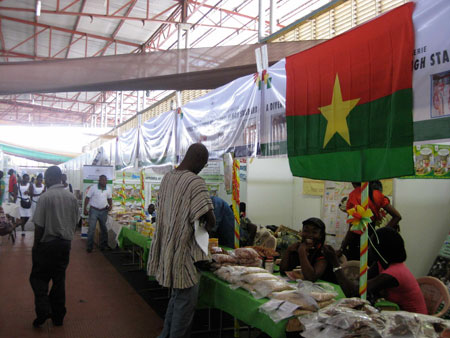
    This week at the 2nd National Farm and Agric Show in Accra (FAGRO) the suggestion that some parts of Africa might be turning the corner seems at least conceivable. At the show farmers, associations of farmers and fisherman, agribusinesses from all sectors, and NGO and governmental agricultural development organizations have come together to share Ideas, showcase and promote agriculture products and learn about improved modern and innovative methods of farming.

    Farmers at the World Food Day ceremonies and the farm and agric show are confident they are up to the task. A placard carried by a farmer in the audience said as much – Aid Cannot Feed Us For Life. Rather fair prices and ready markets for what we also produce. Talking with farmers and processors who produce everything from nutmeg and tilapia to pineapple juice and dehydrated oyster mushrooms confirmed the prevailing sentiment that farmers are eager to access new technologies and reach new markets.

    Linking African producers to markets is not exactly a new idea. International aid and finance organizations have invested significant resources to provide technical assistance to help farmers use good agricultural practices and to shore up supply chains. ACDI/VOCA, for example, is improving Ghana’s agricultural sector by increasing competitiveness in domestic, regional and international markets through the USAID-funded Ghana Agricultural Development and Value Chain Enhancement (ADVANCE) program. Policies and programs like the USA’s African Growth and Opportunity Act (AGOA) offer incentives for Ghana and other African countries to continue their efforts to open their economies and build free markets.

    Significant challenges remain of course if Ghana and other African countries are going to truly turn the corner on combating hunger and malnutrition at home while penetrating new markets on the continent and elsewhere on the globe.

    Philip Abayori, Chairman of the FAGRO Advisory Board, explains that irrigation systems are vastly underutilized for production while post-harvest storage and distribution systems are entirely inadequate. So much that, in some cases, up to 40 percent of the harvest is lost to spoilage.

    At the other end of the market, particularly in foreign markets, there is a lack of information and the necessary infrastructure according to John Dziwurnu, National Secretary for the Ghana National Association of Farmers and Fishermen. Producers need to know what consumers want before they can grow to their requirements; then they must be able to ship them to points of distribution where adequate storage and quality control is in place that will enable products to reach consumers in top condition.

    Find out more about Delore’s and Colin Clark’s visit to Ghana at the AdFarm Blog.

    Delore Zimmerman is publisher of NewGeography.com and President of Praxis Strategy Group.

  • NG Publisher in Fargo Forum Regarding FM Economy

    “What we find in the Fargo-Moorhead economy, with very few exceptions, is that a lot of things are growing and they are growing very substantially. Weʼre firing on all eight cylinders.
    The investments being made in science and technology in Fargo-Moorhead are having a definite impact. Our strategy is right, and the world is our market.”

  • Bill Gates is Right On – We Can Feed a Growing, Hungry World

    The world’s richest man recently sent a shockwave through the world food community by calling for another green revolution built upon n sustainability paired with genetic modification. Gates, one of the preeminent global philanthropists, made the case for empowering Africa’s small landholder farmers to be more productive in drought-ridden and other harsh environments.

    “Poor farmers are not a problem to be solved; they are the solution—the best answer for a world that is fighting hunger and poverty, and trying to feed a growing population,” Gates said.

    Next week in Ghana the first National Farm and Agriculture Show (FAGRO) will be held to take steps that will add value to agriculture and move it from it peasant stage to a commercial stage. According to the Coordinator of FAGRO ’09, Ms. Alberta Nana Akyaa Akosa , “agriculture is a highly ignored discipline and this is not good for the growth of the economy. A lot of corporate institutions do not place high priority on Agriculture and we at FAGRO aim to bring a new revolution in the Agriculture sector. This revolution will increase Private Partnership Approach; where Agriculture will not be politically but privately driven; a revolution where most of our young ones will come out of school and yearn to go into Agriculture” she noted. “It is the only way we can free ourselves from the high import rate of all consumables”, she added.

    During this Thanksgiving holiday we should be mindful that meeting the food needs of a growing, global population – estimated to be around 9 billion by 2050 – will require harnessing the tremendous productive power of North American agriculture, as well as in producing countries in Oceania and Europe, as well as improving the ability of small farmers around the world to produce more for indigenous and export markets alike.

    Precision agriculture can be used to scale up sustainable agricultural practices, reducing energy usage and other environmental ill effects often associated with large-scale production agriculture. Providing small farmers with access to agricultural technologies adaptable to local circumstances and market access should be given highest priority.

    Bill Gates knows this. So do developing world visionaries like Alberta Nana Akyaa Akosa.

  • Woodstock Generation Going Up the Country

    They might not have known it but Canned Heat’s classic Going Up the Country at the now 40 year-old festival was prognostic – at least in terms of where the Woodstock generation would be moving in the 2010s. John Cromartie and Peter Nelson’s recently released USDA report – Baby Boom Migration and Its Impact on Rural America – says that the baby boomers have already shown more affinity for moving to rural and small town destinations than older or younger cohorts. As many boomers end child-rearing duties, enter peak employment earnings and ponder retirement options they are now poised to significantly increase the population of 55-75 year olds in rural and small town America through 2020, with major social and economic implications for their chosen locations.

    Between 2010 and 2020 boomers will make more than 200 million residential moves, most being within or between metro regions, where 80 percent of this cohort now reside. However, net migration to core metro counties is projected to decline by 643,000 during the 2010s, a dramatic shift from a population gain of 979,000 during the 90s. In the countryside the population of 55-75 year olds will increase two-thirds, from 8.6 million to 14.2 million between 2000 and 2020.

    The big winners of course are those rural places with high levels of natural amenities and affordable housing that are already popular as second-home destinations. For these areas the economic future looks good as a potential influx of spending power and seasoned, footloose talent boosts development prospects.

  • Here Come Wall Street’s Carbon Trading Wizards?

    If you think that Wall Street’s vapor traders helped house the nation’s people then you are probably eagerly looking forward to how they will keep our environment clean. Under current “free-market” cap and trade proposals the same people who brought you the housing bubble and have contributed to wild swings in energy prices are eagerly anticipating their next vaporous bonanza. Senator Byron Dorgan of North Dakota, one of the few elected officials vigilant enough years ago to foresee the effects of financial deregulation, believes there is a better way. And his proposed solutions will reduce carbon emissions without leaving the future our environment in the hands of speculators – wizards though they may be. Let’s hope, as The Who was once proclaimed, we won’t get fooled again.