Author: Delore Zimmerman

  • Entrepreneurs Overlooked in Recovery Plans

    As most recently spelled out in The Economist , one of America’s most potent advantages – even in the current economic crisis – lies in its entrepreneurialism. America’s entrepreneurs are the proverbial wellspring of innovation and creators of most of the country’s new economic opportunities. Entrepreneurs, or global heroes as The Economist calls them, are not only important here in this country but are the best hope for creating the innovations that will get sufficient traction to resuscitate the world economy.

    Year in and year out Small Business Administration data confirm that small businesses drive employment. Firms with fewer than 500 employees account for most, if not all, net new jobs while large firms with 500 or more employees exhibit a net loss of jobs. About 99 percent of all businesses are small businesses.

    In that case one would expect that government would be doing more to encourage individuals to start businesses and create jobs, which is ultimately the long-term solution for the country’s economic woes. Not so says a recent study by the Kauffman FoundationEntrepreneurship and Economic Recovery: America’s views on the best ways to stimulate growth.

    The key findings of the report include the following:

    • By a margin of three to one (63 percent to 22 percent) Americans favor business creation policies as opposed to government creating new public and private sector jobs. In fact, 79 percent of respondents say entrepreneurs are critically important to job creation, ranking higher than big business, scientists, and government.
    • Only 21 percent of all survey respondents say that the stimulus package supports entrepreneurial activity and 33 percent believe it will retard entrepreneurship.
    • While 78 percent of survey respondents say innovation is important to the health of our economy, only 3 percent say they believe the stimulus package will encourage innovation.
    • Americans think the government does little to encourage entrepreneurship, despite its importance; 72 percent of respondents say the government should do more to encourage individuals to start businesses. Almost half of respondents think the laws in America make it more difficult to start a business.

    So even now, entrepreneurship is widely recognized as more important than the stimulus package in creating long-term economic stability. Yet, Americans doubt that the stimulus package will spur the entrepreneurship that they hold as so important.

    Americans Want Small Business Innovation
    If entrepreneurship and innovation are the keys to revitalizing our economy, how can the federal government spur this on without the delay involved in creating a new bureaucracy? Is there a proven mechanism in place for evaluating, vetting and administering research funds that can be used to address some of our nation’s most pressing challenges related to the environment, a dwindling industrial base, our defense capability, or the health of our nation?

    Of course there is, and it is somehow – amazingly – overlooked. It’s called the Small Business Innovation Research (SBIR) Program, an existing highly competitive program that funds the most promising scientific and engineering ideas from the nation’s small, high-tech, innovative businesses. It’s so competitive that some, if not most, agencies only fund 1 out of 9 Phase 1 proposals.

    Eleven federal departments now participate in the SBIR program; five departments participate in the companion Small Business Technology Transfer (STTR) program, which requires partnerships with universities to harness the intellectual capital of our universities and the market capabilities of small business. Altogether the SBIR/STTR programs award a little over $2 billion each year to small high-tech businesses.

    Since its inception in the late 70s and early 80s the program has awarded $26 billion to over 80,000 Phase 1 projects and about 31,000 Phase 2 projects, resulting in small businesses filing 67,600 patents and attracting over $41 billion in venture capital. Over 650 SBIR companies have gone public. Increasingly, large firms and mid-sized firms have entered into various forms of collaborative relationships with SBIR awardees to commercialize their technologies.

    Despite having a rigorous independent scientific and commercialization review process in place, and despite its record of success, the program now languishes with little support in either Congress or the White House.

    Now let me admit that I’ve been actively involved in the SBIR program since 1992 – now having served as an eight-time principal investigator for Phase 1 and Phase 2 projects. Our company’s innovations are in community-based solutions for technology-based economic development, related to capital investment, trade and technology linkages and infrastructure investment. Our company is a 1997 recipient of the Tibbetts Award, named after the National Science Foundation’s Roland Tibbetts, awarded for success in the program and for the pursuit of science-based solutions to our nations challenges and opportunities.

    I’ve also been an advocate for sustaining and building the program along with numerous colleagues in other small technology businesses and representatives of government from the technology-based economic development community. I’ve made this personal commitment because the program makes a significant difference in the opportunities that are available to small business and because the program works in creating new economic opportunities based on science, engineering and technology.

    Instead of watching the SBIR program evaporate we should be doubling if not tripling our investment. At a minimum a $5 billion SBIR program should be put in place. It will get us much more in growth than the Treasury bailouts of the banks, or General Motors. It represents both what America wants – Small Business Innovation – and needs in these times of economic stress.

    Delore Zimmerman is president and CEO of Praxis Strategy Group and publisher of Newgeography.com
  • Big Movers – Up and Down the 2009 Best Cities Rankings

    In a year when modest – if not negligible – growth could nudge a city toward the top of the Best Cities for Jobs rankings you would suspect there to be little opportunity for big leaps up the scale. On the other hand, one could easily expect that there would be some places whose economic fortunes would resemble a vertigo-inducing fall.

    A look at the 2009 rankings confirms that there are many cities whose job-creating engines have sputtered.

    Among 336 cities in the rankings 46 cities fell more than 100 places compared to their position in 2008. Below are seven places that took the biggest fall and plummeted more than 200 places compared to 2008.

    Seven Falling Stars: Ranking Fell More than 200 Places 2008-2009
    City 2008 2009 Rank Change
    Port St. Lucie, FL 88 290 -202
    Pensacola-Ferry Pass-Brent, FL 98 302 -204
    Reno-Sparks, NV 104 314 -210
    Myrtle Beach-North Myrtle Beach-Conway, SC 10 230 -220
    Prescott, AZ 26 252 -226
    Winchester, VA-WV 73 299 -226
    Yuma, AZ 33 266 -233


    The Big Downstroke
    Yuma, Arizona’s precipitous decline of 233 places is partly the result of its once envious position among the top ten percent of cities in 2008. It appears they came late to the economic wake that hit some towns with the collapse of the housing bubble in Arizona, Florida and Nevada as early as 2007 . In many communities in these states 2008 reflected things getting worse as commercial and industrial construction activity also dropped off.

    The good news for Yuma, according to Paul Shedal of Yumastats.com is that the “biggest economic pillars,” agriculture and government, have remained relatively unscathed by the recession providing a fallback point that other markets don’t have. This means that our worst case scenario for recession “harm” would be returning to our pre-boom level of economic sustainability rather than some depression abyss.”

    Another falling star, Winchester, Virginia, fell 226 places in the rankings, experiencing what some in northern Virginia have described as a dramatic turnaround. Manufacturing in this part of the Northern Shenandoah Valley is linked to housing and vehicles, two industries hard hit lately. American Woodmark, the third-largest kitchen and cabinetmaker in the U.S. scaled back production as sales to homebuilders continue to fall. The services sector, once a bright spot for the region, has been shedding jobs in the midst of the recession. And major retailers like Linens N’ Things and Circuit City recently closed.

    One bright spot in the Winchester area’s economy is the increase of jobs in the federal government sector, an advantage of its 75 mile proximity to the nation’s capitol. In 2008, the federal government added 400 jobs to the local economy at the Federal Emergency Management Agency offices in Stephenson and the FBI training and recruitment center in Winchester.

    Rising Stars
    Even in a troubled economy one expects that some places will thrive simply through determination and bold leadership moves, the foresight to have done the right things, or the luck of the draw. Everyone shares a hopeful optimism that a meteoric rise can offer a glimpse of things to come and perhaps offer a roadmap to a more prosperous future.

    Rising Stars: Top Five Rankings Climbers 2008-2009
    City 2008 2009 Rank Change
    Lafayette, IN 287 85 202
    Champaign-Urbana, IL 267 83 184
    Sioux City, IA-NE.-SD 253 80 173
    Lubbock, TX 242 74 168
    Wheeling, WV-OH 305 138 167


    This year’s rising star is without doubt Lafayette, Indiana with an astounding – and surprising given its Midwestern location – 202-place charge up the rankings from 2008. Like three of the other top five rising stars Lafayette came from a slightly above average position in 2008 to a respectable position in the top 100. These are by no means this year’s best places but their economies are defying the pervasive decline in the national economy.

    A visit to the Lafayette Commerce website succinctly tells the tale. “Greater Lafayette wrapped up 2008 with a strong showing.” For Lafayette 2008 was a good year with new capital investments of $600 million, new employment in life sciences industries associated with the Purdue Research Park, and a second new hospital on the way as Greater Lafayette expands its regional healthcare base.

    Equally important, Lafayette, like many university and college towns, benefits from the stabilizing presence of Purdue University, the area’s largest employer, which also serves as a force creating new economic opportunities through research, development and access to an educated workforce.

    The annual report from Lafayette Commerce concludes by focusing on two key elements of their success. “In Greater Lafayette, we’re choosing not to participate in the national recession by using this opportunity for workforce development and innovation. That’s not to say we have been immune to the troubles of the national economy, but on the whole our community is growing, it’s thriving and improving every day.”

    The Impending Future of Boom and Gloom

    Science fiction author William Gibson’s famous quip that “the future is already here – it’s just not equally distributed” could have some credence in this year’s rankings –both up and down the scale.

    The fastest rising cities boast stable employers in government and universities. They are leveraging this edge to create new opportunities in manufacturing, production agriculture and advanced producer services serving diverse sectors. Growth in health care services to the mixture, until recently one of the few remaining generators of new jobs, has also played a role.

    Rising stars like Lafayette have made significant investments in infrastructure and advanced infrasystems, enabling them to create jobs in higher-value, innovation-generating economic activities.

    This year’s cities that fell the furthest portend a return to pre-bubble growth patterns. As in the case of Yuma many places will refocus back on their historically strong core industries, like agriculture, and the economic activities that made them viable centers in the first place.

    For all cities the ability to innovate locally and take advantage of demonstrated areas of competence represent two key ingredients of success – for building on existing momentum or hitting the reset button for a more prosperous future.

    Delore Zimmerman is president and CEO of Praxis Strategy Group and publisher of Newgeography.com
  • Borderline Reality

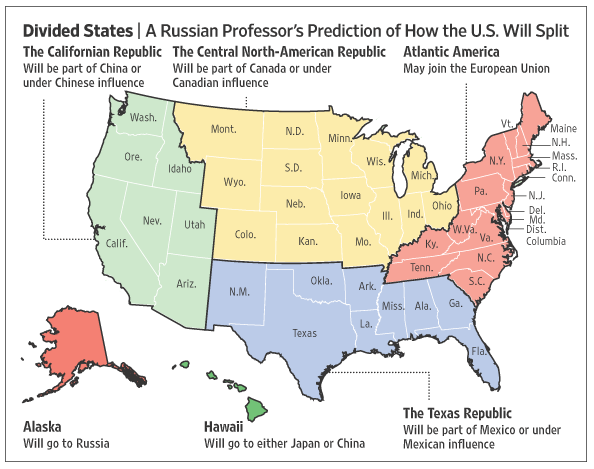
    For years, economic and social observers have taken to redrawing our borders to better define our situation and to attempt to predict the future. Maybe you thought the global financial meltdown has raised anxiety levels in the United States quite enough. But a Russian professor’s decade old prediction of national disintegration suggests much worse on the way.

    Prof. Igor Panarin, a 50-year-old former KGB analyst and a dean of the Russian Foreign Ministry’s academy for future diplomats, estimates there’s a 45-55% chance that the United States will disintegrate like the Soviet Union did sometime in 2010. Mass immigration, economic decline and moral degradation will trigger civil war, the collapse of the dollar and massive social unrest. This in turn will lead to the U.S. breaking into six blocs — with Alaska reverting to Russian control – and other foreign powers grabbing other pieces.

    Panarin’s new map of the United States puts the “Californian Republic” under China’s influence, “the Texas region” under Mexico’s. Hawaii will come under Japanese or Chinese rule, East Coast states will join the European Union, while central northern parts of the US will gradually come under Canada’s influence.

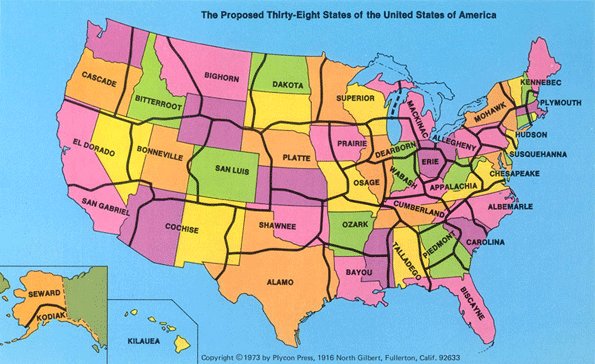
    A less sinister revision of the states that comprise the republic occurred in the 1970s when geography professor C. Etzel Pearcy proposed redrawing the borders of the US states, reducing them from 50 to 38. Pearcy’s framework casts aside the convenience of determining boundaries by using the land’s physical features, such as rivers and mountain ranges, or by the simple usage of latitude and longitude. Instead, his realignment gives high priority to contemporary population density, location of cities, lines of transportation, land relief, and size and shape of individual States.

    In the current fiscal climate some see the new 38 state map as inspired. According to Pearcy, 25% of the expenditures by states can be attributed to the fixed costs associated with the support and maintenance of state governments themselves. For at least some states this kind of savings could be very appealing right now.

    Rethinking, reimagining and then redrawing the borders of maps is by no means a new or even fruitless endeavor. That some if not many borders are where they are for seemingly meaningless or irrational reasons is obvious. Mark Stein’s How the States Got Their Shapes, for example, documents how natural features like rivers come together with the dreams and schemes of people to create today’s jigsaw puzzle of states. Gerrymandering borders for political, economic or religious reasons is both a historical and contemporary reality.

    Any economic planner or strategist worth their salt understands, of course, that borders on a map seldom represent or hold sway over how the real economy operates. Sure there are tangible differences in taxes, regulation and all the things that make up a business environment. But like water, economic activity goes where it wants and finds its own level. This has lead to an increasing amount of policy attention being given to cross-border territories of regions, zones, corridors, clusters, networks and the like.

    North America Re-Imagined
    One of the more reasoned, enduring efforts to make sense of a borderless economic and cultural landscape is Joel Garreau’s landmark work on the The Nine Nations of North America. My 27 year-old copy’s dust jacket asks the reader to forget the traditional map and consider the way North America really works because new realities of power and people are remaking the continent.
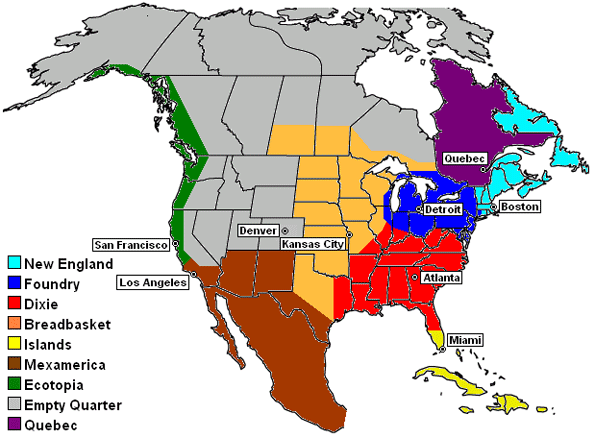
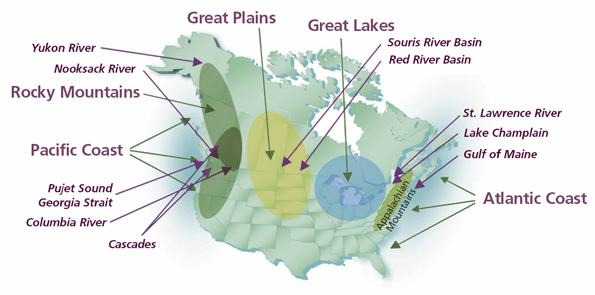
    A recent conference on USA/Canada cross-border economies in the Great Plains confirmed that Garreau’s analysis continues to influence thinking on regionalism. The longevity of his regions lies not only on their basis in actual data but also tied to the distinct “prisms” though which each nation sees the world.

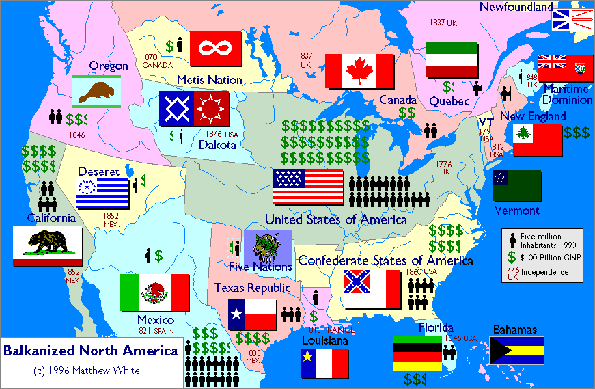
    What could have been in North America, instead of how things really are, is the subject of Matthew White’s 1997 map of a balkanized continent. Here the basic premise is that, in an alternate history beginning in 1787, the westward expansion of the Anglo-American people proceeded pretty much as it did, but the United States government just couldn’t hold the country together against separatists.

    How North America really works and how that is manifested spatially has generated growing interest of late and is reflected in the emergence of cross-border networks and organizations. The government of Canada recently issued an exhaustive report titled The Emergence of Cross-Border Regions Between Canada and the United States: Reaping the Promise and Public Value of Cross-Border Regional Relationships. Here the interest is certainly not on redrawing the borders but on recognizing and building on shared socio-cultural values and furthering relationships between businesses, first and foremost, and universities.

    Mostly a bottom-up phenomenon, these cross-border regional relationships are evidenced by the growth of both informal relationships and formal networks and a rise in cross-border regional co-operative mechanisms. From a policy standpoint the existence of cross-border regions requires new ways of thinking about development, going well beyond our parochial perspective. And this sort of thinking is important because regions – like economic fields of activity – represent the primary theatre in which most activities of international trade and economic integration actually take place.

    Map Forth
    Thematic maps that reconfigure our geography can intrigue and fascinate us. They are really, as some have said, graphic essays that portray spatial variations and interrelationships of geographical distributions. As noted by Norman Joseph William Thrower in Maps and Civilization: Cartography in Culture and Society, thematic maps use the base data of coastlines, boundaries and places, only as point of reference for the phenomenon being explained.

    Sometimes maps can inspire and motivate us by helping to more fully understand the geography of our economic and demographic challenges and opportunities. Perhaps most importantly thematic maps tell a story about places. Some describe the way things really are now while others express a vision of the future. In both cases they can be a graphical point of departure for plans and actions that help us to make the places we inhabit better places to live and work.

    Delore Zimmerman is president and CEO of and publisher of Newgeography.com

  • College Towns Get High Marks for Quality of Life

    It’s hard to find a quality of life ranking that satisfies the preferences and desires of everyone but Bizjournal’s recent ranking of mid-sized metros does highlight and affirm the presence of colleges and universities as an increasingly common and important thread in quality of life analyses.

    The study compared 124 mid-sized metros in 20 statistical categories, using the latest U.S. Census Bureau data. The highest scores went to well-rounded places with healthy economies, light traffic, moderate costs of living, impressive housing stocks and strong educational systems.

    Mid-size places of 100,000 to 1 million residents have experienced strong growth since 2000, exhibiting some of the strongest domestic migration rates among all metropolitan areas regardless of size.

  • Infrasystems Build 21st Century Economies

    Infrastructure investment has been a key driver of economic development throughout American history. In our country’s earliest days, the building of canals and turnpikes, followed by construction of railroads, greatly catalyzed expansion and development. Later, investment in electricity and telephone networks facilitated the development of vast expanses of the American landscape. More recently, the national interstate highway system and now the continuing build-out of broadband telecommunications networks have democratized the geography of business endeavors that were once confined to large metropolitan centers.

    Highways, airports, harbors, utility distribution systems, railways, water and sewer systems, and communications networks remain critical elements in economic development. But in today’s globally competitive, net-centric economy a great advantage will accrue to regions and industries that develop sophisticated “infrasystems” including such innovation infrastructure such as university and lab facilities, technology and training centers, export processing facilities, and research parks.

    These infrasystems – integrating facilities, technology and advanced socio-technical capabilities – have emerged as key drivers of innovation and the locus of future higher-value industries and higher-paying jobs.

    Infrasystems differ by region. For some communities they can be constructed around a key asset such as a local hospital, equipped with medical technology and operated by a highly skilled staff of health care professionals. For a place like Wenatchee, Washington where Internet giant Yahoo decided to locate a data center, the key infrasystems asset lay in a highly aggressive economic development community and low cost, clean energy.

    Wenatchee represents a classic success story for an infrasystems approach. They took many of the right steps including a $12 million investment by the Port of Chelan County and others in the Confluence Technology Center, a state‐of‐the art facility built specifically to attract information technology companies to the area. Another factor in this success is $50 million investment by the Chelan County Public Utility District (PUD) in laying fiber‐optic cable to homes and businesses.

    If our infrastructure policy and financing debate is going to center around miles of paved road, number of bridges or even the number of construction jobs – certainly all worthy objectives – we could still miss the key target of creating long-term employment and making our country, and regions, more competitive. Advanced infrasystems represent the cutting edge economic tool of the 21st Century.

  • American Elections Inspire Interest in Ghana

    There’s another presidential election just around the corner here in Ghana. Current President John Kufuor is stepping down after eight years in office that has seen the gold- and cocoa-exporting West African country expand its economy and solidify its democratic credentials. Another economic stride forward is expected when Ghana begins to pump oil in 2010 or 2011.

    Many people I’ve talked to expect the ruling New Patriotic Party (NPP) to keep a hold on the presidency here in Ghana. The street signs and billboards of NPP Presidential Candidate Nana Akufo Addo appear to significantly outnumber those of National Democratic Congress (NDC) opposition candidate Professor Atta Mills. But the election in Ghana is not the only presidential race that people here are thinking of and talking about in the city and villages.

    Accra, Aburi and Akropong are about as far away from the election day swing states in America as you can get. But America’s election is more than just another news story on the BBC. Crawling and darting through the hectic traffic of the capital city of Accra one catches an occasional glimpse of an Obama bumper sticker. Traveling with my Ghanaian hosts and meeting with people at restaurants and bars talk about the American election quickly turns to questions about the prospects of Barack Obama.

    It becomes readily apparent who is the favored choice between Obama and McCain. People react favorably and with big smiles when I tell them that Obama is leading in the polls. They ask me a second, maybe a third time if I think he will really win. At times some will repeat his name following the conversation – as some kind of hopeful confirmation.

    The interest in the US election goes beyond the Obama candidacy; this is one place where America’s status has not plummeted . Relations between the two countries are at an all-time high, with President Kufuor meeting with President Bush at least five times in the last three years. A visit by President Bush to the capital city of Accra in February of 2008 created widespread excitement, pride and goodwill as the two presidents talked about development issues, the fight against HIV/AIDS, the Africa Union, regional security, and Millennium Development Goals, humanitarian issues.

    The prospects of more international trade and investment for Ghana are certainly part of this equation. A 2007 Pew Global poll shows that, all things considered, people in 47 countries consistently endorse international trade. Favorable views are especially common in sub-Saharan Africa. In all 10 African countries included in the survey, over 80 percent said trade was having a positive impact. My conversations with businessmen and traditional leaders confirm that more trade and development cooperation with the United States is eagerly anticipated.

    Lastly, but certainly as important, the interest in the American election is a consequence of the many personal and family ties that bind Ghanaians to the United States. In conversations over the course of several days I’ve met people who have lived in the Bronx, are proud Kansas Jayhawks, or have spent time in Seattle, Atlanta and Washington DC and the suburbs of northern Virginia. Others have told me of sisters, brothers, sons and daughters who now living throughout the United States.

    No matter the eventual outcome of the election – in the US or Ghana – it is clear that the relationship between the two democracies will and should continue to flourish. Ghana, as much of Africa, faces many development challenges and there will continue to be many opportunities for the US to work together with Ghanaian businesses and leaders in continuing to take small steps and big strides forward.

    Delore Zimmerman is Publisher of NewGeography.com and President of Praxis Strategy Group, a company that works to improve the futures of communities and regions.

  • Resources and Resourcefulness – Welcome to The Real Economy

    By Delore Zimmerman

    The orchard-laden foothills of North Central Washington’s Wenatchee Valley are resplendent at this time of year. The apple and pear harvest is in full swing. The warm golden hues, the crisp mountain air and the bustle of trucks carrying produce to markets near and far provide a stark and welcome contrast to the daily barrage of bad news about the downward spiral of the nation’s financial markets.

    In places like New York, Chicago and San Francisco we can see the result of the demise of once-vaunted vapor traders. They created nothing but debts and are leaving whole economies in shambles.

    But in the Wenatchee Valley one can clearly see the fruits – both tangible and figurative – of the real economy. Over the course of almost ten years a determined coalition of community and business leaders has been working hard and working together to build an economy of substance and promise. The results of their efforts include a picturesque and vital downtown, a thriving and growing fruit and wine industry, a riverfront soon to be animated with housing and community recreation facilities, and a Yahoo data service center.

    These diverse elements make for an economy whose benefits are substantial and meaningful for the people of that region. The City of Wenatchee and the Port of Chelan County are the driving forces behind these initiatives. But the Wenatchee Valley’s success also can be traced directly to the investments and commitment of numerous private and government partners from within the region and from the outside. The Chelan County Public Utility District, for example, operates three hydro projects that deliver clean, renewable, low-cost energy to local residents and to other utilities that serve 7 million residents of the Pacific Northwest. The PUD operates a utility system that now includes local water, wastewater and wholesale fiber-optic services in addition to electricity.

    To capitalize further on its hydro power resources leaders in the Valley are aggressively pursuing an Advanced Vehicle Innovations (AVI) initiative. The AVI Consortium was conceived by the Port of Chelan County in 2005 to establish North Central Washington as a catalyst and center for development, demonstration, and deployment of flex-fuel plug-in hybrid electric vehicles. These are vehicles propelled by a combination of electricity-from-the-grid and bio-fuels (i.e., bio-diesel, ethanol). Both of these energy resources are in plentiful supply in the region.

    So here’s a lesson for our nation’s next stab at building a prosperous national economy. Put the money in the hands of those who can harness local and regional resources and make something useful out of them. It can be fruit, a manufactured product, or a service like data processing. The result is a community that, although not immune to the Wall Street tsunami, retains tangible assets that will survive the current storm.

    This real economy is working right now in the Wenatchee Valley. It also exists in many other communities and regions throughout the nation, from the Dakota plains to the energy corridor around Houston, and the growing industrial districts of the Southeast. These places represent the bright face of America’s future economy. If only they were taken more seriously by those – our nation’s leaders and so-called financial wizards – who are now driving us towards an era of darker expectations.

    Delore Zimmerman is President of Praxis Strategy Group and Publisher of NewGeography.com

  • Heartland Infrastructure Investment Key to the Nation’s Growth

    By Delore Zimmerman and Matthew Leiphon

    Infrastructure investment in America is poised to jump to the front of the policy agenda over the next few years. With the election of the next President, new priorities and objectives are sure to be set on several key issues, including national infrastructure investment. Some of this will be addressed in a major new Congressional transportation funding that will include a major push for all kinds of infrastructure.

    Infrastructure is one of the fundamental building blocks of economic opportunity, something increasingly recognized by pundits as well as political leaders in both parties. At NewGeography.com we hope to expand the discussion about infrastructure policy by examining its role in our communities, and exploring innovative new funding options for its provision.

    We have already looked at the history of infrastructure investment by focusing on the accomplishments of the New Deal. In the next few weeks we will examine current and future trends in infrastructure investment, both here and around the globe, and the fundamental role that infrastructure plays in promoting economic growth and driving innovation.

    Unlike earlier periods of infrastructure expansion, which were often uniformly national or regional in scope, today’s infrastructure needs related to economic development are often closely tied to the specific circumstances, resources, capabilities, and aspirations of the local economy. And, because federal resources alone will most certainly be unable to meet skyrocketing needs, local and private resources be mobilized to the greatest extent possible.

    One major initiative we are developing deals with the role of infrastructure in America’s Heartland, an often-overlooked, perhaps insufficiently understood part of our country’s economic landscape. Today’s Heartland is made up of thousands of rural small towns and hundreds of second and third tier cities scattered across America. They have deep roots in agriculture, forestry, mining or fishing but many have made a steady and successful diversification transition to an economy that now includes strong, globally competitive manufacturing, energy or service industries.

    Heartland communities outside the major metropolitan areas possess many underutilized assets. These include relatively low housing costs and a good business climate, quality schools, a reasonably educated and productive workforce, and available land and other resources for expansion.

    More recently the resurgence of the Heartland can be traced to strong performance in traditional pillars of small town and rural economies ‐‐ food and energy. But as history shows, resource-based markets are often subject to the whims of global cycles that can rise and fall with little warning. The Financial Times recently noted the biggest drop in commodity prices in over 25 years, although from record highs. But the drop does point to the volatility of these markets and the risk of over-reliance on high prices in crops and livestock to keep the Heartland economies robust and growing.

    To avoid a return to what may be seen as the “commodity trap”, there needs to be a commitment to infrastructure that could help grow other sectors of the economy as well as best leverage the commodity-based economy. This includes standard infrastructure such as highways, airports, harbors, utility distribution systems, railways, water and sewer systems, and communications networks. New facilities to distribute energy resources to the rest of the country—including pipelines to supply the water necessary to propel both energy production and manufacturing—will also be needed.

    But we also see the need to pay attention to specialized infrastructure such as university and lab facilities, technology and training centers, multi-modal shipping facilities, and research parks. These infrasystems – integrated fusions of facilities, technology and advanced socio-technical capabilities – have emerged as key drivers of innovation and the locus of future higher-value industries and higher-paying jobs.

    Federal resources will probably not be available meet these needs, as a 2006 GAO concluded For that reason, here and elsewhere around the world, cash-strapped governments are viewing private investment as an increasingly important piece of the infrastructure investment puzzle. Concurrently, banks, pension funds and other private investors are considering infrastructure as a new, long-term asset class that offers a combination of hard assets and visible long-term earning streams.

    This confluence of circumstances has given rise to a new set of private infrastructure funds that have attracted billions of dollars and Euros from individual and institutional investors alike, beyond traditional equity investment, public utility bond issues and into outright privatization of assets.

    The key question is will the new private infrastructure investment vehicles will find their way to the Heartland or remain concentrated in the large metro areas like their venture capital counterparts. Communities and second and third tier cities are, after all, often financially stressed because of a limited tax base, the high costs associated with size and scale, and difficulties adjusting expediently to population growth or decline.

    A possible solution lies in creating a Heartland Infrastructure Investment Bank. This institution would focus solely on infrasystem investments that would create higher-value opportunities in science and technology, manufacturing, energy and advanced services in smaller commuters. The Bank is to serve as a lead or secondary lender on projects of economic significance in the American Heartland and is intended to leverage considerable co-investment from the private and public sectors.

    We first developed the concept of a development bank while working on a project for the Washington, DC-based New America Foundation. Now we are looking for practical advice from potential investors, communities and policy makers. Please help us build a better future for the American heartland.

    Delore Zimmerman is President of Praxis Strategy Group and publisher of NewGeography.com Matthew Leiphon is a Research Analysis at Praxis Strategy Group

  • New Deal Investments Created Enduring, Livable Communities

    Growing appeals for more public infrastructure investment make two critical claims: that this would help stimulate the economy in the short run while making our country more productive over the long run. Unlike tax rebates and other short-term stimulus, a major infrastructure investment program can have powerful effects on community life beyond boosting spending at the local Wal-Mart.

    I thought about this recently when I visited my boyhood hometown of Wishek, North Dakota. Wishek is a small, farming town of 1,200 people nestled in the gently rolling hills of the central Dakotas, about 17 miles from the South Dakota border. Its population is made up largely of people who trace their origins to German immigrants from Russia. These people previously were recruited by Catherine the Great to farm the steppes near the Black Sea.

    Seeing a greater opportunity in North America, these Germans started to arrive in 1885 to homestead the Dakotas’ deep sod prairie – a glacial moraine of earth and rock. They were lured by the romantic thrill of developing a “Territorial Empire” that later became the states of North and South Dakota.

    This dream was widely realized by the 1920s but all but dried up and almost blew away during the drought-ridden thirties. That dream would have extinguished if not for the enlightened programs of the New Deal — from soil conservation to loans for farmers to the Works Progress Administration (WPA).

    Growing up in Wishek during the 50s and 60s, you rarely heard about the New Deal. Life was good, pretty much everything you might imagine small town childhood to be in Middle America. The pace of life was easy; everyone knew everyone and almost everything about anyone. The fortunes of the community rose and fell with farm prices, sometimes fluctuating wildly from year to year. Kids roamed freely on foot and in cheaply fueled cars and there were ample opportunities to participate in almost every facet of community life. With a k-12 school population of about 500 to 600, any child or young person who wanted to could play some kind of role in sports, arts and music, or church related activities.

    Unknown to me — and not widely discussed by the 1960s — was how many of the community’s best and most used facilities were constructed by the WPA. During the drought years of the mid-‘30s, the city park was enlarged and developed with a children’s playground, clay-surfaced tennis courts and a light skating rink paid for by WPA. Later a $6,000 bond issue was floated to build a pool that was designed by WPA engineers and is still in use today. Then in 1942 a new auditorium — a truly landmark building for the community — was completed for use by the school district. The auditorium continues to be used today as a civic center for community and family events including Wishek’s premier regional event the annual Sauerkraut Days.

    This investment strategy in community infrastructure was played out across North Dakota. Elwyn B. Robinson, in his classic “History of North Dakota,” recounts the massive investment in North Dakota:

    “In North Dakota the W.P.A. alone, between July 1, 1935 and June 30, 1942, built 20,373 miles of highways and streets, 721 new bridges and railroads, 166 miles of sidewalks, 15,012 culverts, 503 new public buildings, 61 additions to public buildings, 680 outdoor recreation facilities, 809 water wells, 2 irrigation projects, 39 sewage treatment plants and 9 water treatment plants. It reconstructed 1,002 bridges and viaducts, 2,180 public buildings and 1,721 culverts.”

    To be sure, today is not the “dirty” thirties of the Dust Bowl. It is also far different from the serene place of my boyhood in the 50s and 60s. Some of the old infrastructure needs maintenance while other infrastructure needs have changed significantly. A proposed wind farm just south of town, for example, has been delayed because of the lack of electric transmission capacity throughout the region. In addition, like many rural communities the major employment base is now in manufacturing and health services, pointing to the increasing and essential importance of broadband telecommunications, roads and air service that permit link places like Wishek with the national and international economy.

    Yet if we look about us, the legacy of New Deal endures to this day. It provides clear evidence of the impact that infrastructure investment can make on even the smallest of communities. Much of the current discussions about infrastructure investment too often focus on the giant projects and national implications. However, the case for a renewed investment agenda can be made most persuasively by pointing out what such investments have done for local communities — city or small town — in the past. And what they might have failed to become if there had never been a New Deal.

    Delore Zimmerman is CEO of Praxis Strategy Group and Publisher of www.newgeography.com.

  • Why Small Cities Rock

    Forget New York and San Francisco. With beautiful scenery, skilled workers, and affordable housing, smaller cities are luring companies in droves.

    They may not make a big splash nationally, but small metro areas continue to dominate the top ranks of Inc.com’s Best Cities rankings. This year, for example, 18 of the top 25 cities are small metros.

    We decided to take a look at what makes these places tick by focusing on one of them. St. George, Utah, has a lock on first or second place for the third year in a row. St. George is the bustling population and commercial center of Utah’s Dixie, a nickname given to the area when Brigham Young persuaded Mormon pioneers to grow cotton and wine grapes and harvest silk for export to the Civil War-torn northern states.

    The cotton plants, grapevines and mulberry bushes largely are gone, but the area overall is thriving. Nestled near Zion and Bryce National Parks, St. George has been attracting visitors and retirees for decades. But increasingly, the new houses lining the red-bluffed valleys are not occupied by those at the end of their productive lives; they are being snatched up by younger people and families anxious to take advantage of economic opportunities in a lovely setting. The population has doubled every decade in the last three.

    But it’s not just scenery that attracts. This is a community with a strong sense of pride and connection with its past. And unlike many attractive communities, this one still wants to grow — and has done so by appealing to companies from giant Wal-Mart (which has a distribution center here) and Skywest to entrepreneurial firms who are filling the spacious, orderly industrial parks in the region.

    St. George also is taking advantage of its location. With easy access to I-15, between Salt Lake City and Las Vegas, notes Scott Hirschi, director of the Washington County Economic Development Council, it’s within a day’s semi-truck ride from almost the entire West Coast. At its current pace, Washington County is expected to grow to between 600,000 or 700,000 people by 2050.

    In some small metros, as shown by the dominance of Texas cities in the overall rankings, the resurgence is due to the fact that the pillars of the economy — food, energy, and manufacturing — are in high demand in the global economy. For others it’s the presence of a university or college, the beautiful scenery and abundance of recreation activities, the proximity to a large metro area, or the position within a multi-polar urban complex. In places like Bend, Ore., or Bellingham, Wash., a combination of factors — beautiful settings, movement of skilled workers and entrepreneurs — has come together to create a robust crucible for attracting new talent and new businesses.

    Affordability is also a critical factor. St. George is joined this year near the top of the rankings by its intermountain neighbors Salt Lake City and Provo. So, it seems that Utah’s strong and diverse job growth and low housing prices — at least compared to California — continue as a draw for people seeking more affordable communities ideal for raising families and growing businesses.

    “St. George is the last small, snow-free community as you travel east from California’s Pacific Coast,” says the town’s development director, Scott Hirschi. “And, we have no gambling here which appeals to people that are looking for a family-friendly community.”

    Delore Zimmerman is president and CEO of Praxis Strategy Group and publisher of Newgeography.com