Author: Dimitri B. Papadimitriou

  • Will Lindsay Lohan Save Greece?

    It’s September, but island beaches from the Aegeans to Zante are still buzzing in Greece. Mykonos has been the summer’s Go-To spot for superstars and supermodels; the mainland and cities are also seeing the British and Europeans coming back.

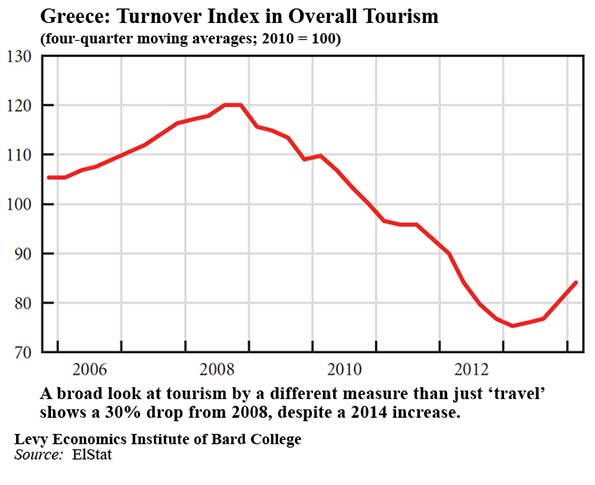
    Greece’s reemergence on the tourist circuit and the celebrity-watch sites has brought travel revenue, which accounted for 12 billion euros through April, actually above the previous peak in 2008. And, based on arrivals, the national tourism agency predicts that visitors will account for 13 billion euros this year.

    So did the appearance of Lindsay Lohan and friends in the Greek isles signify, as one newspaper put it, a template for Greece’s economic recovery?

    It didn’t. It’s even still possible that Greece’s economic troubles have yet to hit bottom — no one really knows. There is one definite, though. Even with a dramatic increase in its significant tourism industry, the dance floor under Greece’s summer parties has been resting on a breathtakingly shaky foundation.

    The debt-ridden economy has now endured 24 quarters of negative output. Young Greeks continue to flee, straining the country’s pension system.

    Extreme austerity regime policies — fiscal tightening — have resulted in the most extreme unemployment rate in Europe, 27 percent.

    Private investment remains in a free fall, with a decline of more than 10 percent over 2013. Financial institutions are barely lending. The gross total of doubtful and nonperforming loans by major banks is up from 5 percent to 25 percent since 2010.

    And, while tourists are crowing about Greece’s fantastic bargains, those low prices are partly a reflection of the salary squeeze on Greek workers. Wage deflation is at a pace never before experienced in a post-WWII era developed country, even as household taxes continue to rise.

    Those facts are just shorthand — an almost random selection from the reams of data we’ve compiled and analyzed at the Levy Economics Institute that document the continued precariousness of the economy.

    This isn’t the first time in recent months that a seemingly positive sign in Greece has been wrongly celebrated as the start of a recovery. The country’s return to the bond markets in April was cheered as the end of a four-year exile. But the exercise was a public relations play. Demand for the bonds reflected the state of excess global liquidity, not investor confidence in Greece as a good risk. (Not to mention that the bonds were implicitly guaranteed by the European Central Bank.)

    The improvement in tourism isn’t a sham like the bond market show. It’s real — but it’s such a small portion of the overall picture that it’s having only a minimal impact on the terrible employment problem, and on Greece’s balance of payments.

    Millions of tourists may keep landing at Greece’s airports. I hope they do. But don’t expect ordinary Greeks to be planning their own luxury vacations anytime soon.
    Dimitri Papadimitriou is president of the Levy Economics Institute of Bard College. The publications, conferences, workshops and congressional testimony of the institute have a wide international audience.

    Flickr photo by efilpera: Clouds over Mykonos, September 2014.
  • Manufacturing, Exports, and the R&D X-Factor

    A recent visit by President Obama to an Ohio steel mill underscored his promise to create 1 million manufacturing jobs. On the same day, Commerce Secretary Penny Pritzker announced her department’s commitment to exports, saying “Trade must become a bigger part of the DNA of our economy.”

    These two impulses — to reinvigorate manufacturing and to emphasize exports — are, or should be, joined at the hip. The U.S. needs an export strategy led by research and development, and it needs it now. A serious federal commitment to R&D would help arrest the long-term decline in manufacturing, and return America to its preeminent and competitive positions in high tech. At the same time, increasing sales of these once-key exports abroad would improve our also-declining balance of trade.

    It’s the best shot the U.S. has to energize its weak economic recovery. R&D investment in products sold in foreign markets would yield a greater contribution to economic growth than any other feasible approach today. It would raise GDP, lower unemployment, and rehabilitate production operations in ways that would reverberate worldwide.

    The Obama administration is proud of the 2012 increase of 4.4 percent in overall exports over 2011. But that rise hasn’t provided a major jolt to employment and growth rates, because our net exports — that is, exports minus imports — are languishing. Significantly, the U.S. is losing ground in the job-rich arena of exported manufactured goods with high-technology content. Once the world leader, we’ve now been surpassed by Germany.

    America’s economic health won’t be strong while its trade deficit stands close to a problematically high 3 percent of GDP (and widening). Up until the Reagan administration, we ran trade surpluses. Then, manufacturing and net exports began to shrink almost in tandem.

    Our past performance proves that we have plenty of room to grow crucial manufacturing exports, and even eliminate the trade gap. The rehabilitation should begin with a national commitment to basic research, which in turn boosts private sector technology investment. The resulting rise in GDP would be an important counterbalance to a slightly higher federal deficit.

    Just-completed Levy Economics Institute simulations measured how a change in the target of government spending could influence its effectiveness. The best outcomes came about when funds were used to stoke innovation specifically in those export-oriented industries that might yield new products or cost-saving production techniques. When a relatively small stimulus was directed towards, for example, R&D at high tech manufacturing exporters, its effects multiplied. The gains were even better than the projections for a lift to badly needed infrastructure, which was also considered.

    Economists haven’t yet pinpointed a percentage figure that reflects the added value of R&D, but there’s a strong consensus that it is significant. Despite the riskiness of each research-inspired experiment, R&D overall has proven to be a safe bet. Government-supported research tends to be pure rather than applied, but, even so, when aimed to complement manufacturing advances, small doses have a good track record.

    Recognition that R&D outlays bring quantifiable returns partly explains why the federal National Income and Product Accounts have recently been altered to conform with international standards. NIPA will now treat R&D spending as a form of fixed investment. This will be a powerful tool to help reliably gauge its aftermath.

    Private sector-based innovation has also proved to be far more likely to occur when it is catalyzed by a high level of public finance. (For amazing examples, check out this just-released Science Coalition report.) Contractors spend more once government has kicked in; productivity rises and prices drop.

    The prospect of a worldwide positive-sum game is far more realistic than the “currency wars” dynamic so often raised by the media. Overseas buyers experience lower prices and the advantages of novel products. Domestic consumers, meanwhile, enjoy higher incomes and more employment, with some of the earnings spent on imports.

    An export-oriented approach faces multiple barriers. Anemic economies across the globe could spell insufficient demand. Another challenge lies in the small absolute size of the America’s export sector.

    But the range of strategic policy options for the U.S. is limited. A rapid increase in research-based exports is the only way we see to simultaneously comply with today’s politically imposed budget restrictions and still promote strong job and GDP growth.

    Instead of stimulating tech-dependent producers, though, we’ve been allowing manufacturing to stagnate and competitiveness to erode. Public R&D spending as a percentage of GDP has dropped, and is scheduled for drastic cuts under the sequester.

    Sticking with the current plan means being caught up in weak growth and low employment for years. Jobs are being created at a snail’s pace, with falling unemployment rates largely a reflection of a shrinking workforce.

    For our R&D/export model, we posited a modest infusion of $160 billion per year — about 1 percent of GDP — until 2016. We saw unemployment fall to less than 5 percent by 2016, compared with CBO forecasts that unemployment will remain over 7 percent. Real GDP growth — instead of hovering around 3.5 percent, by CBO estimates, on the current path — gradually rose to near 5.5 percent by the end of the period.

    We need this boost. It’s urgent that we bring down joblessness and grow the economy. A change in fiscal policy biased towards R&D shows real promise as a viable way to help rescue the recovery.

    Dimitri Papadimitriou is president of the Levy Economics Institute of Bard College, a professor at Bard, and a widely published economist. His policy positions include a past vice-chairmanship of the Trade Deficit Review Commission of the U.S. Congress. This article originally appeared under the title “The U.S. Economy Needs an Exports-Led Boost,” at Reuters.Com.

    Photo by Lawrence Jackson: President Obama at the ArcelorMittal Steel factory in Cleveland, Ohio; November 2013.

  • The Die-Hard Recession Heads Off The Charts

    “By 1970, the governments of the wealthy countries began to take it for granted that they had truly discovered the secret of cornucopia. Politicians of left and right alike believed that modern economic policy was able to keep economies expanding very fast — and endlessly. That left only the congenial question of dividing up the new wealth that was being steadily generated.”

    Those words, from a Washington Post editorial more than twenty-five years ago, echoed the beliefs not only of politicians and the press, but of mainstream economics professionals resistant to the idea that growth in a market economy would ever stagnate over a protracted period.

    And some of the data did fit nicely. Through several recessions and recoveries, inflation-adjusted GDP rose almost in tandem with a line of predicted growth expectations. But in November 2007, something changed. Real GDP dropped down from what was expected by more than 11 percent, and, as this summer’s data has shown, it hasn’t returned to its pre-recession trend.

    The unusual slump has provoked a stream of commentary that attempts to define the problem, but it hardly matters whether the downturn is identified as the second dip of a ‘double-dip’ recession, a continuation of the ‘Great Recession’, a fast-moving slowdown, a slow nosedive, a long-term stall-out, or a confirmation that the economy has entered a Japanese-style ‘lost decade’. Growth during the 21st century is following a different trend line than it did in the 20th, and employment is also responding in new, different ways from earlier post-World War II recessions.

    A range of additional data also indicates that what we’re hearing is not the regular breathing of an economy as it contracts and expands. Annual growth rates and quarterly moving averages — when examined starting in the mid 1970s, as Greg Hannsgen and I did at the Levy Economics Institute — show a steady decline beginning in 2000.

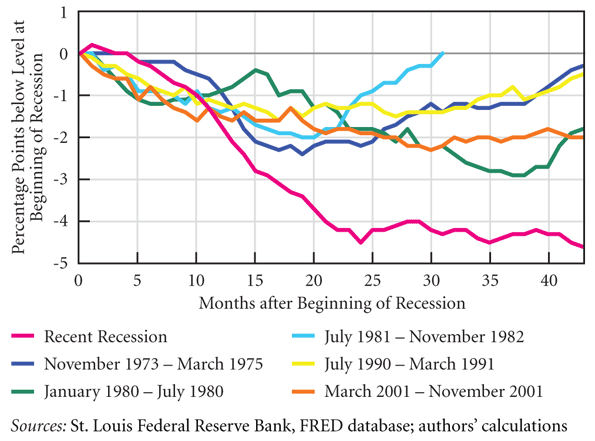
    And the employment numbers make the case yet again. Look at the graph below, with separate lines for the past six recessions. It traces employment-to-population ratios, beginning with the first month of each recession. These ratios are used to measure, among other things, how well a nation utilizes its workforce— a kind of labor drop-out rate.

    You can see at a glance that the pink line indicating the current recession — yes, that one down near the bottom of the chart — is an outlier in the group. It shows that by the 43rd month of the downturn, the ratio stood at just over 58 percent, meaning that 58 percent of the population was employed. That figure is 4.6 percent less than at the recession’s start, when more than 62 percent were working. And it means that this employment decline is steeper, deeper, and longer than in any of the previous five recessions by a long shot.

    Even in the two worst recoveries during the past forty years, this ratio never before declined by more than three percent. By the time the five recessions were this far along, employment had returned either to pre-recession levels, or to a distance from the recession’s start that was, at worst, two percent, compared to the current more than four percent.

    Together, this data makes the case that we’re in a prolonged slump that’s highly unusual, and requires action that’s far more aggressive than the usual responses. Job creation should be the government’s urgent, first priority. The nation needs to recognize just how perilous the employment disaster is — and what a marked departure this recession is from any we’ve seen in the modern era.

    Dimitri B. Papadimitriou is president of the Levy Economics Institute of Bard College, and executive vice president and Jerome Levy Professor of Economics at Bard.

    Photo by mangpages: Recession 1

  • Diagnosing New Inflation Symptoms

    It’s been more than three years since the Great Recession began, and it’s no longer debatable that the federal spending in its wake did not provoke inflation. Years of forecasts by fiscal conservatives about the result of government expenditures have proved to be wrong. After three fiscal stimulus packages, core inflation — which excludes the volatile prices of oil and commodities— remains very much in check. The core rate is the most reliable guide to future inflation, and it has not trended upward.

    Headline inflation, however, the rate that does include these two, has increased. Is the recent uptick in gas and food prices a game-changer on inflation? Does it mean that predictions of an inflation tsunami were well-founded? And what’s the best course to follow now?

    Many commodity prices have made double and triple digit gains over the past year. The changes are more than a blip — cotton futures, for example, have risen 162 percent— even if the cost of oil continues to decline. These prices are notoriously subject to rapid change for reasons that don’t reflect the structure of the U.S. economy. Factors can include Middle East politics, weather, activity in the developing world, and, most significantly today, speculative profiteering.

    Gold and other commodities have become a hot destination for players — money managers — as these markets have become the rare opportunity for high returns. In the absence of federal regulation and supervision, the low interest rates that are so crucial to business growth and to the vast majority of Americans have been allowed to feed into the permissive speculative superstructure.

    The run-up has clearly impacted the poor and the hungry in the undeveloped world. In academic and policy circles, there’s a high level confidence that commodities account for only a small share of GDP in wealthy countries, and so aren’t of concern as long as core inflation is under control. At the Levy Institute, in contrast, our research shows that even in the developed world expensive food, energy, and materials can crowd out other household purchases. Consumer budgets can be hurt even before serious headline inflation appears.

    If commodity prices were to continue to climb broadly and sharply, the Federal Reserve could face the prospect of a serious episode of cost-push inflation, similar to what we saw in the 1970s and ’80s. Fed Chairman Ben Bernanke might find himself occupying the chair of Paul Volcker in more ways than one.

    This kind of inflation is caused neither by the effects of low interest rates on the broader economy, nor by government spending. And, as with any symptom of ill health, the cause dictates the appropriate treatment. So if Bernanke’s response was to raise interest rates dramatically in the hope of abating inflation to some arbitrarily low target, it would be a risky mistake. An interest rate rise would be a serious danger to growth and job creation. Business and labor are far too fragile to deal with a double whammy from rising gas and food prices coupled with monetary policy tightening.

    A better response would be ‘watchful waiting’, a phrase seen in the December 1996 minutes of the FOMC (Federal Open Market Committee) meeting. A commodity price inflation could remain at least somewhat isolated.

    Higher commodity prices will be used as an excuse to charge that the Fed’s supposedly lax policy has unleashed an inflationary flood of cash throughout the economy. But the Fed’s so-called ‘easy money’ is parked at the Fed itself, as bank reserves, since banks are not lending. This can’t cause inflation either. Logic hasn’t stopped newly re-branded Republican presidential candidate Newt Gingrich, who recently admonished that “The Bernanke policy of printing money is setting the stage for mass inflation.”

    Those who purchase securities for long-term investment evidently disagree. Bond traders aren’t anticipating an inflationary surge. Just look at the yield spread between inflation-indexed and non-indexed Treasury securities of the same maturity. It has remained almost constant over the past year. In other words, buyers who want their returns insulated from inflation are paying only slightly more for protection than they were last year. That flatness — the unwillingness to pay a premium for inflation insurance — indicates that long-term bond buyers haven’t revised their inflation forecasts.

    Also unlikely to revise their predictions: inflation doom-drummers, even as energy prices level, and wages, another inflation indicator, are by no means jumping. Like eons of ‘the-end-is-nigh’ prognosticators, they don’t exactly have a great track record. Back in spring 2008, a frenzied Glenn Beck urged Fox viewers to “Buy that coat and shoes for next year now.” Some of his Washington cohorts are coy about inflation’s estimated time of arrival. Republican House Majority Leader Eric Cantor, for example, tells us that “fears” of “future” inflation are “hanging over the marketplace.” Others, like former Pennsylvania Senator Rick Santorum, say its already arrived (Obama brought it). The accusations continue despite a lengthy stretch of the lowest inflation rates in modern U.S. history, even with the current commodities rise.

    Paul Ryan (R-WI) has been hailed as both a truth sayer and a soothsayer on the economy. He recommends that the Federal Reserve raise interest rates now to head off inflation “before the cow is out of the barn”, ignoring the pain this would cause families and businesses. Here’s my recommendation: Don’t trust predictions about the future from those who’ve misread the present, and been very wrong in the past.

    Dimitri Papadimitriou is President of the Levy Economics Institute of Bard College, and Executive Vice President and Jerome Levy Professor of Economics at Bard College.

    Photo by Deb Collins (debs-eye): Beurs van Berlage, built by Hendrik Berlage between 1896 and 1903 as the commodities exchange in Amsterdam.

  • Mortgage Meltdown: How Underwriting Went Under

    The White House remedies for the mortgage meltdown were presented on Friday. Congress will debate the life extension, death, or rebirth of federal mortgage entities Fannie Mae and Freddie Mac during the coming weeks.

    When the noise has died down, don’t expect substantial change. But those who hope for genuine financial reform should, nonetheless, listen carefully not only to what Washington says, but to whom it says it. Will the new guidelines call on traditional home-loan bankers to make traditional loans? Or will we hear a shout-out to the investment bankers/mortgage traders who designed the mess?

    In any new financial structure for home loans, the single most important issue will be the ratio of debt to assets that the government will expect lenders to show.

    During the real estate boom, lenders were willing — and able — to provide mortgage brokers with financing for 100 percent or more of the value of a property with the expectation that real estate prices would rise. We witnessed the triumph of the trader over the banker: Profit relied on the sale or refinancing of the asset. For a mortgage originator or securitizer with no plans to hold on to the mortgage, what really matters has been the ability to place it, not the depth of the underwriting or the long-term financial prospects of the home resident.

    A traditional banker, on the other hand, might feel safe with a capital leverage ratio of twelve to one, with careful underwriting to ensure that the borrower would be able to make payments. With equity at risk, something close to that level of underwriting would be essential.

    The trader-think model virtually eliminated mortgage underwriting. What we saw instead has been succinctly described by L. Randall Wray in a Levy Institute Brief: “Property valuation by assessors who were paid to overvalue real estate, credit ratings agencies who were paid to overrate securities, accountants who were paid to ignore problems, and monoline insurers whose promises were not backed by sufficient loss reserves…” Much of the activity didn’t even appear on the balance sheets. Mortgage brokers arranged for finance, investment banks packaged the securities, and the shadow banks — the managed money — held the securities.

    The debt to assets ratios for mortgages climbed. Investment bankers consolidated their liabilities into a single financial market that could have been called the Mortgages & More Shoppe. Mortgage-backed securities were included with commercial banking, and with other financial services where acceptable capital leverage ratios are much higher than for traditional home loans. (For money managers, capital leverage ratios can be 30 to 1 and up to several hundred, with even higher unknown and unquantifiable risk exposures.)

    Income flows took a backseat. Except for the home resident, that is. Because ultimately, all of these financial instruments came to rest on the shoulders of some homeowner trying to service her mortgage out of annual income flows which boiled down to, on average, five dollars worth of debt and only one dollar of income to service it.

    “In an ideal world,” Wray added, “A lot of the debts will cancel, the homeowner will not lose her job, and the FIRE (finance, insurance, and real estate) sector can continue to force 40 percent of… profits in its direction. But that is not the world in which we live. In our little slice of the blue planet, the homeowner missed some payments, the securities issued against her mortgage got downgraded, the monoline insurers went bust, the credit default swaps went bad when AIG failed, the economy slowed, the homeowner lost her job and then her house, real estate prices collapsed, and, in spite of its best efforts to save [the system], the federal government has not yet found a way out of the morass.”

    Whatever the fate of Fannie Mae and Freddie Mac, the coming federal recommendations need to lift underwriting standards up from that morass and back onto solid ground. According to January’s Financial Crisis Inquiry Commission report, about 13 million US homes have already or will soon face foreclosure. The investment bank traders who securitized those mortgages, with a few notable exceptions, have overwhelmingly escaped such suffering. Financial reform should change that equation by demanding a traditional, appropriate ratio of assets to debts in the real estate markets.

    Dimitri B. Papadimitriou is President of The Levy Economics Institute of Bard College. He recently co-edited, with L. Randall Wray, The Elgar Companion to Hyman Minsky. He blogs at Multiplier Effect.

    Photo by Foxtongue

  • 2011: Jobs Vs The Deficit

    The roadmaps showing the way out of our 1.4 trillion dollar federal deficit almost always begin at the same starting points. During 2010, it became taken-for-granted that today’s record-setting red ink is a result of unrestrained government spending — especially stimulus spending. And the idea that the economic upturn in jobs and growth will begin with deficit reduction has become widely perceived as ‘common sense’.

    The December release of the federal debt panel’s Simpson-Bowles report crystallized a mass re-set of priorities, with politicians and pundits freely equating solutions to ‘the deficit crisis’ with economic recovery. While conservatives and liberals reacted differently to the report’s specifics, the assumption that immediate deficit reduction would be healthy and virtuous was largely accepted. The president has also pledged to follow this path.

    The media, meanwhile, geared up with a national debt counseling forum. November ended with three out of four of the lead columns in the Washington Post providing advice on the subject. US News and World Report called on the president to get busy and “name a deficit Czar”. Deficit reduction? There’s an app for that. A prominent New York Times feature titled “You Fix the Budget” included an interactive Iphone/Ipad application that urged readers to “Make your own plan and share it online”. Jobs and growth have inspired no such apps thus far.

    Are congressional free-spending ways really the problem? Counter-intuitive though it may seem, the strongest evidence indicates that the deficit is tied to many political expenditures that are mandated and locked in place, and not to any ‘spending spree’.

    Consider the sharp increase in expenditures for SNAP (the old “food stamps” program), or for unemployment benefits. While the guidelines to qualify for these benefits have stayed roughly the same, payments have ballooned — in the case of SNAP, 72 percent from 2007 to 2009, as detailed in a report from The Levy Economics Institute of Bard College. The federal government did not choose to increase this spending. And the financial threshold for receiving benefits was not lowered. But many more families slid out of the middle class and into the safety net. As the economy tanked, the recession itself automatically triggered increased federal outlays, which in turn fed the deficit.

    In other words, the system is performing as we originally intended, and hoped, that it would. Like a truck engine suddenly expected to haul a much heavier load, the federal budget is burning more gas… and by doing so, is able to continue uphill, carrying individuals, families, and businesses out of financial disaster.

    If calls to drastically reduce the deficit succeed, and federal spending is radically turned down now, the result will be comparable to cutting the engine’s fuel supply. The roll back downhill will be swift, horrific, and potentially out of control.

    For a glimpse of how deficit slashing could play out, take a look at Portugal. Already, there are signs that recent austerity measures will actually increase its government’s fiscal deficit, a consequence of falling tax revenue and rising social needs as a result of increased unemployment. Portugal’s central government lost ground in the first nine months of this year as its deficit rose by about $280 million, even as actions to restrain it were set in motion. The pursuit of yet more deflationary spending cuts and tax increases could continue the vicious cycle.

    Crisis-related spending, whether oriented toward businesses or households, has been trashed as costly. But shouldn’t it be obvious that business and household income and spending help the private sector, which needs to thrive for the economic growth we need?

    Liberal think-tanks are not alone in their view that running deficits is a logical and necessary response to a severe recession. Even David M. Walker, former CEO of the Peter G. Petersen Foundation, an anti-deficit think tank dedicated to austerity, has joined Lawrence Mishel of the Economic Policy Institute in acknowledging that the United States must address “jobs now and deficits later”; Mishel and Walker have called for two years of elevated deficits.

    And the public does not disagree, despite the Tea Party street-theater shows. In this autumn’s CBS News Poll, 54 per cent saw the Economy/Jobs as the nation’s most important problem, compared to 3 per cent for the Budget Deficit/National Debt; the CNN/ Opinion Research Corp figures were almost the same. Fox News and Bloomberg polls also showed that concerns about the economy and jobs considerably — by about 20 per cent — trumped the deficit and spending.

    Gestures to counteract deficits with measures such as the pay-freeze on federal salaries, or with anti-earmark legislation, are purely symbolic at best and, in the case of salaries, counterproductive.

    Similarly, calls for the deficit to be pegged to no more than 21 percent of Gross Domestic Product, as in the Simpson-Bowles report, or 20 percent, as suggested by Representative Mike Pence (R-Indiana), make no sense, and provoke one simple and as yet unanswered question: Why?

    We are indeed in a crisis. But the crisis is jobs, and the solution is to grow the economy. Deficit reductions would have a negative impact on both. The deficit hawks who demand chicken feed-sized cuts have yet to provide data — let alone logical arguments — that show how these cuts could lead to job creation and growth.

    The deficit should not be treated as the main problem when it is, in reality, only the product of a poorly functioning economy. There are many good reasons that a reasonable deficit reduction plan should be early on the agenda when the US economy is once again strong. But the austerity measures being floated today range from meaningless to ludicrously dangerous. There is no reason that this so-called crisis needs to be acted on while the economy is weak. In deficit reduction — as in navigating turns in the road — timing is everything.

    Photo by Premshree Pillai

    Dimitri B. Papadimitriou is President of The Levy Economics Institute of Bard College. He recently co-edited, with L. Randall Wray, The Elgar Companion to Hyman Minsky.