Author: Eric McAfee

  • Demography & Destiny: America’s Youngest Community

    The village of Kiryas Joel is a perfect illustration of how demographic differences can play out spatially. An enclave of ultra-orthodox Satmar Hasidic Jews tucked in the woods of Orange County, about 60 miles north of New York City, Kiryas Joel is an uncharacteristically high-density settlement filled with individuals whose high birth rate and dependence on federal aid often incurs the anger of the upper-middle class suburbs that surround it.

    Between a few hills in a picturesque but otherwise none-too-remarkable part of a mostly automobile-oriented suburban county of New York City, the settlement of Kiryas Joel has the distinction of being one of the fastest-growing communities in the entire country. In 1980, the Census recorded its population at around 2,080 people; by 2010, it had over 20,000. While such rates might not cause public officials in Nevada, Arizona or Idaho to bat an eyelash, in a slow-growth state like New York, this is unusual—all the more so because, prior to 1975, Kiryas Joel didn’t exist.

    The original founders were a group of Jews belonging to the Satmar Hasidic dynasty. Most lived in Brooklyn, and, like so many who fled to the suburbs at that time, the first arrivals in “KJ” were escaping what they perceived as the ills and crowds of the big city.

    The community has an Orthodox and Haredi population that surpasses virtually everywhere in the world outside of Israel. Its ethos is distinctive for its vocal opposition to Zionism: no Satmar Hasidim would ever culturally identify with Israel; the Hebrew lettering in its signs use Yiddish orthography. While the population in Williamsburg burgeoned, it was only a matter of time before the surrounding, secular neighborhoods of Brooklyn encroached on the enclave. After scouting several sites in New Jersey and Staten Island (rejected fiercely by locals), they discovered an area 60 miles north of their prior home, which at the time was still lightly populated, dirt-cheap and primarily exurban in character.

    Kiryas Joel grows largely through natural increase. It has among the highest birth rates of any municipality not just in the US, but in the developed world. In 2010, an astonishing 730 of 1000 women between ages 20 and 34 gave birth, a high figure even for many developing countries. Hasidic women marry young, usually shortly after completing the equivalent of high school. They do not practice birth control, so they then almost immediately begin to have children every year or two, resulting in a community with the nation’s lowest median age: thirteen years. It’s an extreme outlier, since no other place in the country has a median age under 20.

    The community can claim a number of distinctions, but among those for which it is the most notorious is that it is the poorest municipality with a population of over 10,000 in the entire country, with many estimates placing approximately 70 percent of the population at incomes that would qualify them as below the federal poverty line. About half of the residents receive food stamps, while one-third receive Medicaid benefits. This poverty correlates directly to the fact that virtually none of the women work full-time jobs, and a significant number of the men devote most of their lives to studying the Torah and Talmud; not even 40 percent of them have the equivalent of a high school degree, and the low levels of English proficiency make them further unemployable.

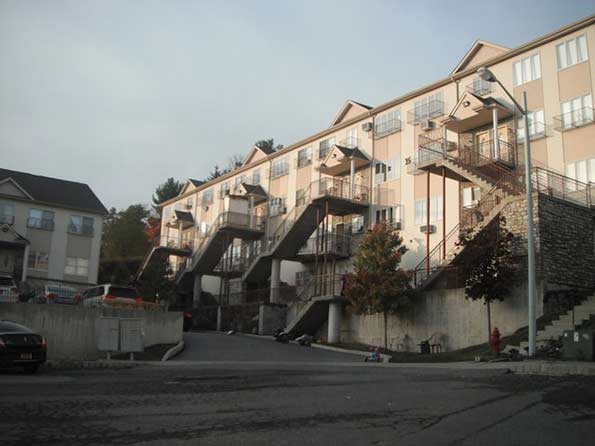
    Visually, its most prominent feature is its housing. It may not be architecturally distinctive, but the density is atypical for outer suburbs, even considering that these are outer suburbs to the nation’s largest and most densely populated city. Since the median household size is nearly six people, homes are both thickly clustered together and crowded within.
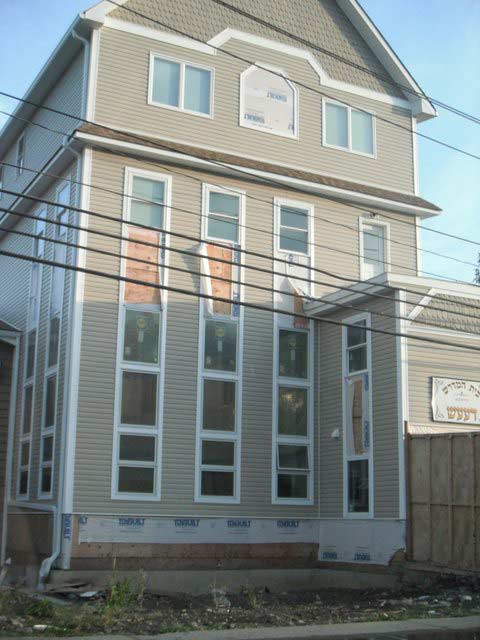
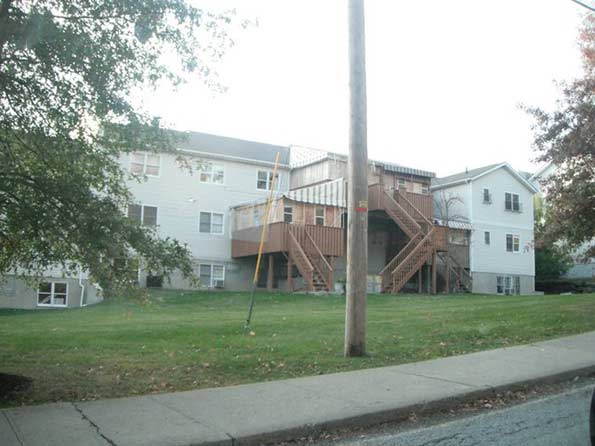

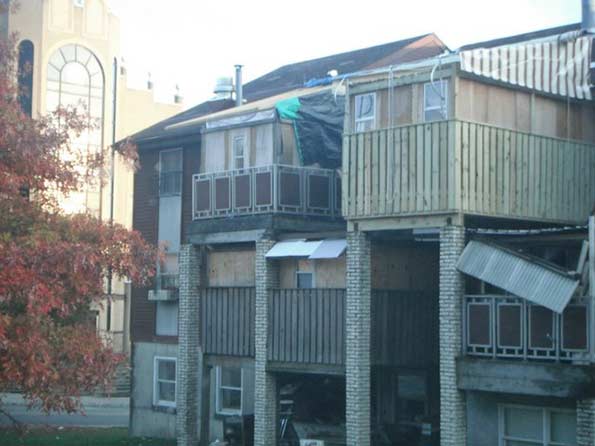
    And they’re expanding, often using construction standards that appear dubious.
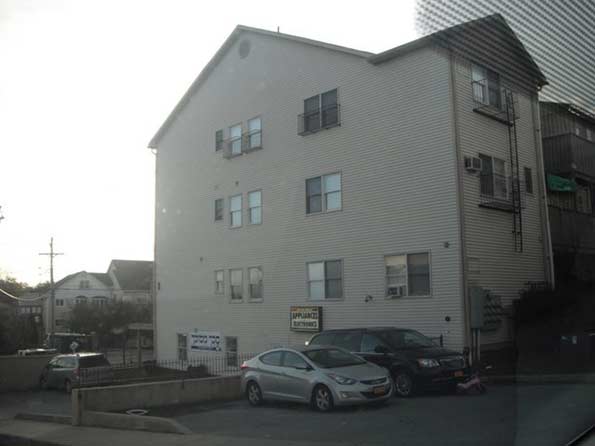


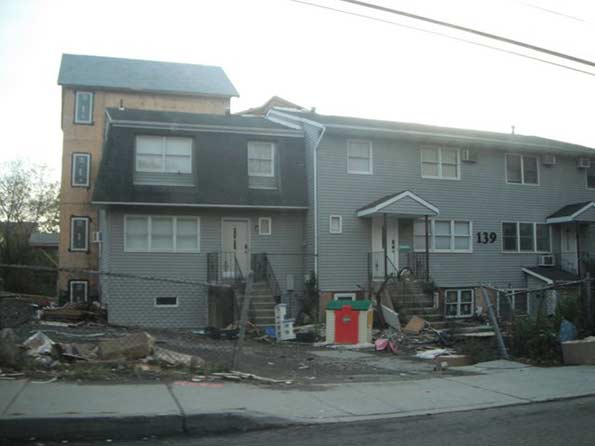
    Virtually none of the housing is single-family. Approximately 95 percent is attached, a higher rate than much of New York City, meaning yards are virtually unheard of, which explains why the streets become a play area so much of the time. And more multifamily goliaths are popping up along the forested fringe.
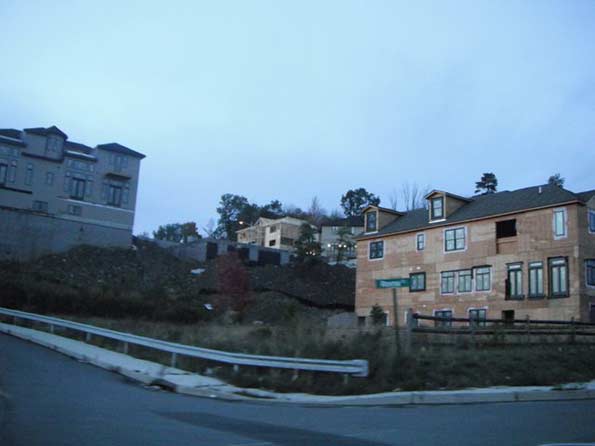
    In its earliest years, Kiryas Joel was almost exclusively residential. Those (mostly male) KJ residents who worked would often take buses for the lengthy trip back to the City. A Park-and-Ride service is still available on the village’s outskirts. But in more recent years, the community has become increasingly self-contained, with retail tucked in the street level of these large residential complexes, as well as basic services to meet other needs.

    With more than one synagogue, multiple commercial buildings, emergency response, and dedicated recreational space, it broadly occupies the goods-and-services domain one might expect of a smaller city of 20,000 inhabitants.

    Bearing in mind that Kiryas Joel is surrounded on all sides by mid-century homes on large, wooded lots, accessed only by undulating rural collector roads, it is really the most urban community around. It’s safe to say that KJ comprises the highest concentration of pedestrian activity in the entire area, at least on the Sabbath day, when its residents do not ride, and probably every other day of the week as well.

    The community bears more than a passing resemblance to other religiously inspired outliers in the United States, also characterized by fundamentalist interpretations of their sacred texts, atypically high birth rates, and an overt repudiation of certain contemporary mores. Certain Anabaptists (particularly the Amish) and the Fundamentalist Church of Jesus Christ of Latter-Day Saints come to mind. Perhaps the principles that shape the way of life of Satmar Hasidim are not as distinct as they may initially seem. Kiryas Joel isn’t the only exurban settlement of Hasidic or Haredi Jewry in metro New York. While Kiryas Joel is the largest, most of the others share its growth rate and are likely only to escalate in public visibility in the years ahead.

    Kiryas Joel embodies a collision of values written many times over. Apparently, the surrounding population in the Town of Monroe has vigorously protested its further growth because it represents suburban sprawl. The irony of such an accusation is obvious. Not only was the development pattern of the 1960s and 1970s a glorification of a decentralized, anti-urban ethos that many deride as sprawl, most recent development in Orange County comes far closer to the “sprawling” densities of Monroe than does Kiryas Joel.

    Even if Kiryas Joel is not unique, it’s still such an anomaly that it is impossible to ignore. It’s a greenfield development more tightly packed than the densest neighborhoods in many American cities. It required no market analyses to determine if a sufficient demand existed to support such high density; the demand was obvious to the rabbinical leadership. The Town of Monroe did not overtly incentivize the development of this concentrated settlement through density bonuses in order to bolster its tax base (quite the opposite). While KJ looks nothing like the Traditional Neighborhood Development (TND) planned communities that have popped up across exurbs throughout the country, it shares at least a few of their objectives: mixed uses and high densities promote the sort of walkability that an increasing number of suburbanites find appealing. And for the Satmar Hasidim, walkability is essential.

    The community remains antithetical to what most of its neighbors would define as the “American Dream” as it applies to housing—a catchphrase that by now is hackneyed, not just from overuse, but from the narrow cultural implications it evokes. Yet Kiryas Joel continues to boom in population The American Dream is diversifying exponentially, fueled by disparate, self-actualizing initiatives, and manifesting in ways that depend largely upon their location. Kiryas Joel is just one example of many that are only “bad” or “good” when compared to their counterparts, whose own goodness or badness depends just as much on subjective judgment. The escalating elasticity of the American Dream must therefore concede to another catchphrase: live and let live.

    Eric McAfee is an itinerant urban planner/emergency manager who fuses his cross county (and trans-national) travels and love of contemporary landscapes into his blog, American Dirt (http://dirtamericana.com/). A longer and slightly different version of this post originally appeared in American Dirt: Part I and Part II.

    Photos by the author.

  • Transforming Kokomo: No Need to Move Mountains

    Across the country—but particularly in the heavily industrialized Northeast and Midwest—smaller cities have confronted the grim realities of the unflattering “Rust Belt” moniker, and all of its associated characteristics, with varying degrees of success.  With an aging work force, difficulty in retaining college graduates, and a frequently decaying building stock, the challenges they face are formidable.  Cites from between 30,000 and 80,000 inhabitants typically boomed due to the exponential growth of a single industry, and, in many cases, the bulwark of that industry left the municipality nearly a half century ago, for a location (possibly international) where the cost of doing business is much cheaper. Essentially, everything the smaller Rust Belt cities had to offer is completely tradable in a globalized market; the resources that provided the town’s life blood are either depleted or are simply to expensive to cultivate further.

    Reinvention is the only condition likely to save many of these cities from persistent economic contraction, but, with an overabundance of retirees and older workers, these towns lack the collective civic will that could be expected in larger communities with more diversified economies.  An absence of young people intensifies (and, to a certain extent, justifies) the low level of civic investment in one’s own community; after all, if a resident is six months from retirement, how likely is it that he or she would support public investments intended to improve quality of life for twenty or thirty years into the future? For that matter, how likely will a population of retirees remain engaged to encourage or challenge major private sector investments as well?

    By no means am I intending to denigrate needs and ambitions of the senior population; I’m merely observing that a stagnant Rust Belt city with this demographic profile will demonstrate vastly different priorities from a city rife with young families.  While every Rust Belt city large and small must avoid obsolescence that results from the spoils of globalization, the smaller cities—which have tended to be dominated in the past by a single thriving industry—are less likely to claim alternative sectors and labor pools if their primary manufacturing lifeblood fails.  A dying city of 80,000 may not exert the same impact within a region (particularly in the densely populated Midwest and Northeast) that a city of 500,000 would, but it is far more of black eye for the state than a town of 2,000 that has lost its raison d’être.  This conclusion is obvious.  Many of these small cities must reordering of their economies comprehensively; while the state, the county, or private foundations may offer some outside help, the constituents of these cities themselves are typically the best equipped to understand how their city should evolve.  Unfortunately, many of these communities aren’t yet even aware of the need for this reinvention, let alone which avenue to pursue in order to achieve it.

    It is with no small amount of reassurance that I can assert that Kokomo, Indiana is not one of these latter cities.

    No Rust Belt complacency on display here in the City of Firsts.  Though a recently as 2008 it was on Forbes’ list of America’s Fastest Dying Towns, a recent visit shows much more evidence than I’ve seen of some comparably sized cities in the region that the civic culture is neither resting on its laurels nor wringing its hands about how much better things used to be.  In fact, one of the Indianapolis Star’s leading editorialists, Erika Smith, recently visited the city, and, after receiving a tour from the Mayor, was pleasantly surprised by how proactive it has been in implementing precisely the type of quality-of-life initiatives largely perceived as necessary to help a historically blue-collar city stave off a brain drain or descend into irrelevancy.

    I, too, recently received the Kokomo tour, followed by a meeting with Mayor Greg Goodnight, and I can also recognize some of the city’s most impressive achievements at shaking off the post-industrial malaise that saddled the city with double-digit unemployment rates as recently as a few years ago.  Since then, the city has introduced a trolley system at no charge to users; prior to this initiative, the city had had no mass transit for decades.  The Mayor pushed successfully to annex 11 square miles in the town’s periphery, therefore elevating the population by about 10,000 people.  The Mayor’s team worked to convert all one-way streets in Kokomo’s downtown to two-ways, recognizing that accommodating high-speed automobile traffic in a pedestrian-oriented environment only detracts from the appeal.  The team has restriped several miles of urban streets to incorporate bike lanes, and it has converted a segment of an abandoned rail line into a rail-with-trail path, branding it by linking it to the city’s industrial heritage. They have deflected graffiti from several bridges and buildings through an expansive and growing mural project.  They have upgraded the riverfront park with an amphitheatre and recreational path. They have introduced several sculptural installations, the most prominent of which is the KokoMantis, a giant praying mantis made entirely of repurposed metal and funded privately.  And my personal favorite: with the support of the City, the school superintendent has integrated a prestigious International Baccalaureate (IB) program to the public school system, including an international exchange program for young men from several foreign countries (a girls’ program should arrive in the next year or two) who live in a recently restored historic structure in Kokomo’s walkable downtown, attending demanding courses that bolster their chances of admittance in a coveted American university.  Most impressively, the City of Kokomo has achieved all of this without incurring any public debt in the past year.

    Obviously the individuals offering me this tour are going to make sure their Cinderella is fully dressed for the ball, and I recognize that not a small amount of the securing of certain infrastructural projects and transportation enhancement grants requires a political savvy that the current civic leadership has in abundance.  And I don’t want to rehash Ms. Smith’s article, which more than effectively chronicles this approach at a macro level.  In addition, Erika Smith recognizes, as do I, that very few of these initiatives (the IB foreign exchange program notwithstanding) are really particularly earth-shattering.  But when most other similarly sized cities in the Midwest seem to be engaged in a race to the bottom, luring new industry through generous tax breaks (often initiated at the state level), Kokomo seems to recognize that a town lacking any amenities outside of low cost of living has to compete with dozens of other cities in Ohio and Michigan and Pennsylvania, and elsewhere in Indiana, that offer the exact same brand.  Whether this investment yields a long-term return remains to be seen, but it certainly demonstrates the right gestures necessary to instill civic stewardship in a place whose decades of job loss have seriously scratched its mirror of self-examination.

    What ultimately struck me about Kokomo—which Erika Smith only touched upon—was the level of design sophistication evident in some of these civic projects.  I need only focus on a single location in the city, in which two particularly laudatory techniques are on display.  At the intersection of Markland Avenue and Main Street, just south of downtown, the Industrial Heritage Trail begins its journey southward.  Here’s a view as the trail terminates at its junction with those two streets, looking northwestward:

    Here is a view in the other direction:

    Continuing a bit further in this direction, one encounters this painted wall:

    And, pivoting slightly to the left, another mural that is still in progress:

    This photo series identifies two amenities that stand out for the astute decision-making that apparently took place during the implementation.  The Industrial Heritage Trail clearly operates a railway corridor, but it is not a rail-trail.  Unlike the more common rail-trail conversion, this Kokomo trail did not incorporate the removal of the original rail infrastructure.  The Rails to Trails Conservancy would label this approach a rail-with-trail, indicating that the trail shares the railway easement, typically separated by fencing.  Rail-trails such as the Monon Trail in metro Indianapolis are still the more common practice. However, a growing number of communities are embracing rail-with-trails, not only because they obviate the need for costly removal of rails, ties, and ballast, but they reserve the rail infrastructure for the possibility that a railroad company may reactivate the line in the future.  If the sponsors of Kokomo’s Industrial Heritage Trail had removed the infrastructure, the possibility of ever reintroducing rail along the corridor would be virtually nil.  As it stands, the only conceivable disadvantage to rail-with-trails is that, in the event a rail company reintroduces train service, its close proximity to the path may prove hazardous to bicyclists or pedestrians.  Otherwise, the decision to retain the railway not only helped to diversify options, it most likely saved a considerable amount of money.

    The other smart decision was the site selection for those murals.  The ones featured in the photos above are part of a growing mural campaign that the City of Kokomo introduced, and every one that I recall shows real foresight in the locational decisions. What makes them so good?  The murals in the photos above front a public right-of-way, minimizing if not completely precluding the chance that later development will conceal them.  I blogged a few years ago about an excellent mural in Indianapolis that showed wonderful care and craft in the entire implementation process…except where the conceivers chose to locate it.  Not only did they paint on a cheap, cinder-block building that will likely tumble down if market pressures encourage new development in the neighborhood, but the mural also faces a vacant lot which is large enough to host a new structure that would block it completely, no doubt frustrating the community and pitting them against a developer.

    Compare this to Kokomo’s murals.  Here’s one a little further south on the Industrial Heritage Trail:

    Again, it fronts the trail itself—not a chance that a developer will try to block it.  And here’s another along a bridge underpass for the recently completed trail along the Wildcat Creek:

    The original intention of the mural was to repel vandals at spot that previously suffered from it frequently; this approach has proven successful in locations across the country. But it also sits in a park along a new greenway, so it should remain in perpetuity. Granted, Indianapolis has plenty of murals along retaining walls and buildings that front the aforementioned Monon Trail.  Those, too, should survive far into the future.  But in recent years, the City of Indianapolis has encouraged countless murals on the side walls of commercial buildings—sites where a blank wall faces a parking lot, where a building once stood.  While these bare walls often scream for some ornamentation to help distract from what used to be there (another adjoining building), in many instances the parking lots will likely fall under increasing development pressure in upcoming years.  Will the locals thwart development in order to save the mural?  This remains to be seen, and I don’t want to base too much of an analysis on speculation.  But it’s hard to deny that these public art investments seem less astute than the once I witnessed in Kokomo.

    One could argue that Kokomo is merely taking advantage of the fact that it is jumping into the game relatively late; it benefits by learning from the mistakes of others.  But decisions that stand the test of time also contribute their fair share to foster civic goodwill. Taxpayers are rarely too forgiving of poorly conceived projects, and several successive blunders, no matter how small they may be, demonstrate poor accountability.  Only time will determine the return on investment, but Kokomo certainly has a leg up on many of its competing small cities,  My suspicion is, if these projects stimulate the discussion and enthusiasm for proactive leadership that they suggest (Mayor Goodnight was re-elected last year by a landslide), the citizens of Kokomo are only beginning to stoke the fire.

    This post originally appeared in American Dirt on November 16, 2012.

    Eric McAfee is an itinerant urban planner/emergency manager who fuses his cross county (and trans-national) travels and love of contemporary landscapes into his blog, American Dirt.

  • Detroit: A Chip off the Old Bulb

    Seven months after the announcement, it still seems like the largest municipal bankruptcy filing (at least up to this point) is the stuff of legend—the culminating event, after successive blunders.  The apex.  Or the nadir. No doubt those of us living here are guilty of a degree of chauvinism as we experience how it plays out firsthand, but it’s easy for anyone with even moderate media curiosity to see how much the city has hogged the headlines.  It may be for all the wrong reasons, but Detroit is prominent once again.

    Yet it was only weeks—if not days—after the declaration made international news that, in order to convey to the world the magnitude of the city’s financial woes, journalists honed in on more mundane failures—failures that, by virtue of their banality, were all the more shocking.  Locals have known about them for ages.  A portfolio of abandoned public school real estate larger than many cities’ functional school systems.  An absence of snowplows, even after heavy storms.  A stonewall of silenced civil servants, hogtied from effectively carrying out duties by daily uncertainty about the security of those same jobs.  The virtual absence of any emergency response, resulting in two-hour waits for an ambulance or a police call.

    But the one that crowds out the rest, no doubt at least partially due to its ubiquity and ordinariness, is the persistent non-functionality of those streetlights.  One of the editorialists for the Free Press has branded it “the city’s deepest embarrassment”.  By most estimates, up to 40% are out on any given night.  Anyone passing through can tell when crossing into the city limits for this exact reason: even huge stretches of the interstates are black, although they’re state or federal highways.  It’s hard to determine if these shadowy streets originate from a cash-strapped DPW’s inability to replace the bulbs—which obviously require periodic maintenance—or an oversight that far precedes the checkered Kilpatrick administration, when the city’s fiscal woes first garnered national attention.  All it takes is a trip down Mack Avenue on the city’s east side to postulate that the problem is a half-century in the making.


    Silhouettes of streetlights punctuate the dusky penumbra, but even at a distance, the shape of these lights seems odd.  Antiquated?  Probably.  And a closer view confirms it.


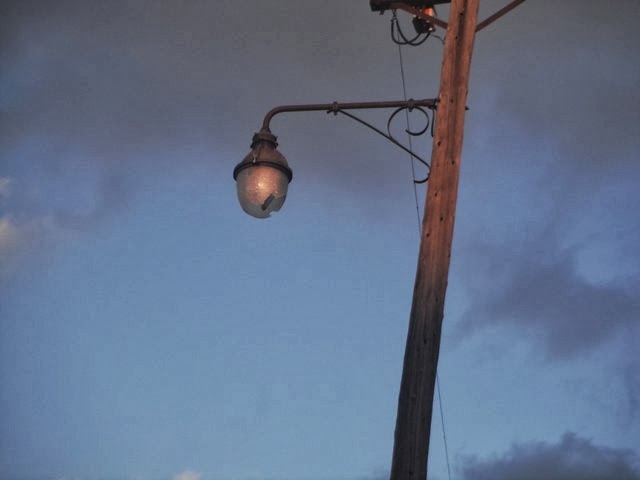
    To be frank, I can’t recall seeing lights like this before anywhere else in the country, and I’m well-traveled across some of the more economically deprived pockets.  From the baroque iron filigree work of the stanchion to the acorn shape of the light itself, my guess is this streetlight comes from an inventory that most cities had fully retired over three decades ago.  And there’s probably good reason for that: this one is broken.


    And so is another one half a block away.


    About half of the lights along this stretch of Mack use this design, and most are cracked.  A big distended bulb offers more surface area encased in glass—more space for something to wrong.  Whether hit by flying debris hit or (my suspicion) deliberately smashed by a passer-by, this streetlight is almost definitely non-operational.  And the visible hardware is only half the problem: inside that quaint, clunky bulb (your grandmother’s streetlight) is—or was—a mercury vapor lamp. Detroit is one of the few cities that still depends heavily on this less efficient, increasingly obsolete method of illumination; most other large cities have replaced their inventory with superior metal halide lamps.   USA Today also noted that Detroit and Milwaukee share the dubious distinction of being the only large cities that still deploy series circuits for much of the streetlight network, meaning that if one transformer box breaks down, the whole strip of lights goes dark, like an old string of Christmas tree lights.  While the Mack Avenue streetlight featured above remains attached to a wood, other lights in the city append to metal poles, presumably the same age as the lights themselves, characterized by rust, peeling paint, and sometimes even open cavities at the base.  The whole contraption has seen better days.

    But viewing these cracked eggs through a cultural lens can help temper some of the scorn.  They might not work well as modern lamps and they’re much easier to vandalize, but they’re relics—they’re curiosity items.  And they’re particularly eye-catching along Mack Avenue because there are so many of them, yet they’re still interspersed with more contemporary designs.  This cool pic doesn’t win awards for clarity, but it still shows the juxtaposition of old and new streetlights, through their silhouettes.


    Or on opposite sides of the street.


    And on a depopulated residential street not so far from Mack, a different kind of lighting style emerges—perhaps not as old-fashioned but still an oddity.


    Perhaps a style and technology that never caught on?

    The irony of the 1950s-era (or maybe even 1940s) lighting that lingers on in Detroit is that, in a broader spatial context, it exemplifies technological advancements playfully defying shifts in taste culture for a particular design.  On Mack Avenue, ancient streetlights bespeak a broke, ineffective government.  And yet, elsewhere in the metro, they convey something else.


    Forgiving the quality of the photo, it’s still easy to see a similar style of lighting to the ones on Mack Avenue, but this time they’re impeccable.


    But this is the comfy suburb of Livonia, presumably part of a streetscape improvement along a thoroughly auto-oriented corridor of strip malls and big boxes.  And they no doubt were a deliberate choice from the Public Works Department because they look good—providing a vintage, old-timey feel.  Apparently they don’t worry in Livonia about ne’er-do-well pedestrians throwing rocks at these distended bulbs.  Maybe it’s because Livonia has few ne’er-do-wells….and even fewer pedestrians.  But even some of the economically healthier neighborhoods within Detroit have caught the bug, replacing older streetlights with a newly vintage design, like these twin lamps in Midtown, near Woodward Avenue.


    This inversion of taste cultures pervades streetscapes across the country, where everything old is new again, in order to exploit nostalgia among a generation that never really experienced a normative walkable environment—a landscape that was still the standard during the era when city crew first installed those acorn mercury vapor lamps.  We’re seduced by nostalgia and novelty; a hybrid of the two is doubly sweet.  Just go to the French Quarter in New Orleans, where a city equally negligent in modernizing its utilities now capitalizes on this same inertia—the flickery gas lanterns that once were a backwater embarrassment are now ambiance.  Detroit isn’t yet so lucky to take similar advantage of its obsolete lighting (and the fact that most streets like Mack are a hodgepodge of styles doesn’t help), but that doesn’t mean that an emergent cultural voice won’t someday call those lights “genuine retro”, and the preached-upon choir will be listening.

    The periodic “freshening” of basic urban infrastructure is only partly due to necessity, as it may very well be in Detroit.  But a great deal simply has to do with keeping up with the joneses, resulting in often needlessly costly capital investments.  For example, the standard for pedestrian signals at intersections now typically involves a “countdown” timer, telling pedestrians exactly how many seconds they have left to cross.  While useful, are these timer boxes essential?  Regardless, public works departments are rapidly phasing out the single-box approach for these new timer-boxes, with little evidence of public advocacy one way or another (despite the fact that the public inevitably is paying for most of these replacement costs).  From decorative viaducts to Day-Glo yellow road caution signs, jurisdictions hell-bent on an infrastructural one-upmanship should look to Detroit as an inverse exemplar—what might happen when profligacy goes perpetually unchecked.  Unless, of course, these granny-and-gramps streetlights become hip and cool again, in which case the Motor City might have the last laugh.

    This post originally appeared in American Dirt on February 27, 2014.

    Eric McAfee is an itinerant urban planner/emergency manager who fuses his cross county (and trans-national) travels and love of contemporary landscapes into his blog, American Dirt, where a different version of this article appeared.

  • Rust Belt: Can Micro-Suburbs Stay Independent?

    The Ohio suburb of East Cleveland abuts the core city to its west and north, and in terms of physical appearance the boundary between the two is indistinct. A century ago, the City of Cleveland unsuccessfully attempted to annex East Cleveland on two occasions. These days, Cleveland is unlikely to perceive its eastern neighbor as much of a catch. East Cleveland fell on hard times during the deindustrialization that took place throughout the Cuyahoga Valley: since 1970, it has lost more than half of its population. Nearly 40% of the 2010 population falls below the poverty level.

    East Cleveland’s residents and depressed real estate do not contribute a tax base by which the city can provide fundamental services. In this way, it’s no different than numerous exceedingly small towns and micro suburbs scattered nationwide. Can it — and other places like it — survive? And, if so, how?

    East Cleveland’s ‘solution’ is to shift the burden to motorists by tackling them with hefty speeding tickets. The 2.5-mile stretch of Euclid Avenue that passes through town is one of the city’s few revenue-raisers; a sidewalk sign promises camera monitoring and $90 speeding tickets.

    East Cleveland is a “Community of Strict Enforcement” that may not have high road fatalities, but the city’s socioeconomics give it few other options to generate the revenue it needs. The placard on the sidewalk (seen above) undoubtedly owes its existence to the debacle that a few years back brought about the demise of another Ohio town, New Rome.

    New Rome, outside Columbus, was a tiny village of only about nine city blocks (approximately twelve acres) that, even at its peak, no more than 150 people called home; the 2000 Census estimated its population at 60. It would probably have gone completely ignored if it weren’t for a four-block stretch of U.S. 40 (West Broad Street in Columbus) that fell within the town’s corporate limits. Within New Rome’s 1000-foot segment of highway, the speed limit dropped from 45 mph to 35. The New Rome Police Department had every right to issue $90 citations to motorists going 42 mph within this speed trap — and it did. The village of a dozen ramshackle houses, three apartment buildings, and a handful of small businesses earned nearly all its revenue from traffic tickets. With no other real public agencies, the money paid for the police force (which at times had as many as 14 employees, one quarter of the then-population) and the village council.

    A few neighbors eventually grew so frustrated that they launched the website New Rome Sucks. And after a series of corruption revelations, the town attracted the attention of the Franklin County Prosecutor and Ohio Attorney General Jim Petro, who determined that, after decades of incompetent management, New Rome should be abolished. Eventually, Petro convinced the Ohio General Assembly to pass a law allowing the state to seek dissolution of a village under 150 people if the State Auditor found that it provided few public services and demonstrated a pattern of wrongdoing. In 2004, the Village of New Rome was irrevocably absorbed into Prairie Township of Franklin County, Ohio.

    In most municipalities, good governance is a selling point. However, New Rome’s malfeasance was unequivocally a reflection of the will of its constituents. They got the racket that a majority of them apparently wanted. And eventually the village forfeited its very existence.

    While a New Rome could realistically emerge anywhere in the country, it is worth questioning whether the municipal incorporation structure in Ohio — and other states — particularly abets the process. Tiny municipalities exist everywhere. But they seem particularly prevalent in the industrial heartland. Cleveland’s Cuyahoga County has 57 incorporated municipalities; Columbus’ Franklin County has 25; Cincinnati’s Hamilton County has 38. Most states to Ohio’s northeast are almost completely incorporated: William Penn mandated this characteristic in his original charter for Pennsylvania. New Jersey is 99% incorporated. It is not uncommon to find boroughs as small as New Rome in both of these states; the Philadelphia suburb of Millbourne, for example, measures only .07 square miles.

    Conversely, southern states are more likely to opt for either expanses of unincorporated urbanized land (which characterizes the vast New Orleans suburb of Metairie) or mega-municipalities, such as the “town” of Gilbert outside Phoenix, with a population over 200,000.

    The majority of shrinking cities — and towns, villages, boroughs, and townships — now are clustered in the Northeast and the Midwest. “Home Rule” provisions in the Ohio state constitution, and similar legislation elsewhere in these regions, coupled with a small population, allow for a disproportionate amount of self-actualization… for better or worse. Cleveland’s most prosperous micro-suburbs have wielded it effectively to stem the erosion of their tax base.

    Does this broad-brush distinction between North and South yield any conclusions? At the very least, Rust Belt states must carefully weigh the benefits of entitling tiny populations to remain as independent towns. Otherwise, the only way many communities in a metropolitan mosaic will ever paint themselves out of the red is through surreptitious speed traps.

    Eric McAfee is an itinerant urban planner/emergency manager who fuses his cross county (and trans-national) travels and love of contemporary landscapes into his blog, American Dirt, where a different version of this article appeared.

    Photo in East Cleveland by the author.
  • What Killed Downtown?

    What Killed Downtown?: Norristown, Pennsylvania, from Main Street to the Malls
    by Michael E. Tolle

    For those of us who have grown dyspeptic on the over-indulged topic of the collapse of the American city center, Michael Tolle’s What Killed Downtown? Norristown, Pennsylvania, from Main Street to the Malls earns much of its anodyne appeal by straying from a commonly accepted convention in urban studies—that an analysis of the socioeconomic decline of a community should draw heavily upon socioeconomic variables. Isn’t there another way to get the point across? And more importantly, aren’t there other contributing factors?

    This compassionate narrative of the 20th century rise and fall of an older Philadelphia suburb avoids graphs and charts for the most part, becoming much more engaging for its alternative approach. And likeability is exactly what it will need to win over skeptics, or the merely apathetic, because most people in the US probably have never heard of Norristown. In fact, it’s likely that quite a few people on the other side of the Keystone State aren’t familiar with it either. After all, the borough at its 1960 peak only had 39,000 inhabitants (the 2010 Census records a population of 34,000). But Norristown merits further observation, not so much because its downtown has declined in the mid-20th century—that happened everywhere, in municipalities of all sizes—but because Norristown sits squarely in the middle of Montgomery County, an expansive bedroom community of Philadelphia with 800,000 people and a median household income of over $78,000, placing it within the top 100 wealthiest counties in the nation. Meanwhile, Norristown’s median household income, according to the latest Census, is approximately $43,000 and its poverty level of 16.4% is almost triple that of the county’s 5.7%, and still a fair amount higher than the state’s rate of 12.6%. While Montgomery County boomed over the last half century, Norristown has not shared in that prosperity. It is by no means a devastated town—many old neighborhoods remain charming and fully intact—but the commercial heart of Norristown has never healed.

    The above paragraph contains a higher concentration of raw data than one should ever expect to encounter in Tolle’s new book. Rather than delving into the Bureau of Labor Statistics, the US Census Bureau, or rankings from Urban Land Institute or the Brookings Institution, Tolle manages to chronicle the rapid ascent of this suburban outpost, its 75-year dominion over commercial activity within the county, and its precipitous decline shortly after the Second World War—and he achieves it through a diligent perusal of old city directories, interviews with almost two dozen of Norristown’s older citizenry, and a vigorous exploration of the internal machinations of the Borough Council. He applies an anthropologist’s lens to a subject that sociologists have long overcrowded.

    While Norristown’s early history—first as a manor under one of William Penn’s initial surveys, followed by a subdivision into smaller farms by Isaac Norris in 1712—is clearly never the focal point for Tolle’s methodical dissection of downtown, he avoids glossing over it. Not surprisingly, Norristown emerged as the most desirable plot of land in the sprawling manor because of its accessibility: it abutted the “canoeable part of the Schuylkill” and the interconnected American Indian trails that allowed for easy fording of the river. By 1784, the Pennsylvania Assembly carved Montgomery County out of the existing Philadelphia County, and a subsequent deed conveyed lots reserved for county buildings at the intersection of two of the only extant roads at the time. Due to its advantageous location, it became a nearly self-sufficient Town of Norris within a few years, abiding by Penn’s “Town Model” for Philadelphia and other Pennsylvania cities, employing tightly organized, gridded streets that maximized uses of available space. The construction of some of the earliest turnpikes helped to stimulate the town’s steady growth and prepare it for its incorporation as a borough of 520 acres in 1812, followed shortly thereafter by the rail networks that galvanized further expansion.


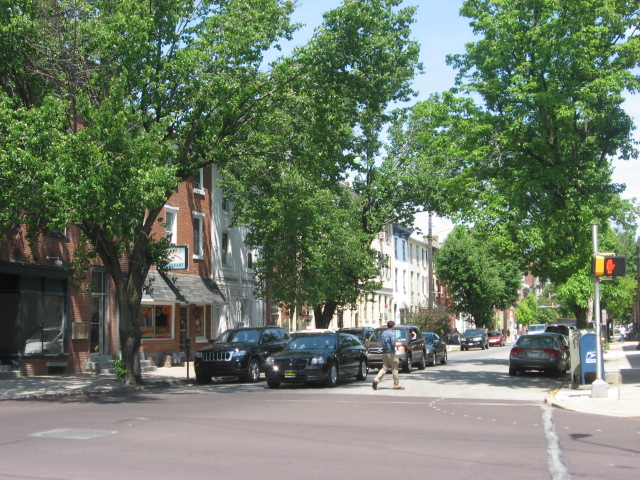
    Swede Street just north of Main Street, known by some as Lawyers’ Row. Photo from Spring 2011, courtesy of Matthew Edmond.

    The early chapters of the book may only provide a backdrop for Norristown’s 20th century rise and fall, but Tolle chronologically accounts for the factors that helped Norristown emerge as the primary urban center in Montgomery County. And unlike neighboring 19th century boomtowns that dot both the Delaware and Schuylkill Valleys, Norristown “lacked the characteristics that define similar towns of sufficient size and influence that could easily explain the downtown’s decline. . . [It] was never a one-company town. It was never dependent on [a] single employer whose corporate fate might have led it to a catastrophic domino effect; rather Norristown’s workforce has always been distributed among many workplaces.” It owed much of its steady growth to its fortuitous location 17 miles northwest of Philadelphia, the convergence of several modes of transportation, and its role as the administrative center of a large and increasingly prominent county.

    By the book’s twentieth page, Tolle reveals the real heart of his study: the bustling commercial core of Norristown’s six-block Main Street. At the borough’s Centennial Celebration, population approached 30,000, swelling largely from immigrants who arrived to work in various industries: first the northern European Protestants, then the Irish, then, in by far the highest concentration, the Italians, overwhelmingly from Sicily. Mennonites, Amish, and Jews (predominantly of German heritage) along with African Americans arrived in smaller numbers. While the population self-segregated along largely ethnic and economic lines (working and lower-middle class Protestants on the West End; the wealthy, Northern European original settlers in the North End and DeKalb Street; Italians and African Americans in the blue-collar East End), all the strata converged along Main Street’s densely commercialized blocks. Tolle explores the full week’s worth of celebratory activities, from the details of the floats in the Industrial Day parade to overhead weave of flags, bunting, and electrical wires. The pace of the narrative slows at this point, but Tolle employs a humanism that he retains across the ensuing pages. When he intermittently bogs down in relentless detail, he’s easily forgivable—even a little admirable for not shying away from his obsessions.


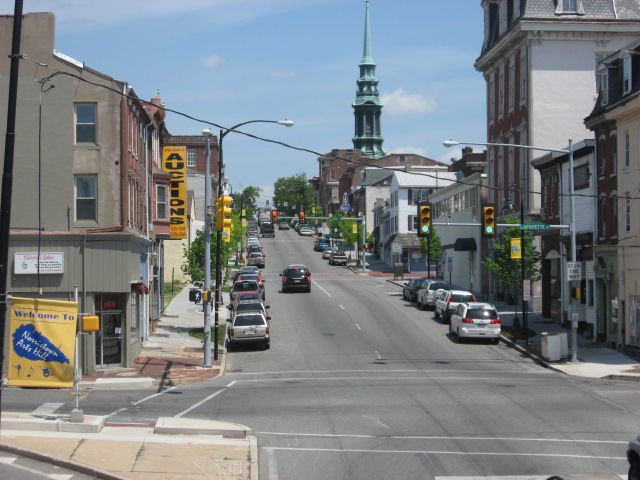
    A view of DeKalb Street, Norristown’s most affluent residential address, from its southern junction with Main Street. This was once the center of commercial activity in the borough. Tolle details the controversy of the implementation of the Comprehensive Plan to make DeKalb Street one-way northbound in 1951, a restriction which remains today. Photo from Spring 2011, courtesy of Matthew Edmond.

    The Directory of the Boroughs of Norristown and Bridgeport, Montgomery County, Pa, for the years 1860-1861 serves as the bedrock for his chronological exploration of the commercial health of downtown Norristown. For some of the most resilient businesses—Chatlin’s Department Store, Egolf’s Furniture, Zummo’s Hardware—Tolle offers vignettes on their immigrant backgrounds and the financial maneuvering necessary to start their trades. Interspersed with these brief accounts are updates from subsequent City Directories, chronicling the change in business composition over time. But Tolle generally eschews tables and charts—with few exceptions, he narrates the changing commercial landscape of Norristown by integrating the livelihoods of the proprietors with the demands of the consumers. Because the authorial voice depends so heavily on firsthand accounts of the business climate—articles from the Norristown Times Herald, advertisements (including misspellings and solecisms), and, in the later years, eyewitness accounts—the routine references to City Directory data never grow stuffy or monotonous.


    What Killed Downtown? is a concatenation of anecdotes. While such an indulgence in human-interest nostalgia could take a maudlin turn, Tolle again counterbalances these episodes with moments of acerbic subjectivity, as any conscientious anthropologist cannot help but do. My two favorite anecdotes feature a building and a person. The Valley Forge Hotel emerged in the roaring 1920s, purely driven by the local business community, who felt that the proud city demanded a first-class hotel. A stock subscription campaign raised enough to complete the massive six-story brick structure by November of 1925. Though it rarely made a profit, its size and relative opulence made it an icon for the city, and as an emblem of civic pride, it succeeded. The other great anecdote involves the detailed account of the life of the city’s most colorful politician, the recalcitrant Paul Santangelo. Lacking greater aspirations than borough administration, Santangelo earns more ink on these pages than any other civic leader, including the mayors. He fiercely defended the interests of the poorer Sicilian immigrants who comprised much of his district, voting ferociously in their favor but often—in Tolle’s opinion—at the expense of city progress as a whole.


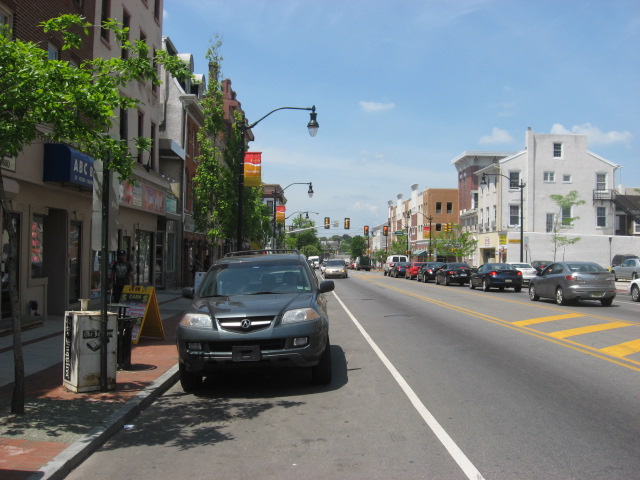
    Norristown Main Street, west of Swede Street and looking westward. Photo from Spring 2011, courtesy of Matthew Edmond.

    Tolle’s account of Norristown’s Main Street after its 1950 apex avoids mind-numbing predictability even has he identifies the usual culprits contributing to its decline: growing dependence on the automobile, competition from suburban shopping plazas like the now-mammoth King of Prussia, shift of the population center toward the far-southern part of Montgomery County, construction of limited access highways outside of the borough’s limits. And of course, all these factors converge with the suburban amenity that wounds Norristown the most: “free, ample parking”—a mantra which Tolle repeats enough that it tacitly answers the question to his book’s title. Anyone with a scintilla of knowledge of American urbanism will know where this is headed. But by the1950s, Tolle reaches a point in time where procures firsthand accounts of Main Street’s changes. The worm’s-eye view continues, imbuing the narrative of Norristown’s saddest days—by the 1970s it is not safe to walk Main Street at night—with empathy and hope.


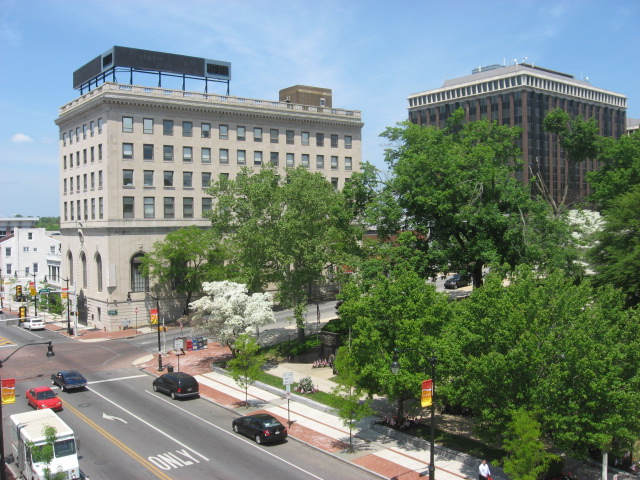
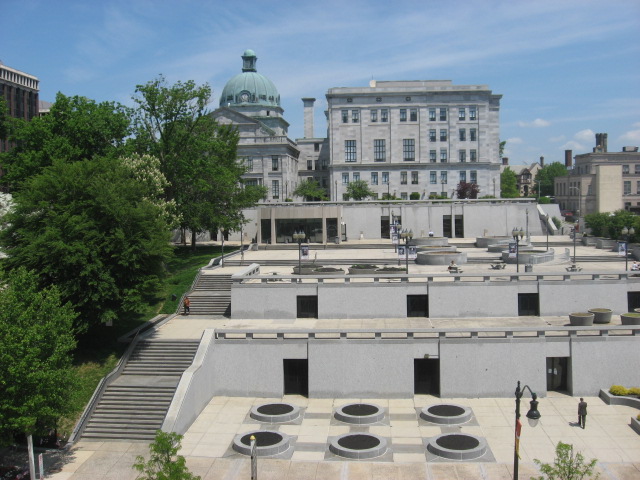
    Courthouse Plaza along Main Street, one of many mid-century projects that removed commercial buildings and replaced them with staid, largely unused civic space. Photo from Spring 2011, courtesy of Matthew Edmond.

    For a person as enamored by details as me, Tolle’s worm’s-eye view never really grows old, even when he’s a fussbudget over counts of shuttered storefronts from year to year. At the same time, this intricate approach to an already small subject could easily undermine the ability for What Killed Downtown? to find a broad audience. What happens to a little-known suburban city can hardly resonate as much as if he had explored the devolution of downtown Philadelphia—or even Allentown or Erie. The fixation on downtown storefronts—at the expense of geographic context—firmly ensconces the book in the “local interest” category. His 250-page narrative rarely explores impacts on Norristown Main Street outside of Montgomery County. From an early point in the book, he describes street intersections with specificity that would only mean anything to a local; then he only provides two referential maps.

    None of these cavils really amount to an inherent weakness of the book—after all, it might prove just the right medicine for Tolle’s fellow Norristowners. But the narrowness of scope does foretell an oversight as to the broader implications for this city’s decline, which could have made for a much bolder peroration than the one the book currently provides. The only atypical bogeyman contributing to downtown Norristown’s precipitous decline is the persistent political gridlock and resultant incompetence of the Borough Council, which he relates with the same humanist eye he applies to his wonderful vignettes of immigrant entrepreneurialism. But Tolle had the chance to make this story matter on a scale that could mean something to someone from Ashtabula or Waukegan, and he spurned the opportunity.

    My knowledge of Philadelphia, having lived there for a time, gives me an unfair advantage, but I can’t help but ask a few questions. Norristown, the seat of wealthy Montgomery County, declined and its main street is moribund to this day. But Media, the much smaller seat of neighboring Delaware County, boasts a flourishing main street of local shops and restaurants—all despite the fact that Delaware County, while equally urbanized, is much less affluent than Montgomery County. Meanwhile, cities like Chester (also in Delaware County) and Camden, New Jersey can claim a similar lifespan to Norristown, strong transportation access, and an industrial boom. But today these two cities are not only among the most devastated municipalities in their respective states, Chester and Camden are among the poorest cities in the country. Perhaps most interestingly, after several decades of population decline, Norristown began to trend upward again in the 2000 census, and by the 2010 Census the city grew virtually 10%–an unprecedented occurrence for a city that still has the reputation of being the poorest place in its respective county.

    What Killed Downtown? remains a welcome contrast to countless other chronicles of downtown decline whose narratives depend on sociological detachment. Recognizing that true objectivity is impossible, Tolle instead depicts the Norristown transformation from the perspective of people who experienced it. Because its vision is geographically precise and obscure to people outside southeast Pennsylvania, I suspect our author felt driven to write it even if it enjoyed a readership of zero. Such an endeavor could reek of self-indulgence, but Michael Tolle’s opus has way too much empathy for that. Hopefully Norristown’s coterie of model train owners and newspaper collectors will put this book on their to-do lists—and then recommend it to others.

    Eric McAfee is a licensed urban planner currently working in emergency management. Though he hails from Indianapolis, his professional field grants him a certain degree of itinerancy, which he uses to his advantage to write about and photograph landscapes across the country in his blog, American Dirt. He lived and worked as a military planner in northern Afghanistan from 2010 to 2012, letting him fudge on the “American” aspect of his blog a little bit. In the past, Eric’s writing has won him Outstanding Paper in Real Estate at the University of Pennsylvania, as well as an outstanding research on housing award from the Joint Center for Housing Studies at Harvard University.  Aside from American Dirt, he has featured his writing on Urban Indy.com, Streetsblog.net, and Urbanophile.com.