Author: Fanis Grammenos and Tom Kerwin

  • Running The Numbers On Transport Options

    Households are offered a great deal of advice which seems intended to dissuade them from using private, motorised transportation — that is, cars. Information about the negative fallout of car ownership — environmental and otherwise — has often been coloured with ethical overtones. Yet, despite those exhortations and the many well-known and indisputable reasons to cut back, extensive reliance on personal motor transport remains unchanged, if not growing. For example, the rate of car ownership since 1962 has doubled in the US, Canada, Australia and New Zealand; quintupled in Switzerland, Norway and Belgium and tripled in Sweden. This persistent growth alone undermines the claim of a high cost of ownership.

    Other trends also back up the notion that cost is not a key issue, and does not belong among the arguments in favour of reducing driving.
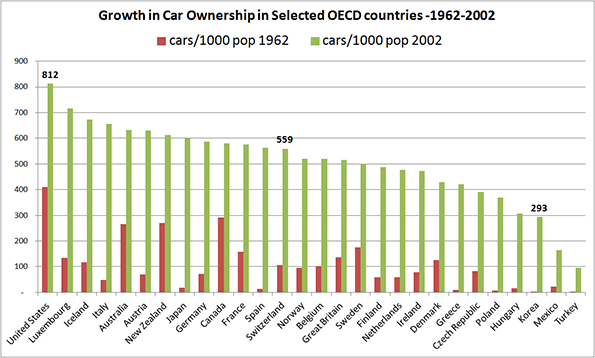

    Chart 1. Source: Joyce Dargay, Dermot Gately and Martin Sommer: Vehicle Ownership and Income Growth, Worldwide: 1960-2030. Institute for Transport Studies, University of Leeds

    In the US, for example, the costs of buying and operating a car have been continuously dropping. An analogous trend can be seen in the UK (Chart 2), where car costs have risen more slowly than the general retail price index, and slower than rail and bus fares (Note: The UK sustains higher tax levels and gasoline prices than the US.) It stands to reason that lower purchase and operation costs increase the car’s affordability.
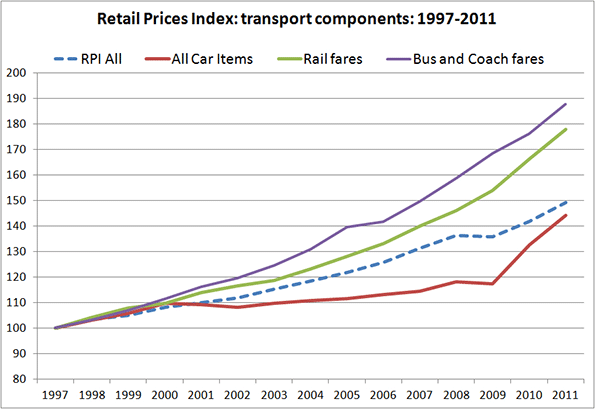

    Chart 2. Source: UK Department for Transport Statistics 1997-2011 report Table TSGB0123 Retail Prices Index: Transport Components.

    Since 1979, incomes in developed countries have been on a rising trend, despite transient periods of economic stagnation. Increased buying power has made numerous commodities — including cars — more accessible.

    The obvious affordability of personal motorized transport does not mean that it will or should obliterate other, more affordable transport options: public transit in all its forms, and bicycling or walking.

    Public transit’s drawbacks are inflexibility and tardiness. Its reach often excludes employment sites at peripheral locations; as a Brookings Institute report has noted, “…Among very large metro areas, the share of jobs accessible via transit ranges from 37 percent in Washington and New York to 16 percent in Miami.” This limits access to employment for those disadvantaged households that rely entirely on transit for transportation. Though this inflexibility is shared by subway systems, subways generally have a speed advantage over cars in central, congested districts.

    The almost no-cost options of walking and cycling are limited by their low maximum speed, and by the effort required. Commuting distances in large cities can often exceed 8 to 12 miles as their diameters range between 15 to 30 miles. Those distances, when undertaken by foot or bike, become untenable because they break the universal half-hour threshold and may require excessive effort. These modes are also ill-suited to trip chains, which involve multiple tasks and destinations on a single trip (e.g. combining work commuting with school drop off/pick-ups, shopping, etc). As with transit, biking and walking has a limited reach of employment destinations. Moreover, a percentage of households may also find it difficult to accommodate all their transportation needs based entirely on these two modes.

    For these and many more reasons, reliance on private vehicles is extensive. That fact is supported by statistics on mode choice among Europeans, who typically have large shares of walking and bicycle trips. The data shows that, when looking at the total kilometers traveled by mode, personal motorised transport takes the lion’s share.
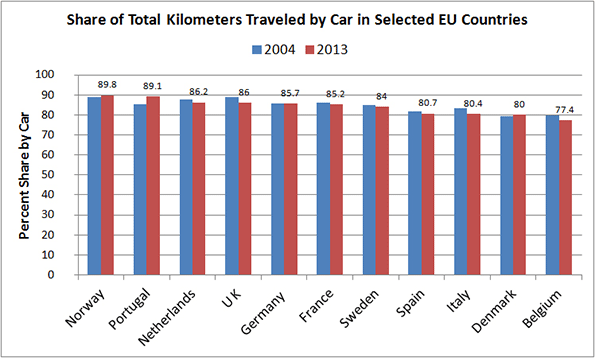

    Chart 3. Source: Modal Split of Passenger Transport [tran_hv_psmod] – Eurostat, last update 2015

    New ideas in transport that include transit, biking, and new forms of car use are emerging. The innovative solutions that follow are consistent with city-building and environmental objectives. Here are a few possibilities, still in a nascent stage:

    Shared car enterprises have sprung up in many urban centers, and offer the convenience of a car without the financial burden of ownership. They reduce total personal driving, and therefore greenhouse gasses (GHGs), as their use is intermittent.

    Pay as you drive car insurance and, a recent entry, pay by how you drive insurance. Both provide an incentive to drive less and better. They could reduce car ownership costs, congestion and GHGs.

    Electric cars are more economical to operate than conventional vehicles, while reducing pollution and city noise—all positive attributes.

    Ride-share services, though controversial, have the potential of reducing the cost of transport by improving its economic efficiency and performance. Both the driver (car owner) and the passenger(s) lower their respective costs, as cars occupancy increases and chained trips become the norm.

    Bicycle parking at subway/rail stations increases the potential universe of a subway or rapid-transit bus line (BRT) to four times or more the area of pedestrians within easy reach. This combined personal and communal transport yields excellent affordability.

    Bike lane systems on existing streets and paths off the streets increases the perception of safety, which typically increases bike commuting.

    Enlarging and enhancing city core sidewalks increases the comfort, safety and pleasure of walking in the city by reducing or removing traffic and, in a similar vein, introducing lanes and passages in the middle of long city blocks reduces walking distances.

    Uni-tickets (e.g. London’s Oyster, or New York’s MetroCard) for all public transit services increase the convenience and affordability of public transit and lead to higher ridership.

    That’s a short, unsorted excerpt of a longer and growing list of opportunities for transportation planning initiatives. What is not growing — and needs to — is the extent and speed of implementation; a great, worthwhile challenge for planners.

    Fanis Grammenos heads Urban Pattern Associates (UPA), a planning consultancy. UPA researches and promotes sustainable planning practices including the implementation of the Fused Grid, a new urban network model. He is a regular columnist for the Canadian Home Builder magazine, and author of Remaking the City Street Grid: A model for urban and suburban development. Reach him at fanis.grammenos at gmail.com.

    After twenty-four years at Canada Mortgage and Housing Corporation, Tom Kerwin now leads an active volunteer life, including being the Science and Environment Coordinator for the Calgary Association of Lifelong Learners. He holds a Master’s degree in Environmental Studies from York University.

    Special thanks to Luis Rodriguez for collaborating in shaping this article.

    Flickr photo by Fraser Mummery; Golden Gate Traffic: Auto drivers, pedestrians and a bus on one of the most recognizable structures in the world… the Golden Gate Bridge in San Francisco, California.
  • Is Owning A Car Too Expensive?

    Many analysts—usually planners—have been regularly offering a wealth of exhortations concerning how uneconomical it is to purchase, operate and maintain a private car. Is this a valid assertion of a household economic burden? And what is the likelihood that the advice will ultimately prove useful? Household economic decision-making varies greatly, depending principally upon income levels, personal circumstances, and preferences. A single mother with children, or a part-time worker, will make transport choices for radically different reasons than a management executive. With their priorities already set, each of these individuals has little use for generic advice; it is either unhelpful or irrelevant to them.

    Such advice often crops up in planning-related journals or web sites. Given that laypeople are unlikely to read these sources, however, the efforts may be largely wasted.

    Underlying the production of advice is the presumption that households need it. In theory, consumers can be unaware of costs in certain cases, for example, if a product is relatively new or not universally used, such as e-cigarettes.

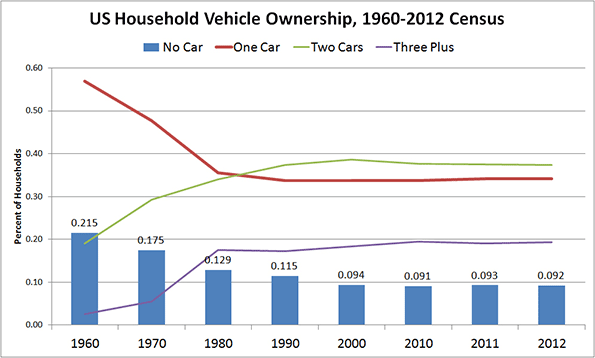
    This could hardly apply to households and the car market. There are 828 cars per 1000 people in the US; 620 in Canada. Even more telling is market participation by households, as shown by the blue bars in Chart 1, below. By 2012, only about 9% of households did not own a vehicle, compared to over 20% in 1960. These figures speak of a large majority of households in the car market. As for households that opted not to own a car, their absence from the market may be due, at least partly, to their knowledge of the costs.

    Chart 1 Source: Oak Ridge National Laboratory; Transportation Energy Data Book. Table 8.5.
    If knowledge is not at issue, the question becomes whether households manage their expenses on this item prudently, or if they could use expert advice to do so.

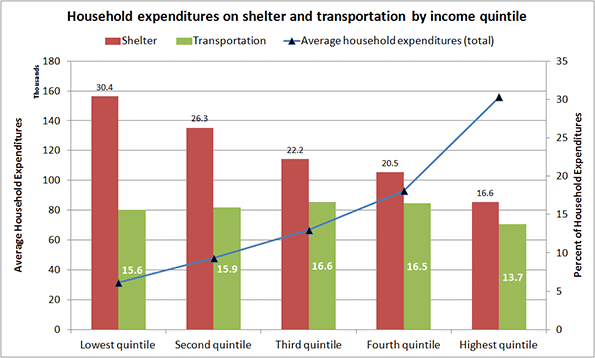
    Advice on how to manage household transportation expenses is, evidently, also unnecessary. Statistics on household expenditures leave little doubt that households manage their transportation budgets surprisingly well. Consumer surveys show that among all income quintiles, with total household expenditures ranging from about $31,000 to five times that ($155,000), the percentage allocated to transportation is fairly constant – around 15% (Chart 2). The only exception is found among the highest quintile, which may simply be indicative of higher disposable incomes. (We hope readers will be lenient about our use of statistics from multiple countries. The intent is to show trends, rather than report on the specifics of a chosen country.)

    Not only is the mid-teen figure constant across different income groups, it is also constant across countries. The European Union, for example, reports 13.0% and 13.2% all across the EU (excluding its newest members). It is hard to interpret this consistency as anything other than an ability to control transportation costs in a way that meets a household’s needs and budget, particularly when seen in juxtaposition to the expenditure on shelter.

    Chart 2 Source: Statistics Canada, Survey of Household Spending. Table 2: Budget Shares Of Major Spending Categories By Income Quintile, 2012.
    This consistency of the transportation expense at all income levels is intriguing and instructive.Researchers have suggested that it represents a universal constant. Regardless of its universality, it indicates the adaptability people demonstrate in controlling this expense. This adaptability ranges from choosing the means of transport (foot, bike, transit, car or rail), their level of effort, the time they are willing to spend traveling, and their flexibility in reaching destinations.

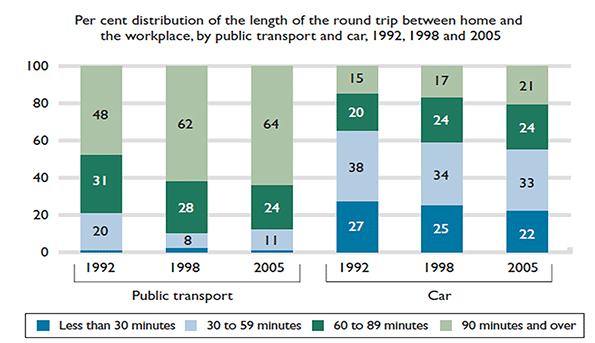
    For example, public transport lowers costs, but is generally slower than a car (Chart 3). In 2005, 21% of drivers recorded a 90+ minute round trip as opposed to three times that (64%) reported by transit riders. As might be expected, public transport users are predominantly lower quintile households that trade cost for time (Chart 4).

    Chart 3 Source: Statistics Canada, General Social Survey, Trip Duration, 1992, 1998, and 2005.
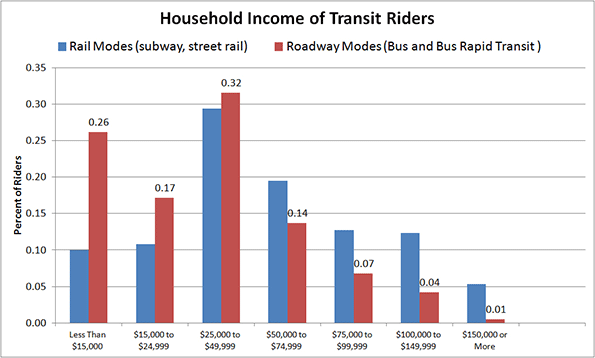
    Choosing the mode of transport is one path to controlling costs, and certain households are clearly doing so. As the chart below shows, about 75% of bus riders (adding the first three bars) earn up to $50,000 a year, a lower-rank quintile income. Riding the bus is a conscious choice, as percentages of riders of other income brackets suggest, but for the 75% it may also be an economic necessity.

    Chart 4 Source: American Public Transportation Association, A Profile of Public Transportation Passenger Demographics and Travel Characteristics, 2007.
    Other options in controlling transportation costs include walking and bicycling where possible, accessing the second-hand car market, and choosing other motorized transport.

    One good example of ‘other’ motorized transport is motor scooter ownership in developing nations, and in certain industrialized countries. In Taiwan, for example, “….Scooter is the primary mode of transport on this densely populated island – there are about 15 million for 23 million citizens.” Such wide-spread dependence on scooter-based motorized mobility correlates well with its cost and the per capita GDP of its users. Italy, for example, tops the EU in scooter/motorbike ownership. It may not be pure coincidence that it also has one of the lowest GDPs per capita among EU nations.

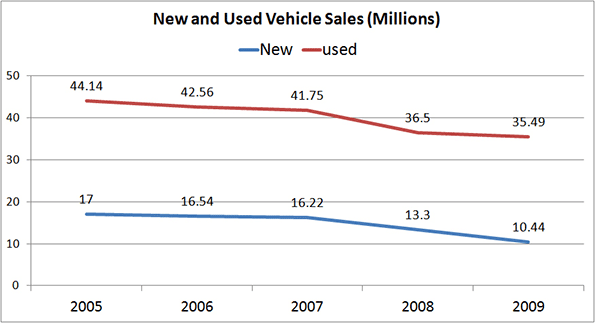
    The resale market for cars in the US outstrips the new car market by about one to three (Chart 5). Not only is the market large but also, significantly the average cost of a pre-owned car is generally about half its original price.

    Chart 5 Source: NIADA’s Used Car Sales Industry Report; Relative Size of Car Markets for New and Used Cars, 2010.
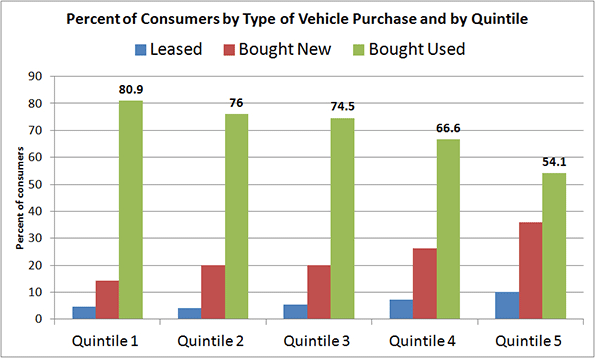
    The size of the resale market demonstrates yet another means by which consumers—particularly the lower quintile households— seek and grasp the opportunity to control car-related costs. As is evident from Chart 6, three of the five quintiles limit their new car purchases extensively; an overwhelming majority of consumers (averaging 77%) buy used cars. That figure reaches about 81% among the lowest quintile households.

    Chart 6 Source: Laura Paszkiewicz, The Cost and Demographics of Vehicle Acquisition, Consumer Expenditure Survey Anthology, 2003 (61) Division of Consumer Expenditure Surveys, US Bureau of Labor Statistics.
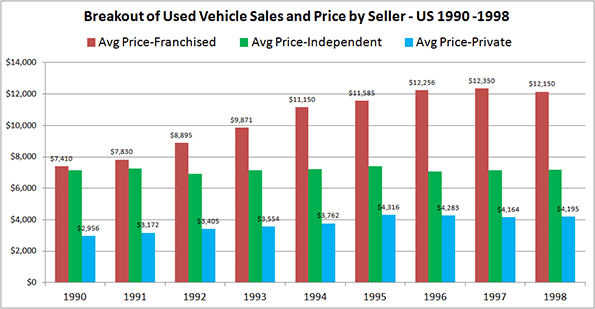
    Not only does the resale market allow for control of a buyer’s initial investment, but segments within the market further enhance that ability. As Chart 7 shows, the price differential between a private sale and that from a franchised dealer can range from double to triple.

    Chart 7 Source: The Used Vehicle Market in Canada, DesRosiers Automotive Consultants Inc., 2000.
    The twentieth century saw momentous change and variety in the means of transport, both personal and collective. All new entries except bicycles are motorized, and were unimaginable a mere century earlier. The previous means of transportation — horse-dependent — lasted for at least forty centuries, during which collective transport was non-existent. Motorized personal transport is just one instance in a trend of displacing muscle-dependent activities with motor-driven ones (such as climbing stairs being supplanted by using elevators). The change has been astonishing, unusually fast, and, judging by the plethora of articles on the topic, a cause for concern to some.

    Statistics and examples so far allow us to draw at least one indisputable conclusion: Households do know their transportation costs, and adjust their expenditures according to their needs and budget by taking advantage of available opportunities. It would appear that there is little need for guidance on either front.

    Fanis Grammenos heads Urban Pattern Associates (UPA), a planning consultancy. UPA researches and promotes sustainable planning practices including the implementation of the Fused Grid, a new urban network model. He is a regular columnist for the Canadian Home Builder magazine, and author of Remaking the City Street Grid: A model for urban and suburban development. Reach him at fanis.grammenos at gmail.com.

    After twenty-four years at Canada Mortgage and Housing Corporation, Tom Kerwin now leads an active volunteer life, including being the Science and Environment Coordinator for the Calgary Association of Lifelong Learners. He holds a Master’s degree in Environmental Studies from York University.

    Special thanks to Luis Rodriguez for collaborating in shaping this article.

    Flickr photo by promich: Car Town, a used car lot in Chicago.

  • Is Suburbia Crashing? Suburban Traffic Myths Refuted

    Traffic crashes are a cause of ill health, impaired living or curtailed lifespan. Does city growth, in its sprawl-type outward expansion, increase the incidence of fatal and injurious crashes? This factor is the latest addition to numerous attempts to pin a correlation or causality linking traffic accidents with any number of causes.

    The twentieth century is not the only time in city evolution at which traffic accidents became a concern. Around the end of nineteenth century, when all in-city transportation was hoof and foot-dependent, accidents in cities were common.

    In New York, for example, 200 persons died in accidents in the year 1900, which, when transposed, means a 75 percent higher per capita rate than today. In Chicago the rate per horse-drawn vehicle in 1916 would be almost seven times the per auto rate in 1997.

    These are surprising, counter-intuitive statistics: the two cities, as all others at the time, were not just walkable, they were predominantly foot-based cities; exemplars of urbanism. No person had to cross six-lane arterials or dodge high-speed vehicles. Distances were short, city blocks small, densities high, and personal daily routine took place mostly on foot. It seems paradoxical that a walkable, dense, mixed-use city would generate high fatality rates; and more so because the speed of traffic ranged between 3 and 9 m/hr : half or less the 20 m/hr threshold beyond which fatalities increase. Without sidetracking for explanations, we can draw at least one simple idea from this past: a dense, foot-based city can generate high rates of fatalities.

    Soon after motorized transport entered city streets, fatal crashes rose. In the face of appalling and rising death figures, many adjustments occurred over a 30-year period. None of these changes involved urban form; they were inevitably operational and regulatory (e.g. lane markers, stop signs, driving rules, etc).

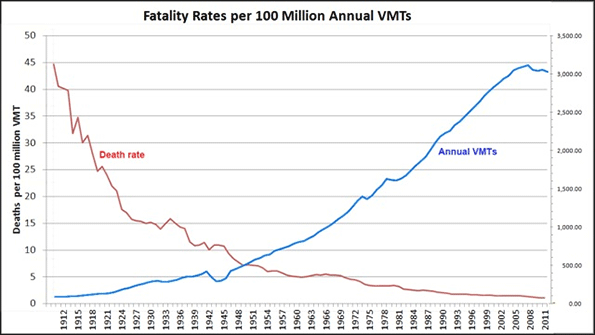
    In the U.S. during the first decades of the automobile’s presence on city streets, car accident rates fell rapidly even though car travel tripled between 1920 and 1955.

    During the same period the urban form characteristics remained fairly stable. The modest suburban expansion of cities at that time was light-rail dependent; “motopia” had yet to emerge . Most urban form of the ’30s and ’40s was generally similar to the early twentieth century prototypes: medium to high density compact development around a rail line or station with a core of amenities and services. It is nearly impossible to determine whether or not this form played a role in the drop in fatalities, due to the absence of concurrent alternative forms. When new “motopia” forms emerged, trends in fatalities did not bear out their influence.

    When automobile dominance was firmly established and new highways opened vast tracts of land for city growth, urban form at the city periphery changed decisively from compact, mixed use, walkable and transit-centered to typical “motopia” or “sprawl.”

    Despite a Smart Growth America recent claim of a correlation between sprawl and an increase in fatal accidents and a small decrease in injuries, the traffic fatality rate actually decreased as U.S. cities sprawled and total VMTs increased.

    The current level of traffic fatalities stands at about one third of the 1955 level and less than 1/20 of the 1925 rate. Intriguingly, sprawl at the national scale did not produce an increase in fatal or total crashes as analysts predicted. If the sprawl paradigm did play its negative role, then other countervailing factors must have had a greater influence that overshadowed its effect.

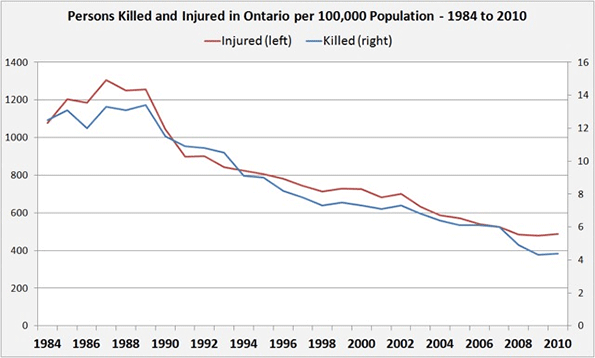
    The national trends in Canada mirror those of the U.S. Notably, fatal crashes fell at a faster rate than injuries, increasing the uncertainty about the correlation that links a substantial rise in fatalities with a rise in “sprawl-ness”. Provincial statistics show similar trends. The chart below shows the trends in Ontario, the most populous Canadian province:

    During a quarter century of more suburban expansion, fatalities and injuries followed a similar decline for a respective drop of around 70 percent in fatalities and about 60 percent in injuries; a substantial change. Like the national level statistics, provincial ones reinforce the uncertainty about a correlation between urban form and traffic fatality rates; instead of upward climb, we see an unmistakable decline.

    But what do statistics show at the finer, city scale?

    We turn to two – Toronto and Calgary – of six Canadian cities whose sprawl has been documented in detail. In spite of their anti-sprawl policies, in most the movement was retrograde, toward more sprawl.

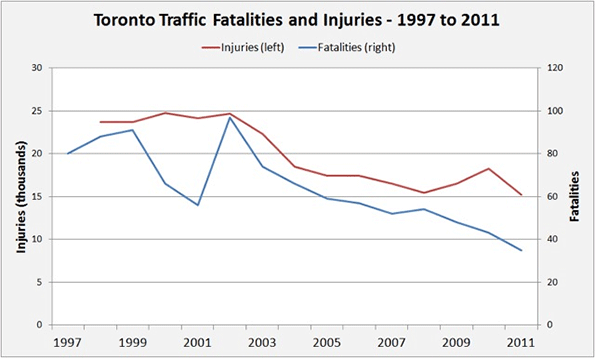
    The graph above shows Toronto’s trend in fatal crashes and injuries for the period of 1997 to 2011. Toronto during these 15 years can be characterized as a suburbanized region (with a few exurban appendices) that continues to expand using the conventional development model.

    In addition, Calgary, Alberta, the “car capital of Canada”, according to a Smart Growth report, has Canada’s lowest overall density; it remains a sprawled city. As with the national and provincial trends, the two cities’ traffic safety trends show a persistent overall drop in fatal and injurious accidents. Once more, the city-level fatalities and injuries trends contradict the correlation that links sprawl-type urban form with an increase in fatal accidents and a decrease in injuries. Whatever the countervailing factors are, they mask and overwhelm an expected rise in fatalities. As for the decrease in injuries, the actual drop is far greater than what the postulated correlation would predict and cannot be explained by it alone.

    If at the national, provincial and city levels the trends are positive in spite of the negative direction of urban form, the health concerns that would justify planning interventions appear to have been alleviated on this front, at least for the first century of automobility and for the half century of uninterrupted sprawl.

    One might speculate that had growth been in a compact, walkable, diverse use, transit-centered form, fatalities could have declined even faster. This could well be true but cannot be deduced from the above statistics. Regardless, the current trends could not be seen as a cause for concern and urgent action on the urban form front. On strictly health grounds, cities and provinces are progressing in the right direction. There is no apparent imminent or growing threat.

    So far we have seen the difficulty of explaining the persistent drop in traffic fatalities via a correlation with “sprawl-ness” and we hypothesized that other factors may be at work. Indeed they are. We find several in overlapping lists of international, national, provincial and city documents: some linked to the causes of fatal crashes, others as government directives. Here is a collection in no particular order of importance:

    Speed limit range/control
    Drinking and driving laws
    Young driver restrictions
    Intersection geometry
    Car crash-worthiness rating
    Car fitness regulations
    Road condition care
    Driving fitness/age
    Speeding penalties
    Vulnerable user protection
    Motorcycle helmets
    Seat belt use/air-bags
    Child restraints usage
    Pre-hospital, on-spot care
    Distraction prohibitions

    As one example of the potential effect of safety measures, NHTSA in 2005 estimated that 5,839 lives would have been saved in 2004 (or 14 percent of total car-related fatalities) if all passengers wore seat belts.

    Planning interventions can have multiple beneficial effects. On at least one front there is no cause for alarm or a rationale for a call to arms; the battle against traffic fatalities is being won, without urban form change. This does not suggest that a correlation between sprawl and the reduction in fatal and injurious crashes exists, or imply that sprawl is a desirable urban form. It simply means that the effect of urban form on crashes cannot be established unequivocally and therefore cannot be a lead driver for action.

    Fanis Grammenos heads Urban Pattern Associates (UPA), a planning consultancy. UPA researches and promotes sustainable planning practices including the implementation of the Fused Grid, a new urban network model. He is a regular columnist for the Canadian Home Builder magazine, and author of Remaking the City Street Grid: A model for urban and suburban development. Reach him at fanis.grammenos@gmail.com.

    After twenty-four years at Canada Mortgage and Housing Corporation, Tom Kerwin now leads an active volunteer life, including being the Science and Environment Coordinator for the Calgary Association of Lifelong Learners. He holds a Master’s degree in Environmental Studies from York University.

    A different version of this article appeared at SustainableCitiesCollective.

    Flickr photo by 7mary3: a car accident due to an unsafe lane change.