Author: Ian Abley

  • Postwar Prefabs: Britain’s Factory-Made Palaces

    After the financial crisis of 2008, much of Great Britain’s construction industry capacity was wiped out. Now, in 2012, there is much fear that the “traditional” construction industry is too weak to rapidly increase the rate of housing production, even if the administrative planning system wanted it to. Which it doesn’t. Yet there is also no suggestion by Local Authorities or the national government that the present lack of construction capacity could be addressed by the manufacture of housing by new businesses in other industrial sectors — the creation of factory made homes — as was done post-World War II.

    Between 1944 and 1949 the British Government organised the production and installation of two bedroom prefabricated bungalows as emergency housing. The Prefabs were a popular success, but have never been repeated.

    As the Second World War was concluding, Clement Attlee, the Labour Party’s Deputy Prime Minister in Winston Churchill’s wartime coalition Government, told the House of Commons,
    ‘The Government have reviewed the potential building capacity of the country, and have come to the conclusion that it will not be possible, for some years, to build enough permanent houses to meet the urgent demands for separate homes. We shall therefore need, in addition, emergency factory-made houses.’

    A budget of £150,000,000 was sanctioned in the Housing (Temporary Accommodation) Act, 1944, and increased to £220,000,000 by 1947. By the time the financial account was closed in 1957 a total of 156,623 prefabricated bungalows of a few types were built on Local Authority Land for £207,309,000. They were all rented out by 1949, popular as suburban “prefabs”.

    Many of of the Prefabs were manufactured by the aircraft industry using aluminium as the production of war-planes wound down. Others were constructed with steel and timber. The aluminium bungalows were road-delivered as sectional buildings. All the Prefabs were built round a central core of a kitchen, toilet and bathroom. The fitted kitchen had a fridge and cooker, running hot water, and a wash (laundry) boiler There was built-in storage, electric lighting, and sockets. For many residents the Prefabs offered a huge advance in their quality of life.

    They were supposed to last 10 to 15 years, but many were so popular that their residents successfully campaigned to save them from demolition. They proved as permanent as any other housing.

    A few of the Prefabs still exist today, but they are gradually being cleared by Local Authorities keen to arrange the redevelopment of the often well-located land that can now be occupied with far denser housing, mostly for a lucrative sale. In today’s model, space inside and outside the home are both sacrificed. Buyers hope that expensive mortage payments might result in equity in an inflating housing market, where rents have also become unaffordable.

    Of course, new housing is needed, but it begs the question of who can afford it. Not the residents of the homes that are being demolished, that is certain. The Prefabs were built during a time when the aim was to keep rents low, while producing spacious homes with gardens for working class people.

    The best example of this Prefab demolition is to be seen at the Excalibur Estate in Catford, South East London, which is Britain’s largest and last surviving post-war prefab estate. It consists of 186 homes built by Italian and German prisoners of war in 1945 and ’46 to house returning servicemen and their families. For many years, a long and bitter battle between the residents and Lewisham Council has continued. The Council plans to develop the site with up to 400 new homes. Some residents continue to fight against the plan. Six Prefabs are listed by English Heritage and saved from demolition; 180 are to be pulled down in phases within the next few years, starting this month.

    Photographer Elisabeth Blanchet has long studied the way these surviving “Palaces for the People” have been lived in by residents. She was struck by the way the Prefabs did not look like British brick, semi-detatched or terraced houses, but more like American homes, with a garden and more space and privacy. “Prefab estates around the country were designed with a sense of community,” says Blanchet, “… sometimes around a green and connected by footpaths, giving them the feel of holiday villages.”

    Speaking of the way the Excalibur Estate has been lived in over the many decades after it was supposed to be demolished, she says, “Apart from slight modifications, the Catford Estate remains virtually unchanged. Some residents have added new doors and windows, painted walls… Some have even given their home mock-Tudor makeovers, or added fake beams to the outside. The sense of community, a rare thing in today’s society, is in danger… I met wonderful people, mainly in their 60s, 70s, 80s and even 90s.” One resident, Eddy, who had been living there since 1946 told Blanchet, “I wouldn’t swap the place for Buckingham Palace, even if it included the Queen!”

    Over more than a decade Blanchet collaborated with Greg Stevenson on a book, Palaces for the People, that includes her unique archive of photographs and interviews with residents. She is now recording stories from people who once lived in the Prefabs, and planning a documentary film, all aiming to answer a simple question: Why do people love these homes so much?

    It is almost impossible to imagine any British Government initiating such an ambitious and popular manufacturing effort today. Even while the rate of “traditional” house building is at an historic low, there appears little willingness by the planning system to increase construction industry capacity. No one is arguing for it in Parliament, but Prefabs 2014-2019 would be great for the public, and a boost to the construction and manufacturing industries.

    Photos by Elisabeth Blanchet

    Ian Abley is a Project Manager for audacity, an experienced site Architect, and is co-author of Why Is Construction So Backward?, as well as co-editor of Manmade Modular Megastructures. He is planning 250 new British towns. Elisabeth Blanchet’s current project, “The Prefabs Tour of the UK”, will show how the homes produced in an emergency turned out to be enduring and well liked. You can get involved here.

  • Housing: How Capitalism and Planning Can Co-Habit

    Did Britain’s New Labour party conspire against land development? Is it responsible for outdated, “socialist” land planning policies?

    The British Conservative Party’s favourite think tank, Policy Exchange, would have us think so. Its latest report aims to demonstrate that the British planning system is socialist rather than capitalist. Why Aren’t We Building Enough Attractive Homes? – Myths, misunderstandings and solutions, by Alex Morton takes on the British planning system that dates from the 1947 Town and Country Planning Act.

    That law was enacted in 1948, when farmers gave up their right to build on their own land in exchange for a continuation of guaranteed food prices. In a genuine legal innovation, government cancelled the right of landowners to build freely on their own property, without nationalising the property itself. By 1954, Prime Minister Winston Churchill had made sure that the owners of land given permission to build by the State, through the agency of a Local Planning Authority, would be able to profit from the “betterment” or planning gain in land value. While land limited to agricultural uses was of low value, the artificial scarcity of land that was granted permission for development was then worth many times that value. Local Planning Authorities negotiated a share of that gain.

    It is significant that this post-war measure survives today. The negotiation over planning gain between landowner, developer, and Local Planning Authority is big business still. Farmland in proximity to urban areas can be turned from £4,047 an acre (£10,000 a hectare) to be worth 100 times that in a development deal. Much land within the planning-approved area of Britain is worth over 1000 times the value of land without any planning approval prospect.

    Nevertheless, for Alex Morton, the Senior Research Fellow for Housing and Planning at Policy Exchange, ‘… the 1940s system is “socialist” as it requires councils create a “socially optimal” plan then impose it on everyone. But we know in reality such changes impose clear costs and benefits on specific individual existing residents.’ Seeing this as a misunderstanding of Churchill’s creation of an artificial scarcity of land that could be selectively inflated in value for profitable development after a negiotiation over the share of the gain, I wrote to Morton and suggested the obvious: that the existing planning system was capitalist rather than socialist. He wrote back, a bit huffed:

    ‘The current system is nothing to do with capitalism. Possibly corporatism (the use of state power to enrich a small business elite through involuntary confiscation of property rights), definitely socialism (at least in original intent given how land uplift was originally to be taken by the state).’

    “Nothing to do with capitalism” … This is a myth from the self-proclaimed “myth-buster” think-tank. The 1947 Act made an entirely new beginning for post-war capitalism by repealing all previous town planning legislation, re-enacting some important provisions salvaged from previous law, and innovating significant legal principles.

    His is a propagandist’s mistake, made before in his 2011 report, Cities for Growth – Solutions to our Planning Problems. At no point does Morton on behalf of Policy Exchange call for the repeal of the 1947 planning law. He knows that no British Planning Minister in any government will argue for repeal of the 1947 law. The Treasury could never allow it, and the members of the Council of Mortgage Lenders would probably have such a Minister hung over the Thames under Westminster Bridge for even thinking about it. To repeal the Churchillian planning law would mean financial disturbance on a scale far more disturbing than events in 2008.

    Fresh-faced Nicholas Edward Coleridge Boles was appointed Planning Minister on September 6th, 2012, and was expected to tear up the planning law. Nick Boles knows the planning system through his time with and close links to Policy Exchange, but he will no doubt conclude that the 1947 planning law must be sustained. He has the Planning Minister’s job now. In contrast, Morton’s inspiration and predecessor, Oliver Marc Hartwich, has imagined a New Labour conspiracy against development:

    ‘The planning system in the UK has been intended to restrict physical development, reducing economic growth as a result. In particular, Labour have made it a matter of policy that 60% of any new housing should be built on so-called “brown field sites”. This policy depends on, and results in, both high house prices and higher land prices.’

    New Labour did not conspire against development. Yes they rejected “sprawl” and planned to contain development. Urban compaction reinforces the effect of the planning law. However, it is the law that planning relies upon that is having unintended consequences since it was innovated in 1947.

    Planning facilitated the New Labour expansion of the fund of mortgage lending up to 2008, so that even in 2012 there is £1,200,000,000,000 of live mortgage debt generating interest. This is a volume of lending made possible by, rather than causing, house price inflation. Inflation caused by the fact that the planning system explicitly prevents people from buying a field cheaply and building a house on it, with a rate of planned new house building lower than at any time since the First World War, not the Second. The effect, by Morton’s own measure, is that in England a median priced home now costs seven times the median salary. Averages conceal other realities, but the general trend is clear. House price inflation, highest in the South and deflating unevenly in parts of the North, is inextricably linked to the planning law. Planning equals mortgage security in housing equity. For that £1.2 trillion of debt there is at least £2.4 trillion of equity variously distributed among households.

    Rather than question how the planning system intersects with the contemporary character of the desperate attempt to augment low household income, or look closely at the capitalist activities of a development sector consolidated around Local Planning Authorities, Morton sees only “socialism”. In our view, the British predicament is a triangulation, characterised as:

    A) Social dependence on substantial house price inflation in Britain’s political economy
    B) Securitisation of mortgage lending by government through the planning system
    C) Public acceptance of the low quality of an ageing and dilapidated housing stock

    Capitalism in Britain depends on this being a stable triangulation, what we have called the Housing Trilemma. It is not a socialist conspiracy, as Policy Exchange imagines. It is a predicament for British capitalism that is having serious consequences for the population.

    Ian Abley is a Project Manager for audacity, an experienced site Architect. He has produced a discussion paper for the 250 New Towns Club to argue the obvious: that planning is capitalist. It can be downloaded from www.audacity.org/IA-20-09-12.htm. He is also co-author of Why is construction so backward? (2004) and co-editor of Manmade Modular Megastructures (2006). He is planning 250 new British towns.

    Flickr Photo by Green Alliance: Nick Boles, Conservative Party MP and brand new Planning Minister

  • Pickles Plans a Pogrom

    Pogróm is a word with Yiddish origin, and is a Russian word meaning “to wreak havoc, to demolish violently, to destroy, or to devastate a town."

    Eric Pickles, British Secretary of State for Communities and Local Government, is planning to demolish, destroy, and devastate half of Dale Farm, on Oak Lane, Crays Hill, near Billericay. Situated to the North of the now established "plotlands" around the post-war New Town of Basildon in Essex, Dale Farm is home to around 1000 people. It is not a farm. It is a 5 hectare former scrapyard off the A127, outside the M25, owned by the Gypsies and Travellers themselves. They have built their own chalet homes in around 100 plots, large enough to include caravan pitches for their families and friends. The problem they have is that the Local Authority has changed it’s attitude to letting Gypsies and Travellers stay to make something of this redundant Brownfield site. Today the Local Authority is mostly against the residents of Dale Farm. But it was not always so in this part of Essex with a long history of "plotlands".

    In the 1960s there were fewer than 10 plots on Oak Lane. Over time the Local Authority, Basildon Council, granted planning permission for around 40 additional plots. Then attitudes hardened in 2000. The Local Authority decided that the Dale Farm plots could not be added to, and that having allowed earlier building on the scrapyard was a mistake. Residents faced opposition to new building on their own land, and the 50 or so homes that were built in the twenty-first century were never going to be granted planning permission by the Local Authority that now wished none of them were there. Half the homes are legal. The other half have had to be built on land the residents legally own, but which the Local Authority now sees as "Green Belt". The Gypsies and Travellers face a Local Authority that, despite Basildon’s history of "plotlands", has nastily turned against them.

    For more information see http://dalefarm.wordpress.com

    Plotlands as a measure of affordability 75 years on 05.04.2009

    Googling plotlands at 10 to 30 homes a hectare 22.04.2009

    On Google Earth look for the rectangle of family housing built in poor quality Green Belt land at Dale Farm, Oak Lane, Crays Hill, Billericay, Essex, CM11 2YJ. The Dale Farm Gypsies and Travellers have shown how people can meet their own housing needs, if only the Local Authority will give them planning permission. Now Basildon Council is planning to spend £8.0 million in demolishing their homes, plus the cost of policing the action. The Daily Mail claimed that Essex Police has asked the Home Office for £10.0 million to cover that policing cost. (1) What kind of crazy planning tyranny is it when people – just like you and I – are prevented from planning and building a field of family houses for themselves?

    Faced with a challenge to 1947 legislation the planning system is acting desperately in forcing the demolition of the Dale Farm homes. The Coalition government has pledged up to £1.2 million to help Basildon Council clear the Gypsies and Travellers away. (2) Basildon Council had asked the department for Communities and Local Government for £3.0 million to help fund an eviction. (3) It’s not the money, but the bigger principle that bothers Eric Pickles, who is now going further. He promises that the CLG will be consulting on new planning guidelines intended to strengthen the hand of Local Authorities in dealing with "unauthorised developments". Dale Farm may be unauthorised, but it is the Local Authority, the CLG, and ultimately Eric Pickles as Secretary of State, who refuse to grant planning approval. If planning approval was likely this conflict would not exist, and 1000 people would be left in peace.

    Pickles is determined to clear the Gypsies and Travellers away. He told the Evening Standard that ‘… we are giving councils the power and discretion to protect the environment and help rebuild community relations’. (2) What he means, of course, is that he sees no place in the local community for Gypsies and Travellers. He is blaming them for any strained local relationships when all they want is to be left alone. He appeals to green ideologues, when the Green Belt that engulfs Dale Farm is waste land. James Heartfield made that point on Spiked! in 2009, when the Dale Farm residents were, once again, unable to overcome the planning legal system. The Dale Farm residents face eco-elitism:

    ‘The law that the Basildon Council is upholding is the law that protects the so-called "Green Belt", which is supposed to stop our towns and cities from sprawling over the unspoilt countryside. Sheridan and his fellow travellers have not taken anyone else’s land; they have built their own homes on their own land. But they are being punished because they have sinned against the sacred cow that is the English Countryside.’ (4)

    Even Pickles will probably admit that vast swathes of the Green Belt, and particularly in Essex, is poor quality, but like New Labour before him, he will not let it be used to live in, and particularly not by working people. He sees an opportunity to get the "law abiding" working people of Basildon to turn on the hard working and independent Gypsies and Travellers for breaking the stupid planning law, and challenging the very idea of an ecology in need of his protection. So Pickles is now going deeper into the green prejudice that people are sprawling over the countryside, and need to be contained. At Dale Farm he is tapping into the prejudice amongst environmentalists that large families are a problem. Many Gypsies and Travellers like to have large families, and look after each other, but their sociable culture is evidently at odds with the anti-human idea amongst greens that population growth is threatening the planet.

    The anti-human prejudice is common to environmentalists, but is being directed by Pickles as he pushes the planning system towards a legal presumption in favour of "sustainable development". Pickles is saying that Gypsies and Travellers building homes represents the unsustainable development his National Planning Policy Framework aims to stop.

    Large families flouting the planning law, and building on the Green Belt in ways that government defines as unsustainable are unacceptable to Pickles. He encourages the local community to organise to move them on, and to use the police to forcibly clear their homes from their own land. Pickles plans a pogrom against Gypsies and Travellers in 2011. As even The Guardian recognised, anticipating "The Battle of Basildon", Pickles ‘… is fast turning his personal track record of vehement opposition to unauthorised Traveller sites into government policy’. (5)

    Pogróm originally meant attacks on Jews in the Russian Empire. The first was anti-Jewish rioting in Odessa in 1821. The term "pogrom" gained common use with anti-Jewish riots across the Ukraine and southern Russia between 1881 and 1884, after Narodnaya Volya terrorists assassinated Tsar Alexander II in St. Petersburg. The "People’s Will" anarchists were responsible, but the reaction to the assassination took the form of anti-semitic attacks, lootings, evictions, and expulsions. The perpetrators were organized locally, often with government and police encouragement. Between 1903 and 1906 there were further pogroms, while the 1917 Bolshevik Revolution was widely denounced as a Jewish conspiracy. The British "Khaki" General Election after the First World War returned David Lloyd George as Prime Minister in December 1918, and Winston Churchill became War Minister and Air Secretary. No strangers to anti-semitism, and fearing a spread of mutinous internationalism throughout Europe, they sent the British Expeditionary Forces to help the Tsarist "White" Russians attack the Bolsheviks in the Soviet Union.

    Nationalists and the Tsarist Army, backed by Expeditionary Forces from Britain, France, and the United States of America, engaged in pogroms in Ukraine, Poland, Belarus, Romania, and Western Russia, killing tens of thousands of Jews between 1918 and 1920. Pogroms continued in Romania to 1921. Anti-semitism went systematically with racism against Gypsies across Europe between the wars, and did not end with the massacre of the Gypsy Camp at Auschwitz-Birkenau on 2 August 1944.

    Eric PicklesEric Pickles is a socially divisive nationalist, but he is no fascist, and would probably hate to be thought of as racist. He believes he is working to protect the planet, while talking about a "Big Society" to businessmen, (6) but he really wants a sustainable Little Britain that makes a virtue out of parochial intolerance. Pickles is adept at exploiting political division. This is of course not a new dispute, nor one limited in consequence to Dale Farm. Much depends on the outcome. The residents were ordered to leave in February 2007 when Ruth Kelly was running the CLG, but they appealed against the decision. (7) The Dale Farm case has gone on since 2001. The leader of Basildon Council Tony Ball insists that ‘… wrong is wrong and there can’t be one rule for one group, and one for another. The law of the land must be upheld’. (8) He knows that the planning law stops everyone from building on their own land unless the Local Authority accepts their design. Ball knows that if the Dale Farm Gypsies and Travellers are not made an example of, then there are plenty of other people around Basildon, Essex, and Britain who would like to build on their own land. Councillors like him would no longer have the power of refusal and demolition that Eric Pickles expects to be exercised on behalf of national government. Ball can’t imagine a planning system based on pursuasion rather than a universal denial of development rights:

    ‘Look at the alternatives. If a council turns a blind eye to law-breaking what moral right do we have to enforce against anybody else who breaches planning laws? Green belt is there for a reason. It is to stop urban sprawl’. (9)

    If the Dale Farm residents win, the denial of the Right to Build can be challenged by many more people around Britain than there are Gypsies and Travellers. Planners would need to win support for something positive to be built by freeholders, having lost the power to say "No".

    Basildon Council Leader Tony Ball defended the eviction plan on 15 March 2011 in a television interview, posted on www.bbc.co.uk.

    Tony BallBall no doubt wants the Dale Farm residents to move on. He seems willing to allow at least a limited window of opportunity for residents to find alternative locations. (10) Yet Ball also appears utterly insensitive to the fact that the Dale Farm residents want the freedom of choice to stay on their own land, at Oak Lane, Crays Hill. Until Secretary of State Pickles intervened it seemed that the 28-day notice of eviction might not be delivered to residents quickly. However Pickles is publicly recommending that all Local Authorities watch for movements of Gypsies and Travellers over the Spring holiday. Rosa Prince, writing for The Telegraph, was not slow to repeat the pre-holiday alarm from Pickles, when she screamed:

    ‘Travellers have been known in the past to take advantage of bank holidays to launch “land grabs,” setting up home on land which they do not have authorisation to camp on, and applying for retrospective planning permission once the council offices reopen… Councils are also being allowed to resist retrospective planning applications submitted by gipsies and other home builders, and give more rights to enforce removal notice against those who act illegally’. (11)

    This eco-anxiety is getting to the truth of the matter. Pickles is blaming Gypsies and Travellers for their independence, but is really worried about "other home builders" who might break the planning law on their own land. ‘It’s time for fair play in the planning system’, he said, ‘… standing up for those who play by the rules and tougher action for those who abuse and play the system’. (12) Gypsies and Travellers know the planning system is not fair. It is stacked against them, and if they try to do anything to solve their own housing predicament the planning system will be used by "the wider community" to demolish, destroy, and devastate their homes. Locals who are not Gypsies and Travellers are asking "Why don’t we all start building extra houses, if they can get away with it?" As James Heartfield has observed, ‘… people usually mean it rhetorically. But actually, it is the right question, just put the wrong way around’. (4) If many more people broke the planning law, and argued to be free to build on their own land as a point of principle, Britain would not have a housing shortage. If Pickles persisted with evictions he would be exposed for his intolerance of Gypsies and Travellers, which in this impending pogrom is hard not to see as an expression of racism.

    It seems clear that eco-elitism can very easily slip into racism, and the ambition of "Localism" seems reduced to mobilising parochial hatreds.

    Talking up "Localism", Pickles told the Conservative Home blog readers that ‘… it’s up to you. Be as ambitious as you can. Be as radical as you like. Be as bold as you want. I’m not going to stand in anyone’s way’. (13) Pickles doesn’t mean Gypsies and Travellers. He will do more than stand in their way, and is whipping up racism against Gypsies and Travellers. Not everyone in Basildon will support what he is doing, but the problem is that locally, and nationally, the disparate working people who support the Gypsies and Travellers are not yet sufficiently organised to effectively stop Pickles. That need not remain a political weakness.

    Pickles will obstruct everyone challenging the 1947 planning law, but he will be viscious against Gypsies and Travellers. He wants "the wider community" to be involved in discussions in determining the number of traveller sites to be provided. (11) Gypsies and Travellers should be free to live on their own land without this sort of government backed locally perpetrated "community" discipline. Don’t be fooled by all the talk from this Coalition about "Big Society" or ending the "dependency culture".

    Britain can’t so easily stop the Dependency Culture 31.10.2010

    The Dale Farm Gypsies and Travellers are clearly being singled out for having the strength to demonstrate their desire for independence. In fact it is Pickles and his burdensome planning law that wants to keep them in a state of dependency. As James Heartfield argued in 2008, we should all applaud and follow the example of Britain’s Gypsies and Travellers:

    Forget Eco-towns – Let’s follow the example of Britain’s Gypsies 15.04.2008

    More urgently, the Dale Farm Gypsies and Travellers need to be defended against the destructive and socially divisive pogrom that Eric Pickles is planning. These family chalet homes should not be demolished. ‘We’re not wanted anywhere. We’re not wanted in the countryside. We’re not wanted in the town’, Candy Sheridan told The Guardian. An Irish Traveller, and Vice Chair of the Gypsy Council 2010, founded in 1966, she is busy trying to help others through the planning system. ‘Councillors don’t want to see us’, but ‘… we are part of the countryside and we have been for 600 years. We have more right to be there than they do’. (14) There is plenty of space for everyone in the 90 per cent of Britain that is not built on.

    Dale Farm Residents - courtesy of Mary Turner

    Britain should be pushing for a universal freedom to build, not forced demolitions, targeted against the few. Don’t be fooled by the awesome mendacity of Eric Pickles. He’s got it in for Gypsies and Travellers, and they threaten his planning system. For Pickles this is a long run battle.

    The awesome mendacity of Eric Pickles 31.03.2011

    Every planning initiative from this government and from the last one is in tatters. Pickles has no plan to build housing, only punish Gypsies and Travellers who refuse to wait around for the planning system to allow house building. They won’t go easily, and they should be supported. (15)

    The CLG looks to be about to demolish more homes built by Gypsies and Travellers than they have managed to deliver through the entire failed Eco-Towns programme. The CLG should be ashamed of their record, and of what Pickles is doing in the name of the planning system.

    Zero Eco-Towns 28.03.2011

    Grattan Puxon representing the Dale Farm Residents Association wrote an open letter to Pickles on the http://lolodiklo.blogspot.com, an organization dedicated to raising awareness about the history, culture and true lives of Romani people. Puxon told Pickles that ‘… forced eviction is always an ugly action but when it’s being taken against ninety families of one community and those families belong to a ethnic minority, then there must be cause for concern, alarm and shame’. (16) But Pickles is shameless. He says he is acting for the environment and the community of Basildon. In reality he is acting on his own prejudices from within a Coalition government sustained in power by Liberal Democrats.

    It is time to stand in the way of Eric Pickles as he plans a pogrom in 2011

    Ian Abley, Project Manager for audacity, an experienced site Architect, and a Research Engineer at the Centre for Innovative and Collaborative Engineering, Loughborough University. He is co-author of Why is construction so backward? (2004) and co-editor of Manmade Modular Megastructures. (2006) He is planning 250 new British towns.

    Notes:

    1. ‘Essex travellers facing eviction threaten Big Fat Gypsy War on the authorities’, 13 March 2011, Daily Mail, posted on www.dailymail.co.uk

    2. ‘Travellers face bank holiday crackdown’, 13 April 2011, Evening Standard

    3. ‘Not evicting gypsies will set "very bad precedent" ‘, 10 March 2011, This is Total Essex, Essex Chronicle

    4. James Heartfield, ‘Dale Farm rebellion against eco-elitism’, 26 January 2009, Spiked Online, posted here

    5. Patrick Barkham, ‘Dale Farm Travellers eviction: the battle of Basildon’, 25 March 2011, The Guardian

    6. Eric Pickles, speech to the ‘Home Builders Federation "One Year On" Conference’, London, 31 March 2011

    7. Andrew Levy, ‘Travellers build a £12,000 hall at illegal camp – with taxpayers’ cash, and without planning permission’, 1 May 2008, Daily Mail

    8. Joshua Farrington, ‘Basildon: Council votes for eviction despite travellers’ protests’, 16 March 2011, This is Total Essex, Essex Chronicle

    9. Tony Ball, quoted by Patrick Barkham, ‘Dale Farm Travellers eviction: the battle of Basildon’, 25 March 2011, The Guardian

    10. ‘Basildon Council votes to evict Dale Farm’, 16 March 2011, Travellers’ Times

    11. Rosa Prince, ‘Eric Pickles: gipsies could take advantage of Royal Wedding bank holiday to set up illegal camps’, 13 April 2011, The Telegraph

    12. Eric Pickles, quoted by Rosa Prince, ‘Eric Pickles: gipsies could take advantage of Royal Wedding bank holiday to set up illegal camps’, 13 April 2011, The Telegraph

    13. Eric Pickles, ‘It’s the local economy, stupid’, 30 July 2010, Conservative Home Blog

    14. Candy Sheridan, quoted by Patrick Barkham, ‘Dale Farm Travellers eviction: the battle of Basildon’, 25 March 2011, The Guardian

    15. Rachel Stevenson, ‘Dale Farm Travellers: ‘We won’t just get up and leave’, 27 July 2010, The Guardian

    16. Grattan Puxon, open letter to Eric Pickles, Secretary of State for Communities and Local Government, ‘UN calls for halt to UK Gypsy Evictions’, 22 July 2010, Lolo Diklo
  • Britain’s Housing Crisis: Causes and Solutions

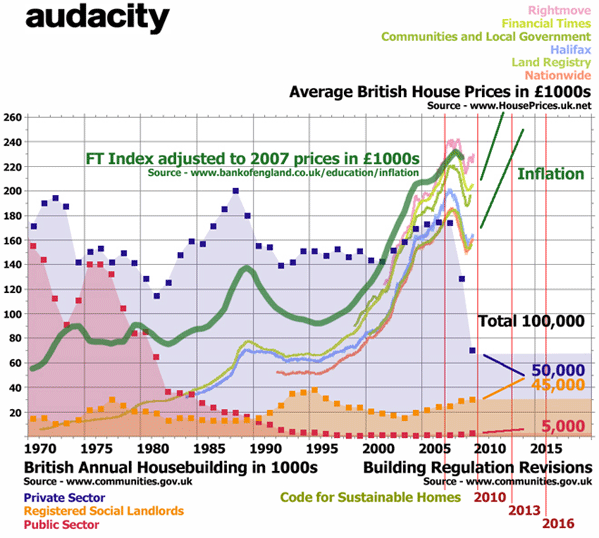
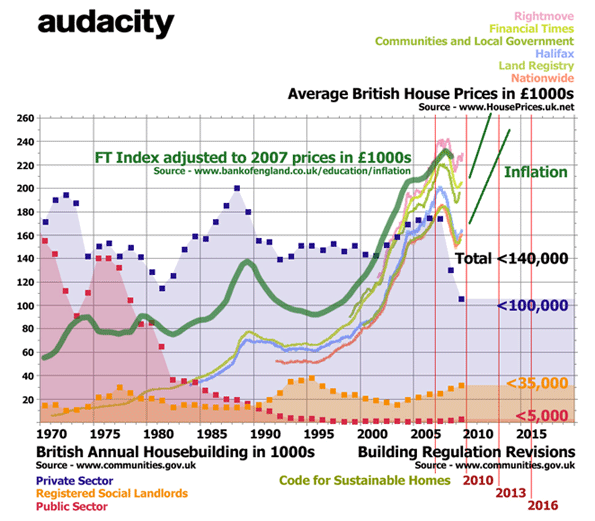
    British house construction has remained at a low level for a decade.   Total new house and flat completions for all tenures last year were 113,670 for England, 17,470 for Scotland, and 6,170 for Wales. Excluding Northern Ireland that is 137,310 for Britain. Under 140,000 homes a year is low for a nation of 60 million.

    We are nearly at the lowest level of housing production since reliable records began in the 1920s. (Note 1)  

    Anyone expecting British house building to pick up soon will be disappointed, even as the housing market inflates into another bubble. Grant Shapps,  the Coalition government’s Housing and Local Government Minister, is also hoping that house price inflation will not return to make the present housing predicament worse.  

    He will be disappointed, too. Shapps wants modest deflation and more houses to be built. However, he is powerless to make that happen while his government sustains the national denial of Freehold development rights that in Britain defines the planning system. By denying landowners the right to build on any land they own, the system works against significant levels of housing production.

    The renewal of house price inflation

    The low level of production all but guarantees renewed house price inflation. According to estate agency Savills, inflation-adjusted house prices grew by 68 per cent in the decade up to 2010, even after the British housing market finished wobbling during the sub-prime mortgage finance crisis. Savills told readers of The Telegraph that house prices will inflate by 40 per cent in real terms over the next decade.  

    Britain’s vast majority of home owners will be relieved. Most people have felt uneasy with financial dependency on the debt and equity in their home. For most British households wages and pensions are insufficient.

    At the root of the problem lies the peculiar nature of Freehold in Britain. The government enjoys an effective national instrument in their effort to protect the housing market. An old innovation of the post-war planning system, this ensures cheap farm land can never come onto the market to allow the building of low cost homes in great volume, sufficient to precipitate a housing market crash worth having. Planning as a denial of development rights works very well to protect the members of the Council of Mortgage Lenders.

    This keeps house building volume low.   Britain’s former volume house builders have begun to make the painful adjustment to work within the Coalition’s planning system. It will not be easy for them.

    The national denial of development rights is sustained, and in many ways the problem is worse under the Conservative-led coalition than under New Labour.

    The house builders have been stripped of New Labour’s national target of 240,000 net additional homes a year, but that was an unmet and inadequate target.   Even more troubled are plans to develop 50 proposed “eco towns” also proposed by Labour, itself a small, even deluded, enterprise that is pathetic compared to development elsewhere in the world.

    Urban expansion and new settlements – whether in Britain or elsewhere – require land. And Britain, contrary to popular belief has land aplenty. The restraints placed on builders can best to described in the words of Sir Peter Hall, as a “Land Fetish”.   

    The planning system also is host to an eco-fetish that the Coalition appears willing to sustain regardless of housing need.

    Inevitably some house builders will have subscribed to the idea that the environment is too precious to allow much land to be developed, but not all.  This leaves no centralised attempt to satisfy the demand for new household formation following from population growth, the needs of immigrants, or to encourage the replacement of the worst housing stock. For greens of the more misanthropic persuasion, opposition to both population and production makes sense. They don’t want humanity to reproduce either biologically or industrially. They don’t want a world that is always about advancing human interests through industry.

    Yet the need for new homes won’t so easily go away.

    A three sided predicament

    This contemporary British housing trilemma will not be easily resolved. The country seems to accept expensive, inadequate housing and mortgage debt as a fact of life.  

    Yet this leaves us with no solution for future needs.

    Something needs to change.  Hugh Pavletich and Wendell Cox publish as Demographia have found – for the seventh year running – increasing unaffordability of British housing.  

    The Solution: 250 New Towns

    The only reasonable solution is to tear down the current planning structure. What we need is an audacious move to build some 250 new towns.

    This movement would try to replicate past successes. In the brief inter-war period, 1918 to 1938, popular owner occupation flourished, with economically struggling farmers keen to sell their Freehold land to house builders.  

    How long will Britain live with low levels of construction, increasingly higher prices and consistently low levels of affordability? The increasing drag of house price inflation on household incomes and the acceptance of poor quality British housing in short supply cannot be sustained indefinitely.  

    How long will Britain sustain housing unaffordability as a financial opportunity, protected by a weak government?  

    The British collective obsession with inflating house prices must end sometime, unless we are to lose all sense of housing primarily as somewhere useful to live.  

    The freedom to build on your own land will deflate the housing market, dramatically in some locations.  Giving all landowners their Freehold right to build will liberate the commercial construction industry from the burden of inflated land prices, allowing disruptive advances in industrial production.  

    If Britain faces the house price inflation projected by Savills in the next 10 years there are many home owners dependent on housing equity who will not object. Neither will the house builders object too much as they build a low number of luxury eco-homes, to the undoubted applause of the architectural press. They may enjoy the praise for their greenness. Farmers might subsist as environmentalists. Greens will be sufficiently deluded to imagine there was some point to all this. The City will make a healthy return.

    The green zealots are conspicuous, and need to be confronted by industrialists with a sense of humanity. Now is no time to let them get away with their anti-humanism.

    Britain certainly is capable of more than is currently being discussed. National housing output had peaked in 1968 at 413,714, more than twice the current rate.

    We have to answer the question: Who will organise to better explain and end the housing predicament in low wage industrial Britain? We are hoping the 250 new towns club can start the ball rolling.

    —-

    Note 1 – Marian Bowley, ‘Table 2, Numbers of Houses Built in England and Wales between January 1, 1919 and March 31, 1939’, in Housing and the State 1919-1944, London, George Allen & Unwin, 1945, p 271

    Ian Abley, Project Manager for audacity, an experienced site Architect, and a Research Engineer at the Centre for Innovative and Collaborative Engineering, Loughborough University. He is co-author of Why is construction so backward? (2004) and co-editor of Manmade Modular Megastructures. (2006) He is planning 250 new British towns.

  • There is no “Free Market” Housing Solution

    The common line used by advocates of housing affordability has been that the solution lies in “free markets”. Yet this “free market” solution does not address the fundamental problem which is really a political one.

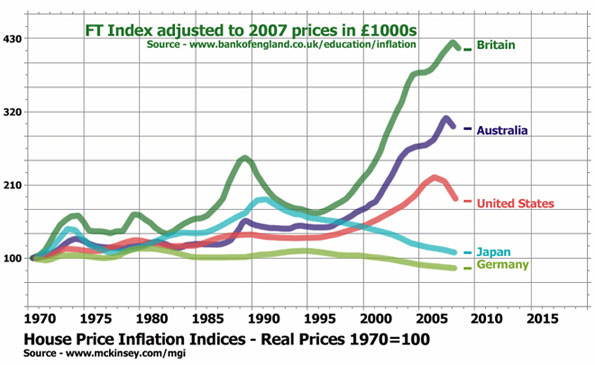
    This true fundamental problem is particularly evident here in Britain, the leader in house price inflation and housing financial bubbles since the 1970s. In their recent report Global capital markets, the McKinsey Global Institute has confirmed what has been shown in recent Demographia surveys.

    The root of this problem lies with an elite agenda that is highly ideological. The ideology at work is environmentalism, making a moral virtue of the retreat of political and commercial elites from the industrial production of housing.

    The preference is for interest payments on a fund of mortgage debt rather than the effort of turning a profit from development, let alone construction. Professionals like estate agents, planners, architects, and bankers are certainly in collusion with that elite ideology.

    That is not to say there is a conspiracy to plan a housing bubble. That is too crude. There is clearly regulation and legislation. On 24 November 2009 the Housing Minister John Healey confirmed that Britain will be the first country in the world to require zero carbon homes as a matter of law from 2016. Britain is the world leader in green ideology.

    John Healey
    All of the newly built British housing will have much better insulated walls, windows, roofs and floors. The clear aim of the government is to keep reducing the energy consumption of all new homes to be measured in kilowatt-hours per square metre of floor area per year. New Labour hope to make it law that total energy consumption is no more than 46 kWh/m2/year for semi-detached and detached homes, and then no more than 39 kWh/m2/year for all other homes. The energy efficiency standards will be applied from 2016, subject to yet another consultation on the Code for Sustainable Homes, announced at the end of 2006, and technically published for use on a voluntary basis in 2007. The building regulations get revised in 2010, 2013, and 2016 leading to this legal requirement for maximum energy consumption in all new homes.

    Healey says that “zero carbon” is a concept that will apply to a new home at the “point of build”. ‘We are not going to regulate through this policy how occupants live in them,’ he says. However the Code for Sustainable Homes assumes patterns of behaviour. Environmentalists within and without government will argue that behaviour needs to change. They will be suggesting all sorts of intrusions into daily life.

    British environmentalism couldn’t be more ideological, and more of a barrier to the production of affordable housing. The planning system has been “greened”. The mood is against development, and planning approvals for new land for new housing are hard to obtain. The zero carbon requirement will only apply to around the 100,000 new homes that will be built annually, while the existing stock is around 26 million homes. Healey is also going to regulate existing housing, and is not just looking at the residential sector.

    I am sure politicians like Healey don’t want their pursuit of “zero carbon” buildings to mean that fewer buildings are built. I am sure there are some environmentalists who will be pleased that building activity is in decline. The logic of green thinking entails that the most energy efficient thing to do is not to build more buildings at all.

    It is green not to build new homes to meet demographic demand. Let people modify their behaviour, say the environmentalists, and live together in as much of the existing stock as can be refurbished. It also happens that the existing stock is highly mortgaged, and the vast majority doesn’t want their homes to fall in value. An indefinite policy of green refurbishment of the homes that already exist and a future of house price inflation are highly compatible. That suits the mortgage lenders and the government. The commitment to “zero carbon” allows government to appear virtuous in its legislation for the new build sector.

    This suits the financial markets as well, since it guarantees house price inflation by making it difficult to meet the demographic demand for homes. Environmentalism offers more and more reasons not to build. Green thinking ensures that house price inflation can be sustained through a bubble, and projected beyond the bursting of that period of financialisation into the next.

    As capitalism ”greens” itself, capitalists continue to profit, while not meeting the fundamental demands of the people for housing. But simply restoring “the free market” will not solve the problem. In an old industrial country like Britain, there are ever more people who don’t earn enough to buy a home even at the “affordable” price of two and a half times their gross annual household income, which is the Demographia measure of affordability.

    This reality has a great appeal to what Robert Bruegmann refers to as “the incumbents club” – established homeowners, increasingly older, and those with inherited money. That majority want homes to be an appreciating asset, not a depreciating utility, like a pair of trousers, or a car. They want their home to appreciate in value, and they want to be green. Most people want to be greener and better off.

    Being anti-development for green reasons allows the incumbents to preserve their wealth, while making mundane opposition to new house building, or the attempt to constrain “sprawl”, seem virtuous. People don’t wake up thinking that they will inflate the value of their home by resisting sprawl in principle. Instead they oppose new development in the mistaken belief that Climate Change is caused by sprawling development. It is common for people to think that sprawl is bad for the planet, even while living, mostly with a mistaken sense of guilt, in the sprawl.

    By hoping for a “free market” solution to the problem of unaffordability, Hugh Pavletich of Demographia assumes that it is politicians, businessmen, and professionals who have distorted the market for reasons of narrow and immediate self-interest. Yet that is not how people think: they believe their environmentalism is morally above self-interest. They are saving the planet in their minds by blocking new building, and by their opposition to sprawl. The incumbents’ club members can feel virtuous at little cost to themselves and don’t worry too much about house price inflation. Of course there is no actual Club. There is no conspiracy. Homeowners simply share a self-interest in raising the value of their home, and tend to also want to show how selflessly green they are.

    This all has had the effect of making the lending of mortgages on inflated land values a much larger business than the construction of homes. No-one planned to cause a sequence of bubbles, but Britain’s desperate social dependence on sustained house price inflation can’t be brought to an end easily.

    The only way to stop national or regional housing bubbles recurring is the establishment of the freedom for everyone to build a home on cheap agricultural land without any government or professional hindrance except in matters of technical building regulations. Fire should not spread, and buildings should not fall down. But even building regulations can become ideological rather than technical. The British building regulations, as Healey has made clear, will also push energy efficiency standards to illogical extremes of peak performance in an attempt to address Climate Change. Even while the supply of new homes reduces

    The political freedom to build wouldn’t be a “free market” because not everyone is able to raise the finance to buy cheap land and pay for construction. The idea of a “free market” is a long running ideological myth. But the universal freedom to build would mean people are free to attempt to raise the finance to buy land and build.

    More importantly, the freedom to build would undermine the financialisation of the housing market. If everyone was free to build on cheap land the incumbents’ club would have to compare the value of their existing home to the cost of building a new one. Mortgage lenders would not be able to lend over the cost of construction unless they felt secure in doing so. The security of the 1947 Town and Country Planning Act would be removed for financiers. Government, the finance system, planners, or the incumbents’ club will be ideologically opposed to that for a host of environmental reasons. Britains mostly want to be greener but with renewed house price inflation, while no-one wants to make an argument explicitly for un-affordability. This may be confused and deluded, but it is an ideology promoted by the British government.

    However, ideas can be challenged and changed. One step is to understand that there is no “free market” housing solution. Getting rid of the 1947 denial of the freedom to build doesn’t mean an end to planning. Homes will still need to be planned, just as they were before 1947. But planners will not have the power to stop people from building. There is a need to politically end the environmentalist denial of the freedom to build in an industrial democracy. With a population free to build the finance system would be more interested in cheapening new construction on lower cost land, and not preoccupied with securing the financialisation of periodic but persistent house price inflation. A freedom to build is very much not a right to a home. It is a freedom from the obstructions of planners, with the weight of government legislation behind them. A freedom that is denied to protect the environment, a denial that sustains house price inflation.

    The market is not capable of being a “free market”. Capitalism is a system of control by political and commercial elites, and their professional employees. British capitalists tend to be less interested in industry, which is held to have caused Climate Change, and more interested in finance these days. What is precisely missing in the face of the morally selfless capitalist ideology of environmentalism is an ideology in favour of raising the productive capacity of the construction industry based on a universal sense of immediate and material self-interest. Getting rid of the 1947 planning legislation is a limited attempt to reconnect house building with the cost of construction and household incomes by removing the means by which house price inflation is sustained. Homes would be more of a utility than an investment in Britain, and we would cease to be world leaders in housing based financial bubbles.

    To do that requires us to oppose those who would be world leaders in the environmental ideology that industrial production is a problem for the planet. In Britain we need to set people free to build housing to the best of their abilities within a capitalist planning system stripped of the legal powers it gained in 1947. Innovative in their day, British planning now only sustains housing bubbles and restricts people’s opportunity for decent housing.

    Ian Abley, Project Manager for audacity, an experienced site Architect, and a Research Engineer at the Centre for Innovative and Collaborative Engineering, Loughborough University. He is co-author of Why is construction so backward? (2004) and co-editor of Manmade Modular Megastructures. (2006) He is planning 250 new British towns.

  • Predicting the Future of British House Building

    People are expecting British house building to pick up. Sadly they will be disappointed, even as the housing market inflates into another bubble.

    There have been declines and recoveries in British house building before the 2007 collapse in construction activity. Data is in abundance. The total number of homes built annually has more than halved since the late 1960s, as successive governments withdrew from publicly funding the post-war welfare programme of council house building. There have been ups and downs in the volume of private housing built. After building 175,000 private homes in 2007 many expected that the market for new private housing would eventually recover from the financial crisis. The pent up demographic demand for new private housing would surely lead to a recovery of building if financing were made available. It seems irrational to suggest that the supply of housing will not recover to meet demand.

    In July 2008 audacity argued that British house builders would be collectively reduced in the planning regulated market to building 100,000 homes in 2009. They would shift from aspiring to build in “volume” to making their money from planning approved “eco-homes” for a luxury market. This has already occurred and there will be no necessary recovery of volume in a few years. Production may even decline from that level of inactivity.

    There seems little demand for new housing from the Public. Instead, we seem to be most concerned that housing continues to inflate in value as an asset. Most see obvious advantages in housing asset inflation, while complaining of the unaffordability of better housing. Britain is experiencing house price inflation again, but home owners know that the worsening gap between household income and the cost of buying a home, even on very low rates of interest, is frustrating new buyers, and the young in particular.

    Gordon Brown knows that playing the housing market is a mainstream activity for the electoral majority. New Labour is doing what is necessary to revive housing asset inflation. Some had hoped that the bursting of the bubble in 2007 would reconnect house prices with household income. Young people were understandably most hopeful of that prospect. Now prices are drifting upwards again to unaffordable highs. This is happening nationally, but is particularly true in greater London, where average house prices have recovered to nearly £270,000, which is where they were before the collapse of Lehman Brothers in September 2008. This makes an average house “affordable” to those earning more than £90,000 a year. That is a very small percentage of the region’s home buying public.

    Here’s what the restoration of higher prices means nationally, and in London in particular. There will be greater social immobility, expressed in more commuting, an extension of families, and several households living in the same home. Overcrowding will be more likely. Homelessness may slightly increase, but most housing difficulty will be accommodated within the existing stock.

    The mainstream majority of the electorate – those already owning homes – is likely to be grateful that the burst bubble did not turn into a crash. New Labour will try to take the credit for averting any further financial disaster. What will be ignored is that house price inflation suits Britain’s politicians, and the lending institutions in The City. The British economy is too weak to pay higher wages, and the mainstream majority are too politically weak to challenge that predicament. What other future is there for Britain except another asset inflation bubble?

    The problem then with restoring the Brown bubble is it solves none of our fundamental problems: notably a weak economy, low wages and lack of decent housing. David Cameron’s Conservative opposition will not make any difference to that predicament. They want to get rid of regional tiers of planners and to return control to local authorities, as was the intention of the 1947 Town and Country Planning Act. That is the legislation that stops the British public from building housing on cheap farmland.

    But it’s doubtful they will try to break the back of housing inflation and our country’s dependence on it. The British economy depends greatly on The City, which needs to expand the £1.2 trillion of mortgage lending in a secure way for lenders in the global financial system. This only happens when existing house prices are maintained well above the cost of constructing new ones, and best in a period of asset inflation. The trickle of new homes onto the market could reduce, and while any demographic demands of a growing population for the utility of housing would not be met, the political and economic demand for asset inflation and loan security will be satisfied.

    The way in which existing homes are made more expensive than the cost of building new ones is to inflate the price of land and keep it inflated. It is the high price of land approved for development within the 1947 legislation that is unaffordable. That is why government and house builders recognise there is “planning gain” to be negotiated over, as the uplift in land value that follows an approval to develop.

    Yet this stands in the way of a clear public interest. Government housing experts argue we need at least 240,000 new homes a year to meet demographic demand. Our inability, or even unwillingness, to tackle this issue would have shocked either the Conservatives or the Socialists of the last Century.

    What matters is to make materialist sense of the future. Society can’t live off asset inflation and debt. We must build new housing.

    We face a serious predicament today. Small quantities of highly subsidised and high density “eco-homes” are to be built by socially motivated architects, some working with the former “volume” house builders. How can building an insufficient number of homes be called “sustainable”? Instead of building new replacement homes Britain is also looking to finance a greener and endlessly refurbished housing stock, while producing too few “eco-homes” even to accommodate yearly household growth.

    The finance obsessed Green Capitalists of today are worse than their counterparts from a century ago. At least the Capitalists of the past were materialists, who believed in building more, and developing a construction industry based on materials manufacture and the skills of the workers they exploited. Those Capitalists were progressive materialists.

    The new capitalists in housing are not even interested in meeting the needs of the working and middle classes, but in pleasing environmentalists. Unsurprisingly, they also will not have to hire too many workers to build their meagre product. Today Capitalists are abandoning industrial production in favour of finance, and this is nowhere more evident than in housing. Hiding behind the moral claims of environmentalism the Capitalists of twenty-first century Britain have clearly abandoned any idea of social progress, when once they could claim to be materialists. What is noticeable is that they have so many moralistic Greens cheering them on.

    Sadly, there is no political association today to oppose Green Capitalists operating a nationalised planning system, in their effort to realise asset inflation in the form of a housing market. New Labour under Gordon Brown will not change this – indeed he clearly favours housing inflation and the City over the needs of aspiring families. So do the Conservatives under David Cameron. At the same time, they can play to a green constituency, which now dominates the media.

    Given the current planning regime and the moral imperative for building “eco-homes”, British house builders will be reduced to building around 100,000 homes for a very long time. They will aspire not to build in “volume” but instead take pride that their homes are “sustainable”.

    Only a political challenge will improve the situation. Gordon Brown faces no political challenge from David Cameron. He never will. Under New Labour or the Conservatives the only future for house builders will be to offer highly differentiated luxury “eco-homes” for the equity rich, or the top quintile of earners, supported with high subsidies in some form to build affordable “eco-homes”. Architects will particularly benefit from this shift in the market.

    New Labour will build a few council homes more as a publicity stunt to keep their middle class Old Labour supporters amused. Conservatives will not bother about such nonsense. They will both insist on “zero carbon” new housing by 2016. Both will focus on refurbishment of the existing stock, not replacement. Both will exclude more land from the planning system.

    The only people who will challenge this predicament, this retreat of Capitalism from population growth and industrial productivity, will be the working mainstream middle. Brown thinks he has bought off the majority of home owners with asset inflation, and temporarily he might have relieved many. Cameron thinks he can further mobilise established local residents attempting to extract more “gain” from the planning system. He imagines local opposition to development aggregating to a general protection of house price inflation nationally.

    These Red/Green and Blue/Green political leaders might be proved wrong. The construction industry matters, and with argumentative organisation materialists might push for house building against the greens of Britain. Most of all there is the new generation of British people – those entering their 20s and 30s – who will demand something other than over-priced, undersized and often miserably maintained housing for themselves and their families.

    A longer version of this article originally appeared at www.audacity.org/IA-07-11-09.htm

    Ian Abley, Project Manager for audacity, an experienced site Architect, and a Research Engineer at the Centre for Innovative and Collaborative Engineering, Loughborough University. He is co-author of Why is construction so backward? (2004) and co-editor of Manmade Modular Megastructures. (2006) He is planning 250 new British towns.

  • UK Green Path leads to Deindustrialization and Worsening Housing Shortage

    The First Secretary of State, Secretary of State for Business, Innovation and Skills, and Lord President of the Council, Peter Mandelson, together with Ed Miliband, the Secretary of State for Energy and Climate Change, have published The UK Low Carbon Industrial Strategy. They are claiming it promises an “economic revolution” but is in fact an environmentalist retreat from industrial production It is a disastrous strategy that will result in further de-industrialisation, supposedly with the aim of addressing a rather vague threat of climate change.

    Mandelson and Miliband insist The UK Low Carbon Industrial Strategy “can ensure that our economy emerges from the global downturn at the forefront of the technological and social shift that will define the next century.” Yet this is typical establishment “greenwash”, which many institutional and corporate leaders of the construction industry will sadly rush to endorse. It will shift us towards the laborious construction of new eco-homes, and the laborious refurbishment of the stock of mostly draughty, poorly insulated, and badly serviced housing. All this is aimed to achieve, at least on paper, a contribution to a national carbon reduction target by 2020.

    Government thinks that it will be building 240,000 “zero carbon” homes every year by 2106. In fact at least 500,000 homes are needed every year to meet household growth and replace the oldest of the stock at a rate of 1% a year. Yet in reality this year new house building is down to 100,000 a year, and there is no reason why that level of production will increase even when, as is starting to happen, house price inflation returns. Instead of promoting mass production, most house builders are quite likely to follow The UK Low Carbon Industrial Strategy to become luxury eco-home builders. They will be content to build around 100,000 “green” homes a year to get through the planning system. They will build homes that show their environmental credentials by the thickness of walls and roofs – full of sheep’s wool or hemp, packed with straw bales, or made from low-fired clay blocks.

    This, of course, is the approach to new house building promoted by Prince Charles and the other would be green gentry. He advocates “the use of local materials to create local identity which, when combined with cutting-edge developments in building technology, can enhance a sense of place and real community.” Just as Mandelson and Miliband claim theirs is an industrial strategy, Charles promotes green building technology.

    Charles talks of building walls and roofs thickly in “volume”, but what does his royal greenness know of the market? Government also imagines it can use renewable insulation materials to produce “affordable” housing. Walls and roofs will get thicker, but housing will not be built in sufficient quantity for a growing population, and will not be affordable on most British household incomes.

    The green tendency will be to use greater thicknesses of less processed, more laborious-to-install insulation materials, cut-to-fit on site. This will make the walls and roofs on new eco-homes around half a metre thick, but that might be fashionable. Having more material in the walls and roof will show how little energy is used in the new and expensive eco-home.

    Thick insulation is an immediate problem in the refurbishment of the stock of 26 million existing houses and flats. It is not always possible to cover the outside with great thicknesses of natural materials that, contrary to the Prince’s claim, have a low capacity to insulate. Even industrially produced fibres and foams, which green purists think are too processed, must be used thickly. It is less possible to apply thicknesses of insulation inside the existing home, when most British homes are so small. A lot of filling of masonry cavity walls has been carried out under energy efficiency schemes, with little regard for why the drained air cavity was there in the first place. But no existing housing has walls with cavities of up to the 300mm that would be required for insulants that satisfy greens.

    The architectural fact is that only made-to-fit insulation, prefabricated as an industrially processed product, can achieve the thermal performance being discussed with a minimal thickness.

    Sheep’s wool and hemp, straw bales, and low-fired clay blocks are positioned increasingly off the scale to the right on thickness. Foam glass as an industrial product is poor as an insulant, as is cellulose fibre. The sorts of glass and mineral fibre insulation that can be bought in any builder’s merchant require substantial thicknesses. Foams have better performance, and are familiar as cut-to-fit insulation. However only the use of processed vacuum insulation, as a made-to-fit industrial product reduces insulation thicknesses to the architectural dimensions required.

    On behalf of New Labour Miliband boasts that Britain has produced a carbon reduction plan to 2020 that should inspire other industrial and industrialising nations. “Having been the first country in the world to set legally binding carbon budgets, we are now the first country in the world to assign every department a carbon budget alongside its financial budget,” he told the House of Commons. We seem to be the first country in the world to ignore the space- and time-saving potential of construction technologies that require energy in their production processes, but save energy in the long term operation of well serviced buildings.

    Britain is retreating from industry and makes an environmental fetish out of bulky “natural” materials that don’t work well. Why favour materials that are lightly processed as agricultural crops, or are low-fired but need rendering? Why not accept processing, as all timber is processed, and welcome the durability of fully fired bricks? This carbon obsessed idiocy in construction works against other great materials like concrete, glass, steel and aluminium.

    For their part government is insisting that insulation must be renewable and crop-based rather than an industrially processed product. This means that small British houses and flats will be thickly walled and roofed and will be built in too few numbers to accommodate British household growth. Every existing home must be refurbished indefinitely. That is truly pitiful for an old industrial democracy like Britain.

    Government abuses the words Industrial and Strategy, sharing the Prince’s low aspirations for twenty-first century construction and architecture. An industrial strategy worthy of the name would promote the development of highly processed vacuum insulation, and would expect skills in design, manufacture, installation, and maintenance.

    An attempt to make “green jobs” rather than raise productivity and wages, The UK Low Carbon Industrial Strategy should be seen and criticised as an environmentalist strategy of de-industrialisation, because that is precisely what it is.

    Ian Abley, Project Manager for audacity, an experienced site Architect, and a Research Engineer at the Centre for Innovative and Collaborative Engineering, Loughborough University. He is co-author of Why is construction so backward? (2004) and co-editor of Manmade Modular Megastructures. (2006) He is planning 250 new British towns.

  • Prince Charles is Britain’s Master-eco-fraudster

    Thomas Paine was born in Thetford, Norfolk, in 1737. He understood that history is made. Aged 39, writing his Common Sense, he noted that Britain is constituted of ‘…the base remains of two ancient tyrannies, compounded with some new republican materials.’ These were:

    ‘First. – The remains of monarchical tyranny in the person of the king

    Secondly. – The remains of aristocratical tyranny in the persons of the peers.

    Thirdly. – The new republican materials, in the persons of the commons, on whose virtue depends the freedom of England.’ (1)

    Since Britain’s reformist politicians in the House of Commons have shown no republican virtue, in 2009 we now also suffer the “aristocratical tyranny” of the House of Lords being augmented with life peers. These political appointees must give their allegiance to the monarchy, even if they imagine they serve the majority. In contrast to reformists today, the revolutionary republican Paine had the “common sense” to ask:

    ‘How came the king by a power which the people are afraid to trust, and always obliged to check? Such a power could not be a gift of a wise people, neither can any power, which needs checking, be from God.’ (2)

    The king in waiting, Prince Charles, certainly believes in God, and entertains the myths of many Gods, but his claim to the throne in 2009 is that he understands and represents “the natural order”. He has been arguing like this for 30 years. He reiterated his claim in the 2009 Richard Dimbleby Lecture. His is the 33rd lecture held in honour of the veteran broadcaster who died in 1965. Charles had warned in March 2009 that there were only 100 months in which to avoid disaster. (3) He reminded the BBC audience on 8 July that there were 96 months left. The imagined catastrophe he hopes to avoid is otherwise due in July 2017. (4)

    The full lecture is available to see on BBC iPlayer.

    It does not matter if Charles Windsor is “well meaning”. As Paine understood in the Rights of Man, ‘…a casual discontinuance of the practice of despotism, is not a discontinuance of its principles; the former depends on the virtue of the individual who is immediate possession of the power; the latter, on the virtue and fortitude of the nation.’ (5) Prince Charles conveniently imagines himself to be the “steward” of “natural capital”. He has an urgent “duty” in his mind to use his monarchical authority to sustain not only Britain, but the entire planet, in some undefined “natural balance and harmony”. This is his eco-myth, and no matter how benign, how little he uses his power, along with the military command that entails, he cannot be tolerated by a self-interested people.

    We are weak if we allow his eco-mysticism to go unchecked, and to reinvigorate the monarchy in Britain. Those promoting Charles as the spokesman for “natural capitalism” are worse than weak.

    Charles talks of not taking too much “income” from the Earth, which makes him sound modest in his monarchy. He does not seem like a feudal monarch. Yet Paine could see through this in 1792:

    ‘As time obliterated the history of their beginning, their successors assumed new appearances, to cut off the entail of their disgrace, but the principles and objects remained the same. What at first was plunder, assumed the softer name of revenue; the power originally usurped they affected to inherit.’ (6)

    The Windsors have been adept at assuming new appearances since the Second World War. Where his grandmother walked through Blitzed streets, and his mother managed to appear “ordinary”, the now 60 year old Charles makes an effort to appear “green”. He is an environmentalist promoting the stasis of sustainability, and the political deception works to the point where in drawing his revenue from “natural capital” he seems to be doing not only the British people but the whole of humanity a favour. ‘If we fail the Earth, we fail humanity,’ he says. (7)

    Even if he lived as a monarch as poorly as the majority of the world does, he would still be a focus for every anti-democratic interest in twenty-first century capitalism. Of course, even before he inherits the British throne from his aging mother, he does not live poorly.

    With a Parliament of worse than weak representatives checked by a house of new gentry and old aristocrats, all in deference to a feudal monarchy in charge of an interventionist military, Britain is a mostly low paid industrial democracy of debt-laden professional and amateur residential property speculators using a planning system that makes a political and economic nonsense of freehold land ownership. We must find a way to break free of this social containment, (8) focused in Britain on the impending coronation of a “green” king.

    ‘Hereditary succession is a burlesque upon monarchy. It puts it in the most ridiculous light, by presenting it as an office which any child or idiot may fill. It requires some talents to be a common mechanic; but, to be a king, requires only the animal figure of man – a sort of breathing automation. This sort of superstition may last a few years more, but it cannot long resist the awakened reason and interest of man.’ (9)

    In the second part of Rights of Man, Paine was over-optimistic. He thought that kings would make themselves sufficiently ridiculous. While Charles is worthy of ridicule on many occasions, he still commands loyalty from “greens”, even when they are embarrassed by his fantasy of the Earth as “Gaia”, as a conscious entity.

    It is not enough to point out his self-deceptive eco-hypocrisy, or its popularity. The pervasive idea that capitalism is in any way “natural” must be broken. That requires the promotion of industrial production based on an appreciation of the social division of labour. It is necessary to see that in moaning about the effect of “mechanisation” on the environment, for which the contemporary capitalist will even accept moral and legal responsibility, they will abandon industry and make a virtue out of a life of laborious effort, sustained as a “duty”.

    In 2009, 200 years after Thomas Paine died, ‘…environmentalism is the ideology of capitalism in retreat from production.’ (10) That is what we understand at audacity. What people lack is social control of the vast industrial surplus that is produced by all of us. At present the aggregated value of our social production is taken as privately owned capital, partially taxed and redistributed through government, while mystified and made acceptable by the likes of the Prince of Wales as “natural capital”.

    Charles says:

    ‘It seems to me a self-evident truth that we cannot have any form of capitalism without capital. But we must remember that the ultimate source of all economic capital is Nature’s capital.’ (4)

    Wrong. Nature just exists. Only human labour turns nature into product, using machines to enable less labour to produce more. Capitalism has succeeded so far in developing industry so that sufficient surplus is produced beyond the needs of subsistence. That has allowed employers to live off their employees. Paine did not understand the parasitical relationship of the employer on employees. The workforce is paid less than the value it produces. However Paine could see institutionalised fraud that we tend to ignore:

    ‘Monarchy would not have continued so many ages in the world, had it not been for the abuses it protects. It is the master-fraud, which shelters all others. By admitting a participation of the spoil, it makes itself friends.’ (11)

    Democratic society depends on raising the productivity of labour. He may fool himself, and some of his fellow “greens”, but we must not let Charles fool us. He and his backward, stasis-loving supporters must be denied the appearance of being “natural” leaders, as they attempt to promote an anti-machine age of capitalist “sustainable development”:

    ‘Our current model of progress was not designed, of course, to create all this destruction. It made good sense to the politicians and economists who set it in train because the whole point was to improve the well-being of as many people as possible. However, given the overwhelming evidence from so many quarters, we have to ask ourselves if it any longer makes sense – or whether it is actually fit for purpose under the circumstances in which we now find ourselves?’ (4)

    What “model of progress” and what “destruction” is he talking about? In his pre-recorded Richard Dimbleby Lecture, broadcast on BBC One on 8 July 2009, Charles insisted that Facing The Future meant a new system that is more ‘…balanced and integrated with nature’s complexity.’ (7)

    This is complete nonsense, but popular “sustainababble”. The majority needs complete control of industrial advance. That requires a plan to rescue society from “greens”. Prince Charles knows much “…depends on how you define both ‘growth’ and ‘prosperity’.” (4) Much certainly depends on whether most people accept his redefinitions, anticipating his imagined “catastrophe”, or whether we are no longer willing to be subject to his retreat from industrial production. We don’t need to accept his prediction for 2017. We need not be his duped “commoners”.

    “As to the word ‘Commons,’ applied as it is in England, it is a term of degradation and reproach, and ought to be abolished. It is a term unknown in free countries.” (12)

    There is much to abolish in Britain, fraudulent monarchy included, and much to build with “republican materials” in pursuit of democracy.

    Ian Abley, Project Manager for audacity, an experienced site Architect, and a Research Engineer at the Centre for Innovative and Collaborative Engineering, Loughborough University. He is co-author of Why is construction so backward? (2004) and co-editor of Manmade Modular Megastructures. (2006) He is planning 250 new British towns.

    References:

    1. Thomas Paine, Common Sense: Addressed to the Inhabitants of America, 14 February 1776, Philadelphia, reprinted in Mark Philp, editor, Thomas Paine: Rights of Man, Common Sense, and Other Political Writings, Oxford, Oxford University Press, 1998, p 8

    2. Ibid, p 9

    3. ‘Prince Charles: ‘We have less than 100 months to stop climate change disaster” ‘, 8 March 2009, posted on www.dailymail.co.uk

    4. Prince Charles, ‘Facing the Future’, The Richard Dimbleby Lecture as delivered by HRH The Prince of Wales, St James’s Palace State Apartments, London, 8 July 2009. For transcript see here as directed on the Press Release, ‘Richard Dimbleby Lecture 2009: The Prince of Wales’, 9 July 2009, BBC, posted on www.bbc.co.uk

    5. Thomas Paine, Rights of Man: Being an Answer to Mr Burke’s Attack on the French Revolution, to George Washington, President of the United States of America, 1791, reprinted in Mark Philp, editor, Thomas Paine: Rights of Man, Common Sense, and Other Political Writings, Oxford, Oxford University Press, 1998, p 98

    6. Thomas Paine, Rights of Man: Part the Second, Combining Principle and Practice, 9 February 1792, London, reprinted in Mark Philp, editor, Thomas Paine: Rights of Man, Common Sense, and Other Political Writings, Oxford, Oxford University Press, 1998, p 221

    7. ‘Prince fears Earth “catastrophe” ‘, 8 July 2009, posted on http://news.bbc.co.uk

    8. Ian Abley, We are witnessing a British built “housing crisis” that Government is powerless to resolve, 23 July 2008, posted on this website here

    9. Ibid, p 226

    10. James Heartfield, Green Capitalism – Manufacturing scarcity in an age of abundance, www.heartfield.org, 2008, p 91, with details of how to buy posted here

    11. Ibid, p 257

    12. Ibid, p 351