Author: Ian Lausa

  • American Hobbit Houses

    Soon after President Obama took office, a proposed plan to “develop federal policies to induce states and local communities to embrace ‘smart growth’ land use strategies” was announced.

    This “Livable Communities Program” is intended to save land and clean up the environment. It is seen as encouraging denser housing arrangements to deter automobile use and accommodate the transit industry, according to goals set by the Secretaries of HUD, EPA and Transportation.

    One potential downside to this plan comes from the transit industry’s Moving Cooler study, which argues that the Administration’s greenhouse gas reduction proposals “may result in higher housing prices, and some people might need to live in smaller homes or smaller lots than they would prefer.”

    If you want to see how this might work, look at the U.K., which imposed strict land regulations in the Town and Country Planning Act in 1947. This effectively froze the supply of land for a growing population, leading to soaring house prices, particularly in the area around London.

    With the land available for development frozen, house size decreased as well, leading to new British homes garnering the nickname of “Hobbit houses.” New British homes are a little more than a third as big as new U.S. homes (818 sq. feet compared the U.S.’s 2,303 sq. feet).

    The question is whether or not the Federal government should be granted the ability to limit housing standards. Currently, this responsibility lands in the lap of state and local governments.

    Can President Obama afford to add the President of the (Hobbit) Homeowner’s Association of the United States to his title?
  • Don’t Go Looking for Work in California

    The current economic recession has tarnished the Golden State’s employment opportunities in a major way.

    A report released on Sunday by the California Budget Project says that two of five working-age Californians do not have a job.

    The level of unemployment has not been this high since February 1977. In fact, the study found that “California now has the same amount of jobs as it did nine years ago.” The only difference? In 2000, the state was home to 3.3 million fewer working age people than today.

    The nation is not faring much better, as the U.S. Labor Department reported last Friday that the nation’s jobless rate had climbed to 9.7 percent, the highest since 1983. California’s unemployment stands at over 11 percent.

  • Redesigning Suburbia

    Dwell Magazine and inhabitat.com have combined forces to sponsor the first ever “Reburbia Design Competition,” a design competition dedicated to re-envisioning the suburbs.

    Citing the current housing crisis, the sub-prime mortgage meltdown, and rising energy cost, as well as limited natural resources available to increased exurban growth, the two companies have called upon “future-forward architects” and “renegade planners” to reinvent the suburbs.

    Finalists range from a “suburban airship” that facilitates eco-friendly and efficient transportation between the suburbs and the city center to mansions turned into wetlands and natural water filtration systems to freeway wind turbines. All intriguing ideas for the suburban future.

    However, Sean Paige, of The American Contrarian, takes issue with the contest’s “darker side.”

    “Strolling the streets of Reburbia isn’t just an imaginative adventure. It also offers a revealing glimpse into the mind of the modern eco-Utopian, which melds dark apocalyptic forebodings with naive flights of fancy,” writes Paige.

    He feels the contest might propel green zealots to use “levers of power” and the “force of government” to impose an “environmentally- and socially-correct vision of suburbia.”

    How might this happen? Paige argues “that opportunity is there, thanks to the power granted government planners through the mania for “smart growth,” new urbanism and other social engineering fads, combined with the totalitarian tendencies of those trying to “save the planet” from climate change.”

    This is, of course, may be an exaggerated view. No doubt, the Gristers may say this contest would serve merely as a catalyst for developing more probable, and immediate, eco-friendly ideas but a sense of balance would not be inappropriate.

  • Decline in Construction and its Effect on Gender

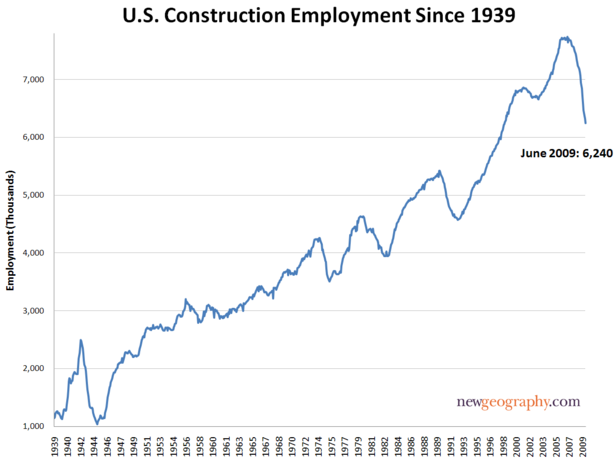
    Unemployment in the construction sector increased by 79,000 in June, according to a report The Associated General Contractors of America released earlier this month. Over the past year, that number has grown to 992,000.

    Even more alarming is the disparity between the construction worker unemployment rate, over 17.4 percent, and the national average for all sectors, around 9.7. Construction employment is crumbling before our eyes.

    The current economic climate has not proven friendly to construction on the whole as state and local revenue continues to decline and little demand for commercial or retail facilities, as well as shrinking orders for new facilities, puts construction in a perilous zone.

    Though as recent as last November, President-elect Obama had conjured up a program to rebuild the nation’s infrastructure.

    The $787 billion American Recovery and Reinvestment Act would modernize roads, bridges, schools, and public transportation – among other things – and reinvigorate the floundering construction and manufacturing industries.

    However, this “shovel ready” stimulus plan did not sit well with women’s groups who wanted nothing to do with a stimulus package that only created jobs for “burly men.”

    These women’s groups seemed to misjudge the president-elects original plan designed to “stop the hemorrhaging in construction and manufacturing while investing in physical infrastructure that is indispensable for long-term economic growth” and instead turned the stimulus into an issue of gender politics. But from the first complaint, onward, the construction and manufacturing industries stood no chance.

    Obama changed his plan, adding health, education, and “other human infrastructure components” to his proposal.

    A report entitled “The Job Impact of the American Recovery and Reinvestment Plan” released on January 10, estimated that the number of jobs created that were likely to go to women was around 42%, a non-too disheartening figure when women “held only 20 percent of the jobs lost in the recession.” The report concluded that the stimulus package would now “skew job creation somewhat towards women.”

    The act was signed into law on February 17 and over the past four and a half months some unfortunate figures have appeared. As noted previously, the construction industry is in a downfall, while there is a growing discrepancy between female unemployment rate (8 percent) and male unemployment rate (10.5 percent) – the highest male-female jobless rate gap in the history of the BLS [Labor Department] data back to 1948.

    All this data, however, has pushed the issue of gender-politics above the issue of human need. Now which group of people should make their voices heard? Let’s hear from women in the construction industry.

  • Fears of Stimulus Favoratism to Pro-Obama Counties is Overblown

    A recent USA Today analysis of government disclosure and accounting records has revealed that counties that supported Obama last year have reaped more of the benefits of the stimulus package than those counties that supported Senator John McCain.

    That federal aid, which amounts to around $17 billion, has been the first piece of the Obama administration’s stimulus package that can be tracked locally. The USA Today findings showed that Obama-counties received an average of $69 per person while McCain-counties received around $34.

    While the disparity between the two looks bad on paper, it is not all that uncommon. As USA Today writes, “much of [the aid] has followed a well-worn path to places that regularly collect a bigger share of federal grants and contracts, guided by formulas that…leave little room for manipulation.”

    The aid has gone to repairs for military bases, improvements in public housing and helping students to pay for college – all areas that eclipse political party lines. Additionally, about a third of the $17 billion allocated towards projects such as runway repaving and nuclear waste clean up has gone to counties that supported McCain.

    It is far too soon to be drawing conclusions about a stimulus effort that favors Obama’s constituents. While we can keep an eye out for “political favoritism,” ensuring that the stimulus aid lands where it’s most needed (regardless of county) should be our first priority.

  • Unemployment Rising in Washington, DC

    In the past month, Washington D.C. has experienced both an increase in number of jobs as well as an increase in unemployment, according to the Washington Post.

    The city’s unemployment rate rose from 9.9 in April to 10.7 percent in May – far surpassing the national average of 9.4 percent – despite gaining about 1,400 jobs primarily with the federal government.

    The District is often considered to be immune to such job market fluctuations because of steady government employment. But as Alice Rivlin, senior fellow at the Brookings Institution, points out, “[D.C.] has plenty of jobs, mostly high-skill jobs that require education beyond high school.”

    The high-paid, higher-skill jobs created within the government are often times given to those not living in the city – Virginia’s unemployment rate: 7.1 percent, Maryland’s: 7.2 percent.

    Job loss has also disproportionately affected the city’s African American population. The predominately white and affluent Ward 3 had an unemployment rate of 2.5 percent in April, far better than the largely poor and black Ward 8, where the rate was 23.3 percent.

  • Manhattan’s Declining Share of New York City Jobs

    The amount of private sector jobs in Manhattan has been declining since 1958, according to the Center for an Urban Future. An increase in job-spread among the other four boroughs – Queens, Brooklyn, the Bronx, and Staten Island – has led to a shift in the New York City job market.

    Still, Manhattan has the largest slice of the Big Apple job pie with a share of 61.59 % in 2008. This number has fallen about 6 percentage points over the past 5 decades. In 1958 Manhattan had a hefty 67.59% share of private sector jobs.

    Needless to say, as Manhattan’s shares have declined, the other borough’s collective shares have increased overall. However, Queens has grown to eclipse Brooklyn with the second largest share in 1978 and has yet to rescind the title. Queens share of private sector jobs sits at 15.07%, while Brooklyn has a 14.09% share. From 1958 to 2008, the Bronx’s share has increased from 5.36% to 6.50% while Staten Island’s share has grown from a minute 0.75% to 2.76%.

    This shift away from the city’s traditional financial sector of Manhattan can seem alarming to those not living in the Outer Boroughs. However, Manhattan-ites can take comfort in the fact that the city’s unemployment rate remains slightly lower than the national average.

  • Can Wind Power be a Reliable Long Term Source of British Power?

    The wind of change is blowing, but for once, that change might be affecting the wind.

    Wind, often championed as a viable alternative-energy source in the United Kingdom, might not be as energy efficient as it was once thought to be. Independent reports of the wind-energy efforts in the UK “have consistently revealed an industry plagued by high construction and maintenance costs, highly volatile reliability and a voracious appetite for taxpayer subsidies.”

    The cost for the energy alternative is sizable. Over the course of fiscal year 2007-2008, UK electricity customers paid a total of over $1 billion to the owners of wind turbines. That number is only expected to rise by 2020 to $6 billion a year as the government builds a national infrastructure of 25 gigawatts of wind capacity.

    Currently, wind produces only 1.3 percent of the U.K.’s energy needs while a 2008 report from Cambridge Energy Research Associates warns that over-reliance on offshore wind farms would only further create supply problems and drive up investor costs.

    Additionally, the average load factor for wind turbines in the UK was about 27.4 percent, meaning a typical 2-megawatt turbine only produced 0.54 megawatt of power on average. Dismissing the fact that low wind days would produce even less, all figures seem to point to poor return on investment.

    Some have suggested the building of cheaper wind farms, but ultimately higher maintenance costs and spare gas turbines to replace broken ones would cancel out any perceived benefits, as gas for the turbines would only add to carbon dioxide emissions.

    At this point, the outlook for wind to be a major source of UK electricity seems grim. Much like the wind itself, the problem just might be uncontrollable.

  • California Natives

    If you are going to San Francisco, be sure to say hello to mom, dad, and maybe your best friend from third grade.

    California has traditionally been a land of migrants from around the country and around the world, but for the first time in the state’s history, the majority of California residents are native-born.

    A study done by researchers at the University of Southern California has determined that more than 70% of those between the ages of 15 and 24 were born in the Golden State. Native-born Californians were also found to be less likely to move out of the state.

    This increase in locally born residents comes with profound implications about the state’s future. For example, more workers will be educated in California, “putting a greater burden on the state’s taxpayers to pay for quality schools.” At the same time, with a greater number of residents staying in-state, a wealth of workers, taxpayers, and home buyers could keep more business from moving.

    Additionally, as more people continue to put down roots, the potential support for investments in such public goods such as transportation networks and public universities could grow as more residents become committed to investing in California’s future.

  • Jobs Continue to Decentralize Within America’s Metropolitan Regions

    Since 1998, most major American metropolitan areas have seen a decline in employment located close to the city center as jobs have moved farther into the suburbs.

    A recent report by the Brookings Institution determined that this “job sprawl” threatens to undermine the long-term regional and national prosperity.

    The report analyzes the spatial distribution of jobs in large metropolitan regions and how these trends differ across major industries, in addition to ranking cities according to their amount of job sprawl.

    The report found that only 21 percent of employees work within three miles of downtown. Using the period before the current recession, the report found that while the number of jobs has increased, 95 of 98 metro areas analyzed saw a shift of jobs away from the central core.

    The Brookings Institute argues that “allowing jobs to shift away from city centers hurts economic productivity, creates unsustainable and energy inefficient development and limits access to underemployed workers.” Yet this may be more a matter of Brookings ideology than a likely far more complex reality.

    Job sprawl is greatest both in areas that have clearly declined – such as Detroit – as well as growing regions like Dallas-Fort Worth. Nor does concentration guarantee success, as can be seen by the mediocore performance of the more concentrated New York region. Yet virtually everywhere jobs continue to sprawl, in many cases faster than even population. Maybe it’s time to learn how to adjust to the emerging future rather than yearn for a return to the economic and geographic structure of the last century.