Author: Jacob Langenfeld

  • Reset Your Life in Flyover Country

    Bert Sperling just released a new list of  “The Best Places to Hit Refresh” and perhaps surprisingly many are located in the much-ignored flyover states. According to the list, five cities throughout the Midwest and Great Plains perfect for those looking to start over. Their methodologies included looking at the city’s overall population, unemployment rates, rates of singles living in the city, and the types of economies that the city can call their own—from oil in the upper Great Plains to education in the eastern Midwest.

    What cities grace the list and why? In fifth place, Sioux Falls, SD, with its location in a state with some of the country’s most business-friendly laws (no corporate income tax, for example), low unemployment rate (5.5%), and a singles rate that rivals some of the larger U.S. metros (19th in the nation) allows for a perfect opportunity for those looking to start over. An economy that includes a number of banks and other financial firms and excellent health care has attracted a huge growth rate in recent years.

    Next on the list is a tie between two more southwestern cities: Lawton, OK and Logan, UT. Both of these locales offer low unemployment rates (5.6% and 5.7%, respectively) and a high singles rate (15.9% and 16.4%). Lawton’s economy consists mostly of the Fort Sill U.S. military base, while Logan’s boasts Utah State University as its major economic provider.

    Next up is the city of Lincoln, NE whose residents enjoy the lowest unemployment rate in the country at 4.1%. The city’s economy is composed of several financial and insurance firms, a Goodyear tire factory, and the University of Nebraska at Lincoln which helps to give the city a high rate of singles at 15.1%.

    The second best city to start over is the northern city of Fargo, ND. Home to Microsoft Business Solutions, Fargo began its growth even before the explosion of the oil and gas industry in western North Dakota. The populace enjoys the nation’s third-lowest unemployment rate at 4.5%, while the presence of North Dakota State University and Minnesota State University at Moorhead contribute a high rate of singles (15.9%) as well as a young feel to the isolated city.

    Finally, the best city to start over according to Sperling is the Midwestern college town of Iowa City, IA. The city boasts a very low unemployment rate (4.7%), a high singles rate (16.1%), and a well-educated workforce thanks to the presence of the University of Iowa. The city’s culture is positively affected by Chicago’s proximity and the university’s label as a Big Ten college, as well as a diverse student population. Iowa City is a flourishing Midwestern city with deep cultural roots that make for a great place to not only start over, but to live as well.

    All of this comes at a perfect time after a University of Iowa journalism professor, Stephen Bloom, openly marginalized the state of Iowa’s populace as the “elderly waiting to die”. Sperling’s list helps to solidify Iowa (and the rest of the Midwest and Great Plains) as a hopeful place with opportunity as fertile as the soil itself.

  • Iowa: Not Just the Elderly Waiting to Die

    Stephen Bloom, a journalism professor at the University of Iowa, created quite a stir in Iowa this week with a piece in The Atlantic describing his unique observations on rural Iowa as evidence that it doesn’t deserve its decidedly powerful hand in the vote for the president. After the article appeared last Friday both his colleagues and the massive student body of the state he so harshly criticizes are returning the favor.

    Mr. Bloom’s writing is not offensive because it contains no truths, but because has over-generalized our collective character as unfalteringly Christian, complacent, ignorant, and uncultured.  He continually describes a sense of delusion that is rampant in the Iowa populace. And, of course, since we’re from Iowa we must have met a meth head before, right?

    When I was a four year old, my parents picked up everything they had and transplanted their lives from Phoenix all the way to Northwest Iowa. I was young, but I can still remember the farm that we originally settled in– it was the kind of farm you see in a painting: a one-level home, a big red barn, two silos for storage, a small thicket grove with a number of deer, and even a fenced-in area for hogs. I was living the rural Iowa dream.

    Eventually, when I was around seven, our next settlement of choice was a (very) small town only a couple of miles from the farmhouse. The city’s population had around 200 people, the vast majority of them at least 50 years old, and a main street littered with old buildings and storefronts of yesterday that had been abandoned over the years since their mid-century inceptions. People didn’t move to this town; instead those living in it would die from old age, or, in my case, move away in hopes of seeing something bigger.

    I’m well aware of the stereotypes of Iowans: we’re wannabe hicks, we’re uncultured, we hunt, we tend to our rolling hills of corn and beans, we all drive Ford trucks because they “ride better” than anything else. I’ve grown up with people that fulfill these stereotypes here and there and I am no stranger to small town life, but not every soul that I have met in this state fits the profile as Professor Bloom posits. Far from it.

    Expectedly, Bloom’s portrayal of Iowans hasn’t exactly had a warm reception. On Tuesday, the Daily Iowan’s front page had perhaps the most outrageous quote that Bloom’s article included, labeling rural Iowans as nothing more than “the elderly waiting to die, those too timid (or lacking in educated [sic]) to peer around the bend for better opportunities, an assortment of waste-toids and meth addicts with pale skin and rotted teeth, or those who quixotically believe, like Little Orphan Annie, that ‘The sun’ll come out tomorrow.’”

    Yesterday, Sally Mason, the president of the University of Iowa, sent out a campus-wide letter reminding the students that she “disagrees strongly with and was offended by Professor Bloom’s portrayal of Iowa and Iowans”. She reminds us of the generosity that Iowans famously possess and of our “pragmatic and balanced” lifestyles. She also goes on to speak about Dubuque’s recent revitalization, the kinds of companies Iowa has attracted (namely Rockwell Collins in Cedar Rapids and Google in Council Bluffs), and the fact that Iowa City, at times called the “Athens of the Midwest”, is designated as the only “City of Literature” in the United States. It seems like Bloom forgot to take any of this into account.

    He even goes so far as to berate and categorize Iowa’s Mississippi River cities as “some of the skuzziest cities” that he’s ever visited. Cities such as Burlington, Keokuk, Muscatine, and Davenport all seem to be more degraded, violent, and worse-off than some of the cities he’s used to having seen growing up in New Jersey, a place with cities that are labeled time and time again for their overall “skuzziness.” Has he ever driven to Newark?

    It seems that Bloom’s laughable interpretation of his years in Iowa have a few rings of truth that I’ve definitely witnessed, but to completely overgeneralize a people into one category assuming it’s only an “Iowa thing” is inappropriate and crude. Is he correct about anything at all? The numbers show that he is off base about the state as a whole.

    The Mississippi River cities’ so-called blight is similar to many other hard hit industrial cities in the Midwest, perhaps on a similar scale to areas in Michigan (which was the only state in the past Census to actually lose population) where Bloom has holed up most recently as a visiting professor for the University of Michigan. Even so, Iowa has the 11th lowest household poverty rate in the nation. So much for widespread blight.

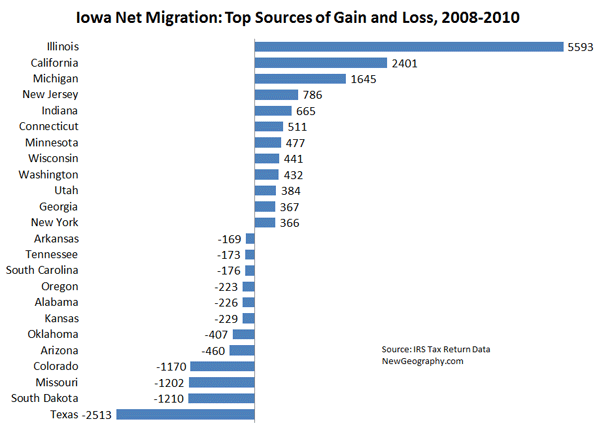
    The state’s brain drain is always a topic of discussion. There has been a very noticeable population shift of rural to urban in the past half-century which was especially fueled by the farming crisis in the 80s, but this trend holds out empirically for all Midwestern states. The problem is that a look at the numbers doesn’t confirm major outmigration. Iowa saw a net gain from other states according to IRS tax return data from 2008-2010. In fact, the net gain from the top 12 source states ­­– states like Illinois, California, and Michigan – in the last three years is 40% higher than the net loss to the top destinations. If Iowans are “fleeing” anywhere, it’s to places like Texas, the largest gainer, and second placed South Dakota which the professor would no doubt like even less.
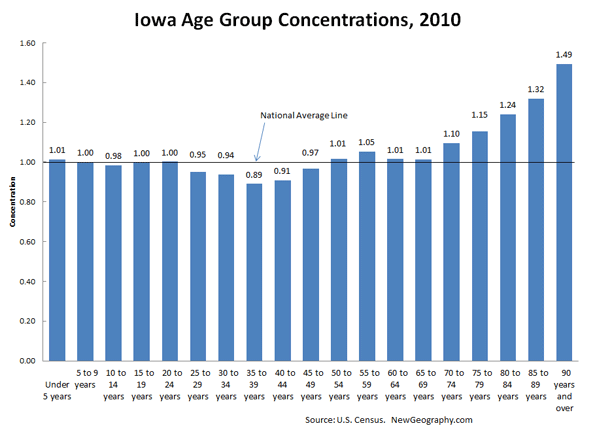
    Iowa does have high concentrations of people over age 70, but that group makes up about 10% of the total population, not enough to skew the other age groups much from the national average. Iowa has an average number of children, and it lags the most in 35-44 year olds: about 10%. This older group skews the state’s educational attainment numbers as well. Iowa’s young workforce is well educated, ranking 11th of all states in residents with at least an associate’s degree. Bloom’s claim that the state is uneducated is simply not true.
    The median age of those living in rural areas is 41.2 while urbanites are relatively young at 35.8. To further add to these negative trends, rural areas have a job growth rate of -6% in the past three years, these numbers mainly fueled by the recession. But overall state jobs are is down 2.8% since January 2008, better than 35 other states. Clearly Iowans are not lazy and giving up.

    Four Iowa cities were even included on CNN Money’s Best Cities to Live in 2011. (This includes the Mississippi River city of Bettendorf.) The state and its cities are also a great place to do business, according to Forbes. In 2010, Des Moines was ranked first, with Cedar Rapids at 13th beating out even a few Texan heavyweights, including Houston, Dallas, and Fort Worth that have been lauded for having a plethora of jobs. The 2011 list puts Des Moines in second place and Cedar Rapids in 11th. It seems Iowa isn’t as economically distraught as Bloom leads us to believe.

    Bloom comes off as nothing more than an ignorant, smug “city-slicker” (a word that Iowans apparently use to describe Obama) who sees the state through an apparently very blurry window. He claims to have seen all 99 counties of Iowa, but how can he possibly paint a portrait of the state that is so absurdly misguided after living here for so long?  If this is what they teach in journalism school, perhaps our skepticism of the media may be better placed than even we suspect.

    Jacob Langenfeld is a senior undergraduate at the University of Iowa studying economics and geography.

    Mark Schill contributed demographic analysis to this piece.

    Des Moines photo courtesty of BigStockPhoto.com.
     

  • Biking in Minneapolis

    The sustainable biking craze seems to keep rolling as more and more cities encourage commuters and wanderers to bike across town instead of drive. New programs, such as Nice Ride in Minneapolis, offer an innovative service where one can rent out a bike for a small fee and ride it across town to other stations, or continue to hold onto the bike and continue making payments.

    Other cities are turning their spokes with similar programs: B-Cycle in Denver, a program in D.C., and Bixi in Montreal all have enough riders to sustain the businesses. While profit from these bikes may be viable, the question of sustainability and more improved quality of life still remains.

    The way Nice Ride functions is endearingly simple: one signs up for a fixed subscription (with discounts for university students) and receives a special key that can be used at any Nice Ride station. The user slips in the key, and unlocks a bike. The bike can then be ridden across town to any station in the city, any time from April to November. In June 2010 when Nice Ride began, this simple plan garnered 10,000 trips in in its first month of use. So has this new model (and increased biking in general) for urban transportation provided any gains for the public other than fatigued legs?

    It seems that the program is a perfect fit for the city’s infrastructure. The city already has 46 miles of on-street bike lanes and 84 miles of bike trails to support such a project. On top of this, the city’s bicycle culture is one of the strongest in the nation, second only to Portland, whose more temperate climate has an edge for those cyclists hoping to commute regularly.

    Something that both cities have experienced is a drop in bicycle/motor vehicle crashes as more and more people decide to utilize biking as their main source of transportation. This “safety in numbers” concept has potentially attracted more and more cyclists each year leading to not only a wider understanding of the bicycle culture present, but safer roads as respect is paid to the cyclists braving the busy roads of Minneapolis and St. Paul as well.

    The biking craze in the Twin Cities has also lead to the area being one of the cleanest cities in the world according to an article featured in Forbes. The research examined many different facets of a city’s infrastructure, including the emphasis the city places upon transportation, including biking. The article cites the city’s extensive use of bike lanes (as well as its transit and bus systems) as the major reason the Minneapolis/St. Paul area is so clean. The Twin Cities ranked fifth on the list, behind the likes of Calgary, Honolulu, Helsinki, and Ottawa.

    So while other cities may stick to the classic emphasis on automobiles, Minneapolis has shown that biking is not only a safe mode of transportation, but one that can help to clean up the urban environment as well. Not to mention the cult cycling craze that many biking cities possess seemingly unifies an active demographic into a hopeful mode for future American transportation.

  • Divorce and Demographics by State

    While everyone seems to know someone who has been divorced, rates can vary widely by state.  Why?  Do high divorce states have anything in common?  We took a look at some visualizations of state divorce rates against a few other demographic characteristics.

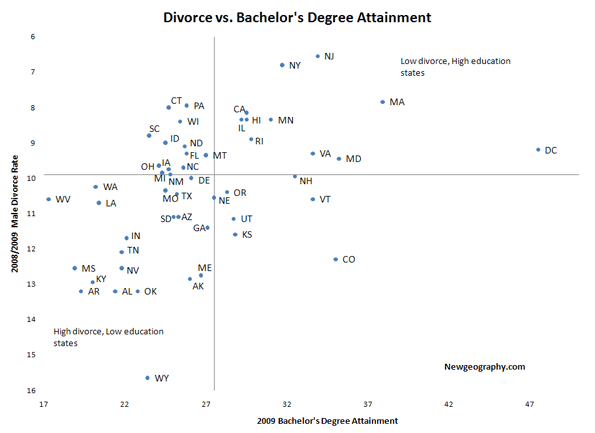
    The latest Census data offers up some observations of how divorce varies regionally. The first graph shows 2008/2009 divorce rate against 2009 bachelor’s degree educational attainment.   We average two years of Census divorce rate data to help even out the variance caused by small sample sizes.

    The chart produces interesting find: states with a high level of bachelor degree attainment (27.5% of the population or higher) also have relatively low divorce rates (lower than 9.9%). States such as California, Hawaii, Minnesota, Illinois, and much of the Northeast fit this profile. Meanwhile, Southeastern and mostly rural states fall in the territory dominated by high divorce rates and low bachelor’s degree attainment.

    This relationship is an alluring one that has been touched on previously. A New York Times article seems to suggest that education does have an impact on divorce rates, especially in rural areas. As married partners become more educated, perhaps this leads to a stronger sense of individualism, or the education of one partner may make them more employable and geographically mobile. The article cites Sioux County, IA as a premier example of this. Heralding from the area myself, I can attest to the strong religious ideologies in that region.

    Orange City in Sioux County is an especially strong example, where a deeply-rooted religious presence mixed with a strong conservative disposition helps to feed a socially conservative society. For example, during the city’s regionally renowned Tulip Festival that occurs every year in mid-May, defacing a precious tulip results in a police citation. On top of this, many storefronts are closed on Sundays, grass must be cut a certain length on a certain day with no exceptions, and taking an absence from the church can lead to adverse social consequences within the community.

    Having such a tight grasp on values leaves little room for anything other than heritage by the city’s residents, especially when these traditions are held in high merit amongst the city dwellers. A strong commitment to a pre-ordained structure seems to have kept women in a certain place — one with less agency and more conformity. Not that this is against any person’s will, quite the contrary: the social structure is geared towards these values and it has stuck since inception.

    Divorce may not work the same in much more populated areas. Regions such as California and the Northeast have low divorce rates while their populations are some of the largest and most concentrated in the nation. Add to this equation the states that contain within them top tier schools (the Ivy League, Stanford, and University of Chicago come to mind) are also more likely to have low divorce rates. Perhaps the emphasis on education in these mostly urban areas has allowed for a more stable social structure. One in which secularism prevails and the choice of marriage between two people suddenly becomes a pragmatic decision rather than one made out of need or what “should be”.

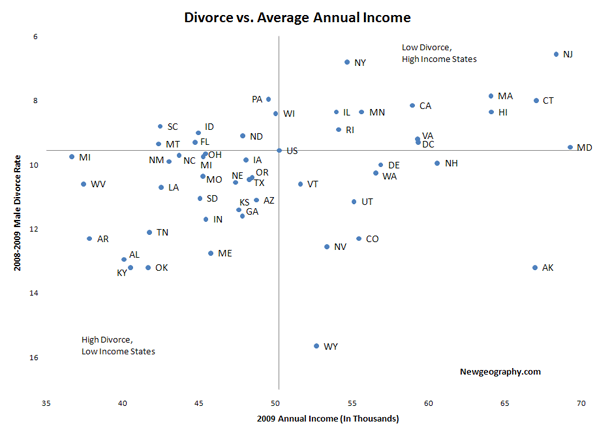
    The chart pitting divorce against average income also reveals a disparity between regions—the higher the household makes annually, the less likely the couple inhabiting it is to be divorced. States such as New Jersey, Hawaii, Connecticut and Massachusetts can all be located here. Meanwhile, households in states with lower incomes (such as states in the South) seem to possess higher rates of divorce. The trend seems to put the Northeast in opposition to the Southeast and the Rust Belt.

    Many of the states settled first with more well-established economies (and perhaps older money) seem to have a lower amount of divorce. Meanwhile, hard-struck regions (Michigan, the Southeast) have below-average rates in general. The more money that households accumulate in these regions, the seemingly lower the rates are. Combine this with less volatile housing markets and economies established in technology and education and much of the Northeast and Midwest seem to be more stable.  Of course, education and income levels are highly interrelated themselves.

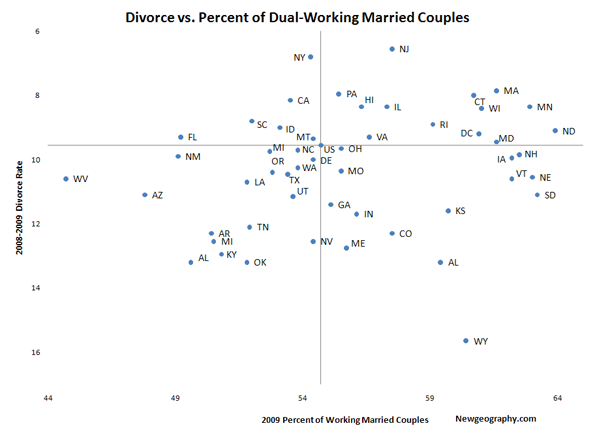
    The last graph displayed here gives the relationship between divorce rates and the percentage of married couples in which both partners work. As in the previous graphs, Northeastern states dominate the first quadrant as well as some Midwestern states.  Meanwhile, the Sun Belt and Southeastern states seem to lag on both measures, much like in the other charts.  Interestingly, in general the northern tier of the U.S. – especially the northeast and northern plains – seems to have a much higher rate of dual income couples than the south.

    The data here may suggest that hard-working couples stick together naturally, or at least persevere more effectively. Perhaps the work ethic amongst couples in these states translates to sound marriage values as well, however correlation to divorce rate seems weaker here than with education and income.

    An outlier for divorce seems to be Wyoming whose high divorce rate (a 2008-2009 average of 16%) places it outside of the bunch in many of the graphs. This may be because of the state’s “quickie” divorces. An article by Wyoming News discusses the reality of Wyoming’s label as “Splitsville” where many couples unhappy with their marriages travel to call it quits. The state lacks laws that force a couple to separate for some time prior to the official divorce, making the state more appealing for those who don’t wish to remain together. With all of the proper paper work in line, a couple could easily end it in Wyoming. Where Las Vegas is the home for a fast espousal, Cheyenne may be the new destination for a speedy separation. 

    Jacob Langenfeld is an undergraduate at the University of Iowa studying economics and entrepreneurship. He aspires to pursue graduate work in one of his many interests, including economics, public policy, and urban issues.

    Photo by DrJohnBullas

  • Home Ownership and the American Dream

    What defines the American Dream? A new poll by Big Builder reveals that one answer to this enduring question may be home ownership. A major portion of the American population (59%) believes that they are living the American Dream. Respondents distinguished owning a home as the second most important factor of the American Dream, just behind raising a family.

    Another statistic in this poll seem to suggest that this trend may be more stifled as the younger generation of Americans (18-29 year olds) come to the crucial decision of buying a home. Still, 49% see home ownership as a “sound investment,” while 49% of this age group call it “too risky.” Perhaps the effect of the weak economy has been especially evident in this age group.

    Some interesting contradictions also arise in these statistics. For instance, 58% of those who believe the housing crisis is a chronic problem also recommend buying a home. Furthermore, 75% of respondents claim to not have benefited from any federal program to assist in ownership (such as mortgage interest deduction), yet 71% confessed to taking the deduction. The pollsters have considered that perhaps the government’s assistance in home ownership may be unclear for many Americans.

    A final statistic worth mentioning is that 58% of Americans believe that fulfilling the American Dream is influenced mostly by their own skills and hard work than by the current state of the economy. The ubiquitous American Dream still runs on hard work and the pressing notion of owning a home, it would seem.

  • Telecommuting and Satellite Cities

    Smaller satellite cities throughout the Midwest may have an advantage that they have yet to realize: strong bases for telecommuters. Cities such as Iowa City, IA; Albert Lea, MN; and Hastings, NE have this advantage, where over four percent of the city’s population works from home according to American Community Survey’s information from 2009. The average rates for larger metros tended to be in the mid 3% range. Here are a few Midwestern cities that were of note:


    % Population working from home

    Albert Lea, MN

    5.7

    Athens, OH

    5.0

    Brainerd, MN

    6.4

    Dubuque, IA

    4.1

    Freeport, IL

    4.8

    Hastings, NE

    5.7

    Iowa City, IA

    4.7

    La Crosse, WI

    4.7

    Source:  U.S. Census American Community Survey, 2009

    These cities have similar attributes: relatively small populations, mostly remote locations, and within 200 miles of a large metro. These characteristics may be a foundation for increased telecommunication in these cities. Could these cities one day become far-flung constituents of a larger conurbation?

    For example, of the eight cities cited above, three of them could call Chicago their focal city. Other cities that act as cardinal municipalities in this list are Madison, Minneapolis, and Omaha. While millions from the labor force pile into large, over-populated metros throughout the Midwest for work, others may be able to find integral employment in these smaller regions, while still in close enough proximity to benefit from the larger markets.

    Telecommuting may also have a positive affect on the quality of life of the individuals who take advantage of the opportunity. A smaller city often makes for lower costs, cheaper housing, less time driving from place to place, and more access to the community. On top of this, rising oil prices have less affect on the telecommuter. Furthermore, some of the cities listed are in an optimal location for natural amenities of the region to be factored in. For instance, Brainerd’s prime location amidst a plethora of lakes and forestry helps to add to the city’s natural lure, while remaining twice daily flight or a 130 mile drive to downtown Minneapolis. 

    If these satellite cities can adapt to be friendly to telecommuters, they may be able to help strengthen the regional economies with a more specialized, more productive workforce. Businesses in the area must be inclined to initiate telecommuting as a part of their workforce and have trust in their workers. A smaller community may make this an opportune place for this, as it forms a more cohesive social unity amongst citizens.

    If these smaller places can maintain reasonable air and telecommunications access, affordable housing, high-end schools and child care, and perhaps flexible small office space or business assistance for lone eagle entrepreneurs, these places could become hubs for this growing segment of workers.  However, the big incentive for those desiring and learning about telecommuting work may simply be the opportunity to do important work in their pajamas.

  • Segregation and Quality of Life

    CensusScope’s dissimilarity index measures the distributions of blacks and whites across a city to quantify the level of integration and segregation. The site discerned three major Midwestern cities in the top ten: Detroit, MI in second; Milwaukee, WI in third; and Chicago, IL in fifth. These cities are major hubs for their region, both socially and economically. But does segregation affect quality of life? And does it help or hinder job growth?

    In order to get a decent comparison between these segregated cities and their quality of life, it’s necessary to take into account three cities with relatively low segregation: Minneapolis at 107; Austin, TX at 179; and Madison, WI at 213.

    To estimate quality of life, let’s look at three factors from the American Community Survey, 2009: Percentage of population with a Bachelor’s degree of higher; percentage of population considered unemployed; and percentage of families below the poverty level. Comparing the different values with their respective city produces an interesting result.


    Chicago

    Detroit

    Milwaukee

    Austin

    Madison

    Minneapolis

    % Bachelor’s +

    33.3

    26.2

    30.9

    38.4

    40.3

    37.5

    % Unemployed

    8.5

    12.4

    7

    6.3

    5

    6.3

    % Below Poverty

    9.1

    11.1

    9.1

    5.8

    5

    5.8

    Source: U.S. Census American Communtiy Survey

    The cities with the most segregated neighborhoods tend to have a less-educated base, contain a higher amount of unemployed workforce, and also have more families below the poverty level. On the other hand, Madison, Minneapolis, and Austin all boast high levels of educational attainment, relatively low unemployment rates, and a smaller percentage of families living below the poverty level, although Austin comes close.

    However, Madison and Austin are relatively smaller than the other areas listed here, and have prospering tech sectors and contain well-known universities that tend to dominate the city’s economy. With respect to this, segregation may not be a factor at all. Instead, the city’s development and more tech-oriented economies may be the answer.

    From these results, one may be able to cite segregation as an obstruction to a strong quality of life. One variable that seems to stick out amongst the data is that of educational attainment. Does education reduce segregation, or does segregation impede education?>

  • The Great Plains: An Old Frontier May Hold The Secret to Recovery

    Could the next zone of opportunity exist in the middle of the country? Census unemployment figures seem to signify this notion, especially in the Great Plains.

    State-wise, November 2010 unemployment rates were lowest in North Dakota at 3.6%; South Dakota at 4.6%; Nebraska at 4.9%; Kansas at 6.5%; and Iowa at 6.8%. Compare these numbers to the ever-growing Sunbelt states where unemployment is at its most dismal with Arizona at 9.6%, California at 12.4%, and Nevada at a depressing 14%.

    The top ten cities with the lowest unemployment rates are all found in the Midwest and the Great Plains, with the exception of Burlington, VT and Portsmouth, NH. The strength of the growing, younger manufacturing industry that escaped the huge manufacturing employment declines in the 80s and 90s may be fueling the prosperity in the plains.

    Upon closer inspection of the economies of these cities, a few common denominators are revealed. Health care is a prevailing industry recurrent across many of the cities. Unsurprisingly, agribusiness and manufacturing also dominate, along with insurance services, food processing, and, in some cases, higher education.

    Metromonitor prepared this interesting piece using data from the Bureau of Labor Statistics allowing one to see unemployement rates throughout the Midwest and the Rust Belt that appear to be on the rebound. The bottom map is of particular interest: One year’s growth has shown a decrease in unemployment throughout much of the Rust Belt, while cities in California and Florida consistently flounder. As far as overall performance, many cities in the Midwest – and much of the Great Plains – remain strong out of the recession and are comparable to the sturdy Texan cities that possess surging economies.

    Perhaps these urban centers across the Midwest, and especially the Great Plains, should be viewed as models for effective economic development. Large cities throughout the Great Plains offer integral services not found for miles and serve as regional havens for essential activities such as health care, education, business services, and food processing. Meanwhile, cities with declining industries, exploding real estate prices, and a surplus of workers suffer. Areas such as the Sun Belt, California, Florida, and some Northeastern cities bare the weight of this dilemma. Our focus should rest on the well-grounded economies of the often-ignored flyover states, instead of those on the crumbling coasts.

  • Kalamazoo Leads Michigan’s Education System

    The city of Kalamazoo in southwestern Michigan may be a shining pinnacle in an otherwise economically withering state. The secret may lie within the city’s well-educated population and its incentives to support an enlightened oasis. For 25-year-olds and older in Kalamazoo, 84.2% have finished high school or higher; 32.7% have accomplished a bachelor’s degree or higher; and 14.4% can boast a graduate or professional degree.

    Compare this to Detroit’s much more bleak statistics: 69.9% of 25-year-olds have graduated high school; 11% have attained a bachelor’s degree; and a petty 4.2% have acquired a graduate or professional degree. The percentage of unemployed in Detroit is 13.8%, while 12.5% are unemployed in Kalamazoo.

    These numbers reflect a well-educated workforce that hasn’t had such an apparent impact from the declining industries in the area. It seems that the answer may be in Kalamazoo’s education services. The most common industries for men and women are educational services, where 13% of men and 17% of women are employed. The area also employs 4% of men and 4% of women in professional, scientific, and technical services, which may lend the city with a more developed economy. Universities such as Western Michigan University and Davenport University help diversify Kalamazoo’s employment base opposed to the historically more manufacturing dependent Michigan .

    Unsurprisingly, Detroit’s leading industry for males is transportation equipment (includeing auto manufacturing) at 15% of the workforce. The share in educational services is much lower than Kalamazoo with only 4% of males and 10% of females employed in the area. Figures for professional, scientific, and technical services were not listed.

    Kalamazoo also has incentive programs for students in the local school systems. The “Kalamazoo Promise” is a program funded by anonymous donors who provide scholarships for students who attend and finish high school in Kalamazoo. Scholarships can total up to 100% of the student’s college tuition. The program started in 2006 and has likely contributed to the area’s 3% growth in student enrollment. In 2008, Detroit began a similar program in hopes of replicating the small economic boom that the Kalamazoo Promise instigated.

    If the city can leverage its higher education institutions and its surging base of high school students entering college, it could ultimately become a prime example of a community improving itself through education. Incentives and opportunities provide citizens with a solid and encouraging way out of a weakening economy inthe state while still providing a standard that the rest of Michigan can attempt to replicate.

    For more Kalamazoo facts and figures, visit http://www.city-data.com/city/Kalamazoo-Michigan.html.

  • South Dakota’s Growth Is Noticeable in the Midwestern Arena

    According to the 2010 Census population data for the United States, the Midwest region was the slowest growing of the four Census regions, at a 3.9% increase overall. South Dakota led the Midwest for population with an increase of 7.9%, while the lowest was the battered state of Michigan at -0.6%. These numbers seem to suggest a shift from the Rust Belt to the Great Plains.

    This is more apparent when considering CNN Money’s list of the top 100 best cities to live in for 2010. Four cities represented the Dakotas on this list while only one city, Ann Arbor, stood for Michigan at number 46. The four cities from the Dakotas were Bismarck, ND at 74; Sioux Falls, SD at 77; Fargo, ND at 86; and finally Grand Forks, ND at 97.

    The odds seem to be against the growing state of South Dakota when compared to the once-great Michigan. Michigan has 32 Fortune 500 companies (the largest being GM, Ford, and Dow), a notable IT strength, three well-known universities (University of Michigan, Michigan State University, and Wayne State University), and is one of the biggest leaders of industrial research and development. However, Michigan’s weaknesses lie in its disintegrating manufacturing industries whereas South Dakota has attained a more promising outlook.

    South Dakota’s major city is Sioux Falls in Lincoln county, which has been named one of the “best counties to find a job” with a 67% increase in job growth in the last decade. Sioux Falls has been named one of the “best places to start a business” by CNN where operating a business costs an estimated 45% less there than it does in New York City. It also boasts a crime rate that is half the national average, is home to offices of many financial giants including Citibank and Wells Fargo that come to the state for its slackened usury laws and positive banking regulations, and has some of the region’s leading hospitals. A determined arts scene and a strong retail sector round out the package.

    Can Sioux Falls be compared to the crumbling Detroit? When considering Sioux Falls to be the major hub of its region (the most proximate major cities are Omaha and Minneapolis, both over 150 miles away) it’s no wonder that many people are flocking there to be a part of its thriving economy that can’t be found for miles. Detroit, on the other hand, is a homogenous product in a competitive market. Other Rust Belt cities find themselves in a corresponding situation, offering a similar lifestyle while depending on declining industries.