Author: James Heartfield

  • Working Class British Voters Led the European Union Rejection

    On Thursday night the first results from Britain’s referendum on pulling out of the European Union came in.

    A small clue to the way things were going last night was the vote in the North East.

    People in Newcastle are known locally as ‘takems’ (said with a short a, like tack um); those in Sunderland are called ‘makems’. It means that people in Sunderland make things and people in Newcastle take them. Sunderland is solidly industrial, while Newcastle, also a big industrial centre, is a market town. Newcastle voted to remain, but by the tiniest of margins. Sunderland voted to leave, 60-40. That was when we began to think that – not for the first time – the polls had got it wrong.

    As the night wore on the results came in, defying the pollster’s determination that the people would reject the referendum question and stick with the European Union.

    Of London Boroughs, Barking voted to leave, too. It was historically a ‘white flight’ borough, but today it is thronging with Poles and Africans. It is very working class. Islington, by contrast, was overwhelmingly for stay. Islington has working class wards, though these are mostly demoralised, and the borough deserves its reputation for being dominated by a precociously radical middle class.

    Most of all the vote is a popular reaction against the elite. Their view that the European Union is not for them is right. I have taken students to the Brussels Parliament, which is a bit like visiting the offices of the IMF. The only people that you see hanging around outside and waiting to see someone, are themselves very haut bourgeois. By contrast, if you go to the Palace of Westminster, you will see large crowds of school children, nurses, veterans, and ethnic minorities. Parliament is often very bad in its decisions and its cliquishness, but the people do look to it in a way that they will never look on Brussels. That law making should have passed so silently and sneakily off to the European Commission is not something that ordinary British people approve of, and they are right.

    The British Labour movement protested against the Maastricht Treaty back in 1991 that created the EU, and had already been committed to a position of withdrawing from the preceding EEC. Labour’s heartlands were in agreement. Over time, though, the temptation of the ‘European Social Chapter’, and the trade union leaders’ resentment at the Tories opt-out of that did tempt some labour leaders (though not their members) to support the EU. That in itself is a symptom of the unions’ loss of influence in their own right; they hoped that their European friends would offer them what their own campaigning could not.

    As the Labour Party became more distant, metropolitan and elitist, it sought to re-write the party’s policy to mirror its own concerns, and also to diminish working people’s aspirations for social democratic reform in their favour. They got rid of the socialist clause in the party’s constitution, Clause 4, diminished union leaders’ say so in making party policy, and, symbolically, they changed the party’s position on Europe from withdrawal to positive support. For younger graduates in London who were the party’s activists, that all seemed to make sense, but a chasm was opening up between the party and its working class redoubts in the Midlands and the North of England.

    There are many facets to this disaffection. People are angry about the NHS. Some of the mood of hostility towards Blair’s government was attached to the Iraq War.

    Latterly, the question of immigration became one that the labour voters came to distrust the Labour leadership on. In private the Cabinet did indeed talk about encouraging wide scale immigration, with the ambition of making the Conservative Party unelectable, by creating a ‘multicultural’ country. In a telling moment in the 2010 election Gordon Brown was caught by a radio mike complaining about a voter whom he had been introduced to. ‘That bigoted woman’, he called her. Suddenly everyone could hear the snobbery in his prissy voice. ‘Bigoted’ here was code for common, uneducated, or perhaps even ‘unwashed’.

    The EU issue was initially raised by the United Kingdom Independence Party (UKIP), which is to say the grassroots of the Conservative Party, peeling away from David Cameron’s leadership. UKIP in that way are a mirror image of the disaffection of the Labour vote. In time, UKIP candidates got some support in Labour constituencies. That was a clue that the disaffection of the Labour vote was about to form itself up around the referendum.

    Asked by pollsters why they had voted to leave the EU, some said it was immigration. But more said that it was the question of democracy. This is a word that seems to mean very little to the academics, government officials, constitutional lawyers and politicians, and yet, strangely, means a great deal to those whose access to it is most limited – the greater mass of the British public.

    Depressingly, the sulking metropolitans and ‘opinion formers’ (Ha!) dismissed this revolt of the lower orders as nothing more than race prejudice. But that says more about those that say it than those that it is said of. To them almost every expression of popular sentiment feels like fascism. They see fascism in the support for the English football team, and lurking in the bad tempered rants of ‘white van man’ as he makes his deliveries. An old drunk on a bus says something mean about immigrants and he is pilloried on YouTube and Facebook as the latest sign of incipient fascism.

    What they usually mean is that the common people have spoken, and spoken clumsily, without the tortuous manners of the intersectional left. But by and large the exiters were not angry with migrants so much as they were angry with the established order.

    A tipping point was the publication of a letter on the front page of the Times, signed by leading businessmen demanding ‘remain’. This came hot on the heels of the claims that all economists (the same ones who had told us that there was no danger of an economic meltdown in 2008) were for remain. Before that the leaders of all the major parties lined up to say that remain was the only viable result.

    Elsewhere in Europe we have seen this kind of consensus form up. The last time was around the proposed EU Constitution in 2004/5. As every respectable voice made it plain that the Constitution effectively making the EU into a superstate was needed, the ordinary people revolted. In referenda in France and Denmark it was rejected. The project was in tatters. The very solidity of the establishment behind the EU Constitution was the thing that sunk it. If this shower are for it, thought the mass of the people, then it must be rubbish. So it was with the EU referendum in Britain on 23 June. The solidity of the establishment case for staying was probably what decided the majority to leave.

    The ‘out’ decision leaves many questions. The traders have attacked the pound – well, they had made it clear that they did not like exit, so we can expect them to try to punish the voters. We will weather it, and the economy’s underlying strength will make them come back for sterling later on.  Shame on them.

    It is by no means clear that the vote to leave will lead to an actual ‘exit’. The prolonged process of leaving set out in the EU Treaty is effectively a ‘cooling off’ period, and a confident political leader – perhaps Boris Johnson, the star of the exit campaign – might well be tempted by some reforms. The EU itself will be shaken by the vote, and there are already signs that its leaders are moving away from the Federal structure of the Union in favour of a looser, intergovernmental agreement, that would allow greater sovereignty for its member states. That much is just an obvious attempt to accommodate what is already a groundswell of opposition to the Union that is much wider than Britain, taking in France, Spain, Greece and Portugal.

    One thing is for sure:  the vote shows that very few of the experts, the academics, the media, lawyers and politicians have any insight into the will of the people, or even understand the meaning of the words sovereignty and democracy.

    James Heartfield is author of The European Union and the End of Politics and an historian and political scientist based in London.

    Photo by flickr user Diamond Geezer licensed under Creative Commons.

  • Britain’s Housing Crisis: The Places People Live

    For twenty years British house building has fallen behind demand, forcing up prices and rents. Here’s a series of photos showing some of the things people have had to do to live.

    Victoria Campbell was living in a shed in her parents’ garden in Havant, while she and her fiance saved up for a deposit, but the Council has told her that she has to move out.


    This family in Plashet Park have been living in a shed for some time.


    In East London, council officers are going checking out garden sheds to make sure that they are not being rented out, as they check too to see if houses are over-occupied.

    In Caledonian Road, super-exploiting landlord Andrew Panayi converted unprofitable shops into money-making flats, and decided to convert their cellars into more flats.


    This is the flats’ skylight, outside.


    This is the passage and stairway down to the flats.


    This is the underground landing with the flats’ front doors.


    And this is the interior.

    These garden sheds in Southall have been turned into homes, and ones like them are rented out to labourers.

    Carl Bond and Stacey Drinkwater converted a double-decker bus for somewhere to live.

    In Crystal Palace Laura Park lives in this converted public toilet.

    Many people have tried to evade the planning laws that stop people from building, but disguising homes as sheds or barns.

    Alan and Sarah Beesely built their home inside a barn, as you can see from the skylights. They were told by the council to knock it down.

    Carl Jones built this garage, but building inspectors decided it was really a house, and told him to take it down.

    So too this toolshed in a garden centre in Stroud was found to be a home, and ordered was ordered to come down.

    In the Pembrokshire National Park Brithdir Moor, Janet and Tony Wrench built the Roundhouse, which was also ordered taken down.

    For years now housebuilders in Britain have failed to build enough homes for people to live in.

    We were told that more homes would encroach on the ‘green belt’ and the countryside. Foolish commentators like Simon Jenkins and Tristram Hunt warned – laughably – of a ‘Tsunami of concrete’ threatening the countryside. Powerful lobbies like the Campaign to Protect Rural England, the Urban Taskforce and the Green Party did all they could to stop new building. But it turns out that less than one tenth of Britain is developed.

    Instead of developing the land we need government and municipal authorities said that they would ‘build up, not out’, and that they could get more people, into less space, by more compact, smart growth. At the time the development advocacy Audacity told them that this could only lead to overcrowding, and that their ‘smart growth’ would take us back to Victorian social problems.

    Today, more people are willing to acknowledge that there is a problem with a shortage of affordable housing – but too few are willing to grasp the nettle and say we need to build many, many more houses to meet housing need.

    Some commentators have made the point that there should be council housebuilding to meet the need. Others that the planning laws should be liberalised so that private developers can build. Both of those would be a good idea, but neither should be turned into a dogma that must be observed before new homes are built. The issue is that however it is done, Britain needs to build the houses that people need to live in.

    James Heartfield’s book Let’s Build! Why We Need Five Million New Homes in the next 10 Years is available from Amazon.

  • London’s Olympic Whingers

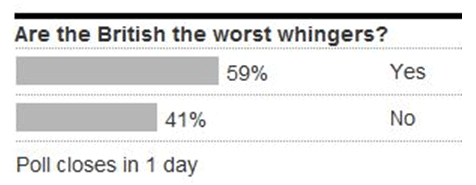
    Busted. “Even in the best of times, whinging, as Britons call the persistent low-grade grousing that is their default response to life’s challenges, is part of the national condition”, Sarah Lyall writes in the New York Times, about Londoners’ failure to embrace the Olympic Spirit. If a British newspaper mocked America there would be a flood of patriotic remonstrance right back at us. But when The Guardian asked its readers whether it was true that Britons were whingers, this is how the poll went:


    There is a lot to complain about with the Olympics. The police have been heavy-handed, pushing around people who have argued with the Olympic hype. The Olympic Park has been forcibly cleared of its official and unofficial tenants.

    Dave Renton, author of Lives; Running, who believes in the Olympics but not in the corporate hype and security that comes with it explains:

    Already the park is enclosed by a sky high fence, topped by razor wires and electronic sensors, with CCTV every few metres and security patrols inside the fence, all to protect the Park from intruders. But in addition the towpath was closed to public access 23 days before the Olympics even began. All across London on the edge of Olympic venues there have been similar restrictions imposed. (see his Olympics-and-other sports blog, http://livesrunning.wordpress.com/)

    Most shockingly, the army has put surface to air missiles on the roofs of local tower blocks, to the outrage of the residents, who see them as a threat against London’s rioting youths rather than any imagined Al Qaida attack. Pointedly, the one estate that has welcomed the installation is the Bow Quarter, a super-rich gated community in the heart of impoverished East London (the site, ironically, of the re-birth of British trade union struggle in the nineteenth century, the Bryant and May match factory).

    There are special Olympic lanes painted on the roads, like those that the old Soviet bureaucracy had for the Zil limousines carrying officials. We are warned that spectators wearing the wrong logo will be barred from the stadium, as will Tibetan flags and any kind of political slogan.

    There is much to complain about, but Sarah Lyall is right: scoffing is the British way. Poor Sebastian Coe, goody-two-shoes of the 1980s track, has a hard job selling the Olympics to the British public. This coming Saturday radicals of the counter Olympics network will meet at noon to protest in Mile End Park.

    Of course Briton’s have not been big on public celebration since they lost that last toe-hold on world domination, as subalterns to the United States in the Cold War. The Falklands War against Argentina (oh, the shame!) was the last that drew out a jingo crowd. Ever since the Berlin Wall came down, we only come out on the streets to object or mourn. That is why the Millennium celebrations drew such a vicious reaction from the intelligentsia here, and why the most recently celebrated Queen’s Jubilee was such a damp squib. By contrast, hundreds of thousands mourned the death of Princess Diana, and perhaps a million marched against the war in Iraq.

    It is not easy to be a British sporting star. Jaded Britons willed Wimbledon tennis finalist Andy Murray to lose with the fervour that in years gone by they would have willed him to win. England’s soccer captain, John Terry, is better known for swearing at Anton Ferdinand than for his defending skills (after a failed prosecution for racial abuse, the press, unwilling to accept the jury’s decision, found him guilty anyway). The mood behind team GB in London right now is markedly downbeat. Londoners’ main interest has been whether they could make any money letting out their homes (no, it turns out, the market was flooded).

    The mood is not helped by the downbeat promotion. Filmmaker Danny Boyle is in charge of the opening ceremony. He says he will not follow the Beijing triumphalism, but instead threatens a mawkish recreation of the English countryside, complete with sheep and even a mob of countercultural festival hippies. On television, Britons follow not the hype, but a mockumentary satire of the hype, Twenty Twelve.

    ******

    The London that Britain will showcase to the world is at a difficult crossroads. It is the centre of the financial services sector, Britain’s most successful export since deregulation in the 1980s, but currently mired in successive crises, most recently the manipulation of the LIBOR rate by Barclays (with the apparent connivance of not only shamed Chief Exec Bob Diamond, but the Governor of the Bank of England, too). There is little doubt that Britain’s economy is dangerously skewed in favour of its financial sector, which buys influence from out-of-touch and cash-hungry politicians. Sadly, the one occasion when the financial sector might have been reined in, the crash of 2008, led to a massive bailout instead. Advice from financiers that the banks were ‘too big to fail’ was accepted with much the same gullibility as advice from the securocrats that Iraq’s weapons of mass destruction could strike London in 15 minutes. In the manner of a naïve maiden aunt, the press and the politicial establishment here were repeatedly surprised that the billions the government gave the bankers went straight into bonuses, instead of being passed on as loans to businesses. Did no one ever tell them that banks are in the business of making money, not giving it away?

    The problem with the banks, in any event, is misunderstood. The febrile financial sector is more symptomatic than causal. It has been fuelled for some years by the surplus capital that British and European industry fails to reinvest in its manufacturing base. Europe’s risk-averse business leaders are reluctant to disturb their cozy relations with each other and government by innovating new processes or products. Where their forebears ploughed profits back into the business, our business leaders prefer to put them in the bank, hunting around for some fantasy of high yield investments that do not entail any relationship more demanding than a phone-call. It is not that bankers steal the cash from business so much as that business that is falling over itself to give it up.

    High on the list of London’s problems is its house-building industry, which has systematically failed to meet the expanding demand for homes. Characteristic of the institutional prejudice against development here, house-building has been stymied by a planning system that restricts building to brownfield sites, and is strangling London’s growth with a ‘green belt’.

    Predictably, the limit on building new houses has forced up prices, and priced poorer Londoners out of central London. According to a study by Tom MacInnes and Peter Kenway for the City Parochial Foundation:

    … more than half (54%) London’s low income population live in Outer London. This is an increase compared to the late 1990s, when London’s low-income population was split equally between Inner and Outer London. Reflecting this relatively bigger population, a larger number of children in low-income households live in Outer London (380,000) than Inner London (270,000). (London’s Poverty Profile, 2009, p 29)

    The impact of high prices on where people live, the gentrification of the inner city, and the exodus of the poor, has been dramatic. For poorer residents to carry on living in London gets more and more difficult. That is particularly so because the rise in rents mirrors the rise in house prices. For too many families living in London means accepting less and less space. Meanwhile, in Caledonian Road, a local developer bought up local shops to convert into flats, and then realised that the cellars could be made into houses, too.

    With some cheek, London’s former Mayor, Ken Livingstone, architect of the London plan that put the dampeners on development is now protesting that ‘rents have soared beyond people’s ability to pay’. But it was Livingstone’s policy, with its mantra of building up, not out, on brownfield, not greenfield land, that created the scarcity of homes that is forcing up prices and rents. All of Livingstone’s solutions are about redistributing the limited housing stock available, without understanding that the real problem is in the realm of production.

    The Olympics, of course, are supposed to have a lsting and positive effect on the London’s housing. But that will not happen unless there is a cultural shift in favour of development that is not engulfed in precautionary regulations and political indecision.

    So let’s hope that Londoners do cheer up before the games start, and enjoy the sight of people giving their all. It ought to be a good antidote to the dog-in-the-manger attitude that is wrecking the prospects of recovery. Londoners have to choose between Olympic spirit, or Olympic whinging.

    Photo by BBC World Service: Homeless Hostel, East London

    James Heartfield’s latest book The Aborigines’ Protection Society: Humanitarian Imperialism in Australia, New Zealand, Fiji, Canada, South Africa, and the Congo, 1836-1909 is published by Columbia University Press, and Hurst Books in the UK.

  • London’s Social Cleansing

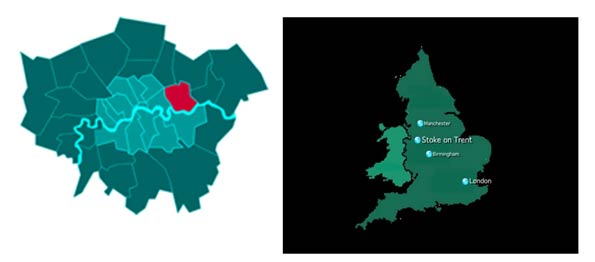
    Unscrupulous landlords are forcing poorer tenants out of their London homes, freeing them up to rent out to visitors to the Olympics this summer, according to the housing charity Shelter. At the same time, the government’s cap on rent subsidies (Housing Benefits) for those out of work or on low incomes threaten to force less well-off tenants out of the capital. Newham Mayor Sir Robin Wales says that they will have to move people as far afield as Stoke-on-Trent if they are to meet their obligations to house the homeless. Fears of ‘social cleansing’ featured in the Mayoral election where Tory incumbent Boris Johnson made sure to distance himself from his own government’s policy to beat off the challenge from veteran left-winger Ken Livingstone.


    Inner London, outer London (Newham in red); London, Stoke-on-Trent

    Critics of London’s ‘Social Cleansing’ have fixed on the changes to the law regarding housing benefits and the Olympics, but failed to notice that working class Londoners have been being forced out of the nation’s capital for some time now – thanks to the ceaseless rise in house prices. On the London Programme in 2003, I said that without opening up more land to building in the green belt, house prices would spiral out of control, pricing ordinary Londoners out of the capital. Mayor Ken Livingstone slapped me down saying that he would never sanction building on the green belt.

    Today Eva Wiseman, a commissioning editor on the upmarket broadsheet, the Observer, says that she cannot afford to rent in London’s once poorest borough, Tower Hamlets, let alone buy a house. She cites Shelter’s estimate that you would need an income of £67,669 to rent there (average income is £26,244).1

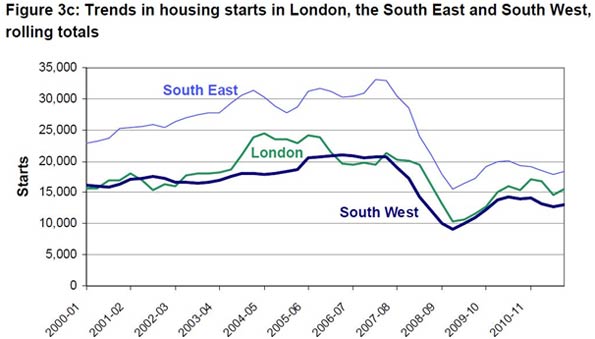
    It is not hard to understand why prices are so steep. Housebuilding in the UK has failed to keep pace with demand. New housing starts are slightly up after the crash, but overall they are woefully short of actual need. The reason is that Britain has among the most stringent laws on building – the ‘planning laws’ – which stop building on the ever-growing ‘green belts’ that surround our cities.

    Given that the working class are the Labour Party’s natural constituency, you might have thought that its years in government (1997-2010) would have seen more homes built for working people. But Labour turned its back on the working classes a long time ago, while keeping its neurotic interest in regulating the economy. The outcome was a re-vamped planning system that put the brakes on home building. This time this was done in the name of the environment, not to protect the Tory Shires from ‘bungaloid sprawl’, as it was originally intended. Housebuilding fell below the bare minimum of 250,000 you would need just to replace the increasingly dilapidated stock.

    When David Cameron’s Conservative-Liberal coalition came to power in 2010, his Communities Minister Eric Pickles and Housing Minister Grant Shapps had promised a large scale liberalisation of the planning laws – and even blamed their predecessors for doing more damage than the Luftwaffe to Britain’s housing stock. But the fine print on Shapps’ new planning law proved as prohibitive as what went before. Even those champions of the Green Belt at the Guardian were moved to editorialise that ‘these convoluted and qualified planning laws will become another aid to the big-money lawyers’. 2

    The Conservative government’s commitment to liberalisation is like its Labour predecessor’s commitment to the working class, theoretical. Home building remains stalled, and prices have not seriously fallen despite the shortage of credit). Governments of all stripes are most committed to orderly regulation of change, and dread the unsupervised activity of their citizens – a prejudice which has only led to chaos.

    The short supply/rising price dilemma is particularly intense in London. A metropolis of nine million creates a fierce competition for prime sites. Even putting aside the super-rich boroughs, like Kensington and Chelsea, where average prices are £1.3 million (roughly $2 million US), the overall London average is £406,000 ($770,000 US) .

    Besides being the most logical place for real estate speculation from around the world, London also has been in the grip of the planning system. It was in London that the Labour mayor took on architect Richard Rogers as an advisor, and committed the capital to a programme of building only on brownfield (already developed) land, ‘building up, not out’. The result is not much building at all, except to pack more four and five storey blocks into what few pockets of green space can be grabbed. His successor Boris Johnson has avoided challenging the Livingstone system, preferring a quiet life to any hint of controversy.

    Rather than face the problem of the absolute shortfall in new homes, most critics have fixated on peripheral issues, such as the number of empty homes (which, despite the attention they receive, are, because of high prices, at an all-time low). Easy credit, too, has been blamed for high prices, which is true, but the shortage of credit has not led to a great fall in prices, because the underlying problem was the absolute shortage of homes. Others have argued that the British are too wedded to the idea that they should own their own homes, and could rent, like the Germans, failing to understand that the availability of homes to rent depends on their being built, and rents tend to move in the same direction as prices, as The Observer’s Eva Wiseman has discovered. London’s Mayors have dedicated much attention to schemes to build ‘affordable homes’ – sometimes reserved for occupations like teachers and firefighters – though these are too few in number to have much impact on prices overall.

    Over time, this means working people are being priced out of central London. Tim Butler, Chris Hamnett and Mark Ramsden’s analysis of London’s employment in the 2001 census shows that outer London and the South East is more working class than inner London. Inner London had more large employers, professionals and managers than outer London and the South East. Outer London had more routine, semi-routine and technical or lower supervisory workers. Inner London did have more unemployed than outer London, and outer London had more self-employed than inner London. This employment profile was new, following changes that took place after fifteen years of economic growth, say Butler and his colleagues, though many have noted the sharper contrasts between wealthy enclaves and impoverished housing estates dogged by underemployment. 3

    These social changes show inner London’s parallel embourgeoisment and deepening social poverty. Of course, those who live in the outer suburbs scoff at the protests from well-heeled social commentators about the prices in inner London as ‘Zone Six snobbery’. Still the changes go some way to explaining why Ken Livingstone was unable to sustain the traditional City Hall machine he built consolidating constituencies among inner London’s poor immigrant and residual working class   communities while Tory Boris Johnson won  over the more working and middle class outer suburbs.

    In his last term Livingstone concentrated on winning over London’s bloated financial service sector more than he did on popular support – but the City of London switched its allegiances to the Tory Johnson, who champions it as an engine of growth. Neither candidate has understood that the skew towards the overheated financial service sector creates a weakness in the London economy, with manufacturing having moved out to the surrounding South East and a growing lack of upwardly mobile jobs for all but the most skilled or privileged.

    The housing benefit cap clearly is a problem for welfare-dependent families who are caught in the poverty trap and cannot earn enough to pay the rent. But the problem of the less well-off being priced out of London began long before the changes in housing benefit rules, or London’s winning the Olympic bid. The city the world will visit this summer increasingly resembles not the social democracy imagined after the Second World War, but increasingly a social bifurcated place increasingly resembling that of Victorian times.

    James Heartfield is the author of Let’s Build: Why we need five million new homes, a director of Audacity.org, and a member of the 250 New Towns Club.

    ————————————–

    A Mile High Tower for London

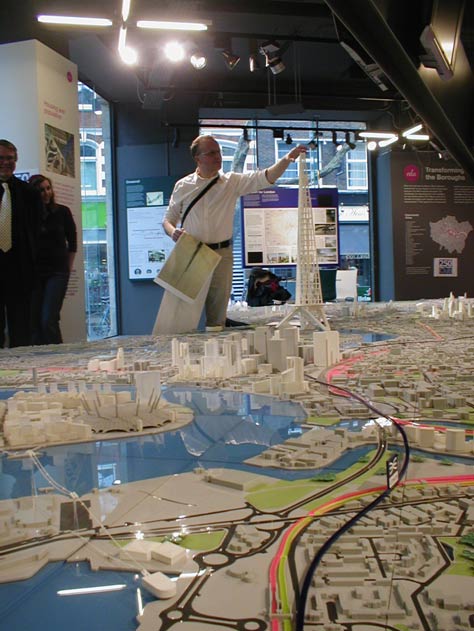
    One imaginative solution to London’s housing problem was proposed by Ian Abley and Jonathan Schwinge of the 250 New Towns Club. Abley and his colleagues have been pressing for new building in Britain’s green spaces to meet housing need.

    Taking on the challenge of building up as well as out, Ian unveiled a plan for a tower one mile high for London at the Building Centre, which could house 90,000 people.


    ‘Locked out of the Property Market’, Observer,  6 May 2012

    27 March 2012, http://www.guardian.co.uk/commentisfree/2012/mar/27/planning-builders-charter-lawyers-delight-editorial, and see ‘Coalition of the Unwilling’, New Geography, 1 July 2011, http://www.newgeography.com/content/001966-coalition-unwilling

    Inward and Upward: Marking Out Social Class Change in London, 1981–2001, Urban Studies 45(1) 67–88, January 2008, 72

    London photo by Bigstockphoto.com.

  • It’s Not the 1980s in Britain Anymore

    Britain’s public sector workers came out on a one day strike last week over government plans to raid their pension funds. Government ministers did the rounds of television studios denouncing the strikers as mindless militants. Both sides are echoing the class struggles of the Thatcher-era, but the truth is that it’s not the 1980s.

    My children were off school, and like many children, glad of it. Schools are among the more solid parts of the public sector action today, and in London were struck out, though in the country the teachers’ unions have not achieved the 90 per cent shut down they were aiming for. Unlike the last great wave of union opposition to Conservative spending cuts, back in the 1980s, the teachers’ unions were supported by the National Association of Head Teachers.

    At the college where I teach, the lecturers in my department were solidly behind the strike, and boldly leafleted and informed students of their decisions in lectures and circulars. Administrative staff, by contrast, crossed the picket lines.

    Overall the strike is well-supported, but not quite the quantum leap of opposition to the Conservative-Liberal coalition that seemed to be in the air. Those joining the marches were 30,000 in London, and a few thousand in the other major cities, which is many more people than the deracinated petit bourgeois mobilised by the #Occupy camps, but does not compare to the bigger union mobilisations of the 1980s.

    Union activists have tried to paint the coalition (which they call the ‘Con-Dem’ government) as Margaret Thatcher’s Conservative government of the 1980s reborn.  As they see it, some ‘anti-Thatcher’ spirit would give the rank and file more fire in their bellies.

    Prime Minister Cameron and his ministers have been trying to spark up a Thatcherite spirit, too. It is their only blueprint for handling the challenge of the public sector union revolt. They have been going around the studios denouncing mindless trade union militants in the same way that Thatcher’s ministers Cecil Parkinson and Norman Fowler did back then. But they have not done it very convincingly. Most of all they have failed to get the public to blame the state sector for the budget deficit, as Mrs Thatcher by and large did. The public is just not in the mood to turn on any group of workers with that much anger. It is people in power that are distrusted, newspaper editors and politicians. The specific plan to cut pensions and raise the pension age is not accepted, but widely seen as the chancellor robbing from people’s rightfully earned savings. Chancellor Osborne has failed to persuade many people that they need to take his harsh medicine.

    It is perhaps typical of the strident Mrs Thatcher that her ghost is haunting the country even though she is still with us, if a little frail. It is a generational thing – anyone over forty either hated or loved Thatcher and by and large it is the ones who hated her who went on to be opinion formers, whether in TV studios, newspapers or teaching in colleges and schools. The under thirties take their idea of the Thatcher era from those teachers, or from the novels of Jonathan Coe, or most recently from the Meryl Streep film. There is a touch of nostalgia for an age that was a bit more black and white, where the choices were starker.

    Today’s class struggle is by no means as clear. As much as the unions talk up the coalition as a return to Thatcherism there is nothing like the determination to lead an offensive against trade union power in Cameron’s cabinet, which, remember, is a coalition with some sceptical Liberal Democratic partners. What is more, the party he leads got elected on the express promise that it had left the ‘nasty party’ image of the Thatcherite 1980s behind. This was the nice Tory party.

    Cameron’s one distinctive policy, the Big Society, if it were to work, would surely be carried along by the kind of people who are on strike today – who struck me as people with a social conscience, and an interest in their communities. It cannot be comfortable for him that this is the very constituency that he most offends.

    Mrs Thatcher was not so bothered about the Social Workers and Community Activists, generally painting them as a big nuisance. What she was good at was rallying the establishment – the newspaper editors, City financiers, industry managers, senior police chiefs and judges were a formidable establishment ready to face down any rebellious mood among the scruff trade unionists or rioting youth. Mr Cameron, though, does not have any such united establishment on his side. They have all been attacking each other for some time now. Right now, Lord Leveson is enquiring into the scurrilous phone tapping done by Rupert Murdoch’s News International. It is a ghoulish picture of the newspaper magnate that emerges, and not the kind of thing that is likely to persuade him to get behind the Cameron government in the way he was behind Mrs Thatcher’s.

    The left, too, is in a weaker state than it looks. There is a kind of trajectory to events, from the student demonstrations of a year ago, through the summer riots and this autumn’s version of #Occupy Wall Street – a tent city in the gardens of St Paul’s cathedral. The rhythm of these protests – and protest is legitimated emotionally by the events in the Middle East, however different those protests are – give the impression of a rising crescendo. But that is deceptive. The anti-capitalist mood is not deeply rooted. Last week they had an opportunity to make their organisation a bit stronger. But without a concerted assault from the government, the opposition is also a little tentative.

    Overall the country is much more exercised by the throwaway line from TV presenter Jeremy Clarkson, that the strikers ought to be shot – for which he has been roundly condemned – than it has been by the strikes.

    On the night Cameron went around the television studios saying that the strikes proved to be a bit of a damp squib. It is a smart spin to put on things. It conveys that he is not rattled, and that it is all a bit of a fuss about nothing. But it is not true enough for him to get away with it. The unions did not land a big punch, but they had a respectable day. Worse still for Cameron is that it sounds like his own strategy is a bit of a damp squib so far.

    James Heartfield’s latest book The Aborigines’ Protection Society: Humanitarian Imperialism in Australia, New Zealand, Fiji, Canada, South Africa, and the Congo, 1836-1909 is published by Columbia University Press, and Hurst Books in the UK.

    Photo by Flickr user Ben Sutherland

  • Britain Needs a Better Way to Get Rich Than Looting

    Mark Duggan, father of four, was armed with a Bruni BBM semi-automatic pistol when he was shot dead by armed police on 4 August. Despite initial reports Duggan did not fire on the officers from the Trident Police Unit, an armed force dedicated to dealing with “gun related murders within London’s black communities”.

    Duggan’s family were not told by police that he had died from his injuries but learned it from the news, in a report designed to deflect blame for the killing onto the victim. The vigil that Duggan’s friends and family held outside the Tottenham police station was a spark that set off rioting across Britain for the last week, and at the time of writing is still not under control.

    Any political character to the initial rioting – as a protest against police brutality – quickly gave way to looting.

    Looting broke out in urban centres, mostly those with a large black community – Tottenham, Enfield, Dalston and Croydon in London. The looters were for the most part young, and of all races, and they sought out popular clothing stores, like foot locker, jewellers and department stores. Some people were attacked in their homes. The “Gay’s the Word” bookshop in Marchmont Street was attacked on 8 August.

    Later, looting spread to Leeds, Birmingham, Manchester and Nottingham – where a police station was firebombed.

    One feature of the looting was the use of mobile phones, blackberries and Twitter accounts to rally looters to sites where, they rightly predicted, the police could be outmanoeuvred.

    Still, it is worth pointing out that as rioting goes this recent outbreak, though widespread, has not been all that violent. Instead it has been more of a Feast of Fools, with the mob enjoying the humiliation of the authorities, as it raids the supermarkets for booze and clothes.

    The Prime Minister, David Cameron has cut short his holiday in Tuscany to recall Parliament, and the London Mayor has come back too. The Drama Queen Cameron, sensing his big moment, promises tough measures to stop the rioting, issuing rubber bullets and water cannon to the police.  London courts processed 167 prisoners in unprecedented overnight sittings on 9-10 of August.

    The cause of the riots has been identified by the Prime Minister and the London Mayor as a breakdown in authority – and they have a point. It is the British social system as a whole that has lost its way, with a collapse in authority in every level, from the police, the political system, school and parental authority but most severely in the system of work and reward.

    Britain’s police force has most decidedly lost authority in recent times. The force used to have an authoritarian culture that was thuggish and racist under reactionary Chief Constables like Sir James Anderton in Manchester and Sir Kenneth Newman in London. But investigations into the police’s “institutional racism” have opened the way to a newer layer of technocratic leaders who were more interested in process than upholding a particular vision of public order.

    Nobody would want to see the return of the old authoritarian policing, but the cadre that replaced them have lacked a guiding esprit de corps. The police have been seen as being corrupted by payments from News International’s investigators for personal information and designed to sideline an investigation into phone hacking.

    Nor has the force’s new face stopped the problem of police brutality. Uncertain of how to deal with the public order challenges of middle class protest (environmental, or more recently student-based), the police have swung irrationally from a hands-off approach that only encouraged greater disorder to excessive force when that failed. The fear of Islamic terrorism has also led to police overreaction.

    The killings of Jean Charles De Menezes (in a terrorism panic), Ian Tomlinson (at a G20 protest) and the vicious assault on Alfie Meadows at a student demonstration have all undermined respect for the police.

    Political leaders have pointedly failed to engage with younger and less well-off groups in society, too. After more than a decade in power the Labour Party is a shell of its former self, but the coalition that replaced it is a bodged compromise whose most attractive radical figure, mould-breaking Liberal Democrat Nick Clegg, managed to turn himself overnight into the most hated man in Britain by joining the government and voting for an increase in student fees (the very thing he had campaigned against). All in all, the political class are stiff, besuited, and incapable of talking in ordinary English, preferring a weird gabble of municipal-speak.

    Lower down the scale teachers, parents and youth leaders have seen their authority undermined by a culture that disparages discipline, and sees “abuse” everywhere. Teachers’ unions have pointed out that changes in the law mean that a substantial minority are being investigated for allegations of abuse made by students at any time, meaning that they are reluctant to uphold discipline in the classroom. At the same time, teachers and social workers challenge parental discipline at every opportunity.

    Perhaps most disturbingly British society has broken the link between hard work and success. Once the “workshop of the world” Britain has a shrinking manufacturing base (around ten percent of all employment). As the analyst Andrew Smithers pointed out, the City of London’s specialisation in financial intermediation took up the slack left by her shrinking industrial sector, but now that is looking like having all your eggs in the wrong basket.

    For a decade or more booming markets and a credit-fuelled economy covered up the weaknesses. Trainers, clothes and electronic devices shipped in from China and paid for on credit kept Britons happy, while a growth in government jobs and the educational maintenance allowance to keep 16-19 year olds in school kept unemployment down.

    The British system of rewards is far from being straightforward. How do you get rich in Britain in 2011?

    • Sir Paul Stephenson, the disgraced chief of the Metropolitan Police retired this July with full pension and benefits on a final salary of £250,000 – having been exposed for taking favours from journalists under investigation for hacking phones.
    • Susan Boyle grabbed the public’s affection on a TV talent show and made £10 million.
    • Beresfords Law firm skimmed £30 million from the Miners Industrial Injury Compensation scheme.
    • Geordie singer turned X-factor judge Cheryl Cole became Britain’s highest paid TV star.
    • Independent consultants raided the National Health Service’s budget of £4.3 billion to build a national database which still does not work.
    • City chiefs like Barclays Bob Diamond and HSBC’s Bob Duggan were awarded bonuses of £6.5 and £9 million last year, from funds boosted by the government’s £200 billion quantitative easing policy.

    The link between work and reward is not easy to fathom. Young people dream unrealistically of success in the world of entertainment, as the most compelling example to them. The more astute know that law and the other professions have done better at securing their incomes – and for them higher education is the route.

    Now the British system of rewards is threatened by the pressure on credit and on government spending. Nervous teenagers and parents see a much higher cost for higher education threatened (though the small print, surprisingly, is more generous than the headline fees). The consumer goods sector has been the one point of connection between younger people and wider society that worked – but recent financial difficulties make many fear that it will soon be out of reach.

    Britain’s radical leaders have in recent times failed to speak to the material aspirations of the greater mass of people. Trade union wage claims are not the fighting point they once were. Left wingers are more likely to be hostile to consumerism than supportive. On the other side, conservatives have abandoned their narrative of hard work to earn well, thinking it too judgmental and mean-spirited.

    Anxiety about the route to material betterment, along with a failure of political answers to that problem and a falling respect for authority have led to disorder. Earlier this year the middle classes rioted on student protests over rising fees. Now some amongst the inner city poor are rioting and looting, in search of a less deferred gratification.

    The looters have taken advantage of the crisis of public authority to make their own short-cut to material success, but it is a self-defeating one. A looted Debenhams or Footlocker will think twice about re-stocking – or at least until they have improved security. Worse still, many family firms and communities have been wrecked by rioters.

    Mark Duggan’s family needs a good answer to why he was shot, and why they had to learn that he had died through the media. Britain needs a less crazed answer to the question of how to meet people’s wants, and it needs a stronger restatement of the value of social solidarity.

    James Heartfield’s latest book The Aborigines’ Protection Society: Humanitarian Imperialism in Australia, New Zealand, Fiji, Canada, South Africa, and the Congo, 1836-1909 is published by Columbia University Press, and Hurst Books in the UK.

    Photo “Tottenham riots” by Nico Hogg

  • Coalition of the Unwilling

    This week the UK government announced an ”end to anti-car policies” reversing the guidance to local authorities to dissuade citizens from using their cars in favour of public transport. Charges for parking will be reined in, they promise.

    It should be good news. The comically-named ”traffic calming” schemes put in place by the outgoing government were deeply unpopular. Still, we are getting used to taking our announcements from the new coalition government with a pinch of salt.

    Before the election Housing Minister Grant Shapps backed demands from the Housebuilders’ Federation for a ‘right to build’. That might seem unnecessary, but in Britain the planning laws are so prohibitive that owning land extends no right to build upon it. Instead planning authorities extend permission to build where it meets the terms of the local plan.

    The impact of Britain’s planning laws has always been a problem, but for the last thirteen years the ‘local plan’ has been hi-jacked by anti-growth campaigners from the Campaign to Protect Rural England, the Urban Taskforce and the massed ‘NIMBY’ campaigners of the Tory Shires.

    The new local government minister Eric Pickles explained that the net effect of the planning system’s strangle hold on house building was that ”we’re at rock bottom”: ”1924 was the last time we built this little number of houses”. His Labour predecessor Nick Raynsford had ”done more damage than the Luftwaffe”, said Pickles, exaggerating a little, but making his point (Sunday Times, 12 September 2010).

    So what about the changes? Grant Shapps’s published policy does include the words ”right to build” – but they are heavily hedged about:

    ”provided that [the new homes and buildings] conform to national environmental, architectural, economic and social standards, conform with the local plan, and pay a tariff that compensates the community for loss of amenity and costs of additional infrastructure’ (Open Source Planning, Page 3).

    All of which sounds pretty much as bad as it was before. What right to build, you might ask? Indeed the words ‘right to build’ feature just once in the document, as quoted above, in the executive summary. There is a question mark, too, over who it is that has the right to build. ”Communities”, according to Shapps, and the government have the right, but just how these ”communities” are defined is not clear. More likely they will be the same planning authorities as before. In that case the only developers that get a look in will be the powerful and well-connected like Tesco or Barratt Homes – those who are in a position to meet the municipal fathers’ demands for baksheesh… or ”planning gain” as it is known in the UK.

    Coalitions are new to Britain (apart from one shaky Liberal-Labour government in the seventies). But with neither David Cameron’s Conservative Party, nor the deeply demoralised Labour Party of Gordon Brown winning enough votes to command a majority in the House of Commons, Cameron had to turn to Nick Clegg’s minority Liberal Democrats.

    This arrangement seems to suit Cameron. Cameron became leader on a pledge to lose the ”nasty party” image the Conservatives had after years of office in the 1980s. His method is a mirror image of Tony Blair’s repositioning of the Labour Party as a centre party by distancing it from its socialist roots. First we had a Labour government that was against socialism. Now we have a Conservative-led government that is shy about capitalism.

    Sidelining the old-school Thatcherite, free market Tories in favour of his friends in the public relations, media and volunteer sector, Cameron seems obsessed with changing the party brand.Although this did not work in the election, the advantage of an alliance with the Liberal Democrats means that he can ditch whatever fundamentalist free market doctrines whenever convenient on the grounds that ”coalition government is compromise”.

    The net effect is a government that keeps sounding as if it is going to do something decisive, but then doesn’t.

    The greatest challenge has been the state of the public finances. Britain’s government debts are astonishing: one trillion pounds sterling, or 68.2 per cent of GDP. Since most of the debt was contracted under Labour’s watch, the coalition government has the moral high ground. The Labour coalition says that the cuts announced in the public sector put the recovery in danger because they are too far, too fast. They stand by ”counter-cyclical” spending, but Labour has little mainstream credibility in terms of the country’s finances.

    For the left, though, balancing the capitalists’ books is hardly the issue. They are looking forward to a re-run of the campaign against the Thatcher public spending cuts of the 1980s. The protests and banners all seem to reinforce the idea that the government is indeed planning to rein in public spending, but it is not. As former Tory Minister John Redwood has pointed out, the planned cuts are not even cuts at all, but a limit on spending growth.

    Cameron’s government had to sound tough on public spending, because the bond traders were in fear of Britain’s debt rating being marked down, and the wider impact of a loss of confidence. With both Greece and Ireland’s finances in trouble, the British government needed to promise stability.

    But the same city traders are just as determined that the spending party should carry on, even if the volume is turned down to avoid scaring the neighbours. For years Britain’s ”private sector” has been dependent on extraordinary boosts of government cash. Under the outgoing government’s Private Finance Initiative, public institutions like hospitals and schools were allowed to raise funds by issuing their own bonds, debt that was not reckoned in the official accounts. Then Gordon Brown’s banking bailout found government buying up failing banks like Royal Bank of Scotland.

    Despite their fawning support for austerity Britain’s City traders still expect to be looked after. The Bank of England’s emergency policy to meet the shortage of credit in the economy is called ”quantitative easing”. In practice it means that the government trades government bonds for the banks’ own toxic debts, while bond traders make money on the commission.

    Even the one controversial cut in public spending turns out to be something more like a gift to the banks. The government says that they will let universities charge fees approaching the market rate, and that students will no longer be subsidised. Since those who made the decision all got to go to university for free, the backlash was understandable – the kind of rioting Saturnalia that Britons indulge in from time to time (“off with their heads!“ shouted student rioters when they chanced upon the Prince of Wales’s limousine and mobbed it, while running from the police).

    To moderate the impact of the fees, though, the government has promised to expand the student loans scheme, where the State lends the money, and then recovers it later, through the tax system. For the banks, what could be more perfect? Here is a tranche of debt created overnight, guaranteed by a government that undertakes to recover it on their behalf: More of a subsidy to the City of London than a cut in government spending.

    Though the Conservatives are thought of as ”Thatcher’s Children”, they behave much more like their ”New Labour” predecessors. The tough talk is for show.

    Nowhere is this proto-New Labour approach clearer than on energy policy. Although Energy Minister Chris Huhne has acknowledged that Britain faces severe electricity shortages – he fails to ascribe the problem to its proximate cause, the failure to build enough coal-powered power stations.

    Huhne’s solution, though, will make things worse. Not more coal-powered stations, but a government imposed increase on tariffs for fossil-fuel generated power, and a special allowance for renewable energy. Of course, renewable energy on any normal pricing system would be uneconomic. Britain’s latest windmills even had to be heated up to stop them freezing solid this winter. The net effect of Huhne’s proposal: no fix for the energy shortage, and more expensive electricity.

    These policies have had disastrous, even lethal, results. According to the latest figures, excess winter deaths in the UK are in the region of 25 000, most of them the elderly, often hastened along by fuel poverty. With Huhne’s proposals, those numbers are set to increase, as electricity becomes something of a luxury to the poor.

    At least in this area, the Tories are “conservative”. The tradition of the poor freezing to death in wintertime is being restored, and so too may be the old class system that allows the City to enrich itself as the expense of everyone else, including the taxpayers.

    James Heartfield is the author of Let’s Build: Why we need five million new homes, a director of Audacity.org, and a member of the 250 New Towns Club.

    Photo by Chris Devers

  • London Special Report: Britain Drifts South – and Why Not?

    The British Broadcasting Corporation wants 1500 of its staff to move to its new ”MediaCity” headquarters in Salford, near Manchester in northwest England. The Corporation, they say with some justification, is too southern, too much part of the metropolitan elite. The move ”addresses concerns that the organisation is not fully representative of the peoples of the UK.”

    On the surface it looks like a good deal. On top of a £5000 payment, they have been offered £350 for each house-hunting journey as well as removal costs, a guaranteed house purchase scheme and and even £3,000 for new carpets and curtains. Other benefits include help securing jobs for spouses or partners jobs in the area and specialist help with children’s schooling. For all that, take up for the scheme has been slow, and the Corporation’s grunts were unhappy to hear that the head of BBC North, Peter Salmon ”is the latest exec to announce that he would rather hack off his own face than move his family anywhere remotely near the north,” as ex-BBC producer Rod Liddle puts it.

    The BBC’s difficulties in persuading its staff of the benefits of the North of England reflects a broader British predicament. Since the 1930s British governments have tried to use grants boost Britain’s depressed regions in the North of England, Wales and Scotland. None of this has stopped the long-term trend of population movement. Demographers Daniel Dorling and Bethan Thomas of Sheffield University point out that outside of London, all major cities are declining in population, and that ”the population of the UK is slowly moving to the South.”

    Dorling and Thomas’s analysis of the 2001 Census drew criticism from regional dignitaries. Bob Kerslake, chief executive of Sheffield City council, and a champion of the lobbying group Core Cities insisted that ”there is already evidence of a turnaround in the last five years and every prospect of things getting better.” Denton and Reddish MP Andrew Bennet, Labour chairman of the Commons local government, housing and planning committee also claimed that ”in the regeneration of cities, the government’s proposals are working well,” while admitting that there were ”horrendous” problems.

    Looking at what Dorling and Thomas say, it is not hard to see why the census should be so problematic for champions of a Northern resurgence.

    At the start of the 21st Century, the human geography of the UK can most simply be summarised as a tale of one metropolis and its provincial hinterland… On each side of the divide there is a great city structure with a central dense urban core, suburbs, parks and a rural fringe. However, to the south these areas are converging as a great metropolis, while to the north is a provincial archipelago of city islands.

    In recent years the decline of the North has at least been mollified by a relatively buoyant economy in contrast to the disaster of de-industrialisation that it was in the 1980s. Yet even still, the divergence is difficult to wish away. Most disturbing, much of the growth taking place in the North owes more to government spending that it does to private initiative. The public spending share in output is 52.6 per cent in the North West, 61.5 per cent in the North East, and 54.9 per cent in Scotland.

    For housing, the importance is clear. With the provinces suffering greater or lesser degrees of depopulation, houses have to be cleared. In 2002 government plans to demolish up to 880,000 homes in northern England and the Midlands were announced. Gateshead, Newcastle, Blackburn, Manchester, Hull, Sheffield, Liverpool, Stoke-on-Trent and Birmingham are all earmarked for substantial demolitions. In Liverpool alone, the council has to cope with 28,000 derelict homes. Long-standing development critic Simon Jenkins bemoaned the plans to knock down 100,000 Victorian terrace houses in the Welsh Streets area of Liverpool as they constitute precisely the “sort of buildings” over which yuppies “would purr” if they were in London.’.

    The contrast between empty homes in the North of the country and the prospect of new building in the South offends people like Green Party’s London leader Darren Johnson who says that it is ”particularly ludicrous to have every single scrap of land in London and the South East being eyed up by developers, when the populations of other regions, such as the North West and the North East, are actually declining.”

    Ros Coward, columnist for the liberal Guardian newspaper, protests that ”In the North-West, vast tracts of urban land lie derelict, while in the South-East … our countryside is under ever-increasing threat.” Uber-architect Richard Rogers takes a similar view, arguing that ”regional balance is critical to achieving a sustainable economy”. This is in the context of bemoaning the ”divided country” of the North and the Midlands with the ”bulk of redundant industrial land” and the South-East’ where the ”greatest pressure for new housing development” is felt.

    Though he is cautious to spell it out, Rogers’s ”regional balance” could only achieved by relocating people up North. No doubt the chaotic workings of the economy do create unplanned waste and blight, but does anyone suggest people should be forced to move up North? Infamously Westminster Council housed its homeless out of borough, paying more outlying regions to take on the social problem. More recently the government imposed resettlement schemes on asylum seekers, forcing them into unwelcoming estates in Glasgow and elsewhere. Surely, everybody understands that in a free society you cannot direct people where to live, like Stalin did the Chechens in 1944 – or do they, particularly if the case can be made on ideological grounds, this time green instead of red.

    It’s undoubtedly true that there is indeed a London-centric bias among British policy makers and media professionals. Deeply rooted in the gentrified boroughs of inner London, opinion-formers often treat the rest of the country with disdain. But it would be a mistake to see the population’s southern drift as the ascendance of the metropolitan chattering classes.

    As important as London is to Britain’s economy, the more interesting area of growth is the south east region around London. The South East has the second highest GDP, and the second highest GDP per head of any region. London has the highest GDP, but it also has more of the very poorest people than the South East.

    This is the heartland of Britain’s middle classes, first in the percentage of the population economically active and the fastest growing demographically. Coastal Brighton, 60 miles from London’s centre, is Britain’s fastest growing town. If the BBC offered its relocation package to move staff to Southampton or Brighton, there would be many more takers.

    We cannot keep holding like Canute and wish away the shifting economic geography of Britain. It is something that has to be worked with. For cities and towns outside of the southeast that can mean some profound challenges. It is not easy to manage a downsizing without it appearing to be a rout.

    But the demolition of old houses ought not to be seen as a disaster, so much as an opportunity. Britain’s ageing housing stock needs renewing. Simon Jenkins presumed to speak up for the “local community” of the Welsh Streets area of Liverpool, but Irene Milson and Mary Huxham of the local tenants and residents association saw things differently:

    Far from it being “wrought” on them, residents in this neighbourhood have been campaigning to be included within the Housing Market Renewal Pathfinders plan for over four years. The decision was supported in a survey of all Welsh Street residents, with a 72 per cent majority in favour of a clearance. … The campaigners, conservationists and critics don’t have to deal with 125-year old properties that are damp, decaying and expensive to heat – let alone with collapsed Victorian sewage systems now over-ridden with rats.

    In principle, there is nothing wrong with the population concentrating itself more densely in one part of the country than another. It is not as if it will tip up and sink. No doubt a perfectly planned society would achieve things less chaotically, but in a democratic society it is better to manage change,rather have planners reshape our society from above.

    James Heartfield is the author of Let’s Build: Why we need five million new homes, a director of Audacity.org, and a member of the 250 New Towns Club.

    Photo by Feuillu

  • London Special Report: The Making of the Hundred Mile City

    (Part I of II.) The writer Ford Madox Ford summarised the inventiveness of the early twentieth century in an essay The Future of London (1909) by lambasting what he called the “tyranny of the past.” “The future,” he argued on the other hand, wages a ceaseless war against the monuments of the past’.

    This debate is alive today in the battle between the emerging metropolitan reality and the nostalgia of the urban past. Ford’s dream was of a Great London ‘… not of seven, but of seventy-million imperially minded people’.

    Unlike urbanist romantics, Ford’s “Great London” presciently considered the capital in relation to its suburbs. He also refused to call them “suburbs”, which he thought derogatory, from the Latin sub urbe, meaning less than the town, and preferring instead the more ambitious fore town: “The fore town of my Great London would be on the one hand, say, Oxford, and on the other, say, Dover.”

    Ford, much like his contemporary H.G. Wells, imagined a London that extended from Winchester, the delightful country around Petersfield, Chichester, all of the coast down to Brighton, Hastings, Dover, all of Essex and round again by way of Cambridge and Oxford. “All south-eastern England,” he wrote, “is just London.”


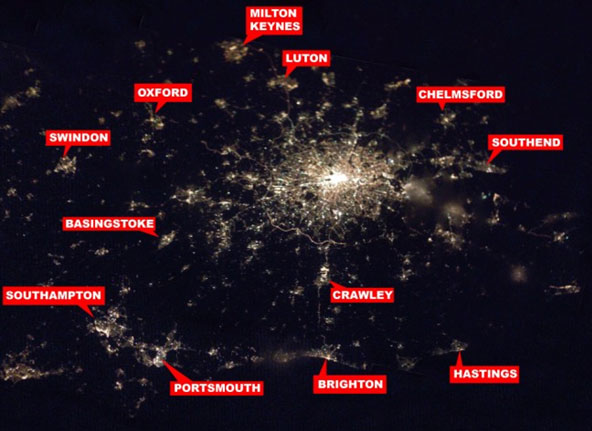
    London and the South East, seen from the night sky, shows the expansion into the South East

    Neither Utopian, nor Dystopian, Ford’s vision proved accurate. Sir Richard Rogers says as much himself, in his Cities for a Small Planet, describing London, some thirty miles wide in 1945, as a commuter belt 200 miles wide stretching from Cambridge to Southampton, and is the largest and most complex urban region in Europe. What delights Ford, appals Rogers.

    Ford was also correct that in failing to embrace change and embrace status of the fore town,. it reduced to the status of suburbs, and many opportunities were lost to create a healthier decentralized metropolis. The elements of Ford’s plan that never got off the drawing board were his proposals to “thin out” central London. Perhaps this had something to do with an eagerness to hang onto the Duke of Westminster’s slum tenements.

    It is tragic that Ford’s vision was ignored, and the real day-dream, that of a London contained, has continued to dominate policy. As a result, there is no London, as such. The city has lost all definition, as its outer edges have blurred into the dormitory towns around it. Having burst its bounds, there really is no recognisable unit called London that can be parcelled together under one name any more. The green belt cannot contain the sprawling suburbs. London has dissolved as its boundaries expand and become more porous.

    For more than a century, the London of the Londonostalgics has been a fraction of the administrative London. Victorian London outnumbers medieval London by more than six to one. Since 1965 Greater London has incorporated Essex boroughs like Walthamstow and other “railway suburbs”.

    The Londonostalgics jeer at the suburbs. ‘Barret Hutches … ‘Kennels’, ‘Lego Homes’, ‘They come in kits,’ according to Iain Sinclair. But for all that bitter condescension, London’s suburbs are where most of its population now lives. Put another way, they do not live in London at all, but Stevenage, Shepperton, or even Oxford and Brighton, commuting sometimes to work or play in the central heritage zone.

    How did London expand?

    From 1901 to 1950 the County of London’s population fell. In the 1930s the annual rate of decline was quite steady at around eight percent, but between 1938 and 1947 that climbed to 40%, reducing the County to a population of 3,245,000. By 1961 that number had reduced to 3,200,000.

    But these numbers obscure the demographic vitality of London, if viewed broadly. If one includes the many who live in the suburbs, the green belt or the outer country, the population of London has climbed to 10.6 million.

    London’s population changes continued to present a confusing picture. In 1965, Greater London incorporated parts of Essex and Middlesex to take account of the popular movement. But between 1961 and 1981 the population of this new, Greater London fell 15%, a loss of 1,186,000 people. Then in 1984, against everyone’s expectations, the direction of population movement changed again with the outer suburbs growing, and inner London once again growing, albeit modestly, between 1981 and today.

    Year

    Inner London Population

    Greater London Population

    1939

    4,364,457

    8,615,000

    1951

    3,679,390

    8,197,000

    1961

    3,492,879

    7,992,000

    1971

    3,031,935

    7,452,000

    1981

    2,550,100

    6,806,000

    1991

    2,559,300

    6,890,000

    2001

    2,859,400

    7,322,400

    2009

    3,061,000

    7,750,000

    Not only did London’s population change unexpectedly, in the opposite direction planned for in Patrick Abercrombie’s 1944 plan for the region: the outer boroughs expanded at the expense of the inner. The greater growth took place in the belt just beyond Greater London,adding another 2-3 million.

    Long before Lord Rogers sought to promote the city against sprawl, planners were trying to reverse the flow of people from London. Then why is London’s expansion so confusing?

    London’s growth combines two distinct trends. There is an underlying trend towards expansion and dispersion due to shifts in the locus of economic growth and better transport. But in the 1980s there was counter-trend of inward migration (much of it from Bangladesh) and later some gentrification in the inner city.

    The secular expansion and dispersal of London’s population can be seen in the fact that the thinning out of inner London’s population is roughly proportional to the expansion of outer London. From 1940, the same trend is expressed in the decline of Greater London’s population relative to the expansion of the outer suburbs of Surrey, Essex, Middlesex and Hertfordshire. “In each decade, the centres of growth moved a little farther out,” says Stephen Inwood, and this continues to be the pattern.


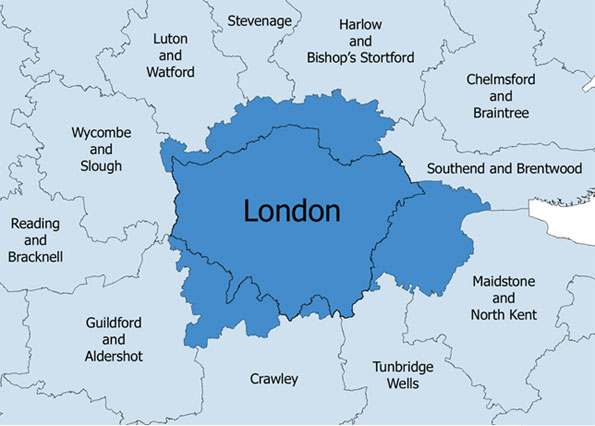
    London and its commuter belt (the ‘Travel to Work Area’, where three quarters of those working work in London) has a population of 9,294,800

    Transportation is the most important factor in dispersal. A.N. Wilson notes that even in the mid-nineteenth century the breakthrough of elliptic springs led to the “age of the carriage folk”, and that this was in turn spurring a movement out of the centre: even “the Marxes abandoned their cramped flat in Soho and moved to a variety of new-built family houses in Kentish Town on the edges of Hampstead Heath.” * So too did William Morris, in his Pre-Raphaelite phase, move from lodgings in the then run-down Red Lion Square, to Bexleyheath in Kent, where he built his celebrated Red House with Philip Webb in 1859. “He continued to curse the iniquities of railways,” writes his biographer Fiona MacCarthy, “but he was to make good use of Abbey Wood, his local station, only three miles away on the newly opened North Kent line.” * Edward Burne-Jones and Gabriel Dante Rossetti were just some of the medieval revivalists collected from the station in Morris’s specially built carriage.

    Later on, lower rail prices – “workmen tickets” – helped clerks establish themselves in Hackney, Wood Green, Hornsey, Hendon, Willesden, Balham and Camberwell. However, these same railway terminals were also adding to the overcrowding of inner London, as land was found for stations by knocking down working-class slums, or “rookeries” – with the surplus population generally moving to the adjacent neighbourhood. *

    In the early century it was electric trams and underground extensions. Historian Asa Briggs says that the slogan of the North Metropolitan Railway (extended from Baker Street to Harrow in 1880) Live in Metroland!, “showed that it was not so much satisfying existing needs as creating new residential districts.” *

    By the post-war period the South-East went through another expansion, one that was driven by the car, rather than the train, which was losing out to its more versatile rival. In 1951 the M1 to Birmingham opened just as car ownership spread among the middle classes. In 1970 the Westway took the M40 right into central London, and in 1986 the London orbital outer ring-road, the M25 was opened by the Prime Minister Margaret Thatcher.

    Greater car ownership was helping to accelerate the process of suburbanisation, coupled with the policies pursued in the 1980s of promoting home ownership (at the expense of public housing). Tories took pride in winning over “Essex Man” – the psychological construct of the aspirant working class voter. Though between 1981 and 1991 it was Cornwall, Cambridgeshire, Buckinghamshire whose population grew fastest, while those of London, Liverpool and Belfast were all stagnant or falling.

    Planners have tried again and again to restrict the growth of London, from the Abercrombie Plan of 1946 to the Urban Task Force of 1998. But just as they planned for a denser inner core and to limit outward sprawl, Londoners stubbornly have preferred the opposite. Even when they changed the boundary to include more of the suburbs and called it Greater London, the main thrust of growth had already moved further outwards into the commuter belt, and the rest of the South East. In reality, today, Oxford and Brighton, Southend and even Southampton are all part of a vast Southern conurbation. Political leaders have failed to catch up with these changes and even tried to stop them – but the change, as Ford explained, is happening with or without them.

    James Heartfield, of the development think-tank audacity.org spoke, at the Mayor’s ‘Story of London’ event on ‘Is London Growing Too Fast?’ on 5 October 2010.

    Photo: By J. A. Alcaide

  • Can David Cameron Close the Deal?

    With the Labour Government exhausted and its supporters dismayed, why isn’t the Conservative Party leader David Cameron sailing home to victory?

    Under the leadership of Prime Minister Gordon Brown, all the weaknesses of the Labour Party have been painfully exposed. British Prime Ministers are elected by the House of Commons, and the Members of that Parliament by the people; so when Brown’s predecessor Tony Blair resigned, his replacement as Labour Party leader became Prime Minister without a general election. In the country, Brown had been a popular figure – if only because he seemed to be the more trustworthy next to the mercurial Blair. But once he took office, Brown’s weaknesses were on view.

    Just as much as Blair, Brown was the architect of the ‘New Labour’ project that shed the party’s welfare state socialist image for a ‘Third Way’. Modelled on Bill Clinton’s revamp of the Democratic Party, the programme demanded that Labour stop using government to provide for its urban poor and trade union constituencies – supporters who would frighten away more aspiring middle class voters.

    But clearing the old-school socialists out of Labour’s policy-making bodies left an ideological vacuum that was filled by environmentalists, the culturati and NGO-enthusiasts for action over the third world. New Labour had freed itself of its traditional socialism only to become beholden to the enthusiasms of the educated political classes. Attention-grabbing ‘humanitarian interventions’ into third world countries were avowedly not in Britain’s national interests, but in pursuit of an ethical foreign policy. Money was directed into subsidising arts centres and other cultural projects.

    Government took on policies that protected the environment, but damaged industry: ‘traffic-calming’ measures – bus and cycle lanes, speed restrictions, congestion charge zones – were put in place with the express purpose of dissuading people from using the roads. Meanwhile road building was put on hold; licenses for new power stations were withheld, so that the country is facing blackouts in six years’ time; bans were put in place on use of GM crops.

    Labour did listen to the City of London’s financial lobby – Goldman Sachs’ Gavyn Davies was a close advisor, as was ‘Shrieky’ Shriti Vadera of UBS Warburg. Labour kept the Conservatives’ banking deregulation but retained Britain’s extraordinary legal controls on land development, so that credit to buy homes was readily available, but very few were built. Anyone sentient could have predicted the result: prices went sky-high putting home ownership beyond the reach of working class people.

    Given his subservience to the City, it was not surprising that when British banks over-extended position led to collapse in late 2008, Brown bailed them pushing public debt into the trillions. Labour’s traditional working class supporters were asking why their party was subsidising million pound bailouts to banks, while their own jobs were disappearing. Most Britons are proud of their armed services, but they had to ask why they were losing their lives in Afghanistan and Iraq. And they wondered how it was that the income gap between rich and poor was getting so much worse under Labour.

    Public disaffection with the political class reached fever pitch when newspapers published details of the Members of Parliament’s own expense claims. MPs were seen to have lied about their addresses to get the taxpayer to pay the mortgage, just as they put their relatives down as researchers and assistants.

    David Cameron ought to have been in the best possible place to take advantage of the government’s difficulties. But Cameron has proven for too much in the same mould as Gordon Brown, and Tony Blair.

    Cameron got to be Tory Party leader after three successive general election defeats. The lesson that the party drew from its experiences in 1997, 2001 and 2005 was that it was the Tory Party’s core brand that was at fault. Cameron was chosen largely by saying that the party should imitate Blair’s ideology-lite, environmentally-conscious, caring, dash for the ‘middle ground’. The Conservatives had to get over their ‘nasty party’ image.

    Cameron dropped a lot of the party’s traditional MPs, and invited people who were not mainstream Tories on board. Cameron’s remodelling of the Conservative Party followed the Brown-Blair model of pushing the core constituency aside to let in new faces. But the new faces that rushed in had the same gentry-liberal preoccupations as those that had taken over the Labour Party in 1997.

    Here’s an example of the new Conservative. As well as running an organic hobby farm, Zac Goldsmith is Cameron’s dashing prospective Tory Party candidate for Richmond Upon Thames. For the last ten years he has been proprietor and editor of The Ecologist magazine, Britain’s foremost green media voice. Zac inherited £300 million from his father, asset-stripping financier Sir James Goldsmith, using the proceeds to finance his pet causes through his own grant-making bodies, the JMG Foundation and the Isvara Foundation. He gives money to his own small-farmers groups FARM, which is committed to stopping private housing developments, has underwritten the Ecologist’s debts of £864,675. He has financed his own web-site SpinWatch to ‘expose’ corporate lobbying – though as Private Eye pointed out, its attack on the nuclear industry was curiously selective, mentioning no Tories, only Labour-backing investors (26 May 2006).

    Well-heeled voters in Richmond might not be too bothered that Zac has written a book The Constant Economy saying we need an end to growth, because they are already enjoying theirs.

    Another key Cameron supporter is advisor Philip Blond whose manifesto Red Tory bemoans the loss of England’s traditional charm under the twin evils of state socialism and the free market ideologies he blames upon the (conveniently foreign-sounding) Milton Friedman. Blond’s traditionalist fantasy of Merrie England is drawn from the backward-looking dreams of G.K. Chesterton and Hilaire Belloc, who railed against modernity back in the early twentieth century.

    Blond’s call for people to rely less on the state is well-made, but his anti-capitalism must have alarmed the party’s core supporters: ‘economic liberalism has often been a cover for monopoly capitalism and is therefore just as socially damaging as left-wing statism.’ Blond’s solution, though, is some state-enforced localism, with legal controls to redirect investment into municipal authorities – what he calls a ‘distributist state’. If this is David Cameron’s big idea, redistributing wealth through local government, it is not surprising that he has not made a great deal of headway in the polls given that everyone understands the real issue is the penurious state of the country’s finances.

    Throughout the election, Cameron has led in the opinion polls, but not by enough to guarantee a majority in parliament. When the country held its first ever televised leaders debate, something that the Tory leader had demanded, he was up-staged by Nick Clegg, leader of Britain’s third party, the Liberal Democrats. In truth Clegg’s appeal is not programmatic – he is pretty much more of the same as the other two. But what he did very effectively was to position himself as the outsider, not a part of the old two party system, a kind of younger, more attractive Ross Perot.

    Clegg’s appeal to the politically disaffected ought to have worked for David Cameron. But Cameron’s failing lies in the fact that he simply has replicated the New Labour project, just as the public were falling out of love with it. Environmentalism, stopping urban sprawl, and ‘restoring communities’ are the preoccupations of a narrow strand of British society: the kind of people who occupy the lower rungs of government service. It is not that most Britons want to trash the environment, or concrete over the countryide, nor indeed support community breakdown. It is just that they do not understand why their own self-betterment always has to give way to those concerns.

    Tragically, the only party that has made an issue of Britain’s chronic housing shortage is the far-right British National Party. Neither the Tories, nor Labour, less still the Liberal Democrats, have the courage to face down the NIMBY opponents of new building. The Tories’ own supporters (like the Lib Dems) have made it to the suburbs and do not want to share or expand them. Labour cannot give up its grip on government planning laws. With no-one willing to free up land for development, the BNP’s call to drive immigrants out is the loathsome conclusion of anti-growth sentiment.

    When they look at the Eton-educated front bench team that Cameron is putting up, voters see the kind of people who have made (or inherited) their stash, and now are pulling up a drawbridge behind them. All of the pious talk about looking after the poor sounds like parish charity, not giving people a chance to help themselves.

    David Cameron’s Conservatives are still the favourite to win the General Election, the only puzzle is why are they finding it so hard to close the deal – a puzzle until you look at their policies, that is.

    James Heartfield works for the Audacity.org think tank, and most recently wrote Green Capitalism: Manufacturing Scarcity in an Age of Abundance (Mute, 2009). His website is at www.heartfield.org

    Photo by: conservativeparty