Author: Jeff Khau

  • Mobility for the Poor: Car-Sharing, Car Loans, and the Limits of Public Transit

    Public transit systems intend to enhance local economies by linking people to their occupations. This presents problems for many  low-income families  dependent on transit for commuting. With rising prices at the gas pump, much hope has been placed on an influx of investment into public transit to help low-income households. But does public transit really help the poor? While the effect of transit access on job attainment is murky, several alternatives such as car loans and car-sharing programs have seen real results in closing the income gap. For Christina Hubbert, emancipation from public transit has been a change for the better. NBC News reports:

    A car means Hubbert no longer spends two hours each way to and from work in suburban Atlanta. It means spending more time with her 3-year-old daughter — and no longer having to wake her up at 5 every morning so she can be in the office by 8. It also means saving hundreds of dollars each week in day care late fees she incurred when she couldn’t get to the center before its 6:30 p.m. closing time.

    Research finds that car-ownership is positively correlated with job opportunities while no such relationship exists with access to transit stations. Furthermore, increased transit mobility has been proven to have no effect on employment outcomes for welfare recipients. The notion that newer and nearer public transit creates benefits for all is inaccurate; it only creates opportunities for those who live near the transit stations, and those opportunities are limited. A study by the Brookings Institute finds that, among the ten leading metropolitan areas in the US, less than 10% of jobs in a metropolitan area are within 45 minutes of travel by transit modes. Moreover, 36% of the entry-level jobs are completely inaccessible by public transit. This is not surprising given the fact that suburbia houses two-thirds of all new jobs.

    The mismatch between people and jobs can be reconciled in two ways: car loans and car-sharing services. Basic car-sharing involves several people using the same car or a fleet of cars, as with the ZipCar. The concept has branched out to on-demand car sharing services, such as Lyft, mobile apps which link riders with drivers.

    Car loans on the other hand have been around for a while and offer affordable financing for a car without a required down payment. Ways to Work, one of the largest loan providers in the U.S., includes courses on personal finance and credit counseling. By making vehicle travel more attractive, these two disruptive innovations threaten the expansion of public transit – and its powerful associated lobbies – in three ways:

    1. It’s more cost-efficient and time-efficient.

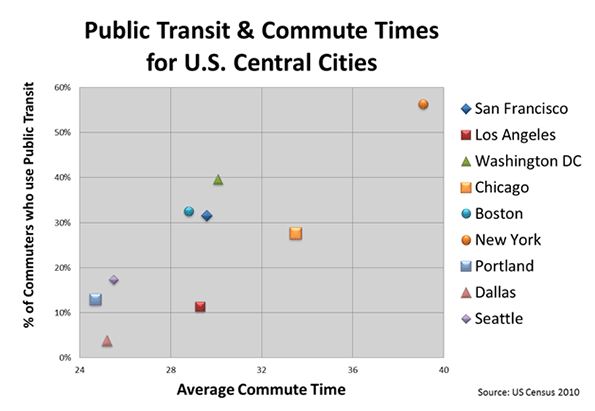
    To improve the way we move people, transit developments must save both time and money. Sadly, transit lines are notorious for their extraordinary costs and long delays. Data from the 2010 Census reveals that people living in central cities with a higher proportion of transit riders experience longer commutes. And since transit riders have more cumbersome commutes, they are much more likely to be tardy or absent from work.
    The hefty price tag of transit projects also triggers concern. For example, the cost per new passenger of the Washington Metro line to Dulles Airport was estimated at $15,000 annually. That’s about the same as the current poverty threshold for a household of two.

    Car-loan programs on the other hand are largely cost-efficient, producing real fiscal benefits to borrowers, employers, and taxpayers. A survey of 4,771 borrowers and their employers finds that borrowers have greater job security as a result of access to vehicles. With access to credit, borrowers increase their purchasing power by an average of $2,900 each year and save about $250 by avoiding payday loans and checks-for-cash outlets. Employers gain as well through cost savings due to increase retention and reduced absenteeism and tardiness, which amount to $817 and $1130 per borrower respectively. In large part, providing vehicle financing is a smart investment since it reduces the number of low-income families on social welfare – an annual cost savings of $2,900 for each borrower coming off public assistance.

    Given its clear advantages, car sharing is increasing. Recent reports find that shared-use vehicle organizations have been lucrative. Between August 2012 and July 2013, car-sharing ridership grew by 112 percent and the number of vehicles increased by 52 percent. And although car-sharing is not typically used to transport the poor, having on-demand car service makes it so that door-to-door access is more available and affordable. If car-sharing continues to grow at its current rate, it’s reasonable then to assume that these pseudo-taxi services will be eventually be affordable enough so that people would choose to be chauffeured rather than drive their own vehicles.

    2. Vehicle ownership provides greater access to jobs and economic opportunities.

    Instead of being limited to a few areas that are transit-oriented, families with cars have access to more jobs and economic opportunities. Public transit lines are limited in their geographical coverage and take time to make often numerous stops.  Transfers are inefficient and time-consuming, making much of that coverage impractical. Also regular transit riders have limited employment options since they’re only able to consider jobs in the vicinity of transit stops and stations.

    3. Travel by car  is responsive to current travel patterns

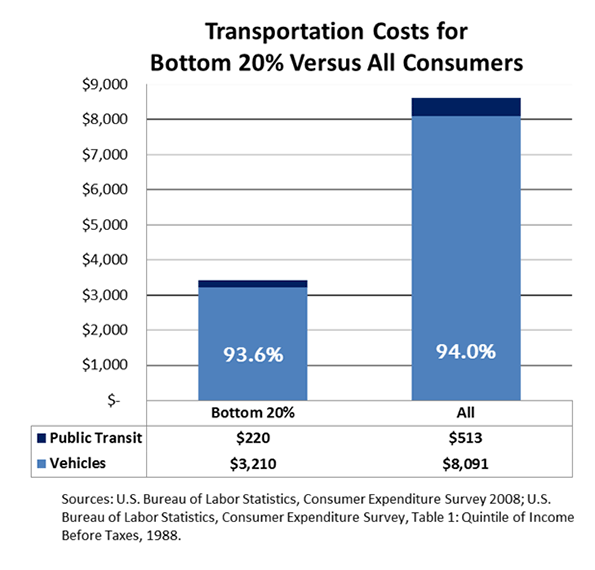
  • A common misperception is that low-income people do not have cars. In reality, 86% of the poor have cars, compared to 95% of the entire population. The high percentage of poor families with cars reveals how automobile culture has become fixed into American ideals of economic well-being and prosperity. And contrary to stereotypes, the poor and the rich similarly spend about 94% of their transportation costs on vehicle travel versus public transit, challenging the notion that low-income travel behavior is unlike that of the rest of the population. As such, providing the poor with cars dramatically levels the playing field as they are the ones who would gain the most from increased access to employment destinations and education facilities.
    A strong argument posited by public transit advocates is that as more cars use the road, congestion and pollution will intensify. And to be sure, public transit is more environmentally friendly than motor vehicles. The Amalgamated Transit Union (ATU), the largest union representing transit workers in North America, reports that one full bus eases the road of thirty-five cars, and that existing transit usage cuts national gasoline consumption by 1.4 billion gallons annually. Yet, on average, this result can only   be achieved if buses were always full, which they are not – authorities from the Los Angeles Metro estimate that their buses run at an average of 42% capacity.

    But is it equitable to ask the poor to forgo mobility and economic gain for the environment? Considering that most Americans experience some degree of social mobility via vehicle ownership, it’s far more reasonable to allow  low-income families greater access to opportunity. In addition, new fuel efficiency standards for cars set by the Obama administration will decrease overall GHG emissions substantially; according to forecasts by the Department of Energy, carbon emissions from light-duty vehicles will drop 21% between 2010 and 2040 in spite of a 40% increase in driving. This shows that, even with more cars on the road, environmental goals can be accomplished.

    Although the eligibility requirements are stricter in some areas than others, every state in the U.S. has a program for low-income residents to have access to car loans. Car-sharing is also rapidly expanding, but  marketing now is geared towards millennials on a budget rather than low-income families. Both innovations, however, respond to new demands faced by future workers, who are likely to find employment in dispersed locations and may make more trips per workday since many may have multiple part-time jobs. With more efficient ways of getting people to work, it’s time to challenge the assumption that the expansion of public transit is the best way to meet the needs of America’s hard-pressed working class.

    Jeff Khau graduated from Chapman University with a degree in business entrepreneurship. Currently, he resides in Los Angeles where he is pursuing his dual-masters in urban planning and public policy at the University of Southern California.

    Photo by Romana Klee, #113 zipcar.
  • Will Driverless Cars Help us Drive Less?

    The war on automobiles is real. Backed by a legion of city officials, environmentalists, and new urbanists, the argument to mitigate vehicle usage has so far been an easy sell – at least in planning circles. Their assumptions echo concerns about the trajectory American cities – the downfall of rural life and open space to name a few.  The problem is the trifecta of pollution, congestion, and urban sprawl. Out with cars, they propose – people could ride high-speed transit instead of sitting in traffic.

    But technical innovation could make this proposal more like a plea. Google, along with GM, Ford, and Daimler are now designing cars that drive themselves, making private vehicles more efficient, flexible, and thereby more irreplaceable. The US is not alone. Manufacturers in Japan and Germany are coordinating with their national government to launch their autonomous cars within the next decade. IEEE, a group of technology professionals, says that self-driving vehicles would comprise 75 percent of the global traffic stream by 2040. 

    “Currently, a car spends 96% of its time idle,” says Koushik Dutta of ClockworkMod. He says there’s an unforgiving economic incentive to make sure an airplane is always in use, since they spend almost their entire lifetime in operation. To leave a plane idle is inefficient and unprofitable; similar logic applies to parked car. Some predict the autonomous vehicle technology will decrease this idle time as households begin to link their commutes in one car, rather than one car per person. Sergey Brin, Google’s cofounder, believes the technology, now tangible, will be on the market in five years.

    But what precisely is this new technology? As it turns out, much of it is not new; a number of automated features can be found in today’s cars: timed braking during collisions, motion sensors that detect distance between the vehicle and what’s in front of it, and adaptive cruise control. Many of the latest features have applications that use advanced sensors to self-park and prevent drifting to adjacent lanes and self-park.

    Unprecedented is the use of a network for vehicles to communicate with one another. A study finds that if vehicles use sensors alone, highway capacity can increase by 43 percent, and if all of the vehicles use both sensors and vehicle-to-vehicle (V2V) communication, the increase swells to 273 percent. Additionally, networks can facilitate information exchange between vehicles and road infrastructure (V2I). With live data streams, cars will be able to inform one another about oncoming traffic, and perhaps even instinctively reroute the car onto less congested roads.

    The move to driverless cars will make the private vehicle much more attractive compared to other modes of travel. This is particularly important for older drivers whose ability to drive has diminished; the coming of driverless cars brings them back onto the road. Less reliant on their friends and family as chauffeurs, boomers may happily embrace the ability to travel further and more frequently.

    This appeal will extend to all generations. The driverless car offers the current conveniences of the private auto – such as door-to-door travel, safety, and status – while reducing its level of risk and mental stress. Also, the stigmas of driving are eased; self-driving cars are expected to be more eco-friendly, time-efficient, and user-friendly. Once on the market, driverless technology will change lives by saving lives. Advocates of self-driving cars believe that with less human operation and more automated maneuvering on the road, fewer accidents will occur.

    But before autonomous cars can save lives, it must squirm through some political barriers. For one, city officials in large metropolitans are glued to the idea that the best communities exemplify mixed used, high-density, transit-oriented development. Hoping to reverse the still far from over exodus to the suburbs, cities like Los Angeles are banking on public transit to revitalize its inner-urban areas. Though public transit ridership has increased in the last two decades, its market share of ridership has being declining. Metropolitan officials hope that millennials, who tend to be more cognizant of mankind’s carbon footprint, will reverse the trend. It is, however, difficult to imagine why any future generation would enjoy the conveniences of taking transit if a car ride can be just as untroubled. Driverless will make vehicle ownership much more attractive. Public transit will lose its status as an amenity. One of the chief advantages of public transit is the fact that one can ride it stress free without worrying about maneuvering to the destination. With driverless cars, this advantage is superseded.

    Congestion may increase because more vehicles will find the frustrations of wading in traffic mitigated. Time in congestion can be replaced with a book, movie, perhaps even a nap. But there’s also the possibility that more households will link their trips using one shared vehicle, decreasing the number of vehicles on the road. Some suggest this may help Americans come to terms with letting go of the private vehicle and, instead, embrace the idea of having one household vehicle, a prevailing trend across the rest of the world.

    Transportation planners often promote tolls as revenue sources because building high-occupancy and toll (HOT) lanes. The concept is deemed equitable since it links the payers with the users, begetting a sustainable funding model. Much of the funding for these projects is based on the congestion premium – what people will pay to avoid a crammed highway. This is useful in determining how much to price a toll or high-occupancy lane. But since driverless technology will likely lower this premium, the revenue of these lanes may be overvalued.

    With the pieces in place, the journey to driverless cars is vastly feasible. In September 2012, California Governor Jerry Brown enacted a state measure to legalize driverless technology in cars running on public roads; at any given moment, a dozen driverless cars are operating somewhere in California. Currently, each vehicle is manned by two testers and marked by a distinguishable license plate. In the future, the vehicle will only be required to have a one driver. And not too far is the idea of a completely unmanned vehicle, what some call the robocar, which will revolutionize not just our mode of travel but our relationship with time and distance.

    Jeff Khau graduated from Chapman University with a degree in business entrepreneurship. Currently, he resides in Los Angeles where he is pursing his dual-masters in urban planning and public policy at the University of Southern California.

    Retrofitted driverless Lexus photo by WikiCommons user Steve Jurvetson via Mariordo.

  • The Rise of Telework and What it Means

    Teleworking (also known as telecommuting) has taken flight as a global trend. During July of 2002, European Union collectively decided on a shared framework agreement on telework, which regulates issues such as employment and working conditions, health and safety, training, and the collective rights of teleworkers. Following suit, the American the Telework Enhancement Act of 2010 served as a rallying call for federal agencies to encourage “work-at-home” employees. In the same year officials in China, eager to reduce gross national carbon emissions, chose the province of Hubei to undergo the country’s first telecommuting pilot program  

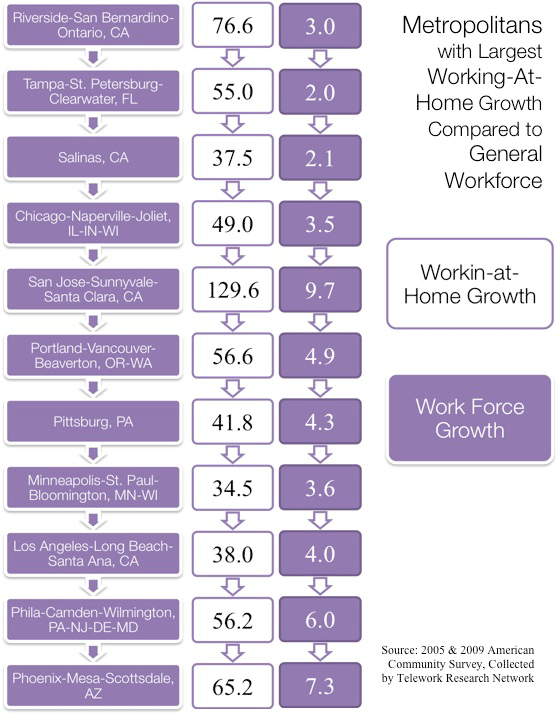
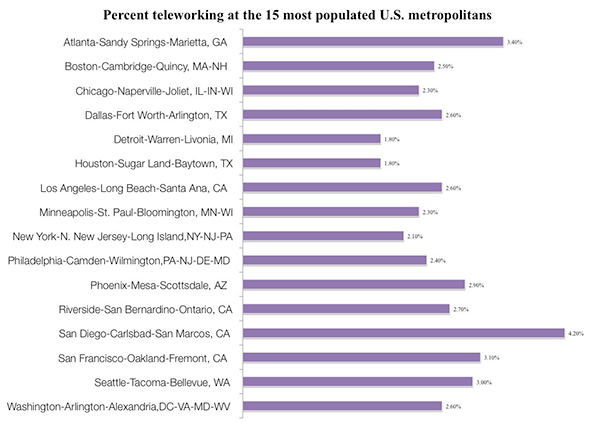
    In the United States, telecommuting is   on the clear increase.  Data from the American Community Survey estimate that the working at home population grew 61% between 2005 and 2009. The biggest increases in teleworking population compared to workforce was in Riverside-San Bernardino-Ontario, CA while the metro with the highest growth in teleworking was San Jose-Sunnyvale-Santa Clara, CA.


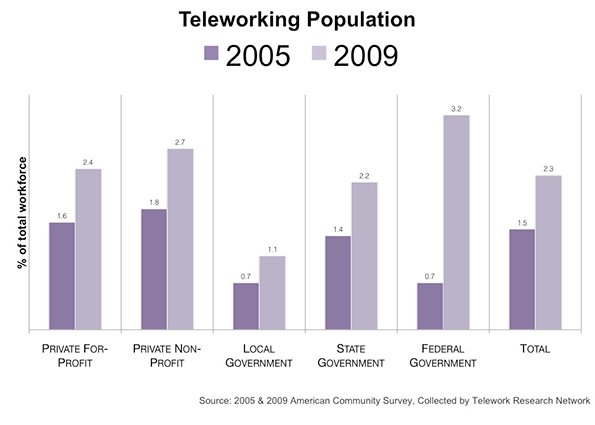
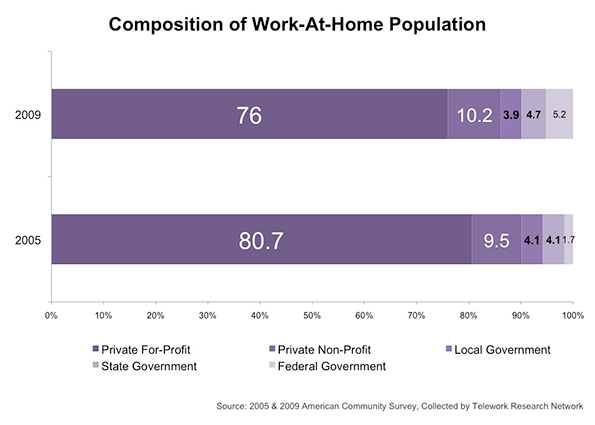
    Is the trend to telecommuting comparable between the private and public sectors? The 2009 American Community Survey gives a snapshot of the work-at-home population by class of worker in the years 2005 and 2009. Although the rise of teleworkers is across both sectors, a surge in government teleworkers indicates the public sector, notably the federal government, has made a huge effort keep staff at home to cut administrative costs.

    After the federal government, the next largest increase in ratio of teleworkers is at the state level. Municipal government teleworkers showed the most modest growth and represent only 3.9% among those working at home. Though only 2.4% of private for-profit sector employees consider themselves teleworkers, by size alone they represent about three-fourths of the working-at-home population.

    Still, understanding of telework remains incomplete.   First, as President Obama’s Council of Economic Advisors stated in 2010, there remains a persistent “lack of data on the prevalence of workplace flexibility and arrangements which makes policy-making more difficult.” There are often ambiguities such as the issue of how to distinguish between part-time and full-time teleworkers. One also must separate paid work telework (such as an official flex-time work arrangement) from non-paid telework (such as a teacher grading papers at home during the weekend).   Telework’s definition is so broad that perceptions   can vary dramatically.

    New research attempts to bring clarity into whether employers should allow their employees to have a work-at-home option. Results from a recent study at Stanford partnered with Ctrip, an online travel-booking agency based in China, presented strong evidence to support the causal relationship between telework and productivity. With a turnover rate among Ctrip call center representatives hovering at around 50% per year (typical of the industry in China), retaining workers was a core objective of the experiment. Estimates by management say the typical costs of hiring and training a new representative is $2000, approximately 6 months of salary for an average employee.

    Despite initial doubt, the research provides stark insight on efficiency gains from telecommuting gains. An article from Slate summarizes the findings:

    Over the duration of the experiment, home workers answered 15 percent more calls, partly because each hour was 4 percent more productive, and partly because home office employees spent 11 percent more time answering phone calls. (Home workers took fewer breaks and sick days, rarely arrived late to their desks, and had fewer distractions.) … distractions of home life had no impact on the quality of service: The home-work group converted phone calls into sales at exactly the same rate as those in the office. And employees themselves liked the arrangement better… [and] reported less “work exhaustion,” a more positive attitude towards their jobs, and were nearly 50 percent less likely to say they were planning to quit at the end of the eight months.

    In the long run, telecommuting could generate massive changes in urban geography. As benefits of telework manifest in new research, city planners ought to observe how its impact on the geography of American cities.

    Teleworkers are more likely than not to live in the suburbs. Since teleworkers are often required to be tech-savvy with the latest mobile devices, one could expect a disproportionately high percentage of them working in hi-tech industries in sprawled tech hubs like the Silicon Valley. Most teleworkers choose to commute for a very practical reason: it would save them time and money. According to research by Kate Lister and Tom Harnish of the Telework Research Network, aside from housing preference the typical teleworker is a 49-year-old, college-educated, salaried, non-union employee in a management or professional role, earning $58,000 a year at a company with more than 100 employees. As of 2009, 76% of the total working-at-home population consists of the for-profit workers.

    Some industries will stay clustered around the city center but more jobs, especially service-oriented ones, will continue to migrate towards the suburbs.  

    Teleworking will increase the total amount of hours Americans work annually. Americans, infamous for overwork, can easily translate telework as “more work.” Data from the United Nations reports 86% of American males and 67% of American females working more than 40 hours a week. While technology has often been accused as a job-killer, it has also made jobs easier and, in some ways, more social. Employers using Cloud technology are utilizing personalized social networks in hopes of creating a more connected community in the work place. The point at which work begins and leisure ends is becoming increasingly hard to distinguish as hours spent “on the job” are elusive, and thus harder to limit.

    For urban planners, this signals new types of urban development to provide for a population of Americans that work longer hours but do so closer to home.  Food and retail establishments will be one of the first to address this trend. Coffee shops with Wi-Fi and casual dining franchises like Panera and Corner Bakery will become commonplace in middle-to-upper class suburban neighborhoods.

    These general locales could generate a privatized version of the Third Place, a milieu distinct from the two usual social environments of home and the workplace. Other urban innovations to anticipate include co-working offices, such as those offered by BLANKSPACES, and pay-as-you-go meeting services, like Liquidspace.

    The availability of affordable mobile technology has been the main contributor to the "any time, any place" lifestyle. Still, the trend is limited to a small percentage of American workers, mainly those that tend to work in service-oriented positions and, as the numbers in Silicon Valley suggest, in the service sector. As more interest and funding is directed towards nanotechnology and cloud networking, perhaps this lifestyle will propagate to become the new normal. If so, telework may someday be just a common way that people work that may change forever the urban landscape.

    Jeff Khau graduated from Chapman University with a degree in business entrepreneurship. Currently, he resides in Los Angeles where he is pursing his dual-masters in urban planning and public policy at the University of Southern California.

    Office or home signpost photo by Bigstock.