Author: Joel Kotkin and Wendell Cox

  • Special Report: America’s Emerging Housing Crisis

    This is the executive summary from a new report, America’s Emerging Housing Crisis, published by National Community Renaissance, and authored by Joel Kotkin and Wendell Cox. Download the report and the supplement report below.

    From the earliest settlement of the country, Americans have looked at their homes and apartments as critical elements of their own aspirations for a better life. In good times, when construction is strong, the opportunities for better, more spacious and congenial housing—whether for buyers or renters—tends to increase. But in harsher conditions, when there has been less new construction, people have been forced to accept overcrowded, overpriced and less desirable accommodations.

    Today, more than any time, arguably, since the Great Depression, the prospects for improved housing outcomes are dimming for both the American middle and working classes. Not only is ownership dropping to twenty-year lows, there is a growing gap between the amount of new housing being built and the growth of demand.

    Our still-youthful demographics are catching up with us. After a recession generated drought, household formation is again on the rise, notes a recent study by the Harvard Joint Center for Housing Studies. In some markets, there isn’t an adequate supply of affordable housing for the working and middle classes. Overall, according to the research firm Zelman and Associates, the country is building barely one-third the number needed to meet the growth in households. Overall inventories of homes for sale are at the lowest level in eight years.

    The groups most likely to be hurt by the shortfall in housing include young families, the poor and renters. These groups include a disproportionate share of minorities, who are more likely to have lower incomes than the population in general. This situation is particularly dire in those parts of the country, such as California, that have imposed strong restrictions on home construction. California’s elaborate regulatory framework and high fees imposed on both single- and multi-family `housing have made much of the state prohibitively expensive. Not surprisingly, the state leads the nation in people who` spend above 30 percent, as well as above 50 percent, of their income on rent.

    Sadly, the nascent recovery in housing could make this situation even more dire. California housing prices are already climbing far faster than the national average, despite little in the way of income growth. This situation could also affect the market for residential housing in other parts of the country, where supply and demand are increasingly out of whack.

    Ultimately, we need to develop a sense of urgency about the growing problem of providing adequate shelter. As a people we have done this many times — with the Homestead Act, and again, after the Second World War, with the creation of affordable “start-up” middle- and working class housing in places like Levittown (Long Island), Lakewood (Los Angeles), the Woodlands (Houston) and smaller subdivisions, as well as large scale cooperative apartment development in places like New York. Government policy should look at opportunities to create housing attractive to young families, which includes some intelligent planning around open space, parks and schools. It is important to ensure that a sufficient supply of affordable housing is allowed throughout metropolitan areas, for all income groups.

    Nothing speaks to the nature of the American future more than housing. If we fail to adequately house the current and future generations, we will be shortchanging our people, and creating the basis for growing impoverishment and poor social outcomes across the country.

    Joel Kotkin is executive editor of NewGeography.com and Distinguished Presidential Fellow in Urban Futures at Chapman University, and a member of the editorial board of the Orange County Register. He is author of The City: A Global History and The Next Hundred Million: America in 2050. His most recent study, The Rise of Postfamilialism, has been widely discussed and distributed internationally. He lives in Los Angeles, CA.

    Wendell Cox is principal of Demographia, an international public policy and demographics firm. He is co-author of the “Demographia International Housing Affordability Survey” and author of “Demographia World Urban Areas” and “War on the Dream: How Anti-Sprawl Policy Threatens the Quality of Life.” He was appointed to three terms on the Los Angeles County Transportation Commission, where he served with the leading city and county leadership as the only non-elected member. He was appointed to the Amtrak Reform Council to fill the unexpired term of Governor Christine Todd Whitman and has served as a visiting professor at the Conservatoire National des Arts et Metiers, a national university in Paris.

  • ‘Lone Eagle’ Cities: Where The Most People Work From Home

    In an era of high unemployment and limited opportunity, more Americans are taking matters into their own hands and going to work for themselves out of their homes.

    Normally small businesses have led the way during economic recoveries, but this time around they’re not creating many jobs. Instead much of the growth we are now seeing is in “lone eagle” businesses, to borrow a phrase from Phil Burgess, often operating out of the worker’s residence. This reverses the trend from 1960 to 1980, when there were steady reductions in the number of people who worked at home. Indeed, despite all the talk of increased mass transit usage, the percentage of Americans working at home has grown 1.5 times faster over the past decade; there are now more telecommuters than people who take mass transit to work in 38 out of the 52 U.S. metropolitan areas with more than 1,000,000 residents.

    One clear driver of this trend is technology, particularly the growing ubiquity of high-speed Internet. A consultant in New York can now serve customers in Fargo, and vice versa, greatly expanding the range of places where people can live. This is particularly true for aging boomers, as well as younger workers having problems finding a full-time job in this tough economy.

    Not surprisingly, of America’s 52 largest metro areas, the ones with the highest proportions of home-based workers are generally those with high-tech, information-based economies. Tops is San Diego, a major center for digital and biomedical businesses, where 6.6% of workers are based at home.

    The next five metro areas, which have home worker concentrations ranging from 6.1% to 6.4%, all boast a high number of STEM workers and tech firms: Austin, Portland, Denver, Raleigh and San Francisco-Oakland. They all also have another thing in common: They tend to be popular destinations for millennials, who seem far more comfortable with unconventional work arrangements than older generations.

    High real estate costs may be accelerating the trend in San Francisco, San Diego and Portland —  if office space isn’t affordable, why not stay at home? All are also plagued by traffic congestion, most notably the Bay Area, which has among the longest commute times in the country. Rather than drive down snarled freeways, or take slow mass transit, individuals may do better working from home and heading into the traffic maelstrom only when absolutely necessary.

    College Towns, Suburbs And Exurbs

    Many metro areas, of course, are huge, and have many different kinds of geographies. But when we looked at the percentage of home-based workers in all municipalities with populations above 25,000, two types dominated the top of the table: college towns and tech-oriented exurbs. Boulder, Colo., for example, has the third highest proportion of people who work at home, at 11.6%, almost three times the national average. Other college towns with large proportions of telecommuters and one-person businesses include Berkeley, Calf. (tied for fifth, 10.6%), and Columbia, S.C. (12th, 9.9%), home to the University of South Carolina.

    But the bulk of our leading work-at-home locales are tech-oriented suburbs or exurbs. These include several communities around the often traffic-clogged greater Atlanta area, including No. 2 John’s Creek (13.1%) and No. 6 Alpharetta (10.6%).

    There are even more in the sprawl of Southern California. As many  longtime Southland residents can attest, the best workday is one that does not involve either driving or taking transit. The top municipalities on our list in the region tend to be more affluent communities, including two suburbs of our top-ranked metro area, San Diego: Carlsbad (16th, 9.4%) and Encinitas (fourth, 10.7%).

    The Codger Economy

    Yet it would be a mistake to think cities with large home-based workforces are necessarily youthful ones. Nor are they all in large metropolitan areas. Although still slightly below the average for metropolitan areas, the pace of new telecommuter growth is now much faster outside the major metro areas.

    More than 5 million Americans aged 55 or older run their own businesses or are otherwise self-employed, according to the Small Business Administration, and their numbers soared 52% from 2000 to 2007. As research from the Kauffmann Foundation suggests, many of these aging workers are not ready to hang up their workboots.

    This entrepreneurial push could correlate with  the movement of aging boomers to more rural communities, and sleepier outer suburbs. Contrary to the much-hyped notion of a “back to the city” movement among boomers, Census research suggests that if they move at all, most head further to the periphery. At the top of our list of communities over 25,000 is the coastal North Carolina city of Jacksonville, home to the Marine Corps’ Camp Lejeune and a good number of military retirees. A remarkable 13.8% of the people in this highly affordable, scenic community of 70,000 work out of their homes, roughly three times the national average. The median home price in Jacksonville: $141,000.

    Other retirement hot spots with high telecommuter shares include Boca Raton, Fla. (9.8%), Scottsdale, Ariz. (9.8%), and Bend, Ore. (9.0%). These communities tend to attract well-educated boomers, many of whom have kept their business connections and work as consultants. In many cases, telecommuting allows people to continue their careers, but in an atmosphere of comfort, without the burden of commuting and, in many cases, sans the high income taxes of places like California and New York.

    We can expect the wired economy to expand to other smaller communities. Already numerous smaller towns in the Midwest, such as Albert Lea, an hour and a half from Minneapolis, Brainerd, Minn., and Hastings Neb., all have home worker shares well above the national average. Many of the areas with the fastest growth in the number of self-employed people, notes EMSI is in small, somewhat isolated communities.

    Many analysts who follow these trends expect stay-at-home workers to become more common in the future. According to research by Kate Lister and Tom Harnish of the Telework Research Network, the typical teleworker is a 49-year-old, college-educated, salaried, non-union employee in a management or professional role, earning $58,000 a year at a company with more than 100 employees.

    This suggests that, as more workers enter their 50s, the telework population will expand further.  These numbers will continue to be buttressed by both economic and social factors. The shift towards outsourcing by companies seems unlikely to slow in the years ahead, with more work going to subcontractors who can often work at home. At the same time more boomers, particularly those with skills and connections, will continue to move to places that offer more attractive lifestyles — a process that Joel Garreau has labeled “the Santa Fe-ization of the world,” which he links to people with enough money to have choices.

    In the future, however, less well-heeled workers can also be expected to increasingly shift to affordable locales that appeal to them. This can be almost anywhere — a beach community, a rural hamlet, an exurb or even a dense urban location, as we can see by the geographic diversity in these rankings. As USC grad student Jeff Khau writes, this should encourage the development of wired coffee shops and casual restaurants in smaller communities and exurbs.

    Finally, there are both familial and environmental reasons for this trend to expand. With more two-worker households, it has become more attractive to have at least one person working from home, part-time or full-time. And then there is the environmental desire to reduce carbon admissions. Compared to being forced to live in dense cities, or taking mass transit, the best way by far to reduce energy use – not to mention stress – is to not leave home at all.

    Top Places Where Residents Work at Home

    No. 1: Jacksonville, NC – 13.8%

    No. 2. Johns Creek, GA – 13.1%

    No. 3: Boulder, CO – 11.6%

    No. 4: Encinitas, CA – 10.7%

    No. 5 (tie): Berkeley, CA – 10.6%

    No. 5 (tie): Alpharetta, GA -10.6%

    No. 5 (tie): Santa Monica, CA -10.6%

    No. 8: Frisco, TX – 10.2%

    No. 9 (tie): San Clemente, CA – 10.1%

    No. 9 (tie): Columbus, GA – 10.1%

    No. 11: Bethesda CDP, MD – 10.0%

    No. 12: Columbia, SC – 9.9%

    No. 13 (tie): Boca Raton, FL – 9.8%

    No. 13 (tie): Scottsdale, AZ – 9.8%

    No. 15: Newport Beach, CA – 9.5%

    Journey to Work Market Share by Mode (2012 ACS.1 & Year)
      Total Drive Alone Car Pool Transit Cycle Walk Other  @ Home
    United States 100% 76.3% 9.7% 5.0% 0.6% 2.8% 1.2% 4.4%
    Outside Major Metropolitan Areas 100% 79.9% 10.2% 1.2% 0.6% 2.8% 1.2% 4.1%
    Major Metropolitan Areas (52) 100% 73.5% 9.3% 7.9% 0.7% 2.8% 1.2% 4.6%
                     
    Atlanta, GA 100% 78.0% 10.5% 2.9% 0.1% 1.4% 1.1% 5.9%
    Austin, TX 100% 76.0% 11.0% 2.3% 0.9% 2.0% 1.4% 6.4%
    Baltimore, MD 100% 76.5% 8.9% 6.5% 0.3% 2.7% 1.0% 4.1%
    Birmingham, AL 100% 85.7% 9.1% 0.6% 0.1% 1.0% 0.5% 2.9%
    Boston, MA-NH 100% 68.6% 7.5% 12.2% 1.0% 5.4% 1.0% 4.4%
    Buffalo, NY 100% 82.9% 7.5% 3.0% 0.5% 2.9% 0.8% 2.3%
    Charlotte, NC-SC 100% 78.8% 10.3% 2.1% 0.2% 1.6% 1.2% 5.9%
    Chicago, IL-IN-WI 100% 70.9% 8.8% 11.1% 0.7% 3.2% 1.1% 4.2%
    Cincinnati, OH-KY-IN 100% 83.5% 8.3% 1.8% 0.1% 2.0% 0.7% 3.5%
    Cleveland, OH 100% 82.3% 7.4% 3.2% 0.3% 2.3% 0.9% 3.6%
    Columbus, OH 100% 82.1% 8.4% 1.6% 0.5% 2.0% 1.1% 4.3%
    Dallas-Fort Worth, TX 100% 80.9% 10.2% 1.5% 0.2% 1.2% 1.5% 4.6%
    Denver, CO 100% 75.6% 9.1% 4.4% 1.1% 2.4% 1.1% 6.3%
    Detroit,  MI 100% 83.7% 8.9% 1.6% 0.3% 1.3% 0.8% 3.4%
    Grand Rapids, MI 100% 82.7% 9.2% 1.2% 0.5% 1.8% 0.6% 4.0%
    Hartford, CT 100% 81.4% 7.6% 3.4% 0.2% 2.7% 0.9% 3.7%
    Houston, TX 100% 79.6% 11.1% 2.6% 0.3% 1.4% 1.5% 3.5%
    Indianapolis. IN 100% 82.6% 9.4% 1.2% 0.3% 1.6% 0.9% 4.0%
    Jacksonville, FL 100% 80.7% 9.9% 1.3% 0.7% 1.3% 1.3% 4.7%
    Kansas City, MO-KS 100% 83.2% 8.9% 1.1% 0.2% 1.3% 1.1% 4.2%
    Las Vegas, NV 100% 78.5% 10.7% 3.8% 0.3% 2.0% 1.6% 2.9%
    Los Angeles, CA 100% 74.1% 10.1% 6.0% 0.9% 2.6% 1.2% 5.1%
    Louisville, KY-IN 100% 82.9% 9.3% 1.8% 0.2% 1.8% 0.8% 3.2%
    Memphis, TN-MS-AR 100% 83.0% 10.5% 1.2% 0.1% 1.2% 0.9% 3.0%
    Miami, FL 100% 77.6% 9.5% 4.2% 0.6% 1.8% 1.3% 5.0%
    Milwaukee,WI 100% 80.2% 8.6% 3.7% 0.6% 2.9% 0.7% 3.2%
    Minneapolis-St. Paul, MN-WI 100% 78.2% 8.6% 4.3% 1.0% 2.2% 0.7% 5.0%
    Nashville, TN 100% 82.4% 9.6% 1.1% 0.1% 1.2% 1.0% 4.7%
    New Orleans. LA 100% 79.2% 10.4% 2.7% 1.0% 2.5% 1.6% 2.6%
    New York, NY-NJ-PA 100% 49.8% 6.7% 31.0% 0.6% 6.1% 1.6% 4.1%
    Oklahoma City, OK 100% 82.9% 10.2% 0.4% 0.3% 1.7% 1.2% 3.3%
    Orlando, FL 100% 80.8% 9.2% 2.0% 0.6% 1.2% 1.7% 4.6%
    Philadelphia, PA-NJ-DE-MD 100% 73.3% 7.9% 9.4% 0.7% 3.8% 0.7% 4.2%
    Phoenix, AZ 100% 77.3% 11.0% 2.1% 0.8% 1.4% 1.8% 5.6%
    Pittsburgh, PA 100% 77.3% 9.0% 5.5% 0.3% 3.4% 0.9% 3.6%
    Portland, OR-WA 100% 70.8% 9.7% 6.0% 2.3% 3.8% 1.0% 6.4%
    Providence, RI-MA 100% 80.4% 8.8% 2.9% 0.3% 3.2% 1.1% 3.2%
    Raleigh, NC 100% 80.3% 9.8% 1.0% 0.4% 1.1% 1.2% 6.2%
    Richmond, VA 100% 81.5% 9.3% 1.6% 0.5% 1.5% 0.9% 4.7%
    Riverside-San Bernardino, CA 100% 77.7% 13.4% 1.5% 0.4% 1.6% 1.0% 4.4%
    Rochester, NY 100% 82.4% 7.9% 1.9% 0.3% 3.6% 0.7% 3.2%
    Sacramento, CA 100% 75.5% 11.2% 2.3% 1.9% 2.2% 0.9% 6.0%
    Salt Lake City, UT 100% 75.0% 12.1% 3.9% 0.9% 2.0% 1.3% 4.7%
    San Antonio, TX 100% 79.7% 11.1% 2.3% 0.1% 1.7% 1.0% 4.1%
    San Diego, CA 100% 76.2% 9.9% 2.8% 0.7% 2.7% 1.2% 6.6%
    San Francisco-Oakland, CA 100% 60.4% 10.1% 15.6% 1.8% 4.3% 1.6% 6.1%
    San Jose, CA 100% 76.5% 10.6% 3.4% 1.9% 1.6% 1.4% 4.6%
    Seattle, WA 100% 69.6% 10.5% 8.5% 1.2% 3.6% 1.1% 5.5%
    St. Louis,, MO-IL 100% 82.4% 8.1% 2.3% 0.3% 1.7% 0.9% 4.2%
    Tampa-St. Petersburg, FL 100% 80.0% 9.6% 1.2% 0.8% 1.7% 1.3% 5.4%
    Virginia Beach-Norfolk, VA-NC 100% 80.9% 8.9% 1.9% 0.4% 2.7% 0.9% 4.3%
    Washington, DC-VA-MD-WV 100% 65.8% 10.2% 14.1% 0.8% 3.2% 0.9% 5.0%

    This story originally appeared at Forbes.com.

    Joel Kotkin is executive editor of NewGeography.com and Distinguished Presidential Fellow in Urban Futures at Chapman University, and a member of the editorial board of the Orange County Register. He is author of The City: A Global History and The Next Hundred Million: America in 2050. His most recent study, The Rise of Postfamilialism, has been widely discussed and distributed internationally. He lives in Los Angeles, CA.

    Wendell Cox is a Visiting Professor, Conservatoire National des Arts et Metiers, Paris and the author of “War on the Dream: How Anti-Sprawl Policy Threatens the Quality of Life.

    Photo by By Rae Allen, “My portable home office on the back deck”

  • China Failing its Families

    China’s recent decision to reverse – at least in part – its policy limiting most couples to one child marks a watershed in thinking about demographics. Yet, this reversal of the 30-year policy may prove unavailing due to reasons – notably dense urbanization and high property prices – that work against people having more children.

    China already faces a demographic crisis unprecedented for a still-poor country. By 2050, China will have 60 million fewer people under 15 years of age, while the over-65 population grows by 190 million, approximately the population of Pakistan, the world’s sixth-most populous country. The U.S. Census Bureau estimates that China’s population will peak in 2026, and then will age faster than any country besides Japan; most of the world’s decline in children and workers ages 15-19 over the next two decades will take place in China.

    The shift in family-size policy acknowledges these looming demographic changes but may not be sufficient to address them. After all, similar problems have cropped up in other Asian countries, including such successful nations as Japan, Singapore, Taiwan and South Korea. All face tremendous fiscal crises from the prospect of a diminishing workforce insufficient to support swelling numbers of seniors. This “burden of support” crisis applies even in rich, thrifty countries like Singapore or Japan, but is potentially far more destabilizing in much poorer China.

    Perhaps the biggest force undermining both marriage and family – the core institutions of all Confucian societies – can be traced, at least in part, to changes in attitudes associated with urban life. Gavin Jones, a demographer at the National University of Singapore, estimates that up to a quarter of all East Asian women, following the example of women in Japan, will remain single by age 50, and up to a third will remain childless.

    “People’s lifestyles are more important, and their personal networks mean more than family,” notes Japanese sociologist Mika Toyota. “It’s now a choice. You can be single, self-satisfied and well. So why have kids? It’s better to go on great holidays, eat good food and have your hobbies. A family is no longer the key to the city life.”

    Urbanization threat

    Nowhere are these effects more profound, or important, as in China, where 270 million migrants, mostly from the countryside, have moved to the cities – nearly as many people as lived in the United States a decade ago. But once they arrive, many newcomers often live in poor, crowded conditions, that, along with lacking access to schooling, discourage child-rearing.

    The detrimental impact of dense urbanization on family formation is not limited to China, but is especially prevalent in East Asia, where Gavin Jones, Paulin Tay Straughan and Angelique Chan of the National University of Singapore report that “a housing and urban environment unfriendly to children” was a chief reason for women’s reluctance to have children (or more children).

    As China has urbanized, its fertility rate – the average number of births for each woman of childbearing age – has fallen to 1.55, considerably below the 2.1 “replacement rate” required to maintain the population level. But in the rest of East Asia, fertility rates are even lower. For example, Singapore’s fertility rate is 0.79, Taiwan’s is 1.11, and South Korea’s is 1.24 – even without one-child policies. Moreover, China’s fertility rate is elevated because of its higher share of rural population and can be expected to fall as rapid urbanization continues. The depressed urban fertility rates are epitomized by Beijing, at less than 1, and Shanghai, 0.70.

    Reforming the one-child policy alone won’t much change this reality. A host of pro-natalist policies in countries, including Japan and Singapore, have failed to boost birthrates. China-controlled Hong Kong, which now suffers one of the lowest fertility rates on the planet, was never subject to the one-child policy and has tried to encourage procreation, raising tax breaks to $100,000 per child. Yet these steps hardly off-set the high costs of raising childrenin this dense, bustling and expensive city. A recent Hang Seng Bank study estimates the cost of raising a child in Hong Kong at $515,000 U.S. dollars.

    Most damaging, East Asian cities have adopted an urban form almost guaranteed to suppress fertility. Most are usually dominated by skyscraping tower residential blocks and lower-rise residential buildings in which most units have no direct ground access. A 20th-floor balcony is not a substitute for a private yard to play in. Even in Western countries, where cities are usually less-dense, fertility rates are far lower in the urban cores than in the suburbs. Similarly, the birthrates in the urban core of Tokyo are well below those in the suburbs, where yards, though small by Western standards, often are available.

    Then there is the problem of affordability. Housing units in the tall residential blocks cost much more to build than ground-oriented dwellings. High costs, particularly for housing, are one reason nearly two in five Chinese, according to Weibo Sina, the country’s top social media site, feel the law change will not encourage them to consider having more children.

    Child-friendly zones?

    The Chinese government could take steps making it easier for people to have children. One would be to drive growth to less-expensive areas in the country’s vast interior. New government policy reforms have reinforced the commitment for development outside the East Coast, to the center, West and Northeast. Already, interior cities have been made more competitive for manufacturing by connection to the world’s longest interstate-type highway system, as well as the highest-volume trucking and freight rail systems.

    Spreading out development may help, but only if the form of the new housing shifts to a more family-friendly pattern. Building high-density areas, even in second-tier cities – a major source of wealth for local governments as well as developers – essentially exports Shanghai’s child-unfriendly environment to the interior. Instead, a new housing policy that stresses lower densities, more space and greater affordability is a prerequisite for encouraging new families.

    The solution could draw on some of China’s own marked policy successes. Under Deng Xiaoping, China established special economic zones, such as Shenzhen, to test liberal economic policies. Shenzhen’s reforms spread around China and have, literally, transformed the country . More recently, China embarked on a similar program to test financial liberalization, with the establishment of its first financial-services trade zone in Shanghai, and a recent announcement indicates that there will be more.

    These innovative policies could be adapted to address China’s demographic crisis. It could take the form of a few “special child-friendly zones,” established around midsize and large cities. These zones would allow for development of ground-oriented dwellings with yards and could include housing from single-family detached to multistory townhomes. New residents and existing residents could move to these dwellings, attracted by the improved environment for raising the second child.

    For its pilot program, the government could designate suburbs of Chongqing, an interior municipality directly governed from Beijing, as special child-friendly zones. Other interior cities such as Zhengzhou (Henan), Changsha (Hunan), or Xi’an (Shaanxi) could also accommodate similarly designated areas. In the West, including the United States and Northern Europe, birth rates are considerably higher – sometimes by as much as 50 percent – in the suburban periphery than in the city core.

    Some in the West may denounce this as a plan for sprawl, but these more humane, ground-oriented residences would not require substantial additional land. Well-designed neighborhoods of single-family houses on small lots and townhouses can be built at high densities. Further, these residential units are usually less-costly. In the United States, high-rise residential construction can cost more than double per square foot as ground-oriented housing.

    After initial success, child-friendly zones could be extended to other cities, just as the successful Shenzhen economic reforms gradually swept the nation. Of course, such an approach violates current Western doctrine on urban planning, which is obsessively focused on encouraging people to live in ever-higher densities. Yet these doctrines turn out to be expensive and unwise, and undermine the prospects for families. Reforming the one-child policy is a good first step, but China’s best chance to solve its demographic problem lies in developing policies that put families and children first.

    This story originally appeared at The Orange County Register.

    Joel Kotkin is executive editor of NewGeography.com and Distinguished Presidential Fellow in Urban Futures at Chapman University, and a member of the editorial board of the Orange County Register. He is author of The City: A Global History and The Next Hundred Million: America in 2050. His most recent study, The Rise of Postfamilialism, has been widely discussed and distributed internationally. He lives in Los Angeles, CA.

    Wendell Cox is a Visiting Professor, Conservatoire National des Arts et Metiers, Paris and the author of “War on the Dream: How Anti-Sprawl Policy Threatens the Quality of Life.

    Photo: Steve Webel

  • Where Are The Boomers Headed? Not Back To The City

    Perhaps no urban legend has played as long and loudly as the notion that “empty nesters” are abandoning their dull lives in the suburbs for the excitement of inner city living. This meme has been most recently celebrated in the Washington Post and the Wall Street Journal.

    Both stories, citing research by the real estate brokerage Redfin, maintained that over the last decade a net 1 million boomers (born born between 1945 and 1964) have moved into the city core from the surrounding area. “Aging boomers,” the Post gushed, now “opt for the city life.” It’s enough to warm the cockles of a downtown realestate speculator’s heart, and perhaps nudge some subsidies from city officials anxious to secure their downtown dreams.

    But there’s a problem here: a look at Census data shows the story is based on flawed analysis, something that the Journal subsequently acknowledged. Indeed, our number-crunching shows that rather than flocking into cities, there were roughly a million fewer boomers in 2010 within a five-mile radius of the centers of the nation’s 51 largest metro areas compared to a decade earlier.

    If boomers change residences, they tend to move further from the core, and particularly to less dense places outside metropolitan areas. Looking at the 51 metropolitan areas with more than a million residents, areas within five miles of the center lost 17% of their boomers over the past decade, while the balance of the metropolitan areas, predominately suburbs, only lost 2%. In contrast places outside the 51 metro areas actually gained boomers.

    Only one city, Miami, recorded a net gain in the boomer population within five miles of the center, roughly 1%. Much ballyhooed back to city markets including Chicago, New York, Washington, D.C., and San Francisco suffered double-digit percentage losses within the five-mile zone.

    Where the boomers move is critical to the real estate industry, as well as other businesses. This is a large and relatively wealthy generation. Boomers account for some 70% of the country’s disposable income, and their spending decisions will shake markets around the country.

    Given the importance of this market, why has the analysis of it proved so wrong? One factor may well be that most boomers generally do not really want to move if they can help it. Three out of four boomers want to “age in place,” according to a recent AARP  study.

    Part of the problem is one found commonly in press reporting on demographic trends; reporters only tend to know what they see, and mostly they work almost exclusively in urban cores. They encounter empty nester who moves to Manhattan or even downtown St. Louis, but not the ones who moves to the desert, lake, the mountains, the woods or into an adult-oriented community on the urban fringe. Out of the core, these people often fade into media oblivion.

    However, as people age, they turn out to be not, as one developer suggests, “more hip hop and happening” than more likely to seek remaining not only close to home, but attached to the workforce and the neighborhood. A recent series in the Dallas Morning News tracked where local empty nesters were moving — largely to low-crime, well-maintained suburbs and exurbs. What were they looking for? The paper found the biggest concern by far to be safety, followed by affordability and quiet.

    So if boomers aren’t flocking to inner cities, which of the 51 biggest metro areas are gaining the largest share of them? The top gainers are all relatively low-cost, low-density Sun Belt metropolises, led by Las Vegas. Its boomer population expanded 20.2% from 2000 to 2010, with a 12.2% decline in the five-mile inner ring and 36.3% growth outside it. In second place, Tampa-St. Petersburg, Fla., up 11.5% (-8.3% in the five-mile zone, +13.5% outside); followed by Phoenix, whose boomer population rose 11.3% (-22.8%, +15.0%). In contrast, more expensive, denser cities like New York, San Francisco, Los Angeles and San Jose, Calif., saw the worst boomer flight, suffering double-digit percentage losses.

    What are the implications of these findings? For cities, time to forget the long-anticipated “back to the city” trend among seniors as something that can save their downtowns. To be sure, there may be some ultra-affluent urban districts that may attract wealthy older investors and buyers, many of them part-time residents, such as Chicago’s Gold Coast and parts of Manhattan. In some elite Manhattan buildings, full-time residents constitute as little as 10% of the total.

    A  little further out from these hot spots, boomers are fleeing. The five-mile zone around the City Hall of New York lost about 20% of its boomer population in the past decade, while in Chicago the corresponding area lost 26%.

    Ultimately, some downtown places might be a “wonderland,” as The New York Times puts it,for a small group of highly affluent residents. But for most they are outrageously expensive. At an age when capital preservation if often paramount, in New York, the senior best positioned is one living a long time in a rent-controlled apartment.

    Cities need to understand that, for the most part, their appeal remains primarily to young, largely single people, students and couples before they have children; cities’ real challenge, and opportunity, lies in trying to keep more of this youthful cohort in the city as they age and expand their households. Boomers and seniors may be able to support luxury apartment developers in parts of Manhattan, but not in most cities.

    The boomer population in the five-mile radius of the 51 largest U.S. metropolitan areas fell by roughly a million from 2000 to 2010, out of a 2000 population of nearly 6 million, or 17%. The boomer population outside the five-mile zone in these metro areas also fell, but at a much lower rate: 2%, or 800,000 people out of a population of 39.5 million in 2000.  Away from the major metros, smaller metropolitan areas and rural areas gained nearly 450,000 boomers. However, there was an overall loss of about 1.3 million boomers, principally due to deaths.

    Given the trends, suburbs will likely persist as a primary arena for aging populations. This suggests these communities will have to ramp up services to accommodate them, such as shuttle buses and hospitals. They should cultivate  downshifting boomers as new consumers for local stores, and particularly on Main Streets, and as sources for capital and expertise.

    Perhaps the biggest impact, however, may be on smaller metropolitan areas and the less expensive Sun Belt communities. As more boomers achieve “empty nester” status they could bring investment capital, and broader connections to smaller cities that could much use them.

    One early sign of this trend may be the recent rise in migration to Florida. After a brief recession-driven hiatus a net 200,000 people have moved to Florida in the last two years. New Census numbers also suggest a  large number of people continue to leave the Northeast, the Midwest and California.  Also likely to benefit will be some emerging boomer magnet communities in Idaho, Arizona, Uta­h, the Carolinas and Colorado.

    For real estate developers and investors, the ones often most entranced by the “back to the city” story, the lessons are very clear. It makes more sense to follow the numbers, and understand the logic of senior migration, than swallow the snake oil so many have been carelessly imbibing. There are great opportunities in the expanding senior market, including in some uniquely attractive urban districts— but the bigger plays are in outlying areas, and, increasingly, smaller towns.

    Baby Boomer Population (35-54 in 2000/45-64 in 2010)
    Comparison: 5 Mile Radius of City Hall v. Balance of Metropolitan Area          
    51 Major Metropolitan Areas (2010 Popultion over 1,000,000)            
    In thousands (000)                
                       
        POPULATION   % OF POPULATION
        2000 2010 Change %   2000 2010  % Change
                       
    5-MILE RADIUS     5,895     4,890   (1,005) -17.1%   7.1% 6.0% -15.7%
    BALANCE     39,352   38,575      (777) -2.0%   47.5% 47.3% -0.4%
    MAJOR METROPOLITAN AREAS (MMAS)   45,247   43,464   (1,783) -3.9%   54.6% 53.3% -2.4%
                       
    OUTSIDE MMAS   37,579   38,025        446 1.2%   45.4% 46.7% 2.8%
                       
    UNITED STATES   82,826   81,489   (1,337) -1.6%   100.0% 100.0% 0.0%
                       
    Calculated from Census Burea data


    This story originally appeared at Forbes.

    Joel Kotkin is executive editor of NewGeography.com and Distinguished Presidential Fellow in Urban Futures at Chapman University, and a member of the editorial board of the Orange County Register. He is author of The City: A Global History and The Next Hundred Million: America in 2050. His most recent study, The Rise of Postfamilialism, has been widely discussed and distributed internationally. He lives in Los Angeles, CA.

  • Aspirational Cities: U.S. Cities That Offer Both Jobs and Culture Are Mostly Southern and Modest Sized

    A city at its best, wrote the philosopher René Descartes, provides “an inventory of the possible.” The city Descartes had in mind was 17th-century Amsterdam, which for him epitomized those cities where people go to change their circumstances and improve their lives. But such aspirational cities have existed throughout American history as well, starting with Boston in the 17th century, Philadelphia in the 18th, New York in the 19th, Chicago in the early 20th, Detroit in the 1920s and 1930s, followed by midcentury Los Angeles, and San Jose in the 1980s.

    Yes, the great rule of aspirational cities is that they change over time, becoming sometimes less entrepreneurial, more expensive, and demographically stagnant. In the meantime, other cities, often once obscure, suddenly become the new magnets of opportunity.

    To determine America’s current aspirational hotspots, we focused in large part on economic indicators, such as employment growth, per capita income, and unemployment. But we also took into account demographic factors, such as the growth of domestic migration and the movement of college-educated people and the foreign born.

    Finally, we considered quality-of-life factors such as traffic congestion, housing affordability, and crowding—which are keenly relevant to young families hunting for the places with the best “inventory of the possible.” In a sense, we believe aspirational cities reflect a kind of urban arbitrage, where people look for those places that provide not just economic and cultural opportunity but a cost structure that allows them to enjoy their success to the fullest extent.
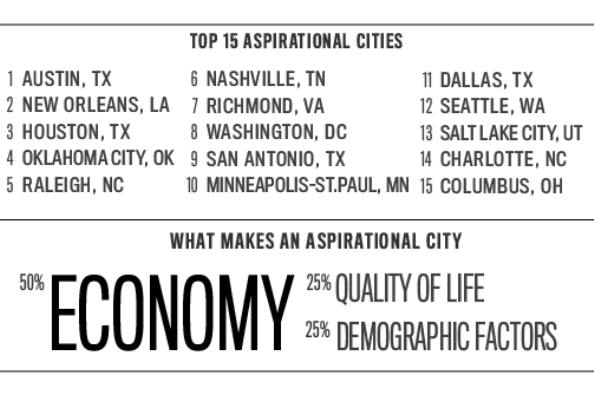
    Our top two cities reflect the importance of this arbitrage opportunity. Both No. 1, Austin, Texas, and No. 2, New Orleans, are places where people can enjoy the cultural amenities and attitudes of “progressive” blue states but in a distinctly red-state environment of low costs, less regulation, and lower taxes. These places have lured companies and people from more expensive regions, notably California and the Northeast, by being not only culturally rich but also amenable to building a career, buying a home and, ultimately, raising a family in relative comfort.

    Like the Texas state capital and the legendary Crescent City, most of our top cities are located in the American South and lower Midwest, and they attract businesses and people not only from other sections of the country but also increasingly from abroad as well. These include No. 3, Houston, and the smaller but burgeoning oil town of No. 4, Oklahoma City. These are followed by three fast-growing, low-cost Southern cities: No. 5, Raleigh-Cary, North Carolina; No. 6, Nashville; and No. 7, Richmond, Virginia.
    Not all our top aspirational cities are in Dixie. If there’s enough growth and opportunity, solidly blue-state regions can perform well enough to stay near the top of these rankings. Such cities include No. 8, Washington, D.C., and No. 10, Minneapolis–St. Paul, as well as No. 12, Seattle; No. 16, Denver; and even No. 22, Boston. In these cities, high-tech and professional-service growth has created enough wealth to offset higher costs while offering the next generation the chance to live in a culturally vibrant place where affording a home and raising a family are still possible.

    Perhaps more surprising is the high aspirational ranking of some old Rust Belt and Great Lakes cities. The middle part of the country has been losing people and jobs for half a century, but more recently several urban areas within or bordering the Midwest have established enough of an aspirational culture to reverse the pattern of out-migration and begin luring people from the coasts. These include such diverse places as No. 15, Columbus, Ohio; No. 17 Louisville, Kentucky; No. 21 Pittsburgh; and No. 23, Indianapolis.

    Of course, not everyone will find a perfect match in one of these cities. For those with extraordinary technical skills, for example, it still may make sense to move to the hotbed of the San Francisco Bay Area—notably No. 24, San Francisco, and No. 27, San Jose—where economic opportunity partially offsets extraordinarily high costs, at least for a certain portion of the population.

    This applies as well even to cities toward the bottom of the list, including No. 46, New York, and, in last place, No. 51, Los Angeles. If you want to break into businesses such as finance, media, and entertainment, you have little choice but to concentrate on New York or Southern California. These areas may also prove more attractive to people who have inherited money (critical to affording houses or paying high rents), as well as those whose business is closely tied to these great cities’ ethnic economies.

    People must also make tradeoffs when they decide where to locate. Some value a big house and yard, while others cannot abide a city without a decent opera or good Thai food. And those obsessed with, say, their children’s educations will clearly find a broader variety of schools and cultural institutions in San Francisco or New York than in Oklahoma City.

    But for those who lack these specific demands, and for those whose priority is achieving a middle- or upper-middle-class quality of life, the less expensive, often smaller, and less congested cities seem to have the greatest appeal. This may offend the sensibilities of retro-urbanists, who tend to cluster in the great legacy cities, along with our tribes of cultural tastemakers, but the hard reality shows that, for the most part, people move to places that offer not merely the best lattes or artisanal pizzas but the great opportunity for advancement.

    The Geography of Growth

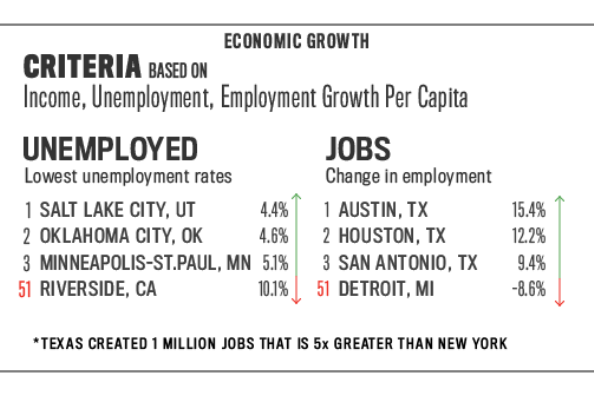
    We give economic growth roughly half of the weight in these rankings. This consists of three factors: employment growth, unemployment, and per capita income. This is where some of the coastal cities still do well, notably San Jose, whose recent job growth places it first, as well as No. 4, Washington, and No. 7, Seattle. The local economies in these areas have all been driven by the rapid expansion of high-tech and professional services, which explains their particularly high per capita GDP numbers.

    Yet most of the big winners in the economic-aspiration sweepstakes are concentrated elsewhere, notably in Texas. Since the recession, the Lone Star State has created 1 million new jobs, five times as many as New York state. In contrast, Florida and California have lost a half million positions. Not surprising, Texas accounts for four of the top 11 regions for economic opportunity (No. 2, Austin; No. 3, Houston; No. 9, San Antonio; and No. 11, Dallas).

    No big economic region outperforms Houston, a metropolitan area of more than 5 million people that boasts arguably the strongest big-city economy in the nation. Not only the global hub of the energy industry, it also boasts the nation’s largest medical center and has dethroned New York City as the nation’s leading export center. Other strong performers include No. 7, Salt Lake City; No. 8, Oklahoma City; and No. 11, New Orleans, all of which have enjoyed strong job growth over the past five years.

    What Do You Get for the Money?

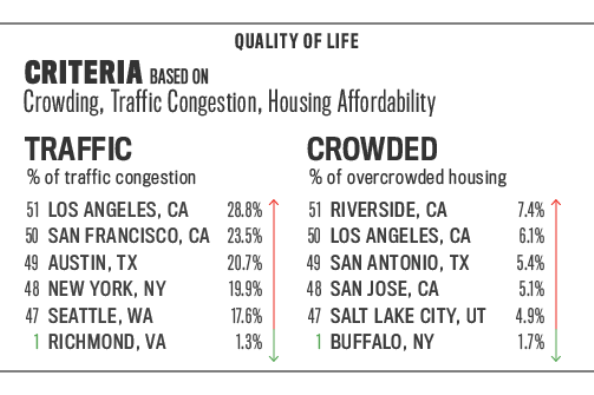
    Strong economic growth—particularly high per capita incomes—represents half of our ranking, but this is balanced by considerations such as cost of living, housing, and traffic congestion. “Everyday life,” observed the great French historian Fernand Braudel, “consists of the little things one hardly notices in time and space.” This reality is particularly critical for young and prospective families, for whom a higher salary or glamorous environment may mean less than the prospect of owning a decent home, particularly without the necessity of a long, dispiriting commute.
    These factors, we believe, will become more paramount as members of the large millennial or “echo boom” generation enter their late 20s, 30s, and even 40s over the next decade. This demographic—projected by the census to expand by roughly 8 million by 2025—is likely to prove intensely interested in owning their own homes. Indeed, research by generational analysts Morley Winograd and Mike Hais demonstrates that not only do millennials aspire to homeownership, but among the oldest cohorts of this group, now just entering their 30s, interest in buying a house actually surpasses that of their boomer parents.

    This difference in the affordability of housing relative to incomes plays a major role in boosting the rankings of some strong aspirational areas, notably Raleigh; Richmond; Charlotte, North Carolina; Kansas City; and Indianapolis. Along with traffic congestion, it tends to bring down the rankings of most California metropolitan areas, including San Francisco, San Jose, Los Angeles, and San Diego, as well as such hipster hotspots as New York and Miami. We also include “doubling up,” where more than one family lives in a household, as a surrogate for poverty (since metropolitan poverty rates are not adjusted for the cost of living).

    Demographic Destiny

    The last component of our rankings, accounting for roughly a quarter, lies in demographic trends. Like playing defense in basketball, the most important thing here is to watch the feet. The question is movement: where are people going, and where are they not? This tells us much about future trends and how people, as opposed to the media, actually view the best places for them to settle.
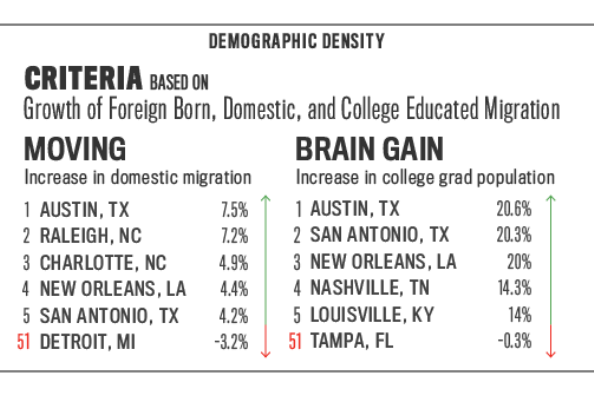
    Our methodology concentrates on three metrics: domestic migration, growth of foreign-born population; and growth in the number of college-educated people. These groups reflect what may be thought of as “the canaries in the coal mine”—indicators of where people seeking a better life are choosing to settle. This factor seems to jibe with our overall rankings more than any other component.

    The biggest beneficiaries tend, not surprisingly, to be places that are economically vibrant but not prohibitively expensive, such as Austin, Houston, San Antonio, Dallas, Raleigh, Nashville, Richmond, and Charlotte. Over the past decade these areas have enjoyed by far the fastest growth not only in migration, but in college-educated people and perhaps most surprisingly in number of foreign-born people. Today immigrants are flocking to such unlikely places as Nashville, Richmond, Louisville, and Charlotte. As for the college-educated, they, too, are also migrating to these same aspirational cities, as well as to new hipster hotspots such as New Orleans and Nashville. The increase in B.A.-degree holders in these cities averages in the double digits or higher over the past decade, in some cases more than twice the growth in such traditional “brain gain” cities as Seattle, San Jose, San Francisco, New York, and Boston.

    The Urban Future

    As the younger generation, as well as newly arrived immigrants, begins to look for places to settle, raise families, and start businesses, they will flock increasingly to these affordable and demographically, economically dynamic regions. Yet it is likely that other factors—global economics, shifts in immigration, and technological changes—could influence the aspirational landscape in the years to come.

    In thinking about the future, then, it is important to recall that not long ago some of the cities near the top of today’s aspirational list were facing seemingly irreversible economic decline, demographic stagnation, and even loss and deterioration of basic infrastructure. You only have to recall the dismal ’70s in Seattle, where post-Vietnam budget cuts inspired some to ask that “whoever is last to leave turn out the lights,” or Houston and Dallas–Fort Worth after the oil bust in the ’80s, when those cities were widely known for their “see through” office buildings and abandoned housing complexes.

    It’s always possible that unpredictable and major shifts could topple today’s aspirational cities from the top of the list. However, given current conditions and the most likely accrual of current trends, we can expect that most of the cities at the top of the aspirational rankings will remain there for some time to come.

    Joel Kotkin is executive editor of NewGeography.com and Distinguished Presidential Fellow in Urban Futures at Chapman University, and a member of the editorial board of the Orange County Register. He is author of The City: A Global History and The Next Hundred Million: America in 2050. His most recent study, The Rise of Postfamilialism, has been widely discussed and distributed internationally. He lives in Los Angeles, CA.

    Wendell Cox is a Visiting Professor, Conservatoire National des Arts et Metiers, Paris and the author of “War on the Dream: How Anti-Sprawl Policy Threatens the Quality of Life.

    This piece originally appeared at the Daily Beast.

    Creative Commons photo “Austin Skyline” by Flickr user StuSeeger

  • Poverty and Growth: Retro-Urbanists Cling to the Myth of Suburban Decline

    In the wake of the post-2008 housing bust, suburbia has become associated with many of the same ills long associated with cities, as our urban-based press corps and cultural elite cheerfully sneer at each new sign of decline. This conceit was revealed most recently in a a studyreleased Monday by the Brookings Institution–which has become something of a Vatican for anti-suburban theology–trumpeting the news that there are now 1 million more poor people in America’s suburbs than in its cities.

    America’s suburbs, noted one British journalist, are becoming “ghost towns” as middle-class former suburbanites migrate to the central core. That’s simply untrue: both the 2010 Census and other more recent analyses demonstrate that America is becoming steadily more suburban: 44 million Americans live in America’s 51 major metropolitan areas, while nearly 122 million Americans live in their suburbs. In other words, nearly three quarters of metropolitan Americans live in suburbs, not core cities.

    The main reason there are now more poor people in the suburbs is that there are now many more people in the suburbs, which have represented almost all of America’s net population growth in recent years. Despite trite talk about “suburban ghettos,” suburbs have a poverty rate roughly half that of urban centers (20.9 percent in core compared to 11.4 percent in the suburbs as of 2010).

    To be sure, poverty in suburbs, or anywhere else, must be addressed. But not long ago, suburbs were widely criticized for being homogeneous; now they are mocked for having many of the problems associated with being “inclusive.”

    Many poor suburbs are developing because minorities and working-class populations are moving to suburbs. Yet even accounting for these shifts, cities continue to contain pockets of wealth and gentrification that give way to swathes of poverty. In Brooklyn, it’s a short walk east from designer shoe stores and locavore eateries to vast stretches of slumscape. The sad fact is that in American cities, poor people—not hipsters or yuppies—constitute the fastest-growing population. In the core cities of the 51 metropolitan areas, 81 percent of the population increase over the past decade was under the poverty line, compared to 32 percent of the suburban population increase.

    In Chicago, oft cited as an exemplar of “the great inversion” of affluence from suburbs to cities, the city poverty rate stands at 22.5 percent, compared to 10 percent in the suburbs. In New York, roughly 20 percent of the city population lives in poverty, compared to only 9 percent in the suburbs.

    Looking at it from a national perspective, most of the major metropolitan counties with the highest rates of poverty are all urban core, starting with the Bronx, with 30 percent of people living under the poverty line, followed by Orleans Parish (New Orleans), Philadelphia, St. Louis, and Richmond, Va. In contrast all 10 large counties with the lowest poverty rates are all suburban.

    This divergence has an impact on other measurements of social health. Despite substantial improvement in crime rates in “core cities” over the past two decades, suburban areas generally have substantially lower crime rates, according to Brookings Institution’s own research. Yet at the same time suburban burgs dominate the list of safest cities over 100,000 led by Irvine and Temecula, Calif., followed by Cary, N.C. Overall suburban crime remains far lower than that in core cities.

    A review of 2011 crime data, as reported by the FBI, indicates that the violent-crime rate in the core cities of major metropolitan areas was approximately 3.4 times that of the suburbs. (The data covers 47 of the 51 metropolitan areas with more than 1 million population, with data not being available for Chicago, Las Vegas, Minneapolis-St. Paul, and Providence.)

    In the least suburbanized core cities, that is places that have annexed little or no territory since before World War II (New York, Philadelphia, Washington, etc.) the violent crime rate was 4.3 times the suburban rate. Among the 24 metropolitan areas that had strong central cities at the beginning of World War II but which have significant amounts of postwar suburban territory (Portland, Seattle, Milwaukee, Los Angeles, etc.), the violent crime rate is 3.1 times the suburban rate. Among the metropolitan areas that did not have strong pre–World War II core cities (San Jose, Austin, Phoenix, etc.), the violent crime rate was 2.2 times the suburban rate. Basically, the more suburban the metropolis, the lower the crime rate.  
    Rather than castigating suburbs for exaggerated dysfunction, retro-urbanists would be much better served focusing on how to correct and confront the issue of poverty, which continues to concentrate heavily in the urban core and elsewhere in America.

    Joel Kotkin is executive editor of NewGeography.com and a distinguished presidential fellow in urban futures at Chapman University, and a member of the editorial board of the Orange County Register. He is author of The City: A Global History and The Next Hundred Million: America in 2050. His most recent study, The Rise of Postfamilialism, has been widely discussed and distributed internationally. He lives in Los Angeles, CA.

    Wendell Cox is a Visiting Professor, Conservatoire National des Arts et Metiers, Paris and the author of “War on the Dream: How Anti-Sprawl Policy Threatens the Quality of Life.

    This piece originally appeared in the The Daily Beast.

    Suburban neighborhood photo by Bigstock.

  • The World’s Fastest-Growing Megacities

    The modern megacity may have been largely an invention of the West, but it’s increasingly to be found largely in the East. The seven largest megacities (defined as areas of continuous urban development of over 10 million people) are located in Asia, based on a roundup of the latest population data released last month by Wendell Cox’s Demographia. The largest megacity remains the Tokyo-Yokohama area, home to 37 million, followed by the Indonesian capital of Jakarta, Seoul-Incheon, Delhi, Shanghai and Manila.

    With roughly 20 million inhabitants, the New York metro area, the world’s largest urban agglomeration from early in the 20th century till Tokyo surpassed it in the 1950s, ranks eighth. The only other western urban areas among the 28 biggest megacities now are Moscow (15th), Los Angeles (17th), and Paris (28th). London, which was the first modern city of a million people, is not on the list at all, with expansion long ago stopped by its green belt. In 1990, New York ranked second and Los Angeles ranked eighth.

    This de-Westernizing trend seems likely to continue. The fastest-growing megacities over the past decade have been primarily in the developing world. Karachi, Pakistan, has led the growth charge, with a remarkable 80% expansion in its population from 2000 to 2010. The growth economies of China and India dominate the rest of the list of most rapidly growing megacities.

    China, not surprisingly, has the most megacities of any country, four. The second fastest growing megacity over the past decade, Shenzhen, was a small fishing village not long ago that became a focus of Deng Xiaoping’s first wave of modernization policies. In 1979 it had roughly 30,000 people; now it is a thriving metropolis of over 12 million whose population in the past decade grew 56%. Its rise has been so quick that the Asia Society has labeled it “a city without a history.”

    Older Chinese cities are also growing rapidly. Shanghai, a cosmopolitan world city decades  before the Communist takeover of the country, expanded almost 50% since 2000. The ancient capital Beijing and the southern commerce and industrial hub of Guangzhou grew nearly as rapidly.

    India matches Japan with three megacities, but they are all growing much faster. The population of Delhi, the world’s fourth-largest city, expanded 40% over the past decade; Mumbai, almost 20%; and Kolkata, roughly 10%, a relatively low rate for a city in a developing country.

    Other rapidly growing megacities are scattered throughout the developing world. In Nigeria, Lagos saw its population swell by over 48%; The Thai capital of Bangkok and Dhaka, Bangladesh, both grew some 45%. The world’s second-largest megacity, Jakarta, expanded 34% to almost 27 million.

    One caveat: Estimating population for comparably defined urban areas, particularly in the developing world, can be difficult. For example, there is considerable disagreement about the population of Lagos, where local officials claimed there were twice as many people in 2005 as were counted in the 2006 Nigerian census. Add the “missing” 8 or more million people and the population would be 22 million this year. The higher local count, however, has not been broadly accepted. There population of Karachi is also disputed, with some claiming a somewhat lower population than reported.

    In contrast, high-income countries in Europe and the U.S., where population tracking is more reliable, grew relatively slowly. The only city with a purchasing power adjusted GDP of over $40,000 that registered population growth over 10% was Moscow, which has expanded rapidly as the center of Russia’s resource-led boom. The population of Paris grew 8%; Los Angeles, 6%; and New York, barely 3%.

    Japan, one of the world’s most urbanized major countries, has also logged slower growth. Tokyo, the great outlier in that country’s stagnant population profile, expanded 7%, Nagoya grew 5.7% and Osaka-Kobe a weak 2.4%. The rapid population depletion in the rest of the country and a lack of immigrants suggest that Japan’s great cities will grow even slower in the years ahead, as the country runs short on migrants from rural areas and young people in general.

    So what do the numbers tell us about the future of megacities? For one thing, it’s clear that the most rapid growth is taking place in countries that still have large rural hinterlands and relatively young populations. These mostly poor places — most with median incomes between Dhaka at $3,100 per capita and Bangkok at $23,000 — will continue to grow, at least until their populations begin to see the results of decreasing birthrates.

    U.N. projections to 2025 suggest that the future list of megacities will be dominated by such lower-income cities, with growth primarily in places like Africa and central Asia. Among the likely new entrants are Lima (Peru) , Kinshasa (Democratic Republic of the Congo) and Tianjin (China). At least seven others (Chennai, Bangalore, Bogota, Ho Chi Minh City, Dongguan, Chengdu and Hyderabad) are now above 8 million, making it likely they could reach megacity status by 2030. Among high-income world cities, London might finally reach 10 million while the only other high-income world candidate, Chicago, with more than 9 million residents, could take until 2040.

    At the same time, some megacities in the low and middle-income world already seem to have reached a point of saturation. A generation ago, it was widely predicted that Mexico City would become the world’s largest city. Yet its growth has slowed to a modest 11% over the past decade. Lower Mexican birthrates and the development of other urban alternatives have made La Capital far less a growth hub than once imagined.

    Similar processes can be seen elsewhere in Latin America, where fertility rates have been dropping to levels closer to American and northern European norm, but not yet those of the ultra-low Japan or southern European countries. Over the past decade population growth was 13% in Buenos Aires, 15%  in Sao Paulo and 10%  in Rio de Janeiro. These cities will likely continue to grow, but at a reduced rate.

    The real winners in the coming decades are likely to be Chinese megacities, and to a lesser extent those in India. China’s megacities all enjoy per capita incomes above $20,000 and the vast scale of the country’s rural population suggests there is still room for growth. It will be perhaps another decade or so before the country’s low birthrate catches up with it, and slows growth down to western or Japanese levels.

    India’s cities, notably Mumbai and Delhi, are not as wealthy as China’s, but are clearly getting richer, with Delhi getting close to the $10,000 per capita income level. With a somewhat higher birthrate than its Chinese or South American counterparts, Indian cities can be expected to continue expanding at least for the next decade or so.

    These trends, of course, may be altered by any number of developments, including the possible threats to  cities from wars, environmental challenges or other large-scale disruptions. But we can say, with some confidence, that the world’s megacities will continue to become increasing Asian and African, reflecting the protean nature of an urban growth pattern that continues to de-emphasize slower expanding regions in the Americas, Japan and, of course, Europe.

    FASTEST GROWING MEGACITIES IN THE WORLD
    (Urban Areas with more than 10 million residents)
    Rank Geography Urban Area Population Estimate GROWTH (Decade)
    1 Pakistan Karachi 20,877,000 80.5%
    2 China Shenzhen 12,506,000 56.1%
    3 Nigeria Lagos 12,090,000 48.2%
    4 China Beijing, BJ 18,241,000 47.6%
    5 Thailand Bangkok 14,544,000 45.2%
    6 Bangladesh Dhaka 14,399,000 45.2%
    7 China Guangzhou-Foshan 17,681,000 43.0%
    8 China Shanghai 21,766,000 40.1%
    9 India Delhi 22,826,000 39.2%
    10 Indonesia Jakarta 26,746,000 34.6%
    11 Turkey Istanbul 12,919,000 25.3%
    Source: Demographia World Urban Areas (2013): http://demographia.com/db-worldua.pdf

    Joel Kotkin is executive editor of NewGeography.com and a distinguished presidential fellow in urban futures at Chapman University, and a member of the editorial board of the Orange County Register. He is author of The City: A Global History and The Next Hundred Million: America in 2050. His most recent study, The Rise of Postfamilialism, has been widely discussed and distributed internationally. He lives in Los Angeles, CA.

    Wendell Cox is a Visiting Professor, Conservatoire National des Arts et Metiers, Paris and the author of “War on the Dream: How Anti-Sprawl Policy Threatens the Quality of Life.

    This piece originally appeared at Forbes.com.

  • Biggest Boomer Towns

    The boomer generation, spawned (literally) in the aftermath of the Second World War, will continue to shape the American landscape well into the 21st Century. They may be getting older, but these folks are still maintaining their power. Those born in the first ten years of the boomer generation  — between 1945 and 1955 — number 36 million, and they will continue to influence communities and real estate markets across the country, especially as they contemplate life after kids and retirement.

    Much has been written about where “empty nesters” might move as their children move off on their own. One longstanding favorite is the notion that, having jettisoned their children, the boomers will also desert their suburban communities for the bright city lights.

    Unfortunately for developers — some of whom have invested heavily in high-end housing for urbanizing “empty nesters” — the actual data do not support this thesis. Indeed, our analysis of migration by this cohort in the past 10 years shows a 10.3% decline among core city dwellers, a loss of some 1.3 million people over the past decade. For this analysis, Forbes, with the help of demographer Wendell Cox, looked at population numbers from the Census for boomers aged 45 to 54 in 2000 and compared them with the numbers for those ages 55 to 64 in 2010.

    These population changes include reductions due principally to deaths. Census data do not include mortality information. This cohort lost 3.2% of its population over the 10 years. This would only marginally reduce the changes between 2000 and 2010, while the scale of differences between the metropolitan areas would be identical.

    So where are these surviving boomers settling as they enter their likely extended golden years?  The results may surprise urban boosters who have confidently expected them to flock downtown.

    To be sure, a few of the highly affluent — the ones mentioned in the mainstream media — may purchase homes, or pied-à-terres, in places like Manhattan, Chicago’s Gold Coast or San Francisco. But these areas actually have suffered an exodus of boomers over the past decade. In our ranking of the 51 largest metros in the U.S., the urban cores of San Jose, San Francisco, Los Angeles and Chicago scored near the bottom, suffering double-digit percentage losses of boomers. According to the last Census, New York’s urban core, which the Daily News suggested is packed with aspiring seniors, lost 12% of boomers in their mid-50s to mid-60s  — or about 274,000 people.

    Over the past three years  you could blame this loss on the economy, which has postponed retirements brought home many of the boomers’ young, largely unemployed or underemployed children back to the suburban homestead. Or you can credit it to more active lifestyles among boomers who appear to working later than ever. According to a Careerbuilder.com survey, over 60% of workers over 60 indicated they are postponing retirement.

    Yet perhaps something more profound is at work here. An analysis of those who were 55 to 65 in 2000 and 65 to 75 in 2010 reveals an even stronger anti-urban bias, with an over 12% drop in city dwellers. Since these folks are far less likely to have kids at home and more properly retired, this cohort’s behavior suggests that aging boomers are if anything less likely to move to the cities in the next decade.

    Indeed, if boomers do move, notes Sandi Rosenbloom, a noted expert on retirement trends and professor of Planning and Civil Engineering at the University of Arizona, they tend to move to less dense and more affordable regions. The top cities for aging boomers largely parallel those that appealed to the “young and restless” in our earlier survey. The top ten on our list are all affordable, generally low-density Sun Belt metros:

    1. Las Vegas, Nev.
    2. Phoenix, Ariz.
    3. Tampa-St. Petersburg, Fla.
    4. Orlando, Fla.
    5. Riverside-San Bernardino, Calif.
    6. Raleigh, N.C.
    7. Austin, Texas
    8. San Antonio, Texas
    9. Jacksonville, Fla.
    10. Charlotte, N.C.-S.C.

    But according Sandi Rosenbloom, a noted expert on retirement trends and a professor of planning and civil engineering at the University of Arizona, most boomers are staying put, largely in the suburbs they settled in decades ago.  The propensity to move, she points out, starts to drop precipitously as people leave their early 30s. Roughly 1 in 3 people in their 20s move in a given year; by the time they enter their 40s, that figure slides to about 1 in 10. As people age into their 50s and beyond, the percentage drops to roughly 5%, or 1 in 20.

    “The boomers are staying put more than anyone thought,” Rosenbloom says. “People of that generation tend to own their own homes and stay there. The idea that they are moving to the city really comes from the wishful thinking school of planning.”

    The recession has exacerbated this stay-at-home trend. The number of people moving is at its lowest level since the early 1960s. When boomers do decide to move, Rosenbloom notes, they do so largely for prosaic reasons, such as being closer to children or, more important, grandchildren.

    Others succumb to the temptation to cash out expensive housing in metros like New York, Los Angeles, the Bay Area or Boston for less costly residences in Sun Belt locales. Housing in and around these core cities, particularly in attractive neighborhoods, Rosenbloom adds, are simply too expensive for the vast majority of budget-conscious seniors.

    Much of this also has to do with the lifestyle preferences of both boomers and seniors, which appear far different than those put forth by urban pundits. People over 55 that Rosenbloom has interviewed usually express a preference to stay or relocate in places that are less crowded and congested. Furthermore, most are reluctant to give up their cars, and many are less able to walk than drive. This may explain why most retirement communities end up on the urban fringe or farther.

    This trend — which Rosenbloom has also encountered in the U.K., Australia, Canada and New Zealand — is also reflected by the growing shift to smaller towns and cities among both aging boomers and seniors. The “young and restless” may head to suburbs, particularly in the lower-cost Sun Belt cities, but some older Americans appear headed to even less densely populated regions. Over the past decade over 1 million aging boomers and seniors moved to more smaller cities and rural locations from suburban or urban locations.

    What do these trends suggest for the future of our communities and real estate? For one, the big opportunities for selling to aging boomers will remain primarily in the suburbs and some select more rural locations. We also can expect the new senior citizens to move to more affordable places close to their children.

    These findings do provide some long-term hope for the housing market, particularly in suburbs. Leading demographers have been busy predicting a massive drop-off in single-family homes as boomers retire and their children leave. Yet our analysis on the Census reveals that most boomers — as well as those older than them — are staying in the suburbs a lot longer than expected. Many will likely to stay in their homes and old neighborhoods well into their 70s or even 80s, leaving either their home either in an ambulance or to an assisted living facility.

    Developers and planners anxious to service aging boomers should, instead of building downtown towers, address the needs of this generation precisely where they now live and are likely to stay. This could include adding to new residential options in the suburbs to enlivening local shopping districts while boosting senior services in everything from recreation and public safety to health care. As the rock and roll generation heads toward its dotage, both business and communities need to adjust their strategies based not on fantasies but on the realities so clearly evidenced by the Census.

    This piece originally appeared at Forbes.com.

    Joel Kotkin is executive editor of NewGeography.com and is a distinguished presidential fellow in urban futures at Chapman University, and an adjunct fellow of the Legatum Institute in London. He is author of The City: A Global History. His newest book is The Next Hundred Million: America in 2050, released in February, 2010.

  • The Census’ Fastest-Growing Cities Of The Decade

    Over the past decade urbanists, journalists and politicians have hotly debated where Americans were settling and what places were growing the fastest. With the final results in from the 2010 Census, we can now answer those questions, with at least some clarity.

    Not only does the Census tell us where people are moving, it also gives us clues as to why. It also helps explain where they might continue to go in the years ahead.  This information is invaluable to companies that are considering where to expand, or contract, their operations.

    For Forbes’ evaluation of the Census’ winners and losers, we have focused not on individual cities, but on metropolitan areas, which represent the most accurate designation for measurement. Take Atlanta, No. 10 on our list. While the city’s population grew by 1,000 over the last decade (2010 boundaries), the region, according to the Census grew, by roughly 1 million, the largest numerical increase among the country’s 51 largest metro areas. The city itself represents less than one-tenth the total metro area population.

    Las Vegas continued to be the nation’s fastest-growing major metropolitan area per capita, adding 41.8% to its population between 2000 and 2010. But the Las Vegas margin was very thin. Raleigh, N.C. (which ranked second) also gained 41.8%, and the difference between the two could only be measured at the third decimal point. If Raleigh had added just 10 more people, it would have been the leader.

    Overall, some 15 of the big metros grew at more than twice the 9.7% rate experienced by the entire country. One key reason — for at least some cities — was job growth. Las Vegas, which added 575,000 residents, and Raleigh grew their economies despite the tough recession. Sin City is still a top flight tourist destination, and its business-friendly policies are still attractive to other industries, particularly from highly regulated California.  The Texas metros Austin (No. 3), Houston (No. 8),  San Antonio (No. 9 ) and Dallas-Fort Worth (No. 11) all had strong job growth — as did Nashville, Tenn. (No. 12).

    However, not all the top growing regions in the country share the same economic trajectory. Many of the other leaders grew their job bases rapidly at the beginning of the decade but gave back some of their gains after the collapse of the mortgage market. This happened in places like Las Vegas Riverside-San Bernardino, Calif. (No. 5), Orlando , Fla., (No. 6), Phoenix, Ariz., (No. 7), Jacksonville, Fla. (No.13) and Sacramento, Calif. (No. 14).

    Yet all of the top ten — with the exception of Atlanta — expanded their job base during the decade.

    So if job growth itself is not a single determining indicator, what else has swelled these populations? Two things seem to stand out. One major factor seems to be affordability of housing. Throughout the decade people have moved primarily to those areas with cheaper house price relative to incomes.

    Take the movement of people from expensive coastal California not only to the interior parts of the state but especially to the Texas metropolitan areas, such as Dallas-Fort Worth and Houston. To put this in context, the median house price today as a share of median household income (the “median multiple”) averaged at 2.7 in Dallas-Fort Worth and 2.8 in Houston, compared with 7.2 in the No. 41 ranked Los Angeles or 8.1 in ultra-pricey San Francisco, which ranked No. 37.

    During the bubble, coastal California housing prices were even higher, peaking at a median multiple over 10, while Dallas-Fort Worth and Houston remained at 3.0 or below. There was also strong migration from coastal California to closer metropolitan areas in the West, where house prices were high by national standards, but far more affordable than in coastal California. Examples of this trend were No. 1 Las Vegas (which averaged 4.0 and peaked at 5.9), No. 7 Phoenix (averaged 3.4 and peaked at 4.7) and No. 15 Denver (averaged 4.1 and peaked at 4.5).

    A similar phenomenon can be seen on the east coast. To understand the rapid growth of a place like Raleigh, you have to look to the migration of people from the Northeast, notably the No. 44 New York area and No. 43 Boston. Housing costs seem to be a leading factor here. The ratio of median house price to median household income   in Raleigh averaged 3.6 (peaked at 4.2) — well below that of its primary talent sources like New York, which averaged 6.3, peaking at 7.7, and Boston, which averaged 5.2 and peaked at 6.1.

    Among the 20 fastest-growing regions, No. 16 Washington, D.C. region had relatively expensive housing, with an average median multiple of 4.2, after peaking at 5.7. Washington must be regarded in this sense as the great exception, a place whose steady employment growth has defied all market logic, since it is largely tethered to the ever-expanding scope of the federal government and its similarly growing legions of parasitic private corporations.

    The other major factor determining growth seems to be urban area density and size. Despite all the triumphant celebration of the glories and attraction of dense big city urbanism, almost all the fastest-growing metropolitan areas have low-density core cities and are predominately suburban in form. Indeed not one of the top 15 growing regions has a core city with a density of over 5,000 per square mile and only three, the Dallas-Fort Worth, Houston and Atlanta metropolitan areas, have more than 5 million residents.

    In contrast, the regions with the densest core cities–such as Boston and San Francisco–all grew at about half or less than the national average, despite core densities of 12,000 or above. All three of America’s largest metropolitan areas–New York, Los Angeles and Chicago, with populations nearing or above 10 million–grew far below the national average.  However thrilling and alluring dense large cities might be to pundits, academics and policy wonks, they are proving not so beguiling to Americans who, for the most part, continue to seek out “the American dream” wherever they can best afford it.

    Yet the very bottom of our list does include cities that are neither expensive nor particularly dense. These include the long-standing declinapolises that actually managed to lose population while the rest of the country was gaining. These include No. 47 Buffalo, N.Y., No. 48 Pittsburgh, Pa., No. 49 Cleveland, Ohio and ever-suffering No. 50 Detroit.

    The only non-rust belt core city to lose population this decade was No. 51 – New Orleans-Metarie-Kenner, La.  Of course, the Big Easy’s decline stems in large part from both nature’s depredations and what appears to be only a limited restoration of its basic infrastructure. But amazingly, the job loss in New Orleans was less than that of perennial loser Detroit and former perennial winner San Jose, which ranked 35th.

    So in our minds, NOLA’s last place finish may be a bit unfair, but then again so is life — and  sometimes demographics.

    Population 2000-2010 Employment 2000-2010
    Geography Change Pct Change Change Pct Change
    Las Vegas-Paradise, NV 575,504 41.83% 103,800 14.88%
    Raleigh-Cary, NC 333,419 41.83% 59,500 13.62%
    Austin-Round Rock-San Marcos, TX 466,526 37.33% 93,800 13.94%
    Charlotte-Gastonia-Rock Hill, NC-SC 427,590 32.14% 34,000 4.43%
    Riverside-San Bernardino-Ontario, CA 970,030 29.80% 122,800 12.42%
    Orlando-Kissimmee-Sanford, FL 489,850 29.79% 92,300 10.15%
    Phoenix-Mesa-Glendale, AZ 941,011 28.94% 108,400 6.87%
    Houston-Sugar Land-Baytown, TX 1,231,393 26.11% 278,600 12.38%
    San Antonio-New Braunfels, TX 430,805 25.17% 96,200 12.91%
    Atlanta-Sandy Springs-Marietta, GA 1,020,879 24.03% -30,900 -1.35%
    Dallas-Fort Worth-Arlington, TX 1,210,229 23.45% 101,400 3.67%
    Nashville-Davidson–Murfreesboro–Franklin, TN 278,145 21.20% 34,900 5.00%
    Jacksonville, FL 222,846 19.85% 15,900 2.81%
    Sacramento–Arden-Arcade–Roseville, CA 352,270 19.60% 10,700 1.34%
    Denver-Aurora-Broomfield, CO 364,242 16.71% -20,000 -1.65%
    Washington-Arlington-Alexandria, DC-VA-MD-WV 785,987 16.39% 285,700 10.67%
    Tampa-St. Petersburg-Clearwater, FL 387,246 16.16% -42,000 -3.63%
    Salt Lake City, UT 155,339 16.03% 41,600 7.36%
    Portland-Vancouver-Hillsboro, OR-WA 298,128 15.46% -7,800 -0.80%
    Indianapolis-Carmel, IN 231,137 15.16% 16,600 1.95%
    Richmond, VA 161,294 14.70% 14,000 2.38%
    Oklahoma City, OK 157,566 14.38% 20,500 3.83%
    Columbus, OH 223,842 13.88% -11,400 -1.25%
    Seattle-Tacoma-Bellevue, WA 395,931 13.01% -10,700 -0.65%
    Miami-Fort Lauderdale-Pompano Beach, FL 557,071 11.12% 27,900 1.29%
    Kansas City, MO-KS 199,296 10.85% -16,600 -1.69%
    Minneapolis-St. Paul-Bloomington, MN-WI 311,027 10.48% -59,000 -3.38%
    Louisville/Jefferson County, KY-IN 121,591 10.46% -29,500 -4.75%
    San Diego-Carlsbad-San Marcos, CA 281,480 10.00% 26,400 2.21%
    Memphis, TN-MS-AR 110,896 9.20% -36,700 -5.88%
    Birmingham-Hoover, AL 75,809 7.20% -27,400 -5.30%
    Baltimore-Towson, MD 157,495 6.17% 21,600 1.73%
    Virginia Beach-Norfolk-Newport News, VA-NC 95,313 6.05% 13,100 1.82%
    Cincinnati-Middletown, OH-KY-IN 120,519 6.00% -35,800 -3.52%
    San Jose-Sunnyvale-Santa Clara, CA 101,092 5.82% -191,900 -18.38%
    Hartford-West Hartford-East Hartford, CT 63,763 5.55% -24,400 -4.38%
    San Francisco-Oakland-Fremont, CA 211,651 5.13% -243,100 -11.43%
    Philadelphia-Camden-Wilmington, PA-NJ-DE-MD 278,196 4.89% -47,300 -1.72%
    St. Louis, MO-IL 114,209 4.23% -48,200 -3.60%
    Chicago-Joliet-Naperville, IL-IN-WI 362,789 3.99% -323,300 -7.07%
    Los Angeles-Long Beach-Santa Ana, CA 463,210 3.75% -340,400 -6.23%
    Milwaukee-Waukesha-West Allis, WI 55,167 3.68% -60,000 -6.91%
    Boston-Cambridge-Quincy, MA-NH 161,058 3.67% -112,900 -4.45%
    New York-Northern New Jersey-Long Island, NY-NJ-PA 574,107 3.13% -99,100 -1.18%
    Rochester, NY 16,492 1.59% -27,700 -5.22%
    Providence-New Bedford-Fall River, RI-MA 17,855 1.13% -35,500 -6.16%
    Buffalo-Niagara Falls, NY -34,602 -2.96% -21,300 -3.81%
    Pittsburgh, PA -74,802 -3.08% -23,300 -2.03%
    Cleveland-Elyria-Mentor, OH -70,903 -3.30% -144,700 -12.74%
    Detroit-Warren-Livonia, MI -156,307 -3.51% -470,900 -21.38%
    New Orleans-Metairie-Kenner, LA -148,746 -11.30% -98,300 -15.91%


    Sources: U.S. Census 2000, U.S. Census 2010, U.S. Bureau of Labor Current Employment Survey

    This piece originally appeared in Forbes.

    Joel Kotkin is executive editor of NewGeography.com and is a distinguished presidential fellow in urban futures at Chapman University, and an adjunct fellow of the Legatum Institute in London. He is author of The City: A Global History. His newest book is The Next Hundred Million: America in 2050, released in February, 2010.

    Wendell Cox is a Visiting Professor, Conservatoire National des Arts et Metiers, Paris and the author of “War on the Dream: How Anti-Sprawl Policy Threatens the Quality of Life

    Photo by justin fain

  • Cities and the Census: Cities Neither Booming Nor Withering

    For many mayors across the country, including New York City’s Michael Bloomberg, the recently announced results of the 2010 census were a downer. In a host of cities, the population turned out to be substantially lower than the U.S. Census Bureau had estimated for 2010—in New York’s case, by some 250,000 people. Bloomberg immediately called the decade’s meager 2.1 percent growth, less than one-quarter the national average, an “undercount.” Senator Charles Schumer blamed extraterrestrials, accusing the Census Bureau of “living on another planet.” The truth, though, is that the census is very much of this world. It just isn’t the world that mayors, the media, and most urban planners want to see.

    Start with the fact that America continues to suburbanize. The country’s metropolitan areas have two major components: core cities (New York City, for example) and suburbs (such as Westchester County, Long Island, northern New Jersey, and even Pike County in Pennsylvania). During the 2000s, the census shows, just 8.6 percent of the population growth in metropolitan areas with more than a million people took place in the core cities; the rest took place in the suburbs. That 8.6 percent represents a decline from the 1990s, when the figure was 15.4 percent. The New York metropolitan area was no outlier: though it did better than the national average, with 29 percent of its growth taking place within New York City, that’s still a lot lower than the 46 percent that the center region saw in the 1990s.

    This may be shocking to some. For years, academics, the media, and big-city developers have been suggesting that suburbs were dying and that people were flocking back to the cities that they had fled in the 1970s. The Obama administration has taken this as gospel. “We’ve reached the limits of suburban development,” Housing and Urban Development secretary Shaun Donovan opined in 2010. “People are beginning to vote with their feet and come back to the central cities.” Yet of the 51 metropolitan areas that have more than 1 million residents, only three—Boston, Providence, and Oklahoma City—saw their core cities grow faster than their suburbs. (And both Boston and Providence grew slowly; their suburbs just grew more slowly. Oklahoma City, meanwhile, built suburban-style residences on the plentiful undeveloped land within city limits.)

    All this suburbanization means that the best unit for comparison may not be the core city but the metropolitan area, and the census shows clearly which metropolitan areas are growing and which are not. The top ten population gainers—growing by 20 percent, twice the national average or more—are the metropolitan areas surrounding Las Vegas, Raleigh, Austin, Charlotte, Riverside–San Bernardino, Orlando, Phoenix, Houston, San Antonio, and Atlanta. These areas are largely suburban in form. None developed the large, dense core cities that dominated America before the post–World War II suburban boom began. By contrast, many of the metropolitan areas that grew at rates half the national average or less—San Francisco, Los Angeles, Philadelphia, Boston, New York—have core areas that are the old, dense variety. Planners and pundits may like density, but people, for the most part, continue to prefer more space.

    If you do look at cities themselves, rather than at larger metropolitan areas, you’ll see that the census reveals three different categories. The most robust cities, with population growth over 15 percent for the decade—Raleigh, Austin, Charlotte, Las Vegas, Jacksonville, and Orlando—were located within the kind of metropolitan area that urbanists tend to dislike: highly suburbanized, dominated by single-family homes, and with few people using public transit. That’s partly because these cities developed along largely suburban lines by annexing undeveloped land and low-density areas. This has been the case in virtually all the fastest-growing cities. Raleigh has expanded its boundaries to become 12 times larger than it was in 1950; Charlotte and Orlando are nine times larger, and Jacksonville an astounding 25 times larger.

    At the opposite end of the spectrum are core cities, mostly in the Midwest and Northeast and often land-constrained, that have continued to shrink. These include longtime disaster zones like Detroit and Cleveland as well as newer ones like Birmingham in the South. They include Pittsburgh, a city much praised for its livability but one that is aging rapidly and whose city government, based disproportionately on revenue from universities and nonprofits, is among the nation’s most fiscally strapped. They even include Chicago, which lost some 200,000 people during the 2000s, its population falling to the lowest level since the 1910 census. The reasons aren’t hard to identify: despite all the hype about Chicago’s recovery and the legacy of Mayor Richard M. Daley, the Windy City is among the most fiscally weak urban areas in the country, its schools are in terrible shape, and its economy is struggling.

    Finally, there are cities that have grown, but not quickly. New York City’s population, for example, inched to a record high in the 2000s, but that growth was less than the national average. The population of Los Angeles grew a mere 97,000—the smallest increase since the 1890s. Many of the slow-growing cities (New York, San Francisco, and Boston, for example) suffer from high housing costs, which inhibit population growth. But they also host high-end industries—finance, technology, and business services—and enough well-paid workers in these industries to afford pricey housing and sustain a small rate of growth. The cities also attract already wealthy people from elsewhere.

    The census provides information on a smaller level, too, telling us not just which cities have grown, but where the growth has taken place within cities. Often, it has been in and around the historic downtowns. This is a trend in many cities that otherwise differ starkly (New York, St. Louis, Chicago, Los Angeles), and it reflects a subtle shift in the role of the downtown. Rather than reasserting themselves as dominant job centers, downtowns are becoming residential and cultural—a change that H. G. Wells predicted when he wrote that by 2000, the center of London would be “essentially a bazaar, a great gallery of shops and places of concourse and rendezvous.” What may have been an office, industrial, or retail zone morphs into a gentrified locale attractive to the migratory global rich, to affluent young people, and to childless households.

    This downtown recovery (which many cities subsidized heavily) was partly why so many urbanists and developers identified a broader back-to-the-city movement; but in reality, the phenomenon was usually limited to a relatively small population and a relatively small area. Since 1950, for example, St. Louis has lost a greater share of its population than any American city ever boasting 500,000 or more residents. The area from downtown to Central West End experienced strong growth during the 2000s, however, adding more people than Portland’s Pearl District, a favorite of urban planners. Yet this gain of 7,000 people was far from enough to offset the loss of 36,000 in the rest of St. Louis.

    It’s also worth noting that in economic terms, downtowns are losing their hold. For example, though the residential population of Chicago’s Loop tripled to 20,000 in the past decade, that famed business district lost almost 65,000 jobs; its share of the metropolitan area’s employment also fell. Los Angeles’s downtown, whose population has likewise grown, lost roughly 200,000 jobs from 1995 to 2005. Manhattan is losing employment share to the other four boroughs, as it has been for decades; but as a recent report from the Center for an Urban Future reveals, the process accelerated over the last ten years. From 2000 to 2009, Manhattan lost a net 41,833 jobs, while other boroughs saw net increases. This employment dispersion is even more evident in the suburbs. Of commuters who live in the inner-ring suburbs (such as Yonkers and East Orange), 60 percent work in their home counties and only 14 percent in Manhattan. Of commuters from such outer-ring suburbs as Haverstraw and Morristown, 73 percent work in their home counties and 6 percent in Manhattan.

    What, in the end, does the census tell us about America’s cities today? Certainly not that they’re dying, as they threatened to do in the 1950s, but equally certainly that they aren’t roaring back. Cities remain a successful niche product for a relatively small percentage of the population. Most people, though, even in the New York metropolitan area, continue to move toward the periphery rather than the core. That said, New York’s continuing growth over the past decade suggests that its recovery will likely prove durable. As for Senator Schumer’s “another planet” allegations, the census is simply confirming the fact that terrestrial Americans continue to disperse, both within and among metropolitan areas. So far, there’s little that planners, policy makers, and urban boosters can do about that.

    This piece originally appeared in City Journal.

    Joel Kotkin is executive editor of NewGeography.com and is a distinguished presidential fellow in urban futures at Chapman University, and an adjunct fellow of the Legatum Institute in London. He is author of The City: A Global History. His newest book is The Next Hundred Million: America in 2050, released in February, 2010.

    Wendell Cox is a Visiting Professor, Conservatoire National des Arts et Metiers, Paris and the author of “War on the Dream: How Anti-Sprawl Policy Threatens the Quality of Life

    Photo by caruba