Author: Joel Kotkin

  • America’s Software And Tech Hotspots

    Where is America’s tech and software industry thriving? In a new study conducted for the San Diego Regional Economic Development Corp., researchers took an interesting stab at that question, assessing which metro areas have the strongest concentrations of software developers, spread across a broad array of industries, as well as the best compensation and job growth, and access to venture capital funding.

    What they found is a geography dominated by traditional tech centers, particularly those with strong universities. The San Jose, Calif., metro area and Seattle led the way, followed by San Francisco and Boston. The back half of the top 10 is a bit more surprising, featuring Baltimore, Atlanta and Washington, D.C.

    All these metro areas have outsized concentrations of software developers compared to the national average. San Jose boasts an unparalleled concentration of talent, with 69.7 software developers per 1,000 employees, five times the average among the nation’s 50 largest metro areas. Seattle runs second with a concentration of 38.3 per 1,000 workers.

    These areas tend to have different areas of expertise. Software is now critical to many industries; not just computers, but also manufacturing, finance and services. In places like Washington and Baltimore, much of the work is related to the federal government, as is also true for seventh-ranked San Diego, which has long had a major military presence. The Bay Area, of course, dominates fields such as new media, search and computer systems design. In San Diego they tend to work in scientific research much more than their counterparts elsewhere in California.

    These ratings matter not so much in terms of the number of jobs — software publishers have added a net of 50,000 jobs since 2001, up 19%. Yet as software use has grown, there has been impressive growth across the board in the number of programmers: According to EMSI, the profession has added 350,000 jobs since 2003, 27 percent growth. Jobs in this category also carry a decent paycheck, with a median hourly wage of $44. In 2015, notes the San Diego report, software firms received $23.8 billion in venture capital—a 400% increase in investment since 2010.

    Greater Concentration Or Decentralization?

    Clearly metro areas like San Diego have good reason to sell themselves as software hotspots; the industry has grown three times faster in employment than the overall economy and expects 18.1 percent growth this year.

    But not all hotspots are equal, which is also true of tech in general. Indeed, according to EMSI data, the share of high-tech employment in the Silicon Valley/San Jose area’s economy  is more than six times the national average. Others that rank more than twice the national average include Washington D.C., San Francisco, Seattle, Boston, Raleigh and Austin, who are also our leaders in software. Others on the software list, such as San Diego, are above the national average, but only slightly – San Diego’s overall share of tech jobs relative to the national average has actually declined since 2001.

    Clearly metro areas that have had long-established tech communities do well, but perhaps this may prove not so much the wave of the future but the resonance of the past. In fact, if we look at which areas are having the most tech growth, many are not what would be widely considered tech hubs. Indianapolis, for example, has seen a 102 percent growth since 2001 in tech jobs while Las Vegas, Jacksonville and Nashville have seen strong growth of over 80 percent or more, and each has boosted its share of jobs in tech dramatically.

    But perhaps the most critical advantage is to those areas which have both high concentrations of tech jobs and also rapid growth. These areas would seem best positioned to advance in the coming years and include some of the study’s software superstars. Austin for example has expanded tech employment since 2001 by 89% and boosted its location quotient (the ratio of local share to national share of jobs in a sector) for tech employment from 2.14 to 2.32. Raleigh, San Francisco and Seattle have also expanded both in relative and absolute tech employment.

    Essentially we may be witnessing two parallel, and notionally conflicting developments, notes analyst Mark Schill of the Praxis Strategy Group. There are clearly a series of regions, as identified by the report, that have achieved critical mass in software and across many other tech fields. Yet at the same time, the most rapid growth is taking place largely in non-traditional tech hubs, including places like Salt Lake City, San Antonio, and Phoenix, all seeing rapid growth in tech jobs as well as a growing concentration.

    Big City Tech Bust

    The software study also reveals something that might not please many advocates for an urban-centered tech world. Despite their strident efforts to promote themselves as tech and software centers, our three largest cities — New York, Los Angeles and Chicago — have not fared terribly well. The one dense urban center that has seen rapid growth in terms of tech jobs and share has been the San Francisco-Oakland area, which has the advantage of being located next to Silicon Valley and the dominant centers of venture capital. The region also includes parts of the Peninsula, like San Mateo, that have emerged as important suburban tech hubs.

    In Los Angeles, the decline of the aerospace industry has stripped away its primary tech anchor. L.A., Chicago and NYC have posted average tech growth. If all the hype ascribed to “Silicon Alley” or “Silicon Beach” were matched by their performance, the numbers would look very different.

    This can be seen by comparing growth in software jobs, an area where dense urban areas are widely held to have big advantages. Between 2010 and 2014 software employment expanded only 13.6 percent in New York, and 11.7 percent in Los Angeles, compared to the median growth of 13.4 percent.

    This parallels their less than spectacular performance in our analysis of EMSI tech employment. Despite the almost endless discussion of Gotham as tech job hub, New York’s tech growth since 2001 has been a below average 27% while its tech locational quotient has dropped from 1.15 to 1.06, roughly the national average. Chicago did even worse, growing just 24% and actually seeing its locational quotient drop to 0.98, below the national average. But the big loser has been Los Angeles, once a premier tech hub, but clearly losing its edge. Since 2001 L.A. has managed only 9 percent tech growth and its relative concentration in tech jobs has fallen to 0.74, well below the national average.

    Looking Ahead

    The San Diego study, as well as our own analysis, suggests a diverse future for software and other tech related fields. First, there are the clear winners — places like San Francisco, Silicon Valley, Raleigh, Seattle, Austin — which continue to add both new jobs and boost their share of tech and software employment. Areas like these enjoy both momentum and critical mass, which all but guarantees a prosperous future for these metro areas as software comes to dominate more of our lives, and other industries.

    The second group, which includes key players like San Diego and Boston, will be fighting to hold onto their positions. They have experienced some growth, but their share of tech jobs has been falling and they may not have the momentum to make up for other disadvantages such as high housing prices and taxes. Such things may not slow superstar cities like San Francisco, but they seem to take some of the wind out of the sales of these less dynamic tech centers.

    Third, and most troubling, will be those places like New York and Los Angeles where the tech economy is often hailed as a savior, but does not seem, in relative terms, to be living up to the feverish advertising. Here high housing prices may be exacting a strong toll on the workforce. NYC and L.A. are both among the bottom six in terms new jobs in STEM (science, technology, engineering and mathematics-related positions); both actually have lost such workers since 2001, and now have workforces considerably less skilled in tech fields than the national average.

    Finally, and this is not something widely acknowledged, has been the strong gains of less expensive, less heralded cities. They do not always have above average concentrations of tech and software workers, but are experiencing impressive gains. Take Phoenix, where tech employment has expanded 78 percent since 2000, while software employment has grown 28.8 percent since 2010. Phoenix’s tech location index is, remarkably, now higher than that of Los Angeles. Other, not widely appreciated big gainers in software include Nashville (43.5 percent gain), Atlanta (48.6 percent) and Charlotte (up 42 percent).

    Given the ability of software firms to locate where they wish due to the intrinsic nature of their industry, we should expect not just consolidation to continue in certain markets, but also a simultaneous rapid dispersion of tech jobs. Yet neither the agglomeration nor the dispersion is likely to be evenly distributed. Among the nation’s 53 largest metropolitan areas, just 20 saw their relative concentrations of high-tech employment increase since 2001. Mapping the future of tech and software employment will need to consider both factors and those regions which fit neither the low-cost model or that of the hyper-concentrated area may need to sit and reconsider how they can get back into the digital game.

    This piece first appeared in Forbes.

    Full List: America’s Top 10 Software Hotspots (Forbes slideshow)

    Joel Kotkin is executive editor of NewGeography.com. He is the Roger Hobbs Distinguished Fellow in Urban Studies at Chapman University and executive director of the Houston-based Center for Opportunity Urbanism. His newest book, The Human City: Urbanism for the rest of us, will be published in April by Agate. He is also author of The New Class ConflictThe City: A Global History, and The Next Hundred Million: America in 2050. He lives in Orange County, CA.

  • California Leaders Double Down on Dry

    “What do we do with this worthless area, the region of savages and wild beasts, of shifting sands and whirlwinds of dust, of cactus and prairie dogs? To what use could we ever hope to put these great deserts and these endless mountain ranges?”

    – U.S. Secretary of State Daniel Webster, on the American West, 1852

    The drought, if somewhat ameliorated by a passably wet winter in Northern California, reminds us that aridity defines the West. Our vulnerability is particularly marked here in Southern California, where the local rivers and springs could barely support a few hundred thousand residents, as opposed to the 20 million or so who live here. Bay Area, we’re talking about you, too, since about two-thirds of your drinking water is imported.

    The prospect of continued water shortfalls – perhaps made worse by climate change – poses something of an existential question for this state. In the past, California met the challenge of persistent dryness much as the Romans did in their heyday, by constructing massive waterworks that connected mountain runoff with the thirsty urban masses. Everything that made California the harbinger of the future, from rich farmland to semiconductors and our great cities, was predicated on water transfer.

    Now there is a sense that California’s expansion, its ability to create new communities and industries – outside of a few fields, like media and software – faces insurmountable constraints on water and other resources. This perspective has been favored by greens, anti-development NIMBYs and those who seek to corral all California growth into ever-denser, family-unfriendly environments.

    This mindset has been predominant over the past decade, as the state has invested little in new water storage or delivery systems, essentially doing nothing since the late 1970s, when the population was 16 million less. Like the Roman Empire in its dotage, we seem to have decided to live off the blessings of the past, a sure way, it seems, to guarantee a diminished future.

    Read the entire piece at The Orange County Register.

    Joel Kotkin is executive editor of NewGeography.com. He is the Roger Hobbs Distinguished Fellow in Urban Studies at Chapman University and executive director of the Houston-based Center for Opportunity Urbanism. His newest book, The Human City: Urbanism for the rest of us, will be published in April by Agate. He is also author of The New Class ConflictThe City: A Global History, and The Next Hundred Million: America in 2050. He lives in Orange County, CA.

    Photo of Lake Palmdale California Water Project by Kfasimpaur (Own work) [Public domain],via Wikimedia Commons

  • A $15 Minimum Wage Is A Booby Prize For American Workers

    In principle, there is solid moral ground for the recent drive to boost the minimum wage to $15, with California and New York State taking dramatic steps Monday toward that goal. Low-wage workers have been losing ground for decades, as stagnant incomes have been eroded by higher living costs.

    This has been particularly tragic for workers in high-priced cities like San Francisco, Seattle, Los Angeles and New York, where the movement has achieved irresistible momentum. If the Democrats manage to win a sweeping victory in the fall, the $15 minimum could also be imposed nationwide, with huge impacts on “laggard” regions like the South.

    Yet if the campaign to boost the minimum wage reflects progressive ideals, the underlying rationale also exposes the failure of these high-priced cities to serve as launching pads for upward mobility for the vast majority of their residents. In effect, the fight for $15 is a by-product of giving up – capitulating on the idea that better opportunities can be created than the menial service jobs that increasingly are the only opportunities for the urban poor. Higher wages will make these jobs moderately more tolerable, while further cementing the wide gulf between the haves and have knots.

    It is not a coincidence that inequality — the issue most closely tied to the minimum wage drive — is consistently worst in larger, denser, deep blue cities such as New York, Los Angeles, San Francisco. Manhattan, the densest and most influential urban area in North America, exhibits the most profound level of inequality and bifurcated class structure in the United States. If it were a country, New York City would rank 15th worst out of 134 nations, according to James Parrott of the Fiscal Policy Institute, landing between Chile and Honduras.

    New York, San Francisco, L.A. and Seattle are at the forefront of a new urban economy, based on industries such as finance, technology and media, that generally creates jobs for the highly educated only. Virtually every region at the cutting edge of the minimum wage movement has seen a rapid decline in traditional blue-collar jobs — notably in manufacturing — which often paid well above the minimum wage, and offered potential for further individual advancement.

    In these and other core cities, we are seeing something reminiscent of the Victorian era, where a larger proportion of workers are earning their living serving the wealthy and their needs as nannies, restaurant workers, dog-walkers and the like. In New York City, as of 2012, over a third of workers were employed in low-wage service jobs, a percentage that rose through the recovery from the Great Recession, according to a study by the Center for an Urban Future. The largest growth in new jobs in NYC between 2009 and 2014 came primarily in low-wage fields. Of the 401,800 net jobs the city gained over that span, 76,400 were in food services and drinking establishments, with an average annual wage of $26,200. The sector that added the second largest number of jobs: ambulatory health care, at 55,400, with an average wage of $46,200. Meanwhile at the high-wage end of the spectrum, Wall Street employment was flat, and the glitzy fields of information services and movies and sound recording added 26,000 jobs.

    Given shrinking opportunities for middle and working class people, it’s not surprising that many seek a more direct redress from the government. If the odds of working your way up are limited, and a working-class job cannot pay for your basic necessities, people have to resort to political solutions, much as occurred in the early decades of the last century. If you have been relegated to the expanding precariat –those essentially living check to check — raising the wage floor might seem very appealing.

    Essentially the minimum wage campaign rests on the notion that traditional middle class uplift cannot be achieved. The problem is, a $15 an hour income represents hardly enough to pay the rent for a small apartment anywhere near the blue cities where the new minimum will hit first. It does allow, however, a way of allowing the dominant wealthy wings of the Democratic Party — financial, real estate, media and tech interests — to hand out a convenient sop to their erstwhile labor allies.

    In some places, the hike may not have an immediate discernible economic impact. Higher wages and prices can likely be absorbed in high-cost areas with lots of wealth, such as Seattle, Manhattan and San Francisco. Some recent research shows that Seattle, which was the first big city to pass a wide-scale, phased in increase, with some wages now hitting $13 an hour, has seen slower growth in restaurant employment than its periphery. However, its economy has hardly collapsed.

    The impacts may be less positive in places like the Bronx and ungentrified Brooklyn. It is in these areas where the likely shrinking of lower-wage opportunities in response to higher salaries may be felt the strongest; the flow of jobs that can move to lower-wage states will likely accelerate.

    The  impact in California will, if anything be larger, as the wage hike will be imposed in a wider fashion on a hugely diverse state. Some 25 percent of workers would get a raise through the kindness of Sacramento. By 2022, by some estimates, the California minimum wage would represent 69 percent of the median hourly wage in the state, assuming 2.2 percent annual growth from the current median of roughly $19 per hour. This compares with a current federal minimum that is 38 percent of the median. Economic modeling suggests the precipitous rise on such a mass scale will slow the state’s employment growth, particularly at the lower end.

    To be sure, higher wages could be a blip in wealthy and thoroughly de-industrialized places like San Francisco – if higher labor costs boost the price of beet-filled ravioli, it doesn’t undermine the market in a place where hipsters and elite workers still have dollars to spend. But it could mean the loss of employment in the lower ends of construction, manufacturing and logistics, and a broader impact in the state’s interior and more heavily minority cities, where much of the state’s poverty is concentrated. The $15 dollar minimum represents only 40 percent of median wages in San Jose/Silicon Valley and 44 percent in San Francisco, but 61 percent for Los Angeles and 74 percent in Fresno.

    Ultimately local workers in poorer areas may see higher wages, but less opportunity. One possible harbinger may be the decision by Wal-Mart to leave Oakland.

    Who Wins: Reviving the Blue Model

    Of course, not all jobs can be moved — but they can be automated. This is already occurring in parts of the restaurant industry, where chains have been introducing touch screen devices to take orders in lieu of waiters and waitresses. The mass automation of industries such as fast food will accelerate, eliminating all but necessary jobs. Some of this would occur naturally; it’s interesting that some of the most cutting-edge developments in the low-labor content restaurant model have occurred in high cost, progressive San Francisco, where the new restaurant Eatsa has almost entirely automated service, and the startup Momentum Machines is developing a mechanized system to cook and assemble burgers, and other meals. Those who will find their way to a new minimum will sing its praises, and rightly so, but many others –notably entry level workers and teenagers — may find themselves forced out of the labor market, or joining the growing ranks of contingent workers.

    Perhaps the greatest beneficiaries of the minimum wage hike will not be the bulk of lower wage workers in blue states, but the people who increasingly dominate their economies. For one thing, a higher minimum removes the stigma of extreme inequality that gives a bad reputation to an economic system that has little need for broad categories of workers. They can feel better about themselves, and avoid the kind of redistribution promised by the likes of Bernie Sanders.

    And as the American Interest recently predicted, those most likely to benefit down the line from the higher wages will be the tech companies that will come up with the software and automated systems that replace the service jobs now made less economically competitive by the wage hikes. It’s not a loony fringe concept: the President’s Council of Economic Advisers recently estimated that lower-wage service jobs have an 80% probability of being automated.

    So in the end, a $15 minimum wage, set in the low growth economy of our times, may end up boosting the very class-based hierarchies that are already increasingly evident. Ultimately it may represent a case of a well-intentioned measure that, while sounding radical, only accelerates our road back to feudalism: a society dominated by the few where many depend on the generosity of their betters and the middle class, already shrinking, fades into the dustbin of history.

    This piece originally appeared at Forbes.

    Joel Kotkin is executive editor of NewGeography.com. He is the Roger Hobbs Distinguished Fellow in Urban Studies at Chapman University and executive director of the Houston-based Center for Opportunity Urbanism. His newest book, The Human City: Urbanism for the rest of us, will be published in April by Agate. He is also author of The New Class ConflictThe City: A Global History, and The Next Hundred Million: America in 2050. He lives in Orange County, CA.

    Unemployed woman photo by BigStockPhoto.com.

  • Aristocracy of Talent: Social Mobility Is the Silver Lining to America’s Inequality Crisis

    Yes, wealth concentration is insane. But the ways in which wealth is shifting are surprising—and give reason for a little optimism.

    In an age of oligarchy, one should try to know one’s overlords—how they made their money, and where they want to take the country. By looking at the progress of the super-rich — in contrast with most of us — one can see the emerging and changing dynamics of American wealth.

    To get a sense of these trends, researcher Alicia Kurimska and I  tapped varying analyses from the Forbes 400 list of richest Americans. No list, of course, captures all the relevant data, but the Forbes list (I am a regular contributor to that magazine’s website) allows us to look not only at who has money now, but how the dynamics of wealth have changed over the past decade or more.

    The bad news here is that our oligarchs are getting richer, and, unlike in the decades following World War II, they are primarily not taking us on the ride. Indeed at a time when middle-class earnings have stagnated for at least a decade and a half,   the oligarch class is making out like bandits. This, of course, extends to much of the infamous “top 1 percent.” The share of income of the top 1 percent of households in the US increased from 10 percent in 1979 to upwards of 20 percent in 2010, as famously found by economist Thomas Piketty and Emmanuel Saez. 

    But if the highly affluent are thriving, the super-rich are enjoying one of the brightest epochs since the days of the robber barons. These people , according toa study by economists Steven N. Kaplan and Joshua D. Rauh, the top 0.0001 percent of 311.5 million US individuals. In constant 2011 dollars, their wealth has grown seven-fold since 1992 — from $214 billion in 1982 to $1.525 trillion in 2011. This at a time when most Americans have endured little or no real income growth.

     What we are talking about is a concentration of wealth and power unprecedented since the turn of the last century. According to an analysis by the left-leaning Institute for Policy studies, America’s 20 wealthiest people own more wealth than the entire bottom half of the population—152 million people in 57 million households. The top 100 own as much wealth as the entire 44.5 million-strong African-American population  (there are only two African Americans on the list), and the top 200 have more than the entire 55 million-strong Latino population (there are 15 Latinos on the list). To make an international comparison, the 400 have more wealth than the GDP of India, arguably the most up and coming big economy on the planet. 

    The Rise of the self-made

    Not all the news is bad, however. The proportion of the 400 who inherited their money has been steadily decreasing. There are more self-made billionaires than existed in the 1980s. Kaplan and Rauh report that since the 1980s the share who grew up wealthy fell from 60 percent to 32 percent. 

    This does not mean so much the return of Horatio Alger — the share who grew up poor remained constant at 20 percent — but that most super-wealthy came from affluent but not rich families, which gave them some head start, notably in education.They did not hand the keys to the kingdom to their offspring. Rather than country clubbers clipping coupons, the rich since the 1980s have become largely, if not entirely, self-made.  

    But origins are not the only thing that has changed in this era of oligarchy. So too have the industries that create the wealth — largely represented by the shift toward technology and finance — and, not surprisingly, where that wealth tends to concentrate. These shifts are already changing not only our economy, but also the outlines of political power, as industries friendlier to Democrats, notably tech and finance, supplant those, notably energy, that have long been associated, particulary in the last decade,  with the Republicans.

    The shift in the fortunes of the super-rich reflect changes in our industrial structure over the past third of a century. The big winners have been in scalable businesses  where capital is king and rapid accumulation possible. Rauh and Kaplan, for example, report that the big winners have emerged  not only in tech, but also include owners of retail and restaurant chains, tech firms and private finance, including hedge funds  Over the period between 1982 and 2012, finance’s share grew the most, followed by technology and mass-retailing.

    Who’s losing ground? The big losers are a bit counter-intuitive. Despite all the attacks on “big oil,” energy has actually suffered the biggest decline in terms of presence on the Forbes list. Energy, for example, used to account for about 21 percent of the 400,  but that has shrunk to about 11 percent. Equally puzzling, amidst a high-end building boom (not so much for the hoi polloi), real estate’s share has dropped about as much. Perhaps less surprising are the losses among non-tech based consumer industrial companies. 

    Since 2012, the year the Rauh study was completed, the tech billionaires have, if anything, expanded their presence, while it’s likely that, with the drop in energy prices, the oil barons will slip even further. On the 2014 list, for example, in terms of dollar gains, five of the top six were from the tech sector, led by Mark Zuckerberg, whose fortunes increased by a remarkable $15 billion (Warren Buffett was the lone exception). Mark Zuckerberg’s gains were larger than the $12 billion increase between Charles and David Koch, even at the peak of the energy boom.

    Fully half of the top 10 on the list came from the tech community, with the balance made up of Wall Street/finance people (Buffett and Michael Bloomberg) along with the Kochs and David Walton, the youngest son of Wal-Mart founder Sam Walton.

    The New Geography of Wealth

    Perhaps more surprising has been the shift in the location of the rich. Despite the rise of the tech oligarchs, the biggest gainers over the past decade have not occurred in California but in New York, Florida and Texas. This reflects not only the power of Wall Street and the investment class (some of whom have decamped to Florida), but the growing diversification of the Texas economy. 

    Oil, of course, still plays a critical role among the Texas rich, but it’s much more than that now. The richest people in the Lone Star Stateinclude Alice Walton, the Ft. Worth-based heir to the retail fortune, but also Austin tech mogul Michael Dell, Dallas financier Andy Beal, and San Antonio supermarket mogul Charles Butt. The first energy billionaire, pipeline entrepreneur Richard Kinder, clocks in as fifth richest Texan. Even if energy remains weak for the next decade, Texas seems likely to keep producing gushers of billionaires.

    If we break the rich list by region, it’s no surprise that New York, long the nation’s premier financial center, would rank first, with 82 billionaires. In second place is the San Francisco area, with 54 billionaires, most of them tied to technology. The Bay Area, with about one-third of the population, surpasses third-place Los Angeles, with 34. Miami ranks fourth with 27, Dallas fifth with 19; each is ahead of the traditional second business capital, Chicago, which ranks sixth with 15, just a few paces ahead of  Houston with 12.

    The Future of Oligarchy  

    What is the future trajectory of wealth in America? One thing seems certain: the twin tech capitals of Bay Area and Seattle, now home to nine of the 400, are likely to expand their reach. One clear piece of evidence is age; people generally do not get richer when they retire. In contrast, virtually all self-made billionaires under 40 are techies

    Of course, the biggest growth can be expected in the Bay Area, particularly as tech people think of new ways to “disrupt” our lives – for our own good, of course. Whole industries such as music, movies, taxis, real estate are increasingly controlled from the Valley; as these companies wax, many of the old fortunes made in these fields will begin to wane. This is also true across the board in retail, where Seattle’s Jeff Bezos now looms as a colossus greater than any individual chain of traditional stores.

    Ultimately what will make “the sovereigns of cyberspace,” to quote author Rebecca MacKinnon, so dominant is precisely what made John D. Rockefeller so rich: control of markets. Google, for example, accounts for over 60 per cent of Internet searches. It and Apple control almost 90 percent of the operating systems for smartphones. Similarly, over half of American and Canadian computer users use Facebook, making it easily the world’s dominant social-media site. 

    And soon, they, like the old Wall Street elites or the energy barons, may be able to regard the government as yet another subsidiary. They will benefit greatly from the likely electoral victory of the Democrats, who are increasingly dependent on tech contributions, while the old economy oligarchs already in retreat, in energy, manufacturing and real estate, fade before them. 

    The prognosis for the future of American wealth, then, is for an ever-expanding role for both tech and private investors, and a gradual shift away from basic industries that are geared to our diminishing middle class. This may not be good for America but will be wondrous indeed for the ever more powerful, and outrageously wealthy, new ruling class.

    This piece originally appeared at The Daily Beast.

    Joel Kotkin is executive editor of NewGeography.com. He is the Roger Hobbs Distinguished Fellow in Urban Studies at Chapman University and executive director of the Houston-based Center for Opportunity Urbanism. His newest book, The Human City: Urbanism for the rest of us, will be published in April by Agate. He is also author of The New Class ConflictThe City: A Global History, and The Next Hundred Million: America in 2050. He lives in Orange County, CA.

  • Singapore’s Midlife Crisis

    Lee Kwan Yew, one of the great political architects of our time, died a year ago, but the regime he established in Singapore remains entrenched in power. In fact, the parliamentary elections last year—to the surprise and consternation of Lee’s critics—enlarged his People’s Action Party (PAP) majority in Parliament from a record low of 60 percent to close to 70 percent. Despite talk of a “new normal” defined by more competitive politics, the city-state’s norms remain very much as they have been for the better part of a half century. Voters have their reasons for remaining in thrall to the PAP. The party’s cadre of well-educated civil servants has turned the Republic of Singapore into arguably the best-run city on the planet, a place of almost surreal efficiency. Thanks to its reputation for cleanliness, safety, and prosperity, Singapore is attracting growing numbers of immigrants from around the world. In 2013, the International Monetary Fund estimated Singapore’s per-capita GDP to be $78,000, making the average Singaporean wealthier than the average American.

    Yet, despite clear support for the regime among the electorate, many thoughtful Singaporeans look to the future with foreboding. One major worry is that the city-state has reached maximum capacity, with 5.3 million people crammed onto a flood-prone island of just 225 square miles. The newcomers have driven up home prices and displaced natives. Talk among the city’s planning and business elites about luring even more immigrants—raising Singapore’s population to roughly 7 million by 2030—has generated a growing sense of unease among the usually well-behaved local residents in this most orderly of places. Even amid their prosperity, Singaporeans are now among the most pessimistic people in the world, alongside the understandably dour residents of Greece, Cyprus, Slovenia, and Haiti. Some have voted with their feet—almost one in ten Singapore citizens now lives abroad, and according to a recent survey, half of Singaporeans would leave if they could.

    Since the city broke off from its short-lived federal union with Malaysia in 1965, the PAP has exercised an iron grip on Singaporeans’ political loyalties, but there are growing concerns—including high up in the ranks of business, government, and academia—that this prosperous nation faces a new and more uncertain era, one for which the government’s top-down planning model may no longer be well suited.

    At the time of its independence from Great Britain in 1959, Singapore was a poor, isolated, and overcrowded Asian metropolis, with high levels of unemployment and illiteracy. Western observers questioned whether the city could survive on its own—the Times of London, for example, predicted that the Singaporean economy “might collapse” without the presence of the British military. The 1963 union with Malaysia fell apart over racial and ideological tensions. China is the mother country of most Singaporeans; ethnic Chinese form 74 percent of Singapore’s population, with Malays constituting just 13 percent and Indians most of the rest.

    In 1965, the quasi-socialist PAP, led by 41-year-old Cambridge-educated lawyer Lee Kuan Yew, took power and sought to diversify the Singaporean economy. A scion of an old Hakka Chinese trading family, Lee created an “authoritarian constitutional democracy,” as British historian C. M. Turnbull described it. Determined to avoid both the corruption afflicting most of Asia’s nonaligned countries and the crushing rigidities of Communism, Lee served in effect as an elected dictator. In a 1980 biography, author Alex Josey compared Lee’s leadership of the PAP with Mao Tse-tung’s role in the Chinese Communist Party. But Lee played things very differently. As much a product of British political ideology as of Chinese culture, Lee came to Fabian socialism directly from the source: he was, as Josey put it, “a patient revolutionary,” and the PAP’s philosophy of governance was rooted in the British socialist tradition of gradual reform. Speaking in 1965 at an Asian socialist conference in India, Lee embraced the notion that “the socialist has got to be realistic and practical in his approach.” Under Lee, the PAP nurtured the economy much like greenhouse agronomists nurture crops, implementing policies only after intense study and input from experts, local and global.
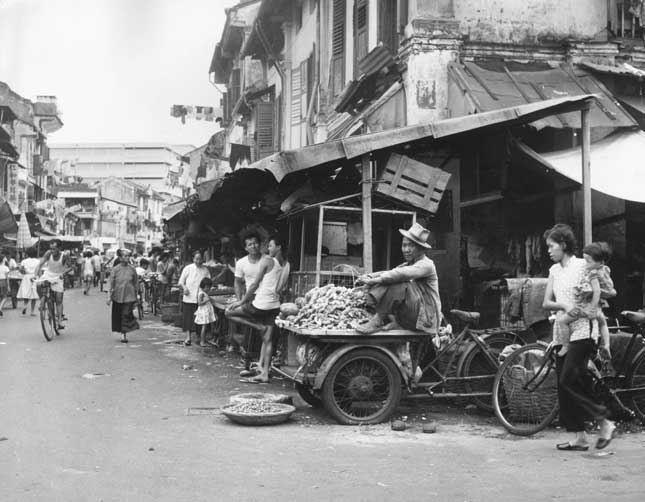
    Bustling street in Singapore, 1962. (Photo by John Pratt/Keystone Features/Getty Images)Bustling street in Singapore, 1962. (Photo by John Pratt/Keystone Features/Getty Images)

    In his bid to modernize Singapore—celebrated last year in the production there of The LKY Musical—Lee embraced a commitment to trade and the rule of law. During the 1970s, due largely to new investments and better use of personnel, productivity in Singapore’s trade sector grew by roughly 40 percent. Under Lee, the PAP invested heavily in the island’s great natural advantage: the 16-kilometer-wide Singapore Strait, connecting East Asia with the Indian Ocean. One of the party’s early accomplishments was a labor deal with the port’s labor unions, allowing for relaxed work rules and an updating of the facility. By 1980, the majority of Singaporeans worked in the trade sector, which led much of the city’s productivity growth.

    The PAP administrators weren’t content to see Singapore become a mere trading post, however. In contrast to other developing Asian economies, which emphasized local entrepreneurship and state-owned or -directed companies, Lee’s planners set about enticing American, European, and Japanese multinationals to relocate by touting Singapore’s English-speaking workforce, low-tax environment, and by-now first-class infrastructure. The country’s big break, Lee later suggested, came in 1968, when Texas Instruments—then one of the world’s largest manufacturers of semiconductors—opened a factory employing 1,000 people at the Kallang Basin industrial estate. “We had to create a new kind of economy, try new methods and schemes never tried before anywhere else in the world, because there was no other country like Singapore,” Lee reminisced in his 2000 memoir, From Third World to First.

    Continuing to look ahead, Lee and his mandarins understood that Singapore couldn’t thrive solely as a manufacturing hub, either. They correctly anticipated the evolution of an economy more reliant on technology and high-end services—for which education would be crucial. “Education must serve a purpose,” the PAP declared in 1965, and schooling was tailored to meet development goals, including instruction in English. It worked: Singaporean students do far better on tests than either their American counterparts or the average of OECD countries, and the Center on International Education Benchmarking describes Singapore’s workforce as “among the most technically competent in the world.” The national educational formula—especially the Singaporean approach toteaching math, based on intensive instruction and a focus on problem solving—has been widely adopted, including in the United States and Canada.

    Singapore’s development model also influenced its neighbors, especially China. Deng Xiaoping visited in 1978, and the famously pragmatic Communist autocrat saw an ideal formula for lifting his country out of poverty. Yet as China moved forward, Singapore ascended even higher.

    In a recent study that I conducted with the Manhattan Institute’s Aaron Renn and demographer Wendell Cox for Chapman University and the Singapore Civil Service College, we ranked global cities on factors including connectivity to the world economy, demographic diversity, cultural influence, technical workforce, foreign investment, and financial power. Singapore placed fourth, just behind London, New York, and Paris, but ahead of Tokyo and Hong Kong, and far ahead of much larger Beijing or Shanghai. Singapore has earned similar scores in other studies: ninth in the A. T. Kearney 2014 Global Cities index and fifth in the London-based Globalization and World Cities Network. These rankings are remarkable, considering that Singapore is much smaller than its prime competitors. Thirteen cities in China alone have larger populations.

    Lee Kwan Yew in 2013. (Photo by Chris McGrath/Getty Images)Lee Kwan Yew in 2013. (Photo by Chris McGrath/Getty Images)

    But Singapore’s appeal to foreign investors and migrants is easy to understand. The city has developed arguably the world’s best urban infrastructure, and its streets are rarely congested. Subways and buses, though crowded, are clean and generally well-functioning. The PAP regime’s intelligent planning also extended to housing. Before the PAP came to power, Singapore’s housing stock was dominated by run-down slums. By establishing the Housing Development Board, the state created decent, if small, residences for its citizens. This helped keep housing prices well below those in other Asian cities. Wendell Coxestimates that the city’s housing costs relative to income are roughly one-third to one-half those in Hong Kong, Shenzen, Beijing, and Shanghai. Its homeownership rates are well above those in the United States.

    Singapore also offers a stable legal and business climate. Like Hong Kong, the city-state benefits from a tradition of British governance and law. According to the World Justice Project’s ranking of civil justice systems—assessing the ability of ordinary citizens “to resolve their grievances and obtain remedies through formal institutions of justice”—Singapore ranks sixth, behind Norway, the Netherlands, Germany, Denmark, and Sweden, but ahead of Canada (13th) and the U.S. (27th). By comparison, China ranks 79th. Along with Hong Kong, Singapore also appears regularly at the top of global rankings for business climate. A combination of legal norms and transparency has lifted Singapore to become the world’s fourth global financial center, behind only New York, London, and Hong Kong. Singapore is home to twice as many regional headquarters for multinationals as much larger Tokyo. A 2011 Roland Berger study named Singapore the leading location for European companies to establish headquarters in the Asia-Pacific.

    To the extent that Singapore has a current economic weakness, it is tied to the PAP’s top-down planning model: key economic decisions are made not by entrepreneurs but by government-led agencies and large conglomerates like Singapore Airlines, GIC, and Temasek Holdings. In Hong Kong, Taiwan, and South Korea, by contrast, privately owned firms generate wealth while also wielding power. Singapore has no equivalents of Hong Kong’s Li Ka Shing, whose net worth is estimated by Forbes at over $30 billion; his Cheung Ho conglomerate employs 280,000 people in 52 countries. Nor does the city-state boast any companies like Taiwan’s Foxcomm, a dominant global power in manufacturing; South Korea’s Samsung, among the world’s leading tech and telecommunications firms; or even China’s Ali Baba, a start-up that has grown into one of the world’s top Internet firms.

    Singapore has avoided a common trap for governments throughout Asia: corruption. Lee and the PAP kept Singapore’s government clean by paying top bureaucrats high salaries. Freed from temptation, these bureaucrats, as one history of the civil service put it, could focus on ways “to mould people’s behaviors.” If Singaporeans did as they were told, they would benefit: this was the PAP’s essential promise.

    For a long time, it seemed to work. Most Singaporeans continued to back the PAP, in large part because the party delivered the material goods. “In Singapore, we’ve been very looked after. The social contract was if we vote for you, we the government will look after you,” says Singapore-born entrepreneur Calvin Soh. This “patriarchal system of governing,” as he calls it, was ideally suited for a manufacturing economy, where people were “efficient, obedient, and followers.” The bureaucracy carefully built the city’s economy, expanding opportunity for the city’s middle and working classes. Unemployment, 14 percent at the time of independence, became rare, and it remains so today, at around 2 percent.

    But “moulding people’s behaviors” has proved more difficult than building new transit lines or improving port facilities. Even in the early days, the PAP’s approach prompted some opposition and grumbling about the regime’s authoritarian bent. David Marshall, a former Singaporean ambassador to France, suggested in 1994 that the PAP was possessed of “a computer brain and a plastic heart.” He chastised the ruling party’s “suffocation of dissent,” which many observers believe continues, though to a lesser degree than in the past.

    Today’s Singaporeans, notes Soh, have less faith in the PAP than their forefathers did, partly because of economic factors. As recently as 2011, annual GDP growth chugged along at 6 percent, but last year it grew by just 2 percent, a rate similar to that of the United States and other high-income countries. Meanwhile, mirroring another problem in the affluent world, real wages for ordinary Singaporeans have stagnated. From 1998 to 2008, the income of the bottom 20 percent of households dropped an average of 2.7 percent, while the salaries of the richest 20 percent rose by more than half. Singapore’s educated population also faces growing competition from China and India, which are as hungry for success as Singapore was a half-century ago. “We went from wild animals forging a new country to tamed, well-fed animals in a zoo,” Soh jokes. “We kind of got contented and lost that hunger, that desperation, that edge for the hunt. We are a victim of our success.”

    Once, the bureaucracy thought that it could “create” a new culture. But many young Singaporeans don’t want their culture manufactured for them any more. Singaporeans, notes graduate student Arthur Chia, are “proud of what we have built, but many Singaporeans are also concerned with what we may be losing.”

    In a sense, there are two Singapores: one seen by multinationals and business travelers; and the other serving the local population. A trip down Orchard Road, the city’s historic shopping boulevard, reminds one of Hong Kong’s Causeway Bay, New York’s Fifth Avenue, or London’s Regent Street. Much of this Singapore—so anxious to appeal to the global rich and corporations—has become uniform and predictable. A once-unique urban environment has been transformed into what architect Rem Koolhaus calls “the generic city,” “a city without qualities,” and a “Potemkin metropolis.”

    The young are drawn to the other Singapore. In areas such as Geylang, restaurants, bars, and ill-disguised houses of prostitution coexist with a heavy concentration of Buddhist temples and Islamic mosques. Also popular is Tiong Bahru, an old art-deco district of open-air restaurants, hip bars, and charming apartments. But even here, independent restaurants and shops, which once proliferated, struggle with high rents, as they do in other prosperous global cities.

    These districts satisfy native Singaporeans’ nostalgia for an earlier version of the city, imagined as more romantic and less relentlessly hygienic. Eager to rediscover what they see as a grittier and more human past, younger Singaporeans have pushed to save what’s left of Singapore’s architectural heritage. They express a desire to return to the values of community they associate, interestingly enough, not with old China but with communal Malay culture. This “kampong spirit” reflects a deep disconnect between the goals of the bureaucracy and those of many citizens. “The starting point for the government is not values, and that’s part of the problem,” notes Alfred Wu, a professor at the Singapore Management University. “It’s all about utilitarianism. The government sets the path and people are not that involved. This makes it hard to change.”
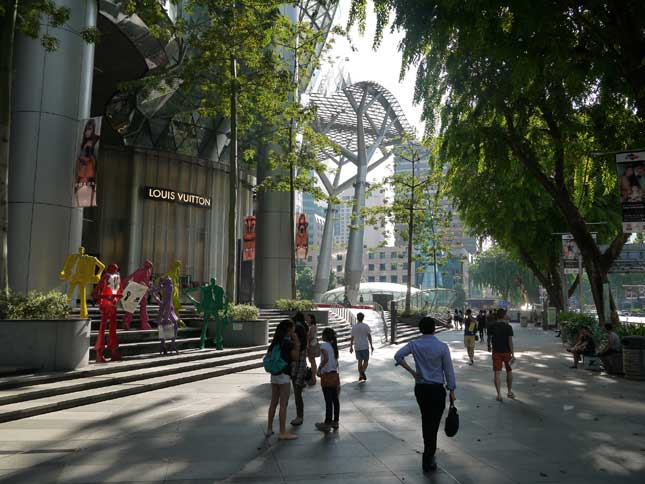
    Singapore's Orchard Road (Photo by wikubaskoro)Singapore’s Orchard Road (Photo by wikubaskoro)

    The movement of foreign capital and workers into Singapore has intensified the feeling of cultural drift and worries about the future. As the labor supply has dwindled, partly because of a plunging birthrate and consistent out-migration, the city-state has become ever more dependent on foreign labor. As recently as 1980, over 90 percent of residents were Singaporean citizens. Today, that number has fallen to 63 percent; by 2030, if the government plans hold up, foreigners will actually outnumber the natives.

    Many Singaporeans feel that the foreign influx is making them strangers in their own land. Most students at the Civil Service College are of Chinese descent. Yet even they view the city’s Chinatown district, now largely populated by people from mainland China, as foreign territory. “We don’t relate to it. We don’t see it as Singaporean,” one student confided to me. These tensions can be seen in other global cities, of course, such as New York, London, and Toronto, but these are large, sprawling metropolitan regions. The impact of population growth and immigration is more intensely felt in space-constrained Singapore.

    Like other successful global cities, Singapore is also becoming an abode of the rich; its millionaire households now number 188,000. As in other global cities, rising levels of real-estate investment from China, the Indian diaspora, and the Middle East have driven up prices, particularly in the private housing market. Many see the influx of foreign wealth as undermining the egalitarian nature of traditional Singaporean society. Some Singaporeans of Chinese descent take a particularly dim view of newly arrived Indians, whether professionals or lower-wage workers. Local playwright Alfian Sa’at’s 2013 play, Cook a Pot of Curry, was inspired by a well-publicized incident involving a Chinese migrant family’s objections to the pungent aroma coming from a neighboring Indian family’s kitchen. The play touched off a heated media debate about the purpose of immigration, the need for assimilation, and the preservation of national identity. Some government officials were troubled by the controversy, which undermined their vision of engineered social harmony.

    The presence of so many skilled foreign workers from China and India is unquestionably threatening social cohesion. Increased competition for low-wage jobs has stoked tension among the city’s south Indian and Sri Lankan immigrants, who occupy much of the lower employment tier. Last year, for the first time since 1969, a riot took place in the city—in Little India, after police rousted some inebriated workers. These disturbances have led the government to tighten its immigration policies.
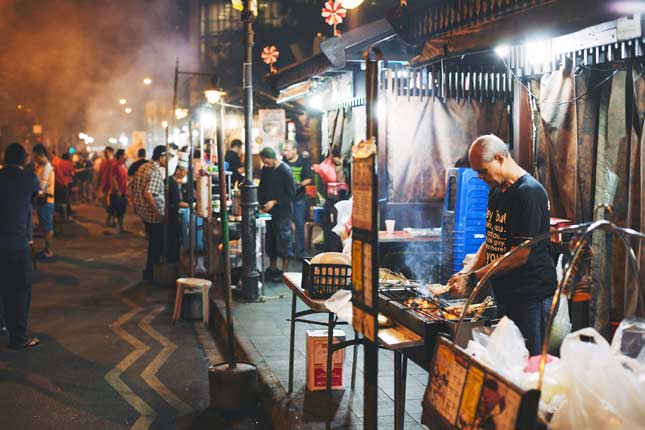
    Photo by Peter Kirkeskov RasmussenPhoto by Peter Kirkeskov Rasmussen

    Singapore’s challenges go beyond its changing population. A diminishing portion of Singaporeans say that they are interested in marriage. Singapore’s birthrate is now one of the world’s lowest. Since 1990, the number of births to Singapore residents has dropped from almost 50,000 annually to barely 37,000. The government has sought to reverse this pattern with well-funded incentives to encourage families—such as subsidies for housing—but the fertility rate still stands at 1.3 per woman, well below replacement level.

    “Demographically, there’s really no way out, no way to stop the decline,” suggests longtime University of Singapore demographer Gavin Jones, over a dim-sum lunch in Holland Village, an old Singaporean neighborhood popular with expats. “The government has tried to address this with incentives, but it doesn’t work. The culture of not having children is now very much internalized. It is seen as something that limits your options.” To some extent, this view reflects trends throughout East Asia, where family bonds are weakening. The low-birth pattern is also evident in Singapore’s competitors, notably Hong Kong, where nearly half of young couples believe that they can’t afford to have children. Shanghai, notes Jones, now has one of the lowest peacetime fertility rates ever recorded.

    Young Singaporeans say that the decision not to have children is pragmatic. “Having kids was important to our parents,” noted one thirtyish civil servant, “but now we tend to have a cost and benefit analysis about family. The cost is tangible, but the benefits are not knowable or tangible.” Many Singaporeans suspect that, however good things may be now, they won’t be better for the next generation.

    “Delivering babies is not such a good business now,” suggests Fong Yoke Fai, a prominent local gynecologist. “There’s a change in perception. Personal goals are more important than social or religious ones. People don’t think they can afford the housing for children, so they opt not to have them.”

    Singaporean planners, who in the 1960s and 1970s fretted about overpopulation, now must confront what their Japanese peers face—an aging population that can only be sustained by immigration. By 2030, Singapore could have many more people over 65 than under 25. If this trend continues, the main question facing the city-state may not be how to remake itself but how to get rich enough, fast enough, to support millions of elderly citizens.

    Going forward, it seems clear that Singapore must change its model, and perhaps jettison the idea of mold making entirely. The city-state needs less planning and more spontaneity. Government attempts to promote creativity or start new cutting-edge industries are bound to fail in a society where bloggers can lose their jobs or get arrested for offending the sensibilities of the bureaucratic elite. Singaporean authorities have also banned films, such as local director Ken Kweck’s 2012 feature, Sex.Violence.FamilyValues, which they found racially controversial. “Even Chinese citizens who take up Singapore citizenship wouldn’t want [censorship],” suggests Soh, whose new company produces archival photos of various locations in the city, many of which have long since been destroyed. “They didn’t leave China to be in China.”

    Singapore’s planners will be tempted to meet the new challenges by doing what they do best—designing, implementing, and managing vast new projects, especially physical infrastructure, that promise to keep the city competitive. In recent years, these efforts have included a remarkable “greening” of the city, with many small parks and a network of nature trails as well as Gardens by the Bay, a large indoor collection of trees, recently completed near the central core. The Gardens represent a broader effort to grow Singapore’s service and tourism sectors, notably through the construction of a massive casino—a remarkable development, as gambling was long considered a curse in Chinese culture. Lee Kwan Yew promised that casinos would appear in his country only “over my dead body,” but even before his death, gambling had become big business: Singapore has vaulted ahead of Las Vegas to boast the world’s second-largest casino revenue. Only Macau takes in more.

    But turning Singapore into an Asian Las Vegas won’t solve the city’s fundamental problems. The real crisis is not in how Singapore is regarded in New York and London, or even in Beijing and Shanghai, but how it meets the needs and aspirations of its own people. Singapore’s leaders must revamp their approach to governance, becoming more responsive to local needs and less focused on defined goals.

    “No amount of analysis and forward planning,” says longtime government advisor Peter Ho, “will eliminate volatility and uncertainty in a complex world.” The old managerial model, he concedes, has become outdated. To thrive in the future, Singapore will have to find its way without a predrawn map. As Asia modernizes and develops a modern infrastructure, Singaporeans cannot remain competitive merely by being more efficient or better educated. The city-state will have to rediscover the boldness of its founding generation, even while discarding many of its methods. “We will have to be pioneers again,” notes Calvin Soh, “and recognize that we don’t have the same strategic advantages that we used to have. We have to start planning for the next ten years from that viewpoint. And that plan has to come from the grassroots, not from above.”
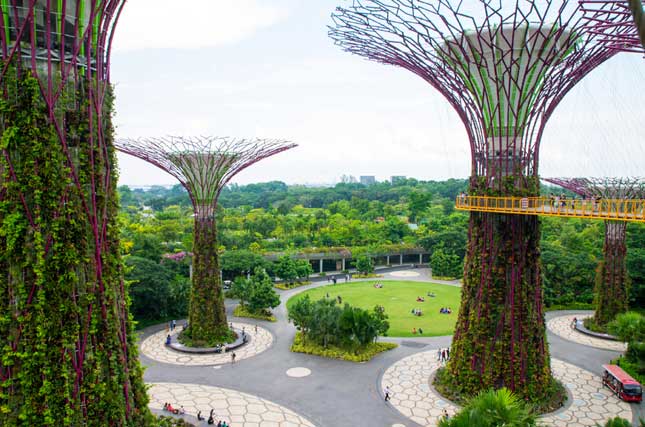
    Singapore's Gardens by the Bay (Photo by M!cka)Singapore’s Gardens by the Bay (Photo by M!cka)

    This piece originally appeared in The City Journal.

    Joel Kotkin is executive editor of NewGeography.com. He is the Roger Hobbs Distinguished Fellow in Urban Studies at Chapman University and executive director of the Houston-based Center for Opportunity Urbanism. His newest book, The Human City: Urbanism for the rest of us, will be published in April by Agate. He is also author of The New Class ConflictThe City: A Global History, and The Next Hundred Million: America in 2050. He lives in Orange County, CA.

    Singapore skyline photo by Bigstockphoto.com.

  • The Sun Belt Is Rising Again, New Census Numbers Show

    From 2009-11, Americans seemed to be clustering again in dense cities, to the great excitement urban boosters. The recently released 2015 Census population estimates confirm that was an anomaly. Americans have strongly returned to their decades long pattern of greater suburbanization and migration to lower-density, lower-cost metropolitan areas, largely in the South, Intermountain West and, most of all, in Texas.

    Among the nation’s 53 largest metropolitan statistical areas, the two biggest population gainers between July 1, 2014, and July 1, 2015, were Houston and Dallas-Ft. Worth, together adding roughly 300,000 people. Their growth, in absolute terms, was larger than that of both Los Angeles and New York, which, respectively, are nearly two and three times as populous, notes demographer Wendell Cox. Two other Sun Belt metropolitan areas, Atlanta and Phoenix, also added more people over the year to July 2015 than L.A. and New York.

    The divergence in growth is even greater when expressed in percentage terms. Of the 10 fastest-growing metro areas in the country, all but two were located in the old Confederacy. Austin ranks first, with 3.0%  growth, followed by Orlando, Fla. (2.6%), and Raleigh (2.5%). Other fast-growing southern metro areas included San Antonio, Texas (2.2%); Nashville, Tenn.; and Jacksonville, Fla. (both 2.0%). The fastest growers outside the South are Denver (2.1%) and Las Vegas (2.2%), the latter of which is now clearly back from the dead.

    The old big cities aren’t all losing people. New York and Los Angeles’ populations grew as well, 0.43%  and 0.65%, respectively, but that’s well below the overall U.S. population growth rate of 0.79% over the same span. Some metro areas, notably Chicago, Pittsburgh, Rochester, Hartford, Cleveland and Buffalo suffered slight losses, while many others, such as St. Louis, Memphis, Milwaukee and Detroit remained essentially stagnant.

    Critically, the most recent patterns confirm longer-term trends. Most of the cities at the top of the list are also the ones that have been growing fastest since 2000, led by Raleigh, Austin, and Las Vegas. Also in the top 10 since 2000 are the other three big Texas cities, Phoenix, Charlotte, Orlando and one California metro, largely exurban San Bernardino-Riverside. The slowest growth also follow a similar pattern, with Chicago, several Rust Belt cities, as well as Los Angeles and New York, all in the bottom quintile in percentage terms.

    Where Americans Are Moving

    To look ahead to where America will be growing in the future, perhaps the best indicator is net domestic migration. This measures where people are moving, essentially taking their skills, purchasing power and capital with them. Houston and Dallas-Fort Worth enjoyed the largest net gains from domestic migration, roughly 60,000 each, from July 1, 2014, to July 1, 2015, followed by Phoenix, Tampa-St. Petersburg, Atlanta and Austin. The Sun Belt, once written off as doomed by the urbanist punditry, is clearly back.

    In percentage terms, Austin led the nation, with a population expansion of 1.7% from net domestic migration. The top 10 cities in percentage terms are all in the Sun Belt (Tampa-St. Petersburg ranked second, followed by Raleigh, Orlando and Jacksonville) or the Intermountain West (Denver and Las Vegas).

    The biggest losers in overall domestic migration are New York (-164,000), Chicago (-80,000) and Los Angeles (-71,000). In percentage terms, Chicago suffered the biggest losses, followed by New York, Hartford, Memphis and Milwaukee. Despite the explosive growth in Silicon Valley,   San Jose ranked 9th in percentage loss, just behind 10th place Detroit.

    In looking at these trends, the Atlantic’s Derek Thompson, one of the more savvy Census watchers, recently suggested that “it’s 2006 again” as people head out to the Sun Belt metros. When international migration is added to the mix along with the domestic migration numbers, the top five gainers remain in the Sun Belt, led by Houston and Dallas-Fort Worth, which are also becoming meccas for immigrants.

    These trends predate the recession. Since 2000, the biggest migration winners in percentage terms are Raleigh, Austin, Las Vegas, Charlotte, Phoenix, and Orlando. In total numbers since 2000 it’s also a familiar list, led by places like Phoenix (net gain: 705,000), Dallas-Ft. Worth (569,000), Atlanta (547,000), Riverside-San Bernardino (513,000) and Houston (496,000).

    The biggest losers are also familiar, led by the New York metropolitan area, which has lost 2.65 million net migrants since 2000, followed by Los Angeles (negative 1.65 million) and Chicago (down 880,000). Remarkably the two metro areas that have benefited the most from the digitization of the economy are in the loser’s column; between them San Jose and San Francisco lost over 550,000 domestic migrants since 2000.

    The Suburban Revival Continues

    The other big finding from the new estimates: suburbs are back. In the wake of the housing bust it was widely predicted that the ‘burbs were doomed by high gas prices, millennial preferences and a profound shift of employment to the core cities. The New York Times NYT -0.08% evenpublished fantasies on how the suburban carcass could be carved up, envisioning suburban three-car garages “subdivided into rental units with street front cafés, shops and other local businesses” while abandoned pools would become skateboard parks.

    As  economist Jed Kolko has noted, the much celebrated era when core cities grew faster than suburbs — the immediate 2009-2011 aftermath of the recession — turned out to be remarkably short-lived. From July 2014-July 2015, only seven out of 53 core cities added more domestic migrants than their suburbs. Of these, the District of Columbia (Washington) could be considered high density urban; the other five core counties are functionally more suburban than urban (Phoenix, Raleigh, Richmond, Sacramento and San Antonio).

    Overall domestic migration continues from the core cities to the suburbs. Over the last year core counties lost a net 185,000 domestic migrants, while the suburban counties gained 187,000.

    Looking Ahead

    These trends are likely to continue as long as the economy achieves even modest growth.  One big factor will be the migration of millennials, now headed increasingly to Sun Belt cities and suburbs. Since 2010,  among educated millennials, the fastest growth in migration has been to such lower-cost regions as Atlanta, Orlando, New Orleans, Houston, Dallas-Fort Worth, Pittsburgh, Columbus, and even Cleveland.

    This is largely a product of high housing prices. According to Zillow, rents claim upward of 45% of income in Los Angeles, San Francisco, New York, and Miami compared to less than 30% of income in places like Dallas-Fort Worth and Houston.  The costs of purchasing a house are even more lopsided: in Los Angeles and the Bay Area, a monthly mortgage takes, on average, close to 40% of income, compared to 15% nationally.

    Millennials are also headed increasingly to the suburbs. According to the National Association of Realtors, 80% of the homes purchased by millennials between 2013 and 2014 were detached houses, and 8% had chosen attached housing. This trend will accelerate in the next few years, suggests Kolko, as the peak of the millennial wave turns 30.

    Similarly immigrants — the other big driver shaping our future geography — are also moving increasingly to Sun Belt cities such as Houston, Dallas-Ft, Worth and Atlanta, as newcomers seek out both economic opportunities and lower housing prices. New York remains the immigrant leader, with the foreign-born population increasing by 600,000 since 2000, but second place Houston, a relatively newcomer magnet for immigrants, gained 400,000, more than Chicago and the Bay Area combined. The regions experiencing the highest growth in newcomers in percentage terms were Charlotte and Nashville, which each have seen their foreign-born populations double.

    In the coming decade, immigrants and millennials will produce the vast majority of the country’s children — and they increasingly sending them to school in the suburbs of Sun Belt cities. Central (urban core) areas lost substantial numbers of schoolchildren between 2000 and 2010, while school populations rose in newer suburbs and exurbs. Overall the child populations in cities such as Austin, Houston, San Antonio, Raleigh, Orlando and Nashville are on the rise while dropping in places like Los Angeles and Chicago, as well as some Rust Belt cities.

    America’s geography will be increasingly dominated by Sun Belt cities as well as suburbs. This challenges the preferred narrative among most planners and the mainstream media, as well as some developers who  believe more Americans desire to live in high cost, high density locales. Some day perhaps the facts — as seen both in this year’s numbers and longer term trends — will intrude on the narrative. Dispersion is back, and getting stronger. It’s time that developers, planners and the media adjust to the facts, rather than just reflect their prejudices.

    Population Change in the Nation’s Largest Metropolitan Areas, 2014-2015
    Change Rank Region 2014 Population 2015 Population 14-15 Change % Change
    1 Houston-The Woodlands-Sugar Land, TX  6,497,864 6,656,947 159,083 2.4
    2 Dallas-Fort Worth-Arlington, TX  6,958,092 7,102,796 144,704 2.1
    3 Atlanta-Sandy Springs-Roswell, GA 5,615,364 5,710,795 95,431 1.7
    4 Phoenix-Mesa-Scottsdale, AZ  4,486,543 4,574,531 87,988 2
    5 New York-Newark-Jersey City, NY-NJ-PA  20,095,119 20,182,305 87,186 0.4
    6 Los Angeles-Long Beach-Anaheim, CA  13,254,397 13,340,068 85,671 0.6
    7 Miami-Fort Lauderdale-West Palm Beach, FL  5,937,100 6,012,331 75,231 1.3
    8 Washington-Arlington-Alexandria, DC-VA-MD-WV  6,033,891 6,097,684 63,793 1.1
    9 Seattle-Tacoma-Bellevue, WA  3,672,866 3,733,580 60,714 1.7
    10 Orlando-Kissimmee-Sanford, FL  2,326,729 2,387,138 60,409 2.6
    11 San Francisco-Oakland-Hayward, CA  4,595,980 4,656,132 60,152 1.3
    12 Denver-Aurora-Lakewood, CO  2,755,856 2,814,330 58,474 2.1
    13 Tampa-St. Petersburg-Clearwater, FL  2,917,813 2,975,225 57,412 2
    14 Austin-Round Rock, TX  1,943,465 2,000,860 57,395 3
    15 San Antonio-New Braunfels, TX  2,332,790 2,384,075 51,285 2.2
    16 Riverside-San Bernardino-Ontario, CA  4,438,715 4,489,159 50,444 1.1
    17 Charlotte-Concord-Gastonia, NC-SC  2,379,177 2,426,363 47,186 2
    18 Las Vegas-Henderson-Paradise, NV  2,069,146 2,114,801 45,655 2.2
    19 Portland-Vancouver-Hillsboro, OR-WA  2,348,607 2,389,228 40,621 1.7
    20 Nashville-Davidson–Murfreesboro–Franklin, TN  1,793,910 1,830,345 36,435 2
    21 Boston-Cambridge-Newton, MA-NH  4,739,385 4,774,321 34,936 0.7
    22 San Diego-Carlsbad, CA  3,265,700 3,299,521 33,821 1
    23 Raleigh, NC  1,243,035 1,273,568 30,533 2.5
    24 Sacramento–Roseville–Arden-Arcade, CA  2,244,879 2,274,194 29,315 1.3
    25 Minneapolis-St. Paul-Bloomington, MN-WI  3,495,656 3,524,583 28,927 0.8
    26 Jacksonville, FL  1,421,004 1,449,481 28,477 2
    27 Columbus, OH  1,997,308 2,021,632 24,324 1.2
    28 San Jose-Sunnyvale-Santa Clara, CA  1,954,348 1,976,836 22,488 1.2
    29 Oklahoma City, OK  1,337,619 1,358,452 20,833 1.6
    30 Indianapolis-Carmel-Anderson, IN  1,971,861 1,988,817 16,956 0.9
    31 Kansas City, MO-KS  2,071,283 2,087,471 16,188 0.8
    32 Philadelphia-Camden-Wilmington, PA-NJ-DE-MD  6,053,720 6,069,875 16,155 0.3
    33 Salt Lake City, UT  1,154,513 1,170,266 15,753 1.4
    34 Richmond, VA  1,259,685 1,271,334 11,649 0.9
    35 New Orleans-Metairie, LA  1,251,962 1,262,888 10,926 0.9
    36 Baltimore-Columbia-Towson, MD  2,786,853 2,797,407 10,554 0.4
    37 Grand Rapids-Wyoming, MI  1,028,962 1,038,583 9,621 0.9
    38 Cincinnati, OH-KY-IN  2,148,450 2,157,719 9,269 0.4
    39 Louisville/Jefferson County, KY-IN  1,271,172 1,278,413 7,241 0.6
    40 Virginia Beach-Norfolk-Newport News, VA-NC  1,717,853 1,724,876 7,023 0.4
    41 Tucson, AZ  1,004,244 1,010,025 5,781 0.6
    42 St. Louis, MO-IL  2,806,191 2,811,588 5,397 0.2
    43 Providence-Warwick, RI-MA  1,609,533 1,613,070 3,537 0.2
    44 Birmingham-Hoover, AL  1,142,823 1,145,647 2,824 0.2
    45 Milwaukee-Waukesha-West Allis, WI  1,574,115 1,575,747 1,632 0.1
    46 Memphis, TN-MS-AR  1,342,914 1,344,127 1,213 0.1
    47 Detroit-Warren-Dearborn, MI  4,301,480 4,302,043 563 0
    48 Buffalo-Cheektowaga-Niagara Falls, NY  1,136,642 1,135,230 -1,412 -0.1
    49 Rochester, NY  1,083,678 1,081,954 -1,724 -0.2
    50 Hartford-West Hartford-East Hartford, CT  1,213,225 1,211,324 -1,901 -0.2
    51 Cleveland-Elyria, OH  2,064,079 2,060,810 -3,269 -0.2
    52 Pittsburgh, PA  2,358,096 2,353,045 -5,051 -0.2
    53 Chicago-Naperville-Elgin, IL-IN-WI  9,557,294 9,551,031 -6,263 -0.1

    This piece originally appeared in Forbes.

    Joel Kotkin is executive editor of NewGeography.com. He is the Roger Hobbs Distinguished Fellow in Urban Studies at Chapman University and executive director of the Houston-based Center for Opportunity Urbanism. His newest book, The Human City: Urbanism for the rest of us, will be published in April by Agate. He is also author of The New Class ConflictThe City: A Global History, and The Next Hundred Million: America in 2050. He lives in Orange County, CA.

    Photo by telwink.

  • Even as They Retire, it’s Still About the Boomers

    America’s baby boomers, even as they increasingly enter retirement, continue to dominate our political economy in ways no previous group of elderly has done. Sadly, their impact has also proven toxic, presenting our beleaguered electorate a likely Hobbesian presidential choice between a disliked, and distrusted, political veteran and a billionaire agitator most Americans find scary.

    Throughout the campaign, boomers have provided the bedrock of support for both Hillary Clinton and Donald Trump. Bernie Sanders may have devastated Clinton among millennial voters, by almost 3-1, but she has more than offset that gap by winning overwhelming support from older voters.

    In the South, it was older African Americans, particularly women, who sealed Clinton’s big wins. But older voters of all races have supercharged her campaign elsewhere; she won older voters by 39 percentage points in Missouri and 54 points in Ohio. She also captured upward of 73 percent of their votes in critical states like Virginia.

    No surprise that she also did well in Arizona and Florida, states that are major retirement havens. Four of the five areas with the most retirees per capita are located in these two states.

    But it’s Donald Trump who arguably was the biggest winner in the boomer wars. He has thrived most in states with aging white populations, notably Nevada, Arizona, Florida, Massachusetts, New Hampshire and South Carolina. He has consistently run five to 15 points better with the boomer generation than among younger GOP primary voters.

    Some of this preference is attributable to racist and xenophobic sentiments among older people, who are, for example, typically far less favorable toward inter-racial dating than younger cohorts. Similarly, boomers are far more likely than millennials to harbor patriotic sentiments; only a third of them believe America is the greatest country in the world, compared with half of boomers. Trump’s appeal to “Make America great again” may connect with boomers, but not so much with their offspring.

    Read the entire piece at The Orange County Register.

    Joel Kotkin is executive editor of NewGeography.com. He is the Roger Hobbs Distinguished Fellow in Urban Studies at Chapman University and executive director of the Houston-based Center for Opportunity Urbanism. His newest book, The Human City: Urbanism for the rest of us, will be published in April by Agate. He is also author of The New Class ConflictThe City: A Global History, and The Next Hundred Million: America in 2050. He lives in Orange County, CA.

  • Trumpism: America’s Berlusconi Moment

    Trump envisioned and created today’s city of white boxes for rootless new money types, who dominate the city even as they leave little mark here.

    An old joke—that in heaven, the Italians do the cooking; in hell, they run the government—feels a lot darker now that American politics are taking an Italian turn.

    Since the fall of Il Duce, Italy has had a staggering 62 governments, and while American doesn’t have that problem yet, our political system is showing all the signs of decline—an inability to come to any consensus, the increased vulgarity of discourse, the utter incompetence of an impenetrable bureaucracy and the growth of extra-constitutional fascist and Mob-like “familial” —run modes of governance—with which Italians have long and unhappy familiarity.

    Let’s start with Donald Trump, who the American left now routinely deems an American fascist in the mold of Benito Mussolini. Like Trump, Mussolini (a former journalist) rose rapidly to power as his country was disintegrating from within. Then, too, nationalist resentments were reaching a fever pitch as a large part of the populace—and especially the middle and working classes—lost its remaining faith in the system as economic conditions decayed.

    In 1919, for example, there were “cost of living” riots throughout the peninsula as the old governing class lost its grip on the state. Fascism, as Mussolini himself suggested, was predicated on strength—on the use and threat of violence. The disruptive hooliganism of Trump supporters at his rallies evokes the frenzied, violent environment in which Il Duce claimed power in the 1922 “March on Rome,” and held it he was finally ousted and arrested in 1943.

    As the Financial Times’  Martin Wolff wrote, Trump follows a pattern that “embodies how great republics meet their end.”

    But past results, as the fine print says, are no indicator of future ones and the comparisons between Trump and Mussolini seem overdrawn. Take a breath and recall that Ronald Reagan and George W. Bush, too, were widely dismissed as “fascists” or even Nazis in their time.

    Trump clearly has an authoritarian personality , and he appeals to those with that bent, but he’s hardly a true heir to Mussolini. For one thing, Mussolini, like Hitler, was not born into money; they emerged from the life-or-death struggles of the Great War. Unlike those two, Trump does not boast an organized paramilitary black or brown shirt movement.  

    It is in the nature of his appeal where Trump does resemble the fascist leaders. His followers, like theirs, are people who feel left out of the calculations of the political class in both parties.

    In this sense, he shares much with the nationalist parties on the rise across Europe, drawing support from the middle class disgusted by politicians kowtowing to identity and radical green politics, from voters who feel the ruling parties serve not their interests but their donors and well-heeled interests, and who, despite their protestations of comity with their concerns, actually hold their electorate in various shades of contempt.tired of being told that changes they can feel hurting them, are actually helping them, tired of electing politicians who then ask them: “Who are you going to be believe: Me or your lying eyes?”

    Members of America’s white working and middle classes, argues Michael Lind, have become an outsiders, even pariahs in their own county: “Lacking any establishment advocates and sympathetic intellectuals, on left, right or center, many white working class Americans have therefore turned to demagogic outsiders like Trump. Where else are they to go?”

    The Donald speaks not only to the their fears haunting the middle class, but also their pride: he wants them to be proud of the country’s past. Some insist the real Italian model may not Mussolini but a more contemporary figure, former Prime Minister Silvio Berlusconi. Like Trump Berlusconi was a successful entrepreneur and  also  a loudmouth.   who appealed to Italians by denouncing “political correctness” as well as the weakness and corruption endemic to the Italian state.   

    If so, there’s some room for hope. Unlike Mussolini, Berlusconi never succeeded in overturning the constitutional order.

    Whichever comparison is more apt, there’s little doubt that iIn the run-up to the seemingly inevitable, horribly depressing face-off with Trump, we can count on Hillary Clinton and her reliable press minions to keep raising these Italianesque models. Trump will be dressed as a fascist, or even a Nazi, for breaking with the politically correct consensus. Like Berlusconi, he will be investigated for his numerous moral lapses—both personal and business—and, by November, will be about as attractive to much of the electorate as Mitt Romney without his noblesse oblige or respectability.

    American Donna

    If Trump is tarnished, that’s a good thing. But ihis political demise would sadly t’s one that opens the door to another ugly Italian model, the less public but arguably more effective one followed by Hillary Clinton and much of the Democratic Party.

    Clinton, notes journalist Jamelle Bouie  reflects  a machine model, with  control of the party itself as a goal.  Rather than an ideological figure, she “appeals to stalwarts and interest groups (like banks and industry) far more than voters who choose on ideology and belief.”

    This approach approximates, more than anything, the structure—though not the actual violence—of the Mafia, with “families.” .These groups that represent distinct, sometimes interlocking, interests, each functioning with almost total dominion over its respective turf but able to process competing demands through a central “commission” like the New York based one founded in 1931—when organized crime, incidentally, was under assault by fascist Italy.

    Under a second President Clinton, the Democrats will operate under a similar system, with Wall Street, tech oligarchs, greens, feminists, gays, African-Americans, public sector unions, universities, Latinos,  urban land speculators sitting around the table and her as il capo di tutti capi.

    She won’t have much patience for legal niceties, having already pledged to circumvent Congress if they won’t do her bidding. What drives progressives crazy.  about the former Secretary of State is not centralism – they generally supported Barack Obama’s rule by decree – but the very pragmatism that grows naturally  out of this kind of familial structure.

    These “families” have already played a critical role in helping bankroll the Clinton machine, both in the form of the family Foundation, whose donations have reached close to $3 billion,  and her campaign. Raising money from the oligarchy, as Bernie Sanders has noted,  makes it much less likely she will challenge their vital interests in a concertedfashion.go after their influence.

    Under a Hillary Clinton Administration, the Commission will be far more important than either under her husband or Barack Obama. Unlike these two articulate and charismatic leaders, Clinton inspires little loyalty outside of the “families.” She will not, for example, tackle entrenched interests like the teachers’ unions, which, to his credit, President Obama has been willing to do.   

    To be sure, a Commission-style government may not seem as scary as one run by an unpredictable and vulgar billionaire. Yet it could prove, in its own way, even more effectively authoritarian. Already critical Democratic “families” such as the universities, the tech world  and even the media have become centers of  censorship and ideological conformity.  Their cultural influence, already pervasive, is likely to become even greater.

    And in choosing a Mafia model, Clinton is adopting a system that lasted longer than thefascisti and thrived through  systematic intimidation of its rivals.  A Clinton Commission  may not cause sleepless nights, as a prospective Trump Administration might , but it hardly represents an edifying future for this most, at least to date, successful of republics.

    This piece first appeared in The Daily Beast.

    Joel Kotkin is executive editor of NewGeography.com. He is the Roger Hobbs Distinguished Fellow in Urban Studies at Chapman University and executive director of the Houston-based Center for Opportunity Urbanism. His newest book, The Human City: Urbanism for the rest of us, will be published in April by Agate. He is also author of The New Class ConflictThe City: A Global History, and The Next Hundred Million: America in 2050. He lives in Orange County, CA.

    Berluscony photo by alessio85 (flickr) [CC BY 2.0], via Wikimedia Commons

  • Farewell, Grand Old Party

    The increased likelihood of Donald Trump as the GOP presidential nominee, as evidenced by his win in Florida and other states last week, spells the end of the Republican Party as we have known it. Successful political parties unite interests under a broadly shared policy agenda. The Clinton Democrats may seem ethically challenged, condescending and bordering on dictatorial, but they share basic positions on many core issues and a unifying belief in federal power as the favored instrument for change.

    In contrast, the Republican Party consists of interest groups that so broadly dislike each other that they share little common ground.

    GOP libertarians want more social freedoms; social conservatives want less. Neocons hunger for war, while most other Republicans, both libertarian and constitutionalist conservatives, reject Bushian interventionism. The rising populist wave now inundating the party and driving the Trump juggernaut both detests, and is detested by, the party’s media, corporate and intellectual establishment.

    Some “movement” conservatives are returning the favor, essentially blaming the white working class for their own failures. Among some on the right, it appears, capitalism and the law of the jungle are always noble, and those who fail to make the grade clearly are not. No surprise, then, that the new generation of voters seems more ready for socialism than for laissez faire.

    Against weak and squabbling opposition, Trump has employed his crude persona, and equally crude politics, to dominate the primaries to date. But in the process he has broken not only the party structure, but also its spirit. Indeed, some of the party’s most promising emerging leaders, such as Nebraska U.S. Sen. Ben Sasse, have made it clear they cannot support a candidate who seems to have little respect for the Constitution, or any other cherished principle.

    Read the entire piece at The Orange County Register.

    Joel Kotkin is executive editor of NewGeography.com. He is the Roger Hobbs Distinguished Fellow in Urban Studies at Chapman University and executive director of the Houston-based Center for Opportunity Urbanism. His newest book, The Human City: Urbanism for the rest of us, will be published in April by Agate. He is also author of The New Class ConflictThe City: A 

    Photo by Gage Skidmore [CC BY-SA 3.0], via Wikimedia Commons

  • Mass Transit Expansion Goes Off The Rails In Many U.S. Cities

    Journalists in older cities like New York, Boston or San Francisco may see the role of rail transit as critical to a functioning modern city. In reality, rail transit has been a financial and policy failure outside of a handful of cities.

    In 23 metropolitan areas that have built new rail systems since 1970, transit’s share of commuting — including all forms, such as buses and ferries — has actually slipped a bit, from an average of 5.0 percent before the rail systems opened to 4.6 percent in 2013. The ranks of those driving alone continue to grow, having increased 14.4 million daily one-way trips since 2000, nearly double transit’s overall daily total of 7.6 million, according to Census Bureau data.

    Virtually all the actual increase in rail commuting has occurred in the “legacy cities”: New York, Boston, San Francisco, Washington, Chicago and Philadelphia. These are older cities built around well-defined cores that were developed mostly before the automobile. Together the core cities of these metro areas, excluding the suburbs, accounted for 55% of all transit work trips in the nation in 2014, according to the latest American Community Survey data. Overall, transit’s work trip market share in these six metropolitan areas rose from 17 percent to 20 percent between 2000 and 2014. In the entire balance of the country, where most of the new rail systems have been built, transit’s market share is only 2.2 percent, up a scant 0.2 percentage points since 2000, according to Census Bureau data.

    Manhattan alone, in fact, accounts for more than 40 percent of all rail commuters in the nation. New York is the only U.S. city where more than 20 percent of workers labor in the central business district (downtown). In most cities, the percentage is less than half of that, and in many others, even smaller. In Los Angeles, less than 3 percent of employment is downtown. In Dallas only 2 percent of metropolitan employment is downtown. In Houston, where numerous large companies maintain headquarters, it’s still only 6.4 percent.

    For transit to work effectively, employment needs to be concentrated. This explains why between 2013 and 2014, New York accounted for a remarkable 88 percent of the total increase in train commuting. But what works for Brooklynites headed to Union Square does not generally work so well for people living in our increasingly dispersed metropolitan areas. Indeed in most cities — Dallas-Fort Worth, Houston, San Diego, and even the new urbanist mecca of Portland, according to 2015 American Community Survey data, where new transit lines have been put in, it has failed to increase the share of commuters who take public transportation, and in some cases the actual ridership has dropped.

    It has even failed where cities are booming and their downtowns flourishing. Houston’s light rail system opened in 2004, but has done little to change the car-dominated commuting pattern of America’s energy capital. Between 2003 and 2014, Harris County’s population grew 23 percent, but transit ridership decreased 12%, according to American Public Transportation Association data. This means that the average Houstonian took 30 percent fewer trips on the combined bus and light rail system in 2014 than on the bus-only system in 2003.

    The Next Great Transit City

    Nowhere is the transit mania more profound than in Los Angeles, a city progressive blogger Matt Yglesias describes as “the next great transit city.”

    There seems to be a conscious strategy of making auto commuting in Los Angeles and the rest of California so unpleasant as to force people into transit. Mayor Eric Garcetti has made bold predictions that commuting times will drop in half, largely by people moving from cars to trains. Of course this is folly, since transit commuting generally takes considerably longer than commuting by car. The Governor’s Office of Planning and Research has called for putting all California on “a road diet,” meaning that traffic will simply continue to worsen. This in a state which has among the worst roads in the country – 68 percent of which are in poor or mediocre condition.

    Can rail solve or mitigate congestion? L.A. has already spent over $15 billion on rail yet this has proven less than effective in either boosting transit ridership or lessening congestion.

    Since 1980 before the rail expansion the percentage of Los Angeles County commuters who take transit has actually dropped from 7.0 to 6.9 percent while the transit share of the combined statistical area has dropped from 5.1 to 4.7 percent. Even the total numbers of riders is heading down. Recently the transit booster Los Angeles Times published statistics that showed that there were now 10 percent fewer boardings on the Los Angeles MTA system than in 2006, and that the decline was accelerating.

    One reason for the poor performance is that much of the train ridership turns out to have been former bus travelers in the first place, which limits actual gains there. Taxpayers, however, should be screaming about this switchero; the subsidy for new L.A. new bus riders, who tend to be the poorest of the poor, cost taxpayers $1.40 while the cost for a new rail rider was $25.82 over the period of 1994 to 2007. If you believe in transit as public good, clearly building more trains makes less sense than expanding bus operations.

    But it’s not just a cost issue. Los Angeles is a vast and dispersed metropolis in which only one in five residents even lives within the city limits, and even much of the city — notably the San Fernando Valley — is essentially suburban in form. Transit travel takes much more time to get to work than the car, even on the region’s miserable roads and overcrowded freeways. With downtown only a minor employment center, people increasingly travel there for cultural events, sports or even a restaurant, not for work.

    Other factors also seem to be contributing to the decline. One is the trend toward working at home; in 2014, the number of Angelinos working at home surpassed the number taking transit. Although this saves more energy, and produces less carbon than transit ridership, there is virtually no government support for this innovative approach to traffic reduction from the climate-obsessed state government.

    Finally, there are now other options such as Uber and Lyft, which provide reasonably priced door to service, always available, often on short notice. Down the road, the path for transit looks even bleaker with the development of self-driving cars, which will make even long suburban commutes easier. Looked at objectively, the drive for a traditional transit dominated Los Angeles is on a collision course with reality.

     Taking Stock and Changing our Approach

    In the alternative world that dominates our transit planners and retro-urbanists, nothing succeeds like failure. Some urban experts still predict that the Sun Belt cities are ripe for a huge infusion of rail transit, despite all evidence to the contrary.

    Given what we know about the share of commuters using transit in most cities, pumping money into this form of transportation seems doubly wrong while other needs such as roads, schools, sewers and parks are neglected. Rather than try to fit all cities, and all parts of metropolitan areas, into a 19thcentury technology, maybe we should look to encourage 21st century innovation.

    Clearly some of this is already with us, notably in the rise of services like Uber and Lyft which, for many, seems a far more effective way of getting around with your own car. Ride-sharing and services like Zipcar also provide new alternatives. And other innovations could be developed, with expanding shuttle and dial-a-ride services. In many big cities dedicated commuter buses, connecting the dispersed employment centers, would make great sense in cities such as Houston, which has many large employment centers, notes my Center for Opportunity Urbanism fellow, Tory Gattis.

    But it’s changing work patterns that may provide the most promising opportunities to reduce traffic and reduce greenhouse gases. In the U.S., working at home, not transit, was the principal commuting alternative to the automobile in 39 of the 53 major metropolitan areas with populations over 1 million as of 2014, according to Census Bureau data. The share of work access accounted for by home workers rose by more than a third between 2000 and 2014, from 3.3 percent to 4.5 percent

    Many of the most striking work at home share gains are taking place in the country’s leading technology regions, including Austin, Raleigh, the San Francisco Bay Area, Denver, Portland and San Diego. Millennials in particular, notes a recent Ernst and Young study, embrace telecommuting and flexible schedules more than previous generations did, in large part due to concerns about finding balance between work and family life.

    All this suggests we need to revamp our ideas of transit, particularly in the newer, fast-growing cities. Trains may elicit a nostalgic smile about the good old days, but most Americans, and the vast majority of our cities, need to live not in the past but in an increasingly dispersed, and choice-filled reality. Time to embrace that future.

    Joel Kotkin is executive editor of NewGeography.com. He is the Roger Hobbs Distinguished Fellow in Urban Studies at Chapman University and executive director of the Houston-based Center for Opportunity Urbanism. His newest book, The Human City: Urbanism for the rest of us, will be published in April by Agate. He is also author of The New Class ConflictThe City: A Global History, and The Next Hundred Million: America in 2050. He lives in Orange County, CA.

    Photo: Atlanta MARTA train by RTABus (Own work) [CC-BY-SA-3.0], via Wikimedia Commons