Author: Joel Kotkin

  • Choosing Fortune Over Freedom

    “If the 19th [century] was the century of the individual (liberalism means individualism), you may consider that this is the ‘collective’ century, and, therefore, the century of the state.”

    Benito Mussolini, “The Doctrine of Fascism” (1932), translated by Barbara Moroncini.

    Where goes the 21st century? Until recently, it could be said that, with the defeat of fascism, in 1945, followed by the collapse of the Soviet Union about a half century later, that we had seen the demise of what the Italian dictator Mussolini envisioned as “a century of authority.” But, now, liberalism’s global triumphal march, as was so brazenly predicted in some corners just two decades ago, seems to have slowed, and may even be going into reverse.

    Increasingly, authoritarian regimes are rising around the world, led by a pesky, resource-rich Russia and a new full-blown superpower, China. Today, few regimes are becoming more democratic, and many, such as Turkey, are evolving toward one-party, voter-blessed, autocracies. These regimes, like their fascist and communist antecedents, often show a kind of contempt for the messy work of pluralistic decision-making and constitutional restraint.

    Elections, long iconic for Americans, are increasingly beside the point. The regimes in Russia and Iran, like that of Turkey, can claim voter mandates, even if their electoral process is twisted by government control of the media and occasional outright repression. Adolf Hitler liked to boast that he, too, took power in Germany in 1933 through legal means.

    But, China, the most important authoritarian country, has little pretense of free elections, so it has become inconceivable that anyone other than the Communist Party will be in control for the foreseeable future. For Chinese whose concerns extend beyond material benefit to such concepts as secure property rights, artistic, political or religious freedom, the obvious option is not to agitate but migrate to one of a diminishing number of spots where such rights are guaranteed.

    But most people in China, like their counterparts elsewhere, are more concerned with their well-being than the freedom of a handful of writers, artists or even businesspeople. Having witnessed a remarkable shift from poverty to growing prosperity and power, the Chinese model, rather than seen as anachronistic, has evolved into the gold standard for many countries, particularly in the developing world.

    This is not surprising, given the rapid progress that country has made in recent years. China has expanded its share of global gross domestic product from 2 percent in 1995 to 12 percent in 2012. Its economic model – communist control of thought and politics but welcoming to most enterprise – has vastly outperformed that of the strongest democracies, the United States, the European Union and Japan, particularly in light of the Great Recession. This recalls the 1930s, where Germany’s state-directed economy and that of the Soviet Union seemed to cope far better with the Depression than their Western democratic counterparts.

    As in the 1930s, we are even seeing the emergence of a new authoritarian Axis. We can see this with Turkey’s decision to increase food exports to Russia to make up for sanction-tightened imports from the U.S. and the EU. Argentina, an increasingly authoritarian democracy, is also set to increase food exports to Moscow.

    Right now, the new Axis is changing global politics. Vladimir Putin’s break with the West reflects, in part, his confidence that his nation’s future lies more with the Middle Kingdom than with the whining democracies of the EU. For less-developed countries, it is more compelling to see in the Chinese model the quickest way to achieve a strong economy.

    Even in democratic and pluralistic India, the new government has sought stronger ties to China, under new Prime Minister Narendra Modi, who has a strongly authoritarian bent, which previously worked well in his management of Gujarat state.

    Chinese success has made it painfully clear that globalization of capitalism does not require pluralism or Western standards of legality. Nor has it done much to promote global understanding, in the China Sea or elsewhere in the world. Religious and ethnic divisions are, if anything, ever more pronounced. The failure of the much-heralded Arab Spring to create anything remotely pluralistic epitomizes this trend, leaving the West with the dilemma of selecting which repressive regimes to ally with to defeat even more heinous entities, like Hamas or the Islamic State.

    This rise of authoritarianism is not limited to the developing world. In the West, these tendencies are also getting stronger, and from both right and left. One powerful spur has been the growing sense among a once-comfortable middle class – beset by 15 years of flat or shrinking incomes – that they are being “proletarianized.”

    Such fear leads normally conservative or moderate people to look at more extreme solutions. Historian Eric Weitz notes that such fears abetted the rise of the National Socialist movement in Germany. Today, across Europe, nativist parties, albeit still far less terrifying than the Nazis, are on the upswing, from traditionally liberal and prosperous Scandinavia to increasingly impoverished Greece.

    Ukraine, facing dismemberment by Putin’s Russia, also has seen the rise internally of the neofascist and anti-Semitic Svoboda movement. The most notable example can be found in France, where the National Front’s Marine Le Pen is leading in the polls to become the Fifth Republic’s next president.

    Perhaps the first neoauthoritarian to gain power in Europe, Hungary’s Prime Minister Victor Orban, has suggested that the recession of the past decade marked the end of what he called “the era of liberal democracies.” For Hungary, he claims, inspiration in the future won’t come from America or the rest of the EU, but from such authoritarian countries as China, Russia, Turkey and Singapore.

    Far less discussed has been the rising authoritarianism on the Left. President Obama’s excessive use of federal regulations to circumvent troublesome Republicans in Congress demonstrates a new surge of executive and bureaucratic power. After the November election, there is good reason to suspect that, particularly if his party loses the Senate, the president’s approach in his final two years in office will increasingly resemble Louis XIV’s L’etat c’est moi.

    If the Right’s authoritarian priorities, including those of some elements aligned with the Tea Party, seek to protect traditional culture, values and the middle classes, the Left favors centralized control to redress wrongs done to selected groups – women, gays, undocumented immigrants – through regulation and taxation. Environmental activists, notably those mobilized around climate change, increasingly despair of addressing their concerns through legislative action, where support is often limited, relying mostly on executive action.

    When liberals abandon liberal principles, we lose one of the most important brakes on expanding central power. As we can see already in California and other places, decisions on virtually everything about how we live – from transportation, to housing and, most particularly, how we generate energy – are increasingly being made not by our elected representatives but through the administrative bureaucracy. The notion of “checks and balances,” of getting buy-in from the opposition and dissenters in your own party, means little to those who have found the “truth” and are determined to impose it on everyone else.

    In some ways, Mussolini, executed by his fellow Italians in 1945, may have been more prescient than his enduring image as a posturing buffoon might suggest. In 1934, Mussolini noted that “as civilization becomes more and more complex, individual freedom is more and more restricted.”This was clearly true in the industrial era, but may also characterize our current transition to a post-industrial, information economy.

    This view diverges from the popular wisdom that information technology is inherently liberating. The visionary MIT analyst Nicholas Negroponte maintained that “digital technology” could turn into “a natural force drawing people into greater world harmony.”

    It turns out that technology is not liberating by itself and can be corralled just as easily for authoritarian purposes. The media’s emphasis on young people posting on Facebook in places like Egypt, Iran and Russia gave us a false impression of how those societies operate. Governmental suppression and organized violence subsequently proved more powerful than digital technology. Smartphones, the Internet and the increasing reach of information technology are not sufficient to spawn conditions for pluralistic democracy. As anyone who spends time in China can attest, great things can be achieved without fundamental individual freedom.

    The sad truth is that we may be entering an era where classical liberalism – market capitalism, freedom of speech and safety from government intrusion – may be somewhat in retreat. As during most of world history, pluralistic democracy remains a fragile achievement that thrives only in a relative handful of places. For that reason, we need – more than ever – to cherish it.

    This piece originally appeared at The Orange County Register.

    Joel Kotkin is executive editor of NewGeography.com and Roger Hobbs Distinguished Fellow in Urban Studies at Chapman University, and a member of the editorial board of the Orange County Register. His newest book, The New Class Conflict is now available at Amazon and Telos Press. He is author of The City: A Global History and The Next Hundred Million: America in 2050. His most recent study, The Rise of Postfamilialism, has been widely discussed and distributed internationally. He lives in Los Angeles, CA.

    Benito Mussolini photo by Bundesarchiv, Bild 102-08300 / CC-BY-SA [CC-BY-SA-3.0-de], via Wikimedia Commons
  • Trustafarians Want to Tell You How to Live

    Americans have always prided themselves on being a nation of the self-made, where class and the accident of birth did not determine success. Yet increasingly we are changing into a society where lineage does matter—and likely this process has just started, threatening not only our future prosperity but the very nature of our society.

    In some ways the emerging age of inheritance stems from the success Americans enjoyed over the past half century. Think not only of the wealthy entrepreneurs, but the vast middle class that purchased their homes, often for what in hindsight look like very low sums, and which now can be sold at massively higher prices. In part this reflects the reality that previous generations simply had an easier time accumulating real estate and other assets at low prices. As a friend once told me, “A chimpanzee could have made money in L.A. real estate—and many did.”

    The oldsters have also have benefited more from the asset-led economic recovery, according to a St. Louis Federal Reserve study, in part because they tended to buy their homes earlier and tend to have larger stock holdings. By 2017, according to Nielsen (PDF), Americans over 50 will control some 70 percent of the nation’s disposable income.

    And the boomers—at least those in the more affluent classes—are about to get yet another windfall. As the members of World War II’s “Greatest Generation” die off, they are set to pass on between $8.4 trillion and $11.6 trillion to their Baby Boomer descendants, according to a study by MetLife.

    In the coming decades this tsunami of inherited money will likely accelerate class divisions, as those in the current top decile (in terms of income) gather in more than a million in parental bequests, while those in the lower class will at best count their inheritances in the thousands. Among boomers who will receive an inheritance, the top 10 percent will receive more than every other decile combined.

    This is just the beginning of the process. The well-born members of the millennial generation are set for an even greater inheritance, which will distort the economy even more. The Social Welfare Research Institute at Boston College estimatedthat a minimum of $41 trillion would pass between generations from 1998 to 2052. This huge transfer, the researchers believe, will usher in what they call “a golden age of philanthropy.” Even as most younger Americans struggle to obtain decent jobs and secure property, the Welfare Institute concluded, America is moving toward an “inheritance-based economy” where access to the last generation’s wealth could prove a critical determinant of both influence and power.

    These trends will affect everything from geography to culture and politics. For one thing, we are likely to see people settling in areas depending on their class status. For example, an examination of income data by Mark Schill of the Praxis Strategy Group finds that, with the exception of retirement communities, the areas with the greatest dependence on rents, dividends, and interest are concentrated in the expensive “luxury cities” New York, Boston, and the San Francisco Bay Area (and their surrounding pricey suburbs).

    With some areas, the differences are stark in terms of where this windfall lands. Manhattan, for example, was among the leaders of the nation’s core cities in asset-based wealth while the Bronx, just across the Harlem River, ranked at the absolute bottom. This inherited wealth is increasingly diffused among multiple cities as the expanding ranks of the ultra-rich purchase apartments in favored locations.

    In contrast, it’s still hard to find concentrations of inherited wealth in historically poorer regions such as the South, even in booming growth regions such as Houston, Dallas-Ft. Worth, and Atlanta. These are places that you don’t have to use family money—or parental co-signers—to afford a decent home, as is often the case in places like San Francisco, Manhattan, or Brownstone Brooklyn—all places where, as the Financial Times’ Simon Kuper has noted, you no longer go to be someone; you only live there once you are already successful or living on inherited largess. They are, as Kuper puts it, “the vast gated communities where the one percent reproduces itself.”

    In the coming decades, these trends could grow, particularly as economic and population growth slow. Of course, there have always been rich people, and wealthy enclaves, but the impact of inherited wealth on politics and culture—like that on real estate—may be more profound in the future. One key difference is education, which increasingly determines social status and wealth.

    Historically, education was one way the middle and working classes, and even the poor, ascended the class ladder. But we may be seeing the end of this trend, given what some see as the “death of meritocracy,” particularly if you also count the enormous advantage in education that comes from going to an elite private school or a well-placed suburban public school. Over the past two generations, notes former Treasury Secretary Larry Summers, the gap in educational achievement between the children of the rich and the children of the poor has doubled. While the college enrollment rate for children from the lowest quarter of income distribution has increased from 6 percent to 8 percent, the enrollment rate for children from the highest quarter has risen from 40 percent to 73 percent.

    So we have a graduate of Choate or Beverly Hills High who attends Wharton, and goes to work for, say, Goldman Sachs. And yes, this individual may work hard. But whether he or she works hard or not, the chances of success are much greater than those of an equally talented, equally diligent person who has to pay off college loans and whose choices about where to live—outside of places like New York or San Francisco—are driven as much by cost as they are by opportunity.

    This represents a sea change from the past, where the inheritors earned their “gentlemen’s Cs” while the aspiring class busted for As. After all, who needs good grades to simply engage in traditional charity work—like feeding the poor or supporting their churches? But now many of the rich feel compelled to “make a difference.” No longer satisfied to suck gin and tonics at the country club, they want to find fulfillment, and impress their friends with their cleverness and social worth.

    One place we can see this is in the cultural sphere. Hollywood, in particular, has always had a weakness for helping its own. Dorothy Parker once noted that “the only ‘ism’ Hollywood cares about is plagiarism.” But increasingly there is another “ism”—nepotism. And the trend can be seen across the the entertainment industry in such families as the Paltrows, Fondas, Douglases, and Smiths. You can see the wheels turning when someone like Jay Z puts his newborn baby’s cries—no doubt a budding rapper—on his songs.

    But some of the most obvious places where dynastic power can be seen are on the executive side of the business. In the early years, the big powers were often rough, self-made men such as Jack Warner or Louis B. Mayer. People like David Geffen who worked their way up from the mailroom are increasingly rare. Today the hottest new producers tend to come from the richest classes, such as William Pohlad, son and heir of a Minnesota billionaire; Gigi Pritzker, an heir to the Pritzker fortune; and Megan Ellison, daughter of Oracle Founder Larry Ellison, one of the world’s 10 richest men.

    At the same time, the media itself, particularly in its most visible manifestations, is increasingly populated by the children of prominent politicians and by those who come from the ranks of the plutocracy. Middle-class parents may have to grind their teeth and empty their wallets as their kids work in unpaid internships in pricey Gotham, but this is not the fate of the offspring of the Reagans, Bushes, Clintons, McCains, Pelosis, or Kennedys, all of whom have ascended to levels of media power that mere mortals take years to achieve, if ever. If you need a show for millennials, why not hand it over to Ronan Farrow, the offspring of celebrity parents. In my time, generally speaking, the icons of a generation were likely to be outsiders; the “screwed generation” of millennials get to have theirs defined by whose birthright landed them on third base.

    But perhaps the biggest long-term impact may come from the nonprofit institutions that the wealthy fund. Nonprofit foundations have been growing rapidly in size and influence since the late ’20s, paralleling the expansion of other parts of the clerisy like the universities and government. Between 2001 and 2011, the number of nonprofits increased 25 percent to more than 1.5 million. Their total employment has also soared: By 2010, 10.7 million people were employed by nonprofits—more than the number of people working in the construction and finance sectors combined—and the category has expanded far more rapidly than the rest of the economy, adding two million jobs since 2002. By 2010, nonprofits accounted for an economy of roughly $780 billion and paid upwards of 9 percent of wages and 10 percent of jobs in the overall economy.

    Nonprofits, due to their accumulated wealth, are able to thrive even in tough times, adding jobs even in the worst years of the Great Recession.

    In the past these organizations might have tended to be conservative, as inherited wealth followed the old notions of noblesse oblige and supported traditional aid to the poor, such as scholarships and food banks. But the new rich, particularly the young, tend to be more progressive, or at least gentry liberal. The direction of this rapidly expanding part of the clerisy will be increasingly important in the future, and already many of the largest foundations—Ford, Rockefeller, Carnegie, and MacArthur—veer far toward a left social-action agenda.This is particularly ironic since their founders were conservative, or even reactionary, and generally held strong, sometimes fundamentalist, religious beliefs.

    Much of this shift reflects the social phenomena of inheritors in general. Not involved with making their fortunes, and sometimes even embarrassed by how those fortunes were made, the new generation of “trust-fund progressives” often adopt viewpoints at odds with those of their ancestors. One particularly amusing, and revealing, development has been the recent announcement by the Rockefeller heirs that they would divest themselves of the very fossil fuels that built their vast fortune.

    Of course, there remain many conservative foundations, such as those funded by the Koch brothers, who wield their fortunes for highly conservative causes. But roughly 75 percent of the political contributions of nonprofits tend to go in a left, green, or progressive direction.

    This trend is likely to accelerate, as millennials—who will inherit the most money and may be the most inheritance-dominated generation in recent American history—enter adulthood. Schooled in political correctness, and not needing to engage in the mundane work of business, this large cadre of heirs to great fortunes will almost surely seek to shape what we think, how we live, and how we vote. They may consider themselves progressives, but they may more likely help shape a future that looks ever less like the egalitarian American of our imaginings, and ever more like a less elegant version of Downton Abbey.

    This piece originally appeared at The Daily Beast.

    Joel Kotkin is executive editor of NewGeography.com and Roger Hobbs Distinguished Fellow in Urban Studies at Chapman University, and a member of the editorial board of the Orange County Register. His newest book, The New Class Conflict is now available at Amazon and Telos Press. He is author of The City: A Global History and The Next Hundred Million: America in 2050. His most recent study, The Rise of Postfamilialism, has been widely discussed and distributed internationally. He lives in Los Angeles, CA.

    Photo: Trustafarian Handbook by Brian Griffin.

  • Silicon Valley’s Chips off the Old Block

    Silicon Valley long has been hailed as an exemplar of the American culture of opportunity, openness and entrepreneurship. Increasingly, however, the tech community is morphing into a ruling class with the potential for assuming unprecedented power over both our personal and political lives.

    Rather than the plucky entrepreneurs of legend, America’s rising tech oligarchy constitutes a narrow emerging elite. They are primarily beneficiaries of the limited pools of risk capital – nearly half of which is concentrated in Silicon Valley. They also have access to a highly incestuous club of skilled professional managers, lawyers, PR mavens and accountants that counterparts elsewhere are unlikely to enjoy.

    In contrast to the intense competitive environment that defined industries such as semiconductors, disc drives and personal computers in the 1980s, today’s “lords of cyberspace,” as author Katherine MacKinnon describes them, enjoy oligopolistic market shares that would thrill the likes of John D. Rockefeller. Google, for example, accounts for more than two-thirds of the market for Internet search. The fantastic wealth amassed by Bill Gates, like that of the other oligarchs, stems in large part from these kinds of “monopoly” rent; in his case, for consistently mediocre but dominant software.

    Of course, these oligarchs, like feudal lords or rival gangs, sometimes fight among themselves, say, Google versus Apple over operating systems or, increasingly, over hardware segments of the industry. Yet, this struggle between oligarchs is far from a competitive free for all: Together, these two firms provide almost 90 percent of the operating systems for smartphones.

    Faux Progressivism

    Normally, progressives would be expected to decry such concentrations of wealth and power. But Silicon Valley has largely insulated itself from such criticism by taking “progressive” policy stances, notably on climate change, and by cultivating both a “hip” image and close ties to the Obama administration. When Steve Jobs died in 2011 during the Occupy Wall Street movement, the passing of this brilliant, but often ruthless, 0.00001 percenter was openly mourned as if he was a counterculture hero.

    But this should not mask the fact that Silicon Valley entrepreneurs have turned out to be every bit as cutthroat – and odious to the individual – as any industrial group in modern American history. As technologist and author Jaron Lanier has suggested, the current oligarchical ascendency rests not on improving productivity or sparking broad-based growth, but mining the private lives of every consumer in order to reap riches from advertisers.

    Google, while a prime offender, is hardly alone in pursuing violations of privacy. Consumer Reports has detailed Facebook’s pervasive, and often deepening, privacy breaches. Ironically, as one blogger noted, even as Facebook has been loosening privacy restrictions for teenage users of its site, company founder Mark Zuckerberg acquired property around his Palo Alto estate to better-protect his privacy.

    Once seen as a liberating force, the social media firms are morphing into an overweening Big Brother. Apple’s new devices, the tech publication Wired recently noted, are aimed at “building a world in which there is a computer in your every interaction, waking and sleeping.” The ambition for control is remarkable. As Google’s Eric Schmidt put it: “We know where you are. We know where you’ve been. We can, more or less, know what you’re thinking about.”

    Political, social implications

    In the emerging era of the tech oligarchs, the rights of the individual computer user look increasingly like those of farmers or small-business people shipping products by rail at the turn of the 20th century; sitting at a home office or kitchen table, the individual computer user has precious little leverage.

    These odds will be made even longer as Silicon Valley leadership pursues sweeping ambitions to influence the political class. “Politics for me is the most obvious area [to be disrupted by the Web],” suggests former Facebook president Sean Parker.

    The success with which technology assisted President Obama’s re-election effort offers clear support to Parker’s assertion. And, not surprisingly, when Obama’s top aides leave government, several have landed lucrative jobs with the tech elite.

    Some see this ascendency as a positive. One tech booster foresees the old “nexus” between Wall Street and Washington being replaced by one between Silicon Valley and the federal leviathan, which will usher the world into a “new age of abundance, connectivity, innovation and sharing.” This viewpoint is beyond naïve, and closer to delusional.

    We often forget that, despite their green and counterculture allure, the tech oligarchs are, indeed, oligarchs, who live fantastically luxurious and consumptive lives. Google executives, for example, have burned the equivalent of upward of 59 million gallons of crude oil – for many years at subsidized federal rates – from 2007-13 on their private jets, even as they hectored regular consumers to cut back on energy use.

    But nothing so mimics the arrogance and hubris of the tech oligarchs as their largely successful efforts to avoid taxation. Bill Gates had voiced public support for higher taxes on the rich but tech companies, including Microsoft, have bargained over, and legally avoided paying, their own taxes while higher taxes fell on affluent, but hardly megarich, taxpayers.

    Similarly, the founders of Twitter have developed elaborate plans to avoid taxation and protect their suddenly vast estates. Facebook paid no taxes in 2012, despite making a profit of over $1 billion. Apple, which the New York Times described as “a pioneer in tactics to avoid taxes,” has kept much of its cash hoard abroad to keep it away from Uncle Sam.

    The Road to Oligarchy

    Emboldened by their access to individual data, the tech oligarchs could form the core of what a recent report from the professional services giant PWC described as virtual “ministates,” with control over markets and employees that more resemble an Orwellian nightmare than a technological utopia.

    This influence will be enhanced by growing control of the media. In the past, more hardware-oriented companies provided the “pipelines” through which traditional media disseminated their products. But, increasingly, the oligarchs – taking advantage of the online shift – are devastating traditional media. Google’s ad revenue in 2013 surpassed that of newspapers.

    The Valleyites are also moving into the culture business, with both YouTube (owned by Google) and Netflix getting into the entertainment content business. The oligarchs may need to source content from more-established vendors on the East Coast or in Hollywood, but they increasingly will control the financial purse strings as well as the critical pipelines.

    Diminishing benefits to society

    Tech industry boosters, such as UC Berkeley’s Enrico Moretti, claim the new tech oligarchs represent the key to a growing economy and greater regional well-being. This claim, however, is dubious, even in Silicon Valley. Tech companies restrain their employees’ wage growth through informal agreements to prevent poaching of each others’ employees and by importing relatively low-paid “technocoolies” to do their programming. Expanding this category of workers has become a major priority for tech firms – despite a surplus of American IT workers – such as Facebook.

    Rather than enhancing middle-class opportunities, high-technology industries have promoted an economy with sharp divisions between the top employees and low-wage workers in retail and other service industries such as janitors, clerks and cashiers. The mostly white and Asian employees at firms like Facebook and Google enjoy gourmet meals, child-care services, even complimentary housecleaning; but wages for the region’s African-American and large Latino populations, roughly one-third of the total, have actually dropped, notes a 2013 Joint Venture Silicon Valley report. As Russell Hancock, the group’s president, observed, “Silicon Valley is two valleys. There is a valley of haves, and a valley of have-nots.”

    In San Francisco, Silicon Valley companies provide free and more luxurious transport for the privileged few they employ, providing a daily reminder of the growing segregation between rich and poor. Increasingly large sections of the Bay Area resemble a gated community, where much of the working and middle classes fork over a large portion of their incomes in rent and often are forced to commute huge distances to jobs serving the Valley’s upper crust.

    There is no denying that the tech oligarchs will continue to play a critical role in the American economy; and, as Mike Malone, among others, suggests, they likely may become even more dominant in the years ahead. This will not be all bad; the country similarly benefited from the often-ruthless actions of the industrial moguls. But, at some point, the public has to weigh how much power and money can be concentrated in a relative handful of companies and people without posing a threat both to our individual rights and democracy itself.

    This piece first appeared at the Orange County Register.

    Joel Kotkin is executive editor of NewGeography.com and Roger Hobbs Distinguished Fellow in Urban Studies at Chapman University, and a member of the editorial board of the Orange County Register. His newest book, The New Class Conflict is now available at Amazon and Telos Press. He is author of The City: A Global History and The Next Hundred Million: America in 2050. His most recent study, The Rise of Postfamilialism, has been widely discussed and distributed internationally. He lives in Los Angeles, CA.

    Photo by TechCrunch (4S2A2079Uploaded by indeedous) [CC-BY-2.0], via Wikimedia Commons

  • RIP, NYC’s Middle Class: Why Families are Being Pushed Away From the City

    Mayor de Blasio has his work cut out for him if he really wants to end New York’s “tale of two cities.” Gotham has become the American capital of a national and even international trend toward greater income inequality and declining social mobility.

    There are things the new mayor can do to help, but the early signs aren’t promising that he will be able to reverse 30 years of the hollowing out of the city’s once vibrant middle class.

    As the cost of living has skyrocketed while pay has stagnated except for those at the very top, New York has shifted from a place people go to make it to a place for those who already have it made, or whose families have.

    And once here, the rich are indeed getting richer even as the rest of the city is barely holding on.

    Manhattan is now the most unequal county in America (it was 17th in 1980), with a Gini coefficient — which measures the disparity between the richest and poorest residents — higher than that of Apartheid-era South Africa.

    Between 1990 and 2010, the city’s 1% saw their median income shoot up from $452,415 to $716,625 in 2010 dollars, even as the bottom 60% hardly saw their incomes budge at all, according to a recent City University study. The trend precedes Michael Bloomberg, the billionaire mayor who envisioned New York as a “luxury city,” and it won’t be easy for de Blasio to reverse — especially as he rolls out pricey new public-employee contracts and programs like universal pre-K that further expand the city’s dependence on its wealthiest citizens.

    In 2009, the 0.5% of New Yorkers who made $1 million or more accounted for 27% of the city’s income (nearly three times their share nationally), and an even higher share of its tax take. But while the smart set that attends President Obama’s frequent Manhattan fundraisers has prospered, in no small part thanks to low-interest Federal Reserve policies that have helped big banks more than working people, just across the Harlem River roughly one in three Bronx households lives in poverty — making it the nation’s poorest urban county.Over the Bloomberg years, New York was the national leader in both luxury housing and in homelessness — with a 73% jump in the number of homeless families here. Last January, an unprecedented 21,000 children were in the city’s shelter system each night. This year, that number is rising.

    And as the city becomes more economically unequal, it’s also become more racially segregated. Demographer Daniel Herz’ census analysis shows New York is now America’s second most racially divided city, behind only Milwaukee.African-American incomes in New York are barely half those of whites, as compared to nearly 70% in Phoenix and Houston.

    And New York City now has the nation’s single most segregated public school system, according to a devastating report from the Civil Rights Project at UCLA.

    As the 2014 report put it: “In 2009, black and Latino students in the state had the highest concentration in intensely-segregated public schools (less than 10% white enrollment), the lowest exposure to white students, and the most uneven distribution with white students across schools.”

    Nowhere are these divergences more obvious than in nouveau hipster and increasingly expensive Brooklyn. In my parents’ native borough, the average income has actually dropped between 1999 and 2011, despite huge increases of wealth in areas closer to Manhattan.

    Roughly one in four Brooklynites — most of them black or Hispanic — lives in poverty.

    Bloomberg’s notion that if “we can find a bunch of billionaires around the world to move here, that would be a godsend,” with prosperity trickling down, hasn’t panned out, at least for most New Yorkers. The billionaires came, bought and flourished, but the same can not be said for Gotham’s middle and working classes.

    Using Bureau of Economic Analysis data, analyst Aaron Renn estimates that the city’s per capita GDP has grown a bare 2.3% since 2010, below the mediocre 3.8% national rate and behind such traditional hard-luck cases as Buffalo, Cleveland and Baltimore.

    The percentage of New Yorkers living in poverty has actually gone up by 1.1% since 2010, while household income has been flat.

    Rather than forge a more upwardly mobile society, New York epitomizes what Citigroup researchers have labeled a “plutonomy,” an economy and society driven largely by the investment behavior and spending of the uber-rich. This creates great demand for low-end service workers — dog-walkers, baristas and waiters — but not much for New York’s middle or aspiring middle class.

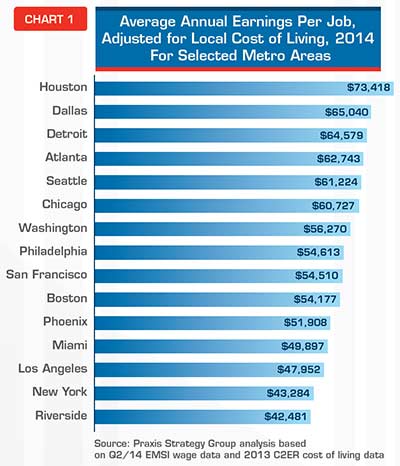
    Adjusting for the cost of living here, the average paycheck in New York is one of the lowest of any major metropolitan area. Put otherwise, working New Yorkers pay a huge premium to live in the five boroughs, one that repels middle-class individuals and families who aren’t compelled to be here.

    The exodus of the middle class has been ongoing for 30 years, with New York by one measure now having the second lowest share of middle-income neighborhoods of America’s 100 largest cities.As the middle class has waned, even exemplars of the celebrated creative class — musicians, artists, writers — find the going increasingly rough, and unrewarding. Laments rock icon Patti Smith: “New York has closed itself off to the young and the struggling. New York City has been taken away from you.”

    This is the dynamic New Yorkers elected de Blasio to fix. And he’s right the reality of rising inequality and, more important, diminishing opportunity, must be confronted.

    Critically — and here de Blasio has better instincts than his predecessor — more emphasis needs to be placed on the outer boroughs. Even if Manhattan remains the prototypical luxury city, the rest of New York can be reinvented as a generator of middle-class jobs and opportunities.

    One approach that’s paid dividends for workers in cities such as Houston, Dallas-Ft. Worth, Nashville and Pittsburgh is to concentrate on diversified economic growth.

    Certainly some middle class jobs could be created by boosting such things as the port and logistics, resuscitating industries such as food processing and specialized household goods, and rolling out policies that encourage, rather than overregulate, smaller firms in the business-service industry.

    But de Blasio’s press to bring in more tax revenue to pay for ambitious new programs, more generous social services and new contracts for city workers have the perverse effect of doubling down on Bloomberg’s bet on the wealthy.

    His ambitious ramping up of green-energy policy could be the straw that breaks the back of what remains of the logistics and manufacturing industries in New York, something that has already occurred in California.

    And his kowtowing to the teachers union and attempted assaults on charter schools threaten to further undermine the effectiveness of public education, something vital to middle and working class residents.

    In fact, the effect of de Blasio’s policies may turn out to be more neo-Victorian than progressive. Rather than new homeowners, the city may see a greater concentration of people dependent on government largesse.

    The poor-door phenomena, with a few lucky members of the lower class winning subsidized units in buildings for the rich, but with separate entrances and no access to luxury amenities, recreates not social democracy but the Victorian upstairs-downstairs society.

    The critical point is this: New York is losing its role as a place of opportunity, and the de Blasio toolbox is unlikely to put back the ladder that’s been pulled up.

    A great city does not only serve the rich, transforming others into their servants or recipients of noblesse oblige. New York need to be, as Rene Descartes described Gotham’s founding city, 17th century Amsterdam, “an inventory of the possible.”

    That must hold true for most New Yorkers, not just for the very rich.

    This piece first appeared at the New York Daily News.

    Joel Kotkin is executive editor of NewGeography.com and Roger Hobbs Distinguished Fellow in Urban Studies at Chapman University, and a member of the editorial board of the Orange County Register. His newest book, The New Class Conflict is now available at Amazon and Telos Press. He is author of The City: A Global History and The Next Hundred Million: America in 2050. His most recent study, The Rise of Postfamilialism, has been widely discussed and distributed internationally. He lives in Los Angeles, CA.

    Photo by Kevin Case from Bronx, NY, USA (Bill de Blasio) [CC-BY-2.0], via Wikimedia Commons

  • Look Out for Obama’s Legacy

    With public support for Barack Obama recently at low ebb, some might suggest that his will be a weak political legacy. But, in reality, the president’s legacy may prove profoundly important in having helped usher into power a new dominant political configuration whose influence will survive for decades to come.

    In “The New Class Conflict,” I describe this alliance as the New Clerisy, which encompasses the media, the academy and the expanding regulatory bureaucracy. This Clerisy already dominates American intellectual and cultural life and increasingly has taken virtual control of key governmental functions, as well as the educations of our young people.

    The Clerisy’s ascendency was predicted more than 40 years ago by the great sociologist Daniel Bell. The rise of knowledge-based industries, he predicted in his landmark 1973 book, “The Coming of Post-Industrial Society,” would establish the “pre-eminence of the professional and technical class.” This new “priesthood of power,” he suggested, would aim for the rational “ordering of mass society.”

    Although usually somewhat progressive by inclination, the Clerisy actually functions much like the old First Estate in France – the clergy – helping determine the theology, morals and ideals of the broader population.

    Nowhere is this function clearer than in the university itself, from which Barack Obama sprang, and which has become an essential part of his political coalition.

    Campus intolerance

    In allying with academia, the president has hitched himself to a sector that has, at least till now, enjoyed rapid growth. In 1958, universities and colleges employed under 370,000 people. By 2014 that number had expanded to roughly 1.7 million. Over that time, academe – once a true battleground of ideas – has become about as ideologically diverse as the medieval Catholic Church. President Obama, for example, reaped a remarkable 96 percent of all presidential campaign donations from Ivy League employees, a margin more reminiscent of Soviet Russia than a properly functioning pluralistic academy.

    This level of unanimity, a recent University of California study suggests, is actually becoming more marked, with barely 12 percent of all faculty self-identifying as right of center. As in medieval academies, such uniformity feeds an attitude of intolerance toward other perspectives, as revealed in the cancellations of commencement speaker invitations this spring. More troubling still is a 2012 study finding that roughly two of five professors would be less well-inclined to hire an evangelical or conservative colleague than a more conventionally liberal one.

    Saddest of all is the impact on students. Longtime civil libertarian Nat Hentoff notes a2010 survey of 24,000 college students, which found that barely a third thought it “safe to hold unpopular views on campus.” Recent years have seen the rise of such things as speech codes and the introduction of “trigger warnings” to alert students about what might be objectionable ideas or phrases, even in American classics.

    Imbalanced media

    We see a similar, if less well-enforced, spirit of uniformity running through the news media. There remain strong conservative outposts (largely the News Corp. empire), but a detailed UCLA study found that, of the 20 leading U.S. news outlets, 18 were left of center. A recent Indiana University study found that barely 7 percent of journalists in 2013 were Republican, compared with nearly a quarter in 1971.

    Even Arnold Brisbane, a former ombudsman of the country’s premier news source, the New York Times, admits that group-think now increasingly overshadows objectivity. Brisbane says so many staffers at the newspaper “share a kind of political and cultural progressivism – for lack of a better term.” He suggests “that this worldview virtually bleeds through the fabric of the Times.”

    One key part of Obama’s legacy is an ever-closer marriage between the organs of the Democratic Party and the press. At least 16 prominent journalists have joined the Obama administration, something of a record. Just this past week, the president’s former longtime press secretary, Jay Carney, announced he would become a commentator on CNN.

    “This press corps,” acidly notes the former Jimmy Carter pollster Pat Caddell, “serves at the pleasure of this White House and president.”

    Over the past few months, the president’s off-kilter performance and slipping popularity has irked even some of his loyalist media backers. But this shrinking fealty toward the Obama personage does not suggest an ideological shift from conventional progressive opinion on everything from women’s or minorities issues to the environment.

    This is perhaps most evident with climate change, a critical issue, to be sure, where reporting about the decades-long “pause” in rising temperatures, or the recentexpansion of Arctic sea ice, has been left primarily to the right-wing media, who have their own agenda. The mainstream media seem to view anyone skeptical about any aspect of the climate change agenda – in good medieval fashion – as heretics, deluded or corrupt “deniers.” The Los Angeles Times, as well as the website Reddit, have chosen to exclude contributions from climate change skeptics.

    Sometimes, you have to wonder what happened to an objective press. USA Today’s media columnist, Rem Reider openly justified limiting or eliminating coverage of “reality-challenged people” who refuse to accept what he calls “established truth.” I imagine there were cardinals and bishops saying much the same thing in 15th century Paris.

    ‘Vast left-wing conspiracy’

    Much the same brain lock can be attributed to the entertainment media. When not indulging in portraying sex and violence, our television and movie people reliably push the same basic agenda as the rest of the media. As the liberal author Jonathan Chaitsuggests, the entertainment industry has come to constitute something of “a vast left-wing conspiracy.”

    Theoretically, the third part of my New Clerisy – the government bureaucracy – could be impacted by election results. But even if Republicans or a center-right majority were to gain control of both houses of Congress, the president seems determined to grant “progressive” bureaucracies more direct power, allowing them to become something of an unelected permanent government. An electoral defeat this November, if anything, might make him even bolder to push rule by decree.

    Like the members of the old First Estate, or the Soviet nomenklatura, the upper bureaucracy has evolved into a privileged – and cossetted – caste, with huge benefits and higher pay than their similarly educated private-sector counterparts, a status secured by their vast political influence. Since 1989, public-sector unions have been among the largest contributors to campaigns, giving overwhelmingly to Democrats.

    Nowhere is this permanent government increasingly more evident than in the expansive agenda of the Environmental Protection Agency. Working intimately with allied environmental groups – but without congressional approval – EPA has been reaching to control the nation’s energy policy through administrative diktat.

    Although a low priority for voters, climate change matters much to the Clerisy, perhaps, at least unconsciously, because it creates a perfect raison d’etre for more expansive control. But the EPA is no outlier; other agencies chafe to extend their power over information, immigration, transportation, education and even such functions of government as land use, traditionally determined by local elected officials. By 2016, our daily lives may be controlled more by unelected agencies than through the legislative process.

    This is more than a reaction to Republican obstructionism, although that bears some of the blame. It also reflects a more authoritarian view among the Clerisy that democracy is too unruly, too determined by human passions and loyalties, to address the most serious issues. Former White House budget director Peter Orszag, for example, thinks we need to become “less democratic.” New York Times columnist Thomas Friedman, another key figure of the Clerisy, has praised the Chinese authoritarian system as better-suited to meet new challenges than is our clunky system.

    Against such established and accumulated power, even a strong November showing by the GOP may have surprisingly little effect. Indeed, even with a Republican in the White House, the Clerisy’s ability to shape perceptions, educate the young and control key regulatory agencies will not much diminish. The elevation of the Clerisy to unprecedented influence may prove this president’s most important “gift” to posterity.

    This piece first appeared at the Orange County Register.

    Joel Kotkin is executive editor of NewGeography.com and Roger Hobbs Distinguished Fellow in Urban Studies at Chapman University, and a member of the editorial board of the Orange County Register. His newest book, The New Class Conflict is now available at Amazon and Telos Press. He is author of The City: A Global History and The Next Hundred Million: America in 2050. His most recent study, The Rise of Postfamilialism, has been widely discussed and distributed internationally. He lives in Los Angeles, CA.

    Barack Obama photo by Bigstock.

  • The Unrest In Hong Kong And China’s Bigger Urban Crisis

    The current protests in Hong Kong for democracy reflects only part of the issues facing Chinese cities, as they grow and become ever more sophisticated. In just four decades, China has gone from 17.4 percent to 55.6 percent urban, adding nearly 600 million city residents. And this process is far from over: United Nations projections indicate that over the next 20 years, China’s urban population will increase by 250 million, even as national population growth rates slow and stall.

    Overall this transition has been spectacularly successful. As it has urbanized, China, following the lead of Hong Kong, has become a much richer country, expanding its share of global GDP from 2 percent in 1995 to 12 percent in 2012.

    China now boasts four megacities of over 10 million people, the most of any country. The population of Shanghai, a cosmopolitan world city decades before the Communist takeover of the country, has expanded almost 50% since 2000, and the ancient capital Beijing and the southern commerce and industrial hub of Guangzhou have grown nearly as rapidly. The U.N.’s growth projections suggest that the future list of megacities will include Chongqing, Tianjin and Chengdu.

    Shenzhen, one of the four current megacities, epitomizes the speed of China’s urbanization. A small fishing village along the Hong Kong border with a few factories when I first visited three decades ago, the city rose as the focus of Deng Xiaoping’s first wave of modernization policies. In 1979 it had roughly 30,000 people; now it is a thriving metropolis of 13 million whose population in the past decade grew 56%. Its rise has been so recent and quick that the Asia Society has labeled it “a city without a history.”

    Shenzhen has not only grown but thrived over the past three decades, as was evident on my most recent trip. In contrast to the often impoverished slum cities of the developing world, China’s cities have grown much as Britain’s did in the 19th century, upon the back of rapid expansion of manufacturing and trade. This sets Chinese urbanization apart from India‘s; manufacturing’s share of Indian GDP is half that of China. In the process, Chinese cities have become more tied to the global economy, exposing its people to international trends, as well as greater affluence. This is exactly what has happened earlier in Hong Kong, setting the stage for some of the recent unrest. At the same time, the leading cities of the West are, for the most part, barely growing, and much of that by dint of immigration. With plunging birthrates and generally anemic economies, the great cities of the Europe and North America are hardly likely to blaze a brash urban trail; they are more concerned with retaining what they can from their historical inertia. There is no city in the West — even Houston and Dallas-Fort Worth — that approaches the dynamism one now finds in China.

    The Coming Chinese Urban Economic Crisis

    China’s successful urban transformation now faces a challenge as the country’s export-led economy weakens. Labor costs are soaring and young adults, some four times as many of whom have attended college than those who came of age a decade ago, have little interest in factory work. At the same time, many of China’s most successful and talented people are seeking out lives abroad; two-thirds of the country’s affluent residents, according to one survey, are considering migrating overseas.

    The labor crunch is most intense in China’s coastal cities, home to most of the urban population. These face greater competition from less expensive urban areas further west, such as Chongqing and Chengdu. But even these areas are facing a labor shortage, forcing companies to fill their ranks with not necessarily voluntary student laborers. There is also growing competition as well in labor-intensive industries like textiles from cheaper cities in places like Vietnam, Indonesia and Bangladesh.

    Recent attacks by Beijing on multinationals, charging them for corruption and anti-trust violations, could make things worse. For political reasons, the government has decided to persecute the very companies that account for half of Chinese exports, charging corruption and anti-trust violation. China, where ironically the public is more favorable than most Westerners to large corporations, now faces an investment downturn as foreign companies look for safer havens such as in Mexico or to come back to the U.S.

    The logical solution to this challenge, particularly for coastal Chinese cities, is to move up the value chain, much as Hong Kong and Singapore have already done. This means a greater reliance on finance, business services and technology. Shenzhen, for example, looks to Silicon Valley as a role model. But their attempt is taking place in an urban environment very different than that nurtured in California suburban garages. Instead we see typically immense infrastructure projects like the 15 square kilometer Qianhai development near the city’s main port. Qianhai hopes to lure service and tech employment from pricier, and for now, more unstable Hong Kong.

    But in many cases, high-value industries depend on open access to information, something Beijing clearly sees as a threat to the political order; China’s great Internet Firewall is getting, if anything, higher and more difficult to breach, to the detriment of local knowledge workers. Government authorities realize that Hong Kongers’ access to western media, movies and culture makes them less pliable than those, even in neighboring Shenzhen, where access to major foreign publications, Google and many websites is highly restricted.

    Health And Demographics

    China is not only urbanizing, but doing it at extreme levels of density; barely four to six percent of all new floor space in the country goes to single-family houses. Even on the suburban periphery, there are few low-rise apartment buildings and even fewer houses; much of the construction, particularly for rural migrants, is also substandard, with buildings erected so close that sometimes residents of one can shake the hands of those next to it.

    This has created a series of health problems. Dense urbanization, notes a recent Chinese study, has led to more obesity, particularly among the young, who get less exercise, and spend more time desk-bound. Stroke and heart disease have become leading causes of death.

    Perhaps the best known result from intensified urbanization can be seen outside any window: pervasive air pollution. Beijing and Shanghai rank among the most polluted major cities in the world, just behind Delhi. This problem has become so severe that it has led, even in authoritarian China, to grass-roots protests, many of them targeted at new industrial plants and other facilities near cities such as Shanghai, Dalian, and Hangzhou.

    More serious still has been the impact on birth rates. Even though the government has been relaxing its long-held “one child” policy, the density of Chinese cities continues to help suppress birthrates. This relationship between density and low fertility can also be seen in similarly crowded Singapore, Taiwan and Hong Kong, where there is no official limit on having more than one child. In Hong Kong some 45% of middle-class couples have abandoned the idea of having children, not surprising since the cost of raising a child is now estimated at over $700,000, more than twice than in the United States.

    Given high prices relative to incomes, and dense conditions, Chinese cities appear to follow the same pattern, which over time is almost certain to slow economic growth as the population of elderly grows and the workforce shrinks. Already, notes National University of Singapore demographer Gavin Jones, the fertility rate of women in Shanghai has fallen to 0.7, among the lowest ever reported, well below the “one child” mandate and barely one-third the number required simply to replace the current population. Overall, the Chinese urban fertility rate is a weak 1.08.

    The Future

    Rather than look at the current unrest in Hong Kong as a singular example, we should understand that many problems faced in the former British colony are increasingly felt as well in mainland China. As cities reach middle class status and land prices soar, they need to move up the value scale, but this is very difficult to do under a fundamentally authoritarian system.

    While authoritarian structures can work in an industrial city, they may be less effective in a more information-based economy, in which companies need to adjust to rapidly changing attitudes and trends. The problem here is that, in an authoritarian state, controls over information are often deemed mandatory; in a sense, in an information-dependent economy, this is like trying to run a car with watered down gasoline. At the same time, the health effects of dense urbanism, and the massive pollution of the surrounding countryside, augur poorly for many of the largest Chinese cities, which will be forced to compete not only with more open economies, but with lower-cost cities across the developing world.

    Ultimately, China, whose urban growth has been a great success story, now must consider changing development patterns, perhaps looking at lower density and more dispersed development. One promising sign is that China’s smaller cities, particularly in the West, are now growing faster — with encouragement from Beijing authorities — than megacities. Recently released 2014 population estimates indicate reductions in the annual growth rates of both Shanghai and Beijing.

    Ultimately, a shift towards dispersion — both within regions and between them — could have a many positive effects. It would allow people more living space, and if employment also was also spread out, a quicker and less rigorous commute, with related benefits gained in time and energy conservation. It would greatly help families and children by reducing the need for parents to migrate for work, separating as many as one in five Chinese families.

    Clearly, new models are clearly called for, ones that look not only at bulking up cities, but humanizing them. This may be imperative if Beijing would like to avoid the prospect of a future characterized by an aging, alienated and increasingly unhealthy population.

    This piece first appeared at Forbes.

    Joel Kotkin is executive editor of NewGeography.com and Roger Hobbs Distinguished Fellow in Urban Studies at Chapman University, and a member of the editorial board of the Orange County Register. His newest book, The New Class Conflict is now available at Amazon and Telos Press. He is author of The City: A Global History and The Next Hundred Million: America in 2050. His most recent study, The Rise of Postfamilialism, has been widely discussed and distributed internationally. He lives in Los Angeles, CA.

    Photo by Pasu Au Yeung.

  • California Bad to its Bones

    Any serious student of California knows that the state’s emergence in the past century reflected a triumph of engineering. From the water systems, the dredged harbors, the power stations and the freeway system, California overcame geographical limits of water, power and its often-unmanageable coastline to create a beacon of growth and opportunity.

    That was then, but certainly not the case today. Indeed, since the halcyon postwar days of infrastructure-building under Gov. Pat Brown, roughly one-in-five dollars of state spending went to building roads, bridges, water systems and the like. Today, this investment amounts to less than 5 percent.

    As a result, California, once the exemplar of modernity, has among the worst road conditions in the nation, a tenuous, but still extraordinarily expensive, energy grid, as well as an increasingly uncompetitive port structure. Thinking itself a youthful magnet for building entrepreneurs of all kinds – creators of new communities, manufacturing and logistics industries – California is increasingly viewed by other places, both in the country and abroad, as an ideal place to hunt for skilled people, expanding industries and investment capital.

    Why has this happened? To some extent, the shift away from infrastructure has a generational twist, reflected, for example, in the differences between Pat Brown and his son, Jerry, who, upon first taking office, in 1975, as recalled by a longtime adviser, Tom Quinn, expressed distaste for his father’s “build, build, build” thing.

    This reaction was not totally illogical. Anyone who has lived here for decades naturally recoils from some of the consequences wrought by large-scale construction upon formerly bucolic areas, turning some of them into unsightly, often dysfunctional, messes.

    Under any circumstances, Pat Brown-level infrastructure building is probably beyond the financial means of the state. At the same time, California’s modest population growth – in contrast with the huge increases of the Pat Brown era – means arguably less demand for new building projects.

    Right now, the only dynamic growth sector of the state economy – social media and software – relies far less on traditional infrastructure than do older industries. Unwilling to pay California’s high costs for energy, water and other things, these tech firms tend to place their industrial projects, as well as their computer servers, in lower-cost regions, often states that tend to be more pro-active in their infrastructure investments.

    Yet just because California can’t finance a second huge building program, there’s little question that new and effective investment in roads, pipelines, bridges and ports is desperately needed. Much of this work may be in retrofitting older infrastructure. The recent flooding on and around the UCLA campus from a broken Los Angeles city water main and frequent smaller water main breaks in Southern California are just one indicator that we no longer keep up even with very basic public needs. As the California League of Cities recently observed, the state’s “infrastructure is rapidly deteriorating. Quite simply, California is crumbling.”

    The League of Cities suggested the state needs to spend some $500 billion over 20 years to maintain its economic competitiveness. But right now there’s little reason to think the current administration and bureaucracy is capable of spending money wisely. The recently completed $6.5 billion eastern span of the San Francisco Bay Bridge, built largely of steel imported from China, is widely suspected of being poorly constructed, and, according to one engineering expert, may need repairs well before its time. There appears to have been systematic “disregard for welding procedure,” with cracks already appearing on the bridge.

    The fact that the state allowed such shoddy work, at taxpayer expense, should be a warning that other state projects might be facing similar issues. Indeed, one can already see, as professor and author Walter Russell Mead has suggested, a similar pattern of disappointment even in the initial phases of Gov. Jerry Brown’s high-speed rail project, with rising cost estimates as well as diminished projections of the train’s speed.

    Ultimately, this boils down to a question of priorities. A state that can’t correctly maintain its existing pipelines and bridges is probably not a good candidate for bold new infrastructure adventures. This is not merely a conservative view, but one held by many liberals. Lt. Gov. Gavin Newsom has suggested that the money poured into high-speed rail may be better spent on “other, more-pressing infrastructure needs.”

    Similar criticism has come from progressive journalist Kevin Drum of Mother Jones magazine,who called projections for the bullet train’s ridership and cost – now pegged at close to $100 billion, almost twice the original projection – “jaw-droppingly shameless,” an appropriate characterization based upon the method and documentation. He suggests that a “high school sophomore who turned in work like this would get an F.” Spending for Gov. Brown’s signature project grows exponentially, even as basic needs are ignored.

    This spending on the nice, as opposed to the necessary, extends down to the local level, where infrastructure already often comes in second to ever-expanding public worker pensions. Los Angeles Mayor Garcetti is totally committed to spending more on expensive mass transit and housing densification, which itself strains infrastructure built for much lower density.

    And, this priority persists even though we have particularly tepid population growth in Los Angeles and have seen very little increase the past 30 years in the percentage of people taking public transit to work. The insistence on building expensive light rail, instead of far-less-expensive bus-based systems, effectively chokes off funds for improving the day-to-day lives of most Angelenos.

    Although there’s little hope we can go back to the era of massive building during the Pat Brown years, we could certainly get a lot smarter about how we can rebuild the state and return to sustained, widespread growth. The water crisis, which has plagued the state repeatedly over generations, would have been less severe had we built more storage facilities during the wet years, notes economist Bill Watkins, and improved our ability to move water across the state. Yet, as Sacramento Bee columnist Dan Waltershas pointed out, the environmentalists who suggest California may experience long-term drought conditions due to climate change have also opposed such practical steps to cope with the problem.

    Much of this reflects the economic unreality of California politics. We neglect roads, bridges, ports and economic energy projects because, in many ways, these are not a priority of the green lobby, which prefers less growth, more density and a shift from cars to transit. So, instead, we get money spent on high-speed rail and ultracostly, environmentally damaging solar panel farms or inefficient wind turbines erected in the middle of the desert.

    These energy costs hit hardest the state’s interior and heavily Hispanic working class but this doesn’t seem to much bother the state political leaders, who come overwhelmingly from the affluent parts of the Bay Area and coastal Southern California.

    So in the name of trying to appear “visionary,” as Brown, Garcetti and their minions portray themselves, in the real world, our state falls ever further behind competitors, many of whom are rapidly improving their infrastructure – everything from roads and ports to parks.

    We collectively may no longer be the vibrant young adult of the Pat Brown years a half-century ago, but there’s no reason for us to enter advancing middle age with politically induced decrepitude. It’s a disservice to the people who endure high taxes and relentless regulation with little benefit to their day-to-day lives.

    This piece first appeared at the Orange County Register.

    Joel Kotkin is executive editor of NewGeography.com and Roger Hobbs Distinguished Fellow in Urban Studies at Chapman University, and a member of the editorial board of the Orange County Register. His newest book, The New Class Conflict is now available at Amazon and Telos Press. He is author of The City: A Global History and The Next Hundred Million: America in 2050. His most recent study, The Rise of Postfamilialism, has been widely discussed and distributed internationally. He lives in Los Angeles, CA.

    Photo by Thomas Pintaric (Own work) [GFDL or CC-BY-SA-3.0], via Wikimedia Commons

  • Opportunity Urbanism: Creating Cities for Upward Mobility

    This is the introduction to a new report commissioned by the Greater Houston Parnership and HRG and authored by Joel Kotkin with help from Tory Gattis, Wendell Cox, and Mark Schill. Download the full report (pdf) here.

    Over the past decade, we have witnessed the emergence of a new urban paradigm that both maximizes growth and provides greater upward mobility. We call this opportunity urbanism, an approach that focuses largely on providing the best policy environment for both businesses and individuals to pursue their aspirations.

    Although contrary to much of the conventional wisdom about cities and regions, this is not a break with traditional urbanism, but instead a reinforcement of old traditions. Long ago, Aristotle reminded us that the city was a place where people came to live, and they remained there in order to live better. “A city comes into being for the sake of life, but exists for the sake of living well.”  In the end, opportunity urbanism rests on the notion that cities serve, first and foremost, as engines to create better lives for its residents.

    The Houston and Luxury Models

    We have focused on the Houston metropolitan area because in many ways it reflects the idea of opportunity urbanism more closely than any major metropolitan area. Across a broad spectrum—income growth, new jobs, housing starts, population growth and migration—no other major metropolitan region in the country has performed as well over the past decade. This was among the first major metropolitan regions to replace the jobs lost in the recession, and has experienced by far the largest percentage job growth since, with Dallas-Ft. Worth second.

    In many ways, opportunity urbanism contrasts with the prevailing urban planning paradigm—variously called new urbanism or smart growth—which seeks to replicate the dense, highly concentrated mono-centric city of the past. At the core of this approach is the notion that policies of forced density, through regulatory mandates and often subsidies, are critical to attracting both young, educated people and the global business elite.4 This approach describes the successful city, in the words of former New York Mayor Michael Bloomberg, as “a luxury product.”

    This notion of the “luxury city” can be seen to have worked, at least for some, in well-appointed older cities such as New York, San Francisco and Boston. Unlike most American cities, these boast long-established dense cores and transit-oriented commuter sheds. They possess great amenities tied to their past, from world class art museums and universities, to charming historic districts, parks and public structures.

    But this model of urbanism does not fit the profile of most American metropolitan regions, which tend to be far more recent in their development, more dispersed and overwhelmingly auto-dominated in terms of commuting. Indeed, most of the fastest growing regions in this country—Houston, Dallas-Ft. Worth, Oklahoma City or Atlanta—function in a highly multi-polar model, that contrasts sharply with that of cities like New York, Boston or Chicago.

    Prospects for Upward Mobility

    The luxury paradigm has worked for some in some cities, but has failed, to a large extent, in providing ample opportunities for the middle and working classes, much less the poor. Indeed, many of the cities most closely identified with luxury urbanism tend to suffer the most extreme disparities of both class and race.

    If Manhattan were a country, it would rank sixth highest in income inequality in the world out of more than 130 countries for which the World Bank reports data. New York’s wealthiest one percent earn a third of the entire municipality’s personal income-almost twice the proportion for the rest of the country.

    Indeed, increasingly, New York, as well as San Francisco, London, Paris and other cities where cost of living has skyrocketed—are no longer places of opportunity for those who lack financial resources. Instead they thrive largely by attracting people who are already successful or living on inherited largesse.

    They are becoming, as journalist Simon Kuper puts it, “the vast gated communities where the one percent reproduces itself.”  

    Not surprisingly, the middle class is shrinking rapidly in most luxury cities. A recent analysis of 2010 Census data by the Brookings Institution found that the percentage of middle incomes in metropolitan regions such as New York, Los Angeles and Chicago has been in a precipitous decline for the last thirty years, due in part to high housing and business costs. A more recent 2014 Brookings study found that these generally high-cost luxury cities—with the exception of Atlanta—tend to suffer the most pronounced inequality: San Francisco, Miami, Boston, Washington DC, New York, Chicago and Los Angeles. Income inequality has risen most rapidly in the very mecca of luxury progressivism, San Francisco, where the wages of the poorest 20 percent of all households have actually declined amid the dot com billions.

    Like other large cities, Houston also suffers a high level of inequality, but its lower costs have helped its middle and working class populations to enjoy a higher standard of living than their luxury city counterparts. The promise of the opportunity urbanism model also can be demonstrated by lower income disparities between racial groups, higher GDP growth, less expansion of poverty and the greater production of high-paying mid-skilled jobs. In these aspects, opportunity cities like Houston greatly out-performed their often more celebrated rivals.

    How to Measure “Living Well”

    We leave this introduction with one statistic that most encompasses the success of the Houston opportunity model and exposes the weakness of smart growth: the cost-of-living adjusted average paycheck.

    Despite the assertions of Paul Krugman, among others, that the Texas urban economy is based on low wages, the fact is Harris County’s average household income is above the national average; close to that of Boston. But once the cost of living is factored in, Houston does far better for its citizens compared to any of the legacy cities. Houston, with Dallas-Ft. Worth a strong second, is able to provide its citizens the highest standard of living, as measured by average annual adjusted wages, of any major metro in America. This is different than subjective “quality of life,” but includes such basics as jobs, housing and overall cost of living.

    Download the full report (pdf) here.

    Joel Kotkin is executive editor of NewGeography.com and Roger Hobbs Distinguished Fellow in Urban Studies at Chapman University, and a member of the editorial board of the Orange County Register. His newest book, The New Class Conflict is now available at Amazon and Telos Press. He is author of The City: A Global History and The Next Hundred Million: America in 2050. His most recent study, The Rise of Postfamilialism, has been widely discussed and distributed internationally. He lives in Los Angeles, CA.

  • America’s Newest Hipster Hot Spot: the Suburbs?

    It’s an idea echoed everywhere from “Friends” to “Girls”Young people want to live in cities. And, we’re told, a lot of them (at least the cool ones) do.

    It’s a common assumption. But it’s also wrong.

    Between 2010 and 2013, the number of 20- to 29-year-olds in America grew by 4 percent. But the number living in the nation’s core cities grew 3.2 percent. In other words, the share of 20-somethings living in urban areas actually declined slightly.

    This trend has occurred in supposedly hot cities like San Fransisco, Boston, New York and D.C., notes demographer Wendell Cox. Chicago and Portland, Ore., both widely hailed as youth boom-towns, saw their numbers of 20-somethings decline, too.

    To some extent, this is an economic problem. Millennials can’t always afford the most popular cities, which have gotten increasingly expensive and unequal.  It doesn’t help that most young people, even with college degrees, are experiencing steadily dropping annual earnings. And their careers are progressing more slowly too.

    But it’s not just that. According to the most recent generational survey research done by Magid and Associates, 43 percent of millennials describe the suburbs as their “ideal place to live,” compared to 31 percent of older generations.

    Only 17 percent of Millennials identify the urban core as where they want to settle permanently. Another survey, by the Demand Institute (funded by the Conference Board and Neilsen), found that 48 percent of 20-somethings hoped to move to the suburbs one day. And contrary to popular myth, they hoped to own a single-family home. Sixty-one percent seek more space.

    These findings may actually understate the suburban preference. As people age, particularly entering the child-bearing period between 30 and 50, they long have displayed a distinct tendency to move to suburban areas.

    And why not?

    A lot of the amenities that once drew people to gritty cities are popping up in the suburbs instead.

    The New York Times documents a trend of people moving from Manhattan and Brooklyn to the verdant suburbs of the Hudson Valley. Increasingly, those towns boast art house films, vegan restaurants and other hip accoutrements.

    Incipient hipster suburbs can also be found in places like Montclair, N.J., Claremont, Calif., and even Irvine, whose Millennial population last decade grew more than four times as much as that of downtown Los Angeles. Once a foodie desert, Irvine and its surrounds now boast dim-sum houses, Vietnamese, Korean, sushi and California cuisine restaurants.

    That’s thanks to another trend: Immigrants are bypassing cities and moving to the suburbs in drovesaccording to Brookings. And they’re bringing good, cheap ethnic food along with them.

    Nowhere are these changes more marked than among Asians, now the nation’s largest source of new immigrants. For example, in the New York metropolitan area, the Asian population grew both in numbers and in percentage far more rapidly in the suburbs than in the core city in the past decade. Nationwide, the Asian population in suburbs jumped by almost 2.8 million, or 53 percent, while that in core cities grew 28 percent.

    great American ethnic culinary tour today would take you not to Manhattan, San Francisco, Hollywood or Chicago, but to places like the San Gabriel Valley, roughly 10 miles east of downtown Los Angeles. This highly suburban region of strip malls and giant food palaces arguably boasts the largest, and most diverse, collection of Asian restaurants in the nation.

    A CNN survey of America’s top 50 Asian restaurants located seven in the area, the most of any region. That includes foodie havens like New York City. Three others were  in the heavily Asian suburbs of Silicon Valley.

    As Tyler Cowen noted, the best places to find distinctive ethnic cuisine in Greater Washington is not in the urban core but in far-flung suburban strip malls, where rents are cheap, parking is adequate and there’s a built-in community of eaters craving home.

    Much the same can be said for Asian markets, temples or schools. Sugarland, some 22 miles further west of downtown Houston, is home to one of the nation’s largest Hindu temples. The largest Hindu temple in the world is now under construction in Robbinsville, N.J. — an exurb of New York some 60 miles south of Manhattan.

    Indeed, in large parts of America, many successful malls are those that are getting “ethnicized.” A prime example is La Gran Plaza on the outskirts of Fort Worth, Tex., where a once-failing mall is now booming, converted to look like an old village in Northern Mexico, with loads of restaurants, markets, wedding and quincenara shops and a huge swap-meet.

    This is in addition to live music and, on some Sundays, Catholic Mass.

    As their demographics change, so too do the functions of suburbs. No longer mere bedroom communities, they are becoming economic centers of their own. Despite the constant hype about the new appeal of downtown locations, jobs continue to follow the migration of middle-class families. Having been widely written off for dead, suburban office space also  began to recover last year at a much quicker rate than in  city centers, according to the office consultancy Costar. Overall, suburbs already account for close to three quarters of the nation’s office inventory.

    Suburbia is not the city’s antithesis, but its natural extension, particularly as young people morph towards adulthood.  Rather than vilify suburbs as fundamentally inefficient, deadening and wasteful, its time to focus on how to improve the preferred environment for work, interaction and raising the next generation for most Americans. Cities have changed too, of course, in many cases for the better. But the suburbs are evolving as well. And all indications suggest that they are likely to retain their preeminence as Americans’ preferred places to settle down.

    This piece first appeared at The Washington Post.

    Joel Kotkin is executive editor of NewGeography.com and Roger Hobbs Distinguished Fellow in Urban Studies at Chapman University, and a member of the editorial board of the Orange County Register. His newest book, The New Class Conflict is now available at Amazon and Telos Press. He is author of The City: A Global History and The Next Hundred Million: America in 2050. His most recent study, The Rise of Postfamilialism, has been widely discussed and distributed internationally. He lives in Los Angeles, CA.

  • The Cities That Are Benefiting The Most From The Economic Recovery

    It is painfully clear that the current U.S. economic recovery has been a meager one, with the benefits highly concentrated among the wealthiest. The notion that “a rising tide” lifts all boats has been sunk, along with the good ship middle class.

    Geographically as well, the recovery has been concentrated in a relative handful of regions. Nationwide, real per capita GDP rose a meager 3.8% from 2010 through 2013, according to new Bureau of Economic Analysis numbers. An analysis of the data by urban expert Aaron Renn shows that a handful of metropolitan areas have enjoyed much faster growth. For the most part, these are areas that have cashed in on the current technology or energy booms, and in some cases, both. Also, surprisingly, there have been some very good gains in some of the nation’s long-distressed industrial heartland metro areas, as the combination of energy development and a resurgent automobile industry have boosted regional GDP.

    Tech Capitals

    Of the nation’s 52 largest metropolitan statistical areas, many of the top performers have strong tech economies, led by the No. 2 metro area on our list, San Jose-Sunnyvale-Santa Clara, aka Silicon Valley, where real per capita GDP expanded 11.5% from 2010-13. Perhaps more surprising is the strong, tech-fuelled performance of No. 3 Portland-Vancouver-Hillsboro, Ore., where real per capita GDP grew 9.2%. The prime contributor has been the robust performance of late of Intel, the state’s largest private employer, which employs about 17,000 in Portland’s western suburbs around the town of Hillsboro, the company’s largest concentration of workers anywhere.

    Other less heralded tech centers have also performed well, including No. 4 Columbus, Ohio (8.2% growth), and No. 8 Salt Lake City (7.3%), both of which are also benefiting from the surge in oil and gas production. Among smaller cities with strong tech communities, Fargo, N.D., and Provo-Orem, Utah, have enjoyed better than 10% real per capita GDP growth since 2010.

    Energy Regions

    Per capita growth in the energy states has been even more impressive. Placing first on our big cities list is Houston-the Woodlands-Sugarland, Texas, where per capita GDP rose 13.2% from 2010-13, a major achievement in a region whose population continues to grow rapidly. Zooming out to all 381 U.S. MSAs, no places come close to the two Texas oil towns that rank first and second overall, Midland (sizzling 38.8% growth since 2010) and Odessa (34.1%). Both lie in the Permian basin, an oil-rich geological formation that was first tapped in the 1920s and has seen a marked revival in production recently due to advances in extraction techniques like horizontal drilling and fracking. Also notable, the southern Texas town of Victoria clocked over 21% growth.

    Among the largest metro areas, energy hubs also did well, including Oklahoma City (7th, 7.5%) and Dallas-Ft. Worth-Arlington (13th,  6.5%) and the San Antonio area (16th), which is benefiting from a gusher in the Eagle Ford Shale play. Economist estimate its development has pumped $87 billion into the south Texas economy.

    Rust Belt Revives

    The booms in tech and energy are well-known. But the most surprising wrinkle in our survey of per capita GDP growth is the revival of auto manufacturing, which benefits both from technological improvements and lower energy costs. Among the larger metro areas, the key winners have been Grand Rapids-Wyoming (fifth, 7.8%) and Detroit (tied for ninth, 7.2%), as well as the surprising 15th place ranking for Cleveland-Elyria.

    These gains are heartening, but the real question may be how long this will continue. In part, the strong 2010-13 numbers reflect a recovery from very poor economic performance that has stretched on for decades, and population losses, which tend to skew per capita GDP numbers upwards. But signs of health in the nation’s long disdained midsection deserve applause.

    Surprising Laggards

    The recovery has not lifted most regions, just as it has not helped most Americans. Per capita income growth has been slow in most of the nation’s largest cities outside Texas. Given the enormous financial bailout from the federal government, as well as the massive spike in stock and real estate prices, one would have expected far better performance from New York, which ranks a middling 33rd out of the 52 largest MSAs, with below average 2.3% growth since 2010.

    Chicago-Naperville-Elgin ranked 26th; Los Angeles-Long Beach-Anaheim, 38th, and  Philadelphia, 40th. Perhaps the biggest disappointment is 51st place Washington D.C.-Arlington-Alexandria, which had been a high-flier through the Recession amid strong federal spending. Per capita GDP since 2010 has fallen 3.4%. This disturbs some pundits, such as Richard Florida, but no doubt Washington’s fall from grace would be widely welcomed by most Americans.

    And What About Poverty

    Increasingly, many question not only the relative lack of growth, but that the growth we are experiencing is doing very little for the vast majority of Americans. Former Clinton adviser Bill Galston has noted that this recovery has “left almost everybody” out.

    No group has been harder hit than the poor. The nation’s population below the poverty line has expanded a full percent since 2010. An analysis by demographer Wendell Cox shows that poverty declined in just seven of the nation’s 52 largest metropolitan areas from 2010-13: Louisville, Ky.; Oklahoma City; Nashville, Tenn.; Columbus Ohio; Grand Rapids; and Texas’ Austin and San Antonio.

    Most of the areas with the strongest growth in per capita GDP posted smaller than average increases in poverty. In Houston the share of the population living in poverty rose 0.6% from 2010-13 to 16.4%, 11th highest among the nation’s biggest metro areas.

    The results in California suggest strongly that the tech boom has not done much to relieve poverty in the Golden State, despite the much ballyhooed “California comeback” trumpeted by the likes of Paul Krugman. In reality it’s poverty, not prosperity, that’s on the march in most California cities outside the Bay Area. Since 2010, the percentage of the population of San Diego living in poverty has grown 1.3% to 15.2%, while that of Riverside-San Bernardino rose 1.7% to 18.2%, the third highest rate among the 52 largest metro areas in the country. Meanwhile the poverty rate in Los Angeles, the state’s dominant urban region, has risen 1.8% to 17.6% (fifth worst), and Sacramento, the state capital, has seen a 2.0% increase in poverty to 16.6% (10th).

    This suggests that, for the most part, what has passed for growth has been too meager to reduce poverty. In many places, even ones growing rapidly, such as the Silicon Valley hub of San Jose, the number of poor continue to increase. Since 1999, poverty in the valley has jumped  from 7.6% to 10.5%. This also likely is a low figure, given the extraordinarily high cost of living in the Bay Area, as well as the rest of coastal California. According to the Census Bureau, California’s poverty rate is the highest in the nation when adjusted for the state’s exorbitant cost of housing.

    For the most part, poverty has been reduced, or at least has grown less, in lower-cost regions that have ties to the energy and manufacturing revival, which tend to create opportunities for middle- and working-class residents. Until we figure out how to get growth whose benefits are widely shared, and reduce poverty, the one measurement likely to go up is cynicism about the efficacy of our current economic policies.

    Real Metropolitan Area GDP Per Capita (2010-2013)
    Rank Metropolitan Area 2010 2013 2010-2013 Change
    1 Houston-The Woodlands-Sugar Land, TX  $  63,816  $    72,258 13.2%
    2 San Jose-Sunnyvale-Santa Clara, CA  $  89,806  $  100,115 11.5%
    3 Portland-Vancouver-Hillsboro, OR-WA  $  63,025  $    68,810 9.2%
    4 Columbus, OH  $  50,370  $    54,493 8.2%
    5 Grand Rapids-Wyoming, MI  $  41,248  $    44,482 7.8%
    6 Charlotte-Concord-Gastonia, NC-SC  $  51,819  $    55,802 7.7%
    7 Oklahoma City, OK  $  45,993  $    49,441 7.5%
    8 Salt Lake City, UT  $  57,790  $    62,008 7.3%
    9 Nashville-Davidson–Murfreesboro–Franklin, TN  $  50,464  $    54,112 7.2%
    10 Detroit-Warren-Dearborn, MI  $  46,314  $    49,653 7.2%
    11 Pittsburgh, PA  $  48,710  $    52,053 6.9%
    12 Cincinnati, OH-KY-IN  $  48,841  $    52,063 6.6%
    13 Dallas-Fort Worth-Arlington, TX  $  57,032  $    60,730 6.5%
    14 Birmingham-Hoover, AL  $  46,108  $    49,034 6.3%
    15 Cleveland-Elyria, OH  $  52,169  $    55,430 6.3%
    16 San Antonio-New Braunfels, TX  $  37,202  $    39,280 5.6%
    17 San Francisco-Oakland-Hayward, CA  $  75,103  $    78,844 5.0%
    18 Seattle-Tacoma-Bellevue, WA  $  71,404  $    74,701 4.6%
    19 Minneapolis-St. Paul-Bloomington, MN-WI  $  59,168  $    61,711 4.3%
    20 Sacramento–Roseville–Arden-Arcade, CA  $  43,905  $    45,764 4.2%
    21 Austin-Round Rock, TX  $  50,094  $    52,110 4.0%
    22 Denver-Aurora-Lakewood, CO  $  59,284  $    61,595 3.9%
    23 Phoenix-Mesa-Scottsdale, AZ  $  43,156  $    44,803 3.8%
    24 Boston-Cambridge-Newton, MA-NH  $  71,936  $    74,643 3.8%
    25 San Diego-Carlsbad, CA  $  55,921  $    57,955 3.6%
    26 Chicago-Naperville-Elgin, IL-IN-WI  $  55,727  $    57,752 3.6%
    27 Providence-Warwick, RI-MA  $  41,698  $    42,994 3.1%
    28 Louisville/Jefferson County, KY-IN  $  46,710  $    48,048 2.9%
    29 Tampa-St. Petersburg-Clearwater, FL  $  39,066  $    40,153 2.8%
    30 Buffalo-Cheektowaga-Niagara Falls, NY  $  41,497  $    42,550 2.5%
    31 Baltimore-Columbia-Towson, MD  $  55,907  $    57,294 2.5%
    32 Indianapolis-Carmel-Anderson, IN  $  58,590  $    60,038 2.5%
    33 New York-Newark-Jersey City, NY-NJ-PA  $  67,499  $    69,074 2.3%
    34 Riverside-San Bernardino-Ontario, CA  $  26,509  $    27,094 2.2%
    35 St. Louis, MO-IL  $  47,876  $    48,738 1.8%
    36 Milwaukee-Waukesha-West Allis, WI  $  55,767  $    56,734 1.7%
    37 Miami-Fort Lauderdale-West Palm Beach, FL  $  44,386  $    45,145 1.7%
    38 Los Angeles-Long Beach-Anaheim, CA  $  58,211  $    59,092 1.5%
    39 Kansas City, MO-KS  $  52,916  $    53,677 1.4%
    40 Philadelphia-Camden-Wilmington, PA-NJ-DE-MD  $  58,696  $    59,339 1.1%
    41 Memphis, TN-MS-AR  $  46,534  $    47,014 1.0%
    42 Richmond, VA  $  50,977  $    51,498 1.0%
    43 Rochester, NY  $  44,825  $    45,202 0.8%
    44 Atlanta-Sandy Springs-Roswell, GA  $  51,830  $    52,178 0.7%
    45 Virginia Beach-Norfolk-Newport News, VA-NC  $  48,395  $    48,708 0.6%
    46 Raleigh, NC  $  51,820  $    51,673 -0.3%
    47 Las Vegas-Henderson-Paradise, NV  $  43,351  $    43,079 -0.6%
    48 Jacksonville, FL  $  42,068  $    41,752 -0.8%
    49 Hartford-West Hartford-East Hartford, CT  $  68,005  $    66,870 -1.7%
    50 Orlando-Kissimmee-Sanford, FL  $  47,023  $    45,855 -2.5%
    51 Washington-Arlington-Alexandria, DC-VA-MD-WV  $  76,035  $    73,461 -3.4%
    52 New Orleans-Metairie, LA  $  61,325  $    56,943 -7.1%
    Analysis by Aaron M. Renn


    This piece first appeared at Forbes.

    Joel Kotkin is executive editor of NewGeography.com and Roger Hobbs Distinguished Fellow in Urban Studies at Chapman University, and a member of the editorial board of the Orange County Register. His newest book, The New Class Conflict is now available at Amazon and Telos Press. He is author of The City: A Global History and The Next Hundred Million: America in 2050. His most recent study, The Rise of Postfamilialism, has been widely discussed and distributed internationally. He lives in Los Angeles, CA.

    Photo by w:Flickr user Bill Jacobus [CC-BY-2.0], via Wikimedia Commons