Author: Joel Kotkin

  • America’s Engineering Hubs: The Cities With The Greatest Capacity For Innovation

    America has always been a nation of tinkerers. Our Founding Fathers, notes author Alec Foege, were innovators in areas ranging from agriculture (George Washington, Thomas Jefferson) and electricity (Benjamin Franklin) to the swivel chair (Jefferson).

    Engineering advances drove America’s quest for industrial supremacy in the 19th century, many of them borrowed (sometimes illegally) from the then very resourceful British Isles. By the early 19th century, the U.S. was producing its own major inventions, including the steamboat and cotton gin. By the end of that century, the U.S. was clearly on the way to industrial preeminence. The growth of engineering schools — MIT, the Case Institute, Stevens Institute of Technology, as well as departments at the great land grant universities — generated a steady supply of engineers. For much of the last 70 years, America, has been the world’s leading center of engineering excellence, dominating markets from steel and cars to energy and aerospace.

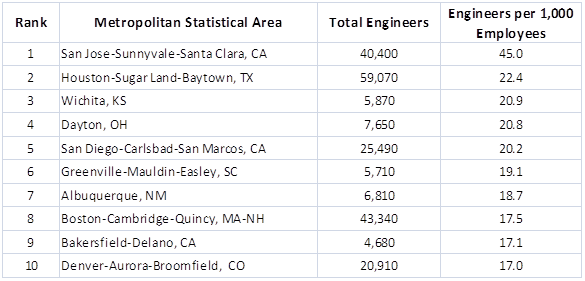
    Today, as well, where engineers concentrate, we can expect the greatest capacity for innovation. According to research from Houston Partnership economist Patrick Jankowski, there is a wide range of concentrations of engineering talent among the country’s 85 largest metropolitan areas. For the most part, regions with higher concentrations of engineers tend to do better, and seize the leadership of key industries.

    Nowhere is this more true than in America’s top engineering hub, San Jose/Silicon Valley. The Valley’s ratio of 45 engineers per 1,000 employees is twice as high as any other big metro area. This deep reservoir of talent remains the Valley’s key asset, and has made it by most measurements the nation’s most affluent metro area.

    This preeminence dates to the Valley’s early history, particularly in research sponsored by the Defense Department and NASA. This large high-tech workforce was then backed by venture capitalists, many of them also engineers by training, to form by far the most dominant high-tech region in the world. The presence of Stanford, now rated the nation’s second leading engineering school by U.S. News & World Report after MIT, Berkeley, ranked third and Santa Clara, at No. 14, gives the area an unmatched capacity to produce technologists.

    More surprising, perhaps, is the second city on our list: Houston. The world energy capital is home to 59,000 engineers — second most in the U.S. after the much larger Los Angeles metro area — and has a concentration of 22.4 engineers per 1,000 employees. Although it does not match the Bay Area in elite engineering schools, Houston is home to Rice University and the University of Houston, both highly regarded, and, perhaps equally important, a strong sub-structure of trade and technical schools that feed into the engineering pool.

    Key here is the energy industry, which is far more technology-dependent than many might believe. Houston is arguably now the country’s most important emerging city, with the largest job growth of any major metro area. Not only can engineers make money there, unlike in Silicon Valley, they can also afford to buy a house.

    More surprising still is the metro area with the third-highest concentration of engineers: Wichita, Kan., with 21 engineers per thousand employees. In this case, the driver is manufacturing, particularly aerospace. But recent cuts by Boeing threaten the future of the self-proclaimed “air capital of the world.” As a result, Wichita has not done nearly as well economically of late as San Jose or Houston, but its reservoir of engineering talent suggests considerable potential if they stick around.

    These top three engineering cities tell us much about the source of American innovation, and the remarkable diversity that makes this country an engineering powerhouse. It involves three essential industries — information technology, energy and manufacturing. Each has a distinct geographic makeup that reflects differing kinds of engineering talent.

    The High-Tech Centers

    No place comes close to Silicon Valley in terms of concentrations of engineers, but several other traditional tech centers make the top 10, led by San Diego in fifth place, a major center for biotech. Boston, home to No. 1 engineering school MIT, ranks eighth, and Denver, which boasts both a thriving tech and energy sector, is 10th. Other tech regions that rank in the top 20 include Seattle (13th), San Francisco (18th) and Austin (19th). None of these areas can claim even half of Silicon Valley’s per capita engineering base, but have thrived during the current high-tech boom.

    The Energy Cities

    When thinking of energy, we might think of wildcats covered with crude (like James Dean in Giant), but this is becoming an industry very dependent on highly trained geophysicists, petroleum engineers, chemical engineers and other specialists. This explains the ninth-place ranking for Bakersfield, “the oil capital of California,” a city better known for country music and cruising than technology. Over 15,000 people work in this generally high-wage industry in the onetime Okie capital. Energy jobs are also big in No. 14 Baton Rouge, La., home to Louisiana State University, which sends many of its engineering graduates into the Gulf of Mexico energy industry.

    Manufacturing Hubs.

    Detroit’s bankruptcy has shed a bad light on rustbelt centers, but in reality the industrial Midwest has been on something of a roll in recent years, with many states, from Wisconsin and Ohio to Iowa, boasting lower unemployment than the national average. One key element has been the increasingly innovative nature of U.S. manufacturing, notably in the auto industry. Little-recognized Dayton, which ranks fourth, has attracted major investment for advanced manufacturing in autos and aerospace.

    Other manufacturing cities high on our list include No. 6 Greenville-Easley, S.C., home to many European auto-related firms. And despite the city bankruptcy we should not ignore No. 12 Detroit, where most of the metro area’s 30,000 engineers live in the economically healthy suburban regions.

    These numbers, of course, focus on concentration as opposed to absolute numbers of engineers. In terms of raw numbers, by far the largest player is Los Angeles, with some 70,000 engineers. Yet it ranks only 33rd by concentration, a far cry from the region’s aerospace-oriented heyday. But L.A.’s legacy still makes an ideal setting for some tech ventures, notably Elon Musk’s SpaceX.

    In terms of total engineers, L.A. is followed by Houston, with 59,000, Washington-Arlington-Alexandria with 49,000 (11th in terms of concentration), Boston with 43,000 and then San Jose and Dallas (29th), each with 40,000 or so engineers. Each has a critical mass that allows them to tackle big engineering projects, while also staffing potential spin-offs and start-ups. Some of these areas, notably the Valley, know how to make more money with their workforce than others.

    The Have-not Regions

    One surprisingly weak area is greater New York, which ranks 78th, with a miniscule 6.1 engineers per 1,000 workers, and some 20,000 fewer engineers than Los Angeles. The New York media and the city’s chattering classes may like to talk up the Big Apple as a high-tech center, but the relative lack of engineering talent should spark a tad of skepticism over whether the nation’s largest urban area is really up to the task of competing against engineer-rich places like Boston, San Diego, Seattle, Denver or Austin, much less stand up to Silicon Valley, with seven times the concentration of engineers.

    The rest of the bottom of the list is depressingly familiar, in terms of economic also-rans. El Paso, Texas, ranks last among the 85 largest metropolitan areas, followed by Las Vegas, Scranton-Wilkes Barre, Pa., and Fresno. These cities are going to have a very tough time competing for high-tech jobs in the immediate future. To make something, whether digital or tangible, the first step lies in gathering in the talent that can make things happen, but as of yet, they have not made much headway.
    Joel Kotkin is executive editor of NewGeography.com and Distinguished Presidential Fellow in Urban Futures at Chapman University, and a member of the editorial board of the Orange County Register. He is author of The City: A Global History and The Next Hundred Million: America in 2050. His most recent study, The Rise of Postfamilialism, has been widely discussed and distributed internationally. He lives in Los Angeles, CA.

    This piece originally appeared at Forbes.

    Creative Commons photo “Engineers” by Flickr user ensign_beedrill

  • Should Uncle Sam Chase a Scandinavian Model?

    When American progressives dream their future vision of America, no place entices them more than the sparsely populated countries of Scandinavia. After all, here are countries that remain strongly democratic and successfully capitalist, yet appear to have done so despite enormously pervasive welfare systems.

    Paul Krugman, the current high priest of progressive economics, approves of Sweden’s high level of spending on benefits as an unadulterated economic plus. He says that Sweden, unlike other European states like France, thrives despite its high tax rate and notes that, while half of all children are born out of wedlock, those children have far less poverty than American children. Progressive pundit Richard Florida, for his part, claims that Sweden is the most creative place on Earth, just ahead of the U.S.

    Some even suggest America should adopt wholesale the Scandinavian system as a policy imperative. The Washington Post praises Sweden as the “rock star” of the financial crisis and lists five ways the U.S. could learn from Sweden. ThinkProgress lauds Sweden’s ability to achieve the world’s highest rate of “social progress” despite a lower per capita income than the U.S. Writer David Dietz, contributor to PolicyMic, sees countries such as Sweden, Norway and Denmark as models that can guarantee both future economic growth and a way for America “to regain its global edge and cement its economic dominance.”

    But before we all go out drinking aquavit, shouting “skol” and dyeing our hair blonde, it makes sense to recognize that not only is relatively small, historically homogenous Scandinavia an ill-suited role mode for a megapower like the U.S., but that, in many ways, the Nordic system may be far more limited than its admirers here might acknowledge.

    Of course, it’s not that there’s not something to learn from these or other countries. Certainly Europe’s chilly corner seems in much better shape than the rest of the continental mess. Given today’s circumstances, recent books extolling the EU as a model such as Stephen Hill’s “Europe’s Promise” or Jeremy Rifkin’s “The European Dream” seem just slightly absurd.

    In truth, Scandinavian countries have performed better than the dismal continental norm in large part because, with the exception of recession-wracked Finland, they have stayed out of Euro currency.

    But even those outside the Euro-destruct zone are not doing as well as widely asserted. Overall unemployment in Sweden, at 8.4 percent, is also higher than that of the U.S.

    Even Norway is underperforming. The last quarter its GDP grew .3 percent, down from an expected .8 percent. As long as mainland Europe is gripped by negative growth and record unemployment, export-oriented Scandinavian countries will continue to struggle.

    In addition, not all the reasons for Scandinavia’s relative health are those that would warm the heart of U.S. progressives. These countries, led by Sweden, have reformed many aspects of their welfare state, including such things as labor laws, and reduced taxes in ways that make them more competitive – and far less egalitarian than in the past.

    Another positive factor for Scandinavia lies in their exploitation of resources, something many progressives, notably green policy aficionados, tend to view with disdain. Sweden exports loads of iron ore to drive its economy and employs massive dams to drive hydropower, which accounts for 42.8 percent of their energy. Norway benefits from a gusher of oil and gas that, producing nearly 2 million barrels of oil per day, making it the 14th largest oil producer in the world despite having a population of 5 million. If anything, Norway can be a model socialist economy because its economic base resembles the Nordic enclave of North Dakota. Overall, the tiny country produces nearly 15 times as much oil per person than the U.S.

    There’s also the matter of scale. Demographically, Scandinavia’s population is microscopic compared to our far vast multi-ethnic Republic. Taken together the four Scandinavian countries – Finland, Denmark, Sweden and Norway – are home to barely 26 million people, far fewer than California and about the same as Texas. These hardy souls are widely dispersed. The population density of Norway and Finland is roughly half that of the U.S., while that of Sweden is one-third less.

    Sweden, to put things in perspective, has fewer people than Los Angeles County. Norway and Finland are less populous than Minnesota, which is about the closest thing we have to Scandinavia. The Minneapolis-Saint Paul region, with 3.6 million residents, would be by far the biggest urban area in the region. Overall American Nordics, including those of mixed ancestry, total 11 million, more than the population of Sweden, by far the region’s largest country.

    Scandinavia’s greatest strength may lie in its least political correct asset: its Nordic culture. Scandinavians’ traditional interest in education, hard work and good governance serves them well both at home and abroad. It’s not socialism that is primarily responsible.

    After all, America’s Scandinavians, although largely the descendents of poor immigrants also are pretty successful, earning more on average than their counterparts back home.

    A Scandinavian economist, for example, once stated to Milton Friedman: “In Scandinavia, we have no poverty.” To which the caustic Nobel Prize winner replied: “That’s interesting, because in America among Scandinavians, we have no poverty, either.” Indeed, the poverty rate for Americans with Swedish ancestry is only 6.7 percent, half the U.S. average which is on par with the poverty rate at home.

    Yet these cultural attributes, notes Swedish based commentator Nima Sanandaji, now appear to be eroding in part because of rising immigration. Long highly homogeneous, the Nordic countries – notwithstanding their liberal kumbaya rhetoric – are facing huge problems absorbing immigrants. Despite populations that are more than 90 percent native, there is growing unease about concentrations of largely Muslim immigrants around large cities like Copenhagen, Malmo and Stockholm.

    These immigrants are not doing remotely as well as those counterparts in the U.S. or Canada. Unemployment rates can reach as high as 80 percent among African and Middle Eastern immigrants in Scandinavia.

    In May, there was a major riot in Stockholm’s heavily Muslim, dense and highly planned inner suburbs. Many immigrants do not seem to embrace the Scandinavian ethos that having strong welfare system available does not mean people should take undue advantage of it.

    More troubling still, notes Sanandaji, who is of Swedish-Kurdish ancestry, many young Scandinavians also seem to be rejecting the old Nordic social compact. Increasing numbers of people under 40 are retiring early, citing disabilities and sickness.

    These trends point to serious problems for countries whose birthrates, despite widely praised natalist policies, are dropping and generally are below ours. With immigration growing ever more unpopular, further demographic decline in the Nordic countries seems inevitable.

    As a result, the Scandinavian welfare state faces challenges arguably far worse than those here at home. The Bank of Finland, for example, warns that an aging population and large public debt would cause a “risk that Finland will drift onto a path of fading economic growth, persistently high unemployment and deteriorating public finance.”

    To be sure, America faces many of these same problems, but it seems silly to look for solutions in a region of the world that is not only fundamentally different but also faces equal, or even greater challenges. Rather than adopt solutions forged in the Nordic cold, American progressives would do better to hone their prescriptions to meet the illnesses of the very different patient here at home.

    Joel Kotkin is executive editor of NewGeography.com and Distinguished Presidential Fellow in Urban Futures at Chapman University, and a member of the editorial board of the Orange County Register. He is author of The City: A Global History and The Next Hundred Million: America in 2050. His most recent study, The Rise of Postfamilialism, has been widely discussed and distributed internationally. He lives in Los Angeles, CA.

    This piece originally appeared at The Orange County Register.

  • America’s Emerging Housing Crisis

    The current housing recovery may be like manna to homeowners, but it may do little to ease a growing shortage of affordable residences, and could even make it worse. After a recession-generated drought, household formation is on the rise, notes a recent study by the Harvard Joint Center on Housing Studies, and in many markets there isn’t an adequate supply of housing for the working and middle classes.

    Given problems with regulations in some states, particularly restrictions on new single-family home development, the uptick in housing prices threatens both prospective owners and renters, forcing people who would otherwise buy into the rental market. Ownership levels continue to drop, most notably for minorities, particularly African Americans. Last year, according to the Harvard study, the number of renters in the U.S. rose by a million, accompanied by a net loss of 161,000 homeowners.

    This is bad news not only for middle-income Americans but even more so for the poor and renters. The number of renters now paying upward of 50% of their income for housing has risen by 2.5 million since the recession and 6.7 million over the decade. Roughly one in four renters, notes Harvard, are now in this perilous situation. The number of poor renters is growing, but the supply of new affordable housing has dropped over the past year.

    So while the housing recovery — and the prospect of higher prices — does offer some relief to existing homeowners, it’s having a negative impact further down the economic ladder. For the poorest Americans, nearly eight decades of extensive public subsidies have failed to solve their housing crisis. Given the financial straits of most American cities — particularly those like Detroit that need it the most — it’s unlikely the government can rescue households stressed by the cost of shelter.

    As one might suspect, the problem is greatest in New York, New Jersey and California, say the Harvard researchers .In those three states 22% of households are paying more than 50% of pre-tax income for housing, while median home values and rents in these states are among the highest in the country. According to the Center for Housing Policy and National Housing Conference, 39% of working households in the Los Angeles metropolitan area spend more than half their income on housing, 35% in the San Francisco metro area and 31% in the New York area. All of these figures are much higher than the national rate of 24%, which itself is far from tolerable.

    Other, poorer cities also suffer high rates of housing poverty not because they are so expensive but because their economies are bad. In the most distressed neighborhoods of Baltimore, Chicago, Cleveland and Detroit, where vacancy rates top 20%, about 60% of vacant units are held off market, indicating they are in poor condition and likely a source of blight.

    America’s emerging housing crisis is creating widespread hardship. This can be seen in the rise of families doubling up. Moving to flee high costs has emerged as a major trend, particularly among working-class families. For those who remain behind, it’s also a return to the kind of overcrowding we associate with early 20th century tenement living.

    As was the case then, overcrowded conditions create poor outcomes for neighborhoods and, most particularly, for children. Overcrowding has been associated with negative consequences in multiple studies, including greater health problems. The lack of safe outside play areas is one contributing factor. Academic achievement was found to suffer in overcrowded conditions in studies by American and French researchers. Another study found a higher rate of psychological problems among children living in overcrowded housing.

    This is occurring as a generation of middle-class people — weighed down by a poor economy, inflated housing prices and often high student debt — are being pushed to the margins of the ownership market. There will be some 8 million people entering their 30s in the next decade. Those struggling to move up face rising rents and dismal job prospects. It’s not surprising that a growing number of Americans now believe life will be worse for their children.

    How do we meet this problem? How about with a sense of urgency? Not that government can solve the problem, but we should consider trying to encourage the kind of entrepreneurs who in the past created affordable “start up” middle- and working-class housing in places like Levittown (Long Island), Lakewood (Los Angeles) and the Woodlands (Houston). Government policy should look at opportunities to create housing attractive to young families, which includes some intelligent planning around open space, parks and schools.

    There’s certainly much that government can stop doing. The drive for “smart growth” is increasingly hostile to the very idea of single-family housing. Instead the emphasis, for example in the newly adopted Bay Area plan, is on high-density housing around transit links and virtual prohibition on single-family housing on the urban fringe, without which much higher housing prices — owned and rental — are inevitable. This may appeal to some — especially those in what historian Robert Bruegmann calls “the incumbent’s club: who are already comfortably housed and benefit financially from policy-induced housing shortages. But for the majority of Americans, including immigrants, who would prefer a single-family home, this is bad news indeed.

    The situation is worst in high-regulation states with out-of-whack rent and housing cost inflation. Until the 1970s, housing costs were only a little higher relative to income in metropolitan areas like San Francisco and New York compared to elsewhere in the country, staying within the same ratio of roughly 3 to 1. Then came the anti-growth regulatory regime that has doubled house prices relative to incomes, and even more so in San Francisco and San Jose.

    But this is not just a California issue. Other states — Oregon, Washington, Maryland — have adopted similar policies. According to Brookings Institution economist Anthony Downs, the housing affordability problem is rooted in the failure to maintain a “competitive land supply.” Downs notes that more urban growth boundaries can convey monopolistic pricing power on sellers of land if sufficient supply is not available, which, all things being equal, is likely to raise the price of land and housing that is built on it.

    Generally speaking, as prices rise, single-family homes become scarcer and rents also rise. The people at the bottom, of course, suffer the most, since the lack of new construction, and the inflated prices for houses, also impacts the rental market. Since 1980, the average house price as reported by the National Association of Realtors has moved in near-lockstep with rents, as reported in the Consumer Price Index, except for the worst years of the housing bubble.

    To be sure, this does not mean we should build more of the classic suburbs of the 1980s. There needs to be thought as to how to provide housing for people who live near work, or encourage more peopleto work at least part-time at home. It is also imperative that policy provides greater opportunity for people to purchase the housing they prefer and that is also affordable. Technology allows for most jobs to disperse, for tremendous opportunity for overall savings for households. Long linear parks — and even some smaller farms — could provide the critical link to nature and recreation that many households seek.

    More than anything we need to recognize that we are not building a reasonable future for the next generation by forcing them to work to pay someone else’s mortgage, that of the landlord. This is the opposite of the American dream and certainly doesn’t reflect the future our parents sought, nor is it one we should bequeath to our children.

    Joel Kotkin is executive editor of NewGeography.com and Distinguished Presidential Fellow in Urban Futures at Chapman University, and a member of the editorial board of the Orange County Register. He is author of The City: A Global History and The Next Hundred Million: America in 2050. His most recent study, The Rise of Postfamilialism, has been widely discussed and distributed internationally. He lives in Los Angeles, CA.

    This piece originally appeared at Forbes.

    Creative Commons photo “Signs of the Times” by Flickr user coffeego

  • Singapore Needs A New Sling

    Over the past half century, the tiny city-state of Singapore has developed arguably the most successful formula for growth and social uplift on the planet. Like the famous Singapore sling — a tropical cocktail blending gin, grenadine, sweet and sour mix, cherry brandy and club soda — the city’s mandarins created the perfect recipe for rapid economic growth by combining its strategic location and hard-driving, largely Chinese population, with first-class infrastructure, a relentlessly improved local workforce and an opportunistic immigration policy designed to fill gaps in the labor pool.

    These policies turned what could have become just another steamy, racially divided, corrupt and crime-ridden Third World metropolis into a modern-day Venice with a stunning skyline, a per capita GDP higher than the U.S. and EU, and one of the world’s best-educated and disciplined workforces. It is a burgeoning financial center that in a recent survey, ranked fourth on the planet ahead of such self-important  places as Tokyo, Chicago and Toronto. It stands fifth in the amount of assets managed by institutional investors, ahead of much larger countriessuch as Japan, Great Britain and Brazil.

    Yet as Singapore approaches its 50th year of independence in 2015, the strategy that worked so well, so long, may have reached its expiration date. In the place of a once swaggering self-assurance, many Singaporeans have turned decidedly negative. In a 2011 Gallup survey, the percentage of city residents who things would be worse in five years was among the highest in the world, along with such more understandable countries as Greece, Italy, Syria and Spain.

    Some ascribe these attitudes to traditional Chinese fatalism — particularly among those living in the diaspora — but China itself was not high on the pessimist list, and, for the most part, as Pew suggests, Asian immigrants to the United States, an increasingly Chinese-dominated group, are actually more optimistic about the future than most Americans.

    Economics may be part of the explanation behind this growing negativity. GDP growth continues to chug along at 5% per annum — something the U.S. and the EU would die for — but real wages for ordinary Singaporeans have stagnated.  From 1998 to 2008, the income of the bottom 20% of households dropped an average of 2.7% while the salaries of the richest 20% rose by more than half. Real median income for the middle class rose 11% from 2001 to 2010.

    By contrast, between the 1970s and 2000, incomes doubled or better every decade.

    The growing income equality is particularly troubling  in a country that under the brilliant leadership of legendary Prime Minister Lee Kuan Yew and his People’s Action Party, combined a meritocratic mentality with a powerful commitment to social democracy.

    To be sure, Singaporean living standards remain very high by Asian standards, even for those toward the bottom of the social order. Largely through the efforts of the state-owned Housing Development Board the vast majority of Singaporeans live in clean apartments, spacious by Asian urban standards, which they also own.

    Yet structural changes in the economy, notably the growth of financial services, could accelerate the growth of inequality. Financial centers tend to have vast disparities in wealth (see New York and London). This gap may be furthered by the rising importance of tourism, where the city ranks fifth in the world behind New York, London, Paris and Bangkok. Add to this gaming — the city is about to pass Las Vegas — and you see a rise of both high-rollers and lower paid hospitality jobs.

    Then there’s city-state’s paramount problem: its plunging fertility. Three decades ago Lee and his PAP were rightly concerned about the city’s overpopulation. Now the big problem is a rock-bottom low birthrate — with a fertility rate under 1.2 – barely  half that necessary to replace the current population, which threatens to turn this ultra-dynamic city state into a giant old-age home.

    The reasons for this plunge, according to demographer Gavin Jones at the National University of Singapore, lie largely in such things as long working hours and ever-rising housing costs, something that has been boosted by foreign purchases of private residences. With large apartments increasingly expensive, Singaporeans, particularly those with children, often think of emigrating to less expensive or at least roomier places such as the United States, Australia and New Zealand. One recent survey estimated that over half of Singaporeans want to migrate; the World Bank estimates upward of 300,000 Singaporeans have moved abroad, accounting for almost one in 10 citizens.

    This emigration is taking place just as Singapore has turned increasingly to foreign workers to keep the economy humming, ranging from the relatively unskilled from neighboring countries and South Asia to some of the world’s most talented academic, technical and financial experts. Since 1970 the percentage of Singaporean citizens among the residential population has dropped from 90% to barely 63% today.

    The growing immigrant presence has sparked some unease among Singaporeans. Some fear their city is evolving into what is sometimes called a “Hotel Singapore,” dominated by globalized culture, with its predictable glitzy panoply of shops, iconic structures and global restaurant brands. This reflects pressure in cities to conform to what the Dutch architect Rem Koolhass calls “a larger and seemingly universal style” whose impact on local culture he compares to “the disappearance of a spoken language.”

    Fears of untrammeled globalization have been stoked by a recent government report, “A Sustainable Population for a Dynamic Singapore,” that suggested, in the name of global competiveness, that Singapore’s population expand to 7 million from its current five by 2030. Many natives saw this proposal, which relies heavily on immigrants, as a direct threat to their quality of life and job prospects . With 5.3 million people crammed onto an island of only 714.3 square kilometers, occasional  flooding and train breakdowns, it is unsurprising that many feel the city-state is already crowded enough.

    These factors are sparking, for the first time in decades, something approaching political conflict. In 2011, the opposition won six seats in Parliament, the most since independence in 1965. The ruling party’s share of the vote dropped from 75% in 2001 to barely 60%.

    Most Singaporeans admire the accomplishments of the PAP, and the generally successful outcomes of its policies , but clearly there is a desire for a change of direction. How Singapore addresses these problems is important not just for the city-state, or even Asia, but the entire world. The Singaporean model remains an inspiration to city-builders , and how it meets its contemporary challenges could prove critical in an age where the majority of people live in urban areas.

    The first step for Singapore’s reinvention lies with recognizing the seriousness of its challenges. The policies of the past may have worked impressively, but may not be as appropriate in the future. As my old Japanese sensei Jiro Tokuyama once noted: the hardest thing to do is how to unlearn the secrets of your past success. The ingredients in the cocktail that is Singapore need to be tweaked for a new era.

    Fortunately, Singapore enjoys the social cohesion, the human capital, and capable leadership to make the necessary changes. One key element relates to focusing on how to nurture families once again, and to recapture that sense of Singaporean-ness that makes the place so special. It is not so much a matter of financial incentives — these have not worked — as in controlling housing costs, expanding space for families,  and most importantly, finding better ways to balance life and work.

    Already some initial steps to humanize the metropolis are taking place. These include a remarkable expansion and improvement of green space, and attempts to decentralize work around the newer state housing estates and commercial developments. Steps to increase the size of apartments, repurpose aging shopping and office structure for housing as well as encouraging more home-based work could also prove helpful. These changes will be critical if the world’s most successful city wants to remain so in the decades ahead.

    Joel Kotkin is executive editor of NewGeography.com and Distinguished Presidential Fellow in Urban Futures at Chapman University, and a member of the editorial board of the Orange County Register. He is author of The City: A Global History and The Next Hundred Million: America in 2050. His most recent study, The Rise of Postfamilialism, has been widely discussed and distributed internationally. He lives in Los Angeles, CA.

    This piece originally appeared at Forbes.

    Singapore skyline photo by Bigstockphoto.com.

  • Eastvale, CA: Suburban Charm Trumps Urban Convenience

    Eastvale, a new community just over the Riverside County line from Orange County, is a place that most urbanists would naturally detest. City Hall is no architectural masterpiece, occupying a small office inside the area’s largest shopping mall. The streets are wide, and the houses tend to be over 2,500 square feet. There’s nothing close to a walking district and little in the way of restaurants besides fast-food outlets and chain eateries.

    Yet Eastvale, which incorporated in 2010 , is also among the fastest-growing places within California. Located in an area once known as Dairy Valley, it was settled by Dutch farmers and for years was known as "Fly Valley" because of the insect infestations associated with herds of cattle. Houses began to go up in the early 2000s, as families leaving congested and high-cost coastal Southern California began to move into the area.

    Although hit by the housing bust, like much of Riverside County, Eastvale’s home sales have been on the upswing, and real estate agents suggest that the biggest problem is finding properties to sell. Land prices, $5 an acre in 1974, rose to $525,000 at the peak of the boom, then collapsed, but are now back to over $300,000. The median price of a single-family home, $433,000, is just around the state average. In contrast, prices in coastal Orange County average $556,000 and, along the coast, closer to $1 million for a comparatively newer home.

    With prices escalating again in Southern California, affordability is once again dropping, particularly for new buyers. Today, according to the California Board of Realtors, affordability of new housing in Orange County for first-time buyers has already dipped below 50 percent for the first time since 2008. It could be headed back to the 20 percent – or lower – rates experienced during the housing bubble.

    Los Angeles, San Diego and other coastal cities are experiencing similar upticks, but with no appreciable likelihood of new home construction, which statewide is now running at one-third of annual demand. This is particularly true for single-family detached homes, the housing preferred by most consumers but most detested by the state’s planning hierarchy.

    In the short run, this shortfall benefits what historian Bob Bruegmann calls "the incumbent’s club," current owners of single-family homes. But it also fundamentally functions as a tax on future generations. The costs of housing inflation are imposed on the offspring of the coastal cities, not to mention immigrants and new migrants, who still need someplace to live a basic middle-class lifestyle without draining all their financial resources.

    Although people on the coast tend to look down on the "909s", the fact remains that, to retain a large, growing and vibrant middle class, the coast needs an outlet, particularly for the workers to staff its industries. Roughly a third of the Inland Empire’s workforce labors in either Los Angeles or Orange County. Without the outlet represented by the area, companies in Orange and Los Angeles will increasingly be forced to relocate or expand further out of the region and the state.

    Rather than being dismissed as second-rate, the oft-maligned Inland Empire remains a critical component for the future of Southern California. The media obsesses over the disasters that accompanied the housing bust but, in places where schools and parks are strong, like Eastvale, things have improved as foreclosures have plummeted.

    In fact, after a long hiatus, local developers are beginning to put up more new houses to meet the demand. With over 50,000 residents, Eastvale already has more people than downtown Los Angeles, and the mayor, Ike Bootsma, seventh of nine children of a Dutch immigrant farming family, projects this population to swell to 76,000 by 2020.

    Eastvale largely attracts upwardly mobile (average household income is around $100,000) families, many of them minorities. These are people who, a decade or two ago, might have settled closer to the coast, but can no longer afford to do so.

    Kids are a big deal in Eastvale, at a time when coastal California, including both Orange and Los Angeles are becoming older, and dominated by childless households. One-third of Eastvale’s population is made up of children under 18, well above the one in four average for California. The number of persons per household is over four, compared to less than three for the state as a whole.

    The dream people are chasing is a traditional one, yet many of the new families are diverse. Located roughly an hour from downtown Los Angeles, almost half the city’s households speak a language other than English at home. Asians account for close to a quarter of the population, Latinos roughly 40 percent.

    "There’s no way you can live this life in Mumbai," notes Indian immigrant Nibha Kothari, who moved to Eastvale with her husband and young daughter earlier this year. "There’s a balance here between city and town here. In Mumbai, everything is so crowded and congested and there’s so much stress. It’s the little things, the quality of life for our family, that got us here."

    Residents like Kothari admit it’s not the aesthetics of the urban design that brings them to Eastvale. Instead, as in Irvine, it’s the things urban pundits barely address, like good schools, a well-developed park system , low crime rates and, perhaps most importantly, larger house footprints. After all, family is the main reason people move to Eastvale, and many locals talk about having relatives living in the same community.

    Andrea Hove, the wife of an Orange County sheriff’s deputy with whom she has four kids, has several relatives in the neighborhood and a network of friends who also have extended families. "I wanted to stay home with the kids," she explains. "In Orange County, we’d be stuck with 1,800 square feet and send the kids to private school. Here, I have great schools, 3,000 square feet for less, and my walk-in closet is bigger than most people’s bedrooms. It’s a great family community in terms of schools and parks. I can’t go anywhere without seeing someone I know."

    Finally, she says, there’s also an excitement from being in somewhere new that is still developing its sense of place and urban traditions. "This is a place where we can shape the community for our kids," she suggests. "We can make it the way we want it, not just live the way some politician says we should."

    These kind of aspirations are rarely discussed among planners, academics or even many developers but they constitute much of what people actually want and reflects their most cherished priorities. It may seem mundane to urban aesthetes, but crucial in the locational decisions of many people.

    "Everyday life," observed the great French historian Fernand Braudel, "consists of the little things one hardly notices in time and space."

    Most people live ordinary lives, start businesses, raise families, go to church, play in little leagues and local softball tournaments. Concert halls, hip restaurants and striking architecture may thrill our media and design communities, but perhaps more critical to the long-term future may be places, like Eastvale, where Southern California’s middle-class families still can comfortably thrive.

    Joel Kotkin is executive editor of NewGeography.com and R.C. Hobbs Professor of Urban Studies at Chapman University, and a member of the editorial board of the Orange County Register. He is author of The City: A Global History and The Next Hundred Million: America in 2050. His most recent study, The Rise of Postfamilialism, has been widely discussed and distributed internationally. He lives in Los Angeles, CA.

    This piece originally appeared at The Orange County Register.

  • The Truce That Could Save American Cities

    Some states, such as New York and California, are loudly proclaiming that they have returned from the fiscal abyss. Maybe for now, but the future doesn’t look so good when long-term debt and pension obligations are factored in. Taken together, our 50 states owe $1 trillion in unfunded pension obligations.

    But right now the most severe and imminent fiscal crisis is in the nation’s cities. For one thing, some states are trying to improve their balance sheets by cutting aid to localities while imposing new mandates for everything from housing to green policies. Governors in states like Pennsylvania, New York and California have b been pushing obligations down to levels of government below them. California Gov. Jerry Brown’s ‘Realignment’ strategy put the responsibility of state justice programs on local governments (though this came with promises of increased state aid). Brown also oversaw the dissolution of over 400 Finance Redevelopment Agencies, some of which may now be forced into bankruptcy. So while state debt is expected to decline by $1.7 billion next year, local debt is set to increase by $600 million.

    Despite the mild recovery, many cities remain in dire fiscal straits. In April Moody’s Investors Service warned it could downgrade the ratings of Chicago, Cincinnati, Minneapolis, Portland and 25 other local governments and school districts as part of a change in how it factors public pensions into debt grades. In Chicago, teachers’ pensions alone cost $1 billion a year, while overall debt service accounts for close to a quarter of the city budget.

    Seven major municipalities have already filed for bankruptcy, the largest being San Bernardino, Calif. The main cause is not hard to find: unfunded pension obligations to employees. A recent Lincoln Institute paper estimated that the aggregate unfunded liabilities of locally administered pension plans top $574 billion and eat up nearly 20% of municipal budgets. But the worst is yet to come. According to the Lincoln Institute’s Anthony Flint,  “If trends continue, over half of every dollar in tax revenue would go to pensions, and by some estimates in some cases would suck up 75% of all tax revenue.”

    This dynamic will eventually be felt not only in long-term basket cases such as Detroit but also in America’s largest and most venerable cities such as Los Angeles, New York and Chicago. Part of the problem lies in legacy costs, similar to what we have seen in older industrial companies and airlines. The longer a municipality has been ladling out generous retirement benefits to public workers, the more they have to face the consequences, particularly as more retirees have the poor taste to live well into their eighties and beyond.

    In New York, notes the Manhattan Institute’s Steve Malanga, annual pension costs during Michael Bloomberg’s 12 years as mayor have grown from $1.8 billion to over $8 billion. According to the 2012 NYC budget, by 2015 these “legacy costs” will account for 25% of the city’s total budget, up from 16% in 2005. Overall these costs will have doubled over 10 years while other spending will have grown by barely 30%.

    A crisis is also brewing in Los Angeles, a once youthful city whose rent-seeking developer and union-dominated political structure has turned it into an economic and fiscal laggard. Former Mayor Richard Riordan has predicted that unless pensions and compensation are reformed dramatically, the city will slide toward bankruptcy. The nation’s second-largest city faces a projected $800 million deficit over the next four years and pensions that are underfunded by at least $15 billion.

    These  huge obligations increasingly constitute a tax on the future of urban residents. As cities are forced to cough up ever more money to meet their retirement promises to workers, they become ever more incapable of addressing the basic infrastructure needs critical to maintaining economic competitiveness against younger, often faster-growing cities in less union-dominated parts of the country, notably in the South and Southwest, as well as newer, often more affluent suburban areas.

    In the coming years count on the emergence of an increasingly dire conflict between urban boosters — who long for everything from improved schools to more bike lanes and better transit — and their traditional allies among the public-sector workforce. Essentially this will be not so much a war between conservatives and free-spending liberals, but what Walter Russell Mead has described as “blue on blue” conflict.

    Conservatives, of course, have their own answers to this conundrum: large-scale budget cuts, severing of union contracts, privatization of essential services even if  basic infrastructure   deteriorate. All but the last alternative have some place in forward-looking urban strategy, but face enormous political challenges given the essentially one-party, union-oriented politics in most major cities. If a media-savvy plutocrat like Michael Bloomberg could not slow the expansion of the cost structure of New York, it’s unlikely that the more run of the mill mayors around the country can much succeed.

    So is there a way out, short of the unlikely resurgence of conservative thinking in urban America? One possibility lies in restating urban priorities towards a  City Hall focus on boosting  the private sector as a means to meet at least some of its obligations. Rather than waging a war neither side can win, perhaps this new understanding could serve as the basis for a durable urban truce.

    This, of course, requires a short course in economics for most urban officials and unions. The impending bankruptcy of cities such as Detroit, where service cutbacks and contract rollbacks are now the order of the day, should be held up as a stark lesson of what can happen. Continued tax increases, the preferred solution among progressives, are a mistake since they tend to drive businesses and middle class workers to places with less onerous burdens.

    What needs to be drilled into the urban progressive mind is the basic reality that if the private economy fails, unions will find themselves confronted not by weak-kneed, weak-minded politicians they can own, but by bond holders, accountants, lawyers and judges who will press to either negate contracts or allow basic services to deteriorate to catastrophic levels.

    At the same time, the private sector needs to recognize its inherent interest in the maintenance of efficient and reliable city services. Rather than simply denounce government, per se, the business community needs to appreciate the fundamental importance of the public sector to long-term economic growth. For much of western history urban infrastructure and efficient services played a critical role in the creation of strong urban economies.

    This has been true as well in the United States, from the days of toll roads to late 19th century investments in water and sanitation systems. Modern Los Angeles would have been inconceivable without the aggressive, and often ruthless, building programs of the city-owned Department of Water and Power. And for all his many excesses, the resurgence of New York still rests on the road, bride and transit legacy created by the master builder Robert Moses.

    These public efforts provided a basis for economic growth, that can  generate revenues to pay city workers. Sadly this virtuous cycle has given way to a vicious one, with much of municipal spending wasted on economically questionable  “bread and circuses” — subsidized condo development, sports stadia, convention centers, arts programs, often marginal rail transit investments  — over more mundane investments in roads, bridges, buses, ports and the like. With rising interest rates imposing higher costs for infrastructure projects, the need to be judicious on spending priorities will become only greater.

    To assure the future of our cities, deals need to be struck between workers and cities to temporarily keep down costs as cities try to snap out of the post-recession doldrums and develop stronger growth-based economies. In economically distressed Rhode Island, State Treasurer Gina Raimondo, a former venture capitalist, led an effort to save that state’s cities and towns about $100 million this fiscal year and $1 billion over the next 20 years.

    Ultimately leaders in both the private and public sectors in cities need to recognize that the only way out of recurring crisis and inevitable decline lies in job-generating economic growth. Many of the cities with the best job growth are running budget surpluses , ranging from ultra-blue, union-dominated San Francisco to red state stalwarts such as Nashville, Fort Worth and Oklahoma City.

    This suggests that business and governments need not only to restrain spending, but spend public funds in ways that are most likely to stimulate economic growth. There should be a strong discussion about municipal priorities — they often differ somewhat by city – with the primary focus   on those things that promote job creation and upward mobility. The urban future can not be secured by providing lavish retirements for city workers or subsidies for rent-seekers. Cities can only truly prosper by promoting that foster  growth in ways that deliver  real benefits to the vast majority of their citizens.

    Joel Kotkin is executive editor of NewGeography.com and R.C. Hobbs Professor of Urban Studies at Chapman University, and a member of the editorial board of the Orange County Register. He is author of The City: A Global History and The Next Hundred Million: America in 2050. His most recent study, The Rise of Postfamilialism, has been widely discussed and distributed internationally. He lives in Los Angeles, CA.

    This piece originally appeared at Forbes.

    City Hall photo by Flickr user OZinOH.

  • Suburbia’s Sacred Spaces

    From the earliest times, cities have revolved around three basic concepts – security, the marketplace and what I call "the sacred space." In contemporary America, everyone wants safe streets and a thriving economy, but what about the ethereal side, the places that makes us take note of a place and feel, in some way, a connection with its history?

    What makes up sacred space in our time is debatable. Certainly, the great churches of Europe and the mosques in the Islamic world are the most obvious symbols. In America, we have relatively few such places, but there’s also the sanctity of a war memorial, a monument to a revered leader, concert hall, cherished parks or a sports facility.

    For its part, suburbia is not good at being venerable. It’s not just a matter of age, notes urban analyst Aaron Renn, but also "a lack of transcendent scale." Ceremonial locations, such as New York’s Times Square or Indianapolis’ War Memorial, make "a statement of the permanence of this community, its people, and their values" for an entire region or even state, he notes. Such spaces tend almost always to be built in core cities.

    There is also another factor impinging on the sanctity of suburbia: its lack of permanent establishments. In most suburbs, even the most iconic businesses, notes Renn, tend to go in and out of business. Visit the suburban town that you grew up in, and many of the most cherished spots have gone. This happens in cities, too, but the presence of historic buildings, including old churches, does lend them a greater sense of permanence.

    The very notion of sacred space in suburbia has long seemed absurd to urban theorists, who have regarded suburbia as a hellish place with little in the way of permanency or transcendence. In 1921, Lewis Mumford described the emerging suburbia around New York as a "dissolute landscape … a no-man’s land which was neither town or country." Decades later, architect Peter Blake intemperately declared in "God’s Own Junkyard" that the suburban pattern developing in the United States is "making life there only slightly less tolerable than on tenement streets."

    Yet, ironically, if the greatest "sacred spaces" are in the core cities, those who seek the transcendent are increasingly found far from the dense urban centers, particularly on the East Coast. The most religious cities, according to one recent study, are lower-density areas such as Salt Lake City, Birmingham, Ala., Memphis, Tenn., and Oklahoma City.

    Overall, suburbs tend to be not only where the megachurches are, but increasingly also where the new mosques, Hindu temples and ethnic Christian churches tend to cluster. In contrast, many urban churches in cities such as Philadelphia, New York and Minneapolis often are empty, or even abandoned.

    One trend-setter here is San Francisco – perhaps the ultimate mecca of the secularized "creative class" – where a large former Catholic church, now shuttered, is being turned into an art academy. In many cities, such as ultra-secular Seattle, religious structures are being routinely refashioned into high-end condos and loft spaces.

    So, if religious folks cluster in suburbs, where there is insufficient "sacred space," urbanites live amidst spiritual and symbolic splendor, but feel very little attachment to the religions that inspired them. Indeed, the places idolized as pillars of successful urbanism – think of places like Seattle, Boston, San Francisco or Manhattan – tend to be less religious, while cities with more of a strong spiritual commitment, such as many in the South, are seen as somewhat backward.

    As the urban booster Richard Florida puts it, the shift from religious to secular values is “one part of the transition to more economically advanced societies.”

    Whether one accepts this thesis, it’s pretty clear that most urbanists today have little or no use for religion. This even has crept into discussion of the urban past. Britain’s Peter Hall, for example, wrote a thousand-page history, “Cities in Civilization,” with hardly any reference to religion. Religious institutions rarely appear in the writings of new urbanists, smart-growth advocates and others who tend to also disdain suburbs.

    So perhaps we need to look elsewhere than even grand church buildings or old synagogues for “sacred space.” Emphasis on historic and grand places should be supplanted with greater attention on the activities of those who worship and perform charity, even operating out of more prosaic places. When I worked in Houston after the Hurricane Katrina disaster, the leading institutions helping the evacuees were not the established mainline churches, but the often vast evangelical ones, many of them housed in uninspiring barn-like structures on the suburban frontier.

    In other words, rather than focus on buildings, perhaps we should look at function. What is the most sacred thing in our lives? This could easily be a place where children can play; the parks in places like Irvine or the new Riverside County community of Eastvale, outside Ontario, serve as a kind of sacred space amidst prosaic buildings, malls and strip shopping centers. Perhaps we need to redefine continuity to be less about stylish brick and mortar and more about what animates peoples’ feelings about place and their connections to it.

    This may be, in particular, the essence of suburban “sacred space.” Suburban community has its own unique iconography of recreation centers, parks and smaller religious bodies; yet, these places also constitute the connective tissue of suburbia. When UC Irvine’s Jan Brueckner and Ann Largey conducted 15,000 interviews across the country, they found that, for every 10 percent drop in population density, the likelihood of people talking to their neighbors once a week goes up 10 percent, regardless of race, income, education, marital status or age.

    This is something I see every day in my own San Fernando Valley suburban community. Not only are there strong ties here among neighbors, but many belong to various faith communities, ranging from African-American evangelical churches, to Armenian orthodox as well as every variety of Judaism, from reform to the ultra-religious “black hats.” For many of us, the “holy places” include the trees, which grow luxuriously here, and the many birds, small mammals and variety of insects that share space with us.

    In the end, I would argue that “sacred space” in the current context is basically about home – those places where one has lived, children have played, pets have lived out their lives and where holidays, religious or not, are shared with neighbors. Suburbia not only does not negate this kind of sacred space but, in a surprising way, nurtures it.

    In his brilliant book, “Holyland: A Suburban Memoir,” author D.J. Waldie writes about growing up in the Orange County-adjacent, suburban tract development of Lakewood. He still lives there, and believes that, for millions of Americans – like his parents – these modest communities represented something very inspiring, a place to raise children, go to church, know the neighbors.

    “I actually believe that the place where I live is, in the words of the Californian philosopher Josiah Royce, a ‘beloved community,’” Waldie said last week. “The strength of that regard, Royce thought, might be enough to form what he called an ‘intentional community’ – a community of shared loyalties – even if the community is as synthetic as a tract-house suburb.”

    Lakewood, he notes, is a place that urban planners would like to have seen “bulldozed away years ago to make room for something better,” yet the people there, increasingly Latino and Asian, do not feel their suburb is the invidious thing reviled in urban-studies program or criticized by advocates of forced densification. These are places that people adhere to, Waldie says, even if the appeal is difficult for outsiders to appreciate.

    “I believe that places acquire their sacredness through this giving and taking. And with that ever-returning touch, we acquire something sacred from the place where we live. What we acquire, of course, is a home,” he suggests. “It’s a question of falling in love … falling in love with the place where you are; even a place like mine … so ordinary, so commonplace, and my home.”

    Joel Kotkin is executive editor of NewGeography.com and a distinguished presidential fellow in urban futures at Chapman University, and a member of the editorial board of the Orange County Register. He is author of The City: A Global History and The Next Hundred Million: America in 2050. His most recent study, The Rise of Postfamilialism, has been widely discussed and distributed internationally. He lives in Los Angeles, CA.

    This piece originally appeared at The Orange County Register.

    Suburbs photo by Bigstock.

  • Beware the Herbivore Effect

    In the 1980s, American commentators and best-selling authors repeatedly sought to convince companies and workers to be more "Japanese." After all, for two generations, the men of Japan, supported by their wives, constituted a fearsome force – first, in the run up to the Second World War, then during the economic "miracle" that drove that small island nation toward the pinnacle of global economic power.

    Yet, today, Japan’s latest generation of men appears lacking the fierce ambition that drove their fathers, much less their grandfathers. The term commonly used for this new generation of Japanese is "herbivores," a play on the word for plant-eating animals generally known for their docility. And, instead of embracing what the new generation is doing in Japan, we should look at our young people and think: God forbid.

    Growing up in a period of tepid economic growth, a declining labor market and a loss of overall competitiveness, Japan’s "herbivores" are more interested in comics, computer games and socializing through the Internet than building a career or even seeking out the opposite sex. Among males ages 16-19, 36 percent in one survey expressed no interest in sex, and some even despised it.

    Not that women are waiting breathlessly for male stirrings: Disinterest is even higher – 59 percent – for females in the same age category. The percentage of sexually active female university students, according to the Japanese Association for Sex Education, has fallen from 60 percent in 2005 to 47 percent last year. There’s a bigger issue here than overly tame libidos, suggests sociologist Mika Toyota. Once-critical interpersonal familial ties are being replaced by more ad hoc relationships based on common interests.

    One indication of this breakdown in family ties has been a gradual loss of interest in marriage, among men but at least as much so among women. By 2010, a third of Japanese women entering their 30s were single, as were roughly one in five of those entering their 40s. That’s roughly eight times the percentage in 1960, and twice that in 2000. By 2030, according to sociologist Toyota, almost one in three Japanese males may be unmarried by age 50.

    Such attitudes, one Osaka blogger observed, indicate that many young people, particularly women, sense "an unwillingness to throw away the freedoms of single life to comply with the strict societal demands accompanying co-habitation or marriage."

    Herbivores, it appears, are less likely to marry. Prime Minister Shinzo Abe can do his best imitation of President Obama’s loose money policies, pumping trillions of yen into his economy, but bigger civilizational forces appear to be at play. Demographics are more intractable than short-term markets. The herbivorization of Japan can’t be good news in a country that suffers from a plunging marriage rate, a declining workforce and a fertility rate so low that adult diapers outsell those for babies.

    Could the same process occur here? Are young American males following the path to herbivore pastures? There are some disturbing parallel trends. The onset of the Great Recession has slowed fertility in the United States, the one large high-income country with fertility rates historically above replacement levels, down to the lowest levels in a quarter century. Despite a rise in population of 27 million Americans, there were actually fewer births in 2010 than there were 10 years earlier.

    The herbivore effect can be seen in the postponing among younger Americans of both marriage and having children, according to a recent Pew Foundation study. As in Japan, a weak economy plays a role. The recession, and the weak recovery, has had a disproportionate impact on young people: Almost two in five unemployed workers are ages 20-34.

    There are other disturbing parallels. Young Americans are increasingly embracing what European scholar Angelique Jansenns described as "the deinstitutionalization of marriage" and "the emancipation of individual members from the family." Although more than 70 percent of U.S. millennials want to get married, nearly half believe the institution is becoming "obsolete." No surprise, then, that a growing proportion of American children born today – and a majority born to women ages 20-24 – are to unwed mothers.

    Another apparent casualty here is entrepreneurship, the very thing that characterized boomers and the successor Generation X. Boomers, while now in their 50s and 60s, are still at it, but start-up rates among young people are getting weaker even as boomers continue to start new ventures. No longer can we take as a given that entrepreneurial activity is associated with the young.

    "Millennials have been raised in ways that make them feel very pressured by the need to succeed," observe generational chroniclers Morley Winograd and Mike Hais. "They see life as a series of hoops to be jumped through, starting with getting into the right preschool, all the way to graduating from the right college. Such a view of the world makes them very afraid to fail on their own and, therefore, very risk averse."

    Some see this age of unambition as a positive. There is a devout "progressive" picture of millennials who don’t buy houses, cars or don’t fret much about getting on with their lives. Some of this may be attributable to cascading student debt but some see the emergence of a higher generational consciousness.

    The environmental magazine Grist sees "a hero generation" that will avoid the pain and suffering that comes with trying to overcome a tough economy. They will transcend the material trap of suburban living and work that engulfed their parents. "We know the financial odds are stacked against us and, instead of trying to beat them, we’d rather give the finger to the whole rigged system," the millennial author concludes.

    Anyone over age 40 will tell you how that strategy likely will work out.

    Yet, I, for one, have not given up. As the new generation begins to face the realities of growing up, Winograd and Hais suggest, they will begin to move away from the "herbivore" model. After all, despite the claims like those in Grist, most millennials, particularly those entering their 30s, want to own a home, with more than three times as many eyeing the suburbs as their ultimate destination as the big city.

    Fortunately, our millennials are not stuck in a narrow, expensive homogeneous country, like Japan. If our native-born young people lack sufficient moxie, newcomers from Mumbai, Mexico City, Seoul or Shanghai will show them the way – or the way to the unemployment office. And when millennials get around to buying homes, there are many places – perhaps not always Southern California – that can accommodate them.

    Like their boomer parents – who endured the malaise of the Jimmy Carter years – reality has a way of reawakening the carnivorous spirit of young Americans. This had better happen, anyway, if America is to remain competitive.

    Joel Kotkin is executive editor of NewGeography.com and a distinguished presidential fellow in urban futures at Chapman University, and a member of the editorial board of the Orange County Register. He is author of The City: A Global History and The Next Hundred Million: America in 2050. His most recent study, The Rise of Postfamilialism, has been widely discussed and distributed internationally. He lives in Los Angeles, CA.

    This piece originally appeared in the Orange County Register.

    Illustration by Timothy Takemoto.

  • The Culture War That Social Conservatives Could Win

    For the better part of a half century, social conservatives have been waging a desperate war to defend “family values.” However well-intentioned, this effort has to be written off as something of a failure. To continue it would cause even more damage to many of the things that social conservatives say they care most about.

    It’s not that we don’t need some sort of culture war — a conflict over values is the ultimate liberal value — but it makes no sense to keep waging a losing one. This includes, first and foremost, attempts to oppose gay marriage, something that almost half of Americans accept, according to Pew. Gay marriage wins even more support among millennials, who will over time come to shape our politics. Other social conservative efforts, like prayer in school or efforts to establish Christianity as a state religion, as recently was proposed in North Carolina’s legislature, make even less political sense.

    Obscured by such divisive approaches are larger issues, such as the durability of the family unit, that should be of concern to both liberals and conservatives. The number of children born to single mothers continues to soar. In 1970, 11% of births were to unmarried mothers; by 1990, that number had risen to 28%. Today, 41% of all births are to unmarried women. Most frightening of all, for mothers under 30, the rate is 53%.

    And Americans are increasingly eschewing not only marriage, but having children, although not yet to the extent of their counterparts in East Asia and Europe. This is particularly evident among the young.

    Not coincidentally, this is taking place as church affiliation, if not in free fall, is clearly on the downward trend. Secularism and the promotion of singleness and childlessness has gained cachet. Contemporary social thinking, as epitomized by “creative class” theorist Richard Florida, essentially links “advanced” society to the absence of religious values. Indeed virtually the entire span of modern urbanism — which has become entangled with both modern progressivism — not only disdains religiosity but gives remarkably short shrift to issues involving families.

    These trends represent a threat to values that many, if not most, Americans still adhere to, such as the primacy of the family, the importance of faith and the centrality of children. You don’t have to be an absolute believer in the revealed veracity of the Bible to see the danger posed by a national shift away from family and toward a hyper-individualist ethos.

    The question is not whether there should be a debate, or, if you will, a “war” over culture, but on what terms this struggle should be waged. This can’t be done, as one conservative writer suggested to me last year, “by marching back to the 1950s.” History does not move backward, and trying to inspire the next generations to live or think like their parents or grandparents simply lacks any serious appeal. There is truth to the Democratic claim that conservative Republicans suffer a “modernity deficit” that could assure them permanent minority status.

    But for all the failings of social conservatives, we should not ignore the reality that the decline of the family and of child-bearing must be addressed if this society is going to have any dynamism in the decades ahead. The largely native-born population is demonstrating all the essential weakness of their counterparts in Europe and East Asia; last year, more whites died than were born. Despite a total rise in population of 27 million from 2000 to 2010, there were actually fewer births in 2010 than 10 years earlier.

    Immigrants may bail us out in the short run — migrants and their offspring have accounted for one-third of the nation’s population growth over the past three decades—but the longer they stay, the more marriage and child-bearing decline over time. Even more seriously, 44% of all millennials think marriage is “obsolete”; among their baby boomer parents, the number is 35%. And fewer young people think childbearing is even important in a marriage.

    This could have disastrous social consequences, Conservative analysts such as Charles Murray point out the deterioration of family life among working-class whites, as measured by illegitimacy and low marriage rates. Among white American women with only a high school education, 44% of births are out of wedlock, upfrom 6% in 1970. With incomes dropping and higher unemployment, Murray predicts the emergence of a growing “white underclass” in the coming decade.

    Sadly, neither of the rising political tendencies — what might be seen as “clerical” liberalism and its libertarian counterpoint — are focused on the fundamental social deficit. Libertarianism, rapidly becoming the most legitimate form of conservatism, is almost psychologically incapable of addressing social issues. “The libertarian priority is meeting market needs,” noted Ben Domenach in Real Clear Politics recently.

    Markets are wonderful things, but what if, as they evolve, they can also tilt against families and communities? If everything boils down to what Marx called “the cash nexus” or simple individual “empowerment,” then having children, or committing to marriage, becomes far less palatable. It’s easy for well-heeled tech entrepreneurs, or inheritors of vast wealth, to speak about principles of classical liberalism, but if free markets fail to serve society’s needs, then support for competitive capitalism will necessarily fade.

    Libertarians tend to detest class warfare, but seem incapable of identifying with anyone other than those they consider “talented.” They seem unconcerned about market manipulations (inevitably aided and abetted by government) that might force more people out of homes and into congested, overpriced apartments. Or how technology is destroying whole classes of jobs while programs to train people for needed skills remain poorly funded.

    Ironically such an approach plays into the hands of the sworn enemies of libertarians, what I call the clerical progressives, who inhabit  certain cosseted institutions: universities, the media and foundations. This is where the new theology of planning the lives of the masses has been cooked up; it is a dogma of both power and belief, one that sees little role for the family as the central institution in society.

    This represents a very dangerous break point from the kind of progressivism embraced by Harry Truman, Pat Brown and traditional liberalism. Rather than see government as something that can help families achieve greater autonomy, and spark voluntary association, the clerical progressives prefer an approach that embraces government in place of parenting, and elevates planning from above over grassroots community.

    If you want to glimpse the world view of the progressive clerisy, watch the inane “Life of Julia” presented last year by the Obama campaign. In “Julia,” virtually every step in life is predicated on some government service. She does “decide” to have a child although a man is never mentioned (one can’t assume that progressive clerics accept the notion of immaculate conception), and the child, once sent off to government-funded pre-school, never reappears. So much for the permanence of family ties.

    Julia did not upset modern progressives because it reflected their worldview — Ms. even carried a piece hailing Julia as “a future standard for women” who are increasingly told that they don’t need men either as long-term partners in child-raising or even as spouses.

    This divergence from familialism represents the real basis for a new culture war. This means moving away from a focus on divisive and peripheral issues, such as gay marriage at least speaks to the desire for long-lasting bonds between people. The new cultural warrior might seek instead combine some elements of traditional social democracy — in terms of a commitment to upward mobility — with the assumption that family represents the essential institution in our society.

    Nowhere will this battle be more intense than in the field of urban planning. The current generations of progressives ascribe, almost universally, to the notion that people should be cajoled, by price or by edict, away from owning homes large enough to raise modern families, particularly those with more than one child. Today’s progressives, echoing an old tradition among urban aesthetes, find our century-long movement to suburbia — which has slowed but barely stopped — an abomination worthy of contempt and eradication.

    In the end what is needed is a new political counterpoint that embraces family as critical to the health of the society. This approach may not fit the conventional preferences of many conservatives, and most progressives, but is a necessary counterpoint to a process that threatens the future trajectory of our society.

    Joel Kotkin is executive editor of NewGeography.com and a distinguished presidential fellow in urban futures at Chapman University, and a member of the editorial board of the Orange County Register. He is author of The City: A Global History and The Next Hundred Million: America in 2050. His most recent study, The Rise of Postfamilialism, has been widely discussed and distributed internationally. He lives in Los Angeles, CA.

    This piece originally appeared at Forbes.com.

    Photo by John Perkins.

  • Cities Still Being Squeezed

    Recent announcements of state budget surpluses have led to the popping of corks across the deepest-blue parts of America, particularly here in California. In some cases, the purported fiscal recovery has been enshrined by an emerging hagiography about Jerry Brown’s steadfastness in the face of budget debacles. One prominent piece even argued that the “smart, bold progressive movement” actually “saved” the Golden State, in part, by forcing up income tax rates.

    Yet, as Walter Russell Mead, among others, has argued, the states’ fiscal meltdown has not been averted, but simply delayed, by the current asset-driven economic recovery. Taken together, the states owe $1 trillion in unfunded pension obligations alone. These costs are eating up much of the projected surpluses, even in prosperous and relatively frugal states such as Texas.

    But the first place where the fiscal blowout will hit the road may be at the local level. This is, in part, because one way that states try to improve their balance sheets is by cutting aid to localities while imposing new mandates dealing with everything from housing to green policies. This has occurred in such places as Pennsylvania, Massachusetts, New Jersey and New York.

    “Quietly and without fanfare, governors and state legislators approved overly generous pension packages, let stand costly, antiquated laws and continued to shift costs from Albany to our front doors,” noted one upstate New York newspaper.

    So, even as state budgets improve somewhat, municipal budgets remain very vulnerable to cutbacks. Pew reports that both state aid and property-tax collections have continued to drop, something that perhaps will be slowed by a developing bubble in real estate values.

    Similarly, according to a report by the National League of Cities, city financers at the end of 2012 projected a sixth consecutive year of year-over-year declining revenue. The ability of localities – particularly the most-distressed – to endure this pattern much longer is somewhat dubious.

    In fact, the run up to a wave of municipal bankruptcies has begun. Seven major municipalities have already filed for bankruptcy, the largest being the city of San Bernardino. To a large extent, these bankruptcies are being driven by unfunded obligations for employee pensions. A new study by the Brookings Institute “estimated that the aggregate unfunded liabilities of locally administered pension plans top $574 billion. … On average, pensions consume nearly 20 percent of municipal budgets.” But the worst is yet to come. “[I]f trends continue, over half of every dollar in tax revenue would go to pensions, and, by some estimates, in some cases, would suck up 75 percent of all tax revenue.”

    This has locked many localities across the country into a classic vicious cycle as they try to dig their way back to growth. Unless radically reformed, health care and retirement obligations to employees seem certain to outweigh the ability to fund necessary government functions, the very things – infrastructure, public safety and other economic development components – necessary to nurse a region and its governments back to health.

    By far, most vulnerable will be those cities with high unemployment, rising crime and tepid recoveries. These will include many of America’s most violent cities – Detroit, Cleveland, St. Louis, Chicago, Memphis, Tenn., – as well as those with generally dysfunctional schools and decaying infrastructure. The idea of cutting police services in such places would invite even greater deterioration of public order.

    This process of small-scale deterioration is already well advanced in California. When it comes to buck-passing to the local level, no one can outdo the Golden State. Gov. Brown’s “realignment” strategy put the responsibility for state justice programs largely on local governments (though this came with promises of increased state aid). Brown also oversaw the dissolution of the state’s 400-plus redevelopment agencies, some of which may now be forced into bankruptcy. Many cities consider these agencies, which provide tax relief to businesses, as one of their most effective economic development tools. So, while state debt is expected to decline by $1.7 billion next year, local-government debt in California is actually set to increase by $600 million.

    Many counties and localities risk also losing their health care benefits under Gov. Brown’s revised fiscal year 2013-14 budget. These changes will be hardest on those localities with the biggest problems, notably some smaller cities already tilting on the edge of bankruptcy. As many as 10 others, including Oakland and San Jose, could join them. Many others are simply cutting back; Sacramento is now asking newly recruited police officers to pay into their pension plans before joining the force.

    These problems also are deeply entrenched in the state’s largest city. Los Angeles, more than any of the top 10 cities in the country, with the possible exception of Chicago, still suffers from quasirecessionary conditions. Not surprisingly, L.A.’s budget situation, in large part due to pension and other employee-related costs, remains perilous. A former mayor, businessman Richard Riordan, has predicted that, unless pensions and compensation are reformed dramatically, the city will eventually slide, inexorably, toward bankruptcy.

    The primary culprit in this slide, notes Riordan, has been the political domination of Los Angeles, and other cities, by public employee unions and the lack of true political competition. The original poster child for this is San Bernardino, where labor costs consumed 80 percent of the city budget, in large part due to public-sector unions’ investment in local political races.

    Bigger and somewhat economically stronger, Los Angeles may not soon go the way of San Bernardino, but its fiscal problems remain severe, with a projected $800 million deficit over the next four years and pensions that are underfunded by at least $15 billion. Clearly, these shortfalls will continue to undermine the city’s ability to keep its streets safe, roads paved and parks operating – until City Hall is willing to stand up to the public-sector lobby.

    The most recent citywide election was not too comforting in this regard, since both candidates for mayor were reliable allies of city worker unions. But, at least, it should be noted that the loser, Wendy Greuel, was, in part, defeated by revelations of her massive financial backing from those unions. It almost certainly hurt her standing with what should have been her base among more conservative, quasisuburban voters from her “hood” – the San Fernando Valley.

    Yet, even if incoming mayor Eric Garcetti can right the ship, residents of Los Angeles are likely to face a combination of rising taxes and fees for years to come to address soaring pension costs. Given the financial drag of pension and other employee benefit obligations, even traditional city services, such as street repair, will likely need to be funded by additional debt or fees on property owners.

    Short of major reform, this self-defeating pattern of higher local taxes and fewer local services is likely to continue even if state economies and budgets climb out of their recent distress. Yet, at the same time, this presents an opportunity to rebalance the relationship between private- and public-sector interests.

    If good habits are learned first in the home, perhaps the road to fiscal health will have to begin at the local level. Sacramento and other state capitals have demonstrated skill at kicking the can down the road while shirking their responsibilities to local governments. Instead, it may fall upon the localities to come up with ways to overcome decades of poisonously irresponsible decision making and concoct the proper fiscal antidote.

    Joel Kotkin is executive editor of NewGeography.com and a distinguished presidential fellow in urban futures at Chapman University, and a member of the editorial board of the Orange County Register. He is author of The City: A Global History and The Next Hundred Million: America in 2050. His most recent study, The Rise of Postfamilialism, has been widely discussed and distributed internationally. He lives in Los Angeles, CA.

    This piece originally appeared in the Orange County Register.