Author: Joel Kotkin

  • Wanted: Blue-Collar Workers

    To many, America’s industrial heartland may look like a place mired in the economic past—a place that, outcompeted by manufacturing countries around the world, has too little work to offer its residents. But things look very different to Karen Wright, the CEO of Ariel Corporation in Mount Vernon, Ohio. Wright’s biggest problem isn’t a lack of work; it’s a lack of skilled workers. “We have a very skilled workforce, but they are getting older,” says Wright, who employs 1,200 people at three Ohio factories. “I don’t know where we are going to find replacements.”

    That may sound odd, given that the region has suffered from unemployment for a generation and is just emerging from the worst recession in decades. Yet across the heartland, even in high-unemployment areas, one hears the same concern: a shortage of skilled workers capable of running increasingly sophisticated, globally competitive factories. That shortage is surely a problem for manufacturers like Wright. But it also represents an opportunity, should Americans be wise enough to embrace it, to reduce the nation’s stubbornly high unemployment rate.

    Driving the skilled-labor shortage is a remarkable resurgence in American manufacturing. Since 2009, the number of job openings in manufacturing has been rising, with average annual earnings of $73,000, well above the average earnings in education, health services, and many other fields, according to Bureau of Labor Statistics data. Production has been on the upswing for over 20 months, thanks to productivity improvements, the growth of export markets (especially China and Brazil), and the lower dollar, which makes American goods cheaper for foreign customers. Also, as wages have risen in developing countries, notably China, the production of goods for export to the United States has become less profitable, creating an opening for American firms. The American Chamber of Commerce in Beijing expects China’s “low-wage advantage” to be all but gone within five years.

    It’s also true that American industry hasn’t faded as much as you might think. Though industrial employment has certainly plummeted over the long term, economist Mark Perry notes that the U.S. share of the world’s manufacturing output, as measured in dollars, has remained fairly stable over the last 20 years, at about one-fifth. Indeed, U.S. factories produce twice what they did back in the 1970s, though productivity improvements mean that they do it with fewer employees. Recent export growth has particularly helped companies producing capital equipment, such as John Deere and Caterpillar, and many industrial firms are even hiring more people for their plants, especially in the Midwest, the Southeast, and Texas.

    One area in which industry is positively roaring: firms that service the thriving oil and natural-gas industries, from Montana and the Dakotas to Pennsylvania. In Ohio alone, there are already 65,000 wells, with more on the way, says Rhonda Reda, executive director of the Ohio Oil and Gas Energy Education Foundation—while a new finding, the Utica shale formation in eastern Ohio, could hold more than $20 billion worth of natural gas. As a result, Karen Wright’s business—selling compressors for natural-gas wells—has been soaring, leading her to add more than 300 positions over the past two years. “There’s a huge amount of drilling throughout the Midwest,” Wright says. “This is a game changer.”

    Wright isn’t alone. Firms throughout the Midwest are moving aggressively to meet the demand for natural-gas-related products. Take the $650 million expansion of the V&M Star steel mill in Youngstown, Ohio, which builds pipes for transporting gas. The expansion will add 350 permanent jobs to the factory after it’s completed next year.

    As the natural-gas boom continues, it could have another effect beneficial to industry: keeping energy prices low, which will give American manufacturers a leg up on their global rivals. Companies in the business-friendly midwestern and Plains states will profit the most, while New York and California—though each has ample fossil-fuel resources—will probably be too concerned with potential environmental problems to cash in.

    The industrial resurgence comes with a price: a soaring demand for skilled workers. Even as overall manufacturing employment has dropped, employment in high-skill manufacturing professions has soared 37 percent since the early 1980s, according to a New York Federal Reserve study. These jobs can pay handsomely. An experienced machinist at Ariel Corporation earns over $75,000, a very good wage in an area where you can buy a nice single-family house for less than $150,000.

    A big reason for the demand is changes on the factory floor. At Ariel, Wright points out, the operator of a modern CNC (computer numerical control) machine, which programs repetitive tasks such as drilling, is running equipment that can cost over $5 million. A new hire in this position must have knowledge of programming, metallurgy, cutting-tool technology, geometry, drafting, and engineering. Today’s factory worker is less Joe Six-Pack and more Renaissance man.

    So perhaps it isn’t surprising that American employers are hard-pressed to find the skilled workers they need. Delore Zimmerman, the CEO of Praxis Strategy Group (for which I consult), observes that this shortage extends to virtually any industrial operation. In his hometown of Wishek, North Dakota, whose population is just 800, one company making farm machinery has 17 openings that it can’t fill. Skilled-labor shortages grip the whole of this energy-rich state. Demand for skilled workers in the North Dakota oilfields—from petroleum engineers to roustabouts—exceeds supply by nearly 30 percent. The shortage of machinists is 10 percent. “The HELP WANTED signs in North Dakota are as common as FOR SALE signs in much of the rest of the country,” Zimmerman reports.

    “There are very few unskilled jobs any more,” says Wright. “You can’t make it any more just pushing a button. These jobs require thinking and ability to act autonomously. But such people are not very thick on the ground.” Among the affected industries will be the auto companies, which lost some 230,000 jobs in the recession. David Cole, chairman of the Center for Automotive Research, predicts that as the industry tries to hire more than 100,000 workers by 2013, it will start running out of people with the proper skills as early as next year. “The ability to make things in America is at risk,” says Jeannine Kunz, director of professional development for the Society of Manufacturing Engineers in Dearborn, Michigan. If the skilled-labor shortage persists, she fears, “hundreds of thousands of jobs will go unfilled by 2021.”

    The shortage of industrial skills points to a wide gap between the American education system and the demands of the world economy. For decades, Americans have been told that the future lies in high-end services, such as law, and “creative” professions, such as software-writing and systems design. This has led many pundits to think that the only real way to improve opportunities for the country’s middle class is to increase its access to higher education.

    That attitude is a relic of the post–World War II era, a time when a college education almost guaranteed you a good job. These days, the returns on higher education, particularly on higher education gained outside the elite schools, are declining, as they have been for about a decade. Earnings for holders of four-year degrees have actually dropped over the past decade, according to the left-of-center Economic Policy Institute, which also predicts that the pattern will persist for the foreseeable future. In 2008, more than one-third of college graduates worked at occupations such as waiting tables and manning cash registers, traditionally held by non–college graduates. Mid-career salaries for social work, graphic design, and art history majors are less than $60,000 annually.

    The reason for the low rewards is that many of the skills learned in college are now in oversupply. A recent study by the economic forecasting firm EMSI found that fewer computer programmers have jobs now than in 2008. Through 2016, EMSI estimates, the number of new graduates in the information field will be three times the number of job openings.

    There’s a similar excess of many postgraduate skills. Take law, which flourished in a society that had easy access to credit. Now, with the economy tepid, law schools are churning out many more graduates than the market wants. Roughly 30 percent of those passing the bar exam aren’t even working in the profession, according to a survey by the National Association for Law Placement. Another EMSI study indicates that last year, in New York State alone, the difference between the number of students graduating from law school and the number of jobs waiting for them was a whopping 7,000.

    The oversupply of college-educated workers is especially striking when you contrast it with the growing shortage of skilled manufacturing workers. A 2005 study by Deloitte Consulting found that 80 percent of manufacturers expected a shortage of skilled production workers, more than twice the percentage that expected a lack of scientists and engineers and five times the percentage that expected a lack of managerial and administration workers. “We don’t just need people—we need people who can meet our standards,” worries Patrick Gibson, a senior manufacturing executive at Boeing’s plant in Heath, Ohio.

    Some of Gibson’s fellow manufacturers blame the shortage of skilled workers on the decline of vocational education, which has been taking place for two decades now. Such training is unpopular for several reasons. For one thing, many working-class and minority children were once steered into vocational programs even if they had aptitude for other things, an unfair practice that many people haven’t forgotten. Today’s young people, moreover, tend to regard craft work—plumbing, masonry, and carpentry, for instance—as unfashionable and dead-end, no doubt because they’ve been instructed to aspire to college. “People go to college not because they want to but because their parents tell them that’s the thing to do,” says Jeff Kirk, manager of human relations at Kaiser Aluminum’s plant in Heath, Ohio. “Kids need to become aware of the reality that much of what they learn in school is not really needed in the workplace. They don’t realize a pipe fitter makes three times as much as a social worker.”

    Fortunately, there are signs that some schools are getting that message and passing it along to their students. Funded by industry sources, the Houston Independent School District’s Academy for Petroleum Exploration and Production Technology trains working-class, mostly minority high school students in the skills they’ll need to perform high-wage industrial jobs. Tennessee—like Texas, a growth-oriented state—has developed 27 publicly funded “technical centers” that teach skills in just months and carry a far lower price tag than a conventional college does.

    Two-year colleges will be crucial to the effort to train skilled workers. One of these schools, Central Ohio Technical College, has recently expanded by 70 welding students and 50 aspiring machinists per year. Many of the college’s certificate programs are designed and partly funded by companies, which figure that they’re making a wise investment. “You have a lot of people sitting in the city doing nothing. They did not succeed in college. But this way, they can find a way up,” says Kelly Wallace, who runs the college’s Career and Technology Education Center.

    Such shorter educational alternatives will become ever more important as industrial workers retire. The average skilled worker in the industries supplying the gas boom is in his mid-fifties. “At our plant, you have lots of people with 20 to 30 years’ experience,” says Kirk, who has three high-skill openings that he can’t fill. “But there’s no apprenticeship program—no way to fill the future growth. We are simply running out of people.”

    New programs may not produce enough graduates to fill all these openings. But Karen Wright, at least, suspects that more young people will start looking for careers that offer them the prospect of a decent living and less debt. This may not be the postindustrial future envisioned by Ivy League economists and Information Age enthusiasts. But it could spell better times for a country in sore need of jobs.

    This piece first appeared at The City Journal.

    Joel Kotkin is executive editor of NewGeography.com and is a distinguished presidential fellow in urban futures at Chapman University, and contributing editor to the City Journal in New York. He is author of The City: A Global History. His newest book is The Next Hundred Million: America in 2050, released in February, 2010.

    Photograph from BigStockPhoto.com
  • Illinois: State Of Embarrassment

    Most critics of Barack Obama’s desultory performance the past three years trace it to his supposedly leftist ideology, lack of experience and even his personality quirks. But it would perhaps be more useful to look at the geography — of Chicago and the state of Illinois — that nurtured his career and shaped his approach to politics. Like with George W. Bush and Texas, this is a case where you can’t separate the man from the place.

    The Chicago imprint on Obama is unmistakable. His closest advisors are almost all products of the Windy City’s machine politic: ConsigliereValerie Jarrett; his first chief of staff, now Chicago Mayor, Rahm Emanuel; and his current chief of staff, longtime Chicago hackster William Daley, scion of the Windy City’s longtime ruling family.

    All these figures arose from a Chicago where corruption is so commonplace that it elicits winks, nods and even a kind of admiration. Since 1973, for example, 27 Chicago Aldermen have been convicted by U.S. Attorney of the Northern District of Illinois.

    That culture of corruption affects the rest of the state as well. Both Gov. George Ryan (who served from 1999 to 2003 and  and his successor Ron Blagojevich have been convicted a major crimes. So have four of the state’s last eight governors. Blagojevich’s felonies are part and parcel of a political climate that also includes the also newly convicted  Antonin “Tony” Rezko, a real estate speculator and early key Obama backer, sentenced late last month to a ten-year prison sentence.

    Crony capitalism constitutes the essential element of what the legendary columnist John Kass of the Chicago Tribune has labeled both the “Chicago way” and the “Illinois Combine”, not primarily an ideology-driven movement. The political system, he notes, “knows no party, only appetites.”

    Just look at the special favors granted to vested interests while the state has imposed a 65% boost in income taxes for middle class citizens. Companies like Boeing and United, which have head offices in Chicago, get tax breaks and incentives, while everyone else pays the full fare. This game is still afoot.  Even as the state deficit persists, other big players such as the CME group, which operates the Chicago Mercantile Exchange, the Chicago Board of Options and Sears are threatening to leave unless their taxes are also lowered.

    Thus it’s not surprising then that cronyism has become a hallmark of the Obama administration. Wall Street grandees, a key source of Obama campaign funders in 2008 and again now, have been treated to bailouts as well as monetary policies that have assured massive profits to the “too big to fail” crowed while devastating consumers and smaller banks.

    The evolving scandal over “green jobs” — with huge loans handed out to faithful campaign contributors — epitomizes the special dealing that has become an art form in the system of Chicago and Illinois politics.  Beneficiaries include longtime Obama backers such as Goldman Sachs, Morgan Stanley and Google. Another scandal is building up around the telecom company LightSquared. This company, financed largely by key Obama donors, appears to have gained a leg up for a huge Pentagon contract due to White House pressure.

    If the Chicago system had proven an economic success, perhaps we could excuse Obama for bringing it to the rest of us. Most of us would put up with a bit of corruption and special dealing if the results were strong economic and employment growth.

    But the bare demographic and economic facts for both Chicago and Illinois reveal a stunning legacy of failure. Over the past decade, Illinois suffered the third highest loss of STEM (science, technology, engineering and math-related) jobs in the nation, barely beating out Delaware and Michigan. The rest of the job picture is also dismal: Over the past ten years, Illinois suffered the third largest loss of jobs of any state, losing over six percent of its employment.

    The state’s demographic picture also is dismal. In the last decade, Illinois lost population not only to sunbelt states such as Texas and Florida but actually managed to have negative migration even with places like California and New York, net losers to virtually everywhere else. In fact, Illinois had a positive net migration with only one major state, Michigan.

    Chicago and its Daley dictatorship has been much celebrated in the media – particularly after Obama’s election in everything from the liberal New Yorker to Fast Company, which named Chicago “city of the year” in 2008. The following year, the Windy City was deemed the best city for men by Askmen.com, for offering what it claimed was “the perfect balance between cosmopolitan and comfortable, combining all of the culture, entertainment and sophistication of an internationally renowned destination with an affordable lifestyle and down-to-earth work hard/play hard character.”

    Well, you can make that case, unless you happen to be searching for a job. Over the past decade, “the Chicago way” has proven more adept at getting good coverage than creating employment for its residents. In NewGeography’s last cities rankings greater Chicago ranked 41st out of the 51 largest metropolitan areas. Between 2001 and 2011 it actually lost jobs. Since 2007 the region has lost more jobs than Detroit, and more than twice as many as New York. It has lost about as many jobs – 250,000 – as up and comer Houston has gained.  In NewGeography’s recent survey of high-tech growth, the Chicago region stood at a dismal 47th among the nation’s 51 largest metropolitan areas.

    Overall, Chicago Loop Alliance reports that private sector employment in the Loop, the core of the Chicago downtown area, fell from 338,000 to 275,000 between 2000 and 2010. Chicago’s core has fallen further behind, in capturing high end employment than its traditional rival, New York.

    This weak hand is also evident in the region’s strongly negative migration. According to the last Census, Chicago lost more than 200,000 people during the last decade. People are leaving the Chicago area not only for Sun Belt havens but to rising Midwest competitors like Indianapolis and Minneapolis, which offer better business climates, lower housing prices and cleaner governments, says local urban analyst Aaron Renn. Even perennial losers like Los Angeles and New York are net gainers with Chicago.

    Given this economic and demographic track record, it’s no big surprise that the City of Chicago and the State of Illinois face enormous fiscal pressures. The city is facing a deficit of about $650 million and the state’s unfunded future liabilities are upwards of $160 billion. The  new taxes are on tap for state residents, according to Illinois Public Policy Institute, will cost the average Illinoisan a whole week’s earnings.

    One might hope this disastrous record might make President Obama consider taking a different path to governing our country.  Yet sadly it appears that acknowledgement of failure is not part of the “Chicago way” — a denial that may cost us dearly in the years ahead.

    This piece first appeared at Forbes.com.

    Joel Kotkin is executive editor of NewGeography.com and is a distinguished presidential fellow in urban futures at Chapman University, and an adjunct fellow of the Legatum Institute in London. He is author of The City: A Global History. His newest book is The Next Hundred Million: America in 2050, released in February, 2010.

    Official White House Photo by Pete Souza.

  • Wall Street Plays Occupy White House

    Wall Street is disdained in the court of public opinion — detested by the tea party on the right and the Occupy movement on the left. The public blames financial plutocrats for America’s economic plight more than either President Barack Obama or former President George W. Bush. Less than a quarter of all Americans, according to Gallup, have confidence in the banks, which vie for the lowest spot with Big Business and Congress.

    But these angry voters are unlikely to get satisfaction in next year’s presidential election. In fact, things are looking up for the financial elite — which donated more to Washington politicians than almost any other sector of the economy over the past two decades. Wall Street can look forward to a bank-friendly administration if Obama is reelected — and perhaps even better conditions if either of the two leading GOP contenders, Newt Gingrich and Mitt Romney, wins the White House.

    Despite his occasional remarks that decry “fat cat”’ bankers, Obama has effectively serviced the financial bigwigs. Bank prosecutions have declined markedly under Obama — to levels not seen for more than 25 years. Obama has even tried to derail aggressive bank prosecutions pursued by state attorneys general, most of them liberal Democrats.

    This is remarkable since a considerable number of people on Wall Street should likely be in the dock — or in jail — for systematically ruining the national, and even global, economy. Instead, financial powers have enjoyed several big bonus years and have been on a spending binge at overpriced New York restaurants and tony boutiques. Struggling homeowners of middle America may be happy to know that the Manhattan luxury apartment market is running low on inventory.

    Even while trying to exploit the Occupy Wall Street movement for political purposes, Obama still leads in financial sector donations, according to the Center for Responsive Politics. He has secured more cash from the financial elite, at this point, than all the GOP candidates combined. He has even raised twice as much as they have from Bain Capital, the venture firm co-founded by Romney. Why not give up on the white working class when you can sew up the Harvard and Wharton business school constituency?

    Nor can we expect this pro-Wall Street tilt to shift in a second term. Obama’s virtual toadying to Wall Street is long-standing. He was the finance industry’s favorite against Hillary Clinton and then-GOP nominee Sen. John McCain (R-Ariz.). He may call them “fat cat” bankers, but Obama has been a kitten when dealing with financiers.

    The president might not have much interest in conventional energy, manufacturing and industry — economic sectors that really create wealth and high-paying blue-collar jobs — but he has performed wonders to make sure the financial elite does well.

    With his enablers, Treasury Secretary Timothy Geithner and Federal Reserve Chairman Ben Bernanke, Obama has pursued low interest rates and easy money, policies favorable to large financial institutions. They get essentially free cash, which they then lend to the government and others at substantially higher rates. Now, to save the European banks, we hand out more money — not so much to save the old continent or our industries but our banks’ exposure to them.

    Yet even Obama’s record of largely obsequious behavior is not enough for some Wall Street powers. Many financiers are now signing on with Romney. No doubt, the former investment banker seems a safe choice. He is, if you will, to the manor born and is expected to view things as the ultra-rich prefer. To him, the Occupy Wall Street movement has been largely looking for “scapegoats.”

    Romney is a strong defender of the Troubled Asset Relief Program and the financial bailouts. He has even talked about lowering capital gains — though for only the smaller investor. Wall Street would likely be safe with Romney in the White House.

    Gingrich is, as usual, harder to categorize — having said and done so many often contradictory things over the past few decades. Typically, after decrying the TARP bailout as “socialism,” Gingrich supported the bailout legislation. He also received compensation of more than $1.6 million in consulting fees from Freddie Mac, one of the big Washington institutions at the core of the financial crisis.

    As a congressman, Gingrich consistently supported another key source of the meltdown — the wholesale deregulation of the financial industry. He has continued to play to Wall Street’s tune, opposing more stringent regulations. Gingrich symbolizes, as much as anyone, the interplay of the financial elite, Washington lobbying and politics.

    More radical Republican challengers — those perhaps more likely to break the Wall Street consensus — seem to have self-destructed. The shifting tea party favorites — Rep. Michele Bachmann (R-Minn.) and Texas Gov. Rick Perry — have been undermined by their own demonstrated ignorance and a fatal attraction to the far-right social conservative agenda.

    On the left, no one is likely to run against Obama. Politicians are perhaps unwilling to challenge the first African-American president — though many Democrats have grave misgivings about his gentry-friendly economic policy.

    Next November, populists on both the left and the right are unlikely to get satisfaction from whoever wins the White House. In contrast, one faction or another of Wall Street is likely to win big.

    The more traditionalist financial wing favors the GOP policies of greater deregulation, which allow for ever increasing risk-taking and agglomeration of assets. The “progressive faction” — which includes many Silicon Valley venture capitalists — tends toward Obama, who has favored its members with more than $14 billion in subsidies for green ventures and supports their status as arbiters of the future economy.

    Yet those who seek a radical shift in economic policy, whether on the right or left, should not give up. Eighty-one percent of Americans are dissatisfied with the status quo, according to Gallup. Their trust in large economic and political institutions stands at the lowest ebb in a generation.

    This anger could fuel a prairie fire that would force the restoration of competition to capitalism and reduce the power of the bipartisan patrician caste.

    What is needed is some sort of tacit agreement among Americans — independents, tea partiers or Occupy Wall Street — for a break with the Wall Street-first policies of the political leaders of both parties. One crucial component could be a reform of the tax system — with flatter rates and capital gains equalized with income taxes, a policy that now overwhelmingly benefits the top 0.1 percent.

    This does not necessarily mean more regulations — which the financial industry can easily game, in any case. We must instead make bankers more accountable for their failures. Let them feel the pain, and not allow them to prevail with the help of bailouts or to slip into their golden parachutes.

    The whole concept of “too big to fail” — which puts smaller community-oriented banks at a severe disadvantage — should be eliminated. We also need to curb all the cozy special deals concocted for banks, energy companies, green ventures and other well-connected businesses.

    Sadly, such reformist impulses won’t get any more support from a President Romney or Gingrich than from Obama. A break with the bipartisan Wall Street consensus will have to be forced on the unwilling financial plutocrats by a public fed up with the financial hegemon’s overweening power and destructive influence.

    This piece first appeared at Politico.com.

    Joel Kotkin is executive editor of NewGeography.com and is a distinguished presidential fellow in urban futures at Chapman University, and an adjunct fellow of the Legatum Institute in London. He is author of The City: A Global History. His newest book is The Next Hundred Million: America in 2050, released in February, 2010.

    Photo by BigStockPhoto.com.

  • Is Suburbia Doomed? Not So Fast.

    This past weekend the New York Times devoted two big op-eds to the decline of the suburb. In one, new urban theorist Chris Leinberger said that Americans were increasingly abandoning “fringe suburbs” for dense, transit-oriented urban areas. In the other, UC Berkeley professor Louise Mozingo called for the demise of the “suburban office building” and the adoption of policies that will drive jobs away from the fringe and back to the urban core.

    Perhaps no theology more grips the nation’s mainstream media — and the planning community — more than the notion of inevitable suburban decline. The Obama administration’s housing secretary, Shaun Donavan, recently claimed, “We’ve reached the limits of suburban development: People are beginning to vote with their feet and come back to the central cities.”

    Yet repeating a mantra incessantly does not make it true. Indeed, any analysis of the 2010 U.S. Census would make perfectly clear that rather than heading for density, Americans are voting with their feet in the opposite direction: toward the outer sections of the metropolis and to smaller, less dense cities. During the 2000s, the Census shows, just 8.6% of the population growth in metropolitan areas with more than 1 million people took place in the core cities; the rest took place in the suburbs. That 8.6% represents a decline from the 1990s, when the figure was 15.4%.

    Nor are Americans abandoning their basic attraction for single-family dwellings or automobile commuting. Over the past decade, single-family houses grew far more than either multifamily or attached homes, accounting for nearly 80% of all the new households in the 51 largest cities. And — contrary to the image of suburban desolation — detached housing retains a significantly lower vacancy rate than the multi-unit sector, which has also suffered a higher growth in vacancies even the crash.

    Similarly, notes demographer Wendell Cox, despite a 45% boost in gas prices, the country gained almost 8 million lone auto commuters in the past 10 years. Transit ridership, while up slightly, is still stuck at the 1990 figure of 5%, while the number of home commuters grew roughly six times as quickly.

    In the past decade, suburbia extended its reach, even around the greatest, densest and most celebrated cities. New York grew faster than most older cities, with 29% of its growth taking place in five boroughs, but that’s still a lot lower than the 46% of growth they accounted for in the 1990s. In Chicago, the suburban trend was even greater. The outer suburbs and exurbs gained over a half million people while the inner suburbs stagnated and the urban core, the Windy City, lost some 200, 000 people.

    Rather than flee to density, the Census showed a population shift from more dense to less dense places. The top ten population gainers among metropolitan areas — growing by 20%, twice the national average, or more — are the low-density Las Vegas, Raleigh, Austin, Charlotte, Riverside–San Bernardino, Orlando, Phoenix, Houston, San Antonio and Atlanta. By contrast, many of the densest metropolitan areas — including San Francisco, Los Angeles, Philadelphia, Boston and New York — grew at rates half the national average or less.

    It turns out that while urban land owners, planners and pundits love density, people for the most part continue to prefer space, if they can afford it. No amount of spinmeistering can change that basic fact, at least according to trends of past decade.

    But what about the future? Some more reasoned new urbanists, like Leinberger, hope that the market will change the dynamic and spur the long-awaited shift into dense, more urban cores.

    Density fans point to the very real high foreclosure rates in some peripheral communities such as those that surround Los Angeles or Las Vegas. Yet these areas also have been hard-hit by recession — in large part they consist of aspiring, working class people who bought late in the cycle. Yet, after every recession in the past, often after being written off for dead, areas like Riverside-San Bernardino, Calif., have tended to recover with the economy.

    Less friendly to the meme of density’s manifest destiny has been a simultaneous meltdown in the urban condo market. Massive reductions in condo prices of as much as 50% or more have particularly hurt the areas around Miami, Portland, Chicago and Atlanta. There are open holes, empty storefronts, and abandoned projects in downtowns across the country that, if laid flat, would appear as desperate as the foreclosure ravaged fringe areas.

    In many other cases, the prices never dropped because the owners gave up selling condos and started renting them, often to a far lower demographic (such as students) than the much anticipated “down-shifting” boomers. Contrary to one of the most oft-cited urban legends by Leinberger and his cohorts, demographics do not necessarily favor density. Most empty-nesters and retirees, notes former Del Webb Vice President of Development Peter Verdoon, prefer not just outer suburbs but increasingly “small towns and rural areas” Dense cities, he notes, are a relatively rare choice for those seeking a new locale for their golden years.

    Verdoon’s assertion is borne out by our own analysis of the 2010 Census. Generally speaking, aging boomers tended to move out of dense urban cores, and to a lesser extent, even the suburbs. If they moved anywhere, they were headed further out in metropolis towards the more rural area. Among cities the biggest beneficiaries have been low-density cities in the Southwest and southern locales such as Charlotte, Raleigh and Austin.

    What about the other big demographic, the millennials? Like previous generations of urbanists, the current crop mistake a totally understandable interest in cities among post-adolescents. Yet when the research firm Frank Magid asked millennials what made up their “ideal” locale, a strong plurality opted for suburbs — far more than was the case in earlier generations.

    Generational analysts Morley Winograd and Mike Hais note that older millennials — those now entering their 30s — are as interested in homeownership as previous generations. This works strongly in favor of suburbs since they tend to be more affordable and, for the most part, offer safer streets, better parks and schools.

    In the short run, suburbia’s future, like that of much of real estate market, depends on the economy. But even here trends may be different than the density lobby suggests. As housing prices fall, the much ballyhooed trend toward a “rentership” society may weaken. Already in many markets such as Atlanta, Las Vegas and Minneapolis and Phoenix it is cheaper to own than rent, something that favors lower-density suburban neighborhoods.

    Longer term, of course, suburbs, even on the fringe, will change as growth restarts. Cities here and around the world tend to expand outward, and over time the definition of the fringe changes. To be sure, some fringe communities, particularly in highly regulated and economically regressive areas, could indeed disappear; but many others, particularly in the faster growing parts of the country, will reboot themselves.

    They will become, as the inner suburbs already have, more diverse with many working at home or taking shorter trips to their place of work They will become less bedrooms of the core city but more self-contained and “village like,” with shopping streets and cultural amenities near what will still be a landscape dominated primarily by single-family houses.

    In fact the media reports about the “death” of fringe suburbs seem to be more a matter of wishful thinking than fact. If the new urbanists want to do something useful, they might apply themselves by helping these peripheral places of aspiration evolve successfully. That’s far more constructive than endlessly insisting on — or trying to legislate — their inevitable demise.

    This piece first appeared at Forbes.com.

    Joel Kotkin is executive editor of NewGeography.com and is a distinguished presidential fellow in urban futures at Chapman University, and an adjunct fellow of the Legatum Institute in London. He is author of The City: A Global History. His newest book is The Next Hundred Million: America in 2050, released in February, 2010.

    Photo courtesy of BigStockPhoto.com.

  • The Best Cities For Technology Jobs

    During tough economic times, technology is often seen as the one bright spot. In the U.S. this past year technology jobs outpaced the overall rate of new employment nearly four times. But if you’re looking for a tech job, you may want to consider searching outside of Silicon Valley. Though the Valley may still be the big enchilada in terms of venture capital and innovation, it hasn’t consistently generated new tech employment.

    Take, for example, Seattle. Out of the 51 largest metro areas in the U.S., the Valley’s longtime tech rival has emerged as our No. 1 region for high-tech growth, based on long- and short-term job numbers. Built on a base of such tech powerhouses as Microsoft, Amazon and Boeing, Seattle has enjoyed the steadiest and most sustained tech growth over the past decade. It is followed by Baltimore (No. 2), Columbus, Ohio (No. 3), Raleigh, N.C. (No. 4) and Salt Lake City, Utah (No. 5).

    To determine the best cities for high-tech jobs, we looked at the latest high-tech employment data collected by EMSI, an economic modeling firm. The Praxis Strategy Group‘s Mark Schill charted those areas that have gained the most high-tech manufacturing, software and services jobs over the past 10 years, equally weighting the last five years and the last two. We also included measures of concentration of tech employment in order to make sure we were not giving too much credence to relatively insignificant tech regions. Our definition of high tech industries is based on the one used by TechAmerica, the industry’s largest trade association.

    Despite the Valley’s remarkable concentration of tech jobs — roughly six times the national average — it ranked a modest No. 17 in our survey. This relatively low ranking reflects the little known fact that, even with the recent last dot-com craze sparking over 5% growth over the past two years, the Valley remains the “biggest loser” among the nation’s tech regions, surrendering roughly one quarter of its high -tech jobs — about 80,000 — in the past decade. Only New York City (No. 44) lost more tech jobs during that time.

    In contrast to this pattern of volatility, our top performers have managed to gain jobs steadily in the past decade — and have continued to add new ones in the last two years. In addition to our top five, the only other regions to claim overall tech gains in the last 10 years are Jacksonville, Fla. (No. 6), Washington, D.C. (No. 7), San Bernardino-Riverside, Calif. (No. 9), San Diego, Calif. (No. 9), Indianapolis (No. 11) and Orlando, Fla. (No. 24).

    So what accounts for high-tech success, and where will jobs most likely grow in the next decade? Certainly being home to a major research university makes a big difference. Seattle, Columbus, Raleigh and Salt Lake City all boast major educational and research assets.

    But it’s one thing to produce scientists and engineers; it’s another to generate employment for them over the long term. Clearly for the San Jose metropolitan region (which is home to Stanford) and the much-hyped No. 29 San Francisco area (home to the University of California Medical Center) academic excellence has not translated into steady growth in tech jobs. Over the past decade the Bay Area has given up 40,000 jobs, or 19% of its tech workforce, including a loss of nearly 6,000 in software publishing.

    Or look at the Boston region (ranked No. 22), which arguably boasts the most impressive concentration of research universities in the country. The region did add jobs in research and computer programming, but these were not enough to counter huge losses in telecommunications and electronic component manufacturing. Over the past decade, greater Beantown has given up 18% of its tech jobs, or more than 45,000 positions.

    One possible explanation may lie in costs, including very high housing prices, onerous taxes and a draconian regulatory environment. In tech, company headquarters may remain in the Valley, close to other headquarters and venture firms, but new jobs are often sent either out of the country or to more business friendly regions.

    Just look at the flow of jobs from Bay Area-based companies to places like the Salt Lake area. In the past two years Valley companies such as Twitter, Adobe, eBay, Electronic Arts and Oracle have all expanded into Utah. This region has many appealing assets for Bay Area companies and workers. Salt Lake City is easily accessible by air from California, possesses a well- educated workforce, has reasonable housing costs and offers world-class skiing and other outdoor activities.

    Another huge advantage appears to be closeness to the federal government, which expends hundreds of billions on tech products both hardware and software. This explains why Baltimore, primarily its suburbs, and the D.C. metro area have enjoyed steady tech growth and, under most foreseeable scenarios, likely will continue to do so in the coming years. Both regions have seen large gains in technology services industries, particularly programming, systems design, research, and engineering.

    Yet even business climate, while important, may not be enough to drive tech job growth. Texas ranks highly in most business surveys, including our own, but it did not fare so well in this one. Indeed No. 32 Austin, often thought as the most likely candidate for the next Silicon Valley, lost over 19% of its high-tech jobs over the past decade, including more than 17,000 jobs in semiconductor, computer and circuit board manufacturing. No. 18 Houston did far better, although it has also lost 6% of its tech jobs over the same period due to the cutbacks in the engineering service, a big sector there. Even more shocking: No. 46 Dallas, generally a job-creating dynamo, has seen roughly a quarter of its high-tech jobs go away, due primarily to losses in telecommunications carriers and in manufacturing of communications equipment and electronics.

    How about other potential up and comers for the coming decade? Two potentially big and somewhat surprising winners. The first: Detroit. Though the Motor City area lost 20% of its tech jobs in the past decade (ranking 40th on our list), it still boasts one of the nation’s largest concentrations of tech workers, nearly 50% above the national average. In the past two years, the region has experienced a solid 7.7% increase in technology jobs, the second highest rate of any metro area.

    The Motor City region seems to have some real high-tech mojo. According to the website Dice.com, Detroit has led the nation with the fastest growth in technology job offerings since February — at 101%. This can be traced to the rejuvenated auto industry, which is increasingly dependent on high-tech skills. Manufacturing is increasingly prodigious driver of tech jobs; games and dot-coms are not the only path to technical employment growth. This could mean good news for other Rust Belt cities, such as No. 28 Cincinatti or No. 38 Cleveland, as well as our Midwest standout, Columbus, which could benefit from growth sparked by the local natural gas boom.

    Another potential standout is No. 8 New Orleans, whose tech base remains relatively small but has expanded its tech workforce nearly 10% since 2009 — the highest rate of any of the regions studied. With low costs, a friendly business climate and world-class urban amenities, the Crescent City could emerge as a real player, aided by the growing prominence of research and development around Tulane University. There has also been a recent growing presence of the video game industry in the city.

    Looking forward, however, it makes sense to be cautious about where tech is heading. By its nature, this is a protean industry; the mix of jobs and favored locales tend to change. If the current boom in social media continues, for example, the Bay Area could recover more of its lost jobs and further extend its primacy. Similarly a surge in manufacturing and energy-related technology could be a boon to tech in Houston, Dallas as well as New Orleans. But based on both historic and recent trends, the surest best for future growth still stands with our top five winners, led by the rain-drenched, but prospering Seattle region.

    Best Places for High Tech Growth
    Ranking of 2, 5, and 10 year growth, industry concentration, and 5 and 10 year growth momentum
    Rank Metropolitan Area Rank Score
    1 Seattle  82.2
    2 Baltimore 75.7
    3 Columbus 67.9
    4 Raleigh 63.2
    5 Salt Lake City 60.0
    6 Jacksonville 59.2
    7 Washington, DC 58.9
    8 New Orleans 58.8
    9 Riverside-San Bernardino 58.2
    10 San Diego 56.1
    11 Indianapolis 55.9
    12 Buffalo 55.8
    13 San Antonio 54.0
    14 Charlotte 53.5
    15 St. Louis 51.6
    16 Pittsburgh 50.8
    17 San Jose 50.5
    18 Houston 50.2
    19 Hartford 50.0
    20 Nashville 49.6
    21 Providence 49.2
    22 Boston 48.3
    23 Minneapolis-St. Paul 48.3
    24 Orlando 48.1
    25 Portland 48.1
    26 Philadelphia 47.4
    27 Louisville 47.2
    28 Cincinnati 46.6
    29 San Francisco 46.6
    30 Denver 46.4
    31 Richmond 45.6
    32 Austin 45.1
    33 Atlanta 44.6
    34 Virginia Beach-Norfolk-Newport News 42.4
    35 Memphis 42.2
    36 Milwaukee 41.5
    37 Rochester 41.2
    38 Cleveland 40.9
    39 Phoenix 38.5
    40 Detroit 37.7
    41 Tampa 37.5
    42 Miami 33.2
    43 Sacramento 32.1
    44 New York 31.4
    45 Las Vegas 31.2
    46 Dallas-Fort Worth 31.0
    47 Chicago 30.2
    48 Los Angeles 29.5
    49 Oklahoma City 26.7
    50 Birmingham 23.5
    51 Kansas City 21.6
    Rankings measure employment in 45 high technology manufacturing, services, and software industry sectors.

    This piece first appeared at Forbes.com.

    Joel Kotkin is executive editor of NewGeography.com and is a distinguished presidential fellow in urban futures at Chapman University, and an adjunct fellow of the Legatum Institute in London. He is author of The City: A Global History. His newest book is The Next Hundred Million: America in 2050, released in February, 2010.

    Mark Schill of Praxis Strategy Group perfomed the economic analysis for this piece.

    Seattle photo courtesy of BigStockPhoto.com.

  • The New World Order: A Report on the World’s Emerging Spheres of Influence

    This is the introduction to a new report, "The New World Order" authored by Joel Kotkin in partnership with the Legatum Institute. Read the full report and view the maps at the project website.

    The fall of the Soviet Union nearly a quarter of a century ago forced geographers and policy makes to rip up their maps. No longer divided into “west” and “east”, the world order lost many of its longtime certainties.

    In our attempt to look at the emerging world order, we have followed the great Arab historian Ibn Khaldun’s notion that ethnic and cultural ties are more important than geographic patterns or levels of economic development. In history, shared values have been critical to the rise of spheres of influence across the world. Those that have projected power broadly – the Greek, Roman, Arab, Chinese, Mongol and British empires – shared intense ties of kinship and common cultural origins. As Ibn Khaldun observed: “Only tribes held together by a group feeling can survive in a desert.”

    Of course, much has been written about the rising class of largely cosmopolitan “neo nomads”, who traipse from one global capital to another. But, for the most part, these people largely serve more powerful interests based on what we may call tribal groupings: the Indian sphere of influence, the Sinosphere and the Anglosphere.

    Our approach departs from the conventional wisdom developed after the Cold War. At that time it was widely assumed that, as military power gave way to economic influence and regional alliances, the world would evolve into broad geographic groups. A classic example was presented in Jacques Attali’s Millennium: Winners and Losers in the Coming World Order. Attali, a longtime advisor to French President Francois Mitterrand, envisioned the world divided into three main blocs: a European one centered around France and Germany, a Japan-dominated Asian zone, and a weaker United States-dominated North America.

    Time has not been kind to this vision, which was adopted by groups like the Trilateral Commission. The European Union proved less united and much weaker economically and politically than Attali and his ilk might have hoped. The notion of Japan, now rapidly aging and in a twodecades long slump, at the head of Asia, seems frankly risible. Although also suffering from the recession, North America over the past quarter century has done better in terms of growth and technology development, and has more vibrant demographics than either the EU or Japan.

    More recently, attention has turned to the rise of the so-called BRIC countries – Brazil, Russia, India and China. Yet it turns out that these countries have even less in common than the squabbling members of the European Union. For one thing, they represent opposing political systems. Brazil and India are chaotic but entrenched democracies, for example; Russia and especially China remain authoritarian, one-party dictatorships.

    These economies also are not particularly intertwined. Brazil is a major food exporter; Russia’s economy revolves around energy and minerals; China dominates in manufacturing; and India is vaulting ahead based largely on services. Brazil’s leading export markets, for example, are the United States and Argentina; Russia and China constituted together take barely 8 percent of the country’s exports. China’s largest trading partners by far are the United States, Hong Kong, Taiwan, South Korea and Japan. India ranks only ninth and Brazil tenth.

    More important still, no common “tribal” link, as expressed by a shared history, language, or culture unites these countries and peoples. This link is fundamental to any powerful and long-lasting power grouping.

    In contrast, the Indian and Chinese spheres, for example, are united by deep-seated commonalities: food, language, historical legacy and national culture. A Taiwanese technologist who works in Chengdu while tapping his network across east Asia, America, and Europe does so largely as a Chinese; an Indian trader in Hong Kong does business with others of his “tribe” in Africa, Great Britain and the former Soviet Republics in east Asia. Beyond national borders, these spheres extend from their home countries to a host of global cities, such as Hong Kong, Singapore, London, New York, Dubai, San Francisco, and Los Angeles, where they have established significant colonies.

    The prospects for the last great global grouping, the Anglosphere, are far stronger than many expect. Born out of the British Empire, and then the late 20th Century, the Anglosphere may be losing its claim to global hegemony, but it remains the first among the world’s ethnic networks in terms of everything from language and global culture to technology. More than the Indian Sphere and Sinosphere, the Anglosphere has shown a remarkable ability to incorporate other cultures and people.

    In the future, we will see the rise of other networks, as well. An example would be the Vietnamese sphere of influence, which reflects both the rise of that particular Asian country, and the influence of its scattered diaspora across the world. Culture is key to understanding the Vietnamese sphere: the country’s history includes long periods of Chinese domination that made it resistant to being absorbed into the Sinosphere. Instead, as we argue, Vietnam is likely to be more closely allied, first and foremost, with the United States and its allies.

    Finally, our maps deal with basic demographic issues that will dominate the future. We trace the global rise of women to prominence in business, education and politics. Although Western nations still lead in female empowerment, we argue that the most significant changes are taking place in developing countries, notably in Latin America. It will be these women – in Sao Paolo, Mumbai, and Maseru – who increasingly will shape the future female influence on the world.

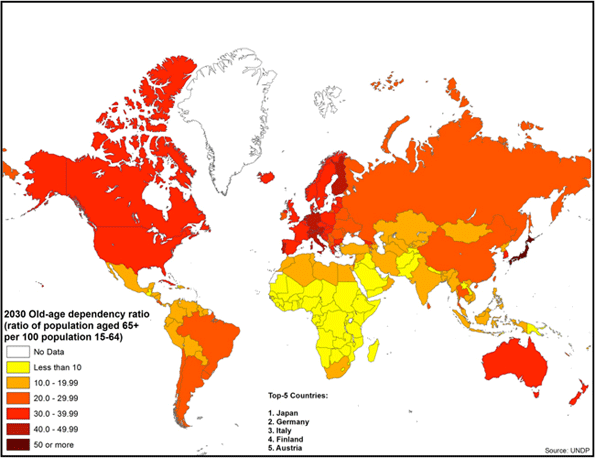
    Yet this positive development also contains the seed of dangers. Female empowerment, along with urbanization, has had a depressing effect on fertility rates, seen first in the highly developed countries, and now increasingly in developing ones. Looking out to 2030, many countries, including the United States and China, will be facing massive problems posed by too many seniors and not enough working age people.

    As has always been the case, the emerging world order will face its own crises in the future, with, no doubt, unexpected, unpredictable results. But our bet is solidly on the three spheres of influence which constitute the bulk of this report.

    For the full report, visit The New World Order website at the Legatum Institute.

    Report authors:

    Joel Kotkin is executive editor of NewGeography.com and is a distinguished presidential fellow in urban futures at Chapman University, and an adjunct fellow of the Legatum Institute in London. He is author of The City: A Global History. His newest book is The Next Hundred Million: America in 2050, released in February, 2010.

    Sim Hee Juat is currently a research associate with the Centre for Governance and Leadership at the Civil Service College of Singapore.

    Shashi Parulekar is an engineer by training. He holds a master’s in finance and an M.B.A. He has worked as a high-tech marketer in Asia for several decades.

    Jane Le Skaife is a doctoral candidate in the Department of Sociology at the University of California, Davis. She is currently conducting her dissertation research involving a cross-national comparison of Vietnamese refugees in France and the United States.

    Wendell Cox is a consultant specialising in demographics and urban issues, principal of Demographia and a visiting professor at the Conservatoire National des Arts et Metiers in Paris.

    Emma Chen is a senior strategist at the Centre for Strategic Futures, Singapore. The views expressed within this article are solely her own. Publication does not constitute an endorsement by the Centre for Strategic Futures, Singapore.

    Zina Klapper is Deputy Editor of www.newgeography.com. A Los Angeles-based writer/editor/consultant with a background in journalism, she works in multiple aspects of report presentation. The maps were prepared by Ali Modarres, Professor of Urban Geography at California State University, Los Angeles.

    We also owe a debt to our largely volunteer research staff, headed by Zina Klapper, Editor and Director of Research. This includes Gary Girod and Kirsten Moore from Chapman University, to whom we owe a special debt for directed study focused on the maps. We also wish to thank Sheela Bonghir from California State University at Northridge; Malcolm Yiong and Jasmin Lau at the Centre for Strategic Futures, Singapore, and Chor Pharn Lee at the Ministry of Trade and Industry and researcher Erika Ozuna, based in Dallas, Texas. Special thanks to Nathan Gamester at Legatum Institute in London for helping put this project together and seeing it to fruition.

  • Political Footballs: L.A.’s Misguided Plans For A Downtown Stadium

    Over the past decade Los Angeles has steadily declined. It currently has one of the the highest unemployment rates (roughly 12.5%) in the U.S, and there’s little sign of a sustained recovery. The city and county have become a kind of purgatory for all but the most politically connected businesses, while job creation and population growth lag not only the vibrant Texas cities but even aged competitors such as New York.

    Rather than address general business conditions, which sorely need fixing, L.A. Mayor Mayor Antonio Villaraigosa and the other ruling elites have instead focused on revitalizing the city’s urban core, which has done little to boost the region’s overall economy in generations. The most recent example of such foolishness is a $1.5 billion plan to build a football stadium, named Farmers Field, downtown,unanimously approved by the city’s City Council and backed by the city’s “progressive” state delegation.

    Like most of  the dominant political class, California Senator and former City Council member  Alex Padilla cites the sad state of the local economy as justification for approving the plan. But, in reality, it’s hard to find something more profoundly irrelevant than a football stadium.

    Indeed years of independent investigations have discovered that urban vanity projects like sports teams and convention centers add little to permanent employment or overall regional economic well-being. As a Minneapolis Fed study revealed, consumers simply shift their expenditures from other activities to the new stadium. Certainly mega-stadiums have done little to boost sad-sack, depopulating cities such as St. Louis, Baltimore or Cleveland.

    Commitments to mega-projects tend to further drive urban areas into debt, largely by issuing more bonds that taxpayers are obligated to pay back. One particularly gruesome case can be found in Harrisburg, Pa., whose underwriting of a minor league baseball team helped push the city into bankruptcy. To get the stadium deal, Los Angeles, already over-indebted and suffering a poor credit rating, will issue another $275 million.

    Such projects often obscure the real and more complex challenge of nurturing broad-based economic growth. This would require substantive change in a city or regional political culture. Instead the football stadium services two basic political constituencies: large unions and big-time speculators, particularly in the downtown area. The fact that the stadium will be built with union labor, for example, all but guaranteed its approval by the city’s trade union-dominated council.

    Downtown developers and “rent-seeking” speculators, the other group behind the project, have siphoned hundreds of millions in tax breaks and public infrastructure in the past decade. They have done so – subsidizing companies from other parts of Los Angeles, entertainment venues and hotels — in the name of a long-held, impossible dream of turning downtown Los Angeles into a mini-Manhattan. Perhaps no company has pushed this more effectively than the stadium developer Anschutz Entertainment Group, a mass developer of generic entertainment districts around the world. AEG has expanded its influence by doling out substantial financial donations to Mayor Villaraigosa and others in the city’s economically clueless political class.

    This explains how the stadium was exempted from the state’s draconian anti-greenhouse gas legislation. The city promises that the stadium will be the “most transit-friendly” football stadium in the nation, which strikes locals as absurd. Football crowds tend to be drawn largely from  affluent types who don’t live anywhere close to downtown and rarely take public transit to their jobs, much less over the weekend. D.J. Waldie, a leading Los Angeles writer, described the entire project as “cloaked in green snake oil.

    An even more nebulous claim is that downtown needs the investment in order to drive regional growth. To be sure, recent years have seen the growth of a central city restaurant scene, and some 30,000 residents now live in the area compared to closer than 20,000 a decade ago. Yet just outside the immediate, highly-subsidized core, population growth in the surrounding parts of central city over the past decade stood at a mere 0.7%, the lowest rate since the 1950s. The vast majority of the region’s population growth took place in the far-flung regions of the San Fernando Valley.

    As an economic engine, downtown LA simply does not warrant the attention, nor the special treatment,  that the city’s ruling elites give it. For one thing, it represents a far smaller part of the city’s economy when you compare it to the urban cores of Washington, D.C., or New York City. Indeed, in New York and D.C. roughly 20% of all employment is in the central core; in Los Angeles it’s barely 2.5%.

    And, despite all the hype, fewer people now work in downtown L.A than in the 1980s and 1990s, when the area was populated by corporations and small businesses, many in manufacturing and trade, instead of hip hangouts. A more recent analysis shows that, despite all the hype, the downtown area has created virtually no new net jobs over the past decade.

    LA’s leaders should therefore focus on the systematic causes for the region’s ailing economy. One source of the problem lies in tough environmental rules that, although lifted on behalf of football, clamp on growth of virtually every other industry, including the city’s port and manufacturing sector. Powerful green interests, for example, make any plan to modernize the port all but impossible. This could prove catastrophic when the widening of the Panama Canal will allow aggressive, cheaper posts in the Gulf or Southeast U.S. to compete with the Pacific Asian trade that has driven LA’s port economy for decades.

    Los Angeles’ huge industrial sector has also been a victim of the regulatory tsunami. Manufacturers have lost roughly one-third of their jobs over the past decade as firms head out to more congenial regions with less onerous regulatory burdens. Sadly, Los Angeles has benefited little from the recent upsurge in manufacturing nationwide when compared with metropolitan areas such as Detroit, Salt Lake City and San Antonio.

    Even Hollywood, an industry less affected by green regulations, has begun to lose steam. Film production has dropped by more than half over the past 15 years. LA’s share of film and television production has eroded as well, with much  of the new work headed to Toronto, New Mexico, New Orleans, New York and Atlanta. All these cities offer richer incentives to attract productions than the world’s self-proclaimed “entertainment capital.”

    Faced with these serious regional challenges, officials should place less emphasis on football and creating another generic downtown and more on the city’s uniquely vibrant and heavily immigrant-driven small-business sector, which has been stifled by the state’s regulatory excess as well as the city’s legendary bureaucracy. Business consultant Larry Kosmont notes that the system is particularly tough on smaller, less politically connected firms. “It usually takes two to three times more to process anything in L.A., compared even to surrounding cities,” Kosmont told the Wall Street Journal. “It makes a big difference if you are a major Korean airline or AEG or if you are an independent entrepreneur.”

    Yet to date these entrepreneurs  receive little respect from City Hall. They  are unlikely to be granted the sort of papal dispensations from green legislation so readily given to the football stadium and other downtown projects. Until the disconnect of the leaders from the city’s real economic essence ends, Los Angeles, a city uniquely blessed by its population, climate and location, will continue to flounder, a perpetual underperformer among America’s great urban areas.

    This piece originally appeared at Forbes.com.

    Joel Kotkin is executive editor of NewGeography.com and is a distinguished presidential fellow in urban futures at Chapman University, and an adjunct fellow of the Legatum Institute in London. He is author of The City: A Global History. His newest book is The Next Hundred Million: America in 2050, released in February, 2010.

    Photo "LA Night Lights" by flickr user Steve Jurvetson

  • Overpopulation Isn’t The Problem: It’s Too Few Babies

    The world’s population recently passed the 7 billion mark, and, of course, the news was greeted with hysteria and consternation in the media. “It’s not hard to be alarmed,” intoned National Geographic. “We should all be afraid, very afraid,” warned the Guardian.

    To be sure, continued population increases, particularly in very poor countries, do threaten the world economy and environment — not to mention these countries’ own people. But overall the biggest demographic problem stems not from too many people but from too few babies.

    This is no longer just a phenomenon in advanced countries. The global “birth dearth” has spread to developing nations as well. Nearly one-third of the 59 countries with “sub-replacement” fertility rates — those under 2.1 per woman — come from the ranks of developing countries. Several large and important emerging countries, including Iran, Brazil and China, have birthrates lower than the U.S.

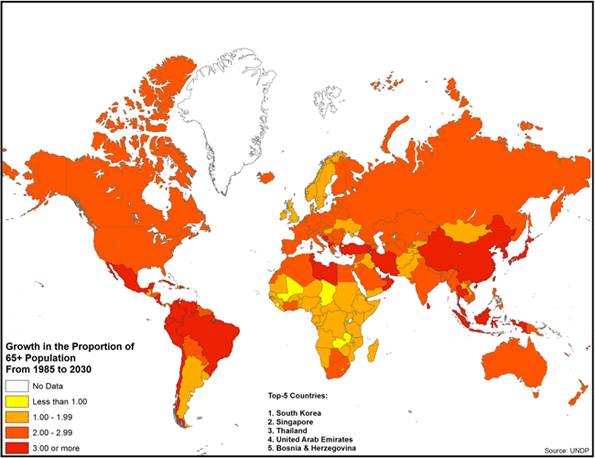
    In the short run this is good news. It gives these countries an opportunity to leverage their large, youthful workforce and declining percentage of children to drive economic growth. But over the next two or three decades — by 2030 in China’s case  – these economies will be forced to care for growing numbers of elderly and shrinking workforces. For the next generation of Chinese leaders, Deng Xiaoping’s rightful concern about overpopulation at the end of the Mao era will shift into a future of eldercare costs, shrinking domestic markets and labor shortages.

    This scenario is already a reality in Japan and much of the European continent, including Greece, Spain, Portugal, much of Eastern Europe, Scandinavia and Germany. Adults over the age of 65 make up more than 20% of these countries’ populations — compared with 15% in the U.S. —  and their numbers could double by 2030, according to researchers Emma Chen and Wendell Cox.

    In many of these countries, rising debt burdens and shrinking labor markets have already slowed economic growth and suppressed any hope for a major long-term turnaround. The same will happen to even the best-run European economies, just as  it has in Japan, whose decades-long growth spurt ended as its workforce began to shrink.

    By 2030 the weight of an aging population will strangle what’s left of these economies. Germany, Japan, Italy and Portugal, for example, will all have only two workers for every retiree. The U.S. will fare somewhat better, with closer to three workers per retiree. By 2030 the median age  will also be higher in China and Korea than in the U.S. This  age difference will grow substantially by 2050, according to the Stanford Center on Longevity.

    The biggest impact of aging, however, will not occur in northern Europe and Japan, where there may be enough chestnuts hidden away to keep the aged fed, but in Asia. In the next few decades, South Korea, Taiwan, Singapore, Thailand, and even Indonesia will start following Japan into the wheelchair stage of their demographic histories. These are not quite rich places like China and Brazil, which still lack the wealth and a developed welfare state to take care of the elderly Although not headed directly to European or Japanese rates of aging, these countries will experience a doubling of their Old Age Dependency Ratios; both will rise slightly above current U.S. levels by 2030.

    In China, the one-child policy could be used to explain this phenomenon, but this hardly accounts for declining birthrates and rapid aging in countries such as Iran, Mexico or Brazil. Other factors — urbanization, a secular society and upwardly mobile women — also appear to be playing an important role.

    Of course, the populations in most developing countries will still grow, but more due to longer lifetimes than a surfeit of new births.  But projections are often wrong, and their demographic trajectory may slow down more than now predicted.

    The one region expected to continue growing is Africa. Some countries, like Nigeria and Tanzania, are expected to more than double or even triple their current populations by 2050. But as Africa urbanizes and develops, it may eventually experience the same unexpected decline in fertility  we already see in Islamic Iran, multi-cultural Brazil  or throughout east Asia.

    Largely left out of the analysis may well be the next big demographic phenomenon: the rise of childlessness. We have already seen how the move in developing countries from six kids or more per household has reduced population growth. In a similarly dramatic way  the shift towards zero children, particularly in wealthier countries could have unforeseen lasting consquences. After all, with two children, or even with one kid, there’s the possibility of two or more grandchildren. With no children, it’s game over — forever.

    Of course, there have always been unmarried people and childless people; some by necessity or health reasons, others by choice. But now a growing proportion of young child-bearing age women in countries as diverse as Italy, Japan and Taiwan are claiming  no intention of having even one child. One-third of Japanese women in their 30s are unmarried, and similar trends are developing in other Asian countries.

    Life without marriage, and children, has also become the rage among a large proportion of the cognoscenti even in historically procreation-friendly America. Whether it’s because men are seen as weak, or children too problematical, traditional families could erode further in the decades ahead.

    The chidlessness phenomenon stems largely from such things as urbanization, high housing prices, intense competition over jobs and the rising prospects for women. The secularization of society — essentially embracing a self-oriented prospective — may also be a factor.

    If this trend gains momentum, we may yet witness one of the greatest demographic revolutions in human history. As larger portions of the population eschew marriage and children, today’s projections of old age dependency ratios may end up being wildly understated.  More important, the very things that have driven human society from primitive time — such as family and primary concern for children — will be shoved ever more to the sidelines. Our planet may be less crowded and frenetic, but, as in many of our child-free environments, a little bit sad and lot less vibrant.

    Our future may well prove very different from the Malthusian dystopia widely promoted in the 1960s and still widely accepted throughout the media. With fewer children and workers, and more old folks, the “population bomb” end up being more of an implosion   than an explosion.

    This piece originally appeared at Forbes.com.

    Joel Kotkin is executive editor of NewGeography.com and is a distinguished presidential fellow in urban futures at Chapman University, and an adjunct fellow of the Legatum Institute in London. He is author of The City: A Global History. His newest book is The Next Hundred Million: America in 2050, released in February, 2010.

    Photo "Nursery Cart" by flickr user Pieterjan Vandaele

  • America’s Demographic Opportunity

    Among the world’s major advanced countries, the United States remains a demographic outlier, with a comparatively youthful and growing population. This provides an unusual opportunity for America’s resurgence over the next several decades, as population growth elsewhere slows dramatically, and even declines dramatically, in a host of important countries.

    This demographic vitality, however, can only work if there is substantive increase in the economic growth rate and particularly in employment. A growing population brings new entrants into the labor force at a rapid rate. Historically, a relatively positive relationship between workforce entrants and dependents, both old and young, has generated waves of growth across the past several decades. This is widely known as “the demographic dividend.”

    In the 1950s and 1960s, a relatively youthful population helped drive rapid economic growth first in Europe and then in Japan. By the 1970s, this “youth bulge” shifted to developing nations of east Asia, notably Singapore, South Korea, Malaysia and Indonesia. China experienced this surge in workers in the 1980s and 1990s. More recently, the big winners in youth demographics could be found in countries such as Vietnam, Turkey and Brazil.

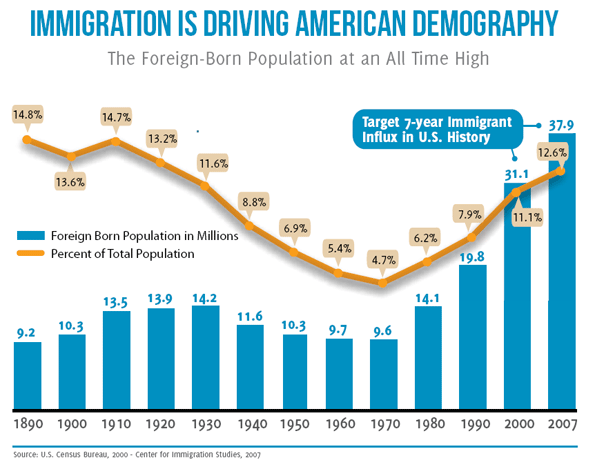
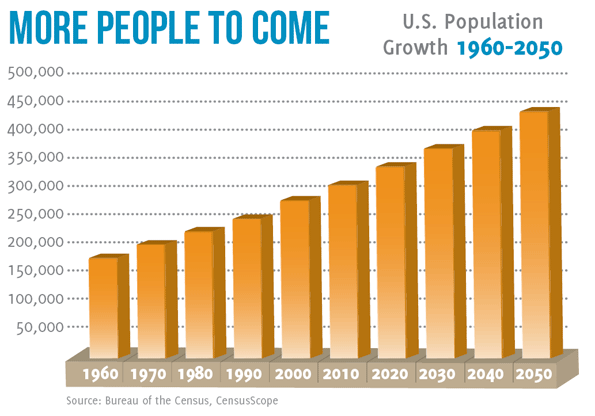
    Yet remarkably throughout this period, the United States has retained its relative youthfulness. The last census showed the nation experienced 10 percent population growth over the first decade of the 21st Century, with a final count approaching 310 million people. This is in large part a product both of immigration and higher birthrates.

    Today, the U.S. fertility rate of over two children per woman remains as much as twice as high as many countries, including Russia, Germany, Japan, Italy, Singapore and Korea. As a result, according to U.S. census projections, the United States will continue to grow to upwards of 420 million by 2050.

    In contrast, the populations of longterm competitors among advanced countries—including the European Union, Japan and Russia—are all expected to stagnate and then decline. Japan is a particularly hard case. Its fertility rate has dropped by a third since 1975. By 2015, a full quarter of the Japanese population will be over 65. Generally inhospitable to immigrants, Japan could see its population drop from a current 127 million to 95 million by 2050, with as much as 40 percent of the population over 65 years of age. By then, no matter how innovative the workforce, Dai Nippon will simply be too old to compete.

    To a large extent, Europe shares this dilemma. By 2050, Europe’s population, now numbering 730 million people, will shrink by 75 to 100 million. Italy’s population alone is slated to drop by 22 percent, while Poland’s will be reduced to 15 percent.

    Due to the one child policy and rapid urbanization, China’s population growth is also expected to slow significantly in coming years while the proportion of seniors soars. In the longer run, population growth will be stymied by a large surplus of boys over girls. As a result, notes demographer Nicholas Eberstadt, more than 25 percent of men in their late 30s by 2030 are likely never to marry.

    Perhaps even more challenged will be Russia, whose low birth and high mortality rates suggest that its population will drop 30 percent by 2050 to less than one-third of that of the U.S. Even Prime Minister Vladimir Putin has spoken of "the serious threat of turning into a decaying nation."

    Russia’s de facto tsar has cause for concern. Throughout history, low fertility and socioeconomic decline have been inextricably linked, creating a vicious cycle that affected once-vibrant civilizations such as ancient Rome and 17thcentury Venice.

    Within the next four decades, most of the developed countries in East Asia, as well as Europe, will become veritable old-age homes: A third or more of their populations will be over 65. The U.S. will also have to cope with an aging population and lower population growth. Comparatively speaking though, the U.S. will maintain a relatively youthful, dynamic demographic. In comparison, the percentage of the population over 65 will be only one in five in the United States.

    The reasons for this divergence with other advanced countries likely includes such things as continuing immigration, greater space, larger houses, a strong aspirational culture and a higher degree of religious affiliation. Whatever the cause, a younger demography could lead to a relatively brighter future for America than is now commonly assumed.

    In the near future, the U.S. could reap a potential critical advantage from a particularly large baby ‘boomlet’ among the Millennial generation, the children of the boomers. This next surge in population may be delayed if tough economic times continue, but over time it will translate into a growing workforce, sustained consumer spending and produce a youthful population likely to push innovation.

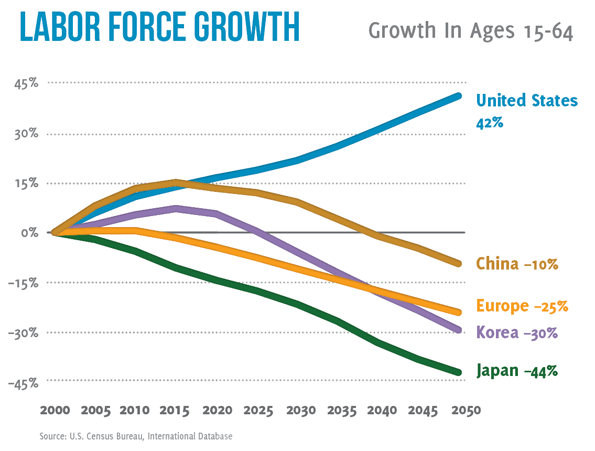
    The most critical shift will be in the growth of the American workforce which is expected to grow by over 40 percent between 2000 and 2050. In contrast, during the same period the number of entrants to the labor pool will decline by 25 percent in the European Union and Korea and plummet over 40 percent in Japan.

    Due to the rapid aging of China’s population, largely due to the impacts of urbanization, that emerging superpower’s workforce is expected to decline by 10 percent. These demographics suggest a far more difficult future for all these countries, as fewer workers support ever-growing numbers of retirees. China’s lack of an established social welfare system makes this transition even more problematic.

    Persistently low birthrates and sagging population growth inevitably undermine the growth capacity of an economy. In large part due to demographic forces, by 2050 Europe’s economy could be half that of the United States’ economy.

    Even frugal Germany, by far Europe’s strongest economy, can expect its growth to be constrained by ever higher spending on seniors and a diminished workforce. By 2030, notes demographer Nicholas Eberstadt, Germany’s public debt will exceed 200 percent of GDP, with annual debt service accounting for 10 percent of GDP. To put this in perspective, that’s nearly twice Greece’s current burden of debt service.

    Other negative consequences of an aging and stagnant (or declining) population are less tangible, but no less real. Similarly, it is generally younger workers who drive innovation. Children provide a large consumer market and push their parents to work harder. By having children, people also make a commitment to the future for themselves, their communities and their country.

    In contrast, a largely childless society generally produces other attitudes. It tends to place greater emphasis on leisure activities over work. It also promotes a shift away from a focus on future growth and toward paying pensions for the aging. An aging society is likely to resist risky innovation or infrastructure investments meant to serve future generations.

    Yet in the immediate future, population and labor force growth present us with enormous challenges. Perhaps the greatest challenge in this era of economic stagnation lies in providing employmen—and adequate education—to a growing workforce. One cause of the U.S.’s persistently high unemployment and underemployment lies in the rapid expansion of the workforce from the large baby boom “echo” or Millennial generation.

    This growing workforce means the country needs to create 250,000 new jobs a month—twice what we produce in a “good” month today—just to stay even. Younger Americans may be unemployed at rates similar to their European counterparts, but in Europe the labor force will be shrinking. For the US to take advantage of its demographic dividend, we need to create the kind of rapid economic growth that sparks widespread job creation.

    One possible, if unpalatable, alternative to meeting the growth challenge would be for the US to follow the path of demographic decline well under way in Europe and Japan. American birthrates, which were rising during the first part of the 2000s, have fallen with the recession and could conceivably become permanently depressed—as occurred in the 1930s—if prospects for economic growth fade.

    A weaker economy could also slow immigration, which has been one of the main causes for the country’s relatively favorable demographics. Roughly one-quarter of all the country’s elementary school students are either immigrants or the children of immigrants. Overall, Mexican immigrants, the largest group coming to the country, average 2.5 children per family compared to 1.8 to their Caucasian counterparts.

    Immigrants, particularly from Mexico, have been hard-hit by the recessions, in large part due to declines in construction and manufacturing where their losses have been higher than native-born Americans. This, not surprisingly, has created diminishing immigration levels across the country.

    Overall, migrants leaving Mexico, both legally and illegally, have dropped by more than two-thirds since 2005, according to that country’s census. Illegal immigration, according to the Pew Center, has fallen even more precipitously, from over 500,000 in 2000- 2004 to barely 100,000 in 2010. This pattern may continue in part due to lower birthrates in Mexico itself—where the average family size has decline from 6.8 children to barely 2.0—and by improving economic conditions.

    A drop-off in immigration from Mexico and elsewhere could be particularly problematic for cities such as New York or Los Angeles, long reliant on newcomers to make up for high levels of domestic outmigration. Already, migration to these cities is roughly 50 percent below the levels in 2000. In 2001, for example, New York welcomed almost 160,000 newcomers; in 2009, that number had dropped to barely 100,000.

    If tough times continue, these levels could drop even further, with profound consequences. Immigrants, for example, fuel much of the urban workforce.

    In Los Angeles, where immigration dropped by 40,000 annually over the past decade, immigrants constitute roughly half the total of those employed.

    Perhaps even more importantly, these immigrants have become critical to creating the kind of grassroots capitalism necessary to create jobs. In the last decade, largely immigrant populations such as Hispanics and Asians expanded their number of businesses at 50 percent higher rates than the overall average. According to the Kaufmann Foundation, the immigrant share of all new startups doubled from 14 percent in 1996 to 29 percent in 2010.

    The future of these new businesses could now be clouded both by diminishing immigration as well as stirring antiimmigrant sentiment. It is perhaps too early to know if strict controls on illegal immigration—enacted in states such as Georgia and Arizona—will slow down migration to other metropolitan regions but this has to be considered as a possibility. Ironically, many of these same areas have been those that were becoming increasingly attractive to newcomers escaping high housing costs in traditional coastal urban magnets.

    Another potential threat to America’s demographic vitality lies in the potential imposition of strong controls on suburban housing development. This is a policy widely supported among Administration officials and their green allies. In places like coastal California where such policies are already in place, housing prices remain artificially elevated, driving large numbers of young families into the interior and further out to other states.

    Generally speaking, people are far more likely to have children in singlefamily homes than in apartment complexes. These potential families also may be impacted by rising tax rates and fiscal burdens, particularly at the state and local levels. Without strong economic growth, it’s difficult to see how even the current level of public education—which is paltry, at best—can be maintained.

    Already poor schools in cities constitute a major reason why so many “young and restless” move from cities to suburbs; but if suburban education also declines, they may be left to send their children to private schools as well. It is logical to assume that, once forced to pay for schools, many parents will become hesitant to have multiple offspring.

    Yet ultimately the question of demographics—and its close link to the need for economic growth—represents a kind of existential question for civilizations. This is understood by some in Europe and Japan, where there have been attempts to increase benefits for families as concerns over demographic declines have grown.

    But can policy really change a society that is falling into demographic decline? So far state measures to encourage child-bearing have failed in a host of countries in both Europe and Asia. One possible solution for Europe, immigration, is now being curbed largely due to fears connected to people of Islamic heritage.

    Similarly, it is difficult to imagine how historically homogeneous China, Korea or Japan would be willing to accommodate large numbers of newcomers. Among the advanced Asian countries, only Singapore, with one of the world’s lowest birth rates, has contemplated using immigrants to stabilize workforce growth and prevent a process of hyper-aging.

    Some in the U.S., particularly on the far right, also oppose greater immigration, in part due to fears of the resultant ethnic shift away from a white majority. In addition, many environmental groups around the world oppose steps to revive birthrates. Some even consider procreation of new carbon-belching citizens as something close to anathema. In Great Britain, Jonathan Porritt, chair of the U.K.’s Sustainable Development Commission has advocated cutting the island’s population in half as a way to reduce global greenhouse gases.

    For their part, some America greens have expressed concern over our country’s relative fecundity. Groups like the Center for Biological Diversity and Greenpeace seek to see a cut in our slightly above replacement level birthrate.

    These pressures, as well as persistently low economic growth, could lead America into a Japanese or European style demographic decline. A growing population may create great environmental and economic challenges, but it seems clear that a scenario of persistent decline and rapid aging presents a far worse prospect.

    This piece originally appeared in Business Horizon Quarterly, published by the National Chamber Foundation.

    Joel Kotkin is executive editor of NewGeography.com and is a distinguished presidential fellow in urban futures at Chapman University, and an adjunct fellow of the Legatum Institute in London. He is author of The City: A Global History. His newest book is The Next Hundred Million: America in 2050, released in February, 2010.

  • Dense Urban Thinking Down Under

    Ku-ring-gai is a piece of suburban paradise in the inner rings of Sydney. A district of modest homes and quaint small-scale shopping districts, it sits near one of the last remaining stretches of blue-gum forest inside Australia’s largest city. You can still catch the occasional cockatoo luxuriating on a branch.

    First built around 1900, the neighborhood of 106,000 boasts all the charms of the classic “garden city,” balancing nature with modestly scaled development. Yet today the Ku-ring-gai community — including the remaining flora and fauna — is threatened with extinction by planners and developers seeking to pack the district with non-descript apartment tracks and ten-story commercial structures.

    “They’re doing everything they can to destroy this area,” says long-time community activist Kathy Cowley, a founding member of both Save Our Suburbs and Friends of Ku-ring-gai over lunch of meat pies and salad at her cottage. “They approach it as if it was a greenfield [or previously undeveloped] site for high-density housing. They are trying to destroy everything with bad planning.”

    Cowley speaks bitterly about how the state government of New South Wales, which controls development, cares little about disturbing a sensitive human as well as natural urban environment. Most of the new apartment dwellers, she notes, tend to be recently arrived residents. Many appear to be Chinese students, who ride on the surprisingly rickety trains largely to schools closer to Sydney’s center city.

    This assault on Cowley’s neighborhood reflects a peculiar density ideology that, although present in the United States, is far more powerful in New Zealand, Great Britain and Australia. Density advocates swear that everything from the necessities of economic competition to limited resources require “cramming” future populations in ever smaller spaces. It doesn’t matter that the population might object.

    In contrast, suburbs are constantly painted as on the verge of extinction. They are destined to become the dull victims of everything from demographics, “cool” migration, green ideology and the rise of “rentership” over home ownership to the ever-present, never-quite-happening “peak oil” that is destined to drive people out of their cars and into the inner cities.

    Economically, the density industry emphasizes the central city’s producer of high-end jobs tied particularly to financial services and its role as home to most universities, government institutions and media. But in the future, even elite industries seem more likely to disperse than concentrate. Look at high tech, where the vast majority of employment tends to be in suburban areas such as Silicon Valley, the counties surrounding Washington, D.C., and sprawling Durham, N.C.

    The same can be said in terms of demographics. Rather than becoming more dense, the vast majority of American cities have become more spread-out. The same has happened in many major metropolitan areas in advanced countries worldwide.

    The density obsession seems particularly ill-suited to Australia, a sparsely populated country where less than 0.2% of the land is urbanized, compared with less than 3% in the U.S. and around 6% for Great Britain.  But such thinking has taken root in this vast continent — to the detriment of many of its people.  ”The writing is on the wall for the Australian dream,” says Joe Flood, professor at the Flinders University Institute for Housing, Urban and Regional Research.

    Perhaps the biggest impact of pro-density policies has been rising land prices. State governments, which control most planning in Australia, along with their developer allies have discouraged development of new houses on greenfield sites, preferring to see the next generation of Australians living cheek to jowl close to the urban core.

    Because of this Australia, once a bastion of middle class aspiration, has suffered some of the world’s highest housing prices.  Sydney itself ranks second, behind Vancouver, in the English-speaking world’s unaffordability sweepstakes. In 1990 a Sydney household median income required five years wages; today it requires almost ten.

    Prices have been shaky recently, but current planning strictures will likely keep them artificially high. In America you can escape California or New York prices by heading south or inland. Even Australia’s second-tier, slow-growing  burgs like isolated Adelaide are more expensive than larger economically vibrant cities like Seattle and more than double as costly relative to incomes as Indianapolis, Dallas-Fort Worth or Houston.

    As a result, many younger Australians — and their parents — have reason to wonder if the next generation will ever be able to own a home. What they call the “Great Australian Dream” — with a backyard and shady streets — is being supplanted by the planner’s utopia of dense urban dwellers. Nothing wrong with having a dense option, but this is not about choice; it’s about coercion. The feisty New City Journal, edited by onetime Labour Party activists, described the process as “ruining our cities in order to save them.”

    Sadly much of the densification policy is based on faulty logic, increasingly justified by climate change. It’s ironic hearing pious greenhouse gas obsessions in a country dependent on exports of raw materials, most prominently coal, to China, the world’s biggest emitter. And a domestic reordering would have little to no impact on climate change since Australia generates barely 1% of the world’s greenhouse gases.

    But even if you agree Australia must do its part against climate change, many policy recommendations are based on a total misreading of modern urban form. Planners and media pundits assume, for example, that people can save energy by taking the train downtown; but even in Sydney, Australia’s largest and oldest big city, barely 12% of the labor force works in the central district, well below the levels decades ago.

    There’s also a presupposition that people living in downtown apartments are inherently less energy consumptive than their suburban counterpart. Yet a recent study done by researchers at the University of South Australia showed that overall urban dwellers — who travel, eat out more and consume more goods per capita — also consume more energy, once things like elevators and common areas are factored in, than the suburbanites living in townhouses or single-family homes.

    A similar finding was also made by the Australian Conservation Foundation. But in this particular battle, facts rarely intrude. Who needs to think after you have spent years in college being conditioned to believe that all density is good, the denser the better?   And for the big urban landowner, what could be better than stating a moral cause for limiting the suburban competition, thus spiking property  prices?

    What is happening to lovely Ku-ring-gai and the Great Australian Dream should stand as a warning of what happens if planners, and their big developer allies, gain total sway.  Let’s just hope America’s traditional decentralization of authority will prevent our middle class dream from following the sad trajectory of our hitherto lucky friends down under.

    This piece originally appeared at Forbes.com.

    Joel Kotkin is executive editor of NewGeography.com and is a distinguished presidential fellow in urban futures at Chapman University, and an adjunct fellow of the Legatum Institute in London. He is author of The City: A Global History. His newest book is The Next Hundred Million: America in 2050, released in February, 2010.

    Photo "Cockatoo in Sheldon Forest" by flickr user AussieGold