Author: Joel Kotkin

  • Obama’s Off-target Class War

    For many conservatives, the notion of class warfare that President Barack Obama now evokes is both un-American and noxious — a crass attempt to cash in on envy among the masses. Yet the problem is not in class warfare itself — but in being clear what class you are targeting.

    In this sense, Obama’s populism is little more than a faux version. He is not really going after the privileges of the super-rich — that would involve actions like removing the advantages of capital gains over earned income or limiting dodges to nonprofit foundations or family trusts. Rather than a war against plutocrats, Obama’s thrust is against the upper end of the middle class, whose income is most vulnerable to higher taxes.

    The president is within his rights to use these class warfare tactics; it’s just too bad he is aiming at the wrong target. Exploiting class divisions, in fact, has long been a part of American politics — from the Jacksonian era through Abraham Lincoln, the New Deal and even Bill Clinton. Obama’s sudden tilt toward class warfare may thrill left-wing commentators such as The American Prospect’s Robert Kuttner. But it’s no real threat to the real ruling classes.

    Though the president’s rhetoric focuses on “millionaires and billionaires,” his proposals do less harm to the ultrarich and their trustifarian offspring than to the large professional and entrepreneurial classes, whose members are earning more than $200,000 a year. More affluent than most Americans, these members of the upper middle class hardly constitute oligarchs. Ninety percent of the targeted class earns less than $1 million annually. Only a tiny sliver, or .01 percent, are billionaires.

    Senate Majority Leader Harry Reid’s proposal to raise the target income level closer to $1 million is a concession to political common sense — but still avoids the big distinction between investor and income earner. Meanwhile, the administration’s rhetorical gambit of using Warren Buffett as the class warfare poster boy reveals its fundamental disingenuousness.

    Many rich do avoid high taxes through dynastic trusts concocted largely to avoid the Internal Revenue Service. Others, like Buffett, put vast amounts into foundations — in his case, the Bill and Melinda Gates Foundation, where it sits tax free. In addition, the patrician class, because its members tend to be more active investors, also pays less, largely because its capital gains earnings are taxed at a low 15 percent rate, less than half that paid by high-income professionals.

    Obama’s biggest problem with class is that his policies have made a bad situation worse. During both the Clinton administration and most of the George W. Bush years, the rich prospered. But so, too, did middle- and working-class homeowners, professionals and construction workers.

    Today, however, only the high-end housing market, roughly 1.5 percent of the market, is flourishing. The vast majority have seen their property values shrink — down 30 percent since 2006. Markets, like Manhattan , which is increasingly dominated by foreign investors, have surged — the average price of a New York condo or co-op has topped $1.4 million, a nifty 3 percent increase over last year.

    But to a large degree, this reflects those who are the biggest beneficiaries of the largesses of Treasury Secretary Timothy Geithner and Fed Chairman Ben Bernanke: hedge fund managers, investment bankers, the corporate aristocracy and officials of “too big to fail” banks. For these financiers, the time since the economic collapse has been very fat years — at least until the European debt crisis.

    The situation, however, has been far worse for small businesses — with serious consequences for job creation. The number of start-ups with employees — the traditional source of new jobs — has dropped 23 percent since 2008. Most entrepreneurs, according to the National Federation of Independent Business, expect the job market to weaken and unemployment to stay high for the foreseeable future.

    “Corporate profits may be at a record high,” said Bill Dunkelberg, chief economist of the National Federation of Independent Business, “but businesses on Main Street are still scraping by.”

    Obama’s phony class war also carries considerable political risk. As Mark Penn, the former Clinton adviser, and others have pointed out, the newest Obama tax strategy most penalizes the professionals who flocked to his cause in 2008 . These voters — concentrated largely in high-tax, high-cost blue states — are also particularly vulnerable to any reduction of write-offs for mortgage interest and state taxes.

    Obama’s left turn also fails to address the America’s biggest problem: how to ignite broad economic growth.

    It should now be clear to all but the most deluded that the administration’s bankrolling of massive solar projects and embrace of hopeless causes like high-speed rail have not reaped much of a bonanza. Indeed, in many places where the administration’s “green” agenda has been adopted most fervently, like California, unemployment rates now surpass even Michigan’s.

    Obama’s misguided economic notions can be seen even when he looks to solve our critical jobs shortage. In addition to the “green jobs” fiasco, the president is looking to Silicon Valley and the information economy — which have lost jobs since 2006. Facebook, Apple, Google and the rest may be swell representatives of American ingenuity — but employ relatively few people in America, and mostly the best educated and thus least vulnerable.

    In contrast, the administration displays relatively little support — and passion — for the many middle-income Americans who depend, directly or indirectly, on industries like oil and gas, warehousing, construction and, except for the bailed-out auto firms, manufacturing. In these sectors, only the fossil-fuel industry has done well — adding more than 500,000 generally well-paying jobs since 2006, despite the Environmental Protection Agency’s best efforts to slow its progress.

    Workers in the energy field – in which salaries average more than $100,000 annually — reasonably fear their jobs could be threatened if Obama is reelected. This could damage his appeal in states like Ohio and Pennsylvania, where many working-class voters are now counting on new oil and gas finds to spur the growth of high-wage employment.

    So how best to confront America’s growing class division? With serious economic growth beyond Wall Street. A flatter tax system with fewer exemptions, limiting trusts and foundations and ending the preference for capital gains would force the wealthy to re-engage the economy. They would have fewer ways to hide their money. Sweep aside both subsidies for oil and gas companies and the renewable industry, regulate sensibly and market forces can drive exploration and development.

    Will Republicans support this approach? Many seem almost incapable of acknowledging the threat to democracy and our social order now posed by the growing concentrations of wealth that eerily recall the 1920s. Others prostitute themselves to fossil-fuel industries — the way the Democrats kowtow to rent-seeking green capitalists. Meanwhile, with Obama’s once strong support on Wall Street weakening, they seem all too eager to dance to big money’s tune to fill their own coffers.

    It’s time to finally acknowledge that the whole “trickle down” from Wall Street approach has been discredited — and with it the current regime of class privilege. You don’t have to be a member of Occupy Wall Street to doubt that what’s good for the top investment bankers is necessarily good for the vast majority of the country.

    Neither mindless budget-cutting nor politically motivated redistribution can solve the growing economic divide or create new wealth. Instead, we need a tax and policy regime that stops favoring financial insiders and instead focuses incentives on the grass-roots hard work and ingenuity that have long been America’s greatest economic asset.

    This piece originally appeared at Politico.com.

    Joel Kotkin is executive editor of NewGeography.com and is a distinguished presidential fellow in urban futures at Chapman University, and an adjunct fellow of the Legatum Institute in London. He is author of The City: A Global History. His newest book is The Next Hundred Million: America in 2050, released in February, 2010.

    Photo of protected Wall Street bull by hunter.gatherer.
  • Silicon Valley Can No Longer Save California — Or The U.S.

    Even before Steve Jobs crashed the scene in late 1970s, California’s technology industry had already outpaced the entire world, creating the greatest collection of information companies anywhere. It was in this fertile suburban soil that Apple — and so many other innovative companies — took root.

    Now this soil is showing signs of exhaustion, with Jobs’ death symbolizing the end of the state’s high-tech heroic age.

    “Steve’s passing really makes you think how much the Valley has changed,” says Leslie Parks, former head of economic development for the city of San Jose, Silicon Valley’s largest city. “The Apple II was produced here and depended on what was unique here. In those days, we were the technology food chain from conception to product. Now we only dominate the top of the chain.”

    Silicon Valley’s job creation numbers are dismal. In 1999 the San Jose-Sunnyvale-Santa Clara area had over 1 million jobs; by 2010 that number shrank by nearly 150,000. Although since 2007 and early 2010 the number of information jobs has increased substantially — up roughly 5000 to a total of 46,000 — the industrial sector, which still employs almost four times as many people as IT, lost around 12,000. Overall the region’s unemployment stands at 10%, well above the national average of 9.1%.

    This is partly because Apple, Intel and Hewlett-Packard have shifted their production — which offered jobs to many lower- and medium-skilled Californians — to other states or overseas. With its focus just at the highest end, the Valley no longer represents the economically diverse region of the 1970s and 1980s. Indeed, it increasingly resembles Wall Street — with a few highly skilled employees and well-placed investors making out swimmingly.

    “Silicon Valley has become hyper-efficient; the region doesn’t create jobs anymore,” says Tamara Carleton, a locally based fellow at the Foundation for Enterprise Development. “In terms of revenue per employee, Facebook’s ratio is unprecedented. Even Apple hasn’t grown significantly this last decade, despite the successful launch of many products and services. While commendable, greater efficiency doesn’t put more jobs in the California economy.”

    This “hyper-efficiency” can be seen in the real state of the valley’s industrial/flex space market. The overall industrial vacancy rate remains 14%, two points higher than in 2009. Areas close to Stanford, such as Palo Alto and Mountain View, have done well, but others on the periphery, such as Gilroy, Milpitas and Fremont, and even parts of San Jose have vacancies reaching over 20%.

    California’s other high-tech centers, with the possible exception of San Diego, are doing worse. The state has been losing high-tech employment over the past decade, while such employment has surged not only in China and Korea, but also in competitor states such as Texas, Virginia, Washington and Utah. According to the annual Cyberstates study, California lost more high-tech jobs — about 18,000 — last year than any other state.

    California’s political leaders, particularly Democrats, still genuflect toward the Valley for economic salvation and job growth. But social media has not proved a jobs-creating dynamo, and it’s clear that the highly subsidized, venture backed “green economy” has floundered miserably and faces a less than rosy future.

    You can feel pride, as an American and Californian, in the legacy of the likes of Steve Jobs but also believe our future cannot be salvaged by high-tech alone. Many of the country’s greatest assets, for example, are physical; in California these include the best climate for any advanced region in the world, fertile soil, a prime location on the Pacific Rim and potentially huge fossil fuel energy reserves, which give it enormous competitive advantages.

    The green theocracy now in control of Sacramento, however, has little interest in these aspects of California. It may prove difficult, if not impossible, to modernize the ports of Los Angeles and Long Beach, prolific sources of good-paying white and blue collar jobs. These ports will soon face increased competition for Asian trade from Gulf and south Atlantic locales eagerly waiting for the 2014 widening of the Panama Canal.

    Administration officials such as Energy Secretary Steven Chu also slate the state’s agriculture for demise by climate change. But just in case he’s wrong, we should note that California’s agriculture — despite green attempts to cut off its water supply — accounts for 40% of state exports. It generates $12.7 billion annually in overseas sales and employs over 400,000 people directly and many thousands more in marketing, processing and warehousing.

    Similarly, California boasts some of the nation’s richest deposits of oil and gas, not only on its sensitive and politically nettlesome coast but along the coastal plains and in the Central Valley. The most recent estimates of the state’s reserves, according to the Energy Information Agency, include nearly 3 billion cubic feet of natural gas and more than three billion barrels of oil, roughly the same as Alaska and more than booming North Dakotas.

    Geologists and wildcatters, usually ahead of the game, believe we have touched only a small part of the state’s energy potential. Some discuss new oil shale discoveries, particularly in the Monterey region, that could dwarf even the massive Bakken find in North Dakota. “If you were in Texas,” quipped economist Bill Watkins to an audience in the hard-hit central California town of Santa Maria, a predominately Latino town north of Santa Barbara, “you’d be rich.”

    A judicious and carefully planned expansion of these resources, particularly in the less populated interior areas, could provide tens of thousands of high-paying jobs. It would also funnel desperately needed revenue to the state. At the same time, such development could forestall much higher energy costs, one of the things driving manufacturers in the state to move elsewhere.

    California is unlikely to take advantage of its physical bounty; its leadership seems to lack enthusiasm for any industrial expansion outside of the “green” economy. Industrial parks across the state are emptying, more houses go into foreclosure and local governments wither on the vine. Unless California begins to take its own economy seriously, it will continue to devolve from the aspirational place that produced not only Steve Jobs but scores of entrepreneurs in everything from movies and oil to agriculture and aerospace.

    The Valley itself will likely do fine. Steve Jobs helped cement the position of Santa Clara Valley as the epicenter of the high-tech world. But this accomplishment does relatively little for the rest of California. What we will miss will not only be Steve Jobs’ creative contributions, but how clearly his opportunistic, entrepreneurial spirit has ebbed away from the Golden State.

    This piece originally appeared at Forbes.com.

    Joel Kotkin is executive editor of NewGeography.com and is a distinguished presidential fellow in urban futures at Chapman University, and an adjunct fellow of the Legatum Institute in London. He is author of The City: A Global History. His newest book is The Next Hundred Million: America in 2050, released in February, 2010.

    Shanghai photo by flickr user acaben

  • Are We Headed For China’s Fat Years?

    Chan Koonchung’s chilling science fiction novel The Fat Years — already an underground sensation in China — will be published in the U.S. January 2012. The book, first published in Hong Kong in 2009, is partly so chilling because it reveals a scenario that is all too plausible. Set in 2013, it takes place after a second financial crisis  (euros, anyone?) that all but destroys the Anglo-American economies and ushers in “China’s golden age of ascendancy.”

    The nation that leads the world in The Fat Years is less bleakly dystopian than the Stalinist state portrayed in George Orwell’s 1984 or the biologically controlled society of Aldous Huxley’s Brave New World. Yet it is supremely authoritarian — harassing and even executing the rare dissident and putting drugs in the water supply to inflate a sense of well-being among the masses.

    This all-powerful Chinese state looks very familiar. It pursues a commercial strategy of plundering resource-rich regions around the world, often working with the most despicable of regimes such as Zimbabwe. And it harnesses and promotes information technology while maniacally censoring the Internet, rendering cyberspace just another outlet for propaganda.

    It is also increasingly self-confident. As one character — a highly placed party cadre in the story — suggests, this new Chinese model represents “the best option in the world as it really exists.”

    Many in the West already accept this notion. According to a recent Pew survey, nearly half of all Americans believe China will surpass America as the world’s leading power. The same poll found that roughly two-thirds of Britons — and many Europeans — believe similarly.

    The higher circles in Washington and New York generally view the Anglo-Saxon democracy as unable to compete with the more ordered, authoritarian Chinese model. Thrilled by what he sees as “China’s green leap forward,” New York Times columnist Thomas  Friedman proclaims the greater advantages of “one-party autocracy.” After all, Chinese autocrats can adopt “policies needed to move a society forward in the 21st century” without needing to check in with the voters. Even conservative pundit Francis Fukuyama, once a believer in the inevitable triumph of market liberalism, feels that “Anglo Saxon capitalism” has squandered its historic moment. “Democracy in America,” he notes, “has less than ever to teach China.”

    Former Obama Management and Budget chief Peter Orszag is the latest to endorse the down-with-democracy movement. Concerned with our inability to deal with our fiscal problems, climate change and rebuilding the economy, Orszag proposes shifting power from Congress to more “independent institutions” made up of unelected policymakers.  He argues that democracy can be “too much of a good thing.”  Comfortably ensconced at bailed-out Citigroup, Orszag has benefited from a financial system that increasingly resembles China’s, with its intimate ties between the state and banks. Crony capitalism, on both sides of the Pacific, it appears, has its rewards.

    Yet perhaps it is too early for the English-speaking democracies to throw in the towel.  Many who now espouse Chinese supremacy previously argued that Japan, and even Europe, was destined to dominate the world.  Yet Pax Niponica never got past the early 1990s; one former inevitable global hegemon has been downgraded to the sick man of Asia.

    Like Japan, China faces many great, if often overlooked, challenges. There’s a devastated environment, growing social unrest and rising competition from other countries, notably the Indian subcontinent. Labor force growth is slowing rapidly, and the country now has up to 30 million more marriage-age boys than girls, an all but certain spur to political unrest. Misallocation of resources by both central and local authorities threatens to create a major property bubble.

    Throughout modern history authoritarian and more centrally controlled countries have proved very good at playing “catch up” and impressing journalists. China’s Communist regime can order investment into everything from high-speed trains to green technology and massive dam construction. The results — like those previously seen in Nazi Germany and Soviet Russia — are often as physically and technologically impressive, although often cruel to both the environment and people stuck in the way.

    But once a country reaches a certain plateau of development, as Japan did in the 1990s, the nature of the competition changes; it becomes harder to target industries that are themselves in constant flux. Workers who have already achieved considerable affluence tend to be harder to bully or motivate.

    Take the battle for cyberspace. Japan’s ballyhooed bureaucracy sought to conquer this frontier through traditional channels. This allowed the internet to become a competition largely among relative young U.S. companies such as Apple, Amazon, Google and Facebook. The much-feared Japanese takeover of the computer and cultural industries back in the 1980s now has petered out into a historical footnote.

    And despite the recent, often spectacular gains of China , the primary English-speaking countries — the  U.S., U.K., Canada, Australia and New Zealand — still control a quarter of the world’s GDP, compared with 15% for the Sinosophere. Their combined per capita income is six times higher.

    Critically the U.S. and its closest cultural allies — New  Zealand, Australia and Canada —  also have enormous physical advantages. These four countries all stand among the eight largest food exporters in the world.  Recent discoveries on the energy front have made North America, particularly the Great Plains, a potentially dominant force in the global oil and gas industries. China lacks the water, and likely to resources, to match up.

    But the real edge lies with culture, particularly the English language, which has decimated all its traditional competitors — French, German and Russian — over the past two decades.  Difficult to learn, Chinese is not likely to replace English any time soon as the dominant language of culture, air travel, science and technology.

    This cultural dominion can be seen in the media as well. The U.S. and its English-speaking allies account for roughly half of all the world’s audio-visual exports. To an extent never seen before, Anglophones dominated how people think, dress and recreate.

    Arguably our biggest advantage lies in the very thing our upper echelons increasingly disdain — our messy multicultural democracy and our addiction to the rule of law. “The secret of U.S. success is neither Wall Street or Silicon Valley but its long-surviving rule of law and the system behind it,” Liu Yazhou, a Chinese two-star general, recently said. “The American system…is designed by genius and for the operation of the stupid.”

    The stunning lack of such constitutional guarantees is just one reason why many of China’s entrepreneurial elite seek to immigrate to the U.S., Canada or Australia.   Indeed, among the 20,000 Chinese with incomes over 100 million Yuan ($15 million), 27% have already emigrated and another 47% have said they were considering it, according to an April report by China Merchants Bank and U.S. consultants Bain & Co.

    To be sure, the U.S. and its allies need to change in order to compete.  Greater incentives for savings, investments and productive industries must supplant those that promote asset speculation and financial manipulation. But we can do this without importing Asia’s   hierarchical structures. Rather than trying to outdo the Politburo in developing crony capitalism we should seek to reinvigorate our diverse, grassroots economy.

    In any competitive race you do not win by emulating your rivals but by building on your intrinsic strengths.  The best way to avoid the scenario laid out in The Fat Years lies not in abandoning the very strengths that drove our historic ascendancy, but by tweaking and enhancing them so that they propel us in the coming decades.

    This piece originally appeared at Forbes.com.

    Joel Kotkin is executive editor of NewGeography.com and is a distinguished presidential fellow in urban futures at Chapman University, and an adjunct fellow of the Legatum Institute in London. He is author of The City: A Global History. His newest book is The Next Hundred Million: America in 2050, released in February, 2010.

    Shanghai photo by flickr user Sprengben

    .

  • Gassing Up: Why America’s Future Job Growth Lies In Traditional Energy Industries

    In his new book, The Coming Jobs War, Gallup CEO James Clifton defines what he calls an “all-out global war for good jobs.” Clifton envisions a world-wide struggle for new, steady employment, with the looming threat of “suffering, instability, chaos and eventually revolution” for those who fail to secure new economic opportunities.

    In the U.S., this conflict can be seen as a kind of new war battle the states, each fighting not only for employment but for jobs that pay enough to support a middle-class lifestyle.

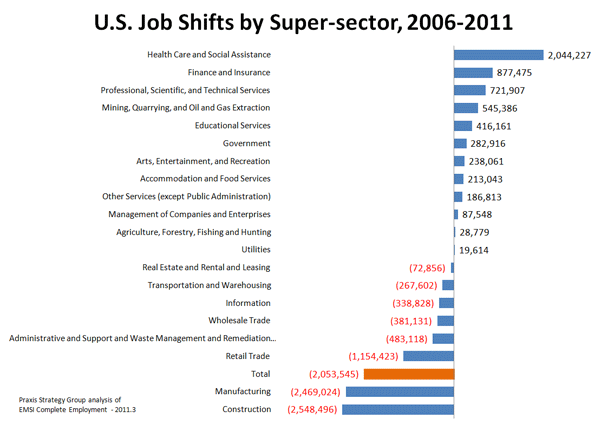
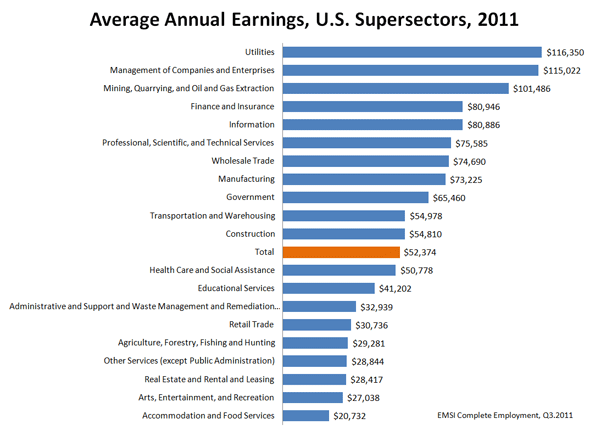
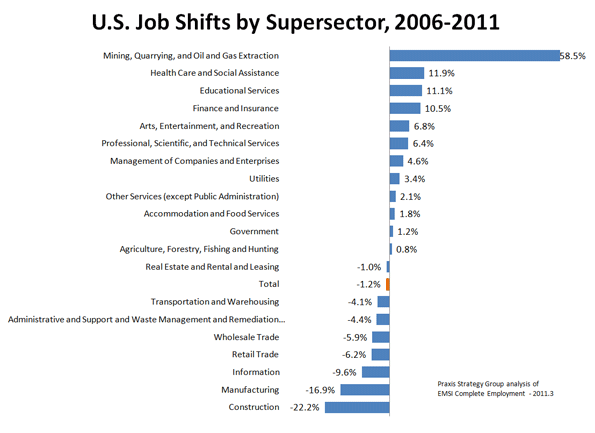
    My colleagues at Praxis Strategy Group and I have looked over data for the period after the economy started to weaken in 2006. Using stats from EMSI, based on data from the Bureau of Labor Statistics, we compared sectors by growth, and then by average salary.

    Not surprisingly “recession-proof” fields such as health care and education expanded some 11% over the past five years. More inexplicably, given its role in detonating the Great Recession, the financial sector expanded some 10%.

    But the biggest growth by far has taken place in the mining, oil and natural gas industries, where jobs expanded by 60%, creating a total of 500,000 new jobs. While that number is not as large as those generated by health care or education, the quality of these jobs are far higher. The average job in conventional energy pays about $100,000 annually — about $20,000 more than finance or professional services pay. The wages are more than twice as high as those in either health or education.

    Nor is this expansion showing signs of slowing down. Contrary to expectations pushed by “peak oil” enthusiasts, overall U.S. oil production has grown by 10% since 2008; the import share of U.S. oil consumption has dropped to 47% from 60% in 2005.  Over the next year, according to one recent industry-funded study, oil and gas could create an additional 1.5 million new jobs.

    This, of course, violates the widespread notion that the future lies exclusively in the information and technology industries. While technology may well be ubiquitous, as a sector it is far from a reliable creator of high-wage jobs. Since 2006 the information sector has hemorrhaged over 330,000 jobs. And those who do have jobs make on average about $20,000 less than their oil-stained counterparts per year.

    How about those “green jobs” so widely touted as the way to recover the lost blue-collar positions from the recession? Since 2006, the critical waste management and remediation sector — a critical portion of the “green” economy — actually lost over 480,000 jobs, 4% of its total employment. Pay here is lower still, averaging something like $32,000 annually, about one-third that of the conventional energy sector.

    The future of the rest of the “green” sector seems dimmer than widely anticipated. One big problem lies in cost per kilowatt, where wind is roughly twice as expensive and solar at least three times as expensive as electricity produced with natural gas. Given the Solydra   bankruptcy  and their inevitable impact on the renewables industry, it’s also pretty certain that the U.S., at least in the near term, will not be powered by windmills and solar panels.

    So instead of tilting windmills or taking out the trash, what about joining the much ballyhooed “creative class”?  Not so great a bet for those limited in talent or nepotism. The arts, entertainment and recreation sector gained about half as many total jobs as energy, and the pay is nothing to write home about. The average salary for these creative souls is about $27,000, slightly higher than for food service workers, but barely a quarter of the average salary for the oil and gas-dominated sector.

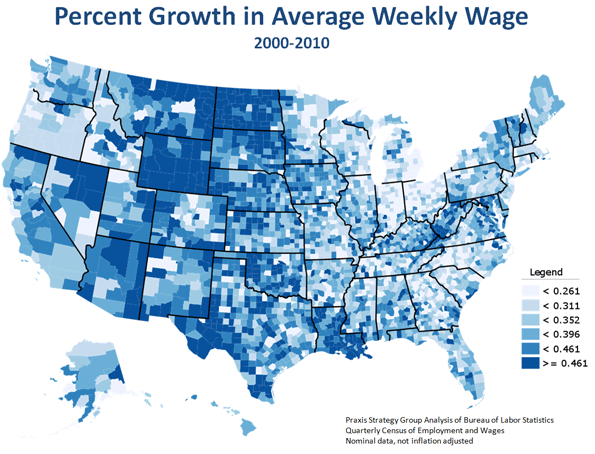
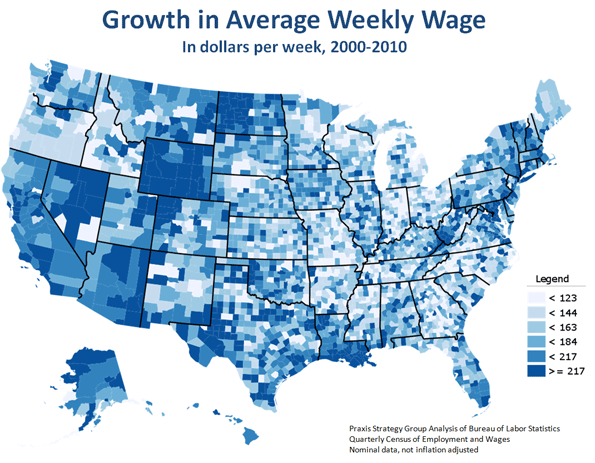
    The relative strength of the energy sector can be seen in changes in income by region over the past decade. For the most part, the largest gains have been heavily concentrated in the energy belt between the Dakotas and the Gulf of Mexico. Energy-oriented metropolitan economies such as Houston, Dallas, Bismarck and Oklahoma City have also fared relatively well. In energy-rich North Dakota there’s actually a huge labor shortage, reaching over 17,000 — one likely to get worse if production expands, as now proposed, from 6000 to over 30,000 wells over the next decade.

    What message does this send to politicians seeking to turn around our moribund economy? Perhaps   they should target oil and gas development as a spur not only to new employment, but to the kind of “good jobs” that Gallup’s Clifton speaks about. With the proper environmental controls, these industries could provide a major jolt to the economy while cutting down on energy imports, reducing debts and bringing jobs back home. As long as Americans consume oil and gas, why not produce close to the market and with reasonable environmental controls?

    The monthly proliferation of new energy finds can provide a much brighter future than many have anticipated. Industry experts say that the shift in energy exploration is moving from the Middle East to the Americas, with rich deposits of oil and gas uncovered from Brazil to the Canadian oil sands.

    Much of the new action is on the U.S. mainland, including the Dakotas, Montana and Wyoming. Increasingly, there’s excitement about finds in long-challenged sections of the Midwest such as Ohio. The Utica shale formation, according to an estimate by Chesapeake Energy, could be worth roughly a half trillion dollars and be, in the words of CEO Aubrey McClendon, “the biggest to hit Ohio, since maybe the plow.”

    Ohio now has over 64,000 wells, with five hundred drilled just year. Recent and potential finds, particularly in the Appalachian basin, could transform the Buckeye State into something of a Midwest Abu Dhabi, creating more than 200,000 jobs over the next decade. The new finds could also help Ohio fund its depleted state coffers without imposing either debilitating budget cuts or economically self defeating new taxes.

    The energy boom also has sparked a spate of new factory expansions, including a $650 million new steel mill to make pipes for gas pipelines. Other local firms are gearing up to make up specialized equipment like compressors.

    Michigan, another perennially hard hit state, is also looking at new energy finds to turbocharge its gradually recovering industrial sector.  While risible former Gov. Jennifer Granholm pushed the notion that Michigan’s recovery lay in “cool cities” and green jobs, the state’s current leaders are focusing on more down-to-earth — and under-the-earth — solutions as part of a strategy to revive industrial production.

    Such growth anywhere is good news, particularly in Midwestern blue-collar towns that have borne the brunt of the recession. Since 2006 manufacturing and construction have shed some 5 million jobs combined — jobs that pay above-average wages, far better than those earned in growing fields such as health care, education or the lower-end service sector.

    The surest road to recovery does not lie in the chimera of “green jobs” or by magically harvesting riches from social networks. It’s in making America a more self-reliant and productive power. The new spate of energy in the Midwest and elsewhere in the country may be one way to do this, if we have the will to take full advantage.

    This piece originally appeared at Forbes.com.

    Joel Kotkin is executive editor of NewGeography.com and is a distinguished presidential fellow in urban futures at Chapman University, and an adjunct fellow of the Legatum Institute in London. He is author of The City: A Global History. His newest book is The Next Hundred Million: America in 2050, released in February, 2010.

    Analysis and charts by Mark Schill, Praxis Strategy Group.

    Photo by flickr user thorinside

  • The Demise Of The Luxury City

    The Republican victory in New York City’s ninth congressional district Sept. 13 — in a special election to replace disgraced Rep. Anthony Weiner — shocked the nation.  But more important, it also could have signaled the end of the idea, propagated by Mayor Michael Bloomberg, of New York’s future as a “luxury product.”

    For a decade, the Bloomberg paradigm has held the city together: Wall Street riches fund an expanding bureaucracy that promotes social liberalism and nanny-state green politics. Indeed, Wall Street’s fortune — guaranteed by federal bailouts and monetary policy under both Presidents George W. Bush and Barack Obama — has been the key to the mayor’s largely self-funded political success. Under Bloomberg, Wall Street’s profits allowed city expenditures to grow 40% faster than the rate of inflation. Bloomberg was also able to buy political peace by bestowing raises two to three times the rate of inflation on the city’s unionized workers.

    Now this calculus is falling apart. Layoffs are mounting on Wall Street, while bonuses — the red meat that fuels everything from high-end condos to expensive boutiques and restaurants — are expected to drop 30% from last year.

    The newly Republican ninth district — stretching from south Brooklyn through the upper-middle-class strongholds around Forest Hills, Queens — reflects growing unease in the non-luxury parts of the city. The area is decidedly middle class, but with a median income of $55,000 it is the city’s least wealthy white district. For the most part, its residents have not benefited from Bloomberg’s management nor from Obama’s economic policies.

    Rather, the district reflects the kind of anxiety that is sweeping middle class areas across the country. “These people are worried about their kids and their future,” says Seth Bornstein, executive director the Queens Economic Development Corp. “The fire may not be in the backyard, but it’s around the corner.”

    Like many native New Yorkers, Bornstein sees Manhattan — the epicenter of the “luxury city” — as something of a “fantasy land,” inhabited by those who, despite living in Gotham’s historic core, are “not really New Yorkers.” Most Manhattanites, he notes, did not grow up in New York, and a majority live in single households. They largely either go to school, work in media or Wall Street, or make their livings servicing the rich.

    The ninth district is different socially as well. It is family-oriented. Barely one-third live in single households, compared with a near majority in Manhattan. Unlike the tony Upper East Side or trendy Soho, there are few celebrities or multi-millionaires. Although some of the ninth district’s inhabitants do work in the financial sector, many are tied to industries such as garments, work as professionals, such as doctors or accountants, or own their own small businesses.

    Some Democrats like California Rep. Henry Waxman have another explanation for the vote: greed. “They want to protect their wealth,” he explained, “which is why a lot of well-off voters vote for Republicans.” You almost have to admire the chutzpah of such views from a man who represents Beverly Hills.

    Waxman, of course, is wrong. This election was driven not by desertions of the rich but by the shift to the GOP among largely middle or working class voters. In many ways this election followed the pattern established by Sen. Scott Brown’s stunning 2009 Massachusetts victory, which came largely from middle-income voters. The ninth district’s new representative, Bob Turner, won big in modest Middle Village and South Brooklyn, while losing decisively in the wealthiest precincts such as Forest Hills and some minority, immigrant-oriented enclaves.

    The big story here, as Bornstein suggests, lies in the growing unease about the national and New York economies among large sections of the city’s beleaguered middle class. Despite the enormous wealth generated on Wall Street, New York’s middle class has been fleeing the city at breakneck speed for decades.

    According to the Brookings Institution, New York has suffered the fastest declines of middle class neighborhoods in the U.S.: Its share of middle income neighborhoods is roughly half that of Seattle or the much maligned Long Island suburbs. Twenty-five percent of New York City was middle-class in 1970, but by 2008 that figure had dropped to 16%.

    Even the young, who so dominate parts of lower Manhattan and Brooklyn, do not appear to be hanging around once they get into their 30s, particularly after their children reach school age. One reason: Bloomberg’s much touted school reforms have been, for the most part, ineffective in turning the bulk of the city’s public schools around.

    Ultimately, the basic truth is this: Bloomberg’s luxury city has failed most of its citizens. Despite its self-celebrated “progressive” image, New York has the most unequal distribution of income in the nation. The bulk of the job growth has not been on Wall Street, where employment has declined over the decade, but in hospitality and restaurants, which pay salaries 60% below the city average. In fact, restaurants are now the largest single private employers in Manhattan, with more people serving tables than trading equities.  As the New York Post quipped: “If you can make it here, you can make it anywhere — as a waiter.”

    It gets worse for the poor. One in five New Yorkers lives in poverty. Black male joblessness hovers at around 50%. Overall, New York’s household income, based on purchasing power, ranks 21st in the nation, behind not only such rich areas as San Francisco or Washington, but also places like Houston, Dallas, Indianapolis, Kansas City and even Pittsburgh.

    Ultimately, suggests Jonathan Bowles, president of the Center for an Urban Future, the future of New York’s middle class depends on reducing dependence on Wall Street.  The city needs to focus on industries and niches outside finance, including education, health, design, high-tech services, media and smaller businesses, many of them owned by immigrants.

    Bowles suggests diversification needs to speed up particularly now that Wall Street, the very engine of the “luxury” economy, is sputtering. Such a change will require a new political climate.  Voter engagement and political choice in New York have atrophied under the Medici-like Bloomberg, who has managed to pay off many interest groups with a combination of his own and the city’s money. Combined with a union-financed get-out-the-vote, the choices offered by the city’s once contentious politics have become increasingly constricted.

    But something is stirring in the boroughs.  The district’s voters not only embarrassed their civic betters by voting Republican, but they also demonstrated that New York’s middle class, politically quiescent under Bloomberg, may need to be taken seriously again.

    This gives hope for what Bornstein calls “the real New York” — a place that is neither particularly glamorous nor severely bifurcated between the rich and those who service their needs. With a more diversified economy and family orientation, this unexpected rebellion could represent the first step toward restoring New York’s roots as a city not of luxury but of aspiration.

    This piece originally appeared at Forbes.com.

    Joel Kotkin is executive editor of NewGeography.com and is a distinguished presidential fellow in urban futures at Chapman University, and an adjunct fellow of the Legatum Institute in London. He is author of The City: A Global History. His newest book is The Next Hundred Million: America in 2050, released in February, 2010.

    Photo by flickr user zoonabar

  • Declining Birthrates, Expanded Bureaucracy: Is U.S. Going European?

    To President Barack Obama and many other Democrats, Europe continues to exercise something of a fatal attraction.  The “European dream” embraced by these politicians — as well as by many pundits, academics and policy analysts — usually consists of an America governed by an expanded bureaucracy, connected by high-speed trains and following a tough green energy policy.

    One hopes that the current crisis gripping the E.U. will give even the most devoted Europhiles pause about the wisdom of such mimicry. Yet the deadliest European disease the U.S. must avoid is that of persistent demographic decline.

    The gravity of Europe’s demographic situation became clear at a conference I attended in Singapore last year. Dieter Salomon, the green mayor of the environmentally correct Freiburg, Germany, was speaking about the future of cities. When asked what Germany’s future would be like in 30 years, he answered, with a little smile,  ”There won’t be a future.”

    Herr Mayor was not exaggerating. For decades, Europe has experienced some of the world’s slowest population growth rates. Fertility rates have dropped well below replacement rates, and are roughly 50% lower than those in the U.S. Over time these demographic trends will have catastrophic economic consequences. By 2050, Europe, now home to 730 million people, will shrink by 75 million to 100 million and its workforce will be 25% smaller than in 2000.

    The fiscal costs of this process are already evident. Countries like Spain, Italy and Greece, which rank among the most rapidly aging populations in the world, are teetering on the verge of bankruptcy. One reason has to do with the lack enough productive workers to pay for generous pensions and other welfare-state provisions.

    Germany, the über-economy of the continent, has little hope of avoiding the demographic winter either.  By 2030 Germany will have about 53 retirees for every 100 people in its workforce; by comparison the U.S. ratio will be closer to 30. As a result, Germany will face a giant debt crisis, as social costs for the aging eat away its currently frugal and productive economy. According to the American Enterprise Institute’s Nick Eberstadt, by 2020 Germany debt service compared to GDP will rise to twice that currently suffered by Greece.

    Europe, of course, is not alone in the hyper-aging phenomena. Japan, South Korea, Taiwan and Singapore face a similar scenario of rapid aging, a declining workforce and gradual depopulation.

    In the past, it seemed likely America would be spared the worst of this mass aging. But there are worrisome signs that our demographic exceptionalism could be threatened. One cause for concern is rapid   decline in immigration, both legal and illegal.  Although few nativist firebrands have noticed, the number of unauthorized immigrants living in the U.S. has decreased by 1 million from 2007.   Legal immigration is also down.  Meanwhile, the number of Mexicans annually leaving Mexico for the U.S. declined from more than 1 million in 2006 to 404,000 in 2010 — a 60% reduction.

    More troubling still, fewer immigrants are becoming naturalized residents.   In 2008, there were over 1 million naturalizations; last year there were barely 600,000, a remarkable 40% drop.

    The drop-off includes most key sending countries, including Mexico, which accounts for 30% of all immigrants. Since 2008 naturalizations have dropped by 65% from North America, 24% from Asia and 28% for Europe.  In fact the only place from which naturalizations are on the rise appears to be Africa, with an 18% increase.

    This drop off, if continued, will have severe consequences. Since 1990 immigrants have accounted for some 45% of all our labor force growth and have increased their share from 9.3% to 15.7% of all workers. These immigrants, and their children, have been one key reason why the U.S. has avoided the deadly demography of Europe and much of east Asia.

    This decline can be traced, in part, by rapid decreases in birthrates among such traditional sources of immigrants such as China, India, Mexico and the rest of Latin America. Mexico’s birthrate, for example, has declined from 6.8 children per woman in 1970 to roughly 2 children per woman in 2011. This drop-off has reduced the number of Mexicans entering the workforce from 1 million annually in the 1990s to about 800,000 today. By 2030, that number will drop to 300,000.

    A second major cause lies with the improved economy in many developing countries like Mexico. According to economist Robert Newell, per-capita  Mexico’s GDP and family income have both climbed by more than 45% over the last 10 years  . Not only are there less children to emigrate, but there’s more opportunity for those who chose to remain.

    Asia not only has lower birthrates, and, for the most part, better performing economies. As a result, immigrants — many of them well educated and entrepreneurially oriented — who in earlier years might have felt the need to come to the U.S. now can find ample opportunities at home. Many educated immigrants and graduate  students, notably from Asia, are not staying after graduation. America’s loss is Asia’s gain.

    Finally the weak U.S. economy is also depressing birthrates to levels well below those of the last decade — birthrates that could soon reach its lowest levels in a century. Generally, people have children when they feel more confident about the future. Confidence in the American future is about as low now as any time since the 1930s.

    Other factors could further depress birthrate. High housing costs and a lack of opportunities to purchase dwellings appropriate for raising children have contributed to the growth of childless households in countries as diverse as Italy and Taiwan. Until now, American home prices — including those for single-family units — were relatively affordable outside of a few large metropolitan areas.

    But now many local and state governments — often with strong support from the Obama Administration — are implementing European-style “smart growth” ideas that would severely restrict the number of single-family houses and drive people into small apartments. For decades, areas with affordable low-density development (such as Houston, Dallas, Nashville, Raleigh and Austin) have attracted the most families. If we become a nation of apartment-dwelling renters, birthrates are likely to slide even further.

    What does this suggest for the American future? History has much to tell us about the relationship between demographics and national destiny. The declines of states — from Ancient Rome to Renaissance Italy and early modern Holland — coincided with drops in birthrates and population.

    To many in Europe our entrance to the ranks of hyper-aging countries would be a welcome development. It would also cheer many academics and greens, and likely some members of the Obama Administration, who might see fewer children as an ideal way to reduce our carbon footprint. Perhaps happiest of all: the authoritarian Mandarins in Beijing who can send their most talented sons and daughters to American graduate schools, increasingly confident they will return home to rule the world.

    This piece originally appeared at Forbes.com.

    Joel Kotkin is executive editor of NewGeography.com and is a distinguished presidential fellow in urban futures at Chapman University, and an adjunct fellow of the Legatum Institute in London. He is author of The City: A Global History. His newest book is The Next Hundred Million: America in 2050, released in February, 2010.

    Photo by flickr user Sigs24141

  • The Crisis of the “Gentry Presidency”

    The Obama administration’s belated attempt to address the looming employment crisis — after three years focused largely on reviving Wall Street, redoing health care and creating a “green” economy — reflects not only ineptitude but a deeper crisis of what is best understood as the “gentry presidency.”

    Unlike previous Democratic presidents, including John F. Kennedy and Bill Clinton, President Barack Obama’s base primarily lies not with the working and middle classes, who would have demanded effective job action, but with the rising power of the post-industrial castes, who have largely continued to flourish even through the current economic maelstrom.

    From the beginning, Obama has been nurtured and supported by an array of influential leaders in finance, technology and real estate who supported his rise. In the run-up to his nomination, he attracted more money from Wall Street than Hillary Clinton, New York’s senator. Later, he pummeled the Republican nominee, Sen. John McCain (R-Ariz.), by a wide margin among financiers.

    To be sure, Obama’s ground game relied on organized labor, particularly public-sector unions, African-Americans, Latinos and progressive activists. But these groups have not emerged stronger from his three years in office.

    Instead, the major winners of the Obama years have been the big nonprofits, venture capitalists and, most obviously, the financial aristocracy. These have all benefited from the Ben Bernanke-Timothy Geithner — previously the Bernanke-Henry Paulson — policy of cheap money and near zero-interest rates, which have depressed the savings of the middle classes but served as a major boon to Wall Street. This has benefited mostly the wealthiest 1 percent, which owns some 40 percent of equities and 60 percent of financial securities.

    This Wall Street-first approach makes Reaganite “trickle down” look like a populist torrent. Glimmers of reality are beginning to dawn on more perceptive progressive analysts, like Kevin Drum of Mother Jones, who accuses the Democrats under Obama of abandoning “the middle class in favor of the rich.” The Democrats, grouses the reliably partisan but perceptive Harold Meyerson, should be known as “Bankers R Us.”

    To be sure, some parts of the old progressive coalition, such as African-Americans, whose prospects have declined markedly under Obama, will most likely remain loyal to the president. Many other working- and middle-class voters, including Latinos and young people, groups particularly hard hit, may not be ready to bolt en masse for the GOP. But their lessened enthusiasm to participate in either the campaign or to vote could threaten the White House next year.

    These developments, as Marxists might put it, reflect the fundamental contradictions of gentry liberalism. Essentially, gentry liberalism reflects the coalescing interests among the financial, technological and academic upper strata. For these people, the Great Recession was brief and ended long ago. All depend heavily on high stock prices to maintain their wealth. Their interest in the overall U.S. economy — particularly the Main Street grass roots — has become ever more tenuous with their increasing ability to shift assets to East Asia and other developing country hot spots.

    These prerogatives have been neatly protected under Obama. In the past, administrations let corporate scofflaws, like the savings and loan companies, collapse. Some were sent to jail.

    But this time, the Wall Street elites have been allowed to skate through their own self-created crisis with astounding agility. Not only have they stayed out of the slammer, but they have been enjoying the best of times.

    This may have also been good news for Manhattan and San Francisco real estate and luxury retail — Tiffany profits were up 25 percent in the past quarter. Silicon Valley venture capitalists, in particular, have been lavished with access to cheap government loans and incentives — as demonstrated by the recent revelations about solar manufacturer Solyndra — to promote their attempted expansion into the ballyhooed “green economy.”

    The essential problem of gentryism, however, is that it fails to address the fundamental economic needs of the vast majority. It is also tied to policy prescriptions that either fail to spur broad-based growth or, in some cases, hinder it.

    For one thing, by concentrating wealth at the top, the gentry approach has depressed entrepreneurialism among the vast middle and working classes. In contrast to past “recoveries,” the rate of new start-ups has slowed considerably. The health of existing small business remains feeble, notes the National Federation of Independent Business.

    Other initiatives have slowed potential growth, particularly the threat of new draconian environmental regulations. Fossil-fuel development, for example, represents one of the best opportunities for new, high-wage employment for blue- and white-collar workers. In contrast, the massive expenditures of public money on “green jobs” has turned out to be less than effective in creating blue-collar employment.

    Equally revealing has been the pathetic performance of states that most fully embraced gentryism. California, an epicenter of the gentry economy, suffers the second-worst unemployment and lowest new business formation rates among all the states. Illinois lost more jobs in August than any other state. The bluest places — New York City and California — also tend to be the most unequal — and places where the middle class is fleeing.

    Whatever the failings of ungentrified Texas — ranging from a too-tattered social safety net and too many low-paying jobs — the rate of employment growth, including the high-tech sector, dwarfs that of key blue states, including California. Denizens of California, New York and other Obama bastions are voting for the Lone Star state with their feet.

    You don’t have to be a fan of Gov. Rick Perry to acknowledge Texas’s relative success compared with the gentry bastions.

    Overall, gentry rule has fostered a sense throughout the American public of national decline and diminishing personal expectations. Small property ownership, the key to a democratic capitalist society, is fraying. Wall Street’s Morgan Stanley, for example, having helped create the housing crisis, now talks boldly of a “rentership” society.

    This would extend the dominion of Wall Street and large landowners, like feudal lords, over the last redoubts of small property owners.

    Clearly, as even many on the left now acknowledge, we need a bold and radical break with gentry politics. Bernanke-ism is absurd — given that, under today’s conditions, a federally sponsored Wall Street boom does not assure prosperity for most. Perhaps it is time to focus instead on how to shift capital and incentives to the grass-roots economy.

    One possible reform would be a flat, or flatter, income tax that eliminates the patently unjust lower rates for capital gains and eliminates dodges for the ultra-rich, while creating greater incentives to individual grass-roots wealth creation. The Obama payroll tax cut represents a small, grudging step in this direction, but may well be too little, too late.

    Such a radical break would most likely cause mass consternation in Washington — as both parties rally to save their friends on Wall Street and a host of special tax breaks that enrich their campaign coffers. Many big money conservatives would shoot back with capitalist indignation while Democrats like Wall Street’s consigliere Sen. Chuck Schumer (D-N.Y.) would come up with more elegant reasons to protect their Wall Street backers.

    But such a suggestion from Obama might show his willingness to end a vassalage to the patrician class that is sinking both the economy and his own reelection chances.

    This piece originally appeared at Politico.

    Joel Kotkin is executive editor of NewGeography.com and is a distinguished presidential fellow in urban futures at Chapman University, and an adjunct fellow of the Legatum Institute in London. He is author of The City: A Global History. His newest book is The Next Hundred Million: America in 2050, released in February, 2010.

    Photo by flickr user Uggaboy

  • Obama’s Economic Trifecta: How The President Helped Kill Progressivism, Capitalism And Moderation

    President Barack Obama‘s “pivot” on jobs this week shows that the president has finally — if belatedly — acknowledged the real misery caused by the Great Recession. However, it does not shed his complicity in the ever deepening employment crisis. Unemployment remains high, exceeding 9% — 16% if you include part-time workers. The percentage of adults in the workforce is bouncing near a 30-year low. And according to a recent Gallup Poll, barely one-fourth of the American public approve of the president’s economic policies.

    Over the past three years, President Obama has done a remarkable job of undermining three very different ideals: progressivism, capitalism and moderation. Progressivism, his own brand, has taken the biggest blow, which may be why so many progressives — particularly environmentalists — have been so critical of their chosen candidate.

    Progressivism’s golden day seemed to have arrived with Obama’s election. But the progressivism embraced by the president was not the middle-class-oriented, growth-inducing kind associated with previous Democrats. Instead, Obama’s progressivism was shaped by his fellow academics, who have enjoyed unprecedented influence in this administration, as well as closely aligned classes such as affluent greens, urban land interests, venture capitalists and the mainstream media.

    Expressing the world view of the well-heeled, Obama’s progressivism did not focus on class mobility and economic growth. The old progressivism’s program was bold and opportunity-oriented: increasing energy supplies (think Tennessee Valley Authority) and encouraging industrial growth through building critical new infrastructure.

    Obama’s stimulus did not seek to increase productivity capacity or create good blue-collar jobs. It largely missed the recession’s biggest victims: minorities, the working class and the young who are well represented of the 1 in 5 Americans now not working.  The president instead chose to service the needs of organized constituencies such as public sector unions, large research universities and “green capitalists.”

    The tragedy is that Obama could have done things differently. A new variation of the Works Progress Administration, for example, would create hundreds of thousands of jobs for the currently unemployed, particularly those under the age of 25. At the same time, it would have created a legacy of tree-planting and road, port and bridge construction, which would have impressed voters of all kinds by actually producing tangible results. Think of all the bridges, public facilities and art bequeathed to us by WPA.

    Instead Obama’s regressive progressivism strangled blue-collar sectors of the economy. Many of his key policy initiatives, particularly in the health and environmental areas, scared businesses from expanding their operations.

    Sadly, the one infrastructure project embraced by the administration — high speed rail — reflected trendy urbanist theory more than common sense. At very best high-speed rail would have served, at an exorbitant cost, a small cadre of tourists and businessmen now capable of getting to the same places by car, plane or Megabus. HSR’s ever rising costs have even led some leftists, such as Mother Jones’ Kevin Drum, to denounce it as “boondoggly.” As Drum sensibly put it, “We have way better uses for the dough.”

    Similarly, Obama’s much ballyhooed “green jobs” have proved an expensive bust. Environmentalists Ted Nordhaus and Michael Shellenberger note there are fewer “green jobs” in Silicon Valley, the industry’s supposed hot bed, today than in 2003. The recent bankruptcy of California-based solar-panel maker Solyndra — recipient of a $500 million federally guaranteed loan — represents just the first of a series of government-backed failures.

    The traditional left is also increasingly persuaded that Obama’s policies have been better for the silk stocking set than the lunch pail crowd. Banks and high-end finance capital have been the biggest beneficiaries of Obama, a peculiar accomplishment for a nominally progressive administration. Wall Street’s subsidized ride to profits — courtesy of TARP and the Bernanke-Geithner fiscal policies — has helped a relative handful of investors and brokers  to enjoy record pay in 2009 and 2010.

    These failures have downgraded the chances for another big stimulus — the prescription most favored on the left — to all but impossible. But left-wing ideology hasn’t been Obama’s only victim; he has also delivered a body blow to the ethos of capitalism itself. For decades conservatives have preached that if we made capital available through a soaring stock market, business would then spend its bounty by reinvesting in the country’s productive capacity. Yet even as the market boomed over the past two years, very little has reached Main Street businesses faced with middle-income customers too skittish to buy their goods and services.

    Obama’s most recent fetish, moderation, also is proving something of a bust. Anxious not to be labeled anti-business, he has surrounded himself not with entrepreneurs but consummate crony capitalists — chief of staff Bill Daley (scion of the Chicago machine family), General Electric‘s Jeffrey Immelt and proposed Commerce Chief John Bryson, who has spent much time as a master manipulator for a large regulated utility. These figures have little or no credibility among grassroots businesspeople. They are seen as being more adept at working the system than succeeding in the free market. If this is what moderation is about, the public has good reason not to trust it.

    So having downgraded progressivism, capitalism and even moderation, Obama’s remaining hope lies in two things: the intrinsic strengths of the U.S. economy and the well-demonstrated ineptitude of his political rivals. He may have helped his cause — to the consternation of his green base — by restraining EPA emissions rules and opening some areas for oil exploration. This could help supercharge the nation’s energy industry, which has added 250,000 new, high-paying jobs since Obama’s election, mostly across the energy belt from Texas to the Dakotas.

    Unencumbered by some of the more draconian EPA rules, America’s increasingly competitive manufacturers should be able to continue boosting exports. The U.S. also retains a big edge in industries from agriculture to software. Just do less egregious harm, and perhaps the economy will come back some on its own.

    And then there’s the gift that keeps giving: the Republican Party. The GOP has no real economic strategy except to cut government and stop higher taxes. Its record on enhancing class mobility, particularly under the Bushes, is less than exemplary; wages barely moved over the George W.’s first five years in office.

    To win this year, the GOP needs to convince enough middle- and working-class voters that it offers something other than a less refined version of the same old insider game, albeit without the annoying professorial rhetoric. In this sense, the recent rush of some former pro-Obama hedge funds to the GOP may represent more of a curse than a blessing since no one, short of Mitt Romney, wants to associate themselves too much with Wall Street.

    The party base’s obsession with antediluvian social views also works to the president’s advantage,  since it distracts from a more  economic focus that would work against Obama’s reelection  . Overt religiosity and social-issue litmus tests are not the best way to win over suburban voters who turned so decisively on the Democrats in 2010.

    For three years President Obama has accomplished a hat trick of economic ineptitude that has downgraded the street cred of progressivism, capitalism and even reason. By all rights, he should be thinking about his profitable future as a post-presidential celebrity. But, for reasons having little to do with his own record, he’ll likely be entering a re-election campaign with a decent chance for another chance to screw up even worse.

    This piece originally appeared at Forbes.com.

    Joel Kotkin is executive editor of NewGeography.com and is a distinguished presidential fellow in urban futures at Chapman University, and an adjunct fellow of the Legatum Institute in London. He is author of The City: A Global History. His newest book is The Next Hundred Million: America in 2050, released in February, 2010.

    Photo courtesy of Barack Obama’s Photostream.

  • The Golden State Is Crumbling

    The recent announcement that California’s unemployment again nudged up to 12 percent—second worst in the nation behind its evil twin, Nevada—should have come as a surprise but frankly did not. From the beginning of the recession, the Golden State has been stuck bringing up a humbled nation’s rear and seems mired in that less-than-illustrious position.

    What has happened to my adopted home state of over last decade is a tragedy, both for Californians and for America. For most of the past century, California has been “golden” not only in name but in every kind of superlative—a global leader in agriculture, energy, entertainment, technology, and most important of all, human aspiration.

    In its modern origins California was paean to progress in the best sense of the word. In 1872, the second president of the University of California, Daniel Coit Gilman, said science was “the mother of California.” Today, California may worship at the altar of science, but increasingly in the most regressive, hysterical, and reactionary way.

    California’s dominant ruling class—consisting of public-employee unions, green jihadis, and Democratic machine politicians—has no real use for science as Gilman saw it: as a way to create prosperity for its citizens. Instead, the prevailing credo of the state has been how to do everything possible to return to its pre-settlement condition, with little regard for what that means to the average Californian.

    Nowhere was California’s old technological ethos more pronounced than in agriculture, where great Californians such as William Mulholland, creator of the Los Angeles Aqueduct, and Pat Brown, who forged the state water project, created the greatest water-delivery system since the Roman Empire. Their effort brought water from the ice-bound Sierra Nevada mountains down to the state’s dry but fertile valleys and to the great desert metropolis of Southern California. Now, largely at the behest of greens, California agriculture is being systematically cut down by regulation. In an attempt to protect a small fish called the Delta smelt, upward of 200,000 acres of prime farmland have been idled, according to the state’s Department of Conservation. Even in the current “wet” cycle, California’s agricultural industry, which exports roughly $14 billion annually, is slowly being decimated. Unemployment in some Central Valley towns tops 30 percent, and in cases even 40 percent.

    And now, notes my friend, Salinas Mayor Dennis Donohue, green regulators are imposing new groundwater regulations that may force the shutdown of production even in areas like his that have their own ample water supplies.

    Salinas was the home town of John Steinbeck, author of The Grapes of Wrath and great chronicler of Depression-era California. Today for many in hardscrabble, majority-Latino Salinas, home to 150,000 people, The Grapes of Wrath is less lyrical than real. “California,” notes Donohue, a lifelong Democrat, “remains intent on job destruction and continued hyper-regulation.”

    California’s pain is not restricted to farming towns. The state’s regulatory vigilantes have erected a labyrinth of rules that increasingly makes doing almost anything that might contribute to increased carbon emissions—manufacturing, conventional energy, home construction—extraordinarily onerous. Not surprisingly, the state has not gained middle-skilled jobs (those requiring two years of college or more) for a decade, while the nation boosted them by 5 percent and archrival Texas by a stunning 16 percent over the same time period.

    There is little chance that the jobs lost in these fields will ever be recovered under the current regime. As decent blue-collar and midlevel jobs disappear, California has gone from a rate of inequality about the national average in 1970, to among the most unequal in terms of income. The supposed solution to this—Gov. Jerry Brown’s promise of 500,000 “green jobs”—is being shown for what it really is, the kind of fantasy you tell young children so they will go to sleep.

    Many Californians who aren’t slumbering are moving out of the state—and not only the pathetic remains of the old Reaganite majority. According to the most recent census, those leaving the state include old boomers, middle-aged families, and increasingly, many Latinos as well. Outmigration rates from places like Los Angeles and the Bay Area now rival those of such cities as Detroit. In the last decade, California’s population grew only 10 percent, about the national average, largely due to immigrants and their offspring. Population increases in the Bay Area were less than half that rate, while the City of Los Angeles gained fewer new residents—less than 100,000—than in any decade since the turn of the last century!

    Increasingly, California no longer beckons ambitious newcomers, except for a handful of the most affluent, best educated, and well connected. Through the 1980s and even through the late ’90s, the aspirational classes came to California. Now they head to other, more opportunity-friendly places like Austin, Houston, Dallas, Raleigh-Durham, even former “dust bowl” burghs like Des Moines, Omaha, and Oklahoma City. Meanwhile, Golden California, particularly its expensive, ultragreen coast, gets older and older. Marin County, the onetime home of the Grateful Dead and countless former hippies, is now one of the grayest urban counties in the country, with a median age of 44.

    Of course, the self-described “progressive” mafia that runs California will point to Silicon Valley and its impressive array of startups. But for the most part, firms like Google, Twitter, and Facebook employ only a small cadre of highly educated workers. Overall, during the past decade the state’s high-tech employment fell by almost 4 percent, while Texas’s science-based employment grew by a healthy 11 percent. The sad reality is that turning T-shirt-wearing kids like Mark Zuckerberg into multibillionaires doesn’t do much to reduce unemployment, which even in San Jose—the largely blue-collar “capital” of Silicon Valley—now hovers around 10 percent.

    Magazine cover stories and movies cannot obscure the fact that entrepreneurial growth—the state’s most critical economic asset—has now stalled. In fact, according to a study by Economic Modeling Specialists Inc., last year the Golden State ranked 50th among the states in creating new businesses.

    California remains rich in promise, home to spectacular scenery; a great Pacific location; leading firms like Apple and Disney; and a still-impressive residue of talented, diverse, entrepreneurial, and ingenious people. But the state will never return until the success of the current crop of puerile billionaires can be extended to enrich the wider citizenry. Until the current regime is toppled, California’s decline—in moral as well as economic terms—will continue, to the consternation of those of us who embraced it as our home for so many years.

    This piece originally appeared at The Daily Beast.

    Joel Kotkin is executive editor of NewGeography.com and is a distinguished presidential fellow in urban futures at Chapman University, and an adjunct fellow of the Legatum Institute in London. He is author of The City: A Global History. His newest book is The Next Hundred Million: America in 2050, released in February, 2010.

    Photo by wstera2.

  • What Does Rick Perry Have To Do With Texas’ Success?

    You don’t have to like Rick Perry or his sometimes scary neo-confederate politics to admire what has been happening in Texas over the past decade. Rather than trashing the state in order to demean its governor, perhaps the mainstream media should be thinking about what the Lone Star’s success story means for the rest of the country.

    Texas has done what most of other states — notably the blue coastal ones — have failed to do: create jobs. Over the past decade Texas has created 2.1 million jobs — while New York, California, Massachusetts and Illinois have all lost jobs.

    Its relative performance since 2009 has been even more stellar, producing nearly 40% of all new jobs in the U.S. Its unemployment rate stands at 8.2, well below the national average of 9.1 — an outstanding feat given the fact that the state grew 20%, twice the national average, over the decade. Texas is creating jobs for a growing workforce, while other states like New York or Massachusetts struggle to keep up with stagnant or even declining ones.

    Some self-proclaimed progressives like Paul Krugman attribute Texas’ success to population growth and the attraction of low-wage jobs for rapacious employers.

    “It is interesting how, suddenly, not having a job is better than working at a low-paying one,” notes architect and developer Tim Cisneros. True, many of the new jobs in Texas, as elsewhere, pay low wages and do not offer health benefits. But, says Cisneros, insisting that all the new jobs in Texas are low-paying is just not credible. “When you see the new hospitals and the new headquarters being built by Exxon here in Houston you can see there are lots of different opportunities,” Cisneros says.

    As Cisneros points out, people are not flocking to Texas for the privilege of being exploited any more than they come for the 100 degree summer heat. Many — and not only low-skilled campesinos — come for opportunities, including well-paying ones, that are not as readily available elsewhere.

    According to research conducted by the Praxis Strategy group, Texas has boosted mid-skill jobs — those that require two years or more of post-secondary education — by 16% in the past decade, That’s the third-highest rate in the nation (after much smaller Wyoming and Utah) and three times the national average. In contrast, New York has grown such positions by less than 5%, while California and Massachusetts have expanded them by less than 2%. Illinois, President Barack Obama’s home turf, was among the few states to actually lose mid-skill jobs.

    This pattern also applies to the high-tech and science-based industries. Over the past decade Texas’ number of STEM (science, technology, engineering and math-related) jobs has surged by 11%, one of the fastest rates among the states and four times the national average. California, Massachusetts and Illinois all lost positions in these fields.

    Another reason people go to Texas is their wages get them more there than in the big blue metros. For example, houses in Dallas, Austin or Houston cost three times the median income in these areas — or less. That ratio is twice as high, or higher, in places like New York, San Francisco or Los Angeles.

    These factors — job growth and lower costs — may not matter much to “trustifarians” or tenured professors who increasingly dominate the politics of the American left. But they have made Texas cities irresistible for almost every demographic in America, from boomers to the “young and restless” to families. For good measure, the state’s high-tech mecca, Austin, ranked third in attracting college-educated residents — well ahead hip centers like San Francisco, Boston, New York or Los Angeles.

    To be sure, Texas has benefited from higher energy prices, as Perry’s detractors point out.  According to an analysis by the EMSI economic forecasting group, the energy sector jumped from over 230,000 jobs in 2001 to just under 490,000 in 2011. That’s roughly 10% of all the state’s overall job gains. This parallels job growth in other states that have experienced surges in energy-related employment — such as North Dakota and Wyoming.

    But some of this has to do with making your own “luck.” Energy-rich California has all but declared war on its fossil fuel industry, once one of the nation’s most important. Instead, the state has placed lavish bets on renewable fuel and the much ballyhooed notion that “green jobs” could provide a massive base for new employment — something even the green-friendly New York Times has called “a pipe dream.”  In fact, employment in this field has actually started to tick down, and the prospect of ever higher energy prices associated with “clean” fuels could prove another nail in California’s economic coffin.

    So how much of Texas’ relative success is due to Perry and his fiscal policies? Some — but not too much. Perry has faced budget shortfalls based in part on an expanding state government that has grown through the recession: Texas, notes EMSI’s Joshua Wright, is one of only 10 states where state and local government jobs have grown since 2009, rising by almost 30,000 positions. “These numbers don’t exactly bolster Perry’s small-government agenda claims,”says Wright. Free-marketers also point out that Perry clearly favored, sometimes with state funds, people who had the foresight to back his political career.

    But Perry has won business support for things other than naked cronyism. Jim DeCosmo, CEO of the Austin-based Forestar Group, credits Perry with maintaining a business-friendly regulatory regime and with important steps for tort reform. These, he feels, both encourage Texas businesses to expand in the state and for out-of-state companies to move in.

    Most of the credit for Texas’ success lies primarily in the state’s economic culture. Rice University urban scholar Michael Emerson notes that Texas’ pro-business tilt started well before Perry, and is not restricted to the GOP. Many of the state’s most prominent Democrats — including the man Perry beat for governor last year, former Houston Mayor  Bill White — have been strong advocates of economic growth and across-the-board energy development.

    “I do not feel Perry has   much to do with Texas’ success,” says Houston real estate mogul David Wolff , who last year backed both a GOP challenger to Perry and, later, White. “But at least you can say that he has not appeared to hinder it.”

    In fact, Texas’ current and, more so, future prosperity might be better served  if a pragmatist like White ruled the Lone Star State. Perry’s ideological rigidity on spending and social issues may not be the best fit for a state facing massive ethnic change, including a future Latino majority. And as the state becomes more high-tech oriented, education of its surging workforce will grow as a concern, something that Perry does not seem to see as a priority.

    Yet despite the state’s shortcomings — and those of its current governor –  Texas’ success remains remarkable, particularly in comparison with that of the other major states. Rigid adherence to low taxes and light regulation may  not be the panacea for all economic problems but the opposite approach of ever higher taxes and debilitating regulation clearly has failed in terms of creating jobs and opportunities.

    Rather than demean the Lone Star state, perhaps progressives should begin demonstrating an alternative approach for American prosperity that might actually work someplace other than in the fevered imaginations of academics and pundits.

    This piece originally appeared at Forbes.com.

    Joel Kotkin is executive editor of NewGeography.com and is a distinguished presidential fellow in urban futures at Chapman University, and an adjunct fellow of the Legatum Institute in London. He is author of The City: A Global History. His newest book is The Next Hundred Million: America in 2050, released in February, 2010.

    Photo by Gage Skidmore.