Author: Joel Kotkin

  • The U.K. Riots And The Coming Global Class War

    The riots that hit London and other English cities last week have the potential to spread beyond the British Isles. Class rage isn’t unique to England; in fact, it represents part of a growing global class chasm that threatens to undermine capitalism itself.

    The hardening of class divisions    has been building for a generation, first in the West but increasingly in fast-developing countries such as China. The growing chasm between the classes has its roots in globalization, which has taken jobs from blue-collar and now even white-collar employees; technology, which has allowed the fleetest and richest companies and individuals to shift operations at rapid speed to any locale; and the secularization of society, which has undermined the traditional values about work and family that have underpinned grassroots capitalism from its very origins.

    All these factors can be seen in the British riots. Race and police relations played a role, but the rioters included far more than minorities or gangsters. As British historian James Heartfield has suggested, the rioters reflected a broader breakdown in “the British social system,” particularly in “the system of work and reward.”

    In the earlier decades of the 20th century working class youths could look forward to jobs in Britain’s vibrant industrial economy and, later, in the growing public sector largely financed by both the earnings of the City of London and credit. Today the industrial sector has shrunk beyond recognition. The global financial crisis has undermined credit and the government’s ability to pay for the welfare state.

    With meaningful and worthwhile work harder to come by — particularly in the private sector — the prospects for success among Britain working classes have been reduced to largely fantastical careers in entertainment, sport or all too often crime. Meanwhile, Prime Minister David Cameron’s supporters in the City of London may have benefited from financial bailouts arranged by the Bank of England, but opportunities for even modest social uplift for most other people have faded.

    The great British notion of idea of working hard and succeeding through sheer pluck — an idea also embedded in the U.K.’s former colonies, such as the U.S. — has been largely devalued.  Dick Hobbs, a scholar at the London School of Economics, says this demoralization  has particularly affected white Londoners. Many immigrants have thrived doing engineering and construction work as well as in trades providing service to the capital’s affluent elites.

    A native of east London himself, Hobbs  maintains that the industrial ethos, despite its failings, had great advantages. It centered first on production and rewarded both the accumulation of skills. In contrast, by some estimates, the pub and club industry has been post-industrial London’s largest source of private-sector employment growth, a phenomena even more marked in less prosperous regions. “There are parts of London where the pubs are the only economy,” he notes.

    Hobbs claims that the current “pub and club,” with its “violent potential and instrumental physicality,” simply celebrates consumption often to the point of excess. Perhaps it’s no surprise that looting drove the unrest.

    What’s the lesson to be drawn?  The ideologues don’t seem to have the answers. A crackdown on criminals — the favored response of the British right — is necessary but does not address the fundamental problems of joblessness and devalued work. Similarly the left’s favorite panacea, a revival of the welfare state, fails to address the central problem of shrinking opportunities for social advancement.  There are now at least 1 million unemployed young people in the U.K., more than at any time in a generation, while child poverty in inner London, even during the regime of former Mayor “red Ken” Livingstone last decade, stood at 50% and may well be worse now.

    This fundamental class issue is not only present in Britain. There have been numerous outbreaks of street violence across Europe, including in France and Greece. One can expect more in countries like Italy, Spain and Portugal, which will now have to impose the same sort of austerity measures applied by the Cameron government in London.

    And how about the United States? Many of the same forces are at play here. Teen unemployment currently exceeds 20%; in the nation’s capital it stands at over 50%. Particularly vulnerable are expensive cities such as Los Angeles and New York, which have become increasingly bifurcated between rich and poor. Cutbacks in social programs, however necessary, could make things worse, both for the middle class minorities who run such efforts as well as their poor charges.

    A possible harbinger of this dislocation, observes author Walter Russell Mead, may be the recent rise of  random criminality, often racially tinged, taking place in American cities such as Chicago, Milwaukee and Philadelphia.

    Still, with over 14 million unemployed nationwide, prospects are not necessarily great for white working- and middle-class Americans. This pain is broadly felt, particularly by younger workers. According to a Pew Research survey,  almost 2 in 5 Americans aged 18 to 19 are unemployed or out the workforce, the highest percentage in three decades.

    Diminished prospects — what many pundits praise as the “new normal” — now confront a vast proportion of the population. One indication: The expectation of earning more money next year has fallen to the lowest level in 25 years. Wages have been falling not only for non-college graduates but  for those with four-year degree as well.   Over 43% of non-college-educated whites complain they are downwardly mobile.

    Given this, it’s hard to see how class resentment in this country can do anything but grow in the years. Federal Reserve Chairman Ben Bernanke claimed as early as 2007 that he was worried about growing inequality in this country, but his Wall Street and corporate-friendly policies have failed to improve the grassroots economy.

    The prospects for a widening class conflict are clear even in China, where social inequality is now among the world’s worse . Not surprisingly, one survey conducted  the Zhejiang Academy of Social Sciences   found that 96% of respondents “resent the rich.”  While Tea Partiers and leftists in the U.S. decry the colluding capitalism of the Bush-Obama-Bernanke regime, Chinese working and middle classes confront a hegemonic ruling class consisting of public officials and wealthy capitalists. That this takes place under the aegis of a supposedly “Marxist-Leninist regime” is both ironic and obscene.

    This expanding class war creates more intense political conflicts. On the right the Tea Party — as well as rising grassroots European protest parties in such unlikely locales as Finland, Sweden and the Netherlands — grows in large part out of the conviction that the power structure, corporate and government, work together to screw the broad middle class. Left-wing militancy also has a class twist, with progressives increasingly alienated by the gentry politics of the Obama Administration.

    Many conservatives here, as well as abroad, reject the huge role of class.  To them, wealth and poverty still reflect levels of virtue — and societal barriers to upward mobility, just a mild inhibitor. But modern society cannot run according to the individualist credo of Ayn Rand; economic systems, to be credible and socially sustainable, must deliver results to the vast majority of citizens. If capitalism cannot do that expect more outbreaks of violence and greater levels of political alienation — not only in Britain but across most of the world’s leading countries, including the U.S.

    This piece originally appeared at Forbes.com.

    Joel Kotkin is executive editor of NewGeography.com and is a distinguished presidential fellow in urban futures at Chapman University, and an adjunct fellow of the Legatum Institute in London. He is author of The City: A Global History. His newest book is The Next Hundred Million: America in 2050, released in February, 2010.

    Photo by Beacon Radio.

  • How Los Angeles Lost Its Mojo

    Los Angeles today is a city in secular decline. Its current political leadership seems determined to turn the sprawling capitalist dynamo into a faux New York. But they are more likely to leave behind a dense, government-dominated, bankrupt, dysfunctional, Athens by the Pacific.

    The greatness of Los Angeles stemmed from its willingness to be different. Unlike Chicago or Denver or New York, the Los Angeles metro area was designed not around a central core but on a series of centers, connected first by railcars and later by the freeways. The result was a dispersed metropolis where most people occupied single-family houses in middle-class neighborhoods.

    Lured by the pleasant climate and a business-dominated political economy, industries and entrepreneurs flocked to the region. Initially, the growth came largely from oil and agriculture, followed by the movie industry. Defense and aerospace during World War II and the postwar era fostered a vast industrial base, and by the 1980s Los Angeles had surpassed New York as the nation’s largest port, and Chicago as the nation’s leading industrial center.

    The region hit a rough spot as the end of the Cold War led to massive federal cutbacks in aerospace. Los Angeles County lost nearly 500,000 jobs between 1990 and 1993. But it bounced back, adding nearly 400,000 jobs between 1993 and 1999. Aerospace never fully recovered, but other parts of the industrial belt—including the port and the apparel and entertainment industries—grew. An entrepreneurial class of immigrants—Middle Eastern, Korean, Chinese, Latino—launched new businesses in everything from textiles and ethnic food to computers. The pro-business mayoralty of Richard Riordan and the governorship of Pete Wilson restored confidence among the city’s beleaguered companies.

    Then progress stalled. Employment stayed relatively flat from 2001 until 2005, when Mayor Antonio Villaraigosa was elected, and then started to drop. As of this March, over the entire L.A. metropolitan area, which includes adjacent Orange County, unemployment was 11.4%—the third-highest unemployment rate of the nation’s 20 largest metro areas.

    Why has Los Angeles lost its mojo? A big reason is a decline in the power and mettle of the city’s once-vibrant business community. Between the late 1980s and the end of the millennium, many of L.A.’s largest and most influential firms—ARCO, Security Pacific, First Interstate, Union Oil, Sun America—disappeared in a host of mergers that saw their management shift to cities like London, New York and San Francisco. Meanwhile, says David Abel, a Democratic Party activist and publisher of the influential Planning Report, once-powerful groups like the Los Angeles Chamber of Commerce and the Los Angeles County Economic Development Corporation lost influence.

    The machine that now controls Los Angeles by default consists of an alliance between labor and the political leadership of the Latino community, the area’s largest ethnic population. But since politicians serve at the whim of labor interests, they seldom speak up for homeowners and small businesses.

    Mayor Villaraigosa, a former labor organizer, has little understanding of private-sector economic development beyond well-connected real-estate interests whom he has courted and which have supported him. He has been a strong backer of L.A. Live, a downtown ports and entertainment complex, and other projects that have benefited from favorable tax treatment and major public infrastructure investments. He’s currently supporting a push to build a new downtown football stadium, though L.A. has no professional football team. His biggest priority is to build the so-called subway to the sea, a $40 billion train line to connect downtown with the Pacific.

    But L.A.’s downtown employs a mere 2.5% of the region’s work force; New York’s central business districts, by contrast, employ roughly 20%. “To put the entire focus of development on downtown L.A.,” says Ali Modarres, chairman of the geography department at Cal State Los Angeles, “is to ignore the historical, cultural, economic [and] social forces that have shaped the larger geography of this metropolitan area.”

    Moreover, the mayor’s accent downtown is on housing, not manufacturing. And as Cecilia Estolano, former head of the Community Redevelopment Agency, points out, “downtown housing simply doesn’t create the jobs that small manufacturers do.”

    Meantime, business-strangling regulations proliferate, often with support from a powerful and well-heeled environmental movement, which Mr. Villaraigosa counts on for political support and media validation. There are draconian moves to control emissions at the port from ships and trucks. Also harmful are the city’s efforts to expand the unions’ presence from the docks to the entire network of trucks serving the port—essentially forcing out independent carriers, many of them Latino entrepreneurs, in favor of larger firms using Teamster drivers.

    Such policies could backfire, says economist John Husing, leading shippers to transfer their business to cheaper and less heavily regulated ports such as Charleston, Houston, Savannah and other growth-oriented southern cities. This is particularly dangerous given the planned 2014 widening of the Panama Canal, which will make Southeastern ports far more competitive for Asia-based trade. Mr. Husing notes that L.A.’s port is the largest generator of blue-collar employment in the region.

    Even some liberal Democrats are beginning to realize that the current system isn’t sustainable. Writing recently in the Los Angeles Business Journal, Roderick Wright, a Democratic state senator from south Los Angeles, compared the state and local governments with the Mafia. The “vig” that government takes from local businesses, Mr. Wright argued—both in taxes and in the cost of regulation—has undermined job creation, particularly in working-class districts like his. He also warned that renewable-energy mandates recently imposed by the state would boost the cost of energy in the region, already 53% above the national average, by an additional 20% to 25%.

    Who will challenge the machine and its ruinous economic policy? It’s not likely to be the city’s enervated business sector. But the city’s working and middle classes might, says Ron Kaye, former editor of the San Fernando Valley–based Daily News. He points to the city’s remaining middle-class homeowners, who are concentrated in the San Fernando Valley but also occupy a number of diverse neighborhoods. “These are the places that reflect the whole idea of L.A., as opposed to the Villaraigosa vision of a city of apartment dwellers,” Mr. Kaye says.

    It is uncertain if Los Angeles will experience the Sunshine Revolution it so desperately needs. What is certain is that only when the machine and its masters no longer dictate L.A.’s fate can this diverse and dynamic region resume its ascent toward greatness.

    This piece originally appeared in the Wall Street Journal and is adapted from the Summer 2011 edition of The City Journal.

    Joel Kotkin is executive editor of NewGeography.com and is a distinguished presidential fellow in urban futures at Chapman University, and an adjunct fellow of the Legatum Institute in London. He is author of The City: A Global History. His newest book is The Next Hundred Million: America in 2050, released in February, 2010.

    Photo by pinchof

  • California Wages War On Single-Family Homes

    In recent years, homeowners have been made to feel a bit like villains rather than the victims of hard times, Wall Street shenanigans and inept regulators. Instead of being praised for braving the elements, suburban homeowners have been made to feel responsible for everything from the Great Recession to obesity to global warming.

    In California, the assault on the house has gained official sanction. Once the heartland of the American dream, the Golden State has begun implementing new planning laws designed to combat global warming. These draconian measures could lead to a ban on the construction of private residences, particularly on the suburban fringe. The new legislation’s goal is to cram future generations of Californians into multi-family apartment buildings, turning them from car-driving suburbanites into strap-hanging urbanistas.

    That’s not what Californians want: Some 71% of adults in the state cite a preference for single-family houses. Furthermore, the vast majority of growth over the past decade has taken place not in high-density urban centers but in lower-density peripheral areas such as Riverside-San Bernardino. Yet popular preferences mean little in a state where environmental zealotry increasingly dictates how people should live their lives.

    Some advocates do cite market forces to justify their policies. Economists on the left and right have cited the recent housing bust as proof that homes are not great investments, suggesting people would be better off leaving their money to the tender mercies of Wall Street speculators. Some demographers also suggest that young people will choose to live in high-density regions throughout their lives and that as boomers age they too will opt out of suburbs for urban apartment living.

    These “facts” may be more grounded in academic mythology than reality. Some widely quoted experts, like the Anderson Forecast at UCLA, cite Census information to say that demographics are shifting demand from single-family homes to condos and apartments, although the Census asked no such question. These experts also fail to address why condo prices have dropped even more in the major California markets than single-family home prices; the percentage of starts that come from single-family houses shifts from year to year, but last year’s number tracks around the same level as seen in the 1980s.

    Perhaps the biggest weakness in the analysis lies with long-term demographic factors. As I wrote last week, many of the “young and restless” folks whom city planners try to court tend to move into suburbs and affordable low-density regions as they grow older and begin starting families. Similarly, the vast majority of boomers, according to AARP, want to remain in their old homes as long as possible. Most of those homes are located in suburban, low- to medium-density neighborhoods.

    But who needs facts when you have religion? Take the Association of Bay Area Governments (ABAG) and Metropolitan Transit Commission’s (MTC) new “sustainable communities strategy,” a document designed to meet the requirements of the state’s draconian anti-greenhouse gas legislation.

    This “strategy” seeks to all but reduce growth in the region’s lower-density outer fringe – eastern Contra Costa County as well as the Napa, Vallejo and Santa Rosa metropolitan areas — which grew more than twice as fast as the core and inner suburbs. Instead the ABAG-MTC projects a soaring increase in demand for high-density housing and its latest “vision” report calls for 97% of all the region’s future housing be built in urban areas, virtually all of it multi-family apartments, to accommodate an estimated 2 million residents

    The projections underpinning ABAG’s strategy are absurd. Over the past decade the population of the region’s historic core cites San Francisco and Oakland — where much of the dense growth would be expected to take place — increased by 1.7%, compared with 6.5% for the suburbs. Overall regional growth stood at a modest 5.1%, roughly half that of the previous decade and just about half of the national and state averages.

    Given this record, a more reasonable assumption would be population growth at something closer to 1 million, half the projected amount. Assumptions about the economy to support even this growth are also dubious. The ABAG report, for example, fantasizes that by 2030 the Bay Area will increase its employment by 900,000 — a neat trick for an area that overall lost 300,000 positions over the past decade.

    So, why wage war on the house? Some greens seem to regard the single-family house as an assault on eco-consciousness. Yet in many cases, these objections are overstated. Research supporting higher-density housing , for example, has routinely excluded the greater emissions from construction material extraction and production, building construction itself and& greenhouse gas emissions from common areas like parking levels, entrances and elevators.

    Further, higher densities are associated with greater congestion, which retards fuel efficiency and increases greenhouse gas emissions, a factor not sufficiently considered. Given that less than 10% of Bay Area residents take transit — and barely 3% in its economic engine Silicon Valley — higher density likely would create greater, not fewer, emissions.

    The ABAG report also studiously avoids mentioning the potential greenhouse gas reductions to be had by expanding telecommuting, which is growing six times faster than the fervently pushed transit commuting in the region. The Silicon Valley already has 25% more telecommuters than transit users. Clearly, by pushing telecommuting, you could get big reductions in GHG without a “cramming” agenda.

    Ultimately the density agenda reflects less a credible strategy to reduce GHG than a push among planners to “force” Californians, as one explained to me, out of their homes and into apartments. In pursuit of their “cramming” agenda planners have also enlisted powerful allies – or perhaps better understood as ”useful idiots” — developers and speculators who see profit in the eradication of the single family by forcibly boosting the value of urban core properties.

    In the end, however, substituting religion for markets and people’s preferences is counterproductive. For one thing, people “forced” to live densely will find other places to live the way they like — even if it means leaving California. This is already happening to middle class families in places like San Francisco and may soon be true of California’s traditionally middle-class-friendly interior as well.

    In the end, two markets are likely to grow in the Bay Area. One is low-end rental housing for students and an expanding servant class — after all Google millionaires need people to walk their dogs and paint their toenails. The other is luxury retirement facilities for the region’s growing population of aging affluents. Once a self-consciously “cool” youth magnet, Marin County, for example, is now one of the country’s oldest urban counties, with a median age of 44.5; San Francisco is headed in the same direction.

    Developers can drool over the prospects of building high-end assisted living joints for all those aging hippies who made their bundle during the state’s glory days and settled into places like Mill Valley. After all, unlike young families, these affluent oldsters will be able to afford indulging in the state’s mild climate, natural food restaurants and brilliant scenery. And with easily accessible medical marijuana and a good sound system for playing Grateful Dead recordings, the gray-ponytail set could be in for a hell of a good time, at least as long as it lasts.

    This piece originally appeared at Forbes.com.

    Joel Kotkin is executive editor of NewGeography.com and is a distinguished presidential fellow in urban futures at Chapman University, and an adjunct fellow of the Legatum Institute in London. He is author of The City: A Global History. His newest book is The Next Hundred Million: America in 2050, released in February, 2010.

    Photo by Mike Behnken

  • Why America’s Young And Restless Will Abandon Cities For Suburbs

    For well over a decade urban boosters have heralded the shift among young Americans from suburban living and toward dense cities. As one Wall Street Journal report suggests, young people will abandon their parents’ McMansions for urban settings, bringing about the high-density city revival so fervently prayed for by urban developers, architects and planners.

    Some demographers claim that “white flight” from the city is declining, replaced by a “bright flight” to the urban core from the suburbs. “Suburbs lose young whites to cities,” crowed one Associated Press headline last year.

    Yet evidence from the last Census show the opposite: a marked acceleration of movement not into cities but toward suburban and exurban locations. The simple, usually inexorable effects of maturation may be one reason for this surprising result. Simply put, when 20-somethings get older, they do things like marry, start businesses, settle down and maybe start having kids.

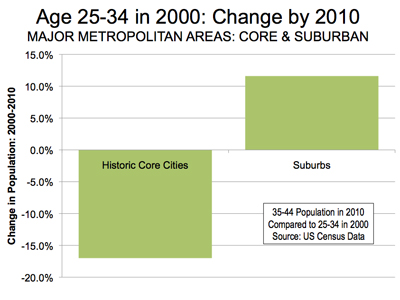
    An analysis of the past decade’s Census data by demographer Wendell Cox shows this. Cox looked at where 25- to 34-year-olds were living in 2000 and compared this to where they were living by 2010, now aged 35 to 44. The results were surprising: In the past 10 years, this cohort’s presence grew 12% in suburban areas while dropping 22.7% in the core cities. Overall, this demographic expanded by roughly 1.8 million in the suburbs while losing 1.3 million in the core cities.

    In many ways this group may be more influential than the much ballyhooed 20-something. Unlike younger adults, who are often footloose and unattached, people between the ages of 35 and 44 tend to be putting down roots. As a result, they constitute the essential social ballast for any community, city or suburb.

    Losing this population represents a great, if rarely perceived, threat to many regions, particular older core cities. Rust Belt centers such as Cleveland and Detroit have lost over 30% of this age group over the decade.

    More intriguing, and perhaps counter-intuitive, “hip and cool” core cities like San Francisco, New York and Boston have also suffered double-digit percent losses among this generation. New York City, for example, saw its 25 to 34 population of 2000 drop by over 15% — a net loss of over 200,000 people — a decade later. San Francisco and Oakland, the core cities of the Bay Area, lost more than 20% of this cohort over the decade, and the city of Boston lost nearly 40%.

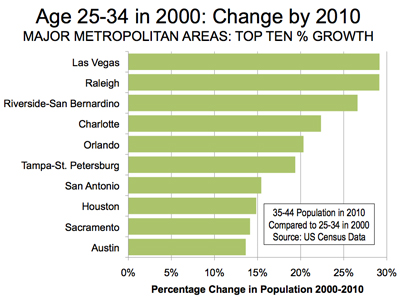
    In contrast, the largest growth among this peer group took place in metropolitan areas largely suburban in form, with a strong domination by automobiles and single-family houses. The most popular cities among this group — with increases of over 10% — were Las Vegas; Raleigh, N.C.; Riverside-San Bernardino, Calif.; Charlotte, N.C.; Orlando, Fla.; San Antonio, Houston and Dallas-Fort Worth, in Texas; and Sacramento, Calif..

    Furthermore, most of the growth took place not in the urban centers of these regions but in the outlying suburbs. This cohort expanded by more than 40% Raleigh’s suburbs — 37,000 people — over the decade. Houston’s suburbs gained the most of any region of the country, adding 174,000 members of this particular generation.

    These findings should inform the actions of those who run cities. Cities may still appeal to the “young and restless,” but they can’t hold millennials captive forever. Even relatively successful cities have turned into giant college towns and “post-graduate” havens — temporary way stations before people migrate somewhere else. This process redefines cities from enduring places to temporary resorts.

    Rather than place all their bets on attracting 20-somethings cities must focus on why early middle-age couples are leaving. Some good candidates include weak job creation, poor schools, high taxes and suffocating regulatory environments. Addressing these issues won’t keep all young adults in urban settings, but it might improve the chances of keeping a larger number.

    Our findings may also give pause to those developers who often buy at face value the urbanist narrative about an city-centric real estate future. In the last decade, many developers have anticipated  a continuing tsunami of wealthy young professionals, as well as legions of “empty-nesters,” flowing into the urban cores. This led to a rash of high-end condominium developments. Yet in the end, the condo market turned out far less appealing than advertised, crashing virtually everywhere from Chicago and Las Vegas to Atlanta, Portland and Kansas City. This has left many investors with empty units, distress auctions or far less profitable rentals.

    One hopes the development community might still learn something from that failure. But the Urban Land Institute among others increasingly maintain that vast new frontiers for new high-density growth will develop in the inner-ring suburbs. Yet in many areas with strong central cores, such as New York, Seattle and Chicago, inner suburbs usually grew slowly, particularly in comparison with the further out peripheral expanses.

    Critically, the notion of mass suburban densification is likely to meet strong resistance from local residents. This will be particularly marked in attractive, affluent “progressive” areas like the Bay Area’s Marin County, Chicago’s North Shore suburbs and New York’s Hudson Valley. People who move to these places are attracted by their leafy, single-family-home-dominated neighborhoods and village-like shopping streets. Nothing short of economic catastrophe or government diktat would make them accept any intense program of densification.

    Of course, some urbanists claim that the new millennial generation, born after 1983,  will prove “different” from all their predecessors. Yet research to date finds older millennials may prove more attracted to suburban living than many density advocates suggest. According to a survey  by Frank Magid and Associates, more millennials consider suburbs as their “ideal place” to settle than do  older groups.

    As generational chroniclers Morley Winograd and Mike Hais have noted, the fact that most millennials plan to get married and have children only reinforces this trend over time. Another problem may prove that millennials may be running out of ideal urban options.  Back in the 1990s it was far easier to buy a home in one of the nation’s handful of really attractive cosmopolitan urban settings — for example,  brownstone Brooklyn, Northside Chicago, LA’s beach communities or San Francisco. Today these areas suffer some of the highest housing prices relative to incomes of any places in the country.

    Rather than blindly accept the vision of a mass movement back to the urban centers, developers might focus instead on what kind of housing, and community, addresses the needs and affordability concerns of millennials as they move into full adulthood. Over the next ten years, the number of millennials entering their mid-30s will expand by over 40 million   – a population larger than those of elderly residents who will be old enough to give up their homes.

    This large group is also most likely to continue moving to the lower-density, more affordable South and  West. These areas already boast disproportionate percentages of millennials, Hais and Winograd report.

    It’s time for developers and planners to look more closely at how young adults as they enter their 30s vote with their feet. Unless there has been a mind-numbing change in attitude or an unexpected return to good governance in cities, young adults entering middle age will continue their shift toward suburban and lower-density areas in the decade ahead, upending the predictions of most pundits, planners and development experts.

    This piece originally appeared at Forbes.com.

    Joel Kotkin is executive editor of NewGeography.com and is a distinguished presidential fellow in urban futures at Chapman University, and an adjunct fellow of the Legatum Institute in London. He is author of The City: A Global History. His newest book is The Next Hundred Million: America in 2050, released in February, 2010.

    Photo by mamamusings, Liz Lawley, Upstairs Window – Encroaching fog

  • A Most Undemocratic Recovery

    Unemployment over nine percent, the highest rate this far into a “recovery” in modern times, reflects only the surface of our problems. More troubling is that over six million American have been unemployed for more than six months, the largest number since the Census began tracking their numbers. The pool of “missing workers” – those neither employed nor counted as unemployed – has soared to over 4.4 million, according to the left-of-center Economic Policy Institute.

    Not surprisingly, working class and even educated middle class Americans have become increasingly pessimistic about their children’s ability to achieve their level of well-being.2 Average consumers are more pessimistic about their financial prospects that at any time for a quarter century.3 The failure of this “recovery” to reach the middle class is unprecedented in modern American history in its scope. The consequences – economic and political – could be profound.

    In sharp contrast, for the affluent few, things improved rapidly even before the recovery started. Large financial institutions, in particular, have been blessed with cheap money and implicit government guarantees for their survival; this has boosted the size, profits and wealth among the very sector most implicated in creating the great financial crisis. Top pay for CEOs of financial companies, including those bailed out by the taxpayers, is once again soaring.4 Stock prices have risen, mostly benefiting the top one percent, who own some forty percent of equities and sixty percent of financial securities.

    How did this very undemocratic scenario unfold? One explanation lies in the significant demographic, economic and geographic shifts within the Democratic Party, epitomized by Barack Obama.

    The Triumph of Gentry Liberalism
    From the beginning, Obama has been first and foremost a gentry candidate. Even in the Democratic primaries, his strongest base lay, outside of the African-American community, within college towns, affluent urban areas and the toniest suburbs. Unlike his predecessors Bill Clinton or Jimmy Carter, he never connected well with working class and middle class suburbs.

    The gentrification of the Democratic Party, of course, predates Obama. Starting in the 1970s, the party has focused more on the liberal social and green values of concern to the urban upper classes than the bread and butter issues of middle or working class voters.

    For financial support, Obama and his Party have become increasingly close to Wall Street. Hedge fund managers have done very, very well under Obama; the top 22 managers in 2010 earned a remarkable $25 billion. Overall in 2010, Wall Street compensation hit a new record of $135 billion. And despite the fact that some hedge fund and bank executives have recoiled at the President’s occasional public chastisement, the financial community and the Republican Party, as the American Prospect recently noted, are the ones “drifting apart.” One source of division lies with the Tea Party movement that, along with its radical fringes, reflects a genuine grassroots middle class disdain for the financial hegemons and their political allies.

    This does not necessarily apply to many Republicans who may play up to Tea Party populist sentiments but in practice favor policies – for example in terms of financial legislation and taxation – that favor financial hegemons and large corporations. As you speak to business groups around the country, particularly in small and mid-sized cities, one senses little more enthusiasm for corporatist Republicans than for their Democratic counterparts.

    Obama’s gentry liberalism is no less corporate and tailored to the powerful than that of the Republicans but differs in what constitutes its economic and political base. President Obama’s other key pillars of support include “new economy” centers as Silicon Valley, Hollywood and the heavily subsidized “green” industrial complex. From the beginning, “green jobs” have been one of the linchpins of the Administration’s job creation strategy and arguably one of its biggest disappointments. Heavily dependent on government mandates and subsidies, the growth trajectory of solar, wind and battery companies, at least in the near term, remains dubious, particularly against even more lavishly subsidized foreign competition.

    At the same time, the Administration has been almost unfailingly hostile to the green-industrial complex’s greatest nightmare, the orderly development of the nation’s prodigious oil and gas resources. This has occurred despite rising fossil fuel prices, expanded off-shore drilling in ascendant countries such as Brazil, and the fact that the country continues to burn a dirtier fuel – coal – while buying much of its oil from other nations.

    The Administration’s green tilt also infects its urban policy. The dogged emphasis on expensive programs like high-speed rail and support for “smart growth” initiatives around the country reveal a cultural mindset that rejects the fundamental aspirations of a vast majority of Americans to own their homes in low-density neighborhoods.

    Here is the ultimate political irony of the Obama era and gentry liberalism: the metropolitan areas most passionately committed to the progressive agenda – which have adopted them on the state and local level – also tend to be those with the highest rates of inequality and the deepest poverty. Indeed, if cost of living is included, most of the urban counties with the highest percentage of poor people are located in the very bluest areas of New York, California or Washington, D.C., which together account for five of the nation’s ten poorest counties. As a state, California, once a prototype for democratic capitalism, now suffers the worst income inequality in the country.

    This is also the case in New York, the other anchor of the Obama economy. Wall Street – the beneficiary of Administration fiscal and monetary policies – is booming, but as the Fiscal Policy Institute notes, the poorest 50 percent claimed barely 8 percent of the city’s income while a shrinking middle class just about 34 percent. Overall, Gotham has become, as The Nation recently noted, “the most unequal large city in America.”

    In contrast to much of the country, government centers, notably Washington and its suburbs, are flourishing. Five of the richest counties in the country are located in the belt around the nation’s capital. The region is also the only one in the nation seeing real estate price gains.

    If you believe some pundits, California, New York and Washington, D.C. represent progress due to the enlightened social and environmental rhetoric espoused by the media, academics and politicians based in these regions. But in reality this new ruling class seems likely to create an American future that looks a lot like today’s Great Britain, with a significant affluent population concentrated in core cities and some affluent suburbs that lives an exciting life at the top of the world economy, surrounded by a large underclass and a fading middle class.

    Learning from the New Deal
    The gentry liberalism that has triumphed in the Obama era differs radically from its New Deal forbearers. For one thing, many places closest to Obama are themselves almost “failed states,” including the President’s nearly-insolvent home state of Illinois. In contrast, the New Deal was forged by a New York that was at the time a leader in economic growth, infrastructure development and social democracy. In the 1920s and 1930s, small entrepreneurs and skilled craftsmen, office workers and the unskilled flocked to New York. Today those same populations are deserting the Obama bastions in huge numbers for places, notably Texas, that embrace a very different political philosophy.

    Unlike the urban-centered Obama, Roosevelt also focused heavily on the nation’s less developed regions. Indeed, the Hudson Valley gentleman farmer had among his stated goals “to make the country in every way as desirable as city life…” The New Deal great hydro-electric plants, for example, literally brought light to large areas that had barely emerged from semi-feudalism, particularly in the South.

    Instead of narrowing his base, Roosevelt’s policies expanded the Democratic Party’s sway from cities to many rural areas which historically might have opposed a progressive agenda. Similarly his successors – notably Truman, Johnson and Clinton – embraced suburbanization as means to assure upward mobility and reduce the overcrowding and unhealthy living conditions associated with cities. To be sure, sometimes bipartisan enthusiasm sparked a surplus of unwise credits to boost homeownership, but at least the party embraced the lifestyle aspirations of Americans, as opposed to seeking to transform them to an urbanist model.

    These approaches must be changed if the Administration and their allies want to create the basis for, as they often claim, a long-term progressive era. Here again the New Deal model could be helpful. One idea, particularly in an era of long-term persistent unemployment, would be to revive the Work Progress Administration (WPA), which along with the Civilian Conservation Corps, which employed roughly three million of the unemployed during the height of the Depression. To be effective, and worth it to the public, a new WPA should concentrate on such things as the expansion of ports, roads, electrical transmission lines and other critical elements needed to revive American industry.

    Most future growth would come from the private sector, but one has to ask what kind of industries should be fostered. Do we really need to spend money for more post-modernist English professors and lawyers, or to lend billions to investment bankers? Perhaps policies should be redirected instead towards bolstering those “basic industries” – notably agriculture, energy and manufacturing – that since the beginning of the Administration have received, at best, mixed signals.

    This approach would counter the fashion, common among both techno-libertarians and “creative class” enthusiasts, asserting that the country’s future can be assured by hip startups, software companies and videogame producers alone. As Intel co-founder Andy Grove has noted, we cannot rebuild our job base just with sexy start-ups; we need to also “scale up” our emerging companies, the very thing that made Silicon Valley and its counterparts across the country such prodigious opportunity regions in the past.

    Rather than being excoriated, for example, the oil and natural gas industries need, with improved regulation, to expand at a time of growing global demand and rising prices. Farmers, notably in the West, have been greeted with pronouncements by senior Interior Department officials about the end of dam-building, a critical source of water, at a time of generally rising demand and prices.

    Manufacturers, particularly smaller ones, have been hard-pressed by regulatory reform when their competitors elsewhere are dialing into the developing country market. There is a pervasive sense that the Administration favors only large and well-connected crony firms, such as General Electric (which paid no taxes last year) and the kinds of green start-ups backed by John Bryson, who has been selected to be Obama’s next Commerce Secretary.

    The well-connected sections of the investment community may well howl at such changes, but ultimately the future of our financial industry depends upon the health of the America’s productive sectors. Without a strong US economy at its back, in the long-term, Wall Street will become ever weaker in its growing competition with London, Frankfurt, Singapore, Shanghai and Hong Kong.

    Ultimately, the only progressive agenda that can work – from the environment to healthcare to education – rests on the foundation of widely dispersed economic growth, not upon policies that favor a few influential sectors at the expense of everyone else.

    This piece was originally published by The New America Foundation Economic Growth Program Decent Jobs Forum.

    Joel Kotkin is executive editor of NewGeography.com and is a distinguished presidential fellow in urban futures at Chapman University, and an adjunct fellow of the Legatum Institute in London. He is author of The City: A Global History. His newest book is The Next Hundred Million: America in 2050, released in February, 2010.

    FDR fireside chat statue photo by Tony the Misfit

  • America’s Burgeoning Class War Could Spell Opportunity For GOP

    Last week’s disappointing job reports, with unemployment rising above 9%, only reinforced an emerging reality that few politicians, in either party, are ready to address. American society is becoming feudalized, with increasingly impregnable walls between the classes. This is ironic for a nation largely defined by its opportunity for upward mobility and fluid class structure.

    According to the latest data, the current unemployment rate is the highest it has been so deep into a recovery since the 1940s.  Even more troubling, over 6 million Americans have been unemployed for more than six months — the largest number since the feds have begun tracking this number decades ago.

    That’s not the worst of it.  The pool of “missing workers” — those who are unemployed but are not counted as such — has soared to over 4.4 million. And under the first African-American president the employment rate for black men now sits at a record low since the government started measuring the statistic four decades ago.

    This recovery has been particularly parlous to the middle class, of all races. Despite the massive stimulus, small businesses — the traditional engines of job growth and upward mobility — have barely gotten off the matt. Indeed, according to a recent National Federation of Independent Business survey, they are now more likely to reduce payrolls than expand them.

    Many blue-collar and middle-class Americans are becoming increasingly pessimistic about the future and their children’s chances for achieving their level of well-being. Middle-age college graduates, who supported Obama previously, increasingly have shifted from the administration.  Even the young seem to have lost their once fervent enthusiasm. After all, they are seeing their prospects dim dramatically.

    Overall disapproval of President Obama’s economic policies now stands at 57% and will likely grow due to the latest job numbers.  And while the middle and working classes have seen their prospects worsen, the very rich have enjoyed a huge boom.

    Of course, no one in a capitalist country should begrudge the earned wealth of the rich.  But there must be some sense that the prospect of greater prosperity extends beyond the privileged. The policies of Fed chief Ben Bernanke and Treasury Secretary Tim Geithner have done little for the small businesses on Main Street while enriching the owners and managers of financial companies by showering them with cheap money and implicit government guarantees for their survival. Top pay for CEOs of financial companies, including those bailed out by the taxpayers, has soared.  The rise in stock prices has benefited the wealthiest 1% of the population, which owns some 40% of equities and 60% of financial securities.

    The consequences will be profound — socially and politically.  For one thing, the president, despite his occasional barbs against “the rich,” has turned out something of a faux populist. If a George Bush recovery was as bad as this one, we would never hear the end of it from the “progressives” who still cling to Obama.

    Of course, not all the blame belongs to the White House. The formerly Democrat-controlled Congress largely ignored the middle class’ concerns over the economy and jobs. Instead they focused on health care — which, according to the Pew Foundation survey, ranks as only a middling concern among voters — and climate change, which ranked dead last among the top 20 issues for the electorate.

    Even with the Main Street economy grasping for air, Congress chose to impose new regulations and taxes on the entrepreneurial class. Meanwhile Washington has given huge government support to often marginal green ventures such as Tesla, which is building $80,000 plus electric cars. Such assistance was not extended to the struggling garment-maker or semiconductor plant forced to compete globally largely on their own.

    Of course Democrats resort to stirring up class resentments, but their credibility is thin. After all it’s New York Sen. Charles Schumer, not some fat-cat Republican, who remains the financial industry’s designated hitter on the Hill. Instead of chastising the big financial institutions, the administration has largely coddled them. Despite the obvious abuses behind the financial crisis, there have been virtually no prosecutions against what Theodore Roosevelt once identified as “the malefactors of great wealth.”

    This has created a class divide large enough to propel a Republican sweep next year. Some Republicans, like former Bush aide Ryan Streeter, understand this opportunity. Streeter argues for the GOP to become more economically populist approach.  He calls for an “aspiration agenda” based on policies to spark private sector economic growth and a wide range of entrepreneurial ventures. To succeed, the GOP needs a viable alternative to middle and working class voters who are losing faith in Obama-style crony capitalism but who do not want to replace it with policies focused on enhancing the bottom-lines of the top 1% of the population.

    Yet at a time when people are worried primarily about paying their bills and prospects for their children, many Republicans seem determined to campaign on social fundamentalism, something that is already distressingly evident in the Iowa primary race. This may have worked in the past, in generally more prosperous times. Right now what sane person thinks gay marriage is the biggest issue facing the nation?

    Neither right-wing ideology nor mindless support for corporate needs constitute a winning strategy in a nation plagued by a sense that the system works only for the rich and well-connected.  Only by focusing on working and middle class concerns can the GOP permanently separate the people from the party which pretends to represent them.

    This piece originally appeared at Forbes.com.

    Joel Kotkin is executive editor of NewGeography.com and is a distinguished presidential fellow in urban futures at Chapman University, and an adjunct fellow of the Legatum Institute in London. He is author of The City: A Global History. His newest book is The Next Hundred Million: America in 2050, released in February, 2010.

    Official White House Photo by Pete Souza

  • The Next Boom Towns In The U.S.

    What cities are best positioned to grow and prosper in the coming decade?

    To determine the next boom towns in the U.S., with the help of Mark Schill at the Praxis Strategy Group, we took the 52 largest metro areas in the country (those with populations exceeding 1 million) and ranked them based on various data indicating past, present and future vitality.

    We started with job growth, not only looking at performance over the past decade but also focusing on growth in the past two years, to account for the possible long-term effects of the Great Recession. That accounted for roughly one-third of the score.  The other two-thirds were made up of a a broad range of demographic factors, all weighted equally. These included rates of family formation (percentage growth in children 5-17), growth in educated migration, population growth and, finally, a broad measurement of attractiveness to immigrants — as places to settle, make money and start businesses.

    We focused on these demographic factors because college-educated migrants (who also tend to be under 30), new families and immigrants will be critical in shaping the future.  Areas that are rapidly losing young families and low rates of migration among educated migrants are the American equivalents of rapidly aging countries like Japan; those with more sprightly demographics are akin to up and coming countries such as Vietnam.

    Many of our top performers are not surprising. No. 1 Austin, Texas, and No. 2 Raleigh, N.C., have it all demographically: high rates of immigration and migration of educated workers and healthy increases in population and number of children. They are also economic superstars, with job-creation records among the best in the nation.

    Perhaps less expected is the No. 3 ranking for Nashville, Tenn. The country music capital, with its low housing prices and pro-business environment, has experienced rapid growth in educated migrants, where it ranks an impressive fourth in terms of percentage growth. New ethnic groups, such as Latinos and Asians, have doubled in size over the past decade.

    Two advantages Nashville and other rising Southern cities like No. 8 Charlotte, N.C., possess are a mild climate and smaller scale. Even with population growth, they do not suffer the persistent transportation bottlenecks that strangle the older growth hubs. At the same time, these cities are building the infrastructure — roads, cultural institutions and airports — critical to future growth. Charlotte’s bustling airport may never be as big as Atlanta’s Hartsfield, but it serves both major national and international routes.

    Of course, Texas metropolitan areas feature prominently on our list of future boom towns, including No. 4 San Antonio, No. 5 Houston and No. 7 Dallas, which over the past years boasted the biggest jump in new jobs, over 83,000. Aided by relatively low housing prices and buoyant economies, these Lone Star cities have become major hubs for jobs and families.

    And there’s more growth to come. With its strategically located airport, Dallas is emerging as the ideal place for corporate relocations. And Houston, with its burgeoning port and dominance of the world energy business, seems destined to become ever more influential in the coming decade. Both cities have emerged as major immigrant hubs, attracting on newcomers at a rate far higher than old immigrant hubs like Chicago, Boston and Seattle.

    The three other regions in our top 10 represent radically different kinds of places. The Washington, D.C., area (No. 6) sprawls from the District of Columbia through parts of Virginia, Maryland and West Virginia. Its great competitive advantage lies in proximity to the federal government, which has helped it enjoy an almost shockingly   ”good recession,” with continuing job growth, including in high-wage science- and technology-related fields, and an improving real estate market.

    Our other two top ten, No. 9 Phoenix, Ariz., and No. 10 Orlando, Fla., have not done well in the recession, but both still have more jobs now than in 2000. Their demographics remain surprisingly robust. Despite some anti-immigrant agitation by local politicians, immigrants still seem to be flocking to both of these states. Known better s as retirement havens, their ranks of children and families have surged over the past decade. Warm weather, pro-business environments and, most critically, a large supply of affordable housing should allow these regions to grow, if not in the overheated fashion of the past, at rates both steadier and more sustainable.

    Sadly, several of the nation’s premier economic regions sit toward the bottom of the list, notably former boom town Los Angeles (No. 47). Los Angeles’ once huge and vibrant industrial sector has shrunk rapidly, in large part the consequence of ever-tightening regulatory burdens. Its once magnetic appeal to educated migrants faded and families are fleeing from persistently high housing prices, poor educational choices and weak employment opportunities. Los Angeles lost over 180,000 children 5 to 17, the largest such drop in the nation.

    Many of L.A.’s traditional rivals — such as Chicago (with which is tied at No. 47), New York City (No. 35) and San Francisco (No. 42) — also did poorly on our prospective list.  To be sure,  they will continue to reap the benefits of existing resources — financial institutions, universities and the presence of leading companies — but their future prospects will be limited by their generally sluggish job creation and aging demographics.

    Of course, even the most exhaustive research cannot fully predict the future. A significant downsizing of the federal government, for example, would slow the D.C. region’s growth. A big fall in energy prices, or tough restrictions of carbon emissions, could hit the Texas cities, particularly Houston, hard. If housing prices stabilize in the Northeast or West Coast, less people will flock to places like Phoenix, Orlando or even Indianapolis (No.11) , Salt Lake City (No. 12) and Columbus (No. 13). One or more of our now lower ranked locales, like Los Angeles, San Francisco and New York, might also decide to reform in order to become more attractive to small businesses and middle class families.

    What is clear is that well-established patterns of job creation and vital demographics will drive future regional growth, not only in the next year, but over the coming decade.  People create economies and they tend to vote with their feet when they choose to locate their families as well as their businesses.  This will prove   more decisive in shaping future growth   than the hip imagery and big city-oriented PR flackery that dominate media coverage of America’s changing regions.

    Cities of the Future Rankings
    Rank Metropolitan Area
    1 Austin, TX
    2 Raleigh, NC
    3 Nashville, TN
    4 San Antonio, TX
    5 Houston, TX
    6 Washington, DC-VA-MD-WV
    7 Dallas-Fort Worth, TX
    8 Charlotte, NC-SC
    8 Phoenix, AZ
    10 Orlando, FL
    11 Indianapolis, IN
    12 Salt Lake City, UT
    13 Columbus, OH
    14 Jacksonville, FL
    15 Atlanta, GA
    16 Las Vegas, NV
    16 Riverside, CA
    18 Portland, OR-WA
    19 Denver, CO
    20 Oklahoma City, OK
    21 Baltimore, MD
    22 Louisville, KY-IN
    22 Richmond, VA
    24 Seattle, WA
    25 Kansas City, MO-KS
    26 San Diego, CA
    27 Miami, FL
    28 Tampa, FL
    29 Sacramento, CA
    30 Birmingham, AL
    31 New Orleans, LA
    32 Philadelphia, PA-NJ-DE-MD
    33 Minneapolis, MN-WI
    34 St. Louis, MO-IL
    35 Cincinnati, OH-KY-IN
    35 New York, NY-NJ-PA
    37 Boston, MA-NH
    38 Memphis, TN-MS-AR
    39 Pittsburgh, PA
    40 Virginia Beach, VA-NC
    41 Rochester, NY
    42 Buffalo, NY
    42 San Francisco, CA
    44 Hartford, CT
    45 Milwaukee, WI
    45 San Jose, CA
    47 Chicago, IL-IN-WI
    47 Los Angeles, CA
    49 Providence, RI-MA
    50 Detroit, MI
    51 Cleveland, OH

    This piece originally appeared at Forbes.com.

    Joel Kotkin is executive editor of NewGeography.com and is a distinguished presidential fellow in urban futures at Chapman University, and an adjunct fellow of the Legatum Institute in London. He is author of The City: A Global History. His newest book is The Next Hundred Million: America in 2050, released in February, 2010.

    Photo by Exothermic Photography

  • The Rise Of The Third Coast: The Gulf Region’s Ascendancy In U.S.

    For most of the nation’s history, the Atlantic region — primarily New York City — has dominated the nation’s trade. In the last few decades of the 20th Century, the Pacific, led by Los Angeles and Long Beach, gained prominence. Now we may be about to see the ascendancy of a third coast: the Gulf, led primarily by Houston but including New Orleans and a host of smaller ports across the regions.

    The 600,000 square mile Gulf region has long been derided for its humid climate, conservative political traditions and vulnerability to natural disasters. Yet despite these factors, the Gulf is destined to emerge as the most economically vibrant of our three coasts. In our rankings of the fastest-growing job markets in the country, six Gulf cities made the top 50: Houston, Corpus Christi and Brownsville, in Texas; New Orleans; and Gulfport-Biloxi and Pascagoula, in Mississippi. In contrast, just one Pacific port, Anchorage, Alaska, and one small Atlantic port, Portsmouth, N.H., made the cut.

    This reflects a long-term shift of money, power and jobs away from both the North Atlantic and the Pacific to the cities of the Gulf. The Port of Houston, for example, enjoyed a 28.1% jump in foreign trade this year, and trade at Louisiana’s main ports also reached records levels.

    This growth stems from a host of factors ranging from politics, demographics and energy to emerging trade patterns and new technologies. One potential game-changer is the scheduled 2014 $5.25 billion widening of the Panama Canal, which will allow the passage to accommodate ships carrying twice as much cargo as they are able to carry currently. This will open the Gulf to megaships from Pacific Basin ports such as Singapore, Shanghai, Pusan and Kaohsiung, which have mostly sent their cargos to West Coast ports such as Los Angeles and Long Beach. Some analysts predict that more than 25% of this traffic could shift to Gulf and South Atlantic ports. “More of Asia will be heading to this part of the world,” says Jimmy Lyons, CEO of the Alabama State Port Authority.

    The area also is getting a big jolt from ascendant Latin America, the Gulf’s historic leading trade partner. Bill Gilmer, an economist with the Federal Reserve Bank of Dallas, notes that Latin America is home to many of the world’s fastest-growing economies, with overall growth rates last year exceeding 6.1%. Since 2002 about 56 million people in the region have risen out of poverty, according to the World Bank.

    Trade with Latin American partners — including Mexico — is ramping up growth in Houston as well as other Gulf ports. Brazil, for instance, has risen to become Mobile, Ala.’s leading trade partner.  Latin immigration to virtually all the Gulf cities, including New Orleans, can only strengthen these economic ties.

    The energy industry represents another critical force in the Gulf’s resurgence. It employs at least 55,000 workers in the Gulf, which produces roughly one-quarter of the nation’s natural gas and one-eighth of its oil. Although Houston seems assured of its spot as the focal point of the world fossil fuel industry, oil and gas also boosts numerous economies throughout the region, notably in Corpus Christi and various ports across Southern Louisiana.

    Though the Obama administration puts its bets on subsidizing “green jobs,” traditional energy jobs may prove, in the short and medium term, far more important.  There is even widespread talk about the Gulf emerging as a center for the export of natural gas. Over $ 6 billion in new investments are already being proposed for export facilities, notes David Dismukes, associate director of the Louisiana State University Center for Energy Studies.

    The energy-related economy produces high-wage jobs that range from geology and engineering to the muscle work on the oil rigs, which provide well above average wages for blue collar workers. Such growth is particularly critical to regions such as New Orleans, long dependent on generally lower-wage industries like hospitality and personal services. The energy business also will help accelerate the expansion of business services such as law, accounting, architecture and advertising.

    The shift to the Gulf includes some rapid industrial expansion, particularly for energy intensive industries. Huge natural gas supplies are creating enormous opportunities for expanding petrochemical industries. The German firm Thyssen Krupp opened a new $5 billion steel mill last year, and Nucor Steel announced a large new facility to be built just outside New Orleans. Like energy production, these facilities tend to pay above-average wages for blue collar workers, which will likely raise living standards for a region that has lagged historically.

    At the same time, demographic trends suggest these areas will continue to become more attractive to international commerce. Despite a legacy of hurricanes and floods, Houston, with over 5 million people, has emerged as among the fastest-growing large metropolitan regions in the country. The region’s population is expected to double in the next 20 years. Most of the economies its port serves — Dallas-Fort Worth, San Antonio and Austin — also have experienced rapid growth. Recoveries are in place in many other hurricane-devastated areas, including greater New Orleans.

    Overall the Gulf is expected to be home to 61.4 million people by 2025, a nearly 50% increase from its 1995 base. This expanding domestic market — along with the possibilities posed by the canal — have already persuaded two larger retailers, Wal-Mart and Home Depot, to establish modern new distribution centers in Houston.

    Finally there is the matter of political will. Both the Northeast and the Pacific regions are increasingly dominated by environmental, labor, urban land and other interests often hostile to wide-ranging industrial expansion.  A legacy of labor unrest, most notably a big strike of West Coast ports in 2002,   convinced some shippers to diversify their operations elsewhere.   Growing regulation in California, suggests economist John Husing, a leading expert on port-related issues, makes the prospects for growing warehouse, logistics and manufacturing jobs increasingly “impossible”  there.

    East Coast ports, subject to some of the same pressures, may be slow to make the “intense capital improvements” required to capture expanding trade. In contrast, the Gulf’s leaders in both parties support   broad based economic growth.  New Orleans’ Democratic Mayor Mitch Landrieu is no less friendly to industrial and port expansion  than Republican Gov. Bobby Jindal. Houston Democratic mayors like Annise Parker, Bill White and Bob Lanier have been as strongly in favor of critical business and infrastructure investment as their Republican counterparts.

    Such differences in attitude have driven power shifts   throughout American economic history. In the 19th century New York through a combination of ruthless ambition and greater vision  overcame aristocratic Boston and more established Philadelphia. Icy Chicago performed a similar coup over its then far more established and temperate rival, St. Louis, in the mid- and late 1800s.

    In the last century, unfashionable Los Angeles, without a great natural port, overcame the grand Pacific dowager San Francisco, blessed by one of the world’s great natural harbors, as the economic center of the West Coast. Los Angeles built a vast new modern and largely artificial port to make up for what nature failed to provide, and also nurtured a host of   industries from aerospace, oil and entertainment to garments.

    Now history is about to repeat itself as Texas, Louisiana and other Gulf Cities seek to reorder the nation’s economic balance of power.  Unless California and the Northeast awaken to the challenge, they will be increasingly supplanted by a region that seems more determined to expand their economic dominion.

    This piece originally appeared at Forbes.com.

    Joel Kotkin is executive editor of NewGeography.com and is a distinguished presidential fellow in urban futures at Chapman University, and an adjunct fellow of the Legatum Institute in London. He is author of The City: A Global History. His newest book is The Next Hundred Million: America in 2050, released in February, 2010.

    Photo by NASA Goddard Photo and Video

  • Hey, Dad: Family Still Matters!

    America is getting older. Those over the age of 65, which currently account for 12% of the population, are expected to make up 20% of the population by 2030. People are marrying later, and a growing group, though still a distinct minority, is choosing not to have children. So if there are proportionately fewer traditional households, do families still matter in determining how places and regions grow?

    The answer is yes. Using Census data, with the help of demographer Wendell Cox, we determined the regions in the U.S. with the biggest increases in children ages 5 to 17 (See table below). These family hot spots, which include Raleigh, N.C. (No. 1), Austin, Texas (No. 3) and Charlotte, S.C. (No. 4), are also some of the country’s biggest job generators. Many rank highly in the fastest-growing cities in the U.S. And seven of the ten leading regions for kids also have the fastest-growing foreign-born populations.

    Take the region with the biggest increase in children, Raleigh. The North Carolina powerhouse experienced a nearly 50% jump in residents between ages 5 to 17 over the past decade. There are 70,000 more kids in the Triangle now than a decade ago. The region also experienced the second-highest overall population increase, the second-biggest surge in educated migrants and the third-highest job growth over the past two decades. It also ranked among those regions seeing the biggest jump in new immigrants.

    Texas boasts many of the strongest economies in the country, which helps make it home to many of the leading metros for kids, including Austin (No. 3), Dallas (No. 7),  Houston (No. 9) and San Antonio (No. 10). These areas have emerged as major magnets for migrants from both within the country and abroad. Dallas and Houston, for example, now get more immigrants per capita than Washington, Chicago or Boston.

    The rest of our top ten areas for kids were superstars in employment and population growth during the early years of this decade. Despite tougher times, Las Vegas (No. 2), Charlotte, S.C. (No. 4), Phoenix, Ariz. (No. 5), Atlanta (No. 6) and Orlando, Fla. (No. 8)” were all among leaders in overall population and also saw large increases in their numbers of immigrants.

    One thing these regions share is affordable housing. Throughout the real estate bubble, housing prices in Raleigh, the Texas cities and Atlanta remained low. Today, prices have also plummeted in virtually all the other markets in our top ten, reinforcing their relative affordability.

    A look at the bottom of the list also tells two stories. Some 28 of the 50 largest regions — we took out New Orleans due to the unusual circumstance of Hurricane Katrina — actually experienced an absolute decrease in the number of kids. Buffalo’s youth population dropped by almost 30,000 — a 13.6% decline. Many of the other cities at the bottom of the list came from the familiar ranks of slow- or negative-growth Rust Belt cities, including   Pittsburgh (No. 49), Rochester, N.Y. (No. 48) Cleveland (No. 47) and Detroit (No. 46).

    Other areas losing youngsters included the nation’s three legitimate megacities — Los Angeles (No. 44), New York (No. 38) and Chicago (No. 35) — as well as areas long associated with the migration of the “young and restless,” including Boston (No. 37) and San Francisco (No. 36). Unlike young adults who move to Austin and Raleigh, the “young and restless” in these “hip and cool” centers may not hang around long enough to have children.

    Jobs certainly are a big factor. Like the Rust Belt towns, most of these areas have experienced stagnant job growth or even lost employment over the decade. Another reason young families aren’t staying could be housing costs; all these cities rank among the most unaffordable in the nation. Even if you’re a family with a job, or two, it’s hard to raise the capital to make a down payment unless you have loads of stock in Google, or more likely, well-to-do parents.

    Overall, the places with the absolute fewest kids ages 5 to 17 tend to be dense core cities. Children constitute barely 1 in 10 residents in the city of Seattle.  The urban cores of San Francisco, Washington and Boston show similar low rates.

    The few kids in these regions are mostly in the suburbs.  The Seattle suburbs, for example, have 75% more kids than the city. This difference is driven both by growth in immigrants to more affordable, less dense suburban areas as well as the movements of people of child-bearing age out of the city.

    So what do the numbers suggest about the link between families and regional dynamism? Some demographers and urbanists see the shrinking percentage of families as a sign of their increasing irrelevance to regional growth. One prominent demographer even called traditional families a kind of “endangered species,” although an awfully large one given that they still number one in five households and constitute, with their kids, roughly 90 million people, or almost 30% of the population.

    In reality families are unlikely to go the way of the Dodo. As the large millennial generation, born between 1982 and 2003, enters their late 20s and early 30s, they will naturally begin to spawn. Generational researchers Morley Winograd and Mike Hais have studied millennial attitudes and have found that these young adults are much more family-oriented than Gen Xers and even their own baby boomer parents. Some 85% plan on getting married, and some 77% are inclined toward having children of their own.

    It’s also critical to expand our definition of families. Once children leave their home, parents do not suddenly become footloose, fancy-free singles; they remain parents. Often they end up moving closer to their children, or sometimes the children make a “U-turn” to be close to Mom and Dad: Grandparents, after all, make excellent, and cheap, babysitters.

    Of course, many of the more affluent and educated young adults will initially head to urban centers like New York, San Francisco or Boston as they seek potential spouses and begin their careers. But as they age, Winograd and Hais note, many of the older millennials want to establish roots in more affordable suburbs that are often closer to their work, especially ones with good schools. According to a survey by Frank Magid and Associates, a large plurality of millennials name suburbs as their “ideal” place to settle, more so than earlier generations.

    The surprising uptick in the percentage of multigenerational households also suggests a growing role for extended families. Rather than shrinking, household size is beginning to grow again for the first time in decades.

    According to the Pew Foundation, multi-generational households now make up 15% of households, up from 12% in 1980. If hard times continue this trend likely will accelerate. The percentage of single households has also started to flatten and has actually dropped among the elderly.

    So what’s the lesson here? Ignore the claims of pundits on right and left who long have predicted the demise of the family. The family will prove more important than ever in determining where people live, work and, especially, settle.

    None of this suggests a reprise of the Ozzie and Harriet 1950s. As social historian Stephanie Coontz points out, that era was an outlier created by peculiar circumstances including the Depression and the Second World War, which suppressed child-bearing, followed by a huge and sustained economic boom. For most of our history, Coontz notes, family relations in America have been far less orthodox, with grandparents, aunts, uncles, divorced parents and even siblings raising kids.

    Margaret Mead once wrote, “No matter how many communes anybody invents, the family always comes back.” Those who have children, not those who do not, define and create the future. It’s a lesson companies and economic developers would do well to learn.

    Fastest Growing Areas for 5-17 Year Olds
    Rank
    2000
    2010
    Change
    % Change
    1
    Raleigh 143,369 214,124 70,755 49.4%
    2
    Las Vegas 248,469 349,636 101,167 40.7%
    3
    Austin 223,958 307,256 83,298 37.2%
    4
    Charlotte 243,784 329,495 85,711 35.2%
    5
    Phoenix 619,044 794,609 175,565 28.4%
    6
    Atlanta 813,107 1,016,643 203,536 25.0%
    7
    Dallas-Fort Worth 1,035,311 1,276,916 241,605 23.3%
    8
    Orlando 300,729 367,908 67,179 22.3%
    9
    Houston 988,463 1,190,078 201,615 20.4%
    10
    San Antonio 353,599 418,439 64,840 18.3%
    11
    Riverside-San Bernardino 756,033 893,468 137,435 18.2%
    12
    Nashville 235,779 278,122 42,343 18.0%
    13
    Indianapolis 293,728 332,189 38,461 13.1%
    14
    Denver 402,259 453,645 51,386 12.8%
    15
    Tampa-St. Petersburg 387,074 432,851 45,777 11.8%
    16
    Salt Lake City 210,272 232,331 22,059 10.5%
    17
    Columbus 297,323 327,153 29,830 10.0%
    18
    Washington 878,018 957,157 79,139 9.0%
    19
    Sacramento 361,875 390,940 29,065 8.0%
    20
    Oklahoma City 205,122 221,354 16,232 7.9%
    21
    Jacksonville 216,124 233,109 16,985 7.9%
    22
    Portland 356,220 381,928 25,708 7.2%
    23
    Louisville 212,078 224,638 12,560 5.9%
    24
    Kansas City 356,234 376,038 19,804 5.6%
    25
    Richmond 204,359 215,599 11,240 5.5%
    26
    Memphis 249,261 255,755 6,494 2.6%
    27
    Seattle 548,711 562,461 13,750 2.5%
    28
    San Jose 309,422 317,055 7,633 2.5%
    29
    Minneapolis-St. Paul 580,592 593,309 12,717 2.2%
    30
    Miami 870,894 881,916 11,022 1.3%
    31
    Birmingham 192,830 195,263 2,433 1.3%
    32
    San Diego 525,040 520,745 -4,295 -0.8%
    33
    Hartford 205,814 204,130 -1,684 -0.8%
    34
    Cincinnati 390,704 387,109 -3,595 -0.9%
    35
    Chicago 1,772,051 1,745,047 -27,004 -1.5%
    36
    San Francisco-Oakland 676,544 660,471 -16,073 -2.4%
    37
    Boston 751,049 726,366 -24,683 -3.3%
    38
    New York 3,269,939 3,144,025 -125,914 -3.9%
    39
    Milwaukee 292,713 279,371 -13,342 -4.6%
    40
    Philadelphia 1,074,283 1,023,024 -51,259 -4.8%
    41
    Baltimore 479,250 455,157 -24,093 -5.0%
    42
    St. Louis 528,319 493,153 -35,166 -6.7%
    43
    Virginia Beach 306,209 284,872 -21,337 -7.0%
    44
    Los Angeles 2,482,750 2,301,383 -181,367 -7.3%
    45
    Providence 281,358 257,614 -23,744 -8.4%
    46
    Detroit 869,661 784,176 -85,485 -9.8%
    47
    Cleveland 403,465 360,365 -43,100 -10.7%
    48
    Rochester 200,620 177,981 -22,639 -11.3%
    49
    Pittsburgh 406,762 353,740 -53,022 -13.0%
    50
    Buffalo 213,785 184,816 -28,969 -13.6%
    51
    New Orleans 261,362 195,664 -65,698 -25.1%
    Total 28,485,719 29,560,594 1,074,875 3.8%
    Source:  U.S. Census 2000, U.S. Census 2010.   Analysis by Wendell Cox.

    This piece originally appeared at Forbes.com.

    Joel Kotkin is executive editor of NewGeography.com and is a distinguished presidential fellow in urban futures at Chapman University, and an adjunct fellow of the Legatum Institute in London. He is author of The City: A Global History. His newest book is The Next Hundred Million: America in 2050, released in February, 2010.

    Photo by shutterBRI

  • California’s Green Jihad

    Ideas matter, particularly when colored by religious fanaticism, wreaking havoc even in the most favored of places. Take, for instance, Iran, a country blessed with a rich heritage and enormous physical and human resources, but which, thanks to its theocratic regime, is largely an economic basket case and rogue state.

    Then there’s California, rich in everything from oil and food to international trade and technology, but still skimming along the bottom of the national economy. The state’s unemployment rate is now worse than Michigan’s and ahead only of neighboring Nevada.  Among the nation’s 20 largest metropolitan regions, four of the six with the highest unemployment numbers are located in the Golden State: Riverside, Los Angeles, San Diego and San Francisco. In a recent Forbes survey, California was home to six of the ten regions where the economy is poised to get worse.

    One would think, given these gory details, California officials would be focused on reversing the state’s performance. But here, as in Iran, officialdom focuses more on theology than on actuality.   Of course, California’s religion rests not on conventional divinity but on a secular environmental faith that nevertheless exhibits the intrusive and unbending character of radical religion.

    As with its Iranian counterpart, California’s green theology often leads to illogical economic and political decisions. California has decided, for example,  to impose a rigid regime of state-directed planning related to global warming, making a difficult approval process for new development even more onerous.  It has doubled-down on climate change as other surrounding western states — such as Nevada, Utah and Arizona — have opted out of regional greenhouse gas agreements.

    The notion that a state economy — particularly one that has lost over 1.15 million jobs in the past decade — can impose draconian regulations beyond those of their more affluent neighbors, or the country, would seem almost absurd.

    Californians are learning what ideological extremism can do to an economy. In the Islamic Republic, crazy theology leads to misallocating resources to support repression at home and terrorism abroad. In California green zealots compel companies to shift their operations to states that are still interested in growing their economy — like Texas. The green regime is one reason why CEO Magazine has ranked California the worst business climate in the nation.

    Some of these green policies often offer dubious benefits for the environment. For one thing, forcing California businesses to move to less energy-efficient states, or to developing countries like China, could have a negative impact overall since shifting production to Texas or China might lead to higher greenhouse gas production given California’s generally milder climate.   A depressed economy also threatens many worthy environmental programs, delaying necessary purchases of open space and forcing the closure of parks. These programs enhance life for the middle and working classes without damaging the overall econmy.

    But people involved in the tangible, directly carbon-consuming parts of the economy — manufacturing, warehousing, energy and, most important, agriculture — are those who bear   the brunt of the green jihad. Farming has long been a field dominated by California, yet environmentalist pressures for cutbacks in agricultural water supplies have turned a quarter million acres of prime Central Valley farmland fallow, creating mass unemployment in many communities.

    “California cannot have it both ways, a desire for economic growth yet still overregulating in the areas of labor, water, environment,” notes Dennis Donahue, a Democrat and mayor of Salinas, a large agricultural community south of San Jose. Himself a grower, Donahue sees agricultural in California being undermined by ever-tightening regulations, which have led some to expand their operations to other sections of the country, Mexico and even further afield.

    Other key blue collar industries are also threatened, from international trade to manufacturing. Since before the recession California manufacturing has been on a decline.  Los Angeles, still the nation’s largest industrial area, has lost a remarkable one-fifth of its manufacturing employment since 2005.

    California’s ultra-aggressive greenhouse gas laws will further the industrial exodus out of the state and further impoverish Californians.  Grandiose plans to increase the percentage of renewable energy in the state from the current unworkable 20% to 33% by 2020 will boost the state’s electricity costs, already among the highest in the nation, and could push the average Californian’s bill up a additional 20%.

    Ironically California, still the nation’s third largest oil producer, should be riding the rise in commodity prices, but the state’s green politicians seem determined to drive this sector out of the state.. In Richmond, east of San Francisco, onerous regulations pushed by a new Green-led city administration may drive a huge Chevron refinery, a major employer for blue collar workers, out of the city entirely. Roughly a thousand jobs are at stake, according to Chevron’s CEO, who also questioned whether the company would continue to make other investments inside the state.

    Being essentially a religion, the green regime answers its critics with a well-developed mythology about how these policies can be implemented without economic distress.  One common delusion in Sacramento holds that the state’s vaunted “creative” economy — evidenced by the current bubble over   surrounding social media firms — will make up for any green-generated job losses.

    In reality the creative economy simply cannot  make up for losses in more tangible industries. Over the past decade, as the world digitized, the San Jose area experienced one of the stiffest drops in employment of any of the 50 largest regions of the country; its 18% decline was second only to Detroit.  Much of the decline was in manufacturing and services, but tech employment has generally suffered. Over the past decade California’s number of workers in science, technology, engineering and math-related fields actually shrank. In contrast, the country’s ranks of such workers expanded 2.3% and prime competitors such as Texas , Washington and Virginia enjoyed double-digit growth.

    So who really benefits from the green jihad? To date,  the primary winners have been crony capitalists, like President Obama’s newly proposed commerce secretary, John Bryson, who built a fantastically lucrative  career (he was once named Forbes’  “worst valued chief executive”) while  running the regulated utility Edison International. A lawyer by training, Bryson helped found the green powerhouse National Resources Defense Council. He’s been keen to promote strict  renewable energy  standards  that also happen to benefit solar power and electric car companies in which he holds large financial stakes.

    Other putative winners would be large international companies, like Siemens, that hope to build California’s proposed high-speed rail line, the one big state construction project favored by the green-crony capitalist alliance. Fortunately , the states dismal fiscal situation and  rising cost estimates for the project, from $42 to as high as $67 billion, as well as cuts in federal subsidies, are undermining support for this project even among some liberal Democrats.  Even in a theocracy, reality does, at times, intrude.

    Finally, there are the lawyers — lots of them. A hyper-regulatory state requires legal services just like a theocracy needs mobs of mullahs and bare knuckled religious enforcers. No surprise the number of lawyers in California increased by almost a quarter last decade, notes Sara Randazzo of the Daily Journal. That’s two and a half times the rate of population growth.

    The legal boom has been most exuberant along the affluent coast.  Over the past decade, the epicenter of the green jihad, San Francisco, the number of practicing attorneys increased by 17%, five times the rate of the city’s population increase. In the Silicon Valley, Santa Clara and San Mateo counties boosted their number of lawyers at a similar rate. In contrast, lawyer growth rate in interior counties has generally been far slower, often a small fraction of their overall population growth.

    If California is to work again for those outside the yammering classes, some sort of realignment with economic reality needs to take place.  Unlike Iran, California does not need a regime change, just a shift in mindset that would jibe with the realities of global competition and the needs of the middle class. But at least with California we won’t have to worry too much about national security: Given the greens anti-nuke proclivities, it’s unlucky the state will be developing a bomb in the near future.

    This piece originally appeared at Forbes.com.

    Joel Kotkin is executive editor of NewGeography.com and is a distinguished presidential fellow in urban futures at Chapman University, and an adjunct fellow of the Legatum Institute in London. He is author of The City: A Global History. His newest book is The Next Hundred Million: America in 2050, released in February, 2010.

    Photo by msun523