Author: Joel Kotkin

  • The Rise of the Efficient City

    Smaller, more nimble urban regions promise a better life than the congested megalopolis.

    Most of the world’s population now lives in cities. To many academics, planners and developers, that means that the future will be dominated by what urban theorist Saskia Sassen calls “new geographies of centrality.” According to this view, dense, urban centers with populations in excess of 20 million—such as metropolitan Tokyo, New Delhi, Sao Paolo and New York—are best suited to control the commanding heights of global economics and culture in the coming epoch.

    In fact, the era of bigger-is-better is passing as smaller, more nimble urban regions are emerging. These efficient cities, as I call them, provide the amenities of megacities—airports, mass communication, reservoirs of talent—without their grinding congestion, severe social conflicts and other diseconomies of scale.

    Megacities such as New Delhi, Mumbai, Sao Paolo and Mexico City have become almost unspeakably congested leviathans. They may be seen as “colorful” by those engaging what writer Kennedy Odede calls “Slumdog tourism.” They may also be exciting for those working within the confines of “glamour zones” with high-rise office towers, elegant malls, art galleries and fancy restaurants. But most denizens eke out a meager existence, attractive only compared to even more dismal prospects in the countryside.

    Consider Mumbai, with a population just under 20 million. Over the past 40 years, the proportion of its citizens living in slums has grown from one in six to more than half. Mumbai’s brutal traffic stems from a population density of more than 64,000 per square mile, fourth-highest of any city in the world, according to the website Demographia.

    Many businesses and skilled workers already are moving to smaller, less congested, often better run cities such as Bangalore, where density is less than half that of Mumbai. Much of this new growth takes place in campus-like settings on the edge of town that take advantage of newer roads, better sanitation systems and sometimes easier access to airports. Companies like Alcatel-Lucent and Infosys offer their employees facilities more similar to those of Silicon Valley or suburban Austin than to Mumbai or Kolkata (formerly Calcutta).

    Consider also Singapore and Tel Aviv, which are among the best models for the efficient cities of the future. At its founding in 1965 after independence from Malaysia, Singapore’s per capita GDP was about that of Guatemala and well below that of Venezuela and Iraq. Today it equals, on a purchasing power basis, that of most Western cities including London, Sydney and Miami.

    The city-state bears no resemblance to the typical unsanitary and disorderly tropical metropolis. Singapore’s roughly five million citizens live under efficient (if heavy handed) government. With its modern port, airport and excellent transport network, Singapore consistently ranks as the No. 1 locale for ease of doing business by the World Bank. Over 6,000 multinational corporations including Seagate, IBM and Microsoft have a large presence in Singapore.

    Tel Aviv represents a decidedly different approach to building the efficient city. With roughly two million people in its metropolitan area, this little dynamo produces the vast majority of Israel’s soaring high-tech exports, is home to a preponderance of the country’s financial institutions and has established itself as the global center of the diamond industry. Incomes in the region are as much as 50% above Israel’s national average.

    Tel Aviv’s pleasure-loving denizens may differ markedly from more controlled Singaporeans—or the usually more religious citizens of Jerusalem—but they employ many of the key efficient city advantages: a sharp focus on business, a well-developed sense of place and a first-class communications infrastructure. The city’s tech industry includes firms such as Microsoft, Cisco, Google and IBM. It is home to Israel’s only stock exchange and most of the country’s resident billionaires.

    The U.S. is also embracing the efficient city. Between 2000 and 2008, notes demographer Wendell Cox, metropolitan areas of more than 10 million suffered a 10% rate of net outmigration. The big gainers were generally cities with 100,000 to 2.5 million residents. The winners included business-friendly Texas cities and other Southern locales like Raleigh-Durham, now the nation’s fastest-growing metro area with over one million people. You can add rising heartland cities like Columbus, Indianapolis, Des Moines, Omaha, Sioux Falls, Oklahoma City and Fargo.

    Some of these—such as Austin, Columbus, Raleigh-Durham and Fargo—thrive in part by being college towns. Others like Houston, Charlotte and Dallas have evolved into major corporate centers with burgeoning immigrant populations. But they thrive because they are better places for most to live and do business.

    Take the critical issue of getting to work. According to the American Community Survey, the average New Yorker’s daily trip to work takes 35 minutes; the average resident of the Kansas City or Indianapolis region gets to the office in less than 13 minutes. That adds up in time and energy saved, and frustration avoided.

    The largest American cities—notably New York, Los Angeles and Chicago—also show the most rapid decline in middle-class jobs and neighborhoods, with a growing bifurcation between the affluent and poor. In these megacities, high property prices tend to drive out employers and middle-income residents. By contrast, efficient cities are where most middle- and working-class Americans, and their counterparts around the world, will find the best places to achieve their aspirations.

    This article originally appeared at the Wall Street Journal.

    Joel Kotkin is executive editor of NewGeography.com and is a distinguished presidential fellow in urban futures at Chapman University. He is author of The City: A Global History. His newest book is The Next Hundred Million: America in 2050, released in February, 2010.

    Photo by wili_hybrid

  • The Toto Strategy: How Kansas Can Save Barack Obama’s Presidency

    Here’s an idea that could save Barack Obama’s presidency: Give up those troubling Chicago roots and get back to Kansas. If, as Dorothy observed in the Wizard of Oz, “We’re not in Kansas anymore,” get the Wizard to send you back there soon.

    Barack Obama owes much to Kansas–and the Great Plains in general–something he used to acknowledge often enough. Not only was he largely raised by products of that region (his mother and grandmother hail  from  the Sunflower State), but also his remarkable victory over Hillary Clinton during the presidential primaries was built largely by winning first in the Iowa caucuses, followed by surprising victories in Kansas, North Dakota, Minnesota and Illinois.

    But the midterm elections saw much of the central region’s Congressional Democratic contingent “annihilated,” using Ron Brownstein’s word. Stalwart senators like Byron Dorgan of North Dakota politely gave up without a fight, and the Democrats lost House seats in both of the Dakotas, Minnesota and Kansas. They lost four in Illinois. The political imperative for Obama to shift his focus to the Heartland has never been clearer.

    By embracing  his mother’s families historic heartland roots–as he did in the early part of the primary campaign–Obama could energize a listless presidency increasingly disconnected from much of mainstream America.  This would help the president and his party emerge from their coastal redoubts, college towns and big cities like Chicago–which is crucial since there aren’t enough electoral votes in these areas in win re-election, particularly after the reapportionment coming following the census.

    A Kansas–or “Toto”–strategy would provide the economic focus or bringing the country out of the recession. Illinois teeters on the edge bankruptcy, but Kansas and most Plains states remain fiscally healthy  states.  Although hardly a high flier, Kansas’ unemployment rate — a mere 6.6% — stands well below the national average; of the ten states with the lowest unemployment rates, five are in the Plains, including Kansas, Iowa, Minnesota and the Dakotas. Over the past decade, the region between Texas and the Dakotas has created more jobs per capita than the Northeast, the West Coast, the Great Lakes or the Southeast.

    Kansas and the rest of Great Plains also represent the part of America best positioned to benefit from changes in the global economy. Much is made about the “new economy” based on high-end intellectual products like software and biotechnology, venture capital and tech companies. Kansas is widely seen as falling way beyond coastal states like Massachusetts, Washington and Maryland, according to a recent survey by the Kansas City-based Kaufmann Foundation.

    But our country’s economic future may rely even more on more mundane fields, notably agriculture, manufacturing and energy, than the increasingly competitive information economy. Kansas ranks seventh among the nation’s agricultural states; Plains states Iowa, Texas, Nebraska, Illinois and Minnesota also rank in the top 10.  Growing demand for food from China, India and other developing countries places this part of the country in a fortuitous position. The U.S. agricultural trade balance jumped from roughly $5 billion in 2005 to $35 billion in 2008. This year’s corn crop, notes North Dakota State business professor Debora  Dragseth, could be the largest in the nation’s history. Overall the U.S. produces almost two-thirds of the world’s product of this much sought-after commodity.

    Of course, the Plains has its share of the large corporate farms detested among blue-state intellectuals, but most are family owned, including a growing number of smaller, specialized and organic producers. Due to strong demand from around the world, notes Creighton University economist Ernie Goss, the Plains’ “rural Main Street economy has picked up steam both in terms of jobs and income over the past year.

    The Plains also figures prominently in the country’s critical energy future.  Energy constitutes the largest component by far in our persistent trade deficit, accounting for roughly half the total. Texas has become a national leader in wind-driven energy, while the whole region has been described as “the Saudi Arabia of wind.”

    But wind, like solar power, is not a game-changer in the short run–in the Plains or anywhere else for that matter. For one it depends on huge subsidies roughly five times per kilowatt hour those for fossil fuels . More troubling still the industries associated with them–the supposed sources of miraculous numbers of “green jobs”–also are increasingly dominated by China.

    For the foreseeable future fossil fuels, which generate 84% of our power (all but 1% or 2% of the rest comes from nuclear or hydro-electrical power), will be more pertinent to our economic resurgence than renewables;  by 2035, according to federal Energy Information Administration, they will still account for roughly 75%.

    Unlike green energy, in which China and Europe remain stronger, the U.S. remains the world leader in fossil fuel technology. The industry’s global hub is in Houston, but many Plains cities, like Dallas, Oklahoma City, Tulsa and Bismarck, play important roles. Kansas ranks eighth among oil producers; Texas, Oklahoma, North Dakota and Montana also stand among the nation’s top 10 oil-producing states. More important, unlike carbon-crazed California, which still ranks third in total oil production, these states seem in favor of producing more of the gooey stuff.

    The Plains are also emerging as big players in what should be the key energy source of the next decade: natural gas. The country’s reserves of natural gas have grown rapidly; it is widely estimated we have 100 years supply of the stuff. Far cleaner than either coal or oil, our nation’s natural gas reserves are so great that energy executives in Texas are now talking about the possibility of becoming an energy exporter again.

    Kansas, for its part, is among the top 10 gas producers–along with Texas and Oklahoma. Colorado, New Mexico and Wyoming, other top ten producers, inhabit the western end of the Plains. A shift to natural gas for everything from electrical generation to fuel for trucks, cars and buses would do more to improve the country’s sagging finances than anything else on the horizon. It will also generate a lot of both high-end engineering and skilled blue collar jobs.

    Finally, the Plains are becoming the new frontier of America’s still potent manufacturing capacity. This is the region where, over the past year, goods-producing jobs have been growing fastest.   A steady, relatively well-educated workforce–North Dakota now ranks just behind Washington, D.C., and Massachusetts for percentage of people 25 and 34 with a college degree–is becoming a major lure.

    As a born-again Kansan, President Obama can rebuild his reputation and our economy. Rather than being dissed as a taciturn intellectual, he can be respected as reticent, self-controlled Plainsman, a Gary Cooper, if you will. And he wouldn’t be out of place: Kansas is far less homogeneous than when Obama’s grandparents left there. Whites are already a minority in four Kansas counties, with immigrants coming from places as diverse as Mexico, Myanmar, Ethiopia, Sudan and Somalia.

    The culture of the Plains produced the mother who bore our president, and the grandmother who raised him. He certainly owes more to Kansas than to Kenya or Indonesia–or maybe even Illinois. A revival of Obama Kansasness may not thrill all his coastal fans, but it could help the President and his party find a way out of the political wilderness.

    This article originally appeared at Forbes.com.

    Joel Kotkin is executive editor of NewGeography.com and is a distinguished presidential fellow in urban futures at Chapman University. He is author of The City: A Global History. His newest book is The Next Hundred Million: America in 2050, released in February, 2010.

    Photo by earlycj5

  • How Liberalism Self-destructed

    Democrats are still looking for explanations for their stunning rejection in the midterms — citing everything from voting rights violations and Middle America’s racist orientation to Americans’ inability to perceive the underlying genius of President Barack Obama’s economic policy.

    What they have failed to consider is the albatross of contemporary liberalism.

    Liberalism once embraced the mission of fostering upward mobility and a stronger economy. But liberalism’s appeal has diminished, particularly among middle-class voters, as it has become increasingly control-oriented and economically cumbersome.

    Today, according to most recent polling, no more than one in five voters call themselves liberal.

    This contrasts with the far broader support for the familiar form of liberalism forged from the 1930s to the 1990s. Democratic presidents from Franklin D. Roosevelt to Bill Clinton focused largely on basic middle-class concerns — such as expanding economic opportunity, property ownership and growth.

    Modern-day liberalism, however, is often ambivalent about expanding the economy — preferring a mix of redistribution with redirection along green lines. Its base of political shock troops, public-employee unions, appears only tangentially interested in the health of the overall economy.

    In the short run, the diminishment of middle-of-the-road Democrats at the state and national level will probably only worsen these tendencies, leaving a rump party tied to the coastal regions, big cities and college towns. There, many voters are dependents of government, subsidized students or public employees, or wealthy creative people, college professors and business service providers.

    This process — driven in large part by the liberal attachment to economically regressive policies such as cap and trade — cost the Democrats mightily throughout the American heartland. Politicians who survived the tsunami, such as Sen. Joe Manchin in West Virginia, did so by denouncing proposals in states where green policies are regarded as hostile to productive local industries that are major employers.

    Populism, a traditional support of liberalism, has been undermined by a deep suspicion that President Barack Obama’s economic policy favors Wall Street investment bankers over those who work on Main Street. This allowed the GOP, a party long beholden to monied interests, to win virtually every income segment earning more than $50,000.

    Obama also emphasized an urban agenda that promoted nationally directed smart growth, inefficient light rail and almost ludicrous plans for a national high-speed rail network. These proposals appealed to the new urbanist cadre but had little appeal for the vast majority of Americans who live in outer-ring neighborhoods, suburbs and small towns.

    The failure of Obama-style liberalism has less to do with government activism than with how the administration defined its activism. Rather than deal with basic concerns, it appeared to endorse the notion of bringing the federal government into aspects of life — from health care to zoning — traditionally controlled at the local level.

    This approach is unpopular even among “millennials,” who, with minorities, represent the best hope for the Democratic left. As the generational chroniclers Morley Winograd and Michael Hais point out, millennials favor government action — but generally at the local level, which is seen as more effective and collaborative. Top-down solutions from “experts,” Winograd and Hais write in a forthcoming book, are as offensive to millennials as the right’s penchant for dictating lifestyles.

    Often eager to micromanage people’s lives, contemporary liberalism tends to obsess on the ephemeral while missing the substantial. Measures such as San Francisco’s recent ban on Happy Meals follow efforts to control the minutiae of daily life. This approach trivializes the serious things government should do to boost economic growth and opportunity.

    Perhaps worst of all, the new liberals suffer from what British author Austin Williams has labeled a “poverty of ambition.” FDR offered a New Deal for the middle class, President Harry S. Truman offered a Fair Deal and President John F. Kennedy pushed us to reach the moon.

    In contrast, contemporary liberals seem more concerned about controlling soda consumption and choo-chooing back to 19th-century urbanism. This poverty of ambition hurts Democrats outside the urban centers. For example, when I met with mayors from small, traditionally Democratic cities in Kentucky and asked what the stimulus had done for them, almost uniformly they said it accomplished little or nothing.

    A more traditional liberal approach might have focused on improvements that could leave tangible markers of progress across the nation. The New Deal’s major infrastructure projects — ports, airports, hydroelectric systems, road networks — transformed large parts of the country, notably in the West and South, from backwaters to thriving modern economies.

    When FDR commissioned projects such as the Tennessee Valley Authority, he literally brought light to darkened regions. The loyalty created by FDR and Truman built a base of support for liberalism that lasted for nearly a half-century.

    Today’s liberals don’t show enthusiasm for airports or dams — or anything that may kick up some dirt. Deputy Assistant Secretary of the Interior Deanna Archuleta, for example, promised a Las Vegas audience: “You will never see another federal dam.”

    Harold Ickes, FDR’s enterprising interior secretary, must be turning over in his grave.

    The administration would have done well to revive programs like the New Deal Works Progress Administration and Civilian Conservation Corps. These addressed unemployment by providing jobs that also made the country stronger and more competitive. They employed more than 3 million people building thousands of roads, educational buildings and water, sewer and other infrastructure projects.

    Why was this approach never seriously proposed for this economic crisis? Green resistance to turning dirt may have been part of it. But undoubtedly more critical was opposition from public- sector unions, which seem to fear any program that threatens their economic privileges.

    In retrospect, it’s easy to see why many great liberals — like FDR and New York City Mayor Fiorello LaGuardia — detested the idea of public-sector unions.

    Of course, green, public-sector-dominated politics can work — as it has in fiscally challenged blue havens such as California and New York. But then, a net 3 million more people — many from the middle class — have left these two states in the past 10 years.

    If this defines success, you have to wonder what constitutes failure.

    This article originally appeared in Politico.

    Joel Kotkin is executive editor of NewGeography.com and is a distinguished presidential fellow in urban futures at Chapman University and an adjunct fellow with the Legatum Institute in London. He is author of The City: A Global History. His newest book is The Next Hundred Million: America in 2050, released in February, 2010.

    Photo: Tony the Misfit

  • California Suggests Suicide; Texas Asks: Can I Lend You a Knife?

    In the future, historians may likely mark the 2010 midterm elections as the end of the California era and the beginning of the Texas one. In one stunning stroke, amid a national conservative tide, California voters essentially ratified a political and regulatory regime that has left much of the state unemployed and many others looking for the exits.

    California has drifted far away from the place that John Gunther described in 1946 as “the most spectacular and most diversified American state … so ripe, golden.”  Instead of a role model, California  has become a cautionary tale of mismanagement of what by all rights should be the country’s most prosperous big state. Its poverty rate is at least two points above the national average; its unemployment rate nearly three points above the national average.  On Friday Gov. Arnold Schwarzenegger was forced yet again to call an emergency session in order to deal with the state’s enormous budget problems.

    This state of crisis is likely to become the norm for the Golden State. In contrast to other hard-hit states like Pennsylvania, Ohio and Nevada, which all opted for pro-business, fiscally responsible candidates, California voters decisively handed virtually total power to a motley coalition of Democratic-machine politicians, public employee unions, green activists and rent-seeking special interests.

    In the new year, the once and again Gov. Jerry Brown, who has some conservative fiscal instincts, will be hard-pressed to convince Democratic legislators who get much of their funding from public-sector unions to trim spending. Perhaps more troubling, Brown’s own extremism on climate change policy–backed by rent-seeking Silicon Valley investors with big bets on renewable fuels–virtually assures a further tightening of a regulatory regime that will slow an economic recovery in every industry from manufacturing and agriculture to home-building.

    Texas’ trajectory, however, looks quite the opposite. California was recently ranked by Chief Executive magazine as having the worst business climate in the nation, while Texas’ was considered the best. Both Democrats and Republicans in the Lone State State generally embrace the gospel of economic growth and limited public sector expenditure. The defeated Democratic candidate for governor, the brainy former Houston Mayor Bill White, enjoyed robust business support and was widely considered more competent than the easily re-elected incumbent Rick Perry, who sometimes sounds more like a neo-Confederate crank than a serious leader.

    To be sure, Texas has its problems: a growing budget deficit, the need to expand infrastructure to service its rapid population growth and the presence of a large contingent of undereducated and uninsured poor people. But even conceding these problems, the growing chasm between the two megastates is evident in the economic and demographic numbers. Over the past decade nearly 1.5 million more people left California than stayed; only New York State lost more. In contrast, Texas gained over 800,000 new migrants. In California, foreign immigration–the one bright spot in its demography–has slowed, while that to Texas has increased markedly over the decade.

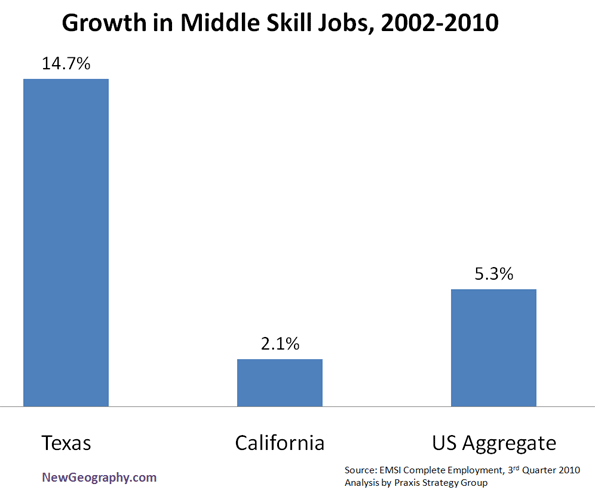
    A vast difference in economic performance is driving the demographic shifts. Since 1998, California’s economy has not produced a single new net job, notes economist John Husing. Public employment has swelled, but private jobs have declined.  Critically, as Texas grew its middle-income jobs by 16%, one of the highest rates in the nation, California, at 2.1% growth, ranked near the bottom. In the year ending September, Texas accounted for roughly half of all the new jobs created in the country.

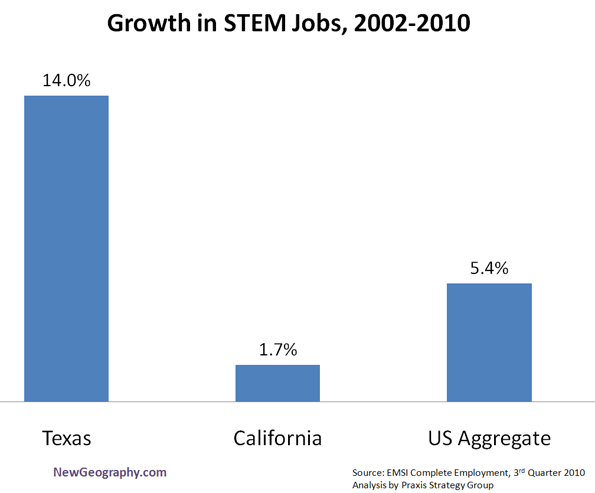
    Even more revealing is California’s diminishing preeminence in high-tech and science-based (or STEM–Science, Technology, Engineering and Mathematics) jobs. Over the past decade California’s supposed bulwark grew a mere 2%–less than half the national rate. In contrast, Texas’ tech-related employment surged 14%. Since 2002 the Lone Star state added 80,000 STEM jobs; California, a mere 17,000.

    Of course, California still possesses the nation’s largest concentrations of tech (Silicon Valley), entertainment (Hollywood) and trade (Port of Los Angeles-Long Beach). But these are all now declining. Silicon Valley’s Google era has produced lots of opportunities for investors and software mavens concentrated in affluent areas around Palo Alto, but virtually no new net jobs overall. Empty buildings and abandoned factories dot the Valley’s onetime industrial heartland around San Jose. Many of the Valley’s tech companies are expanding outside the state, largely to more business-friendly and affordable places like Salt Lake City, the Research Triangle region of North Carolina and Austin.

    Hollywood too is shifting frames, with more and more film production going to Michigan, New Mexico, New York and other states. In 2002, 82% of all film production took place in California–now it’s down to roughly 30%. And plans by Los Angeles County, the epicenter of the film industry, to double permit fees for film, television and commercial productions certainly won’t help.

    International trade, the third linchpin of the California economy, is also under assault. Tough environmental regulations and the anticipated widening in 2014 of the Panama Canal are emboldening competitors, particularly across the entire southern tier of the country, most notably in Houston. Mobile, Ala., Charleston, S.C., and Savannah, Ga., also have big plans to lure high-paid blue collar jobs away from California’s ports.

    Most worrisome of all, these telltale signs  palpable economic decline seem to escape most of the state’s top leaders. The newly minted Lieutenant Governor, San Francisco Mayor Gavin Newsom, insists “there’s nothing wrong with California” and claims other states “would love to have the problems of California.”

    But it’s not only the flaky Newsom who is out of sync with reality. Jerry Brown, a far savvier politician, maintains “green jobs,” up to 500,000 of them, will turn the state around. Theoretically, these jobs might make up for losses created by ever stronger controls on traditional productive businesses like agriculture, warehousing and manufacturing. But its highly unlikely.

    Construction will be particularly hard hit, since Brown also aims to force Californians, four-fifths of whom prefer single-family houses, into dense urban apartment districts. Over time, this approach will send home prices soaring and drive even more middle-class Californians to the exits.

    Ultimately the “green jobs” strategy, effective as a campaign plank, represents a cruel delusion. Given the likely direction of the new GOP-dominated House of Representatives in Washington, massive federal subsidies for the solar and wind industries, as well as such boondoggles as high-speed rail, are likely to be scaled back significantly.  Without subsidies, federal loans or draconian national regulations, many green-related ventures will cut as oppose to add jobs, as is already beginning to occur. The survivors, increasingly forced to compete on a market basis, will likely move to China, Arizona or even Texas, already the nation’s leader in wind energy production.

    Tom Hayden, a ’60s radical turned environmental zealot, admits that given the current national climate the only way California can maintain Brown’s “green vision” will be to impose “some combination of rate heights and tax revenues.”  Such an approach may help bail out green investors, but seems likely to drive even more businesses out of the state.

    California’s decline is particularly tragic, as it is unnecessary and largely unforced. The state still possesses the basic assets–energy, fertile land, remarkable entrepreneurial talent–to restore its luster. But given its current political trajectory, you can count on Texans, and others, to keep picking up both the state’s jobs and skilled workers. If California wishes to commit economic suicide, Texas and other competitors will gladly lend them a knife.


    This article originally appeared at Forbes.com.

    Joel Kotkin is executive editor of NewGeography.com and is a distinguished presidential fellow in urban futures at Chapman University. He is author of The City: A Global History. His newest book is The Next Hundred Million: America in 2050, released in February, 2010.

    Employment data from EMSI.

    Photo by {Guerrilla Futures | Jason Tester}

  • Greetings From Recoveryland: Ten Places to Watch Coming Out of the Recession

    Like a massive tornado, the Great Recession up-ended the topography of America. But even as vast parts of the country were laid low, some cities withstood the storm and could emerge even stronger and shinier than before. So, where exactly are these Oz-like destinations along the road to recovery? If you said Kansas, you’re not far off. Try Oklahoma. Or Texas. Or Iowa. Not only did the economic twister of the last two years largely spare Tornado Alley, it actually may have helped improve the landscape.

    We have compiled a list of the 10 American cities best situated for the recovery. These are places where the jobs are plentiful, and the pay, given the lower cost of living, buys more than in bigger cities. In other words, places unlike much of the rest of the country. The cities, most of which lie in the red-state territory of America’s heartland, fall into three basic groups. There’s the Texaplex—Austin, Dallas, San Antonio, and Houston—which has become the No. 1 destination for job-seeking Americans, thanks to a hearty energy sector and a strong spirit of entrepreneurism. There are the New Silicon Valleys—Raleigh-Durham, N.C.; Salt Lake City; and urban northern Virginia—which offer high-paying high-tech jobs and housing prices well below those in coastal California. And then there are the Heartland Honeys—Oklahoma City, Indianapolis, and Des Moines, Iowa—which are enjoying a revival thanks to rising agricultural prices and a shift toward high-end industrial jobs.

    Unlike the Sun Belt states and cities along the East and West coasts, these locales not only grew during the boom of the mid-2000s, they suffered least in the Great Recession. The fact that they are mostly in red states should give the newly ascendant GOP comfort as it tries to deliver on its election-year promise to right the economy. That isn’t to say all the blue states will remain weather-beaten. Wall Street, heady with cheap money, has sparked a return to opulence. And the strong demand for high-tech products and services will likely keep places like Boston, San Francisco, and San Diego from devolving into fancy versions of Detroit. Yet given the results of last week’s election and the increasing odds against another bailout of state governments, the near-broke and highly regulated blue states will be hard-pressed to generate much new employment.

    Of course, not everyone living in our Top 10 cities has avoided the heartache. And the continued slow pace of the economic recovery could hamper expansion even in the most-favored cities. If energy tanks as a result of a renewed global slowdown, it could hurt Texas and Oklahoma; dropping agricultural prices would hit some of the Heartland Honeys hard. But relatively—and that is the operative word in this tough economy—our 10 cities should fare better than most anywhere in America. And they could offer us a road map for what the nation’s economy will look like once the dust settles.

    THE TEXAPLEX

    For sheer economic promise, no place beats Texas. Though the Lone Star State’s growth slowed during the recession, it didn’t suffer nearly as dramatically as the rest of the country. Businesses have been flocking to Texas for a generation, and that trend is unlikely to slow soon. Texas now has more Fortune 500 companies—58—than any other state, including longtime corporate powerhouse New York.

    Austin boasted the strongest job growth in our Top 10, both last year and over the decade. Home to the state capital and the ever-expanding University of Texas, the city is arguably the best-positioned of the nation’s emerging tech centers. It enjoys good private-sector growth, both from an expanding roster of homegrown firms and outside companies, including an increasing array of multinationals such as Samsung, Nokia, Siemens, and Fujitsu.

    Yet Austin’s newfound prosperity isn’t simply a product of its university culture or its synergetic collection of technology firms. Its success owes a great deal to simply being in Texas—a state itching to eclipse its historic archrival, the increasingly troubled California. Indeed, Texas is becoming to the Golden State what Arizona, Nevada, and Oregon were in the last decade: a refuge for workers and companies fed up with California’s high unemployment, cost of living, and dysfunctional state government.

    The Texas economy has benefited from widening diversification. Houston has a robust energy business and medical-services industry, and thriving international trade—all long-term growth areas. Dallas enjoys an expanding tech sector and well-developed business-service industries tied to a powerful corporate base. San Antonio has a strong military connection and an expanding manufacturing capacity, and it is a key locale for the growing Latino marketplace. What’s more, Texas offers pro-business policies and relatively low taxes, and the physical infrastructure in the cities is generally as good or better than in many East and West coast metropolitan areas.

    People are voting with their feet. All four Texas cities are enjoying strong immigration from the rest of the country and abroad. Houston and Dallas have higher rates of immigration than Chicago, and if the job picture stays the same, those cities could someday rival New York and Los Angeles in terms of ethnic diversity.

    THE NEW SILICON VALLEYS

    Although Massachusetts and California are lauded as the places “where the brains are,” neither ranked high in the growth of tech jobs over the past decade. More important is where the brains are headed.

    A lot of them are going to North Carolina, Virginia, and Utah. The population of Raleigh-Durham grew faster than any major U.S. metropolitan area during the recession, and the city ranked third on our list in terms of job growth over the last decade. To the north, in Virginia, lies another Silicon Valley wannabe, stretching across Alexandria, Arlington, and Fairfax counties. And then there’s Salt Lake City and its environs, buoyed by the arrival of such big names as Adobe, Twitter, and Electronic Arts. The Greater Salt Lake region, which follows the Wasatch Mountains from Provo to Ogden, has much to attract tech companies: short commutes, decent public schools, spectacular nearby recreation, and, perhaps most important, affordable housing. Roughly 75 percent of households in Salt Lake can afford a median-priced house, as compared with 45 percent in Silicon Valley and roughly half that in New York City and San Francisco. The cost advantages of cities like Salt Lake and the other high-tech hubs are expected to prove especially attractive to millennials—the generation born after 1982—as they begin forming families and buying homes en masse.

    None of these Silicon Valleys may ever reach the critical mass of the real thing in California, but they will become increasingly more effective competitors and take an expanding market share of the nation’s technology business.

    THE HEARTLAND HONEYS

    The oft-ignored center of the country boasts a thriving economy that seems poised for further expansion. The region is well positioned to take advantage of growing markets for agricultural commodities and farm machinery in fast-growing countries such as India and China. The Great Plains and parts of the southern Midwest have also attracted new investments in manufacturing, both from domestic and foreign firms.

    Having largely missed out on the housing bubble, the region also avoided the hangover. As a result, after watching generation after generation move away, several heartland cities are enjoying a noticeable uptick in domestic migration as well as immigration. During the Great Depression, it was Oklahomans who moved to California to escape the Dust Bowl. Now there are considerably more people moving from California to Oklahoma than the other way around.

    Indianapolis, once written off as “Indiana no-place,” is one emerging hotspot. The area’s housing affordability now stands at a remarkable 90-plus percent. Although the recession has hit some of Indiana’s manufacturing-oriented northwest corner, over the past decade Indianapolis’s population grew at a rate 50 percent greater than the national average, notes urban analyst Aaron Renn. Much of this success is due to an aggressively pro-business attitude that promotes growing clusters such as life sciences, motor sports, and Internet marketing.

    Oklahoma City and Des Moines have also enjoyed steady growth in both jobs and net migrants over the past decade. Des Moines was recently rated the No. 1 spot in the country for business and careers by Forbes magazine, thanks to a surging agricultural sector and strength in the business-services segment. And Oklahoma City—which enjoys low unemployment as a result of its steadily growing energy and aerospace sectors—has been ranked among the best job markets for young people, ahead of Dallas, Seattle, and even New York (having Kevin Durant lead the NBA’s Oklahoma City Thunder for the foreseeable future can only improve the buzz).

    Of course, none of the cities in our list competes right now with New York, Chicago, or L.A. in terms of art, culture, and urban amenities, which tend to get noticed by journalists and casual travelers. But once upon a time, all those great cities were also seen as cultural backwaters. And in the coming decades, as more people move in and open restaurants, museums, and sports arenas, who’s to say Oklahoma City can’t be Oz?

    Job Growth
    Net Domestic Migration
    Total 2010
    2009
     
    10yr
    7yr
    2yr
    1yr
    9yr
    6yr
    2yr
    1yr
    Emplymt
    Population
    Northern Virginia 13.8% 11.5% -1.0% 1.2% 12.3 3.2 10.1 8.3 1,309,675 2,558,256
    Raleigh 13.5% 13.7% -4.9% -0.4% 236.7 186.6 47.2 18.4 496,900 1,125,827
    Salt Lake City, Ogden, Provo 7.7% 8.5% -6.7% -1.4% 9.2 15.9 7.4 2.4 961,900 2,227,413
    Austin 14.1% 17.8% -0.9% 1.7% 177.2 136.5 37.3 15.5 768,500 1,705,075
    Dallas-Fort Worth 3.7% 8.1% -3.6% 0.8% 59.3 44.8 14.3 7.2 2,876,925 6,447,615
    Houston 11.7% 10.9% -3.6% -0.5% 51.2 42.9 15.5 8.7 2,518,675 5,867,489
    San Antonio 11.4% 10.8% -2.7% -0.2% 102.1 86.4 21.3 9.3 833,325 2,072,128
    Oklahoma City 4.9% 6.7% -2.2% 1.0% 37.8 32.7 11.6 7.3 561,125 1,227,278
    Des Moines 7.8% 7.4% -3.5% -0.9% 63.6 56.2 14.0 6.1 316,975 562,906
    Indianapolis 1.6% 0.3% -5.5% -0.3% 45.9 34.6 8.0 4.1 870,850 1,743,658
    New York -1.5% 0.3% -4.1% -0.5% -104.7 -82.6 -13.8 -5.8 8,288,300 19,069,796
    Los Angeles -6.2% -5.2% -8.0% -1.0% -107.9 -89.0 -15.7 -6.3 5,118,950 12,874,797
    San Francisco -13.1% -6.0% -8.9% -2.6% -83.1 -57.6 3.4 1.9 1,853,350 4,317,853
    Chicago -8.0% -4.8% -7.4% -1.7% -60.0 -45.8 -8.8 -4.2 4,235,175 9,580,567
    Nation -1.2% 0.4% -4.9% -0.1%   130,690,750  
    Areas are Metroplitan Statistical Areas
    Northern Virginia, Va. includes Arlington, Clarke, Fairfax, Fauquier, Loudoun, Prince William, Spotsylvania, Stafford, and Warren Counties and Alexandria, Fairfax, Falls Church, Fredericksburg, Manassas, and Manassas Park Cities in Virginia.
    Salt Lake City region includes Ogden and Provo Metroplitan Statistical Areas
    Job growth uses May-August average for each year.
    Job data:  U.S. Bureau of Labor Statistics, Current Employment Survey
    Migration data:  U.S. Census Population Estimates.  Migration is cumulative over 10, 7, 2, or 1 yr period.  Number is rate per 1,000 residents in base year.

    —————-

    This article originally appeared in Newsweek.

    Praxis Strategy Group and Zina Klapper provided research for this article.

    Joel Kotkin is executive editor of NewGeography.com and is a distinguished presidential fellow in urban futures at Chapman University and an adjunct fellow with the Legatum Institute in London. He is author of The City: A Global History. His newest book is The Next Hundred Million: America in 2050, released in February, 2010.

    Photo: Jeanette Runyon

  • The Smackdown Of The Creative Class

    Two years ago I hailed Barack Obama’s election as “the triumph of the creative class.” Yesterday everything reversed, as middle-class Americans smacked down their putative new ruling class of highly educated urbanistas and college town denizens.

    More than anything, this election marked a shift in American class dynamics. In 2008 President Obama managed to win enough middle-class, suburban voters to win an impressive victory. This year, those same voters deserted, rejecting policies more geared to the “creative class” than mainstream America.

    A term coined by urban guru Richard Florida, “the creative class” also covers what David Brooks more cunningly calls “bourgeois bohemians”–socially liberal, well-educated, predominately white, upper middle-class voters. They are clustered largely in expensive urban centers, along the coasts, around universities and high-tech regions. To this base, Obama can add the welfare dependents, virtually all African-Americans, and the well-organized legions of public employees.

    These are the groups for whom Obama’s persona and policies pack the greatest appeal. Since Obama took office, the prime beneficiary of fiscal and monetary policies has been Wall Street, which has seen a nice 30% rise in the market and record bonuses. Large corporations, which are largely financed by stocks and bonds, have seen their profits soar over 40%, in part due to access to easy money.

    The financial boomlet is most marked in key creative class strongholds such as Manhattan, Boston and San Francisco, as well as their surrounding, super-affluent suburbs. The largesse benefits not only the traders, but the high-priced lawyers, accountants and publicists serving the financial elite. It has also benefited the high-end consumer industry, including the arts, which support much of the creative class. Not surpisingly, the Democrats scored well in these areas last night despite the GOP tide.

    The creative class also has benefited from the lavish expenditures of public funds to major universities for research. This has lifted the prospects of the professoriate at the elite colleges from which Obama takes much of his advice. Finally the administration has rewarded its friends and funders among Silicon Valley venture capitalists. Once self-described paragons of entrepreneurial risk-taking, they increasingly search out government incentives and subsidies to pay for their large bets on renewable energy technology.

    In contrast, the traditional middle class has not fared well at all. This group consists of virtually everyone who earns the national household median income of $50,000 or somewhat above. They tend to be white, concentrated outside the coasts (except along the Gulf), suburban and politically independent. In 2008 they divided their votes, allowing Obama, with his huge urban, minority and youth base, to win easily.

    Since Obama’s inauguration all the economic statistics vital to their lives–job creation, family income, housing prices–have been stagnant or negative. Not surprising then that suburbanites, small businesspeople and middle-income workers walked out on the Democrats last night. They did not do so because they loved the Republicans but because the majority either fears unemployment or already have lost their jobs. Many were employed in the industries such as manufacturing and construction hardest hit in the recession; it has not escaped their attention that Obama’s public-sector allies, paid with their taxes, have remained not only largely unscathed, but much better compensated.

    Of course, few on the progressive left–more expressive of a dictatorship of the professoriate than that of the proletariat–seem likely to confront these class realities. Many will ascribe last night’s disaster to the dunderheadness of the American people, or to the clever venality of the right. Certainly some tea party candidates, inexperienced and untested, did appear incapable of passing a high school civics test. But the results had less to do with Karl Rove’s money than the Democrats disconnect with the middle class.

    The real problem for the Democrats lies with fundamental demographics. The middle class is a huge proportion of the population. Thirty-five million households earn between $50,000 and $100,000 a year; close to another 15 million have incomes between $100,000 and $150,000. Together these households overwhelm the number of poor households as well as the highly affluent.

    In contrast, the “creative class” represents a relatively small grouping. Some define this group as upward of 40% of the workforce–largely by dint of having a four-year college degree–but this seems far too broad. The creative class is often seen as sharing the hip values of the Bobo crowd. Lumping an accountant with two kids in suburban Detroit or Atlanta with a childless SoHo graphic artist couple seems disingenuous at best. In reality the true creative class, notes demographer Bill Frey, may constitute no more than 5% of the total.

    At the same time, this affluent constituency may be more than offset by another more traditional upper class. This consists of people closely tied to such basic sectors as agriculture, fossil fuel production, suburban home-builders and the aerospace industry. These voters have, for the most part, remained solidly Republican for generations, and but many followed the “creative class” into the Democratic Party in 2006 and 2008. Last night this part of the upper class shifted back toward their political home.

    But the real decider–to use George W. Bush’s unfortunate phrase–remains the much larger, more amorphous middle class. Given the economy of the past two years, the subsequent alienation of this group should pose no mystery. Suburban swing voters didn’t suddenly turn into racists or right-wing cranks. Instead they have seen, correctly, that Obama’s economic policy has to date worked to the advantage of others far more than themselves or their families. Until the Democrats and Obama can prove that they once again can serve the interests of these voters, they will continue to struggle to recapture the optimism so appropriate two years ago.

    This article originally appeared at Forbes.com.

    Joel Kotkin is executive editor of NewGeography.com and is a distinguished presidential fellow in urban futures at Chapman University. He is author of The City: A Global History. His newest book is The Next Hundred Million: America in 2050, released in February, 2010.

    Photo by World Economic Forum

  • Suburban Nation, but Urban Political Strategy

    Ideologues may set the tone for the national debate, but geography and demography determine elections.

    In America, the dominant geography continues to be suburbia – home to at least 60 percent of the population and probably more than that portion of the electorate. Roughly 220 congressional districts, or more than half the nation’s 435, are predominately suburban, according to a 2005 Congressional Quarterly study. This is likely to only increase in the next decade, as Millennials begin en masse to enter their 30s and move to the periphery.

    Now the earth is shaking under suburban topsoil — in ways that could be harmful to Democratic prospects. “The GOP path to success,” according to a recent Princeton Survey Research Associates study of suburban attitudes, “goes right through the suburbs.”

    The connection between suburbs and political victory should have been clear by now. Middle- and working-class suburbanites keyed the surprising election win of Republican Sen. Scott Brown in Massachusetts in January. Suburban voters were also crucial to the 2009 Republican gubernatorial victories in Virginia and New Jersey, two key swing states.

    Nationally, suburban approval for the Democrats has dropped to 39 percent this year, from 48 percent two years ago. Disapproval for President Barack Obama is also high — nearly 48 percent of suburbanites disapprove, compared to only 35 percent of urbanites. Even Obama’s strong support among minority suburbanites, a fast-growing group, has declined substantially.

    Many suburban voters, notes Lawrence Levy, executive director of the National Center for Suburban Studies at Hofstra University, appear to be undergoing “buyer’s remorse” for backing Obama and the Democrats last time around .

    Much of the suburban distress, of course, stems from the still perilous state of the economy. Obama’s mix of fiscal and monetary policies has provided much succor to Wall Street, where stock prices have soared 30 percent, and to big corporations, whose profits have risen by 42 percent. This has been great for Manhattan plutocrats — but not particularly helpful for the suburban middle class.

    Indeed the indicators most important to suburbanites – private sector employment, weekly earnings, home prices and disposable income – have all stagnated or even fallen since Obama took office. Fifty-three percent of suburban residents, according to the Princeton study, described their financial situation as “bad.” The vast majority have either lost their job or know someone who has lost theirs. Almost 40 percent have either lost their home or know someone who did – up from 27 percent in 2008.

    Given the stubbornness of this recession, neither the current administration or Congress gets credit for improving conditions. Barely 10 percent of suburbanites polled think the stimulus helped, one-third thought it hurt and the rest said it made little difference.

    But there may be other, perhaps more nuanced, reasons for the administration’s suburban disconnect. Many of the administration’s most high-profile initiatives have tended to reflect the views of urban interests – roughly 20 percent of the population – rather than suburban ones.

    When the president visits suburban backyards, it sometimes seems like a visit from a “president from another planet.” After all, as a young man, Obama told The Associated Press: “I’m not interested in the suburbs. The suburbs bore me.”

    More recently, Obama made clear that he is more interested in containing suburbia than enhancing it. In Florida last February, the president declared, “the days of building sprawl” are “over.”

    Much of the Obama policy agenda – from mass transit and high-speed rail to support for “smart growth” policies – appeals to city planners and urbanistas. Transportation Secretary Ray LaHood has spoken openly of “coercing” Americans out their cars and the Department of Housing and Urban Development is handing out grants to regions which support densification strategies that amount to forced urbanization of suburbs.

    This is a problem since the vast majority of Americans – consistently more than 80 percent – do not prefer to live in dense big cities. Most want a house rather than being forced to live in an apartment. And for all but a handful, a car, not a bus or train, remains not only the preferred way to get to work, but often the only feasible means to get work — mostly in the suburbs.

    If the Democrats want to mount an electoral comeback in suburbia, they need to take these realities into account . There are just not enough votes in core cities, upscale close-in suburbs or college towns to knit together a majority.

    Recovering suburbia s is not impossible for Democrats. Obama himself proved this in 2008, by essentially tying for the suburban vote — a remarkable achievement. Bill Clinton won in 1992 and especially 1996 by competing well in suburbs and exurbs. In the last two election cycles, the shift of suburbanites to the Democrats keyed the party’s steady gains in the Congress – accounting for, according to GOP sources, as many as 24 seats in the last two congressional elections.

    Most important, suburbanite identification with the Republican Party has continued to erode over the past two years, according to the Princeton survey. Instead the big winners have been independents, who have grown to 36 percent from 30 percent of the suburban electorate.

    These voters, for the most part, also tend to be less strident in their cultural views than either secular urbanites or rural evangelicals. More than one in five suburbanites is an ethnic minority — which could also help the Democrats.

    But to win even these suburban voters, the Democrats must offer solutions to suburbanites that go beyond devising their forced conversion to dense urbanity. They could refocus their efforts on climate change to suburbs-friendly strategies like telecommuting — perhaps the cheapest, quickest and most socially acceptable way to cut down on greenhouse gas emissions.

    Outside of greater New York, which has half the nation’s transit users, there are already about as many telecommuters as transit riders. Why not work to expand this phenomena, so well suited to the vast majority of the country?

    These suburb friendly approaches should be examined as the Democrats reflect on what many expect to be midterm electoral setbacks. They can only compete successfully on a national basis by jettisoning their apparent disdain toward the aspirations of suburban homeowners and begin treating them with respect.

    This article originally appeared at Politico.

    Joel Kotkin is executive editor of NewGeography.com and is a distinguished presidential fellow in urban futures at Chapman University. He is author of The City: A Global History. His newest book is The Next Hundred Million: America in 2050, released in February, 2010.

    Photo by Caesar Sebastian

  • Prosperity Index Shows That Democracy Still Works Best

    With the Cold War well behind us, the real choice between systems lies in a growing variation in the form of capitalisms. Choices now range from the Chinese Leninist model – essential centrally planned exploitation of the greed gene – to various kleptocracies, divergent Anglo-American systems and varied forms of European capitalism.

    None of these systems are likely to excite the most rabid Hayekian, especially now that the once free market haven Hong Kong is being integrated into the Chinese command and control system. But still, according a new study by my colleagues at the Legatum Institute, when it comes to delivering the best economic environment for people and families various forms of liberal capitalism still perform best.

    The Legatum Prosperity Index found that all the more prosperous places – not only by income, but by quality of life, environment, education and health care – almost exclusively are democratic states. “Prosperity,” the report concludes, “is found in entrepreneurial democracies that have strong social fabrics.”

    This is a critical point given the current focus and admiration for the more centralized, state-controlled models emerging in places like Russia, China and Brazil. As an emerging country, China may enjoy the highest rate of growth but overall still does not provide most of its citizens anything close to what we might consider the “good life.” China, the Legatum study found, still lags behind in a host of factors besides democracy, ranging from poor health care and a degraded environment to an overweening state role in the private sector.

    In contrast, without exception, the most prosperous states are not so much the fastest-growing economies but those democracies that have been able adjust successfully to the emerging reality. At the top of the list are the northern democracies, led by Scandinavian countries Norway (#1), Denmark (#2), Finland (#3) and Sweden (#6). These are joined by other small, compact cold-weather states such as the Netherlands (#9) and Switzerland (#8). Rounding out the top 9 on the list are three resource-rich Anglo-American states, (#4) Australia, (#5) New Zealand and (#7) Canada.

    All these countries sell either resources – Norway, Australia and Canada – to emerging Asian super-powers or expertise and services. Most countries possess powerful niches that drive their economies and promote exports to developing countries. These include green technology (Denmark), motor vehicles, telecommunications, pharmaceuticals and forestry (Sweden), information technology (Finland), engineering and finance (Switzerland), business services , chemicals and plant science (Netherlands). The tiny Netherlands, for example, is China’s second largest European trading partner.

    The ability to shift gears also can be seen in Germany which improved its ranking to 15 due in part to rising industrial exports to emerging economies. Like the Scandinavian countries, Germany economy has also become significantly less regulated in the past decade. They are no longer the ultra generous social welfare states imagined by some liberals , but increasingly adapted to a tougher global marketplace.

    In this sense these northern states resemble the old Hanseatic trading cities of 13th century northern Europe, which created, in the words of historian Fernand Braudel, a “common civilization created by trading” from England to Russia. At its peak the League included dozens of cities across Northern Europe. Like the old Hansa, today’s version share largely Germanic or Nordic cultural roots, and have found their niche by selling high value goods, to distant burgeoning markets in Russia China, and India.

    This strong performance contrasts dramatically with the emergence of what might called ”a second Europe” made up of what I call the Olive Republics. These countries – Spain, Portugal, Italy, and Greece – remain functioning democracies but without the kind of effective governance found in their better managed, more fiscally responsible northern neighbors. These states have all fallen in over the past year in the Legatum rankings , falling into the 20s and even 30s – something very rare for long established European economies.

    Once again, the critical issue lies with adjustment. In contrast to the northern powers, the Olive Republics do not appear to be adjusting well to the general shift of global demand to the east. After all, besides a great history and culture, how much do these countries have to sell the Chinese, Indians and Brazilians ? Trips to Barcelona or expensive Italian food may be popular among the new rich of Shanghai or Singapore, but its Volvos, Mercedes, BMWs, not Fiats, that crowd the streets. In high tech, increasingly dominated by the U.S. and Asian countries like India and South Korea, the only big player along the Mediterranean is now greater Tel-Aviv.

    What about the other big Western democracies? Most rank between the ascendant Hansa and the depressed Olive Republics. The mega-giant of the liberal democracies, the U.S., ranks 10th, followed by the 13th ranked United Kingdom, 18th ranked Japan and 19th ranked France. All these countries retain strong technological prowess and entrepreneurial savvy, but have proven more adept at consuming goods and services from the rising Asian powers than selling to them. Governance, particularly fiscal management, also generally has been less impressive than among the Hansa states.

    But perhaps the best proof that democracy remains an economic asset can be found not in Europe or North America, but among the developing economies. China may dominate the world’s current trajectory through its huge population and expanding economy but its level of prosperity still lags that of democratic Australia and New Zealand. It also ranks well below demonstrably more democratic countries (albeit imperfectly liberal) like #17 Singapore, #22 Taiwan and #27 South Korea. These are emerging as the Hansa of Asia, selling high-technology products and services to the emerging Asian powers . If China ever could achieve some level of democratic governance say of South Korea, the world would need to really watch out.

    Similar patterns can be found across the rest of the developing world.In the Middle East, the relatively tolerant United Arab Emirates (#30) that leads the list. The only legitimate constitutional democracy in the region, Israel (#36), soars way ahead of repressive but oil-rich Saudi Arabia (#49) not to mention such stark autocracies as Syria (#83), Iran (#92) and Yemen (#105).

    In sub-Saharan Africa, democracies such as Botswana (#52) and (#66) South Africa generally lead the pack, while resource rich, but dictatorship ridden Zimbabwe ranks a meager 110. In Latin America, liberal democracies such as #28 Uruguay, #32 Chile and #33 Costa Rica sit on top while minerals rich but autocratic Venezuela (#75) and Bolivia (#82) sink closer to the bottom.

    Of course, it’s fashionable today in some circles to toast autocracy – particularly among our growing ranks of Sinophiles on both right and left. But the Legatum study suggests that democracy, not top-down dictatorship, remains the surest way to build a prosperous society. True, sometimes a dictatorship can spark faster growth in the short and even medium run but only democracies have proven capable of steering countries beyond rapid growth and into true, sustained prosperity. For this reason, democratic capitalist countries remain at the apex of the global economy outperforming challengers by the measure that most matters: delivering a secure, healthy and affluent life to the vast majority of their citizens.

    This article originally appeared at Forbes.com.

    Joel Kotkin is executive editor of NewGeography.com and is a distinguished presidential fellow in urban futures at Chapman University. He is author of The City: A Global History. His newest book is The Next Hundred Million: America in 2050, released in February, 2010.

    Photo by Rob Boudon

  • Who’s Racist Now? Europe’s Increasing Intolerance

    With the rising tide of terrorist threats across Europe, one can somewhat understandably expect a   surge in Islamophobia across the West. Yet in a contest to see which can be more racist, one would be safer to bet on Europe than on the traditional bogeyman, the United States.

    One clear indicator of how flummoxed Europeans have become about diversity were the remarks last week by German Chancellor Angela Merkel saying that multi-culturalism has “totally failed” in her country, the richest and theoretically  most capable of absorbing immigrants. “We feel tied to Christian values,” the Chancellor said. “Those who don’t accept them don’t have a place here.”

    One can appreciate Merkel’s candor but it does say something the limitations about the continent’s ability, and even willingness, to absorb immigrants. It’s quite a change from the generations-old tendency among Europeans, particularly on the left, to denigrate America as a kind of hot bed for racism.  Yet even before the latest report of potential terrorist attacks in several western European cities, the center of Islamophobia – and related ethnic hatreds – has been shifting inexorably to the European continent.

    Of course, America has always had its bigots, and still does. And of course, Islamists who threaten or commit violence need to be arrested and thrown behind bars. But, to date, neither major political party has been able to make openly white-supremacist politics a successful leading platform. After all, what was the last time anyone took Pat Buchanan , who has made comments similar to those of Merkel, seriously? Despite the brouhaha over the Arizona anti-illegal alien law, only 5% of Americans consider immigration the nation’s most pressing issue, according to a September Gallup poll.

    The situation in Europe is quite different. Openly racist, anti-immigrant and Islamophobic groupings are on the rise, and they are wreaking havoc on once subdued European politics. Traditional mainstream parties are declining, and the new racist parties can be seen in broad daylight in Austria, Switzerland, Denmark, Sweden and the Netherlands, where populist firebrand Geert Wilders has suggested banning the Koran. In Italy the anti-immigrant Northern League is already hugely powerful.

    It is true that as many Europeans as Americans–about half–think immigration is bad for their countries.  The big difference is what Europeans are willing to do about it. Just consider French President Nicholas Sarkozy’s farcical effort this fall to expel the hapless Roma.

    Yet for most Europeans the big issue is not purse-snatching gypsies but fear and loathing toward the expanding presence of Muslims–who are at least three times as numerous in the E.U. as in the U.S.  Over half of Spaniards and Germans, according to Pew, hold negative views of Muslims. So do roughly 40% of the French. In contrast, only 23% of Americans share this sentiment.

    More disturbing, Europe is actually putting these ethnic hostilities into law. An early sign came this winter, when the usually phlegmatic  Swiss voted to prohibit the building of new minarets. More recently a ban on burqas – the admittedly unattractive female body suits favored by some orthodox Muslims – passed in France, home to Europe’s largest Muslim community. The same measure is now being considered in Spain.

    These actions reflect a broad, and deepening, stream of European public opinion. A recent Pew survey found that over 80% of the French support banning the burqa, as do over 70% of Germans and a large majority of Spaniards and British.

    In contrast, nearly two-thirds of Americans find the burqa ban distasteful. Burqas don’t exactly stir admiring glances in the shopping mall, but few Amercians think we need to ban them. The basic ideal of “don’t tread on me” means “don’t tread on them” as well – at least until they start blowing themselves up at Wal-mart.

    This nuance escapes some of our own knee-jerk racial obsessives, like the Atlanta Journal Constitution’s Cynthia Tucker, who equates opposition to a mosque at Ground Zero as proof of a “new McCarthyism”  aimed against Muslims. But you don’t have to be a bigot to have second thoughts about erecting a mosque at the very spot where innocents were slaughtered by radical Islamists.

    Critical here are profound differences between the U.S. and Europe  in  the role played by ethnicity, race and religion. On the continent national culture is precisely that — the product of a long history of a particular ethnic group. Small minorities, such as Jews in Holland or Armenians in France, are tolerated but expected to submerge their ethnic identities. France has many artists and writers who may be Jewish, but you don’t see many French Woody Allens or Larry Davids who exploit their otherness to help define the national culture.

    Muslim attitudes in Europe are not exactly helpful either.  European Muslims often seem more interested in breaking the national mold than adding to its contours.  More than 80% of British Muslims, for example, identify themselves as Muslims first before being British. This is true of nearly 70% of Muslims in Spain or Germany. Similarly, up to 40% of Britain’s Islamic population believe that terrorist attacks on both Americans and their fellow Britons are justified.

    This alienation also reflects an appalling social and economic reality. In European countries immigrants can receive welfare more easily than join the workforce, and their job prospects are confined by education levels that lag those of immigrants in the United States, Canada and Australia. In France unemployment among immigrants–particularly those from Muslim countries–is often at least twice that of the native born; in Britain Muslims are far more likely to be out of the workforce than either Christians or Hindus.

    Partly due to a less generous welfare state, American immigrant workers with lower educations have, for the most part, been more economically active than their nonimmigrant counterparts.  The contrast is even more telling among Muslim immigrants. In America most Muslims are comfortably middle class, with income and education levels above the national average. They are more likely to be satisfied with the state of the country, their own community and their prospects for success than are other Americans—even in the face of the reaction to 9-ll.

    More important still, more than half of Muslims identify themselves as Americans first, a far higher percentage than in the various countries of Western Europe.   More than four in five are registered to vote, a sure sign of civic involvement. Almost three-quarters, according to a Pew study, say they have never been discriminated against–something that is definitely not the case in Europe where a majority, according to Pew, complain of discrimination.

    Over time, these differences between Europe and America may become even more pronounced. America is becoming increasingly diverse, but it is also growing demographically, and Muslims make up a very small part of that. There’s little fear in Anerica of the kind  of  Muslim envelopment that appears to threaten a  rapidly aging, and soon to be depopulating, Europe.

    Of course the U.S. still has its bigoted Islamophobes, just as it has its own small cadre of vicious Islamists. One law of history appears to be that morons will be morons.   But America’s culture seems strong enough to resist the anti-immigrant hysteria emerging throughout Europe. This is one case where  la difference between America and Europe may prove  a very good thing indeed.

    This article originally appeared at Forbes.com.

    Joel Kotkin is executive editor of NewGeography.com and is a distinguished presidential fellow in urban futures at Chapman University. He is author of The City: A Global History. His newest book is The Next Hundred Million: America in 2050, released in February, 2010.

    Photo by World Economic Forum

  • North America’s Fastest-Growing Cities

    The U.S. and Canada’s emerging cities are not experiencing the kind of super-charged growth one sees in urban areas of the developing world, notably China and India. But unlike Europe, this huge land mass’ population is slated to expand by well over 100 million people by 2050, driven in large part by continued immigration.

    In the course of the next 40 years, the biggest gainers won’t be behemoths like New York, Chicago, Toronto and Los Angeles, but less populous, easier-to-manage cities that are both affordable and economically vibrant.

    Americans may not be headed to small towns or back to the farms, but they are migrating to smaller cities. Over the past decade, the biggest migration of Americans has been to cities with between 100,000 and 1 million residents. In contrast, notes demographer Wendell Cox, regions with more than 10 million residents suffered a 10% rate of net outmigration, and those between 5 million and 10 million lost a net 2.4%.

    In North America it’s all about expanding options. A half-century ago, the bright and ambitious had relatively few choices: Toronto and Montreal for Canadians or New York, Chicago or Los Angeles for Americans. In the 1990s a series of other, fast-growing cities–San Jose, Calif.; Miami; San Diego; Houston; Dallas-Fort Worth, Texas; and Phoenix–emerged with the capacity to accommodate national and even global businesses.

    Now several relatively small-scale urban regions are reaching the big leagues. These include at least two cities in Texas: Austin and San Antonio. Economic vibrancy and growing populations drive these cities, which ranked first and second, respectively, among large cities on Our “Best Places For Jobs” list.

    Austin and San Antonio are increasingly attractive to both companies and skilled workers seeking opportunity in a lower-cost, high-growth environment. Much the same can be said about the Raleigh-Durham area of North Carolina, and Salt Lake City, two other U.S. cities that have been growing rapidly and enjoy excellent prospects.

    One key advantage for these areas is housing prices. Even after the real estate bust, according to the National Association of Homebuilders, barely one-third of median-income households in Los Angeles can afford to own a median-priced home; in New York only one-fourth can. In the four American cities on our list, between two-thirds and four-fifths of the median-income households can afford the American Dream.

    Advocates of dense megacities often point out that many poorer places, including old Rust Belt cities, enjoy high levels of affordability, while more prosperous regions, such as New York, do not. But lack of affordability itself is a problem; areas with the lowest affordability, including New York, also have suffered from high rates of domestic outmigration. The true success formula for a dynamic region mixes affordability with a growing economy.

    Our future cities also are often easier for workers and entrepreneurs alike. Despite the presence of the nation’s best-developed mass transit systems, the longest commutes can be found in the New York area; the worst are for people living in the boroughs of Queens and Staten Island. As a general rule, commuting times tend to be longer than average in some other biggest cities, including Chicago and Washington.

    In contrast, the average commutes in places like Raleigh or San Antonio are as little as 22 minutes on average–roughly one-third of the biggest-city commutes. Figure over a year, and moving to these smaller cities can add 120 hours or more a year for the average commuter to do productive work or spend time with the family.

    Similar dynamics–convenience, less congestion, rapid job growth and affordability–also are at work in Canada, where two cities, Ottawa (which stretches from Ontario into Quebec) and Calgary, stand out with the best prospects. Many Canadians, particularly from Vancouver, would dispute this assertion. But Vancouver, the beloved poster child of urban planners, also suffers extraordinarily high housing prices–by some measurements the highest in the English-speaking world. This can be traced in part to the presence of buyers from other parts of Canada and abroad, particularly from East Asia, but also to land-use controls that keep suburban properties off the market.

    Calgary, located on the Canadian plains, not much more than an hour from the Rockies, retains plenty of room to grow, and its housing price-to-income ratio is roughly half that of Vancouver’s. Calgary is also the center of the country’s powerful energy industry, which seems likely to expand during the next few decades, and its future is largely assured by soaring demand from China and other developing countries.

    The other Canadian candidate, the capital city of Ottawa and its surrounding region, has developed a strong high-tech sector to go along with steady government employment. Remy Tremblay, a professor at the University of Quebec at Montreal, notes that Ottawa “is changing very rapidly” from a mere administrative center to a high-tech hotshot. Yet for all its growth, it remains remarkably affordable in comparison with rival Toronto, not to mention Vancouver.

    In developing this list we have focused on many criteria–affordability, ease of transport and doing business–that are often ignored on present and future “best places” lists. Yet ultimately it is these often mundane things, not grandiose projects or hyped revivals of small downtown districts, that drive talented people and companies to emerging places.

    Raleigh Durham, N.C.

    Even in hard times this low-density, wide-ranging urban area has repeatedly performed well on Forbes’ list of the best cities for jobs. The area is a magnet for technology firms fleeing the more expensive, congested and highly regulated northeast corridor. One big problem obstructing the region’s ascendancy has been air connections. But Delta recently announced a large-scale expansion of flights there from around the country. Population growth will likely be lead by educated millennials seeking affordable housing and employment opportunities. Today the region has 1.7 million residents; the State of North Carolina projects it will grow to 2.4 million by 2025.

    Austin, Texas

    Austonites tend to be smug, but they have good reason. The central Texas city ranked as the No. 1 large urban area for jobs in our last Forbes survey. Along with Raleigh-Durham, Austin is an emerging challenger for high-tech supremacy with Silicon Valley. The current area’s population is 1.7 million and is expected to grow rapidly in the coming decades. Austin owes much both to its public sector institutions (the state government and the main Campus of the University of Texas) and its expanding ranks of private companies–including foreign ones–swarming into the city’s surrounding suburban belt.

    Salt Lake City, Utah

    Once seen as a Mormon enclave, the greater Salt Lake urban area–with roughly 1 million people–has every sign of emerging as a major world player with a wider appeal. The church still plays a critical role, in part by financing a massive redevelopment of the city’s now rather dowdy city core. The area’s population has doubled since the early 1970s and will grow another 100,000 by 2025 to well over 1.1 million. New companies are flocking to this business-friendly region, particularly from self-imploding California. Increasing national and global connections through Delta’s hub will tie this once isolated city closer with the wider world economy.

    Calgary, Alberta, Canada

    You don’t have to buy the notion of a climate-change-driven northern ascendancy to see a bright future for Alberta’s premier city. Calgary is positioned well on the fringe of Canada’s largest energy belt and enjoys lower taxes and less stringent regulations than its Canadian rivals. Calgary has been hit by a slowdown in energy business, but over time demand from China, India and a slowly recovering world economy should boost this critical sector. The region is expected to be back to its familiar place on top among Canadian urban economies by next year.

    San Antonio, Texas

    Last year this historic Texas metropolis–home to the Alamo–ranked second on our list “best cities for jobs” among larger cities. The region has been growing rapidly to well over 2.1 million. As the economy, particularly in Texas, recovers, an already strong health care sector will be joined by an expanding industrial base. One key factor in San Antonio’s favor: stable house prices–even by Texas standards. PMI Mortgage Insurance Co.’s most recent risk index, which is a two-year measure, lists San Antonio as having the lowest risk from falling prices among large Texas cities.

    Ottawa, Ontario-Quebec

    Canada’s capital region, which extends across the border to Gatineau, in Quebec, has grown to over 1.2 million. This growth has come in large part from government–which may slow after the end of Canada’s stimulus–but also a vibrant private sector. Ottawa boasts a pleasant quality of life and is one of Canada’s most affordable big cities. The population, notes the University of Quebec’s Remy Tremblay, is the “most educated, with the highest disposable income, of all Canadian cities.” Ottawa airport, Tremblay adds, is experiencing the fastest traffic growth of virtually any in Canada.

    Oklahoma City, Okla.

    Oklahoma City–with its business-friendly environment and abundant oil and natural gas reserves–ranked No. 11 in Forbes’ list of the best big cities for jobs. A KPMG study named it the least costly metro area to do business among U.S. cities with populations between 1 million and 2 million, and according to the Census Bureau Community Survey, it has the third-shortest commute time among the 52 largest cities. Such factors–plus its exciting new basketball star, Kevin Durant–have definitely attracted plenty of new residents. An article in the Sacramento Bee reported that many Californians were migrating to the former Dust Bowl town in search of jobs and more stable housing prices, and its population, at 1.2 million, is expected to grow 9.8% in the next 10 years, according to the Greater Oklahoma City Partnership.

    Omaha, Neb.

    The Omaha metro area has a population of 838,875, making it the 60th largest metropolitan area in the country. And it’s growing, thanks to high in-migration and a recent baby boom that added about 4,600 children between 2008 and 2009. The population has grown 9.4% to from 2000 to 2009, and it is expected to grow another 2.3% by 2014. Why are so many people flocking to Omaha? One reason is the low cost of living, including stable housing prices (like many of the Great Plains cities). Another reason: jobs. Omaha ranked ninth in our most recent best big cities for job list, with its healthy agriculture and civil engineering industries. Its friendly attitude toward business and innovation–as well as the strong universities in the area–has made it a leader in biotechnology. More than 20 bioscience companies are headquartered there–including Streck Laboratories and ConAgra Foods.

    Northern Virginia

    Formerly considered a suburb of Washington, D.C., Northern Virginia–which comprises Arlington, Fairfax, Loudon and Prince William counties, as well as other independent cities–has become a metro area of its own. The expanding federal government no doubt plays a large part in the area’s growth; the CIA and the Department of Defense are headquartered there, and it is home to many other government agencies. The area also has one of the largest technology industries outside Silicon Valley. Northern Virginia has one of the most affluent, as well as the most educated, populations in the country; an astonishing 35% of Arlington County’s population, for example, holds a graduate or professional degree.

    Nashville, Tenn.

    A high quality of life, a vibrant cultural and music scene and a diverse population make Nashville a desirable place to live. The Nashville Area Metropolitan Planning Organization expects the 10-county greater Nashville area, home to 1.3 million people, to add close to another million by the year 2035. Low housing costs contribute to a cost of living that is lower than other affordable cities, like Raleigh, Austin, Dallas or Indianapolis. Nashville is also home to a growing health care industry: More than 250 health care companies have operations in Nashville, and 56 are headquartered there.

    Columbus, Ohio

    While the recession has taken a huge toll on the rest of Ohio, Columbus has been thriving, thanks to strong population growth, a booming startup culture and the largest college campus in the country–Ohio State University, a major employer and information center. Forbes named the Columbus metropolitan area–home to 1.8 million residents– one of America’s best housing markets, as well as one of the best places for businesses and careers. The city enjoys below-average unemployment and a strong tech presence that includes Battelle Memorial Institute, which oversees laboratories for several federal agencies.

    Indianapolis, Ind.

    Thanks to a business-friendly attitude, inexpensive housing and a strong cultural community, Indianopolis’ population–now at 1.7 million–has increased at a rate that is 50% higher than the national average. That’s faster than hot spots Washington, D.C., and Seattle, and nearly as fast as urban-planner darlings Portland or Denver. But while Portland and Denver may attract more young singles, Indianapolis boasts a growing population of educated, young married couples–many coming from cities like Chicago for the shorter commutes and lower cost of living–an arguably more attractive demographic since they will most likely stay, raise families and invest in the communities, boosting the area’s growth even more.

    This article originally appeared at Forbes.com.

    Joel Kotkin is executive editor of NewGeography.com and is a distinguished presidential fellow in urban futures at Chapman University. He is author of The City: A Global History. His newest book is The Next Hundred Million: America in 2050, released in February, 2010.

    Photo by branewphoto