Author: Joel Kotkin

  • Beyond the Census: America’s Demographic Advantage

    As the nonstop TV commercials have made clear, the U.S. Census Bureau really hopes you’ve sent back your questionnaire by now. But in reality, we don’t have to wait for the census results to get a basic picture of America’s demographic future. The operative word is “more”: by 2050, about 100 million more people will inhabit this vast country, bringing the total U.S. population to more than 400 million.

    With a fertility rate 50 percent higher than Russia, Germany, or Japan, and well above that of China, Italy, Singapore, South Korea, and virtually all of Eastern Europe, the United States has become an outlier among its traditional competitors, all of whose populations are stagnant and seem destined to eventually decline. Thirty years ago, Russia constituted the core of a vast Soviet empire that was considerably more populous than the United States. Today, Russia’s low birthrate and high mortality rate suggest that its population will drop by 30 percent by 2050, to less than one third that of the United States. Even Prime Minister Vladimir Putin has spoken of “the serious threat of turning into a decaying nation.”

    Perhaps an even more important demographic gap is emerging between the United States and East Asia. Over the past few decades a rapid expansion of their workforce fueled the rise of the East Asian tigers, the great economic success story of our epoch. Yet within the next four decades, a third or more of their populations will be older than 65, compared with only a fifth in America. By 2050, according to the United Nations, roughly 30 percent of China’s population will be more than 60 years old. Lacking a developed social-security system, China’s rapid aging will start cutting deep into the country’s savings and per capita income rates. A slowdown of population growth in poor countries can offer a short-term economic and environmental benefit. But in advanced countries, a rapidly aging or decreasing population does not bode well for societal or economic health.

    Between 2000 and 2050 the U.S. population aged 15 to 64—the key working and school-age group—will grow 42 percent, while the same group will decline by 10 percent in China, nearly 25 percent in Europe, and 44 percent in Japan. Unlike its rivals, America’s economic imperative will lie not in meeting the needs of the aging, but in providing job and income growth for our expanding workforce. What the United States does with its “demographic dividend”—that is, its relatively young working-age population—will depend largely on whether the private sector can generate jobs, an issue that’s particularly critical now, with more than 15 million unemployed.

    Immigrants may be one force that will lead the way: between 1990 and 2005 immigrants started one quarter of all venture-backed public companies. This enterprising spirit is crucial, because U.S. employment has been shifting not to mega corporations but to individuals; between 1980 and 2000, the number of self-employed people expanded tenfold to make up 16 percent of the workforce.

    To create jobs, America needs to pay attention not only to high-tech industries but also the basic ones—construction, manufacturing, agriculture, energy—that will employ our expanding blue-collar workforce. Expanding our basic industries, and focusing on the necessary skills training for those laboring in them, will provide new opportunities for the majority of workers who do not possess college degrees. It also will be critical to addressing the outflow of capital to other countries, and provide the basis for innovations that will create new exports.

    With the mobilization of our entrepreneurs and supportive government policies, the United States should be able to exploit its vibrant demography to assure its preeminence over the next four decades. If we fail to start taking these steps now, our current leaders will have earned the opprobrium that future generations will heap upon them.

    This article originally appeared at the Newsweek.

    Joel Kotkin is executive editor of NewGeography.com and is a distinguished presidential fellow in urban futures at Chapman University. He is author of The City: A Global History. His newest book is The Next Hundred Million: America in 2050, released in Febuary, 2010.

    Photo by Seema K K

  • All In The Family

    For over a generation pundits, policymakers and futurists have predicted the decline of the American family. Yet in reality, the family, although changing rapidly, is becoming not less but more important.

    This can be traced to demographic shifts, including immigration and extended life spans, as well as to changes of attitudes among our increasingly diverse population. Furthermore, severe economic pressures are transforming the family–as they have throughout much of history–into the ultimate “safety net” for millions of people.

    Those who argue the family is less important note that barely one in five households–although more than one-third of the total population–consists of a married couple with children living at home. Yet family relations are more complex than that; people remain tied to one another well after they first move away. My mother, at 87, is still my mother, after all, as well as the grandmother to my daughters. Those ties still dominate her actions and attitudes.

    Critically, marriage, the basis of the family, is also far from a dying institution. Sociologist Andrew Cherlin notes that over 80% of Americans eventually get married, often after a period of cohabitation. Later marriages are also reflected in later childrearing. Younger women today may be less likely to have children, but far more older women are giving birth; since 1982 the number of those over 35 who give birth has more than tripled. This trend has accelerated and will continue to do so given advances in natal science.

    More important, people continue to value the stability and cohesion that only families can provide. According to social historian Stephanie Coontz, Americans today are more likely to be in regular contact with their parents than in the past. Some 90% consider their parental relations close, and far more children are likely to live with at least one parent now than they were as recently as the 1940s.

    To be sure, as Coontz makes clear, the 21st-century family will not reprise the Ozzie-and-Harriet norms of the 1950s. Everything from divorce to immigration and gay marriage is reshaping family relations. While Americans may “swing back” to a more family-oriented society, social historian Alan Wolfe notes, “it will be with a difference.”

    But family will remain the central force that informs our communities and economy. For example, when people move, a 2008 Pew study reveals, they tend to go to areas where they have relatives. Family, as one Pew researcher notes, “trumps money when people make decisions about where to live.”

    Perhaps nothing better illustrates this trend than the increase in multigenerational households. As people live longer and produce offspring later, family ties are strengthening. A recent Pew survey reveals that the number of households accommodating at least two adult generations has grown in recent years. Today the percentage of such multigenerational households–some 16%–is higher than any time since the 1950s and swelled by some 7 million since 2000. At the same time, the once rapid growth of single-person households, which nearly tripled since the 1950s, has begun to slow and, among those over 65, has declined in recent years.

    Rather than be hived off in isolation, grandparents are playing a larger role in family life, both as financial supporters and as sources of reliable child care. Living with or being close to grandparents is particularly important for younger Americans, many of whom are struggling to raise families in expensive regions such as New York or Los Angeles. As Queens resident and real estate agent Judy Markowitz puts it, “In Manhattan, people with kids have nannies. In Queens, we have grandparents.”

    As these caregivers age, in turn, they will require help for themselves. One welcome change, already evolving, is the number of older adults moving in with their children. Institutionalized care for people over 75, once seen as inevitable, has dropped since the mid-1980s, as more families hire part-time help or have aging parents move in with them.

    Today as many as 6 million grandparents live with their offspring, allowing, by one estimate, as many as half a million people to avoid nursing homes. Between 2000 and 2007, according to the Census Bureau, the number of people over 65 living with adult children increased by more than 50%. One California builder reports that one third of new home buyers want a “granny flat,” an addition to accommodate an aging parent. Roughly one third of American homes have the potential to create such units. In the coming decades homes that can be adapted to the changing needs of families will become an increasingly desirable commodity.

    Arguably the strongest force for continued importance of family comes from the two groups, ethnic minorities and millennials, who will shape the next few decades. Immigrants, particularly Latinos and Asians, are also far more likely to live in married households with children than are other Americans. They are also more than twice as likely, according to Pew, to live in households with at least two adult generations.

    The other key group will be the millennials, those Americans born since 1982. As noted generational researchers Morley Winograd and Mike Hais suggest in their landmark book Millennial Makeover, the rising “millennial” or “echo boom” generation–those born after 1983–enjoy more favorable relations with their parents: Half stay in daily touch, and almost all are in weekly contact.

    The millennials, Winograd and Hais suggest, generally do not share the generational angst that defined many boomers. Indeed three-quarters of 13-to-24-year-olds, according to one 2007 survey, consider time spent with family the greatest source of happiness, rating it even higher than time spent with friends or a significant other. And they seem determined to start families of their own: More than 80% think getting married will make them happy, and some 77% say they definitely or probably will want children, while less than 12% say they likely will not.

    The current tough economic conditions may be slowing family formation but is clearly bolstering close, long-term ties between children and parents. One quarter of Gen Xers, for example, still receive financial help from their parents, as do nearly a third of those under 25.This trend has been mounting since well before the recession. Ten percent of all adults younger than 35 told Pew researchers last year that they had moved in with their parents over the past year.

    Higher college debts, high home prices and a less-than-vibrant job market could all extend this virtual adolescence in which children maintain strong ties of dependence into adulthood. Although these conditions may increase support for more governmental assistance among some, young people are finding out there’s one institution that, despite political shifts, really can be counted on: the family.

    This article originally appeared at Forbes.com.

    Joel Kotkin is executive editor of NewGeography.com and is a distinguished presidential fellow in urban futures at Chapman University. He is author of The City: A Global History. His newest book is The Next Hundred Million: America in 2050, released in Febuary, 2010.

    Photo: driki

  • The Heartland Will Play a Huge Role in America’s Future

    One of the least anticipated developments in the nation’s 21st-century geography will be the resurgence of the American Heartland, often dismissed by coastal dwellers as “flyover country.”

    Yet in the coming 40 years, as America’s population reaches 400 million, the American Heartland particularly the vast region between the Rocky Mountains and the Mississippi will gain in importance.

    To fully appreciate this opportunity, Americans need to see the Heartland as far more than a rural or an agricultural zone. Although food production will remain a crucial component of its economy, high-tech services, communications, energy production, manufacturing and warehouses will serve as the critical levers for new employment and wealth creation.

    This contradicts the common media portrayal of the Great Plains as a kind of Mad Max environment a postmodern, desiccated, lost world of emptying towns, meth labs and militant Native Americans about to reclaim a place best left to the forces of nature.

    Some environmentalists and academics even have embraced the idea, popularized by New Jersey academics Frank J. Popper and Deborah Popper, that Washington, D.C., accelerate the depopulation of the Plains and create “the ultimate national park.” Their suggestion is that the government return the land and communities to a “buffalo commons.”

    Yet ironically, the future of the Heartland particularly its cities will be tied, in part, to growing migration from the expensive, crowded coasts. Already, the growth capacity for “mega- cities” like New York, Chicago and Los Angeles may be approaching their limits as the urban megalopolis of cities, suburbs and exurbs become more crowded and expensive.

    As huge urbanized regions become less desirable or unaffordable for many businesses and middle-class families, more and more Americans will find their best future in the wide-open spaces that, even in 2050, will still exist across the continent. The beneficiaries will include places as diverse as Fargo and Sioux Falls in the Dakotas to Des Moines, Oklahoma City, Omaha and Kansas City.

    Many of these areas are now enjoying both population growth and net domestic in-migration even as the nation’s most ballyhooed “hip cool” regions like the Bay Area, Los Angeles, New York City and Chicago experience slower growth. Fargo, N.D., Sioux Falls, S.D., Des Moines and Bismarck, N.D., for example, all grew well faster than the national average throughout the past decade.

    Economics undergirds this trend. Unemployment in the Great Plains has remained relatively low, even during the recession that began in 2007. For much of the decade, the biggest problem facing many businesses has been finding enough workers.

    In the future, some will thrive by the production of energy or specialized manufactured products. Others will serve as magnets for tourists, hunters, bird-watchers, arts festivals and pageants. Small rural college towns may serve as refuges for empty nesters relocating or returning from the congested, expensive coasts.

    The critical sources for the evolving resurgence of the Heartland lie both in new technology and traditional strengths.

    The advent of the Internet, which has broken the traditional isolation of rural communities, has facilitated the movement of technology companies, business services and manufacturing firms to the nation’s interior. This will reinforce not so much a movement to remote hamlets but to the growing number of dynamic small cities and towns throughout the Heartland.

    The other critical element concerns the traditional role of the Heartland as a producer of critical raw materials. As world competition for food and energy supplies intensifies, a critical primary advantage for the United States in contrast with China, India, Japan and the European Union will lie with the vast natural abundance of its Heartland regions.

    New investment will flow back into the Heartland to tap previously difficult-to-access resources such as oil and gas, while new technologies will exploit prodigious natural sources such as wind.

    Equally critical, the Heartland will reconnect America with its own historic strengths as a great, largely open, continental nation, a place of aspiration that can accommodate future growth. The Heartland reinforces our national character, what Frederick Jackson Turner called “that restless, nervous energy; that dominant individualism, working for good or evil … that buoyancy and exuberance which comes with freedom.”

    As the population expands to 400 million people, Americans will need to tap that spirit more than ever.

    This article originally appeared at the Omaha World Herald.

    Joel Kotkin is executive editor of NewGeography.com and is a distinguished presidential fellow in urban futures at Chapman University. He is author of The City: A Global History. His newest book is The Next Hundred Million: America in 2050, released in Febuary, 2010.

    Photo by: Sacred Destinations

  • Jobs Will Rule November

    Health care lays behind him, financial reform and climate change ahead, but for President Barack Obama–and his opponents–there is only one real issue: jobs. The recent employment reports signal some small gains, yet the widespread prognosis for a slow, near-jobless recovery threatens the president and his party more than any major domestic challenge.

    Tea party activists and conservative ideologues often link the president’s dwindling popularity to an overreach on health care, but it all boils down to the old Clintonian adage: It’s the economy, stupid. Health care reform is simply too complex and its long-term effects too unknowable to be a winning issue for either side.

    The jobs deficit, on other the hand, is immediate and affects tens of millions of families. You can start with the highest-ever percentage of long-term unemployed on record. In recent months there have been roughly five to six applicants for every open position. Youth unemployment reaches near 20% for workers in their 20s–more than 25% for teenagers and over 43% for black teens. Even if the economy improves, according to the administration predictions, unemployment could remain close to double digits by the mid-term elections and over 8% by 2012.

    The prospect of long-term unemployment, and underemployment, is clearly damaging the “hope” brand once associated with the president. Recent CBS poll data show that 84% of Americans are worried about the economy.

    Over a third of those polled were concerned that someone in their household might lose their job. Some 52% identify the economy as the most important issue, while health care registered only 13%. Given the administration’s focus on health care and other issues–such as climate change–it’s not surprising that barely two in five of those polled approve of the president’s handling of the economy.

    Those inside the Washington bubble are too absorbed with political maneuverings to focus on the basic. The primary domestic challenges for the country lie not in addressing climate change, suburban sprawl or gay marriage, but spurring employment and generating new wealth.

    Part of our problem is that the two main parties are committed primarily to serving the interest of aligned constituencies .Republican dogmatism and canine-like obedience to short-term corporate profits contributed mightily to the economic meltdown. In its period in power , the GOP failed to either restrain Wall Street or address the nation’s indebtedness. No surprise then that many even moderate, middle-class voters opted for the Democrats over the past two elections.

    The question now is whether the Democrats are squandering their advantage. After almost 15 months in office, Democratic dogmatism–a mixture of faith in all forms of federal spending, “green jobs” and ever more regulation–has not exactly turbo-charged the economy. As a result, middle-class voters–those making $50,000 to $75,000 annually, have been slipping from the Democrats, according to a recent Wall Street Journal poll. These are precisely the voters who also put Scott Brown into the Senate.

    Yet the president’s situation is far from hopeless. Manufacturing payrolls are slowly beginning to grow, and industrial production is on the upswing. Survivor sectors such as health care continue to create new jobs. The bleeding may have finally stopped in construction, where the recession has been particularly devastating. Although the generally high-wage finance and information sectors continue to shrink, rapid growth in temporary business services could presage a new wave of permanent hires.

    These improvements suggest new opportunities for Obama. It allows him to point to a relatively stronger economy–particularly compared with Japan and the E.U.–as proof both of his policy acumen and our country’s overall vitality.

    This is when we really find out whether Obama is a thoughtful moderate of the campaign trail who embodies American exceptionalism or the hard-edged tool of the Democratic constituency groups. So far he has been a man of the left more comfortable with expanding the public sector than finding ways to boost private sector payrolls.

    The stimulus, crafted by old-dog Democrats like Nancy Pelosi and Harry Reid, with its emphasis on government workers and the university-industrial complex, solidified this notion. A public-sector-oriented approach has proved to have limited popular appeal, particularly at a time when many in the private sector regard the public workforce as an oppressive and overcompensated privileged class.

    Administration fiscal policy also erred in its focus on Wall Street. Obama, described during the 2008 campaign as the “hedge fund” candidate, has indeed done very well for this privileged class. Yet Democrats are hard-pressed to make the case that what’s good for George Soros is good for the USA.

    Now the question is whether the president can refocus on jobs. This will take, among other things, backing off the economically ruinous climate change agenda. Even the most gullible economic development officials are beginning to realize that “green jobs” are no panacea.

    In fact, as evident in Spain, Germany and even Denmark, over-tough green legislation can destroy the productive capacity of the most enlightened industries. Similarly in green strongholds like California and Oregon, the mounting climate change jihad could slow and even explode the incipient recovery by imposing ever more draconian regulation on businesses that can choose to migrate to less onerous locales.

    There are some hopeful signs of Obama’s repositioning. His recent moves embracing nuclear power and off-shore oil drilling, however inadequate, show that he’s at least trying to triangulate between the green purists and the unreconstructed despoilers. Some sort of moderated energy legislation–there’s no way to get the more radical House version through the Senate–would reassure businesses and the public that the president has jobs as his No. 1 priority.

    The well-funded, politically connected environmental lobby, no doubt, will try to head off any dissent from its agenda. But the same hard-boiled pol who threw his own pastor under the bus–remember Rev. Jeremiah Wright?–would seemingly be willing to diss pesky affluent white greens who, after all, have nowhere else to go politically.

    An equally good opportunity lies in the push for financial reform. As in the case of health care, the Republicans have a miserable record to defend. After all, the GOP dominated Congress and White House did little to rein in the out-of-control financial sector. Sure, there’s blame to go around for folks like Barney Frank but the buck was definitely with the Republicans, and they failed.

    Main Street businesses that felt ignored by the stimulus might look favorably on tough administration polices against big banks. Republicans could yet score points by opposing “too big to fail” provisions, as Mike Barone suggests, but one has to wonder if Republicans possess the moxie to stand up to large corporate interests, even detested ones.

    But right now the burden is on the president. Building on what is still a weak recovery, he must make clear that jobs and growth are his top domestic priorities. If he fails to communicate that message adequately, the voters, however leery of the Republicans, will rebuke him.

    This article originally appeared at Forbes.com.

    Joel Kotkin is executive editor of NewGeography.com and is a distinguished presidential fellow in urban futures at Chapman University. He is author of The City: A Global History. His newest book is The Next Hundred Million: America in 2050, released in Febuary, 2010.

  • Don’t Mess With Texas

    One of the most ironic aspects of our putative “Age of Obama” is how little impact it has had on the nation’s urban geography. Although the administration remains dominated by boosters from traditional blue state cities–particularly the president’s political base of Chicago–the nation’s metropolitan growth continues to shift mostly toward a handful of Sunbelt red state metropolitan areas.

    Our Urbanist in Chief may sit in the Oval Office, but Americans continue to vote with their feet for the adopted hometown of widely disdained former President George W. Bush. According to the most recent Census estimates, the Dallas and Ft. Worth, Texas, region added 146,000 people between 2008 and 2009–the most of any region in the country–a healthy 2.3% increase.

    Other Texas cities also did well. Longtime rival Houston sat in second, with an additional 140,000 residents. Smaller Austin added 50,000–representing a remarkable 3% growth–while San Antonio grew by some 41,000 people.

    In contrast, most blue state mega cities–with the exception of Washington, D.C.–grew much more slowly. The New York City region’s rate of growth was just one-fifth that of Dallas or Houston, while Los Angeles barely reached one-third the level of the Texas cities.

    These trends should continue: According to Moody’s Economy.com, Texas’ big cities are entering economic recovery mode well ahead of almost all the major centers along the East or West Coasts. This represents a continuation of longer-term trends, both before and after the economic crisis. Between 2000 and 2009 New York gained 95,000 jobs while Chicago lost 257,000, Los Angeles over 167,000 and San Francisco some 216,000. Meanwhile, Dallas added nearly 150,000 positions and Houston a hefty 250,000.

    This leads me to believe that the most dynamic future for America urbanism–and I believe there is one–lies in Texas’ growing urban centers. To reshape a city in a sustainable way, you need to have a growing population, a solid and expanding job base and a relatively efficient city administration.

    None of these characteristics apply to places like President Obama’s hometown of Chicago, which continues to suffer from the downturn–but you would never know it based on media coverage of the Windy City.

    The New Yorker, for example, recently published a lavish tribute to the city and its mayor, Richard Daley. But as long-time Chicago observer Steve Bartin points out, the story missed–or simply ignored–many critical facts. Mistaking Daley’s multi-term tenure as proof of effectiveness, it failed to recognize the region’s continued loss of jobs, decaying infrastructure, rampant corruption and continued out-migration of the area’s beleaguered middle class.

    Generally speaking, as Urbanophile blogger Aaron Renn points out, the repeated reports of an urban renaissance in older northern cities should be viewed with skepticism. In the Midwest region over the past year the share of population growth enjoyed in core counties–an area usually much larger than the city boundary–actually declined in most major Midwestern metros, including Chicago.

    Yet urbanists generally have not embraced the remarkable growth in the major Texas metropolitan areas. Only Austin gets some recognition, since, with its hip music scene and more liberal leanings, it’s the kind of place high-end journalists might actually find tolerable. The three other big Texas cities have become the Rodney Dangerfields of urban America–largely disdained despite their prodigious growth and increasingly vibrant urban cores.

    Part of the problem stems from the fact that all Texas cities are sprawling, multi-polar regions, with many thriving employment centers. This seems to offend the tender sensibilities of urbanists who crave for the downtown-centric cities of yesteryear and reject the more dispersed model that has emerged in the past few decades.

    Yet despite planners’ prejudices, places like Houston and Dallas are more than collections of pesky suburban infestations. They are expanding their footprints to the periphery and densifying at the same time.

    Of course, like virtually all other regions, Houston and Dallas suffer excess capacity in both office buildings and urban lofts. But the real estate slowdown has not depressed Texans’ passion for inner city development. Indeed, over the past decade the central core of Houston–inside the boundaries of the 610 freeway loop–has experienced arguably the widest and most sustained densification in the country.

    An analysis of building permit trends by Houston blogger Tory Gattis, for example, found that before the real estate crash, the Texas city was producing more high-density projects on a per-capita basis than the urbanist mecca of Portland. Significantly, as Gattis points out, the impetus for this growth has largely resulted not from planning but from infrastructure investment, job growth and entrepreneurial venturing.

    This process is also evident in the Dallas area, which has experienced a surge in condo construction near its urban core and some very intriguing “town center” developments, such as the Legacy project in suburban Plano. In Big D, developers generally view densification not as an alternative to suburbia but another critical option needed in a growing region.

    It’s widely understood there that many people move to places like Dallas, whether in closer areas or exurbs, largely to purchase affordable single-family homes. But as the population grows, there remains a strong and growing niche for an intensifying urban core as well.

    Dallas and other Texas cities substitute the narrow notion of “or”–that is cities can grow only if the suburbs are sufficiently strangled–with a more inclusive notion of “and.” A bigger, wealthier, more important region will have room for all sorts of grand projects that will provide more density and urban amenities.

    This approach can be seen in remarkable plans for developing “an urban forest” along the Trinity River, which runs through much of Dallas. The extent of the project–which includes reforestation, white water rafting and restorations of large natural areas–would provide the Dallas region with 10,000 acres of parkland right in the heart of the region. In comparison, New York City’s Central Park, arguably the country’s most iconic urban reserve, covers some 800 acres.

    If it is completed within 10 years, as now planned, the Trinity River project will not only spawn a great recreational asset, but could revitalize many parts of the city that have languished over the past few decades. It could become a signature landmark in the urban development of 21st-century America.

    As we look at the coming decades, this Texan vision may help define a new urban future for a nation that will grow by roughly 100 million people by 2050. To get a glimpse of that future, urbanists and planners need to get beyond their nostalgic quest to recreate the highly centralized 19th-century city. Instead they should hop a plane down to Dallas or Houston, where the outlines of the 21st-century American city are already being created and exuberantly imagined.

    This article originally appeared at Forbes.com.

    Joel Kotkin is executive editor of NewGeography.com and is a distinguished presidential fellow in urban futures at Chapman University. He is author of The City: A Global History. His newest book is The Next Hundred Million: America in 2050, released in Febuary, 2010.

    Photo by Stuck in Customs

  • Immigrants Key to Economy’s Revival

    In Washington on Sunday, the tens of thousands of demonstrators demanding immigration reform looked like the opening round of the last thing the country needs now: another big debate on a divisive issue.

    Yet Congress seems ready to take on immigration, which has been dividing Americans since the republic was founded.

    But identifying immigrants as a “them,” as both their advocates and nativists do, misses the point. Immigrants — and their children — are the people who will help define the future “us.” They are also critical to the revival of the U.S. economy.

    This is particularly true on the entrepreneurial frontier.

    Overall, some of the country’s highest rates of entrepreneurship are found among immigrants from the Middle East, Cuba, South Korea and countries of the former Soviet Union. These recent arrivals regularly build new businesses — from street-level bodegas to the most sophisticated technology firms.

    Immigrants started one-quarter of all venture-backed public companies between 1990 and 2005. In addition, large U.S. firms are increasingly led by executives with roots in foreign countries, including 14 CEOs of the 2007 Fortune 100.

    Nowhere is this contribution more critical than in our major cities, many of which would be economically destitute without these immigrant communities.

    In Los Angeles County, for example, the self-employment rate among immigrants is more than 10 percent — almost twice that for the native-born. Nationwide, according to the last economic census, the number of all Latino establishments increased by nearly three times the national average, while those owned by all Asians expanded by two times.

    Immigrant contributions extend across a range of activities, from retail and food to culture. Asian immigrants, like the Italians and Jews before them, have concentrated in specific niche markets and then expanded beyond historic ghettos.

    Asian Indians, who began emigrating in large numbers starting in the 1970s, specialized in hotels and motels across the country. South Koreans opened greengroceries in New York and Los Angeles. Vietnamese became known for nail parlors, and Cambodians for doughnut stores. Overall, Asian enterprises expanded at roughly twice the national average in the first years of the new century.

    Perhaps most remarkable has been the movement of Asian immigrants into technology. In California, they account for a majority of such firms. Regions at the center of the high-tech economy — including Silicon Valley, Orange County and parts of suburban Seattle — are now heavily Asian-American. Although most of these new companies are small, some have grown sizable. The founders of Sun Microsystems, Yahoo, AST Research and Solectron are all of Asian descent — and are largely immigrants.

    This immigrant experience, says John Tu, president and co-founder of Kingston Technologies, the world’s largest independent producer of computer memory, has forced them to think differently.

    “The key thing is,” Tu said, “being an immigrant makes you flexible. … IBM, Apple and Compaq were inflexible. They told the memory customers: Take it or leave it. We thought about the customer and the relationship with the employees. I guess we didn’t know any better.”

    Yet the immigrant contribution goes beyond high-tech. In the years ahead, these new Americans, nonwhites and the “blended” population could reshape the national marketplace. Taken together, purchases by Asians, African-Americans and Native Americans, according to the Selig Center for Economic Growth at the University of Georgia, have exploded, growing far more rapidly than the national average.

    Combined with Latinos, these minorities could account for more than $2.5 trillion by 2010 — nearly one in every $4 of U.S. consumer spending.

    Perhaps nothing better illustrates these changes — and immigrants’ effect on daily life — than the shifts in that most basic of industries: food.
    In the old paradigm, ethnic groups such as Italians might cook traditional foods, like pizza, for their compatriots. Then, in a generation or two, they would reach out to the mainstream population. Meanwhile, immigrants, and particularly their children, acclimated to “American fare” like McDonald’s.

    But today, the shift from ethnic niche to mainstream is rapid. In Houston, once dominated by Southern cuisine, nearly one in three restaurants — overwhelmingly small, family-run businesses — serves Mexican or Asian cuisine. They account for more establishments than all the hamburger, barbecue and Italian restaurants put together.

    Nationwide, while pizza, hamburger and other traditional fast-food restaurants have stagnated, new chains selling quick, inexpensive Asian or Mexican food have flourished. Consider the successful Panda Express, started and owned by immigrants.

    By embracing, and being embraced by, immigrants, America can continue to build on its diversity. This allows the nation to retain its youthfulness, tap the global market and provide critical new spurs to innovation.

    America increasingly resembles Walt Whitman’s description, “not merely a nation, but a teeming Nation of nations.” The mid-21st-century United States can reflect that description — and aspiration — to our substantial long-term benefit.

    This article first appeared at Politico.

    Joel Kotkin is executive editor of NewGeography.com and is a distinguished presidential fellow in urban futures at Chapman University. He is author of The City: A Global History. His newest book is The Next Hundred Million: America in 2050, released in Febuary, 2010.

    Photo by SEIU International

  • The Not-So-Lucky Country

    President Obama’s last-minute decision to postpone his homecoming to Indonesia and a trip to Australia expands the list of friendly countries–which include France, the U.K. and most of Eastern Europe–that have received a presidential snub. Yet in putting off his Australia trip, Obama will also miss an opportunity to commune with the politician whom he most closely resembles.

    Prime Minister Kevin Rudd, like Obama, symbolizes a distinct shift in his country’s politics. Replacing the rough-hewn but long-serving Liberal Party leader John Howard, Rudd offered sophisticated Australians a better reflection of their own savoir faire, much as Obama restored the self-image of America’s Bush-wracked educated classes. Like Obama, Rudd is widely seen as smart and worldly as well as perhaps a bit rude and arrogant.

    On a more serious note, Rudd reflects a shift from the country’s foreign policy orientation, which historically focused on British and, later, American ties. Like Obama, Rudd has little patience for the old ties to the English-speaking world. A confirmed sinophile, Rudd clearly sees the sun rising in the east–or in his case, the north. He has made no bones of his post-European perspective and his interest of aligning his country closer to Beijing.

    Indeed the affection of Rudd, a former diplomat fluent in Mandarin, for things Chinese worries some Australians, given the Middle Kingdom’s increasingly assertive authoritarianism.. His coziness with the Communist Party bosses has provided fodder for clever comic videos from down under.

    Also like President Obama, Rudd epitomizes the ascendancy of a new “progressive” educated class in Australia that has little allegiance to the traditional notions of what constitutes “the good life” for the vast majority of citizens. Down under–even more than in America–the “good life” generally means a suburban home with a backyard.

    In contrast, Rudd’s core supporters are disgusted by what they see as a wasteful, anti-social suburban sprawl. Like their counterparts here in North America, they have embraced a climate change agenda that, as part of its dogma, seeks to densify Australia’s cities.

    Although the Labour Party’s roots lay with the working class and private sector unions, New City co-editor John Muscat contends that the Rudd Labour Party has transformed into an instrument of the bureaucracy and “progressive” gentry. The latter includes academics, green activists, media stars and some prominent business interests well-positioned to flourish in a hyper-regulated state.

    The losers, Muscat notes, are the traditional middle- and working-class constituencies of the party. Where the Labour government has in the past sought to help people fulfill their quest for the “Australian dream,” the current leadership plans to make it difficult for them to achieve it. “Green planners,” Muscat says, “engage in a form of class discrimination. The costs of climate change are heaped on outer-suburban working people, who lose jobs, mobility and housing amenity, while the affluent emerge unscathed.”

    Such a result would seem to be unnecessary in a vast country with a population that in 2050 will be smaller than California’s today. Australia has often been called “the lucky country” since its prodigious natural resources and fertile agriculture have long afforded an astonishingly high quality of life for its citizens. This position has been made even stronger as demand for commodities has skyrocketed in recent years, paced largely by demand from China, India and other developing countries.

    Yet now, at precisely the time that the Australian “dream” would appear, if anything, more supportable, the administration and local state governments seem determined to wage war against the aspirations of its own citizens. Strict limits on developing land on the periphery–something supported both by oligopolistic property interests and greens–have been turning Australia from highly affordable to one of the least affordable places to buy a home in the English-speaking world.

    These changes are evident in Sydney, a city that 20 years ago was filled with charming tree-lined, relatively low-density neighborhoods. Strict land regulation has made homes more expensive by restricting new subdivisions further in the periphery; indeed the city is now the second most expensive major housing market, based on income, in the English-speaking world, behind only Vancouver.

    At the same time that suburban housing has been limited, Sydney has allowed the spread of high-rise apartments into formerly bucolic neighborhoods. To many natives it seems less like the very livable old Australia and more like the overcrowded, frenzied new China. Similar policies are infecting other Australian cities, including Melbourne and Perth. As the New City bloggers warn, “Enjoy your country while it still exists.”

    Not surprisingly, the agenda embraced by Rudd, like that of Obama, also has had negative political consequences. Rudd’s attempt to force a “cap and trade” system on his country is problematic given the country’s dependence on fossil fuel and mineral production as well as greenhouse-gas-gushing big agriculture. In December Rudd’s cap and trade proposal was blocked by opposition in the Australian Senate, much as Obama’s cap and trade legislation has been stymied by malcontents, including some in his own party, in the American Senate.

    When they do finally get together, Obama and Rudd could also commiserate on their falling poll numbers. Rudd’s 74% support last year has declined to a new low of 48%. He now runs neck and neck in surveys with the opposition leader, Tony Abbott. Rudd wants to run largely on the issue of climate change, a course that one suspects Barack Obama may not be so deluded as to pursue.

    Of course, Rudd’s gentry liberal politics still play well among Sydney’s media mavens and pundits, just as Obama’s does in similar circles here. But they both are running into strong opposition from voters, with whom their appeal is clearly weakening.

    Ultimately, these two very modern leaders will have to face the consequences of their own worldviews, which are shaped primarily by a belief in the superiority of the prescriptions favored by the highly educated classes .This defines their approaches in everything from foreign policy and climate change to governing how people should live.

    The problem with this philosophy is that neither the U.S. nor Australia functions along the lines of Plato’s Republic, where the enlightened get to rule unhindered by the hoi polloi. Despite the preferences of their betters, citizens in both countries still have a say over what happens to them. This is something that may not bother Rudd’s Chinese Communist allies, but it can prove troublesome for those politicians wishing to take their people places they may not want to go.

    This article originally appeared at Forbes.com.

    Joel Kotkin is executive editor of NewGeography.com and is a distinguished presidential fellow in urban futures at Chapman University. He is author of The City: A Global History. His newest book is The Next Hundred Million: America in 2050, released in Febuary, 2010.

    Photo by London Summit

  • America in 2050 — Where and How We’ll Live

    The presence of 100 million more Americans by 2050 will reshape the nation’s geography. Scores of new communities will have to be built to accommodate them, creating a massive demand for new housing, as well as industrial and commercial space.

    This growth will include everything from the widespread “infilling” of once-desolate inner cities to the creation of new suburban and exurban towns to the resettling of the American heartland — the vast, still sparsely populated regions that constitute the majority of the U.S. landmass.

    In order to accommodate the next 100 million Americans, new environmentally friendly technologies and infrastructure will be required to reduce commutes by bringing work closer to — or even into — the home and to find more energy-efficient means of transportation.

    Suburbs Rule

    Suburbia — the predominant form of American life — will probably remain the focal point of innovations in development. Despite criticisms that suburbs are culturally barren, energy inefficient or suitable only for young families, 80 percent or more of the total U.S. metropolitan population growth has taken place in suburbia, confounding oft-repeated predictions of its inevitable decline.

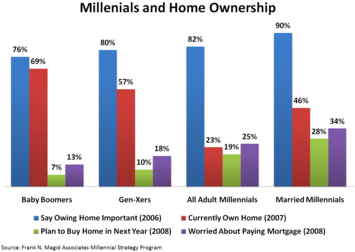
    This pattern will continue to the mid-21st century. The reasons are not hard to identify: Suburbs experience faster job and income growth, far lower crime rates (roughly one-third) and much higher rates of home ownership. While cities will always exercise a strong draw for younger people, the appeal often proves to be short-lived; as people enter their 30s and beyond, they generally prefer suburbs. This pattern will become more pronounced as the huge millennial generation — those born after 1983 — enters this age cohort.

    Over the next few decades, however, suburban communities will evolve beyond the conventional 1950s-style “production suburbs” of vast housing tracts constructed far from existing commercial and industrial centers. The suburbs of the 21st century will increasingly incorporate aspects of preindustrial villages. They will be more compact and self-sufficient, providing office space as well as a surging home-based workforce. Well before 2050 as many one in four or five people will work full or part time from home.

    Surveys of housing preferences consistently show that if given the choice, most Americans, particularly families, will still opt for a place with a spot of land and a little breathing room. And despite the coming population growth, most Americans will probably continue to resist being forced into density, and even with 100 million more people, the country will still be only one-sixth as crowded as Germany.

    The Rise of ‘Cities of Aspiration’

    The continuing appeal of suburbia does not mean that America’s urban centers are doomed. On the contrary, the United States will remain a nation of great cities. Throughout the history of civilization, cities have been engines for social, cultural and economic activity. The market for dense urban existence is likely to remain small compared with suburbs, but there will still be massive opportunities to provide for the roughly 15 million to 20 million new urban dwellers by 2050.

    Some urban areas such as San Francisco, Boston, Manhattan and the western edge of Los Angeles will remain highly attractive to the young, the affluent and the highly skilled, as well as some recent immigrants. After all, these cities contain many of the nation’s most vibrant cultural institutions, research centers, colleges and universities, and much of its most attractive architecture.

    These cities will sit atop the urban economic food chain, somewhat aloof from the rest of country, and will experience modest growth. But for most Americans, the focus of urban life will shift to cities that are more spread out and, by some standards, less intrinsically attractive.

    These new “cities of aspiration” — Phoenix, Houston, Dallas, Atlanta and Charlotte, N.C. — will perform many of the functions as centers for upward mobility that New York and other great industrial cities once did.

    Filling America’s Heartland

    Perhaps the least anticipated development in the nation’s 21st century geography will be the resurgence of the American heartland, often dismissed by coastal dwellers as “flyover country.” But as the nation gains 100 million people, population and cost pressures are destined to resurrect the nation’s vast hinterlands.

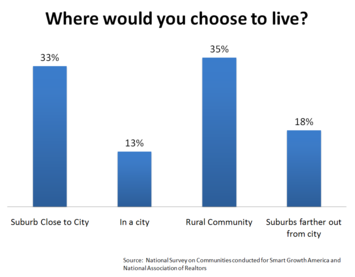
    Americans will head out to the hinterlands because they will find opportunities and perhaps a better quality of life. According to recent surveys, as many as one in three American adults would prefer to live in a rural area — compared with the 20-odd percent who actually do. Most Americans perceive rural America as epitomizing traditional values of family, religion and self-sufficiency and as being more attractive, friendly and safe, particularly for children.

    One critical factor in the heartland’s growing relevance is the advent of the Internet, which has broken the traditional isolation of rural communities. As the technology of mass communications improves, the movement of technology companies, business services and manufacturers into the hinterland is likely to accelerate. This will be not so much a movement to remote hamlets, but to the growing number of dynamic small cities and towns spread throughout the heartland.

    The heartland, consigned to the fringes of American society and economy in the 20th century, is poised to enjoy a significant renaissance in the early 21st. Not since the 19th century, when it was a major source of America’s economic, social and cultural supremacy, has the vast continental expanse been set to play so powerful a role in shaping the nation’s future.

    This article originally appeared at AOLNews.com.

    Joel Kotkin is executive editor of NewGeography.com and is a distinguished presidential fellow in urban futures at Chapman University. He is author of The City: A Global History. His newest book is The Next Hundred Million: America in 2050, released in Febuary, 2010.

    Photo: sparktography

  • America in 2050 — Strength in Diversity

    An ongoing source of strength for the United States over the next 40 years will be its openness to immigration. Indeed, more than most of its chief global rivals, the U.S. will be reshaped and re-energized by an increasing racial and ethnic diversity.

    These demographic changes will affect America’s relations with the rest of the world. The United States likely will remain militarily pre-eminent, but the future United States will function as a unique “multiracial” superpower with deep familial and cultural ties to the rest of the world.

    No Clear Majority

    The United States of 2050 will look very different from the country that existed just a decade ago, at the dawn of the new millennium. Between 2000 and 2050, the vast majority of America’s net population growth will come from racial minorities, particularly Asians and Hispanics, as well as a growing mixed-race population.

    By the middle of the 21st century, America will have no clear “majority” race. Today 30 percent of the U.S. population is nonwhite; in 2050 it may be nearly 50 percent. Latino and Asian populations are expected to triple. Today, because of high Latino birthrates, one in five American children under the age of 5 is Hispanic; increasingly most Hispanic growth will come from the children of those born in America.

    More Multiracial

    At the same time, these varying groups, and particularly their children, will become ever more multiracial in their outlook. The percentage of Americans of mixed race is growing significantly among people under 18; in California and Nevada mixed-marriage rates are at more than 13 percent, and in the rest of the Southwest a heavily Latino population increasingly intermarries with other ethnic groups.

    We will see more of this kind of interracial pairing in the future. According to market research firm Teen Research Unlimited, 60 percent of American teens say they have friends of different ethnic backgrounds. Even more telling, a 2006 Gallup Poll showed that 95 percent of young people (ages 18 to 29) approved of interracial dating — compared with only 45 percent of respondents over the age of 64. Likewise, a USA Today/Gallup Poll conducted in 2008 among teens showed that 57 percent have dated someone of another race or ethnic group, up 40 percent from when Gallup last polled teens on the question back in 1980.

    More Immigrants

    Europe also will continue to be a source of immigrants as many talented young Europeans continue to escape the continental nursing home by heading to the United States. But by far the largest groups of immigrants to the U.S. will come from Latin America, Africa, China and other developing countries. The United Nations estimates that 2 million people will move to developed countries annually until 2050, and more than half will come to the United States.

    Some of best educated and most successful, of course, will then go back home, as has been case throughout most of American history. But many more will stay, often for very mundane reasons, such as the chance to live in a dwelling larger than a shoebox or to have more than one child. Others will cherish the chance to live without worrying about the depredations of some party bureaucrat, caudillo or religious fanatic. These immigrants are not seeking a spot on the Titanic. They realize that, despite its many failings, America is uniquely able to reinvent and re-energize itself.

    Changing Landscape

    This greater diversity will become increasingly evident across an expanding landscape, including many once homogeneous areas like the Great Plains.

    But the new epicenter for diversity will lie in the once overwhelmingly white suburbs, which now increasingly are settled by minorities and immigrants. An absolute majority of our foreign-born population now lives in suburbia, up from 44 percent in 1980.

    Already the best places to find ethnic shopping complexes, Hindu temples and new mosques are not in the teeming cities but in the outer suburbs of places like Los Angeles, New York and Houston. In most immigrant-rich suburbs, you find alongside the temples and mosques churches and synagogues.

    Unique in the World

    In contrast to this growing diversity, the United States’ chief global rivals seem far less able to accommodate this level of interracial mixing. China, Japan and Korea are culturally resistant to diversity and unlikely to welcome large-scale immigration, even if much of their labor force has to go to work in walkers and wheelchairs.

    Given Europe’s current considerable problems integrating its immigrants, particularly Muslims, the continent seems ill disposed to open its doors further; Denmark and the Netherlands are considering measures to sharply restrict immigration.

    Economic Benefits

    The changing ethnic population in the U.S. will no doubt play a leading role in the next economic transition.

    Recent newcomers have already distinguished themselves as entrepreneurs, forming businesses from street-level bodegas to the most sophisticated technology companies. Between 1990 and 2005 immigrants started one-quarter of all venture-backed public companies.

    Large American companies are also increasingly led by people with roots in foreign countries, including 14 of the CEOs of the 2007 Fortune 100. Even corporate America — once the almost-exclusive reserve of native-born Anglo-Saxons — will become as post-ethnic as the larger society.

    The America of 2050 will seem, to some, a very different and even foreign country. Yet our continuing racial evolution confirms the basic dynamism of our society and its ability to adapt. Our experiment with creating what Walt Whitman in 1855 described as “the race of races” will represent one of the great accomplishments of mid-21st century America.

    This article originally appeared at AOLNews.com.

    Joel Kotkin is executive editor of NewGeography.com and is a distinguished presidential fellow in urban futures at Chapman University. He is author of The City: A Global History. His newest book is The Next Hundred Million: America in 2050, released in Febuary, 2010.

    Photo: chrisjfry

  • Forced March To The Cities

    California is in trouble: Unemployment is over 13%, the state is broke and hundreds of thousands of people, many of them middle-class families, are streaming for the exits. But to some politicians, like Sen. Alan Lowenthal, the real challenge for California “progressives” is not to fix the economy but to reengineer the way people live.

    In Lowenthal’s case the clarion call is to take steps to ban free parking. This way, the Long Beach Democrat reasons, Californians would have to give up their cars and either take the bus or walk to their local shops. “Free parking has significant social, economic and environmental costs,” Lowenthal told the Los Angeles Times. “It increases congestion and greenhouse gas emissions.”

    Scarily, his proposal actually passed the State Senate.

    One would hope that the mania for changing how people live and work could be dismissed as just local Californian lunacy. Yet across the country, and within the Obama Administration, there is a growing predilection to endorse policies that steer the bulk of new development into our already most-crowded urban areas.

    One influential document called “Moving Cooler”, cooked up by the Environmental Protection Agency, the Urban Land Institute, the Environmental Defense Fund, Natural Resources Defense Council, the Environmental Protection Agency and others, lays out a strategy that would essentially force the vast majority of new development into dense city cores.

    Over the next 40 years this could result in something like 60 million to 80 million people being crammed into existing central cities. These policies work hard to make suburban life as miserable as possible by shifting infrastructure spending to dense areas. One proposal, “Moving Cooler,” outdoes even Lowenthal by calling for charges of upwards of $400 for people to park in front of their own houses.

    The ostensible justification for this policy lies in the dynamics of slowing climate change. Forcing people to live in dense cities, the reasoning goes, would make people give up all those free parking opportunities and and even their private vehicles, which would reduce their dreaded “carbon imprint.”

    Yet there are a few little problems with this “cramming” policy. Its environmental implications are far from assured. According to some recent studies in Australia, the carbon footprint of high-rise urban residents is higher than that of medium- and low-density suburban homes, due to such things as the cost of heating common areas, including parking garages, and the highly consumptive lifestyles of more affluent urbanites.

    Moreover, it appears that even those who live in dense places may be loath to give up their cars. Over 90% of all jobs in American metropolitan regions are located outside the central business districts, which tend to be the only places well suited for mass transit.

    Indeed, despite the massive expansion of transit systems in the past 30 years, the percentage of people taking public transportation in major metropolitan regions has dropped from roughly 8% to closer to 5%. Even in Portland, Ore.–the mecca for new wave transit consciousness–the share of people using transit to get to work is now considerably less than it was in 1980. In recent months overall transit ridership nationwide has actually dropped.

    These realities suggest that densification of most cities–with the exceptions of New York, Washington and perhaps a few others–cannot be supported by transit. Furthermore, drivers in dense cities will be confronted with not less congestion, but more, which will likely also boost pollution. The most congested cities in the country tend to be the densest, such as Los Angeles, Sen. Lowenthal’s bailiwick, which is in an unenviable first place.

    Then there is the little issue of people’s preferences. Urban boosters have been correct in saying that until recently there have been too few opportunities for middle-class residents to live in and around city cores. But over the past decade many cities have gone for broke with dense condo and rental housing and have produced far more product, often at very high cost, than the market can reasonably bear.

    Initially, when the mortgage crisis broke, the density advocates built much of their case on the fact that the biggest hits took place in suburban areas, particularly on the fringe. Yet as suburban construction ended, cities continued building high-density urban housing–sometimes encouraged by city subsidies. As a result, in the last two years massive foreclosures have plagued many cities, and many condominiums have been converted to rentals. This is true in bubble towns like Las Vegas and Miami; “smart-growth” bastions like Portland and Seattle; and even relatively sane places such as Kansas City, Mo. All these places have a massive amount of high-density condos that are either vacant or converted into lower-cost rentals.

    Take Portland. The city’s condo prices are down 30% from their original list price. The 177-unit Encore, one of the fanciest new towers, has closed sales on 12 of its units as of March, while another goes to auction. Meanwhile in New York half-completed structures dot Brooklyn’s once-thriving Williamsburg neighborhood, while the massive Stuyvesant Town apartment complex in Manhattan teeters at the edge of bankruptcy.

    Finally, it is unlikely that cities would be able to accommodate the massive growth promoted by urban boosters, land speculators and policy mavens. Aaron Renn, who writes the influential Urbanophile blog, says that most American cities today struggle to maintain their current infrastructure. They also have limited options to zone land for high-density construction, due in part to grassroots opposition to existing residential neighborhoods. Overall they would be hard-pressed to accommodate much more than 10% of their region’s growth, much less 50% or 60%.

    Given these realities, and the depth of the current recession, one might think that governments would focus more on basics like jobs and fixing the infrastructure–in suburbs as well as cities–than reengineering how people live. Yet it is increasingly clear that for many “progressives” the real agenda is not enabling people to achieve their dreams–especially in the form of a suburban single-family house. It is, instead, forcing them to live in what is viewed as more ecologically and socially preferable density.

    In the next few months we may see more of the kind of hyperregulation proposed by the likes of Sen. Lowenthal. It is entirely possible that a hoary coalition of HUD, Department of Transportation and EPA bureaucrats could start trying to restrict future housing development along the lines suggested in “Moving Cooler.”

    Yet over time one has to wonder about the political efficacy of this approach. Right now Americans are focused primarily on simply economic growth–and perhaps a touch less on the intellectual niceties of the “smart” form. In addition they are increasingly skeptical about climate change, which serves as the primary raison d’etre behind the new regulatory schema.

    Given the zealousness of the density advocates, perhaps the only thing that will slow, and even reverse, this process will be the political equivalent of a sharp slap across the face. Unless the ruling party begins to reacquaint itself with the preferences and aspirations of the vast majority of Americans, they may find themselves experiencing repeats of their recent humiliating defeat–manufactured largely in the Boston suburbs–in true-blue Massachusetts.

    Americans–suburban or urban–may resist a return to unbridled and extreme Republicanism, whether on social issues or in economic policy. But forced to choose between Neanderthals, who at least might leave them alone in their daily lives, and higher-order intellects determined to reengineer their lives, they might end up supporting bipeds lower down the evolutionary chain, at least until the progressive vanguard regains a grip on common sense.

    This article originally appeared at Forbes.com.

    Joel Kotkin is executive editor of NewGeography.com and is a distinguished presidential fellow in urban futures at Chapman University. He is author of The City: A Global History. His newest book is The Next Hundred Million: America in 2050, released in Febuary, 2010.

    Photo: Creativity+ Timothy K Hamilton