Author: Joel Kotkin

  • What American Demographics Will Look Like in 2050

    To many observers, America’s place in the world is almost certain to erode in the decades ahead. Yet if we look beyond the short-term hardship, there are many reasons to believe that America will remain ascendant well into the middle decades of this century.

    And one important reason is people.

    From 2000 to 2050, the U.S. will add another 100 million to its population, based on census and other projections, putting the country on a growth track far faster than most other major nations in the world. And with that growth — driven by a combination of higher fertility rates and immigration — will come a host of relative economic and social benefits.

    More fertile

    Of course the percentage of childless women is rising here as elsewhere, but compared to other advanced countries, America still boasts the highest fertility rate: 50 percent higher than Russia, Germany or Japan, and well above that of China, Italy, Singapore, Korea and virtually all of eastern Europe.

    As a result, while the U.S. population is growing, Europe and Japan are seeing their populations stagnate — and are seemingly destined to eventually decline. Russia’s population could be less than a third of the U.S. by 2050, driven down by low birth and high mortality rates. Even Prime Minister Vladimir Putin has spoken of “the serious threat of turning into a decaying nation.”

    In East Asia, fertility is particularly low in highly crowded cities such as Tokyo, Shanghai, Tianjin, Beijing and Seoul. And China’s one-child policy — and a growing surplus of males over females — has set the stage for a rapidly aging population by mid-century. South Korea, meanwhile, has experienced arguably the fastest drop in fertility in world history, which perhaps explains its extraordinary, if scandal-plagued, interest in human cloning.
    Even more remarkably, America will expand its population in the midst of a global demographic slowdown. Global population growth rates of 2 percent in the 1960s have dropped to less than half that rate today, and this downward trend is likely to continue — falling to less than 0.8 percent by 2025 — largely due to an unanticipated drop in birthrates in developing countries such as Mexico and Iran. These declines are in part the result of increased urbanization, the education of women and higher property prices. The world’s population, according to some estimates, could peak as early as 2050 and begin to fall by the end of the century.

    Younger and More Vibrant

    Population growth has very different effects on wealthy and poor nations. In the developing world, a slowdown of population growth can offer at least short-term economic and environmental benefits. But in advanced countries, a rapidly aging or decreasing population does not bode well for societal or economic health, whereas a growing one offers the hope of expanding markets, new workers and entrepreneurial innovation.

    In fact, throughout history, low fertility and socioeconomic decline have been inextricably linked, creating a vicious cycle that affected such once-vibrant civilizations as ancient Rome and 17th-century Venice and that now affects contemporary Europe , Russia and Japan.

    Within the next four decades, most of the developed countries in both Europe and East Asia will become veritable old-age homes: a third or more of their populations will be older than 65, compared with only a fifth in the U.S. By 2050, roughly 30 percent of China’s population will be older than 60, according to the United Nations. The U.S. will have to cope with an aging population and lower population growth, in relative terms, but it will maintain a youthful, dynamic demographic.

    More Hopeful About the Future

    The reasons behind these diverging trends is complex. In some countries, a sense of diminished prospects, combined with a chronic lack of space, appear to be the root causes for plunging birthrates. As Italians, Germans, Japanese, Koreans and Russians have fewer offspring — one recent survey found that only half of Italian women 16 to 24 said they wanted to have children — they will have less concern for future generations.

    In contrast, in the United States roughly three-quarters of young people report they plan to have offspring. Such individual decisions suggest that America, for all its problems, is diverging from its prime competitors, placing its faith in a future that can accommodate 100 million more people.

    As author Michael Chabon recently wrote, “In having children, in engendering them, in loving them, in teaching them to love and care about the world,” parents are “betting” that life can be better for them and their progeny.

    This article originally appeared at AOLNews.com.

    Joel Kotkin is executive editor of NewGeography.com and is a distinguished presidential fellow in urban futures at Chapman University. He is author of The City: A Global History. His newest book is The Next Hundred Million: America in 2050, released in Febuary, 2010.

    Photo: victoriapeckham

  • Jerry Brown: Machiavelli Or Torquemada?

    For more than one-third of a century Jerry Brown has proved one of the most interesting and original figures in American politics–and the 71-year-old former wunderkind might be back in office in 2010. If he indeed wins California’s gubernatorial election, the results could range from somewhat positive to positively disastrous.

    Brown is a multi-faceted man, but in political terms he has a dual personality, split between two very different Catholic figures from the 15th century: Machiavelli and Tomas de Torquemada. For the sake of California, we better hope that he follows the pragmatism espoused by the Italian author more than the stern visage of the Grand Inquisitor.

    Like a good Jesuit, Brown certainly can be flexible. Back in 1978, for example, he worked against Howard Jarvis’ Proposition 13, which capped real estate taxes. But once the measure was passed, Brown embraced it as his own. Indeed, he was so enthusiastic about the tax-cutting measure that Jarvis actually voted for Brown’s re-election late that same year. A month after the vote a Los Angeles Times poll revealed most Californians thought Brown actually supported 13.

    Brown also has shown his flexibility by throwing even loyal allies under the bus. Elected largely due to the electoral coalition constructed by his father, Edmund G. “Pat” Brown, Brown made a point of tweaking and restraining the expanding bureaucracy largely created by his father. He also took on the University of California and the welfare bureaucracy as well as agriculture, residential real estate and manufacturing giants.

    This Oedipal battle reflected Brown’s personal crankiness. He came into office, recalled top aide Tom Quinn, “questioning the values of the Democratic Party.”

    Ascetic and even monk-like, he rejected his father’s “build, build, build” philosophy and embraced E. F. Schumacher’s “small is beautiful” ideology. Like the 15th-century Florentine Catholic monk Girolamo Savanarola, he came to rid Sacramento of suberbia and luxuria.

    Brown was also ahead of his time. His early embrace of green politics–particularly energy conservation and renewable fuels–foreshadowed that of later Democrats, particularly Barack Obama. His strong outreach to Latinos and other minorities expanded his political base among California’s fastest-growing populations.

    Yet Brown understood that economic prosperity–not civil rights or environmental zealotry–was key to political ascendancy. Eastern journalists dismissed him as “Governor Moonbeam,” but they ignored his Machiavellian skill in recognizing and reaching out to rising economic forces, notably the high-tech entrepreneurs in the Silicon Valley and across Southern California. The growth of this sector, along with rising trade with Asia and the military boom after the Soviet invasion of Afghanistan, set the pace for the state’s strong rebound from its early 1970s doldrums.

    But Brown’s inquisitorial side surfaced again as he prepared a second run–he had made a charmingly eccentric assault in 1976–for the White House. Perhaps the prospect of facing a man of infinite flexibility, Bill Clinton, pushed him over the top, but Brown re-invented himself as a high-octane and, at times, shrill populist.

    After some years in the political wilderness, he reemerged in 1998 as Mayor of Oakland, a tough job even in good times. Although he remained predictably arrogant and aloof, the job of managing a working-class city seemed to have brought him to his senses. Like the ideal politician in The Prince, Brown governed with something approaching strategic precision, pushing economic development, embracing the police and supporting new infrastructure spending.

    Brown’s newfound reputation as a canny realist helped him win the election as attorney general in 2006. Yet once back in statewide politics, the inquisitorial side found expression. Convinced about the impending threat of global warming, Brown used his new powers to push the Gorite agenda with the passion of a Torquemada.

    Although Brown was not quite torturing heretics, he certainly applied the legal equivalent of thumbscrews to anyone–developers, cities, counties–who did not follow his prescriptions about “carbon neutrality.” Even proposals for sensible, relatively dense “in fill” development were turned aside in favor of utopian, economically unsustainable ideas about forced density and transit friendliness.

    Today, with California’s economy is in tatters–its unemployment well over 12%–and Brown’s crusade seems likely to make it worse. Onerous regulation threatens everything from the construction of new single-family homes to new employment tied to anything that releases demon carbon–including manufacturing, oil drilling and large-scale agriculture.

    All this has made Brown widely feared in much of California’s fractured, traumatized business community. Even worse, he has emerged as the standard-bearer of the public employee unions, the very force whose political power and pensions are bringing the state to the verge of economic ruin. The fact that Brown’s campaign is funded largely by these unions makes it, at least on the surface, unlikely to challenge the hegemony of our putative “civil servants.” They are said to be ready to spend up to $40 million on “independent” campaigns to help beat back any chance of a GOP victory.

    This is worrisome given Brown’s role in fostering the expansion of public-sector unions during his term, a group whose ascendancy has become arguably the single biggest factor in the state’s precipitous decline during his last gubernatorial reign. As author Steven Greenhut has pointed out, unfunded pension liabilities in excess of $50 billion are one key element driving the state toward ever more depressed bond ratings and possible bankruptcy.

    Under normal circumstances, Brown’s ties to the public sector, his fickle nature and his dubious accomplishments would spell political doom. But amazingly, Brown’s long, if mixed, record might actually prove an advantage against his most likely opponent, former eBay executive Meg Whitman, who is running as an outsider.

    The problem for Whitman or any GOP candidate lies with the miserable legacy of another nominally Republican outsider, Arnold Schwarzenegger. The Terminator’s record of ineptitude and empty blather stands as a mega-advertisement against inexperience. Compared to the former body builder’s amateurish blundering, Brown’s wealth of knowledge of government looks appealing.

    Whitman, or her main challenger Insurance Commissioner Steve Poizner, also must struggle with a Republican Party out of sync with an increasingly multi-racial and socially liberal state. As long-time political analyst Allan Hoffenblum notes, for the first time there is not one congressional, state senate or assembly district with a GOP majority.

    So in the end, California’s fate may end up resting on which Jerry Brown emerges after the election. If he continues on his inquisitorial assault on carbon-creators, you can pretty much expect California’s middle class to continue diminishing while the state’s aspirational appeal ebbs ever further. The state could end up resembling Kevin Starr’s description of his native San Francisco– “a cross between Carmel and Calcutta.”

    But given his history, Brown could still surprise us. Stuck with responsibility for a decaying economy and fiscally burdened by the voracious public unions, Brown could do a “Nixon in China,” imposing controls on pensions and salaries. He could recognize that “green jobs” can not save California from the abyss and that a new “era of limits” must apply to the public sector as well as the rest of us. With the passionate climate-change constituency shrinking, he might even decide to accept a modicum of carbon heresy as a necessary evil.

    Brown should heed Machiavelli’s advice for rulers to be “merciful and not cruel” and “proceed in a temperate manner with prudence and humanity.” If in his old age Brown adopts the Italian writer’s credo of tactical flexibility, reason and tolerance, the Golden State may yet revive itself, and with it restore the legacy of its most storied political family.

    This article originally appeared at Forbes.com.

    Joel Kotkin is executive editor of NewGeography.com and is a distinguished presidential fellow in urban futures at Chapman University. He is author of The City: A Global History. His newest book is The Next Hundred Million: America in 2050, released in Febuary, 2010.

    Photo: Troy Holden

  • Decentralize The Government

    From health care reform and transportation to education to the environment, the Obama administration has–from the beginning–sought to expand the power of the central state. The president’s newest initiative to wrest environment, wage and benefit concessions from private companies is the latest example. But this trend of centralizing power to the federal government puts the political future of the ruling party–as well as the very nature of our federal system–in jeopardy.

    Of course, certain times do call for increased federal activity–legitimate threats to national security or economic emergencies, such as the Great Depression or the recent financial crisis, for example.

    Other functions essential to interstate commerce–basic research, science education, the guarantee of civil rights, transportation infrastructure, as well as basic environmental health and safety standards–also call for federal oversight. Virtually every modern president, from Roosevelt and Eisenhower to Reagan and Clinton, has endorsed these uses of centralized government.

    But what is happening now goes well beyond the previously defined perimeters of the federal government’s powers. Obama seems to possess a desire not so much to fix the basic infrastructure of the country but to re-engineer our entire society into the model championed by liberal academia.

    There also seems to be a conscious design to recreate the country as a European-style super-state. Forged by an understandable urge to minimize chaos after a century of conflict, the super-state generally favors risk management through centralization of authority. This has traditionally been accomplished by ceding regulatory powers to national capitals, though lately more and more powers have been ceded to the European Union.

    Initially the administration had hopes of imposing similar controls through acts of Congress. However, with the shifting political mood, this seems less and less possible. With its latest action the administration sends the message that it will now impose the desired results through the bureaucracy. Under the proposal, private firms that do not raise wages will be bullied into doing so through the manipulation of federal contract awards.

    This marks a departure from our basic traditions. For most of our history the burden of expanding opportunity has rested with the private economy, albeit in conjunction with often necessary protections for workers and consumers. Now the overall control of the economy is shifting to Washington–from government contracts to ownership shares in companies like General Motors and much of the financial sector.

    This new order would transform the very nature of American capitalism. Now the economic winners will not be those working for the most agile or profitable companies, but those who gain the blessings of the federal overlords. In some senses this extends the corrupt, largely failed political economy of Chicago politics to a bastard American form of French dirigisme.

    Climate change provides another critical and necessary rationale for the expansive federal role. With the “cap and trade” system all but dead, the administration now wants to regulate energy and land use through the gentle graces of a largely unaccountable EPA apparat. As a result, we may see energy use, land use and transportation–as is increasingly the case in California–controlled by the whims of the unelected bureaucracy.


    Such command and control approaches have their advantages in making people do what the mandarins demand. This is one reason there are so many admirers of Chinese autocracy now. In that regime, unlike our messy democracy, you can be forced to be green in precisely the way they tell you. There are always firing squads for those who go off the program.

    Of course, even the most passionate centralists don’t advocate adopting the Chinese model. But the notion of an enlightened super-state has long appealed to those disgusted with American-style muddling through. In some ways, the current fashion recalls Americans’ attraction for the Soviet Union or even fascist Italy during the troubled 1930s.

    Fortunately, most Americans do not appear ready for unbounded autocracy. This is particularly true outside the coastal urban centers. The Tea Party may have some cranky–even ill-advised–ideas, but they reflect a genuine–and broader–American preference for solving problems at the state or local level.

    Indeed, Americans, including some on the left, are instinctive decentralists. We express this tendency physically, first in our decades-old movement to the suburbs, and increasingly to smaller towns and cities as well as rural areas. Even in cities like New York or Los Angeles, local neighborhood identity trumps ties to more grandiose visions of City Halls or regional bodies. The rise of the Internet and social networks has enhanced this decentralizing trend by providing instant linkages and helping ad hoc organization among neighbors.

    Economic evolution mirrors this trend. Over the past few decades U.S. employment has shifted not to mega corporations but to smaller units and individuals; between 1980 and 2000 the number of self-employed individuals expanded 10-fold to include 16% of the workforce. The smallest businesses–the so-called micro enterprises–have enjoyed the fastest rate of growth, far more than any other business category. By 2006 there were some 20 million such businesses, one for every six private sector workers.

    America’s entrepreneurial urge, in contrast to developments elsewhere, has actually strengthened. In 2008 28% of Americans said they had considered starting a business–more than twice the rate for French or Germans. Self-employment, particularly among younger workers, has been growing at twice the rate of the mid-1990s.

    The remarkable volatility within even the largest companies has exacerbated this trend. Firms enter and leave the Fortune 500 with increasing speed. More and more workers will live in an economic environment like that of Hollywood or Silicon Valley, with constant job shifts, changes in alliances between companies and the growth of job-hopping “gypsies.” Although hard times could slow new business formation, historically recessions have served as incubators of innovation and entrepreneurship.

    Much of the most dynamic and meaningful change takes place under the radar of both big business and government. The shift to greater localism can be seen in the growth of local, unaffiliated community churches, regional festivals and farmers markets. Bowling clubs and old men’s clubs may be fading, but volunteerism has spiked among millennials and seems likely to surge among baby boomers. In 2008 some 61 million Americans volunteered, representing over a quarter of the population over 16.

    No other major country exhibits this kind of localized, undirected activism. Such vital grassroots may become even more important as the country becomes more diverse. In the coming decades we will have to accommodate an expanding range of locally preferred lifestyles, environments, ethnic populations and politics. One size determined by mandarins in Washington increasingly will not fit all. South Dakotans and San Franciscans will prefer to address similar problems in different ways. Within the limits of constitutional rights, we should let them try their hand and let everyone else learn from their success (or failure).

    Ultimately, we do not want to recreate the expansive mandarin state so evident in many foreign countries. Instead, we should focus more on family, community, neighborhoods, local jurisdictions and voluntary associations–what Thomas Jefferson called our “little republics”–as the most effective engines driving toward a better future.

    This article originally appeared at Forbes.com.

    Joel Kotkin is executive editor of NewGeography.com and is a distinguished presidential fellow in urban futures at Chapman University. He is author of The City: A Global History. His newest book is The Next Hundred Million: America in 2050, released in Febuary, 2010.

  • Obama’s Middle-Class Meltdown

    The rapid decline in public support for Democrats and President Obama represents one of the most breathtaking political collapses in modern times. Little over a year from a huge electoral triumph, President Obama’s level of support has dropped from around 65% to under 50%. The Democrats in Congress, who held as much as a 10% edge over the Republicans last spring, are actually losing a “generic” vote.

    Many Republicans and conservatives may think this represents a confirmation of their values. Yet in reality, the Democratic meltdown has less to do with belated admiration for the GOP—their support as a party remains at historically low levels—than a question of a massive disconnect between the people in power and the large, middle-class majority.

    The Great Disconnect reflects a growing chasm between the normative “wisdom” within political parties and their aligned media, academic and policy cadres. The Disconnect in part derives from the tendency of politicos and their associates to converse mostly with each other—and not develop much of a direct feel for that vast, and increasingly complex, country beyond the Beltway.

    As President, Barack Obama’s Great Disconnect seems most obvious. Although he occasionally uses populist middle-class rhetoric, both Obama’s priorities and body language suggest his inspiration comes largely from the rarified world of the universities and Democratic Party contributors.

    Not surprising then that he started with a stimulus package that, although one was needed, offered little to private sector Main Street businesses. Instead, the primary beneficiaries turned out to be Wall Street grandees, whose high salaries he variously denounces and excuses, and public employee unions.

    Obama’s move was encouraged by the aging leadership of the Democratic Party, shaped by places like Nancy Pelosi’s San Francisco and Henry Waxman’s lushly affluent Beverly Hills. It has little to do with the views of the middle class who reside generally in smaller towns and less-than-tony suburbs—but some of the wealthiest, and most privileged, populations on earth.

    President Obama’s other key constituency lies in the public sector unions, whose power in his home state of Illinois now rivals and perhaps surpasses that of the Daley machine. Even as middle-class voters see their pensions dwindle along with their housing prices and jobs, the public sector has waxed into something resembling the Blue Meanie in Yellow Submarine who consumes everything in sight, and ultimately itself.

    Perhaps nothing so illustrates the Great Disconnect than the president and the congressional lions’ embrace of the radical green climate change agenda. Still popular in upper-class urban areas and university towns, this agenda is notably less well-supported in middle and working class communities, particularly in the middle of the country.

    Even before the Climategate revelations—which led to one top warmist figure admitting to the BBC that there had been in fact “no statistically significant” warming over the past fifteen years—the agenda was losing support, ranking it dead last among 20 priorities in a Pew survey last year. Now the public is becoming openly skeptical, with support for the notion of primarily human-caused warming falling since April from 47 to 35%.

    President Obama must realize that prioritization of the climate agenda, along with other coastal liberal priorities, undermines Democratic support in the Great Plains and the Great Lakes, where the party recently has been making some significant gains. The recent withdrawals of Senators Byron Dorgan and Evan Bayh reflect the Democrats’ growing vulnerability in these regions. Recent polls in Iowa, where Obama won his signature primary victory in 2008, show the president’s popularity at less than 50 percent, in large part due to losses among independent voters.

    Yet if Americans have been departing the Democrats, does it follow that they will shift en masse to the GOP? There is reason for skepticism here as well. After all, this is the same party that, along with the Democrats, supported massive spending under George Bush and actively promoted the disastrous de-regulation of the financial markets. The prescience of the likes of former Majority Leader Dick Armey—a co-conspirator in the Bush era’s profligacy—at the forefront of the Tea Parties should worry even the most credulous small-government activist.

    The Republican claim to the populist mantle is even more suspect. Republicans like House Minority Leader John Boehner have cozied up to Wall Street, hoping to take advantage of rising “buyer’s remorse” among the grandees. Suggesting Republicans could shield the financial sector from even modest Democrat efforts to make them face consequences for their loathsome and disastrous folly, they unintentionally show that their critique of the president’s “crony capitalism” largely involves shifting the identity of the cronies.

    The Republicans also have a bit of a demographic problem. Their Neanderthal stance on social issues varies radically from the rising millennial generation, and threatens to alienate them permanently. And perhaps even more seriously, the strong nativist wing of the party, epitomized by Tea Party keynoter former Representative Tom Tancredo, represent a threat to the other large emerging voting block, immigrants and their offspring.

    If you want to see an illustration of what this means, just examine the plummeting GOP registration levels in increasingly multi-racial California. For the first time in modern history, according to veteran political observer Allan Hoffenblum, there is not a single congressional, state Senate or Assembly district in the state with a majority Republican registration.

    Although the Republicans are riding high now, do not overestimate their ability to seize the field now so ineptly being vacated by the Democrats. It may well turn out that President Obama still may overcome the Great Disconnect before the GOP does. Obama’s ability to change direction already can be seen in such things as his new-found enthusiasm for nuclear power and more drilling on public lands. His most recent jobs bill also has more of a focus on promoting private employment growth than past efforts.

    Ultimately, the party that wins in 2010 and beyond will be the one that addresses the real issues of this age—the battle for private sector jobs and upward mobility—that matter to the vast majority of Americans. It is on those issues, not global warming, ethnic purity or gay marriage that the political future will now turn.

    This article originally appeared at The Daily Beast.

    Joel Kotkin is executive editor of NewGeography.com and is a distinguished presidential fellow in urban futures at Chapman University. He is author of The City: A Global History. His newest book is The Next Hundred Million: America in 2050, released in Febuary, 2010.

    Photo: Official White House Photo by Pete Souza

  • Welcome to Ecotopia

    In this era of tea-partying revolutionary-era dress-ups, one usually associates secessionism with the far right. But if things turn sour for the present majority in Washington, you should expect a whole new wave of separatism to emerge on the greenish left coast.

    In 1975 Ernest Callenbach, an author based in Berkeley, Calif., published a sci-fi novel about enviro-secessionists called Ecotopia; a prequel, Ecotopia Rising, came out in 1981. These two books, which have acquired something of a cult following, chronicle–largely approvingly–the emergence of a future green nation along the country’s northwest coast.

    Aptly described by Callenbach as “an empire apart,” this region is, in real life, among the world’s most scenic and blessed by nature. Many in this part of America have long been more enthusiastic about their ties to Asia than those with the rest of the country. It is also home to many fervent ecological, cultural and political activists, who often feel at odds with the less enlightened country that lies beyond their soaring mountains.

    Until the election of Barack Obama, the Pacific Northwest certainly was separating from the rest of America–at least in attitude. After George W. Bush’s victory the 2004 presidential election, the Seattle weekly The Stranger published an angry editorial about how coastal urbanites needed to reject “heartland values like xenophobia, sexism, racism and homophobia” and places where “people are fatter and dumber and slower.”

    Such a narrow, cynical view of the rest of the country is in line with Callenbach’s Ecotopia novels, in which the bad guys–representatives of American government and corporations–are almost always male, overweight and clueless about everything from technology to tending to the earth.

    Of course, would-be Ecotopians have much of which to be proud. The three great cities of the region–San Francisco, Portland and Seattle–easily rank among the most attractive on the continent. They all boast higher-than-average levels of education and–at least around San Francisco and Seattle–some of the world’s deepest concentrations of high-tech companies.

    Yet for all their promise, the Ecotopian regions cannot claim to have missed the current recession. Downtown Seattle currently suffers a vacancy rate in excess of 20%, the highest in decades; last year apartment rental rates dropped 13.8%, the steepest decline among American metros. Meanwhile vacancies in the Silicon Valley area south of San Francisco have soared to above 20%. By early this year, there was enough unoccupied office space in the Valley to fill 15 Empire State Buildings.

    This may seem a bit counter-intuitive for a region that boasts the headquarters of Microsoft, Costco, Amazon, Intel and Apple. But while such companies provide lots of high-wage employment, they are no longer enough to spark much growth across the region’s economy. The San Francisco area has actually lost jobs over the past decade and shows little sign of recovering its once prodigious growth rates.

    But easily the weakest of the economies has been Portland, which lacks the presence of major anchor firms like those in greater Seattle or the Bay Area. Portland’s unemployment rate has been well over 10% since late last year.

    A wave of youthful migration has made the city a slacker haven for the past decade and, in turn, exacerbated unemployment figures. Homeless kids now crowd the downtown area, which, although far from destitute, does appear pretty grungy in places.

    Yet, like the Ecotopians in the Callenbach novels, Portland residents and politicians seem nonplussed about their anemic economic performance. After all, the city voted heavily–despite solid opposition from the rest of the state–to raise Oregon’s taxes on wealthy individuals and corporations, a move likely to deter new in-bound investment.

    “You don’t have a big focus here on economic development,” observes Stephen B. Braun, dean of the School of Management at Portland’s Concordia University. “There’s much more emphasis on quality of life than on making a living.”

    The proof: Portland may have high unemployment, but the big idea around city hall is not how to promote jobs but about investing an additional $600 million in bike lanes.

    All these places, of course, avidly endorse green jobs even if there’s little prospect they could replace the jobs being lost in the fading blue-collar sectors. A growing green job sector needs a vibrant economy that produces things and builds new buildings, notions that have little currency across much of the region.

    This anti-growth attitude reflects that of Callenbach’s Ecotopia, which favors a “stable state” economy over job or wealth creation. Ecotopian politics explicitly ban both population increases and the private automobile.

    While the mayors of Portland, San Francisco and Seattle are hardly that extreme, they could propose policies that would make driving more burdensome. And they certainly seem to do wonders in chasing would-be baby-makers out of the city. All three cities have among the lowest percentages of children of any in the U.S.

    Perhaps the toughest issue facing the Ecotopian political economy lies with the issue of class. Callenbach’s Ecotopia adopts something of an anarchic socialism; the cities of the real ecotopia have tended toward ever greater class bifurcation.

    San Francisco, for example, boasts one of the highest per capita incomes in the nation and remains a favorite destination for inherited wealth, whether among individuals or nested in nonprofits. Yet according to the Public Policy Institute of California, if the cost of living is applied, San Francisco ranks high among urban counties in terms of its concentration of poverty.

    It doesn’t help that the city’s economy has been hemorrhaging corporate headquarters and mid-range middle-class jobs for decades. High-end workers commute to Google and other Valley companies, and others work in the financial or media sectors, but many mid-range jobs have been lost, many of them to more affordable business-friendly locales in places like Colorado.

    As middle-class jobs disappear, Ecotopia’s cities increasingly resemble restrictive communities that are anything but diverse. As analyst Aaron Renn has pointed out, Portland and Seattle stand as among the whitest big cities in the nation. And San Francisco’s once vibrant African-American population has been dropping for decades.

    In the coming years this pattern will likely become more pronounced in Seattle and Portland as well. These cities continue to attract many well-educated people, particularly from California, who in turn bring with them both significant accumulated wealth and anti-growth attitudes.

    Strict “green” planning regimes are also accelerating the decline of the local middle class by driving housing prices up, greatly diminishing the once wide affordability for the middle class. Seattle’s regulatory environment, according to one recent study, has bolstered housing prices in the region by $200,000 since 1989. The percentage of families who could afford a median price home in the area has fallen by more than half.

    Many observers see a similar outcome from Portland’s widely ballyhooed planning regime. Despite the massive acceptance by planners as something of a model for the restored city, the vast majority of all job and population growth in the region has occurred at the less pricey fringes, including across the river in Vancouver, Wash., which lies outside the fearsome Portland planning regime.

    So what is the future for the region, and particularly the eco-cities? If the country starts moving toward the center, and even the right, you can expect Ecotopian sentiment to rise again, perhaps not to the point of secession but expressed in attitude.

    But this may not be all bad. As America’s population grows and other regions rise, perhaps it’s helpful for the various parts of the country to experiment with different systems. Short of civil war, there’s something to be said for relentless, even if sometimes daft, experimentation at the local level. The rest of country may not follow all their strictures, but our would-be Ecotopians could produce some interesting and even usable ideas.

    This article originally appeared at Forbes.com.

    Joel Kotkin is executive editor of NewGeography.com and is a distinguished presidential fellow in urban futures at Chapman University. He is author of The City: A Global History. His newest book is The Next Hundred Million: America in 2050, released in Febuary, 2010.

  • America’s European Dream

    The evolving Greek fiscal tragedy represents more than an isolated case of a particularly poorly run government. It reflects a deeper and potentially irreversible malaise that threatens the entire European continent.

    The issues at the heart of the Greek crisis – huge public debt, slow population growth, expansive welfare system and weakening economic fundamentals – extend to a wider range of European countries, most notably in weaker fringe nations like Portugal, Italy, Ireland, Greece and Spain (the so-called PIIGS). These problems also pervade many E.U. countries still outside the Eurozone in both the Baltic and the Balkans.

    But things are also dicey in some of the core European powers, notably Great Britain, which has soaring debt, high unemployment and very slow growth. Even solvent economies like France, the Netherlands and the continental superpower, Germany, have fallen short of expectations and are expected to experience meager growth for the rest of the year.

    Europe’s poor performance undermines the widespread view held by left-leaning American pundits, policy wonks and academics about Europe’s supposedly superior model. This Euro-philia has a long history, going back at least to the Tories during the Revolution. In better times America usually moves beyond European norms instead of retreating to its cultural mother.

    When the U.S. hits a rough spot, however, there’s a ready chorus urging us to emulate the old continent. During the psychological meltdown that accompanied the Vietnam War, some pundits looked longingly at the relatively peaceful and increasingly affluent Europe as a role model. “There is much to be said for being a Denmark or Sweden, even a Great Britain, France or Italy,” Andrew Hacker said in 1971.

    In the 1980s, as the country struggled to recover its historic competitiveness, numerous pundits suggested adopting European models, notably French and German, to restore our economic standing – a notion widely echoed by Euro-nationalists such as former French President Francois Mitterand’s eminence grise, Jacques Attali.

    Two decades later, with the U.S. reeling from the Great Recession, there’s been a rebirth of euro-mania. Author Parag Khanna, for his part, envisions a “shrunken” America that is lucky to eke out a meager existence between a “triumphant China” and a “retooled Europe.” And Jeremy Rifkin, in his The European Dream, promotes the continent as a morally preferable model – more egalitarian, open and environmentally sensitive – a sentiment recently echoed in my old New America colleague Steven Hill’s Europe’s Promise: Why the European Way Is the Best Hope in an Insecure Age.

    Yet over the past four decades Europe’s core economies – the E.U. 15 – have lagged behind the U.S. in terms of both gross domestic product and job growth. Overall, the E.U. 15’s share of the global GDP has declined to 26% from 35% while the U.S. has held on to its share, now roughly equal to that of its European counterparts. The big winners, of course, have been in East and South Asia.

    Some of this has to do with the difficulties of maintaining an elaborate welfare state. In a productive, efficient and still largely homogeneous country such as the Netherlands or Sweden, an expansive system of social insurance and a vast public sector remains an affordable luxury.

    In contrast, countries like Portugal, Greece and to some extent Spain have tried to create a Scandinavian-style welfare state based on Banana Republic economies. In addition, over-reliance on tourism and real estate speculation has proved no more viable there than in places like Las Vegas or Phoenix.

    Europe’s problems may prove even more profound in the long term. For example, Europe has some of the lowest birthrates in the world. Among 228 countries ranked in terms of birthrate, Europe accounts for 20 of the bottom 28. These include relatively prosperous Germany (No. 226) and Sweden as well as a range of the shaky fringe including Greece, Bosnia, Hungary, Latvia, Italy, Portugal and Spain.

    The shrinking population problem is complicated by the fact that the one growing source of new Europeans consists of Muslim immigrants who generally have not integrated well into continental society. Many European countries – Denmark, the Netherlands and Switzerland, for example – are taking steps to shut their doors, something that may promote harmony and security but could exacerbate the long-term demographic decline.

    With their state-driven economies pledged largely to support a growing population of aging boomers, it’s hard to see what new sources of growth will propel the continent in the coming decades. Overall, according to the European Central Bank, the Eurozone’s growth potential is now roughly half that of the United States.

    Meager economic growth may also be affecting one of Europe’s greatest achievements: its relative egalitarianism. The trend toward greater inequality, earlier evident in the U.S., has now spread to Europe, including such famously “egalitarian” countries as Finland, Norway and Germany, which was the only E.U. country to see wages fall between 2000 and 2008.

    In Berlin, Germany’s largest city, unemployment has remained far higher than the national average, with rates at around 15%. One quarter of the workforce earns less than 900 euros a month. In Berlin, 36% of children are poor, many of them the children of immigrants. “Red Berlin,” with its egalitarian ethos, notes one left-wing activist, has emerged as “the capital of poverty and the working poor in Germany.” [i]

    As in the U.S., the burden of recession has fallen most heavily on younger people. An OECD analysis found that older European workers enjoyed the best gains during the past 30 years, while children and young people fared worse. For E.U. workers under 25 the unemployment rate is well over 20%, slightly higher than that of the U.S. but a remarkable statistic given the far less rapid expansion of the European workforce.

    The situation is particularly dire in Europe’s exposed southern tier. Young people who rioted in Athens in 2008 suffer unemployment rates in excess of 25%. By the end of 2009 unemployment for those under 25 stood at 44% in Spain and 31% in Ireland. Even in Sweden the youth unemployment rate has reached 27%.

    If the pattern of the last decade holds, many of Europe’s most talented young people will end up in the U.S., particularly once the recession comes to an end. By 2004 some 400,000 European Union science and technology graduates were residing in the U.S. Barely one in seven, according to a recent European Commission poll, intends to return. “The U.S. is a sponge that’s happy to soak up talent from across the globe,” observes one Irish scientist.

    Of course, there is still much we can learn from Europe. Besides a sometimes enviable lifestyle, Europeans offer some intriguing health care models and have led the way in efficient fuel economy standards. But overall, profound differences in demographics and cultural traditions suggest that America cannot easily follow a European approach to social organization and planning.

    Indeed as the U.S. and Europe confront the challenge of the rising Asian powers, their approaches likely will have to diverge. To maintain its economy and pay its debts, America will have to focus on creating jobs and opportunities for a growing population. Europeans will struggle with declining workforces, radically skewed demographics and an increasingly burdensome welfare state.

    In the 21st century we will witness not so much a clash of civilizations, but a more subtle parting of the ways. Americans need to choose a path that makes sense for us, not one drawn from an aging society whose future seems unlikely to match its past achievements.


    [i] “Income inequality and poverty rising in most OECD countries,” OECD, Oct. 21, 2008; Nicholas Kulish, “In German Hearts, a Pirate Spreads the Plunger Again,” New York Times, Nov. 6, 2008; Sally McGrane, “Berlin’s Poverty Protect It From Downturn,” Spiegel on line, March 4, 2009; Emma Bode, “Unemployment and poverty on the rise in Berlin,” World Socialist Web Site, Aug. 30, 2008

    This article originally appeared at Forbes.com.

    Joel Kotkin is executive editor of NewGeography.com and is a distinguished presidential fellow in urban futures at Chapman University. He is author of The City: A Global History. His newest book is The Next Hundred Million: America in 2050, released in Febuary, 2010.

    Photo: leucippus @Flickr

  • America on the Rise

    For much of the past decade, “declinism” – the notion that America is heading toward a deadly denouement – has largely been a philosophy of the left. But more recently, particularly in the wake of Barack Obama’s election, conservatives have begun joining the chorus, albeit singing a somewhat different variation on the same tune.

    In a recent column in The Washington Post George Will illustrates this conservative change of heart. Looking over the next few decades Will sees an aging, obsolescent America in retreat to a young and aggressive China. “America’s destiny is demographic, and therefore is inexorable and predictable,” he suggests, pointing to predictions by Nobel Prize economist Robert Fogel that China’s economy will be three times larger than that of the U.S. by 2040.

    Will may be one of America’s great columnists, but he – like his equally distinguished liberal counterpart Thomas Friedman – may be falling prey to a current fashion for sinophilia. It is a sign of the times that conservatives as well as liberals often underestimate the Middle Kingdom’s problems – in addition to America’s relative strengths.

    Rarely mentioned in such analyses is China’s own aging problem. The population of the People’s Republic will be considerably older than the U.S.’ by 2050. It also has far more boys than girls – a rather insidious problem. Among the younger generation there are already an estimated 24 million more men of marrying age than women. This is not going to end well – except perhaps for investors in prostitution and pornography.

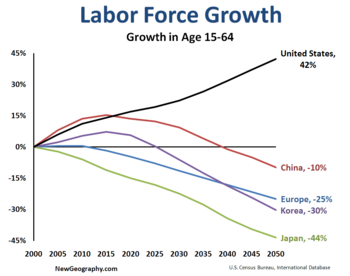
    In the longer term demographic trends actually place the U.S. in a relatively strong position. By the end of the first half of the 21st century, the American population aged 15 to 64 – essentially your economically active cohort – are projected to grow by 42%; China’s will shrink by 10%. Comparisons with other competitors are even larger, with the E.U. shrinking by 25%, Korea by 30% and Japan by a remarkable 44%.

    The Japanese experience best illustrates how wrong punditry can be. Back in the 1970s and 1980s it was commonplace for pundits – particularly on the left – to predict Japan’s ascendance into world leadership. At the time distinguished commentators like George Lodge, Lester Thurow and Robert Reich all pointed to Europe and Japan as the nations slated to beat the U.S. on the economic battlefield. “Japan is replacing America as the world’s strongest economic power,” one prominent scholar told a Joint Economic Committee of Congress in 1986. “It is in everyone’s interest that the transition goes smoothly.”

    This was not unusual or even shocking at the time. It followed a grand tradition of declinism that over the past 70 years has declared America ill-suited to compete with everyone from fascist Germany and Italy to the Soviet Union. By the mid-1950s a majority were convinced that we were losing the Cold War. In the 1980s Harvard’s John Kenneth Galbraith thought the Soviet model successful enough that the two systems would eventually “converge.”

    We all know how that convergence worked out. Even the Chinese abandoned the Stalinist economic model so admired by many American intellectuals once Mao was safely a-moldering in his grave. Outside of the European and American academe, the only strong advocates of state socialism can be found in such economic basket cases as Cuba, North Korea and Venezuela.

    So given this history, why the current rise in declinism? Certainly it’s a view many in the wider public share. Most Americans fear their children will not be able to live as well as they have. A plurality think China will be the world’s most powerful country in 20 years.

    To be sure there are some good reasons for pessimism. The huge deficits, high unemployment, our leakage of industry not only to China but other developing countries are all worrisome trends. Yet if the negative case is easier to make, it does not stand historical scrutiny.

    Let’s just go back to what we learned during the “Japan is taking over the world” phase during the 1970s and 1980s. At the time Dai Nippon’s rapid economic expansion was considered inexorable. Yet history is not a straight-line project. Most countries go through phases of expansion and decline. The factors driving success often include a well-conceived economic strategy, an expanding workforce and a sense of national élan.

    In the 1950s, 1960s and 1970s Japan – like China today – possessed all those things. Its bureaucratic state had targeted key industries like automobiles and electronics, and its large, well-educated baby boom population was hitting the workforce. There was an unmistakable sense of pride in the country’s rapid achievements after the devastation of the Second World War.

    Yet even then, as the Economist’s Bill Emmot noted in his 1989 book The Sun Also Sets, things were not so pretty once you looked a little closer. In the mid-1980s I traveled extensively in Japan and, with the help of a young Japanese-American scholar, Yoriko Kishimoto, interviewed demographers and economists who predicted Japan’s eventual decline.

    By then, the rapid drop in Japan’s birthrate and its rapid aging was already clearly predictable. But even more persuasive were hours spent with the new generation of Japanese – the equivalent of America’s Xers – who seemed alienated from the self-abnegating, work-obsessed culture of their parents. By the late 1980s it was clear that the shinjinrui (“the new race”) seemed more interested in design, culture and just having fun than their forebears. They seemed destined not to become another generation of economic samurai.

    At the time though, the very strategies so critical to Japan’s growth – particularly a focus on high-end manufacturing – proved highly susceptible to competitors from lower-cost countries: first Taiwan, Korea and Singapore, and later China, Vietnam and more recently India. Like America and Britain before it, Japan exported its unique genius abroad. Now many companies, including American ones, have narrowed the technological gap with Japan.

    Today Japan, like the E.U., lacks the youthful population needed to recover its mojo. It likely will emerge as a kind of mega-Switzerland, Sweden or Denmark – renowned for its safety and precision. Its workforce will have to be ultra-productive to finance the robots it will need to care for its vast elderly population.

    Will China follow a similar trajectory in the next few decades? Countries infrequently follow precisely the same script as another. Japan was always hemmed in by its position as a small island country with very minimal resources. Its demographic crisis will make things worse. In contrast, China, for the next few decades, certainly won’t suffer a shortage of economically productive workers

    But it could face greater problems. The kind of low-wage manufacturing strategy that has generated China’s success – as occurred with Japan – is already leading to a backlash across much of the world. China’s very girth projects a more terrifying prospect than little Japan. At some point China will either have to locate much of its industrial base closer to its customers, as Japan has done, or lose its markets.

    More important still are massive internal problems. Japan, for all its many imperfections, was and remains a stable, functioning democracy, open to the free flow of information. China is a fundamentally unstable autocracy, led from above, and one that seeks to control information – as evidenced in its conflict with Google – in an age where the free flow of information constitutes an essential part of economic progress.

    China’s social problems will be further exacerbated by a huge, largely ill-educated restive peasant class still living in poverty. Of course America too has many problems – with stunted upward mobility, the skill levels of its workforce, its fiscal situation. But the U.S., as the Japanese scholar Fuji Kamiya once noted, possesses sokojikara, a self-renewing capacity unmatched by any country.

    As we enter the next few decades of the new millennium, I would bet on a more youthful, still resource-rich and democratic America to maintain its preeminence even in a world where economic power continues to shift from its historic home in Europe to Asia.

    This article originally appeared at Forbes.com.

    Joel Kotkin is executive editor of NewGeography.com and is a distinguished presidential fellow in urban futures at Chapman University. He is author of The City: A Global History. His newest book is The Next Hundred Million: America in 2050, released in Febuary, 2010.

  • A Race Of Races

    When Americans think of our nation’s power (or our imminent lack of it) we tend to point to the national debts, GDP or military prowess. Few have focused on what may well be the country’s most historically significant and powerful weapon: its emergence as the modern world’s first multiracial superpower.

    This evolution, after centuries of racial wrangling and struggle, will prove particularly critical in a world in which the power of the “white” race will likely diminish as power shifts to China, India and other developing countries. By 2039, due largely to immigrants and their offspring, non-Europeans will constitute the majority of working-age Americans, and by around 2050 non-Hispanic whites could well be in the minority.

    But this should not be seen so much as a matter of ethnic succession as multiracial amalgamation. The group likely to grow fastest, for example, will be made up of people, like President Obama himself, who are of mixed race. There is no more demonstrable evidence of the changing racial attitudes of Americans. As recently as 1987 slightly less than half of Americans approved of interracial couples. By 2007, according to the Pew Center, 83% supported them. Among the millennial generation, who will make up the majority of adults in 2050, 94% approve of such matches.

    Today roughly 20% of Americans, according to Pew Research Center, say they have a relative married to someone of another race. Mixed-race couples tend to be younger; over two-fifths of mixed-race Americans are under 18 years of age. In the coming decades this group will play an ever greater role in society. According to sociologists at UC, Irvine, by 2050 mixed-race people could account for one in five Americans.

    The result will be a U.S. best described in Walt Whitman’s prophetic phrase as “the race of races.” No other advanced, populous country will enjoy such ethnic diversity.

    The U.S. will likely remain militarily and even economically preeminent, but much of its power will stem from its status as the world’s only multiracial superpower. America’s global reach will extend well beyond Coca-Cola, Boeing and the Seventh Fleet and express itself in the most intimate cultural and familial ties.

    Our continuing relative success with immigration is key to this process. In the next decades the fate of Western countries may well depend on their ability to make social and economic room for people whose origins lay outside Europe. No Western-derived country produces enough children of European descent to prevent them from becoming granny nation-states by 2050.

    In other words, countries and societies need to become more racially diverse in order to succeed. Yet over the past few decades many countries, from Iran to the nations of the former Soviet bloc, have narrowed their definition of national identity. Even the province of Quebec, bordering the U.S., has imposed preferential policies devised to blunt successful minorities. Because of these restrictive policies, which in some places are accompanied by lethal threats, Jews, Armenians, Coptic Christians and diaspora Chinese have often been forced to find homes in more-welcoming places.

    In recent decades Europe has received as many immigrants as the U.S., but it has proven far less able to absorb them. The roughly 20 million Muslims who live in Europe have tended to remain segregated from the rest of society and economically marginalized. In Europe, notably in France, unemployment among immigrants – particularly those from Muslim countries – is often at least twice that of the native born; in Britain, as well, Muslims are far more likely to be out of the workforce than either Christians or Hindus. British Muslims, according to Britain National Equity Panel, possess household wealth one-fifth that of the predominant nominally Christian population.

    This is also a famously alienated and socially isolated population. For example, in Britain in 2001 up to 40% of the Islamic population believed that terrorist attacks on both Americans and their fellow Britons were justified. They are not mixing much; 95% of white Britons say they have exclusively white friends. In comparison, only 25% of American whites in 29 selected metropolitan areas reported having no interracial friendships at all.

    Despite scattered cases of terrorists in our midst, the contrast between U.S. Muslims and their counterparts overseas is particularly telling. In the U.S. most Muslims are comfortably middle class, with income and education levels above the national average. They are more likely to be satisfied with the state of the country, their own community and their prospects for success than are other Americans – even in the face of the reaction to 9-ll.

    More important, more than half of Muslims – many of them immigrants – identify themselves as Americans first, a far higher percentage than in the various countries of Western Europe. This alienation may be a legacy of the European colonial experience, but it can also be seen in Denmark and Sweden, which had little earlier contact with the Muslim world. In contrast, in the U.S. more than four in five are registered to vote, a sure sign of civic involvement. “You can keep the flavor of your ethnicity,” remarked one University of Chicago Pakistani doctorate student in Islamic studies, “but you are expected to become an American.”

    But the general success of American immigration extends beyond Muslims. Even the largely working-class immigrants from Mexico generally have had lower unemployment than white and other workers, at least until 2007; then with the housing-led recession their unemployment rate began to rise, since so many were involved in construction and manufacturing. Once the economy recovers the historical pattern should reassert itself. Other large groups, including Asians, Cubans, Africans and a still considerable number of Europeans, have performed even better.

    Immigrants by their very nature, of course, are a work in progress, reflecting the essential protean nature of this civilization. Yet they are clearly becoming Americans and transforming who we are as a people. Ideologues on the left and right often don’t understand what is going on in America. The left, locked on the racial past, looks for new grievances to stoke among newcomers. They envision the rise of a fractured country – precisely the same thing many conservatives fear.

    Yet Hispanics, and particularly their children, are not becoming serape-wrapped Spanish speakers. Among Hispanics in California, 90% of children of first-generation immigrants speak fluent English; in the second generation half no longer speak Spanish. Only 7% of the children of immigrants speak Spanish as a primary language.

    Over the next few decades this pattern of ethnic and racial integration will separate America from its key competitors. In 2005 the U.S. swore in more new citizens than the next nine immigrant-receiving countries put together. These newcomers will reshape the very identity of the country and allow the U.S. to continue growing its labor force.

    Our prime competitors of the future – India and China – are unlikely to evolve in this direction. India is a highly heterogeneous country itself and remains driven by ethnic and religious conflicts. China, like Japan and Korea, remains a profoundly homogeneous country with little appetite or capacity to accept newcomers.

    America’s relative openness is particularly critical in the worldwide struggle for skilled labor. Right now more than half of all skilled immigrants in the world come to the U.S., though Australia and Canada, which have much smaller populations, have higher percentages of them. Despite repeated press reports about return migration to home countries, understandable given our sometimes bizarre immigration policy and the deep economic downturn, the vast majority of skilled immigrants – at least 60% – from around the world are staying.

    America’s successful evolution to a post-ethnic society will prove particularly critical in U.S. relations with developing nations, our largest source of immigrants. Even those immigrants who return home to Europe, China, India, Africa or Latin America often retain strong familial and business ties to the U.S. They can testify that America maintains a special ability to integrate all varieties of people into its society.

    As we negotiate the next few decades, America’s growing diversity allows it to stand alone, a multiracial colossus unmatched by any in the evolving global economy. In the current world being a “race of races” represents not a dissolution of power but a new means for expressing it.

    This article originally appeared at Forbes.com.

    Joel Kotkin is executive editor of NewGeography.com and is a distinguished presidential fellow in urban futures at Chapman University. He is author of The City: A Global History. His newest book is The Next Hundred Million: America in 2050, released in Febuary, 2010.

  • The Death Of Gentry Liberalism

    Gentry liberalism, so hot just a year ago, is now in full retreat, a victim of its hypocrisy and fundamental contradictions. Its collapse threatens the coherence of President Barack Obama’s message as he prepares for his State of the Union speech on Wednesday.

    Gentry liberalism combines four basic elements: faith in postindustrial “creative” financial capitalism, cultural liberalism, Gore-ite environmentalism and the backing of the nation’s arguably best-organized political force, public employee unions. Obama rose to power on the back of all these forces and, until now, has governed as their tribune.

    Obama’s problems stem primarily from gentry liberalism’s class contradictions. Focused on ultra-affluent greens, the media, Wall Street and the public sector, gentry liberalism generally gives short shrift to upward mobility, the basic aspiration of the middle class.

    Scott Brown’s shocking victory in Massachusetts–like earlier GOP triumphs in Virginia and New Jersey–can be explained best by class. Analysis by demographer Wendell Cox, among others, shows that Brown won his margin in largely middle- and working-class suburbs, where many backed Obama in 2008. He lost by almost 2-to-1 among poor voters and also among those earning over $85,000 a year. He also won a slight margin among union members–remarkable given the lockstep support of their organizations for Brown’s Democratic opponent, Martha Coakley.

    Geography played a role, of course, but class proved the divider. Coakley did well in the wealthiest suburbs largely north and northwest of Boston. But Brown’s edge in the more middle- and working-class suburbs proved insurmountable.

    Obama, a genius at handling race, has always had problems with class. His early primary victories in 2008 resulted not only from superior organization but the preponderance of students and upper-income professionals in early primary states. Once Hillary Clinton morphed, just a bit late, into Harry Truman in a pants suit, she proved unstoppable, rolling over Obama in critical states like Pennsylvania, Texas, California, Florida, Michigan and throughout Appalachia.

    In the general election Obama succeeded in winning over a significant portion of these voters. Long-simmering disgust with the Bush administration and the Republican Congress, combined with a catastrophic economic collapse, undermined the GOP’s hold on middle-class suburbanites.

    Now that the ball is in his court, the president and his party must abandon their gentry-liberal game plan. The emphasis on bailing out Wall Street and public employees, supporting social welfare and manufacturing “green” jobs appealed to the core gentry coalition but left many voters, including lifelong Democrats, wondering what was in it for them and their families.

    In the next few elections there’s an even greater threat of alienation among millennial voters, who in 2008 accounted for much of the president’s margin of victory. Generational researchers Morley Winograd and Mike Hais note that millennials are starting to enter the workforce in big numbers. Right now their prospects are not pretty. The unemployment rate for those under 25 stands at 19%. Even for college graduates, wages are declining even as opportunities dry up.

    The greatest political danger is not so much a millennial switch to the GOP but a loss of enthusiasm that will diminish the youth vote. Winograd and Hais estimate only about one-third of those who voted in 2008 in Massachusetts voted in this last special Senate election. “Republicans will keep on celebrating victories until Democrats turn their attention to young voters and get them as excited as Obama did in 2008,” Winograd warns.

    Ever deepening disillusionment–not only among millennials–is inevitable unless Obama changes course and starts building a broad-based recovery. The president’s economic team is as pro-big-bank as any conjured up by the most rock-ribbed Republican. Its motto could be a reworking of that old notion by onetime GM CEO and Eisenhower Defense Secretary Charles Wilson: “What’s good for General Motors is good for the USA”–just substitute Wall Street for GM.

    But where GM brought jobs and prosperity to millions, the current Wall Street focus has forged a recovery that works for the gentry but fails to promote upward mobility. Bailed out from their disastrous risky bets and then provided with easy access to cheap credit, the financiers have had themselves a fine party while the rest of the private sector economy suffered. The partygoers have become so rarified that they are unable to lift even the New York City economy, whose unemployment rate now surpasses the national average.

    This spectacle has forced Obama to try locating his hidden populist, but dangers lurk in this shift. If he attacks Wall Street with any real ferocity, the only linchpin of the current weak recovery could crumple. An administration that has focused on finance as the essence of the economy may prove poorly suited to skewer its primary object of affection.

    Yet it may not be too late for the president to recover some of his economic mojo. Although his financial tax plan represents little more than petty cash at today’s absurd Wall Street rates, Obama’s endorsement of Paul Volcker’s more muscular reform agenda could rally Democrats while forcing Republicans into a doctrinal crisis. Some, like Sen. John McCain, may favor a policy to downsize the megabanks and limit their activities. But many others who hold up the holy grail of free markets über alles will expose themselves again as mindless corporate lackeys.

    But badmouthing the financial aristocracy is not enough. Obama also must jettison some of the lamer parts of the gentry agenda. Cap and trade, a gentry favorite that satisfies both green piety and Wall Street’s greedy desire for yet another speculative market, needs to be scrapped as a potential job-killer for many industries. Similarly, the administration needs to delay measures to impose draconian limits of greenhouse gas emissions through the Environmental Protection Agency, which could devastate large sectors of the economy, including manufacturing, agriculture and construction.

    Obama, particularly after the Copenhagen fiasco, needs to shift to more practical, job-creating conservation measures like tree-planting and reducing traffic congestion–notably by promoting telecommuting–while continuing research and development of all kinds of cleaner fuels. Measures that make America more energy-efficient and self-sufficient–without ruining the economy with ruinously high prices–would be far more saleable to the public than the current quasi-religious obsession with wind and solar.

    Obama also needs to stop his naive promotion of the chimera of “green jobs” as his signature answer to the country’s mounting employment woes. There is no way a few thousand, mostly heavily subsidized, jobs creating ever more expensive energy can turn around any economy. Just look at the economic carnage in Spain–where youth unemployment has now reached a remarkable 44%–which has bet much of its resources targeting “green” energy.

    More than anything the president needs to make the case that government can help the productive economy. This requires a scaling down of regulatory measures that are now scaring off entrepreneurs–including some aspects of health care reform–and beginning to demonstrate a direct concern for basic industries like manufacturing, agriculture and trade.

    Pivoting away from gentry liberalism will no doubt offend some of the president’s core constituencies. But if he does not do this soon, and decisively, he will find that the middle-class anger seen in Massachusetts will spread throughout the country. As a result Barack Obama, a man who would be Franklin Roosevelt and could settle on being the next Bill Clinton, will end up looking more like that sad sack of Democratic presidents, James Earl Carter.

    This article originally appeared at Forbes.com.

    Joel Kotkin is executive editor of NewGeography.com and is a distinguished presidential fellow in urban futures at Chapman University. He is author of The City: A Global History. His next book, The Next Hundred Million: America in 2050, will be published by Penguin Press February 4th, 2010.

  • Phoenix, Put Aside Dreams of Gotham

    Now that Phoenix’s ascendancy has been at least momentarily suspended, its residents are no doubt wondering what comes next. One tendency is to say the city needs to grow up and become more like East Coast cities or Portland, Ore., with dense urban cores and well-developed rail transit. The other ready option is always inertia – a tendency to wait for things to come back the way they were.

    Neither approach will work in the long run. Over the coming decade, Phoenix has to recalibrate its economy into something based on more than being a second option for Californians and speculative real-estate investment. Instead, it needs to focus laserlike on economic diversity and creating good jobs.

    The model here for Phoenix is not New York or San Francisco. Phoenix can’t rival these cities for their 19th-century charm or early 20th-century infrastructure. As we would say back in New York (my hometown): fuggedaboutit.

    Instead of dreaming about Gotham, Phoenix should think more about Houston. Like the Texas megacity, Phoenix is the ultimate late 20th-century town, dependent on air-conditioning, ample freeway space and a wide-open business culture.

    A century away from becoming “quaint,” Phoenix needs to follow Houston’s example of relentless economic diversification: in Phoenix’s case, away from dependence on tourism and construction. Houston has done this by focusing beyond its core energy sector to fields like international trade, manufacturing and medical services.

    Phoenix’s opportunities may lie elsewhere but may include some of these same industries. The idea is that the region needs to heal its job problem. Only then can the real-estate market rebound on a solid basis.

    This employment focus must replace the current obsession with changing the city’s urban form. Despite the current problems, Phoenix has performed pretty well over the past decade, creating more new jobs than most Sun Belt cities, not to mention job losers like San Francisco, Chicago, Los Angeles and New York. Equally important, it still leads the nation over the past decade in net in-migration among the largest cities

    Unfortunately, some in Phoenix still suffer horribly from Manhattan envy. One prominent Phoenix consultant describes the downtown as “the glorious goose that’s laying the gilded egg” that will turn the city into a dynamic trend-setter of a new urban paradigm. Phoenix, he opined, “won’t be a place of renown till it has the Big It.” In other words, Phoenix will not be a true metropolis until it has its own Times Square, Eiffel Tower, Space Needle or other grand attraction.

    Yet in newer cities like Phoenix, the quest for the “Big It” is often delusional. In Phoenix, the vast majority of the population moved in decades after the original downtown lost its primacy. People have their own notion of what “it” is, and many times, “it” could be in a different center or in more than one center – think Scottsdale, Tempe, Mesa, the Camelback Corridor, or a host of other communities.

    The Valley’s $1.4 billion transit system carries barely 15,000 round trips daily – a microscopic proportion of the region’s trips – with the biggest traffic on weekends. Sounds more like Disneyland than New York.

    Nor does the high-end condo, art-museum, convention-center thing seem to be working so well. Too bad the extra $1.5 billion spent sprucing up the area could not have been spent more usefully for less critical things, like police and fire, or better roads and schools.

    Rather than focus on emulating the urban father figures from the past, Phoenix’s best bet lies with its best assets: being reasonably priced, professionally managed and, well, warm and lovely in December. Shedding its real-estate-obsessed cocoon, Phoenix should focus on creating jobs for both present and future residents. That’s how you can grow up and find your own way.

    This article first appeared at The Arizona Republic.

    Joel Kotkin is executive editor of NewGeography.com and is a distinguished presidential fellow in urban futures at Chapman University. He is author of The City: A Global History. His next book, The Next Hundred Million: America in 2050, will be published by Penguin Press February 4th.

    Photo: robotography