Author: Joel Kotkin

  • Is Obama Separating from His Scandinavian Muse?

    Barack Obama may be our first African-American president, but he’s first got to stop finding his muse in Scandinavia. With his speech for the Nobel, perhaps he’s showing some sign of losing his northern obsession.

    On the campaign trail, Obama showed a poet’s sensitivity about both America’s exceptionalism and our desire to improve our country. His mantra about having “a father from Kenya and a mother from Kansas” resonated deeply with tens of millions of Americans.

    Obama’s more recent recasting as a politically correct Nordic seemed out of sync. His speech in Oslo – a surprising defense of American values and role in the world – must have shocked an audience that all but the most passionate courtiers suspect he does not deserve.

    But the bigger challenge will come when he rushes off to Copenhagen to push for his politically dubious climate change agenda. This will take a more serious break from his unfortunate tendency to identify first with the global cognitive elite.

    This is a particularly European, and particularly Scandinavian, affliction. In these countries professors, high-level bureaucrats, and corporate chieftains usually dominate the media, policy making and public perceptions. This constitutes an essential part of what is often called the “Scandinavian consensus” model.

    It works pretty well there. Historically homogeneous, affluent and well-educated Scandinavians generally accept working hard and giving up much for people for the poorer members of societies. These admirable attitudes reflect noble Nordic virtues of thrift, study and social trust.

    These values also work reasonably well in Nordic parts of America, such as in North Dakota. When a local economist told Milton Friedman “In Scandinavia we have no poverty”, he replied: “That’s interesting because in America among Scandinavians, we have no poverty, either.”

    As Obama may finally be learning, America is not Scandinavia, outside a handful of places. It is a big, amazingly diverse country with an expanding population. In a country made up of so many crunched together cultures an expansive welfare state faces many problems. (This is one reason northern Europe is having such a difficult time with its immigrants.)

    In a diverse society, you cannot assume that everyone will play by the rules. Coexisting with very different kinds of people, Americans tend to be less than enthusiastic about paying high taxes to support them.

    Demographics are also a major factor. Our relatively youthful and socially diverse population includes a large component of people, particularly males, with limited skills and education. Yet, at least until they were blindsided by falling poll numbers and stubbornly high unemployment, Obama’s administration treated the recession as if it could be cured Euro-style by simply adding more employment in government, education and medical care.

    Similarly the president’s to date dogmatic embrace of an extreme climate change agenda seems one more saleable to Danes or Swedes than people in the Dakotas or South Carolina. After all, they are well-positioned to absorb the costs. Norway and Sweden enjoy huge reserves of hydropower, the largest sources of renewable fuels. Norway also has lots of oil to boot and fellow traveler Netherlands still boasts strong reserves of natural gas.

    The dense land use policies associated with the climate change agenda fit better into small compact cities like Amsterdam, Copenhagen, Stockholm and Oslo than their sprawling American counterparts. In America, the vast majority lives in sprawling suburbs and small towns. With the exception of the Northwest few parts of the U.S. rely on hydropower, with most of the country reliant on coal, oil and natural gas.

    Then there are political risks to Obama’s dogged embrace of the alarmist “climate change” agenda. Recent Gallup, Pew, and Rasmussen surveys show weakening interest in global warming and increasing levels of skepticism. Today we even have considerable disputes over whether the temperature is even warming. Certainly a series of cold winters and mild summers might make some casual citizens a bit skeptical.

    Even one of the scientists whose email was hacked recently at the UK’s University of East Anglia Climate Research Unit wondered, “Where the heck is global warming?” The revelations, now widely known as Climategate, make clear that some of the science – and the scientists – behind the most apocalyptic predictions are suspect, a view now held by a majority of Americans, according to a recent Rasmussen survey.

    Yet so far, Obama appears blissfully unaffected by the swirling controversy. But the man has a full capacity to surprise. Perhaps he will understand that just because the media and his climate advisors have circled the wagons, this may be a case where the “crowds” may be onto something that the self-proclaimed experts would rather ignore.

    Perhaps if President Obama had studied history, rather than law, he might realize that “smart” (i.e. highly credentialed) types often get things terribly wrong. After all, a century ago eugenics – that some races were intrinsically superior to others – stood as the reigning ideology of the scientific community. Back in the 1970s, the scientific consensus embraced by his science advisor, John Holdren, predicted imminent mass starvation, a catastrophic decline in resource availability, and a bleak future for all developing countries, including China and India. This assessment proved widely off the mark.

    Of course, having committed himself to today’s climate orthodoxy, Obama may find it difficult to reverse course. Not only does he seem ill-disposed to challenging the cognitive elites but he also gains support from the well-funded warming lobby – rent-seeking utilities, “green” venture capitalists, investment bankers and urban land speculators – who hope to wrest huge fortunes from a strict carbon regime.

    If he wants to regain his effectiveness, however, the president needs to realize that these groups and the science establishment are just a small fraction of the country that elected him. His speech in Oslo may be the first sign he may be waking up from his Scandinavian slumber to become the assertive, independent American leader that we need.

    Joel Kotkin is executive editor of NewGeography.com and is a distinguished presidential fellow in urban futures at Chapman University. He is author of The City: A Global History. His next book, The Next Hundred Million: America in 2050, will be published by Penguin Press early next year.
  • Capping Emissions, Trading On The Future

    Whatever the results of the Copenhagen conference on climate change, one thing is for sure: Draconian reductions on carbon emissions will be tacitly accepted by the most developed economies and sloughed off by many developing ones. In essence, emerging economies get to cut their “carbon” intensity–a natural product of their economic evolution–while we get to cut our throats.

    The logic behind this prediction goes something like this. Since the West created the industrial revolution and the greenhouse gases that supposedly caused this “crisis,” it’s our obligation to take much of the burden for cleaning them up.

    Plagued by self-doubt and even self-loathing, many in the West will no doubt consider this an appropriate mea culpa. Our leaders will dutifully accept cuts in our carbon emissions–up to 80% by 2050–while developing countries increase theirs, albeit at a lower rate. Oh, we also pledge to send billions in aid to help them achieve this goal.

    The media shills, scientists, bureaucrats and corporate rent-seekers gathered at Copenhagen won’t give much thought to what this means to the industrialized world’s middle and working class. For many of them the new carbon regime means a gradual decline in living standards. Huge increases in energy costs, taxes and a spate of regulatory mandates will restrict their access to everything from single-family housing and personal mobility to employment in carbon-intensive industries like construction, manufacturing, warehousing and agriculture.

    You can get a glimpse of this future in high-unemployment California. Here a burgeoning regulatory regime tied to global warming threatens to turn the state into a total “no go” economic development zone. Not only do companies have to deal with high taxes, cascading energy prices and regulations, they now face audits of their impact on global warming. Far easier to move your project to Texas–or if necessary, China.

    The notion that the hoi polloi must be sacrificed to save the earth is not a new one. Paul Ehrlich, who was the mentor of President Obama’s science advisor, John Holdren, laid out the defining logic in his 1968 best-seller, The Population Bomb. In this influential work, Ehrlich predicted mass starvation by the 1970s and “an age of scarcity” in key metals by the mid-1980s. Similar views were echoed by a 1972 “Limits to Growth” report issued by the Club of Rome, a global confab that enjoyed a cache similar to that of the United Nations’ Intergovernmental Panel on Climate Change.

    To deal with this looming crisis, Holdren in the 1977 book Ecoscience (co-authored with Anne and Paul Ehrlich) developed the notion of “de-development.” According to Holdren, poorer countries like India and China could not be expected to work their way out of poverty since they were “foredoomed by enormous if not insurmountable economic and environmental obstacles.” The only way to close “the prosperity gap” was to lower the living standards of what he labeled “over-developed” nations.

    These predictions were less than accurate. World-wide systemic mass starvation did not take place as population escalated. Rather those many millions wallowing in poverty in the developing world, particularly in Asia, lifted themselves into the global middle class. Far more efficient ways to use energy have been developed, and unexpected caches of new resources continue to be discovered all over the planet.

    Yet however wrong-headed, Holdren’s world view now has jumped from the dustbin of history into the craniums of presidents and prime ministers. President Obama’s pledge to “restore science to its rightful place” has morphed into state-sponsored scientific ideology.

    The blind acceptance of this agenda threatens the credibility of Obama and other Western leaders. For one, if the crisis is by its nature global why should we allow massive increases in carbon emissions in developing countries–China will soon surpass us in greenhouse gas emissions, if it hasn’t already–while we draconically cut ours? Does the planet really care if it’s turned to toast by American- vs. Chinese-made gas?

    Then there’s the specious historical narrative that insists we pay for creating the industrial revolution since it brought on global warming. Should the West pay for the sins of the British who brought electricity and railroads to India? Does America owe carbon penance for making the technology transfers critical to East Asia’s remarkable rise? Maybe we should start by making Wal-Mart cancel its China orders. That might help de-carbonize the planet a bit.

    There’s also growing skepticism about the whole warmist narrative. Climate change now ranks last among 20 top issues in a recent Pew report. There’s been a similar rise in skepticism in the U.K., once a hot bed of warmist sentiment.

    The reasons for the shift may vary. First, there’s a controversy over the temperatures of the past decade, with even some concerned about climate change admitting that there has not been the expected warming. Or perhaps a deep recession has made many “rich” countries feel a trifle less “overdeveloped.”

    And now we have Climate-gate–where leading warmist pedagogues are trying to suppress unsuitably conformist scientists and perhaps even cook the numbers a bit. Although you won’t see too much tough coverage in the mainstream press, the tawdry details have poured out over the Internet and diminished the aura of scientific objectivity of some leading global warming researchers. One recent poll shows that a large majority of Americans believe scientists may have indeed falsified their research data. By well over 4 to 1, they also believe stimulating the economy is a bigger priority than stopping global warming.

    Clearly the political risks of giving first priority to the carbon agenda are on the rise. Australia’s Senate just voted down that country’s proposed cap and trade scheme. The Western center-right, once intimidated by the well-financed greens and their media claque, has become bolder in challenging climate change alarmism.

    There’s also something of a rebellion brewing, at least toward emissions trading schemes, among some liberals from the South and Midwest, notably Wisconsin’s Russ Feingold and North Dakota’s Byron Dorgan. As analyst Aaron Renn has pointed out, these areas are most likely to be negatively affected by the current climate change legislation. Feingold recently stated that he was “not signing onto any bill that rips off Wisconsin.”

    So why do leaders like Barack Obama and British Prime Minister Gordon Brown continue identifying themselves with the climate change agenda and policies like cap and trade? Perhaps it’s best to see this as a clash of classes. Today’s environmental movement reflects the values of a large portion of the post-industrial upper class. The big money behind the warming industry includes many powerful corporate interests that would benefit from a super-regulated environment that would all but eliminate potential upstarts.

    These people generally also do not fear the loss of millions of factory, truck, construction and agriculture-related jobs slated to be “de-developed.” These tasks can shift to China, India or Vietnam–where the net emissions would no doubt be higher–at little immediate cost to tenured professors, nonprofit executives or investment bankers. The endowments and the investment funds can just as happily mint their profits in Chongqing as in Chicago.

    Global warming-driven land-use legislation possesses a similarly pro-gentry slant. Suburban single family homes need to be sacrificed in the name of climate change, but this will not threaten the large Park Avenue apartments and private retreats of media superstars, financial tycoons and the scions of former carbon-spewing fortunes. After all, you can always pay for your pleasure with “carbon offsets.”

    So who benefits from this collective ritual seppuku? Hegemony-seeking communist capitalists in China might fancy seeing America and the West decline to the point that they can no longer compete or fund their militaries. A weakened European Union or U.S. also won’t be able provide a model of a more democratic version of capitalism to counter China’s ultra-authoritarian version.

    The Chinese may win a victory in Copenhagen greater than anything accomplished so far in the marketplace–and our leaders will likely thank them for it. Forget bowing to the emperor in Tokyo; like vassal states at the height of the old Middle Kingdom, the new requisite diplomatic skill for Westerners will be kow-towing to Beijing.

    Yet most people in the developing world will not benefit from the suicide of the West. The warmists’ vision is not one of growing prosperity, but of capping wealth at a comparatively low level. De-industrialization means the West falls back while emerging economies grow a bit. The “prosperity gap” may close, but ultimately everyone is left with less prosperity.

    In the long run developing countries gain less from harvesting guilt than enjoying a bounty of customers, capital and expertise. The West’s experience and technology can assist developing nations in improving their far more greatly threatened environment. Turning the West into a spent force will leave the world poorer, dirtier and ultimately less hopeful.

    This article originally appeared at Forbes.com.

    Joel Kotkin is executive editor of NewGeography.com and is a distinguished presidential fellow in urban futures at Chapman University. He is author of The City: A Global History. His next book, The Next Hundred Million: America in 2050, will be published by Penguin Press early next year.
  • The World’s Smartest Cities

    In today’s parlance a “smart” city often refers to a place with a “green” sustainable agenda. Yet this narrow definition of intelligence ignores many other factors–notably upward mobility and economic progress–that have characterized successful cities in the past.

    The green-only litmus test dictates cities should emulate either places with less-than-dynamic economies, like Portland, Ore., or Honolulu, or one of the rather homogeneous and staid Scandinavian capitals. In contrast, I have determined my “smartest” cities not only by looking at infrastructure and livability, but also economic fundamentals.

    These criteria unfortunately exclude mega-cities like New York, Mexico City, Tokyo or Sao Paulo, which suffer from congenital congestion, out-of-control real estate prices and expanding income disparities–symptoms of what urban historian Lewis Mumford described as “megalopolitan elephantiasis.”

    Instead, today’s “smart” cities tend to be smaller, compact and more efficient: places like Amsterdam; Seattle; Singapore; Curitiba, Brazil; and Monterrey, Mexico. This is not an entirely new notion: Between the 14th and 18th centuries, modest-sized cities like Venice, Italy; Antwerp, Belgium; and Amsterdam nurtured modern capitalism and created canals and vibrant urban quarters that remain wonders even today.

    In the Pacific-centric modern era, smart commercial cities are increasingly found outside Europe. Indeed, the most likely 21st-century successor to 15th-century Venice is Singapore, a commercially minded island nation that, like its forebear, is run by an often enlightened authoritarian regime.

    When it first achieved independence in 1965, Singapore’s condition was comparable to other developing cities like Bombay, Cairo, Lagos or Calcutta. The island city’s neighbors included unstable countries like Vietnam, Malaysia and Thailand. Its GDP per capita ranked well below those of Argentina, Trinidad, Greece or Mexico.

    The country’s first prime minister and current eminence grise, Lee Kuan Yew, was determined to change reality. Today, Singapore, with a population of less than 5 million, boasts an income level close to the wealthiest Western countries and a per-capita GDP ahead of most of Europe and all of Latin America. Once largely semi-literate, its population is now among the best-educated in Asia.

    To be sure, this enviable achievement was accomplished in an authoritarian fashion, but much of what Singapore has done must be considered “smart” by any reasonable accounting. Strategic investments taking advantage of its location between the Indian and Pacific Oceans have paid off handsomely: Today Singapore Airport is Asia’s fifth largest, and the city’s port ranks as the largest container entrepôt and is the second biggest, after Shanghai, in terms of cargo volume in the world.

    All this has made Singapore a huge lure for foreign companies, with over 6000 multinationals, including 3600 regional headquarters, now located there. For foreign managers, engineers and scientists, largely English-speaking Singapore offers a pleasant and predictable environment, particularly compared with other Asian centers.

    At least one recent survey by the World Bank’s International Finance Corporation rates Singapore No. 1 in the world for ease of doing business. Although its growth has been slowed by the recession, the city’s close ties to the resurging economies of Southeast Asia, China and India lead many forecasters to predict a strong recovery over the next year.

    Hong Kong, yet another outpost of British imperialism, has also performed well. Last year the World Bank ranked the area No. 3 for ease of doing business, compared with No. 89 for the rest of China. As long as Chinese Communists allow wider freedoms in Hong Kong than in the mainland, the area should continue to take advantage of its basic assets, including the world’s third-largest container port, an excellent airport and a highly skilled entrepreneurial population.

    The continuing appeal of Hong Kong was vindicated by the recent decision of Hong Kong Shanghai Bank Chief executive George Geoghegan to relocate there from London. As the center of the world economy continues to shift to Asia while Europe and America struggle, he is likely to find more company.

    Not all the world’s “smart” cities are trading giants like Hong Kong and Singapore. They also include well-run metropolises, such as the city of Curitiba. The south Brazilian city is regarded as an innovator in everything from bus-based rapid transit, used by some 70% of residents, and its balanced, diverse economic development strategy.

    With a population of 3.5 million, Curitiba demonstrates how to achieve the evolving Brazilian dream without the mass violence, transportation dysfunction and ubiquitous grinding poverty that plague many other Latin American metro areas. The city’s program of building “lighthouses”–essentially electronic libraries–for poorer residents has become a model for developing cities world wide. These are among the reasons Reader’s Digest recently named Curitiba the best place to live in Brazil.

    Another similarly “smart” city in the developing world is Monterrey, Mexico, which has emerged from relative obscurity and turned itself into a major industrial and engineering center over the past few decades. The city of 3.5 million sits adjacent to the dynamic U.S.-Mexico border region and has 57 industrial parks specializing in everything from chemicals and cement to telecommunications and industrial machinery.

    Over the last decade, the area has consistently grown at a faster rate than the rest of Mexico–or, for that matter, the United States. Monterrey and its surrounding state, Nuevo Leon, now boast per-capita GDP roughly twice that of the rest of Mexico.

    Although hard-hit by the current recession, Monterrey seems poised for an eventual recovery. Dominated by powerful industrial families, the area has long been business-friendly. It has also become a major education center, with over 82 institutions of higher learning and 125,000 students, led by the Instituto Technologico de Monterey, considered by some Mexico’s equivalent of MIT or Cal Tech.

    Of course, “smart” cities also exist in the advanced industrial world. Amsterdam, a longstanding financial and trading capital, is home to seven of the world’s top 500 companies, including Philips and ING. Relatively low corporate taxes and income taxes on foreign workers attract individuals and companies, one reason why, in 2008, the Netherlands was largest recipient of American investment in Europe. Amsterdam’s advantages include a well-educated, multilingual population and a lack of political corruption.

    Amsterdam’s relatively small size–740,000 in the city and 1.2 million for the entire metropolitan area–belies its strategic location in the heart of Europe and proximity to the continent’s dominant port, Rotterdam. The city’s Schiphol airport, Europe’s third-busiest, is only 20 minutes from the center of Amsterdam, a mere jaunt compared with commutes to the major London or Paris airports. Schipol has also spawned a series of economically vibrant “edge cities” that appear like more transit-friendly versions of Houston or Orange County, Calif.

    North America also has its share of smart cities. Although self-obsessed greens might see their policies as the key to the area’s success, Seattle’s growth really stems more from economic reality. In this sense, Seattle’s boom has a lot to do with luck–it’s the closest major U.S. port to the Asian Pacific, which has allowed it to foster growing trade with Asia.

    Furthermore, Seattle’s proximity to Washington state’s vast hydropower generation resources–ironically the legacy of the pre-green era–assures access to affordable, stable electricity. The area also serves as a conduit for many of the exportable agricultural and industrial products produced both in the Pacific Northwest and in the vast, resource-rich northern Great Plains, linked to the region by highways and freight rails.

    As North America’s economy shifts from import and consumption toward export and production, Seattle’s rise will be a model for other business-savvy cities in the West and South. Houston’s close tie to the Caribbean, as well as its dominant global energy industry, thriving industrial base, huge Texas Medical Center complex and first-rate airport, all work to its long-term advantage. Arguably the healthiest economically of America’s big cities, Houston is also investing in–not just talking about–its green future; last year it was the nation’s largest municipal purchaser of wind energy.

    Another smart town poised to take advantage of an industrial expansion is Charleston, S.C., which has expanded its port and manufacturing base while preserving its lovely historic core. Once an industrial backwater, Charleston now seems set to emerge as a major aerospace center with a new Boeing 787 assembly plant, which will bring upward of 12,000 well-paying jobs to the region.

    Further inland, Huntsville, Ala., has long had a “smart” core to its economy–a legacy of its critical role in the NASA ballistic missile program. Today the area’s traditional emphasis on aerospace has been joined by bold moves into such fields as biotechnology. Kiplinger recently ranked the area’s economy No. 1 in the nation.

    With the likely rise in commodity prices over the next decade, Canada also seems likely to produce several successful cities. Perhaps the best positioned is Calgary, Alberta. Over the past two decades, the city’s share of corporate headquarters has doubled to 15%, the largest percentage of main offices per capita in Canada.

    Although last year’s plunge in oil prices hit hard, rising demand for commodities in Asia should help revive the Albertan economy by next year.

    In their press releases, all these cities make a point of bragging about being green and environmentally conscious. Yet they have demonstrated their “intelligence” in other ways–by exploiting their locations and resources to make savvy business and development decisions. At the end of the day, it will not be their clean air but their commercial prowess–as has been the case in history–that will sustain their success in the decades ahead.

    List of the World’s Smartest Cities

    1. Singapore The 21st-century successor to 15th-century Venice, this once-impoverished island nation now boasts an income level comparable to the wealthiest Western countries, with a per-capita GDP ahead of most of Europe and Latin America. Singapore Airport is Asia’s fifth-largest, and the city’s port ranks as the largest container entrepot in the world. Over 6,000 multinational corporations, including 3,600 regional headquarters, are located there, and it was recently ranked No. 1 for ease of doing business.
    2. Hong Kong As the center of the world economy continues to shift from West to East, Hong Kong is certainly reaping the benefits. Hong Kong Shanghai Bank’s chief executive recently relocated there from London. Its per-capita GDP is ranked 15th in the world. The Heritage Foundation and The Wall Street Journal have ranked Hong Kong the freest economy in the world.
    3. Curitiba, Brazil This well-run metropolis in southern Brazil is famous for its rapid bus-based transit, used by 70% of its residents, and its balanced, diverse economic development strategy. The city’s program of building “lighthouses”–essentially electronic libraries–for poorer residents has become a model for developing cities worldwide. Environmental site Grist recently ranked Curitiba the third “greenest” city in the world.
    4. Monterrey, Mexico Over the past few decades Monterrey has emerged from relative obscurity into a major industrial and engineering center. The city of 3.5 million has 57 industrial parks, specializing in everything from chemicals and cement to telecommunications and industrial machinery. Monterrey and its surrounding state, Nuevo Leon, boast a per-capita GDP roughly twice that of the rest of Mexico.
    5. Amsterdam This longstanding financial and trading capital is home to seven of the world’s top 500 companies, including Philips and ING. Relatively low corporate taxes and income taxes on foreign workers attract companies and individuals. Amsterdam’s advantages include a well-educated, multilingual population and a lack of political corruption, as well as its location–in the heart of Europe, close to a major international airport and a short train trip to Rotterdam, the continent’s dominant port.
    6. Seattle, Wash. Seattle’s location close to the Pacific Ocean has nurtured trade with Asia, and its proximity to Washington state’s vast hydro-power generation station assures access to affordable, stable clean electricity. The area also serves as the conduit for many of the exportable agricultural and industrial products produced both in the Pacific Northwest and in the vast, resource-rich northern Great Plains, closely linked to the region by highways and freight trains.
    7. Houston, Texas Houston’s close tie to the Caribbean, as well as its dominant global energy industry, thriving industrial base, huge Texas Medical Center complex and first-rate airport all work to its long-term advantage. Arguably the big city in the U.S. with the healthiest economy, Houston is also investing in a “green” future; last year it was the nation’s largest municipal purchaser of wind energy.
    8. Charleston, S.C. Charleston has expanded its port and manufacturing base while preserving its lovely historic core. Once an industrial backwater, Charleston now seems poised to emerge as a major aerospace center, with the location of a new Boeing 787 assembly plant there, which will bring upward of 12,000 well-paying jobs to the region.
    9. Huntsville, Ala. This southern city has long had a “smart” core to its economy, a legacy of its critical role in the NASA ballistic missile program. Today the area’s traditional emphasis on aerospace has been joined by bold moves into such fields as biotechnology. Kiplinger recently ranked the area’s economy No. 1 in the nation.
    10. Calgary, Alberta With the likely rise in commodity prices over the next decade, Canada seems likely to produce several successful cities. Over the past two decades, Calgary’s share of corporate headquarters has doubled to 15%, the largest percentage of main offices per capita in Canada. Although the plunge in oil prices hit hard, rising demand for commodities in Asia should help revive the Albertan economy by next year.

    This article originally appeared at Forbes.com.

    Joel Kotkin is executive editor of NewGeography.com and is a distinguished presidential fellow in urban futures at Chapman University. He is author of The City: A Global History. His next book, The Next Hundred Million: America in 2050, will be published by Penguin Press early next year.
  • It’s A Mall World After All

    If Indian Prime Minister Manmohan Singh wants a taste of home during his visit to Washington this week, he might consider a trip to McLean, Va., home to the region’s largest indoor mall, Tysons Corner Center. After all, there are few groups more mall-crazy than India’s expanding affluent class.

    Back here in the U.S., urban boosters and planners like to predict that malls are “vanishing.” But while consumer-deflated America may suffer from mall fatigue and a hangover from overbuilding, much of the developing world has experienced no such malaise. In 2000, for example, India was virtually mall-less. Today it has several hundred, with scores of new ones on the drawing boards.

    Malls are particularly attractive to India’s “aspiring” middle class, including those who have returned from work, study or travel abroad, suggests Vatsala Pant, director of client solutions at AC Neilson in Mumbai. Indian novelist and Mumbai blogger Amit Varma suggests that these folks like malls “because they are relatively clean and sanitized” as opposed to the city’s pollution-choked, beggar-ridden and often foul-smelling streets.

    Malls such as those built by mall developer Inorbit in suburban Malad or the new Paladium closer to the center of Mumbai boast many brands familiar to the suburban malls of the West–from Pizza Hut and Reeboks to Marks & Spencer. But they also contain scores of swanky shops selling saris and other Indian-made merchandise as well as trendy restaurants like the vegetarian thali palace Rajdahni. All cater almost exclusively to locals.

    This mall mania extends well beyond India. Today Asia is the site of seven of the world’s 10 largest malls, mainly in places like Beijing, Dongguan, China, Dubai and Kuala Lumpur, Malaysia. By 2010, China alone may be home to seven of the biggest shopping arcades on the planet.

    The rapid growth of mall culture in Asia and elsewhere reflects the rising incomes and expectations taking place across the globe. So while many malls struggle in North America, they are thriving in Asia due in part to suburbanization and automobiles. In the first 10 months of 2009, Chinese consumers alone purchased more cars than their American counterparts. India is also going through an automotive revolution, with sales up 20% since April and local firms like Tata, developer of the $2,500 minicar, Nano, gearing up for long-term growth.

    It’s not just growing affluence, car culture and suburbanization that are driving people into malls in India and other developing nations. Many of these places–like the American south and southwest–suffer hot, inhospitable climates. In Dubai, where the temperatures even in November hover well into the 90s, malls provide both a diverse shopping experience and relief from the heat.

    These malls also play a surprisingly democratic function often under-appreciated by urban theorists, planners and purveyors of architectural nostalgia. While Mumbai’s malls may not host the city’s scores of beggars, they can not be described as the exclusive province of the rich. The affluent may be there, of course, but so would their drivers, the factory workers and others of India’s growing aspirational population.

    “You get to see a massive cross-section of people, there for different reasons, all breathing the same [air conditioning],” Varma observes. “And really, these people only come together in the malls.”

    This oddly democratic phenomenon is also evident in the nearly 6 million square foot Dubai Mall. Of course, there are the evidently wealthy local Arabs in their traditional white flowing robes, but you also can spot the Filipino maids, British bankers, American and Korean engineers and a diverse array of Indians all shopping, eating and conversing in the air-cooled commercial oasis.

    “It’s the one place where people share a common culture,” observes Tabitha Decker, a Yale Ph.D. candidate working at the Dubai School of Government. “In a place like this, these are the boulevards.”

    This mall-ization of the developing world predictably offends many American and European critics who wish that the Third World remain “authentic.” The widely read Mexico City-based blogger Daniel Hernandez thinks places like Mexico’s swank Centro Santa Fe, on la capital’s southern edge, represents “all that is wrong with the rapid commercialization and privatization of urban development.”

    I wonder if he has tried making that case to the shoppers who flock west to the Santa Fe mall or the more middle-income Centro Comercial Perisur. These commercialized Mexicans look, dress and act remarkably like, well, Texans at the Houston Galleria rather than denizens of the traditional marketplaces so beloved by tourists and writers.

    Mexico-born developer Jose de Jesus Legaspi suggests that Mexicans come to malls because they find them more appealing than the somewhat grimy, and sometimes crime-ridden, traditional downtowns. “Some second- and third-generation Latinos may feel Mexicans should be dressing in huaraches, but really these places are like the traditional zocolo, a place to gather on Sunday,” Legaspi says.

    This social role, Legaspi believes, may prove critical to the future of the malls in America as well. Like many things in post-crash America, shopping is changing. But even though they’ve cut their purchases, Americans are hardly deserting malls any more than they are traditional urban downtown shopping districts. Just look at the dismal condition of Chicago’s State Street.

    Yet despite their travails, most malls likely won’t be stripped down in favor of dense urban neighborhoods or green fantasy zones for vegetable hothouses or bio-fuel production. Instead their future will depend on evolving from a purely consumptive palace to a “gathering place” that is safe and friendly, particularly for working- and middle-class families. In this sense, India, China, Dubai and Mexico may be not imitators as much as harbingers.

    Not surprisingly, in America the ethnic market is setting the new tone. The Latino-oriented mall Plaza Mexico in Lynwood, Calif., a 400,000 sq. foot open-air commercial center, consciously recreates the old zocolo through historic architecture, music and family-oriented fun. Even more ambitious is the enormous 1.2 million square foot La Gran Plaza in Fort Worth, Texas, which features such family-friendly fare as mariachis, Mayan dance, horse shows and even a Sunday Mass presided over by a local bishop.

    Equally revealing, both these centers also accommodate smaller, independent businesses in an adjacent mercado, in La Gran Plaza’s case one that extends 120,000 sq. feet. And you don’t have to have an ethnic focus for this formula to work. The Grove, a highly successful Los Angeles Mall, has emphasized family entertainment and a nearby link to the Farmer’s Market, a long-standing bastion of small, independently run businesses.

    Rick Caruso, the developer of the Grove, which now ranks among Southern California’s top tourist destinations, sees future American malls focusing on their social role, with closer links to local cultural events and celebrations. This is one way, Caruso believes, malls can compete with both big-box stores–stand alone centers built around a Wal-Mart, Target or Costco–and the rising force of Internet marketing.

    “The discussion of retail in America is really about community,” Caruso notes. “Lots of communities want to preserve something of Main Street and to keep the organic retailers who grew up in the area and are one of a kind. I think it works best in the long run. The key for a developer is how to keep both that feeling and the newer developments. You want to be seen as part of the future of the community.”

    Despite the predictions of their demise, the mall, both at home and abroad, appears far from finished. Like all urban forms, they must adjust to changing conditions but will likely thrive well after most of their critics are enjoying their university pensions. It looks like our increasingly small, globalized world will also be a malled one.

    This article originally appeared at Forbes.com.

    Joel Kotkin is executive editor of NewGeography.com and is a distinguished presidential fellow in urban futures at Chapman University. He is author of The City: A Global History. His next book, The Next Hundred Million: America in 2050, will be published by Penguin Press early next year.

    Photo by Rohtak8

  • Boomer Economy Stunting Growth in Northern California

    The road north across the Golden Gate leads to some of the prettiest counties in North America. Yet behind the lovely rolling hills, wineries, ranches and picturesque once-rural towns lies a demographic time bomb that neither political party is ready to address.

    Paradise is having a problem with the evolving economy. A generational conflict is brewing, pitting the interests and predilections of well-heeled boomers against a growing, predominately Latino working class. And neither the emerging “progressive” politics nor laissez-faire conservatism is offering much in the way of a solution.

    These northern California counties–which include Sonoma, Napa, Solano and Marin–have become beacons for middle- and upper-class residents from the Bay Area. These generally liberal people came in part to enjoy the lifestyle of this mild, bucolic region, and many have little interest in changing it.

    “The yuppies have insulated themselves here for the long term,” notes Robert Eyler, a director at the Center for Regional Economic Analysis at Sonoma State University. “The boomers have blocked everyone else different in age and skill from rising up and making their place.”

    Nowhere is this more evident than in the “green,” anti-growth movement so prevalent in these places. Strong restrictions of business growth, bolstered by California’s draconian land-use regulations, have turned these areas into business no-go zones. This has become increasingly clear after the collapse of the real estate boom, which created thousands of jobs for agents, mortgage brokers and construction workers.

    Hard times have come to paradise. Unemployment in Sonoma now tops 10%, up from barely 3% two years ago, notes Eyler. The rate is slightly higher in neighboring Solano County but a bit lower in wealthy Marin and Napa. Across the region, vacancy rates for offices and other commercial buildings have reached as high as 30%. Overall, by some estimates, the vacancy rate is higher in Sonoma than in Detroit.

    These conditions, local business leaders suggest, seem to have no effect on the region’s well-organized and well-financed greenies, who often see any growth as a threat to their quality of life

    Of course, economic reversal can sometimes hurt the balance sheets of wealthy yuppies and early retirees, but Eyler suggests the change could prove most devastating to the next generation of residents. In 2000 these counties were almost 70% white; Eyler projects that by 2030 they will be majority minority, with the Latino percentage more than doubling to almost one-third the population.

    At the same time, the predominant white population will be getting older and even less supportive of economic growth. The boomers who moved to paradise may not have “put up a parking lot” as much as rooted themselves firmly into the ground. Already Marin, the wealthiest county, is among the oldest in California, vying with other high-end places like San Francisco and Orange and Ventura Counties.

    Today in Marin, there are still more people aged 40 to 55 than over 65. But by 2025 the over-65 crowd will be as large as the prime working-age population (which comprises those in their 30s and 40s) and should be larger than the under-25 population. The old and young also will diverge greatly in their ethnicities. In virtually all North Bay areas, the bulk of the codgers will be white, while most young people will be Hispanic or other minorities.

    In the past, besides construction, these young workers might have found employment in the area’s once-burgeoning electronics and telecommunications industry. But many of these companies have moved operations to more business-friendly regions or overseas. “When these kids who are in school now grow up, we are going to have a huge job crisis here,” Eyler warns. “But when the boomers are gone, what happens when all the jobs have moved to Des Moines?”

    Of course, the widely accepted solution to this dilemma comes in the color green–that environment jobs will provide the new employment. Indeed by some accounts, most embarrassingly in a recent Time magazine cover, the shift to green technologies has already created a “thriving” economy.

    This would be news to a state that suffers 12% unemployment, massive outmigration and among the worst business climates in the country. Time extols Google, Apple, Facebook, Twitter and the other Silicon Valley companies as exemplars leading to a glorious prosperity; somehow the article missed the empty factories, vacant offices and abandoned farms across the state.

    Not surprisingly, California’s middle class is getting hammered, and has for years. Since 1999, according to research at the California Lutheran University forecast project, the state has experienced a far more dramatic drop in households earning between $35,000 and $75,000, than the national average. At the same time California’s poverty rate has grown at a more rapid pace than the national average, with a huge spike since 2006.

    This reflects a strange disjunction between the optimism of the top-tier boomers–venture capitalists, academics and the self-described progressives–and the realities facing most Californians. For Apple’s Steve Jobs, Google’s Eric Schmidt and venture capitalists connected to Al Gore, these could well be the best of times. Fed policy prints money for investment bankers to speculate; stock prices rise as people have nowhere else to invest. And for the much celebrated venture community, there’s also an Energy Department that pours hundreds of millions into “green” start-ups that build things like expensive electric cars.

    California’s high-tech greens may talk a liberal streak in terms of diversity and social justice, but their prescriptions offer little for those who would like to build a career and raise a family in 21st century California. Their policies in terms of land use regulation and greenhouse gas emissions will make it even harder for existing factories, warehouses, homebuilders and other traditional employers of the middle- or working class. “In effect,” Eyler notes, “the progressives have become regressives.”

    In the real world hype and enthusiasm are not sufficient to create a sustainable economic model. In order to grow a “green” economy, you first have to have an economy. To be sure, there are potential opportunities in the development and implementation of energy-saving technologies in the next decade, including wind and solar energy, but it’s doubtful that many jobs can be generated without a major shift in the economic climate here.

    One key problem, as suggested in a recent analysis by Rob Sentz at Economic Modeling Specialists, is that green is not really about “what” you make but about “how” you make it. Green jobs, for the most part, will come from growth in construction, manufacturing and warehousing industries.

    Yet the “greenest” parts of the country–places like the northern end of the Bay Area–are among the toughest places to build or manufacture anything, without huge public-sector subsidies. Indeed, California’s new green requirements, compared with places like Texas or China where manufacturing has other advantages, would further undermine an already struggling sector. Few businesspeople see much growth in the near future in office or residential construction.

    This leaves “green” industries reduced to largely improving the energy footprint of existing structures, an effort that will no doubt be further undermined by the deteriorating picture for many commercial mortgages. At best, Eyler notes, this may create a small temporary surge in jobs, but the long-term effects will likely be limited.

    Ultimately, the only way out of this looming crisis lies with the boomer gentry doing something totally out of character: getting past their self-interest and self-love for the good of the next generation. In the process, they do not have to give up preserving paradise, but focus as well on creating economic opportunity for the emerging working and middle class majority. If not, their Eden will end up as a green version of a gated community.

    This article originally appeared at Forbes.com.

    Joel Kotkin is executive editor of NewGeography.com and is a distinguished presidential fellow in urban futures at Chapman University. He is author of The City: A Global History. His next book, The Next Hundred Million: America in 2050, will be published by Penguin Press early next year.

  • Obama Still Can Save His Presidency

    A good friend of mine, a Democratic mayor here in California, describes the Obama administration as “Moveon.org run by the Chicago machine.” This combination may have been good enough to beat John McCain in 2008, but it is proving a damned poor way to run a country or build a strong, effective political majority. And while the president’s charismatic talent – and the lack of such among his opposition – may keep him in office, it will be largely as a kind of permanent lame duck unable to make any of the transformative changes he promised as a candidate.

    If Obama wants to succeed as president he must grow into something more than movement icon, become more of a national leader. In effect, he needs to hit the reset button. Here are five key changes that Obama can implement to re-energize and save his presidency.

    1. Forget the “Chicago way.” The Windy City is a one-party town with a shrinking middle class and a fully co-opted business elite. The focused democratic centralism of the machine – as the University of Illinois’ Richard Simpson has noted – worked brilliantly in the primaries and even the general election campaign. But it is hardly suited to running a nation that is more culturally and politically diverse.

    The key rule of Chicago politics is delivering the spoils to supporters, and Obama’s stimulus program essentially fills this prescription. The stimulus’s biggest winners are such core backers as public employees, universities and rent-seeking businesses who leverage their access to government largesse, mostly by investing in nominally “green” industries. Roughly half the jobs saved form the ranks of teachers, a highly organized core constituency for the president and a mainstay of the political machine that supports the Democratic Party.

    The other winners: big investment banks and private investment funds. People forget that Obama, even running against a sitting New York senator, emerged as an early favorite among the hedge fund grandees. As The New York Times’ Andrew Sorkin put it back in April, “Mr. Obama might be struggling with the blue-collar vote in Pennsylvania, but he has nailed the hedge fund vote.”

    At best, the president’s policy seems like Karl Rove in reverse, essentially smooching the core and ignoring the rest. This is a formula for more divisiveness, not the advertised “hope” Americans expected last November.

    2. Focus on Real Jobs, Not Favored Constituencies . The Chicago approach works better in a closed political system controlled by a few powerbrokers than in a massive continental economy like the U.S. Health care and education, which depend on government largesse, are surviving. But the critical production side of the economy that generates good blue-collar jobs – like agriculture, manufacturing and construction – is getting the least from the stimulus.

    These industries need more large-scale infrastructure spending, as well as more focused skills training and initiatives to free capital for politically unconnected entrepreneurial businesses. Instead, productive industries face the prospect of more regulation while capital for small businesses continues to dry up.

    Those in post-industrial bastions tied to speculative capital – think Manhattan and the Hamptons – are the ones most benefiting from Obamanomics. College towns like Cambridge, Mass., Madison, Wis., Berkeley, Calif., and Palo Alto, Calif., will also prosper, becoming even richer and more self-important. It seems, then, that Obama has done best for elite graduates of Harvard and Stanford and other members of the “creative class.”

    The rest of America, however, is still waiting for a real sustained recovery. Industrial and office properties remain widely abandoned not only in Detroit but Silicon Valley. The future sustainability of our economy depends mostly on what happens to those who previously staffed these facilities – those who produced actual goods and services – not just on a relative handful of people working at Google or the national laboratories. In other words, we need jobs for machinists, welders and marketers as well as scientists with Ph.D’s.

    3. Step on the Gas. Providence has handed America – and Obama – an enormous gift in the now recoverable deposits of natural gas found across the continent. Proven levels have been soaring and now amount to 90 years’ supply at current demand. More will be found, and across a wide section of the country.

    Natural gas may be a fossil fuel, but it is relatively clean and thus the perfect intermediate solution to our energy problems. The problem: The president’s green advisers will seek to prevent developing these resources.

    Although Obama should support strong environmental controls on gas extraction, the greens should not be allowed to block this unique and historic opportunity to shift economic power back to North America. Along with modest increases in domestic and Canadian oil, natural gas could end our dependence on fossil fuels from outside North America. This would relieve our military from the onerous task of defending other people’s oil supplies. But most important, the new energy sources could expand our industrial and agricultural economies so they can capitalize on the huge potential growth from markets at home and in the developing world.

    The natural gas era could then finance continued research and deployment of renewable fuels. Let’s give it the 10 or 20 years that great transformations require. Quick fixes will lead us to subsidize the purchase of rapidly dated technology from China or Europe; we should aim at the energy equivalent of the moon shot, helping forge a huge technological advantage.

    4. Rediscover America. As a candidate, Obama spoke movingly about his Kansas roots, but lately he seems to have become all big city all the time. This administration offers very little to people who live in places like Kansas, as many of my heartland Democrat friends complain.

    Urbanites often forget that this is an enormous country. Crowded into dense cities themselves, they fail to look down from the window when crossing the country by plane. The vast majority of America is, well, vast – sparsely settled, if settled at all.

    Moreover, Obama’s people need to understand that 80% of America live in suburbs or small towns. They do not want to live in dense cities or realize a move there would mean living in less than idyllic conditions. If Obama wants to shape a green America, he must find ways that work with the majority’s preferences.

    But so far the president’s housing, transport and planning advisers seem to be pushing the death of suburbia and promoting ever more densification. It’s hardly surprising, then, that suburbs and small towns feel left out. After finally starting to inch toward the Democrats, they are now turning again to the right. If Democrats want to retain their majority, they need the strong support of these constituencies – without it the Congressional majority will be gone by the end of the second term, if not the first.

    5. Chuck the Nobel; Embrace Exceptionalism. Many progressives love Obama because they see him as one of them in the struggle with what the immortal Bill Maher calls “a stupid country.” But the president should remind himself that the country may not be quite as dumb as it sometimes looks from Oslo – or from Dupont Circle, Cambridge or Soho.

    Being smart was part of the reason the Republicans lost the majority. The voters understood the country was wasting resources – and young people – on internecine conflicts for energy that we could produce at home. The Bush years also undermined any GOP claim to fiscal responsibility.

    Initially Obama allowed us to redefine American exceptionalism as something more than monomaniacal use of force and overconsumption. He spoke to our traditions of inclusiveness, adaptability and idealism. He offered the perfect vehicle because he and his story are so exceptional. Yet Obama sometimes seems more interested in serving as the apologizer rather than as commander in chief. His vision appears less American than pseudo-European.

    This is not the path to success for American presidents. Whether Ronald Reagan or Franklin Roosevelt, Harry Truman or even Bill Clinton, a president has to be a spokesman for his country. Right now, on the world stage, Obama is looking more and more like Jimmy Carter.

    I suggest these things because, for all his missteps over the past year, Barack Obama is my president and I want him to succeed. But to do so, first he needs to hit his own reset button – and the sooner the better. Unlike some, I do not believe the Obama presidency is already doomed. Presidents often grow in office: Despite his exceptionalism in other areas, let’s hope that Obama proves the norm here.

    This article originally appeared at Forbes.com.

    Joel Kotkin is executive editor of NewGeography.com and is a distinguished presidential fellow in urban futures at Chapman University. He is author of The City: A Global History. His next book, The Next Hundred Million: America in 2050, will be published by Penguin Press early next year.

    Official White House Photo by Pete Souza

  • Numbers Don’t Support Migration Exodus to “Cool Cities”

    For the past decade a large coterie of pundits, prognosticators and their media camp followers have insisted that growth in America would be concentrated in places hip and cool, largely the bluish regions of the country.

    Since the onset of the recession, which has hit many once-thriving Sun Belt hot spots, this chorus has grown bolder. The Wall Street Journal, for example, recently identified the “Next Youth-Magnet Cities” as drawn from the old “hip and cool” collection of yore: Seattle, Portland, Washington, New York and Austin, Texas.

    It’s not just the young who will flock to the blue meccas, but money and business as well, according to the narrative. The future, the Atlantic assured its readers, did not belong to the rubes in the suburbs or Sun Belt, but to high-density, high-end places like New York, San Francisco and Boston.

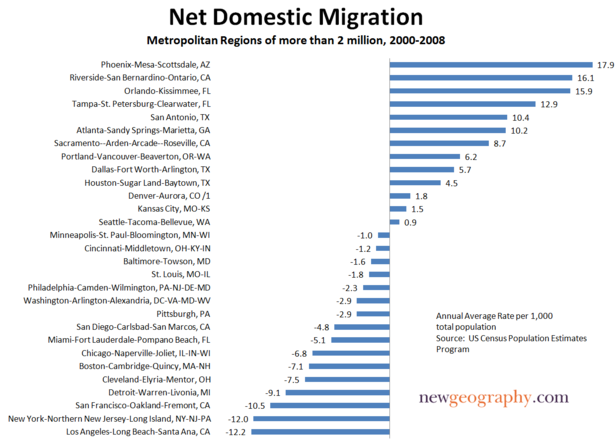
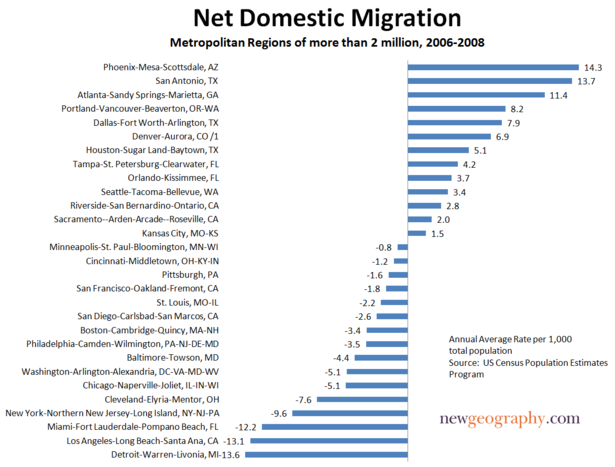
    This narrative, which has not changed much over the past decade, is misleading and largely misstated. Net migration, both before and after the Great Recession, according to analysis by the Praxis Strategy Group, has continued to be strongest to the predominately red states of the South and Intermountain West.

    This seems true even for those seeking high-end jobs. Between 2006 and 2008, the metropolitan areas that enjoyed the fastest percentage shift toward educated and professional workers and industries included nominally “unhip” places like Indianapolis, Charlotte, N.C., Memphis, Tenn., Salt Lake City, Jacksonville, Fla., Tampa, Fla., and Kansas City, Mo.

    The overall migration numbers are even more revealing. As was the case for much of the past decade, the biggest gainers continue to include cities such as San Antonio, Dallas and Houston. Rather than being oases for migrants, some oft-cited magnets such as New York, Boston, Los Angeles and Chicago have all suffered considerable loss of population to other regions over the past year.

    Much the same pattern emerges when you look at longer-term state demographic patterns. A recent survey by the Empire Center for New York State Policy found that the biggest net losers in terms of per capita outmigration between 2000 and 2008 were, with the exception of Louisiana, all blue state bastions. New York residents lead in terms of rate of exodus, closely followed by the District of Columbia, Michigan, Pennsylvania, Massachusetts and California.

    An even greater shock to the sensibilities of the insular, Manhattan-centric media, the report found that most of the movement from the Empire State was not from the much-dissed suburbia, but from that hip and cool paragon, New York City. This can not be ascribed as a loss of the unwanted: According to the report, those leaving the city had 13% higher incomes than those coming in.

    How can this be, when everyone who’s smart and hip is headed to the Big Apple? This question was addressed in a report by the center-left, New York-based Center for an Urban Future. True, considerable numbers of young, educated people come to New York, but it turns out that many of them leave for the suburbs or other states as they reach their peak earning years.

    Indeed, it’s astonishing given the many clear improvements in New York that more residents left the five boroughs for other locales in 2006, the peak of the last boom, than in 1993, when the city was in demonstrably worse shape. In 2006, the city had a net loss of 153,828 residents through domestic out-migration, compared to a decline of 141,047 in 1993, with every borough except Brooklyn experiencing a higher number of out-migrants in 2006.

    Of course, blue state boosters can point out that the exodus has slowed with the recession, as opportunities have dried up elsewhere. True, the flood of migration has slowed across the nation. Yet it has only slowed, not dried up. When the economy revives, it’s likely to start flowing heavily again.

    More important, the key group leaving New York and other so-called “youth-magnets” comprises the middle class, particularly families, critical to any long-term urban revival. This year’s Census shows that the number of single households in New York has reached record levels; in Manhattan, more than half of all households are singles. And the Urban Future report’s analysis found that even well-heeled Manhattanites with children tend to leave once they reach the age of 5 or above.

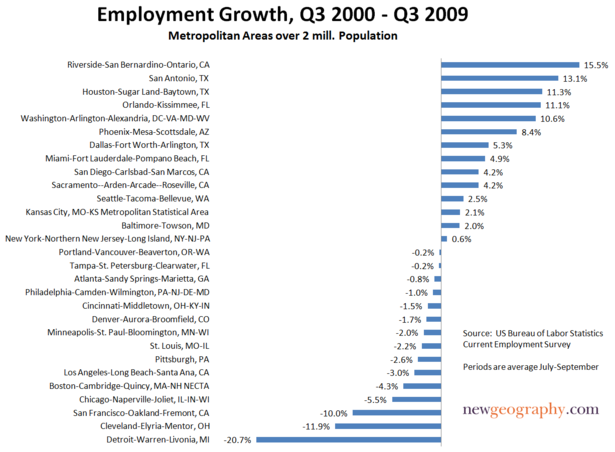
    The key factor here may well be economic opportunity. Virtually all the supposedly top-ranked cities cited in this media narrative have suffered below-average job growth throughout the decade. Some, like Portland and New York, have added almost no new jobs; others like San Francisco, Boston and Chicago have actually lost positions over the past decade.

    In contrast, even after the current doldrums, San Antonio, Orlando, Houston, Dallas and Phoenix all boast at least 5% more jobs now than a decade ago. Among the large-narrative magnet regions only one–government-bloated greater Washington–has enjoyed strong employment growth.

    The impact of job growth on the middle class has been profound. New York City, for example, has the smallest share of middle-income families in the nation, according to a recent Brookings Institution study; its proportion of middle-income neighborhoods was smaller than that of any metropolitan area except Los Angeles.The same pattern has also emerged in what has become widely touted as America’s “model city”–President Obama’s adopted hometown of Chicago.

    The likely reasons behind these troubling trends are things rarely discussed in “the narrative”–concerns like high costs, taxes and regulations making it tough on industries that employ the middle class. One clear culprit: out of control state spending. State spending in New York is second per capita in the nation (anomalous Alaska is first); California stands fourth and New Jersey seventh. Illinois is down the list but coming up fast. Over the past decade, while its population grew by only 7%, Illinois’ spending grew by an inflation-adjusted 39%.

    The problem here is more than just too-large government; it lies in how states spend their money. Massive public spending increases over the past decade in California, New Jersey, Illinois and New York have gone overwhelmingly into the pockets and pensions of public employees. It certainly has not flowed into such basic infrastructure as roads, bridges and ports that are needed to keep key industries competitive.

    The American Association of State Highway Transportation, for example, ranked New York 43rd in the country and New Jersey dead last in terms of quality of roads. Some 46% of the Garden State’s roads were rated in poor condition, compared with the national average of 13%, even as the state’s spending reached new highs. The typical New Jersey driver spends almost $600 a year in auto repairs necessitated by the poor conditions of the roads.

    In contrast, states in the South and parts of the Plains tend to pour their public resources into productive uses. Cities like Mobile, Ala., Houston, Charleston, S.C., and Savannah, Ga., have been investing in port facilities to take advantage of the planned widening of the Panama Canal. The primary goal is to take business away from the increasingly expensive, overregulated and under-invested ports of the Northeast and West Coast. Similarly, places like Kansas City and the Dakotas are looking to boost their basic rail and road networks to support export-heavy industries.

    Even in the face of the Obama administration’s strongly urban-centric, blue state-oriented economic policy, these generally less than hip places appear poised to grow as the economy recovers. Virtually all the top 10 economies that have withstood the recession come from outside the “youth-magnet” field: San Antonio; Oklahoma City; Little Rock, Ark.; Dallas, Baton Rouge, La.; Tulsa, Okla., Omaha, Neb.; Houston and El Paso, Texas. The one exception to this rule, Austin, also benefits from being located in solvent, generally low-tax Texas.

    This continued erosion of jobs and the middle class from the blue states and cities is not inevitable. Many of these places enjoy enormous assets in terms of universities, strategic location, concentrations of talented workers and entrenched high-wage industries. But short of a massive and continuing bailout from Washington, the only way to reverse their decline will be a thorough reformation of their governmental structure and policies. No narrative, no matter how well spun, can make up for that reality.

    This article originally appeared at Forbes.com.

    Joel Kotkin is executive editor of NewGeography.com and is a distinguished presidential fellow in urban futures at Chapman University. He is author of The City: A Global History. His next book, The Next Hundred Million: America in 2050, will be published by Penguin Press early next year.

  • GOP Needs Economic Populism

    You would think, given the massive dissatisfaction with an economy that guarantees mega-bonuses for the rich and continued high unemployment, that the GOP would smell an opportunity. In my travels around the country — including in midstream places like suburban Kansas City and Kentucky — few, including Democrats, express any faith in the president’s basic economic strategy.

    Ask a local mayor or chamber of commerce executive in Kentucky or Kansas City about the stimulus, and at best you get a shrug. Many feel the only people really benefiting from Obamanomics are Wall Street grandees, public employees, subsidized “green” companies and various other professional rent seekers.

    It’s not surprising, then, that most Americans — upward of 60 percent — feel the country is headed in the “wrong direction.” Most of these malcontents are not zealots such as those you might find at a tea party. They are more akin to villagers watching in horror as two armies, each fighting in their name, wage war on each other, leaving desolation in their wake.

    Yet it’s unlikely that the independent-minded will move to the GOP until the party comes up with a credible economic plan that addresses popular concerns. One big problem lies in the very nature of the Republican Party. Since Theodore Roosevelt, the party has devolved into a de facto shill for large corporate interests. One notable exception, to some extent, was Ronald Reagan, whose rise challenged the hegemony of some in the corporate establishment, first in California, when he was governor, and later nationally.

    Republicans may now find it convenient to rail against the Troubled Asset Relief Program, but it’s something many supported under George W. Bush. Even now, most are loath to fight excessive pay and bonuses at places like Goldman Sachs. Instead, it’s populists like North Dakota Democrat Byron Dorgan and Vermont independent Bernie Sanders who seem most outraged by the massive rip-off of taxpayers.

    Republicans also do not seem sympathetic to pro­posals by former Fed chief Paul Volcker and others to break up “too big to fail” banks or reimpose distinctions between investment and mainstream banks. If anything, this illustrates that for all the rhetoric about self-sufficiency and small business, they remain more attuned to Wall Street and K Street than Main Street.

    Yet there may be new opportunities for Republicans on the economic front. This winter, the focus of political debate will shift from health care to energy legislation. Whatever the negatives associated with President Barack Obama’s proposals, Republicans’ long-standing inability to reform clearly flawed health care systems has undermined their credibility. The health insurance industry and right-wing ideologues may applaud their efforts, but it’s unlikely to impress the many middle- and working-class Americans for whom the current system is not working.

    In sharp contrast, the coming debate over energy and climate plays to the weaknesses of the Democrats. All the administration’s talk of reducing our “addiction” to foreign energy can be painted as fraudulent, since the powerful green lobby will militate against developing our country’s huge natural gas and other fossil-fuel deposits, as well as nuclear power.

    In the past election, some of the few good moments for John McCain came in the wake of his embracing a nationalistic, growth-oriented “Drill, baby, drill” agenda. This approach remains popular not only with conservatives but also with moderates and independents, particularly in energy-producing states.

    Obama’s climate change proposals offer an additional opportunity. The mainstream media remain slavishly tied to the Al Gore warming thesis, but skepticism toward the anti-carbon jihad is building via the Web. In recent months, Gallup, Pew and Rasmussen have reported reduced enthusiasm for radical steps to battle climate change. Right now, this seems to be a major concern for barely one in three Americans.

    Yet the “cap and trade” proposals could prove a boon to some of the very corporate interests — on Wall Street and among utilities — still considered core supporters by some Republicans. GOP leaders seem simply incapable of comprehending the discreet charm that Timothy Geithner’s collusive capitalism holds for many corporate chieftains. In this, they resemble the boyfriend who ignores the implications of finding someone else’s Jockeys on his girlfriend’s bed.

    Sadly, those who do tend toward populism, like current front-runners Mike Huckabee and Sarah Palin, appear too socially regressive to appeal to the suburban independents who will decide the elections in 2010 and 2012. Americans may yearn for an economically populist alternative, but not if they think it will bring back the Inquisition.

    In the end, economic populism, not social conservatism, can transform Republicans into something other than a scarecrow party. And they could make this strategy work, if they only had a brain.

    This article originally appeared at Politico.com.

    Joel Kotkin is executive editor of NewGeography.com and is a distinguished presidential fellow in urban futures at Chapman University. He is author of The City: A Global History. His next book, The Next Hundred Million: America in 2050, will be published by Penguin Press early next year.

  • Let Freedom Ring: Democracy and Prosperity are Inextricably Linked

    With autocratic states like China and Russia looking poised for economic recovery, it’s often hard to make the case for ideals such as democracy and rule of law. To some, like Martin Jacques, author of When China Rules, autocrats seem destined to rule the world economy.

    A columnist for the Guardian, Jacques predicted that by 2050 China will easily surpass America economically, militarily and politically. The belief in the power of autocracy even extends to such leading American capitalists as Warren Buffett and Bill Gates, who have nothing but high praise for what Gates enthusiastically describes as a “brand-new form of capitalism.”

    Fortunately a new study released Monday by my colleagues at the Legatum Institute refutes the notion that the road to worldly riches lies in autocracy and repression. In a careful study of everything from economic opportunity, education and health to security, freedom of expression and societal contentment, the Legatum “Prosperity Index” makes a powerful case for the long-term benefits of democracy, free speech and the rule of law.

    Some of this stems from how Legatum measures prosperity. The survey takes into account both wealth and well-being, and finds that the most prosperous nations in the world are not necessarily those that just have a high GDP, but that also have happy, healthy, free citizens.

    The top of the list, which ranks 104 countries, is dominated by flourishing democracies. The only exception in the top 20 is No. 18’s Hong Kong, which ranks first in economic fundamentals and continues to be ruled, if not quite democratically, under a far more permissive system than the rest of mainland China. The next semi-autocratic state on the list is Singapore, at No. 23 – another Confucian-style autocracy with great economic and human capital fundamentals.

    This linking of democracy and prosperity with well-being is by far the most significant aspect of the study. But what else determines the success of nations in the modern world?

    1. Small democracies do best.

    The denizens of the Greek city-states or their Renaissance counterparts would have recognized something of themselves in the small, well-managed countries that dominate the top of the list. The top five, Finland, Switzerland, Sweden, Denmark and Norway – as well as the Netherlands at No. 8 – certainly fit this description. These countries rank highly on the quality of life measurements, and, not surprisingly, their main cities also tend to dominate the most-livable-cities lists. With the exception of Switzerland and the Netherlands, these places do not perform as well in terms of basic economics, scoring between 10th and 18th. Although some might ascribe these rankings to successful social democratic policies, virtually all these mini-states have instated significant market-oriented reforms in recent years.

    Other top players Australia (No. 6) and Canada (No. 7) are far larger than their European rivals. And though their citizens are not as socially coddled as in Scandinavia, they enjoy strong democratic institutions, high levels of social well-being and good governance and education.

    And in purely economic terms Australia and Canada boast better economic fundamentals than the Scandinavian countries. One reason may be their enormous stockpiles of natural resources, now in high demand from countries like China and India. These countries also benefit by a large and often skilled migration from these and other Asian countries.

    2. Among the mega-countries, the U.S. is still way ahead

    Don’t cry for me, America. In terms of the large countries, both in population and size, no one comes close to the No. 9-ranked U.S. Indeed there’s not another country with over 100 million people on the list until you get to Japan at No. 16.

    Like all big countries, America is a complicated place, with distinct areas of strength as well as disturbing weaknesses. The U.S. leads all countries in entrepreneurship and innovation and ranks second in the stability of its democratic institutions – the Swiss are No. 1. Less than optimal health and safety rankings, however, push America from the top. Its economic fundamentals are also sub-prime, ranking only 14th, which isn’t surprising in light of persistent current account and now government deficits.

    Despite its problems, the U.S. still outperforms its other large rivals, not only Japan but also the U.K. (No. 12), Germany (No. 14) and France (No. 17). Yet judged within the ranks, all four of these economies have to be considered successful in terms of delivering prosperity and a reasonably high quality of life to their citizens.

    3. Breaking down the BRICs

    The Index’s most fascinating findings can be found a bit further down. The focus of the world’s economy has been shifting to countries that have been – and in some cases remain – governed by Communist, military or single-party dictatorships.

    Democracy’s efficacy can be seen clearly in success enjoyed by the former European Communist states – the Czech Republic, Poland, Latvia, Estonia, Slovakia and Hungary – all of which land in the first third of the ratings. Similarly, Taiwan (ranked 24th) and South Korea (26th), long ruled by military-dominated dictatorships, show how democratization and rising prosperity can flourish together.

    This pattern can also be seen among the “big boys” of the economic upstarts – the so-called BRIC countries. Here the leaders of the pack are both functioning democracies, Brazil (No. 41) and India (No. 45). These rapidly growing economies are kept out of the top tier by significant shortcomings in vital fields such as education, health and public safety.

    The other two BRIC powers, China and Russia, neither of which can be considered anything close to open societies, lag behind. Russia’s mineral wealth gets it a respectable 39th in economic fundamentals, but a lack of democracy, personal freedom and personal safety – as well as poor governance and corruption – drags it down to a paltry 69th. China, ranked a disappointing No. 75, also performs admirably on economic fundamentals, clocking in at No. 29, but is hammered for glaring shortfalls in democracy, personal freedom and governance as well as health and education.

    4. Autocracy may seem to pay, but not in the long run

    Throughout modern history, autocracy has proved effective in sparking fast growth, but a pervasive democratic deficit, poor governance and lack of personal freedom seem likely to constrain long-term progress. For one thing, the ruling elite in the dictatorship is under no strong compulsion to adjust to the needs of its population. Short of forestalling outright rebellion, nest-feathering tends to gain the upper hand.

    As you get to the bottom of the list, the price of dictatorship rises higher still. In this nether-region, there is nary a democratic state. Some of the low-ranking Third World countries are obvious – like Cameroon (No. 100) or Yemen (No. 101) – but some potentially rich but despotically ruled nations do poorly as well.

    Take, for example, No. 94 Iran, a country with enormous natural resources, a well-educated population and a rich cultural heritage. A reasonably enlightened Iran would likely sit in the top third of the list instead of skipping toward the bottom.

    Even the bottom-ranked country, Zimbabwe, left its colonial period with a thriving agriculture sector and great mineral wealth. Here again despotic rule has shown itself an adept destroyer of economic promise.

    In these times of acute self-doubt not only in America but across the democratic world, the Legatum ratings validate the idea that if democracy is not the inevitable wave of the future it represents by far the most efficient way to manage a society. In the end, democracy and prosperity prove not two distinct elements, but, in fact, inextricably linked to each other.

    This article originally appeared at Forbes.com.

    Joel Kotkin is executive editor of NewGeography.com and is a distinguished presidential fellow in urban futures at Chapman University. He is author of The City: A Global History. His next book, The Next Hundred Million: America in 2050, will be published by Penguin Press early next year.

  • Stimulate Yourself!

    Beltway politicians and economists can argue themselves silly about the impact of the Obama administration’s stimulus program, but outside the beltway the discussion is largely over. On the local level–particularly outside the heavily politicized big cities–the consensus seems to be that the stimulus has changed little–if anything.

    Recently, I met with a couple of dozen mayors and city officials in Kentucky to discuss economic growth. The mayors spoke of their initiatives and ideas, yet hardly anyone mentioned the stimulus.

    “We didn’t see much of anything,” noted Elaine Walker, mayor of Bowling Green, a relatively prosperous town of 55,000 in the western part of the state. “The money went to the state and was siphoned off by them. We got about zero from it.”

    Ironically, Walker does not seem overly upset about the lack of federal assistance for Bowling Green. Instead, Walker–a self-described supporter of the president in a part of the country largely resistant to Obamamania–seems more disposed to taking matters into her own hands. Rather than waiting for Obama, Bowling Green is looking to stimulate itself–and other communities would do well to emulate this grassroots approach

    Bowling Green’s “self-stimulation” is part of a concentrated effort at diversification for the city, which has long depended on its General Motors plant, which produces the Corvette. Other single-industry-dominated regions, notably Detroit, have made much noise about moving into other fields, but their emphasis has frequently revolved around high-profile, highly subsidized projects such as “green” industries, entertainment or tourism.

    Instead, says Walker, the first step in diversification lies with boosting small local businesses.

    A primary vehicle for this has been the successful Small Business Accelerator located at an abandoned mall. Buddy Steen, who runs the program in conjunction with Western Kentucky University, claims it has fostered some 38 companies and created over 700 jobs. Blu Pharmaceuticals, developed by Small Business Accelerator, for example, currently employs five but expects to add another 40 workers at its new plant in nearby Franklin. The program’s other firms specialize in everything from electronic warfare to robotics.

    Kentucky may seem an unlikely spot for such ventures, admits local entrepreneur Ed Mills, but things are changing in the Bluegrass State. Mills, a former General Motors executive, and his twin sons, Clint and Chris, founded a Web-based software firm, HitCents, in 1995 when the boys were still in high school.

    Today the company, which develops software for retail and other applications, has over 50 employees and customers from across the country, including GM, as well as a host of local companies, unions and public agencies. “We hope to build a $100 million company, and we think we can do it.” Mills says. “You don’t have to be in California. People think you can’t do this in Kentucky but plainly you can.”

    With its strategic location on Interstate 65 connecting the old industrial heartland to the emerging one along the Gulf, Bowling Green enjoys many advantages. It’s slightly over an hour to Nashville and two hours to Louisville, the area’s two major consumer and cultural marketplaces.

    Other small communities in the state have also realized that any green shoots would have to come from local grassroots. Russellville, a rural community of some 7,200 in the southwest part of the state, is looking at a “back to basics” economic development plan that stresses the export of local food products and crafts.

    “You can ride down the highways and smell the hams smoking,” notes one local economic developer. “We are looking on how to export those hams to the rest of country.”

    Mayor Gary Williamson of Mt. Sterling, a town of 6,000 located in Montgomery County, in the generally more impoverished east, has been pushing a different strategy. His region is dotted with industrial plants of varying sizes. The city is also 45 minutes from Georgetown, site of a large Toyota factory.

    These employers require a steady stream of skilled industrial workers, particularly in such fields as machine maintenance. Williamson and other officials in the area see training such workers–starting at the high school level–as a way to not only keep people employed but to attract other firms to the area. “We want to keep people here, and they will do so if they have jobs after school,” he explains.

    It’s significant that such grassroots-based development–geared to unique local conditions–is taking place in Kentucky. For generations, the state and the rest of the surrounding Appalachian region has been the brunt of both jokes and patronizing attention from the nation’s academes, policy circles and media.

    Most Americans, observed Newsweek in 2008, “see Appalachia through the twin stereotypes of tragedy (miners buried alive) and farce (Jed Clampett).” One prime reflection of that approach can be seen in a CNN report last year that painted a decidedly dismal portrait of the region.

    For generations, Appalachia’s seeming backwardness has led to the creation of numerous federal programs aimed at lifting it into the national economic and cultural mainstream, notes University of Kentucky historian Ronald Eller. In his excellent Uneven Ground: Appalachia Since 1945, Eller describes how these efforts reflected the region’s “struggle with modernity.” Progress has been often associated with efforts to undermine what the late Michael Harrington described as a “separate culture, another nation with its own way of life.”

    Yet, this unique culture also could provide some of the basis for a regional recovery. There’s a growing sense, notes longtime Kentucky League of Cities President Sylvia Lovely, that the region’s fundamental assets–its natural beauty, resources and traditions of craftsmanship–could constitute a distinct advantage in the coming decades.

    More important still could be less tangible values, Lovely notes. “Modernity” in its current unadulterated form–with a lack of community, homogeneity and disconnect from the natural world–could be losing its allure for millions of Americans. In terms of what matters, she suggests, Appalachian towns may possess “if not more information, perhaps more wisdom than those who hold themselves out as experts. “

    Looking at the statistics, the news is not all grim. Despite its still glaring problems, particularly in its rural hinterland, Appalachia has been gaining steadily compared to the rest of the country. In 1960 one-third of Appalachia residents lived in poverty, compared with 1 in 5 nationally; by 2000 the poverty rates had fallen to 13.6%, just a tick higher than the national 12.3%. The region’s continued struggle with the gap between rich and poor, Eller notes, now more reflects broader national trends as opposed to something unique to the region.

    Perhaps the most dramatic changes are illustrated by migration patterns. By the end of the 1960s one out of every three industrial workers in Ohio came from Appalachia. Young people studied, notes Eller, “reading, writing and Route 23,” referring to the main highway to the industrial north.

    Since 2000 Kentucky, as well as Tennessee and West Virginia, have enjoyed positive rates of net migration. Although some parts of the region continue to suffer horrendous poverty and continued out-migration, many other communities–such as Bowling Green, Lexington and Louisville, as well some more rural areas–have attracted more newcomers than they have lost. Overall Appalachian states’ migration statistics look a lot healthier than Ohio and Illinois, not to mention New York or California.

    Walker–who moved to Kentucky from Los Angeles shortly after the 1992 race riots–sees this new migration as part of what will sustain a recovery in the region. Like many newcomers, Walker came to Kentucky not for bright lights but for a good place to raise her children. “Everyone still waves and says hi,” she observes. “That makes a lot more difference to people than many think. In the end, people come here because it’s a better place to live and also to raise your kids. It’s all about families.”

    Ultimately, a combination of folksiness and access to the world brought by technology could spark a continued renaissance not only in Bowling Green but across the region. The fact that the resurgence seems to be the product of largely local efforts not only makes it all the sweeter, but could inspire similar approaches among those communities still waiting for Washington to rescue them.

    This article originally appeared at Forbes.com.

    Joel Kotkin is executive editor of NewGeography.com and is a distinguished presidential fellow in urban futures at Chapman University. He is author of The City: A Global History. His next book, The Next Hundred Million: America in 2050, will be published by Penguin Press early next year.

    Downtown Bowling Green photo courtesy of OPMaster