Author: Joel Kotkin

  • Obama’s Energy Triangulation

    With the possible exception of health care reform, no major issue presents more political opportunities and potential pitfalls for President Barack Obama than energy. A misstep over energy policy could cause serious economic, social and political consequences that could continue over the next decade.

    To succeed in revising American energy policy, the president will need to try to triangulate three different priorities: energy security, environmental protection and the need for economic growth. Right now, the administration would like to think it could have all three, but these concerns often collide more than they align.

    A president should have no higher priority than to ensure that America becomes more independent from foreign producers, particularly those outside North America. This represents a great opportunity to diverge from the failure of the Bush administration to reduce this dependence and encourage conservation.

    Instead, the best course could be called an “all of the above” strategy. This would embrace not only conservation and investment in renewable fuels but also aggressive expansion of the electric grid, the domestic fossil fuel industry and nuclear power. In particular, the country should focus on exploiting our vast reserves of relatively clean natural gas and drive technologies that could also clean up emission from coal, our other large resource.

    Instead of promoting fossil fuel development, environmental lobbyists — and Obama — like to talk about “green jobs.” Although green elements need to be integrated into all walks of economic life, the notion that green jobs can provide economic salvation seems more like a marketing strategy than one based on reality.

    Given current energy prices, large-scale numbers of green jobs can be created only through huge subsidization, the costs of which would, of course, be born by other parts of the economy. At the same time, jobs lost in fossil fuel production and manufacturing because of the high costs associated with renewables would most likely far outweigh any imaginable surge of green jobs.

    A recent study conducted in Spain, another country with a history of strong subsidies for renewable fuels, found that the money invested in green jobs actually cost so much that the overall employment effects were negative. Increasingly, the “green jobs” mantra seems like a story we tell our children to get them to sleep.

    The mantra also obscures the critical fact that the true goal of the environmental lobby is, above all, to shrink the much detested “carbon footprint” of people and communities. People like Obama’s science adviser, John Holdren, do not place much priority on maintaining much of the present American way of life. An acolyte of the many-times-wrong neo-Malthusian Paul Ehrlich, Holdren has promoted the “de-development” of Western societies as a way to lower carbon emissions and redistribute the world’s wealth.

    Such an approach might be popular at academic soirees or even among some investment bankers who see their future in Shanghai as opposed to Saginaw or Sacramento. It may prove a bit less popular among those, particularly in the middle and working class, who might not welcome seeing their families and communities de-developed.

    This should be obvious to the president and the clever political tacticians around him. Recent polls reveal that voters now rate global warming among their 20 least-critical concerns. Not surprisingly, the economy and jobs ranked as the top two.

    There are also serious regional issues to consider. Areas with economies tied to fossil fuels — mainly in Texas, the Great Plains, the Southeast and Appalachia — view the issue differently than do places like Manhattan, San Francisco or Chicago’s Gold Coast, whose residents can afford much higher energy prices and have few ties to traditional productive industries.

    As leader of both the country and his party, the president will have to consider these regional and class divides. The Republicans may be irrelevant, but the swelling ranks of more-pragmatic Democrats from Western, Southern and exurban districts cannot be so easily dismissed.

    In this sense, the possibility of the election next year of Houston Mayor Bill White, a Democrat, to the Senate represents more of a threat to the green lobby than a Republican victory does. White, like many Texas Democrats, has close ties to the energy industry and has already expressed grave misgivings about the administration’s renewables-obsessed carbon emissions policies.

    Given growing opposition in Congress, green groups and their allies in legal circles now argue that the administration can transcend the messy political process by imposing a strict anti-greenhouse-gas policy through the Environmental Protection Agency apparat. This has the virtue of allowing the president to avoid direct confrontation with many congressional Democrats but leaves power firmly in the hands of zealots for whom both energy independence and economic growth are less-than-compelling priorities.

    Ultimately, energy policy is too important to the economy and security to be left in the hands of bureaucratic zealots and their allies. It is up to the president to forge an energy program that, while looking toward renewables in the long run, does not sacrifice the livelihoods of millions of American workers today or leave our country ever more susceptible to the machinations of hostile foreign powers.

    This article originally appeared at Politico.

    Joel Kotkin is executive editor of NewGeography.com and is a presidential fellow in urban futures at Chapman University. He is author of The City: A Global History and is finishing a book on the American future.
  • Austin’s Secrets For Economic Success

    Few places have received more accolades in recent years than Austin, the city that ranked first on our list of the best big cities for jobs. Understanding what makes this attractive, fast-growing city tick can tell us much about what urban growth will look like in the coming decades.

    Austin’s success is not surprising since, in many ways, it starts on third base. Two of its greatest assets result from the luck of the draw; it’s both a state capital and home to a major research university.

    Our ranking of the best cities for job growth includes many college towns–from Fargo, N.D., (home to North Dakota State) to Athens, Ga., (University of Georgia), Durham-Chapel Hill, N.C., (Duke and University of North Carolina) and College Station, Texas (Texas A&M).

    Being a state capital also helps. Baton Rouge, La., home to both the state government and Louisiana State University, ranked seventh on our list of the best medium-sized cities for employment. This confluence of institutions also accounts in large part for the relatively decent rankings of two Midwestern cities, Indianapolis and Columbus, Ohio, in spite of the generally sad situation in that region.

    That’s because colleges and state governments offer stable employment–since they cannot or will not outsource jobs to India or China. These places also tend to be inhabited by reasonably well-educated people whose stable incomes makes them less vulnerable to contractions in competitive industries like finance, manufacturing, construction or information.

    “We’re pretty close to recession-proof,” suggest Chris Bradford, a local attorney and blogger in Austin. “It’s almost anti-cyclical. In bad times, the students want to stay here.”

    There is a third factor, however, that adds to Austin’s special sauce: the fact that it is located in Texas, the one fast-growing mega-state. With low taxes and low regulation at the state level, Austin–no doubt to many locals’ consternation–is a great environment not only for public sector employment but also private sector growth.

    Its success contrasts dramatically with the relatively poor employment status of capitals in business-unfriendly states (such as Sacramento, Calif., which ranked 60th among large cities) as well as other college towns like Ann Arbor, Mich., home to one of the nation’s best public universities, the University of Michigan. (Among medium-sized cities, Ann Arbor came in 93rd.)

    Austin, essentially, reaps the benefits of being a deep blue, Democratic island in a red-state sea. The university and state government employ large numbers of people who might want higher taxes and greater regulation–but they can talk the redistributionist’s game without feeling any of the pain.

    This is not to say that Austin itself–that is, its urban core area–does not try to trot out its blue, and “green,” trimmings. Like every college town, Austin likes smart growth, mass transit and high density.

    But in reality, Austin is not a dense region. In fact, its metropolitan population per acre puts it in the middle of the nation’s largest areas, well behind not only Los Angeles and New York but also Houston and Dallas.

    Even central Austin seems rather spread out and suburban compared to traditional East Coast cities. Smaller, older homes–mainly cottages–dominate neighborhoods close to downtown. Recent attempts to go high-rise have not been notably successful, as the auction signs on the sides of some new towers suggest.

    Yet the urban center increasingly represents less and less of the area’s total employment and houses fewer and fewer of its residences. Today, the city itself is home to well under half the metropolitan population of 1.5 million.

    As in many regions, notes blogger Bradford, over the past decade the strongest growth has occurred in Austin’s periphery. Even as the city itself has enjoyed strong job and population growth, the biggest increases have taken place in suburban outposts outside city limits, like Williamson, Bastrop and Hays counties, as well as parts of Travis, the county that is home to Austin. In fact, Williamson was the nation’s sixth fastest-growing county last year, while Hays ranked 10th.

    Surprisingly, these suburban areas are the places most driving Austin’s economic success. Why? Two reasons: affordability and livability. By Texas standards, the city is not cheap. It costs between $350,000 and $400,000 for a nice three- or four-bedroom house in a good school district, say, 20 minutes from downtown. However, a similar place in the ‘burbs of Silicon Valley, San Francisco, Boston or Irvine would run at least twice as much.

    Local Realtor and blogger Shannan Gonyea-Reimer adds that, a bit further away from town, home prices can drop as low as $150,000. “People come from California, and they are shocked,” she says.

    This price structure, along with the human capital attracted to the University of Texas, has in turn propelled the rapid expansion of the non-governmental economy in places like Cedar Creek and Round Rock, home to Dell. A recent Brookings study estimates that central Austin employment grew by almost 13% between 1998 and 2006. The number of jobs more than 10 miles from the central business district increased by 77,523, or 62%, according to the study.

    Austin has seen remarkable overall employment growth–almost 34%–in the last decade. With that figure, it leaves its major hip tech rivals in the dust. Over the same period, for example, San Jose/Silicon Valley has lost 6% of its jobs; San Francisco, around 1.6%. Boston, Austin’s other big high-tech competitor, enjoyed only a 1.2% gain.

    Again, this growth stems in part from the unique combination of both an appealing city center and attractive suburbs. The city’s lively urban core remains a lure for affluent professionals, young singles and, of course, students. However, unlike places like New York, Boston and San Francisco, the sprawling ‘burbs provide an affordable place for people to move to when their hardcore clubbing days are over.

    “California might work well for the apartment-dwelling, single-guy lifestyle person, but when you get married, you can’t afford Los Gatos,” says former Silicon Valley entrepreneur Mike Shultz, the CEO of Infoglide, a software firm headquartered on Austin’s outer ring. “In Austin, the same person can grow up, move into a reasonable house and have a reasonable life.”

    This does much to explain why Austin has enjoyed a migration pattern unlike that of its primary competitors. Its residents may start off hip and cool, but the city also accommodates their often inevitable evolution to Ozzie and Harriet. This allows individuals and companies to plan to stick around. One doesn’t have to have the short-term mentality so common in the Bay Area, L.A., Boston or New York.

    Ultimately, it is this combination of a “cool” downtown culture–with excellent restaurants as well as great music–and a more sedate, affordable periphery that makes Austin a home run.

    “It has a hip cool side to it,” Shultz observes, “but it’s also a great place to raise kids.”

    A caveat to all this: We also have to consider scale. With roughly 1.5 million people, Austin simply offers more convenient choices than a megalopolitan behemoth like Los Angeles, New York or the Bay Area. In Austin, nice, single-family homes within walking distance of cool urban streets are not uncommon or absurdly expensive–and even a larger, more affordable house out in the suburbs is usually less than a half an hour from downtown.

    Additionally, Texas, unlike its main rival California, is not teetering on the edge of bankruptcy and is instead a stable long-term bet in this recession. Rather than haggling with bankers or public employee unions, it is busy building its future: attracting new comers, investing in its university and building new transportation infrastructure.

    “Austin is off the charts livable, but it’s in a state that makes it viable,” says Shultz, the entrepreneur. “You can’t say that about California and many of the other places where our competitors are.”

    This article originally appeared at Forbes.

    Joel Kotkin is executive editor of NewGeography.com and is a presidential fellow in urban futures at Chapman University. He is author of The City: A Global History and is finishing a book on the American future.
  • America’s (Sub)Urban Future

    Cities today have more political clout than at any time in a half century. Not only does an urbanite blessed by the Chicago machine sit in the White House, but Congress is now dominated by Democratic politicians hailing from either cities or inner-ring suburbs.

    Perhaps because of this representation, some are calling for the administration and Congress to “bail out” urban America. Yet there’s grave danger in heeding this call. Hope that “the urban president” will solve inner-city problems could end up diverting cities from the kind of radical reforms necessary to thrive in the coming decades.

    Demographics and economics make self-help a necessity. Despite the wishful thinking of urbanophile pundits and policymakers, central cities have little realistic chance to reclaim their pre-1950 role as the dominant arbiters of American life.

    Short of a catastrophic change, the country will remain predominately made up of suburban, exurban and small town residents. Since 2000, more than four-fifths of metropolitan growth has taken place in suburbs and exurbs. Economically, we see a similar pattern. According to a recent Brookings Institution study of 98 large metropolitan areas, only 21% of employees work within three miles of downtown. The report found that only three regions avoided the decentralizing trend.

    The Brookings report and many others decry all these trends as promoting “sprawl,” but name-calling will not assure that urban areas can impose their political hegemony over the long run. The Obama administration may try to boost cities by imposing barriers to suburban growth, but these seem doomed to failure given both the preference of most Americans for lower-density lifestyles and the president’s demonstrated ability to count votes.

    Rather than waiting for Barack, urban boosters should instead take up the New Testament injunction to “heal thyself.” Cities should have a chance to grow based on the roughly 10% to 20% of Americans who tell researchers they would like to live in a dense urban environment. With an extra 100 million Americans coming on line by 2050, cities could look forward to accommodating upwards of 20 million more people in the next few decades. As my grandmother would say, that’s not exactly chopped liver.

    Yet in order to enjoy this repast, cities will need to address three fundamental and inextricably related issues: public safety, business climate and political reform. Of these, public safety is the most critical. From the earliest times, security has represented a critical pre-condition for urban success. The huge surge in urban crime during the 1960s, for example, played an enormous role in the precipitous decline of cities in the ensuing decades.

    Conversely, improvements in public safety after 1990–notably in New York and Los Angeles but also in other large cities–helped slow the out-migration from urban cores and attract new residents, mostly young educated professionals and immigrants. Now urban crime may be on the rise, and could again threaten new growth.

    This is worrying because urban crime rates, notes demographer Wendell Cox, remain still three times higher than those of surrounding suburbs. Almost all the highest crime areas in America can be found in urban settings, while the safest places tend to be in suburban towns.

    Even the president’s much-celebrated hometown of Chicago suffered roughly a murder a day last year. On the city’s MTA trains, robbery soared 77% between 2006 and 2008. Now there’s also more than a stickup a day.

    Hard economic times may exacerbate these problems, with an estimated 250,000 more Chicagoans predicted to fall into poverty by the end of the year. More widely, unemployment among core urban populations–young people, minorities and immigrants–is on the rise, even more than in the general population. Indeed, for the first time since the mid-1990s, the foreign born now suffer a higher rate of joblessness than the native born.

    Yet even in the face of a tough economy, few cities seem to focus on long-term middle-class job creation. Most seem to prefer to indulge in marginally useful taxpayer-subsidized prestige projects like convention centers, arts complexes, ball parks and arenas. Meanwhile, the core issues stifling growth–high taxes, stiff regulatory burdens and sometimes corrupt governments–remain largely ignored.

    Recently while researching the middle class in New York, I met many otherwise committed urbanites considering leaving to less costly, lower-tax and more business-friendly locales. Up until recently, this problem was somewhat obscured by spectacular earnings on Wall Street, which engendered the growth of an extensive “luxury economy” largely insulated from high costs. But even Timothy Geithner won’t be able to bail out this favored segment of the economy ad infinitum.

    Instead cities, including New York, will have to diversify to less gilded industries. Increasingly cities will need to rely on small companies, micro-enterprises and self-employed high-tech artisans to drive their economies. To keep them there, they will need to attend to basic services–education, police and transportation–while managing to curb taxes and regulations.

    This will necessitate confronting the largest source of high city costs: public employee salaries and pensions. This problem is not unique to core cities, but tends to be more severe in urban areas where public employee unions often dominate local politics.

    Finally, cities need to address their educational systems. Despite all the talk of urban educational reform, the urban dropout rate, according to a recent study of the nation’s largest cities by America’s Promise Alliance remains around 50%, roughly 20 points higher than the rate for suburbs. Poor-quality urban schools drive out both the middle class and the most upwardly mobile segment of the working class.

    Even more money from Washington won’t solve this problem. Cleveland, with a 38% graduation rate, spent far more on students per capita than Ohio’s statewide averages. In contrast, the surrounding suburbs enjoyed an 80% graduation rate.

    Are cities capable of changing their governance for the better? In the 1990s, the emergence of tough, reform-minded mayors like New York’s Rudy Giuliani, Indianapolis’ innovative Steven Goldsmith, Richard Riordan in Los Angeles and Houston’s hard-driving Bob Lanier all sparked urban revivals in their cities.

    Today, however, there are few such personages; Houston’s Bill White is one glaring exception. Yet without an infusion of bold new leadership, the future of American cities, although not universally bleak, will not be nearly as bright as it should be. Rather than a constellation of strong, reviving cities, we can envision the emergence of a less promising set of scenarios.

    One archetype will be the Bloombergian “luxury city,” a very expensive urban area dominated by the wealthy and their servants, students and nomadic young workers as well as the poor. The affluent will drive this growth, but only in a relatively few neighborhoods in attractive places like New York, Chicago, Boston, Los Angeles, Seattle, Portland, Denver and Minneapolis.

    San Francisco may presage this urban form. Already middle-class families are becoming scarce in the city by the bay. The place seems increasingly something of a Disneyland for privileged adults, exempting of course the large homeless population. “A cross between Carmel and Calcutta,” jokes California historian and San Francisco native Kevin Starr.

    At the opposite end of the spectrum lie those cities consistently at the bottom of our Worst Cities For Jobs ranking. Despite some zones of gentrification, such once-great cities as Detroit, Cleveland, Memphis, Baltimore and Philadelphia could continue to suffer persistently high rates of poverty, diminished populations and high crime rates.

    Not that this has to be. These areas could stage a real resurgence if their governments determine to throttle criminals, improve basic services and nurture small businesses. Low housing prices, cheap land and, in some cases, strategic locations could attract businesses as well as some of the millions who will be seeking out an urban lifestyle in the coming decades.

    Currently the brightest hopes for America’s urban future lie with newer, “aspirational,” middle-class-oriented cities such as Houston, Dallas, Austin, Phoenix, Raleigh-Durham, Charlotte and Orlando. Although some are now suffering from the recession, these places will benefit from both lower costs and more business-friendly regimes. Primarily suburban in nature, many of these cities have worked to develop attractive dense urban districts, which could expand much further over the next few decades.

    There remains nothing pre-determined about the urban future. Some cities may surprise us by reviving strongly while others may continue to disappoint. Success will depend not on Washington, but on how each city addresses the basics of safety, economics and governance. Grasping this fundamental truth constitutes the first step towards creating a sustainable long-term urban resurgence.

    This article originally appeared at Forbes.

    Joel Kotkin is executive editor of NewGeography.com and is a presidential fellow in urban futures at Chapman University. He is author of The City: A Global History and is finishing a book on the American future.
  • The Worst Cities for Job Growth

    One of the saddest tasks in the annual survey of the best places to do business I conduct with Pepperdine University’s Michael Shires is examining the cities at the bottom of the list. Yet even in these nether regions there exists considerable diversity: Some places are likely to come back soon, while others have little immediate hope of moving up. (Please also see “Best Cities For Job Growth” for further analysis.)

    The study is based on job growth in 336 regions – called Metropolitan Statistical Areas by the Bureau of Labor Statistics, which provided the data – across the U.S. Our analysis looked not only at job growth in the last year but also at how employment figures have changed since 1996. This is because we are wary of overemphasizing recent data and strive to give a more complete picture of the potential a region has for job-seekers. (For the complete methodology, click here.)

    First let’s deal with the perennial losers, the sad sacks of the American economy. Mostly cities in the nation’s industrial heartland, these places have ranked toward the bottom of our list for much of the past five years. Eleven of the bottom 16 regions on our list are in two states, Ohio and Michigan. In fact, the Wolverine State alone accounts for the bottom four cities: Jackson, Detroit, Saginaw and Flint.

    Unfortunately, there’s not much in the way of short-term – or perhaps even medium- or long-term – hope for a strong rebound in those places. President Obama seems determined to give the automakers, for whom Michigan is home base, far rougher treatment than what he meted out to ailing companies in the financial sector.

    In addition, new environmental regulations may not help auto production, since it necessitates some carbon-spewing and therefore perhaps unacceptable levels of greenhouse gas emission.

    However, not all of Michigan’s problems stem from Washington or the marketplace. Many of the locations at the bottom of the list remain inhospitable to business. To be sure, housing is cheap – in Detroit, property values are fast plummeting toward zero – but running a business can be surprisingly expensive in these hard-pressed places.

    In fact, according to a recent survey by the Tax Foundation, Ohio has an average tax burden roughly similar to New York, California, Massachusetts and Connecticut. But while the others are comparatively high-income states, Ohio residents no longer enjoy that level of affluence.

    Can these places come back? It is un-American to abandon hope, but there needs to be a radical shift in strategy to focus on creating new middle-class jobs. Some Midwestern cities, like Kalamazoo and Indianapolis, have made some successful efforts to diversify their economies, encouraging start-ups and trying to be business-friendly.

    But those are exceptions. Cleveland, one of our worst big cities, could spark a renaissance by revamping its port and nearby industrial hinterland. Once the world economy improves, it could re-emerge – building on the existing knowledge and skills of its production- and design-savvy population – as a hub for manufacturing and exports.

    But right now, Cleveland does not seem to be pursuing such opportunities. As Purdue’s Ed Morrison has pointed out, local leaders there seem to “confuse real estate development with economic development.”

    So Cleveland will focus on inanities such as convention business and tourism, believing we all fantasize about a week enjoying the sights along Lake Erie. Yet even high-profile buildings like the Rock and Roll Hall of Fame and Museum, completed in 1986, have not transformed a gritty old industrial town into a beacon for the hip and cool.

    Old industrial cities like Cleveland are better off focusing on their locational advantages – access to roads, train lines and water routes – while offering a safe, inexpensive and friendly venue for ambitious young families, immigrants and entrepreneurs.

    Meanwhile, cities with formerly robust economies – like Reno, Nev., Las Vegas, Orlando, Fla., Tampa, Fla., Fort Lauderdale, Fla., West Palm Beach, Fla., Jacksonville, Fla., and Phoenix – are more likely to rebound. These areas topped our list for much of the 2000s; their success was driven first by surging population and job growth and later by escalating housing prices.

    But the collapse of the housing bubble and a drop in large-scale migration from other regions has weakened, often dramatically, these perennial successes. “We could rely on 1,000 people a week moving into the area,” notes one longtime official in central Florida. “These people needed services, houses and bought stuff. Now the growth is a 10th of that.”

    Instead of waiting for the real estate bubble to return, these areas should choose to focus on boosting employment in fields like medical services, business services and light manufacturing. In much of Florida and Nevada, there’s also a need to shift away from a reliance on tourism, an industry that pays poorly on average and is always subject to changes in consumer tastes.

    We can even be cautiously optimistic about some of these former superstars. After all, observes Phoenix-based economist Elliot Pollack, the existing reasons for moving to Arizona, Nevada or Florida – warm weather, relatively low taxes and generally pro-business governments – have not disappeared. “There’s no change in the fundamentals,” he argues. “It’s a transition. It’s ugly, and there’s pain, but it’s still a cycle that will turn.”

    Once the economy stabilizes, Pollack says he expects the flow of people and companies from the Northeast and California to Phoenix and other former hot spots will resume, once again lured by inexpensive real estate, better conditions for business and a generally more up-to-date infrastructure.

    The Problem with California
    So what about California? The economic well-being of many metropolitan areas in the Golden State has been sinking precipitously since 2006. This year, three California regions – Oakland, Sacramento and San Bernardino-Riverside – have sunk down into the bottom 10 on the large cities list. That’s a phenomenon we’ve never seen before – and never expected to see.

    Like other Sun Belt communities, California suffered disproportionately from the housing bubble’s bust, which has devastated both employment in construction-related industries as well as much of the finance sector. But some, like economist Esmael Adibi, director of the Anderson Center for Economic Research at Chapman University, where I teach, think a real estate turnaround may be imminent.

    Among the first to predict the potential for a real estate bubble back in 2005, these days Adibi is more upbeat, pointing to rising sales of single-family homes, particularly at the lower end of the market. California’s inventory of unsold homes is now down to about six months’ worth, a figure well below the national average of 9.6 months.

    It seems not everyone is ready to abandon the Golden State – but still, recovery in California may prove weaker than in surrounding states. One forecaster, Bill Watkins, even predicts unemployment could reach 15% next year, up from about 11% today. California, most likely, will see only an anemic recovery in 2010 even if growth picks up elsewhere.

    Much of the problem lies with the state’s notoriously inept government. The enormous budget deficit will almost certainly lead to tax increases, which will fall mostly on the state’s vaunted high-income entrepreneurial residents. Stimulus funds won’t do much good either, Adibi notes, since “the state is grabbing all of the federal stimulus money” to keep itself afloat.

    A draconian regulatory environment also could dim California’s prospects for growth. Despite double-digit unemployment, the state seems determined not only to raise taxes but also to tighten its regulatory stranglehold.

    This is a stark contrast to what happened in the 1990s during the last deep recession. At that time, leaders from both political parties pulled together to reform the state’s regulatory and tax environment. Almost everyone recognized the need to improve the economic climate.

    But an even deeper recession, it seems, hardly troubles today’s dominant players – public employees, environmental activists and gentry liberals who largely live along the coast. The state has recently passed a draconian Assembly bill aimed to offset global warming by capping greenhouse gas emissions – a measure that seems designed to discourage productive industry.

    “This is becoming a horrible place to produce anything,” says Watkins, who is executive director of the Economic Forecast Project at the University of California, Santa Barbara.

    California’s lawyers, though, might stay busy. Attorney General Jerry Brown has threatened to sue anyone who grows their business in unapproved, environment-threatening ways. To be sure, this promise may have relatively little impact on the more affluent, aging coastal communities – but it could wreak havoc on younger, less tony areas in the state’s interior. Many of the local economies there still rely on resource-dependent industries like oil, manufacturing and agriculture.

    It’s sad because California has the capacity to recover more quickly than the rest of the country if the state moderates its spending and stops regulating itself into oblivion. This current round of legislation is so dangerous precisely because it could eviscerate the heart of the economy by slowing down entrepreneurial growth, the state’s greatest asset.

    Even in hard times, there are people with innovative ideas trying to bring them to market – and not just in Hollywood- and Silicon Valley-based industries but in a broad range of fields, from garments to agriculture, aerospace and processed foods. The desire to increase regulation reflects a peculiar narcissism and arrogance of the state’s ruling elites, who believe the genius of San Francisco’s venture capitalists and Los Angeles’ image-makers alone are enough to spark a powerful recovery.

    This is delusional. True, California still has a lead in everything from farm products to films to high-tech manufacturers. But it has been slowly losing ground – to both other states and overseas competitors. CEOs and top management might stay in the Golden State, but they increasingly send outside its borders all jobs that don’t require access to the local market, genius scientists or talented entertainers.

    “There’s a feeling in California that we will come back, no matter what, because we are California,” Watkins says. “The leadership is swallowing Panglossian Kool-aid. Some very smart people, a beautiful climate and nice beaches is not enough to guarantee a strong recovery.”

    This article originally appeared at Forbes.

    Joel Kotkin is executive editor of NewGeography.com and is a presidential fellow in urban futures at Chapman University. He is author of The City: A Global History and is finishing a book on the American future.
  • We Must Remember Manufacturing

    General Motors‘ reorganization and contemplated bankruptcy represents one possible – and dismal – future trajectory for American manufacturing.

    Unlike highly favored Wall Street, which now employs fancy financial footwork to report a return to profitability, the nation’s industrial core is increasingly marginalized by an administration that appears anxious to embrace a decidedly post-industrial future.

    Indeed, a recent survey of manufacturers found that most see the stimulus as only “slightly effective” for them. This is no surprise, since the lion’s share of the $800 billion is going to bolster the banks, with scraps spread out to green projects, health care and education.

    The administration’s priorities reflect a new political consciousness that, if not openly anti-industrial, seems to minimize manufacturing’s role in the nation’s long-term future.

    Just examine the demands placed upon General Motors and Chrysler. Their workers are being asked to make huge sacrifices – 1,600 new layoffs announced just this weekwhile their executives are largely shunned and demeaned compared with the generally more gentle treatment Wall Street malefactors get.

    This disparity reflects the close ties between Treasury Secretary Timothy Geithner, chief economic adviser Larry Summers and other top administration officials with the increasingly Democratic financial elite.

    Perhaps most revealing has been the somewhat bizarre choice to make mega-contributor and investment banker Steve Rattner as the “car czar” overlooking Detroit’s fate. Rattner, after all, has limited experience with the auto industry. (His expertise is largely in media.) “About all he knows about cars,” joked one person who has worked with him, “is that his chauffeur drives one.”

    Rattner may yet lose his post because of his involvement in New York’s latest pension fund scandal – but his appointment speaks volumes about the disdain with which the administration views the industrial economy.

    It also reflects an attitude – common among the academics, financiers and high-tech executives closest to the administration – that “smart” people can solve any problem better than someone with more hands-on experience but perhaps a less lofty IQ or a less tony advanced degree.

    To be sure, we should be wary of an approach like the Bush administration’s well-demonstrated embrace of mediocrity. But it is also dangerous to embrace a mindset that disdains all practical skill and areas of business not dominated by the cognitive elite.

    These days this mentality appears alongside an overall contempt for the tangible economy. Very few Obama appointees have ties to the country’s core productive sectors: manufacturing, agriculture, energy. Veterans of investment banking, academia or the public sector, they seem to see the economy more in terms of making media, images and trades – as opposed to actually making things.

    Such an approach also reinforces the administration’s surprising radicalism on the environmental front. Most industrial firms understand that precipitous moves to limit greenhouse gases and decimate domestic fossil fuels threaten America’s international competitiveness. Apparently, patience with and sympathetic understanding for Wall Street’s foibles is one thing; figuring out sustainable economic and energy policies that are friendly to industry is another.

    Unless something is done soon, the Obama policy could end up eroding more than just the nation’s industrial base. The president’s much-ballyhooed expansion of “green jobs” to make up for massive manufacturing layoffs worked well on the stump – but in reality it’s largely a fantasy.

    Certainly windmills and solar panels won’t rescue many of the communities at the bottom of our recent list of best cities for job growth. Industrial towns like Lansing and Flint, Mich., as well as Janesville, Wisc. may only see more devastation.

    Since 2007, these areas have lost somewhere between 15% and 25% of their industrial jobs. In Flint, nearly half have disappeared since 2003. These are the places where the American dream is dying most rapidly; Big Three bastions Michigan and Ohio have seen the quickest declines in per-capita incomes for most of this decade.

    The situation may be getting worse. Industrial decline could even be spreading to areas – like Houston, Texas, Fargo, N.D., Tulsa, Okla., or Anchorage, Alaska – that have actually been gaining industrial jobs. One culprit here may prove to be the administration’s anti-fossil fuels agenda, which could undermine even healthy firms and healthy regions. Even if Congress refuses to approve draconian rules for cap and trade or new taxes on greenhouse gas emissions, the “green” agenda could be imposed by the federal apparat anyway, through bureaucratic fiat. One harbinger could be the EPA’s recent actions to regulate carbon dioxide as a pollutant.

    All this doesn’t bode well for the country’s prosperity and for the prospects of millions of Americans. As demographer Richard Morrill has pointed out, traditionally, regions with industrial economies have been more egalitarian than the finance-driven areas. If this anti-manufacturing trend continues, more of America will resemble New York, Los Angeles or Chicago, places sharply divided between a growing class of low-wage workers and a relative few hegemons in finance, academia and media.

    Perhaps even worse, by stimulating everything but industry, the administration risks accelerating the very imbalance between production and consumption that is one key reason for the nation’s economic woes. Padding incomes by handing out money without increasing production may indeed prove a great way to stimulate economies – that is, those of industrial exporters like Germany, Japan and, most critically, China.

    Over time, Republicans may try to make these points. But economic conservatives have tended, if anything, to be at least equally clueless about the importance of industry. As far back as 1984 – the peak of the Reagan era – the New York Stock Exchange issued a report stating that “a strong manufacturing economy is not a requisite for a prosperous economy.”

    Disdain for industry has since grown as industrial employment has ebbed and the finance, service and media industries – and other non-tangible fields – have gained workers. Yet few understand how a swelling manufacturing trade deficit, which has grown ten-fold since 1984 to over $800 billion in 2007, has undermined the nation’s financial position. It has shifted so much wealth to countries focused on productive industry and energy.

    In the long run, too, it’s not just forlorn factory towns that get hurt. A strong manufacturing sector also boosts science and technology; the industrial workforce is increasingly dominated by engineers and highly trained technicians, many of whom are in increasingly short supply. Marketers, media firms, advertising agencies and software companies all benefit when industry expands.

    Fortunately, the situation isn’t hopeless. Despite commonly held assumptions, American can still compete industrially – and could do even better with the right investments in both human and physical infrastructure. In fact, despite unfavorable trade policies and growing regulatory burdens, American factories have remained among the most productive in the world; output has doubled over the past 25 years, and productivity has grown at a rate twice that of the rest of the economy.

    Clearly, not all American factories are run by the kind of boobs who governed General Motors and other failed enterprises. A 2008 McKinsey study noted American factories actually were, on average, considered the best-managed in the world – ahead, albeit slightly, of competitors based in advanced nations like Germany, Sweden and Japan, and considerably better than their counterparts in key emerging competitors China and India.

    To take advantage of these assets, American industry needs government to recognize their importance. We need incentives for improved productivity and investment, including ones for those companies employing “green” technologies. Another step would be to include accurate “carbon accounting” of goods produced elsewhere – particularly in places like China, whose production tends to generate more pollutants than those in more regulated countries like the U.S. Greening may be good, but it should not become another excuse for American de-industrialization.

    Finally, President Obama should recognize that expanding industry presents some of our best chances for future growth. Once the world recovers from the current financial crisis, there will be another surge in demand, particularly from developing countries, for the basic products that the U.S. can produce at prodigious levels, such as foodstuffs and airplanes, as well as farm, energy and construction equipment. The strategic opening for American firms may indeed be greater than any other time since the years after World War II.

    “We’re in the midst of 2 to 4 billion people around the world rising out of abject poverty and demanding a better living standard,” notes Daniel R. DiMicco, head of Nucor, the nation’s largest steelmaker. “That means we have a 20- to 30-year bull market in basic stuff.”

    Hopefully the Obama administration will overcome its preoccupation with post-industrial and green industries and allow American firms and workers to take advantage of this historic opportunity. If they fail to do so, the Great Lakes, Appalachia, parts of the Southeast and other regions can expect ever more economic devastation. Rather than delivering much-anticipated “hope” to the most beleaguered parts of the country, the administration could instead leave a legacy of wasted potential and economic misery that will haunt communities, and the entire country, for generations.

    This article originally appeared at Forbes.

    Joel Kotkin is executive editor of NewGeography.com and is a presidential fellow in urban futures at Chapman University. He is author of The City: A Global History and is finishing a book on the American future.

  • Where are the Best Cities for Job Growth?

    Over the past five years, Michael Shires, associate professor in public policy at Pepperdine University, and I have been compiling a list of the best places to do business. The list, based on job growth in regions across the U.S. over the long, middle and short term, has changed over the years–but the employment landscape has never looked like this.

    In past iterations, we saw many fast-growing economies–some adding jobs at annual rates of 3% to 5%. Meanwhile, some grew more slowly, and others actually lost jobs. This year, however, you can barely find a fast-growing economy anywhere in this vast, diverse country. In 2008, 2% growth made a city a veritable boom town, and anything approaching 1% growth is, oddly, better than merely respectable.

    So this year perhaps we should call the rankings not the “best” places for jobs, but the “least worst.” But the least worst economies in America today largely mirror those that topped the list last year, even if these regions have recently experienced less growth than in prior years. Our No.1-ranked big city, Austin, for example, enjoyed growth of 1% in 2008–less than a third of its average since 2003.

    The study is based on job growth in 333 regions–called Metropolitan Statistical Areas by the Bureau of Labor Statistics, which provided the data–across the U.S. Our analysis looked not only at job growth in the last year but also at how employment figures have changed since 1996. This is because we are wary of overemphasizing recent data and strive to give a more complete picture of the potential a region has for job-seekers. (For the complete methodology, click here.)

    The top of the complete ranking–which, for ease, we have broken down into the two smaller lists, of the best big and small cities for jobs–is dominated by one state: Texas. The Lone Star State may have lost a powerful advocate in Washington, but it’s home to a remarkable eight of the top 20 cities on our list–including No. 1-ranked Odessa, a small city in the state’s northwestern region. Further, the top five large metropolitan areas for job growth–Austin, Houston, San Antonio, Ft. Worth and Dallas–are all in Texas’ “urban triangle.”

    The reasons for the state’s relative success are varied. A healthy energy industry is certainly one cause. Many Texas high-fliers, including Odessa, Longview, Dallas and Houston, are home to energy companies that employ hordes of people–and usually at fairly high salaries for both blue- and white-collar workers. In some places, these spurts represent a huge reversal from the late 1990s. Take Odessa’s remarkable 5.5% job growth in 2008, which followed a period of growth well under 1% from 1998 to 2002.

    Of course, not all the nation’s energy jobs are located in Texas, even if the state does play host to most of our major oil companies. The surge in energy prices in 2007 also boosted the performance of several other top-ranked locales such as Grand Junction, Colo., Houma-Bayou Cane-Thibodoux, La., Tulsa, Okla., Lafayette, La., and Bismarck, N.D.

    Looking at the energy sector’s hotbeds, however, doesn’t tell the whole story. Another major factor behind a city’s job offerings is how severely it experienced the housing crisis. There’s a “zone of sanity” across the middle of the country, including Kansas City, Mo., that largely avoided the real estate bubble and the subsequent foreclosure crisis.

    Still other factors correlating with job growth–as evidenced by Shires‘ and my current and past studies–are lower costs and taxes. For example, the area around Kennewick, Wash., is far less expensive than coastal communities in that same state, and residents and businesses there also enjoy cheap hydroelectric power. Compared with high-tech centers in California and the Northeast, such as San José and Boston, places like Austin offer both tax and housing-cost bargains, as do Fargo, N.D. and Durham-Chapel Hill, N.C.

    College towns also did well on our list, particularly those in states that are both less expensive and outside the Great Lakes. Although universities–and their endowments–are feeling the recession’s pinch, they continue to attract students. In fact, colleges saw a bumper crop of applicants this year, as members of the huge millennial generation, encompassing those born after 1983, reach that stage of life. More recently, college towns have emerged as incubators for new companies and as attractive places for retirees.

    Specifically, the college town winners include not only well-known places like Austin and Chapel Hill, but also less-hyped places like Athens, Ga., home of the University of Georgia; College Station, Texas, where 48,000-student Texas A&M University is located; Morgantown, W.Va., site of the University of West Virginia; and Fargo, the hub of North Dakota State University.

    Democratic states are glaringly absent from the top of the list. You don’t get to a traditionally blue state–in a departure from past years, Obama won North Carolina–until you get to Olympia, Wash., and Seattle, which ranked No. 6 among the large cities.

    But political changes afoot could affect the trajectory of many of our fast-growing communities–and not always in positive ways. It’s possible that the Obama administration’s new energy policies, which may discourage domestic fossil fuel production,could put a considerable damper on the still-robust parts of Texas and elsewhere where coal, oil and natural gas industries are still cornerstones of economic success.

    By contrast, the wind- and solar-power industries seem to be, as of now, relatively small job generators, and with energy prices low, endeavors in these areas are sustainable only with massive subsidies from Washington. But still, if these sectors grow in size and profitability, other locales that have not typically been seen as energy hubs over the past few decades may benefit–notably parts of California, although Texas and the Great Plains also seem positioned to profit from these developments.

    Another critical concern for some communities is the potential for major cutbacks on big-ticket defense spending. This would be of particular interest to communities in places like Texas, Oklahoma and Georgia where new aircraft are currently assembled. Over the years, blue states like California have seen their defense industry shrivel as the once-potent Texas Congressional delegation and the two Bushes tilted toward Lone Star State contractors.

    These days it’s big-city mayors and big blue-state governors who are looking for financial support from Obama. Northeast boosters are convinced more money on mass transit, inter-city rail lines and scientific research will rev up their economies. Boston–No. 16 on the list of large cities and a leading medical and scientific research center–could be a beneficiary of the new federal spending.

    The most obvious winner from the recent power shift should be Washington, D.C. The Obama-led stimulus, including the massive Treasury bailout, has transformed the town from merely the political capital into the de facto center of regular capital as well. Watch for D.C. and its environs to move up our list over the next year or two. Already the area boasts one of the few strong apartment markets among the big metropolitan areas in the country, which will only improve as job-seekers flock to the new Rome.

    Yet Washington is an anomaly, because most of the places that stand to benefit from this unforgiving economy are ones that are affordable and therefore friendly to business, reinforcing a key trend of the last decade. It also helps regions to have ties to core industries like energy and agriculture, a sector that has remained relatively strong and will strengthen again when global demand for food increases.

    Some areas have attracted new residents readily and continue to do so, albeit at a somewhat slower pace. Over time this migration could be good news for a handful of metropolitan areas like Salt Lake City, which ranks seventh among the big cities for job growth, and Raleigh-Cary, N.C., which was No. 1 among large cities last year and No. 8 this year. Over the last few years, these places have consistently appeared at the top of our rankings and are emerging as preferred sites for cutting-edge technology and manufacturing firms.

    Below these winners are a cluster of other promising places that have already managed to withstand the current downturn in decent shape and seem certain to rebound along with the overall economy. These include the largely suburban area around Kansas City, Kan., perennial high-flyer Coeur d’Alene, Idaho, and Greeley, Colo.–in part due to their ability to attract workers and businesses from bigger metropolitan centers nearby–as well as Huntsville, Ala., which has a strong concentration of workers in the government and high-tech sectors.

    In the end, most of the cities at the top of the lists–whether they are small, medium or large–have shown they have what it takes to survive in tough times. Less-stressed local governments will be able to construct needed infrastructure and attract new investors so that job growth can rise to the levels of past years. If better days are in the offing, these areas seem best positioned to be the next drivers of the economic expansion this nation sorely needs.

    This article originally appeared at Forbes.

    Joel Kotkin is executive editor of NewGeography.com and is a presidential fellow in urban futures at Chapman University. He is author of The City: A Global History and is finishing a book on the American future.

  • The American Suburb Is Bouncing Back

    From the very inception of the current downturn, sprawling places like southeast California’s Inland Empire have been widely portrayed as the heart of darkness. Located on the vast flatlands east of Los Angeles, the region of roughly 3 million people has suffered one of the highest rates of foreclosures and surges in unemployment in the nation.

    Yet now George Guerrero, a top agent at Advantage Real Estate in Chino Hills, says he can see the light, with sales picking up and inventories finally beginning to drop. “There’s been a real surge in sales,” Guerrero says. “The market has come back to where it should be. I think we are ahead of the curve here of the overall recovery.”

    Of course, for the moment, much of this growth is concentrated in foreclosure sales. However, even developers of new properties, such as Brookfield Homes , also report a strong uptick in sales. In his new developments in the Inland Empire, notes Adrian Foley, head of Brookfield’s Los Angeles area office, sales are up 150% since six months ago.

    Although the economy is still hurting, the housing trend has become much more positive. Statewide, existing home sales have jumped 30% over the past year, taking the inventory from an estimated 16.7 months to less than seven months. In Chino Hills, it is down to six months.

    Most encouraging, this activity is taking place exactly where the market was hit hardest in the beginning – in the suburbs and at the lower end of the market, which in the Inland Empire means between $150,00 to $300,000. This could presage the resurgence of the suburbs and the prospects for the middle and working classes once again to purchase their piece of the American dream.

    Nor is this merely a Californian phenomenon. Nationwide, existing home sales – predominately in the suburbs – have been on the rise for the last few months. The strongest growth is occurring in Sunbelt markets in Arizona, Nevada and Florida, as well as in California. These places experienced some of the greatest surges in prices, which forced many buyers to turn to subprime and interest-only loans.

    These loans are largely not available today, Guerrero notes. Instead of financial quackery, lower prices – sometimes as much as 50% below peak – are allowing new buyers to buy affordably. In 2007, Inland Empire median house prices were roughly seven to 10 times the average annual income of potential buyers. Now they are settling close to the historic norm of three times.

    But not everyone will be happy to see life return to the suburban housing tracts. Indeed, for some self-proclaimed urbanists, planners and pundits, this development might seem almost nightmarish.

    Long the Rodney Dangerfield of American geographies, suburbs have never been popular with the country’s intellectuals, academics and planners. The destruction of community, racial segregation, expanding waistlines and a host of environmental sins – from consuming too much gas to helping create global warming – all have been blamed on the suburbs.

    When the mortgage crisis first hit, some urbanists, not surprisingly, were quick to blame the suburbs – instead of Wall Street – for the financial meltdown. With energy prices on the rise, they persuaded themselves and the ever-gullible mainstream media that the long-awaited “back to the city” jubilee was imminent.

    In contrast, the suburbs and exurbs, crowed Brookings’ Chris Leinberger, were soon to become “the new slums.” As the middle classes trudged their way back to Boston and other suitably dense big cities, James Howard Kunstler – the “shock jock” of the new urbanist movement and a leading apostle of the “peak oil” thesis – happily proclaimed, “Let the gloating begin.”

    Yet as George Guerrero could tell them, a dream is not a thing so easily destroyed. The American landscape continues to change, but perhaps not entirely in the ways so eagerly projected by urban boosters and their media claque.

    For one thing, even with the higher energy prices of last year, there seems to be, in fact, no notable shift of population to the urban core. Instead, as demographer Wendell Cox has pointed out, the recession may have slowed migration, but the trend toward the suburbs and sprawling Sunbelt cities has not ended or reversed.

    At the same time, the once-widely ballyhooed market for dense urban living has unraveled. The “gospel of urbanism” may be accepted as such by most of the mainstream press, most notably The New York Times and Atlantic Monthly, but on closer examination the new religion has limited numbers of converts. In many locales – from Massachusetts to Los Angeles – inner-city condominium projects are losing value at least as much or more than suburban single-family houses. In San Diego, for example, condo prices have dropped in some developments by 70% since 2007, twice the decline in the overall market.

    The problem has much to do with timing. In many areas, urban condominium developers continued to build even as the economy soured, largely due to the longer lead times and financing arrangements around such projects. Yet as the prices of houses have dropped many potential condominium dwellers have opted to purchase single-family homes – or are sitting anxiously on the sidelines waiting for prices to drop further.

    As a result, foreclosure rates for condominiums, according to the Federal Deposit Insurace Corp., are on average one-third higher than for single-family residences. You do not have to travel to the outer exurbs to find zones of foreclosures, bankruptcies and the turning of ownership properties to rentals. Towers are either unoccupied or have gone to rental in markets as diverse as Miami, central Atlanta and downtown L.A. Even Chicago, the poster child for urban gentrification, now suffers from abandoned “condo ghost towns.”

    Manhattan, too, which long saw itself as immune to the housing downturn, is now experiencing the most precipitous price decline since 1980. Big urban developers across North America are filing for bankruptcy, including the largest private landowner in downtown Los Angeles, just like suburban builders were last year.

    As someone who lives in – if you consider L.A. a city – and likes cities, I do not greet the urbanization of the housing crisis as an unalloyed positive. Yet one can hope that lower prices and interest rates – as well as the administration’s tax credits for up to $8,000 for first-time buyers – could allow more people to consider an urban option, if that’s what they want.

    However, this will not be where the bulk of the action will take place. Surveys consistently show that between 10% and 20% of people want to live in dense cities. In a country that will gain 100 million people over the next four decades, that’s 20 million, not exactly what you’d call chopped liver.

    But the bulk of growth will continue to be in the ‘burbs. The main reason is simple enough for almost anyone but a planning professor, architect or pundit to comprehend: preference. Virtually every survey reveals that the vast majority of Americans – and around 80% of Californians – prefer single-family homes that generally are affordable only in suburban areas. The fact that jobs have also continued to move inexorably to the periphery – as a newly released Brookings report demonstrates to liberal think tanks’ own undisguised horror – makes living in the ‘burbs even more attractive.

    These trends lead developers like Randall Lewis in Upland, Calif., who has suffered the downturn in the Inland Empire, not to dismiss the suburban future. He takes note of a recent 10% to 20% surge in sales among the 18 projects his company is now working on, all in suburban projects in California and neighboring states.

    “The basics of the suburbs are still there,” Lewis suggests. “Schools are important, but also people like the sense of place. But the basic amenities are children, grandchildren, where people go to church, where their work networks and friends are.”

    Lewis also rightly adds that a somewhat different suburbia will emerge from the crash. It will be a “melting pot,” he suggests, “not just by race, but by ages and lifestyle.” You will see more singles, empty-nesters and retirees as people choose to “age in place” close to where they have settled. There likely will be more smaller-lot, townhouse and other mixed-density developments closer to burgeoning suburban job centers.

    But even as they change, the allure of suburbs – and the single-family house – will not fade and could even grow as they develop more city-like amenities. The fundamental desire to own a place of your own, to possess some private space and a relatively quiet environment has not died. Nor is it likely to without the imposition of a draconian planning regime.

    For right now, it’s all enough to make George Guerrero a born-again optimist. “There’s something healthy just beginning to happen out here,” he says. “This time people with good credit are getting good deals at good prices. It’s a wonderful thing to see.”

    This article originally appeared at Forbes.

    Joel Kotkin is executive editor of NewGeography.com and is a presidential fellow in urban futures at Chapman University. He is author of The City: A Global History and is finishing a book on the American future.

  • From Bush’s Cowboy to Obama’s Collusive Capitalism

    Race may be the thing that most obviously distinguishes President Barack Obama from his predecessors, but his biggest impact may be in transforming the nature of class relations — and economic life — in the United States.

    In basic terms, the president is overseeing a profound shift from cowboy to what may be best described as collusive capitalism. This form of capitalism rejects the essential free-market theology embraced by the cowboys, supplanting it with a more managed, highly centralized form of cohabitation between the government apparat and the economic elite.

    Never as pure as its promoters suggested, cowboy capitalism always depended on subsidies to businesses such as corporate farming, suburban development, pharmaceuticals, energy and aerospace. George W. Bush and the Republican majorities of the early 2000s simply drove this essential hypocrisy to a disastrous extreme by increasing deficits and allowing deregulated financial markets to run wild. In the process, they helped drive the world economy off the cliff.

    Not surprisingly, Obama and his backers see their mission to reverse the course. However, the path they are taking may prove no friendlier — and perhaps less so — to the interests of American democracy and the middle class than those of the now-deposed cowboy posse.

    The Obama policy of collusive capitalism is most evident in the financial bailout. He has placed his economic program in the hands of a man — Treasury Secretary Timothy Geithner — who can best be called, as analyst Susanne Trimbath puts it, a “lap dog of Wall Street.” A protégé of former Treasury Secretary and Citicorp board member Robert Rubin, Geithner played a pivotal role in the original Bush bailout of the Wall Street elite.

    Most recently, he proposed selling toxic assets to hedge funds and other financiers, a plan widely denounced by a host of liberal commentators, notably Paul Krugman and Joseph Stiglitz. The Geithner plan, Stiglitz noted this week in a New York Times op-ed, represents “the kind of Rube Goldberg device that Wall Street loves: clever, complex and nontransparent, allowing huge transfers of wealth to the financial markets.”

    The winners in the plan are the top guns of the financial industry, who would welcome further government-sponsored financial consolidation. For them, this would be vastly preferable to the more democratic alternative of selling the remaining assets of the failed large firms to dispersed, healthy, usually smaller, regional institutions.

    Largely missing from even these critiques is precisely why Obama has adopted this collusive approach while mostly avoiding anything smacking of populist anger. Perhaps one has to start with the very obvious fact that the president — despite occasional attacks on the greed of Wall Street — did not run against the financial markets but, rather, with their strong support. As early as the 2008 Democratic primaries, noted New York Times Wall Street maven Andrew Ross Sorkin, Obama had “nailed [down] the hedge fund vote.”

    This group includes the notorious currency speculator George Soros, a major backer of liberal groups in Washington who recently admitted to London’s Daily Mail that he was having “a nice crisis.” Whatever Geithner is doing seems to be working well for Soros and his ilk, although not so beneficently for the people who are losing their jobs and homes.

    I do not mean to suggest the shift to collusive capitalism represents a conspiracy; it simply reflects a changing of the guard among the American elite. The new hegemons include not only financial barons but also powerful interests such as the burgeoning green industry, the high-tech/venture capital complex, urban landowners and, at least in the category of useful idiots, Hollywood and much of the media.

    The new collusive capitalist class differs from the cowboys in its view of government. The collusive capitalists — notably, powerful IT companies and venture capitalists — now look to spur “green” technologies, which are seen as their next meal ticket.

    Others standing to benefit from the rise of collusive capitalism include the university and nonprofit research establishment. Universities have become critical linchpins for the new Democratic Party — providing student shock troops and professorial financial contributions as well as the basic ideological underpinnings and much of the key personnel.

    Are there any dangers for the administration from this approach? In the short run, they certainly have little to fear from the Republicans, whose strident claims about a lurch toward socialism have about as much credibility as their supposed born-again faith in fiscal conservatism.

    A potentially more dangerous threat lies from those parts of the non-gentry left, who fear that collusive capitalism will promote a dangerous further concentration of wealth and power. More immediately, it may also suffer from the limitations of a top-down, green-obsessed strategy that is unlikely to generate enough private-sector jobs, particularly for blue-collar workers.

    This large job creation deficit may take years to become evident but could have a long-term impact on middle-class voters and, perhaps most important, the generally pro-Obama millennial generation workers who are among the prime victims of the current economic malaise. Hopefully, before then, the president will recognize the limitations of collusive capitalism and set out on a broader, more democratic wealth-creating agenda.

    This article originally appeared at Politico.

    Joel Kotkin is executive editor of NewGeography.com and is a presidential fellow in urban futures at Chapman University. He is author of The City: A Global History and is finishing a book on the American future.

  • Kansas City and the Great Plains is a Zone of Sanity

    Over the past year, coverage of the economy appears like a soap opera written by a manic-depressive. Yet once you get away from the coasts – where unemployment is skyrocketing and economies collapsing – you enter what may be best to call the zone of sanity.

    The zone starts somewhere in Texas and goes through much of the Great Plains all the way to the Mexican border. It covers a vast region where unemployment is relatively low, foreclosures still rare and much of the economy centers on the production of basic goods like foodstuffs, specialized equipment and energy.

    People and companies in the zone feel the recession, but they are not, to date, in anything like the tailspin seen in places like the upper Great Lakes auto-manufacturing zone, the Sunbelt boom towns or, increasingly, the finance-dependent Northeast. Last month, for example, New York City’s unemployment experienced the largest jump on record.

    “That whole swath from Texas and North Dakota did not see either the bump or the decline,” notes Dan Whitney, a principal at Landmarketing.com, a real estate research company based in Kansas City, Kan. “People have a more conservative nature here. It’s just saner.”

    The housing market is one indicator of greater sanity. Kansas City housing prices dropped 7% between 2006 and 2008, compared with 10% in Chicago, 15% in San Francisco, 20% in Washington, D.C., and over 30% in Los Angeles. Houston and Dallas, the Southern anchors of the zone, have seen little movement either way in prices.

    One key measurement is affordability. The median multiple for Kansas City housing – that is the number of years of income compared with a median-priced house – has remained remarkably stable at under 3.0. In contrast, notes demographer Wendell Cox, the ratio approached up to 10 in places like Los Angeles and San Francisco, as well as something close to 7 in New York and Miami.

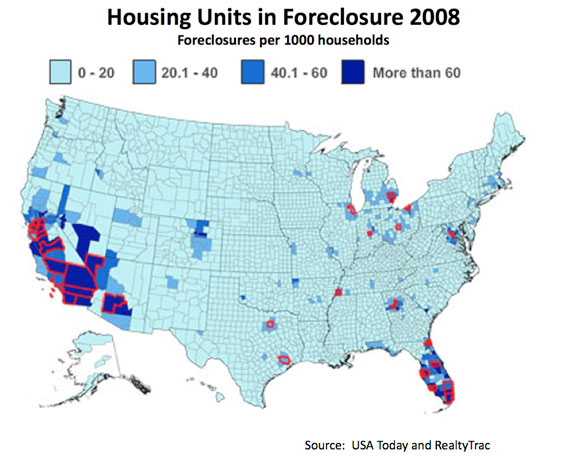
    The result has been that foreclosures – the key driver of many regional economic collapses – have been relatively scarce throughout the zone. This USA Today map reveals how the foreclosures are heavily concentrated in Florida, California, Arizona and Nevada, as well as parts of the old Industrial Belt of the Great Lakes.

    housing_foreclosure_565.jpg

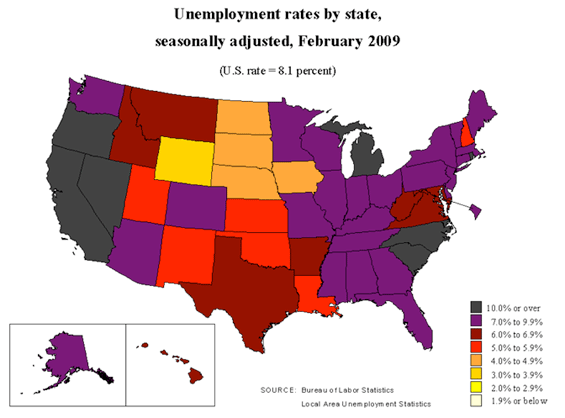
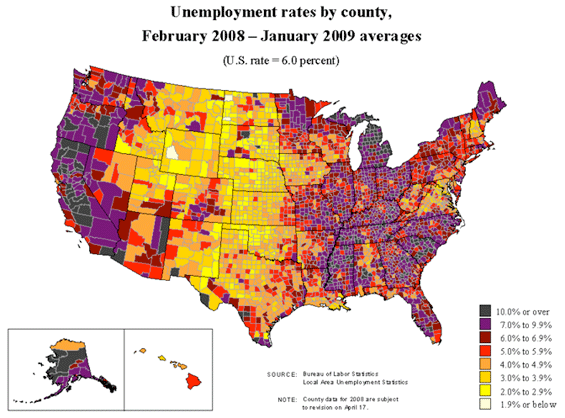
    Analysis by my colleagues at Praxis Strategy Group of the job market’s condition also reveals the divergence between the zone and the rest of the country. Regions from the Northeast, the Great Lakes and the Southeast all have seen significant job losses, and the damage is spreading to the Pacific Northwest, New York and New Jersey. In contrast, the Kansas City area and much of the zone of sanity has experienced only a ratcheting down of its generally steady growth rate. Things are not bustling, but there seem to be few signs of a basic economic collapse.

    unemployment_state_565.gif

    unemployment_country_565.gif

    Sanity, as Whitney put it, may constitute a critical part of the equation. If you discuss why people live in a place like Kansas City, people tend to speak about stability, family-friendliness and the basic ease of everyday life. Many executives, notes Phil DeNicola, who runs Strong Suit Relocation, initially resist a transfer to the region but quickly see the advantages.

    “It is attractive to be here,” notes DeNicola. “You don’t get a lot of highs and lows for years. There is stability instead, particularly for families. It all reduces your stress.”

    Of course, not everyone is satisfied with the status quo. As in many second-tier urban centers, many in Kansas City’s leadership crave being something other than pleasant, affordable and stable. Leaders in the city – home to roughly one in four of the region’s 2 million residents – have been particularly exercised to show that KC can be as hip and cool as New York, L.A. or, at the very least, Chicago.

    “There’s a real kind of self-loathing here,” notes Mary Cyr, a Harvard-trained architect, who works on projects throughout the region. “We feel less than what we are. We do not know what we are as a city. We don’t even realize what we have.”

    Hundreds of millions have been poured and continue to pour into the usual monuments favored by urban policymakers and subsidy-hungry developers – a sparkling new arena, plans for an expanded convention center and a massive entertainment complex called the Power and Light District. Yet at the same time, the city’s budget, like many others, is severely strapped, so much so that City Hall is considering not turning on the city’s iconic fountains this spring.

    Even worse, city and regional issues seem to result in plenty of money for new expressions of wannabe grandiosity. One notable example: plans to build a $700 million-plus light-rail line, the kind of thing that has become the sine qua non for the “monkey see, monkey do” school of urban policymakers across the country.

    This project makes little sense in a region with a well-below-average percentage of jobs in its downtown core – roughly around 7% – with one of the lowest shares of transit-riding residents in the nation. The relative lack of traffic makes a rail system less sensible than could be argued for higher-density urban corridors, where it at least can be imagined that many would give up their cars.

    Ultimately, none of this taxpayer largesse is likely to do much more than replicate the same kind of development that can be found in scores of cities – from St. Louis to Dallas – that have tried it. At best, you get a few blocks of activity but very little in terms of urban dynamism.

    “The growth of downtown is not at all organic – it’s kind of forced,” notes architect Cyr. “They build all those projects in there, and you end up with the huge monumental buildings and the Gap.”

    The problem for the downtown crowd is that Kansas City has remained a quintessential American city, most dynamic in places where private initiative leads the way. Typically the bulk of new growth has taken place in the suburban fringes, but there are several successful nodes within the city, particularly around the lovely, 1920s vintage, privately developed Country Club Plaza area, famous for being the world’s first modern shopping center.

    Similarly, the artist-inspired Crossroads district has also evolved – largely without government help – into a genuine bastion of bohemians, with small companies and locally owned restaurants. With its low-cost commercial and residential space, as opposed to government subsidies, many see the area as precisely the kind of grass-roots urban life with a future in a place like Kansas City.

    Such developments in the city, as well as outside, make it possible to project a very bright future for Kansas City – and across the zone of sanity. Unless there is a massive shift in conditions, the zone should see a return to prosperity earlier than places bogged down with excess foreclosures, shuttering industries, soaring taxes and ever-tightening regulation. Dan Whitney, for example, expects the local housing supply to run out soon – with “tremendous pent-up demand” by the end of the year. If credit conditions improve, new construction should resume within the next 18 months.

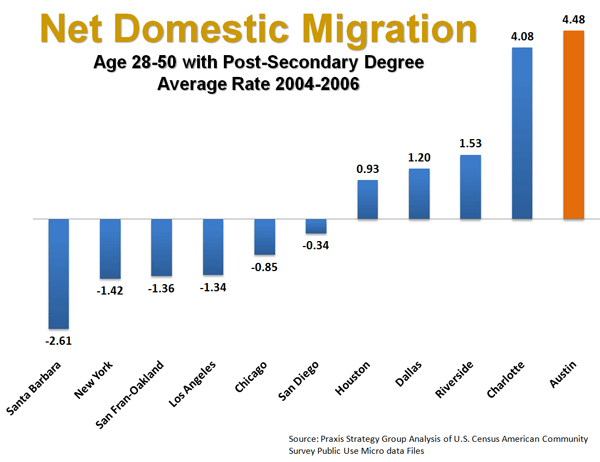
    This all reflects the essential attractiveness of cites like Kansas City. Overall, in fact, its rate of domestic in-migration has been higher than much-celebrated Seattle and only slightly below that of Denver. Indeed, since 2000, Kansas City’s regional population has grown 8.6%, more than twice as much as New York, Boston, San Francisco or Los Angeles.

    Unlike the national media, which rarely focus on mundane things that drive most people’s lives, some seem to get the appeal of lower prices, affordable housing options and a generally calm environment. Although never a beacon for newcomers, like Phoenix, Atlanta or Dallas, Kansas City has not suffered the massive out-migration seen in such big metropolitan regions as Los Angeles, San Francisco, Chicago or New York.

    In fact, Kansas City has enjoyed a slow but steady in-migration through the past decade. These newcomers could provide the energy, talent and initiative that a region, known for stability, needs to get to the next level. Attracting more of them – not new prestige projects or subsidized developments – remains the key to the region’s future.

    Instead of trying to duplicate growth patterns that are foundering on the coasts and in countless Rust Belt cities, the denizens of the zone of sanity need to learn how to build on their virtues of stability and affordability. Particularly in hard times, such things count for much more than many – both inside and outside the region – might imagine.

    This article originally appeared at Forbes.

    Joel Kotkin is executive editor of NewGeography.com and is a presidential fellow in urban futures at Chapman University. He is author of The City: A Global History and is finishing a book on the American future.

  • Why We Need A New Works Progress Administration

    As the financial bailout fiasco worsens, President Obama may want to consider a do-over of his whole approach towards economic stimulus. Instead of lurching haphazardly in search of a “new” New Deal symphony, perhaps he should adapt parts of the original score.

    Nothing makes more sense, for example, than reviving programs like the Works Progress Administration (WPA), started in the 1935, as well as the Civilian Conservation Corps (CCC), begun in 1933. These programs, focused on employing young people whose families were on relief, completed many important projects – many still in use today – while providing practical training to and instilling discipline in an entire generation.

    Unemployment today may not be as extreme as in the 1930s, but for whole segments of the population – notably young workers under 25 – it is on the rise. Already young workers with college educations suffer a 7.7% jobless rate, while employment is nearly twice that among young workers overall. Hardest hit, in fact, are young people without college educations, whose real earnings already have dropped by almost 30% over the past 30 years, according to one study.

    Tapping the energies of this new “millennial” generation – those now entering their teens and early 20s – would make enormous sense both for economic and social reasons.

    Not only do they need work, but also, as their chroniclers, authors Morley Winograd and Mike Hais have demonstrated, many share an interest in community-building in ways reminiscent of the last “civic generation” in the 1930s.

    In contrast, the current stimulus, rather than inspiring a new generation, has focused on bailing out failed corporations, few of which will generate much employment. Many of the “new” jobs will be going to the already entitled: highly paid, big-pension-collecting, unionized government workers and well-educated people working in federal and university laboratories.

    Also getting short shrift has been the kind of construction projects that drive fundamental economic growth and competitive advantage. These include roads, freight rail, electrical transmission lines and water services that boost productivity in agriculture, manufacturing, high-end business services and technology. The Chinese are currently targeting their spending on precisely the steps that would aid these sectors.

    This is where a New Deal revival would help. The WPA and the CCC were all about building useful, tangible things that made the country stronger and more competitive. Overall, these and other New Deal programs amassed an amazing record – finishing over 22,000 roads, 7,488 educational buildings and over 7,000 sewer, water and other projects.

    These efforts put to work over 3 million workers. (Compare that to the mere 250,000 slated to work in the expanded AmeriCorps program.) Their earnings helped support 10 million dependents. The WPA also employed 125,000 engineers, social workers, accountants, superintendents, supervisors and timekeepers scattered in every state and community. Ultimately, notes political economy professor Jason Scott Smith, the New Deal intimately touched the lives of more than 50 million people – out of a total U.S. population, in 1933, of 125 million. Now that’s stimulus!

    Critically, the WPA and CCC also left behind useful things for the next generation. As historian Gary Breichin has pointed out, we unknowingly walk, drive and ride through many structures built by these agencies.

    These projects did not act as “lures” for the elites, cognitive and otherwise – as so many of our current efforts do – but rather served a broader purpose for the public. The University of Washington’s Richard Morrill notes that the WPA bequeathed “an enduring legacy” around Seattle: bridges and retaining walls and drainage systems, parks and playgrounds, roads and trails, sewers, recreational facilities, airports, streetcars, low-income housing, as well as programs for musicians, artists and writers.

    The WPA and CCC left a similar mark even on the most remote parts of rural “red” America. In places such as Wishek, N.D., notes native Delore Zimmerman, few people recognize that it was the New Deal-sponsored WPA that built the still-used local pool and the community center. Nor do farmers, many of them rock-ribbed Republicans, readily acknowledge that the windbreaks and other conservation projects started by the CCC helped preserve the land from devastating erosion.

    A public works agenda today, of course, would include different things, like expansion of broadband Internet access and a greater emphasis on private financing and skills training. Yet a neo-WPA would still focus on upgrading and expanding our basic infrastructure, which, by all estimates, is generally in sad shape.

    If this is such a good idea, why is no one else promoting it? Among Republicans and conservatives, of course, nothing done by Franklin Roosevelt – except, perhaps, winning the Second World War – could ever hold much merit. They certainly can argue, with some justification, that it was the war, and not the New Deal, that finally got us out of the Great Depression.

    But this is narrow thinking. America’s post-war boom owed much to the work of WPA, CCC and other New Deal programs. Our late 20th-century expansion required travel along their roads and bridges; their energy plants and transmission lines powered our industrial growth, extending it to formerly poor regions like the South. Water and conservation projects undertaken in the agricultural heartland precipitated a revolution in productivity that has fed much of the world.

    More troubling may be why Democrats – often professed admirers of FDR and his work – have not been eager to revive these programs. One factor may be the enormous power of unions representing public employees. The power of organized public-sector workers, notes historian Fred Siegel, was a non-issue in the 1930s and 1940s.

    Today, though, these groups are powerful enough to boost the cost of any government initiative – because often they require high salaries, costly work rules and, most important, pension benefits. The last thing these unions would sanction would be the mass employment of young workers on a temporary basis at living, but not union-scale, wages and benefits.

    Secondly, there are political obstacles. This administration often appears, as one Democratic mayor from central California put it, like “moveon.org run by the Chicago machine.” Its first priority seems to be to reward allies in organizations – whether in “grassroots” groups like ACORN or in the academy – who also share their political agenda.

    Take, for example, the federal government’s proposed expenditure of $500 million to $600 million for “climate change research.” These funds are almost certain to end up in the pockets of high-end government workers and university-based zealots; as a scientific enterprise, it is likely to be as valid as asking the College of Cardinals in Rome to determine the existence of God. The ultimate result will be to provide new grist for Al Gore’s – and the administration’s – friends in the “green” investment banking world and Silicon Valley.

    This green agenda itself may also constitute a third cause itself for WPA avoidance. Much of the environmental movement – committed largely to reducing the carbon footprint of 300 million Americans – doesn’t want new bridges, roads, ports or much of anything that uses greenhouse gas-spewing concrete. They’d prefer to scale back agriculture and grow just enough organic produce to keep Alice Waters clucking happily in her kitchen.

    A similar disconnect can be seen in energy policy. A new WPA could help build transmission lines to connect the energy-rich parts of the country to the major metropolitan areas. This would spur both industrial development in places like the Great Plains – rich in everything from fossil fuels to wind power – while keeping energy prices down for U.S. consumers and firms.

    Yet so far, the energy program seems focused almost exclusively on providing rich contracts to Silicon Valley firms that are close to the administration. So don’t expect a massive expansion of new transmission lines or any expansion of new, “clean” hydropower. The administration’s green agenda seems to revolve not predominately around better or even cleaner energy, but less.

    And, sadly, conservation is one place a new WPA would be most effective. One possible function for a modern WPA would be to go to neighborhoods – particularly poor and working class ones – and insulate houses. This would certainly save money over having government workers or contractors do the same work.

    All this suggests a profound disconnect between the new administration and the real world.

    The post-industrial educated class that now dominates Washington appears, if not scornful, profoundly detached from the problems facing productive industry. These officials also seem blissfully unaware that the public – as opposed to the academy and the elite media – cares more about jobs than about being green; by nearly three to one, according to the most recent Pew poll, they are more worried about the economy than climate change.

    In many ways, this disconnect is inevitable. Products of the “information age,” Obama’s academically oriented backers seem to have trouble distinguishing between words and actual things. Virtually no one in the upper reaches of this administration has been tested by running a private company, manufacturing a product or bringing in a crop. This administration of “experts” from academia and government service appears to possess little tactile knowledge of the real world.

    In this way, Obama’s great strengths – he is a brilliant communicator and image-builder – are also proving to be a source of profound weakness. Right now, he is selling a post-racial kumbaya and a vague confection of ‘hope.” Financing for these good intentions is likely to ebb, however, as a result of a stunning redistribution of wealth from taxpayers to an expanded class of tax-takers.

    Indeed, for all his communication skills, the president has failed to create an attainable vision of a stronger, wealthier America with better jobs, more wealth and improved infrastructure. Roosevelt and even Truman provided inspiration, too, but they backed it up with practical changes that promised improvements in the day-to-day lives of most Americans.

    These hard times require tangible solutions to basic economic problems. Rather than worry about the generally clueless Republicans, the administration should focus on building a legacy as real and long-lasting as the one left behind by the WPA and CCC.

    More than a mere matter of building roads and bridges and increasing access to cheap energy, the WPA was about restoring a collective spirit, a shared stake, in constructing the sinews of a more competitive, prosperous country. Unfortunately, amidst the confused priorities of this administration, such bold initiatives remain but distant possibilities.

    This article originally appeared at Forbes.

    Joel Kotkin is executive editor of NewGeography.com and is a presidential fellow in urban futures at Chapman University. He is author of The City: A Global History and is finishing a book on the American future.