Author: John Muscat

  • Inside Sydney’s Central Business District: the Retail Core

    World famous for its beautiful harbour setting, Sydney’s Central Business District is undergoing a resurgence. As the hub of Australia’s finance sector, it stumbled during the global crisis. Office vacancies jumped from 5.7 per cent in early 2008 to 8.8 per cent in mid 2009, despite stable supply. Ultimately, though, Sydney was spared the worst, owing to its rise as a staging post for trade and investment in the Asia-Pacific region, which averted the havoc of Europe and North America. Recovery is now underway, if slowly. White-collar employment is picking up and the vacancy rate is down to 7.3 per cent. Landlords are again celebrating the prospect of rising rents.

    But there’s a bigger story. This revival is happening amid some notable trends. Post-crisis, the CBD’s functional map is being redrawn by a wave of Asian and other visitors and investors, prominently listed property trusts and pension funds looking for a safe haven, the spatial demands of a transformed white-collar workplace, intensive residential development on the CBD fringe and officials pushing flashy “green” projects. There’s no doubting the importance of these developments, or that they will be hyped by inner-city based media.

    In fact, central Sydney has been losing economic clout, in relative terms, to the periphery or suburban hinterland for some time, a polycentric trend observed in other countries. Between the 1981 to 2001 censuses, encompassing the most active period of economic liberalisation in Australia’s history, Sydney’s general population growth was 23 per cent, while outer areas in Greater Western Sydney grew by 38 per cent. The CBD’s share of Sydney’s jobs shrunk from around 30 per cent to 9 per cent during this period. Four of the five strongest growing Local Government Areas (LGAs) in the year to 30 June 2009 were still in the outer west: Blacktown, Parramatta, The Hills Shire and Liverpool.

    The latest wave of change will prove significant and long-lasting, but the CBD isn’t destined for a return to metropolitan supremacy.
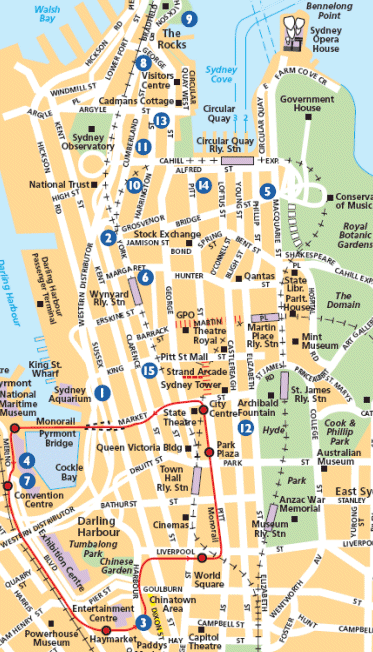
    Sydney CBD
    Sydney CBD

    The retail core

    For theorists of the CBD, peak land value intersection (PLVI) is a pivotal concept. This is the centrally-located point, usually at the intersection of two thoroughfares, where land values are highest. Without doubt, Sydney’s PLVI is the intersection of George and Market Streets. George Street is the CBD’s spine, traversing a north-south axis from Circular Quay to Central Station. Historically, Market Street was the critical entry route from the west, extending from the defunct Pyrmont Bridge (over Darling Harbour), and now from a branch of the Western Distributor. Blocks surrounding the PLVI are typically occupied by upscale department stores, absorbing peak land prices with high turnover of quality goods on multiple floors. Thus Myer and Gowings stores occupy the north-east and south-east corners respectively, and David Jones a site further east along Market Street (the Gowings site is earmarked for refurbishment as a boutique hotel). The iconic Queen Victoria Building arcade sits on the south-west corner.

    According to the “core-frame model”, another tool of CBD theory, activities competing for the highest rents, like upmarket retail and superior grade office towers, concentrate in core blocks, while marginal activities disperse to peripheral blocks. In terms of the theory, the latter are a “zone in transition”, at an intermediate stage between lower grade building stock and future redevelopment. Activities like low-end retail, fast-food, novelty shops, pawnbroking, wholesaling, storage, off-street parking, warehousing and light-manufacturing locate there.

    Traditionally, Sydney’s CBD had a retail core around the PLVI bounded by York, Park, Elizabeth and King Streets, south of an office core bounded by King, Clarence and Macquarie Streets and Circular Quay. Judging by the headlines, the retail core is Sydney’s biggest news. Long a feature of suburban life, the CBD is being transformed by the arrival of mall-style shopping, adding to the mix of department stores, arcades and stand-alone shops. In some ways, it’s catching up with the social evolution of shopping as a “complete experience” linked to identity formation.

    The catalyst is Westfield’s $1.2 billion development at the corner of Pitt Street Mall and Market Street, just a block east of the PLVI. A pedestrianised section of Pitt Street between King and Market Streets (not a regular mall), Pitt Street Mall is the retail core’s epicentre. Last year, global real estate firm CB Richard Ellis (CBRE) rated it the second most expensive street for retail rents in the world. The first was New York’s Fifth Avenue.

    With rents so high, investment dollars are pouring in. Fronting the eastern side of Pitt Street Mall, Westfield’s contemporary glazed-glass structure, box-like at street level but topped by Sydney Tower, converts four properties into 93,000 square metres of retail space, distributed over a six-storey shopping mall. The first stage opened last October. On completion, it will house 330 flagship and specialty fashion outlets, and lifestyle stores, most of them international brands, including Sydney firsts Versace, Gap, Zara and Miu Miu, together with several eateries. Two skybridges link the complex to nearby Myer and David Jones department stores.

    Westfield’s opening coincided with a general revamp of Pitt Street Mall, featuring landscaping, paving and tree-planting by Sydney City Council, and reconstruction of the mall-like Mid-City Centre, 52 shops on four-levels fronting the Mall’s western side, almost opposite Westfield, penetrating west to 420 George Street. One Mid-City store, jewellery retailer Diva, is reputedly paying the highest rent in the CBD, $13,500 per square metre a year.

    Pitt Street Mall’s face-lift set off a reshuffle of fashion and luxury goods retailers around the retail core, with knock-on effects all the way up George Street. Burberry is moving to refurbished premises at 343 George Street, Louis Vuitton to a new flagship store on the corner of King and George Streets, Dior to Castlereagh Street, and Zegna and Prada to Westfield, from Martin Place. This follows the 2008 opening of the world’s largest Apple store, at glass-clad 367 George Street (roughly opposite Mid-City at 420).
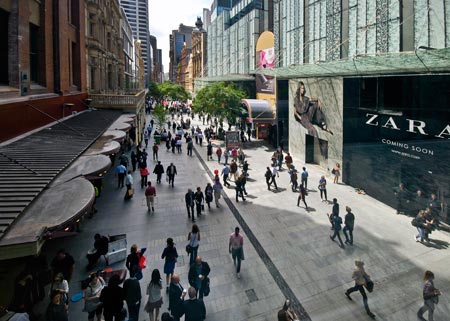
    Pitt Street Mall
    Pitt Street Mall

    A sign that the retail core may be busting out of its old confines, and creeping north of King Street, major retail developments are planned in the vicinity of Wynyard railway station, at 301, 333 and 383 George Street. Some of these anticipate the most striking proposal yet: a futuristic commercial and residential precinct on the foreshore of East Darling Harbour, or Barangaroo, seeing the retail core spill into the CBD’s rising “western corridor”, which was a "zone in transition" in the days when Darling Harbour and Walsh Bay were working ports. This $6 billion plan includes 30,000 square metres of retail space and a pedestrian walkway to nearby Wynyard, the CBD’s busiest underground station.

    It’s easy to explain such hyperactivity. Sydney is one of a handful of global cities in a developed country which wasn’t flattened by the financial crisis. There’s a clear international dimension to the CBD’s resurgence. According to Cushman & Wakefield’s International Investment Atlas 2011, the Asia-Pacific is dominating global property investment. Ranked eleventh, Sydney joins 6 other Asia-Pacific cities in the top 20. In the 18 months to June 2010, reports CBRE, Sydney ranked fourth in the world in terms of cross-border investment. Foreign investors accounted for 42 per cent of Australia’s property asset acquisitions in the third quarter of 2010, way above the typical level of 10 to 15 per cent. In these conditions, Sydney shot up to ninth out of 65 cities in AT Kearney‘s 2010 Global Cities Index. And a 2010 survey by real estate agents Jones Lang La Salle rated Tokyo and Sydney the most popular Asian cities for investment. At a time when many asset classes carry outsized risks, Australian commercial property is a safe option.

    Of course, there’s nothing new about Asian investment in the retail core. Three of its most fashionable shopping arcades belong to Ipoh Pty Ltd, which is owned by a Singaporean fund manager: the Queen Victoria Building, The Strand Arcade between Pitt Street Mall and 412-414 George Street, and The Galleries, on the corner of George and Park Streets, the core’s southern edge.

    But urban planners would be wrong to overestimate the impact of all this on the wider metropolitan region. Quite clearly, Westfield’s target market embraces a small minority of Sydney’s 4.5 million residents. Commenting on the mall’s opening, the Group’s managing director hoped it would be a “destination for the people of Sydney, and the 26.8 million domestic and international visitors who come to Sydney each year”. The Australian Financial Review, citing Westfield, reported that it will “service not only 240,000 workers in the [CBD], but 1.5 million in the primary trade area across the richest suburbs and the 26 million tourists who visit the city each year”. David Jones’ CEO expressed similar sentiments, saying “my hope is that Sydney’s CBD retail precinct becomes a world-class shopping destination on a par with the world’s best such as Oxford Street, London, and Rodeo Drive in LA”.

    Much of the investment surge is predicated on large numbers of visitors, and the growth of inner-suburbs ringing the CBD. If the travelling patterns of China’s newly cashed-up middle class are any guide, for instance, these hopes won’t be disappointed. The number of Chinese visitors to Australia is forecast to grow by 7.9 per cent a year, reaching 783,000 a year by 2019. Meanwhile, Sydney LGA’s population is ballooning (the CBD and environs). Between 2001 and 2009, it grew by 38 per cent, or 49,000 new residents. Eager to meet the former state government’s target of 55,000 new residential units over the next decade, Sydney Council is presiding over a number high-density projects on derelict industrial or recreational sites. Most of the newcomers will belong to the same demographic as current residents, younger, upper-income professionals with a taste for inner-city living. They are no cross-section of Sydney’s population. Below average in age, their median weekly income is $717, compared to $518 for the whole metropolitan region.

    To an extent, Sydney CBD is exhibiting features of the global city phenomenon, when highly-developed zones “secede” from their hinterland and develop stronger ties to distinct occupational classes and overseas markets. The revitalised retail core is unlikely to lure the vast majority of shoppers — who live and work far from the CBD — away from suburban megacentres like Chatswood Chase, Miranda Fair, Warringah Mall, Castle Towers, Minto Mall, Top Ryde City, Westfield’s other centres at Bondi Junction, Parramatta, Burwood, Hurstville, Hornsby and Penrith, local retail strips, or the growing number of Australians who shop online. Just as suburban malls attract customers from their surrounding feeder population, the same applies to the retail core, but with a higher proportion of domestic and foreign visitors.

    The CBD’s revival shouldn’t be misinterpreted. It doesn’t herald a return to regional primacy. Calls by green-tinged academics and newspaper editors and columnists for billions to be spent on CBD-centric rail networks are wrongheaded. Such plans can only have a distorting and negative effect on economic vitality across the metropolitan region, especially fast growing outer LGAs. Look at the CBD’s story. For all the contemporary rhetoric linking urban success to green amenity, it owes more to plain old capitalism.

    John Muscat is a co-editor of The New City, where this piece originally appeared. 

    Photo by Christopher Schoenbohm.

  • Actually, Cities are Part of the Economy

    “The prosperity of our economy and communities is dependent on the political structures and mechanisms used to manage and coordinate our economic systems.”

    No politician expecting to be taken seriously would say that today. State intervention was discredited long before it collapsed in the 1980s. Even our prime minister in Australia pays lip-service to “flexible markets with the right incentives and price signals to maximise the value of our people and capital resources.” But how does that square with her government’s quiet push for a more intrusive urban policy agenda?

    Over the last twelve months, Infrastructure Minister Anthony Albanese has been laying the ground work for a grand National Urban Policy, to be announced later in the year. To this end, he released three dense documents. Last March we got State of Australian Cities 2010 (“Cities 2010”), a compilation of statistics confirming, amongst other things, that cities account for 80 per cent of our Gross Domestic Product. Then in December came a discussion paper and a background paper, both called Our Cities.

    Their general drift can be gauged from a line in the latter’s final chapter. It’s the sentence quoted at the top of this article, with the words “cities” and “urban” replacing “economy” and “economic.”

    Embarrassed to champion intervention at the macro level, progressives resort to carving chunks out of the national economy and relabeling them “the environment”, “social capital” or “urban planning” before turning reality upside down. As he moves urban policy to the environment ledger, Mr. Albanese promises to transform the “productivity, sustainability and liveability” of our cities. Intervention is bad for the national economy, it seems, but good for the 80 per cent of GDP generated by cities.

    Urban Myths

    The authors of Mr. Albanese’s documents are anonymous, but aficionados will recognize the handiwork of Curtin University’s Sustainable Policy Institute, Griffith University’s Urban Research Program, the Faculty of the Built Environment at NSW University, and other focal-points of green orthodoxy. The reference lists are full of their output. Their technique of persuasion, recycled by Mr. Albanese’s Department, is to evoke plausible images while perpetuating three myths: suburban growth worsens carbon emissions and traffic congestion, people are being forced to live far from jobs concentrated in CBDs, and denser development will make housing cheaper.

    The discussion paper says: “Australian cities generate very high carbon emissions and air pollution from our heavy reliance on carbon fuels for energy and transport. Carbon emissions from transport are principally due to the lengths of trips necessitated by our dispersed cities and our extensive use of private motor vehicles.” Variations of this passage recur throughout the documents. It sounds plausible enough. So many vehicles cris-crossing our wide open cities must be spewing out heaps of carbon dioxide. But the documents ignore evidence painting a different picture.

    There is the Australian Conservation Foundation’s Consumption Atlas, which found that dense, affluent, inner-suburbs account for more carbon than the dispersed fringe, suggesting that, as a factor in emissions, general consumption trumps settlement patterns; there is a 2007 study by Randolph and Troy confirming earlier findings that energy consumption per capita in high-density developments, like high-rise apartments, is notably higher than in detached housing; there is a recent report by Allen Consulting for the Victorian Building Commission, noting the absence of conclusive evidence that vertical living is more ‘sustainable’ than conventional homes; and there is more.

    None of these rate a mention in the documents. Chapter 5 of the background paper does reference a couple of studies by Alford and Whteman (2009) and Trubka, Newman and Bisborough (2010), but these focus on “transport energy consumption” and “transport greenhouse gases.” They don’t investigate the impact of urban form on general consumption, the real determinant of emission levels. And a study by Perkins et al (2009), cited in Cities 2010, actually contradicts the approved message: “overall, it cannot be assumed that centralised, higher density living will deliver per capita emission reductions for residents … ”

    There is no reliable evidence that suburban growth is worse for emissions. Even Griffith’s Brendan Gleeson, a very green urbanist, had to concede that “the faith … in residential density as a simple lever that can be used to manipulate urban sustainability appears to be misplaced. New Australian scientific analysis points to the consumptive lifestyle, not the nature of one’s dwelling, as the root of environmental woes.”

    In any event, transport accounts for 14 per cent of Australia’s 1.4 per cent share of global emissions, or a minuscule 0.197 per cent of the world’s carbon. We should retain a sense of perspective, even if the documents obsess about our high per capita emissions. If the climate is being affected (a big if), it’s absolute volumes that matter.

    Allied to the myth of carbon-spewing suburbs is the myth of centrally-located jobs. We read in Cities 2010 that “the impacts of outward expansion and low density residential development have been a greater separation between residential areas and locations of employment …” The discussion paper asserts, more directly, that “the trend to inner-city living reflects changing preferences for dwellings and location – living closer to employment that is concentrated in central areas.” Again, similar statements crop up throughout the documents. People shouldn’t have to drive or commute long distances to a “centre” where the jobs are.

    Evidence to the contrary is easy to find. According to the NSW Department of Transport, only 12 per cent of Sydney’s jobs are in the CBD, and second tier centres like North Sydney, Chatswood, Parramatta, Hustville and Penrith have no more than 1.8 per cent each. The rest are distributed throughout the metropolitan region. In the case of Melbourne, McCloskey, Birrell and Yip (2009) say it’s absurd to concentrate housing near transit lines since only 19 per cent of jobs within the Melbourne Statistical Division (MSD – Greater Melbourne) were located in the Melbourne Local Government Area (the CBD), while 81 per cent “are scattered throughout the rest of the MSD”.

    In fact, the background paper points out that a majority of the employed in Sydney, Melbourne and Perth live within 10 kilometres of their workplace, while around 15 per cent live more than 20 kilometres away. This is hardly a disaster in the making. Consistently, Cities 2010 refers to “evidence that commuting distances have been stable or even declining since the 1990s in a number of capital cities.”

    For green urbanists, these myths are indispensible. Their agenda hasn’t a hope unless the public accepts that suburban growth will spoil the climate, and hike congestion and transport costs. As for housing affordability, the documents take a leave-pass (social housing is another story). They promote the term “living affordability”, adding petrol prices and mortgage rates to the equation.

    Evidence linking costly housing to supply restrictions on the fringe, like the annual Demographia survey, is too inconvenient. When the background paper does get around to the subject, it says “multiple factors [impede] the delivery of an efficient supply of suitable and affordable housing.”
    These include “land zoning and building code regulations and other standards related to building quality.” A few pages later, however, canvassing some solutions to the problem, the paper proposes “reforming planning systems to … position a variety of residential development in close proximity to centres and transport infrastructure”. Doesn’t this mean a lot more inefficient “land zoning”?

    This is just one instance of disjointed logic and economic illiteracy; many others are scattered throughout the documents.

    The Invisible Hand and Land

    Actually, cities are part of the economy, and are subject to the same principles. The operations of demand, supply and prices are equally applicable to land and structures. They can’t be erased by regulation, even if it’s called planning and zoning. The inflationary effect of coercive zoning on land values is the elephant in the room. Nowhere is it acknowledged in the documents.

    Consider two recent press items. Retail tenants in Pitt Street Mall, the heart of Sydney’s CBD, are paying rents as high as $13,000 a square meter, while industrial tenants on the north-west outskirts pay around $237. These rent differentials are, of course, a function of distance, and influence the viability, not just the location, of various types of activities.

    Restricting expansion and other forms of coercive zoning place an escalating floor under peripheral rents and values. Mr. Albanese’s authors fail to appreciate the implications of this, not least for “urban productivity.” There is little call to dwell on economic mechanisms if you believe, as the discussion paper puts it, “the private sector, through a myriad of individual decisions and investments, guided and constrained by government investments, regulations or charges, is a powerful shaper of cities [emphasis added]”.

    In the documents, lifting productivity boils down to cutting the costs of traffic congestion, estimated to reach $20 billion a year by 2020, principally by reducing “car dependency” (another loaded term, echoing drug dependency).

    Ignoring the reality of high job dispersal, the background paper says “a key challenge is to reduce dependence on motor vehicles while maintaining access between and within locations … the Australian Government recognises that it has a role … in investing in major mass transit systems, identifying and protecting new transport corridors and supporting means to shift from private vehicles to public transport”. But as McCloskey, Birrell and Yip explain, “the high level of job dispersal around Melbourne [and other cities] cannot be easily unwound.” In those conditions, Mr. Albanese’s strategy is doomed to failure.

    Alternatively, when diseconomies from congestion start to outweigh economies from centrality, firms and commuters will move to other, less congested sites, easing congestion all-round. This is the only effective, long-term solution to congestion. However by mandating concentration rather than enabling dispersion, evidenced by a dim view of road-building, green planning stymies this process. The documents want to end it altogether.

    According to the background paper, “connectivity within cities can also be achieved by placing people closer to the jobs, facilities, goods and services they desire – or putting these closer to where people live. This highlights the important role of integrated land-use and infrastructure planning in managing the need for physical travel”. But this notion, that firms and residences can be “placed” by a central authority, is logically flawed. It suffers from something akin to a “coordination problem” (a concept from game theory).

    Suppose household A has, in existing circumstances, chosen its optimal location relative to (1) affordable housing, (2) employment and (3) services. How can the government arrange things so that A ends up in a more optimal location? Moving A closer to work may push it further from affordable housing and services. Moved closer to services, A may end up further from other factors, and so on. It’s unlikely that the government can ever place A in a better location relative to all three factors.

    Then suppose household B has chosen its own optimal location relative to the three factors, some distance away from the point chosen by A. How does the government improve the outcome for both households? Action benefiting A may hurt B and vice versa.

    The same problem can be framed for businesses locating relative to (1) competitive rents, (2) transport routes, (3) suppliers, (4) suitable labour and (5) customers (market). Our cities host hundreds of thousands of households and businesses. There is no way that a planning hierarchy can engineer a more efficient outcome than the people themselves, interacting freely in the marketplace. Official meddling is more likely to induce problems than solve them.

    Instances of disjointed logic abound. One paper talks about “micro-reforms to reduce costs to businesses and consumers”, but another urges “access to a range of [more expensive and less efficient] high-quality renewable energy sources”; a paper commends “the principle of subsidiarity, ensuring that the most local level of government is used …”, but then calls for “improving alignment and integration of planning and investment across all three levels of government to support the nationally agreed … objective”; a paper demands action to “reduce red tape”, but all three documents offer heaps more instruments and regulations.

    Ultimately, Mr. Albanese’s documents are the pretext for a new wave of intrusion into economic life. As such, they represent a glaring case of bureaucratic overreach. However much he may spruik flats, smaller houses, public transport and higher utility bills as an enhancement of urban “liveability”, most Australians will disdain them as anything but liveable.

    John Muscat is a co-editor of The New City, where this piece originally appeared. 

    Photo by Joseph Younis.

  • Australia 2010: Unstable Politics in a Prosperous Country

    2010 has been something of an annus mirabilis in Australian politics. On 24 June a prime minister was dumped before facing the voters a second time. This was the first time ever for such an early exit. Then the election on 22 August produced a “hung parliament”, an outcome not seen since the 1940s. Having fallen short of enough seats to form government, the major parties are scrambling for the support of four independents and one Green in the House of Representatives.

    If this looks like the politics of a nation mired in economic upheaval, the reality is far different. Australia was one of a handful of advanced countries to avoid recession during the financial crisis. The unemployment rate never rose much above 5 per cent. For some economists, Australia is “the wonder from down under”.

    So why did the Labor government, elected in 2007, fall apart? There was certainly a lack of governing experience after eleven years in opposition. But in a broader sense, the political class is struggling to cope with Australia’s increasingly regionalised economy, and the divergent sources of its new-found prosperity.

    Like many industrialised countries, Australia passed through a seemingly intractable malaise in the 1970s. The country’s predicament appeared worse than that of more diverse and innovative economies like the United States. Relying on agricultural and mineral exports, legacies of a colonial past, Australia’s manufacturing base was inward-looking, outmoded and sclerotic. Disparaging assessments like that of former Singapore Prime Minister Lee Kwan Yew – Australians were destined to be “the poor white trash of Asia” – were common. Some fretted about “the Argentine route”, a country failing to diversify its economy and sliding down world rankings of GDP per capita. As transformed manufactures and high-tech products gobbled up an increasing share of world trade, Australia seemed stuck in the slow lane of commodity exports.

    And then came the 1980s. Protective barriers were slashed, the currency was floated, the financial system was opened up to foreign banks and state-owned agencies were sold off or treated to radical micro-economic reform. By the mid-2000s, the contours of the economy had changed. Activities such as business and property services rose from 10 to almost 15 per cent of GDP over the decade to 2006. Meanwhile manufacturing declined from 15 to 12 per cent. The new economy was dominated by services, now accounting for 68 per cent of GDP. Rather than drag down the economy, however, mining enjoyed parallel growth, from 4.5 to 8 per cent in the same period. China’s explosive arrival on the world scene shifted commodity exports into a very fast lane. These developments set Australia on a growth path that few could have foreseen in the 1970s. A small economy in relative terms to countries like China and the United States, it has evolved into a series of distinct geographic regions.

    The booming commodities export sector, dominated by mining, is concentrated in the northern and western states of Queensland and Western Australia, which account for 74 per cent of onshore mining production. Business and property services are concentrated in the south-eastern states of New South Wales and Victoria, specifically the inner precincts of Sydney and Melbourne, the nation’s emerging global cities. Together, these cities host around 50 per cent of Australia’s finance industry jobs. Public sector services, mostly in health and education, figure prominently in the populous south-east, again skewed towards long-established inner-city localities, where the most prestigious institutions are found. Construction, consumer services, including retail, and light manufacturing, fuelled by demand for household goods and building supplies, thrive in the larger metropolitan regions with high rates of immigration and population growth, like outer Sydney and Melbourne, and increasingly south-east Queensland.

    At the end the true driver of the economy lies with commodities. Today mineral resources make up just under 80 per cent of Australia’s commodity trade and around half of all exports (including services). Australia is the world’s leading exporter of coal and iron ore and ranks high other minerals like zinc and aluminium.

    Reaping the China bounty, former Prime Minister John Howard kept the federal budget in surplus and reduced government debt to zero, while handing out tax cuts and family income supplements. This winning combination delivered Howard eleven years in power. Towards the end of his rule, however, strains in the boom economy began to manifest themselves. Skilled labour shortages and the heated property market began to put pressure on inflation and interest rates, contributing to a sense of policy exhaustion in Howard’s later years.

    By 2007, there was a widespread view that the benefits of the resources boom were not being distributed fairly. The service sector professionals of the south-east, especially in the public sector who dominate the national media, began to shift to Labor as did outer suburban workers, who saw the dream of home ownership slipping beyond their reach. Forced to compete for investment in the open economy, south-eastern state governments, controlled by Labor, were constrained to keep taxes low. An ever larger proportion of their budgets was channelled into health and education services, partly due to close links with powerful public sector unions. There was little left to pay for urban infrastructure on the booming fringes.

    In response, infrastructure costs were shifted onto developers and local government, along with a new set of regulations, and urban consolidation (“smart growth”) was enforced as planning policy, ostensibly to reduce the need for extra resources. These choices reflected the green ideology taking hold in the planning profession, as well as among the professional classes.

    The impact of these measures on housing affordability were disastrous. When the low interest rates of the Howard years began to creep up, the problem turned into a crisis, as the Demographia survey has shown. The property market slowed down, depriving the south-eastern states of even more funds, since property taxes are a significant share of their revenues. This contrasted with conditions in the mining states, prompting the Federal Treasury Secretary to declare Australia a “two speed economy”.

    At the 2007 election, Labor leader Kevin Rudd claimed to have the solutions. Paying lip service to Howard’s fiscal conservatism, he signalled plans to divert mining boom proceeds towards infrastructure and services, including a new deal on health funding and an “education revolution“. Much of this was wrapped up in the rhetoric of climate change, talked up by Rudd as “the greatest moral challenge of our time”. His environmental centrepiece was an Emissions Trading Scheme (cap and trade), a massive revenue raising device for the federal government. In essence it was a mechanism for transferring wealth from the mining states, and their fossil-fuelled economies, to the populous south-east.

    Rudd’s electoral success, and apparent public support for climate action, drove the agenda forward until the crash at Copenhagen. This precipitated a revolt in the opposition Coalition, which replaced ETS supporter Malcolm Turnbull with climate-sceptic Tony Abbott. When Abbott labelled the ETS “a great big new tax on everything“, and blocked its passage in the Senate, public interest in the scheme melted away, particularly in the mining regions. Rudd lost his nerve and shelved it until 2012. For many Australians, he was exposed as a weak leader without the courage of his convictions.

    Rudd refused to give up his dream of redistribution though, turning to Plan B. Having commissioned a review of Australia’s taxation system, he announced a Resource Super Profits Tax, a complex device confiscating up to 40 per cent of mining profits above a threshold. Adopted without consulting the resources industry, it attracted furious opposition from the global mining companies, which launched a powerful advertising campaign against it. Opposition leader Abbott labelled the measure ”a great big new tax on mining”. Opinion polls showed strong opposition to the tax in mining states, and mild support in the south-east. Rudd’s poll ratings fell through the floor. He was soon deposed by his Labor Party colleagues.

    Julia Gillard, the new prime minister, substantially modified the proposal after negotiations with the large miners, but smaller operators remained opposed, along with most of Queensland and Western Australia. Gillard quickly called an election to capitalise on her status as the country’s first female leader. But the legacy of Rudd’s undelivered promises shaped the outcome. Australia’s regional divisions were clearly evident in the voting patterns. Western Australia and Queensland swung to the Coalition, and Queensland proved to be a killing ground, depriving Labor of nine seats. New South Wales also swung to the Coalition, reflecting dissatisfaction with the long-serving state Labor government’s failure to address the infrastructure and housing needs of suburban western Sydney. In contrast, the southern states of Victoria, Tasmania and South Australia swung towards Labor.

    Well over half of Labor’s lost votes moved left to the Greens, who more than doubled their share of the vote, rather than right to the Coalition. Increasing numbers of south-eastern professionals consider the Greens their preferred agent of redistribution. Handing the Greens the balance of power in the Senate, and possibly the House of Representatives (only one seat this time), may prove a better strategy than sticking with a fractured Labor Party. Inevitably though, regional and outer-suburban voters, with their divergent priorities, will react to a green-dominated agenda, which tends to dismiss suburban interests. Over time, and perhaps after the next election, this may mean a shift back to the right and a clear Coalition victory.

    John Muscat is a Sydney lawyer and co-editor of The New City (www.thenewcityjournal.net), a web journal of urban and political affairs.

    Photo by webmink

  • The Urbanist’s Guide to Kevin Rudd’s Downfall

    The political execution of Prime Minister Kevin Rudd by his own Australian Labor Party colleagues was extraordinary, the first time a prime minister has been denied a second chance to face the voters.

    According to the consensus in Australia’s mostly progressive media establishment, Rudd fell victim to his “poor communication skills”, a somewhat Orwellian take since until recently he was hailed as a brilliant communicator. What went wrong?

    Certainly, Rudd’s style of communication was a factor. Yet the media’s disjointed interpretations avoid what, for them, is an inconvenient truth. As much as any defects in the man himself, Rudd’s linguistic meltdown can be traced to deep socio-economic divisions wracking today’s Australian Labor Party.

    Australia has its own version of the American red and blue state dichotomy. But with a much smaller, highly urbanised population, and only six states, the social fault line runs through major metropolitan regions rather than state boundaries. Left with a fractured support base, federal Labor often struggles to hold onto majority support. Rudd clearly underestimated the persisting social divide, and his obsession with a media driven solution was disastrous.

    In Australia, post-war suburbanisation and gentrification played out differently than in the US. Since in the 1970s, Australian cities have experienced a broad geographic sorting along class lines. On the one hand, rising land values and car ownership dispersed the old industrial core, and its working class population, to the middle and outer suburbs. On the other, a booming generation of university graduates, many immersed in the counter-culture, and employed in expanding government agencies, flooded into inner-city tenements.

    Lacking the racial frictions of some American cities, and typically adjacent to attractive harbour foreshores (Australia’s major cities are all coastal), these nineteenth century streetscapes were ripe for gentrification. Before long, all remnants of the old working class gave way to restaurants, upscale bars, coffee shops, cinemas, bookshops, art galleries and other favourite amenities of a new upper middle class.

    Over time, urban polarisation has far-reaching political consequences. While the new professional class voted Labor, and transformed the Labor Party in their own image, they dominated only a handful of electorates (electoral districts). Most of these are in the inner precincts of Sydney and Melbourne. The overwhelming majority of electorates are suburban or regional, populated by blue-collar, routine white-collar and self-employed private sector workers. Whether former inner-city residents, or newly arrived migrants, they embraced the suburban ideal of reward for work, free-standing homes on a quarter acre block and the prospect of upward mobility, particularly for their children. Later, social commentators labelled them “aspirationals”.

    Increasingly, inner-city elites and suburban aspirationals inhabited different worlds. By 1996, many aspirationals felt Labor had lost touch with their priorities. Apart from his poor record on inflation and interest rates, sensitive issues in the mortgage-belt, then Prime Minister Paul Keating became a champion of the elite’s obsession with race and gender. Having infiltrated Labor’s apparatus, progressives now seized control of the party’s policy agenda.

    Ultimately, Labor’s historic bond with working people was severed at the 1996 election, when masses of aspirational voters defected to the conservative John Howard. Howard retained their support over four terms in office. During this time they acquired another label – “Howard Battlers” (an antipodean variant of Reagan Democrats).

    Labor spent these years wavering between elite and aspirational programs, failing to reconcile their deep-seated differences. Successive leadership changes were a flop. Not until 2006, when Howard showed signs of running out of steam, was victory finally in sight. Leaving nothing to chance, the popular Rudd was installed as leader, and handed the task of herding both progressive and aspirational voters into Labor’s camp. Rudd’s strategy may have won him the election, but it bore the seeds of his destruction.

    On sensitive issues, Rudd resorted to an elaborate form of doublespeak: headline rhetoric crafted for aspirationals with policy small print pitched at progressives. He was confident enough in his mastery over the media cycle to pull this off. And he assumed aspirationals were too unsophisticated to catch on. He was proved wrong on both counts, but only after winning office.

    Take his handling of housing, transport and urban development. Housing affordability and traffic congestion loomed as hot topics in the 2007 election. Before the late 1990s, Australian cities had generally liberal approaches to land release and suburbanisation, and the motor vehicle was supreme. Urban planning was the province of state governments, which had long considered motorways the wave of the future, given the country’s increasingly dispersed patterns of residential, commercial and industrial development.

    As the century drew to a close, however, sentiment in the planning profession, including state officials, many now religiously green, shifted from growth to consolidation (“smart growth“) and the revival of rail transport. More recently, the climate panic accelerated this trend. On the whole, state governments, mostly Labor in the decade to 2007, proved compliant. Considering that Australian cities were experiencing high rates of population growth, in part due to very high levels of immigration, land values and house prices soared and roads, particularly in the middle to outer suburbs, couldn’t cope with traffic volumes. These problems were especially bad in Sydney. For the first time, many Australians feared that their children would never achieve the dream of home ownership.

    Leading up to the election, Rudd took to calling housing affordability “the ultimate barbeque stopper”, a subject on everyone’s lips. He convened a Housing Affordability Summit, and released a strategy paper. His campaign launch speech, weeks out from polling day, reminded voters that Labor had “put forward a national housing affordability strategy – so that we can keep alive the great Australian dream of one day owning your own home”. Rudd’s rhetoric on “infrastructure bottlenecks” was just as high-blown. “For 11 years”, he said repeatedly, “Mr Howard’s government has failed to provide leadership in developing our nation’s infrastructure”. References to traffic congestion were made in this context.

    But the policies didn’t match the rhetoric. Since elite sentiment was, by this stage, in the grip of climate alarmism, there was little way Rudd would address the root causes of these problems. Restricted land supply and urban growth boundaries, to contain Australia’s “ecological footprint”, combined with population growth, were driving up land values and inducing developers to bank their land holdings rather than release them. Rudd’s plan just tinkered around the edges. There were to be tax breaks on capped home saver bank accounts, subsidised rental accommodation for low income earners, and a massive boost in social housing stock. Conceived by activists who saw housing as a welfare issue, these measures did little for the mass of aspirationals or their children. A later boost to the existing “first home buyer grant” probably inflated prices further. Far from saving the great Australian dream, Rudd cast it into the dustbin.

    After the election, the small number of infrastructure projects selected for funding had limited potential to ease traffic congestion. In his landmark October 2009 speech on urban policy, Rudd had more to say on shifting motorists out of cars and onto trains than upgrading roads to improve traffic flows. For Sydney’s long-suffering commuters, there was no sign that “missing links” in the Orbital Motorway Network ring road would be completed.

    Well into 2010, house prices had been escalating for over a year, and mortgage interest rates began to creep up again, having been slashed during the financial crisis. More and more Australians thought Rudd’s performance, on a broad range of policy fronts, was falling short of his elevated rhetoric. He was “all talk and no action”. When his opinion poll ratings plummeted, with no revival in sight, Labor Party power-brokers feared their government would be thrown out after just one term, a first since 1932. Either Rudd or the Labor government had to go. They chose Rudd.

    John Muscat is a Sydney lawyer and co-editor of The New City (www.thenewcityjournal.net), a web journal of urban and political affairs.

    Photo by London Summit