For much of its history, New York City has thrived as a place that both sustained a large middle class and elevated countless people from poorer backgrounds into the ranks of the middle class. The city was never cheap and parts of Manhattan always remained out of reach, but working people of modest means—from forklift operators and bus drivers to paralegals and museum guides—could enjoy realistic hopes of home ownership and a measure of economic security as they raised their families across the other four boroughs. At the same time, New York long has been the city for strivers—not just the kind associated with the highest echelons of Wall Street, but new immigrants, individuals with little education but big dreams, and aspiring professionals in fields from journalism and law to art and advertising.
In recent years, however, major changes have greatly diminished the city’s ability to both retain and create a sizable middle class. Even as the inflow of new arrivals to New York has surged to levels not seen since the 1920s, the cost of living has spiraled beyond the reach of many middle class individuals and, particularly, families. Increasingly, only those at the upper end of the middle class, who are affluent enough to afford not only the sharply higher housing prices in every corner of the city but also the steep costs of child care and private schools, can afford to stay—and even among this group, many feel stretched to the limits of their resources. Equally disturbing, even in good times, the city’s economy seems less and less capable of producing jobs that pay enough to support a middle class lifestyle in New York’s high-cost environment.
The current economic crisis, which has arrested and even somewhat reversed the skyrocketing price of housing, might offer short-term opportunities to some in the market for homes. But the mortgage meltdown and its aftermath will not change the underlying dynamic: over the past three decades, a wide gap has opened between the means of most New Yorkers and the costs of living in the city. We have seen this dynamic play out even during the last 15 years, as the local economy thrived and crime rates plummeted. Despite these advances, large numbers of middle class New Yorkers have been leaving the city for other locales, while many more of those who have stayed seem permanently stuck among the ranks of the working poor, with little apparent hope of upward mobility. This is a serious challenge for New York in both good times and bad. A recent survey found the city to be the worst urban area in the nation for the average citizen to build wealth. For the first time in its storied history, the Big Apple is in jeopardy of permanently losing its status as the great American city of aspiration.
This report takes an in-depth look at the challenges facing New York City’s middle class. More than a year in the works, the report draws upon an extensive economic and demographic analysis, a historical review, focus groups conducted in every borough and over 100 individual interviews with academics, economists and a wide range of individuals on the ground in the five boroughs. These include homeowners, labor leaders, small business owners, real estate brokers, housing developers, immigrant advocates, and officials from nearly two dozen community boards.
Throughout the course of our research, the vast majority of New Yorkers—for the most part fierce defenders of the city—were alarmingly pessimistic about the current and future prospects of the local middle class. “What middle class?” was the quip we heard repeatedly after telling people about our study.
But for all the valid concerns of those we spoke with, our conclusion is that a strong middle class remains in New York, and that there are considerable grounds for optimism about its future. In 2007, the city recorded the second highest total of building permits issued since it started keeping track in 1965, with Brooklyn and Queens hitting records—a clear sign that large numbers of people want to live in these long-time middle class havens. Home ownership rates in the city reached their highest levels ever in 2007, another testament to the city’s desirability—even if a not insignificant share of the recent housing purchases were driven by unfair and deceptive predatory lending practices. And in many communities, there have been long waiting lists for day care centers and private schools. While the economic crisis is already leading to sharp spikes in foreclosures, a precipitous decline in housing sales and, most troubling, a massive number of layoffs, it should not reverse the sense of many middle class families that New York now offers a safe environment to raise their kids—a key factor in the decision to stay in the city rather than decamp for the suburbs.
“The perception of New York among young people is so phenomenal,” says Alan Bell, a partner with the Hudson Companies, a real estate development company that has built housing from the East Village to the Rockaways. “It used to be that automatically you’d get married and had kids and you were out to Montclair, New Jersey or Westchester. Now they want to stay. The question is how they stay since it’s so expensive.”
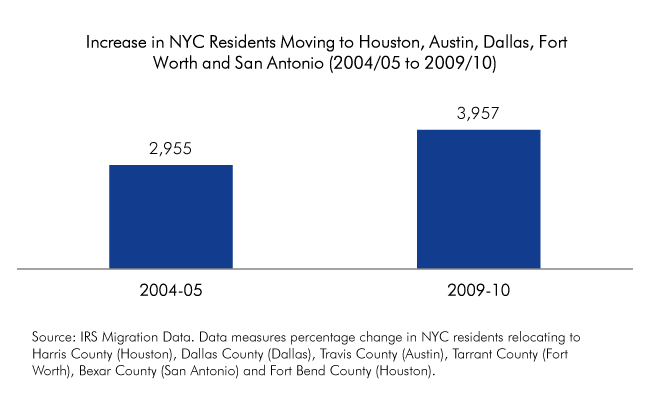
Set against this picture of progress, however, are some alarming trends. Most of the people interviewed for this report told us of middle class friends, relatives or colleagues who had recently given up on the city. “I work with a lot of people who moved to Philadelphia and commute each day,” says Chris Daly, a media director at Macy’s who now lives with his wife and three kids in Tottenville, Staten Island but plans to move to New Jersey. “It’s the cost of living. You’re going to see more people moving to Philadelphia, the Poconos and commuting.”
Unless we find ways to reverse some of the trends detailed in this report, the New York of the 21st century will continue to develop into a city that is made up increasingly of the rich, the poor, immigrant newcomers and a largely nomadic population of younger people who exit once they enter their 30s and begin establishing families. Although such a population might sustain the current “luxury city”—as Mayor Michael Bloomberg famously described New York—it betrays the city’s aspirational heritage. Further, a New York largely denuded of its middle class will find it nearly impossible to sustain a diversified economy, the importance of which is clearer than ever in light of the current finance-led recession.
As a final consideration, a large and thriving middle class has always provided the ballast that a great city requires. Throughout modern history, such cities at their height—for example, Venice in the 15th century and Amsterdam in the 17th—have nurtured a large and growing middle class. But no city has had a greater history as a middle class incubator than New York. As the legendary urbanist and long time New York resident Jane Jacobs once noted: “A metropolitan economy, if working well, is constantly transforming many poor people into middle class people, many illiterates into skilled people, many greenhorns into competent citizens… Cities don’t lure the middle class. They create it.”
Although some may suggest that this is a role New York can no longer play, we believe it is one that the city needs to address if it is to remain a truly great city.
Released by Center for an Urban Future, this report was written by Jonathan Bowles, Joel Kotkin and David Giles. It was edited by David Jason Fischer and Tara Colton, and designed by Damian Voerg. Mark Schill, an associate with Praxis Strategy Group, provided demographic and economic data analysis for this project. Additional research by Zina Klapper of www.newgeography.com as well as Roy Abir, Ben Blackwood, Nancy Campbell, Pam Corbett, Anne Gleason, Katherine Hand, Kyle Hatzes, May Hui, Farah Rahaman, Qianqi Shen, Linda Torricelli and Miguel Yanez-Barnuevo.