Author: Joseph Schwieterman

  • Amtrak and Express Coach Lines: What’s Competition Have To Do With It?

    Express coach lines like BoltBus and Megabus have grown dramatically in recent years, providing millions of Americans with new mobility options. When the subject of competition between bus and train arises, however, many transportation wonks instantly become minimizers. Some cite growing rail traffic to make the case that this competition hardly matters. Others point to severe congestion on the Northeast Corridor (NEC)—Amtrak’s busiest route—to build the argument that attempting to lure passengers from buses to trains is a pointless exercise. Still, others note that trains are roomier and more comfortable than buses. This implies that the latter will forever be a last-resort option.

    There may be a grain of truth in some of these assertions, but the fact is that today’s travel market is increasingly cutthroat. Neither Amtrak nor bus lines can continue to expect robust growth of traffic merely by doing more of the same. The national average price of gasoline has, stubbornly, remained below $2.50 for more than two years, nullifying much of the advantage buses and trains had as relatively more fuel-efficient modes. The average round trip ticket price for airline trips fell to $361.20 in 2016, down almost $20 from 2015.

    In this tough environment, air and automobile travel has grown while bus and rail traffic has ebbed. After years of steady growth, Amtrak experienced a slight drop in passenger miles of traffic during its 2016 fiscal year, despite an improving economy. FirstGroup, owner of Greyhound, which operates the popular express coach line BoltBus, and Stagecoach Ltd., which owns Megabus, both experienced revenue drops from their North American operations during the 2016 fiscal year.

    That means the gloves are coming off in the fight for market share. Amtrak is experimenting with new pricing strategies and has added free Wi-Fi to most routes, matching the amenities of express coach lines. BoltBus and Megabus have also lowered fares and created apps allowing travelers to quickly change their reservations at only a nominal cost. Megabus has also rolled out reserved seating, allowing passengers to choose a specific seat – even one at a table – when booking to appeal to those wanting to work on their trip or who are concerned about a lack of comfort and privacy.

    Amtrak & Express Coaches – What’s Really Going On?

    Intrigued at the shifting contours of bus versus rail competition, I evaluated the competition between Amtrak and relatively new express coach lines. Five results stand out:

    1) On short- and medium-distance corridors with several daily trains, competition with Amtrak from express coach lines is fierce. Among the 4,854 miles of such corridors with more than one Amtrak train each day, almost three quarters (74%) have parallel express coach service, with Megabus easily the most pervasive. The entire NEC operation runs head-to-head against not only BoltBus and Megabus, but smaller lines like Go Buses as well. Every mile of the Pacific Northwest’s Cascade Corridor is traversed by BoltBus, while Amtrak’s busiest medium-distance corridors in the Carolinas and the Midwest are served by Megabus’ double-deckers.

    Click here for an enlarged map.

    By comparison, on long-distance routes and corridors having only one daily train, only about a third of mileage is subject to express coach competition. You will not find express coach lines paralleling any stretch of the Chicago – Los Angeles Southwest Chief route, yet every mile of the Crescent’s New York – New Orleans route is covered. Still, new bus lines are regularly popping up.

    2) The “sweet spot” for express bus lines are 125 – 300 mile routes, which allow for trips between 2.5 and 6 hours. Anything longer can seem insufferable in a bus, while shorter trips are often avoided due to many travelers’ desire to stay flexible. Plus, on short-hop routes, a large portion of the ride can be spent on traffic-clogged urban expressways, making travel times more unpredictable.

    This means than when trips are less than 125 miles, the train often wins. Both BoltBus and Megabus have withdrawn from the approximately 120 mile Los Angeles – San Diego route, and they provide scant competition on the Oakland – Sacramento “Capitol Corridor” and Chicago – Milwaukee “Hiawatha Corridor”, running no more than a pair of daily trips. Express coaches are more popular between New York – Philadelphia (90 miles) partially due to abnormally high train fares on this route, which often run four times the normal bus fare.

    3) Amtrak’s greatest advantage lies in serving intermediate stops. Another bright spot for Amtrak is that express coaches bypass many places generating extensive Amtrak business. Megabus, for example, runs express between Chicago and St. Louis (except for rest stops), while Amtrak calls on ten intermediate points, including Springfield, IL, the state capital. A similar pattern exists along other corridors.

    Express coach bus lines reach deeper in the NEC, serving not only Boston, New York, Philadelphia, Baltimore and Washington, D.C., but smaller points as well. Still, the railroad’s “string of pearls” network allows for direct trips between dozens of city combinations in a way not possible on express coaches, which tend to run direct to major hubs like New York.

    4) Express coach bus lines no longer operate predominately from Amtrak’s doorstep, which makes for a fairer fight. It may have once been true that express bus lines poached passengers eager to save a few bucks by leaving from curbs outside major train stations, but this is now rare. Almost two thirds of Megabus departures leave from points at least a half-mile away from the train. In New York, these buses now leave from about a mile away, on Manhattan’s west side. Only about a quarter of express coach departures operate from points a third-of-a-mile or less from Amtrak. This is the case in Boston and Washington, D.C., where dedicated bus terminals are connected to train stations.

    What’s more, development pressures and other urban issues are pushing the express coach lines to more remote spots. Earlier this year, for example, Megabus moved its loading zone to a location four blocks farther away from Chicago’s Union Station, where it had been located since its inception.

    Driving Up Demand

    Increasing demand over the next several years could take the sting out of the upsurge in competition. Oil prices are expected to inch up and the economy is improving. Moreover, working together could help give these modes a competitive edge in some circumstances. Buses can fill gaps in train schedules to provide better ground-travel options (while respecting federal rules limiting Amtrak’s involvement in the motor coach business). Intercity buses could more intensively feed Amtrak routes, as is done in California, who pioneered this approach, and Michigan, which has a similar strategy.

    But the bigger story is that bus-train competition has left the station and is speeding down the tracks. Expect bus lines to add new stops and continue to roll out amenities, while Amtrak works to boost frequency and speed, and grapple with its nemesis—delays—without the expectation of significant increases in federal funding over the short term. May the best mode win!

    Joseph Schwieterman, Ph.D., is professor of Public Services and director of the Chaddick Institute for Metropolitan Development at DePaul University in Chicago. He is the author of several books on railroads and a widely read annual report on the intercity bus industry.

    Photo by Chaddick Institute.
  • UberPool & LyftLine: How the New Carpools Will Change Travel

    How will new carpool options like LyftLine and UberPool affect the marketplace of transit services? When mobility conversations turn to Lyft, Uber and other ridesourcing — or ridesharing — companies, the discussion typically centers on their effects on the taxicab business. Here in Chicago, Lyft and Uber recently survived a turbo-charged regulatory battle with cabbies that could have forced them to entirely withdraw from our city.

    Ridesharing carpools add a new dimension to the extraordinary rise of these companies. Many users have not until recently begun experimenting with carpooling options, but by all indications their popularity is accelerating. Both LyftLine and UberPool were unveiled in summer of 2014, and then rolled out gradually.

    To use LyftLine or UberPool, a rider inputs his or her location and destination on a smartphone, which then displays two options — a traditional rate, and a discounted rate for those who choose to ‘pool’. The driver of a pool may make other pickups and drop-offs. A four-mile trip on UberPool may cost around $6, whereas on UberX (the standard Uber service) it might cost $10; a taxi ride would run much higher.

    In communities with lackluster public transit, carpooling fills an enormous void by giving millions without a private vehicle a new, lower cost travel option. Even in areas saturated with public transit, however, this new option promises to reshuffle how people move about.

    The opportunity raises critical questions. Will significant numbers of time-sensitive travelers, including commuters, opt to use public transit less, in favor of rideshare service carpools? How much time can they expect to save? To what extent do the additional stops negate the benefits of this option, compared to using transit?

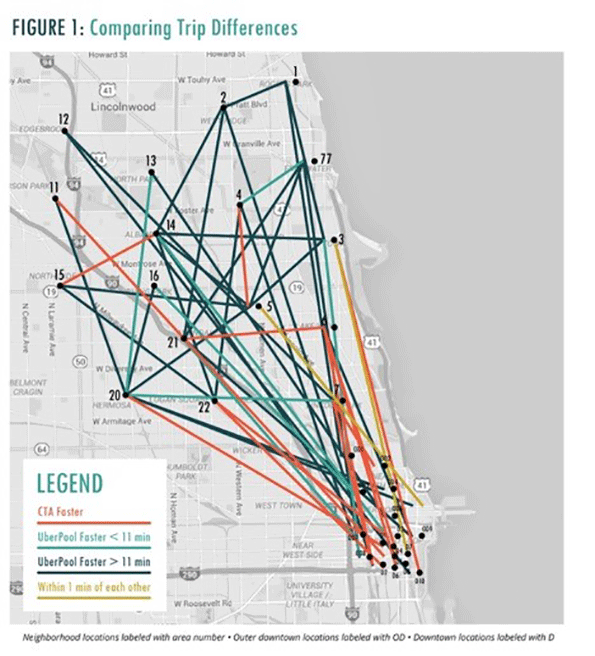
    I created a controlled experiment involving 50 one-way trips between various urban locations in a transit-rich part of Chicago. Data collectors measured the differing costs, time, and conveniences associated with UberPool, trains, and buses. One person used Chicago Transit Authority (CTA) services while the other hailed an UberPool (Figure 1).

    We evaluated only weekday trips during daytime hours to and from the north and northwest sides of the city, in order to focus on a transit-rich environment. Our trips, which linked the centroids of community areas, averaged about six miles long.

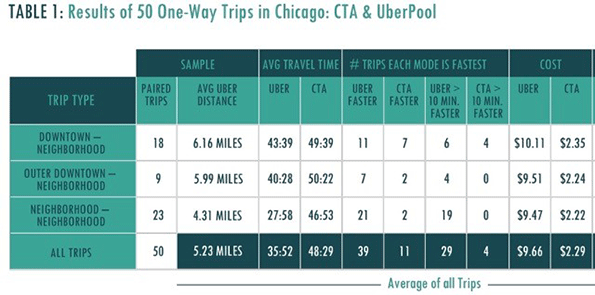
    UberPool did not disappoint. Regardless of the type of trip involved, our study found that carpooling tended to get you there faster than public transit, although often not by enough for to justify — for many passengers — the cost difference. The average elapsed time for all UberPool trips was about 36 minutes, besting transit by about 12 minutes. UberPool was faster on 39 trips, while the CTA was faster on 11 (Table 1). The carpooling costs averaged $9.66, compared to transit’s $2.29.

    Stops to pick up other passengers were not as prevalent as many might expect, with UberPool trips averaging just under one extra stop. Still, one fifth of all trips made at least two extra stops, while two out of the 50 trips involved three extra stops

    The appeal of carpooling may depend on the type of travel involved. On downtown-oriented trips, the time savings averaged a mere six minutes. UberPool was faster on eleven of these, and the CTA on seven.

    Moreover, UberPool can be challenging during rush hour, when it is slowed by traffic congestion and taking rapid transit is often faster due to the heightened schedule frequency.

    We suspect that primarily people in a hurry, those carrying heavy or bulky items, or those uncomfortable with transit would be inclined to regularly carpool to work downtown. The level of exertion is also greater on public transit. Our transit passengers were unable to find seats on about one-fifth of trips, and walked more often. UberPool involves minimal walking, whereas the average transit trip involved about a half-mile trek. Eleven transit trips required passengers to hoof it for at least two-thirds of a mile, while three involved doing so for more than a mile.

    On trips from the peripheral ‘outer downtown’ to the neighborhoods, though, UberPool outpaced transit by ten minutes. Carpooling starts to look more tempting to the transit rider in this scenario.

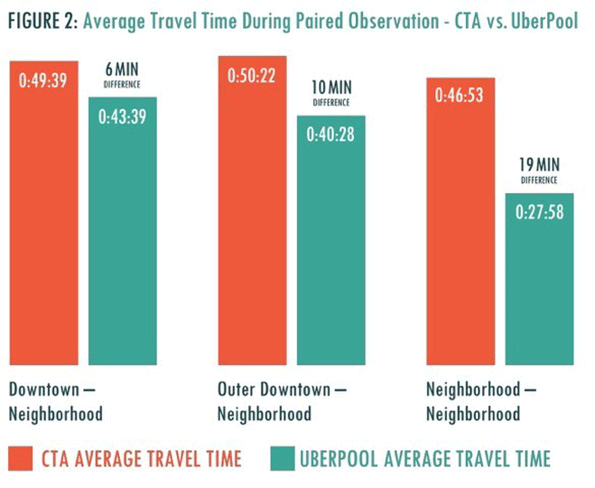
    The most dramatic benefits from carpooling, however, involve neighborhood-to-neighborhood travel (Figure 2). Such trips can be painful to transit users in Chicago, in part due to our slow pace of getting bus rapid transit off the ground and our ‘legacy’ rail system, with its radial design that focuses primarily on travel to and from downtown. And busses on some routes stop every few blocks.

    On these trips, UberPool dominates, averaging 28 minutes per trip, almost 19 minutes faster (about 40 percent) than transit. Carpooling was more than 10 minutes faster on all but four of our 23 trips, and more than an hour faster on one.

    A notable negative aspect of using UberPool is, of course, the variability in pricing. Six of the 50 trips involved ‘surge’ pricing (premium fares due to heavy demand), resulting in prices as much as 60 percent above the normal fare. We did not study the price and speed of UberPool during the evening and late-night hours, when demand is reportedly heaviest, and when surge pricing appears to be more prevalent.

    The inescapable conclusion is that carpooling services are appealing to far more than transit-averse and extremely time-conscious travelers, although perhaps not as an option that many commuters would use daily. UberPool tends to perform best precisely where transit is at its worst, e.g., on trips between the neighborhoods, especially during the off-peak periods when traffic is lighter.

    On one level, our results support the conclusions of a new Shared Use Mobility Center/American Public Transit Association report showing that such mobility innovations tend to be complementary to public transit. Shared-use services like Lyft and Uber fill the gaps that exist in urban bus and rail operations, and encourage people to pursue lifestyles that do not center on private cars.

    Still, carpooling should also be regarded as a potential game-changer. Federal guidelines recommend that analysts assume the average urban traveler values time savings at $24 per hour. An average traveler on an UberPool making a neighborhood-to-neighborhood trip may, therefore, by arriving about 20 minute earlier than a transit rider, derive a benefit from carpooling of around $8 per trip, which would be a far greater amount than the extra cost. The most time-sensitive travelers and groups of travellers would derive an even higher benefit.

    Even though rideshare carpools represent a mobility breakthrough, it unfortunately continues to take a backseat in the taxi-centric debate over Lyft and Uber. It is certainly going to pose an increasing challenge to public transit agencies. Heightened competition in urban transit markets appears here to stay, and is now poised to bring dramatic changes to the way we travel.

    Joseph P. Schwieterman is director of the Chaddick Institute for Metropolitan Development and Professor of Public Service at DePaul University in Chicago.

    Flickr photo of the S2 smartwatch from Samsung Newsroom: Travel NYC with the Gear S2 and Uber

  • Intercity Buses: 2015 Was A Smooth Ride

    As a former airline pricing analyst who once viewed the intercity bus as an inconsequential player in major markets, I am perhaps an unlikely champion of this mode’s potential. But since Megabus made its US debut just blocks from my Chicago office in 2006, I have become intrigued with this increasingly popular mode of intercity transportation. I now collect data and write a year-in-review report that summarizes the notable happenings in the sector.

    Ever since I began this research, there have been remarkable developments. In 2015, the trend was for fast-growing brands such as BoltBus, Greyhound Express, and megabus.com to pivot from investing in new routes to investing in conveniences for quality-minded travelers, in a bid to woo them from cars and planes. Another major surprise has been the resurgence of Chinatown lines, some of which had been written off as dead after federal safety crackdowns several years ago.

    The intercity bus industry’s shift from added routes to investments that improve passenger experience stems from three factors.

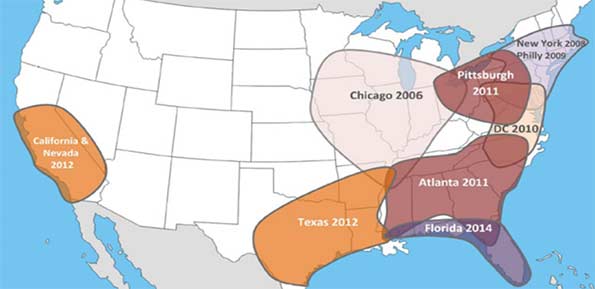
    First, major lines need to allow consumer markets to catch up with previous expansion, which has pushed bus service to regions in which product awareness is relatively low (it often takes three to five years for new service to achieve financial self-sufficiency). The map below illustrates the expansion of hubs by Megabus since it began its US service in 2006 and continued with Florida additions in 2014.


    Development of hubs by Megabus with approximate geographic range of service. Chaddick Institute

    Secondly, as the map shows, many of the most lucrative markets have already been tapped, giving carriers little choice but to focus their efforts on broadening their appeal among the large segment of the public that has been reluctant to give bus travel a try.

    Third, plummeting fuel prices have greatly intensified competition from private vehicles. Average gasoline prices across the US fell from $3.68 a gallon in July 2014 to just over $2 last month, negating some advantages of fuel-efficient modes. Double-decker buses with heavy loads can easily achieve 200 passenger miles per gallon. On a 250 mile round-trip, these falling prices have reduced the relative cost of driving by about $25 per passenger. That’s a big change to overcome!

    Carriers retained momentum by working to make coach travel more appealing. Greyhound introduced OnTouch©, allowing passengers to surf for information about tourist attractions, theatrical events, and ridesharing services at their destination using the bus’ Wi-Fi system. The carrier also launched BusTracker, which provides updates every one to four minutes on a bus’s location and expected arrival time.

    Megabus created a reserved seating program that allows passengers to select particular seats — including table spots — when buying tickets, generally for $5 or less. As recently as a decade ago, almost all US bus passengers were denied even having a guaranteed seat, much less a particular seat, on a selected departure. This uncertainty compelled many to arrive at the station at least an hour ahead to stand in line. Now, passengers can arrive at the last moment with their preferred seat awaiting them.

    New business-class services, meanwhile, popped up, linking New York City to Ithaca (on both Chaddick Institute for Metropolitan Development and Professor of Public Service at DePaul University in Chicago.

    Flickr Photo by Richard Masoner / Cyclelicious

  • Buses: Ride the Friendly Roads?

    Intercity bus companies have made some surprising moves to win a bigger slice of the business-travel market in the past year. City-to-city express operators like BoltBus, GO Buses, and Megabus are upping their game, and several new luxury services have entered the mix with amenities designed to attract disenchanted frequent flyers who wouldn’t have dreamed of taking an intercity coach a few years ago. Think refreshments, attendants, roomy seating, and even shoe shining services.

    A case in point is Vonlane, a new first-class service between Austin and Dallas that launched in May 2014 and plans to expand to Houston this March. A luxury operator, it seats only sixteen passengers, and an attendant serves snacks and drinks. It also offers a private six-seat “boardroom” for business meetings, and Wi-Fi and outlets, which are now almost standard on all bus lines. The service is also going after travelers that are willing to ride coaches to make connections to long-haul flights: Vonlane operates from the Hyatt Hotel at Dallas Love Field, where riders have access to a free airport shuttle. The fare isn’t cheap—around $100 each way—but it’s far less than flying. Southwest’s walk-up fare is $207.

    Equally noteworthy is Royal Sprinter, launched by D.C.-based restaurateur Andy Seligman about a year ago. First-class bus service isn’t new to the Northeast Corridor. It’s already available from Manhattan to Boston via LimoLiner, to Washington, D.C. on Vamoose Gold, and to northern New England via both C&J and Dartmouth Coach. What differentiates Royal Sprinter is its small coaches with only eight seats on board, and satellite TV that accesses pay movie and sports channels. The company currently operates two trips each day between New York and Washington, D.C., with fares running around $95.

    The powerhouse in express city-to-city service, Megabus, is also expanding from its traditional base of college students and urbanites. Taking aim at the business flyer, it introduced reserved seating in fifty-eight cities last year, with ten seats generally available at a cost of between one and nine dollars on each bus. Groups that reserve seating at a table can conduct business meetings during the trip.

    Bus companies are also growing more sophisticated in “selling flexibility,” to allow passengers to change their departure times at only a modest expense, in sharp contrast to restrictive (and costly) airline policies. BoltBus and Megabus, for example, now allow changes up to a day or two in advance for $5 or less, plus any fare difference—a far cry from the $200 charged by American, Delta, and United.

    Bus travel-booking websites, most notably Wanderu and Busbud, are also becoming more visible. Wanderu, in particular, offers convenient means of comparison-shopping Greyhound, BoltBus, Megabus, and others, much as Expedia, Orbitz, and Travelocity do for air travel.

    What does the resurgence of intercity bus travel mean for U.S. transportation? The growth reminds me of the mid-1980s, when new airline hubs were popping up everywhere. Airlines vied to gain a foothold in markets before their competitors did, fearing that there was enough business for only one carrier, but all the new service led to enormous increases in the number of people flying. Unfortunately, there is a void in official data on what is really happening in the bus business. Schedule information isn’t stored in any public data bases and vanishes from company websites the moment a bus departs, complicating growth analyses of this industry. Air and rail travel data is much more easily available.

    To help fill the void, for the past five years I’ve co-authored a year-in-review summary of what’s happening in this industry. Our study attempts to measure growth by recording schedule activity in published timetables and websites. We focus on branded carriers, including Megabus, Greyhound, and Trailways, because small carriers that intentionally stay below the radar, or only serve specialized niches (such as Chinatown operators and airport shuttles) are too hard to track.

    Last year, we observed a 2.1 percent increase in daily scheduled operations on the 107 carriers that met our criteria. While bus service grew, Amtrak train-miles held constant, and the number of airline flights diminished by 3.5 percent. Although bus companies aren’t expanding their schedules at the frenetic pace of past years, when growth often exceeded 5 percent, the sector is still growing much faster than other modes. Plus, ridership appears to be growing at an even faster rate. In October, Megabus reported that its sales were up 13.5 percent over the past year.

    How quickly senior corporate executives on expense accounts will embrace new luxury bus services remains to be seen. Regardless, travel markets of 350 miles or less are about more than college kids and bargain-hunters looking for the cheapest way to get from Point A to Point B.

    Joseph Schwieterman is professor of public service and director of the Chaddick Institute for Metropolitan Development at DePaul University.

    Photo by the author: Megabus double-decker at the Canal Street loading area in Chicago.

  • Have i-Phone, Will Travel

    Much in the way that fax machines, Fed Ex, and home computers changed residential living several decades ago, portable technology is now changing how we spend our time when moving from place to place. To better understand traveler behavior in the digital age, our DePaul University team has been tracking how passengers on intercity trips engage with technology. We’ve compiled data using (ironically) hand-held electronic devices on 112 air, bus and rail departures encompassing 18,000 passengers.

    Technology usage rose sharply among travelers on all modes of transportation between late 2009 and the beginning of this year. The percentage of passengers using technology at randomly selected points rose to 43 percent on curbside buses and 36 percent on conventional Amtrak trains. Airlines and Greyhound buses also saw sharp increases in tech usage. And almost 90% of passengers today use a portable digital-communication device at some point during their trip. Travelers have increasingly switched from simple audio devices to complex “visual” devices with LCD screens that can’t be effectively used behind the wheel when driving.

    The latest technology developments seem to favor common carriers. Drivers cannot text, tweet or catch up on Facebook when behind the wheel, unless of course, they are willing to put themselves and others at risk. This is a contrast from the earliest advances in portable electronic technology, which tended to favor automobile travel. Cellular phones were useful in cars, but their bulk and their weak batteries, along with the frequency of ‘dead spots,’ rendered them impractical on buses and trains, and in airports.

    Although the first commercial cellular phone service was introduced on Metroliner trains in 1969, the widespread installation of pay phones (particularly the Airphone) on commercial flights did not occur until 1984, and even then they were seen as an expensive luxury.

    As recently as the start of this century, traveling on a common carrier often meant going “incommunicado” for long periods of times. Business flyers who ventured “out of the loop” dashed for pay phones after arriving. Weary motorists fumbled for change at truck stops to place pay phone calls.

    Megabus and Boltbus, both curbside operators, have been the most adept at riding the personal technology wave. These curbside operators offer a trifecta of amenities — free Wi-Fi, power outlets accessible from every seat, and continuously strong cellular signals (due to their use of interstate highways) — that no other major transportation mode has yet to provide. They generally serve a younger demographic, so it’s not surprising that passengers on curbside buses are more likely to be engaged with technology than travelers on any other major mode. On curbside buses, it is common for more than 60% of passengers to be engaged with electronic technology at any given point.

    A survey we administered to riders waiting at curbside boarding locations showed that almost half consider Wi-Fi important when they choose a travel mode, and about 55% plan to send texts or emails on their trip. The ability to freely use portable devices, while undoubtedly less important than the low fares, helps explain why so many affluent travelers now hop on curbside buses, even when travel times are longer. With more than 400 daily departures, this sector has grown by more than 25% annually over the past several years.

    We also observed that many technology users on buses take advantage of adjacent empty seats. This opportunity is increasingly rare when flying. Our results shows that technology usage declines significantly on both airplanes and buses as conditions on board become more crowded.

    Amtrak is also benefiting from the technology wave, offering generous seating and tray tables that are attractive to technology users. Nevertheless, there are far more dead spots on trains than on buses, and Amtrak has not fulfilled its goals of making Wi-Fi widely available, in part due to the technological challenges associated with simultaneously serving hundreds of travelers along freight-oriented corridors. Wi-Fi is provided on Acela high-speed trains, but on very few other routes. Moreover, most long-distance trains still lack readily-available power outlets in coach class, sometimes leaving travelers in the dark after only a few hours.

    Even more perplexing is the absence of Wi-Fi and power outlets at most major rail stations, where installation is relatively cheap. Last summer, for example, I scrambled to find an outlet in San Diego—even searching the restrooms—to no avail, before reluctantly starting a long commuter train ride with a dead battery.

    Airlines face entirely different challenges. Only 24 percent of flyers in coach cabins were engaged with technology at randomly selected points during our observations. Crowded conditions and prohibitions during takeoffs and landings—which can be in effect for almost half of a flight—discourage use. Nevertheless, use of technology grew sharply during 2010. Airlines have invested heavily in airport lounges, gate areas, outlets and interactive on-board systems that support portable devices and in-flight Wi-Fi. Inflight cell phone calls also could be a game-changer in the not-so-distant future.

    It would be a stretch to argue that portable technology will appreciably diminish the share of travel by car anytime soon. Technology has accelerated the pace of life, making many people less tolerant of trains and buses operating on slow and unreliable schedules. As digitally connected lives in decentralized environments become more feasible, many people find it difficult to travel other than in private cars.

    And cars, too, are becoming more technology friendly. Bluetooth-equipped steering wheels allowing for hands-free phone use and voice activated dialing; power outlets and input jacks for i-Pods and satellite radio are on the rise. Built-in Wi-Fi is also now available in cars.

    Portable technology is making us rethink how we travel. The winner of the first round of innovation was the private automobile. The winner of the second was arguably the curbside bus. The next winner remains to the seen.

    Photo by Ben Dodson

    Joseph Schwieterman is a professor in the School of Public Service and director of the Chaddick Institute for Metropolitan Development at DePaul University in Chicago.

  • Here Comes the Bus: America’s Fastest Growing Form of Intercity Travel

    Travel by intercity bus is growing at an extraordinary pace: reflecting a rise in travel demand, escalating fuel prices, and investments in new routes. This confluence of factors has propelled scheduled bus service between cities to its highest level in years and has made the intercity bus the country’s fastest growing mode of transportation for the third year in the row.  “Curbside operators,” including BoltBus, DC2NY Bus, and Megabus.com, which eschew traditional stations in favor of curbside pickup and provide customers access to WiFi and other amenities, have enjoyed particular success.

    The comeback of the intercity bus is noteworthy for the fact that it is taking place without government subsidies or as a result of efforts by planning agencies to promote energy efficient forms of transportation.  Instead, it is a market-driven phenomenon that is gradually winning back demographic groups that would have scarcely contemplated setting foot on an intercity bus only a few years ago. Our DePaul University study estimates that curbside operators like Megabus expanded the number of daily departures by 23.9% last year.   In the Northeast and Mid-Atlantic states, service grew at an even faster rate. 

    As recently as a decade ago, traditional bus services were all but written off as a “mode of last resort.”  A painful and unrelenting decline had pushed intercity buses into the margins of travel.  The opening interstate highways, increased automobile ownership, and the deterioration of downtown business districts in major cities had weakened demand for intercity bus services starting in the 1960s.  Continued retrenchment took place throughout the 1980s and 1990s—a downturn that pushed Greyhound into bankruptcy and continued even after the terrorist acts of September 11, 2001, which dramatically affected the demand for air travel.    

    By 2006, the sector began a recovery.  “Curbside” bus companies had begun operating express service on relatively short-distance corridors linking major cities.   Attracting publicity for their steeply discounted fares—with a few seats sold for only $1—these operators sometimes entered service on routes already served by so-called “Chinatown Operators,” bus lines, typically operated by Asian businesses, between the Chinatown districts of major cities. 

    In other instances, curbside carriers infused new life into markets that hadn’t had seen new service in many years, including many routes through the Midwest’s Rust Belt.   

    The largest and best-known of the curbside operators, Megabus.com (“Megabus”), a subsidiary of Coach USA (owned by Stagecoach, Ltd., a British company) opened its Chicago hub in early 2006.  In 2008, DC2NY Bus began service between New York City and Washington, D.C., differentiating its product with wireless internet service and other amenities.  Megabus and BoltBus (a joint venture between Greyhound and Peter Pan Lines) soon followed suit and took the model one step further by building full-scale hubs based out of Manhattan.  On the West Coast, California Shuttle launched service between the San Francisco Bay Area and Los Angeles, albeit with limited schedule frequency. 

    All this early success made the brisk expansion of 2010—a time of economic difficulty for American transportation—all the more remarkable.  Curbside operators such as Boltbus and Megabus expanded their number of departures by 23.9%, accounting for more than 440 daily bus operations in the continental United States.  A significant share of the growth—68 daily departures—took place to and from Megabus’ new Philadelphia and Washington, D.C. hubs, both launched in the latter half of 2010.     

    For the first time, with the advent of its Philadelphia hub, Megabus operated a route that did not originate nor terminate in Chicago, Los Angeles, or New York.  This change marks an important shift in expansion strategies of curbside operators into somewhat smaller origin-destination combinations.  This trend continued with hubs created in Washington, D.C., resulting in new express service provided from the nation’s capital to eight cities, including Boston, Mass., Knoxville, Tenn., Raleigh, N.C., and Richmond, Va., with a new hub in Pittsburgh, Penn. announced earlier this month.  Only a few years ago, the idea of a private company publicizing new express bus service linking shrinking industrial cities like Pittsburgh to Detroit would have seemed unlikely, but it is happening today.    

    For the third year in a row, the intercity bus service was the fastest growing mode of intercity transportation, outpacing air and rail transportation.  The amount of bus service—the total number of daily departures, inclusive of both curbside and traditional carriers like Greyhound and Trailways—grew by 6.01%.   The number of airline departures rose by about 3% in 2010 while the number of train miles operated by Amtrak rose by a modest 0.5%. 

    Greyhound, now twenty years out of bankruptcy, is also showing signs of life.  Last December, the carrier introduced premium service on selected routes from Chicago offering passengers receive free WiFi internet, more spacious cabins, and guaranteed seating.    A year earlier Greyhound unveiled a similar product upgrade on certain East Coast routes that included new buses and an advertising campaign aimed at diversifying its ridership.  In the Southeast, a new luxury operator, Red Coach, launched last between South Florida and Central Florida as well as points as far north as Atlanta.   Red Coach offers extra-wide seats that decline to near-horizontal positions as well as a GPS satellite monitoring system.

    Curbside buses achieve more than 160 passenger-miles per gallon of fuel burned, making them several times more fuel efficient than commercial airplanes and private automobiles, as well as conventional diesel trains. Using the results of a survey we administered to 250 curbside-bus passengers in East Coast and Midwestern revealing how passengers would have traveled had curbside bus service not been available, we estimate that curbside bus service is reducing fuel consumption by about 11 million gallons annually and reducing carbon emission by an estimated 242 million pounds—the equivalent of removing about 23,818 vehicles from the road. 

    When making these estimates, we take into account the fact that curbside operators, in part due to their low fares, have a stimulating effect.  That is, they generate new travel.  We measure how some of the potential reduction in fuel consumption is offset by additional trips made by consumers. 

    The growing prevalence of portable electronic technology, such as laptops and cellphones, gives intercity bus a new competitive advantage over air service and driving.  At randomly selected points, we estimate in our analysis of traveler use of technology that more than 40% of passengers on curbside buses are equipped with portable devices, a percentage higher than on Amtrak (perhaps due to the free Wi Fi) and much higher than on commercial airplanes.  Customers who place a premium on their ability to access electronic devices apparently find curbside bus service a particularly attractive option.

    By all indications, we will see more intercity bus expansion over the next year.   We anticipate that new service will likely emerge over the next several years in places where little or no curbside service is available, such as in California, Florida, and Texas.  It appears only a matter of time before curbside operators make a significant presence throughout the United States, something remarkable considering that this mode entered the scene just a few years ago.

    Joseph Schwieterman, Ph.D., is a professor at DePaul University in Chicago and director of the school’s Chaddick Institute for Metropolitan Development.

    Photo by Sidddd