Author: Kris Hartley

  • Extending the Reach of Smart Cities

    What distinguishes a ‘smart city’ from one that merely possesses smart technology? At the basic level, ‘smart’ implies a threshold level of technology uptake. Cities with fast internet, straddling buses, and driverless police cars could be considered smart. However, if technology is the only prerequisite, smart is neither revolutionary nor interesting. It is time to move towards a more enlightened understanding of what makes a city smart.

    Most smart city definitions fail to articulate how disparate technologies mutually support goals beyond efficiency. If policies are holistic and integrated, technologies should be as well. Integration is not the final objective, though: it represents only the starting point for developing broader strategies to equitably distribute technology benefits and raise living standards. As such, the fundamental question for planners and policymakers is not how to optimize components of the system, but how to ensure that the overall system delivers on the promise of its potential.

    In 2014, I introduced what I called a constraint theory of governance. Based on the concept of throughput optimization in the field of operations management, constraint theory posits that efforts to maximize the speed or capacity of individual production stages do little to improve the speed of systemic throughput. This is more colloquially known as the weak-link phenomenon. The concept describes a common management folly that prioritizes efficiency at one stage of production while inventories accumulate at other stages and overall progress stagnates.

    So it is with governance. The improvement of a single policy stage (e.g. consultation, design, or implementation) is fully realized only when other stages are proportionately reformed. In an interlinked policy system, achieving complementarity among stages is crucial for improving throughput – as measured by the delivery speed and durability of policy initiatives. More broadly, according to the constraint theory of governance, reforms applied across rather than within functional areas are the only means to generate transformative progress in outcomes.

    The constraint theory of governance applies also to smart city systems, in which output is neither a product, as in business, nor a policy, as in governance. Rather, outputs can be seen more broadly as outcomes defined by political, social, and economic progress. Technology is only one component of this complex system; it is the butter, not the bread. Operating within the broader context of a dynamic society and body politic, the power of smart city technology is dependent on strategic and functional integration of urban systems. In other words, technology is only as effective as the governance priorities and capabilities underlying it.

    Seemingly disparate technological capabilities can become increasingly interdependent over time. According to the late scientist John Henry Holland, complex adaptive systems are characterized by the presence of components that learn through interaction. This is a useful metaphor for the potential of smart city systems. While much focus has been given to individual components, technological convergence requires a systems perspective. Benefitting from both network growth and scientific progress, smart city systems can shape the collective capabilities of once silo-bound technologies into a continuously evolving whole. This self-correcting mechanism is valuable in environments where policy and planning systems are encumbered by persistent bugbears like political patronage and ideological territoriality.

    In smart cities, order is needed for planners to channel technological capabilities productively, while chaos provides a dynamic and flexible space for business and social innovation to ‘breathe.’ The sterile and the organic exist in paradoxical equilibrium. However, even politically progressive cities are sometimes unable to hold this balance, as in the recent controversy about rideshare services Uber and Lyft in Austin, Texas. Such cases are evidence that deeper thinking is needed about how to anticipate and manage the disruptive effects of smart city systems.

    Appreciating the complex and paradoxical dimensions of smart cities can help improve human welfare, particularly when leaders and citizens look beyond efficiency. Rather than optimizing discrete goals, the new architecture of smart cities should be oriented towards broader social and political outcomes. Planner and academic Murtaza H. Baxamusa recently stated, “To be effective, urban planning needs to dig deeper than obscure code, pretty pictures and jumbling data. It needs to make a difference in the lives of all people.”

    Smart cities have focused long enough on finding cool ways to do the same old things. Lest they be relegated to the garbage heap of worthless miracles, new generations of urban technologies can earn their keep with lower costs, faster delivery, and improved services, all indicators of efficiency. However, as I recently wrote, “All that computes is not progress.” While technology improves certain aspects of business and governance, its broader potential should not be undersold. The new ‘smart’ implies extension of opportunities to the disadvantaged, broadening of political participation, and enabling of social forces to shape urban space for the greater good.

    Kris Hartley (www.krishartley.com) is a Visiting Research Fellow at the University of the Philippines Diliman, and a PhD candidate at the National University of Singapore, Lee Kuan Yew School of Public Policy.

    Flickr photo by Nicolas Nova: Smart City Infrastructure
  • Rural Industrialization: Asia’s 21st Century Growth Frontier

    A World Bank report released earlier this year featured a jarring statistic: 200 million people moved to East Asia’s cities between 2000 and 2010. That figure is greater than the populations of all but five of the world’s countries. Commentators argue that the urbanization of Asia is inevitable, with one calling recent growth “just the beginning.” Considered alongside figures about urban migration, the fact that only 1 percent of Asia’s land is urbanized (a popular statistic) appears to validate predictions about the increasing densification of cities. However, growth in the capacity of cities to accommodate industrial growth seems to be flattening. With a rising middle class and booming demand for automobiles, Asian cities can expect no relief from congestion, and this may be a deterrent for businesses. Rural areas are increasingly prepared to absorb this potential shift in demand.

    Urbanization patterns

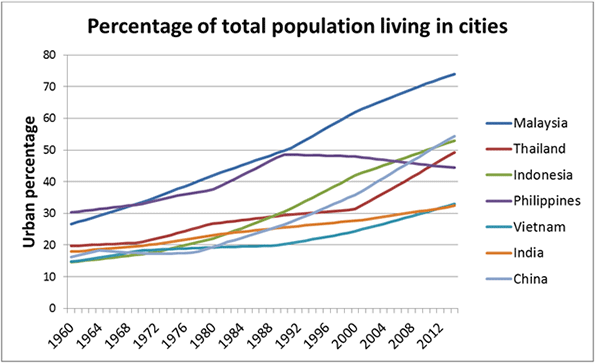
    In examining Asia’s economic growth through urbanization patterns, it is helpful to consider historic data spanning several decades. Figure 1 compares 54 years of urbanization in Southeast Asia’s five largest economies against India and China, both arguably the 21st century’s most dynamic growth stories and frequent subjects of urbanization research and commentary. Urban population share has been rising consistently in most countries of this study. Malaysia has long seen a population majority living in cities, and China and Indonesia both crossed the 50% threshold in 2011. Thailand has also rapidly urbanized since 2000, and will likely pass 50% this year. By contrast, Vietnam, India, and the Philippines have been slower to urbanize, with the latter declining since 1990. Part of this variation reflects differences in definitions and measurements of urbanization across countries and time, but the underlying pattern remains clear: the past several decades have seen an urban migration of historic scale.

    Figure 1 (Data source: World Bank)

    That urbanization correlates with economic growth is a point rarely overlooked. Indeed, the two have supported one another since the emergence of capital- and labor-intensive manufacturing during the industrial revolution. Borne of historic growth patterns, this logic has been used to support predictions of continued industrial urbanization and policies that promote it. However, remote penetration of connective infrastructure – including both transportation and communications – is replacing old growth models with a new rural industrialization. The following data support this claim.

    GDP and urban growth

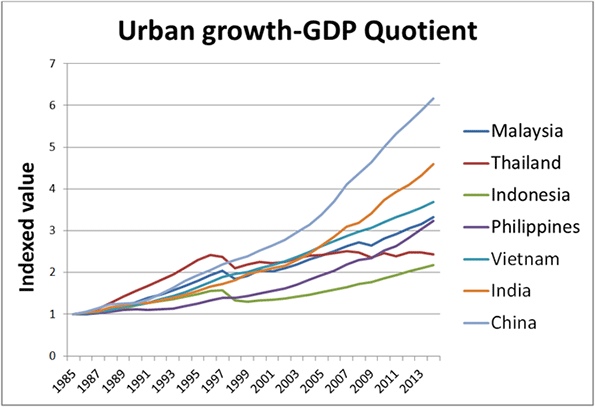
    The urban growth-GDP quotient (Figure 2) represents urban population growth divided by GDP, and is effectively a measure of how much economic activity countries are extracting from their cities. It is not an absolute measure such as GMP (gross metropolitan product). Rather, it is a measure of how changes in GDP track changes in urbanization, providing a broader look at the relative role of cities in national economies. A time horizon of nearly three decades (1985 – 2014) is chosen to capture the high growth period after market reforms in China (1979) and Vietnam (1985). The indexing approach is necessary to normalize the scale of variables for more meaningful graphical visualization, essentially “controlling” for vast differences in numeric values (e.g. the GDPs of China vs. the Philippines). It also creates a common reference point to compare longitudinal performance across countries.

    Figure 2 (Data source: World Bank)

    In this metric, China outperforms comparator countries with a particularly rapid increase in the quotient since 2005; it has evidently been successful deriving GDP value from urban areas. By contrast, Indonesia has seen comparatively less urban-based GDP contribution, and Thailand’s contribution has remained roughly the same since outpacing all countries between 1985 and the Asian financial crisis.

    Manufacturing and urban growth

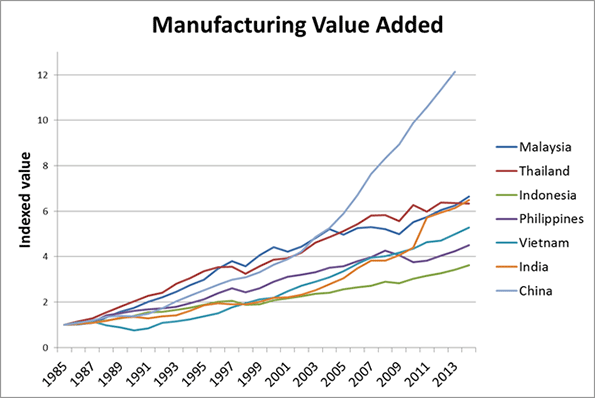
    One factor underlying these differences is the type of industries contributing to GDP growth, and in particular their location patterns (rural vs. urban). An examination of manufacturing value added (MVA) is necessary to sharpen this analysis, as manufacturing is historically an urban-based activity. Cities provide labor, infrastructure, business services, and global connectivity; their importance to manufacturing is undisputed. The raw MVA numbers (Figure 3) indicate that since 2005, China has far outperformed other countries in the study, most of which showed consistent but not transformative growth. Among the latter, India boasts the lone spike in MVA, and that only recently.

    Figure 3 (Data source: World Bank)

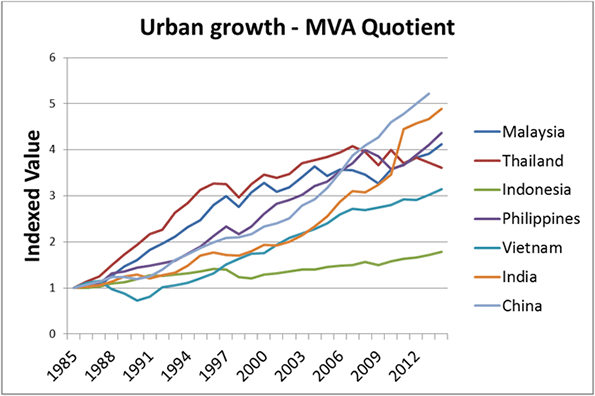
    To complete the analysis, Figure 4 compares historic patterns of manufacturing growth against growth in urbanization. The indexed quotient replaces GDP (Figure 2) with MVA and can be regarded as a measure of the extent to which countries leverage urbanization to support manufacturing growth. China’s statistical dominance in previous measures vastly diminishes here. Further, growth in the ability of many remaining countries to derive MVA from cities slows after initially rapid growth.

    Figure 4 (Data source: World Bank)

    The notable exception is India, and this is the critical point in this analysis. India’s competitive advantage is rooted in the country’s tech sector and other higher-value added activities. From call centers to technology R&D, India has developed a defensible regional position in knowledge-based industries, which are increasingly dependent on the by-products of urbanization: an educated workforce, global talent networks, and lifestyle amenities that appeal to higher-income residents. China maintains its position at the top due in part to its particular urban-based industrialization strategy (special economic zones and decentralization reforms empowering cities). However, China’s conversion of rural agricultural land into industrial facilities is an emerging phenomenon, and the line between urban and rural is fading. For example, in many provinces (e.g. Hebei) factory parcels stand alone, surrounded by farms.

    Towards rural industrialization

    In Southeast Asia, as in parts of China, industrialization is not a fundamentally urban phenomenon. From the industrial estates of Thailand’s Eastern Seaboard to the suburban clusters of Vietnam and Indonesia, companies are now finding most everything they need outside of city centers. The advantages are numerous: cheaper land, lower labor costs, less congestion, and in some cases lucrative business incentives. These suburban and rural industrial clusters are even focusing on quality of life for families, looking beyond hard infrastructure to provide housing, education, and recreation facilities. Such amenities appeal to workers of all skill types, from manufacturing to research and development. As such, rural industrialization need not be only smokestacks and assembly lines; an educated workforce can be recruited if rural living standards match those of cities. This broadens the array and sophistication of industries capable of supporting a new kind of growth.

    Hyper-urbanization visits significant inefficiencies on businesses, potentially making rural regions more attractive for operating. In many of Asia’s major cities, snarled traffic grinds life to a near halt and transit infrastructure has provided only modest relief. Aside from Singapore (a frequent statistical exception), Bangkok and Kuala Lumpur are leaders within Southeast Asia in developing urban rail. However, neither system offers the geographic coverage needed to loosen gridlock. Ho Chi Minh City is currently building its first metro line, but construction is delayed and completion appears to be years away. If hyper-urbanization is re-interpreted as a policy challenge rather than a sign of progress, the decentralization of industrial development can be one solution. Asia’s economic fate is not inextricably linked with the size of its cities, and fresh visions of decentralized growth are already proving their value. The potential is vast; for example, Indian Prime Minister Narendra Modi’s “digital push” and recent commitments to rural broadband represent a development path for the country’s remote regions. Technology, expertise, new funding sources, and emerging economic opportunities are ready to support the rise of rural industrialization across Asia.

    Kris Hartley is a Visiting Lecturer in Economics at Vietnam National University – Ho Chi Minh City, and a PhD Candidate at the Lee Kuan Yew School of Public Policy, National University of Singapore.

    Top Photo: Putrajaya, Malaysia: Seri Gemilang Bridge. Behind the bridge on the right side Ministry of Women, Family and Community and Ministry of Urban Wellbeing, Housing and Local Government © CEphoto, Uwe Aranas / , via Wikimedia Commons

  • Revisiting Two Forces of Modern Urban Transformation

    Few factors have had a greater impact on recent urban growth than communications technology (ICT) and property investment strategies. The evolution of both is transforming space and social interaction at an unprecedented pace and depth, with mixed results. As these maturing forces are increasingly taken for granted, the next generation of urban growth should accommodate them in ways that preserve urban vitality and citizen livelihoods.

    The jetpack that wasn’t

    The impacts of ICT on urban life have been examined primarily in two realms: government operations and citizen-user lifestyles. With several decades of modern technology absorbed into urban life, it is now possible to longitudinally examine the impacts of ICT in both its functional and social dimensions.

    In the mid-20th century, simple technologies supported the minutiae of city operations in ways that now seem mundane: stoplight sequencing, emergency response, utilities management, etc. After decades of innovation, technology is now a broader and more integral part of urban governance, from design to operations. For example, ICT’s value in aiding growth projection continues to be explored through highly sophisticated systems such as UrbanSim, which is being used by several cities around the world. What was once the concern only of technocrats – and the muse of Popular Science magazine – is now the recipient of large budget appropriations and a common topic for discussions about inter-urban competitiveness.   

    Beyond operations, ICT has also restructured urban social interaction in both planned and unexpected ways; these are expressed in particular through changes in the physical environment. One example is the book retail industry, for which virtual markets have caused catastrophic impacts. For example, Barnes and Noble provided proxy community gathering spaces where people of varying ages and interests interacted. Aimless and leisurely perusing created a shared atmosphere of curiosity and exploration. However, many such stores are now bankrupt, replaced by an online shopping medium that eliminates the need for face-to-face interaction. A vestige of community life may have perished as a result.

    Urban planners should be concerned about the socio-physical impacts of these transformations. As society withdraws into virtual realms, ICT exerts both convergent and divergent effects. The former allows people in dispersed locations to rally around a common interest, political cause, or commercial pursuit. It bridges cultures and geographies, and “flattens” the world in ways already amply studied. At the same time, ICT can splinter interests and fragment shared identities. There is little consensus about this matter, with some studies arguing that online media diminishes social skills and increases isolation, and others arguing that it has a positive correlation with “civic engagement” and tightens familial ties. Regardless, as social and commercial activity is virtualized there remains the chance that that place-based affinities – expressed, for example, by patronage of local enterprises – will gradually erode. Despite their virtues, “online communities” are still fundamentally a-spatial constructs. What is begun there often must be executed in person, underscoring the continued relevance of public space.

    The long-term transformative effects of ICT cannot yet be fully appraised in part because technology uptake is rapid and unpredictable. Nevertheless, in one aspect – urban design – a synergy has emerged between bricks-and-mortar merchants and planners, in reaction to virtualization. Their complementary efforts, when successful, imbue commercial space with interaction-based vitality. The human instinct for sociability further supports these efforts, evidence that there is no substitute for many of the benefits cities offer. Lives are arguably better in proximity, a point supported by decades of agglomeration and anthropological research. The challenge for planners, therefore, is to create space for meaningful experiences inimitable in the virtual realm.

    The masters of the neighborhood

    Modernized property investment models predate ICT, but have imposed similarly transformative impacts on urban growth. 20th century efforts to generate vibrant commercial and residential spaces have a chequered history: suburban malls of the 1960s, festival marketplaces of the 1980s, and live-work-play new urbanist developments of the pre-recession 2000s. These development strategies exhibit the prevailing commercial and social trends of the time: white-flight suburbanization, urban core revitalization, and densified brownfield redevelopment.

    More importantly, property development in its various forms is a product of the global investment climate. Susan Fainstein argues that emotion, shoddy research, and availability of (other people’s) money have fuelled unsuccessful investments that ultimately destabilised property markets. Development capital – particularly for large projects that can redefine an entire urban core – is increasingly sourced from institutional investors who arguably have little stake beyond financial returns. For example, Turkey has recently announced plans to facilitate international investment in its domestic property markets, and investment in Indian property by private equity firms has risen sharply in 2015. These types of developments range from business and technology parks to vast urban retail and residential complexes.

    Additionally, the behavior of investors can influence the nature of such development. Stock investment strategies increasingly favor the short-run – “in and out quickly” – over the long-run (“blue-chips”). Translated into property investment, this strategy attracts capital to projects with quick returns but poor long-run viability. The immediacy of funding is commercially alluring, but rapid flight of capital can be devastating for neighborhoods. For example, the mortgage crisis illustrated the risk of designing property investment models like those for intangible (and liquid) assets such as stocks. Rapid divestment of investment shares and properties – in panicked response to market signals – elevates natural cycles into manic booms and catastrophic busts.

    Cases like this illustrate how urban growth is impacted not only by the characteristics of financial institutions, but also by the eminently human irrationalities that distort their function. The city becomes less a product of local market demand than of the financial ambitions and risk preferences of absentee investors. These global prospectors often have little contextual knowledge of projects and even less interest in their social impacts. This investment approach may work for stocks, but not for property developments – particularly those that support urban growth and generate economically sustainable neighborhoods.

    Citizens as social investors

    Both technology and investment patterns have been enablers of growth strategies that serve interests beyond local livelihoods. This tension tests the power and will of urban governments to interpret global trends – including those of ICT and capital markets – in ways that enhance local livability and equity. It is therefore incumbent on planners to reconcile the vicissitudes of technological and financial change with the exigencies of authentic and inclusive urban growth. Moreover, a city is not merely a product of planning; it is the embodiment of resident priorities.

    Authentic urban transformation relies more on citizen initiative than the influence of global capital, and may be facilitated by ICT but not defined by it; this can be seen in the quiet regeneration of urban neighborhoods. Global capital may underwrite loans for acquiring properties and developing land, decisions in such neighborhoods are often made locally and in the type of fragmented manner that generates a bricolage of uses and styles. Examples in the United States include East Nashville, Kansas City’s Crossroads district, and Oakland’s foodie Temescal and KoNo districts. None displays the architectural shock-and-awe of emerging global mega-cities, but each embodies a citizen-level developmental determinism that shapes their design and atmosphere. They are literal incarnations of the unique priorities of citizens at that time and place, independent of global trends that often result in regression to an aesthetic mean.

    If cities balance opportunism with judiciousness in absorbing these forces, citizens ultimately should be the ones to demand it. Examples of facilitative policies are inclusive zoning, public space requirements, mixed-use zoning that reserves space for local enterprises. From the current vantage point, ICT and global investment appear poised to maintain their role in development; however, this no defeat for citizen livelihoods. Among their many responsibilities, planners should embrace their role as public-private intermediaries, creatively channelling external forces to de-commodify space and preserve vernacular authenticity. This is only possible by balancing stakeholder influence.

    Kris Hartley is a visiting researcher at the Center for Government Competitiveness at Seoul National University, and a PhD Candidate at the National University of Singapore, Lee Kuan Yew School of Public Policy.

  • Flexible Economic Opportunism: Beyond Diversification in Urban Revival

    Discouraging employment data have recently dampened optimism about America’s economic recovery. These challenges are nothing new for developed regions long beset by manufacturing decline amidst globalization. Exemplars of this trend, America’s rust belt cities have battled unemployment, decaying infrastructure, and social challenges since economic decline emerged in the 1960s. In response, some now cultivate service, knowledge, and tourism industries. Explaining these new growth models, analysts often espouse the virtues of diversification. However, legacy industrial systems and native constraints (e.g. geography and culture) can hinder this strategy. Chasing diversification for its own sake diverts policy attention from a more valid determinant of growth. Post-industrial urban policy should target structural flexibility, enabling diversification or specialization – neither deserving preeminent status – to occur naturally.

    In exploring rival economic development strategies, two management theories are particularly relevant: Michael Porter’s competitive advantage and Harry Markowitz’s portfolio theory. Competitive advantage describes the strategic orientation of business operations and brand image to command an inimitable market position. Portfolio theory is the logic behind investment diversification to maximize returns for given risk preferences. In management, these are not rival theories. However, when applied to urban economic development they present a direct contrast. The former can be likened to specialization, and the latter to diversification.

    In attempting to revive their economies, cities often reduce strategic options to the simple dichotomy of specialization versus diversification. Some compromise by favoring a primary industry and enabling the emergence of secondary industries. Economic orthodoxy generally argues that diversification is the wiser choice in volatile economies. This portfolio-style approach assumes that stability in one industry offsets decline in another. This argument is convincing: many “single-engine” economies have underperformed amidst globalization. Besides the usual cases, overlooked examples are Oakland, California (shipbuilding and automobiles), Birmingham, Alabama (steel), and upstate South Carolina (textiles). A similar fate befell the British Midlands and German Ruhr Valley, where recovery strategies have generated mixed results. Instability in single-industry dependence is not limited to manufacturing. Las Vegas, where the pro-cyclical tourism mirrors national economic trends, remains fairly irrelevant outside its casinos and related industries.

    By contrast, many successful cities boast diversified economies. New York has a path-dependent advantage in finance, with recent volatility offset by tourism, business services, and the arts. The 1986 collapse in oil prices tested the resilience of Sunbelt boomtown Houston, whose shipping industry offset energy sector declines while banking, finance, and healthcare kept the city competitive. Large cities are naturally more diversified, but smaller cities can also exhibit diversification: examples are Austin, Texas (research, education, and technology), Nashville, Tennessee (entertainment, insurance, and health care), and Tampa, Florida (military, tourism, trade, and retirement services). Austin added jobs even during the 2008 recession, and has routinely been labelled the nation’s best-performing economy in recent years. These examples show that economic resilience is dependent more on diversified industrial portfolios than on size.

    Nevertheless, a larger story underlies America’s revitalization champions. While the flag of diversification flies high, at the base of the pole stands structural flexibility, arguably a more durable, achievable, and powerful mechanism for growth. Cities prepared to re-orient towards emerging opportunities maintain development potential across economic cycles. Furthermore, flexibility gives cities of any size hope for transformative growth. Not every city has the native advantages to meaningfully diversify, but flexibility can be their wild-card strategy.

    Two former manufacturing cities have exhibited post-industrial flexibility: Pittsburgh and Bilbao. Once the pride of America’s post-WWII steel industry, Pittsburgh suffered a precipitous decline in the 1980s as manufacturing moved overseas. 200,000 jobs and nearly half the population were lost. However, Pittsburgh’s situational advantages provided a flexible platform for revival. Well-endowed cultural institutions and flourishing medical, education, and research sectors supported a lifestyle economy based on knowledge, services, and creative entrepreneurship. Pittsburgh’s economic performance was seventh best in the nation during the 2008 recession, an example of how flexible planning, private sector creativity, and situational advantages converged to make progress halting seemingly irreversible decline. Similarly, Bilbao, Spain, sharply declined after the withdrawal of manufacturing. Without its economic engine and facing crisis-level unemployment, it creatively turned to tourism and culture. The government’s stated commitment to collaborative policy making and quality-of-life now complements efforts to sustain post-industrial competitiveness. Like Pittsburgh, Bilbao has used flexible, opportunistic planning to pursue economic growth.

    Despite their highly publicized transformations, however, these post-industrial success stories are not without challenges. The Pittsburgh metropolitan area has failed to gain population for years, and lost nearly 5,000 residents between mid-2013 and mid-2014. The city’s stagnant job growth has led some claim that Pittsburgh’s amenities, rather than employment opportunities, are a relocation magnet. Others claim that flat overall job growth conceals local economic restructuring, as manufacturing industries give way to the creative sector. Despite recent signs of a recovery, Spain’s persistent unemployment (23.8% in the first quarter of 2015) indicates that the nation, and particularly secondary cities such as Bilbao, continues to struggle in the stubborn wake of the 2010 euro crisis. Further, Bilbao’s top-down approach of museum-based revitalization has failed to generate vitality in the grassroots cultural scene, where artists have collectively mobilized but still struggle to obtain financial support.

    Manchester has recently enjoyed consistent growth, and is now considered the UK’s healthiest economy outside of London. Like Pittsburgh and Bilbao, the city experienced rapid mid-century decline with the closure of its shipping port and loss of heavy manufacturing. The city’s economic revival has pivoted towards knowledge, services, and entertainment, a strategy attracting recognition for liveability and cultural vibrancy. Financial services now outsize manufacturing and engineering, with no single industry representing more than 16% of the economy. Poised to benefit further from devolutionary reforms and “northern powerhouse” status, Manchester has garnered recognition for its economic diversity and entrepreneurial spirit. The city exemplifies a flexible approach to post-industrial development, particularly for a hinterland region overshadowed by a dominant neighbour (London).

    Other efforts at revitalization, however, have produced lesser results. Like Pittsburgh and Bilbao, Cleveland’s steel industry flourished in the mid-20th century before industrial decline gutted the city of jobs and population. In 1969 the emblematic Cuyahoga River fire brought national attention to Cleveland’s economic crisis. Since 1990 the city has caught fire once again – in a revival driven by services, tourism, and entertainment. Global connections in knowledge industries and education complement Cleveland’s flexible economic vision. However, the city still struggles with disinvested neighbourhoods, ageing infrastructure, and regional competition from Pittsburgh, where flexible strategies also target culture and technology.

    Taken superficially, these revival cases support the concept of diversification. Cities focusing on a singular competitive advantage – geography, image, or path-dependent conditions – tend to specialize but often struggle to re-configure inflexible industrial infrastructure for new opportunities. Regardless, specialization versus diversification is a false choice. Beyond this continuum, the true survival instinct is structural flexibility. Diversification often correlates with overall growth but is more a lagging indicator of opportunistic preparedness. Flexible policy broadens structural capabilities and builds resilience into urban systems, in either a specialized or diversified economy. The outputs include infrastructure both hard (transport, technology and housing) and soft (education, culture, and institutions). In providing platforms for investment that adapt to global trends, this strategy transforms industrial determinism into flexible economic opportunism.

    Kris Hartleyis a visiting researcher at Seoul National University and PhD Candidate at the National University of Singapore, Lee Kuan Yew School of Public Policy. For more details about his argument, see his book Can Government Think? Flexible Economic Opportunism and the Pursuit of Global Competitiveness.

  • Global Cities in the 21st Century: a Chicago Model?

    As America’s “third” city, Chicago competes for international attention against the usual rivals: New York and Los Angeles. Even San Francisco, next to Silicon Valley, claims prominence for its cutting-edge industries and progressive culture. Ultimately, though, Chicago’s domestic peers have global status through definitive leadership in industries with visibility and impact (New York in finance, Los Angeles in entertainment, Houston in energy, and San Francisco in technology and innovation). Chicago has dim prospects of replicating such undisputable competitive advantages, but it may not need to.

    Global status in the 21st century favors international collaboration over industry dominance, for three reasons. First, the innovative nature of emerging industries and modernizing traditional industries shifts competitive determinants from resources to ideas. This equalizes the international knowledge race, with companies seeking ideas regardless of geographical origin. Second, technology-enabled connectivity integrates previously isolated regions into the global economy, creating what a recent Foreign Affairs article labels a “unified global marketplace for labor.” Third, the dynamic knowledge sector rewards flexibility over size; footloose over big and rigid. Accordingly, local workforce size loses relevance, good news for small cities. The digital revolution enables geographic dispersal of talent through “internet-based globalization.” In short, collaboration enables flexible capacity, while international collaboration taps a vastly more diverse and hungry talent pool.

    Is Chicago prepared to abandon pursuit of industry dominance and seek global status in the hyper-connected knowledge economy? The city already boasts corporate prominence and diverse lifestyle amenities, and has even seen post-recession growth in emerging creative industries like high-tech and film. Chicago also has a lively private sector, and visionary, pro-developmental planning from both its recent and distant past. In 2013 the city committed US$ 3 billion to revive urban neighborhoods, through a public-private initiative that Mayor Rahm Emanuel insists will help Chicago “live up to its potential as the global city that it should be.” Such factors make a city great, but do they make it global?

    Despite being a paragon of economic diversification, Chicago lacks an undisputed position in any transformative and globally relevant industry, as enjoyed by its coastal rivals. The city is even perceived by some as a striver whose influence is more regional than global. For example, in a 2012 New York Times article, a relocation expert stated that global business and political leaders “have an idea of Chicago that is 20 or 30 years out of date.” Indeed, Chicago has a development history that is steady but not exceptional. Before its recent struggles, the city’s plodding, linear economic progress was a product of the typical determinants: population growth and path-dependent agglomeration. Outdated theories recommend that Chicago aim for inimitable dominance in an emerging industry. However, such efforts would be misplaced in the current global economy.

    In practice, a growth approach favoring industry dominance has two problems. First, it ignores the fact that the most elite global cities acquired prominence the hard way: through gradual institutional evolution. Dominance across multiple industrial eras is only the shiny product of underlying economic, social, and political circumstances that generated structural flexibility. These circumstances, rather than industry prominence itself, should be the focus of urban growth strategies prioritizing prepared opportunism over industrial roulette.

    Second, the industry dominance approach unduly emphasizes competition, with a zero-sum philosophy that marginalizes collaboration. No industrial windfall or shock-opportunity has fundamentally transformed Chicago’s competitive position since the 19th century, when connectivity through railroads, canals, and westward expansion made the city a trading and logistics hub. Chicago can now develop global status through connectivity of a new sort, as a collaborative leader in emerging global networks for trade and production. It can even anchor an inter-governmental urban network addressing economic challenges in large inland cities lacking inimitable competitive advantages.

    Historically, an unchallenged advantage in trending industries generates global visibility and relevance. However, modern embodiments of the dominance model are fundamentally unstable, in particular due to sector cyclicality. Only three cities have historically maintained near-permanent global status: Tokyo, London, and New York. Their type of competitive advantage is institutionally entrenched and therefore largely inimitable, although Tokyo has struggled throughout Japan’s multi-decade economic slump. Aside from these mega-cities, Chicago’s global aspirations face significant competition from ambitious secondary cities. Rapid economic growth in Asia has attracted capital to places whose names were just decades ago scarcely recognizable in the West (e.g. Wuhan and Guangzhou, both with populations comparable to New York’s).

    A 21st century growth strategy should not assume zero-sum economic competition, but instead emphasize membership in the right “clubs.” Inter-urban cooperative networks are increasingly common; for example, Singapore is collaborating with Indian cities on “smart” development. This type of soft-diplomatic relationship is a form economic symbiosis that emerges from a “flattening” world. Networks also emerge around industry complementarity (e.g. Los Angeles-Nashville-Austin in entertainment, Oklahoma City-Dallas-Houston in energy, and Singapore-New York-Frankfurt in finance). Chicago must contemplate what it offers as a network partner, and move early in establishing inter-urban relationships to jointly capture global opportunities.

    Recent history is littered with failed urban growth strategies derived from outdated models. For example, to quickly garner status many cities have made grandiose commitments such as Olympic bids, sports stadiums, and ambitious megaprojects. Such efforts are cheap and politically expedient to announce, but drain municipal coffers during implementation. Chicago can alternatively stake its future on the more sustainable and farsighted growth model of networked interdependence. An internationally connected economy may not be glamorous, but it is certainly “global” and can also be diverse and stable, as quietly proven by some of the world’s more creative secondary cities (e.g. Toronto, Sydney, Amsterdam, and Bangalore). Chicago must decide first what kind of status is wants, and ultimately whose company to keep.

    Kris Hartley is a Visiting Researcher at Seoul National University and PhD Candidate at the National University of Singapore. He focuses on economic policy, urban planning, and governance innovation, and has a decade of experience with government agencies, community development corporations, and research institutes. His book Can Government Think? Flexible Economic Opportunism and the Pursuit of Global Competitiveness proposes a model for urban economic growth through the alignment of institutional structures and administrative processes supporting evidence-based policy. His work is available at www.krishartley.com.