Author: Laura Vaughan

  • Urban Renewal Needs More than ‘Garden City’ Stamp to Take Root

    Every few years the ideals of Ebenezer Howard’s garden city utopia are resurrected in an attempt by the UK government to create new communities, and address the country’s housing crisis. Sometimes this takes the form of new towns or eco-towns, and sometimes proposals for an actual garden city are put forward – as in the last budget.

    Rather than just rolling out this romantic terminology, we should take a closer look at garden city ideals and how they can be adopted to make the proposed Ebbsfleet development a success.

    Several years ago my colleague Michael Edwards presciently forecast the current problems in the Thames Gateway where Ebbsfleet falls, with a dominance of private development that does little to provide for local employment and walkable communities.
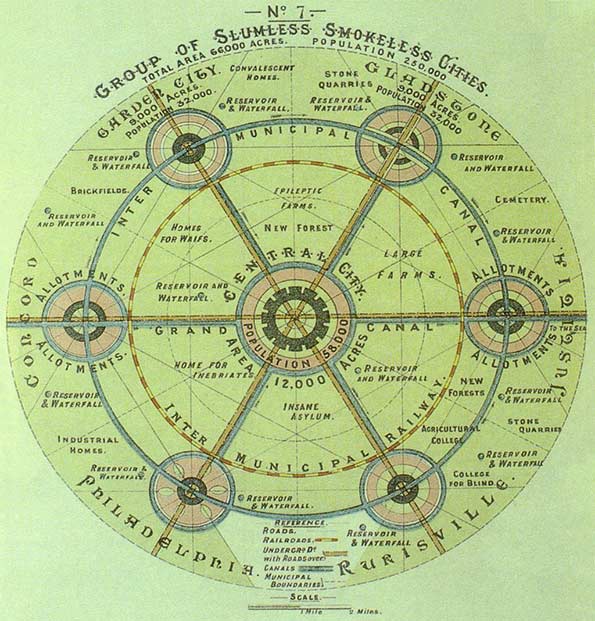

    Ebenezer Howard’s utopian vision

    He outlined the need to return to funding principles similar to the garden city model, where development trusts retain freeholds on the land. This model, based on investment in infrastructure and services, is a fundamental principle that shifts from short-term returns to a long-term relationship created between the collective or public landowner and local inhabitants.

    Lessons From History

    Despite the fact that the garden city was a highly influential model throughout the first half of the 20th century, ultimately leading to the establishment of some key settlements in the UK, US and elsewhere in the world, it has had few genuine successes. After World War II, similar utopian dreams of creating model communities, with decent housing surrounding a well-designed centre, met with the reality. British reformer William Beveridge famously summed them up for having “no gardens, few roads, no shops and a sea of mud”.

    You’d be forgiven for thinking that past lessons would be applied to the next generation of housing. But, even the post-war housing plans – though inspired by the garden city movement of the interwar periods – failed to plan the new housing in relation to transport, employment and public services such as shops and schools. While UK government reports have tried to draw lessons from both their positive and negative aspects, they have also been criticised in more recent reports, for lacking a sense of community – although it should also be said that “community” takes time to develop and cannot be “designed” as such.

    Many of the challenges of creating new communities are bound up in the spatial separation between newcomers and older inhabitants, a lack of social infrastructure, such as doctor’s surgeries and schools, and difficulties that stem from long commutes, such as lower net income and the strain this has on families. Ruth Durant found this in her 1939 study of Burnt Oak on the outskirts of London.

    Early post-war new towns were similarly criticised for their very slow build-up of health services, higher schooling, cultural facilities and decent shopping facilities, although some did better with the provision of local employment, due to many people moving to the towns with a local job linked to their housing. With shifts in the industrial economy, such beneficial connections between home and work (one of the tenets of the garden city) reduced over time.

    Modern Twist

    The challenges today are slightly different, however. People live more mobile and fragmented lives and are arguably less likely to be tied to place as was the case for the primarily working-class (and manual labouring) communities of the past. This poses the risk that community will be lost because of how transient people can be.

    But increased mobility and social interaction don’t have to be mutually exclusive. Indeed, a lack of mobility is the worst problem that can be imposed on a community: both work and leisure must be accessible to people. Plus, with the advent of the internet and grass-roots activism, connections can traverse space more easily. This has allowed movements such as the Transition Network, which brings communities together around sustainable issues, to blossom.

    Adapting to Change

    UCL’s EPSRC funded Adaptable Suburbs project has studied the evolution of London’s outer suburban towns over the past 150 years, providing some clues on what has made for the relative success of the original garden cities over other planned settlements. It is clear that their success has been dependent on excellent transport connections, coupled with the provision of local employment and access to employment at a commutable distance.

    Also important is the provision of a mixed-use town centre, giving a destination for a wide variety of activities in addition to retail: community activities, schools, leisure and cultural uses. Centres work well when connected to the street network, accessible by foot, bicycle, public and private transport. This multi-functional design has helped even the smallest of centres to sustain themselves through the most recent economic recession.

    A recent government report, “Understanding High Street Performance”, also found that successful town centres are “characterised by considerable diversity and complexity, in terms of scale, geography and catchment, function and form … [as] a result, the way in which they are affected by and respond to change is diverse and varied”.

    It is almost impossible to predict how society will change in the future, particularly as new technologies have the power to change how people connect and build community. But what is evident is that here lies another essential aspect of building successful communities: in allowing for places to adapt to change.

    This needs to be a foundational aspect of the government’s new cities – simply invoking the phrase “garden city” is not enough. By building places with sufficient flexibility of buildings, infrastructure and uses, coupled with links that allow for local and wider-scale trips to take place, with the necessary long-term financial investment, we can start to create places that will successfully weather the future.

    This article was originally published on The Conversation.

    Dr Laura Vaughan is Professor of Urban Form and Society at the Bartlett, University College London. She has been researching poverty and prosperity in cities, suburbs and the space between them for the past dozen years using space syntax – a mathematical method for modelling social and economic outcomes. Her edited book ‘Suburban Urbanities’ is due to come out in UCL Press in 2015.

    Photo: Which way are the flower beds? Matt BuckCC BY-SA

  • Sustaining Localism in the English Suburban Context

    Localism, a longstanding agenda of the Green Party in the context of the UK economy, is gaining ground in the current economic crisis. In a recent edition of the London-based Daily Telegraph, a striking contrast is made between Chester in north-west England – which is suffering from the decline of its relatively narrow economic base and Totnes in south-west England, which with its longstanding interest in alternative living, and more localised economy, seems to be weathering the situation much better. The underlying message from the article is that small is good – particularly for businesses not overextended in their borrowing, and familiar enough with their immediate context to be able to adapt to a changing economy.

    The New Economics Foundation think-tank, has been for several years campaigning against Clone Town Britain (namely, the over preponderance of chain stores at the expense of small chains and independent stores). Past criticism of the foundation for having an overly romantic notion of what constitutes a successful town centre may still continue, but there may also be some economic logic to a more locally oriented town centre strategy.

    Perhaps the best approach is to avoid either free-market efficiency ideology, on the one hand, or a strict local-only approach. It seems clear from other recent research into successful suburban town centres that a combination of national chains and good quality independents makes for the best mix to ensure long-term economic sustainability.

    This issue, like perhaps too much else in Britain, is currently subject to government action. The new Sustainable Communities Act now makes it mandatory for the UK government to assist local councils and community ‘stakeholders’ in drawing up local sustainability strategies for enabling independent businesses to survive in the increasingly cut-throat high street (the equivalent of the US ‘main street’).

    Yet as usual the government seems to overlook where most people live: the word suburb or suburban is nowhere in the Act. Possibly this is not surprising as the main focus is on large scale, infrastructure projects, but the continuing lack of attention in policy terms to the suburbs should be a matter of concern to those who believe a diffuse network of connections is essential to the continuing sustainability of the economy.

    It is equally worrying to see that the influential group set up by London’s Mayor Boris Johnson to focus on the outer London suburbs (which are cited as being his main source of political support in the mayoral elections) continues the pattern of focusing on the larger metropolitan centres at the expense of the smaller suburban centres in the capital. At an ‘Outer London Summit’ held on 11th June, Mayor Johnson made it clear that the policy focus continues to be on strengthening a constellation of “growth hubs” of economic activity, such as the metropolitan centre of Croydon in south London, despite the clear evidence demonstrating how smaller centres have an important role in making suburbs more sustainable.

    Within the next 20 years, most housing growth in England and Wales is predicted to occur in suburban settlements. This development is expected to be sustainable economically and environmentally, which means that suburbs will increasingly be required to provide local economic activities in order to minimise travel and to support cohesive and vibrant communities.

    The Towards Successful Suburban Town Centres research project at University College London has investigated the strategic contribution of Greater London’s smaller and district centres to the sustainability of the metropolitan region. ‘Sustainability’ in interpreted by the project team as referring to conditions favourable to local concentrations of long-lasting socio-economic and cultural activity.

    The research also has found that the widespread perception of suburbia as synonymous with social and architectural homogeneity belies its spatial, social, ethnic and economic diversity. With pressure to build large numbers of new homes increasing, there is a real danger that such perceptions become self-fulfilling.

    Initial findings suggest the success of local centres depends on the ability of their built environments to adapt to social and economic change by allowing pedestrian movement around an extended central area, balanced with accessibility to vehicular and public transport at larger scales of movement. Centres that support a wide range of locally generated activity are likely to be more resilient in the face of change than retail or purely residential monocultures. The results show that spatial variety and economic adaptability are both crucial to economic sustainability.

    This adaptability inherent to the suburban built environment needs to be more widely understood and promoted. The Towards Successful Suburban Town Centres project has found that where the town centre supports a diverse range of activities it benefits from increased by-product movement, where people do more than what they deliberately came to do during their visit to the centre. People visiting local town centres such as Surbiton (made famous by the 1970s BBC sitcom The Good Life), are not like shoppers at a ‘power centre’ dominated by a Wal-Mart. They don’t just shop for a specific item; they linger, eat lunch, drink coffee, research local cultural activities and indeed might be there for a business meeting. Surbiton, like many of London’s smaller town centres, has close links to larger centres such as Kingston, which alongside retail, offices and a university, boasts the new Rose Theatre led by Sir Peter Hall.

    The benefits here go well beyond the strictly economic. More time spent locally leads to a more vibrant mix of people on the streets and helps enliven the town centre throughout the day. This street network potential provides a critical element for sustaining the vitality of suburban and small town centres. The extensive and varied activity in lively areas enables complex routine daily and weekly movement patterns to emerge, thereby furthering the engagement of individuals with their locality.

    With the closure of chains such as Woolworths, however tragic for long-time customers and employers, the economic downturn also opens up opportunities for alternative high street activities. In one example, Art Space + Nature, an avant-garde Scottish art collective, have produced plans to bring new activities to empty shop fronts by putting on art exhibitions. The Institute of Community Cohesion is working on plans to create new indoor markets for local communities in closed business units.

    These and many other grassroots initiatives are localist at heart. The key may be in making sure that these attempts remain grassroots, and not too impacted by either large governmental units or major non-profits. To succeed, localism must be properly bedded in the community. Economic trends, as well as history, demonstrate that a bottom-up approach to creating lasting viable communities works not only in cities, but in suburbs as well.

    Laura Vaughan is a Senior Lecturer in Urban and Suburban Settlement Patterns and the Director of the MSc in Advanced Architectural Studies at the Bartlett, University College London and a member of UCL’s Space research group.