Author: Mark Schill

  • Riding Out the Recession in the Forty Strongest Metropolitan Economies

    A few days ago BusinessWeek released a list of the top 40 metropolitan economies based on data compiled at the Brookings Institution’s Metromonitor project. But, as many old media sites tend to do, they’ve locked the list behind a slow-loading slide show in a cheap attempt to drum up page views. Many of the commenters to the original article couldn’t even find the list.

    So, in the interest of usability, here’s the top 40 in boring list format:

    1 San Antonio, TX
    2 Austin-Round Rock, TX
    3 Oklahoma City, OK
    4 Little Rock-North Little Rock-Conway, AR
    5 Dallas-Fort Worth-Arlington, TX
    6 Baton Rouge, LA
    7 Tulsa, OK
    8 Omaha-Council Bluffs, NE-IA
    9 Houston-Sugar Land-Baytown, TX
    10 El Paso, TX
    11 Jackson, MS
    12 McAllen-Edinburg-Mission, TX
    13 Washington-Arlington-Alexandria, DC-VA-MD-WV
    14 Columbia, SC
    15 Pittsburgh, PA
    16 Harrisburg-Carlisle, PA
    17 Des Moines-West Des Moines, IA
    18 Virginia Beach-Norfolk-Newport News, VA-NC
    19 Honolulu, HI
    20 Rochester, NY
    21 Buffalo-Niagara Falls, NY
    22 Scranton-Wilkes-Barre, PA
    23 Augusta-Richmond County, GA-SC
    24 Colorado Springs, CO
    25 Madison, WI
    26 Albuquerque, NM
    27 Syracuse, NY
    28 Albany-Schenectady-Troy, NY
    29 Kansas City, MO-KS
    30 Raleigh-Cary, NC
    31 Ogden-Clearfield, UT
    32 Boston-Cambridge-Quincy, MA-NH (tied)
    32 New Haven-Milford, CT (tied)
    33 Bridgeport-Stamford-Norwalk, CT
    34 Denver-Aurora-Broomfield, CO (tied)
    34 Baltimore-Towson, MD (tied)
    35 Poughkeepsie-Newburgh-Middletown, NY
    36 Hartford-West Hartford-East Hartford, CT
    37 Indianapolis-Carmel, IN
    38 Memphis, TN-MS-AR

    Trends? Looks like energy economies, state capitals, university-heavy towns, generally affordable regions that avoided the housing boom, and a few old industrial centers that suffered the brunt of decline 25 years ago and now may be positioned for an up-swing.

    Here’s an explanation of the list methodology:

    The Brookings Institution ranked the 100 largest metros by averaging the ranks for four key indicators: employment change, unemployment change, gross metropolitan product, and home price change. Employment was measured by the change from the peak quarter for each metro to the second quarter of 2009. The peak was the quarter in which the metro had the most jobs during the past five years. Unemployment was ranked by measuring the percentage-point change from the first quarter of 2009 to the second quarter of 2009. Gross metropolitan product was measured from the peak quarter to the second quarter of 2009. And the ranking of home prices compared the second quarter of 2009 to the previous quarter. The employment data were provided by Moody’s Economy.com, the unemployment data were collected from the U.S. Bureau of Labor Statistics, and the home price index came from the Federal Housing Finance Agency.

    Source: The Brookings Institution’s MetroMonitor
  • Webinar: The Future of Rural America

    New Geography publisher Delore Zimmerman will host a webinar next week discussing the future of rural america. The webinar is part of the Rural Broadband Initiative organized by Northern Minnesota’s Blandin Foundation.

    From Blandin:

    If you are interested in rural community and economic development trends, this webinar is for you. Delore Zimmerman will provide guidance for rural community leaders about development trends and the steps communities must take to increase their investment attractiveness.

    The role that technology plays in increasing economic vitality will be presented both in theory and practice, and Delore will include information about successful regional economic development strategies.

    Here’s more information and registration for this free webinar.

  • New Job Market Report from Jobbait Adds New Data

    Mark Hovind over at Jobbait.com released his monthly job market report, and this month he’s expanded it significantly with sector-level data by state and metropolitan area.

    Mark offers the numbers in an easily digestible format organized by state in color coded tables. It’s a great way to get a feel for what’s happening in your region or nationally.

    Mark hopes this will help identify sectors with job prospects, even in regions where overall employment is declining.

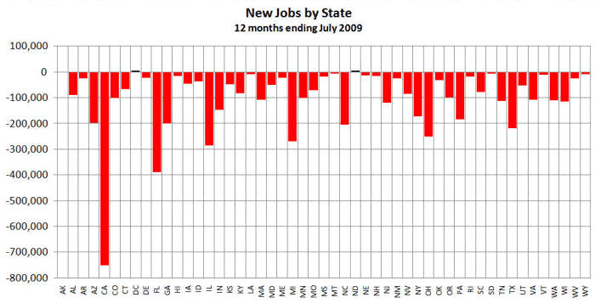
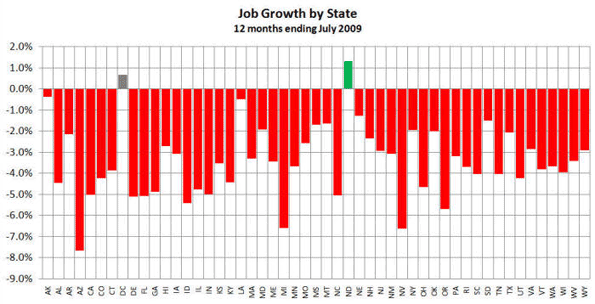
    Looking at total job growth, North Dakota is still the only state showing year-over-year employment growth, followed by Washington, DC.

    Fastest declining states by growth rate are Arizona, Michigan, Nevada and Oregon.

    Fastest declining states by sheer numbers are California, Florida, Illinois, Michigan, Ohio and Texas.

    See Jobbait.com for the full report.

  • Joel Kotkin at threedonia.com on DC, NYC and centralizing power

    “We often live under the fallacy that things will always be as they are coupled with the delusion that things have always been as they are. We forget that human history is mostly the story of tyranny, oppression, centralization — totalitarianism. The United States of America has stood athwart history for over two centuries. Our moment can pass… not in an apocalyptic way necessarily, but do we really want to be Sweden or France?”

    It Must Increase; But We Must Decrease?

  • Richard Reep at EMSI blog on Orlando’s Tourism Industry

    “As Reep outlines, the Central Florida city, among other resort towns, has been blacklisted by the federal government to host meetings and conferences because the government wants to avoid sites that “give the appearance of being lavish or are resort destinations.” A new public-sector emphasis to meet in locales such as Chicago and St. Louis hurts places like Orlando and Las Vegas, but Reep brings up another point…”

    Orlando’s Tourism Industry Hurting

  • Joel Kotkin at Instapundit on DC and the stimulus

    “JOEL KOTKIN: Rome vs. Gotham. “Urban politicians have widely embraced the current concentration of power in Washington, but they may soon regret the trend they now so actively champion. The great protean tradition of American urbanism – with scores of competing economic centers – is giving way to a new Romanism, in which all power and decisions devolve down to the imperial core. This is big stuff, perhaps even more important than the health care debate. The consequence could be a loss of local control, weakening the ability of cities to respond to new challenges in the coming decades.””

    Joel at Instapundit

  • Michael Lind Qutoted on BrothersJudd blog

    “Liberalism without labor unions?: Hey Democrats: Can liberal interest groups and social elites really form the basis of a successful political party? (Michael Lind, Aug. 25, 2009, Salon)”

    BrothersJudd.com: I woke up with what?

  • Michael Lind in BeliefNet on class struggle in politics

    “Writing from the left, Michael Lind has some pretty sobering words for his fellow liberals today, in a column asking whether or not liberalism is possible without labor unions. His point is that liberal politics today, unlike the recent past, is primarily a matter of social and cultural elites mobilized around issues that appeal primarily to educated urbanites, who typically have little interest in the economic struggles of the working-class people for whom they presume to speak.”

    Class struggle in American politics

  • Joel Kotkin in Patrol Mag on Green Jobs

    “EVERYONE IN America wants their town to hit the list of the top five places to live in the U.S.—clean streets, amazing mixed-use housing, and an easy walk to the corner grocery. But the question most developers fail to ask is: “At what cost?””

    Searching for a balanced urban growth model. – By Rebecca Horton – Patrol Magazine

  • Mapping Industry Employment Trends by State

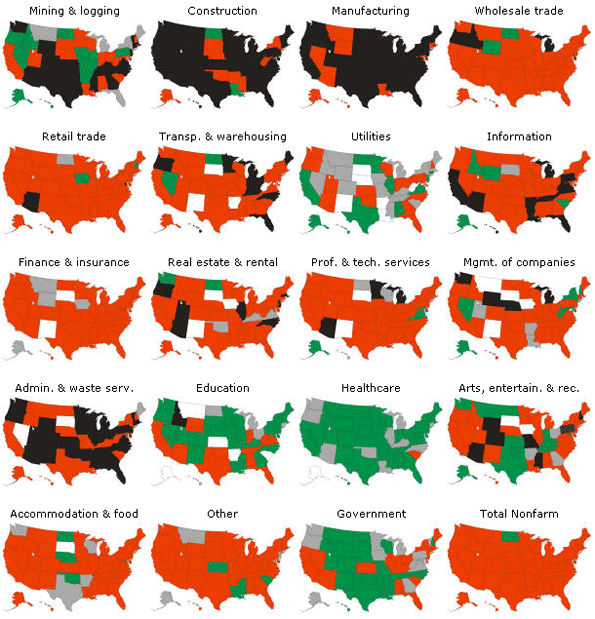
    Mark Hovind at Jobbait.com has released another fascinating set of maps and data on industry employment trends by state over the past few months. Here’s a taste:

    The maps below show the employment trends by state and industry sector for the 12 months ending June 2009 (July will be available August 21). Green is growing faster than the workforce. Grey is growing slower. Red is declining. Black is declining more than 8%. White is not available.

    Head over to Jobbait.com for the full analysis.