Author: Mark Schill

  • Projecting 30-45 Year Olds in the United States

    We constantly hear the the harping about “brain drain” in our local editorial pages and economic developer’s board rooms. Most of the time, the term is referring to college-age or immediately post college individuals. However this overlooks another slightly less mobile age group that might be more amenable to direct recruitment tactics: 30-45 year olds, or those that may be looking to resettle as their priorities shift more seriously to their career, their family, and more importantly a balance of the two.

    Now comprised of the smaller Generation X group, we’ll reach a low point in the United States for this age group in 2010:
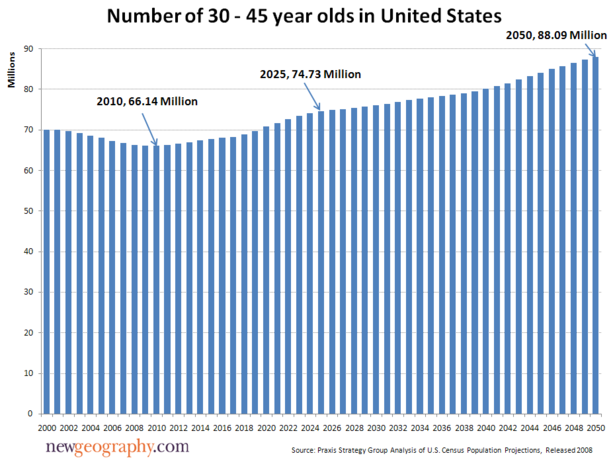
    As the larger group of the Millennial generation ages, we’ll see another 8-10 million 30-45 year olds in the US in the next 15 years, and this group will grow by nearly 1/3 by 2050.
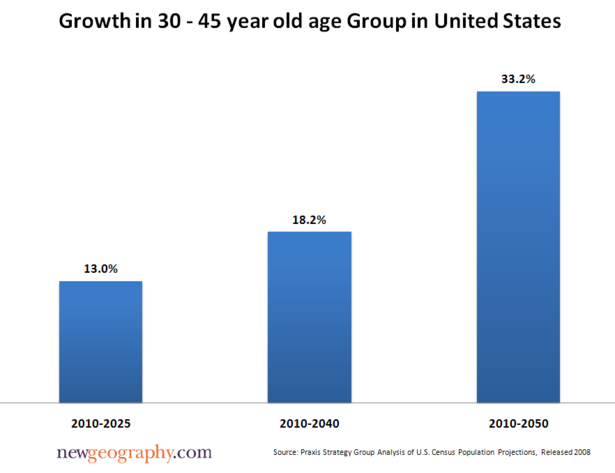
    Census projects very rapid growth of this group between 2040 and 2050, but keep in mind that folks comprising this rapid growth after 2040 are just being born now, so this projection will be refined as birth numbers become concrete in the next few years.
  • Mapping US Metropolitan Unemployment Rates, May 2009

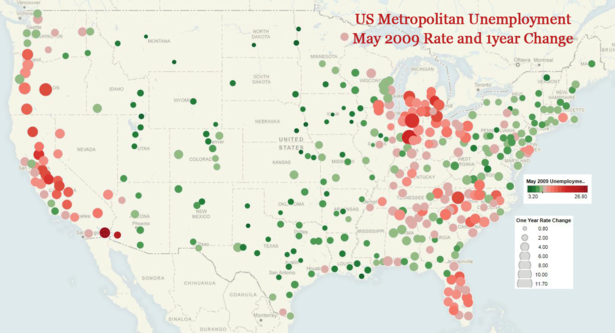
    Here’s a quick map of the newly released May 2009 metropolitan area unemployment numbers. On this map, color signifies the rate in May 2009 and size of bubble indicates the rate point change since May of last year. Green dots are below the national unemployment level of 9.1 in May, and red dots are above the national number.

    We can see that highest unemployment is concentrated on the west coast and California, manufacturing dependend Michigan, Indiana, and Ohio, parts of Appalachia, the Carolinas, and Florida.

    Unemployment is increasing the fastest in Kokomo and Elkhart-Goshen, IN; Bend, Eugene, Medford, and Portland, OR; Hickory-Lenoir-Morganton, NC; and Muskegon and Monroe, MI.

    While every metropolitan area of the country saw increased unemployment over May 2008, the Great Plains from Texas to North Dakota, the Mountain West, and parts of New England are still holding employment better than the rest of the nation.

  • Report on the Jobless Recovery: 18.7% Effective Unemployment Rate in May

    Is the recent talk of “green shoots” coming out of this recession realistic? A recent report from the New America Foundation outlines the strong likelihood of a jobless recession that “could perpetuate the crises in the housing and banking sectors and prevent a sustainable and healthy economic recovery.” A jobless recovery will prevent the wage growth necessary to stimulate business investment, maintain consumption, and pay down debt.

    The report outlines a constructed measure of effective employment: BLS’s measurement of unemployed, 2.2 million marginally attached workers, and 9.1 million workers employed part time only because they can’t find full time work plus another 4.4 million Americans who want to work but gave up the search over a year ago. This results in an 18.68% effective unemployment rate.

    Other highlights from the report:

    • The US economy must add 125,000 jobs per month just to keep pace with population growth.
    • Employment growth is further hindered by continued productivity gains through this recession.
    • As of Q1 2009, only 27% of employers experiencing mass layoffs anticipate rehiring some of the displaced workers.
    • The most severe unemployement and job losses are occurring in sectors comprising the productive economy, precisely the sectors that must grow to shift from the debt-financed growth of the recent past to growth driven by production and consumption made possible by rising incomes.
    • Mass unemployment is now fueling home foreclosures on prime mortgages: 5.7% of prime fixed-rate loans were overdue or in foreclosure last quarter, up from 3.2% a year earlier.

    Read the full report at New American Contract and check out the NAC’s Value Added blog.