Author: Matthew Stevenson

  • Superstorm Sandy & The Beachfront Bailout

    Deadline reporters, especially in weather broadcasts from the surf line, have been wailing about “this enormous storm” or “the unfolding tragedy.” What they might also say is that hurricanes are a munificent windfall for newspapers, television stations, the federal government, construction unions, and politicians seeking reelection. In addition to classifying storms from one to five on the Saffir-Simpson scale, going forward it might also be possible to grade hurricanes as profit centers, or by the surge levels that they generate in reelection campaigns.

    By all (usually breathless) accounts, Hurricane Sandy delivered a wide band of damage and destruction to areas stretching from North Carolina to Maine. Along with a death toll now approaching 50, a 13 foot storm surge in New York harbor inundated parts of lower Manhattan and Brooklyn, and millions of residents around New York, New Jersey, Maryland, and Pennsylvania lost power in their homes. The aftermath, unlike the legacy of Hurricane Katrina, however, is that the waters which flooded Manhattan’s streets, tunnels and subways are receding with ebb tides, although the damage from surging waves and fallen trees is widespread, especially across New Jersey.

    Although the storm will have cost the Mid-Atlantic region some $45 billion in cleanup costs, not to mention the loss of work days for many, even this perfect storm not seen in “a millennium” did not rack up the apocalypse that was predicted as Sandy “barreled” up the coast on its “rendezvous with destiny” in Atlantic City. From the teeth of the storm in New Jersey, my sister reported only an epic loss of cable and Internet.

    The reasons storms rarely appear as they are cast on television is because, instead of acts of nature with a lot of wind and rain, hurricanes are now best understood as political spectacles, somewhere between nominating conventions and state lotteries.

    Take the federalization of the disaster business. Previously storm damage and the costs of clean up were the responsibilities of states and municipalities, who in the first place made the decisions to allow homeowners to build houses and businesses on barrier islands, sand dunes, and low-lying waterfront property.

    For much of the twentieth century, insurance companies refused to write flood or hurricane policies for stilted houses perched precariously on Cape Hatteras or wherever, which angered wealthy political donors, who equate their life successes with owning beachfront property.

    Enter the federal government into the realm of disaster indemnification, when Congress passed the National Flood Insurance Program in 1968, to mandate that vulnerable home owners in potential flood zones purchase adequate insurance that private companies were refusing to cover. Think of it as Obamacare for beachfront homes.

    Although the legislation was designed to cover the undue risks of shore properties, it also gave the political parties a mechanism that would allow (for all those waterfront contributors) a building boom on hurricane-exposed barrier islands.

    At a time when global warming has increased the intensity and frequency of major storms and hurricanes (which are nature’s teapots blowing off steam), we are living with the fallout of an earlier era, when the federal government doubled down by writing insurance for beachfront condos from Maine to Texas.

    After the 2000 recount election came the transformation of Florida into a swing state in presidential elections, insuring that claim adjusters would reach hurricane damage zones as fast as FEMA’s first responders. Before the 2004 election arrived, four more hurricanes had passed over Florida. In their wake came billions in federal aid relief, just to insure that neither awnings nor chads would be floating in the wind.

    As powerful as hurricanes may be, they are no match for the construction lobbies, something I learned in the 1980s when writing about the National Hurricane Center in Coral Gables, Florida.

    The then-director, Neil Frank, a man of ebullience and integrity, showed me a slide show on the back of his office door, explaining that it was folly to allow construction on Gulf and Atlantic barrier islands. That was thirty years ago, and since then cities of flimsy beachside construction have risen along the dunes.

    What I admired about Frank was his passion for hurricane preparedness. He had walked the beaches of Biloxi, Mississippi in 1969, after Hurricane Camille, and measured that surge at 25 feet—something he then extrapolated to other beaches around the United States, including Atlantic City. But in urging a ban on beachfront buildings, he was shouting into an ill wind.

    Not only was the federal government complicit in allowing places like Myrtle Beach to become housing projects (the poet Robert Watson called it “white Harlem by the sea”), it also assumed that its job performance could be measured by the number of blankets and water bottles that reached those crazy enough to “ride out” a major storm in their seaside mobile homes.

    No doubt this is the Katrina Effect in American politics: The truism that if a big storm hits, the best place for the president probably isn’t dockside in San Diego, playing Otis Redding tunes on a guitar. Nevertheless, it means that the federal government (not exactly a profit center these days) is on the hook for the rescues, the clean up, and the insurance claims.

    The sad reality of Hurricane Sandy is that, despite all the Weather Channel epithets that it was “the storm of the century,” a lot of it was ordinary. It wasn’t even technically a hurricane when it came ashore near Atlantic City. What made it destructive was its size, and that it arrived late in the hurricane season and, by chance, merged with other Atlantic and Canadian storm systems. Imagine, however, if it had been one of Neil Frank’s dreaded Category 4 storms?

    Undoubtedly, President Obama would love to turn Hurricane Sandy into a backdrop for reelection spots that show him compassionate to his fellow Americans in times of need. The problem is that neither Wall Street underwater nor the flooded roulette tables in Atlantic City makes an ideal photo op or headline (“President Vows: We Will Not Let This Stop Us From Gambling!”). And I doubt he wants to campaign as the Claims-Adjustor-in-Chief.

    Photo: MTA New York City Transit, Bus on the Move. Morningside Heights, 125th and Broadway, October 28, 2012, as Hurricane Sandy approached New York City.

    Matthew Stevenson, a contributing editor of Harper’s Magazine, is the author of Remembering the Twentieth Century Limited, a collection of historical travel essays. His next book is “Whistle-Stopping America”.
  • Baseball Vs Basemall: Goodbye to the Games of Summer

    Even if the best-seller Fifty Shades of Grey did draw more fans than the Olympics (both sports involve “play parties” and metallic neckwear), the nominal American summer game is baseball. But that celebration of agrarian mythology and fields of dreams has descended to the level of a cable infomercial: white noise blended with car sales promotions, insurance deals, and breakfast cereals.

    As conceived and refined on nineteenth century sandlots, baseball was the symbol of the settled frontier, rules and regulations brought to a chaotic landscape populated with prehistoric giants (the Babe, Cobb, Teddy Ballgame, etc.). Now, in the twenty-first, it’s a video billboard; a familiar backdrop of sights and sounds orchestrated with the idea of selling something. The scores are incidental. The game has been lost to the vendors, and players are best understood less as pitchers, more as pitchmen.

    Fans used to watch baseball in a kind of meditative silent reflection, trying to put themselves into the mindsets of the manager or the players. Now they go to games as cash cows, to be milked in corporate barns.

    I came to these conclusions while sitting behind third base with my father at an AA minor league game between the Altoona Curve (a Pittsburgh Pirates franchise) and the Trenton Thunder (of the New York Yankees). The Curve were ahead 4-0, but the Thunder had the bases loaded and one of their sluggers, the larger-than-life Luke Murton, was at bat. The count was full, and this was the chance for Trenton to make the game close. A double would clear the bases.

    At such a moment of high drama, I expected from the fans either wild cheering for Luke or silent tension, as the pitcher looked in for the payoff pitch. Instead, Waterfront Stadium never skipped a beat of its consumerism.

    From the sound speakers around the stadium came the familiar game Muzak, a medley of charge bugles and recycled Top 40 hits. Around the stands fans stood in small clusters, holding beers, eating and chatting, as if at a barbecue. Luke’s at-bat felt little different from the transient images in a sports bar—something that you glance at while getting something to drink. No wonder Mighty Luke struck out. He was a footnote to the occasion.

    The reason that baseball is now little more than mall television has to do with the national passion for oligopoly. When the game was a sport, freely conceived and played across the country, every village, town, and city had a local team, and above them were the professional leagues. Stadiums were fields or parks, in the best sense of the words. Crowds watched the game from folding chairs, cheap bleachers, or grassy hillsides. There was an endless nationwide demand and supply for baseball, the American pastime.

    The problem with grassroots baseball, at least to the owners, was that there was too much supply of the product. Who needed to drive seventy miles to watch a dreadful team play in Kansas City, when Topeka had a good local team, with a few recognized stars and lots of bunting, sliding, and inside-the-park home runs.

    Beginning with the grant to professional baseball of an anti-trust exemption in the 1920s, the inside pitch of the owners has been to restrict the game to a handful of large American cities. Baseball as a club sport among towns and smaller cities has been snuffed out.

    Once baseball was in the hands of monopolists, players were no longer in it for the love of the game, and the winners were those who could dictate the prices of stadium box seats, cable subscriptions, and jersey sales. Think of Major League Baseball as a medieval guild, with the trade devoted to squeezing the fans on the rack.

    Because baseball became such a scarce commodity (doled out and protected by the commissioner, according to congressional fiat), team owners could threaten to move teams away from their home cities, unless given multi-million dollar stadiums, funded by taxpayers. Who would care about this carpetbagging if other baseball teams were nearby?

    Into the modern era, municipalities from New York to Altoona meekly complied with these ransom notes, and in the process have run up billions in debts and subsidies for a nominally privately-owned business that only provides jobs for ushers and shortstops.

    No edifice better illustrates the folly of baseball economics than the “new” Yankee Stadium, built adjacent to the old one for about $1.5 billion. The new one is a field of corporate and political schemes—for contractors, sky-box lessors, local politicos, season-ticket holders, and concessionaires. For fans interested just in watching a baseball game, the old and new stadiums are a wash.

    Although I am a Yankees fan, I find the new stadium to be a cross between former owner George Steinbrenner’s mausoleum and the sporting equivalent of Nuremberg’s rally fields. Pretentious columns of light now illuminate the façade, and around the interior are kitsch photographs of Yankee greats. The new stadium’s success can be measured in that it can cost a family of four $600 (parking is extra) to take in a game.

    Even at Yankee Stadium, the actual baseball game feels like a sideshow. There are giant video screens on the scoreboard, MTV commercials everywhere, the lure of $9 beer, and vast souvenir emporiums. No wonder fans at baseball games wander the stadiums as if they were at the mall.

    Another example of baseball’s descent into the service of online catalogues and corporate sponsorship can be seen, on a sports channel near you, in Williamsport, PA at the Little League World Series.

    Little Leaguers used to look like the kids playing baseball in the street, who would jump for joy when they scored a winning run and wear odd-fitting uniforms that they had snatched from their brothers’ closets.

    Now Little League is a Major League Baseball clone, and its World Series is a tournament of Mini-Me-isms. Batters stride grimly to the plate wearing hundreds of dollars of endorsed gear, from elbow pads and batting gloves to expensive helmets and space-age metal bats. Nearby are the disapproving scowls of enraged coaches and reproving parents. Whatever the score, joy has struck out.

    Contrast the morose business of Little League—chasing the same television revenue as the Red Sox and Dodgers—with the decline and fall of sandlot baseball, the felicitous schoolyard game that gave us the national pastime.

    In my travels around America, usually by car but often by train and bike, I despair at the absence of boys and girls playing informal baseball on local fields. Most baseball diamonds around the United States are as idle as Ohio steel mills. On Long Island, I recently passed dozens of fields with weeds growing up in the infield. Never once did I see kids choosing up sides or shagging fly balls.

    One reason so few American kids play baseball, I am sure, is because they associate it with the rigid hierarchy of parent-trapped Little League, not the pick-up games of summer I knew as a child. Those games began in the afternoon and only ended at darkness, when mothers rang the dinner bell, or we lost the ball in the woods.

    During the course of a pickup game, everyone got to pitch, catch, switch-hit, bunt, and field. Winning mattered less than playing hard and sliding across home plate. Nor were there coaches, parents, television announcers, sponsors, beer commercials, or umpires. As I recall those eternal games of summer, the only spectators were the fireflies that showed up at dusk.

    Flickr photo by LA Wad, ‘Giant Coke Bottle and Baseball Glove’, AT&T Park, San Francisco.

    Matthew Stevenson, a contributing editor of Harper’s Magazine, is the author of Remembering the Twentieth Century Limited, a collection of historical travel essays. His next book is Whistle-Stopping America.

  • Travel Bans: Do No-Go Lists Fight Freedom?

    Had the 1789 constitutional amendments protected travel alongside the rights to freedom of the press, religion, and assembly, the United States might be a less xenophobic country. It might be less prone to treat arriving tourists as terror suspects, and more encouraging to those of its own citizens who want to explore the world’s darker corners. Instead, foreign travel in the age of terror feels more like an imperial favor than a constitutional right.

    Europe now has few internal border controls, and tourists routinely depart for Algeria and Myanmar. The American government, however, equates travel with a political endorsement, and seems to think that economic embargoes spread the doctrines of life, liberty, and the pursuit of happiness.

    How many departing despots, making their runs for the border, proclaim, “I’d still be in power if it wasn’t for that damned travel ban!” Who thinks keeping tourists from Syria will persuade Bashar al-Assad to abdicate? Nevertheless, dividing the travel world into gardens of good and evil is an increasing preoccupation of the American government.

    Despite President Barack Obama’s celebrated processions and feel-good speeches in Europe and the Middle East, his administration and that of George W. Bush are easily the most xenophobic since President Woodrow Wilson in 1919 unleashed A. Mitchell Palmer and the young J. Edgar on alien associations.

    If you have doubts, add stickers to your luggage from Iran, Somalia, Yemen, North Korea, Cuba, Iraq, Syria, Libya, Afghanistan, Sudan, Pakistan, or Kashmir. See what questions you get asked when returning from your next cruise.

    The ban on Cuban travel dates to October 1960, although the absence of KFC chicken in Havana has done nothing to dislodge the Communist regime. The net effect of the embargo has been to allow the Castros to govern harshly in splendid isolation from American goods and services.

    Would Fidel and his brother have lasted in power for fifty-four years if they had to contend with the landings of Carnival Cruise Lines, instead of those CIA operatives at the Bay of Pigs?

    The U.S. does not explicitly ban travel to countries like Iran and North Korea, although because it is easy to construe travelers checks as commercial relations or to equate Revolutionary Guard souvenirs bought in the Tehran airport as contraband, few Americans are empowered to book passage to Pyongyang or Isfahan.

    Myanmar, or Burma, is another country on the suspect travel list, it being felt that idling in places like Rudyard Kipling’s old Moulmein Pagoda implies support for the ruling military junta.

    Not only does the United States discourage its citizens from wandering the globe freely, it has confronted foreign travelers coming into the US with a nightmare of entrance requirements, including demands for conforming photographs, biometric passports, and thoughtful answers to edgy consular questions. Europeans not on the visa-waiver program have to jump through hoops just to spend money in Disneyland. (“Visit America: Your fingerprints are already here!”)

    President Obama claims credit for “bravely” reducing restrictions on Cuban travel (group visas are now easier to get; relatives can go more often), but maintaining all the other Cuban embargoes, including those on American medicine, hardly adds up to a profile in courage.

    To counter these dark perceptions, there is something new called Brand USA, whose public/private mission is to “encourage increased international visitation to the United States and to grow America’s share of the global travel market. In doing so, we aim to bring millions of new international visitors who spend billions of dollars to the United States, creating tens of thousands of new American jobs.” Needless to say, a worthy goal.

    The $12 million ad campaign includes Roseanne Cash singing “Land of Dreams,” and the assumption that most tourists to America are here for bungee jumping (unless the high wires in the trailer are serving the interrogation needs of Homeland Security).

    The more insecure a government, the more likely it is to impose travel restrictions. The People’s Republic of China had it borders closed for years. Cuba has all sorts of rules to regulate which of its citizens can go abroad (generally only those who leave behind hostages). North Koreans live behind the barbed wire, as did the inmates of Enver Hoxha’s Albania.

    The Iron Curtain and the Berlin Wall were other examples of the degree to which strutting regimes will go to keep their citizens from foreign travel or, as V.I. Lenin said, “voting with their feet.” Who would think the United States would become the heir to the tradition of telling its citizens where they can go, and with whom they can spend their free time?

    Who believes that travel bans and trade restrictions had a hand in bringing change to the Soviet Union, South Africa, Libya, or Rhodesia? Embargoes beggar the local population and enrich the sanction breakers. But they suit the American imperium that wants its laws to govern every corner of the globe. Witness that a British bank was fined $340 million for doing business with Iranians.

    If traveling freely was a constitutional right, Americans could make up their own minds about where to go and what to see, even if it included taking the measure of Beloved Leader’s North Korea or of Potemkin’s villages in Russia. How many Americans would believe the government propaganda about Iran or Cuba if they were free to inspect the poverty themselves, or to mix with local pro-American populations?

    In the last decade the United States has fought wars, directly or by proxy, from Morocco to Kashmir, yet few Americans have been to these countries and even fewer are encouraged to have a look.

    More often than not, Washington ends up in conflict with those countries that start out on its no-go lists, for example, Libya, Syria, Iraq, Iran, Yemen, or Sudan. A travel ban or economic embargo is often the first salute in the drum to war.

    In most of the Middle East, only professional diplomats and journalists are deemed worthy to offer their firsthand impressions, although I would put more stock in backpacker accounts of Iran than I would in a State Department white paper.

    Because I am a wandering contrarian, the travel that often engages me is to countries that belong in the dustbin of history. I am drawn more to the Axis of Evil than to the Magic Kingdom or Vegas floorshows, although I return from places like Albania, apartheid South Africa, or the Soviet Union, immune to the charms of strongman governments.

    Everything I know about Pakistan’s dysfunctional tribal areas I learned in Peshawar, near the border with Afghanistan. I gave up on the Soviet Union after going there on a student tour in the 1970s. The reason I believe little that is reported about the Syrian civil war is because I drove across that country—in a rental car with my teenaged son—something I recommend to anyone… although not just at this moment.

    Flickr Photo by By Sem Paradeiro : Myanmar Visa

    Matthew Stevenson, a contributing editor of Harper’s Magazine, is the author of Remembering the Twentieth Century Limited, a collection of historical travel essays. His next book is “Whistle-Stopping America”.

  • Libor: Is The City of London Fixed?

    Having worked inside banking, do I think that banks colluded to post an artificial London interbank offered rate, otherwise known as Libor? For those not in the brotherhood, that acronym is a compendium of average borrowing prices from sixteen large banks, pronounced either as lee-boar or lie-bore. Before turning to conspiracy theories, let’s review the facts of a scandal that began more than four years ago, and are so murky that I, for one — despite twenty-five years in international banking — have a hard time grasping.

    In 2008, around the time of the September panic, Barclays and perhaps other large banks began obfuscating the true costs of their interbank borrowing, and submitted rates to the “fix” (in all senses of the word) that were less than their actual cost of funds. Why?

    Few creditors wanted to take a chance on leaving their deposits in large European or American banks, especially since so many, such as Lehman, Merrill Lynch, Countrywide, and the UK’s Northern Rock were shuttering their branch windows.

    Only by paying over the market rates could banks like Barclays fund their bloated balance sheets of subprime assets. (Big banks in 2008 were more like pyramid schemes.) If the market got wind of their true borrowing costs, it would have eroded what little confidence was left in the banking system. Barclays and the British government concocted (shall we say colluded?) to post rates to the Libor “fix” that did not reflect the bank’s actual cost of borrowing funds.

    As in Olympic scoring, when setting the Libor the highs and lows are thrown out, leaving the financial world with an approximation of what big banks pay to borrow from each other. When big banks actually trade with each other, however, they have to pay what they agree to with their creditors, not the Libor rates printed in the Wall Street Journal.

    In 2008, Barclays was paying over Libor. The British government was helping it to cover its wobbly funding tracks in the interest of showing the financial world that London banks were solid and creditworthy.

    Before this shell game, there was the another leg of the current scandal. From about 2005 onward, Barclays and others had been posting artificially high interbank borrowing costs, so that borrowers across the world would be paying higher benchmark rates on their loans and derivative contracts, valued in the trillions of dollars.

    The reasons are easy to calculate. Imagine that the world’s big banks can borrow from each other at 2%, but that they secretly agree to establish a Libor benchmark rate of 2.5%. The fifty basis points are pure profit to anyone funding loans at 2%, and then charging a margin on top of 2.5%.

    If true, Libor’s three-card Monte could have drained a reported $22 billion from unwitting borrowers. Nevertheless, while cabalistic traders were feathering their plush-carpeted nests, global regulators were also willing accomplices to the large banks in these rigged markets.

    After the crash, institutions like the Bank of England and the Federal Reserve Bank were desperate to recapitalize the banking system. The presumed results would be to improve the profitability of the banks, and make them less dependent on state funding.

    In fixing Libor, both high and low, Barclays probably thought it was doing the king’s bidding. No wonder its $39-million-a-year Chairman Bob Diamond expected a knighthood rather than a pillory.

    If much of this finagling happened between 2005 and 2008, why are bankers now heading to jail for aiding and abetting their senior managements or the regulators? Why now the moral outrage, Senate hearings, presidential soundbites, indictments, hair shirts, resignations, and headlines that the banks have yet again stolen our money?

    Although in theory banks are credit institutions, at least according to their charters, in reality they are political interest groups that occasionally grant loans.

    Among the oldest arguments in American politics are those that center on whether the US should have national or just state banks, and whether the circulating currency should be tethered to some commodity (gold, silver, toasters) or allowed to float unhinged on world money markets, as they now do (Nixon ended the dollar’s convertibility in 1971).

    Another divisive political argument has been whether banking and money should be beholden to big city interests (for example, robber baron J.P. Morgan) or to agricultural concerns (Andrew Jackson had them in mind). Morgan got rich on deflation when money was tied to gold; the farmers won with inflation because they could repay their loans with cheaper dollars.

    In Europe, the similar divide is between the propertied and working classes. In the Libor scandal, Barclays is synonymous with the remittance men in the House of Lords, living off coupons.

    Now on both continents, the political question is whether the financial system should be geared toward stimulus (cheaper money) or austerity (debt reduction; gold standards). In the US. election, Romney speaks for the hard money men while the Obama administration, like French President François Hollande, believes in fiat money with the revolutionary passions of Marat and Robespierre.

    Because both political blocs have their constituents and henchmen, Libor bankers are walking the plank for constricting the money supply, and spendthrift politicians are being turned out of office, charged with debasing the paper currency.

    Although the fine print of the outrage is obscure, Libor is at the subconscious center of the 2012 election and the future of Europe. No wonder headline writers and prosecutors are rounding up the usual banking suspects.

    The soundbite storyboards are perfect for a prime-time, election-season docudrama, starring greedy bankers, virtuous senators, victimized home owners who were bilked out of billions in a scam hatched in City of London pubs and carried out in corner offices.

    On the campaign trail the President could be heard to imply that plutocratic, Republican supporters of Mitt Romney are hand-in-black-glove with the rate fixers. The message is clear. The reason the world’s economies are in recession is not incompetent economic policies, but collusion between Wall Street and its UK counterpart, the City of London.

    In other words, the banking system has fulfilled its historic political mandate: to give every presidential election “a good, safe menace,” so that nervous voters can cast their ballots to keep the moneychangers away from the temples of democracy, even though they need a billion in soft money to light the altar candles.

    Flickr Photo by Garry Knight – The Dragon from the City of London’s coat of arms, cast as a statue.

    Matthew Stevenson, a contributing editor of Harper’s Magazine, is the author of Remembering the Twentieth Century Limited, a collection of historical travel essays. His next book is Whistle-Stopping America.

  • London Olympics 2012: Let the Games End

    Why does anyone persist with the Greek mythology that the Olympics are an engine of economic development, sportsmanship, or peace on earth? London is spending $15 billion on the hope that it can sell enough tickets to synchronized swimming, and earn enough from television ads, to cover the costs of the 30,000 rent-a-cops and military personnel being deployed in the spirit of Olympic harmony.

    Even though the Games break few economic records, except those for non-performing sovereign debts, governments around the world scramble madly every four years for the right to act as host, as if influence peddling were an Olympic sport.

    The original cost estimate, sold to the British public to convince them to get behind the bid for the 2012 Games, was about $4 billion. Those budget forecasts imagined that, after the event, Olympic sites would be recycled for use as schools, homes for the aged, and handicapped parking, even though earlier Olympic cities have found little use for their table tennis stadiums and aquatic centers.

    In 2005, London beat out Paris (narrowly), New York, Madrid, and Moscow for the right, if not the privilege, to spend billions of dollars (that no one has) on a temporary Olympic village, a badminton complex, and swimming pools suitable for the American relayers to lap swimmers from places like Albania and Costa Rica.

    Those who advocate Olympian edifice dreams include smiling politicians who can dole out sweetheart construction contracts; national sports associations, whose budgets are commensurate with gold-medal production; the International Olympic Committee, which in the past has been something of a Dream Team for backhand payments; and the television networks, which use the Games to fill the dog days of August and to develop various story-lines around medal-gobbling athletes (see Michael Phelps) or mildly voyeuristic content (women’s beach volleyball comes to mind).

    Everyone wins at the Olympics: stadium contractors, strutting central governments, and athletes who place high enough to be crowned with the laurels of corporate sponsorship. Well, everyone except the bondholders, who are left with little more than folded tents when the circus leaves town after three weeks of breathless commentary about women’s weightlifting.

    By chance, I have been to many of the cities that have hosted recent summer Games — Barcelona, Moscow, Beijing, Athens, and Seoul. In nearly each locale the thought crossed my mind that city residents have little more to show for their indebted billions than a few light-rail lines, perhaps an airport facelift, and impractical buildings that can be converted only into minimum-security prisons.

    Beijing still has its iconic Bird’s Nest and Water Cube, although neither stadium is used now for anything more than tourist photography and an aqua park.

    My son Charles and I spent a week driving around Greece after the 2004 Games. As best as we could tell, all Athens got for its now-bad loans were signs pointing the way to the Olympic Sailing Center (we even found these billboards miles from the sea), and a light-rail connection to Piraeus. Weeds covered the infield of the softball stadium.

    Barcelona, the 1992 host, ended up with some new apartment buildings — since the Olympics were played in downtown areas — a few marinas, and of course light-rail. Many cities, however, have successfully put up apartment blocks without staging a field hockey tournament.

    Nor did Moscow get the political bounce it had angled for when it hosted the 1980 summer Olympics. In protest over the Russian invasion of Afghanistan, the United States and many allies refused to send teams, giving the Games the feel of a Warsaw Pact scout jamboree. The paint peeled off the Olympic village faster than some of the times in the marathon. (In London, the US has decided against boycotting its own invasion of Afghanistan.)

    In theory, politics have nothing to do with the Games, although by organizing teams according to countries, the Olympic Committee has ensured that the spectacle is best understood as the continuation of war by other means, including archery and (in 1900) live pigeon shooting.

    When the modern Olympics were revived in 1896, individual athletes paid their own way to Athens to compete as amateurs. Now, nearly all nations field the equivalent of the East German swim team, a squad bred in laboratory test tubes to demonstrate a triumph of the will.

    The reason terrorists have the Games on their hit lists (Munich in 1972 was the worst example) is because the governments that they revile enter the stadiums with such wild displays of flag waving, as though the opening ceremony were a bullfight. At the London Games, security contracts are worth more than gold medals. For example, the British army is deploying surface-to-air missiles near the Olympic Stadium (apparently javelins no longer do the trick), and the FBI, in theory an exclusively domestic US Agency, is sending over about 500 agents, even though it was the Secret Service that won the regional escort trials in Cartagena.

    Does the corporate business of the Olympics negate the achievements of the athletes? Am I so cold-hearted that I cannot admire Joan Benoit Samuelson coming home in 1984 with the gold or Fosbury’s flop? Not at all. I enjoy watching Moldova lose at water polo as much as the next American. At the same time, there is something cartoonish about NBA All-stars dunking over a Latvian small forward.

    Were the decision mine, I would let the Olympics go the way of Nuremberg rallies. The Games strike me as ruinous to city finances and bad for sport. Should not the goal of the Olympic movement be to encourage more players and fewer spectators? Instead, the Games are a celebration of reclining consumerism. At least the athletes get to go through 100,000 condoms in 17 days.

    Nor does any sporting event that requires the protection of thousands of soldiers, surface-to-air missiles, and 24/7 cable coverage strike me as the spiritual heir of the Games first contested in a Greek sanctuary.

    Several school vacations ago, I took my younger daughter to Olympia, located in the western Peloponnese. We were tracking down the ancient wonders of the world, and Olympia once had a huge gold statue of Zeus, until “promoters” stripped it for parts and carted off the gold to Aleppo on donkeys.

    We strolled around the original Olympic stadium, which even today could be built for about $200,000. The “seats” are slopes of grassy lawn, and the field of dreams is covered with dirt. The rest of the Olympic village is a few pine trees and some worn temples, but it’s magical.

    Even during times of conflict, from 700 BC to 400 AD athletes came to Olympia from the contours of the Greek world, and left for home, if successful, only with olive branches in their hair. Along with paying honor to Zeus, the ancient Olympics celebrated athletic achievement, not prime-time nationalism or Coca-Cola. To show modesty, athletes were naked for their competitions. The Games ended only when Christianity moved to wipe out what it viewed as a pagan ritual.

    At the end of three weeks of the London Games, even if the British army has had to shoot off a few of its surface-to-air missiles, TV commentators will pronounce the Games an immortal success, a triumph of Spartan proportions, and an epic not seen since Jason came back with the golden fleece.

    Then, in three years, if not sooner, London will get the $15 billion invoice for its fun summer, and all it will have to show for it will be a few used diving boards and, with luck, some new light-rail. In the words of George Best, the great Northern Irish footballer: “I spent a lot of money on booze, birds and fast cars. The rest I just squandered.”

    Flickr photo by Jesse Scott / twowaystairs – Wenlock, the 2012 Olympic mascot.

    Matthew Stevenson, a contributing editor of Harper’s Magazine, is the author of Remembering the Twentieth Century Limited, a collection of historical travel essays. His next book is Whistle-Stopping America.

  • China’s French Connection

    No two countries would appear more divergent than France and China, especially in the age of Eurozone collapse. One country represents the Asian future, while the other is the capital of the failed, if diverting, old world.

    The French recently elected a socialist president and assembly on the basis that everyone should share the country’s deficits and decline. The Chinese, meanwhile, have enough surpluses to buy out the European Union, should they wish to exchange their EU debts for an equity stake. (Maybe they will choose to have Paris shipped east in boxes?)

    To take the measure of the two economies — although I admit this survey lacks academic rigor — I recently crossed each country by rail.

    In China, I rode a succession of trains, high-speed and low, between Beijing and Hong Kong, with stops along the way in Yenan (Mao’s revolutionary capital), Xian (of Terra Cotta Warrior fame), Chongqing (Chiang Kai-shek’s wartime capital), Zhuzhou (a rail junction), Guangzhou (used to be Canton) and Shenzhen (the biggest city near Hong Kong you’ve never heard of).

    I have also recently taken a number of train trips between Geneva and Bordeaux and crossed “France profonde” through the mountainous Massif Central, or gone on more roundabout routes through Toulouse and Tours.

    My conclusions, which even I find surprising: France has a better balance between its land and cities, as well as richer farms and a more sustaining political culture, even if the presidency is a reality show.

    China, at least from a train window, seems to be devoting most of its budget surpluses to moving the population into fifty-story, high-rise apartment buildings, the dormitories of its industrial revolution.

    Like France, China has a high-speed rail network that travels on segregated tracks, allowing for speeds close to 200 miles per hour. I went from Zhuzhou to Guangzhou in about four hours, a trip that used to take overnight. The stations of the expanding high-speed Chinese network, however, are outside the downtowns of most cities, so getting to them feels like a trip to the airport.

    Unlike trips in France, most intercity trips in China take place on slow night trains, with thousands of passengers tucked into open couchette berths. On my trip south, I was usually assigned the cramped middle bunk and rode, even during the day, like “John Malkovich” on floor 7½.

    The French have largely given up on night trains. My regional train from Geneva to Bordeaux is a milk run (skim, I would say, to judge by the amenities), with beautiful views but few passengers. French high speed trains — Trains à Grande Vitesse or TVGs — do go downtown, although the French have the annoying habit of routing every trip through Paris.

    In the current economic crisis, however, funding is being bled from the rails, and many TGV cars look thread-worn. Nevertheless, the TGV remains the inspiration for the Chinese high-speed system, perhaps because many Communist leaders had warm memories of their Paris underground cells.

    Sadly, Chinese cities retain few of their French inspirations. Apart from old Beijing and some quarters of Shanghai, Xian and Guangzhou, Chinese cities are faithful to Maoist doctrine in that that they serve as worker housing and base camps for industrial output.

    I may, however, be one of the few who prefers Beijing over Paris; the biking is better and the hotels are cheaper. Nevertheless, the average Chinese city is going the way of Los Angeles and Phoenix. The streets are less forgiving to cyclists, pedestrians, and kids playing after school. The outskirts of Chinese cities are great walls of housing projects that probably can be seen from the moon.

    In France, because I often travel with a bike, during waits between trains I sometimes go for a downtown spin, which has allowed me to discover the old world charms of Orleans, Tours, Toulouse, and Blois.

    Because French cities were laid out in the eighteenth and nineteenth century and not in 2003, they have narrow streets, often unsuitable for cars, but perfect for walking, bikes and sidewalk cafés. Bordeaux, a hive of narrow streets and small, self-contained neighborhoods, is an excellent example of a car-unfriendly French city that is flourishing.

    Away from the glittering high-rise buildings in places like Dalian and Shanghai, much of train-window China remains a poor country, a succession of terraced subsistence farms, cut out of rocky hillsides and inevitably encased in a steamy fog. Elsewhere, China has the fault lines of runaway development: a population confined to worker housing, and agricultural provinces that are stripped for minerals or exports.

    By comparison, French trains are never far from verdant pastures or neatly tended vineyards. Ironically, China’s detached “people’s” government is the largest consumer of first-growth French wines.

    The wine industry is one of the few meeting points where the French and the Chinese find harmony. China is now fifth (ahead of the U.K.) in wine consumption, and at the high end nearly all of it comes from Bordeaux and Burgundy. (The low end is a concoction of bootlegged Algerian and Rhône reds.) The reason that the wines of Château Lafite Rothschild can command $2000 a bottle is because newly coined Chinese millionaires find it a must-have brand.

    Since France produces a surfeit of wines, the trade should stimulate the economies of both countries for a long time. Nevertheless, French producers live on the precipice of Chinese wine tariffs, should the Beijing government want to promote its own vineyards south of Shanghai at the exclusion of those in Pauillac.

    Which country will fare better in the coming decades: China with its Dickensian economic juggernaut, or France with its budget deficits, despite having well-fed cows and landscapes worthy of Monet?

    Just because my Geneva to Bordeaux train crosses through the contours of an Impressionist painting does not mean that France will return to its imperial glories. Nor do China’s traffic jams mean that it will dissolve into Manchu feudalism. Furthermore, to paraphrase Chou En-lai on the French revolution, it may be “too soon to tell” if Chinese communal capitalism will put an end to the party or to free enterprise.

    Ironically, France does have the surplus of a self-contained economy, even if now it is in hock to German debt markets. Similarly, China has the deficits of post-Maoism—something close to the state capitalism of fascism—including that the best that can said of its Politburo is that it keeps the high-speed trains running on time.

    Personally, I hope that both countries do well. I love that in each I can take trains, get around by bike, read about the Revolution or the Franco-Prussian war, enjoy the cities—especially Beijing and Bordeaux—and, well, drink French wines.

    Photo: The new high-speed rail station, Zhuzhou, China; from the studio of Matthew Brady.

    Matthew Stevenson, a contributing editor of Harper’s Magazine, is the author of Remembering the Twentieth Century Limited, a collection of historical travel essays. His next book is Whistle-Stopping America.

  • The Beijing Bicycle: A Requiem

    Just because China has 500 million bikes on the road or tucked away in sheds or courtyards does not mean the two-wheeler has a bright future there, especially in its largest cities.

    Such is the growing indifference to the bike in China that no one seems to mind that the national model is manufactured in Taiwan (or under license on the mainland). With a single gear and heavy steel frame, the Giant is ideal for long rides on flat city streets. At a cost of US $180, it is the bike bargain of the world. Nevertheless, the dream for younger Chinese is a Honda scooter.

    The problem now in Beijing, Xian, and Guangzhou, if not in the country at large, is that increased prosperity is making city bike riding that much more a thing of the past. Wonderful Asian bike cities like Hanoi have already been lost to the noisy scooter and small car. Is Beijing next?

    Three years ago, Beijing was delightful by bike. Initially, I signed up with my friend George at Bicycle Kingdom to teach me the tricks of the narrow streets and the detours around Tiananmen Square. Ever since that first night of instruction, when we rolled out to the Olympic Park and down to the Temple of Heaven, I have been pedaling on my own power in Beijing and savoring every moment in the saddle.

    One reason that biking in Beijing is such a pleasure is that riders are accorded privileges lost to those sitting in traffic jams or drifting around on tour buses. During the 60th anniversary of the Chinese Revolution, a bike got me a front row seat to the spectacle.

    Beijing bikes have their own lanes, traffic lights, and rights-of-way, and a rider can easily thread his or her way anywhere. At railroad stations there are special bicycle parking lots, and even at the Forbidden City it is possible to leave your bike next to the front gate, as if you were a Mandarin.

    A few of the parks are off-limits to riders, but to my mind the only way to explore the hutongs — the historic districts of old Beijing, laid out like rabbit warrens — is on a bike, with which it is possible to roll past tea houses, food stalls, and open shops, as if in a Venetian gondola.

    Recently back in the capital, I spent a long day riding from Tiananmen Square out to Peking University, near the Summer Palace — about fifteen kilometers (a little more than nine miles) to the northwest.

    I had mapped out my route using a mixture of back streets and boulevards, and rolled away to find the Beijing grave site of the American writer Edgar Snow, whose 1937 book, Red Star Over China, was the first English-language account of Mao Tse-tung and a reportorial classic. (They met near Yenan, to which I went by train, but where there are almost no bikes.)

    To be sure, bike riding in Beijing is an acquired skill. I accept that it means weaving around buses, parked cars, delivery vans, and other obstacles. What surprised me on this long ride — about three hours in all — is how often the bikes lanes were flooded with motor scooters, cars, and a variety of motorized contraptions.

    After a while, I had my eyes attuned to the demographics of bike riders. They tended to be school kids or the elderly. From this blacktop survey, I judged that middle-aged or prosperous Beijingers have little appetite for riding. Most were moving around on scooters, the kind that have clogged many Asian cities.

    On earlier bike rides around Beijing, I found the experience sublime. This time it felt like I was riding for my life in New York City, outnumbered and outgunned by a variety of taxis, swerving motorists, and motorcyclists.

    Not only is Beijing going the way of Bangkok and other Asian cities that have been lost to gridlock, but the effects of non-riding can been seen among the Chinese themselves, more of whom are obese; undoubtedly KFC and McDonalds don’t help, either.

    Beijing is not the only Chinese city where I found biking on the wane. On my recent trip I also visited Xian, Chongqing, and Guangzhou, in search of Maoist redoubts and World War II battlefields. Chongqing (which has an excellent General Joseph Stilwell Museum and a Chou En-lai house) is built on hills, like San Francisco, so it has never been much of a bike city. Xian and Guangzhou are ideal for the bike, at least in their historic quarters. Yet each city is now overrun with cars.

    In Xian, I spent a long time just trying to find a shop that would rent me a bike. I went to several where the owners just shrugged. Finally, I borrowed a neglected bike from a hostel, but first had to take it in for repairs. No one had ridden this Giant in weeks, and the seat was set for a Lilliputian.

    You wouldn’t cycle to see the Terra Cotta warriors on a local clunker, as they are an hour by car from the city. But a bike is perfect to explore the Muslim quarter or to take in the Xian Incident Museum, which tells the story of Chiang Kai-shek’s kidnapping in 1936 and his subsequent agreement to recognize the Communist party. (Nothing focuses the mind like a kidnapping.) In Guangzhou I made it to the Sun Yat-sen Museum, but the snarling traffic scared me into a taxi.


    In Beijing and other cities, you still see bicycles loaded with garbage bags, cords of wood, furniture, dumplings, racks of clothing, and things like hundreds of fresh eggs. Some riders can comfortably bike around several family members on one frame, and it’s not unusual to see children following a parent through a busy intersection. In one alley, I biked alongside a man using his bike to move a large desk.

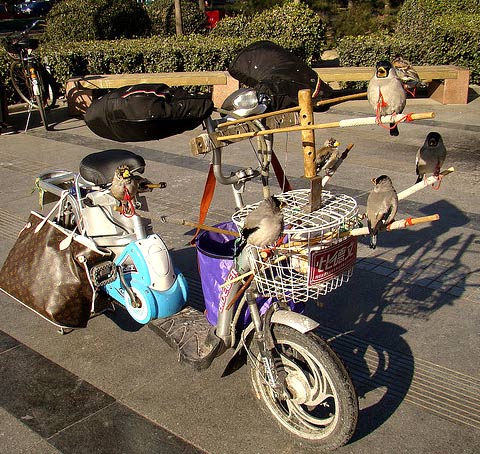
    In Beijing and Xian, I especially love the cyclists who have rigged up devices so that they can ride around with their caged birds, although one cycling raven of my acquaintance just sat on a wooden perch across the handlebars. Where will he be in five or ten years? I hate to think that Edgar Allen Poe was a writing an elegy for, among other things, the Beijing bike:

    Quoth the raven, “Nevermore.”

    Matthew Stevenson, a contributing editor of Harper’s Magazine, is the author of Remembering the Twentieth Century Limited, a collection of historical travel essays. His next book is Whistle-Stopping America.

    Photo: Raven on a Bicycle, Beijing, by the author.
    Flickr Photo: Bird Scooter; birds and paraphernalia on a bike in Beijing by IstoletheTV.

  • A Little Snooki in the French Presidential Campaign

    As a reality television series, it’s hard to beat the prime-time adventures of the French presidential election; as endless as the Republican primaries, but racier than Snooki’s antics on “Jersey Shore”. This ought to give pause to anyone who is relying on Parisian politics to save the European Union.

    To ensure that the Élysée Palace is inhabited occasionally by bigamists (François Mitterand), megalomaniacs (Charles de Gaulle), diamond smugglers (Valéry d’Estaing), or influence peddlers (Jacques Chirac), the presidential electoral system works like this: In the first round on April 22nd, candidates from a diverse number of parties across the spectrum will face off. If none of the candidates get more than 50 percent of the vote (unlikely), a runoff is then held two weeks later, featuring the top two finishers of round one.

    In the current cycle, the major candidates are President Nicolas Sarkozy (right of center; best imagined as a tough detective on “Law and Order”), François Hollande (socialist; looks like Seinfeld’s friend George Costanza), Marine Le Pen (far-right nationalist; uses the word deportation as a noun, verb, adjective, and term of endearment), François Beyrou (centrist; keen on the moral purity of centrism), and Jean-Luc Mélenchon (far left; speaks for those whom Le Pen would deport).

    According to the latest polls, which are notoriously inaccurate, Sarkozy should pull the most votes in the first round—followed by Hollande, Mélenchon, Le Pen, and Bayrou—but not enough to win outright.

    Enthusiasm for Hollande is tepid, and hardline voters, fearing he is a margarine socialist, might ditch him to vote for the florid, far left candidate, Mélenchon, although it is doubtful that Mélenchon would ever place second. In the runoff, if Sarkozy were to face Hollande, the forecasts are that the socialist candidate would beat the standing president, 54 – 46 percent.

    Campaigning in France takes place on nightly news programs that feature breathless, non-stop reports about the day’s political events. Sarkozy loves big indoor rallies in halls that look like Madison Square Garden, where only his supporters are admitted. They madly wave “La France Forte” placards (“For a Strong France”), while he denounces illegal immigration, Islamic terrorists, and economic stagnation. He has even campaigned against himself, saying, if re-elected, he would be “a different president.”

    The mundane facts of the campaign don’t explain why the election has become a prime-time drama, with most talk shows spending hours on the candidates’ love lives or on the scandal of the week.

    When he ran for president in 2007, Sarko was married to Cécelia Sarkozy. They met when, as mayor of Neuilly in Paris, he officiated at her first wedding. Three years later, they were a couple.

    During the presidential campaign in 2007, however, she told one interviewer that perhaps she might not vote. After her husband won, she acted bored at the thought of moving into the Élysée Palace (“all those rooms and servants…”), and famously blew off a Bush family cookout at Kennebunkport when she found out that it would involve spending the day with her husband.

    Those Sarkozys divorced. Cécelia said Sarko conceived of political office as a platform on which to seduce women, including some not dressed up as brides. Sarko brooded for about an afternoon and then took up with the singer, songwriter, and supermodel fashionista Carla Bruni, who sees herself as this generation’s Jacqueline Kennedy.

    Not to be outdone on “How the President Met Your Mother,” François Hollande has four children with Ségolène Royal, the socialist party candidate for president in 2007. Imagine a relationship—they never officially married—in which both partners want to be president of France? Ségo lost to Sarko in 2007. During that election it turned out that life-partner Hollande was “campaigning” with a Madame de Pompadour-like magazine journalist, who now might become the first official live-in girlfriend at the Élysée Palace.

    Although France is not a country that bores easily on the subject of sex, when voters are looking for other electoral diversions (why dwell on recession, illegal immigrants, angry Arabs, or the Greek invoice?), the newspapers are ready with a host of tabloid scandals.

    The mud sticking to the sides of Sarko’s Nixonian smile is his relationship with the rich heiress of the L’Oréal fortune, Liliane Bettencourt, who is suspected of having financed his 2007 campaign with envelopes that were stuffed from a Swiss bank account. Her bagman has been arrested, and the accountant is singing to the judges, but as a sitting president Sarkozy is immune from prosecution. Nor, until he leaves office, does he even have to answer questions about the bulging envelopes.

    Were the Bettencourt scandal a Burgundy wine, the review notes on the shelf might read, “Lush hints of the Swiss alps, with just the right amount of perfume and hidden pleasure, yet classically French. Drink now or hold until the election.”

    Because the socialists don’t want to go into pre-election prime-time sweeps without a scandal of their own, they can always rely on former party chief Dominque Strauss-Kahn, the excommunicated head of the International Monetary Fund, who on a slow day for news can be counted on to harass women, cavort with prostitutes, or land in jail, with each headline reminding the French that, save for the odd rape charge, he could well have been their next president.

    The latest DSK charges involve call girls who provided pleasures at a Lille hotel, and whom, when the mood and cash were right, flew off to far-flung DSK soirées. There, the president-in-waiting together with some (socialist?) corporate donors would loosen their chains and unite with these workers. (Marx would have approved.)

    In court, DSK’s lawyer claimed his client didn’t know the ladies were escorts because he only saw them in a natural state, when it’s harder to discern the “provenance” of the “goods,” which is how Strauss-Kahn referred to the women.

    Alas, scandals are included in a French presidential election only for entertainment. Neither sacks of cash nor tales of sexual escapades will determine how people vote. The working classes, based in large cities, vote for the left. Agrarian, conservative France guards its pocketbook and votes for the right. Centrism isn’t a French concept.

    Sarko’s chance is that he appeals to the middle right, a law-and-order president angry at Islam who has the backs of shopkeepers and farmers, all of whom are tired of strikes and lazy functionaries.

    Hollande — if he makes it to the second round, where he could well beat Sarkozy — can point to an incumbent who is presiding over a stagnating economy with high unemployment. But Hollande’s sonorous campaign might make voters long for someone more passionate, even Sarko, who each day reminds the electorate of some new red scare.

    Marine Le Pen, for her part, has made it clear that she would not put up with any more nonsense—not with rioting Algerians, not with bankrupt Greeks, not with German alliances.

    Still, nonsense and naughtiness might be exactly what the French are looking for, and that raises this question: Are the French toast?

    Photo: Nicolas Sarkozy at Davos, 2011; copyright World Economic Forum

    Matthew Stevenson is the author of Remembering the Twentieth Century Limited, a collection of historical travel essays, and recently edited Rules of the Game: The Best Sports Writing from Harper’s Magazine. His next book is Whistle-Stopping America.

  • Peyton Manning for President?

    Is the free agency of Colts quarterback Peyton Manning, or the trade of the evangelic Tim Tebow to the New York Jets a far more compelling story than anything yet to emerge from the presidential election news?

    Compared with Peyton Manning’s dignified handling of his neck injuries and his complicated departure from Indianapolis, Mitt Romney seems about as stately as those hair-rinsed, middle-aged men who show up on halftime advertisements with that Viagra look in their eye. (In Romney’s case he is trying to get a few primary delegations to head upstairs.)

    Even those seeking a greater religious presence in public life seem to find the faith of All-American Tim Tebow more engaging than the awkward positions of Rick Santorum, who sounds like he would pass out scarlet letters after his inauguration. And the YouTube Tebowing craze has breathed more fun and light into Christianity than any of Newt Gingrich’s C-SPAN homilies.

    Ron Paul, who speaks in complete sentences about Federal Reserve economics and the national surveillance state, must wish he could command the respect of a retired football coach, someone like John Madden, so that people would listen when he is drawing his Xs and Os to explain the gold standard.

    Had Peyton Manning tearfully retired from the Colts and announced his intention to campaign for president, I am sure he could have given Romney a run for his money. At least no one would begrudge him his millions. Romney’s two-Cadillac wife, $10,000 friendly bets, and country club bearing have doomed him with large swathes of the electorate. By contrast, Manning was able to spin four neck surgeries, a 36-year-old arm, and bad playoff performances into a Denver contract that could pay him $96 million over five years.

    When he signed his deal, you would have thought he had won a Nobel or negotiated a truce in Syria, such was the public acclaim, relief, and satisfaction that he would not have to face the off-season playing fantasy football or that he might be down to his last $200 million.

    The reason the electorate cares more about its quarterbacks than its candidates is because those running for office all sound like team owners, promising everyone season tickets to the American dream, while siphoning the revenue from the concessions and the sky boxes. At least NFL quarterbacks have to play the games and get their uniforms dirty.

    To be sure, professional football organizations no more want to dilute their market share than Democrats or Republicans want to open up the U.S. electoral system to all the small parties — greens, social democrats, Christian socialists, trade unionists, nationalists, etc. — that you find in European countries.

    The reason that the Broncos can afford to gamble $100 million on Peyton Manning’s neck surgeon is because professional football enjoys antitrust exemption, and collectively cashes the dividends of a market rigged more closely than one of Leland Stanford’s freight lines.

    With the blessings of Congress, football hires indentured servants (the draft), limits ownership franchises (the protected guild of the NFL), shares cable contracts, and raids public treasuries to build billion dollar stadiums that only benefit the owners (and perhaps a few beer vendors). Think of the NFL as just another political action committee.

    No wonder Mitt Romney campaigns for president as if auditioning to become the league commissioner, who serves at the grace of the owners and whose job it is speak sternly on 60 Minutes about “the integrity of the game.” In recent years, the real NFL Commissioner, Roger Goodell, has taken to fining players for violent hits and suspending coaches for tolerating bounties on opposing players.

    NFL careers are nasty, brutish and short. Who would pay NFL stars tens of millions if on any given Sunday the game looked like Ultimate Frisbee? As a result of football’s violence, ex-NFL players are prone to dementia and other crippling diseases, with little more support from the league than a handshake when their time on the field is up.

    Listening the bounty tapes, the NFL has no more claim to “integrity” than a hockey enforcer, but the façade is maintained that the league promotes “sport” and “fairness,” even if the Saints’ locker room was home to the mentality of a hit squad.

    Just as Goodell’s job is to preside over a closed chop shop but make it all look and sound like Chariots of Fire, President Obama is the league commissioner of the Fortune 500. That team can only dream of football’s antitrust exemption, even if it got in on some revenue sharing through the stimulus plan and TARP bailouts.

    If the president, even in a minor way, were serious about creating jobs, he could deregulate the football industry by ending the antitrust exemption and allow other owners and cities to form their own teams. Why does the US limit the supply of its professional football?

    Going long, the president could campaign against state and local subsidies ($20 billion by some accounts) for white-elephant stadiums that benefit only political cronies. He could take on the cable television oligopoly and let anyone with a webcam “broadcast” games that should be considered news events, not pay-per-view entertainments. He could also urge that college players be paid, as they work hard at many things, although school usually isn’t one of them.

    The reason that the football establishment has trouble tolerating quarterback Tim Tebow is because he represents the sandlot game as it was played before the sport became a subsidiary of the advertising business — a colorful if violent spectacle around which to plug Taco Bell or Coors Lite. (Players are best understood as animated billboards.) His passes may flutter like wounded ducks, but he’s a free spirit. Tebow is closer to democratic rule than to the corporate hierarchy of the football industry, no doubt one reason that the Broncos moved him along to the Jets, who at least have credentials in preferring anarchy to victories.

    In the presidential election, candidates Romney and Obama will raise and spend more than $1 trillion, and speak endlessly about the “integrity of the country,” even as the CIA posts bounties on the heads of American citizens living abroad. (Maybe disgraced Saints coach Sean Payton should pass his suspended year in Yemen? At least there his talents would not be wasted.)

    An election between Manning and Tebow would at least be fun, instructive, engaging, and offer clear choices. Manning would be the voice of protected industry, in which team owners or corporate sponsors are always munificent and wise, and always in the game for yet another government protection racket under the banner of competition. By contrast, Tebow would stand for a grassroots revival, prairie chapels, and the sense that the game has yet to be fixed.

    Flickr Photo by Tennessee Journalist: Peyton Manning at the podium, looking presidential.

    Matthew Stevenson is the author of Remembering the Twentieth Century Limited, a collection of historical travel essays, and recently edited Rules of the Game: The Best Sports Writing from Harper’s Magazine. His next book is Whistle-Stopping America.

  • The Leveraged Buyout of the GDR

    Until the European Central Bank purchased a call option on the future assets of the Greek government (which remains out-of-the-money), the largest leveraged buyout of a sovereign state had taken place in 1990, when the West German government acquired the German Democratic Republic (GDR), thought at the time to consist largely of liabilities. By most accounts the Bonn government paid over the odds for East Germany, estimated to have cost the West more than $1 trillion.

    The resulting peaceful unification of Germany has been one of the great achievements of postwar European integration. In recent months, Germany has faced the opportunity for another buy-out of a European neighbor, this time of Greece, but it has showed little appetite for the purchase. Does East Germany provide a model for the Greek bailout? ,

    To take stock of what the West Germans got for their investment, my son Charles, aged 16, and I recently biked around the principle cities of the East—Dresden, Leipzig, Weimar, Potsdam, and East Berlin—that for a long time fell on the dark side of the Iron Curtain.

    Berlin is unified and elegant, Dresden is a restored cultural monument, and Leipzig (where J.S. Bach lived) is a city of vast commercial and artistic ambitions. If our bike ride along the ragged edges of the Iron Curtain taught us anything, it was that the GDR was worth the money.

    To get to Dresden, we loaded the bikes onto an overnight express from Basel to Prague and slept until the train joined the River Elbe, historically the frontier between Western and Eastern Europe. In the last days of World War II, American and Russian armies met on its riverbanks at Torgau, just north of Dresden.

    At the end of the Cold War, the city synonymous with World War II fire bombings was a tired European backwater, with only a fraction of its royal splendors rebuilt and a trickle of Bulgarian tourists.

    Starting with the main railroad station in the early 1990s, the German government has transformed Dresden into a showroom for tourists and industry. The station is elegant and grand, a hybrid of the classical and the new, and Charles and I toured an ultramodern Volkswagen plant where the VW Phaeton, a bourgeois saloon car, is assembled largely by hand.

    We steered our bikes around the revived cathedral square, rolled past the elegant opera house, and wandered around the grounds of the royal palace. The city museum—like Kurt Vonnegut’s novel Slaughterhouse Five (a reference to his prisoner-of-war location, from which he witnessed the February 13, 1945 bombings)—tells how the city was engulfed in fireballs, the effect of detonating explosives detonated at an altitude of 2000 feet, which then sucked the air and life out of Dresden.

    To get to Leipzig, we biked northwest along the River Elbe, through industrial suburbs, apartment complexes, shopping centers, and finally a pristine landscape of orchards, villages, and river scenes. Only occasionally did we see the remnants of the GDR, the crumbling concrete so synonymous with the central committee’s five-year plans. Otherwise, the East has been gentrified.

    The 1989 revolution that brought down the Berlin Wall and the East German government started in Leipzig, with vigils in front of the Stasi headquarters and with larger rallies at the St. Nikolai Church.

    The Stasi building has been preserved as a memorial to its victims. The display cabinets are arranged around the offices of the secret police, complete with exhibits of wigs, tape recorders, phone taps, uniforms, typewriters, metal desks, maps, shoe phones, and devices suitable to steam open letters.

    Were its practices and legacies not alive and well in Homeland America, I would consign the Stasi to some dead-letter file, to be archived with Hitler’s SA in the dark nights of German history. The Stasi museum had the feel of an amateur theater production that had opened in East Germany and, after 9/11, moved to Broadway.

    From the museum director, I bought Anna Funder’s memoir of the GDR, Stasiland. She writes: “In Hitler’s Third Reich it is estimated that there was one Gestapo agent for every 2000 citizens, and in Stalin’s USSR there was one KGB agent for every 5830 people. In the GDR, there was one Stasi officer or informant for every sixty-three people.”

    In the U.S., the ratio of Homeland Security employees to the general population is one for every 1500 citizens.

    Weimar is the path not taken in German history—toward representative government and the celebration of intellectual enlightenment over what Bismarck called “iron and blood.”

    Charles and I found the assembly hall that lent its name to the post-World War I governments that were wiped away in the 1923 currency inflation. We rode to the houses of the poets Goethe and Schiller, each of whom found artistic freedom in the city that has the feel of a small university town, with libraries and parks. Nevertheless, the choreographers of Nazism and Communism arranged their own Weimar stage sets to tell the story that democracy leads to weakness, chaos and bankruptcy.

    Potsdam and East Berlin are monuments to vanished empires. Prussia’s Hohenzollern dynasty settled on Potsdam for its imperial palaces and amusements (one ballroom we saw is lined with thousands of seashells), and East Berlin was the people’s court of Stasiland.

    Funder writes of her visit to the condemned East German parliament: “Like so many things here, no one can decide whether to make the Palast der Republik into a memorial warning from the past, or to get rid of it altogether and go into the future unburdened of everything, except the risk of doing it all again.”

    Riding along the remnants of the Berlin Wall, which is preserved as an art gallery in several sections, I was curious about “ostalgie”—nostalgia for the simpler ways of the GDR, absent unified Germany’s cult of material ambition.

    Funder quotes a conversation about the Wall’s legacy: “It was an historical necessity. It was the most useful construction in all of German history! In European history…. Because it prevented imperialism from contaminating the east. It walled it in.”

    The highlight of the ride came between Leipzig and Weimar, where we spent much of our time exploring the Napoleonic battlefields of Jena and Auerstädt, where in 1806 France doomed Prussia to the fate of a second-rate European power until Bismarck redeemed the nation in the 1870 Franco-Prussian war.

    In tracking down the routes of Napoleon’s marshals, we rode through farm villages, towns, and small cities, many of which are rebuilding town squares or repainting important buildings—all part of the East German renovation. When Erich Honecker was the East German party chief, buildings were only painted up to the first floor, allegedly because that’s all he could see from the backseat of his limousine.

    It was just up the road in Leipzig where Napoleon lost his empire, in the 1813 Battle of Nations. It was perhaps the first attempt at a European Union. But Austria, England, Prussia, and Russia all decided that Napoleon was a nuisance on the continent, and sent him packing to Elba—even if they had to repeat the exercise at Waterloo.

    A similar coalition has tendered its offer to keep Greece in the grand alliance. Having East Germany in the money should give the EU confidence in its convictions, proof that it can be more cost effective to buy a nation than to put one through liquidation.

    Photo by Matthew Stevenson. Near Leipzig, formerly in East Germany, a railroad station that will soon be renovated.

    Matthew Stevenson is the author of Remembering the Twentieth Century Limited, a collection of historical essays. He lives in one of the wine regions of Switzerland. His next book is Whistle-Stopping America.