Author: Matthew Stevenson

  • Home Sweet McMansion

    Is the new American house, with three-car garages and laundry chutes like Olympic ski runs, an improvement over the old ones that were limited to a cozy dining room, a den, and a kitchen that held a small round table on which was kept a toaster?

    The size of the American house tracks the evolution of the budget deficit and national debt. Think of McMansions as you would the Federal Reserve Bank—an imposing edifice with the contents of the garage pledged to Household Finance, if not the Chinese.

    Many neighborhoods have become the United States of Gatsby.

    Because I live in Europe but travel across America to visit family and friends, I will start my appraisal in the guest room.

    In my wanderings, I have slept on bunk beds, fold-out sofas (one called “the rack of pain”), camping mats oozing air, and luxury, king-sized mattresses, suitable for a sultan. This summer, I woke up in the middle of the night to find two dogs nestled against my feet. My only objection was when they chose to growl at each other at 3:00 a.m.

    What makes a great guest room? My tastes are idiosyncratic, but I like a room that has bookshelves, a good reading light, a clock that works, a large desk, Wi-Fi, windows that open onto cool air, the distant sounds of trains in the night, hooks instead of closet hangers, and a cat that buys into guests.

    Instead of television, I prefer a radio beamed up to the BBC World Service and a side table of magazines (ones devoted to gardens, yachts, and celebrity divorces are the best) that I would never buy or read, unless I were a guest. I like coming down in the morning with up-to-date information on Jody Foster’s career. (She’s loyal to Mel Gibson, despite his crazy rants.)

    Having been recently in Pennsylvania, North Carolina, and New Jersey, I can report that the American guest room is alive and well. As for the rest of the new American home, the jury is out, or least meeting with the architect to design several thousand more square feet of pool rooms, wet bars, conversation pits, walk-in closets, and fireplaces that ignite with jet propulsion.

    When I last lived in the United States in the 1990s, our kitchen was the size of a pantry. If I held my arms outstretched, I could almost touch both walls, and the length was less than that of a stretch limo (literally and figuratively, imagine the oven in the trunk).

    Nevertheless, that kitchen was a perfect place to feed a family of four, prepare a dinner party, and hold a conversation. The cost to renovate the kitchen was about $900, but that’s because we went with a “custom” linoleum countertop that fit around the stove top. The overhead light came from a closed New York City school. A neighbor, whose services we won at a charity auction, repainted the cupboards.

    Now the American kitchen is the size of Polynesia and comes with archipelagos of “islands,” a nearby “family room,” television screens that could track a lunar launch, machines that dispense coffee and boiling water on demand, hidden drawers that contain freezers, enough marble to impress the Emperor Aurelian, and appliances that give the room the air of an operating theater.

    The “new” kitchen is designed to celebrate the diversity of American families—imagine Thanksgiving with the Brady Bunch, maybe over at Bill Cosby’s house—although best as I can judge from my travels, these tribal nations rarely eat together, in the kitchen or anywhere else.

    Like nomads, children and adults wander through the new American kitchen as if it were the Serengeti, collecting food and drink until the grazing land is stripped, and then they head off to a cave, to surf the web, text, or watch movies.

    I would say that the herd goes to the living room, but I haven’t seen anyone in an American living room since “Gunsmoke” was aired during the Eisenhower administration.

    Part of the reason that living rooms are now as forlorn as a safe house is because the television is elsewhere and because there are few formal occasions to sit in the American living room, which often looks as though it could be hired out to a funeral parlor.

    As a guest, I am sometimes granted a living-room audience. As a rule of thumb, however, Americans prefer to talk to their guests when standing up in the kitchen or sitting outside on the porch.

    Porches are one of the few areas of the house that modern architecture has improved. Screened porches used to be small and cramped, with patches on the screen where the bugs had drilled holes in the night.

    In places like Florida, there are now screened porches that are the size of the backyard; in fact, they are the backyard, and the netting and enclosed jungle trees give the terrace the air of a film location on “Survivor.” But I admire anything that allows me to sit outside, beyond the reach of mosquitoes. I also like the practical evolution of the outdoor kitchen, even though the idea seems better suited to the Roman senate.

    Part of the reason that many new American houses lack a central focus (think of the courtyard in a Spanish hacienda or an English fireplace) is because television is the high alter of fleeting attention, and screens pop up in all sorts of diverse places, as though part of a billboard campaign.

    I have seen televisions in the basement, in small dens, in exercise rooms, on kitchen and living room walls, and on small robotic arms that shift the blue haze around the bathroom as if it were yet another jet spray coming out of the shower or Jacuzzi.

    Nevertheless, television watching is a solitary endeavor and programs could be beamed into headsets, for all they foster family or community. Its effect on house layout is put up electronic walls that the architects have spent thousands of dollars to remove, in the spirit of open design.

    In my experience, happy houses are those that work in spite of their obvious flaws, like all those New York City apartments that used to have a bath tub in the kitchen or farmhouses with large wood stoves just inside the kitchen door.

    In the 1970s, I loved visiting a house in Maryland that instead of a front hall had an indoor rock garden. The meals were cooked outdoors on an open flame, but no one left the dinner table before midnight, unless it was to go for beer (kept outdoors).

    The house in which I grew up had claw-footed tubs and one shower. Between 1961 and 1994, when my parents lived there, home improvements consisted of cosmetics and painting (sometimes carried out by one Larry W. Jones, who was a family legend for his ability to paint windows shut).

    For years, my parents resisted “improving” the kitchen, because the walls had hand-painted fruit trees and it reminded them of a European café. Nor did they touch the wallpaper in the hall, which had similar scenes of the French revolution.

    When they sold the house, the new owners, no doubt in counterrevolutionary horror, tore it down and put up a McMansion, although I have a hard time imagining that they were able completely get rid of all the “fraternité” that would have been lodged in the walls.

  • Amtrak Fails To Weather The Storms

    Why do I persist in riding Amtrak, the short name for the National Railroad Passenger Corporation, a company originally owned by the freight railways, but now subsidized by Congress and run like a Russian bureaucracy, complete with late trains, sullen employees, myriad petty regulations, budget deficits, cold coffee, feather bedding, broken seats, clogged toilets, rail cars that feel like buses, and a schedule that serves the interests of congressmen, lobbyists, unions, budget stimulators, and small-town mayors, but rarely passengers?

    Isn’t it time to let Amtrak go the way of such failed railroads as the Nickel Plate, Erie Lackawanna, Chicago & Alton, Rock Island, Maine Central, Wabash, Missouri Pacific, or the New York Central, lines that outlived their corporate incarnations and were either wound up or merged into larger entities?

    Amtrak was set up in 1971 to replace the passenger rail network that was killed off by government regulations, the Interstate Commerce Commission, subsidized air and road travel, and urban blight. The new entity went to work hauling passengers on a route system better adapted to 1921 than 1971. The earlier trains were faster.

    It’s hard to imagine Leland Stanford or E.H. Harriman buying into the Amtrak business model. Forty years after Amtrak’s creation, little of its plan has changed. It offers corridor services on the East and West coasts and, in between, a meandering schedule of trains that account for less than one percent of all intercity travel.

    Buyers could easily be found for the Northeast Corridor service between Boston and Washington. Better yet, allow competition on the line, and auction off the franchise rights, using the proceeds to pay down national debt.

    England had the dreadful network that operated as BritRail. After it was privatized, Britain’s rail service became competitive, passenger friendly, faster, and more comfortable.

    Compare the new British private train system with the Amtrak experience (“Enjoy the journey”). Think about New York’s Pennsylvania Station, a subterranean strip mall with dank corners, uncomfortable chairs in cheerless waiting rooms, confusing destination boards and dreary platforms that have seen few improvements since I first used them in the early 1960s.

    Passengers buying Amtrak tickets in Penn Station stand in a line that feels like Ceauşescu’s Romania. Only one or two agents are on duty, the tickets are expensive, you need you an identity card to buy one, and getting on the train has the feel of descending into a Chilean mine.

    At the cost of billions, there’s a plan for a new “Moynihan Station” across the street, although much of what’s wrong with Penn Station could be fixed if Amtrak outsourced the operation to Hyatt.

    Its shoddy service explains the rise of discount bus lines that are now digging into core Amtrak passenger revenue between Boston, New York, and Washington. Companies such as Bolt Bus charge $15 or $20 to get from New York to Boston, while Amtrak costs $67 to $95, depending on the day and time.

    Bolt leaves from West 34th Street, and departures are punctually on the hour. The seats are cramped, but the buses are clean and have Wi-Fi. The trip takes less time than many trains, when you add in inevitable Amtrak delays. Nor is there a surly Amtrak conductor reading the riot act at each station.

    To get a flavor of Amtrak’s attitude toward its passengers, read the cheerful words of its CEO in the on-board magazine: “Our identification policy, random screenings in stations, random on-board ticket verification process and more interactive police efforts—including our K-9 teams—are some of the visible activities we have been working on.” Trains used to advertise comfortable berths with sleeping kittens.

    Killing off Amtrak would mean the end of long-haul passenger service, the sleepers that are the heirs to trains like the Twentieth Century Limited. I would deeply regret the absence of long-distance train travel in the United States. But, were Amtrak spun off, its overpriced and indifferent service might be replaced by a network of private operators that would compete to take Americans around a glorious country that longs to be seen by rail.

    Even today, Amtrak trains run near full capacity, and the potential to tap into a travel-happy country of 300 million ought to interest a few hedge funds and stock jobbers, not to mention flourishing overseas rail companies.

    Already there are nascent private companies and sleeping car owners that offer rail trips to national parks, art museums, jazz festivals, baseball games, and the homes of famous writers. Deregulate the passenger industry, and companies like these will flourish. Railroads are in America’s entrepreneurial DNA.

    Recently, for $325, less than the cost of a cramped night in an Amtrak “Slumberette” (emphasis on the “ette”), I rode round-trip in a private rail car, New York Central 3, owned by Lovett Smith III, from New York to Pittsburgh.

    Along the way, I sat on the open, rear platform from which presidential candidates whistle-stopped across America, and took in the sweep of the Philadelphia skyline, the majesty of Amish country (I loved the teams of horses pulling plows), the arched bridge across the Susquehanna, the engineering marvel that is the Horseshoe Curve, the path of the Johnstown Flood, and the remnants of the steel industry around Greensburg. Inside the car, I chatted with my fellow passengers, ate elegant meals, and sampled Italian wines (a group on board had organized a tasting). Were Amtrak a service company, not a protection racket set up to bleed government money into padded contracts, it would have the imagination to operate similar excursions.

    Instead, Amtrak wants to position itself as the paymaster for a national rail plan. The Department of Transportation recently issued a strategic plan called Moving Forward: A Progress Report. (If Amtrak were to issue a report to its passengers, it could be entitled, “Sorry for the Inconvenience: Due to a Track Incident, We’re Being Held in Baltimore.”)

    Amtrak imagines itself as the federal agency that should be hired to spend $117 billion, over thirty years, to build a segregated high-speed rail system between Boston and Washington, and for additional billions, to operate Core Express Corridors between cities less than 500 miles apart.

    Such visions of grandeur come from a company that needs nine hours and fifteen minutes to run a train the 444 miles from New York to Pittsburgh; that’s an average speed of 48 m.p.h.

    To be fair, not all of Amtrak’s failings are its fault. Most of the tracks on which it operates are owned by freight companies that find passengers a nuisance, and think nothing of shunting aside “the varnish” to send through more coal and containers.

    Amtrak, however, is responsible for a corporate culture that makes a mockery of “customer service.” In many ways, it is the perfect metaphor for everything that is wrong with letting Washington have a heavy hand in the economy, or for imagining that an economic revival can be built around companies with federal guarantees.

    Amtrak lacks direction, lives off subsidies and stimulating money, and now wants $117 billion to operate high-speed rail that, for the cost differential, would be only marginally better than the private bus companies now competing up and down the East Coast, with fares of one third or less than what Amtrak charges.

    Americans would happily pay for low-speed rail, if the food was good, the seats spacious, the broadband fast, and if, on the rails, they could surf, shop, eat tacos, and watch movies.

    At the moment, I am riding an Amtrak train that is four hours behind schedule on its way into North Carolina. So far, to use a phrase from railroading legend, the services have not been worth a “plated nickel.”

    Photo By Kyle Gradinger, Amtrak Keystone Snowstorm I. Amtrak AEM-7 locomotive 904 leads a Keystone Corridor train through the snow in Rebel Hill, King of Prussia, PA.

    Matthew Stevenson is the author of Remembering the Twentieth Century Limited, winner of Foreword’s bronze award for best travel essays at this year’s BEA. Growing up, he was a “Central” man, but loved the majesty of the old Pennsylvania Station. Together with his father, now 91, he recently has waded through a 1969 edition of the ‘Official Guide to the Railways’. He lives in Switzerland.

  • Divining The Stock Market’s Future

    Like the rest of us, I pick over the stock market’s runic inscriptions to find meaning in earnings reports, ratios, analyst reports, and trend lines, hoping to divine the traces of an orderly world—something it clearly is not.

    In modern nations, especially the United States, the averages of stock exchanges have, at least psychologically, become synonymous with the national pulse and well-being. America was a happier and more prosperous country when the Dow Jones industrial average was above 14,000, as opposed to its current levels of around 10,000. To be more precise, the country is about thirty percent less happy than before the crash of 2008.

    What has accounted for the changes in the market, not to mention the selloff in the national psyche?

    A favorite book about the market psychology of the U.S. economy, Clement Juglar’s “A Brief History of Panics,” was published in 1916. It makes the point that since the founding of the republic, the country has experienced booms and busts roughly every ten years, and that the market has three phases: Panic, when assets get dumped; Liquidation, a period of deflation, where we are now; and Prosperity, when credit is easy, people buy things, and stocks go up.

    For the moment, the stock market, like the economy at large, is in Liquidation. Few investors wake up in the morning with the idea of acting on a tip that they heard whispered at a club dinner. Buying stocks is something that your grandfather did, probably in a drab suit and a kind of Jack Ruby hat.

    Are stocks a good deal? The overall exchange is in the doldrums — real estate is bust, the only new employer is the Census Bureau, banks are black holes. Dow Theorist Richard Russell advises his subscribers, “We’re now in the process of building one of the largest tops in stock market history. The result, I think, will be the most disastrous bear market since the ’30s, and maybe worse.”

    But unless you are a gold bug, even now stocks are better deals than the alternatives: lending your money to a wobbly government (T-bills and bonds to insolvent nations), leaving it on deposit at a bank (zero return, and bank balance sheet risk), or flipping condos in Miami (do you really want to be a landlord?).

    I still believe there are quality stocks that are cheap enough to buy, and, chosen well, stocks throw off cash, offer an inflation hedge (those that can reprice their products easily), and can be bought in any amount. In high school I invested $180 in an obscure company my father had never heard of, Toyota. Wish I still had it.

    The reason stocks are languishing, however, is that most investors feel burned by the collapse. They bought things that their brokers, their friends, or their golf buddies suggested, and those financial instruments went up and then down, for reasons few understand.

    Take GE. When it was $57 a share, and growing at twenty percent a year, CEO Jack Welch was a genius and writing books with modest titles like “Leadership” or “Winning.” The company was “well positioned,” and, according to most brokers, a client’s portfolio “needed a little” for the long term. Anyone who had it made money.

    Now it’s $15, and is probably a better company than when it was at $57, but nobody wants any of it. Welch is remembered as just another guy who raked in millions in stock options, treated the company like a honey pot, and dumped his wife for a hot editor.

    Even at $15, however, GE is still expensive to buy. It’s price-earnings ratio is twelve times (meaning you give them $12 for every $1 you get back in earnings), and the yield is 3.2 % (what you earn while holding the share). GE would actually be a good deal when the stock price drops to $10, the P/E is eight, and the yield is 5.4 %. From that low entry point, you will stay “in the money” for a long time.

    What ruined the stock market in 2008? I would argue that the government’s demand for funding collapsed the pyramid schemes on which modern investment banks, not to mention stock markets, were built. In Juglar’s phrase, it was a panic of liquidity.

    The federal demand to fund the U.S. deficit and the suspicious balance sheets of Fannie Mae and Freddie Mac dried up the easy money that had previously allowed the Lehman brothers to party on in commercial real estate. In turn, the stock market ran up on the fumes of bank and personal leverage, much drawn from home equity. Now that money is propping up mattresses.

    Much of the stock market collapse, however, is because buyers will only pay a low premium for shares. A stock that once traded at twenty times it earnings, but is now trading at twelve times earning, will have lost almost half its market value. Ironically, the underlying fundamentals of such a company may be little changed.

    Look at Johnson & Johnson. Most of its key ratios have improved steadily over the last ten years, yet at the same time it’s stock price is down, because investors will not pay the multiple that they paid previously to own it.

    In 2007, J&J earned $3.63 a share, when it traded around $67 (that’s a P/E of eighteen). Now it brings in about $4.84 a share, yet the company’s stock price is $58. It still sells for a premium of twelve times, which is low for Johnson & Johnson, but not the kind of bargain that would tempt Warren Buffett, who wants the companies he buys to sell for a P/E under ten.

    To make money in the stock market, forget about “market sentiment,” “investor psychology,” or Jim Kramer’s “Mad Money.” Instead, think of the stock market as a mall that has high-priced boutiques, discounters, mom and pop stores, and even Wal-Mart. Who in America doesn’t understand malls?

    When you buy from the elegant boutiques (stocks in favor, selling at high premiums, with brands that everyone wants, like Google), know that you are indulging an impulse, fashion buy, and that someday you may be trying sell the equivalent of last year’s Gucci loafers on eBay. (“Common stock, hardly used, a lot of buzz about this co., you pay shipping.”)

    In the stock-market mall, however, there are other shops, with companies that no one wants or has heard off, that will let you share in their profits, treat your money with respect, and even pay you dividends while you own them. Search for companies that have a sustained record of profitability, regularly increase their dividends, have relatively low debt relative to their capital, employ drab managers who drive Buicks, and have diverse products with broad appeal.

    Never buy a stock that has naming rights to a professional stadium.

    It helps if this company, for reasons beyond its control, has been “beaten up” in the stock market and if it trades at a historic low premium. In summer 1982, GE traded at a P/E of five times its earnings. When I started in banking, banks sold for less than book value, and a P/E of about seven times. At their peak, some traded at 32X earnings.

    If you are nervous about owning stocks, only buy a few, in companies that you can study and understand. Sell them the moment they reach your “selling price,” which is almost the moment when you look at your statement and think, “That’s doing okay.”

    In looking at the cycle of the American economy and its markets, Juglar saw Panic lasting a few months to a few years, Liquidation going on for several years, and Prosperity running five to seven years.

    Think roughly of the bull markets between 1982-89, and 1996-2001, and 2003-2008, and they reasonably track Juglar’s timetables. Yes, the current phases of Panic and Liquidation are no fun, but the pattern was familiar in 1916.

    Juglar’s investment advice: “Buy when the decline caused by a panic has produced such liquidation that discounts and loans, after steady and long-continued diminution, either become stationary for a period, or else increase progressively coincident with a steady increase in available funds; and sell for converse reasons.”

    I prefer the more shorthand market expression: “The only time to buy a stock is when you feel like throwing up.”

    Photo by roadsidepictures of Psychic World, Las Vegas, Nevada, built in 1938.

    Matthew Stevenson is the author of Remembering the Twentieth Century Limited, winner of Foreword’s bronze award for best travel essays at this year’s BEA. He is also editor of Rules of the Game: The Best Sports Writing from Harper’s Magazine. He lives in Switzerland.

  • Currency Wars: The Yuan and The Dollar Face Off

    In the currency wars looming between the United States and China, everyone is focused on the decline of the U.S. dollar and the overvaluation of the Chinese renminbi. In the standoff, China maintains a low valuation for the yuan — the unit in which the renminbi is denominated — against the dollar, insuring that Wal-Mart can fill its aisles with goods that cost less than the patio furniture and video games made in Paducah, Kentucky.

    The Obama administration would like to “jawbone” the Chinese to relax its currency peg, so that the yuan appreciates, making it possible for Chinese consumers to buy goods from the United States. This monetary logic assumes that Chinese buyers want to own serialization rights to “The Apprentice”, or are shopping for B-1 bombers, as at the moment that may be what the U.S. economy primarily has to offer for export.

    In trying to explain the depth of the current U.S. recession, economists have latched onto the phrase “structural issues,” to indicate that the U.S. needs fewer pilates classes and more steel orders if it is to pay down its debts and create new jobs. The phrase itself is a hint that the currency wars have provoked bizarre east/west role reversals.

    While the mandarins of the Chinese politburo sound increasingly like hard-nosed American executives, the Obama administration is speaking a language that could well be lifted from Mao’s Little Red Book.

    Like the Cultural Revolution, the U.S. administration came to power pledging to get rid of the “four olds”: old thoughts, old culture, old customs, and old habits. It might well have denounced “Party formalism” or “spiritual pollution.” Yes, there would be struggle sessions and the opposition of turmoil elements. But the result of the reforms would be a Great Leap Forward, although one that evidently comes with the price tag of $2 trillion in annual deficits.

    China’s worry, meanwhile, is that its economy relies on one client with a receivable problem. Its treasury sits on $1 trillion of U.S. government bonds and securities, the peg to keep the yuan in line with the dollar, while the dollar is sinking under the weight of its GM shares, subprime loans, entitlement IOUs, and health care payouts.

    Twenty years ago it would have been a dream to imagine “capitalist roaders” running China. Now, we fear having to answer to repo men.

    Like any nervous creditor, the Chinese leadership focuses on “payout ratios,” “interest cover,” “debt-to-equity,” and “price-to-book.” Mao might have warned about “spontaneous tendencies toward capitalism,” but the new Chinese leadership thinks more about solvency and capital adequacy.

    Hence the current American hand–wringing at IMF meetings and the calls in Congress to convene what the Central Committee used to call “Grievance Redress Societies.”

    While the Chinese are working on Saturdays, the Obama administration’s jobs policy, for the moment, consists largely of hiring America’s unemployed into the Census Bureau. Maybe we can expect large posters of Uncle Sam exhorting Americans: “Do Your Economic Duty: Stand Up and Be Counted!”

    Why do Americans have trade and payment imbalances with China? The short (and nonacademic) answer might begin by saying that Americans are in love with such big box stores as Target and Costco, and can’t own enough sheets, towels, housewares, wrapping paper, sweatshirts, shoes, T-shirts, caps, kitchen appliances, televisions, recliners, electronics, iPhones, picture frames, blue jeans, and sneakers, all of which China is willing to supply at cut-rate prices.

    Consumerism in China is not the state religion that it is in the United States. Shoppers in the U.S. congregate in malls and stores that are the size of the Vatican, and they walk around in the same hushed raptures. The average shop in China, as best as I can tell from my travels there, is the size of a closet and sells bags of rice, bottled water, Hand of Buddha Tea, little pots, bird cages, and shoots of bamboo, none of which are made in those retooled New England woolen mills.

    China would buy our software, were it not already stealing it. As it is, all the Chinese want from the U.S. is a few buckets of KFC chicken, some coal plants, and the odd New York Yankees cap. Too bad they don’t want to buy AIG, the city of Las Vegas, or the Social Security system.

    Although the last thing I want to be accused of is “mountaintopism” or “right opportunism,” my fear is that the failure of the Obama administration’s currency pronouncements, combined with the rise of Tea Party nativism, will provoke the kind of protectionism that would warm the earmarks of Senator Smoot and Congressman Hawley.

    What could be easier than to impose tariffs on a variety of Chinese–made goods? The problem with protectionism is that it will further delay the economic recovery.

    In the short run, protectionism could redress the monthly U.S. trade imbalance (up to $28 billion a month with China), stimulate a few jobs, and end the “capitulationism” toward the subsidized state capitalism of the Far East.

    Longer term, protectionism puts the U.S. on a path in which its economy will be isolated from the rest of the world, with these (“renegade”) consequences: trade collapses, government debt remains high, foreign investors disappear, costs and inflation increase, unemployment goes up, savings go down, and “the carefree clique” in Washington raises taxes to pay for these “opportunist errors.”

    The currency disagreements mask the inherent imbalances in the global financial system: the West consumes too much and saves too little, and the developing world, and countries like China, spend too little and horde too much. Only economic expansion, debt reduction, and expanded trade can redress this so-called disequilibrium. Neither protectionism, nor more Fed magic will do the trick. Nor will declaring a currency war against China.

    Even the Chinese know that it’s better to be a dog in peace than a man in troubled times.

    Photo by Eric Mueller, “It’s Money, Comrade!”

    Matthew Stevenson is the author of Remembering the Twentieth Century Limited, winner of Foreword’s bronze award for best travel essays at this year’s BEA. He is also editor of Rules of the Game: The Best Sports Writing from Harper’s Magazine. He lives in Switzerland.

  • Cruising Into Student Debt

    I once calculated that, for the cost of four years of education at a private American university, a student could take 105 cruises around the world. For the comparison, I chose only cruises that cost about $1,900, as who wants to go through college stuck with an inside cabin? As I imagine it, Cruise College (school motto: “Go Overboard on Learning”) even has some similarities to the landlocked undergraduate experience.
    For all I know it may exist, given that higher education is one of the few growth sectors in the U.S. economy.

    Despite the decline of American business, private colleges, state universities, night schools, and for-profit continuing education have boomed.

    Harvard College will get about 30,000 applications for the 1,700 places in next year’s freshman class. At the same time, there’s a strong demand for education at community colleges in economically depressed places, as laid–off workers retool for new jobs.

    Beyond colleges with bricks and mortar boards, there is also the flourishing world of online universities, which flash their pop–up banners each time you log onto the Internet. (“Welcome to Faber College: Knowledge is Good.”)

    “For profit universities” offer master’s in business administration or degrees in philosophy in exchange for computer clicks and (prepaid) tuition. But you don’t need an online degree from Ace’s Accounting and Appraisal Academy to understand that there are hidden costs.

    For years one of the hottest stocks on Wall Street has been Apollo Group, Inc., an education corporation that markets its degree under the flagship of the University of Phoenix.

    Its campuses (not to mention leafy computer servers, for online students) are spread across the country and operate in forty states. Among other theorems, Phoenix postulated that continuing educators like their “campus” to be near Interstate exits, and that students usually only will drive twenty minutes to attend class. (It was Mark Twain who said, “Never let college get in the way of the evening commute.”)

    Apollo’s stock went public in the 1990s, and reached a pre-crash high of $91 a share, before Wall Street reduced its grade to about $50. Still, it’s a billion dollar company with strong growth, and the University of Phoenix is larger than nearly all state universities, not to mention the Ivy League, with some 470,000 enrolled students.

    Faithful to its name, Phoenix believes in the redemption of the American spirit, and it attracts its students with the promise that more degrees will lead them out of their doldrums. Courses are practical, borrowing from the school of knocks.

    To “take this job and shove it,” Americans need new skills — as nurses, IT programmers, whatever — and Phoenix (“the drive-thru university”) markets classes at convenient times and places.

    The reality of online education, however, is more subtle, as students are not the instruments of a new enlightenment so much as the pipeline of subprime student debt. They are recruited not for their mastery in art or football, but for their ability to fill out bank forms that let Phoenix, like any for-profit school, tap into the vast subsidized gold mine of federal student loan programs.

    Imagine, one day, stickers on the back of their Volvos that read “Subprime State.”

    For-profit university cheerleaders and even the federal government often brag about the low default rates on student loans. The reason the loans stay current, long after students have flunked out of astrology, is because it’s impossible to walk away from the tuition bills.

    Neither a bankruptcy nor an incomplete allows a student an escape from lenders intent on debt collections. (John Blutarksy: “Christ. Seven years of college down the drain.”) Better yet, the ultimate guarantor of the loans is the U.S. government. Knowledge may be Good, but government-backed debt is better.

    According to the New York Times, the default rate on student loans was about 7 percent in 2008, the most recent year for which data are available; “In the 2008-9 award year, students at for-profit schools represented 26 percent of borrowers — but 43 percent of defaulters. The median federal loan debt for students earning associate degrees at for-profit institutions was $14,000.”

    There is an online Student Loan Debt Clock, which reports outstandings of $855 billion, more than the credit card debt in the United States. It goes up about $3,000 a second, which is 5,684 luxury cruises an hour.

    It could be argued that traditional universities have similar Faustian (he coached at Notre Dame) bargains with their students. In exchange for about $200,000, which funds all sorts of professorial sabbaticals and vague courses (“Proust, Prufrock, and Pederasty”), students get undergraduate degrees that can be redeemed for yet more study at the graduate level… should they want to find interesting jobs.

    Statistically, an undergraduate degree provides, on average, $50,000 more per year in salary than does a high school diploma, although it is about a wash, were you to invest the tuition money into an S&P stock fund. Engineers are paid more than poets; state universities offer better “returns” than private colleges. It’s hard to date a cheerleader at an online university.

    Is Cruise College a better deal than the great American undergraduate experience? I can only speak from personal experience, which is limited. I have only gone on one cruise, while I spent six years in the waters of American and European universities. My quick take: The cruise had better floor shows, but I preferred the college library. The food was about the same. Overall, it would be hard to distinguish those who were drunk at fraternity parties from those merely seasick on board.

    And at least the students at Cruise College, for their job networking practicum, can mix with retired American executives.

    Because I am a child of mid-century suburbia, I believe in the good of a college education. On the walls of my childhood room were the pennants of various schools, and we covered our grammar school books with the names of great universities. In high school, we laughed at the Woody Allen line: “I was thrown out of there during my freshman year, for cheating on my metaphysics final. You know, I looked within the soul of the boy sitting next to me.”

    I loved a lot about my university experiences — the seminars, my friends, and something the cafeteria staff called “Chicken Eugène.” Still, I have no doubt that learning has many paths and that, for some, cruising would work as well as Princeton or Cal State. And for universities to be the instruments of financial sleights-of-hand, as opposed to teaching the great books, seems as distorted as the sermons of Elmer Gantry.

    Herman Melville wrote: “A whale ship was my Yale College and my Harvard.” I never read Moby-Dick in college, but I heard that it was a quite a cruise.

    Photo by Jonathan Blundell

    Matthew Stevenson is the author of Remembering the Twentieth Century Limited, winner of Foreword’s bronze award for best travel essays at this year’s BEA. He is also editor of Rules of the Game: The Best Sports Writing from Harper’s Magazine. He lives in Switzerland and has two children at universities.

  • High Speed Rail: Fast Track To Nowhere

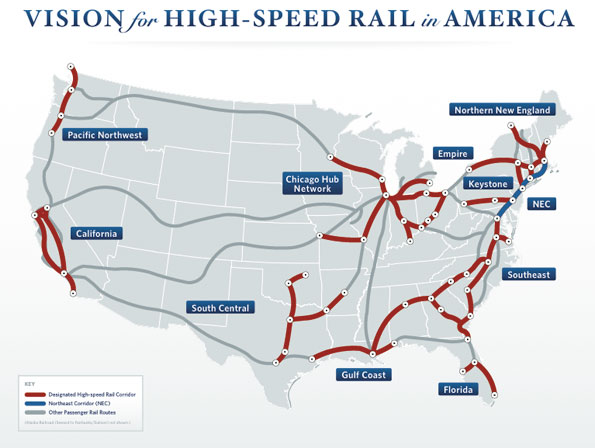
    Given that Warren Buffett ponied up $44 billion in cash and stock to take private the Burlington Northern Santa Fe Railroad, I wonder why President Obama is betting that the way to lift the country out of stagnant growth is to invest another $50 billion, in public funds, to swing aboard the dream of high-speed intercity rail.

    According to the administration, new money needs to be allocated to such high-speed rail (HSR) projects as those between San Diego and Sacramento, Orlando and Tampa, and — my personal boondoggle favorite — the DesertXpress between Los Angeles and Las Vegas, a $4 billion bet that getting high-rollers to the blackjack tables will lift the U.S. economy out of its doldrums.

    To establish some track cred, I spend much of my life dreaming about trains, consulting timetables on how to catch them, and plotting trips that might end up on night trains to Butterworth (the station for Penang) or Iasi (change in Ungheni, on the Moldovan border).

    More to the point, I have ridden nearly all the high-speed trains — in China, Japan, and France — that are being held as speeding examples of what the United States could build if Congress would fork over another $50 billion, and if the President could appoint a railroad czar with the acumen of E. H. Harriman.

    Painful as it is for me to admit, the $50 billion high-speed stimulus package is a way to lay track to nowhere.

    Take the rail link between Tampa and Orlando that imagineers hope will shuttle theme-parkers at speeds reaching 186 m.p.h. President Obama has already thrown $1.25 billion at the line. Presumably, the named expresses will be The Absentee Balloter and The Recount.

    Local officials have been busy buying rights-of-way and planning stations in their home districts, although, oddly, downtown Orlando is given a miss.

    When the stimulating project is finished for close to $3 billion, a family visiting Disney World can drive to the station, catch a high-speed train to Lakeland, pay a cab driver to take them to the Detroit Tigers spring training facility, and watch a game. After the game, to get back to their hotel, they would do the trip in reverse. Or they could drive to Lakeland in the hour projected on MapQuest. What would you do?

    The reason high-speed rail has more allure in Europe is because people live in cities. Nor do they like driving their cars on the cobblestones of historic quarters. In China, cities are megalopolises and few Chinese own cars or want to drive them across the vast country. France is a one-city country, so all rail lines lead quickly to Paris, as Louis XIV would have wanted.

    In Target-specked America, everyone has a car, lives out-of-town (“we like it here”), and, except for a few New Yorkers, drives everywhere, except when they fly. Orlando might be the most car-centric suburban cluster in the country.

    Not long ago, I had to drive from my Orlando motel just to find dinner. Is it remotely possible that Floridians will hop a high-speed train to rush them into downtown Tampa, which after 6:00 PM, when I was last there, looked like Death Valley?

    I can imagine Chicagoans taking a fast train to St. Louis, as opposed to flying out of O’Hare. But normal trains, and lots more of them, that reached the 100 M.P.H. speeds of the 1930s would suffice in most corridors.

    What logic explains betting public billions on a concept — intercity rail transportation — that the same government has devoted countless resources to destroying? Through most of the twentieth century, the American government used public money to lay down roads and interstates, and to subsidize airports, that choked off demand for passenger rail service.

    Federal bodies like the Interstate Commerce Commission, which regulated the profits out of the industry, killed off the national jewel that was the railroad network in the 1920s, with its 250,000 miles of track.

    It is doubtful whether the combined forces of the Texas Railroad Commission, Jay Gould, railroad baron Daniel Drew, and Leland Stanford, could have kept passenger service alive when confronted by a government that lived by the rail credo of William Vanderbilt, who said: “The public be damned.”

    Between the 1970 collapse of the Penn-Central and the 1980 passage of the Staggers Act — President Carter’s successful deregulation of the industry — most Class I railroads flirted with bankruptcy, earning less than one percent on their capital, and were unable to set rates competitively.

    The Staggers Act got the government off the rails; since then, the vital signs of the business have flourished to the point of attracting Warren Buffett’s capital. Trackage has been rationalized from 270,623 to 160,734 miles. Container traffic has grown from three to twelve million. Productivity has more than doubled, and, adjusted for inflation, prices are down (although the big coal companies hate deregulation, and they are forty-five percent of the business).

    I mourn the loss of such evocative railroad names as Grand Trunk, Boston & Maine, Nickel Plate, and Chicago & Alton (for which my grandfather worked). Nonetheless, from more than thirty failing companies, mergers have produced five thriving Class I railroads. The industry employs 164,439 works at an average annual wage of $72,836. Even the government made a profit by spinning off Conrail.

    Despite such a success story, renewed federal intervention threatens the freight revival. A Bushism called Positive Train Control, a computer system to reduce accidents and allow tighter spacing between trains, will cost the industry $15 billion, although there’s little proof that it will work better than what Casey Jones would have known as the “dead man’s hand” (a grip that stops the train if the engineer dies).

    The new stimulus package represents the government belief that it understands the passenger business better than either the industry or the capital markets, neither of which wants in on any high-speed rail action. (You would think the Vegas Highball would tempt Wall Street.)

    More to the point, the government’s record with Amtrak ought to disqualify it from any say in how to run a railroad.

    Freight companies are leery of high-speed rail because of what it might do to their rights-of-way. Many plans project HSR running on freight lines, which are notorious for “putting the varnish in the hole.” Meaning: let the passengers wait on a siding while a freight train goes through.

    I love trains, so I take Amtrak often and everywhere, and it’s an endless disappointment, with late trains, cold food, clogged toilets, and indifferent “customer service representatives.” Even though I collect its schedules and prowl its web site, Amtrak reminds me of Aeroflot.

    Nor is Amtrak’s meandering route system anything more than the arteries of a patronage network that would warm the heart of E.H. Harriman, who knew all about railroad patronage. Remember Mark Twain’s aside: “I think I can say, and say with pride, that we have some legislatures that bring higher prices than any in the world.”

    Before the United States rushes further into high-speed rail, it needs first to decide whether passenger rail service should be a public or private business. A white paper is due out this fall, but I am not holding my breath.

    Personally, I like the English model, flawed as it may be, in which BritRail (the U.K. Amtrak, but with cold pork pies) was privatized, and routes around the country were sold to private railways. A government corporation, albeit one starved for capital, held on to the track and infrastructure.

    On the surface, anyway, British trains are now shiny, clean, faster, and a pleasure to ride. The airline Virgin has some trains, and newer lines, like Eurostar, have come into business. It used to take BritRail ninety minutes to chug out to Cambridge from central London. Now two companies compete on the line, and the trip is forty-five minutes.

    I doubt that Warren Buffett wants to get the Burlington Northern back into the passenger business. His bet is that he can monopolize container traffic from Asia to Chicago and maybe, someday, with another deal, to New York.

    With proper incentives, why wouldn’t a private company bid for the line between Boston and Washington, or San Diego to Los Angeles? Or maybe Disney could integrate the Orlando-Tampa train into its monorail? At least it could fill the seats without stimulus money.

    Matthew Stevenson is the author of Remembering the Twentieth Century Limited, winner of Foreword’s bronze award for best travel essays at this year’s BEA. He lives in Switzerland (near the station).

    Photo: Amtrak (although this particular one is the Pacific Surfliner in Del Mar, California)

    Map: The White House

  • A Mass Transit New England Ramble

    To escape the summer crowds in the Hamptons, I rode the S92 bus (fare $1.50) for almost three hours, as it cruised the south and north forks of Long Island, before leaving me at the ferry that connects Orient Point to New London, Connecticut.

    I might end up late to some meetings, but this way I could monitor the progress of the American Recovery and Reinvestment Act of 2009, at least as it pertains to the more than $8 billion earmarked for high-speed trains, if not buses and ferries.

    Not many Hampton People leave on a local bus, which in this case was filled with Latino day laborers, giving it the air of a John Steinbeck novel. I was headed to New England, and I wanted to see if I could make a circuit to Providence, Boston, Amherst, and Keene entirely on public transportation.

    Conclusion: Mass transit works better as a White House sound bite than as a way to get around New England.

    The S92 rolled through the Hamptons to Riverhead, the county seat, where the Latinos got off, leaving me with the driver (from Masuria in Poland) to pass by the North Fork vineyards, which are vast and sophisticated. When I was young, only winos drank Long Island vintages; now it can cost $40 a bottle.

    The ferry to New London made the crossing in local fog banks, which obscured Plum Gut, but parted for the run into New London, the American Gibraltar. I saw a surfacing submarine and, at the ferry terminal, a sculpture of the playwright Eugene O’Neill, shown as a boy gazing out to sea (even though he spent most of his adult life looking at bad marriages rather than the waves).

    The train to Providence ran along the snug harbors around Mystic and Stonington, although inexplicably it arrived forty-five minutes late. Brown University and some local technology companies are the reason that the Rhode Island capital does not feel like a failed mill town. My friend on the local newspaper whispered that the well reputed university is long on celebrity children, and short on academic excellence.

    I switched to the Massachusetts Bay Transportation Authority (MBTA) for the hour run into Boston’s Back Bay Station. It ran with the air conditioning on full blast, as if it were a rolling meat locker. The rail car had wifi, a commuter train novelty for me, and much appreciated.

    The $15 billion Big Dig, to bury the city’s interstates, not to mention the U.S. Treasury, is largely completed. Even so, much of downtown feels like an exit ramp, usually named after one of the Kennedys. Boston is not one of the cities where I am at home, but I appreciate the glimpses of the Freedom Trail and thinking I might have to make way for ducklings.

    After my Boston meetings, I headed for Amherst in central Massachusetts. Traveling by bus would have meant changing in Springfield, as would have Amtrak (estimated travel time, about four hours). Instead, I took a MBTA commuter train to North Leominster, a gritty mill town now given over to Jiffy Lube and donuts.

    The Amherst area has thousand of students from eastern Massachusetts, but few plans to improve its bus or train connections. Nor is it possible to take public transportation from Amherst one hour north to Keene, New Hampshire. Had I wanted to do so, I would have had to first go south to Springfield, then back up to Bellows Falls, Vermont, spend the night, and connect the following morning to Keene on Greyhound (“safe, reliable, courteous, and slow”).

    I surrendered and rented a car.

    Before leaving Amherst, I visited the Emily Dickinson House, where I had the good luck to join Ms. Casey Clark’s tour. She made the reclusive Emily come to life: by quoting from her work (“Forever is composed of nows”), and pointing to the solitary window table where Dickinson wrote many of her 1,800 poems, the passionate Tweets of the nineteenth century.

    I had not been to Amherst College since October 1963, when as a nine-year old boy I was taken to see President John F. Kennedy dedicate the new Robert Frost Library.

    On this visit, I recalled seeing JFK’s helicopter land on the football field, and his motorcade along the main street. His bright red hair and toothy smile are etched in memory. He sat on the back of an open car; the President as prom queen. Even to a rapturous boy, he looked vulnerable. Less than a month later, he died in the same convertible.

    For the benefit of my university-bound children, I joined a campus tour. After exhaustive inspections of laundry rooms, showers, dorms, lounges, and food courts — why are colleges marketed as subdivisions? — I gave up and drove to Brattleboro, Vermont, another mill town that is trying make a go of spinning cappuccino.

    My New England ramble ended on Amtrak’s Vermonter, a train that goes from northern Vermont to Washington, probably in about the same amount of time that the Indians took to make the journey in canoes. The train poked across Massachusetts, idled in Springfield, and then picked up speed south of Hartford, where we crossed the Connecticut River.

    The biggest problem with American public transportation is that it lacks a critical mass. The infrequent service is more of a problem than the slow speeds, which could be padded over with comfortable seats, wifi, and better coffee. Amtrak has only one train a day north of Springfield, which in turn has one train to Boston and spotty bus service. Little wonder everyone drives.

    Why throw money at high-speed rail when Amtrak runs on such dilatory schedules? Spend the money, instead, on more traditional rail cars and engines, which are in short supply, or hire some Swiss conductors and engineers to keep to the schedules.

    Amherst to Princeton, New Jersey, where I was headed, is a five–hour car ride. I made the trip by train in a leisurely eight hours, with the proximity of an AmCafé and a power outlet for my computer, to write this article.

    I appreciated not having to drive on the interstate or sit on a cramped bus, although the station waits were maddening. The train crew changes were frequent, suggesting a company hostage to union rules and feather bedding. To my knowledge, Emily Dickinson never wrote a poem about Amtrak. If she had, it might read:

    I cast my Fate upon the Rails –
    As if a spirit on Indian trails –
    We stopped, and shuddered, and watched our steps –
    And sweated during A/C fails

    Leaving out the $80 cost of the rental car, my travels cost less than $125. And although I loved being on trains and ferries, there is something shabby about public transportation, as though it’s headed for obscurity, rather than for the President’s brave, new high-speed world.

    Back home, the question on my mind was: If you had $8 billion, would you let Amtrak manage it?

    Matthew Stevenson is the author of Remembering the Twentieth Century Limited, winner of Foreword’s bronze award for best travel essays at this year’s BEA. He is also editor of Rules of the Game: The Best Sports Writing from Harper’s Magazine. He lives in Switzerland.

    Photo: Black-backed gull and Sea Jet high-speed ferry, New London, Ct.
    By L’eau Bleue

  • Summer in the Hamptons: UnReal Estate

    If you are looking for a place where you can, in your day dreams, ride out the recession, might I suggest one of the Hamptons? These are the celebrity-drenched villages that stretch for thirty miles across the sand dunes and potato fields of Long Island’s South Fork, which ends at Montauk Point and its lighthouse.

    Why the Hamptons for a depression-era exile? For starters, if you’re a seller, the Hamptons remain Paradise. Fishermen’s cottages start at $1 million, oceanfront property goes for about $7 million an acre, and the street value of guacamole rivals that of cocaine.

    When I was growing up on Long Island (although closer to New York City than the East End), the Hamptons were popular, but not in the league of Newport, Malibu, or Key Biscayne. Southampton was notable for the childhood home of Carl Yastrzemski, the Boston Red Sox star. Montauk had a few old inns associated with railroad developments, and party fishing boats with names like the “The Codfather.”

    Then as now, the beaches and the surf were invigorating. To spend time in the Hamptons, however, it wasn’t necessary to have the wealth of Stephen Spielberg, Jerry Seinfeld, or Martha Stewart (whose Hampton Style mansions I have passed when out biking).

    Now, however, the Hamptons have become as mythical as Camelot, a place where for $26.7 million you can buy an oceanfront “cottage” that looks like a departure lounge at Raleigh-Durham Airport.

    Part of the reason for this North Atlantic bubble is that the Hamptons allow tourists and residents to imagine themselves as extras in a romantic comedy.

    If you have never been, it’s best to imagine the towns, once fishing and potato farming villages, as Hollywood backlots, although to play a leading role it helps to cultivate eccentricity. For example:

    When Jerry Seinfeld bought his estate off Further Lane in East Hampton, he put in a baseball diamond, prompting his neighbors to insist that he screen the backstop, less someone think it was a public park.

    In one of her piques of anger or carelessness, Martha Stewart apparently ran over her neighbor’s gardener.

    The writer George Plimpton was arrested for shooting off fireworks.

    As told in the documentary film Grey Gardens, in the 1970s East Hampton authorities and the ASPCA raided the house belonging to Jacqueline Kennedy Onassis’s aunt, who lived in a 28-room beachfront mansion with stray cats, broken windows, and unpaid electricity bills.

    The house now belongs to the former Washington Post editor, Ben Bradlee, and his wife, Sally Quinn. I have puzzled over the connection between an East Hampton estate and Richard Nixon’s Watergate scandal, which Bradlee broke. Was one a reward for the other?

    Even in World War II, the Hamptons had a make-believe aura. The local newspaper ran ads for “War Damage Insurance…resulting from enemy attack,” just in case your infinity pool got taken in some crossfire.

    According to the popular legend (well packaged by J. Edgar Hoover’s FBI), on a foggy night in June 1942, a German U-boat landed four spies on Amagansett beach, plus enough money, weapons and explosives to make a dent in Pennsylvania’s Horseshoe Curve and New York’s Hell Gate Bridge.

    A Coast Guardsman patrolling the beach came across the bumbling Germans, who claimed (in slightly accented English) to be local “Fischermenn” but then offered a $300 bribe to the officer to forget about the encounter.

    The spies-like-us buried their stash in the sand, including a hat with a Nazi insignia (now that’s covering your tracks), and walked to the train station, where they bantered with the ticket agent, presumably about the weather in Berlin. Some days later in New York, Hoover’s G-men busted the ring. It’s impossible not to wonder whether the FBI scripted such turgid summer theater from the beginning.

    Technically, Montauk is not part of the Hamptons. Traditionally a fishing village, it is responsible for many East End legends, including the rumor that Howard Hughes was secluded here in one of his darkened rooms.

    In 1792 President George Washington authorized the construction of the Montauk Lighthouse. Now it’s part of a state park, which charges $8 for parking and $9 per person for admission, and where bicycles and picnickers are treated as public nuisances.

    In the Spanish-American war, Teddy Roosevelt and the Rough Riders were stationed at Montauk, although with so few rations that they had to live off food baskets from local housewives. Later, Montauk harbor became the preserve of bootleggers, who would land hooch and drive it to the Hamptons .

    Through much of the early twentieth century, speculators traded land around Montauk, on the theory that it would become the “Miami of the North” or a commercial port for transatlantic shipping. Neither ever happened, although the Pennsylvania and Long Island railroads ran sleeping car service to the end of the island. Clearest proof of the Great Depression was the news in 1932 that the Pennsylvania had suspended its parlor cars from Pittsburgh to Montauk.

    What do people “do” in the Hamptons? The beach and the surf are the main attractions, and near them are tennis courts and golf courses, not to mention all sorts of boutiques, including those selling skimpy $3,000 cocktail dresses.

    What many visitors like to do is drive up and down Route 27, the only east-west corridor through the Hamptons. At all hours it is clogged with black SUVs, with tinted windows, that give the Hamptons the air of a parking lot at a Russian night club.

    Full-time residents have an additional burden: their vacations are spent at various “benefits” to support libraries, whales, wetlands, and rain forests, all of which can be saved for about $1,000 a table.

    The East Hampton Star, the local newspaper, and a great one at that, chronicles the summer charitable works with celebrity pictures and half-page invitations, all of which, as best as I can determine, promise to deliver the presence of Alec Baldwin.

    Leaving aside the $100 guacamole and the multi-million dollar cottages, there is still a lot to love about the real-world in the Hamptons. The beach is glorious, and the sea breezes deal with most New York City heat waves. The view of the ocean and the dunes at sunset is timeless. I still like biking to the Montauk lighthouse, despite the Route 27 traffic and gruff staff.

    One reason I return to the Hamptons is that it reminds me of childhood summers, which involved trips to the same beaches, sometimes by train. On still nights, lying in bed, I can hear the engine whistles of the Long Island Railroad, echoing at grade crossings in distant cornfields. They remind me of F. Scott Fitzgerald’s boats, those that “beat on, against the current, borne back ceaselessly into the past.”

    Photo By Jeff Pearce, Montauk Lighthouse

    Matthew Stevenson is the author of Remembering the Twentieth Century Limited, winner of Foreword’s bronze award for best travel essays at this year’s BEA. He is also editor of Rules of the Game: The Best Sports Writing from Harper’s Magazine. He lives in Switzerland.

  • Syria: Luxury Rentals With A Turkish Backstory

    In looking for winners in the war in Iraq, a good place to start is the Damascus real estate market, which went from being a subprime, Axis-Of-Evil neighborhood to one where Iraqis with flight capital could stash their money.

    I had not connected the cost of a Syrian two-bedroom with those Iraqis who are losing hearts, minds, and subsidiaries, until I traveled with my teenaged son on the Ottoman and Crusader roads from Istanbul to Damascus… and heard of apartments selling for $2 million.

    In headlines about the Middle East, Syria is a front-line state, a radical Arab nation that is sworn to Israel’s destruction, and, more recently, an ally of Iran that will envelope the infidels running Iraq and agitate terror along the Lebanese-Israeli border.

    On the ground, however, Syria has softer edges than most rogue states. It has a nascent tourist industry, built around Roman ruins and Crusader fortresses. The populace is friendly, and largely indifferent to the protectionist rackets of the ruling al-Assad family. There is perhaps enough secularism to bridge east and west, if not Israel and the Arab world.

    Getting to Syria isn’t easy. The trip from Istanbul’s glorious Haydarpasha Station was a forty-hour excursion, including a train ride across Anatolian Turkey and the Taurus Mountains. Highlight: the kabuki theatre at the Turkish-Syrian border crossing, an Arabian Checkpoint Charlie. (Our taxi driver distributed duty-free cigarettes to each of the passengers and, between the borders, filled up the tank of his car with gas from a Pepsi bottle.)

    The places between Istanbul and Aleppo — Syria’s second largest city — included Tsarus, the hometown of St. Paul; Ceyhan, terminus of the geopolitical Azerbaijan-Georgia-Turkey oil pipeline; and ancient Antioch, now Hatay, where the word “Christian” first circulated in caves beyond the city.

    We spent the night in the port of Iskenderum in the province of Hatay, which remains a sore point in the often troubled foreign relations between Turkey and Syria. To keep Turkey away from an alliance with Nazi Germany in 1939, the French government, which had a League of Nations mandate over Greater Syria, gave the Arabic province to the Turks.

    Syria claims the region, which may explain why, in happier days, Turkey was friendly with Israel. When that relationship cooled, irredentism in Hatay was forgotten, and now trade is booming between Syria and Turkey.

    The Iskenderum waterfront feels like a Black Sea resort. Most importantly, it has backgammon and strong coffee. The town was contemplated as the terminus of a Persian Gulf railway, to speed British troops to India. In 1917, after his ignominious defeat at Gallipoli, Winston Churchill wanted to stage yet another amphibious assault behind the Ottoman lines, this time from Alexandretta (now Iskenderum). Britain’s war cabinet ignored him.

    Aleppo is a traveler’s dream, and far from the raw emotions of Middle East politics. We stayed at the Hotel Baron in the Agatha Christie room (I checked the armoire for a body), and wandered around the souk, the Crusader citadel, and the mosque, which has more little boys with soccer balls than it does angry Muslims.

    In the Armenian genocides of 1915, the few survivors walked to Aleppo. I met an older woman at the hotel whose father, at age ten, was the only member of a large family to survive the forced march. As she told the story of their fate, she wept.

    T. E. Lawrence (of Arabia) also stayed at the Baron. We inspected his hotel bill, saved in a musty cabinet. In 1909, to research his Oxford thesis on Crusader fortresses, Lawrence walked across Syria, at that time just an Ottoman province.

    We did his trip in reverse—not on foot but in a rental car—and ended up at Krak des Chevaliers, which he called the “finest castle in the world.” Imagine the roundtable of King Arthur on a Syrian mountain.

    The Crusaders lost their foothold in the Near East, in part because they failed to form a lasting alliance with their logical protector in Constantinople, the Byzantine Empire. Even now, the Christian enclaves in Lebanon and Syria, not to mention those in Israel, feel adrift from history. Diplomatically, Syria is largely alienated from its neighbors.

    For its patchy tourist industry — a few more road signs would be nice — Syria can build upon the soaring columns of its Roman ruins, which can be found near the Mediterranean coast and in the remote eastern desert.

    We walked the imperial miles at Apamea and in Palmyra, where many columns are intact. Hadrian and other emperors turned these distant watering holes into cities that resemble the Parthenon in Athens. Palmyra feels like a Greek mirage.

    I didn’t linger over the tourist kitsch of Old Damascus or the city’s charming alleys. Instead, I found a cafe overlooking the Umayyad mosque and read David Fromkin’s A Peace to End All Peace, a book that tries to lay the blame for current Middle East instabilities on the British decision in World War I to break up the Ottoman Empire.

    The 1919 Peace of Paris (for Turkey, it was the Treaty of Sèvres) left the Middle East with national borders drawn haphazardly around tribal clans. Of the partitioning, Fromkin writes: “It was the Liberal dream of triumphant Hellenism and Christianity, promoted by Gladstone’s political heir, David Lloyd George.”

    Lawrence dreamed of independence for the Arabs, only to see them subjugated to the British and French empires. He observed: “Our government is worse than the old Turkish system.” He might well have said the same about the United States, which has taken up the Ottoman’s burden in the Middle East.

    The modern nations of Syria, Lebanon, Israel, and Jordan were originally figments in the imaginations of Paris mapmakers. Arabs complain about Israel’s artificial borders, but the same can be said of all its neighbors.

    Few people I met in Syria ever mentioned Israel, the Golan Heights, or the Arab-Israeli conflict. The border wars seemed more symbolic than real, a looming menace that allows the al-Assad family to prove its bona fides with Arab nationalists (few of whom have a voice in the Syrian government). Syrian diplomacy is generally cynical: Syria talks tough against Israel, funds Hezbollah, and rails against the Americans… so that the Syrian government can then lord over the local economy as if it were a family business.

    As a train man, I spent much of the trip searching for the Hejaz Railway, which Lawrence devoted his time in the desert to blowing up. The railway brought pilgrims, not to mention janissaries, from Damascus to Medina, now in Saudi Arabia, and it had a branch line to Haifa. Since the lines were cut, the Middle East has been fractured.

    To further the cause of peace in the Middle East, I am for its revival. The narrow gauge engines are still in working condition, and much of the track bed remains. Call it the Peace Train or the Freedom Express, but have rail service from Beirut to Damascus, and a connection to Haifa. Rail buffs and tourists would love it, but so would Syrian merchants and Israeli trading companies.

    The line might not connect Berlin to Baghdad, or even Alexandretta to the Persian Gulf. But it would be a better use of Middle East reconstruction money than what’s now disappearing into Damascus apartments.

    Photo by Steven Damron; Damascus apartments.

    Matthew Stevenson is the author of Remembering the Twentieth Century Limited, winner of Foreword’s bronze award for best travel essays at this year’s BEA. He is also editor of Rules of the Game: The Best Sports Writing from Harper’s Magazine. He lives in Switzerland.

  • Deepwater Dreams: Drilling The Psych of Oil Execs

    For more than fifteen years, I spent a considerable amount of my professional time in the company of oil men. For years I ate lunch with them, traveled with them to places like Scotland and Russia, listened to their war stories over drinks, watched them unfurl seismic charts on board tables, read their budgets, and marveled at their forecasts — all of which predicted finding the next Prudhoe Bay, North Sea, Bass Strait, or Caspian Sea, no matter where they looked. In one meeting, I heard of a vast store of gas under, alas, the walls of old Jerusalem.

    The oil men of my acquaintance had names like Swede, Red, Junior, Clint, and Roge. To a man they believed that oil could be found through satellite images, wildcat drilling, 3-D seismic surveys, or, in one case, a careful reading of select Biblical passages.

    All they ever needed to realize their dreams was about $25 million, a few drilling rigs, a handful of outside experts (all of whom charged $2000 a day to pour cement, decode seismic, or spud wells), and then to be left alone until the crude came bubbling to the surface, as it does in the opening scenes of “The Beverly Hillbillies”.

    The stories of British Petroleum’s Deepwater Horizon have reminded me that the industry runs on the fumes of dreams, what Sigmund Freud called “the future of an illusion.”

    According to the mainstream media accounts, which read like a Frank Norris novel, the petroleum industry is an octopus that has wrapped its stranglehold around all aspects of America’s economic and political life. It’s methodical, logical, all-encompassing, and evil.

    In practice, most oil companies are lotteries with gas stations.

    Yes, the Gulf oil spill is a cautionary tale of what happens when wily corporations strong-arm regulators, scoff at environmental impact statements, and ignore safety regulations to bleed the world of its precious energy reserves, all for extortionate profits.

    That said, the Deepwater Horizon sounds like every oil deal I ever heard described, with the exception that the shareholders and management of BP were willing to fund the diving rods with millions in actual front money. In most cases, petroleum deals do not get past the sketches drawn on restaurant napkins.

    The only way to go into the oil business, at least on the upstream (exploration) side, is to think big. Downstream (refining, gas stations, Jiffy Lube and the like) is closer to banking or life insurance, a narrow-margin turnover business. Upstream is the stuff of wildcat dreams, where the right drilling rig (which can cost $100,000 a day) and the right well (some as deep as several miles) will unlock a gusher.

    Large oil companies, however, rarely go it alone when developing a new field. In places like the North Sea and the Caspian, they syndicate participations to other oil companies in order to reduce capital requirements and spread around the risk.

    With the Deepwater Horizon, apparently BP thought they had a sure thing and held on to a majority. If you’re tapping into Paradise, why bring in outside angels?

    Doubt is not an emotion that I associate with oil men; think of BP’s chief executive, Tony Hayward, who said, “I think the environmental impact of this disaster is likely to have been very, very modest,” and then rode out the media storms on his yacht. I am sure BP’s executives who planned the Gulf drilling are no different from those that I met who preached the gospel of untapped petroleum wealth in Sudan, Mongolia, the Democratic Republic of Congo, and Albania.

    Whenever I would ask about the risks or costs of a venture, the oil men at the table would look at me as if I were shoe salesman who was trying to understand the finer points of neuroscience. My job as a banker was to find the money to sink the drills. Beyond that, I was on a “need not to know” basis.

    How often do oil men hit oil? Obviously, many wells hit pay dirt. Nonetheless, I spent fifteen years following drilling adventures and no one I came across ever shouted “Eureka!”. Instead, I was introduced to the concept of the “dry hole,” a noble but unsuccessful effort to tap into the riches of the earthen core, which costs about eight million dollars a whack.

    When a hole comes back empty, oil men generally agree that failure is key to the industry, that the faults were not their own, and that next time, with another eight or eighty million to sink into the ground, they will do things differently, such as actually study the geological formations, consult earlier drillers, prepare a budget, or call some top notch oilman who has retired to Wyoming. Many oil meetings end with someone saying, “Let’s get Swede over here.”

    As best I could tell, drilling is done on a wing and a prayer. I am sure this was the case for BP as much as it was for my biblical geologists, despite all of the “beyond petroleum” spin, Maybe the company did not consult the Bible after it anchored the Deepwater Horizon, but otherwise it might well have followed the script from the Book of Revelation (‘The sea is turning into blood and everything is dying’).

    Another central belief of the petroleum industry is that losses measure an oil man as much as does success. Bankers hate bad loans, and retailers loathe getting undercut. Oil men, however, take a fair amount of pleasure in losing huge sums of money. It’s part of the culture to have lost $100 million in the Caspian or $300 million in the Black Sea. It shows the world that their pockets are as deep as their drill bits.

    I am not saying that BP wanted its well to blow out or its crude to pollute the Gulf of Mexico, although failure does have its rewards. I am sure that many oil men, including a number inside BP, are having what might be called “a good spill.” It has been as munificent as holy water to all the consultants earning $4000 a day for their opinions on caps, relief wells and blowout preventers.

    If properly maintained, wells produce oil and gas for years. That does not take away the go-for-broke, extreme risk element that is critical to the industry’s emotional DNA, and probably it’s success.

    I remember one wildcat deal in the former Soviet republic of Georgia. In meeting after meeting, specialists from Texas, Aberdeen or Egypt poured over budget projections showing billion dollar profits, the largest gas field in Central Asia, the next East Texas in Tbilisi.

    It was a liquid gold mine, and for “$2 million, $5 million, okay, $15 million” it could be reached with a few rigs shipped in from Israel. (As John the Geologist wrote in Revelations: “I will give unto him that is athirst of the fountain of the water of life freely.”)

    In the end, the investors put up $45 million for three dry holes. The reasons for failure were endless: the seismic was old, the Soviets had ruined the wells, the reservoirs were fractured, water had diluted the oil, the Georgians were siphoning the oil into their cars, you name it. After that, the drillers blamed the owners for “failing to support the project” and walked away.

    Who was right? I have no idea, although I was impressed by the insight of one executive who had gone to many planning meetings. Earlier in his career, he might even have worked for BP. “Well,” he said, “they didn’t find any oil or gas, but they certainly got their $40 million worth of fun.”

    U.S. Coast Guard photo by Petty Officer 3rd Class Patrick Kelley of Deepwater Horizon Flaring Operation, posted by DVIDSHUB

    Matthew Stevenson is the author of Remembering the Twentieth Century Limited,winner of Foreword’s bronze award for best travel essays at this year’s BEA. He is also editor of Rules of the Game: The Best Sports Writing from Harper’s Magazine. He lives in Switzerland.