Author: Nima Sanandaji

  • Challenging Nordic Myths

    Hillary Clinton, Bernie Sanders and numerous other American politicians want to increase taxes, regulate businesses and create a society where government takes responsibility for many aspects of daily life. If you are sick, the public sector should pay for your treatment and give you sick leave benefits. If you quit your job, taxpayers should support you. If you have a low income, the government should transfer money from your neighbor who has a better job.

    The ideal is a society in which the state makes sure that those who work and those who don’t have a similar living standard. These are classical socialist ideas, or as Bernie Sanders himself would explain, the core ideas of social democracy.

    Social democracy is becoming increasingly popular among Leftists in the United States. An important reason is that positive role models exist. In fact, a number of countries with social democratic policies — namely, the Nordic nations — have seemingly become everything that the Left would like America to be: prosperous yet equal, and with good social outcomes. Bernie Sanders has said, “I think we should look to countries like Denmark, like Sweden and Norway and learn from what they have accomplished for their working people.”

    At first glance, it is not difficult to understand the Left’s admiration for Nordic-style democratic socialism. These countries combine relatively high living standards with low poverty, long life spans and equal income distribution — everything the Left would like America to have. The Left, however, is simply failing to understand the reasons why Nordic societies are so successful. The reason is not large welfare states, but rather a unique culture.

    Debunking Utopia – Exposing the myth of Nordic socialism, my new book, details the situation. Many people seem to forget that Nordic countries have not always had large welfare states. During the latter half of the nineteenth century and the first half of the twentieth century, these places were shining examples of small government systems that combined open trade policies with free labor markets and a dynamic market system.

    Today, Denmark, for example, stands out as having the highest tax rate among developed nations. But in 1960 the tax rate in the country was merely 25 per cent, lower than 27 percent in the US at the time. In Sweden, the rate was 29 percent, only slightly higher than the US.

    During this time, the Nordic countries had already developed equal income distributions, long life spans, low child mortality rates, and high levels of prosperity. The reason is simple. In order to survive the harsh Nordic climate, the people in this part of the world adapted a rigorous work ethic. The Protestant norms of hard work and individual responsibility combined with a system that emphasized protection of private property, limited government and openness to global markets. Income equality grew and poverty was pushed back, thanks to the wealth creating force of markets.

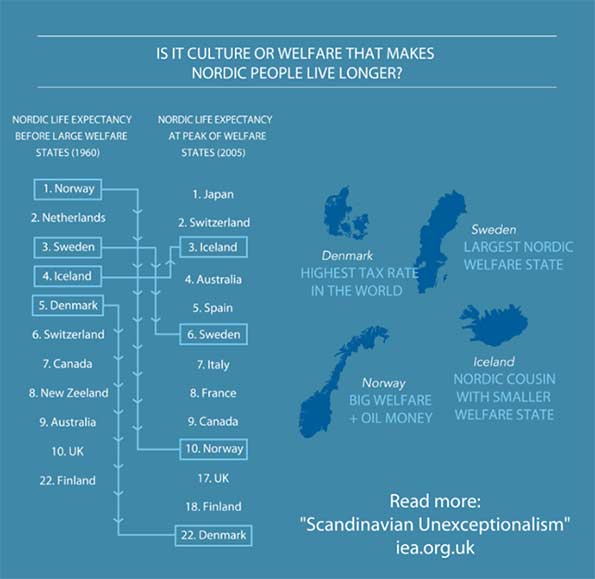
    In 1960, well before large welfare states had been created in Nordic countries, Swedes lived 3.2 years longer than Americans, while Norwegians lived 3.8 years longer. After the Nordic countries introduced universal health care, the difference shrunk: today, it is 2.9 years in Sweden and 2.6 years in Norway.

    This fact might surprise those who believe that large welfare states lead to longer life spans. Once we study the issue in depth, however, it becomes clear that the explanation is cultural. Nordic people eat healthy diets, run in forests, and avoid the unhealthy lifestyles of many Americans.

    In late 2015, a PBS story entitled “What Can The US Learn From Denmark?” stated, “Danes were excited this week to see their calm and prosperous country thrust into the spotlight of the U.S. presidential race when Democratic hopefuls Bernie Sanders and Hillary Clinton sparred over whether there’s something Americans can learn from Denmark’s social model.” The story continued, “Danes get free or heavily subsidized health care” and “compensation when they’re unemployed, out sick from work or on parental leave,” adding that they have longer life spans than Americans.

    Now, all these statements are certainly true. The only problem is that the story gives the impression that these facts are directly related. Danes have universal healthcare and government compensation when sick. Correspondingly, they live longer than Americans. So, for the US to raise its life expectancy rates, perhaps a Danish model should be adapted? After all, what kind of heartless monster would oppose policies that increase life spans?

    Well, as it turns out, Danes lived 2.4 years longer than Americans in 1960 — when Denmark had lower taxes than the US. Today, the difference has shrunk to 1.5 years. Denmark no longer ranks among the top ten countries in the world in terms of lifespan.

    Iceland, the Nordic country with the smallest welfare state, has far surpassed Denmark and the other Nordic countries in terms of life span. The explanation for this success is clearly not a large welfare state. Nor is it that the Icelandic people inhabit a pleasant country. Iceland is cold and dark. It has large, barren, volcanic fields which look much like the fictional Mordor of Lord of the Rings. But the Icelandic people enjoy going out in nature. Also, they eat a healthy diet based to a large extent on fish. The lesson is quite simple: Nordic culture, rather than Nordic-style social democracy, explain the social successes in this part of the world.

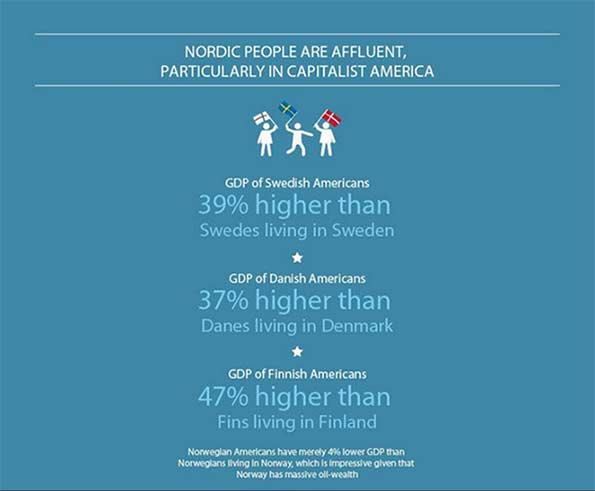
    The American Left has an idealized, and fully unrealistic, vision of social democracy; a belief that if the US adapts a large welfare state it will magically succeed in this way. There is little if any merit to this viewpoint. Today, Nordic-Americans actually outstrip their cousins in the Nordics both in prosperity and social outcomes.

    If we look at another broad measure of social success, child mortality, again we find that yes, Nordic countries indeed do have among the lowest levels in the world. But this too was already the case when these countries had small public sectors. As Sweden, Denmark and Norway introduced large welfare states, if anything they fell somewhat in global ranking. Iceland, on the other hand, climbed the ranking.

    The conclusion is clear: Nordic social success pre-dates the modern welfare state, and was if anything more pronounced during the small-government era. Perhaps equally interesting is that while Nordic-style democratic socialism is all the rage among Leftist ideologues in the US, the same policies are to a large degree rejected by the people of the Nordic countries themselves.

    After seeing his country held up as an example by in the Democratic presidential debate, the Danish prime minister, Lars Løkke, Rasmussen, objected to the skewed image of socialism in his country. In a speech at Harvard’s Kennedy School of Government, he told students, “I know that some people in the US associate the Nordic model with some sort of socialism. Therefore I would like to make one thing clear. Denmark is far from a socialist planned economy. Denmark is a market economy.”

    The remark comes as no surprise. While some US liberals believe that democratic socialism is a flattering label, in the Nordics many are distancing themselves from socialist ideas, pointing out that they, too, embrace the market. In many regards, the Danish government interferes less in the economy than the American government does.

    While Denmark does have high taxes and generous welfare policies, today even the Danish Social Democratic Party acknowledges that these policies are slowly eroding responsibility norms, trapping people in welfare dependency and reducing the level of prosperity.

    Out of the five Nordic countries, four currently have center-right governments. The only exception is Sweden, in which the Social Democratic Party – which holds the seat of power – has never in its modern history polled as weakly as it does today. Most Swedes vote either for the center-right coalition which wants to reduce the scope of government, or for the right-wing anti-immigration party.

    Perhaps these facts are worth pointing out to Bernie Sanders, Hillary Clinton, the journalists at PBS and numerous other Americans who believe that Nordic-style social democracy will transform America to Shangri-La.

    Nima Sanandaji is president of the European Centre for Policy Reform and Entrepreneurship. His latest book is Debunking Utopia – Exposing the myth of Nordic socialism.

    Copenhagen Harbor Water Bus by Jacob Surland
  • Scandinavian Women Do Well, Except at the Top

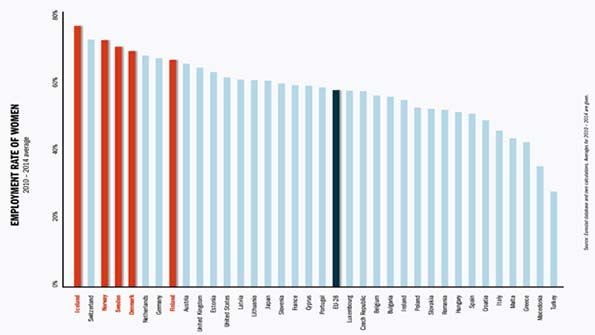
    In which part of the world should we expect most women to reach the top? The answer has to be the Nordic countries. According to The Global Gender Gap report, for example, Iceland is the most gender equal country in the world followed by Norway, Finland and Sweden. Yet as I will discuss below, this has not translated in women making it to “the top”, as one might expect. This a paradox that I will seek to address.

    Around the world, the Nordic countries are often idealized as the most gender equal places in the world. To a large degree, this admiration is warranted. But it is time to realize that the very same system is holding back women’s ability to reach the top.

    To begin with, the Nordics have a unusual gender equal history. The tradition of gender equality has roots in Viking culture. For example, Scandinavian folklore is primarily focused on men who ventured on longboats to trade, explore and pillage. Yet the folklore also includes shiledmaidens, women chosen to fight as warriors. Byzantine historian John Skylitzes records that women were indeed participating in Nordic armies during the 10th century. The fact that women were allowed to bear arms, and train as warriors, suggests that gender segmentation in early Norse societies was considerably more lax – or at least more flexible – than other parts of contemporary Europe. Evidence also suggests that women in early Nordic societies could inherit land and property, that they kept control over their dowry and controlled a third of the property they shared with their spouses. In addition, they could, under some circumstances at least, participate in the public sphere on the same level as men.

    Medieval law, which likely reflects earlier traditions, supports this notion. Medieval inheritance laws in Norway for example followed family relations through both male and female lines. Additionally, women could opt for a divorce. These rights might not seem impressive today, but they were rather unusual in a historical context. In many contemporary European and Asian societies, the view was that women simply belonged to their fathers or husbands, having little right to property, divorce or inclusion in the public sphere.

    Nordic gender egalitarianism continued after the Viking age, particularly in Sweden. In much of the world, women were excluded from participating, at least fully, in the rise of early capitalism during the 18th and 19th centuries. In essence, free markets and property rights were institutions that initially excluded women. Although Sweden and the other Nordic countries were far from completely egalitarian, they challenged contemporary gender norms by opening up early capitalism for women’s participation.

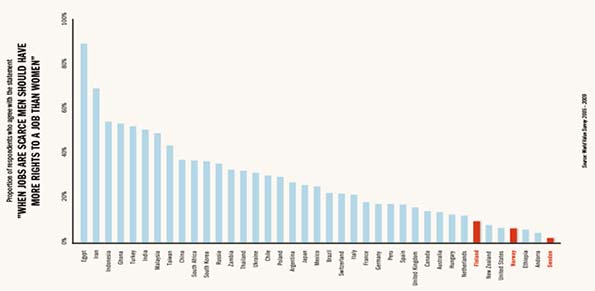
    As shown below, the World Value Survey has asked respondents around the world whether they believe that men should be prioritized over women if jobs are scares. In modern market economies, fewer agree with this notion. In Switzerland for example, 22 per cent believe that men should have more right to a job than women, compared to 16 per cent in the United Kingdom and 14 per cent in Canada and Australia. Sweden has the lowest share agreeing with this view, merely 2 per cent. Norway (6 per cent) and Finland (10 per cent) are also amongst the countries with egalitarian views.

    In addition, the Nordic welfare states have encouraged women to enter the labor market early on. Still today Nordic countries are ahead of most of Europe in this regard. Child care cost and paid maternity, services provided largely by the public sector in the Nordic welfare states, can in part explain the high labor participation amongst both parents. Such systems are much more extensively funded by the public sector in the Nordics compared to other modern economies, and particularly so compared to the Anglo-Saxon nations. Although even here, the United States, still not a full welfare state, does surprisingly well.

    A long history of gender equality, gender equal norms, many women actively participating in the labor market and family friendly welfare policies – surely this should be seen as the recipe for many women reaching the top of the business world? In the new book The Nordic Gender Equality Paradox I show that this is not the case. In Nordic countries surprisingly few women have made to the top echelons.   

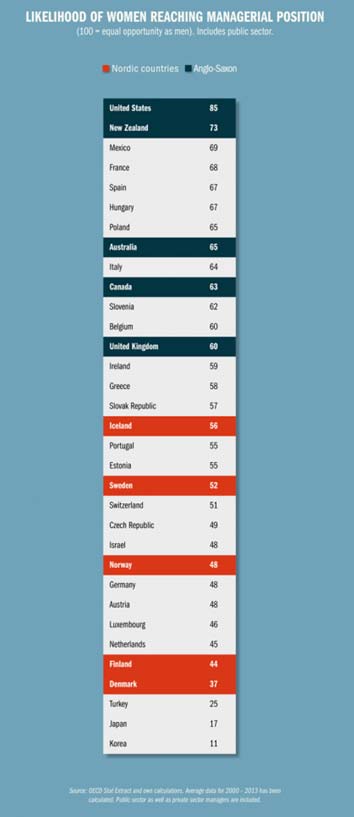
    The OECD gathers information about the proportion of employed persons which have managerial responsibilities in different developed economies. In the table below the share of women managers in different countries is shown as a percentage of the share of male managers. This calculation yields a measure of the likelihood of the average employed women to reach a managerial position compared to the average employed man. The likelihood of a women reaching a managerial position as compared to the same likelihood for a man in the United States is found to be 85 per cent. This is far higher than any other country in the study. As a comparison, the same share is 60 per cent in the United Kingdom and 52 in Sweden. Norway (48 per cent), Finland (44 per cent) and Denmark (37 per cent) score even lower.

    It should be emphasized that this measure includes public sector managers, which inflates the figures for Nordic countries compared to if private sector managers had been studied. The data paints a clear picture: The United States, where welfare state programs do not subsidize women’s parental leave has more women reaching managerial positions than any of the Nordic welfare states.

    Why is it that Nordic countries fail to reach their gender equal potential? Shouldn’t these countries be heads and shoulders above the US when it comes to the share of women climbing to the top? Progressive theorists would naturally assume this. But in reality there is a paradox here; the egalitarianism of the Nordics has clear limits.   At the end of 2014 for example, The Economist ran a story entitled A Nordic mystery

    “Visit a typical Nordic company headquarters and you will notice something striking among the standing desks and modernist furniture: the senior managers are still mostly men, and most of the women are [program administrators]. The egalitarian flame that burns so brightly at the bottom of society splutters at the top of business.”

    As I explain in The Nordic Gender Equality Paradox there is a logical answer to the apparent paradox: policy matters. Numerous studies support the conclusion that the large welfare states in the Nordics, although designed to aid in women’s progress, in fact are hindering the very same progress. Social democratic systems do provide a range of benefits for women, such as generous parental leave systems and publicly financed day care for children. The models however also have features that are detrimental to woman’s careers.

    To give an illustrative example, public sector monopolies in women-dominated areas such as health and education seem to substantially reduce the opportunities for business ownership and career success amongst women. Welfare state safety nets in particular discourage women from self-employment. Overly generous parental leave systems encourage women to stay home rather than work. Substantial tax wedges make it difficult to purchase services that substitute for household work, which reduces the ability of two parents to engage fully in the labor market.

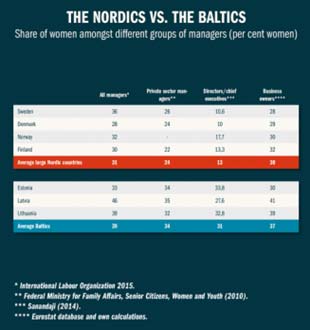
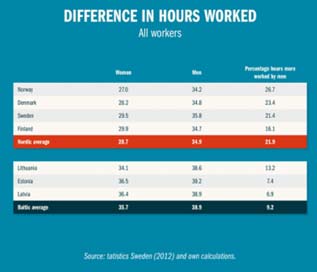
    The Nordic welfare model has, perhaps unintentionally, created a model where many women work but seldom in the private sector and seldom enough hours to be able to reach the top. For example, it might seem as a puzzle why the Baltic countries – which have much more conservative and family oriented cultures – have a higher share of women amongst managers, top executives and business owners than their Nordic neighbors. As shown below, a key factor is difference in working time. In the Nordic societies the average employed man works fully 22 per cent more hours than the average working women. In the Baltic model, where families have greater choice in organizing their lives compared to the Nordic welfare states, the gap is only 9 per cent. On top of this comparison, which looks at working individuals, many Nordic women also take long parental leaves, paid to do so by the welfare state, and thus fall behind in their careers. Of course Baltic mothers are also much concerned for the upbringing of their children. However, many of them solve the equation by getting help from family, perhaps grandmother, to watch the children or buy services to alleviate household work – something easier to do in low-tax countries.

    Thus, for all their gender equal progress, the Nordic countries in fact have relatively few women entrepreneurs, managers and executives. And there is really not a paradox why this situation has developed. It’s all about the policy choices made in the Nordics.

    As is clear, an expansive welfare state may be good for some things, but expanding the ranks of managers for women is not one of them. The feminist heritage that dates back to the age of the Vikings needs to be combined with a more free-market and small government approach if Nordic societies are to fulfill their gender equal potential. Perhaps this is also a lesson to the rest of the world, where progressive policies are often seen as the recipe for promoting women’s careers.

    Nima Sanandaji is the president of the European Centre for Policy Reform and Entrepreneurship (www.ecepr.org) and a research fellow at the Centre for Policy Studies and at the Centre for Market Reform of Education. His latest book, The Nordic Gender Equality Paradox, can be ordered here.

  • Rethinking the Scandinavian Model

    During a tour to Paris, Bruce Springsteen explained that his dream was for the US to adapt a Swedish style welfare state. The famous musician is far from alone in idealizing Nordic policies. The four Nordic nations (Denmark, Finland, Norway and Sweden) are often regarded as prime role-models the policies to be emulated by others. Internationally, advocates of left of centre policies view these countries as examples of how high tax social democratic systems are viable and successful. Paul Krugman, for example, has said: “Every time I read someone talking about the ‘collapsing welfare states of Europe’, I have this urge to take that person on a forced walking tour of Stockholm”.

    This admiration has a long history. In the mid-1970s Time Magazine described a country that sounded much like a utopia. “It is a country whose very name has become a synonym for a materialist paradise”, the international magazine wrote and continued to report about Sweden: “No slums disfigure their cities, their air and water are largely pollution free… Neither ill‑health, unemployment nor old age pose the terror of financial hardship.” Similarly, political scientist John Logue argued in 1979: “A simple visual comparison of Scandinavian towns with American equivalents provides strong evidence that reasonably efficient welfare measures can abolish poverty as it was known in the past; economic growth alone, as the American case indicates, does not”. Logue believed that the greatest threat to the Nordic welfare states was that they were too successful; eliminating social problems to such a degree that people forgot the importance of welfare policies.

    The high regard comes as no surprise. Nordic societies are uniquely successful. Not only are they characterised by high living standards, but also by other attractive features such as low crime rates, long life expectancy,  high degrees of social cohesion and even income distributions. Various international rankings conclude that they are amongst the best, if not the best, places in the world in which to live. One example is the “Better Life Index”, complied by the OECD. In the 2014 edition of the index Norway was ranked as the nation with the second highest level of well-being in the world, followed by Sweden and Denmark in third and fourth position. Finland ranked as the eighth best country.

    The OECD “Better Life Index”


    1. Australia

    2. Norway

    3. Sweden

    4. Denmark

    5. Canada

    6. Switzerland

    7. United States

    8. Finland

    9. Netherlands

    10. New Zealand


    If one disregards the importance of thinking carefully about causality, the argument for adopting a Nordic style economic policy in other nations seems obvious. The Nordic nations – in particular Sweden, which is most often used as an international role‑model – have large welfare states and are successful in a broad array of sectors. This is often seen as proof that a ”third way” policy between socialism and capitalism works well, and that other societies can reach the same favourable social outcomes simply by expanding the size of government. If one studies Nordic history and society in‑depth, however, it quickly becomes evident that the simplistic analysis is flawed.

    To understand the Nordic experience one must bear in mind that the large welfare state is not the only thing that sets these countries apart from the rest of the world. The countries also have homogenous populations with non-governmental social institutions that are uniquely adapted to the modern world. High levels of trust, strong work ethic, civic participation, social cohesion, individual responsibility and family values are long-standing features of Nordic society that pre-date the welfare state. These deeper social institutions explain why Sweden, Denmark and Norway could so quickly grow from impoverished nations to wealthy ones as industrialisation and the market economy were introduced in the late 19th century. They also play an important role in Finland’s growing prosperity after the Second World War.

    Take Sweden as an example. In 1870 free markets were introduced in this agrarian society. During the coming 100 years Sweden combined low taxes, liberal regulations and strong working ethics to experience an unrivalled growth rate in Europe. In 1870 Sweden’s GDP per capita was 57 per cent lower than in the UK. In 1970 it had risen to become 21 per cent higher. The shift towards high taxes and state involvement actually began   occurred around 1970, resulting in a long-lasting period of stagnation that was broken through ambitious market reforms during the 1990s and onward.

    Perhaps even more interestingly, even the social progress that Nordic countries are admired for developed during the latter part of the 19th century and the first half of the 20th century, developed not under socialism but at a time when Nordic countries combined free markets and low taxes with small (and efficient) welfare states. Researchers have for example shown that it was during this period that Sweden and Denmark developed a relatively equal income distribution. Long life expectancy is another example. In the picture below I show the life expectation at birth is shown for various OECD nations in 1960 – when Nordic nations had small welfare states – and 2005 – when Nordic welfare states were at their peak. In both periods Nordic countries were characterized by relatively long life expectancy, but if anything, this was more the case when the countries had small rather than large welfare states. The reason is simply that everything is not politics, cultural attributes such as a love for nature and healthy diets explains much of Nordic citizens good health.

    Similarly, it comes as no surprise that descendants of the Nordics who migrated to the US in the 19th century are still characterised by favourable social outcomes, such as a low poverty rate and high incomes. In fact, as shown below, Nordic Americans have considerably higher living standard in capitalist America than their cousins in the Nordics. This is interesting, since those Nordic citizens who migrated to the United States in large groups during the 19th and 20th centuries were anything but an elite group. Rather, it was often the poor who left for the opportunities on the other side of the Atlantic.

    A key lesson from the success of Nordic society lies in what can broadly be defined as “culture matters”. We should not be surprised that it is these nations, with their historically strong work ethic and community-based social institutions, t  have had fewer adverse effects from their welfare states and are therefore used as the poster child for those wishing to extol the benefits of active welfare policies. On the other hand, Southern European countries with similar sized welfare states and size of government have had less favourable outcomes.

    Paul Krugman is right in noting that a forced walking tour of Stockholm disproves the idea of the collapsing welfare states of Europe. Nordic societies have not collapsed under the weight of welfare policies, particularly since they have lately adopted by introducing market reforms, reducing the generosity of welfare programs and cutting taxes. Such a tour may perhaps also be wise for Krugman himself, in teaching that Scandinavian countries have been rather unexceptional. The normal economic rules apply: incentives, economic freedom, a strong self-sufficient culture and a regime of good governance all matter when it comes to economic success. The question that remains is whether Scandinavian countries will continue their return to the free-market roots that have historically served them so well. If so, the Nordic culture of success can in combination with sound policies allow growth, innovation and entrepreneurship to flourish.

    Dr. Nima Sanandaji is a research fellow at CPS, and the author of “Scandinavian Unexceptionalism – Culture, Markets and the Failure of Third-Way Socialism”. The book, which was recently released is currently being translated to a number of different languages. The entire book is available through the Institute of Economic Affairs which has published it.

  • Integrating Immigrants: Outcomes Not Attitudes Matter

    Many modern economies struggle with integrating foreign-born into their labor markets. In particular, low-skilled immigrants from poor countries experience high unemployment and a range of related social problems. Much has been written about the extent of the problem. In many Western European cities, entire communities of migrants are living in social and economic exclusion. The state of poverty is often persists among their children.

    But although the problem is widely acknowledged, the cause of it remains an issue of vivid debate. One line of reasoning is that modern job markets are increasingly knowledge-based. Technological changes have reduced the availability of simple jobs. The supply of the low‑skilled workforce often becomes higher than the demand for it. A limited number of jobs exist at the formal or informal minimum wage levels in various modern economies. Foreign‑born individuals, who often have weak social networks and language skills, find it particularly hard to obtain these jobs.

    Another related explanation is that welfare states hinder integration. High taxes and generous public benefit systems reduce the incentives for work. Families with children can experience a situation where their actual incomes are only slightly, if at all, increased when a parent transitions to work. In addition, rigid labor market regulations can make it difficult for outsiders to enter the labor market.

    A third view is that the problem is rooted mainly in discrimination and open racism. Immigrants are simply not given a chance to prove themselves since employers chose not to hire them. Direct and indirect racist structures hinder the success of immigrants and their children.

    It is difficult to conclusively say which explanations are more relevant than the others. But we can look at the relation between discriminatory viewpoints and the labor market success of migrants. This is made possible by the World Value Survey, an ambitious project to map the prevalence of different attitudes around the world.

    Recently the result of latest survey, conducted between the years 2010 and 2014, has been made available. One of the questions included in the survey was how many who would not like to have neighbors which were immigrants or foreign workers. Another was how many who thought that when jobs are scarce, employers should give priority to natives over immigrants.

    As shown below, the prevalence of these answers vary greatly between seven modern economies for which data have been released so far. In Germany and the Netherlands for example a fifth of the population express that they would not like to have foreign-born neighbors. The same view is shared by less than four percent of the Swedish population. Likewise, about half of the public in the US, Australia, New Zealand and Spain believed that employers should give priority to natives over foreign-born when jobs are scarce. In Germany and the Netherlands about four in ten hold the same view, compared to 14 percent in Sweden.

    Would not like foreign-born neighbors

    Employers should give priority to natives

    Unemployment difference low-educated foreign-born versus low-educated natives

    Unemployment difference high-educated foreign-born versus high-educated natives

    Germany

    21

    41

    2.6

    6.1

    Netherlands

    20

    36

    4.5

    3.3

    US

    14

    50

    -8.9

    1.4

    Australia

    11

    51

    -1.0

    2.5

    Spain

    7.5

    53

    11

    9.9

    New Zealand

    5.9

    50

    -0.96

    1.9

    Sweden

    3.5

    14

    10

    8.1

     Data from World Value Survey 2010-2014. Unemployment difference from OECD data over “Indicators of integration of immigrants and their children”, given for the years 2009-2010.  Rounded to two significant digits.


    However, there is no clear link between tolerance for foreign-born as either neighbors or in the labor market on one hand, and actual labor market success on the other. Sweden, where the public expresses the most tolerant viewpoints, could be expected to be characterized by good labor market outcomes for immigrants. However, Sweden is next  to spain is  characterized with the biggest gap in employment between foreign-born and natives. This relation holds regardless if we look at the difference between low-educated or high-educated people with foreign-born and native backgrounds respectively.

    The US on the other hand, has merely 1.4 percentage point higher unemployment amongst high-educated foreign-born compared to natives with similar educational background. Amongst the low-educated in the US the difference is 8.9 percentage points in favor of the foreign-born. At the same time, the share in the US who would not like to have foreign-born neighbors is almost twice as high as in Spain and fully four times as high as in Sweden.

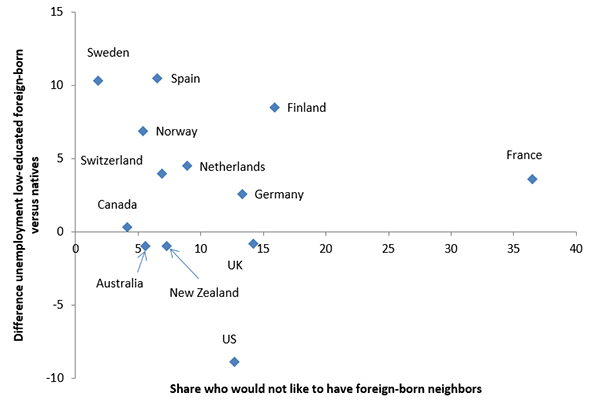
    Perhaps it is difficult to find a strong link since the number of countries included is so small. In order to broaden the sample, we can look at the 2005-2009 edition of the World Value Survey. In that survey the question relating to foreign-born neighbors, but not that of allocation of jobs, was asked. The graph below shows the relation between the share who would not like to have foreign-born neighbors on one hand, and the difference in unemployment on the other. 


    Source for attitudes towards foreign-born neighbors: World Value Survey 2005-2009. Source for difference in unemployment: OECD data over “Indicators of integration of immigrants and their children”, given for the years 2009-2010. 

    The relation between attitudes and employment prospects are not what one would expect. If anything, the countries in which fewest people do not want foreign-born neighbors are also those in which differences in unemployment are the highest. This does not necessarily mean that countries with the different attitude do better. Canada, Australia and New Zealand are nations where a relatively small share has anything against foreign-born neighbors. The same countries have good labor market outcomes for the foreign-born. In Australia and New Zealand, low-skilled individuals with a foreign-born background have slightly lower unemployment than similar natives. In Canada the difference is minute between the two groups.

    Given these outcomes it is difficult to conclusively say what factors that favor integration and what obstacles that stand in the way of integration. It could, for example, be argued that the people in countries such as Sweden are giving politically correct responses. These responses do not necessarily have to translate to the discrimination actually faced by immigrants on a daily basis. At the same time, it is clear that the Anglo-Saxon countries are succeeding in integration. This could be attributed to having English as their main language. It could also be attributed to market-based systems with strong incentives for work and relatively free labor markets. In short, attitudes, at least as reported by the World Value Survey, do not seem to explain the differences in integration. Although all enlightened countries should strive for the tolerant views expressed in countries such as Sweden, this does not guarantee well‑functioning integration.

    Dr. Nima sanandaji is a frequent writer for the New Geography. He is upcoming with the book "Renaissance for Reforms" for the Institute of Economic Affairs and Timbro, co-authored with Professor Stefan Fölster.

    Photo from BigStockPhoto.com.

  • The Changing Face of European Economics: Liberalism Moves North

    Where do we find the nations with the highest tax levels? In the mid-90s the answer was quite clear: in Western Europe. Both Denmark and Sweden had a tax rate of 49 percent of GDP in 1996, followed closely by Finland with a 47 percent level. The tax burden was somewhat lower in France, Belgium, Austria and Italy, where rates ranged from 42 to 44 percent of GDP. Thanks to its oil-wealth Norway could afford a Nordic welfare model with 41 percent taxes, the same level as the Netherlands which had recently slimmed down its welfare system considerably. These Western European welfare states were the nine OECD countries with the highest tax rates. The tenth country was Eastern European Hungary with a rate of 40 percent.

    And where do we today find the high-tax nations? Looking at tax data from 2012, the answer is again amongst the Western European welfare states plus Hungary. At first glance, little seems to have changed with time. The only country to leave the top-10 list is the Netherlands, which has recently been replaced by another Western European nation: Luxembourg. But a closer look shows that Western Europe’s welfare states have indeed changed, and are continuing to do so. With time, a significant convergence has occurred.

    In 2012 Denmark still lead the tax league, with a 48 percent rate. France and Belgium had climbed to shared second position, with 45 percent tax rates. Rising levels in Italy and lowered ones in Sweden and Finland resulted in the three countries sharing a 44 percent level. Austria and Norway had increased their levels slightly, whilst the Netherlands had implemented further reductions. So, the welfare states with the highest taxes lowered their levels, whilst those with somewhat lower levels raised them. The Netherlands is the exception, as it continued to reduce relatively low taxes. No surprise then that it is the only country to leave the top-10 tax league.

    Of course, taxes are far from the only indicator of economic policy. A range of other factors, such as trade openness, business policy and protection of property rights, affect the opportunities for job creation, competition and growth. The Index of Economic Freedom, published by the Heritage Foundation in partnership with the Wall Street Journal, ranks countries based on a broad set of indicators of economic freedom. The Western European welfare states can overall be said to combine large public sectors and high taxation with relatively free economic policies. But the differences between them are significant, and the direction of change has varied considerably during the last decades.

    Tax rate % of GDP

    1996

    2006

    2012

    Change 1996-2012

    Sweden

    49,4

    48,1

    44,3

    -5,1

    Finland

    47,1

    43,5

    44,1

    -3,0

    Netherlands

    40,9

    39,1

    38,6*

    -2,4

    Denmark

    49,2

    49,0

    48,0

    -1,2

    Austria

    42,8

    43,0

    43,2

    0,4

    France

    44,2

    43,6

    45,3

    1,1

    Norway

    40,9

    43,1

    42,2

    1,4

    Belgium

    43,9

    44,4

    45,3

    1,4

    Italy

    41,6

    40,8

    44,4

    2,8

    * Data given for 2011. Source: OECD Stat Extract and own calculations.

    When the index of economic freedom was first published in the mid-90s, it showed that the Netherlands and Austria were the most market liberal of the nine Western European countries listed above. Sweden and Italy were on the other hand found at the bottom. In the latest 2014 edition of the index, Denmark – which compensates for high taxes with market oriented policies, including a liberal labour market – has climbed to become the freest economy amongst the group.

    In fact, Denmark ranks on 10th position globally, higher than even the US on 12th position and the UK on 14th. The Netherlands ranks on 15th place globally, followed by Finland and Sweden on the 19th and 20th positions. Belgium on the other hand has gone from being one of the more economically free Western European welfare states to becoming the third least free. Today the country scores on 35th place globally. France is found on a dismal 70th position, and is unique in having reduced its economic freedom score marginally between 1996 and 2014. Italy has merely increased its score by 0.1 points, ranking at 86th place– just below Kyrgyz Republic. The Western European welfare states might seem to have similar policies at first glance, but differences in market adaptation are in fact quite significant.

    Heritage/WSJ Economic Freedom Score

    1996

    2006

    2014

    Change 1996-2014

    Sweden

    61,8

    70,9

    73,1

    11,3

    Finland

    63,7

    72,9

    73,4

    9,7

    Denmark

    67,3

    75,4

    76,1

    8,8

    Norway

    65,4

    67,9

    70,9

    5,5

    Netherlands

    69,7

    75,4

    74,2

    4,5

    Belgium

    66,0

    71,8

    69,9

    3,9

    Austria

    68,9

    71,1

    72,4

    3,5

    Italy

    60,8

    62,0

    60,9

    0,1

    France

    63,7

    61,1

    63,5

    -0,2

    * Data for 1997 given. Source: Heritage/WSJ Economic Freedom Index and own calculations.

    The change in economic freedom parallels that of change in taxation, since taxation is an important part of economic freedom and since tax-reforms and other market reforms have tended to go hand-in-hand. The major changes have happened in the Nordics, particularly in the three high-tax countries which lack Norway’s oil-wealth. Sweden has lowered its taxes by over 5 percent of GDP between 1996 and 2012, by far the greatest change. The country has also increased its economic freedom score by over 11 points, again the most significant change. If Sweden had retained its 1996 score, it would score as the 78th freest economy today, just below Paraguay and Saudi Arabia.

    Finland has reduced its taxes by 3 percent of GDP, and improved economic freedom almost as much as Sweden. Denmark still leads the tax league, but has also implemented major increases in economic freedom – quite impressive given that the country had a high economic freedom score already in the mid-90s. Norway has liberalized overall economic policy, but increased taxation somewhat. France and Italy have stagnated at a low economic freedom score, and relied on increasing taxation rather than growth-oriented reforms to fund public services. Belgium and Austria have implemented some economic liberalization, but increased taxes. 

    The welfare states of Western Europe are quite complex. Their social and economic systems have much in common, but also differ in many ways. Today, as well as during the mid-90s, the countries in the world with the highest tax rates are found amongst this group. Still, major changes have occurred, and more seem on the way. In the upcoming 2014 elections of Sweden, it is more likely than not that the left will emerge victorious. But even the social democrats have, after initial resistance, accepted most of the current center-right government’s reforms. The social democratic government of Denmark is currently focused on reducing taxes, as well as government spending and the generosity of the welfare state. Part of the inspiration at least seem to come from the recent workfare policies of the Swedish right.

    As I recently discussed in a New Geography article, the current government of the Netherlands has raised the issue of reforming the welfare state further, to a “participation society” by encouraging self-reliance over government dependency. Finnish policies focus on how new entrepreneurial successes can be furthered. Part of the background is that Nokia, which the country relied so much on, has quickly fallen behind the global competition. On the other hand, the small company behind the game Angry Birds has gained global attention and become a symbol of new Finnish ingenuity. France and Italy still struggle with faltering markets and sluggish development. Perhaps with time the countries will follow the lead of the Nordics and the Netherlands, in reducing the scope of big government, and moving towards lower taxes and increased economic freedom?

    It is anything but easy to predict the future development of the Western European welfare states. But one thing is clear: the countries in the region that are doing well today are those that have reformed towards free-market policies and lower tax burdens since the mid-1990s. Given the apparent problems in France and Italy, and the continued interest for market reforms in the more vibrant North, it would seem that increased economic freedom is still the recipe for success.

    Dr. Nima sanandaji is a frequent writer for the New Geography. He is upcoming with the book “Renaissance for Reforms” for the Institute of Economic Affairs and Timbro, co-authored with Professor Stefan Fölster.

    Creative commons photo "Flags" by Flickr user miguelb.

  • Female Executives Across the European Union

    A great divide exists between European countries when it comes to the issues of women’s career opportunities. Some countries have high female work participation and values that promote gender equality, while others lag behind. But a closer look shows that the share of women in managerial positions is in odds with other indicators of equality. Scandinavia, where we might expect to find most female directors and chief executives, has in fact the lowest share. Many more women have reached the top of the business sector in countries with relatively low female labor participation, and far from gender equal attitudes. Other factors, such as the scope of welfare state monopolies and hours invested in work, seem to crucially affect women’s chances to reaching the top of the business world.

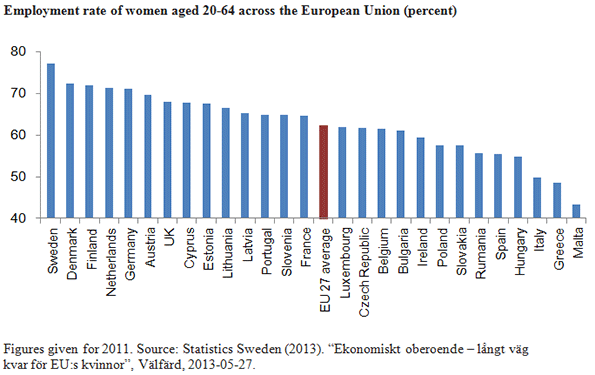
    The European Union has set the goal to achieve an employment level of 75 percent amongst women. So far, only Sweden exceeds this ambition with an employment level of fully 77 percent. Denmark, Finland, the Netherlands, Germany and Austria follow closely behind. In these five countries seven out of ten women working age are employed. It doesn’t seem a coincidence that these northern European nations share similar cultural and political attributes. The expansion of welfare states has historically encouraged womens’ entry into the workforce. Still today public childcare encourages women to invest time at work, whilst high taxes make it difficult to live on only one salary.

    Overall, the Eastern- and Central European countries have a lower share of women working, since it is more common with housewives. The three former Soviet states Estonia, Lithuania and Latvia are in particular interesting to look at. Not only are they Eastern European, and strongly committed to low taxes and free markets, but they also share Nordic cultural attributes. The three Baltic states have a respectably high level of two thirds of women in employment. This is somewhat higher than the European average, and considerably more so than in parts of Southern Europe. In Malta and Greece, fewer than half of the women work. In Italy exactly half of them do.

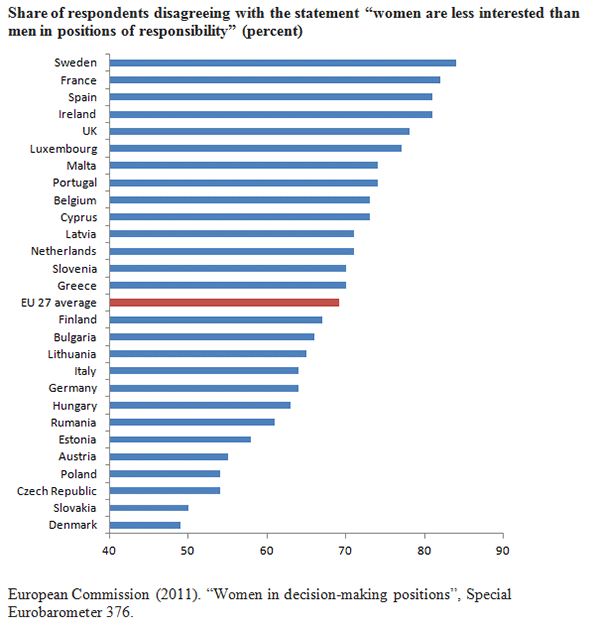
    Northern and Western European countries also tend to have more equal gender attitudes. A special edition of the Eurobarometer has focused on the issue of women in decision-making positions. One key indicator is how many disagree with the statement “women are less interested than men in positions of responsibility”. Sweden again stands out, with 84 percent of the public disagreeing with this notion. Although culturally and politically similar Denmark is found at the other end, with only 49 percent disagreeing with this idea, the overall trend is clear. The general publics in Nordic and Western European countries more strongly reject the notion that women are less interested in reaching positions of responsibility while Southern-, Eastern-, and Central European countries are found at the opposite end of the spectrum.

    We would expect to find many more women in top positions in the egalitarian Nordic nations, as well as Germany, the Netherlands and other similar countries. And indeed we do. At least when it comes to politics, the public sector and company boards. All too often the analysis stops here. But it is important to realize that representation on boards is a poor measure of women’s progress in the private sector of many European countries. Many boards in Nordic nations for example have relatively formal roles, meeting a few times a year to supervise the work of the management. The select few who end up on the boards – many of whom reach this position after careers in politics, academics and other non-business sectors – enjoy prestigious jobs.  They are however not representative of those taking the main decisions in the business sector. The latter role falls on executives and directors. Public sector managers tend to have less overall power, working within the scope of large bureaucratic structures.

    Chief executives and directors in the private sector are responsible for taking much of the crucial decisions in the business world. One typically only reaches a high managerial position after having worked hard in a certain sector, or successfully started or expanded a firm as an entrepreneur. The share of women reaching this position is a good proxy of women’s opportunities in the business world as a whole.

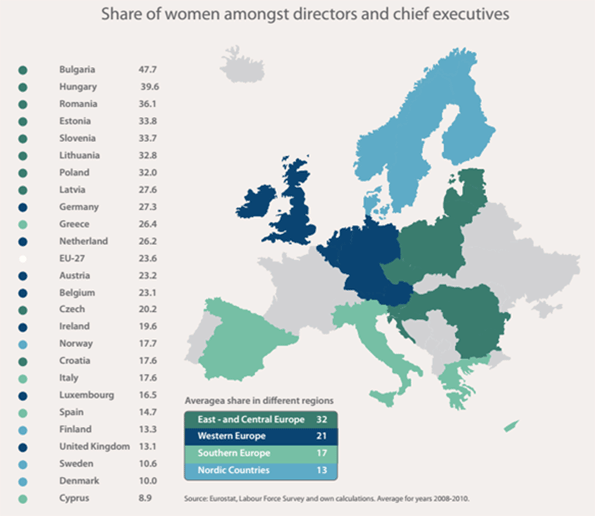
    Astonishingly, the data show that the gender equal Nordic nations all have lower levels of women at the top of businesses than their less progressive counterparts. In Sweden and Denmark, only one out of ten directors and chief executives in the business world are women. Finland and the UK, two other nations with large public sector monopolies, fare only slightly better.

    In contrast, in the average Eastern- and Central European country fully 32 percent of the directors and chief executives are women. This can be compared to 21 percent in Western European countries, 17 percent in Southern European nations and merely 13 percent in the otherwise egalitarian Nordic nations. In Bulgaria, with lower than EU-average levels of female work participation, and not a bastion of egalitarian attitudes, women fill almost half the positions.

    It should be noted that other measures of the share of women at top of businesses supports this general trend. Eurostat for example also publishes a broader measure of business leaders, including also middle-managers. In the Baltics Estonia has the lowest share of women in these positions, 36 percent. Lithuania and Latvia fare better with 39 and 45 percent respectively. In Sweden the share is 35 percent and in Denmark 28 percent. Based on interviews with 6 500 companies around the world, the firm Grant Thornton estimates that around four out of ten managers in the three Baltic nations are female, compared with around a quarter in the Nordic nations. The overall picture is clear: fewer women in the Nordic nations reach the position of business leaders, and even fewer manage to climb to the very top positions of directors and chief executives.

    How can egalitarian Nordic countries, in most regards world leaders in gender equality, have the lowest rates of female directors and chief executives, whilst the nations in Eastern- and Central Europe are leaders in the same regard? I have previously touched upon this perhaps unexpected relation in the Swedish book “Att Spräcka Glastaken” (Breaking the glass window), a short report in English co-authored with Elina Lepomäki for Finnish think tank Libera and also in a column for the New Geography.

    Key here is the nature of the welfare state. In Scandinavia  female dominated sectors such as health care and education are mainly run by the public sector. The lack of competition has not only reduced the overall pay, but also lead to a situation where individual hard work is not rewarded significantly (wages are flat and wage rises follow seniority, according to labour union contracts, rather than individual achievement). Some opportunities for entrepreneurship do exist, as private competition has been allowed in particularly the Swedish welfare sector in recent years. But overall, the Nordic political systems still create a situation for many women where their job prospects are mainly   limited to the public sector . Women in Scandinavia can of course become managers within the public sector, but their wages and influence in these positions are typically more limited compared to in private enterprises.

    The former planned economies in Eastern- and Central Europe are well behind in terms of female employment and attitudes. But they have also since the times of socialist economies had systems where women who are employed work almost as many hours as the men. During recent years the nations have transitioned to market economies, in many regards more free-market systems than in other European countries. Employed women have continued to invest heavily in their workplaces in the former planned economies.

    The situation is quite different in the Nordic welfare states, where high taxes and public benefits create incentives for women to work, but often to work relatively few hours. For example 10 percent of the employed women in Latvia and Lithuania, and 14 percent in Estonia, work part time. In Sweden, the share is fully 41 percent. To put it differently, the average employed man in the Scandinavia works between 16 percent (Finland) and 27 percent (Norway) hours more than the average woman. In Lithuania the same gap is 13 percent, and in Latvia and Estonia merely 7 percent. Bulgaria is unique as the only European Union nation where women actually work more (1 percent more) hours than men. Women in Eastern- and Central Europe reach managerial positions by working hard and, contrary to the men, staying away from alcohol and other social ills.

    To reach the top of the business world, high employment and gender equal values are not enough. These factors must be complemented with political structures that allow for competition and entrepreneurship, as well as systems where women in their careers are encouraged to invest the time needed to climb the career ladder. It is quite telling that the Baltic nations, as well as other Eastern- and Central European countries, manage to outperform the rest of Europe in their share of female directors and chief executives. They do so by having systems with limited public monopolies and smaller differences between hours worked by men and women. It is equally telling that the Nordic nations underperform in the same regard, as their Social Democratic systems encourage many women to work, but hinder them from reaching the top of the business world. The map of gender equality in Europe is more complex than it might appear at a first glance.

    Dr. Nima Sanandaji has written two books about women’s carreer opportunities in Sweden, and has recently published the report “The Equality Dilemma” for Finnish think-tank Libera.

  • The Dutch Rethink the Welfare State

    When the Netherlands’ newly coronated king made his first annual appearance before parliament, he turned some heads when he addressed the deficiencies of the Dutch welfare state.   “Due to social developments such as globalisation and an ageing population, our labour market and public services are no longer suited to the demands of the times”, the king said in a speech written by Liberal prime minister Mark Ruttes cabinet. “The classical welfare state is slowly but surely evolving into a ‘participation society’”, Willem-Alexander continued. By this he meant that the public systems should start encouraging self-reliance over government dependency.

    It is worthwhile to reflect on the challenges faced by the Dutch welfare system. In a knowledge based economy, influenced by strong global competition and dynamic economic development, public policy must encourage thrift, education and build-up of social capital. Discouragingly high taxes and encouragingly high benefits are no way of doing so. Such policies are therefore likely to become even greater obstacles to social and economic development as they are today.

    Concern over the welfare state is not new in the Netherlands. 

    During the beginning of the 1980s the Netherlands ranked as a top spender in terms of welfare policy. Whilst the US and the UK allocated some 22 and 27 percent respectively of GDP to welfare spending, the Netherlands spent fully 40 percent – the same level as the famously generous Swedish public system.  But since then the pattern has been to reduce the welfare state. Indeed as most OECD-countries public spending rose significantly from the 1980s a  report from the OECD notes that the Netherlands, alongside Ireland, gradually scaled theirs down. A combination of economic growth, tightening of welfare state generosity and privatization of sick-pay led to a decline in public social spending in these two countries. In 1980 public social spending was 25 percent of GDP in the Netherlands, much higher than the OECD-average of 16 percent.

    In the beginning of the 2000s the average OECD-country had expanded its welfare state, so that public social expenditure had reached 21 percent of GDP – whilst the Netherlands had reduced its share to the same level. According to another study, benefit expenditure was reduced from 27 to 22 percent of GDP in the Netherland between 1980 and 2001, compared to the EU15 average which rose from 21 to 24 percent during the same period.

    Although the Netherlands does not lie in Scandinavia, there are significant similarities between this advanced European nation and the Nordic countries. The similarities go beyond the fact that the Dutch are tall and blond, and live in a small trade-dependent nation. Shared cultural traits and political beliefs can explain why the Dutch adapted similar welfare policies as the Nordic nations. Similarly to as in Denmark and Sweden, the Netherlands has with time reformed its system, for example by introducing legislation which increases employer’s responsibility for the provision of sickness benefits. In some ways the Dutch have been even keener to reform than the Nordic countries.

    Privatisation of social security and a shift from welfare to workfare have been coupled with the introduction of elaborate markets in the provision of health care and social protection. Not only other European welfare states, but in some regards even the US, can learn much from the Dutch policies of combining a universally compulsory Social health insurance scheme with market mechanisms. Netherlands has, similarly to Denmark, moved towards a “flexicurity” system where labour market regulations have been significantly liberalized within the frame of the welfare system. Taxes in the country peaked at 46 percent of GDP in the late 1980s, but have since fallen to ca. 38-39 percent. The Netherlands has moved from being a country with a large to a medium-sized welfare system, something that still cannot yet be said about culturally and politically similar Sweden and Denmark. The Dutch seem to have been earlier than their Nordic cousins in realizing that overly generous welfare systems and high taxes led to not only sluggish economic growth, but also exclusion of large groups from the labour market. 

    Societal challenges are not difficult to find in the Netherlands, at least not if we look at the difficulty to integrate foreign-born individuals and those with low skills. These problems are shared with other European welfare models, not least the Scandinavian ones. However, the Netherlands overall continues to rank highly  in terms of societal measures such as good school results, high life expectancy, strong civic participation and high life satisfaction. Reforming the welfare state to a smaller size, and introducing more market mechanism within the system, have clearly not lead to a social disaster as some would like to believe.

    The Dutch continue to support the welfare society. This does however not mean supporting an overly generous “cradle to grave” system, with demands that everybody have similar living standard regardless of their individual achievements. As shown in the book “Contested Welfare States: Welfare Attitudes in Europe and Beyond”, Netherlands ranks at second place, following closely after Switzerland, in having the most limited support for the idea that government should be responsible for peoples’ life prospects. A likely reason is that whilst the Dutch are in favor of welfare policies in general, they believe in fostering individual responsibility within the system. The “participation society” that the Dutch king recently spoke about has thus already gained ground.

    There is a strong case to be made that the Dutch can benefit in going further in reducing the size of the state, introducing market reforms and liberalizing the labour market. Such changes would indeed be in line with OECD recommendation. Recently even the IMF recommended the nation to continue structural reforms to enhance growth potential. In addition, considerable savings seem to be possible in the Dutch welfare state, in areas such as health care and education. Luckily, the country can rely on previous positive experience with reforms.

    There is a good chance that the Netherlands will continue on a long-term route towards smaller government and greater prosperity. This does not mean abandoning the idea of public welfare for its citizens but focusing more on enabling people to take care of themselves. The positive experience of past changes, coupled with the realization that change is needed, can catalyze change. If change indeed happens, it will likely not occur over-night. Continuous small steps towards change are more likely. The direction of European nations such as the Netherlands might not excite a US audience, but perhaps there is a lesson to be learned about the value of pragmatic and steady reforms? 

    Dr. Nima Sanandaji has written several books and reports in Sweden, Finland and the UK about subjects such as urban development, entrepreneurship and women’s career opportunities.

  • Norway Breaks with Social Democracy

    Largely uncommented on in the US press, Europe’s long-standing social democratic tilt has changed. During recent years, almost all Western European nations have seen a dramatic fall in support for the traditional Social Democratic parties, which for so long have dominated the political landscapes. In response, the centre-left parties have morphed, moving towards greater emphasis on the benefits of free markets and individual responsibility. In several countries the former communist parties now claim that they fill the role of traditional Social Democrats. A new breed of modernized centre-left parties is likely to replace several centre‑right governments during coming years. The third consecutive loss for the German Social Democrats illustrates the continuing difficulties for Europe’s labor movements to gather the strong support that they previously almost took for granted.

    Until recently oil-rich Norway has remained unique, as the only nation where Social Democrats have resisted change to highly generous welfare benefits. In 1999 the former Swedish social democratic minister of business, Björn Rosengren, famously called Norway “the last Soviet state” due to the lack of willingness to adopt market policies. But now even Norway is shifting with the recent election of a centre‑right government formed by Erna Solberg. Making the transition from a full-scale welfare state to a system which consistently rewards work more than public handouts will be a difficult one for Norway. Hopefully, the newly elected government will draw inspiration from the neighbor to the east.
    Politicians in Norway for long admired the Swedish social system, seeing their larger neighbor as a pioneer of Social Democratic policies.

    Recently however, particularly the left has begun to emphasize the uniqueness of the Norwegian Welfare Model rather than the Scandinavian Welfare Model. Swedish policies have even been used in the recent election as deterrence by the left. It is easy to see why. The current centre-right government in Sweden, elected in 2006 and re‑elected in 2010, has focused on a broad reform agenda. The workfare policies introduced include: somewhat less generous benefits, tax reductions aimed particularly at those with lower incomes, liberalizations of the temporary employment contracts and a gate-keeping mechanism for receiving sick and disability benefits.

    The policies have successfully addressed the problem of overutilization of welfare benefits. The number of those on sick leave in Sweden has fallen from around 212,000 individuals in 2005 to 136,000 in 2012. At the same time, the number of individuals on early retirement has fallen from 557,000 to 378,000. If we look at the total share supported by various government benefits, we can see that this figure has been reduced from 25 to 16 percent of the working age population between 2005 and 2012 (adjusted to full‑time equivalents). Not a bad feat given that the period has been shaped by the global economic downturn.

    Until recently, Norway has continued on the path of very generous public handouts. Contrary to Sweden, overutilization of welfare systems has thus continued in Norway. Erna Solberg utilized this fact to criticize the Social Democratic policies during the recent election campaign. Solberg noted that the working age population which depends on welfare benefits has increased slightly from 31.2 percent in the beginning of 2006 to 31.7 percent in the beginning of 2013. After adjusting the figures to full‑time equivalents, and thus making them more comparable to the Swedish data given above, the Norwegian magazine Aftenposten calculates that the share has been stable around 20 percent of the population since 2005.

    By relying on workfare policies, Sweden has thus gone from having considerably more to quite less dependency on public handouts.  It should be noted that both countries are very healthy. The high share on sick benefits, disability benefits and early retirement is not a sign of bad health. Rather, it is a combination of overutilization of welfare systems by segments of the population at one hand, and of the willingness of politicians to hide the true unemployment by classifying individuals as outside the labor force on the other hand.

    The difference between the more work-fare oriented Sweden and the more welfare oriented Norway are also seen in the number of hours worked. Swedes on average spend 14 percent more hours working than their neighbors to the west. (In fact, as my brother has shown, in terms of hours worked per working age adult, Sweden has recently even outpaced the US). Particularly young Norwegians are considered to have a notoriously weak working ethic, while Swedish workers are highly praised in Norway. Interestingly, since Norway has such significant oil resources, the countries welfare state is supported by lower taxes than Sweden. Clearly, overly generous welfare systems will create welfare dependency even when combined with more moderate tax levels.

    Norway remains, in many regards, one of the most affluent nations in the world thanks to its oil‑wealth. But whilst Sweden and Denmark have introduced significant market reforms during recent decades (Denmark recently even ranked slightly above the US in the Heritage/WSJ index of economic freedom), Norway has resisted change. It is of course an exaggeration to call Norway “the last Soviet state”, although this notion remains popular in Sweden.

    A more nuanced perspective is that although Norway has yet to introduce market liberalizations which promote competition, reduce state involvement in the economy and promote workfare policies, it seems headed in this direction. Norwegians can continue to afford an overly generous welfare system. But they have good reasons to be concerned over the social and economic consequences that follow long‑term welfare dependency and deterioration of the work ethic. Like many other European systems, Norway has much to gain in bringing in more emphasis on individual responsibility and free markets in the traditional Social Democratic system.

    Dr. Nima Sanandaji has written two books about women’s carreer opportunities in Sweden, and has recently published the report “The Equality Dilemma” for Finnish think-tank Libera.


    Bergen Norway photo by Jim Trodel.

  • Is Scandinavia Female Friendly?

    Scandinavia is often hailed as the best place on the planet for women. Yet in reality — despite being frontrunners in gender equality — Nordic countries have not been so successful when judged by women’s career progress.

    A few years ago Professor Alison Wolf, director of Public Services Policy and Management at King’s College, remarked: “the statistics are clear: among young, educated, full-time professionals, being female is no longer a drag on earnings or progress”. Her view is supported by the research of demographer Andrew Beveridge, who has shown that full-time working single women in New York aged 21-30 years went from earning 19 percent less than their male counterparts in 1970 to having the same median income in 2000. Five years later a 17 percent wage gap resurfaced, this time to the favor of the young women. Similar trends have been shown for many metropolitan areas in the US.

    Even when we include smaller cities and the countryside, it is clear that the glass ceiling has been broken by US singles. The latest figures show that the average single American women aged 22-30 earns $27,000 annually, eight percent more than the average single man in the same age group. In the UK figures from the Office for National Statistics show that young women have 2 to 3 percent higher hourly wages than young men.

    Nordic nations are characterized by early labor market entry of women, the least gender-biased attitudes in the world and a culture where men take much of the responsibility for care of children and household work. The emergence of a large public sector has historically played an important role in women’s entry into the labor market. One reason is that many women have found jobs in the public sector. Another is that public services such as childcare facilitate the combination of work and family life. But in the long run, women’s career success has been hampered by the fact that the labor market entry of women has been so intimately connected with public sector monopolies.

    In 1998 the International Labour Organization noted that an unusually gender-segregated labor market had developed in Nordic countries, since many women worked in the public rather than the private sector. The report concluded: “in terms of differences amongst industrialized countries, several studies comment on how Nordic countries, and in particular Sweden, have among the greatest inequalities”. A similar conclusion is reached by Swedish economists Magnus Henrekson and Mikael Stenkula in their paper “Why are there so few female top executives in egalitarian welfare states?”.

    Sweden is a case in point. Much of the progress that women are making throughout the world relates to their success in higher education. Women make up the majority of university students in Sweden. But although Sweden has fully tax-financed higher education, calculations by the OECD show that a young Swedish women opting for higher education will only earn the equivalent of 5,000 U.S. dollars more than if she would have worked right after high school – over her entire lifespan. In the U.S. the corresponding increase in earnings is $75,500. Swedish women who work for public sector monopolies, and monopolies often have a negative premium, as education is simply not sufficiently rewarded to compensate the income lost while in school.

    But change is coming, albeit slowly, in the Nordic nations. Between 2007 and 2011 the share of female Swedish entrepreneurs rose from 18 to 22 percent, partially due to greater opportunities for private businesses in female dominated welfare services such as education and health care. The majority of the new firms in these sectors, which have been opened up for private business as previous public monopolies have been replaced by voucher systems, are run by women. Studies show that increased competition from private firms also pushes up wages and reduces sick-leave for employees.

    The gender equal Nordic societies clearly have the potential to be world leaders also when it comes to women’s success in the business sector. The question is what policies will be used to reach that goal. The state mandated affirmative action which has been in place in Norway has not yet produced a ripple effect – only benefiting a handful of powerful women often filling positions in many boards.

    The market approach taken in Sweden seems a wiser way. Perhaps there is also a good lesson here for the UK. While women do thrive in the private service sector in Britain, women’s entrepreneurship is, similarly to Nordic nations, hampered by public monopolies on welfare services. Opening up these services for private businesses can create a much needed boost for women owned businesses. Reducing women’s reliance on the welfare systems thus seems central for promoting gender equality.

    Dr. Nima Sanandaji has written two books about women’s carreer opportunities in Sweden, and has recently published the report “The Equality Dilemma” for Finnish think-tank Libera.

    Creative commons photo “Flags” by Flickr user miguelb.

  • Swedish Lessons for Obama

    During his upcoming visit to Sweden, President Barack Obama will surely praise the nation’s combination of high living standards, few social problems, and high level of income equality. What he may not recognize — although he should — is that the astonishing social and economic outcomes in Sweden and other Nordic countries have more to do with a unique culture among homogenous populations than with simply following a recipe of social democratic policies.

    Sweden long has been admired by US intellectuals, particularly on the left. In 1976 Time Magazine described Sweden as a “country whose very name has become a synonym for a materialist paradise… No slums disfigure their cities, their air and water are largely pollution free… Neither ill‑health, unemployment nor old age pose the terror of financial hardship.” The praise has continued since then. Recently even Bruce Springsteen joined those in favor of the US adopting a Swedish style welfare state. The success of Nordic nations is often seen as the proof that large welfare states lead to good outcomes. Paul Krugman for example writes: “Every time I read someone talking about the ‘collapsing welfare states of Europe’, I have this urge to take that person on a forced walking tour of Stockholm.”

    A walk through Sweden’s history however paints a more nuanced perspective than the one Krugman and other praise-givers might suggest. Around 1870 the previously poor country could begin its route to prosperity, thanks to comprehensive market reforms. Between 1870 and 1936, the start of the social democratic era, the country had the highest growth rate in the industrialised world. Between 1936 and 2008, a period when Sweden was mainly controlled by the Social Democrats, the growth rate was only ranked 18th out of 28 industrialised nations. Also, it is vital to remember that the social democrats were initially highly pragmatic. Small government policies continued until the social democrats radicalized in the late 1960s.

    Sweden’s phenomenal growth can, besides business friendly policies, has much to do with the country’s unique history. Nordic countries were for a long period dominated by independent farmers who had great incentives to work hard in order to survive in the harsh and cold climate. The populations in these homogenous countries not only adapted very strong ethics relating to work and responsibility, but their culture also became characterized by social cohesion and high levels of trust.

    Early welfare state institutions, not least a public school system open for all social classes that emphasized discipline and academic knowledge, indeed promoted social mobility. It is vital to realize that the high level of income equality for which Sweden is envied for developed when the nation had relatively small welfare state. The rise of high tax policies occurred after Sweden had already grown equal.

    The cultural attributes that explain Nordic success work well also in the US, at least amongst the nation’s Nordic population. Today we can see that descendants of Scandinavians who live in the US (whose fore-fathers left well before the development of social democratic policies) have the highest levels of trust in the US. Americans of Swedish origin have the same poverty level as Swedes in their native country. The Americans however earn some 50 percent higher incomes than the latter.

    The period for which Sweden has been most envied by the US left is the massive state expansion that occurred mainly during the period following the second world war, a period when the tax rate increased by almost one percentage point annually over three decades. In particular the left is fascinated by the “third way policies”, a mix between capitalism and socialism, which followed radicalization of previously pragmatic social democrats in the late 1960s. This period, characterized by massive state involvement and effective marginal tax rates of sometimes 100 percent, was however anything but successful. Previously Sweden had thrived due to birth of new entrepreneurial firms, a phenomenon that almost stopped in 1970 and did not again start until significant market reforms where introduced during the 1990s and early 2000s.

    During recent decades the levels of economic liberty have again increased strongly in the Nordic countries (Norway, leaning on its oil-wealth, is somewhat slow to reform). The Nordic nations compensate for their high taxes and regulated labour markets by having introduced high levels of economic liberty in a wide range of other fields. Recently, even the taxes have been reformed. In 2000 total tax revenues in Sweden were over 51 percent of GDP. The level decreased somewhat during the following years of social democratic rule, to 48 percent in 2006. The current centre-right government has reduced them to 44 percent and is currently introducing new reductions of the tax burden.

    Rather than expand their welfare states, Nordic nations are again returning to the free market roots that have served them so well historically. This is perhaps an important lesson for Obama, Springsteen and Krugman, to ponder. There are indeed many smart elements in the Swedish welfare state, and the welfare states of other Nordic countries, that deserve admiration. An example is how public child care has encouraged women’s entry into the labor market. Another is Danish flexicurity that combines public safety nets with a liberal labour market. A third is partial privatization of social security in Sweden. A fourth — often ignored —  is the country’s dedication to fiscal conservatism even under the Social Democrats.

    There are also many areas in which some Nordic nations fail whilst others do significantly better. Norway continues to rely on systems with very generous public benefits, which deteriorate the work ethic. The other nations, which cannot rely on oil wealth, have learned their lesson and work towards strengthening incentives for work and entrepreneurship. Finland has kept a school system that is, thanks to academic discipline and knowledgeable teachers, able to educate well those who do not come from academic or middle-class families. Sadly, Swedish public schools, have, much like their US counterparts, moved towards progressive ideas and deterioration in teacher’s knowledge. The result is an inability to stimulate those who are not intrinsically motivated to learn to do so. Overall the Nordic nations also fail at integrating foreign-born, even those who come with higher education.  

    There is simply much to learn from Nordic nations. They have experimented with everything from implementing Milton Friedman’s idea of vouchers in welfare to implementing gender quotas in corporate boards. But aside from benefitting from the unusually strong norms related to work, trust and cooperation, Nordic societies are no exception to the rules of politics and economics. The same policies that hinder growth in the US (high taxes, lack of infrastructure, failing school policies) limit societal success in Scandinavia, whilst steps to encourage innovation, entrepreneurship, and work are proven to work equally well in both sides of the Atlantic.  

    Dr. Nima Sanandaji is a Swedish author of Kurdish-Iranian origin. He has written numerous books and reports about issues such as entrepreneurship, women’s career opportunities, integration, and welfare. Nima is the author of reports "The Swedish Model Reassessed" for Finnish think-tank Libera and "The surprising ingredients of Swedish success” for the Institute of Economic Affairs. Currently he is working on a book about the unique economic and cultural success of both the Nordic nations and the “new Nordic” countries in the Baltics.