Author: Nima Sanandaji

  • High Confidence Not Translating to High Math Scores for American and European Students

    Swedish fourth graders are leading the world in mathematics, followed closely by those in other developed European nations, at least if we look at students’ reported self-confidence in the subject. Fully 77% of Swedish students at fourth grade express a high level of confidence about their learning, compared to merely 5% who express a low level. In Austria, Germany, Denmark, and Norway seven out of ten students have high confidence about their mathematics knowledge. One in ten or fewer have low confidence. Self-confidence is somewhat less common amongst US fourth graders, where 67% believe that they perform highly in mathematics and 10% express the opposite view. Unfortunately, this confidence – in America and elsewhere – is not backed up by high achievement.

    As shown by the Trends in International Mathematics and Science Study, the average US student with high confidence only scored 551 on the test. This is just half a standard deviation from the average score of 500. The phenomenon where many students believe that they are doing well in mathematics – while they are in fact lagging behind other nations – is even more evident in several European nations. In Sweden the average score of the self-identified high achievers is only 514. The sureness of Swedish students seems to rise from a progressive school system. As more focus is put on promoting self-expression and raising self-esteem than on actual knowledge gathering and hard work, students with only slightly higher international scores identify themselves as being high achievers.

    When competing in the global marketplace, or applying for top universities, the self-identified high-achievers of Europe and the US are challenged by students from places such as Hong Kong and Singapore – where the school systems focus more on actual achievements and thrift. In Hong Kong and Singapore 46% of fourth graders identify themselves as high achievers. On average they score impressively 634 and 639 respectively on the international math test. Even the students who have a low self-confidence in Singapore score 544 on the international test. This is considerably higher than the values reached by those believing themselves to be high-achievers in Sweden and close to that of the same group in the US.

    Hong Kong’s self-identified low-achievers score on average 574. The students who believe themselves to have low math skills in Hong Kong thus outperform those who believe themselves to have high skills in the US. In an increasingly knowledge intensive society, policy leaders should ask themselves what this western complacency does with the urge to learn more?

    We should of course never blame the students, who simply react to the school system and the overall society created by their adults. It is the societies that are created by the adults who should consider changing. Encouraging high confidence in general is of course a good thing. But why not focus more on actually teaching out than focusing on self-esteem regardless of achievement?  

    Norway is Perhaps the most interesting nation in terms of the gap between self-perception and reality. This may in part due to the country’s oil wealth that has allowed it to remain the only European country yet to challenge a traditional social democratic model. In Norway, public handouts can be as generous as work income.

    Not surprisingly, the previously strong Nordic working ethic of the country seems to have plummeted while student perceptions of their own knowledge have strongly inflated. Fully 69% of Norwegian students have a high confidence regarding their math scores. On average this groups scores only 490 on the international test – below the international average.

    In the same study, standardized tests are also given to eighth graders. Again, the average global score is set to 500. We can see that as students grow up, their perceptions somewhat adapt to reality. Only 49% of eighth graders in Sweden have high confidence, scoring on average 528. Half of Norway’s eight graders share the same optimistic view, scoring slightly above the average global values (505). In the United States, 53% of students have high confidence regarding their mathematic learning, with an average score of 537. Hong Kong and Singapore   students also face a reality check. Only 30% of the eight graders in the former country and 41% in the latter country have high confidence relating to their math knowledge. However, even the eighth graders with low confidence in these two countries do better on average than those with high confidence in the US and many rich European nations.

    To be sure, mathematic scores are far from the only metrics of educational success. Mathematics is however interesting since it is a vital tool for logical reasoning and since skills in this subject can be readily compared amongst students from different cultures. Mathematics scores are deemed to be so important since they give a good expression of how much knowledge and analytical ability students in different nations have.

    The progressive elements in the school systems in Norway, Sweden and the US seem to foster inflated views about mathematic knowledge that is not backed up by actual knowledge. I am sure there is much good to say about the softer school systems in these countries compared to more knowledge-focused school systems in for example South East Asia. Studying in a soft school system, after all, leads to less stress.

    But at the same time, life is not always soft. The adults have a responsibility to create a system where as many students as possible are given good opportunities to further their knowledge, working-ethics and analytical ability. Without this human capital, many will face difficulties in the real world. Perhaps the school systems in rich European countries and the US could empower their students in the long-term by teaching the necessary knowledge, and making their students aware of their performance-gap in a global competition.

    Dr. Nima Sanandaji is a Swedish author of Kurdish-Iranian origin. He has written numerous books and reports about issues such as entrepreneurship, women’s career opportunities, integration, and welfare.

    School bus photo by BigStockPhoto.com.

  • Angry Young Men

    “’Angry young men’ lack optimism.” This was the title of a BBC News story earlier this year, exploring the deeply pessimistic views that some young working class British hold about their own future. Two-thirds of the young men from families of skilled or semi-skilled workers, for example, never expect to own their own home. Angry young men, this time of immigrant origin, were also recently identified as the group causing riots in Swedish suburbs such as Husby. As Swedish Prime Minister Fredrik Reinfeldt noted, the riots were started by a core of “angry young men who think they can change society with violence”.

    The social unrest occurring in Western Europe is often ascribed to the lack of integration into society among immigrants. It is true that dependency of public handouts rather than self-reliance has become endemic in Europe’s well‑entrenched and extensive welfare states. In Norway for example, the employment rate of immigrants from Asia is only 55 percent, compared to 70 percent for the non-immigrant population. Amongst African immigrants the figure is merely 43 percent.  In neighboring Sweden, a recent government report noted that the employment rate of Somalians was merely 21 percent. This can be compared to 46 percent in Canada and 54 percent in the US for the same group. The low incentives for transitioning from welfare to work in Sweden and Norway compared to in Canada and the US explain at least part of this difference.

    But a failure of integration is hardly the sole explanation for the social unrest which extends well beyond immigrant youth. Why not add another relevant perspective to the puzzle, namely the increasing marginalization that some young men feel across the continent? This frustration is hardly an excuse for violence, but relates to important social phenomena which deserve to be explored, and targeted with the right policies.

    Youthful exclusion from the labor market constitutes a major challenge to European economies. Unemployment for European youth is in many countries more than twice the level of adult workers. The youth unemployment in advanced economies is, according to the International Labour Organization, estimated at an average level of 18 percent. Some countries, such as Switzerland, Austria and Germany, fare relatively well with a rate below ten percent. In others, such as the UK, France and Sweden, around one in five of the youth is unemployed. In Spain and Greece the share recently peaked at a rate of one in two.

    It is hardly news that youth who face unemployment have a tendency to become angry, and to translate this anger to violence. What has become increasingly evident is how much this situation pertains particularly to men. 

    To begin with we can see that a number of societal trends in particular favor women’s career opportunities. Girls tend to perform better in school, regardless of class, place of residence or ethnicity. Young women also, not only in developed countries but even globally, now constitute the majority of students in higher education. Another important change which in particular benefits women’s career opportunities is urbanization. Large cities attract talented young people like magnets. The attraction tends to be greatest for young women, who find employment and opportunities for entrepreneurship in the sprawling service sectors. Men who remain behind in less densely populated areas sometimes struggle to find both work and a spouse.

    As a whole, we have little reason to feel sorry for men in the labor market. Since women still take the primary responsibility for children and family, men can on average invest much more time on their careers and thus more often reach the top. But while some men succeed, others fall behind. Men end up dominating not only the top of society but also the bottom. After having failed in school, many men face rejection in both the labor market and the marriage market. They are left with little in terms of social capital, in terms of valuable know-how and established social networks.

    One reason for why frustration grows is that for men the link between success in work and success in finding a partner is very strong. Men without higher education for example face a higher chance of never becoming a parent, whilst men with higher degrees face the lowest chance (the relation is the opposite for women, where the individuals with higher education face the highest risk of remaining childless).  Extreme opinions, racism and violence are not uncommon among young men who feel they have little chance of making their way in society.

    We should of course stress individual responsibility. But awareness of the alienation felt by some young men has the danger of morphing into a considerable long-term problem, even in wealthy European nations. In previous generations, a considerable amount of “simple jobs" existed in manufacturing, forestry, agriculture and the like which were suited for young individuals with limited education. Today, such jobs are far less available.

    Part of the explanation is that technological changes and increasing global competition are pushing the labor market towards higher degree of specialization. Another reason is that policies in many modern countries, due in part to bureaucratic regulation, work to slow industrial development. Although industrial job growth is clearly possible and very promising in developed nations, many politicians wrongly believe that new industry has no future in rich Europe.

    The lacking interest to open up for growth in manufacturing is combined with the fact that education systems in countries such as the UK and Sweden are not good at encouraging students with low academic interest to ready themselves for manufacturing and other technical jobs – the situation is much different in for example Germany and Switzerland, with promising apprentice systems. In addition a strong social stigma has begun to become associated with not having a higher degree. This prompts individuals to choose even university courses that aid them little if any on the labor market, rather than take available simple jobs and climb the career ladder by developing practical knowledge.   

    Frustrated young men should never be excused in their acts of violence. But we must take their lack of hope seriously. Both policies and the education system should be reformed, so that the simple entry-level jobs that are suited for young men who lack academic skills or interest are opened up. Such policies would as an added bonus boost growth, employment and in particular benefit smaller cities and rural regions. We surely need ample policies to boost women’s’ career opportunities and entrepreneurship, but we should also recognize the challenges tied to the increasing marginalization for the men who feel little hope of progressing in society by following the rules.

    Dr. Nima Sanandaji is a Swedish author of Kurdish-Iranian origin. He has written two books about womens carreer opportunities in Sweden, and is upcoming with the report “The Equality Dilemma” for Finnish think-tank Libera.

    Husby riot photo by Wiki Commons user Telefonkiosk.

  • What to Look For in the Nordic Model

    The Nordic nations, and Sweden in particular, are seen by many as the proof that it is possible to combine innovative and entrepreneurial economies with high tax rates. It is often argued that nations such as the US can gain the attractive social features of Denmark, Sweden, Norway and Finland — such as low crime rates, high life expectancy, and a high degree of social cohesion — simply by expanding the welfare state. An in depth analysis, however, shows that this line of reasoning is flawed.

    To begin with, one should remember that free-markets have been at the core of the Nordic success stories. Sweden, for example, was an impoverished nation before the 1870s; one indication of that was massive emigration to the United States. As a capitalist system evolved out of the agrarian society, the country grew richer. Property rights, free markets, and the rule of law, in combination with large numbers of well-educated engineers and entrepreneurs, created an environment in which Sweden enjoyed an unprecedented period of sustained and rapid economic development. Globally famous companies such as IKEA, Volvo and Tetra Pak were founded during a period when Sweden was characterized by business-friendly economic reforms and relatively low taxes.

    However, during the late 1960s, policies steered sharply to the left and the overall tax burden rose significantly. The Swedish economist Magnus Henrekson has shown that the effective marginal tax rate (marginal tax plus the effect of inflation) that was levied on Swedish businesses could be more than 100 percent of the profits. The sharp left turn in Swedish economic policy did indeed affect entrepreneurship. Sten Axelsson, another Swedish economist, has shown that the period between the end of the 19th century and the beginning of the First World War was a golden age for the founding of successful entrepreneurial firms in Sweden. After 1970, the establishment of new successful firms almost stopped. The experiment of following a middle way between socialism and capitalism was not only unsuccessful, but also short-lived. In the 1990s and onward, a range of market reforms were implemented, paving the way for new entrepreneurial firms.

    Taxes still remain high in the Nordic nations, particularly in Denmark and Sweden. The high tax pressures create high costs for the societies. A report recently published by the European Central Bank finds that both Denmark and Sweden are on the tip of the Laffer curve when it comes to both taxes on income and on capital. This means that capital taxes are so damaging that reducing them by one Kronor would stimulate the economy to grow, so that more than one Kronor in additional taxation could be levied (at the lower tax level). Many entrepreneurs relocate their businesses to other countries in order to avoid Sweden’s high taxes. Skype, for example, was founded by a Dane and a Swede, but they chose to startup in free-market oriented Estonia, and later move the ownership to another free-market oriented nation, Luxembourg.

    So how come the Nordic nations are so prosperous? A key reason is that they, particularly since the 1980s, have compensated for high tax regimes by implementing a range of market reforms. These reforms range from Flexicurity — a combination of strategies to provide flexibility for employers and security for workers — in the Danish labor market, to partial abolition of rent-control in Finland, to school vouchers and partial privatization of the pension system in Sweden. Indeed, the Nordic nations have risen sharply in both the Heritage/WSJ and the Frasier Institute indexes of economic freedom over the years.

    It is also important to realize exactly why the Nordic nations have been able to implement large welfare states, and what the benefits have been. The cultural and economic systems in the Protestant Nordic nations have historically given rise to very strong norms related to work and responsibility. Coupled with uniquely homogeneous societies, these norms made it possible to implement larger welfare states in the Nordic nations than those in other industrialized countries. Since the norms relating to work and responsibility were so firmly rooted, Nordic citizens were not as likely as other Europeans or Americans to try to avoid taxes or misuse generous public support systems. Also, the “one-solution-fits-all” systems of the welfare state are typically less disruptive in a strongly homogeneous social environment, since most of the population has similar norms, preferences, and income levels.

    However, with time the norms have evolved. In the World Value Survey of 1981-84, almost 82 percent of Swedes responded that “claiming government benefits to which you are not entitled is never justifiable”, but in the survey of 1999-2004, only 55 percent held the same belief. It is no coincidence that much of the public policy debate in Norway, Sweden, Denmark and Finland has focused on curbing overutilization of welfare systems.

    Many of the favorable social outcomes in the Nordic nations relate to our unique culture, and the policies cannot simply be copied. In1950, long before the high-tax welfare state, Swedes lived 2.6 years longer than Americans. Today the difference is 2.7 years. The two researchers Jesper Roine and Daniel Waldenström have similarly shown in a new study that “most of the decrease [in economic inequality in Sweden] takes place before the expansion of the welfare state”, occurring during the period when the nation was characterized by low taxes, a small state and a flexible labor market.

    Clearly, the social success in the Nordic countries is not simply a result of welfare policies, but related to cultural and demographic factors. Therefore it would be difficult, if even possible, to achieve these results in nations such as the US simply by introducing a high tax regime. Why not instead be inspired by the fiscal conservatism and the free-market reforms that make the Nordic nations prosper today?

    Flickr Photo by ‘creating in the dark’ (Helen Harrop): Gate to the Mazetti Chocolate Factory, Malmö, Sweden

    Nima Sanandaji has published several books in Sweden relating to subjects such as entrepreneurship, integration and women’s career opportunities. He is the author of the study, “The surprising ingredients of Swedish success – free markets and social cohesion”, which has recently been published by the Institute of Economic Affairs.

  • Sweden: A Role Model for Capitalist Reform?

    Sweden is often held up as a role model for those wishing to expand the size of government in the U.S. and other nations. The nation is seen as combining a large public sector with many attractive features, such as low crime rates, high life expectancy and a high degree of social cohesion.

    But in actuality the success of the Swedish society lies not with the extent of its welfare state, but as the result of cultural and demographic factors as well as a favourable business environment throughout most of Sweden’s modern history.

    First, it should be noted that Sweden experienced even higher rates of growth and impressive social outcomes well before the start of the Social Democratic era in 1936. Sweden was an impoverished nation before the 1870s, as evidenced by the massive emigration to the United States. As a capitalist system evolved out of the agrarian society, the country grew richer.

    Property rights, free markets and the rule of law in combination with an increasingly well-educated workforce created an environment in which Sweden enjoyed an unprecedented period of sustained and rapid economic development. Famous Swedish companies like IKEA, Volvo, Tetra Pak and Alfa Laval were all founded during this period, aided by business friendly economic reforms and low taxes.

    Between 1870 and 1936, the start of the Social Democratic Era, Sweden had the highest growth rate in the industrialized world. In contrast, between 1936 and 2008 the growth rate was merely the 18th highest of 28 industrialized nations.

    Second, more attention needs to be paid to social and cultural factors. This reflects factors
    such as the Lutheran work ethic and the cohesion of a largely homogeneous population with
    particular social values. The perceived advantage of Swedes over other countries rose before
    the rise of the welfare state. In 1950, before the rise of the high-tax welfare state, Swedes
    lived 2.6 years longer than Americans. Today the difference is 2.7 years. Sweden’s lower
    income inequality also stems back to at least the 1920s.

    These same factors can be seen in the success of Swedes abroad. The approximately 4.4 million Americans with Swedish origins are considerably richer than the average American, as are other immigrant groups from Scandinavia. If Americans with Swedish ancestry would form their own country their per capita GDP would be $56,900, more than $10,000 above the earnings of the average American and 53 percent above the Swedish GDP level of $36 600.

    A Scandinavian economist once stated to Milton Friedman: “In Scandinavia we have no poverty.” Milton Friedman replied, “That’s interesting, because in America among Scandinavians, we have no poverty either.” Indeed, the poverty rate for Americans with Swedish ancestry is only 6.7 percent, half the U.S. average. Economists Geranda Notten and Chris de Neubourg have calculated the poverty rate in Sweden using the American poverty threshold, finding it to be an identical 6.7 percent.

    Critically, those Swedes who immigrated to the U.S., predominately in the 19th century, were anything but elite. Many were escaping poverty and famine. What has made Sweden uniquely successful is not the welfare state, as much as the hard-won Swedish stock of social capital.

    Third, the recent strong performance of the Swedish economy has its roots in labor market and other reforms enacted by center-right governments. Perhaps least appreciated, Sweden has dramatically scaled back the size and scope of government starting in the 1990s, which spurred the recovery of the growth rate.

    Indeed, modern Sweden’s success can be seen as more a shift away from the far left policy that predominated from the 1960s till the end of the century. During recent years Swedish policies have shifted strongly to the center-right, placing the once dominant Social Democrats in deep crisis.

    An important explanation is that the Swedish electorate wishes to again strengthen the ethical norms that have been eroded during the high tax regime. The center-right government that took office in 2006 and was re-elected in 2010 has implemented stepwise and rather large tax reductions.

    Few other nations demonstrate as clearly the phenomenal economic growth that results from adopting free-market economic policies. School vouchers have successfully been introduced, creating competition within the frame of public financing. Similar systems are increasingly being implemented also in other public programs, such as health care and elderly care. Another example is that the pension system has been partially privatized, giving citizens some control over their mandated retirement savings.

    Where is Sweden headed?

    Yet this is not to say Sweden can not go further into a free market direction. Although taxes have been lowered, research publication reveal they still impact to the level of entrepreneurship and crowding out private sector job creation. One study has for example shown that for each additional Swedish Kronor levied and spent by the government, the efficiency losses in the private sector can be as high as 1-3 additional Kronor.

    One particular challenge lies with immigrants. In the past Sweden was highly successful in integrating immigrants. In 1950 the level of employment for foreign-born was 20 percent higher than the average citizen. In 2000 the level of employment was 30 percent lower for the foreign-born.

    In 1968 foreign citizens living in Sweden had 22 percent higher income from work compared to those born in Sweden. In 1999 foreign citizens had 45 percent lower incomes. While racism had decreased significantly as time had passed, the situation of those born abroad in the labour market had worsened dramatically.

    A government study has shown that in 1978 foreign born from outside the Nordic nations had an employment level that was only seven percent lower than ethnic Swedes. In 1995 the gap had expanded to 52 percent.

    Looking forward, it’s clear that Sweden’s great advantages lie not in socialism, but in circumstances. In addition to its considerable human capital, Sweden has an abundance of natural resources, another that the nation was not involved in either of the worlds wars, which tore up other industrialized nations.

    There remain many problems connected to the welfare state. Amongst others Jan Edling, former economist at the labor union LO which has close ties to the Social Democratic party, has discussed this high hidden unemployment and the connection to over-utilization of welfare systems. Around one fifth of the working age population in Sweden are supported by one form or another of government handouts rather than work.

    The Swedish welfare state, of course, does create some social good, by for example providing relatively generous social security nets. But it is clearly not solely responsible for the low poverty and long lifespan in the nation.

    Many in the United States and elsewhere who tend to see Sweden as a social democratic role model fail to understand the history and trajectory of Swedish society. Indeed, much of the success of Sweden, and other Scandinavian nations, relate to strong norms and entrepreneurship.

    To be sure, Swedish society is not necessarily moving away from the idea of a welfare state, but continuous reforms implemented towards economic liberty have strengthened the society. The rise of government has been stopped and clearly reversed during the past years. Sweden is again returning to the free market policies which have served it so well in the past.

    Nima Sanandaji, is President of the Swedish think-tank Captus.

    Photo by Hector Melo A.

  • Can We Socialize Ourselves to Good Health?

    How can we reduce health problems in society? Should we tackle poverty and social problems such as crime and drug abuse, or is the problem inequality in itself? If we reduce the income in a middle class neighborhood, will this in itself improve the health of poor people living in the same city?

    The latter form of reasoning is perhaps not so popular in the US, but quite so amongst European social democrats. A new book highlights how the European left is as concerned with fighting wealth as it is with fighting poverty.

    One year after its publication, the “The Spirit Level: Why More Equal Societies Almost Always Do Better” – by social epidemiologists Richard Wilkinson and Kate Pickett – has been embraced by many European intellectuals and politicians. The Social Democratic Party leader Mona Sahlin relies on the book as one of her main arguments during the current Swedish election campaign.
    Even conservative British Prime Minister David Cameron has praised the book, which claims that income inequality in itself causes more or less every problem in society. The argument goes: if your neighbor’s income increases, so does you chances of catching cancer.

    The authors of the book, Wilkinson and Pickett, seemingly make as strong argument for the notion that social ills are caused not by poverty but rather by inequality itself. Inequality, they say, acts like a “pollutant spread throughout society,” with rich and poor equally susceptible to its toxic effects.

    The book will likely soon appear also on the bookshelves of many US intellectuals, not least amongst the left. It is interesting then to note that its notions are dismissed by current research.

    Last year for example, the “Oxford Handbook of Economic Inequality” was published. There we could clearly read that income inequality in itself is not the cause of health problems or lifespan: “The preponderance of evidence suggests that the relationship between income inequality and health is either non-existent to too fragile to show up in a robustly estimated panel specification.”

    The same conclusion has been drawn in research conducted by Professor Angus Deaton, one of the world’s leading health economists. After a comprehensive survey of the scientific literature he concludes:
    “[I]t is not true that income inequality itself is a major determinant of public health. There is no robust relationship between life expectancy and income inequality among the rich countries, and the correlation across the states and cities of the United States is almost certainly the result of something that is correlated with income inequality, but is not income inequality itself.” (Published in Journal of Economic Literature, 2003).

    One could say that one of the main theses of the European social democracy – that inequality in itself is the problem – has been proven wrong by recent scientific studies. Social problems in themselves do cause inequality.

    If there are problems with drug abuse, racial tensions, unemployment, etc., in one neighborhood for example, this will decrease the income of the citizens. Thus income inequality arises compared to the middle class. Reducing social problems will also reduce inequality. But inequality in itself does not cause social problems.

    The socialist approach – to shrink the income of the middle class instead and hope this will aid the poor – is simply based on a skewed analysis of the correlation between social problems, poverty and inequality.

    A comparison between Sweden and the US is often used to argue that the European social democratic approach will reduce social problems and expand life span. As noted in a previous New Geography article, this reasoning is misleading.

    Sweden was characterized by an even income distribution, low poverty and long life spans already before the introduction of high-tax welfare policies. The difference in lifespan between Swedes and Americans was the same (2.6 years) in 1950 as it is today (2.7 years). And lastly, the 4.4 million Americans with Swedish origin are not only 50% more rich than Swedes living in Sweden, but also have the exact same level of poverty.

    It is simply wrong to assume that high tax welfare state policies automatically improve health. In 1960 Sweden was a low-tax country, with the third highest lifespan in the world. Switzerland was ranked on the sixth position. 45 years later, it was Switzerland that had the second highest lifespan, whilst Sweden was ranked on sixth position. Evidently, retaining a low-tax system did not hinder Switzerland from catching up to and surpassing Sweden.

    Low taxes might however explain why the poorest fifth of Swiss citizens have a considerably higher purchasing power compared to the same group in Sweden (the US figure is slightly, but not much, lower than in Sweden).

    And it is simply not true that socialist policies always lead to low income distribution, whilst free-markets increases inequality. Reforming away from communism to a very free-market oriented approach has for example allowed the Czech Republic, Slovakia and Slovenia from gaining a high living standard. But these nations do not have a low, but rather relatively high level of income equality. Moving away from socialism has benefited not only a small handful of capitalists, but rather the population as a whole.

    History teaches us that one society simply cannot change to another by simply changing its policies. Much can be achieved by focusing on the root of social problems – such as unemployment, crime and drug abuse – but society has little to gain and much to lose from thinking that we should hinder those who strive towards success in the name of social equality.

    Nima Sanandaji is president of the Swedish think tank Captus. He is the author of the book ”Entrepreneurs who go against the stream – what the 90s successful entrepreneurs can teach us” (Swedish title: ¨”Entreprenörer som går mot strömmen – vad 90-talets succéföretagare kan lära om dagens utmaningar”) for Fores.

    Photo by: JavierPsilocybin

  • Entrepreneurship Fuels Recession Recovery in Sweden

    In a time when many European nations are burdened by high debts and difficulties to get spending under control, the Swedish economy is amongst the most well managed in Western Europe.

    The nation’s GDP fell dramatically, by more than four percent, when the financial crisis struck. This decline was twice the average of the OECD-15 countries. Despite this, Swedish employment actually increased between the last quarter of 2006 and 2009.

    Sweden was hit hard by the crisis since the country relies heavily on exports. On the other hand, the new center-right government that was elected in 2006 has implemented considerable supply side reforms in terms of tax cuts and tightening of welfare and social insurance benefits. These reforms have encouraged work rather than dependence on handouts, balancing out much of the negative impacts of the crisis.

    This reformist trend is rarely acknowledged in the United States. However, during the last two decades both center-right and social democratic governments have implemented free market reforms, tax reforms, pension reforms, privatization of state owned firms and increased reliance on private production of public services such as education and health care.

    The country has also followed a surprisingly conservative fiscal policy. The welfare state remains, but Sweden is no longer an extreme case in terms of socialist policies. This now helps Sweden stay on top as Europe starts on the road to recovery.

    Bu what are Sweden’s long-term prospects for turning the crisis into an opportunity for growth? As history shows, when the macroeconomic shocks subside, growth to a large extent depends on innovation and entrepreneurship. Typically, entrepreneurship is not included as a factor in economic models. In real life however, the business climate matters.

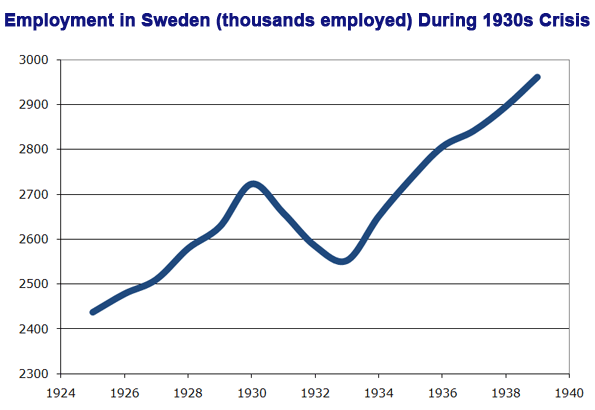
    This is illustrated by how well Sweden handled the great depression. Between 1930-33 170,000 jobs were lost, leading to a six percent drop in employment. However, the downturn soon turned to growth.

    At this time, Sweden was far from a socialist welfare state. The nation boasted low taxes, a flexible labor market and a good business climate. The solution for many who lost their jobs was to start their own business.

    Job creation spurred. Already in 1935 more people were employed compared to before the depression. One reason is that the Swedish economy already had gone through a recession in the 1920s, sparking structural changes.

    New and innovative ventures were started to replace the jobs that had been lost. Several famous Swedish firms, that still today remain as top employers, were formed during and shortly after the depression, such as: Volvo Aero, the mining company Boliden, Securitas and SAAB.

    Swedish social democrats have a surprisingly strong tradition of being quite pro-growth, and even pro-business. However, the hard left resurgence in the 1960s, culminating in the turmoil of 1968 radicalized the Social Democratic party. The tax level started climbing (through hidden taxes on labor and consumption), the labor market became dominated by labor union influence and regulations and the incentives for work, education and entrepreneurship were severely limited.

    As policy shifted, the growth of highly successful entrepreneurial ventures stagnated. A study by economist Sten Axelsson (Axelsson 2006) has examined the entrepreneurial ventures that had the highest revenues in Sweden in 2004. Only two out of 38 firms had been formed after 1970. If the firms were instead ranked after how many the employed, not a single one was shown to have been formed after 1970!

    Another study by economist Jonny Ullström (Ullström 2002) has looked at all the firms that were started in Sweden between 1986 and 1996. Among the 180,000 examined firms, 90 percent had fewer than five employees in 1997. Less than one among a thousand firms had 50 employees or more. Only eight of all the firms had 200 employees or more.

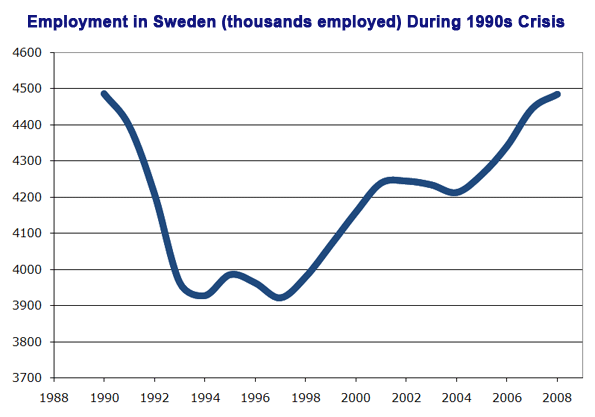
    The drop in entrepreneurship affected Sweden’s ability to deal with downturns. In the beginning of the 1990s, a new crisis hit Sweden. The global economy was growing strongly, but major obstacles faced the Swedish welfare state. Employment fell with almost twelve percent between 1990 and 1993. Within a few years the economy began to grow again. But employment stagnated. It remained until 2008 until Sweden reached the same level of employment as before the crisis.

    However, due to the previously mentioned reforms, the Swedish economy in 2008 was far more flexible than previous years, and thus better able to withstand the international downturn. Since the beginning of the 1990s, Swedish politicians amongst both the right and the left have realized the importance of moving towards greater share of economic freedom and following a generally fiscally conservative path In this time of worldwide crisis, this has helped Sweden’s economy to perform better than many others.

    This is not to say that more reforms are not needed to promote growth and entrepreneurship. Labor market regulations and taxes still depress successful entrepreneurship. For example, a person increasing her or his income with 100 Swedish Kronors has to pay fully 74 Kronors in hidden and visible taxes on employment and consumption taxes.

    Successful entrepreneurs are often highly educated people who already have a good career within large firms. But why spend time and energy on a new venture if up to three quarters of the gains are taxed away?

    Sweden is a nation with a strong history of entrepreneurship, great scientific institutions and strong working ethics. Today the nation stands stronger thanks to reforms towards greater level of economic freedom. But as long as taxes and labor market regulations block the way of growing businesses, the country cannot hope to repeat its stellar recovery course seen during the 1930s.


    Nima Sanandaji is president of the Swedish think tank Captus. He is the author of the book ”Entrepreneurs who go against the stream – what the 90s successful entrepreneurs can teach us” (Swedish title: ¨”Entreprenörer som går mot strömmen – vad 90-talets succéföretagare kan lära om dagens utmaningar”) for Fores.

    Photo by: jdlasica

    References:
    Axelsson, Sten (2006). ”Entreprenören från sekelskifte till sekelskifte – kan företag växa i Sverige?”, in Dan Johansson och Nils Karlsson (ed.), ”Svensk utvecklingskraft”, Ratio.

    Ullström, Jonny (2002). ”Det svenska nyföretagandet 1986-1997: förändringar i företagsstruktur och sysselsättningseffekter”,Vinnova.

  • Is Sweden a False Utopia?

    By Nima Sanandaji and Robert Gidehag

    Sweden is often held up by American pundits and experts as a kind of Utopia, a country to be emulated. As is often the case when dealing with Utopias however, the complexities of history, culture and policy frequently are shoved aside.

    Rather than being guinea pigs in a progressive experiment in social engineering, Swedes are a unique people with a long history. Therefore, we should question the lazy assumption that good Swedish outcomes (long life expectancies, social equality) are due to particular Scandinavian policies (the welfare state).

    After all, even before the high-tax welfare state, Sweden was characterized by an even distribution of income, low poverty and long life spans, the same phenomena that today are said to be the result of high-tax welfare policies. In 1950, before the high-tax welfare state, Swedes lived 2.6 years longer than Americans. Today the difference is 2.7 years.

    A more reasonable view of why Sweden performs well on many social metrics has its basis in history and sociology: Swedes have for hundreds of years benefited from sound low-level institutions, such as a strong work ethic and high levels of trust and cooperation.

    These cultural phenomena do not disappear when Swedes cross the Atlantic to the supposedly inferior “cowboy” country. On the contrary, they appear to bloom fully. The 4.4 million Americans with Swedish origins are considerably richer than the average American. If Americans with Swedish ancestry would form their own country their per capita GDP would be $56,900, more than $10,000 above the earnings of the average American.

    The old Sweden, in contrast, has not done as well in economic terms. In 1960 taxation stood at 30 percent of GDP, roughly where the US is today. As taxes rose, economic growth decreased, with Sweden dropping from being the 4th richest country in 1970 to being the 12th richest in 2008. Swedish GDP per capita is now $36,600, far below the $45,500 of the US, and even further behind the $56,900 of Swedes in America.

    A Scandinavian economist once stated to Milton Friedman: “In Scandinavia we have no poverty.” Milton Friedman replied, “That’s interesting, because in America among Scandinavians, we have no poverty either.” Indeed, the poverty rate for Americans with Swedish ancestry is only 6.7%, half the U.S average. Economists Geranda Notten and Chris de Neubourg have calculated the poverty rate in Sweden using the American poverty threshold, finding it to be an identical 6.7%.

    Ironically, this points us towards the conclusion that what makes Sweden uniquely successful is not the welfare state, as is commonly assumed. Rather than being the cause of Sweden’s social strengths, the high-tax welfare state might have been enabled by the hard-won Swedish stock of social capital. It was well before the welfare state, when hard work paid off, that a culture with strong protestant working ethics developed.

    As taxes in Sweden have grown rapidly towards taking up half of the economy, that social capital is being eroded. In the 1990s, supposedly hyper-healthy Sweden established itself as being sickest country in the rich world, in terms of sick-leave. In addition, half a million working-age people (compared to a total labor force of four million) were placed in health-related “early retirement”.

    Labor union economist Jan Edling calculated that a fifth of working-age Swedes were supported by some form of public unemployment support, including sickness related leave in 2004, when the economy was growing strongly.

    The high-tax state has also created an increasingly threatened middle class. In a recent study, the Swedish Taxpayers association noted that wealth formation among the middle classes is weak. There is little correlation between earnings and wealth amongst Swedes.

    Instead of building capital, Swedes go into debt: 27 percent of Swedish households in fact have more debts than wealth, compared to between 16 and 19 percent in the US. With middle class wealth formation being held back by high taxes, Sweden has ironically developed a more unequal wealth distribution than the US. The Gini coefficient for ownership is almost 0.9 in Sweden, compared to slightly above 0.8 in the US.

    In short, there is much to admire in Sweden. But when it comes to economic policy and copying Swedish institutions, Americans are probably better off being inspired by Swedes in America, rather than Swedes in Sweden.

    Nima Sanandaji, is President of the Swedish think-tank Captus and Robert Gidehag is president of the Swedish Taxpayer´s association. They were assisted by Tino Sanandaji and Arvid Malm, chief economists at Captus respectively the Swedish Taxpayers Association.

  • Young People Living Off the System in Sweden

    There are those who believe that Sweden has a low level of unemployment. This is far from the truth. The combination of high taxes, generous government benefits and a regulated labor market has led to many Swedes to rely on handouts rather than work. The system does succeed in one thing: hiding the true unemployment.

    A few years ago, the Swedish economist Jan Edling noted that the number of people on sick leave and early retirement tended to correlate strongly with unemployment figures. The reason, Edling explained, was that many of the unemployed were hidden from the statistics through these measures.

    Far from being a right-leaning economist, Edling at the time worked for LO – an influential labor union with strong official and unofficial ties to the then-ruling Social Democratic party. The claim that the Swedish welfare state hid actual unemployment through various measures was unpopular among Swedish socialists. So unpopular in fact that Edlings report was not published, causing him to resign after 18 years faithful service.

    Four years ago a center right government was elected with the promise to reduce visible and hidden unemployment. The government has had some success in this, at last before the financial crisis hit and again raised unemployment. Tax cuts and reduced generosity of government benefits have promoted work over dependence. However, among one group reliance on government has not decreased: young people who are relying on early retirement for their living.

    The concept of relying on early retirement among the relatively youthful might sound a bit strange. Swedish politicians have even changed the term “early retirement” into “activity and sickness compensation” to make it sound more acceptable. And it has oddly enough become more or less an accepted fact that many young Swedes who cannot find a job instead rely on early retirement – often on a permanent basis.

    Since 2004 close to 70,000 Swedes in the ages 20-39 have been supported by early retirement. This represents close to three percent of the total population among this age group living in the country. In the Stockholm region, where the labor market is strong, two percent of the young population is living on early retirement. In regions where jobs are scarcer, the figure is four percent. Even among the youngest group – those between 20-24 years – more than two percent of Sweden’s population is being supported by early retirement.

    One reason for the popularity of early retirement is because of the increasing troubles for young Swedes to find employment. According to Statistics Sweden, the unemployment amongst those between 15-24 years was fully 24 percent in the beginning of 2009. Although Sweden does not have minimum wages set by the government, the vast majority of the employers have to follow labor union contracts and the contracts in turn include very high effective minimum wages.

    Not only is the price of youth labor set too high for demand to meet supply, but employers find it too risky to hire inexperienced youth since rigid labor market regulation make it difficult to fire those who do not perform well on their job.

    The high unemployment amongst youth is not only an economical, but also a social issue. Many young people feel depressed since they cannot find a meaningful purpose and cannot contribute to society. This feeling, strong among the youth who are not even officially employed, but rather hidden from the statistics through early retirement, sick leave or other systems.

    The OECD measures the percentage of those who are officially declared to be outside of the workforce but view themselves as being unemployed. This group is referred to as “discouraged workers”. In countries such as Denmark, Germany and the United Kingdom only 0.1 percent of the labor force of 15-24 year olds is composed of discouraged workers. In Sweden, the figure is almost a hundred times higher.

    The Swedish welfare system is seen as many as a role model. When it comes to creating opportunities for the youth however, Sweden could learn much from free-market systems. Or for that matter it could learn from neighboring welfare state Denmark, which has combined welfare mechanisms with a dynamic labor market. The combination, coined by previous Social Democratic Prime Minister Poul Nyrup Rasmusson as “flexicurity”, is far superior to the system of high effective minimum wages and rigid labor regulations introduced by the Social Democrats and their labor union allies in Sweden.

    Nima Sanandaji is the CEO of Swedish think tank Captus, and author of a report on early retirement among the youth for the think tank Timbro.

    Photo: by Claudio.Ar

  • Sweden’s Taxes – The Hidden Costs of The Welfare State

    By Nima Sanandaji and Robert Gidehag

    Sweden is a nation with extraordinary high tax rates. The average worker not only pays 30 percent of her or his income in visible taxes, but, additionally, close to 30 percent in hidden taxes. The defenders of the punishing tax burden argue that it is needed to maintain Sweden’s generous welfare system. While this claim may seem reasonable on its surface, a deeper look suggests that it is based on flawed analysis.

    Some level of taxation is, of course, required to fund the public sector. At the same time, a high level of taxation does not necessarily translate into an equally high level of welfare:

    Taxes discourage work and encourage tax avoidance. There is strong evidence that Sweden’s highest rate of individual and capital taxation actually reduces public revenue. For this reason, some taxes, such as the wealth tax, have recently been reduced. The result is estimated to be a net increase in tax revenues.

    When Swedish municipalities receive increased funding from the state, the money is used to expand the local bureaucracy, a government survey has shown, instead of going to educators and health care workers.

    Municipalities provide much of the welfare in Sweden. The Swedish Association of Local Authorities and Regions have shown in a study that funding for Swedish municipalities grew dramatically between 1980 and 2005. Despite this, the general public consensus is that the quality of welfare has declined during the same period.

    Welfare provisions don’t necessarily correspond with taxation levels. A 2005 research paper examines the efficiency of the public sector in 23 industrialized countries. The researchers found that Sweden only reaches a mediocre 12th place when it comes to how much the public sector provides in terms of welfare services. When the level of welfare is related to the level of taxation, Sweden falls to the last position in the index.

    There is a high variation in how effectively public money is spent within Sweden. The Swedish Taxpayers Association has, in a number of surveys, shown that identical welfare services such as care of the elderly, can vary in cost quite dramatically across Sweden.

    There are two important reasons why the average Swedish worker pays a large portion of her or his income in taxes, without necessarily receiving an equally high level of welfare.

    First, much of the money is spent on administrative costs at various levels of government. Although a small nation, Sweden has over a hundred public authorities. Vast sums are spent on political projects which fall outside the frames of general welfare. It is, for instance, not unusual for Swedish municipalities to fund bowling alleys, swimming pools, or camping places.

    Second, a large fraction of the population is living on benefits rather than working, due to the combination of high taxes, a rigid labour market and generous welfare benefits. Even before the economic crisis hit, for example, almost one out of five children in Sweden’s third largest city, Malmö, were living in a family supported by social security. Sweden has 105 local districts where the majority of the population lives off of various public benefits, and does not work. This unintended consequence of the welfare state has taken a heavy toll on public services, since an increasing share of tax revenue must be diverted to fund welfare payments, rather than social services.

    Many are immigrant dense neighborhoods; others are situated in the northern part of Sweden, where many cities with stagnating economies have suddenly experienced a boom in the fraction of the population who cannot work due to disability.

    The famous Swedish welfare state is to a large degree a notion of the past. Many feel that its glory days occurred during the late 1950s and early 1960s, when Sweden successfully combined welfare policies with an expanding economy. At that time, however, Swedish taxes were 27 percent of the GDP, compared to 47 percent today. The golden days of Swedish welfare did not coincide with the high tax regime we know today.

    How could Sweden fund a prospering welfare system with relatively low taxes in the past? As the researcher Erik Moberg documents in a book for the Ratio Institute, public money was spent much differently back then. The share of public revenues spent on health care and education at the end of the 1950s was greater than it is today.

    And, compared to the 1950s, close to three times as much of public revenues are now spent on public bureaucracy. Four times as much is spent on welfare payments and social insurance. As the level of taxation has increased, so has the share of taxes going to public bureaucracy and various government handouts.

    The historical comparison with the 1950s and 1960s is worth thinking about. It shows that a high quality of welfare can be achieved with a much lower tax level than we have today. If politicians slim down public bureaucracy and cut wasteful spending, resources can be opened up for increasing welfare and reducing taxes at the same time. If the system rewards work to a greater degree than it does living off the state, fewer will be dependent on the public for their daily living, again opening up tax revenues for better use.

    Sweden has long been a small homogeneous country with a high degree of economic equality. Strong norms related to work and responsibility made it possible to enact an effective welfare system early on. With time, however, welfare dependence has reduced the very norms that formed the foundation of Swedish welfare, and wasteful spending has increased.

    Many important social outcomes that the welfare state aims to address, and that Sweden is famous for, such as a low crime rate, have increased in recent decades, concurrent with the expansion of the welfare state. Even income inequality has increased in Sweden compared to, for example, the 1980s, despite similar or higher public expenditure.

    Swedish decision makers are doing their best to reduce public spending and lower taxes. The reforms have been highly successful so far. As taxes have decreased from 57 percent of GDP in 1989 to 47 percent of GDP in 2009, the incentives to work have improved, with Swedish growth rates benefiting. The convergence of lower taxes and lower public spending is likely to continue. After all, experience has made it quite apparent for many Swedes that extraordinary high taxes are not the key to qualitative welfare services and a well functioning society.

    Nima Sanandaji is president of think tank Captus and a fellow at the Swedish Taxpayers Association. Robert Gidehag is president of the Swedish Taxpayers Association.

  • Influence of ‘Creative Class’ Ideas in Sweden

    By Nima Sanandaji, Johnny Munkhammar, and Peter Egardt

    The American academic Richard Florida has gained international attention for his theories about the “creative class”. According to Florida, the key to urban success lies in attracting certain groups of people, such as artists, scientists and twenty-something singles. Florida insists that this can be accomplished through nursing a specific type of culture within a city: hip cafes, art galleries and other manifestations of indigenous street-level culture.

    Florida’s theories have become rather popular in Sweden, the country which tops the list of his creativity index. In a recent study about urban development in Sweden, we have found that Florida’s ideas mainly attract the political left. The Social Democratic Party, as well as the former communist party, embrace Florida’s ideas on their party web pages. The Social Democrats go as far as to quote Florida in a parliamentary bill.

    In Sweden, Florida’s ideas are used by those who wish to argue that public funding of cultural events, rather than a competitive business climate, is the way to achieve economic growth. These urban planners quote Florida in their development strategies, shifting focus from business friendly reforms to attracting “unusual shops” in order to bring development to communities struck by high unemployment and other social ills.

    Swedish cities thus risk choosing the same strategy as Berlin, where the focus of administrators for many years has been to attract art galleries, fashion shows and hip cafes, but where basic conditions for development have been neglected. The bureaucracy in Berlin has a less-than-business-friendly attitude, and taxes for those with typical means of income, as well as for entrepreneurs, remain high.

    The result of these policies, aiming to market Berlin as “a city of glamour” to attract the creative class, has been rampant unemployment. Between 2000 and 2006 The European Union spent close to 2 billion US dollars (1.3 billion Euros) to attempt to curb the economic crisis in the city.

    Florida has, together with two Swedish co-writers (amongst others), recently published an index of creativity in Swedish municipalities. The results of this index are interesting to examine. In accordance with observations made by Harvard Professor Edward L. Glaeser, Florida’s definition of the creative class builds upon the inclusion of well educated people; municipalities with high percentages of educated people are defined as being creative.

    However, in many cases, the rankings in Florida’s Swedish index have little to do with actual creativity or the fundamentals for growth and progress within a municipality. Among 290 Swedish municipalities, the one best fitting Florida’s criterion of creativity is Södertälje.

    This is quite astonishing, since Södertälje is seldom seen as a role model for other municipalities. Among the 26 municipalities in the Swedish capital region, Södertälje has the second highest unemployment rate. The business climate there ranks, according to the Confederation of Swedish Enterprise, as only the 199th most business friendly amongst Swedish municipalities.

    The municipality in the capital region that has the highest unemployment rate is Botkyrka. It is number 233 in business climate. In Florida’s index, however, Botkyrka gains a respectable position as the 22nd most creative municipality.

    While places with failing business climates, high unemployment, high crime rates and overall failing development can be ranked as highly creative in Florida’s Swedish index, actual creativity is not always acknowledged.

    Gnosjö is a small Swedish municipality made famous by its frequent use as an example of how a spirit of entrepreneurship can lift up a community. The unemployment rate is much lower in Gnosjö than in the rest of Sweden. Gnosjö is indeed full of creativity, but in Florida’s index it only ranks as the 141st most creative municipality. Florida’s index fails to catch the real origins of creativity and cultural development in Sweden.

    Abroad, many believe Sweden to be the very showcase for social democratic welfare states. However, ambitious reforms implemented during the past few decades have transformed Sweden into a competitive economy with an increasing degree of economic freedom and strong growth.

    In the wake of this development, culture, fine food and the arts have all blossomed in Swedish cities. Tourists, as well as businesses, are attracted not least to the capital city of Stockholm. The strategy underlying this development has been based on a sound business-and-growth-friendly policy orientation, not a Berlin style emphasis on public subsidies of culture over families and businesses. Cultural development has occurred as the result of a growing economy, not the opposite.

    Nima Sanandaji is President of the think tank Captus. Johnny Munkhammar is President of the consulting agency Munkhammar Advisory. They are authors of a report for the Stockholm Chamber of Commerce about urban development. Peter Egardt is President of the Stockholm Chamber of Commerce.