Author: Pete Saunders

  • Integration — We’ve Been Doing It All Wrong

    I recently had a revelation about the American approach to racial integration. We’ve been doing it all wrong, and its had disastrous impacts on African-Americans. Our cities are facing another integration challenge today, and we’re in danger of repeating the same mistakes.

    Let me present a few provocative counter scenarios to show you what I mean.

    What if, when the time came for baseball integration, the major leagues merged with the Negro Leagues? Instead of identifying a handful of early players who had the grit and toughness to deal with the ostracism, perhaps 2-4 Negro League teams in the 1940’s could’ve become full MLB teams, and the rest of the Negro League players are put into a supplemental draft for all teams. Four Negro League teams from four markets untouched by MLB at the time — the Baltimore Elite Giants, the Newark Eagles, the Indianapolis Clowns and the Kansas City Monarchs — could’ve become full-fledged MLB members, and more players would’ve had a shot at major league play.

    What if, in the wake of the U.S. Supreme Court’s Brown v. Board of Education decision in 1954, segregated white schools were required to admit not only black students, but black faculty and administrators as well? When segregated white schools finally addressed integration, they did so by dispersing black students among several white schools, and generally shutting down the black schools they came from. Black teachers and principals were often left completely out of the integration process, and black students lost a critical support group during a difficult period.

    What if, instead of outlawing housing discrimination by race, religion, national origin and all other protected classes, the federal government outlawed specific practices (exclusionary zoning, redlining, discriminatory public housing and urban renewal, discriminatory real estate practices like steering or contract buying, among others) and at the same time required all local jurisdictions to provide housing for all persons at all income levels? Mid-century American suburbs would likely have seen an increase in working-class and low-income housing, becoming far more diverse far earlier than it has. Cities would’ve seen an uptick in high-end construction far earlier as well. On the whole, there would’ve been greater balance in urban and suburban property values, then and now.

    America did something quite different in reality. Brooklyn Dodgers general manager Branch Rickey sought out someone with the talent and fiery personality like Jackie Robinson. The Little Rock NAACP was forced to find the Little Rock Nine to push Little Rock Central High School toward integration. Individual homebuyers or renters were sent into sometimes hostile neighborhoods in the name of integration.

    In reality, the burden of integration was always on black people.

    This hit me with full force after hearing a podcast by Malcolm Gladwell at Revisionist History. In his story about integration, entitled Miss Buchanan’s Period of Adjustment, he talks about the aftermath of the Brown v. Board decision — how the Brown family’s intent was misread by so many, including the Supreme Court, and how it led to tragic unintended consequences. One of those consequences: the number of African-American teachers in the South, to this day, has never recovered from its heights during the Jim Crow Era, because school systems, administrators and school parents believed they could deal with black students in the classroom, but could not abide being taught by black teachers.

    In each of the real scenarios, two systems were (or are) at work, and African-Americans were seeking to operate on a level playing field. There were two baseball “systems” — MLB and the Negro Leagues. There were two school “systems”, explicitly so in the South but implicitly so in the North — one for whites and one for blacks. There are two housing “systems” in our metro areas, for blacks and whites.

    Here’s the problem. When our nation’s power structure looks at these dual systems, the assumption is that one is superior and the other is inferior. Barriers must be broken so that people can flow to the clearly superior system. In pursuing integration, our society destroyed one system in the name of inferiority, while never fully accommodating the needs of those dependent on another.

    But really, were those “inferior” systems really inferior? There are many accounts of Negro League teams playing exhibitions against MLB teams and winning with regularity. The Brown family in the Brown v. Board case? They were quite pleased with the quality of education, the excellence of the faculty and staff, at the segregated school their daughter attended; they brought up the case because their daughter was forced to attend a school several miles away, when another school was available just four blocks away. But because of the assumption of inferiority, the power structure sought to be expansive rather than inclusive: meaning that it would expand one system in the hopes that it would accommodate more participants, rather than fully include the other system fully into the mix.

    In fact, when it could, the power structure effectively destroyed one system in favor of the other. The Negro Leagues were effectively defunct by the mid-1950’s. The expansion of suburban school districts at the time of rapid suburban expansion, accompanied by policies that kept blacks out of suburbs, led to resegregation and negative impacts in urban school districts.

    Back to housing, where we have another conflict of systems. Urban revitalization has produced a lot of angst. There are newcomers with lots of anxiety about their imprint on formerly low-income communities. There are longtimers fearful about the change coming to a neighborhood they hold near and dear. Increasingly, the newcomer response has been to expand its options. Yes In My Back Yard (YIMBY), they say; build more housing and prices and rents become more affordable, and we can rid ourselves of the displacement angst. Longtimers, in voices that are seemingly heard less and less, call for an inclusive approach to revitalization. Something that allows them to stay in place, and benefit from positive change as well.

    History suggests it won’t go well for the longtimers.

    This piece originally appeared on The Corner Side Yard.

    Pete Saunders is a Detroit native who has worked as a public and private sector urban planner in the Chicago area for more than twenty years.  He is also the author of “The Corner Side Yard,” an urban planning blog that focuses on the redevelopment and revitalization of Rust Belt cities.

    Photo: A painting of East-West All Star Game participants at Chicago’s Comiskey Park, undated. Source: tiki-toki.com

  • Detroit — The Movie

    I guess there was always going to be a difference between the Detroit film I wanted and the Detroit film that was produced.

    “Detroit”, the new big-budget exploration by director Kathryn Bigelow that goes into the details of one of Motor City’s most defining events, came out this weekend to strong critical acclaim but less than outstanding popular success. As a native Detroiter I was intrigued from the outset about the film’s premise and how it would present such a tense and difficult subject — and if the film could offer any potential for resolving the issues that still plague the city 50 years later. In an attempt to connect 1967 Detroit to present-day concerns over police brutality, the film succeeds in making us feel brutality, but fall just short of explaining how it became a tool of oppression and how it can be undone.

    As someone whose absolute earliest memory is of watching National Guardsmen drive down residential streets in fatigues and pointing rifles, while in my mother’s arms, I had envisioned a film that would provide context for the uprising. One that would provide meaning. I envisioned an epic, sweeping, panoramic film that would establish the economic and social roots of the riot. Possibly develop the perspectives of people on multiple sides of the uprising — police, looters, white and black riot resisters, dispassionate suburbanites. Something that would acknowledge that before 1967, there was 1943, there was 1941, there was 1925, and a host of other indignities large and small. The film begins with that potential, but loses it along the way.

    The film starts with a well done animated montage that describes, basically, how the cauldron that would eventually explode was built. But it does so in a way that doesn’t convey the sense of desperation felt by many blacks, nor is particularly specific to Detroit. Blacks moved up from the South for jobs. They were confined to the worst neighborhoods and the worst jobs. Efforts by blacks to gain better housing and better economic opportunity were met with resistance — sometimes procedural and administrative, others visceral and violent — by the white majority. That’s the case in hundreds of cities nationwide, but I feel as if Detroit still needs more context.

    The film then moves into the event that spurred the riot itself — the police raid of a Vietnam War veteran’s welcome home party at a “blind pig”, or unlicensed after-hours club. The montage may seem sanitized, but the raid itself and the start of the riot seems very real.

    We then see the first three days of the disturbance played out. Looting, buildings burning, exasperated black residents in conflict with overwhelmed, but quite angry, Detroit police officers, state police, and National Guardsmen. Perhaps as a metaphor for dreams dashed and never realized, we’re introduced to a group of young black singers known as the Dramatics (a real group, dramatized) hoping to make it big with a performance to Motown executives at Detroit’s Fox Theater, but police tell guests to evacuate the theater just prior to their performance.

    Then the film sharply narrows its focus to its depiction of events at the Algiers Motel. In fact, a strong case could be made that the film should have been named “Algiers” instead of “Detroit”, because of its focus. But any film that would try to tackle a topic as significant as Detroit’s 1967 conflict would have to have the city’s name in it. Spoiler alert for those who wish to see the film (but the film is based on actual and easily found events): the Algiers Motel incident was a deeply tragic and brutal injustice in which police officers killed three young black men and severely beat five other men and (white) women. Police respond to a perceived sniper attack coming from the motel by seizing it, gathering its occupants and then engaging in truly evil torture and intimidation. Police were later acquitted on all charges in the murders and beatings, but never served on the Detroit police force again.

    The Algiers Motel scenes, making up almost half of the film, extremely violent, claustrophobic, and visceral. It is hard to watch. Without question, if one wants to see what it looks like to be under the control of a deranged sociopath, this is the film. But is this what racism is? Or all that racism is? Did it require hundreds of thousands of similarly deranged people to terrorize Detroit’s black community? Not at all. And that’s where the film fails. It reduces racism to the violent actions of deranged individuals, who have no regard for the lives of the people they’re supposed to protect.

    The racism that led to the conflict in 1967 was far more subtle, until it wasn’t. Redlining, urban renewal, interstate highway construction, job and educational disparities, and more — they weren’t practices explicitly tailored to diminish black progress, but those who supported them knew they did the trick. And all it took to support them was a nod of agreement.

    In an attempt to find a connection between the tragedy of Detroit then and recent police killings, from Ferguson to Baltimore to St. Paul, we lost out on a chance to develop greater meaning and understanding of what happened 50 years ago.

    For what it’s worth, it seems the film, or the process of completing the film, or the healing powers of time itself, has had a redemptive impact for residents of metro Detroit. The 1967 conflict kicked off a decade of controversy in Detroit — the Algiers Motel trials, a contentious mayoral race for control of the city, tense fights over metro-level school busing, all while the auto industry slipped into decline and violent crime moved steadily upward. Many white residents fled the city during that time and afterward, believing “one day our city was fine, and the next it was on fire”, and never looked back. But more are beginning to acknowledge a sense of pain and loss from their dislocation from the city. If the film has that effect on Detroiters, then it’s succeeded despite its flaws.

    This piece originally appeared on The Corner Side Yard.

    Pete Saunders is a Detroit native who has worked as a public and private sector urban planner in the Chicago area for more than twenty years.  He is also the author of “The Corner Side Yard,” an urban planning blog that focuses on the redevelopment and revitalization of Rust Belt cities.

    Photo: Actors Will Poulter (left) and Anthony Mackie in a scene from “Detroit”. Source: parlemag.com

  • On the Outside, Looking In

    The urban political base that was the foundation of African-American politics since the Civil Rights Movement is slowly eroding. Because of large-scale demographic trends at work in our metro areas, black political influence is in decline. Unless blacks become more inclusive (or intersectional) in our political approach, or better at building coalitions, we risk having our political concerns relegated to the margins, by virtue of where we live.

    I said as much nearly three years ago (“How ‘Black = Urban’ Ends”) and in subsequent posts I wrote nearly two years ago about urban and suburban demographic trends and how that’s reflected in our metro areas. I haven’t updated the data, but think the trends are more evident now than ever.

    How can I make this claim? One measure is the number of elected African-American mayors in our nation’s largest cities.

    Let’s look at how thing have changed over the last 25 years. In 1992 four of the ten largest cities in the nation were led by black mayors (New York, Los Angeles, Philadelphia and Detroit). Some cities, like Chicago and Cleveland, had already elected black mayors but no longer had them; others, like Seattle, Denver, Kansas City, Memphis, Minneapolis and San Francisco, would elect their first black mayors before the end of the decade. In all, by 2000, 13 of the 25 largest U.S. cities at the time, and 19 of the 50 largest, either had or would have a black mayor in office.

    But the election of black mayors in large cities would slow greatly after 2000. Today, only six of the 50 largest cities (Houston, Denver, Washington, DC, Baltimore, Kansas City and Atlanta) currently have black mayors. Five more cities in the top 50 — San Antonio, Jacksonville, Columbus, Sacramento and Wichita — had black mayors whose terms started in 2000 or later, but have since been replaced (most recently former San Antonio Mayor Ivy Taylor, just last month).

    Let’s be clear about a couple things, however. While the numbers of black mayors of large cities has declined over the last 25 years, the leadership of our cities is far more diverse — and representative — than it was then. There are more Latino, Asian and women mayors leading our large cities than ever before, and that’s a positive. But that doesn’t change the fact that there are fewer blacks in those positions.

    And while the election of big city mayors is relatively easy to track, identifying trends among other local officials is far more difficult. My guess is that city councils, county boards, special service districts and the like are also more diverse and representative, and may even have more African-Americans in those positions — even as the number of black mayors has declined. That also can be viewed as a positive.

    The Explanation

    How can this be explained? Two years ago I pulled some Census Bureau ACS data for the twenty largest U.S. urbanized areas (the contiguous portions of metro areas with more than 1,000 people per square mile) that offered some interesting findings:

    • Nationally, principal cities and their suburbs both grew at 4.4% between 2010 and 2014.

    • Metro area population growth is driven by strong growth among Hispanics, Asians and other groups.

    • Within urbanized areas, however, whites and blacks are growing at much slower rates – blacks at 4.0%, whites at just 0.3% nationwide.

    • Within the twenty largest urbanized areas, the number of white residents is growing in principal cities and decreasing in suburbs.

    • Similarly, the number of black residents in growing in suburbs, and essentially flat in principal cities.

    • At the metro level, 12 of the top 20 metro areas have principal cities where the white population is increasing while the black population is decreasing, or where the growth rate of whites exceeds that of blacks.

    • Similarly, 19 of the top 20 metro areas have suburbs where the black population is increasing while the white population is decreasing, or where the growth rate of whites exceeds that of whites.

    • Here’s how that information looks graphically. First, for whites, blacks, Hispanics, Asians and others, at the national level by city and suburban geography:

    And then, a focus in on whites and blacks nationally, by city and suburban geography:

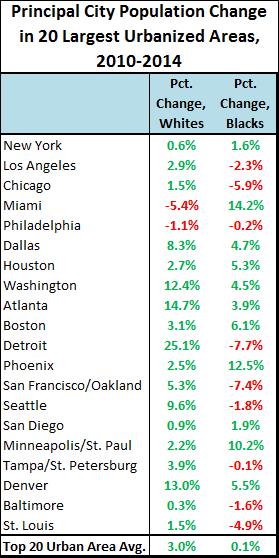
    Now, let’s look at percentage changes of whites and blacks within the principal cities of the twenty largest urbanized areas:


    And lastly, at percentage changes of whites and blacks in suburban areas of the top 20:


    This data is in need of updating, and there is the question of whether trends evident within the top 20 urban areas are applicable to smaller ones. I’ll try to answer both when I can. In the meantime, simply put, Latino and Asian populations are growing in the largest cities and suburbs. Whites are growing more numerous in cities while declining in suburbs, while blacks are declining in cities and growing in suburbs.

    This is the first part of understanding the change in African-American political influence.

    Much of this seems to slip under the radar of urbanists, because of the second part of trying to understand this — your level of analysis impacts your ability to perceive, and evaluate, the trend. At the metro level, we see that suburbs are becoming more diverse as they add more people of color and cities see a return of white residents to core cities. After generations of practices put in place to exclude people of color from suburbs, this is applauded. But at the neighborhood level, it could be viewed quite differently — an influx of minorities where none previously existed in the suburbs, or an influx of whites in minority-dominated neighborhoods. Only one of these trends at the neighborhood level has truly been considered by most urbanists.

    Speaking of which — I want to dispel any notion that displacement related to gentrification plays a dominant role in this. That’s the narrative that’s fueled gentrification debates for years. But rarely does this narrative consider the aspirational appeal of moving to the suburbs that still resonates with many people of color, just as it did with earlier generations of whites in the 20th century. Lance Freeman, a professor of urban planning at Columbia University, has conducted considerable research that counters this assumption:

    “What distinguishes gentrification is not who moves out; it’s who moves in. In a gentrifying neighborhood, new residents are more likely to be well-off . As a result, the neighborhood’s poverty makeup can shift, even if no one leaves. In 2004, I found that a neighborhood’s poverty rate could drop from 30 percent to 12 percent in a decade with minimal displacement. That’s because gentrification often leads to new construction or to investment in once-vacant properties.”

    Thinking that gentrifiers are forcing this dynamic magnifies their importance, and diminishes the decision-making process of people of color.

    The Impact

    Back to politics. What will this mean going forward, given what we know about how cities are changing the political landscape? We know that cities are pushing forward to develop an urban political agenda; in the aftermath of the election of Donald Trump to the presidency, a key recommendation of Richard Florida’s book The New Urban Crisis was that cities should become more autonomous so they can more effectively address the challenges that impact them. But with increasing numbers of minorities in suburbia, and a growing number of urbanists who have “been there, done that” when it comes to the suburbs, does autonomy come at a price?

    Here’s how I see things playing out over the next decade or two. People of color will continue to move to suburbia in increasing numbers. They will do so for the same reasons people before them did — affordability, good schools, lower crime. They are doing so in part because suburbia is something that eluded them for so long, and is now within their grasp. As they move in, they will begin to wield more influence on suburban politics — suburban mayors, County Board representatives, more representation in state legislatures. We will see more minority representation in the suburbs — just as suburban political influence wanes.

    Why? Because cities are ascendant. It’s not just people flowing back into cities. It’s jobs, and it’s money. More and more people in residential and commercial real estate are finding out that the real money to be made is now in cities. Banks will change lending patterns to favor cities, and not suburbs. The case will be made — and rightly so — that urban density is the right response to lowering carbon emissions in a climate change world, and those who choose density will be rewarded. At the same time, those who choose sprawl will be punished. Banks won’t finance new development or renovations. Property values will decline. Tax dollars for infrastructure improvements will be harder to come by.

    I hardly see this happening to all suburban areas across the country. There are suburbs in some metro areas that are closely aligned with the core city (either by adjacency or transit) and will adapt accordingly. There are pockets of affluence in many suburbs that will not change, no matter what broader trends portend. There are other metro areas whose entire makeup is largely suburban in orientation, and any change they have will more likely be region-wide. As for metro areas with a bigger city-suburban divide, over time I see wealth being pulled from suburbia and back into cities in quite the same way it happened in the middle of the 20th century, in reverse. Minority political representation will continue to decline in cities and increase in suburbs — and they’ll find they own a landscape few people want.

    In other words, even as people of color are making decisions that work in their interests now, we may need to get accustomed to a future of being on the outside, looking in.

    This piece originally appeared on The Corner Side Yard.

    Pete Saunders is a Detroit native who has worked as a public and private sector urban planner in the Chicago area for more than twenty years.  He is also the author of “The Corner Side Yard,” an urban planning blog that focuses on the redevelopment and revitalization of Rust Belt cities.

    Photo: huffingtonpost.com

  • Can the Chicago White Sox Help Turn Around the South Side?

    As a displaced Detroit Tigers fan who adopted the Chicago White Sox as my team, I often wonder how our city’s other team, the Cubs, became an integral institution in the remaking of our city, while the White Sox have not. I published a piece at my Forbes site some time ago that detailed my thoughts on how the Cubs facilitated that transition. The Cubs’ growth in prominence, particularly from 1969 until today, parallels the city’s transition from Rust Belt to Global City. Conversely, the White Sox have diminished in prominence over the same span. I realized the Sox missed out on the locational advantages the Cubs enjoyed, and circumstances and mistakes have hurt them.

    Once again, readers may ask, “what does any of this have to do with cities?”, so let me explain. Baseball, I believe, holds a special place as a sport that is an institution and amenity for the places they call home. As the nation’s oldest professional team sport, it has an enduring history in many of our largest cities. In its early years, major league teams sought to establish close relationships with the neighborhoods that surrounded them; with 77 (and now 81) home games scheduled each year, that was just a good business practice. Teams in other sports have tried to replicate the institution/amenity feel, with varying degrees of success. Basketball and hockey are winter sports and played indoors. Football plays to much larger crowds and with far fewer games, and is far more likely to be viewed as a neighborhood intrusion than an amenity. But baseball is summer. It’s (mostly) outdoors. It can be easily integrated into a neighborhood fabric. So, yes, I see baseball teams, baseball stadiums, as having an outsized impact on city revitalization that other sports teams can’t compete with.

    What I tried to capture in my Forbes piece is that before the Cubs enjoyed their current baseball success, they have for some decades enjoyed that locational success, and parlayed that into a successful partnership with the surrounding neighborhood. From that piece:

    “Starting in 1969, the Cub mythology begins to grow, and television becomes a bigger part of it. Chicago kids would come home from school to watch day baseball games. Plays by David Mamet were being written about bleacher bums. At the same time, the economies of north and south were continuing to diverge. Institutions like DePaul and Loyola University, Children’s Hospital, and others, were attracting more of the Midwest’s best and brightest to study and work. And the Cubs became a very attractive amenity to people returning to cities exactly for that reason.

    It was in the 1980s that the real and enduring changes occurred. WGN became a cable television superstation, and now Cub games were broadcast nationally. Throughout the ’80s, especially with Harry Caray at the helm in the broadcast booth, every game was a celebration of what Chicago, and specifically North Side Chicago, had to offer. A jewel of a ballpark, day baseball, views of sailboats on Lake Michigan and a dramatic skyline nearby — all of this became not just a Midwestern phenomenon, but a national one. Suddenly, it wasn’t just Midwestern kids who dreamed of moving to big city Chicago. It became national.”

    In other words, the heart of Cubbie fandom lies in its place: the old ballpark, the surrounding neighborhood, the bars and restaurants, the nearby lakefront, even the nearby eds and meds institutions that employ many of the neighborhood’s residents — they all blend together to create a unique and enviable environment.

    Conversely, over the last 50 years or so the White Sox lost whatever locational advantage they had. Deeply identified as the “South Side’s Team”, their fortunes diminished just as the South Side’s:

    Meanwhile, as the Cubs became more popular in the late ’60s, the luster on the White Sox began to dim. The Bridgeport neighborhood that is home to the Sox is in many respects the polar opposite of the Cubs’ Lake View neighborhood. It’s working-class, with far fewer eds and meds institutions, and a Bronzeville neighborhood — also known as the Black Belt — that stood between it and the south lakefront. While Cubs fans sitting in the upper reaches could see sailboats on the lake, Sox fans could see a never-ending row of public housing towers.

    Beginning in the late ’60s and early ’70s the fortunes of the Cubs and White Sox diverged as dramatically as their respective parts of the city.

    First, Some Facts

    Let’s try to establish a context for the Cubs and White Sox by using the most accepted measure of popularity in baseball, attendance. Since 2001 the Cubs have been in the top tier of MLB attendance, with an average annual rank of eighth out of thirty teams. The Cubs are regularly in the mix with the Yankees, Dodgers, Cardinals, Giants, Mets, Red Sox and Angels as a top MLB draw. Over this period the Cubs have averaged just under 3 million fans per season, or about 37,000 per game. Cubs attendance has proven to be remarkably consistent and impervious to big fluctuations in wins and losses. The Cubs paid a big price in 2013 when attendance dropped by 11.8% after disappointing seasons in 2011 and 2012, but overall the Cubs increased attendance at a rate of 1.2% a year over the last sixteen seasons. MLB attendance has grown at a rate of about 0.6% annually since 2001.

    The White Sox, however, are quite a different story. Since 2001 the Sox have consistently ranked in the bottom third in MLB attendance. They’ve averaged just over 2 million fans annually, or nearly 26,000 per game. That’s enough to rank them 21st out of thirty teams in that span.

    I haven’t been able to document this yet, but I suspect the Sox may be among the more win-sensitive teams in MLB. Attendance jumped 21.3% from 2004 to 2005, the year the Sox won the World Series, and jumped another 26.2% in 2006, in the World Series afterglow. The Cubs have no such huge year-to-year gains over the last sixteen seasons. However, subsequent poor seasons meant attendance has dropped for eight consecutive seasons before ticking upward again in 2015. The Sox have gained about 0.5% annually in attendance since 2001, just under the MLB average.

    Cubs fans, and Chicagoans in general, seem to accept the Cubs/Sox fandom differential as an immutable fact, but that’s not the case. Historically speaking, as I wrote previously about this at Forbes, the White Sox regularly outdrew the Cubs following World War II and into the ’60s. From the late ’60s to early ’80s, there was general attendance parity between the teams. Since the early ’80s, the Cubs have regularly outdrawn the Sox. The Cubs have outpaced the Sox in attendance every year since 1992.

    Downtown, Neighborhood and Suburban Teams

    The Cubs are one of just a handful of major league baseball teams that have maintained a strong neighborhood identity and association. Out of 30 MLB teams, just nine are located in neighborhood locations today, with 18 located in downtown areas and three in the suburbs (including the Atlanta Braves, who moved to suburban Cobb County this season). Here are the nine so-called neighborhood teams, located at least two miles outside of the center of a city’s CBD:

    • New York Yankees
    • Boston Red Sox
    • Chicago White Sox
    • New York Mets
    • Philadelphia Phillies
    • Washington Nationals
    • Miami Marlins
    • Oakland Athletics
    • Chicago Cubs

    Philadelphia, Washington, Oakland and Miami deserve special attention. By my eyes, the Phillies, Nationals and A’s all play in stadiums that are beyond their cities’ central business districts, but appear to be located in areas that are largely warehouse or former manufacturing districts, as opposed to residential or mixed-use areas. The home of the Miami Marlins opened in Miami’s Little Havana in 2012, so one could argue it’s had little time to develop — yet — a strong relationship with the surrounding neighborhood. (Kansas City — the Royals’ Kauffman Stadium, although within the city’s limits, is so far from the city’s downtown, and relies on interstate access to reach it, that it gets a “suburban” designation from me.)

    The Yankees, Red Sox and Cubs are each intimately connected with their surrounding neighborhoods. Yankee Stadium is in the Bronx; while it doesn’t seem to have the same revitalization impact on its surrounding area, it is within easy reach affluent Manhattan. The Red Sox’ Fenway neighborhood and Fenway Park might be the closest analogue to the Cubs’ Lake View/Wrigleyville neighborhood and Wrigley Field in terms of vibrancy and impact on the city. I’m less familiar with the connection between the Mets and the nearby Queens neighborhoods.

    What Happened?

    The White Sox, however, seem to have far less impact than the others on the surrounding neighborhoods. In fact, the White Sox’ home seem most similar to the Oakland A’s — beyond downtown, and in the less-favored area of a two-team baseball market.

    I don’t know what happened with the A’s and Oakland, but I think it’s easy to figure out how the neighborhood fortunes, and subsequently the fan fortunes, of the Cubs and White Sox diverged. Keep in mind that prior to about 1950, the areas around Wrigley Field and Comiskey Park were more similar than they are today. But the area around Clark and Addison retained its neighborhood fabric, while the area around 35th and Shields mostly lost it. A few things factored into the divergence:

    Macro: the general decline of the South Side. A quick and easy way of seeing the difference between the North and South sides is looking at the median household incomes for the communities that house the respective teams, Lake View (Cubs) and Bridgeport (Sox). In 1970, the median household income in Lake View (in 2014 dollars) was $44,889. In Bridgeport, it was $48,548. In 2015, median household income in Lake View was $76,424, and in Bridgeport it was $42,951. This plays out more broadly as well; wealth has flowed into the north lakefront neighborhoods of the Near North Side, Lincoln Park, Lake View and Edgewater, and it flowed away from Bridgeport, Bronzeville, Washington Park and Woodlawn.

    Micro: Sox Park’s hemmed-in geography. The home of the White Sox has long been hemmed in by two freight rail lines, about a third of a mile apart — the Norfolk Southern line on the west and the Rock Island on the east. For much of its stretch on the South Side, the narrow corridor has been treated as a no-man’s land with manufacturing uses, intermodal facilities, and poor quality housing strewn in. The intact Bridgeport neighborhood lies further west, and Bronzeville further east. A look at an aerial of U.S. Cellular Field highlights this:
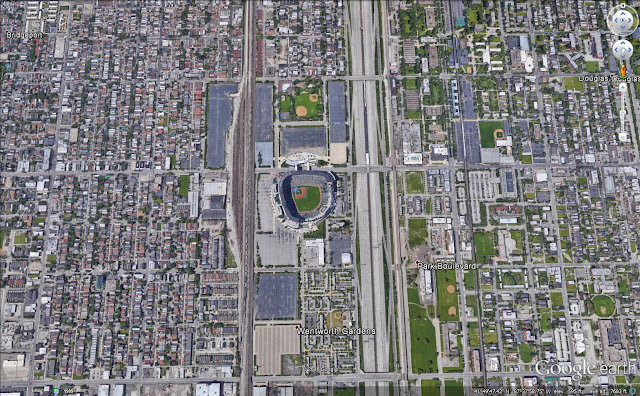
    Lack of nearby institutions and amenities. Several key institutions are located near Wrigley Field — DePaul and Loyola universities, several hospitals — that make the area an attractive place to live. Near old Comiskey, the much smaller Illinois Institute of Technology and Mercy Hospital are still there, but their presence might not be felt in the same way in the community as those further north.

    Public housing construction. The year 1949 began a 20-year period where public housing was constructed just to the east of Comiskey Park. Dearborn Homes, Stateway Gardens, and Robert Taylor Homes were built within eyesight of Comiskey over that period, concentrating tens of thousands of low-income residents along the area’s eastern edge.

    Dan Ryan Expressway construction. Between 1957 and 1962, the Dan Ryan Expressway was constructed just feet from Comiskey’s eastern edge. Remember the narrow rail corridor? The 16-lane expressway, with a new public transit line in the median, made it even narrower.

    When you combine these with some management differences between the Sox and Cubs, like the spotty radio and TV presence the Sox had when compared to their Cub brethren, and the failed venture to showcase Sox as a pay-per-view attraction on CableVision in the early ’80s, and it becomes clearer how the two teams took vastly different tracks.

    Paths to White Sox Success — And Urban Revitalization

    That being said, I think there are ways the White Sox could reclaim the kind of locational advantage they once had and the Cubs currently enjoy. However, it would mean the Sox would have to view themselves as a city institution invested in the revitalization of its surrounding area and employ unconventional tactics. Otherwise, they may need to consider other options. Here’s what they can do:

    Stay at 35th and Shields — and partner with commercial and residential developers. In the late ’80s, when the White Sox threatened to leave Chicago and received the public gift of U.S. Cellular Field in return, a counter-proposal was floated by Chicago architect Philip Bess to create Armour Field. It was to be a stadium that wouldn’t just be firmly integrated into the fabric of the surrounding community — it would create community where none currently existed. Take a look:


    The oddly-shaped outfield harkens back to the New York Giants’ Polo Grounds, and Bess took pains to re-create the outlines of old Comiskey. More importantly, Bess frames the stadium with mixed-use development to the east, west and south of the stadium, and includes a circle at 35th and Wentworth that creates a signature entrance into the area. I’m guessing this type of development would bring the same types of residents who live near Wrigley today. I’ve never heard an explanation from the Sox for why this proposal was rejected, but I assume costs had much to do with it. And yes, working on the commercial and residential sides of the project would be a challenge.

    This, of course, is just one redevelopment option. If the Sox are serious about staying at 35th and Shields, it would be in their best interest to lead the revitalization of the surrounding area.

    Find another neighborhood site on the South Side. There are likely other spots on the South Side that don’t have the constraints that prevent Cubs-style community cohesiveness and neighborhood connection. One such site could’ve been the 49-acre site of the former Michael Reese Hospital on the Near South lakefront; it was formerly considered as the site for the Olympic Village in Chicago’s 2016 Olympic bid, but is now being redeveloped as a major mixed-use development. I’ve also considered locations in largely manufacturing areas adjacent to the Southwest Side’s Orange Line. I’m sure there are other possible sites out there. All, however, would probably come with some significant neighborhood resistance, and have the same cost challenges inherent in the above scenario.

    Find a downtown or near-downtown location. It’s quite possible that in a two-team baseball market, only one team can be the “neighborhood” team. If so, the Cubs are it. The White Sox could find a site downtown or nearby (to be sure, very expensive) and begin to shed their South Side identity by becoming the team at the center of the metro area. Even though they’re not in a two-team market, the Detroit Tigers invigorated their fan base by moving from antiquated Tiger Stadium to Comerica Park in 2000, leaving the city’s Corktown neighborhood for a downtown locale. During the ’90s the Tigers were among the lower rung teams in attendance, drawing 1.5 million annually. The Tigers vaulted into the middle tier with the new stadium (and some on-field success) in the 2000’s, averaging 2.5 million a season. Of course, the last option would be to…

    Move to the suburbs. The White Sox flirted with suburban locations in the late ’80s. However, suburban stadium locations are seen less often today, particularly for baseball stadiums (Atlanta Braves excepted). Perhaps it’s because suburbs or suburban counties are less able to put together the public financing packages that team owners often demand (or extort?). If it were to happen, my guess is that the Sox would target relatively affluent south or southwest suburban communities like Orland Park or Bolingbrook, so that the team could easily attract fans from a broad spectrum of the metro area without completely compromising its South Side heritage. Honestly, I see this as highly unlikely, as the return-to-the-city movement is moving ahead in Chicago as much as anywhere.

    I couldn’t fathom a move to another city now, so I won’t explore it as an option.

    Bottom line, despite their on-field failures over the years, the Cubs have done a masterful job of taking advantage of locational opportunities presented to them. The White Sox have had a more difficult go of it for the last 60 years or so, but could turn it around with the right kind of thinking. Here’s hoping the White Sox can become the kind of integral institution of South Side change that the Cubs have been up north.

    This piece originally appeared on The Corner Side Yard.

    Pete Saunders is a Detroit native who has worked as a public and private sector urban planner in the Chicago area for more than twenty years.  He is also the author of “The Corner Side Yard,” an urban planning blog that focuses on the redevelopment and revitalization of Rust Belt cities.

    Top photo: U.S. Cellular Field, home of the White Sox. Source: sportingnews.com

  • Las Vegas Lessons, Part II

    A couple weeks ago I wrote some thoughts after a recent visit to Las Vegas. Most of what I wrote about concerned the Strip and downtown areas of the city, without question the two most recognizable and most frequently visited parts of the region. But in a rapidly growing region of nearly 2.2 million people (the Las Vegas Valley held only 273,000 residents in 1970, meaning it has increased its population by 8 times since then), clearly there’s much more to the region than its most iconic and visible parts. Here I’ll offer some thoughts on the broader region, its built environment, its economy, and thoughts on its future.

    First, for those tl;dr readers who won’t click through to read Part I, here’s a quick summary of it:

    • The Strip and Las Vegas are two entirely different entities.
    • Strip is a great pedestrian experience.
    • The Strip is an exclusively private space.
    • Downtown Las Vegas is quite different from the Strip.
    • There are poor linkages between Downtown Las Vegas and the Strip.
    • The north end of the Strip is plagued with high-profile failed projects.

    Again, as someone who’s “part urbanist, part sociologist, and part economist,” I offer some observations and thoughts on the rest of the city and region.

    The balance of the city and region consists of unremarkable suburbia. This is probably evident to anyone who puts any amount of thought into it, but it does bear repeating. Step away from the Strip and downtown, and Las Vegas’s built environment is amazingly consistent: according to the U.S. Census Bureau American Community Survey in 2015, the metro area is about 60% single family detached homes, with about 4,000-6,000 people per square mile throughout. There’s no sudden or even slight gradation in density as one commonly finds in many eastern cities; the city quickly establishes its suburban character and spits it out relentlessly. And, I’ve been struck on this visit and previous ones at how similar Vegas looks to suburbia in other places. Yes, there are newer, upscale areas that stand out (Summerlin comes to mind), but if you replace Vegas’s palm trees with oaks and elms, it looks a lot like suburbia anywhere else in America, except with Spanish tile roofs. Similarly…

    Nothing in the region is old; the region will have to learn the art and skills of redevelopment. Fifteen years ago when I did some consulting work in Las Vegas, I thought it was weird when city officials referred to West Las Vegas, just northwest of downtown, as “historic”. Most of the homes and businesses there were built in the ’50s and through the ’70s, and in my mind they were the kind of structures that were just beginning to establish some character. But when the median year of structure built in the region is 1995 (the same for Chicago’s metro is 1967), you simply won’t find the pre-WWII type of development that is called historic in other places. There will come a time when the structures of the Las Vegas Valley will be viewed as obsolete and inconsistent with modern living (whatever that is), and the region will have to undergo one of the more difficult transitions for municipalities — shifting from easy greenfield development to complex redevelopment.

    Low wage and low skill jobs proliferate in the region. Like the unremarkable nature of the suburban pattern, here’s another conventional observation that bears repeating. As one would expect, the accommodations/food services employment sector dominates in Las Vegas — nearly one-third of all Las Vegas workers work in hospitality. Those have traditionally been low-paying jobs, and that’s true of the region today. Overall, 44% of Vegas workers earn less than $40,000 a year. Contrast that with Austin, a similarly-sized and similarly-fast-growth metro, where only 9% of workers are employed in accommodations/food services, and just 34% of workers earn less than $40,000 a year (and consider that Austin is a college town that has many recent grads, possibly pushing incomes downward). My concern for Vegas in this regard is that there is growing research that suggests that the kind of work automation that decimated much of the Rust Belt’s manufacturing jobs may now enter a phase that targets food services, administration and office support, sales and even retail jobs — precisely the kinds of jobs that many new Las Vegas residents moved there to occupy. Las Vegas workers could be quite vulnerable to the kinds of challenges that reshaped the Rust Belt.

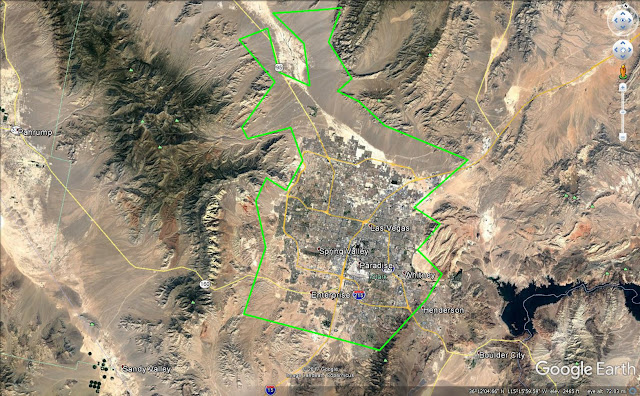
    The Las Vegas Valley is nearing its physical limits. According to Wikipedia, the Las Vegas Valley is a 600 sq. mi. basin surrounded on all sides by mountains. I don’t know the precise delineations between flat and inclined topography, but a look at Google Earth tells me the region is near its limit:

    I could be wrong, but it looks as if Vegas has available land to the north and southwest, and the Valley might be approaching 90% developed. It could be that the region hits the wall (literally) within the next 10 years. What will that mean for a region that is as low-density suburban as this one? Will the Valley’s communities have the ability to shift their focus inward? Time will tell.

    What happens to the region if tourism… changes? Wikipedia’s Atlantic City page has a good explanation for the decline of tourism there after World War II. It connects its decline with the car; prior to the war, people generally traveled to Atlantic City by train and stayed for a week or two. Cars made people more mobile and they made shorter visits. Suburbanization and its creature comforts, like backyards and air conditioning, also took visitors away from AC. The final nail in the coffin was affordable jet service, opening up vacation spots like Miami, Havana, and the Bahamas (and Vegas) in the 50’s and onward. I don’t know what challenge is out there for Vegas now, but what will be crucial to the region’s survival is how it responds.

    What impact will climate change have on a desert resort city? When flying into Las Vegas I couldn’t help but notice the low level of Lake Mead, just southeast of the city. It was clear from the air; bleached rock that had once been under water now exposed. Las Vegas is blessed to have one of the largest reservoirs in the nation at its back door, but could continued drought and increased demand for water undermine everything? The Strip’s casinos tout themselves as leaders in water conservation, but whether their efforts will be enough as conditions worsen is an open question.

    Las Vegas is truly a unique place. It’s a place that seems to serve a certain time and space, and is concerned about now more than its future. But I’m sure if the region squints its eyes and looks, it will see the future is getting closer. It will need to figure out how it will be sustainable as that future approaches.

    This piece originally appeared on The Corner Side Yard.

    Pete Saunders is a Detroit native who has worked as a public and private sector urban planner in the Chicago area for more than twenty years.  He is also the author of “The Corner Side Yard,” an urban planning blog that focuses on the redevelopment and revitalization of Rust Belt cities.

    Photo by Stan Shebs [GFDL, CC BY-SA 3.0 or CC BY-SA 2.5], via Wikimedia Commons

  • Las Vegas Lessons, Part 1

    I spent much of last week in Las Vegas for the International Council of Shopping Centers’ RECON 2017, the world’s largest real estate convention. It’s a gathering for developers, brokers, property owners, retailers, architects, landscape designers, construction companies, municipalities and more to get together to discuss real estate possibilities, in the one city that owes its very existence to aggressive real estate ventures.

    I had a good time, at least as much as I could; being there for a convention is far different from being there for pleasure. In fact, I’ve been to Vegas many times before, but always within a business context and never for pleasure. Also, I had not been in about 15 years, which is important for two reasons: 1) in Vegas time, with the rapid pace of development there, 15 years is an eternity; and 2) it completely predates the establishment of this blog, so I can include my thoughts on the city in this forum.

    In that vein, here’s a Corner Side Yard take on the Sin City — part urbanist, part sociologist, part economist, all observational — that details my thoughts on a truly unique place.

    The Strip and the city of Las Vegas are two entirely different entities. I think this subtle distinction, which few outsiders really know about, is key to understanding Las Vegas’ growth and development. Hal Rothman’s book Neon Metropolis, published in 2003, notes that the Las Vegas Valley grew in three distinct phases: the Union Pacific Railroad, the construction of Hoover Dam and military investment enter the picture prior to 1945; organized crime arrives and Nevada legalizes gambling, driving investment and perceptions through the 1960s; and the passage of two Corporate Gaming Acts in 1967 and 1969, which drew corporate investment into the area (partly as a means to dilute criminal investment). In that second phase, and continuing into the third, casino developers sought to avoid city development and permitting regulations by setting up outside of the city boundaries, which is at Sahara Avenue on Las Vegas Boulevard (aka the Strip). What most people recognize as Las Vegas is actually the unincorporated communiites of Winchester, Paradise and Spring Valley — significantly sized communities of their own, but under the jurisdiction of Clark County, Nevada. The county, which has two-thirds of Nevadans within its boundaries, takes a far more laissez-faire approach to development than the city of Las Vegas does, and directly reaps the benefits of development without having to pass through the city. That being said…

    The Strip is a great pedestrian experience. Anyone familiar with the Strip knows that a stroll of the roadway is an experience unto itself. From north to south, the Strip builds as a visual spectacle beginning at the Stratosphere toward Circus Circus and continuing to the Wynn and Encore, before reaching a crescendo at the intersection of the Strip with Flamingo Road, where the Bellagio, the Venetian, the Flamingo, Caesar’s Palace, Paris, and Planet Hollywood converge (see the picture above). The dense concentration of resorts continues southward past the MGM Grand to include the Tropicana, the Escalibur, the Luxor, and Mandalay Bay. Architects and urbanists Robert Venturi, Denise Scott Brown and Scott Izenour wrote of the Strip in their 1972 book Learning From Las Vegas, and one of their criticisms at the time was the isolation of the resorts via massive parking lots. If anything, the developers should be commended for revising their thinking on the Strip by creating the pedestrian environment. Yes, it’s gaudy, yes, it’s a jarring juxtaposition of architectural styles, but it does what so many other cities still fail to do — bring the experience right to the street. A great addition to the Strip is the usage of escalators and pedestrian bridges to minimize pedestrian interaction with the high-traffic Strip, serving a dual purpose as entrances into connected resorts. Which means…

    The Strip is an exclusively private space. It might be better to think of the Strip as the world’s largest mall, because its private management reminds me of enclosed shopping centers, writ very large. It’s clear that every inch of the Strip has been thought out as a way to collect and divert traffic into the resorts — the Monorail stops, the signage on the pedestrian walkways. If you’re looking dial down the Strip’s intensity through quiet public open spaces, you’re out of luck. The best you can do is find something inside one of the many resorts.

    Downtown Las Vegas is quite different from the Strip. Continue northward on Las Vegas Boulevard and eventually you will enter downtown Las Vegas. This is where the earliest hotels and casinos were established, the ones that drew visitors in by railroad as opposed to automobile. Resorts here are smaller and less overwhelming. It has a long-standing reputation for being a little more downscale, even seedier, than the Strip further south, but the city has worked hard to clean up its image and make it a fantastic destination in its own right. The Fremont Street Experience, an open-air pedestrian mall with a super-sized LED canopy display, unites several of the downtown casinos with an experience that’s completely different from the more well-known Strip. However, downtown Las Vegas probably maintains a secondary status in the Las Vegas Valley because…

    There are poor linkages between downtown Las Vegas and the Strip. The Fremont Street Experience in downtown Las Vegas sits about two miles north of the city’s southern boundary, where the Stratosphere hotel and casino are located. Downtown is about three miles north of where the real action and activity begins near the Wynn and Encore resorts. In between are the kinds of warehousing, light industrial, marginal commercial and grimy multifamily structures often found on the outskirts of downtown areas. There are wedding chapels, auto repair shops, convenience stores, and the like. There’s nothing that easily draws visitors between the Strip and downtown. Why?

    The north end of the Strip is plagued with high-profile failed projects. The Fountainbleau Resort Las Vegas and Echelon Place stand out as two high-profile casualties of the Great Recession, proposed just as the Strip was developing a continuous string of modern resorts that would reach from the Strip all the way into downtown. The Fountainbleau, a $2.8 billion project first proposed in 2005 with the second tallest structure in the Las Vegas Valley, managed to reach 70 percent completion before construction stopped in 2009 when the project went into bankruptcy. The $7.2 billion Echelon Place was announced in 2004, and the implosion of the Stardust Hotel and Casino, which it was to replace, happened in 2007. However, there were fits and starts in its construction due to the economy, until the developers sold the site in 2013. The new owners are proposing a new venture called Resorts World Las Vegas, but that project too has been plagued with delays. It’s clear that had these two projects been developed, they would have had a catalytic impact on further development northward toward downtown.

    That’s enough about the city and the Strip; I’ll follow up soon with more thoughts on the overall region’s built environment, economy and potential future.

    This piece originally appeared on The Corner Side Yard.

    Pete Saunders is a Detroit native who has worked as a public and private sector urban planner in the Chicago area for more than twenty years.  He is also the author of “The Corner Side Yard,” an urban planning blog that focuses on the redevelopment and revitalization of Rust Belt cities.

    Photo by Carol M. Highsmith [Public domain], via Wikimedia Commons

  • Welcome to South Chicago

    If you’ve been reading my stuff here long enough, you probably know that cringe when I hear people talk about Chicago’s South Side as a monolith, as code for black and poor.  The truth is, there are many facets to the South Side.  It is largely black, but not exclusively so; it is less wealthy than other parts of the city and region, but with pockets of wealth also.  It has its very troubled spots, but it has places of promise.  I’ve written about one part of the South Side here, and recently wrote about a nearby but very different part of the South Side too.  With that in mind, I’m adding another entry into my “Welcome To” series.  Today, I’ll talk about one of the oldest parts of the South Side, and indeed Chicago — the neighborhood of South Chicago.

    Others in the “Welcome To” Series:
    Welcome To Mount Greenwood
    Welcome To Rosemont
    Welcome To The South Side, JRW Style

    South Chicago does indeed fit one image of the South Side: it is a classic late 19th/early 20th century industrial neighborhood, and that sense is captured in the image above.  Virtually from its inception, steel production, port activities and rail transportation defined the community.  Situated at the mouth of the Calumet River as it enters Lake Michigan, the neighborhood was well suited to produce manufactured goods and deliver them to the entire nation. 

    Had things gone a little differently, South Chicago could’ve been at the center of Chicagoland, rather than on the periphery.  The Calumet is in fact a larger river than the Chicago River, closer to the centerpoint for today’s metropolitan area.  There are historical reports that suggest that the early U.S. government nearly established Fort Dearborn where the river empties into Lake Michigan, but later opted for the less flood-prone area further north. 

    The swampy areas around South Chicago may have inhibited early development but never diminished its importance.  Settlement of the area began in the 1830’s, and happened independently of Chicago’s settlement and growth, ten miles to the north.  The Chicago Fire (1871), the establishment of the South Works steel mill (1880), annexation into Chicago (1889), the acquisition of South Works by U.S. Steel (1901), and the creation of the Calumet Harbor/Port of Chicago (1921) all served as catalysts for growth that started in South Chicago and spread to its surrounding communities.   

    South Chicago has a unique physical and demographic character derived from its growth independent of Chicago and relative isolation because of the surrounding swampy land.  To the north, west and south of South Chicago, most residential and commercial development consists of structures built between about 1925-1955.  But within South Chicago itself, you can find plenty of blocks that look like this:

    92nd and Brandon, South Chicago

    or like this:

    90th and Houston, South Chicago

    that have much more of the 1890’s/1900’s/1910’s-era construction that could be found in places much closer to the Loop, like Bucktown or Bridgeport.  When driving into the area, it gives a sense of stepping back in time. 

    South Chicago’s commercial heart, the aptly named Commercial Avenue, also has the rather dusty appearance.  Here’s the primary commercial intersection of 91st and Commercial (presumably scrubbed of all cars and pedestrians just for this Google Earth pic):

    South Chicago is also served by a spur of the Metra Electric line that provides transit service to much of the South Side.  The South Chicago branch begins (or ends, I guess, depending on your perspective) at 93rd and Baltimore, just east of the Commercial Avenue view you see above.  The only electrified train line in Metra’s transit system, and the only one that does not share its tracks with freight lines, South Chicago has regular service that connects it to the Loop within 35 minutes.

    I had the pleasure of working with the South Chicago Chamber of Commerce during my time with the City of Chicago about 25 years ago.  It was then that I found out another unique characteristic of the community — a substantial and long-established Latino community, mostly Mexican, that’s been based in South Chicago for more than 100 years.  Significant Mexican immigration to Chicago began around 1910, with immigrants drawn (or recruited) to the city to work in steel plants and packinghouses, and also pushed by the upheaval of the Mexican Revolution that began around the same time.  Steel mill jobs were plentiful at the time, but so were worker strikes.  Mexican workers were often cast as strike breakers, putting them at odds with recent European immigrants.  By 1960 Latinos made up more than one-third of South Chicago’s population, even as it was less than ten percent citywide.  Today, blacks are the largest racial/ethnic group in the community, but Latinos still make up nearly one-fourth of the population there.

    Developers are trying to bring South Chicago into the 21st century by parlaying its lakefront location into new development.  The former U.S. Steel South Works site, closed in 1992, is the single largest vacant site on the Chicago lakefront.  A development team is working out the details of a purchase of the 430-acre site to build as many as 12,000 residential units and new retail on the site.  This effort comes on the heels of a failed joint venture attempt by U.S. Steel and a developer that fell apart in 2004, and considerable infrastructure investment by the city into the area (remediation of the U.S. Steel site, an extension of Lake Shore Drive, and the creation and upgrade of lakefront parks). 

    I’m guessing that there will come a time when South Chicago sheds its industrial past and embraces its potential.  A key lakefront location, with nearby parks and excellent transit options, and a funky, authentic building stock that might appeal to urban pioneers might mean that South Chicago could get discovered.  We’ll see.

    Pete Saunders is a Detroit native who has worked as a public and private sector urban planner in the Chicago area for more than twenty years.  He is also the author of “The Corner Side Yard,” an urban planning blog that focuses on the redevelopment and revitalization of Rust Belt cities.

    Lead photo: A freighter leaves Lake Michigan and enters the Calumet River Turning Basin in South Chicago, near 95th Street and Lake Shore Drive.  Source: still from youtube.com

  • Suburban and Urban Housing Cost Relationships

    Perhaps this is old hat to you, but this came across as a bit of an epiphany to me earlier today.

    I was listening to the local public radio station this morning and there was a segment about the Chicago regional housing market that was fairly interesting.  Real estate and personal finance expert Ilyce Glink talked about home buying in the Chicago regional market.  Like many other housing markets nationwide, Chicago took an incredible hit in 2008-09 via the Great Recession, and regionally, home prices have been slow to rise from the depths of the early parts of the 2010s.  There’s some greater optimism that prices might be up throughout the area, even as the potential for higher mortgage rates increases, too. 

    In describing the Chicago regional housing market, Glink described many things in our recent housing history that are familiar to a lot of people in metro Chicago, and in other metros as well — depressed prices, numerous foreclosures, and a razor-thin inventory.  But she also alluded to the pre-Great Recession pattern that defined the region’s housing market — the continued movement outward of new home construction at the edges of the region — and how that essentially stopped around 2009 and hasn’t resumed since. 

    That got me thinking.  YIMBYs, the “yes-in-my-backyard” group that’s been pushing for relaxed housing regulation so that more housing units are built in cities to address affordable housing, have been effective in using the obscene housing prices and rents of cities to justify new city housing construction, despite my repeated objections.  My contention has usually been that prices rose so steeply in the hottest city neighborhoods because the demand was so high.  There was a newfound preference for city living, especially among young professionals.  However, there simply wasn’t enough of Lincoln Park or Wicker Park for everyone that wanted in.  Furthermore, there are other neighborhoods, like South Shore, that have the same positive qualities (lakefront location, easy public transit, close to the Loop) that should make it appealing to those wanting to live in the city, but it was being bypassed.  My argument was that such neighborhoods might actually welcome investment.  The combination of these factors, I believed, led to the price and rent spikes in the hottest areas, and it could be resolved in part by city newcomers considering previously unconsidered parts of the city.

    Here’s the epiphany — what if the lack of housing supply, at the regional level, has less to do with the lack of housing production within cities, and more to do with the lack of housing production at the metro area’s margins?

    Just before and well after the last recession, I worked for a city at our region’s edge and it was a huge beneficiary of the pre-2007 housing free-for-all.  In fact, the city where I worked more than doubled its population between 1990 and 2010 on the strength of annexation and new housing construction, becoming one of the largest cities in Illinois.  In 2007, weaknesses in the housing market were becoming apparent; in 2008, the bottom fell out; in 2009 and 2010, people were wondering when the old normal would return, or if a new normal would set in.  I think it’s fair to say the latter, since nothing approaching the pre-2007 boom has returned to the metro edges. 

    This would require further study and analysis by someone far more qualified than me, but here’s what I’m thinking.  Maybe, in a strange way, early urban pioneering was dependent on housing growth at the margins.  It could be affordable for those who chose to live there because it was one part of a housing market conveyor belt: first step a trendy but safety-optional urban apartment, second step a safer and quieter apartment or condo, third step a house in the suburbs.  The lack of edge housing construction disrupts that model, especially if there’s a shift in housing preferences as well.

    In other words, what’s broken is not the ability of cities to accommodate new construction, but the edge-driven model we’ve had for the last 60-70 years. 

    Don’t get me wrong.  I don’t see a return to our suburban-sprawl frenzy as a way to reduce prices and rents in cities.  But maybe it pays to examine the entirety of a regional housing market before designating a culprit.

    Pete Saunders is a Detroit native who has worked as a public and private sector urban planner in the Chicago area for more than twenty years.  He is also the author of “The Corner Side Yard,” an urban planning blog that focuses on the redevelopment and revitalization of Rust Belt cities.

    An unfinished subdivision.  Source: joyyehle.com

  • Detroit’s Recovery? Oh Yeah, It’s Real Alright

    So it seems the debate has begun.  There’s been enough progress in Detroit to discuss whether its rebound is for real, or not.

    Two academics, Laura Reese of Michigan State University and Gary Sands of Wayne State University, wrote a piece for the Atlantic a couple weeks ago to counter the spreading narrative of Detroit’s comeback.  The article notes the Motor City’s rebound has caught the attention of the national media and parts of academia, but they aren’t so certain that the trend is real, or if it is, whether it’s indeed sustainable.  From the article:

    “These rosy descriptions were not consistent with the reality of what we continued to see in many Detroit neighborhoods. To provide perspective on Detroit’s comeback story, we examined trends in a variety of indicators including population, poverty, income disparities, business recovery, unemployment, residential sales prices and vacancies, and crime.

    Two major conclusions emerged from our data. First, by a number of measures Detroit continues to decline, and even when positive change has occurred, growth has been much less robust than many narratives would suggest. Second, within the city recovery has been highly uneven, resulting in increasing inequality.”

    In response to this article, blogger Lyman Stone added his take on Detroit’s recovery.  He seems to agree with Reese and Sands that, whatever is happening in Detroit, it’s not touching growing numbers of city residents, and therefore it’s not exactly a comeback:

    “I tend to be on team “Abandon all hope ye who enter here.” Saving Detroit is likely to be extremely costly while still holding a high risk of failure, in my opinion. But this view is predicated on a certain perspective of what it means to succeed. To some, success means population decline stops. To some, success means fewer empty buildings. To some, success means balanced municipal finances. To some, success means increasing employment. To me, I tend to think success means that huge population outflows will stop, and that population will begin to rise. Others may espouse other views, but I tend to think a locality’s ability to provide prosperity only matters in a general equilibrium framework, so a place that makes locals rich by culling the herd of non-rich locals is not “succeeding.” Success means that you offer prosperity to a rising share of the general population.”

    However, Stone notes that there are some positive demographic trends that are evident in Detroit, and seems to make the case that if Detroit is to get out of its hole, it’s at least stopping digging.

    The City Observatory’s Joe Cortright took a positive spin on Detroit in the Atlantic, going against the grain of both pieces and suggesting that Detroit’s comeback shouldn’t be dismissed:

    “Is Detroit “back?” As best I can tell, no one’s making that argument. The likelihood that the city will restore the industrial heyday of the U.S. auto industry, replete with a profitable oligopoly and powerful unions that negotiate high wages for modestly skilled work, just isn’t in the cards…

    That said, there’s clear evidence that Detroit has stanched the economic hemorrhage. After a decade of year-over-year job losses, Wayne County has chalked up five consecutive years of year-over-year job growth. True, the county is still down more than 150,000 jobs from its peak, but it has gained back 50,000 jobs in the past five years.”

    Honestly, I think each of the pieces — indeed, most people — underestimate the depths of Detroit’s collapse, and therefore underestimate the significance of its current recovery.  Detroit’s collapse was not simply an economic one, but a cultural, social and demographic one as well.  It lost virtually all connections with the networks of wealth and information that drive economic growth, and the city had such a pervasive negative perception that it was effectively erased from the minds of many.  What’s happening now is Detroit is reconnecting itself to the national and international network of cities, slowly returning to life among the living.  This is a necessary step for Detroit before any rebound that improves the lives of the majority its residents. 

    I view things this way.  While Detroit suffered immensely from the restructuring and decline of the auto industry, it likely suffered even more from demographic collapse.  Four years ago, I wrote a piece that showed the strength of the city’s demographic vacuum.  It’s not just that the city lost jobs and people moved.  People soured on Detroit in ways no other major city experienced, and left behind a city of concentrated poverty. I’ve often brought this graphic out, and it still amazes me:


    To his credit, Joe Cortright gets this in his article.  Where Reese and Sands argue that Detroit’s economic boost in the downtown and Midtown areas and some select nearby neighborhoods is raising income inequality, Cortright responds with a comment from the Brooking Institution’s Alan Berube: “Detroit does not have an income inequality problem—it has a poverty problem. It’s hard to imagine that the city will do better over time without more high-income individuals.”

    And that’s indeed the critical first step for Detroit.  It has to once again attract a critical mass of middle income and upper income residents who are ready, willing and able to invest in the city, before it can effectively take on its greater economic challenges. The post Great Recession recovery we’re witnessing now means the city is getting closer to being able to take on greater tasks.

    Pete Saunders is a Detroit native who has worked as a public and private sector urban planner in the Chicago area for more than twenty years.  He is also the author of “The Corner Side Yard,” an urban planning blog that focuses on the redevelopment and revitalization of Rust Belt cities.

    Top photo source tomabouttown.wordpress.com

  • Chicago’s Crime Wave Understood: Complex Problem, Simple Formula

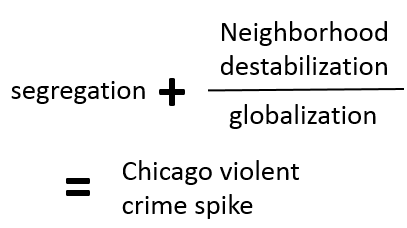
    Chicago’s violent crime problem can be understood through this formula:

    It’s a simplistic, reductionist, even crude, but it explains the roots of Chicago’s crisis as well as anything.

    It has been particularly grueling time in Chicago this recently.  We experienced the murders of at least ten Chicagoans, including two girls, age 12 and 11, shot within 30 minutes of each other in different locations, and a 2-year-old boy.  Once again, Chicago is thrust into the spotlight as President Donald Trump spoke of “two Chicagos” and renewed his pledge to send some kind of federal assistance to deal with the violence (note: you may have seen me refer to “two Chicagos” before, but I’m definitely uneasy with our current President making even starker distinctions between them).  And with each new story of violence, of television and newspaper reporters being sent out to document another life lost, of an expression of heartbreak from a grieving parent, we ask ourselves, “how did it get this way?  How do we solve it?”

    In many respects the violent crime wave is a reaction to the same trends that got our president elected, but coming from even deeper and longer lasting strains of dislocation and disenfranchisement.  It’s also a set of unintended consequences related to very specific policies undertaken by the city itself.  While Chicago’s experience is rather unique among American cities, other cities that exhibit similar traits are seeing the same spike as well.  In each case, the spike is decades in the making.

    Segregation

    It starts with segregation.  Chicago’s leaders during the early years of the twentieth century were the innovators of a segregation system that plagues the city to this day.  Natalie Moore, South Side bureau reporter for Chicago public radio station WBEZ and author of The South Side: A Portrait of Chicago and American Segregation, noted the pervasiveness of segregation in Chicago in this interview with the Chicago Tribune:

    “People know that segregation exists, but they don’t always think about it,” said Moore, WBEZ’s South Side Bureau reporter and the author of “The South Side: A Portrait of Chicago and American Segregation.” “It’s like air and water: You just kind of live it, but you don’t think about it.”

    And how was it established?  Tribune reporter Jeremy Mikula and Moore go on:

    “The institutional racism Moore charts in the book goes back generations and has its roots after the start of the Great Migration. Restrictive covenants prevented African-Americans from moving outside the city’s historic Black Belt until U.S. Supreme Court cases such as Hansberry v. Lee (1940) and Shelley v. Kraemer (1948) eliminated such restrictions in housing.

    Through that time, Moore writes, “the city designed a way for blacks to not fully participate in the freedoms of the North,” and later formulated subtle policy decisions that can still be felt today, she said.

    “All the things from redlining to the Home Owners’ Loan Corporation to blockbusting to white flight, there are so many things that happened in the 20th century that have lingering effects,” Moore said. “It’s never been about white people want to live there and black people want to live there. This is where the history is really important for us to understand.”

    Emphasis added. 

    Tools were developed and employed to create a segregated Chicago — restrictive covenants, redlining, exclusionary zoning, urban renewal, interstate highway development, public housing development, aggressive policing tactics and a judicial system that exploits inequality — and those tools are foundational to our understanding of the way the city operates today. 

    Chicago is not alone in its history of segregation, nor is it alone in its current spike in violent crime.  In fact, it may not even be the worst.  In late 2016, USA Today reported on the nation’s most violent cities, based on 2015 FBI violent crime data.  Chicago was not among the top ten.  The list was headed by St. Louis, followed by Detroit, Birmingham, Memphis, Milwaukee, Rockford, IL, Baltimore, Little Rock, AR, Oakland and Kansas City.  What’s dispiriting is the number of violent cities that are also among the most segregated.  St. Louis, Detroit, Birmingham, Memphis, Milwaukee and Kansas City are on most lists of highly segregated cities, as well as Chicago, Indianapolis, Cleveland, Cincinnati and Philadelphia.  Nearly all have seen violent crime increases.

    Neighborhood Destabilization

    So Chicago became a highly segregated city, with large numbers of blacks cut off from the economic and social networks necessary for upward mobility.  Old segregated spaces increasingly became impoverished spaces, as former white neighborhoods became new segregated spaces.  Concentrated poverty became super-concentrated with the development of the public housing in Chicago, and by the ’80s and ’90s Chicago was notorious for two features of its segregated system: 1) a gigantic collection of gangs operating as organized criminal enterprises; and 2) a depraved and dysfunctional public housing system, which also served as a base for gang activity.  To many, the dysfunction of Chicago’s public housing was crystallized in the story of the murder of Eric Morse, a 5-year-old taken to a vacant 14th floor Ida B. Wells public housing complex apartment by two preteens, and dropped to his death because he would not steal candy for them.  The city, and the nation, was outraged.

    It’s at this point that Chicago made a significant departure from other cities and pursued three policy choices that impacted the stability of its neighborhoods.  First, it made a concerted effort to lock up the leadership of the gang hierarchy, intent on “cutting off the head” of the gangs.  Second, the city recognized the failure of its public housing system, and elected to dismantle its most troublesome projects through its Plan for Transformation.  Third, in a cost-saving measure, the city closed nearly 50 public schools, with nearly all being in the highly segregated south and west sides.

    Each played a role in undermining the stability of Chicago’s south and west side neighborhoods, sending them into the violent crime spiral we see today.

    In the mid-’90s, Chicago police worked with the U.S. Attorney’s office to establish Operation Headache.  At the time the Chicago drug trade was largely controlled by gangs that were more akin to organized crime syndicates than gangs in the conventional sense.  The Gangster Disciples, the Black Disciples, the Vice Lords and the Latin Kings covered large parts of the city and developed distribution networks and open-air drug sales areas, and law enforcement found the problem nearly intractable.  Operation Headache represented a shift in tactics designed to bring them down.  Rather than focus on lower-level drug dealing youth who cycled in and out of the criminal system, they chose to go after gang leaders in an effort to destabilize them, and it was successful:

    “The first wave of convictions stemming from Operation Headache came in March 1996. But the biggest, most symbolically meaningful blow to the Gangster Disciples was delivered in May 1997, when Hoover was convicted of 42 counts of conspiracy to distribute drugs, received a sentence of six life terms, and was transferred to a supermax prison in Colorado, where his cell was located several stories underground and his ability to communicate with the remnants of his gang were severely constrained. Soon, the GDs in Chicago had been all but neutralized, and the authorities shifted their attention to decapitating the city’s other major drug organizations, the Black Disciples and the Vice Lords.

    Over the course of a roughly 10-year stretch starting in the mid-1990s, leaders from the GDs, the Vice Lords, the Black Disciples, and to a lesser extent, the Latin Kings were successfully prosecuted and taken off the street. The top-down assault appeared to work as Safer and his colleagues had hoped: violent crime in Chicago began to decline, with the city’s murder total dropping from a high of 934 in 1993 to 599 10 years later.”

    Beginning in 2000, the Chicago Housing Authority moved out public housing residents from developments that looked like this:

    and demolished them.  The goal was to replace them with less concentrated developments that would be integrated with their surrounding communities that looked more like this:

    or like this:

    The critical difference would be, however, that the CHA would now pursue a mixed-income approach to public housing development to address the city’s segregation problems and poverty concentration.  To do that, a third of residential units in new developments would be reserved for public housing residents, another third would be developed as affordable units for working-class and middle-class residents, and the last third would be sold or rented as market-rate properties. 

    Just as Operation Headache was successful in its early stages, so was the Plan for Transformation.  CHA worked closely with the U.S. Department of Housing and Urban Development to tear down the old public housing towers, and completed developments that did indeed appear more integrated into the surrounding neighborhood and fulfilled the mixed-income character that people desired.  By the mid-2000s both policies looked to be successful elements in the remaking of Chicago.

    But there were unintended consequences that law enforcement and housing officials did not see.  Violent crime in Chicago dropped to historic lows by 2005, leveled off for a few years, and started trending upward.  One reason cited?  Law enforcement became a victim of its success:

    “While experts say the Latin Kings, a Hispanic gang, continue to run a large and rigidly organized drug-selling operation on Chicago’s West Side, the majority of Chicago residents who call themselves gang members are members of a different type of group. Rather than sophisticated drug-selling organizations, most of the city’s gangs are smaller, younger, less formally structured cliques that typically lay claim to no more than the city block or two where they live. The violence stems not from rivalries between competing enterprises so much as feuds that flare up with acts of disrespect and become entrenched in a cycle of murderous retaliation.

    Many close observers of Chicago’s violence believe that, as well-intentioned as it was, the systematic dismantling of gangs like the Disciples led directly to the violence that is devastating the city’s most dangerous neighborhoods in 2016. Taking out the individuals who ran the city’s drug trade, the theory goes, caused a fracturing of the city’s criminal underworld and produced a vast constellation of new entities that are no less violent, and possibly even more menacing, than their vanquished predecessors.”

    Meanwhile, CHA was successful in the dismantling of old projects, but had limited success in the development of new ones, especially when trying to implement the mixed-income model.  In 1999, CHA committed to finding replacement housing for all public housing residents who would be displaced by the demolition, counting on their ability to construct mixed-income developments.  However, they soon ran into several challenges.  Private developers were finding it difficult to obtain financing for mixed-income developments, despite federal, state and local commitments.  But more importantly, market-rate buyers and renters, and even buyers and renters in the affordable range, showed little desire to share space with public housing residents. 

    This curtailed CHA’s ability to construct new developments, and forced them to rely much more heavily on Housing Choice Vouchers (HCVs, commonly referred to as Section 8 vouchers) to provide housing for former public housing residents.   An April 2011 report by CHA found that of the 16,500 public housing family households they committed to developing mixed-income units for, only 20% were actually in such developments.  There were 36% living in CHA projects that weren’t demolished, and 44% received HCVs and were living wherever their voucher would take them.

    Where did voucher holders go?  Generally to working-class black neighborhoods further south or west of former public housing sites on the south and west sides.  Many Robert Taylor and Stateway residents left Bronzeville and moved to the Englewood and Auburn-Gresham neighborhoods further south; many Horner and Rockwell residents left the near west side and Garfield Park and moved to Austin, further west. 

    The last straw was the closure of schools by the Chicago Public Schools in 2013.  By the mid-2000s, for anyone who cared to note it, there was growing evidence of conflict within the city’s public schools as children new to various neighborhoods competed with children of long-time residents.  At the same time the school system continued down its own budget spiral as the service delivery costs went upward and pension obligations went unmet.  That forced consideration of closures by CPS, much to the dismay of community residents familiar with the disruption caused by gang disorganization and an influx of poor residents.  Not only would the education of students be compromised by the closings, they argued, but the conflicts seen as voucher-holding residents moved into their communities would arise again.  New school boundaries would put combustible mixes of vulnerable children in new and dangerous environments.

    Globalization

    The election of Donald Trump as president has brought sharp focus to the polarization of our nation by economics, class and geography.  Well-educated and high-skilled workers are succeeding in today’s economy; less-educated and lower-skilled workers are failing.  A lot of people view this within the context of our nation’s white working class in small cities and rural areas, but the same applies to blacks in cities like Chicago as well.

    I’m going to plagiarize myself and pull some things about Chicago I wrote last year, when I saw six distinct categories of neighborhoods in the city.  Here’s the map:

    Gentrified Communities (dark green): Former middle and working-class neighborhoods that have firmly become well-to-do neighborhoods over the last 30 years or so. Home to a substantial amount of Chicago’s walkable urbanism inventory. Transit supported and amenity rich.

    Gentrifying Communities (light green): Historically similar to the adjacent gentrified communities, but part of a second or third wave of growth that emanated from the first group. Almost as affluent and educated as the first group, and quickly catching up, but not quite there yet.

    Frontline Communities (yellow): Largely working-class neighborhoods that may be experiencing development pressure generated in the gentrified/gentrifying communities. People in the above two areas may identify with communities here as places for authentic ethnic dining or shopping. Less wealthy and with more minorities than the gentrified/gentrifying communities, but less than those on its outer flank. In Chicago, at least, fear of the prospects of gentrification here may exceed reality.

    Stable Prosperous Communities (gold): Middle-class neighborhoods that sprouted in the city at the advent of the suburban era and have changed little since. Single-family home oriented and auto-oriented. In Chicago, home to many city workers who must remain in the city due to residency requirements. Rapidly growing older in its makeup.

    Transitioning Communities (orange): Structurally similar to the stable prosperous communities, but more deeply impacted by one or two transitions. Some are receiving a large influx of new minority residents, largely Latino. Others are experiencing a huge outflow of middle-class families, largely African-American. Those experiencing the Latino influx are becoming younger and less affluent; those experiencing the African-American outmigration are being hollowed out, leaving behind large numbers of older and younger less affluent residents.

    Isolated Communities (brown): Impoverished areas of the city. Middle-class white residents left here in the ’50s and ’60s, replaced by middle-class and working-class blacks who bore the brunt of job loss in the subsequent decades. Plenty of walkable urbanism exists here, but demolition means it’s fading away.

    Here are a few data pieces I gathered for each of the categories I identified (you can click to see bigger):

    Looking at the map, the green and light green neighborhoods have been Chicago’s winners in today’s global economy.  The gold neighborhoods have been doing reasonably well.  Depending on your perspective, the yellow neighborhoods are threatened with gentrification encroachment, or have a reasonable expectation of upcoming revitalization.  The orange and brown neighborhoods?  They’re not doing so well.  They’re the ones largely impacted by Chicago’s century-old segregation legacy, or in various stages of instability via the actions undertaken over the last 25 years. 

    Chicago’s rigid segregation patterns set the stage economic divergence before globalization did, but globalization made it worse.  And in the aftermath of the Great Recession, when globally connected communities returned to their upward trajectory, troubled communities sunk further into the abyss.

    Chicago’s violent crime spike will not be solved with National Guard troops patrolling the streets.  It will not be solved with greater emphasis on gun control laws.  It will not be solved by a wholesale reform of the Chicago Police Department, which has just come out of a year-long investigation by the U.S. Department of Justice that excoriated its “excessive force, lax discipline and bad training.”  All of these measures would have some incremental impact on violent crime.  Crime would go down, if only temporarily.  However, these measures treat the symptom.  None would do anything to address root causes and eliminate the problem for good.

    There is an answer to Chicago’s madness.  It would not solve the problem overnight, but it would have the potential to solve it for the long term.  I’ll outline it in my next blog post later this week.

    Pete Saunders is a Detroit native who has worked as a public and private sector urban planner in the Chicago area for more than twenty years.  He is also the author of “The Corner Side Yard,” an urban planning blog that focuses on the redevelopment and revitalization of Rust Belt cities.

    Top photo: A body is removed from the scene after a man was shot and killed in the 3000 block of West 53rd Place in Chicago. — Anthony Souffle, Chicago Tribune, April 13, 2014