Author: Pete Saunders

  • The Midwest, Redefined

    What if the region we broadly understand as the Midwest, stretching from the foothills of the Alleghenies to the high plains, and from the chilly northern Great Lakes to the Ohio, Mississippi and Missouri river valleys, had been allowed to develop as organically as its eastern and southern — and even western — neighbors?  

    If it had, it would be far better understood, have a much stronger cultural clarity, and more recognized for its contributions to American society and economy.

    Here’s what I mean.  The north central region of the U.S. has been an American paradox since its founding.  Unlike other regions of the country, where a critical mass of settlers established a colony or territory and then pursued legitimacy, the core of the region had its territorial boundaries established long before settlers had a chance to make a major imprint on the land.  That set off a race for control of the region by two already established regions, New England and Appalachia, with vastly different motivations — and cultural mores.  Because they came from different places, they took different paths to the Midwest.  New Englanders came via the Erie Canal and Great Lakes, while Appalachians traveled northward across the Ohio River.  Rather than intermingle and create a new and blended society, the New Englanders and Appalachians tended to maintain their local strongholds, with New Englanders in larger Great Lakes cities, and Appalachians in the upper regions of the Ohio Valley.  And this happened without any reconsideration or adjustment of political boundaries in the Midwest’s early days. 

    This has hampered our understanding of the Midwest ever since.

    Here’s a thought experiment.  Let’s say that instead of New York expanding to the shores of Lake Ontario and Lake Erie because it wanted to control development of the Erie Canal, western New Yorkers fought to establish their own state.  Similarly, let’s say that early settlers of western Pennsylvania recognized their remoteness from Harrisburg and Philadelphia, and decided local control suited them, too.  And let’s further suggest that, instead of becoming part of Ohio, the Connecticut Western Reserve was also allowed to develop as a separate state as well. 

    Ultimately, it’s conceivable that a new map of the Midwest, one that matches more closely to actual American settlement patterns, might look something like this:

    In my mind, as many as six new states could have emerged.  Western New York could’ve become Niagara, with Buffalo and Rochester as its key metropolises.  Western Pennsylvania could’ve become Allegheny, centered on Pittsburgh and Erie.  The Connecticut Western Reserve could’ve become Erie (or Cuyahoga?), greater Chicago could’ve been recognized as its own state, and the upper parts of Michigan, Wisconsin and Minnesota could’ve become Superior.  The southern part of Missouri could’ve become Ozark.

    The benefit of this is that the political environment aligns with the settlement patterns and modern-day networks of the region.  I’ve made similar points before about the cultural geography of the Midwest.  I think that because two different cultural groups inhabited the same space without ever effectively coming together, they’ve never maximized the development potential within either.  Yes, the Midwest was the nation’s manufacturing center for much of the 20th century, but it could be argued that it often did so in spite of rural and agricultural interests that were strong in state capitals like Columbus, Indianapolis and Springfield.  When manufacturing faded, those same interests often promoted the development of cities within their regions that were less tainted by a manufacturing legacy.

    Two years ago, I noted that, irrespective of state boundaries, the Midwest was somewhat aligned like this:

    And yet, the tension that was evident two centuries ago continues today.  For my “Five Midwests’ series, I quoted a passage from James McPherson’s book about the Civil War entitled Battle Cry of Freedom, in which he noted the economic, social and cultural differences between the Hoosiers, Buckeyes and Butternuts of the Ohio Valley, and the Yankees of the Great Lakes.  Today, geographers can track and map broad travel and commuting patterns that illustrate how we’re connected as a nation, and find those patterns still exist:

    “Danville, in central Illinois, is more closely connected to Des Moines, which is hundreds of miles away in Iowa, than it is to Chicago, which is much closer and in the same state.

    That’s not necessarily because there are tons of Danville commuters trekking to Des Moines. Rather, Nelson and Rae’s methodology shows they are both more tightly linked to the necklace of cities in between them—Urbana, Bloomington, Peoria, etc.—than they are to the cities that fall outside the entire zone.”

    Welcome to the characteristic that keeps the Midwest from being well understood as a region.

    Pete Saunders is a Detroit native who has worked as a public and private sector urban planner in the Chicago area for more than twenty years.  He is also the author of “The Corner Side Yard,” an urban planning blog that focuses on the redevelopment and revitalization of Rust Belt cities.

  • A Capital Improvement and Revitalization Idea for Detroit

    You may have heard that Detroit is in the midst of a modest but enduring revival in and around its downtown. Residents and businesses are returning to the city, filling long-vacant skyscrapers, prompting new commercial development and revitalizing adjacent old neighborhoods. As a former Detroiter I’m excited to see the turnaround. After so many false starts, Detroit’s post-bankruptcy rebound seems very real.

    However, there seems to be a growing awareness that the city’s current revival has its limits. On one hand, what’s happening now in Detroit could be considered a rather elongated recovery for the city instead of growth, as the city races to catch up with cities that have had a 20-year head start on urban revitalization. One could argue that the Motor City is slowing losing its taint, and the investment that’s coming to the city now is investment that never left, or never left at such a scale, in other cities. Maybe its reclamation rather than revitalization.

    But more broadly speaking, there’s a sentiment that the city’s revival hasn’t been inclusive. In a majority-black city, startlingly few African-Americans appear to be involved in the rebound, either as developers, homebuyers or even consumers of new amenities. Because of this, two vastly different kinds of fears seem to trouble much of the city’s black community — the revitalization could burn through the city like a wildfire and lead to widespread displacement, or the rebound could peter out before it has a chance to transform even more of the city.

    How can that be? Maybe because people and businesses are coming back not because of an economic change in the city, but a socio/cultural one. Detroit is still the Motor City, and that won’t change anytime soon. Detroit will remain the headquarters of American auto production and be a key manufacturing center for generations to come, and it will continue to ride the wave of manufacturing ebbs and flows. That’s why I say the economy is driving little of what’s happening in Detroit today. The Big Three are only eight years away from a true existential threat, and are still in the process of righting the ship. By my eyes, Detroit still hasn’t found a new economic raison d’etre that could vault it into the next phase of its development.

    As the fears that drove white and middle-class flight from the city from the 1960’s onward recede into the distant memory, many people are willing to reconsider Detroit and return.

    Detroit is at an interesting juncture in its history. After 125 years of focusing on its national and global economic prominence and leaving city-building behind, maybe now Detroit can focus on being a thriving, livable city. For everyone. There is an opportunity for Detroit to build on its rich urban design legacy to include more of the city, and more of its people, in its revival. There is an opportunity to set the stage for good — even innovative — urban development in the Motor City as the city continues to search for a new economic catalyst.

    I believe the city should undertake a capital improvement/revitalization plan that utilizes its grand arterial streets — Gratiot, Woodward Grand River and Michigan avenues — and Grand Boulevard, the parkway necklace around the city’s inner core, as assets and foundations for growth. After that, the city could extend similar improvements to the locations where the arterial streets intersect with the defunct Detroit Terminal Railroad, further out from the city center. Finally, the improvements could be extended even further outward to Detroit’s other boulevard necklace, Outer Drive, near the city limits. Just as interstate highway development had the net impact of opening up outer bands of suburbia to city residents, this plan could open up languishing parts of the city for revitalization.

    Here’s the five-phase process:

    • Transform Gratiot, Woodward, Grand River and Michigan avenues into true boulevards — landscaped medians, streetscaping, wide sidewalks, bike lanes, etc. — from their sources in downtown Detroit to their intersections with Grand Boulevard.

    • Establish public squares where each new boulevard intersects with Grand Boulevard.

    • Develop a connected greenway along the path of the former Detroit Terminal Railroad.

    • Extend boulevard treatment along Gratiot, Woodward, Grand River and Michigan avenues to a new terminus at Outer Drive.

    • Complete and connect Outer Drive where necessary, and establish new public squares where the boulevards intersect with Outer Drive.

    Each step of the plan would include zoning changes along the affected areas with the intent of increasing residential and commercial development choice, and send a signal that the city is ready for transformation.

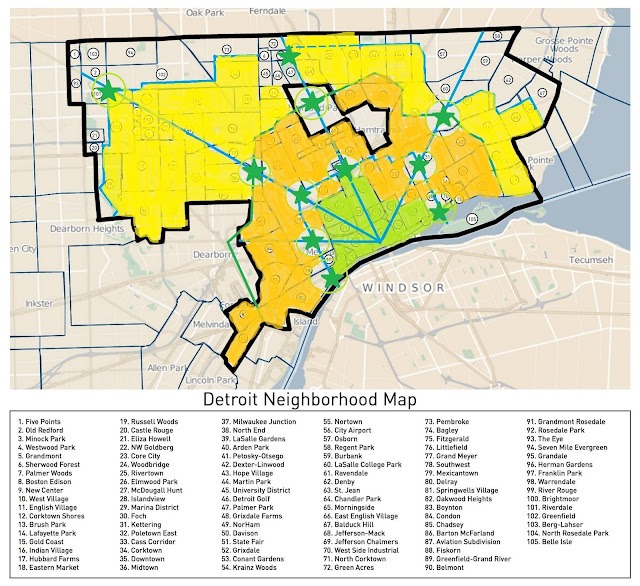
    Here’s how this project would look conceptually, looking at the entirety of Detroit:

    image of detroit

    First, please excuse my crude Microsoft Paint illustration. Hey, it serves its purpose. Second, let’s consider the broad areas of the city highlighted in various colors. The green areas are the downtown and downtown-adjacent areas that have been experiencing a pretty significant rebound over the last 5-10 years. In fact, you could say that revitalization took hold there with the opening of the Comerica Park baseball stadium in 2000 and the Ford Field football stadium in 2002. This area also includes the Midtown area north of downtown that includes Wayne State University and a host of city cultural institutions. The orange areas are the parts of the city that capture the dystopian imagination of Detroit. This area is quite — but not totally — abandoned, where much of the city’s older residential and industrial treasures have been lost. There’s still some intact neighborhoods that have a solid walkable foundation, but they’re often disconnected from each other by some serious abandonment. The yellow areas are the areas that might be described as imperiled; they could soon look like the orange zone if action isn’t taken, and in fact some parts of it (like the Brightmoor neighborhood, on the far west side, are quite abandoned already). The gray or uncolored areas on the far northeast and northwest edges of the city represent the most stable residential neighborhoods of the city, but they, too, are threatened by the challenges experienced by the rest of the city.

    When you hear Detroiters expressing concern that downtown revitalization isn’t reaching the neighborhoods, they often come from the yellow and gray/uncolored areas, with fewer and fewer voices coming from the relatively open orange areas. Viewed this way it can be understood that people see the city’s rebound as having a low ceiling; there is a half-empty quarter that sits between them and the promise of revitalization.

    My idea is to utilize strategic infrastructure investment and zoning reform to attract new development to key corridors, utilizing the city’s radial network. The radial blue lines on the map emanating from their intersection downtown represent (clockwise, from the left) Michigan, Grand River, Woodward and Gratiot avenues. The blue line that connects them, just outside the green revitalization area, is Grand Boulevard. The blue line that connects the radial streets further out is Outer Drive. The green stars represent public squares or plazas that could be built, and the light green circles indicate an approximate extent of impact outward from the squares or plazas. The green line that serves as the dividing line between the yellow and orange areas is the Detroit Terminal Railroad, and it would become a connecting trail.

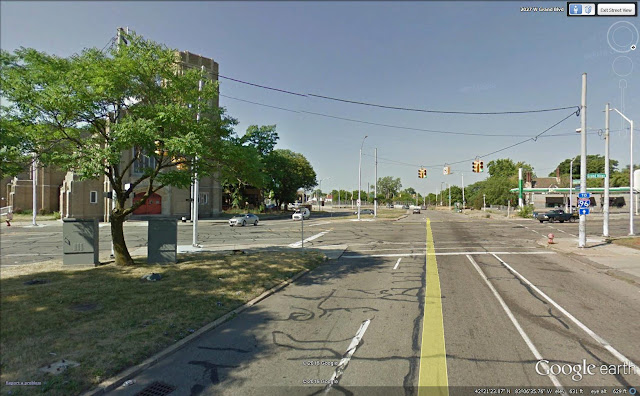
    Detroit was blessed early on with an excellent radial street system, but it quickly abandoned it as growth took hold in the early 20th century. Detroit missed an opportunity for grand public spaces at the same time that other cities were incorporating them into their urban fabric — and those public spaces became the foundation for their rebound. Consider this image, where Grand River Avenue intersects with Grand Boulevard:

    google image of grand river avenue intersecting with Grand Boulevard

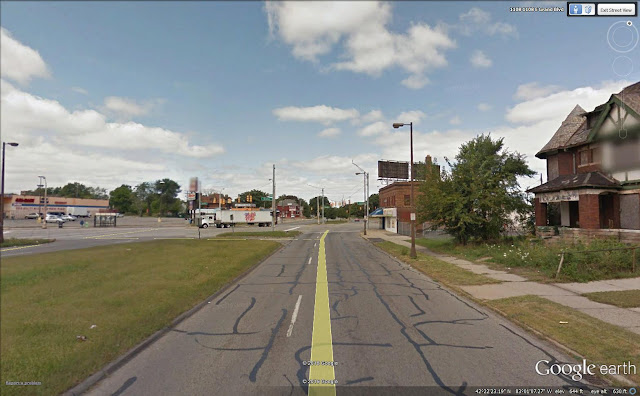
    Or, worse yet, where Gratiot Avenue and Grand Boulevard meet:

    google image of Gratiot Avenue and Grand Boulevard

    This was a missed opportunity for Detroit to have majestic entryways into neighborhoods beyond the city center. This was also a missed opportunity to develop areas that could become more mixed use and multifamily in character, as opposed to the dominant single-family home city that Detroit is today.

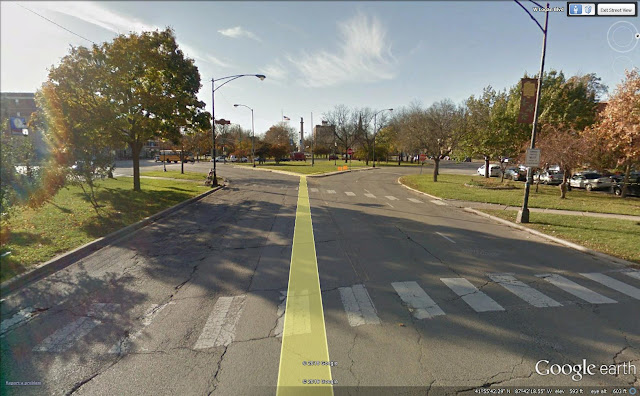
    If Detroit had the foresight 100 years ago to make strategic infrastructure investments, it could have put in place something like Chicago’s Logan Square, located at Milwaukee Avenue and Logan Boulevard (also a radial street and boulevard intersection):

    google image of Chicago's Logan Square

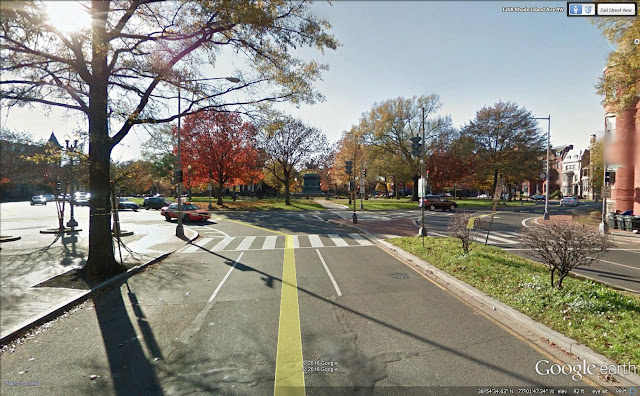
    Or Logan Circle, in Washington, DC:

    google image of Logan Circle

    The public squares on the radial avenues could have the effect of drawing development and revitalization outward from the city center, as has happened in Chicago and DC. This could continue outward to the DTR trail and Outer Drive, if the city sees success in such a measure, finds the appropriate resources and desires to extend it further.

    Detroit should certainly see the merits of such an investment. The city renovated and rededicated a new Campus Martius Park in 2004, and it has become a focal point for downtown revitalization.

    Without a doubt, this would be a costly measure, maybe even a folly for a city just out of municipal bankruptcy and still struggling to provide basic city services. that’s why I would envision this as a long term proposal, perhaps a 10-year project.

    That’s the basis of the idea. I’ll follow up with more details soon.

    Top photo: detroit.curbed.com

    Pete Saunders is a Detroit native who has worked as a public and private sector urban planner in the Chicago area for more than twenty years.  He is also the author of “The Corner Side Yard,” an urban planning blog that focuses on the redevelopment and revitalization of Rust Belt cities.

  • Welcome to Rosemont, IL

    Millions of people pass through O’Hare, settle into the adjacent hotels, go to conferences and meetings in the nearby convention centers, shop in the nearby stores or drink and eat in the nearby bars and restaurants, and believe they’re in Chicago.  But they’re not.  In most cases, they’re in the small village of Rosemont, the tiny town that’s done more than any community I know to capitalize on its location.

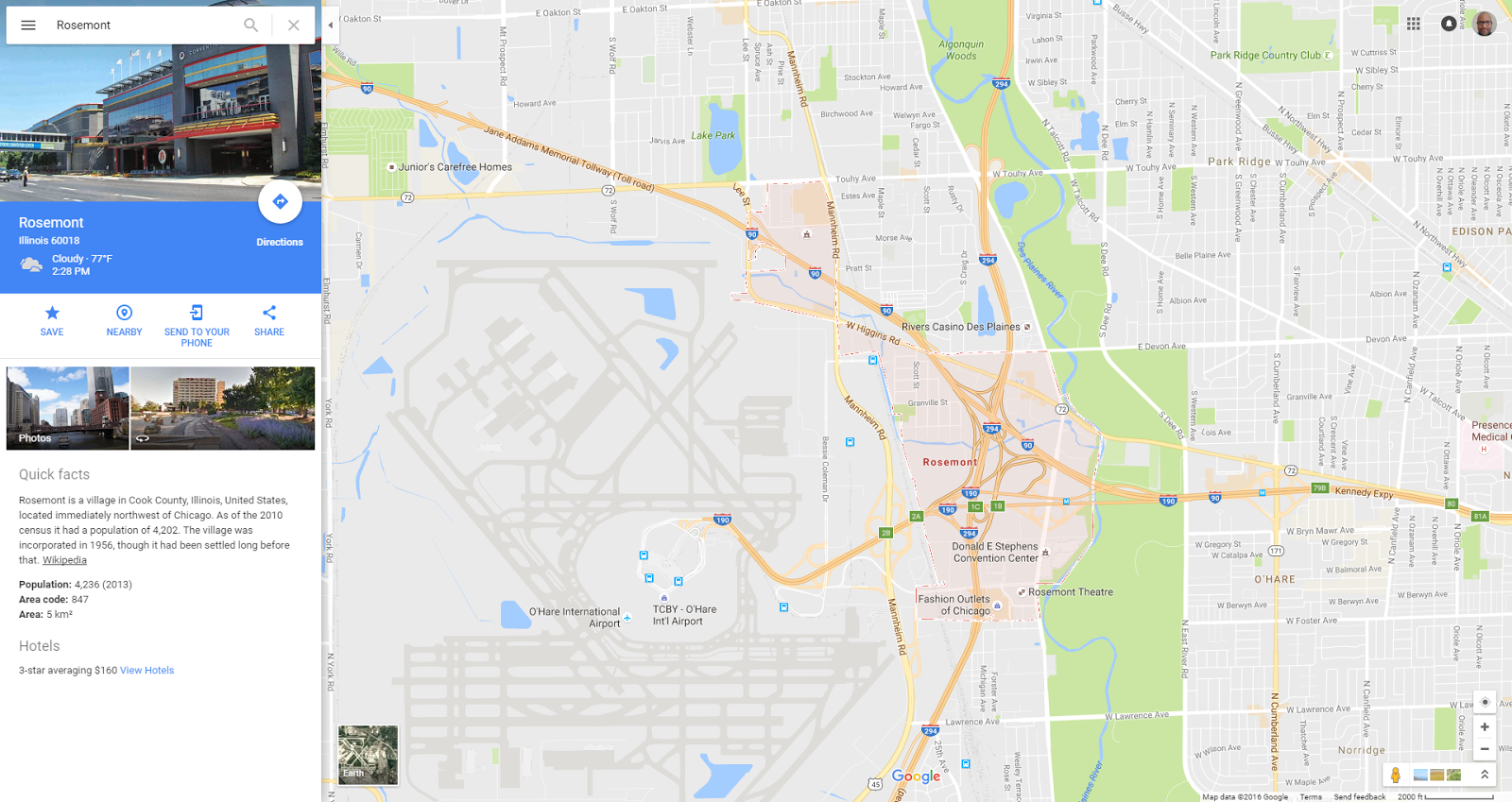
    Last week my wife and son flew out of town for a quick vacation on the West Coast.  As for me, duty called and I was unable to join them.  But I did drop them off and pick them up from Chicago’s main international airport, O’Hare.  While I waited for their arrival, I drove around the area surrounding the airport. For reference, here’s Rosemont’s boundaries, courtesy of Google Maps.  Rosemont is the area shaded in faint red (click on the map if you need to make it larger):

    Here’s what many people don’t know.  Yes, O’Hare International Airport is technically within the City of Chicago.  The airport is owned and operated by the City; Chicago Transit Authority (CTA) “L” lines can take you directly from downtown Chicago to the airport within 30-40 minutes.  But the airport is connected to the rest of Chicago by a sliver of property that follows the parcels fronting Foster Avenue for about a half mile, before connecting with the broad tarmac that is the airport.  Immediately east of the airport, where all the highways meet that connect the airport to the region, stands little Rosemont.

    But “little” hardly applies in any sense to Rosemont.  The village is a dizzying mix of hotels, convention centers, restaurants, large and small-scale entertainment venues, tightly packed against the interstates that wind their way through the community.  Those familiar with the area know that the area has almost a Vegas Strip feel to it, with a scale that can overwhelm.  Here’s some screenshots from Google Earth:

    What you see above are hotels, a convention center, office complexes, an outlet mall, and Allstate Arena, a venue for professional and collegiate sports teams.  What have I not included?  Myriad bars and restaurants, a performing arts center, even a field for a professional women’s softball team.  There’s even a casino, but it’s in yet another suburb, Des Plaines, just feet from the Rosemont boundary.  All of this within a 1.8 square mile area that holds only 4,200 residents.

    How did this happen?  Two words, one man — Donald Stephens.

    Airplane construction had taken place on the site that is now O’Hare for many years prior to the airport’s official opening in 1963.  The City of Chicago annexed the property for manufacturing uses in the 1940s, using the Foster Avenue sliver mentioned earlier to reach the site.  Chicago, as well as neighboring suburbs Des Plaines, Park Ridge and Schiller Park, all passed on annexing the land just east of what was a major manufacturing hub.  However, the Interstate Highway Act, which initiated the construction of the Interstate Highway system, was passed in 1956.  That act opened up possibilities for the development of an airport and changed how the empty lands would be viewed.  Donald Stephens, an insurance underwriter, led the effort to incorporate the community that same year.

    Rosemont’s boom as a commercial center paralleled the growth and expansion of O’Hare.  First came the hotels, and then smaller commercial uses like bars and restaurants.  The Donald Stephens Convention Center and Allstate Arena opened in 1975 and 1980, respectively, and throughout much of the ’80s the entertainment district also grew and expanded.  The airport-driven uses continue to gather in the community; the Rosemont Theater for the Performing Arts opened in 1995.  The Fashion Outlet Mall of Chicago opened in 2013.

    This extreme concentration of commercial, recreational and entertainment uses led to a unique development in Rosemont.  In 1995, residents living within the small residential core of the community voted to enclose all portions of residential Rosemont as a gated community.  Rosemont residents may fight major traffic when going to or coming home from work, but they have a sense of security that usually comes with living in upper class enclaves.

    Rosemont’s growth didn’t come without controversy.  Stephens, who was the only mayor of Rosemont from its founding in 1956 until his death in 2007, was often dogged with accusations of associations with Chicago organized crime.  Twice he was brought up on political corruption charges, for tax fraud and bribery, but was acquitted.  After Stephens’ death, his son Bradley assumed the position of mayor.

    Rosemont’s unique location has led to a unique set of statistics about the community. The community’s residents are firmly middle- and working-class: the median household income for residents is about $46,000, just below the metro area’s median of $55,000.  Demographically speaking, the community is about 57% non-Hispanic white and 35% Hispanic/Latino.  Rosemont residents lag behind the metro area in terms of educational attainment by one measure 13.1% of residents over age 25 have a bachelor’s degree or more, compared to 35.3% in the metro area.

    But none of that matters when the community has outsized economic numbers related to its location.  In a region that averages about 1.1 jobs per household, Rosemont has 11.3.  In a region that averages about $14,500 in general merchandise retail sales per capita, Rosemont has over $163,000.  In 2014, Rosemont had an equalized assessed value, or a value for all property in the community, of nearly $260 million.  Schiller Park, just to the south of Rosemont and nearly three times its size in terms of residents, had an equalized assessed value of $290 million.

    So, in many respects Rosemont is less a community than a state-chartered commercial and entertainment district.  Its successes cannot be replicated.  But that doesn’t mean that its successes are enduring.  On my brief visit there, I saw many pedestrians walking across Rosemont from one commercial or entertainment venue to another, in what is a challenging walkable environment.  The network of interstates that meet in the village means that it is an environment for cars, and there’s currently no way around that.  If Rosemont wishes to maintain its position as a commercial and entertainment venue, it may really need to consider improved walkability as a way to reach new and younger demographics travelling through Chicago.

    As for me, I often wonder how the area would look if Chicago had the foresight and vision to annex the property prior to the development of O’Hare,  If it had, the uses may have been quite similar but the look very different.

    Top photo: The Hyatt Regency O’Hare, located in Rosemont, IL.  Source: totsandtravel.com

    Pete Saunders is a Detroit native who has worked as a public and private sector urban planner in the Chicago area for more than twenty years.  He is also the author of “The Corner Side Yard,” an urban planning blog that focuses on the redevelopment and revitalization of Rust Belt cities.

  • Why Most Cities Will Never Be All They Used to Be

    Recently I published a piece on my Forbes site that discusses the disparate impact that demographic and social shifts had on larger, older U.S. cities over the second half of the 20th century.  Basically, the smaller American household size, generated by later marriages, rising divorce rates, lower fertility rates and rising life expectancy, among other things, has meant that unless cities were adding housing, they simply weren’t growing.  Yeah, I know I’m quoting myself, but here’s a sample:

    “Most people intuitively understand the economic underpinnings of urban decline, and the economic advantages that have led to their rebound. The loss of manufacturing destroyed the economic base; the spread of globalization and the new economy has created new opportunity in cities. But far less well understood are the far-reaching cultural and social changes that impacted the demographic makeup of cities — and would have caused population loss, even without economic restructuring.”

    I encourage you to check it out.

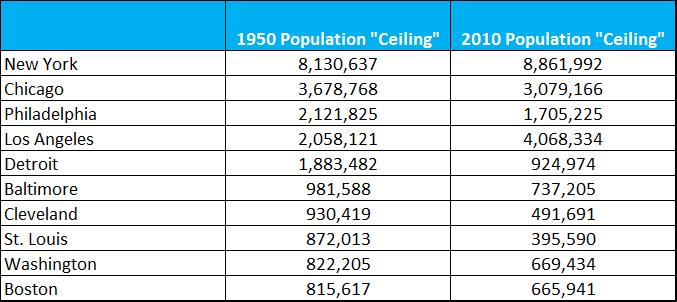
    I go on to suggest that population loss was inevitable for the most of the largest cities of mid-century America, and point out that today’s cities may never reach their previous population peaks.  I put together a cool table that demonstrates this:

    However, in putting this piece together I left quite a bit on the table, both in terms of graphics and additional content.  So consider this an addendum to the Forbes piece.

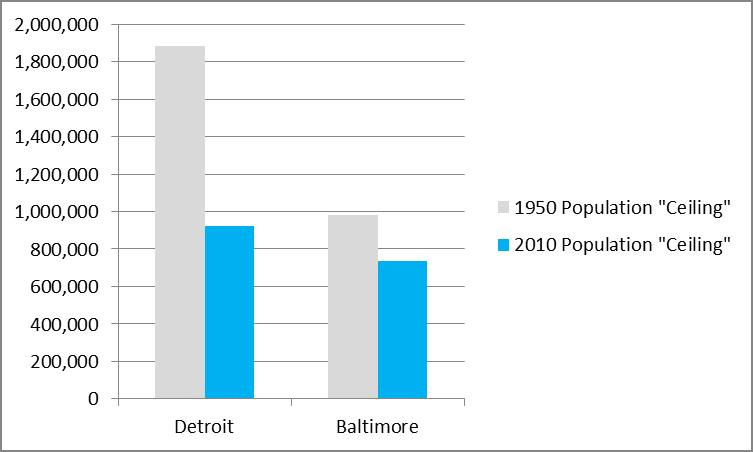
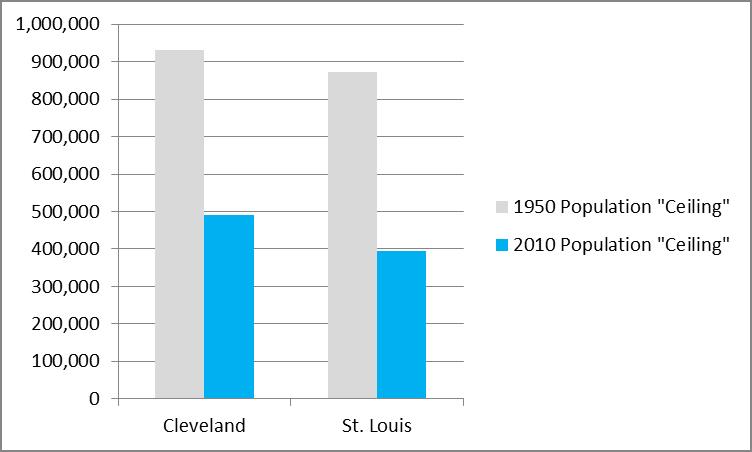
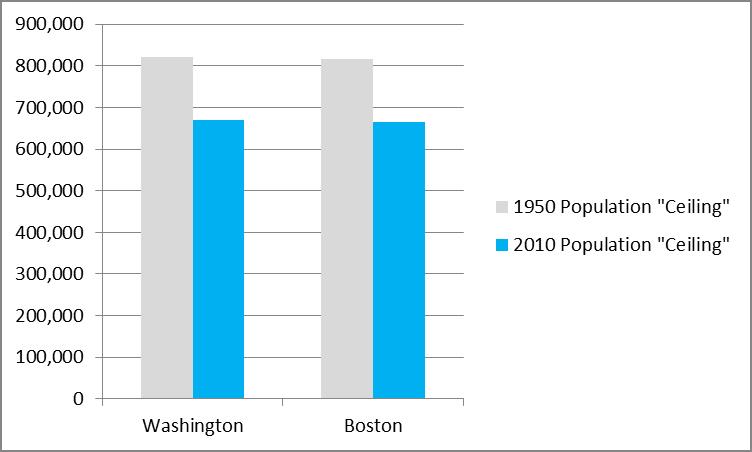
    First, I think it’s stunning to see a visual that illustrates the differences in a 1950 and 2010 population ceiling for the ten cities examined.  Check these out, shown two cities at a time:

    I think it is absolutely stunning to see that cities like Cleveland, Detroit and St. Louis could at best (at least right now) attain maybe half of their population in 1950.  And a case could be made that smaller household size may be the most significant factor in their decline.

    Three points I was unable to expand on in the Forbes piece.  First, now that the pendulum is swinging back in favor of cities, their influence is ascending faster than their population growth.  Cities are leading discussions now the economy, on infrastructure, on energy, on housing.  For the latter third of the 20th century the suburbs led that discussion.  But today, cities have reclaimed that role.  Their actual size, in terms of population, matters less today than it did 60 years ago.  

    Second, the American preference for new over old has nearly as much to do with this shift as shrinking household size.  For nearly 50 years the suburbs (and by extension, the Sun Belt) was new, and that was a main feature of their attraction.  But there’s also that saying, “everything old is new again.”  Cities are the new thing, and while they’re not everyone’s cup of tea, they are doing better than at any time in the last 50 years.

    Third, it’s conceivable that many suburbs and/or Sun Belt cities may find themselves impacted by emerging demographic or social shifts.  Having a huge inventory of single family homes in a world that is asking for multifamily options?  A strong auto-oriented landscape when more people are looking for walkable environments?  

    I’m not suggesting that all older cities are ascendant, and the suburbs and Sun Belt are doomed.  But staying ahead of trends may be the lesson all need to heed.

    Pete Saunders is a Detroit native who has worked as a public and private sector urban planner in the Chicago area for more than twenty years.  He is also the author of “The Corner Side Yard,” an urban planning blog that focuses on the redevelopment and revitalization of Rust Belt cities.

    Top photo: Vacant homes in Philadelphia, awaiting their revitalization.  Source: smartgrowthamerica.org

  • Notes From An Upzoning Heretic

    I recently got into a discussion on Twitter about the soundness of upzoning, or the increase in the allowance of residential units in cities, as a rational and reasonable response to the lack of affordable housing in our nation’s large cities.  Anyone who’s been reading my writing knows that I’ve disagreed with this for quite some time, and tried many ways to articulate my views and reach some understanding. From the discussion I learned two things: 1) Twitter is a really poor vehicle for debate when nuance is critical (OK, I really knew that already), and 2) the orthodoxy of the upzoners is so strong that my views on this might put me on the pariah end of the urbanism spectrum. 

    It started innocently enough.  Ramsin Canon suggested upzoning major streets in Chicago for more residential units.  That brought several supporters, including City Observatory writer and fellow Chicago blogger Daniel Kay Hertz, who (gracefully, I might add) noted my objections.  I then chimed in, and shortly thereafter I found myself swimming against the tide of upzoners hoping to prove that upzoning helps improve housing affordability. 

    Look, upzoners, I understand the problem and the sentiment.  I understand the desire to find the right policy response to address the issue.  But I remain unconvinced that upzoning will help any more than a handful of American cities.  Here’s why.

    An Abstract Argument

    Surely a big part of the appeal of upzoning is its abstract simplicity.  Increasing the supply of housing units in extremely tight housing markets can unleash market forces that drive home prices and rents downward, making cities more affordable to affluent and poor alike.  And in housing markets that have an almost even distribution of high priced housing within them, like San Francisco or New York, this makes sense.  Allowing more units will have the effect of bringing prices down.  (I’d also add parenthetically that the tightest and most expensive housing markets nationally also tend to be the most geographically constrained, by either water or mountains, and that constraint does not hold for all cities nationwide.  This escapes many people.)

    The reality, however, is that nationally gentrification is just a pittance compared to the expansion of urban poverty.  As Carol Coletta of the Knight Foundation put it in a speech last month at the Congress of the New Urbanism:

    “In 1970, about eleven hundred urban Census tracts were classified as high poverty.

    By 2010—40 years later—the number of high poverty Census tracts in urban America had increased from 1100 to more than 3,000. (3165)

    The number of people living in those high poverty Census tracts had increased from 5 million to almost 11 million. And the number of poor people in high poverty Census tracts had increased from 2 million to more than 4 million.

    So over a 40-year period, the number of high poverty Census tracts in America’s core cities had tripled, their population had doubled, and the number of poor people in those neighborhoods had doubled.

    Given that record, I’ll bet a lot of people are hoping for a little gentrification– if gentrification means new investment, new housing, new shops without displacement.

    The idea that places might benefit from gentrification runs against the popular narrative. But here’s the really startling fact: only 105 of the eleven hundred Census tracts that were high poverty in 1970 had rebounded to below poverty status by 2010. That’s only ten percent! Over 40 years!”

    Most American cities are not like San Francisco or New York, where the high prices and rents cannot be avoided and the return-to-the-city demand remains very high.  Most cities have greater variance in prices and rents, from very high to very low.  This takes away the first layer of abstraction for prices and rents and allows those with money to rationally widen their consideration when choosing to live in cities.  On the surface this sounds great. 

    But — and this is where the second layer of abstraction is shed — people don’t make housing decisions or neighborhood decisions rationally.  They take in all sorts of information and put it to subjective use, and justify its rationality later.  Historical perceptions of neighborhoods linger far longer than their reality.  Media perceptions can distort the reality of neighborhoods.  Egos can get involved and people select neighborhoods that have a certain cache or brand.  For urban neighborhoods in most cities, we find that affluence clusters in certain areas and moves outward slowly.  Poverty expands quickly, as those who have the ability to escape it do so, and further destabilize a neighborhood in the process.  The end result, again for cities that do not have the same strong return-to-the-city demand or the uniformly high home prices and rents, is affluent enclaves surrounded by expansive and increasingly impoverished neighborhoods.

    Upzoning can accelerate this process.  If a major city undergoes an upzoning process and allows a substantial increase in the number of housing units, what do you think the development community’s response to that will be?  My guess is that they will work hard to fulfill the market demand where the demand is strongest — in the most desirable neighborhoods or in the areas immediately adjacent to them.  Only after that demand is tapped out will developers move into other areas, and most will elect to build in areas that are adjacent to the newly saturated neighborhood.  Those who live in the path of development will see prices and rents remain high; those away from the path of development will likely see  prices and rents crater, and lament the lack of investment in their community. 

    The Need for Investment

    TAt one point in the Twitter discussion.  Daniel Kay Hertz asked me, “Would there be more or fewer Latinos in Logan Square if there was more new housing in Lincoln Park?”  For non-Chicagoans, Logan Square is the rapidly gentrifying neighborhood immediately west of the quite-gentrified Lincoln Park neighborhood on the lakefront.  My response was that Logan Square would indeed have more Latinos in that scenario and that it would have no discernible impact on other neighborhoods outside of the “hot zone” as well.  But that sets up the scenario I cite above — an affluent neighborhood next to an eternally poor/working class one, possibly lamenting the lack of investment in their midst.  And the further one’s home or neighborhood is from the “hot zone”, the more that lament turns into angst, frustration and resentment.

    It’s worth bringing back a portion of the quote above from Carol Coletta:

    Given that record, I’ll bet a lot of people are hoping for a little gentrification– if gentrification means new investment, new housing, new shops without displacement.The idea that places might benefit from gentrification runs against the popular narrative.

    Despite the growing problems of affordability in select neighborhoods in major cities across the nation, there are many more neighborhoods that wish they had that problem.  Many people rue the fact that maybe one-quarter or one-third of a city is priced beyond their means.  That leaves two-thirds to three-quarters of a city to explore and find a place worthy of investment.  Upzoning can have the impact of further concentrating development within the “hot zone” and drive a deeper inequality wedge between urban haves and have-nots.

    Upzoners are not doing cities a favor more broadly by addressing an issue that helps them directly.

    Ultimately I see high prices and rents as being demand-driven and not supply-driven.  Prices and rents are high because there are too many people focusing on too few neighborhoods — and squandering the opportunity to take some of that investment to other neighborhoods that could use it.

    Pete Saunders is a Detroit native who has worked as a public and private sector urban planner in the Chicago area for more than twenty years.  He is also the author of “The Corner Side Yard,” an urban planning blog that focuses on the redevelopment and revitalization of Rust Belt cities.

  • In Comparing Metro Areas, the Devil is in the Details

    Frequently I see examples of metro areas comparing themselves to other, more successful metro areas.  Metro area movers and shakers take a deep dive into the intricacies of what makes a “good” place tick, and try to implement the takeaways in their metro.  This is a reasonable action, but I believe it misses the point.  There is more to examine by taking a deep dive within your own metro than looking at another.

    Surely there are physical scale, density and economic differences between metro areas that are worth exploring.  But those differences can be overstated.  Milwaukee, for example, will never be the Silicon Valley, for a host of reasons. Just as importantly, the reverse is true. 

    When I see that, say, Kansas City wants to do what Portland’s doing, or Grand Rapids wants to do what Nashville’s doing (totally fabricated examples, I might add), I cringe for three reasons — 1) distinctiveness, not homogeneity, should be the hallmark of cities and metro areas; 2) metro areas are already far more alike than different, in terms of their built environment and even their economies; and 3) there is more inequality that is evident within metro areas than between them.

    Why is it that, when looking at the marketplace of metros, they try to emulate successes rather than striking out for distinctiveness?  This generally stands in opposition to what happens in business, where firms seek to deliver a product that is of better quality, or less expensive, or offers more options, in order to stand out in the marketplace. 

    Unfortunately we end up having metro areas chasing advantages they will never be able to attain.  The Bay Area’s combination of entrepreneurship and top-tier education, leading to the R&D work that supports Silicon Valley, is only tangentially replicable in a handful of metros nationwide.  The low-tax, low-cost advantage that many interior metro areas enjoy over their coastal brethren is not something that can be done in the high-tax, high-cost coastal metros.

    Addressing the third point will lead to greater city and metro growth than trying to replicate what any other metro area purports to be doing at a metro scale.

    Let me offer one example.  Below you’ll see a table that shows the top 25 metro areas from 2010, organized by median household income.  The data is from the Census Bureau’s American Community Survey in 2011 (although there is more recent data available, the reason for using this dataset will become clearer below):

    Median household income for the top 25 metro areas falls within a fairly narrow range.  Together, the metros have a median of medians, if you will, of $57,783, with a standard deviation of about $7,300.  The Tampa/St. Petersburg metro area comes in at the lowest ($46,890), while San Francisco/Oakland comes in as the highest ($76,911). 

    At the metro level, there are easy answers to explain why some metro areas are where they are — the supercharged, tech-driven or eds-and-meds economies lift San Francisco and Boston, while the presence of larger numbers of retirees in some Sun Belt metros, and deindustrialization that saw jobs move away, depresses incomes in Tampa, Miami, Pittsburgh or Detroit. 

    It’s data like this that reinforces the simple tropes that drive our understanding of metro areas.

    But what if we look within a metro area?

    I have a dataset that has 2011 American Community Survey data for 283 municipalities within the Chicago metro area, as well as the 55 zip codes that comprise the city of Chicago.  This data covers about 8.5 million of the 9.5 million within the broader metro area, excluding a handful of outlying exurban counties in Illinois as well as a few counties in Indiana and Wisconsin.  By looking at finer grained data that examines municipalities, and breaks down the behemoth that is the region’s core city of Chicago, we can see how there are greater differences within the a metro area than between them.

    Median household income falls within a far broader range within the Chicago area than in the top 25 MSA dataset.  In 2011, the median of median household incomes for the 338 places identified was $68,325, which is completely understandable when one considers higher income suburban municipalities being over-represented in the dataset.  The range, however, is what stands out — the highest median household income was in North Shore Kenilworth ($242,188) while the lowest was in Chicago’s 60621 zip code, which corresponds with the city’s Englewood neighborhood ($19,692).  What’s crazy, though, is that the standard deviation for median household income in the Chicago area in 2011 ($32,700) is nearly double the actual number for the 60621 zip code. 

    There were 68 municipalities and city zip codes that had median incomes below $50,000 in 2011; there were 54 municipalities and city zip codes above $100,000.  One group presently drives metro area economic policymaking, while another remains largely ignored.

    There is greater variation within metros than there is between them.  This idea should inform our urban policymaking.  (Note: I use Chicago only because I have the data for it.  I imagine other metros, particularly large ones, will have similarly large ranges; the range likely decreases as metros get smaller, but remains to some extent.)

    For decades economic developers have relied on two economic strategies to improve conditions that influence data points like median household income — 1) attract more skilled businesses and workers, and 2) work like hell to retain skilled businesses and workers. The first strategy works in metros that have relied on migration for growth; the second works almost nowhere.

    As I see it, there is an opportunity for dramatic metro area improvement by those that focus on talent development, rather than talent attraction or retention.  When metro areas focus on the successes of our nation’s metro area “winners”, and try to implement a talent attraction/retention strategy, they relegate themselves to the whims of a select group who, for a variety of reasons, can choose to be anywhere.  Developing talent — investing in early, secondary and higher education, forging strong links between higher education and the business community, supporting entrepreneurship and investment — can pay dividends.  At some point, metros that become proficient at talent development will find that that activity evolves into talent attraction, creating the vibrant economic environment that all metros desire.

    Pete Saunders is a Detroit native who has worked as a public and private sector urban planner in the Chicago area for more than twenty years.  He is also the author of “The Corner Side Yard,” an urban planning blog that focuses on the redevelopment and revitalization of Rust Belt cities.

    Lead photo: View of the Life Sciences Complex, UB School of Medicine at the University at Buffalo, with downtown Buffalo, NY in the background.  Panoramas such as this can make any place look fantastic, but the devil is in the details.  Source: medicine.buffalo.edu.

  • Identifying Black Urbanists

    There are black urbanists.  There are African-Americans who have invested their life’s work toward the betterment of cities.  They haven’t always gotten the exposure and acknowledgement that others have received, but they have nonetheless contributed to an improved understanding of how cities work, especially in an African-American context. 

    Today, I’m putting forth a nomination list of ten individuals whose work may not conventionally fall in the realm of urbanism as it’s known today, but certainly stands out as urban-oriented.  And why is that?  The work of the people listed below doesn’t fall in the fields or disciplines most people associate with today’s urbanists — architects, landscape architects, urban designers, economists, and enlightened public works officials or policymakers.  The ten I’m nominating as leading black urbanists tend to have sociological or activist backgrounds, often rooted in the Chicago School of sociology, which emphasizes the study of human interactions as opposed to the impacts of design, economy or policy on the built environment.  And of course, the human interactions they most frequently observed were those of African-Americans within major cities.

    Here they are, in (roughly) chronological order.

    W. E. B. DuBois.  As a sociologist, historian, civil rights activist and founder of the NAACP who was the first African-American to earn a doctorate (from Harvard, in sociology), DuBois’ work as an activist is well-known.  However, DuBois rose to prominence in 1899 with the publication of The Philadelphia Negro.  The study, which helped to cement the field of sociology as an academic discipline, examined the form and function of Philadelphia’s black community, which operated nearly completely out of the context of other urban communities.  DuBois’ study was among the first to openly say that discrimination was at the heart of problems within isolated black urban communities.

    Horace Cayton, Jr./ St. Clair Drake.  Cayton and Drake followed up the work of DuBois with their own Northern city sociological study, Black Metropolis: A Study of Negro Life in a Northern City.  Using Chicago’s Bronzeville neighborhood as their laboratory, Cayton and Drake provided not only a “generalized analysis of black migration, settlement, community structure, and black-white race relations in the early part of the twentieth century, but also tell us what has changed in the last hundred years and what has not.”  Cayton was the grandchild of America’s first elected African-American senator who later went on to become a sociologist, newspaper columnist and author.  Drake was a sociologist and anthropologist who later founded the African-American Studies program at Stanford University.  The two met at the University of Chicago and produced their famed study.

    John Hope Franklin.  As an historian at several institutions throughout his career, Franklin did not specialize in cities per se.  However, in works such as From Slavery to Freedom, first published in 1947, and his lecture series Racial Equality in America, he more than touches upon the African-American experience in cities, and how discrimination shapes the experience of black residents, and indeed the entire city.

    Gordon Parks.  A photographer, writer and filmmaker, Parks specialized in documenting the everyday lives of African-Americans, especially in cities.  His work often made a statement on the conditions of blacks in cities, and forced viewers to reflect on their condition:


    Parks became known for much more with his later work in fashion photography and film making.  However, his early work brought plenty of attention to race matters in American cities.

    Dorothy Mae Richardson.  Richardson was a community activist who fought against redlining in her neighborhood in Pittsburgh, PA.  Richardson challenged local Pittsburgh banks to issue conventional loans for mortgages and housing rehabs in her Central North Side neighborhood.  That led to the founding of Neighborhood Housing Services in Pittsburgh, and the national group now known as NeighborWorks America, one of the nation’s leading community development institutions.

    Rev. Dr. Calvin Butts.  Rev. Dr. Butts is the pastor of Abyssinian Baptist Church in New York, but in this context is more well-known as the founder and chairman of Abyssinian Development Corporation in New York as well.  Founded in 1989, ADC is one of many community development corporations in New York and across the country that have sought to fill the investment void — for housing, for commercial development, for community services — in distressed communities.  In ADC’s case, the organization is credited with bringing in more than $500 million in housing and commercial development to New York’s Harlem neighborhood since 1989.

    William Julius Wilson.  Following in the earlier sociological tradition of the study of blacks in cities, Wilson is sociology professor at Harvard University.  Wilson is the author of many works, but perhaps his most influential include The Truly Disadvantaged: The Inner City, The Underclass and Public Policy, which once again brought African-American community isolation to the forefront, and When Work Disappears: The World of the New Urban Poor, which examines the impact of job loss on poor communities.  More recently, Wilson published More Than Just Race: Being Black and Poor in the Inner City, which more closely links urban poverty with discriminatory practices whose impacts linger today.

    Geoffrey Canada.  Canada is credited with vastly expanding the role of a traditional family-oriented social service agency to the Harlem Children’s Zone, an organization that tightly tracts the academic success and family support of all families within a 24-block area in Harlem.  The program is resource-intensive, but it is credited with stemming the tide against poverty in Harlem.

    Mary Pattillo.  Pattillo is a professor of sociology and African-American Studies at Northwestern University.  She’s added two important works that illustrate how blacks operate in today’s urban environment.  In 1999 she published Black Picket Fences: Privilege and Peril for the Black Middle Class, which documents how the black middle class has a far more difficult time achieving “escape velocity” from the ills of the inner city, and Black on the Block: The Politics of Race and Class in the City, which illustrates how a uniquely African-American version of gentrification emerged in Chicago’s North Kenwood-Oakland neighborhood on the South Side. 

    So there’s ten black urbanists.  I know there are many more; some who work with lots of notoriety as they address issues like police brutality, housing, public transit, environmental justice, food deserts and the like.  And there are others who toil in anonymity, working in block clubs, CDCs and other organizations, working steadfastly to make their community a better place.

    I made a statement three years ago that takes a shot as to why there are “no prominent black urbanists” today:

    “I believe no nationally prominent black urbanist has emerged in large part because of differing worldviews held by whites and blacks. Very, very, very broadly speaking, with many caveats, I believe whites have a history of believing they can impact cities, while blacks have a history of believing that cities impact them.”

    By that I mean that I see many white urbanists surveying the urban landscape and developing rather abstract solutions that flow downward into actual policy, while many black urbanists assess conditions on the ground and develop solutions that they believe will rise up into actual policy.  I hope at some point the two can meet and work together.

    This post originally appeared at Corner Side Yard on July 7, 2015.

    Pete Saunders is a Detroit native who has worked as a public and private sector urban planner in the Chicago area for more than twenty years.  He is also the author of “The Corner Side Yard,” an urban planning blog that focuses on the redevelopment and revitalization of Rust Belt cities.

    Top photo: Google Earth view of Chicago’s Bronzeville neighborhood, on the South Side lakefront.  Source: Google Earth.

  • Two Chicagos, Defined

    Years ago, when I first started working as a planner for the City of Chicago, my primary responsibility was working with community organizations that received Community Development Block Grant (CDBG) funding for commercial revitalization activities.  This being CDBG funding, our work was constrained to areas of the city where 51% or more of households earned less than the median household income for the Chicago metro area.  In the early 1990’s, this hardly interfered with our work — outside of the Gold Coast, the Near North Side, Lincoln Park, Lakeview and a few parts of the Northwest and Southwest sides, we were able to grant CDBG funding to virtually the entire city.

    Fast forward twenty years.  Chicago’s transition from Rust Belt Capital to Global City has been unparalleled.  Where there once had been large swaths of middle-class, working-class and impoverished neighborhoods, with high-income enclaves, there are now nearly as many high-income neighborhoods as there are of the other three.  Perhaps someone who moved to Chicago post-1995 and lives in one of the up-and-coming areas is vaguely aware of this, but anyone who was here before then is quite right to be astounded.

    Despite Chicago’s transformation, it’s been pretty well-documented that not all parts of the city have benefited.  The battle over the closing of nearly 50 schools, mostly located in the city’s poorer South and West side neighborhoods, brought this to light, as did Chicago’s high-profile murder and violent crime rates through 2013 (which, to date in 2014, have gone down dramatically).  Inequalities and disparities became evident in both areas; University of Chicago graduate student and blogger Daniel Kay Hertz brought the disparities to light with his analysis of violent crime in Chicago.  As he said in his piece:

    Over the last twenty years, at the same time as overall crime has declined, the inequality of violence in Chicago has skyrocketed. There have always been safer and more dangerous areas here, as there are everywhere; but the gap between them is way, way bigger now than it used to be.

    Over the last two decades a new but undefined paradigm has emerged, the one of “Two Chicagos”.  This is probably best explained once again by Dan Hertz, who recounted an overheard conversation on the L:

    I was on the train earlier this week, and two white men got on and asked their neighbors, who were two black women, how to get to a hotel. The women told them. And then began a sort of stock conversation that Chicagoans have with tourists: How do you like the weather, ha ha? The men, who were from Atlanta, did not like it. Have you been on a subway before? Yes, but not often. Would you come back? Oh, yes. We love Chicago, the men said.

    The men reached their station, and left.

    One woman said to the other: I hate it when people say that – I love Chicago. No, you don’t. You love downtown and the North Side. The other woman said, Uh huh. 

    That is a frequent sentiment of those who live on the other side of the invisible divide in Chicago.  But what, exactly, is that divide?  Where are the boundaries?  Exactly how deep are the difference?

    I took a stab at trying to figure this out.

    I compared some socio-economic statistics for the 56 zip codes in Chicago against medians and averages for the entire Chicago metro area (Indiana and Wisconsin excluded).  The differences are stark.

    Let’s start by looking at maps of the areas of examination.  Here is the seven-county Illinois portion of Chicago’s metro area, with Chicago etched in:

    I gathered data for all suburban municipalities and all City of Chicago zip codes within this area, for five variables — population, non-white population percentage, median household income, and median home value, and bachelor’s degree or more for persons 25+.  The data comes from the 2011 U.S. Census American Community Survey.  After collecting that data, I established an “average of medians” or “average of averages” to get a baseline for the metro area, and an understanding of how jurisdictions or zip codes would compare to one another.  One fairly big caveat — an average of medians or average of averages weighs all jurisdictions equally, skewing the numbers higher due to the number of small but well-to-do suburban municipalities.  So while the 2011 actual median household income for the seven-county area overall was $61,491, the average of medians was $74,731.  But since all data is expressed this way, differences are negated.

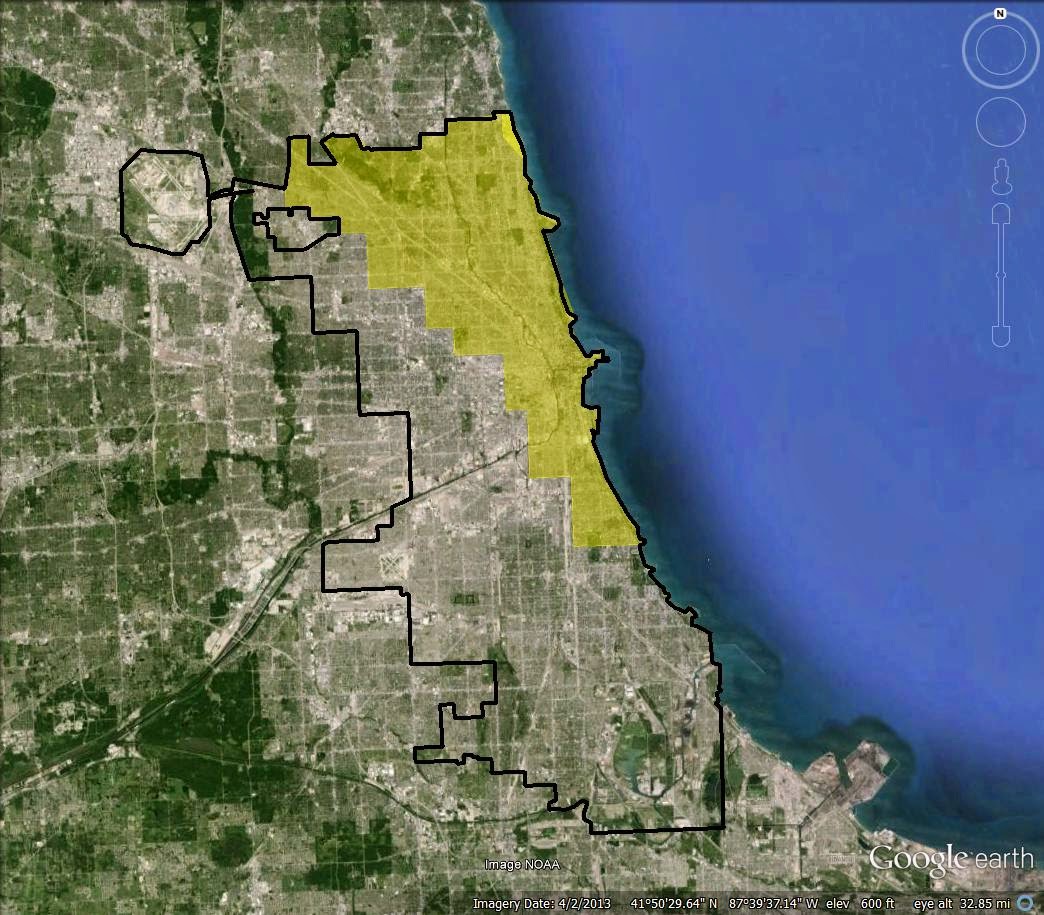
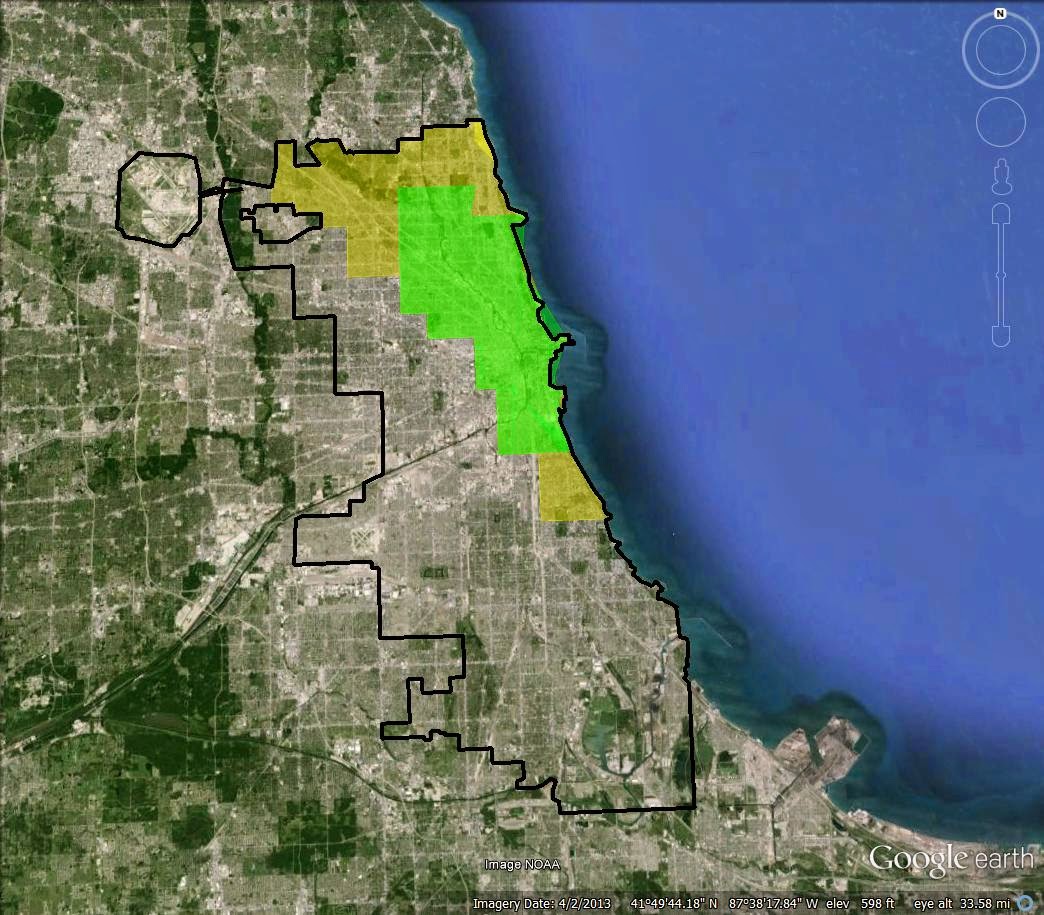
    Next, I looked for Chicago zip codes that were above the metro area average in at least one of three categories — median household income, median home value, and bachelor’s degree or more for persons 25+.  These are the higher income neighborhoods that can be called “Global Chicago”.  Within the city, they look like this, in yellow:

    Most Chicagoans would recognize this as the wealthier parts of the city.  It stretches from the far Northwest Side eastward to the lake, south to downtown and continuing south before ending in the Hyde Park neighborhood on the South Side.  Again, I included all zip codes that were above the metro average for at least one of the three categories I examined, so not all communities are the same.  Hyde Park, for example, is here because it has high educational attainment, but is below the average for income and home value.  The same applies to Rogers Park and Edgewater on the city’s northern border with Evanston.  Jefferson Park, Norwood Park and Sauganash, on the other hand, located on the Northwest Side, rank highly in home value but lower for income and educational attainment.

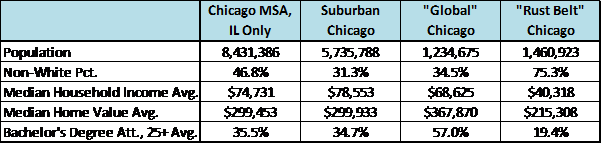
    Taken together, you can see how “Global Chicago” compares with the Illinois portion of the metro area, the metro area excluding Chicago to give you Suburban Chicago, and the balance of the city beyond “Global Chicago” that I’ve called “Rust Belt Chicago”:

    The differences are indeed stark.  “Global Chicago” is on par with the Chicago suburbs and the metro area overall in terms of income, and has a lower percentage of minority residents compared to the metro area.  Interestingly, “Global Chicago” has a much higher home value and educational attainment when compared to the metro area overall or the ‘burbs.  Meanwhile, “Rust Belt Chicago” lags far behind.  “Rust Belt Chicago” has a large majority-minority population, has an income nearly one-half as much as the suburban households, and has only one-third as many college graduates as “Global Chicago”.

    I decided to take this analysis a little further and determine if there is a core to “Global Chicago”, and how it would compare to the rest of the city.  I collected data for zip codes that exceeded the metro average in two or more of the three categories.  That produced this map:

    And this table:

    Here, a “Super Global Chicago” compares favorably with the ‘burbs in terms of income, but far exceeds it in terms of home value and educational attainment.  Including some of the peripheral areas of the previous “Global Chicago” with the previous “Rust Belt Chicago” to produce an “Average Chicago” leads to some gains, but it still lags far behind the other slices of the metro area.

    Right now, the CNN series “Chicagoland” is doing its best to illustrate the “Two Chicagos” meme, highlighting blues festivals and Stanley Cup championship celebrations on one end of town and school closures and endless crime on another.  However, these maps and tables may do a far better job of demonstrating the impact of past and current practices and policies on the city’s landscape.  In fact, I think Chicago’s example is one that will serve as a model, for better or worse, for other cities across the nation.

    In reality I see the “Two Chicagos” meme as overplayed.  Chicago may be better understood in thirds — one-third San Francisco, two-thirds Detroit.

    This post originally appeared at Corner Side Yard on March 18, 2014.

    Pete Saunders is a Detroit native who has worked as a public and private sector urban planner in the Chicago area for more than twenty years.  He is also the author of “The Corner Side Yard,” an urban planning blog that focuses on the redevelopment and revitalization of Rust Belt cities.

    Chicago photo by Bigstock.

  • The Three Generations of Black Mayors in America

    A select group of cities elected black mayors during the brief and tumultuous Black Power Era, seeking to implement an activist social justice platform.  These cities – notably Cleveland, Gary, Newark and Detroit among large cities — became stigmatized in a way that few have been able to recover from.   A negative narrative was developed about most of them that stuck, despite considerable efforts to dispel them.  Cities that elected “first black mayors” after the Black Power Era, during a period of relative calm, were able to adapt as the political skill set grew in the African-American community.  However, the Black Power Era’s near-toxic combination of heightened white racism, black disenfranchisement and disillusionment – and ill-prepared black political leadership – accelerated the downfall of these select cities.

    If the cities that elected black mayors during this tumultuous period are ever to move forward, to achieve their potential, they must be released from the purgatory they inhabit.

    Just as many people have well-developed thoughts and opinions on the American Civil War but little understanding of the turbulent Reconstruction Era that followed, many are familiar with the 20th Century Civil Rights Movement, yet are far less knowledgeable about the local social and political events that followed it.  The Black Power Movement supplanted much of the Civil Rights Movement after the assassination of Dr. Martin Luther King, with an emphasis on turning social activism into political empowerment.  Several cities elected their first black mayors during that period.  Cleveland was the first with the selection of Carl Stokes as mayor in 1967.  Gary, Indiana followed suit the same year with the election of Richard Hatcher, and the federal government appointed Walter Washington to become Washington, DC’s first black mayor as well.  Later, Newark (Kenneth Gibson), Dayton (James McGee) and Cincinnati (Ted Berry) followed suit by 1972, and culminated with the elections of Tom Bradley (Los Angeles), Maynard Jackson (Atlanta) and Coleman Young (Detroit) in 1973.  A new era of African-American political empowerment had begun.

    Taking a long historical view, it’s clear that the people who became first African-American mayors beginning in the late ‘60s and continuing through today held different views, developed different paths to victory and methods of governance, and had differing perceptions of their skills among their constituents.  Mayors elected through about 1975 were often activists straight from the Civil Rights Movement, and were looking for ways to turn the movement into actual political power.  The group of black mayors that followed them, from about 1975 to 1990 or so, had more distance between them and the Civil Rights Movement and were less concerned about implementing movement politics; they were more concerned about developing the kind of coalition that could get them elected and help them win legislative victories once in office.  The third group of “first black mayors”, coming after about 1990 and continuing through today generally came to terms with a different demographic landscape in most major American cities.  Whereas first black mayors elected twenty years prior could dependably rely on a supermajority of black votes in their favor – and an equally large supermajority of white votes against them – the most recent group works in a more nuanced and less racially charged environment.  Younger white residents without the racial grievances of their parents or grandparents were returning to cities, and Hispanics were rapidly increasing in numbers.  Anyone who would attempt to become a “first black mayor” in that environment would have to develop an appeal that goes beyond racial boundaries.

    And yes, the decade that followed Dr. Martin Luther King’s assassination was as tumultuous as they come for America’s largest cities.  That period, well remembered by those who lived it as a time of particularly strong urban and social tensions, coincided with the downward slide in momentum of the Civil Rights Movement and the subsequent rise of the Black Power Movement.  Older adults likely remember the period well: urban riots, fights over school busing, Affirmative Action battles, efforts to eliminate long-entrenched policies like blockbusting and redlining.  Skyrocketing crime, heated debates on the inequity of public services, and the development of a new, rapidly expanding land called “suburbia” that was looking very appealing to a growing number of city residents.  Nearly all large cities developed scars during that period.  The question is whether they healed, and healed well.

    “It’s Our Time”
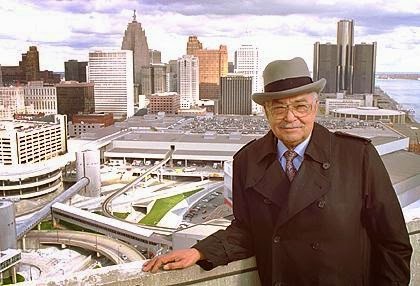


    Detroit Mayor Coleman Young.  Source: Detroit News

    Coleman Young, elected as Detroit’s first black mayor in 1973, in many ways epitomizes the first group of black political leadership that emerged following the Civil Rights Movement.  One might call them the Black Power set.  Born in 1918, Young was part of a generation of African-Americans who stood tantalizingly closer to economic prosperity and social equality than any previous generation, yet were reminded that they could never achieve it.  After serving as a bombardier and navigator for the U.S. Army Air Forces during World War II, Young returned from his service disillusioned by the segregation he and his fellow troops suffered.  He went on to become a labor leader with the UAW and later built a political base as a state representative and state senator in the Michigan Legislature, representing Detroit’s East Side.

    Young became a vocal critic of local leadership after the 1967 riots, and targeted the heavy-handed efforts of Detroit police to reduce crime.  Young announced he was running for mayor in 1973 in large part to work to disband the Detroit Police Department’s STRESS (Stop the Robberies, Enjoy Safe Streets) unit.  The unit was often mentioned as the initiator of police brutality complaints, and was allegedly responsible for as many as 22 deaths of black residents over a 2 ½ year period.  Young ran against John Nichols, the city’s police commissioner and staunch supporter of the troubled unit.

    Young won a narrow victory over Nichols in 1973 in a race that was almost entirely split along racial lines in the nearly 50/50 city.  In his inaugural address, Young famously told “all those pushers, (to) all rip-off artists, (to) all muggers: It’s time to leave Detroit; hit Eight Mile Road! And I don’t give a damn if they are black or white, or if they wear Superfly suits or blue uniforms with silver badges. Hit the road.”  Young maintained that his message was that criminals were not welcome in Detroit; the quote has often been interpreted by white former Detroit residents as a throwing down of the gauntlet, urging whites to leave the city for the suburbs.  Young went on to win four more terms in office.  He balanced budgets yet struggled to maintain services in a city with a rapidly declining tax base.  He remains one of the most controversial leaders in Detroit history.

    Conversely, Cleveland’s Carl Stokes and Newark’s Kenneth Gibson may not have provoked similar passions in their respective cities, but they did not fare much better.  Stokes obtained his law degree in 1956, served three terms in the Ohio Legislature and narrowly lost a bid for mayor in 1965.  His eventual win in 1967 garnered him plenty of national attention as he became the first African-American mayor of one of the nation’s ten largest cities.  He was successful enough to pursue and win a second two-year term in 1969, but his tenure in office was characterized by constant feuds with the Cleveland City Council and the Police Department.  Stokes left office at the end of his second term.  After studying civil engineering in college, Gibson worked for nearly two decades as a structural engineer with the New Jersey Highway Department, the Newark Housing Authority and the City of Newark.  He pursued the mayor’s office as a reformer wishing to restore honor to the office following the corruption scandals of incumbent Hugh Addonizio.  Gibson won in 1970 but perhaps his attachment to people like Newark poet and playwright Amiri Baraka, who challenged Gibson to push the city’s corporate interests to take a more active and responsible role in the community, served as a lightning rod to the city’s remaining middle class element.  Gibson was elected to four terms, but Newark’s slide continued unabated.

    Black National Political Convention

    It’s probably fair to say that the political pinnacle of the Black Power era took place between the elections of Gibson and Young, with the advent of the Black National Political Convention in 1972.  Held in Gary, Indiana and hosted by Mayor Richard Hatcher, delegates from the entire spectrum of black leadership convened to establish a black political agenda for urban America.  More than 8,000 people attended the three-day convention, with 3,000 selected to be voting delegates.  Newly elected black officials attended, along with celebrated black nationalists and revolutionaries.  Delegates with more moderate position also attended.  However, whites were not invited.  No white speakers whose views were sympathetic to the movement; not even white reporters.  This exclusion caused groups like the NAACP and the Urban League to skip the event and be critical of the gathering.

    Renee Ferguson, a former Chicago local news television reporter and currently the press secretary for U.S. Rep. Bobby Rush (D-IL), attended the convention as a 22-year-old reporter for the Indianapolis News.  In an interview with Chicago public radio station WBEZ remarking on the 40th anniversary of the convention in 2012, she spoke about the frenzied nature of the event.  “When I got there it was very disorganized, much bigger than anybody had planned for and impossible actually for anybody to see what was happening. The speeches were long and there were a lot of egos and there weren’t many women.”

    Ferguson said that the agenda of the convention was framed by a basic question, and was the source of great tension.

    “Are black people going to work on the inside with the system, or are they going to have their own and work on the outside? And that was the big argument no matter what else they talked about,” Ferguson said. “That was the underlying intrigue and the most interesting thing for me to document as a young reporter.”

    In the end, black nationalists won the day.  The prevailing theme of the convention was that African-Americans would seek to create change outside of the system.  The agenda included platforms that had support from other liberal factions (elimination of capital punishment, national health insurance), but also included platforms that sought to consolidate political control with the growing number of leaders (community control of schools, busing for school integration).  Perhaps the biggest message of the convention, however, was that “White politics had failed Black people”.  And a new group of leaders set out to implement that vision.

    Coalition Builders
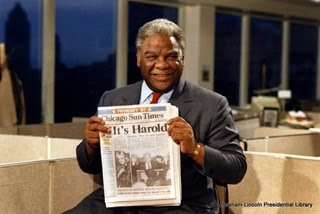


    Chicago Mayor Harold Washington, the day after winning the election in 1983.  Source: Illinois Historic Preservation Agency.

    Almost immediately after the convening of the convention, a group of rising black political figures who rejected the premise of the Black Power era leaders sought to ascend through coalition building.  Rather than work exclusively outside of the system, and alienating those who disagreed with them, this group stressed their ability to work within the existing power and political framework.

    As a state representative at the time representing Illinois’ 26th legislative district, Harold Washington would’ve been eligible to serve as a delegate to the Black National Political Convention.  Whether he attended is uncertain.  But it is clear that he adopted a coalition-building style that served him well as he ascended to the office of Mayor in Chicago.

    Born in 1922 and just four years younger than Detroit’s Coleman Young, Harold Washington nevertheless followed a different path to mayor of Chicago.  Washington also served in the Army during World War II, building runways for long-range bombers in the North Pacific.  Upon his return from service he graduated from Roosevelt College in Chicago in 1949, and from Northwestern University Law School in 1952.  Washington immediately became immersed in local Chicago politics after law school, working for 3rd Ward Alderman and former Olympic athlete Ralph Metcalfe.  While working with Metcalfe Washington became intimately familiar with Chicago’s brand of Machine politics – a spoils system, patronage, and a personal approach to bringing out the vote on Election Day.

    Contrary to Young’s experience in Detroit, African-Americans in Chicago experienced a fair amount of political enfranchisement.  In many respects, African-Americans were just one part of the ethnic milieu that made up Chicago’s political landscape, like the Germans, Poles, Italians and Irish.  The foundation of Chicago’s political machine was its ability to meet the specific needs of those who could be convinced to depend on them, and convincing as many people to depend on them as they could.  The Machine’s success meant that it could not ignore or exclude potential votes, wherever they came from, and that included the African-American community.  The Machine’s strength was derived from its network of precinct captains, committeemen and elected officials that would convene regularly to discuss its political platform, slate of candidates vote targets and distribution of benefits.    Washington received a sound political education in coalition building through his work in Chicago’s Machine.

    Washington was elected into the Illinois House of Representatives in 1965 and to the U.S. Congress in 1980.  Over the years, he developed a reputation of independence from the Chicago Democratic Party leadership, often becoming an unreliable member of the Machine’s state legislative contingent.  As a State Senator Washington was one of a group of independent black Democrats who partnered with white liberal Democrats and moderate Republicans to push forward the Illinois Human Rights Act of 1980.  His ascension to Congress later that year, defeating Machine loyalist Bennett Stewart, further alienated him from the Machine.

    This effort afforded Washington a unique political perspective.  He enjoyed strong independent support from his African-American base, largely developed apart from the Machine.  He had strong connections with members of Chicago’s “lakefront progressive” community, which had a fairly large contingent in the city’s Hyde Park community, where Washington also lived.  It was likely evident to Washington and others that this pairing provided him a wider base than other black elected officials who rose through the ranks and focused solely on serving the needs of their African-American constituents.  Furthermore, Washington likely realized that the Hyde Park progressive community’s networks with other progressives, particularly on the North Side, opened up opportunities for offices beyond Congress.

    Washington rode the wave of his unique coalition into mayoral politics in 1983.  Bolstered by support from his African-American base and reform-minded white progressives, Washington won against Republican Bernard Epton that November.  Once elected, however, he was confronted with a solid bloc of 29 aldermen (out of 50) firmly wedded to the “Democratic Organization” structure that had survived for so long in Chicago.  The bloc led a four-year period of legislative gridlock in Chicago known as Council Wars – the bloc assumed control of all Council committees, allowing it to set the legislative agenda; the bloc voted down virtually all of the mayor’s appointments; the bloc fought bitterly with Washington’s supporters on budget and appropriations.

    Despite the challenges, however, Washington’s coalition held firm.  Federal lawsuits led by Washington allies challenged Chicago’s ward redistricting following the 1980 Census.  At the time, Chicago’s population included approximately 40 percent white and black residents, and 15 percent with an Hispanic background.  However, Washington supporters argued that wards were gerrymandered to maximize the number of white aldermen in the racially polarized city – at the time of Washington’s election as mayor there were 33 white, 16 black and one Hispanic aldermen.  Federal courts ruled in favor of Washington’s supporters in 1986, causing a redrawing of seven wards and special elections.  Washington supporters won four elections, creating a 25-25 split in the City Council and effectively giving the mayor control of the Council through his ability to cast a deciding vote.  Unfortunately, Washington’s control was short-lived.  He died of a massive heart attack on November 25, 1987, just months after his defeat of the obstructionist bloc.

    Whereas Harold Washington’s political acumen made him a coalition builder, Baltimore mayor Kurt Schmoke’s stellar athletic and academic pedigree, wonky sensibility and personable nature drew coalitions toward him.

    Schmoke attended the prestigious Baltimore City College for high school, where he excelled in football and lacrosse.  He entered Yale University in 1967, where he played quarterback for the freshman team and developed into an undergraduate student leader.  After graduating from Yale with a degree in history in 1971, Schmoke studied as a Rhodes Scholar at Oxford University and graduated from Harvard Law School in 1976.

    Schmoke’s first electoral victory was as Baltimore State’s Attorney in 1982.  He defeated William Swisher in a surprise landslide, running a race-neutral campaign against the law-and-order, and (according to some) racially insensitive incumbent.  Schmoke was technically not Baltimore’s first black mayor; that title goes to Clarence “Du” Burns, who was elevated to mayor after the election of the previous mayor, William Donald Schaefer, as Maryland’s governor.  But Schmoke inherited much of Schaefer’s progressive and business establishment, as they saw him as the one who could articulate their agenda in a largely black city.  Schmoke challenged Burns in 1987 and won narrowly.  Recalling Schmoke’s victory for an article in Baltimore’s City Paper, City Council member Bill Cunningham said it was a “new-day-is-dawning thing.”  In the same article, the Rev. Arnold Howard of Enon Baptist Church said, “We were looking for someone to encompass our hopes for the future, someone who would validate our own journey.  He went into office with all that on him. He was the new savior. He was the one who would fulfill our dreams.”

    In the end, however, despite being twice re-elected, Schmoke’s analytical approach to leadership alienated coalitions who thought they were getting something else.  He developed a reputation for establishing bold policy goals that were difficult to build consensus around – improving adult literacy, drug decriminalization – and put in place department heads who brought the same policy wonk approach to their work that he did.  The business establishment and African-American community alike thought they were electing a dynamic “mover and shaker” who could energize them as they pushed toward new heights.  But Schmoke was perhaps more manager and caretaker than mover.  As a result he left office in 1999, deciding not to seek a fourth term, with a frayed coalition: a business community slightly betrayed, and an African-American community slightly disillusioned.

    Trans-Racial Appealists

    With the start of the 1990’s a new type of black political figure began to emerge.  Gains made through increased access to education and job opportunities were putting more African-Americans in previously unattainable positions, and allowing them to pursue previously unattainable avenues.  Wellington Webb, the first black mayor of Denver, fits this bill.

    Webb was born in 1941 in Chicago and arrived in the Mile High City at age 11.  In his autobiography, he chronicles a difficult childhood; his mother had a drinking problem and he ended up being raised by his grandmother, and he had academic difficulties at Denver’s Manual High School.  But Webb fought through his family problems and personal demons.  He attended and graduated from Northeastern Junior College in Colorado in 1960, and obtained his bachelor’s degree from Colorado State College in 1964.  He was introduced to politics by his grandmother, who was a Democratic Party district committeewoman in Denver.  Webb wanted to become a teacher, but found it difficult to obtain a position in Denver’s public schools, and thought local political involvement in some of the federal “War on Poverty” programs of the late 1960’s might help.  He transitioned from working in a potato chip factory to working in city government, and later obtained a master’s degree from the University of Northern Colorado in 1971.

    Webb developed a reputation as a numbers-cruncher and policy wonk in city government, and was pulled into politics rather than pushed into it by any sense of bitterness.  He was elected to the Colorado House of Representatives in 1972 and represented the Northeast Denver neighborhood he grew up in.  In 1977 he was appointed by President Jimmy Carter to serve as regional director of the U.S. Department of Health, Education and Welfare, and in 1981 he was appointed by Colorado Governor Richard Lamm to be executive director of the state Department of Regulatory Agencies.  Webb held that position until 1987, when he ran and won in the election to become Denver’s city auditor.

    Webb’s political ascendance through the ‘70s and ‘80s certainly put him on a path to consider pursuing citywide and even statewide positions, but it was unclear whether an African-American in a city with a small minority population, in a state with a small minority population, could be competitive.  He did not start with a built-in large political base like Young or Washington; nor did he have to ability to strengthen a base through coalition building the way Washington did.  His only strategy, should he pursue another office, was to make a trans-racial appeal that would highlight his experience, skills and vision.

    Webb entered the campaign in late 1990.  Three leading candidates emerged: Webb, Denver District Attorney Norm Early (also African-American), and Republican lawyer Don Bain.  Webb carried out his “Sneaker Campaign”, going door-to-door in virtually all of Denver’s neighborhoods while preaching a message of competency.  He surprised everyone by forcing a runoff with Early in the May 1991 primary, finishing with 30 percent of all votes to Early’s 40 percent.  Webb was able to consolidate the support from other candidates with a law-and-order platform prior to the general election against Early in June 1991.  Webb won with 57 percent of the vote.
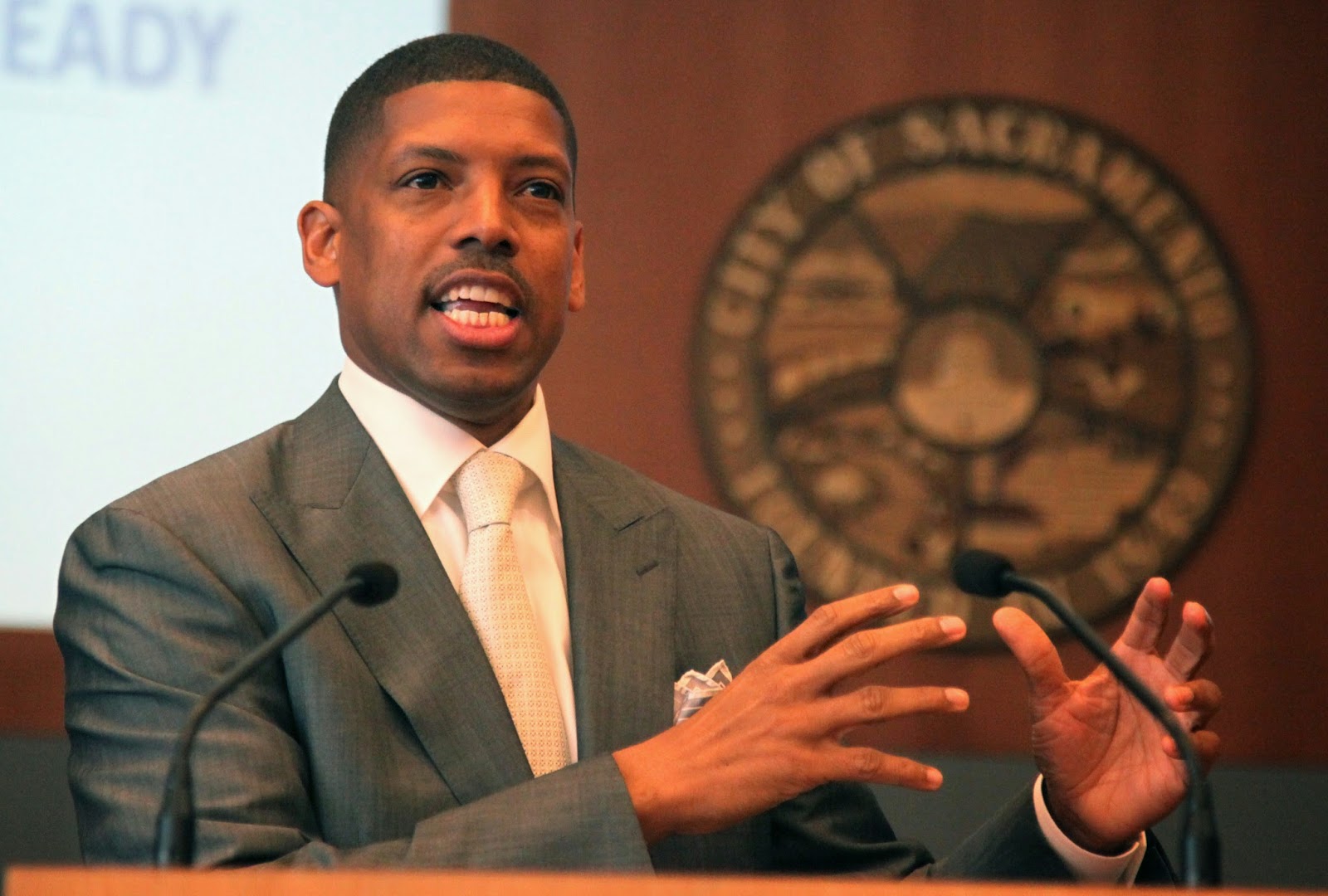


    Sacramento Mayor Kevin Johnson.  Source: gbmnews.com

    Perhaps a better version of a first black mayor who won with a broad trans-racial appeal would be Kevin Johnson of Sacramento.  Johnson was born in Sacramento, where he was a standout student and athlete.  He excelled in basketball and baseball, and accepted a scholarship to play basketball at the University of California, Berkeley.  From there he went on to a storied college basketball career and a long professional career with the NBA’s Cleveland Cavaliers and Phoenix Suns.

    Even during his playing days Johnson maintained strong roots with his native Sacramento.  He established the Kevin Johnson Corporation, which focused on real estate development and business acquisitions, and the St. HOPE nonprofit organization as an after-school program in the Oak Park neighborhood he grew up in.  After his retirement from basketball in 2000, he broadened St. HOPE to include charter schools and nonprofit development in Sacramento.  Today, St. HOPE is a network of four charter schools in Sacramento, and a development company with more than a dozen new construction and renovation projects in Sacramento.

    Johnson had intimated his political ambitions for years, but finally announced his run for mayor in 2008.  Race was hardly a factor in the race; indeed, Johnson was viewed as a decorated favorite son of California’s capital city.  Johnson received numerous endorsements from Sacramento’s business and political establishment, and was the highest vote getter in the nonpartisan election that June.  He forced a runoff against two-time incumbent mayor Heather Fargo, and soundly defeated her in November.

    Johnson has parlayed his athletic, corporate and nonprofit success well in the government sector.  He has been a staunch supporter of charter schools, along with his wife Michelle Rhee, the former chancellor of the Washington, DC Public Schools.  He was actively involved in keeping the NBA’s Sacramento Kings basketball team from fleeing the city, orchestrating the team’s sale to a group of local investors.  He easily won reelection in 2012, and in April 2014 was elected as president of the U.S. Conference of Mayors.

    There are other black mayors who fit the trans-racial appeal profile, but are not the first black mayors of their respective cities.  Kasim Reed of Atlanta, Michael Nutter of Philadelphia, and Cory Booker of Newark each brought impressive academic credentials, strong corporate backgrounds and youthful passion to their positions as mayor, distinguishing them from their predecessors.    Reed interned for U.S. Rep. Joseph Kennedy II before earning his juris doctorate from Howard University, and became a partner at a law firm prior to entering politics.  Nutter earned a business degree from the Wharton School at the University of Pennsylvania.  Booker earned his bachelor’s and masters degrees from Stanford, earned a Rhodes Scholarship to attend the University of Oxford, and earned his juris doctorate from Yale.

    Because of their academic and corporate credentials, Reed, Nutter and Booker are as comfortable in corporate boardrooms as they are in churches or community centers.  Each has forged partnerships with political opponents, and adopted a pragmatic bipartisan approach to governing cities.  Each has focused on effective service delivery rather than empowerment or redistributive policies.  Booker’s success as mayor of New Jersey’s largest city propelled him to his current position as New Jersey’s junior U.S. Senator through special election in 2013.

    The Power of Perception

    Detroit, Cleveland, Newark, Chicago, Denver, Baltimore and Sacramento occupy different positions on the success spectrum of American cities.  Of these five Chicago would certainly occupy the highest perch.  Chicago clearly is a global city – a world financial center, the home of a dozen Fortune 500 companies and the critical link in the nation’s rail and air transportation network.  The Windy City has extensive economic connections throughout the world.  Indeed, world-class architecture firms based in Chicago are designing the gleaming skyscrapers sprouting everywhere in China’s large cities.  Denver would rest in a position not far behind Chicago.  Denver has become the capital of the Great Plains and Mountain West, a mid-continent transportation hub that built its wealth on its access to mineral resources in the Rocky Mountains.  Sacramento would likely occupy a position behind Denver.  Sacramento’s growth has been more recent than the others, and it still sits in the shadows of much larger California metropolises.  But as the capital of our nation’s largest and most influential state, it has heft.

    Baltimore, Cleveland and Newark would occupy another place on the spectrum.  All are well known for enduring the storm of industrial decline, and in Cleveland’s case, fiscal insolvency.  They’re slowly recovering from a nadir reached perhaps a decade or two ago and have made small steps toward improvement.  They’ve worked hard to revitalize their cores – Newark has leaned on its financial services sector to turn the tide, while Baltimore and Cleveland have relied on their assets in education, health care services, and biomedical and biotech research.  However, all are far from being complete success stories.

    Then there is Detroit.

    Each city has had African-Americans serve in the city’s highest office.  Chicago’s Harold Washington endured tough times as mayor of Chicago, but he built a lasting coalition that allowed him to prevail.  Denver’s Wellington Webb learned to adapt in a pluralistic environment and raised the profile of a Western city.  Cleveland, Newark and Detroit each elected first black mayors during the turbulent post-Civil Rights era and paid a steep social price for doing so.  Cleveland and Newark began their turnaround some years ago; perhaps Detroit’s, with its recent bankruptcy filing, has just begun.

    If anyone doubts the impact of electing an African-American mayor during the racially tumultuous late ‘60s-early ‘70s era, examine the general perceptions that formed of the cities during that period and have endured ever since.  Newark and Detroit, already tainted by the aftermath of urban riots, were effectively shunned by white residents after the elections of their first black mayors.  Cleveland may have been headed down the same path after the election of Carl Stokes in 1967.  But Stokes chose not to run for a third two-year term as mayor, leaving a wide open field.  Stokes was followed by three consecutive white mayors — Ralph J. Perk, Dennis Kucinich and George Voinovich – before the election of the city’s second black mayor, Michael White, in 1990.  Atlanta touted itself as the “City too busy to hate” in the ‘70s, but Maynard Jackson’s 1973 election coincided with rapid white flight out of the city, at the same time that Sun Belt migration from the north was strengthening the suburban base.  In Washington, DC, black political empowerment there was often wrapped up in the controversy of federal political representation for the District.  Mayors in the District were federally appointed until Walter Washington was elected mayor in 1975.

    Perhaps the best way to view perceptions of cities that elected “first black mayors” during the Black Power Era is to examine the fortunes of Detroit and Philadelphia during and after this period.  Entering the 1970’s the Motor City and the City of Brotherly Love had similar populations (about 1.5 million people in Detroit, 1.9 million in Philadelphia), with a similar geography (about 140 square miles) and similar demographics (approximately a 60/40 split between whites and blacks).  As noted, Coleman Young was elected mayor of Detroit in 1973, narrowly winning against Police Commissioner John Nichols.  It was clear that Nichols’ candidacy was an effort by his constituency to restore order to a city during a difficult time.  Meanwhile, another police commissioner, Frank Rizzo, assumed power as mayor of Philadelphia in 1971.  As mayor Rizzo was regarded as having a strained relationship with the city’s African-American community.  Rizzo’s “law-and-order” tactics were viewed positively by his white ethnic base and have been credited by some for keeping Philadelphia from suffering the same fate as other cities.  Could the Nichols campaign have been modeled after the successful Rizzo election two years earlier?

    Possibly.  Yet it is instructive to view the difference in perceptions of both cities since that time.  Philadelphia was certainly hit hard by the decline of the nation’s manufacturing sector.  Philly had substantial losses in the shipbuilding, oil refining and food processing industries over the decades, losing thousands of jobs as a result.  Yet did Philly endure what was in effect a boycott of the city by white residents?  Troubled North and West Philadelphia are well known, but did their troubles define the entire city?  I think many people could imagine a real-life “Rocky Balboa” coming from Philadelphia in the ‘70s and ‘80s, but far fewer could imagine a similar character coming from Detroit.

    Philadelphia’s national perception took a tumble over the last 40 years, but the city has fought back hard to rebuild itself as a premier city with a strong economic foundation in education, health care and financial services.  Detroit, however, continued on a descent no other city endured.  High crime rates, racial tensions, dilapidated abandoned buildings in a desolate post-industrial landscape  — all defined Detroit then and continue to define it today.

    Between 1970 and 2010, Philadelphia’s population dropped by 22 percent, from 1.9 million to 1.5 million.  The decline was largely driven by a substantial loss of its non-Hispanic white population over the period, which declined by 56 percent.  Over the same period, Detroit’s population dropped by 53 percent, from 1.5 million to just over 700,000.  Its decline too was largely driven by a loss of its non-Hispanic white population, which dropped by 93 percent. Ninety-three percent.

    Something happened that kept a base or core of white residents in Philadelphia.  Something happened in Detroit that led to their virtual disappearance.

    Cities that elected their first black mayors during the Black Power Era deeply suffered in national perception because of the gamut of social challenges they had at the time, and found it difficult to stabilize poor economies or for revitalization to gain traction.  But they suffered far worse than other cities because they were in effect shunned.  They suffered from the greatest increases in crime.  They experienced the largest declines in school quality and performance.  They witnessed the steepest drops in property values.  They had the widest divides between police and community.  They had the highest numbers of white middle-class residents departing for the suburbs.  Newark was shunned.  Gary was shunned.  Detroit was shunned.  Maybe Cleveland, Los Angeles, or Cincinnati, or Dayton did not suffer the same fate because African-American populations there did not approach parity with whites, who were eventually able to “reclaim” the city’s highest office.  In the end, however, select cities paid a price for the election of black mayors during this time, a price not paid by cities that elected black mayors after them, or not at all.

    Another Transition
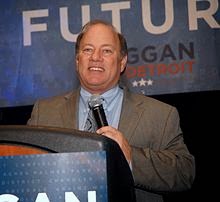


    Detroit Mayor Mike Duggan on election night in 2013.  Source: wikipedia.org

    On January 1, Michael Duggan assumed the difficult and unenviable responsibility of becoming the 75th mayor of Detroit, Michigan.  Given the most recent difficult period that Detroit has endured, and the continued difficult times ahead, Mayor Duggan’s inauguration was a subdued affair.  There was no inaugural ball or celebration.  The new mayor was simply sworn in with a short ceremony in his new 11th floor office in the Coleman A. Young Municipal Center.

    The new mayor said he would focus on operations – removing blight, snowplowing streets, repairing lights, making sure buses run safely and on time.  The mayor suggested he would move into Manoogian Mansion, the palatial mayoral residence on the Detroit River that was deeded to the city in the 1960’s.  As far as the focus on operations goes, he really has little choice in the matter.  The State of Michigan-appointed emergency manager Kevyn Orr, brought in with exceptionally broad powers to resolve the city’s financial mess and currently leading the Motor City’s largest-ever municipal bankruptcy, has a lock on policy decisions right now.  Mayor Duggan says his focus is to “return the city to elected leadership on October 1,” the day that Orr’s 18-month appointment from the state ends.

    And with that, Mike Duggan became the first white mayor of Detroit since 1973, mayor of a city with a population that is 83% African-American.  This most recent election, most observers believe, is a venture into the unknown, and is as much an experiment as Detroit’s bankruptcy itself.  An era of African-American political leadership has ended in Detroit, but no one is certain of what the next era might be.

    Perhaps the bankruptcy, the election of a white mayor and the growing urban pioneer spirit that is visible in parts of the city means that the shunning of Detroit has ended.

    This post originally appeared on August 10th, 2014 in Corner Side Yard.

    Pete Saunders is a Detroit native who has worked as a public and private sector urban planner in the Chicago area for more than twenty years.  He is also the author of “The Corner Side Yard,” an urban planning blog that focuses on the redevelopment and revitalization of Rust Belt cities.

    Top photo: The Monument to Joe Louis, commonly known as “The Fist”, in downtown Detroit. For more than thirty years, the sculpture has been a controversial symbol of black power in Detroit.  Source: Pete Saunders

  • A Typology of Gentrification

    Patterns of gentrification vary by city, and the spread of gentrified areas is partly determined by the city’s predominant development form and the historic levels of African-American populations within them. Gentrification is a nuanced phenomenon along these characteristics, but most people engaged in any gentrification fail to acknowledge the nuances.

    Spurred on by the recent debate on the impact of limited housing supply on home prices and rents, thereby “capping” gentrification, (taken on fantastically by geographer Jim Russell in posts like this), I decided to do a quick analysis of large cities and see how things added up. The analysis was premised on a couple observations of gentrification, one often spoken and one not. One, gentrification seems to be occurring most and most quickly in cities that have an older development form, offering the walkable orientation that is growing in favor. Two, gentrification seems to be occurring most and most quickly in areas that have lower levels of historic black populations. This less noted observation was the thrust of a study by Harvard sociology professor Robert Sampson and doctoral student Jackelyn Hwang, recently described here. Here’s what they said, after conducting an exhaustive study of gentrification patterns in Chicago:

    After controlling for a host of other factors, they found that neighborhoods an earlier study had identified as showing early signs of gentrification continued the process only if they were at least 35 percent white. In neighborhoods that were 40 percent or more black, the process slowed or stopped altogether.

    That prompted my quick study. I wanted to categorize cities by old and new development forms, and low and high historic levels of black population. To do that I came up with an arbitrary proxy for the age of development form. Using decennial Census data, if a city reached 50 percent of its peak population by 1940, it was deemed to have an old development form; if a city reached 50 percent of its peak population in 1950 or later, it was deemed to have a new development form. Here’s a quick example of how this works. Baltimore, currently with a population of a little over 600,000, reached its peak of 949,000 in 1950. Baltimore reached half its peak, or about 475,000, by 1890, a time at which it could be said that Baltimore’s form as a city had been firmly established. Similarly, Austin reached its peak of 790,000 in 2010. The fast-growing Texas city was half that size in only 1990, a year in which it could be said that its development form was established and the city began to see itself as a major city. Imprecise, yes, but a decent proxy for examining old and new city development forms.

    The second piece of analysis was gathering Census data on central city black populations in 1970. This decade was chosen largely because it represents the end of the Great Migration, when millions of African-Americans left the rural South for cities across the nation. By that time the cities which are generally recognized as having large black populations had already been identified, and it’s possible to explore the impact of the migration on them. I arbitrarily said cities with black populations lower than 25 percent of the total in 1970 had a low black population, and those above 25 percent had a high black population.

    Using those two factors, I put together this table of the 64 primary cities over 250,000 in the U.S.:


    There are more than a few cities that are exceptions, largely because recent consolidations or large-scale annexations have boosted them into more unfamiliar boxes. But some patterns are evident, and if you think of these in terms of gentrification, you might be able to make the following general assumptions:

    Old Form + Low Black Population = Expansive Gentrification (OFLB)
    Old Form + High Black Population = Concentrated Gentrification (OFHB)
    New Form + Low Black Population = Limited Gentrification (NFLB)
    New Form + High Black Population = Nascent Gentrification (NFHB)

    Identifying the examples might be the best way to explain what I mean. New York, San Francisco and Boston are the prototypical OFLB cities, and gentrification has made its widest impact in these three cities. Chicago, Washington and Atlanta are the classic OFHB cities, where gentrification is concentrated in certain areas of the city (or region), and eludes the heavily African-American parts of the city. Phoenix, San Diego and Las Vegas might be the prototypical NFLB cities, all of which came of age with the car as the dominant mode of transport and with few African-Americans. NFLB cities may also be the leaders and innovators in seeking ways to catalyze their inner cities, with greater tangible investments in public transit and mixed use development. The relatively few NFHB cities are a distinctly Southern phenomenon, and by all appearances gentrification activity lags behind other cities, with sprawl still the dominant development engine.


    Cities by gentrification type. Special thanks to Adam Carstens for producing this map.

    Why would any of this matter? Nationally, the gentrification debate is defined by the experiences of the OFLB types like New York, San Francisco and Boston. There, the issues are rapidly growing unaffordability, concerns with displacement and growing inequality. But the gentrification debate is quite different in OFHB cities like Philadelphia and Atlanta, where seeking ways to more equitably spread the positive benefits of revitalization might lead such discussions.

    In other words, it’s not exactly correct to look at what’s happening in Los Angeles or San Diego, or Baltimore or St. Louis, in the New York-San Francisco-Boston context. Different forces and different experiences are creating different outcomes in each city, and if we want to understand how to look at gentrification’s impact, we need to understand its foundations.

    This post originally appeared in Corner Side Yard on August 15, 2014.

    Pete Saunders is a Detroit native who has worked as a public and private sector urban planner in the Chicago area for more than twenty years.  He is also the author of “The Corner Side Yard,” an urban planning blog that focuses on the redevelopment and revitalization of Rust Belt cities.