Author: Pete Saunders

  • The Uniqueness of Detroit’s Housing Stock

    Last week, as part of my series on planning reasons behind Detroit’s decline, part 2 of the nine-part series was about the city’s poor housing stock.  I started to play with some numbers to see if there was any validity to my opinions about the city’s housing, and I found some very intriguing things.  Detroit’s housing stock is definitely unique among its Midwestern and Rust Belt peer cities, and perhaps among cities nationwide.  Let’s examine.

    Grouping the cities by population figures from the 2013 U.S. Census population estimates, and housing data from the 2008-2012 American Community Survey, I looked at housing age and single family detached housing data for 15 Midwest/Rust Belt cities with populations above 250,000.  One city I typically include in an analysis like this, Louisville, was not included due to a lack of ACS data.  Data for the Twin Cities of Minneapolis and St. Paul were aggregated into one (sorry, Minneapolis and St. Paul) because they jointly function as the core city for their region.  Here’s the big table with all the data:
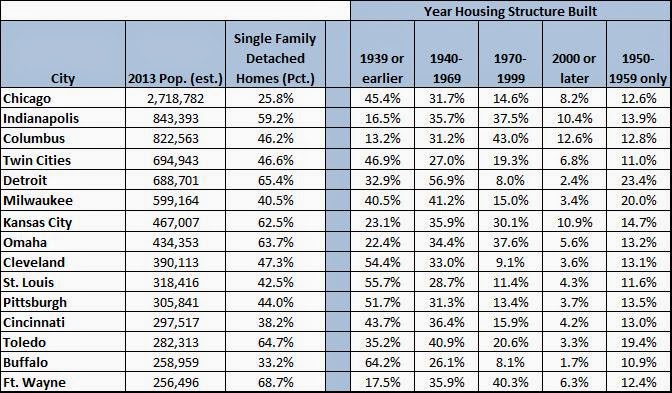


    That’s a lot to digest, so I’ll take the data piece by piece.  First, let’s look at the cities ranked by their percentage of housing units built in 1969 or earlier:
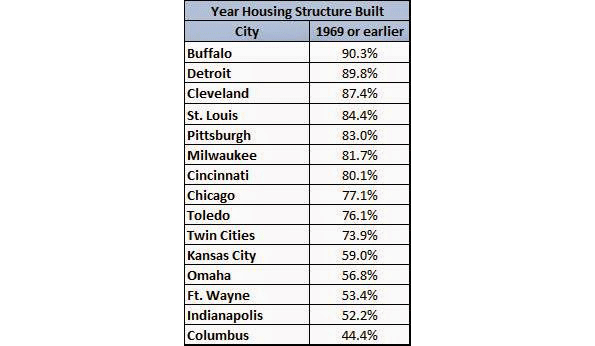
    You’ll see here that, perhaps following the general national perception of Detroit housing, the Motor City has an older housing stock.  Only Buffalo has a higher percentage of older housing. Generally speaking, the cities at the top half of this list have older housing because they lack redevelopment activity that replaces older housing, while cities at the bottom half consists of cities with decent levels of redevelopment activity, or more recently built housing that’s been annexed into the city in recent decades.  Here, Detroit does seem to fit the pattern.

    But does it really?  If you look at the Census’ earliest category for age of structure, 1939 or earlier, Detroit drops considerably on the list:
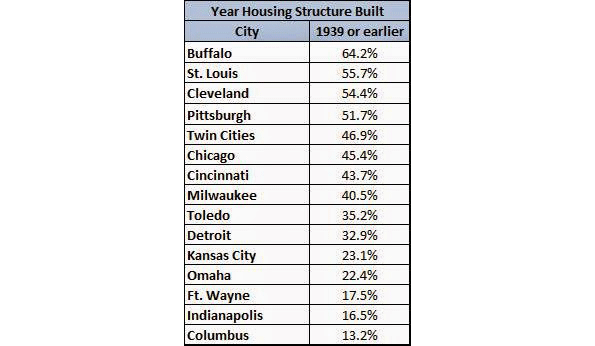
    Instead of ranking second as in the earlier table, Detroit falls to tenth.  The rest generally hold the same spots they occupied from the previous table as well. The only ones ranking lower than Detroit here are smaller cities (Omaha, Ft. Wayne) and the cities that annexed large amounts of land post 1970 (Kansas City, Indianapolis, Columbus).

    Next, let’s look at how the cities rank in terms of their concentrations of single family detached homes:
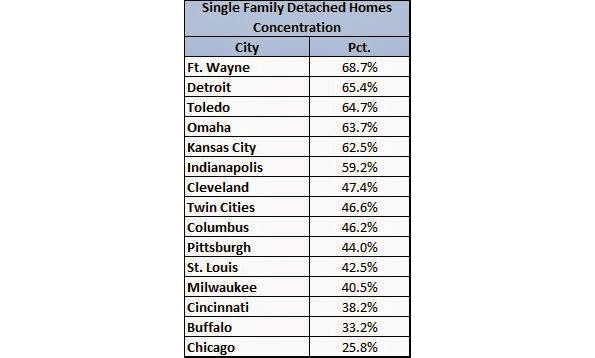
    Detroit shows up here with the second highest percentage of single family detached homes, comprising nearly two-thirds of the city’s housing stock.  Once again, the only comparable cities are the smaller cities and the big annexers.

    Clearly, most observers believe Detroit has more in common with Buffalo, Cleveland and Pittsburgh than with Ft. Wayne, Kansas City and Indianapolis.  What happened to Detroit’s housing stock that gave it such an odd profile?

    To understand, let’s pull out a specific category on the age of structure table, the 1950-1959 category:
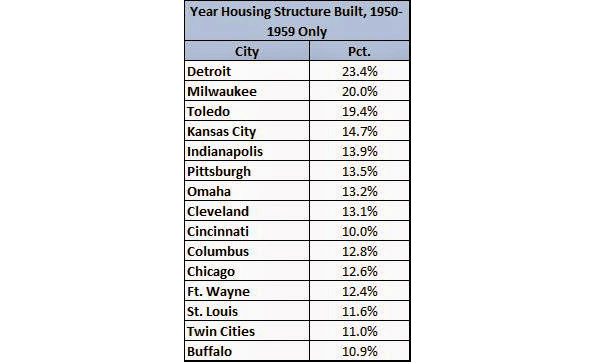
    Here, we find that Detroit has, by far, the highest concentration of housing units built between 1950-59 of all its peer cities.  Nearly one in four homes in Detroit were built during this period.  In fact, Detroit, along with Milwaukee and Toledo, occupies a strange space among Midwestern/Rust Belt cities.  (Side note: the more I study Detroit against other Midwestern cities, the more I find that Detroit and Milwaukee are virtually the same city.  And it doesn’t surprise me that Toledo, just 75 miles from Detroit, would share its characteristics as well).  Detroit, Milwaukee and Toledo all added their greatest numbers of housing at the outset of the modern suburban development period, what I’ve called the Levittown Period in my so-called Big Theory of American Urban Development.  This supports my thinking that if anyone was ever interested in establishing a Levittown-style national historic district, Detroit would be a good candidate.  The Motor City has perhaps more small Cape Cod-style, three-bedroom, one-bath single family homes than any city in the nation.

    How did Detroit get this way?  Housing demolition likely had some role in a city that lost so much.  Detroit likely lost older single family homes and multifamily buildings over the last few decades, leading to skewed numbers.  The same is also true of Indianapolis, Kansas City and Columbus, cities that annexed large undeveloped areas after 1970 and built new housing there.  Keep in mind, though, that Milwaukee and Toledo, Detroit’s comparables, may not have had the same level of demolition loss that Detroit had, yet they still match the Motor City well.

    That leads me to believe that a concentration of housing development at a unique time is a crucial piece in understanding Detroit’s housing stock.

    Here’s another way of looking at this.  I grouped the cities by age and single family home concentration and came up with interesting groupings:
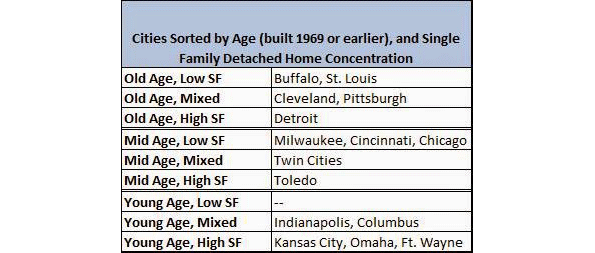
    Here it becomes clearer that Detroit and Toledo stand alone as locations for old or moderately old structures that are largely single family.  Also, Milwaukee’s greater mix of single family and multifamily units begins to set it apart from Detroit and Toledo, even when it has a similar concentration of Levittown-style housing.

    Finally, let’s consider housing adaptability as part of the housing stock analysis.  Chicago, the region’s largest city and lone “global city” member of the group, comfortably rests in the middle of all tables except for the single family detached table, where it shows the lowest concentration of single family homes.  My guess is that Chicago’s continued desirability means more newer housing has been built, and that its lower single family housing numbers mean that other housing types (lofts, condos and the ubiquitous 2-flat and 3-flat) created a more flexible and adaptable housing development landscape.

    Assuming that younger structures are more often suitable to renovation for adaptability, moderately old structures require more intense rehabs, and older types are more often subject to demolition and rebuilding, I reorganized the previous table in terms of housing adaptability:

    And if I put in the cities next to this adaptability scale, it’s easy to see the magnitude of Detroit’s housing challenges:
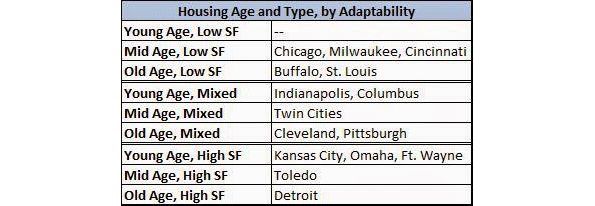
    Detroit is such a unique city in so many ways.  The Motor City needs more research and analysis that highlights its uniqueness and adds to our understanding of the what led to its downfall, and less of our ire and contempt.

    The more I study Detroit, the more I see the seeds of a similar downfall in other cities nationwide.

    This post originally appeared in Corner Side Yard on July 6, 2014.

    Pete Saunders is a Detroit native who has worked as a public and private sector urban planner in the Chicago area for more than twenty years.  He is also the author of “The Corner Side Yard,” an urban planning blog that focuses on the redevelopment and revitalization of Rust Belt cities.

    Lead photo: A scene from the Grixdale neighborhood on Detroit’s northeast side.  Source: Google Earth.

  • May the (Insidious) Force Be With You

    Google Earth pic to the left of the boundary between Detroit and suburban Grosse Pointe Park, MI. Alter Road (cutting from upper left to lower right) is the boundary between the two. Take note of the differences in vacant land between Detroit (on the left) and Grosse Pointe Park (on the right).

    Too many people think today’s “de facto” segregation in metro areas is the result of personal preferences expressed by individuals, when the fact is that public policy has created the conditions we live with today.  In fact, I see the demise of Jim Crow through the Civil Rights Act and the Voting Rights Act corresponding with the immediate rise of an insidious, “non-racist” racism that shapes our metros today.  Our metro areas have never dealt with this.

    In the aftermath of the Donald Sterling controversy (which, if you aren’t aware of, you truly are under a rock), the Atlantic’s Ta-Nehisi Coates posted an on-spot critique of how racism is viewed and how racism is really working in today’s society.  It is a truly beautiful piece on the perception of racism versus its realities — the perception being that racism is the purview of dunces like Sterling (and Cliven Bundy before him) who get caught making inelegant statements that shed light on their true feelings, and a reality that is far more insidious and receives far less attention.  Coates describes how “elegant racism”, that insidious force, shapes where we live, what jobs are available to us, how we’re educated, and who is incarcerated and who isn’t:

    “Elegant racism is invisible, supple, and enduring. It disguises itself in the national vocabulary, avoids epithets and didacticism. Grace is the singular marker of elegant racism. One should never underestimate the touch needed to, say, injure the voting rights of black people without ever saying their names. Elegant racism lives at the border of white shame. Elegant racism was the poll tax. Elegant racism is voter-ID laws.”

    And to better describe how “elegant racism” works, he cites Chicago as its key implementer:

    “Throughout the 20th century—and perhaps even in the 21st—there was no more practiced advocate of housing segregation than the city of Chicago. Its mayors and aldermen razed neighborhoods and segregated public housing. Its businessmen lobbied for racial zoning. Its realtors block-busted whole neighborhoods, flipping them from black to white and then pocketing the profit. Its white citizens embraced racial covenants—in the ’50s, no city had more covenants in place than Chicago.

    If you sought to advantage one group of Americans and disadvantage another, you could scarcely choose a more graceful method than housing discrimination. Housing determines access to transportation, green spaces, decent schools, decent food, decent jobs, and decent services. Housing affects your chances of being robbed and shot as well as your chances of being stopped and frisked. And housing discrimination is as quiet as it is deadly. It can be pursued through violence and terrorism, but it doesn’t need it. Housing discrimination is hard to detect, hard to prove, and hard to prosecute. Even today most people believe that Chicago is the work of organic sorting, as opposed segregationist social engineering. Housing segregation is the weapon that mortally injures, but does not bruise.”

    (Let’s parenthetically stop here for a second; the symbolism in that last sentence is incredible.  The implication is that victims of elegant racism “die” from internal injuries, which are often believed to be sustained from a lifetime of poor personal choices.  But elegant racism made those choices for them.  Absolutely incredible).

    I don’t know if Chicago was the innovator of this type of racism, but I do believe it was something created in Northern industrial cities — i.e., the Rust Belt.  I suspect it has its seeds in the antebellum North, whose cities had small African-American populations prior to the Civil War and immediately afterwards.  I imagine at that time, when blacks comprised maybe less than five percent of, say, Buffalo’s population, it was relatively easy to isolate blacks without necessarily singling them out, as in the Jim Crow South.

    But the Great Migration changed everything.  The need for industrial labor in the North, and rapidly declining conditions in the Jim Crow South, pushed African-Americans into Northern cities.  Once there they encountered competition for jobs and housing from both longtime “nativists” and more recent European immigrants.  The ten years from 1910-1920 were fraught with racial conflicts in Northern cities, culminating with the Red Summer of 1919.

    But Northern cities did something that Southern ones did not.  They sought to limit and stigmatize the places where blacks lived, instead of limiting or stigmatizing the people themselves.  Out of this a whole set of policies emerged.  Racial covenants.  Redlining emerges during the New Deal.  Blockbusting came about as a tool to clear room for a growing black population, accelerate suburban expansion, and enrich real estate speculators.  Public housing was concentrated where blacks lived, and infrastructure investments ground to a halt.  Investments in education fell behind that of suburban schools, or couldn’t keep up with growing social challenges.  “Tough-on-crime” measures like mandatory sentencing and the “War on Drugs” were effective in removing potential workers from the workforce, reducing competition.  Taken together, these “non-racist” racist policies, often grounded in sound, rational economic thinking, created deeply ingrained patterns within metros that shape them today.

    This position is further buffeted by research done by Nancy DiTomaso, a business professor at Rutgers University in New Jersey.  In her book, The American Non-Dilemma: Racial Inequality Without Racism, she says this:

    “Because whites disproportionately hold jobs with more authority, higher pay, more opportunities for skill development and training, and more links to other jobs, they can benefit from racial inequality without being racists and without discriminating against blacks and other nonwhites. In fact, I argue that the ultimate white privilege is the privilege not to be racist and still benefit from racial inequality.”

    There are other strong claims made by DiTomaso in that interview; it (and the book, which I loved) is worth your attention.

    In my opinion the practice was perfected in the Rust Belt but has spread everywhere.  Milwaukee Journal-Sentinel is doing a series on political segregation in southeastern Wisconsin, and found that its roots are in the state’s residential segregation legacy.  Lee Atwater’s famous quote about the abstraction of racial policies, uttered in 1981, possibly signaled to Southern metros that there was a way to accomplish the separation that Jim Crow had earlier provided.  I see a correlation between the number of blacks within a metro area, and the impact of insidious policies on residential and job patterns.  In some metros, the impact, while there, is not as strong (New York, Boston), because of lower relative numbers of blacks.  In some Sun Belt metros, Jim Crow likely enforced similar patterns but subsequent post-War growth and the new policies altered things a little (Atlanta, Charlotte, Nashville).  In other Sun Belt metros with more recent growth the numbers of blacks has hardly been enough for full-on “elegant racism” implementation (Phoenix, Las Vegas).  But insidious racism is a critical feature of today’s Rust Belt cities.

    This is in part why I’m skeptical of new calls from urbanists to increase affordable housing in cities, when I see vast neighborhoods that have suffered from policies that simply removed them from the consciousness of the majority of the housing market.  I’d prefer to address yesterday’s mistakes before creating new ones.

    Plus, I keep thinking about that saying that the only thing necessary for evil to prosper is for good people to do nothing…

    This post originally appeared in Corner Side Yard on May 9, 2014.

    Pete Saunders is a Detroit native who has worked as a public and private sector urban planner in the Chicago area for more than twenty years.  He is also the author of “The Corner Side Yard,” an urban planning blog that focuses on the redevelopment and revitalization of Rust Belt cities.

  • Can the Rust Belt Learn From Dixie?

    Aaron Renn’s recent piece on the Rust Belt has some formidable strengths that can be the foundation of its revitalization, but it has a set of structural problems that must be confronted to achieve true revitalization.  Current revitalization strategies, he suggests, are outside of each city’s system or fail to bring the appropriate heft to lift all those who need lifting — largely because they only obliquely address the structural challenges.  The challenges:

    • Racism
    • Corruption
    • Closed societies
    • Two-tiered environment and resulting paralysis

    I won’t rehash Aaron’s assessment, but I do agree with it.

    What occurred to me is that, if you think about it, the South’s cities were in the same position following the Civil War — and faced the same obstacles — until after World War II.  Racism clearly plagued Southern metros and hindered growth during that era; many places were well known for their corruption.  The South certainly had a reputation for being a closed society, unwelcome to outsiders, and its history of reliance on low- and moderately-skilled labor made the South perhaps more skeptical of highly educated labor, just like in the Midwest.

    Following World War II, however, Southern metros began to make great strides to catch up with and even surpass Northeastern and Midwestern cities.  I’m no scholar on post-war Southern growth, but it appears Southern metros took on these strategies to move upward and onward:

    Tolerate Newcomers.  After World War II Southern cities realized that they could no longer rely on intra-region growth if they were going to prosper, particularly during a period with widespread migration of blacks to Northern cities at the time.  Southern business leaders rightfully recognized opportunities to bring businesses and residents to the South from other parts of the country.

    Seeing education as an asset.  It’s no coincidence that the Southern metros that have developed the strongest post-war economies — Atlanta, Charlotte, Dallas, Houston, Austin, Raleigh, Nashville — are home to significant educational institutions.  After the war the colleges and universities of large Southern metros became integral to their growth.

    Becoming a low-cost alternative to the rest of the country.  Prior to their turnaround Southern cities probably described themselves in terms of what they lacked in comparison to Northern cities.  They did not have the impressive skylines, the classic neighborhoods, the exceptional park systems or the infrastructure that were the legacy of Northern cities.  However they did have cheap land and cheap labor, and those factors became the driver that facilitated the development of what they lacked.

    The above strategies, combined with the widespread use of air conditioning that made the Southern climate more tolerable, allowed for the growth of Southern metros. 

    The Rust Belt should take note.  While the South only address race as the federal government made them, perhaps the Rust Belt can become a leader in addressing race matters.  If the South can learn to become more tolerant of outsiders, the Midwest can as well; it does have a legacy of immigration that can serve as a foundation.  Advocates of the Rust Belt Chic movement may turn the low-cost strategy on its head — the Rust Belt has a unique physical and social legacy that those who’ve grown up in places with less would welcome.  And the Rust Belt has perhaps the greatest collection of public research universities in the nation (even if most are located in smaller metros and not the big cities), and they could be a huge driver of revitalization.

    Clearly, the South did not get everything right.  But when faced with an existential crisis not unlike what the Rust Belt faces today, they adapted.  The Rust Belt must find its strengths and play to them.

  • Detroit, Why Hast Thou Forsaken Me?

    Thou wouldst fain destroy the temple! If thou be Jesus, Son of the Father, now from the Cross descend thou, that we behold it and believe on thee when we behold it. If thou art King over Israel, save thyself then!

    God, My Father, why has thou forsaken me? All those who were my friends, all have now forsaken me. And he that hate me do now prevail against me, and he whom I cherished, he hath betrayed me.

    Lyric excerpts from the Fifth and Fourth and Words, respectively, of the Seven Last Words of Christ orchestral work by Joseph Haydn.

    I’m pissed.

    Ever since the announcement late Thursday that the City of Detroit was indeed going to file for Chapter 9 municipal bankruptcy protection, the Internet has been overflowing with commentary on the matter. The commentary has come from all places and taken on by all comers – from the political left and right; from hard news and general interest sources. And all usually with the same scripted and lazy tripe about how Detroit reached its nadir:

    • Single-minded dependence on a collapsing auto industry doomed Detroit.
    • An inability to diversify economically doomed Detroit.
    • Public mismanagement and political corruption doomed Detroit.
    • An inability to effectively deal with its racial matters doomed Detroit.
    • The dramatic and total loss of its tax base doomed Detroit.

    That’s it, people, they seem to reason. The Motor City’s fall from grace is as simple as that. You do the things Detroit did, and you get what Detroit got. You defer decisions just as Detroit did, and you too will suffer the consequences. The speed with which the various articles on Detroit came out proved to me that many writers anticipated the announcement with at least a twinge of glee.

    As I’ve written before, Detroit’s narrative serves everyone else as the nation’s whipping boy, and that came through in the last couple of days:

    You can find Detroit in Cleveland, St. Louis, Buffalo, Milwaukee, Baltimore and Philadelphia. You can find it in Indianapolis, Minneapolis, Cincinnati, Columbus and Louisville. You can find it in Atlanta, Miami, Houston, Dallas and Phoenix. You can even find it in Las Vegas, Seattle, San Francisco and Portland. And yes, you can definitely find it in New York, Chicago, Los Angeles and Washington, DC. You can find elements of the Detroit Dystopia Meme™ in every major city in the country. Yet Detroit is the only one that owns it and shoulders the burden for all of them.

    But let’s leave that aside. I’m pissed because no one seems to acknowledge the central reason Detroit is filing for bankruptcy now. It has endured abandonment – white flight abandonment – on an absolutely epic scale. Before there was auto industry collapse, before there was a lack of economic diversity, before there was mismanagement and corruption, there was abandonment. People skirt and dance around the issue when they talk about the loss of Detroit’s tax base. What Detroit lost was its white people. The chart above illustrates how Detroit’s unique experience when compared to similar cities.

    Detroit is what happens when the city is abandoned. And frankly, there is a part of me that views those that abandoned Detroit with the same anger reserved for hit-and-run drivers – they were the cause of the accident, they left the scene of the crime, and they left behind others to clean up the mess and deal with the pain. What’s worse, so many observers seem to want to implicate those left behind – in Detroit’s case a large African-American majority community – for not cleaning up the mess or easing the pain. Their inflicted pain which they’ve made ours.

    White abandonment of Detroit did not start with the 1973 election of Coleman Young as mayor, or even the 1967 riots, yet those two events accelerated the process. And indeed, Detroit had a very unique set of circumstances that caused it to veer down a troubled path. The very first piece featured in my blog was about the land use and governing decisions that were made more than one hundred years ago in Detroit that literally set the city’s decline in stone. I identified eight key factors:

    • Poor neighborhood identification, or more broadly a poorly developed civic consciousness.
    • A housing stock of poor quality, cheap and disposable, particularly outside of the city’s traditional core.
    • A poorly developed and maintained public realm.
    • A downtown that was allowed to become weak.
    • Freeway expansion.
    • Lack of or loss of a viable transit network.
    • A local government organization type that lacked accountability at the resident/customer level.
    • An industrial landscape that was allowed to constrain the city’s core.

    Conor Friedersdorf of the Atlantic wrote perhaps one of the best recent articles I saw on Detroit when he acknowledged that even a half-century ago, journalists were predicting a dire future for the D. Take this quote Conor found from The Reporter, published October 31, 1957:

    The auto industry created modern Detroit simply as its dormitory and workshop, attracted polyglot millions to it, used it, and now threatens to abandon it. Civic consciousness played little part in the lives of the masses of Irish, German, Poles and Italians who flocked to Detroit in search of a Ford or Dodge or Packard pay check, and who settled there in islands of their own – any more than it played a part in the managements of Ford or Dodge or Packard themselves, or in the crowd of Negroes who also descended upon the city during the boom years of the Second World War… Indeed, it is remarkable that any sense of civic responsibility at all should have been generated in so rootless and transient a community.

    What can a city do when it finds its patron industry and its middle class moving out, leaving it a relic of extremes?… But urban deterioration offers at least one advantage. Once a city core has become as run-down as Detroit’s you can start to rebuild fairly cheaply.

    Yes, that is from 1957.

    The chart at the top of this article was done for an article I did more than a year ago, looking at U.S. Census data for several peer cities over the last seven decennial censuses. In it, I concluded that Detroit’s experience of abandonment was entirely unique:

    Between 1950 and 1970, the decline in Detroit’s white population was on the low end of the spectrum of cities on this list, but it was in the ballpark. Prior to 1970, Detroit and St. Louis were the white flight laggards. After 1970, the bottom fell out and Detroit stood alone. While there certainly are economic reasons white residents may have had for moving, this graph may lend credence to the twin theories of Motor City white flight – the 1967 riots and the 1973 election of Mayor Coleman Young.

    I’m not trying to persuade anyone of the invalidity of their decision to move from Detroit. There were good reasons and not so good reasons. I’m only trying to describe its impact relative to other cities. And where exactly are those white residents who left over the last 60 years? Certainly many have passed on. Some are currently in the Detroit suburbs or elsewhere in Michigan. Some are part of that great Detroit Diaspora that took them to New York, Washington, Charlotte, Atlanta, Houston, Phoenix, Los Angeles, Seattle and Portland. There are clearly at least 1.5 million reasons why white residents left Detroit.

    But the fact is, had Detroit experienced white flight at the same combined rate as the other cities on this list, and not experienced any other changes, there would be nearly 350,000 more white residents today. Maybe 140,000 more households. Maybe more stable neighborhoods.

    Can you imagine that? An additional 350,000 residents means Detroit would still be a city with more than one million people. It would likely be viewed in the same way that a Philadelphia or Baltimore is now – challenged but recovering – instead of the urban dystopia it’s widely seen as today. What impact would that have had on the city’s economy? On the metro area’s economy? On the state’s economy? Or simply the city’s national perception?

    I’ve mentioned here on several occasions that the reason I chose the planning profession is because I grew up in Detroit during the 1970s. I looked around and saw a city with an inferiority complex and saw people leaving in droves. My naïve and childish thinking was, “instead of leaving the city, why don’t people stay and work to make it better?”

    Silly of me. Abandonment is the American way.

    Nonetheless, I view Detroit’s bankruptcy announcement positively. It acknowledges that its troubles are far deeper than most realize. It can be the springboard for fiscal recovery, a re-imagining of the city and an actual and complete revitalization. Detroit indeed is in uncharted waters, and its abandonment means that in many respects it could be viewed as a frontier city once again. I would not be surprised if, after restructuring and reorganization, after recapturing its innovative spirit, the city could see growth almost like it did at the beginning of the twentieth century, mimicking what, say, Las Vegas has done for the last 40 years. Even at this dark moment, Detroit has assets that are the envy of other cities.

    But let no one forget that it is abandonment that brought Detroit to this point.

    This piece originally appeared at The Corner Side Yard.

    Pete Saunders is a Detroit native who has worked as a public and private sector urban planner in the Chicago area for more than twenty years.  He is also the author of "The Corner Side Yard," an urban planning blog that focuses on the redevelopment and revitalization of Rust Belt cities.

  • East Coast, West Coast – What about Our Coast?

    Most Americans take it as an article of faith that there’s a strong connection and relationship between the major cities of the East and West coasts.  Indeed, there may be 3,000 miles separating New York from Los Angeles, or San Francisco from Washington, but psychologically the cities each seem to be more connected to each other than, say, Dallas to New York or Atlanta to San Francisco.  Of course, in the minds of the coastal crowd, the rest of the nation has become “flyover” country.  That wasn’t always the case.  How exactly did that happen?

    Lots of factors helped to develop America’s west coast.  Certainly the pioneer spirit that initially brought settlers west led to a strong sense of individualism and entrepreneurism that pushed development forward.  The allure of the weather brought many transplants west.  But I think the West Coast benefitted much more from the kinds of connections identified by Jim Russell at Burgh Diaspora (and now at Pacific Standard) – the West Coast had an effective talent attraction strategy, created strong bonds with the East Coast, and never let them go.  It’s a lesson that the shrinking cities of the Rust Belt should heed and practice.

    I’m no historian, nor am I the ultimate authority on the development of cities.  But it’s clear West Coast cities did some things that Rust Belt cities did not.  As we all know, the settlement of California was kicked off with the Gold Rush of 1849.  Prior to that California was a sparsely-settled former Mexican territory with no physical or institutional infrastructure.  The Gold Rush propelled Eastern financiers to provide the money to develop San Francisco as the financial center that would open up the west, and give it the physical and institutional resources to deliver its goods to the rest of the nation.  San Francisco never relinquished those ties.

    Further south, Los Angeles used its fabulous and consistent weather as a means to attract parts of a budding film industry previously based on the East Coast.  The growth of the film industry ultimately led to the growth of the media industry in Southern California, and voila – the economic underpinnings of a major metropolis are established.  Like San Francisco, LA never relinquished those ties.  (Side note: I don’t think you can understate the importance of the Rose Bowl in luring Midwesterners in particular to Southern California.  The “Granddaddy of Them All”, started in 1902, annually brought the Big Ten’s best and brightest for a few weeks of sun and fun in winter.  The strategy paid off.)

    The lesson here for the Rust Belt is talent attraction, and maintaining the connections over time.  San Francisco was able to parlay its Eastern financial connections into the development of a strong financial center, which later served as the financial apparatus for the tech industry.  Los Angeles was able to do the same with the film industry and media, and it could be argued that the city’s ties to Midwestern interests led to the growth of the defense industry there.

    As for the Rust Belt?  It seems that what sets it apart from the West Coast is that it remained content to be the industrial hearth of the nation, instead of seeking other avenues to leverage its advantages for even more growth.  That, and the fact that West Coast cities understood the importance of maintaining strong connections with East Coast partners, and East Coast cities understood the financial upside – for their own cities – of staying close to those on the West Coast.  Can the Rust Belt do the same?

    This piece first appeared at Corner Side Yard.

  • Detroit: America’s Whipping Boy Needs a Second Chance

    Every so often, Detroit seems to pop up in our popular consciousness in a negative way.  Ever since the ’67 riots, a steady stream of bad press has altered the national perception of the Motor City.  Right now the city’s efforts to prevent state takeover because of its fiscal problems seems to shape discussion about Detroit.  The most recent demonstration of this is the State of Michigan’s proposal to make Detroit’s Belle Isle Park, the jewel of the city’s park system, into a state park through an extended lease agreement. 

    But I’ve had a rather counterintuitive thought for some time – Detroit is our nation’s urban “boogeyman”, our poster child for urban decline, and we are the ones who prevent the city’s revitalization because we won’t let that image go.  America needs Detroit to be our national whipping boy. 

    Whipping boys came into prevalence in 15th Century England.  I think Wikipedia’s entry on the subject captures it well:

    They were created because of the idea of the divine right of kings, which stated that kings were appointed by God, and implied that no one but the king was worthy of punishing the king’s son. Since the king was rarely around to punish his son when necessary, tutors to the young prince found it extremely difficult to enforce rules or learning.

    Whipping boys were generally of high status, and were educated with the prince from birth. Because the prince and whipping boy grew up together they usually formed a strong emotional bond, especially since the prince usually did not have playmates as other children would have had. The strong bond that developed between a prince and his whipping boy dramatically increased the effectiveness of using a whipping boy as a form of punishment for a prince. The idea of the whipping boys was that seeing a friend being whipped or beaten for something that he had done wrong would be likely to ensure that the prince would not make the same mistake again (emphasis added).

    If that doesn’t accurately describe Detroit’s position in our nation’s collective conscience, I don’t know what does.

    I grew up in Detroit.  Like so many others, I’ve long since moved away (been gone for 30 years), but I occasionally come back to visit family.  I left the city as a teen, but I remain an avid fan of the city’s sports teams.  I regularly read about events and happenings in the city via the Internet.  And, if given a chance, I could still navigate pretty easily throughout the city.  I heartily root for the city’s revitalization.

    I sincerely believe that growing up in 1970s Detroit contributed to my ultimate career path.  As a kid, I remember news reports of people leaving the city for the suburbs or any number of Sun Belt cities – Houston, Dallas, Atlanta, Phoenix.  I remember reports of arson fires to abandoned buildings.  I remember Mayor Coleman Young taking such a defiant political stance on most issues that he may have urged (if not necessarily directly so) continued “white flight” and suburban expansion.  And, of course, I remember the tag that dug deep – “Murder Capital of the World”.  That kind of environment might prompt – did prompt – many people to just give up on cities in general and Detroit in particular, but I always had the vague notion that someone should stick around and try to make the city better.  I was first exposed to the field of urban planning during an eighth-grade career fair, and I later made it my career choice.

    It was clear, however, that most people did not react to Detroit’s decline as I did.  The city’s decline allowed it to be pushed into the recesses of the American mindscape.  It was only to be recalled as a foreboding reminder of the evils of cities.

    In my mind, four films from the last fifteen years seem to capture the general national image of Detroit and continue to shape our perceptions.  The 1997 film Gridlock’d features Tupac Shakur and Tim Roth as heroin addicts traversing a bleak urban environment, trying without success to get the help they need to drop the habit.  The much more celebrated 2002 Eminem film 8 Mile takes place in the same stark physical environment and details the visceral world of MC battling.  The 2005 film Four Brothers covers yet again the same desolate setting as four adopted young men seek to avenge the senseless murder of their mother.  And 2008’s Gran Torino, featuring Clint Eastwood, put a different spin on the meme by putting an elderly white widower into the same gritty landscape, full of resentment toward the people around him who represent the city’s demise. 

    Of course, we don’t need films to tell us what to think about Detroit.  Journalists, business leaders, artists, and others are more than happy to report on a physical environment that is a gray and gritty, post-industrial collection of smokestacks, abandoned buildings.  Everyone knows that Detroit is a city with huge swaths of vacant land and substandard housing.   Time Magazine famously purchased a house in Detroit to provide a launching pad for reporters to chronicle the city’s collapse.  On more than one occasion I’ve heard people suggest that Detroit is undergoing a “slow-motion Hurricane Katrina”.  The image of the city’s people is one of, at best, ordinary blue-collar, hockey-loving, working-class slugs, holding on but facing inevitable economic obsolescence because of an inability to compete in today’s bottom-line global economy.  At worst, they are poorly educated and isolated miscreants who relish burning buildings every October 30th (“Devil’s Night”), and causing mayhem when one of the local sports teams actually wins a championship.

    There are aspects of this in virtually every large city in America.  You can find Detroit in Cleveland, St. Louis, Buffalo, Milwaukee, Baltimore and Philadelphia.  You can find it in Indianapolis, Minneapolis, Cincinnati, Columbus and Louisville.  You can find it in Atlanta, Miami, Houston, Dallas and Phoenix.  You can find it in Las Vegas, Seattle, San Francisco and Portland.  And yes, you can definitely find it in New York, Chicago, Los Angeles and Washington, DC.  You can find elements of the Detroit Dystopia Meme ™ in every major city in the country.  Yet Detroit is the only one that owns it and shoulders the burden for all of them.

    Why is Detroit our national whipping boy?

    The image of Detroit serves as a constant reminder to cities of what not to become. This is the real Boogeyman syndrome right here.  City leaders around the nation can always refer to Detroit as the quintessential urban dystopia, invoking images of crime and crumbling infrastructure.  By doing this they can garner support for (or just as likely, against) a local project, because if this project does or doesn’t happen, you know what could happen to our fair city?  We could become like Detroit!

    The image of Detroit allows the rest of the nation’s cities to avoid facing their own issues – urban and suburban. As long as Detroit’s negative image remains prominent in people’s minds, they can forget about trying to improve what may be just as bad, or even worse, in their own communities.  I remember visiting Las Vegas about twelve years ago, and was astounded by the amount of homelessness I saw, away from the Strip.  No one immediately associates homelessness with Las Vegas, but such an issue would be completely understandable for discussion to the average guy when talking about Detroit.  Cities like Miami and New Orleans have long histories of high crime rates, but that perception rarely registers like Detroit’s because they have other assets like South Beaches and French Quarters to mitigate it.  Cities like Memphis and Baltimore have a violent crime profile similar to Detroit’s, but they fail to excite in the way Detroit does.

    The image of Detroit allows the rest of the nation to maintain a smug arrogance and sense of superiority. I imagine a nation pointing its collective finger at Detroit and saying its situation is the result of its own bad decisions.  Shame on Detroit, they say, for going all in on auto manufacturing.  Shame on Detroit for aligning itself so closely with labor unions.  Or the Big Three.  Shame on Detroit for not dealing with its racial matters.  Shame on Detroit for its political failures and corruption.  And I imagine this being said without the slightest bit of irony by the American people.  We are not you, they say, because we made better choices.  But the truth is dozens of cities made the same choices but escaped a similar impact, or had other physical or economic assets that could conceal the negatives.  This is a conceit that prevents not only Detroit’s revitalization, but that of former industrial cities around the nation.

    Detroit needs a reprieve.  It needs a second chance.  Motown needs our nation to let go of its past and allow it to move on into the future.  There are millions of people who have had troubled lives in the past, but do we continually hold that against them?  There are corporations that betray the public trust, but we go back to buying their products.  There are Hollywood actors who make atrocious movies, but we go back to see their latest flick.  There are politicians who’ve been disgraced out of office, and even they are able to come back.  Detroit needs to be allowed to move into its next act.

    More importantly, we must recognize that Detroit’s story is not unique.  It is the story of every American former industrial city, just writ large.  America is the land of second chances – we need to let go of our “at-least-we’re-not-Detroit” smugness and support this city.  Detroit has paid its dues, and it is long past time for the city to cash in.

    By allowing Detroit to move on, we’ll find that it will free up other communities across the nation to actually focus on their own problems.  There’s a checklist of activities that require urban leadership.  Dealing with foreclosures.   Crushing income inequality and economic disparities.  Mind-numbing traffic congestion on our roads.  Crumbling infrastructure.  Unsustainable sprawl development.  The impact of global climate change on water availability in the Sun Belt.  That represents just the tip of the iceberg. Certainly, other cities certainly have their fair share of problems.

    But I look at Detroit like this.  To paraphrase Frank Sinatra in his song “New York, New York” – if it can be fixed there, it can be fixed anywhere.

    Pete Saunders is a Detroit native who has worked as a public and private sector urban planner in the Chicago area for more than twenty years.  He is also the author of "The Corner Side Yard," an urban planning blog that focuses on the redevelopment and revitalization of Rust Belt cities.

    Photo: The “Detroit” we’ve all come to love — and expect