Author: Phil McDermott

  • Cities and Sustainability: Is Intensification Good Policy?

    This post examines the idea that we can promote sustainability by increasing the densities of large cities around their centres.  This compact city paradigm presumes that we can reshape the consumption of citizens in environmentally benign ways by reshaping the cities they live in.  

    The sustainability challenge is the challenge of consumption: how much and what we consume drives our impact on the planet.  But presuming that by enforcing urban intensification we will transform ingrained patterns of consumption in favour of the environment may be a step too far.  Will obliging more citizens to live at higher densities in smaller dwellings around city centres really pave the way to environmental salvation?

    Some evidence of urban impacts

    The Australian Conservation Foundation is committed to ecological sustainability, tackling the social and economic causes of environmental problems.  Among other things, the Foundation publishes the onlineAustralian Consumption Atlas. This is a useful source for addressing the role of urbanisation and urban form.

    The Atlas is based on methodology which traces the direct and indirect demands on the environment of different goods and services.  Consumption patterns from Household Expenditure Surveys are related to household size and type, members’ age structure, incomes and education, and the statistical areas they live in. Using this information the environmental impacts of individuals living in different areas can be mapped. 

    Three indicators of impact are displayed in the atlas: tonnes of greenhouse gas emitted, litres of water consumed, and ecological footprint.  The latter estimates the area of resources required to support a person’s lifestyle.  You can read more about the methodology here.

    The data underlying the atlas is dated – based on the 2001 Census and 1999 Household Expenditure Survey, among other things.  But I do not expect the relativities it demonstrates, or the conclusions it supports, to have changed much.

    Cities don’t consume; people do

    Here is the authors’ key conclusion. Our urban planners, designers, and politicians should consider carefully:

    despite the lower environmental impacts associated with less car use, inner city households outstrip the rest of Australia in every other category of consumption. Even in the area of housing, the opportunities for relatively efficient, compact living appear to be overwhelmed by the energy and water demands of modern urban living, such as air conditioning, spa baths, down lighting and luxury electronics and appliances, as well as by a higher proportion of individuals living alone or in small households.

    In each state and territory, the centre of the capital city is the area with the highest environmental impacts, followed by the inner suburban areas. Rural and regional areas tend to have noticeably lower levels of consumption.

    (Consuming Australia: Main Findings, 2007, Australian Conservation Foundation, p.10)

    Looking inside Sydney

    I explored the indicators for different parts of Sydney.  Here are some results.

    Indicators of Environmental Impacts: Sydney Centre and Suburbs

    People in Inner Sydney generate 92% more greenhouse gas than the New South Wales Average, and well over twice as much as people in the lower income western suburbs, like Penrith and Blacktown. The levels are a bit higher for people in the more prosperous northern suburbs. Despite proximity to major employment centres, and an efficient commuter rail service, the consumption patterns of Willoughby and Ku-ring-gai residents generate high levels of air pollution. 

    Looking East to Sydney CBD
    (Source: www:freeaussiestock.com)

    A similar pattern is evident for water consumption – residents of the hot, dry, western suburbs account for the least consumption, Inner and North Sydney residents the most.  They also have the biggest ecological footprint.

    So what does this tell us?

    The lesson is not necessarily that location in the CBD is less sustainable; but that the lifestyle associated with it is. 

    I have discussed the potential inefficiency of small, multi-unit dwellings elsewhere.  Over and above that, the high cost of redevelopment in central locations calls for housing construction strategies that add little to sustainability.  

    One strategy is to build to modest standards.  This keeps the price down and rental yield up for investors; or creates opportunities for ownership by low income earners.  Another strategy is to adopt high standards of fit-out and install luxury appliances in favoured locations to make multi-unit dwellings attractive to wealthier households. 

    Neither option is particularly environmentally sympathetic.  

    Smaller is still better

    I also reviewed the indicators for smaller cities and towns in New South Wales.  (In some cases these included surrounding rural settlement).  

    Indicators of Environmental Impacts: New South Wales Towns and Small Cities

    This suggests that smaller towns hold the key to environmentally sustainable lifestyles, even more than city suburbs.  For example,  Coffs Harbour’s 73,000 residents generate greenhouse emissions at 88% of the state average, and just 46% of inner Sydney residents.  They consume water at 81% of the State rate (and 60% of North Sydney), and have an ecological footprint just 60% of their inner Sydney counterparts.  Similar patterns are evident in coastal settlements like Byron Bay (33,000 residents), Ballina (42,000), and Port Macquarie (77,000) and inland towns such as Griffith (26,000), Tamworth (60,000), and Wagga Wagga (64,000).

    What does it all add up to?

    A simple overview can be derived by summing the percentage deviations of each area from the New South Wales average across the three measures. Admittedly this is a course approach: it weights each indicator equally, and ignores differences in how much centres vary across each individually.  Nevertheless, it provides a sufficiently meaningful overview to confirm that towns and small cities are generally more sustainable than a large city, and that the suburbs perform better than the inner city. 

    Summary Index of the Environmental Impact of Urbanisation

    Explaining the sustainability dividend of small towns

    There can be any number of explanations for this, the obvious one being that it is all about income.  Perhaps the advantages of lifestyles outside Sydney simply reflect lower average incomes in smaller cities and towns.  As people become more affluent or seek more income, they migrate into the main cities taking their high consumption expectations with them; or by living in large cities they are more likely to earn – and consume – more. 

    Conversely, living in smaller cities and settlements may reflect lifestyle preferences which are intrinsically less environmentally intrusive.  At the same time. small settlements make less travel demands given the greater proximity to work, shopping, service, and recreation opportunities.  In addition, lower density housing may provide more opportunities for passive energy efficiency, directly reducing resource consumption for comparable activities.  

    Flawed policy

    Until we know more, however, we need to avoid the trap of determinism.  It would be short-sighted simply to invert the current paradigm, for example, and decide that policies to encourage people to live outside large cities and city centres will somehow enhance sustainability. 

    Ultimately, how we live is more important than where we live.  What the evidence here confirms, though, is that under current patterns of consumption promoting large scale urban consolidation is flawed as environmental as well as urban policy. 

    Phil McDermott is a Director of CityScope Consultants in Auckland, New Zealand, and Adjunct Professor of Regional and Urban Development at Auckland University of Technology.  He works in urban, economic and transport development throughout New Zealand and in Australia, Asia, and the Pacific.  He was formerly Head of the School of Resource and Environmental Planning at Massey University and General Manager of the Centre for Asia Pacific Aviation in Sydney. This piece originally appeared at is blog: Cities Matter.

    Aukland harbour photo by Bigstockphoto.com.

  • Cities Don’t Consume Resources, People Do

    Urban form or urban consumers? If we want to reduce the environmental impacts of modern society let’s prioritize consumption, not city form.  The evidence suggests that large cities (and especially city centres) are associated with a bigger environmental footprint than modest cities or suburbs. 

    This post looks at incomes and consumption, especially the consumption of housing and transport services, asking how far can local regulation really influence environmental impacts?

    What can local governments do about the environment?
    Local governments have two core roles.  One is to ensure that the infrastructure and services necessary to sustain everyday life and commerce are in place and working well.  In fulfilling this role they should aim to enhance the quality of the urban environment and limit any environmental impacts of infrastructure. 

    The other role is to plan and manage development in a way that reduces conflict among land uses. In doing that they should aim to contain or control adverse spill-over impacts. 

    However, for councils to use their investment in infrastructure and land use regulation to determine in detail how and where people should live and consume pushes the boundaries of these roles, particularly when they try indirectly to reshape household behavior by reshaping the city.

    The key to understanding the environmental impacts of urbanized society is not urban form but household consumption, a function of income, not city plans.

    Urbanization and environmental impacts
    In a recent piece I showed how policies to increase residential densities around city and town centres assume a relationship between urban form and environmental impacts that is not supported by the evidence. In Australia, for example, residents of the New South Wales state capital, Sydney, particularly central Sydney, have by far the largest environmental impact per head.  Much lower levels are recorded in suburbs, smaller cities, and towns. (The same pattern is evident in all Australian states: have a look using the Australian Consumption Atlas).

    The environmental impacts of intensive urban living outweigh any advantages of increasing scale and density. This means that policies that push agglomeration and intensification will increase rather than lower the impacts of urban living.

    Household spending is the issue
    The Australian study confirms that a city’s environmental impacts simply comprise the collective impacts of its residents.  Income is the driver of their consumption and thereby their demands on the environment. 

    If we really believe city form can in some way over-ride income- and consumption-driven environmental impacts, then we should heed the evidence and plan for modest, small scale, dispersed urban settlement. 

    Spending on housing and transport in New Zealand
    Household Expenditure Survey data for New Zealand (and elsewhere) provide an opportunity to explore the role of income in consumption generally. 

    First, take a look at the distribution of spending on housing, transport, and discretionary goods (recreation and cultural services is used to represent the latter category) according to household incomes in 2010. Average spending levels have been organized by income decile for this purpose, each group containing 10% of households. Average incomes increase from decile 1 (the lowest earning 10% of households) to decile 10 (the highest earning 10%).

    The pattern is pretty predictable.  Housing dominates the spending of low decile households.  It accounts for 34% in the lowest decile, falling to 22% in the ninth.  It rises again (to 24%) in the highest earning decile (10). This lift between decile 9 and 10 households no doubt reflects higher discretionary spending in the latter group by way of additional space, the quality of fit-outs, and second homes. 

    Shares of Household Spending to Selected Categories, by Income Band
    http://3.bp.blogspot.com/-9RfoZrWOqJk/UdklonCl_xI/AAAAAAAAAY0/AX1r49MtdJE/s640/Share+of+hhold+spend+by+category.jpg

    Do lower housing costs lead to higher transport spending?
    Rent theory suggests that lower household spending is offset by higher transport spending.  This is because low income households can only afford cheaper, less accessible properties and so end up commuting further at a higher cost than high income households. 

    It turns out that it’s not that simple.  Contrary to the theory, higher income households actually spend more of their income on transport.  That makes sense when we realize that commuting accounts for only around 25% of time spent travelling by New Zealanders.  The capacity to take discretionary trips is a bigger determinant of transport consumption than non-discretionary commuting and work-based trips.

    The Relationship Between Spending on Housing and Transport

    http://4.bp.blogspot.com/-8sGLN4_gTfo/UdyUskoSpgI/AAAAAAAAAZk/WEqMSQNRZM4/s640/Transport+Housing+Relationship.jpg


    Lower incomes leave a lot less to spend on discretionary goods and services once housing and essential transport spending are covered. [1] Higher income households can and do travel more and consume more.  Their behavior is unlikely to be significantly influenced by changing city form. 

    Who spends how much?
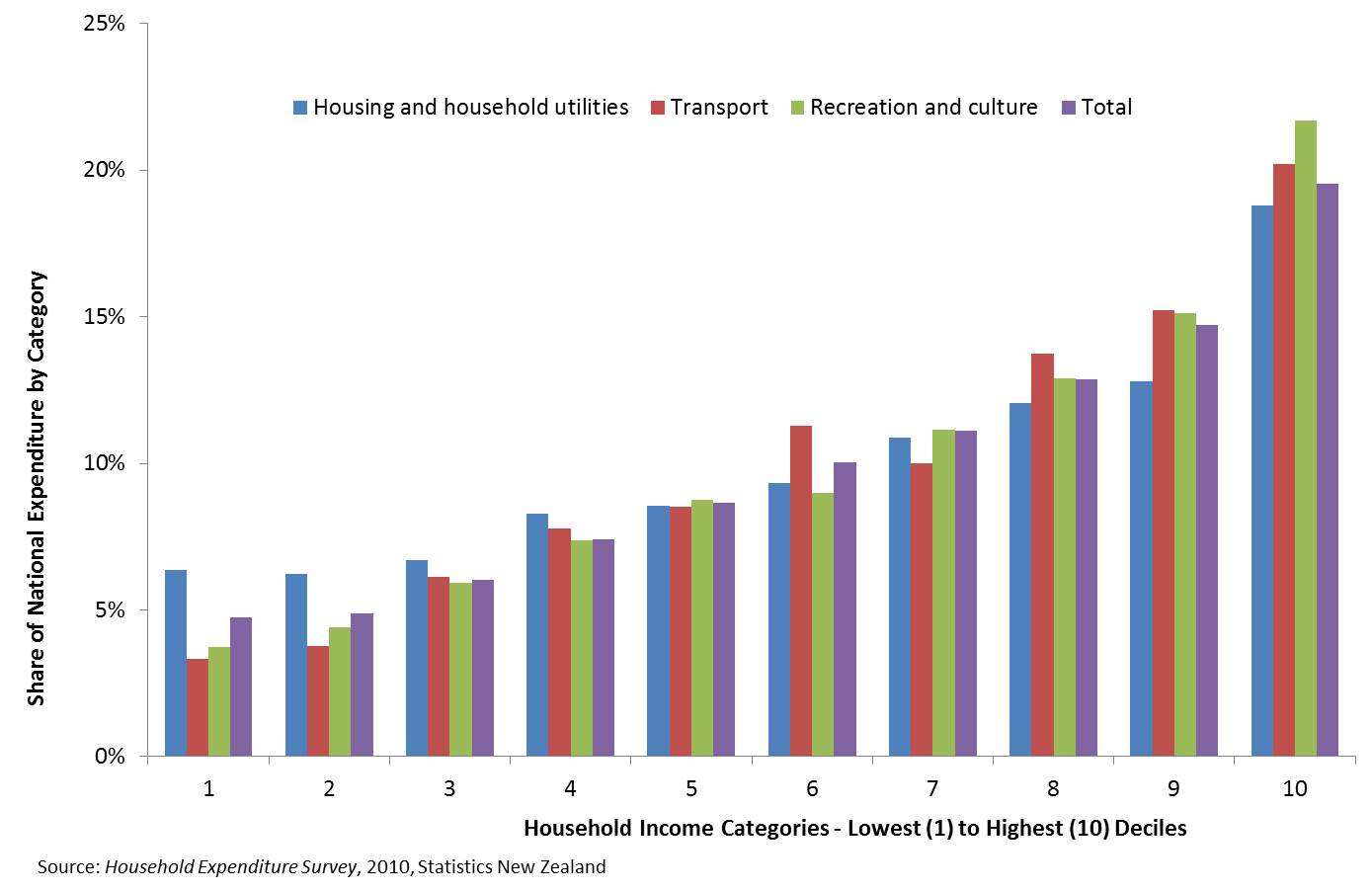
    Not surprisingly total consumption in New Zealand is dominated by higher income households: the 20% highest earning households (deciles 9 and 10) account for 35% of total spending on goods and services, while the lowest earning 20% (deciles 1 and 2) account for just 20%.

    And decile 10 households account for 7 times more spending on transport than decile 1 households.  They spend 5.5 times more on recreation and cultural services, and 3.5 times as much on food.


    The Contribution of Household Total Expenditure by Income Band, Selected Categories
    http://2.bp.blogspot.com/-OXL5hMRRw-Q/UdklqCO8CjI/AAAAAAAAAZA/o2GweAb3nTc/s640/Contributinm+to+totalmspoend+by+decile.jpg

     
    The highest income households spend three times more on housing than low income households, an average of $476 per week compared with $161.
    If refurbished housing in high amenity inner city living is expensive, guess which income groups will be living there?  The high consumers, obviously.  And in Auckland, at least, it seems that city planners and policy-makers are keen to deliver them the high order consumer services that will promote ever-more discretionary spending around the CBD(although much of central city resident travel may be taken up with recreational and social trip-making away from there).  

    A high social cost for little environmental benefit?
    The conclusion is straightforward: higher incomes mean more expenditure on additional housing, transport, and discretionary goods and services with correspondingly high environmental impacts.  If incomes are higher in cities, then their collective impacts will be high too.

    Planning policies won’t change that much – except to the extent that they erode consumption by inflating the basic costs of living, something that impacts most heavily on lower income households.  

    Fiddling with city form is unlikely to significantly reduce the impact of higher incomes and associated spending on the environment.  Increasing dwelling and living costs by promoting larger cities, higher residential densities, and uneconomic transit systems simply penalizes low income households already committing substantial shares of their spending to housing and transport.  And this is the group that, by dint of constrained consumption, has the lowest impact on the environment. 

    Better to address environment issues directly
    From a policy perspective, environmental issues are better tackled directly.  This may mean promoting environmentally friendly goods and services, promoting low impact technologies (including low impact housing, fuel efficient vehicles, and the like), and encouraging responsible consumption. If we are really serious about environmental threats, we need to examine the efficiency of current pricing practices and even taxation measures, rather than leaning so heavily on clumsy, indirect, and ultimately spurious urban planning policies. 

    Phil McDermott is a Director of CityScope Consultants in Auckland, New Zealand, and Adjunct Professor of Regional and Urban Development at Auckland University of Technology.  He works in urban, economic and transport development throughout New Zealand and in Australia, Asia, and the Pacific. He was formerly Head of the School of Resource and Environmental Planning at Massey University and General Manager of the Centre for Asia Pacific Aviation in Sydney. This piece originally appeared at is blog: Cities Matter.
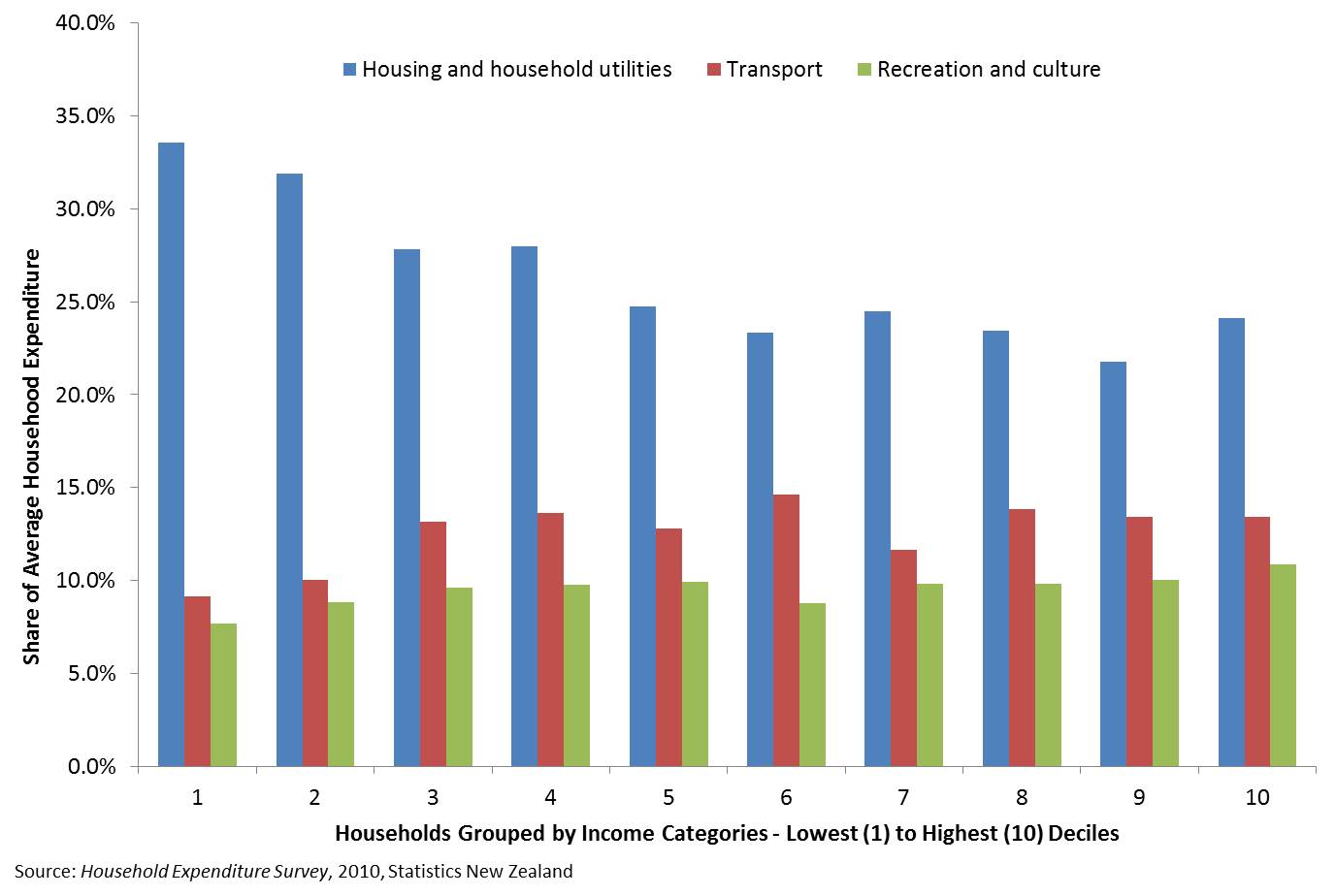
    Photo by Pat Scullion

  • Time to Acknowledge Falling Private Car Use

    The prospect of falling car use now needs to be firmly factored into planning for western cities. 

    That may come as a bit of a surprise in light of the preoccupation with city plans that aim to get people out of their cars, but it is already happening.  And it is highly likely to continue regardless of whether or not we promote urban consolidation and expensive transit systems. 

    But not necessarily lower resource consumption
    Of course, as day-to-day travel savings are made by households these can simply result in other forms of consumption, offsetting any resource savings.  This should not be surprising.   Final demand embodies resources consumed right across the production and distribution chain.  Savings from lower transport spending (including commuting) – an intermediate input in the chain – that lead to lower prices translate into increases in discretionary spending (assuming constant or rising incomes). 

    Hence, the reduction in resource use and pollution sought by subsidising public transport and promoting higher density living may simply be spent on resource-intensive appliances, recreation, entertainment, and inter-city and international travel.

    Look to the fringe to look to the future
    Putting that inconvenient equation aside, long-term plans for cities should avoid simply projecting past behaviours into the future. Instead, we might look to changes at the margin that signal the issues, discoveries, and events that might determine the long-term outcomes we are interested in. 

    So let’s look at what’s happening at the margins of car use, focusing for the purpose of illustration on Auckland.

    First, travel demand
    The New Zealand Travel Survey has been conducted since 2003.  The results are published on a two-yearly rolling basis.  Using Statistics New Zealand population estimates I have calculated annual “per person” measures for Auckland from 2003 to 2011.  There are some sampling issues and qualifications regarding the survey that mean motor cycle and bicycle use statistics for Auckland are not considered reliable enough to use. Even given sampling error, the balance point to some significant and consistent shifts.

    For example, total travel (measured as annual kilometres per resident) appears to have peaked around 2007 (Figure 1). In fact, recorded travel declined by 15% over the period.  Public transport has done better, down 12% overall but actually increasing 13% between 2007 and 2011.

    Figure 1: Aucklanders’ Travel by Mode, 2003-2011


    More telling, though, has been declining car use.  The first column in Table 1 shows changes over the whole period.  The second column shows changes between the 2007 travel peak and 2011.

    The fall in car dependence since 2007 has been marked among passengers (-23%).  Perhaps that means fewer discretionary trips are being taken. This and a 14% decline in driver kilometres and 17% fewer trip legs confirms what the vehicle counts say – cars are being driven significantly less in Auckland  (particularly inner Auckland) now than they were five or ten years ago.

     
    Period

    2003-11
    Peak
    2007-11
    Driver
    Km
    -4%
    -14%
    Hours
    3%
    -12%
    Trip Legs
    1%
    -17%
    Passenger
    Km
    -33%
    -23%
    Hours
    -18%
    -17%
    Trip Legs
    -8%
    -22%
    All Car Users
    Km
    -16%
    -17%
    Hours
    -5%
    -13%
    Trip Legs
    -3%
    -19%

    Possible reasons:

    1.      We know already that an ageing population reduces car use.

    2.      Public transport is playing a growing but so far minor role (up from 3.7% to 3.9% share of all kilometres travelled).  An average 76km per person growth in public transport use since 2007 hardly offsets the 1,810km average contraction in distance travelled by car.

    3.      Lower real incomes and higher fuel prices play a part.  A sharp contraction since 2007 suggests that economic conditions have an impact on motoring far more immediate and influential than trying to reshape the shape the city and how people live in it might.   

    4.      The decentralisation of jobs, recreation and entertainment, professional services, and consumer services – including retailing – mean that people can get more done closer to where they live.  Trying to turn this clock back by pushing commercial activity back into the central city and then providing subsidised public transport to access it seems somewhat obtuse in the light of this development.

    Second, car purchases

    The Ministry of Transport publishes new car registrations (which include imported used cars).  It also provides data on the total  vehicle fleet since 2000.  

    Long-term registration statistics are interesting when related to national population data (Figure 2). Apart from a hiccup in 1991 growth in registrations was more or less continuous from 1950 until 2003.  Since then there has been a sharp decline.  Time will tell whether this is cyclical or signals a long-term shift.  It is noteable, though, that 2009, 2010, and 2011 figures fall well below trend.

    Figure 2: Trends in New Car Registrations

    This slowdown in new car registrations is reflected in two ways.  First, it is reflected in total fleet size, for which data are available from 2000 (Figure 3). This shows that  2007 was a turning point in total numbers, consistent with evidence that driving in Auckland peaked in that year.  That’s presumably good for the environment.

    Figure 3: New Car Registrations, New Zealand 2000-2011,

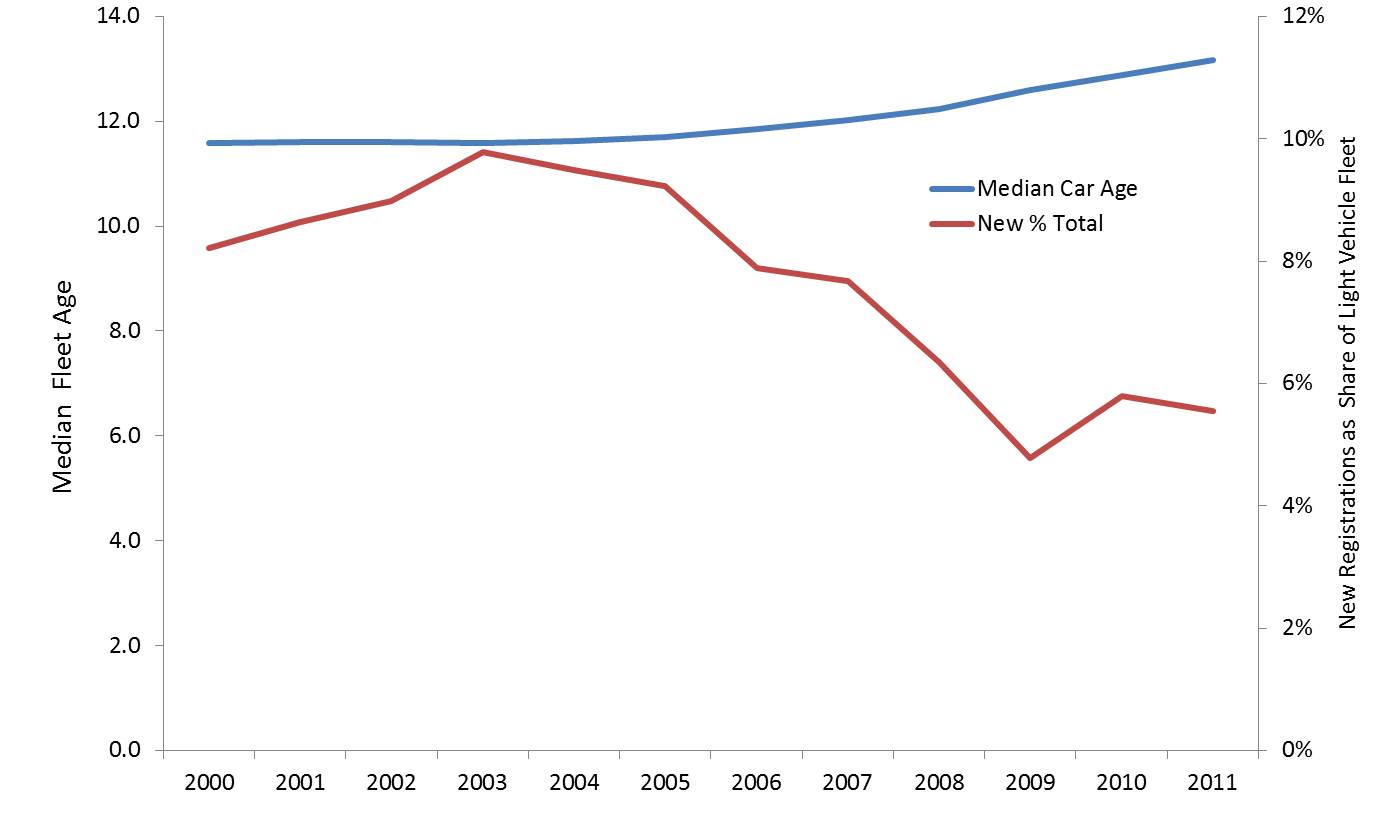
    Second, with the slow-down in imports, the fleet has begun to age (Figure 4).  That’s presumably bad for the environment, as older cars are less efficient and generate more emissions.

    Figure 4: New Zealand’s Ageing Car Fleet

    Third, fleet changes
    Fleet composition is changing as growth slows. The average CC rating of newly registered vehicles in 2000 was 2,127.  This climbed to 2,191 in 2005, but fell to 2,033 in 2011, an 8% fall in six years. 

    If this is a sign of things to come an increase in the turnover of vehicles would boost fleet efficiency over the medium term even without taking account of the greater engine efficiencies being delivered and gains among electric and hybrid vehicles

    Add to that the prospect supported by these numbers of increasing differentiation among vehicle styles (Figure 5).  At one end sits the large weekend recreational vehicle, perhaps falling as a share of new vehicles – or at least being down-sized.  At the other is the increasingly popular city runabout or smart car, and in the middle  the family sedan, the work horse with an engine size now likely to be well under 2,000cc.  

    Figure 5: Changes in Engine Size of Newly Registered Vehicles, 2000-2011

    So what does this all mean?
    There is evidence accumulating to suggest that significant changes are taking place at the margin of transport demand and car dependence.  If this is a sign of things to come it raises questions about long-term road expenditure, about dire predictions of road congestion, and about the benefits of adopting expensive land use and transport measures designed to force people out of their cars.

    Already, within a more constrained economy, people seem to be making their own decisions to reduce car dependence.

    In terms of city planning, it suggests that decentralisation may be more sustainable than the compact city protagonists make out.  In this respect, is interesting that motorway traffic counts show that significant reductions in inner city vehicle flows are offset by gains (albeit much smaller) in outer parts of the city – even as measured distance travelled falls. 

    And Auckland definitely needs to rethink assumptions behind spending plans for major road and rail infrastructure – and confront the risks and costs of getting them wrong. 

    And, incidentally, it’s about time New Zealand’s Ministry for the Environment updated its report card on trends in the environmental impact of vehicle travel – which only goes up to 2007, a year which may prove to be a turning point in long-term travel behaviour.

    Phil McDermott is a Director of CityScope Consultants in Auckland, New Zealand, and Adjunct Professor of Regional and Urban Development at Auckland University of Technology.  He works in urban, economic and transport development throughout New Zealand and in Australia, Asia, and the Pacific.  He was formerly Head of the School of Resource and Environmental Planning at Massey University and General Manager of the Centre for Asia Pacific Aviation in Sydney. This piece originally appeared at is blog: Cities Matter.

    Aukland harbour photo by Bigstockphoto.com.

  • The Answer Is Urban Consolidation – What Was The Question?

    The New Zealand Green Party is perpetuating the claim that development beyond Auckland’s “city limits” imposes a high cost on ratepayers.  A spokesperson claims that the current Auckland plan, which allows for some new development outside the current urban area, “will cost ratepayers $42b billion to 2042, an annual levy of $200 per ratepayer” according to a report in the New Zealand Herald.   

    But is just so happens that study on which these calculations are based is a flawed commissioned report[1] rather than a peer reviewed academic study. 

    Oops – Contradictory Claims
    The authors of the Curtin report acknowledged at the outset that

    "The challenge …  is that infrastructure costs are so heavily dependent on area-specific values.  For instance, road costs among different prospective development areas may vary based on the necessity for major arterial roads, costs for sewerage and water infrastructure could vary immensely depending on terrain and trenching conditions, and many infrastructure components will differ depending on the level and degree of excess capacity” (p.4)

    So why did they try to develop a generic tool for estimating the cost of urban development in Australiancities based on a mishmash of evidence from different cities and suburbs in Australia and the United States?  And why would anyone even contemplate applying such “findings” to Auckland with its distinctive physical geography, so different from its Australian counterparts? 

    A Quick Critique
    The Productivity Commission actually considered the study, among others, in a brief review of housing costs and urban form (Appendix B of the final report).  It noted substantive differences in the physical and social settings behind the data assembled to support the study’s claim to some sort of universal cost relationship between development and distance from the city centre.

    And there are glaring methodological deficiencies:

    An obvious one is mixing discount rates (zero for infrastructure capital costs, 7% for transport-related costs, and 3% for health and emission costs), and omitting operating costs for some items (non-transport infrastructure) and not others (pp. 295-296)

    To these flaws can added the assumption of a cost of Aus$170/tonne for carbon emissions when the carbon floor price set by the Australian government (of $15) has since been rescinded and figures at or below $10.00 may be more appropriate based on today’s European prices.  So the environmental argument is seriously overstated.

    And the analysis fails to deal with the costs of expanding the capacity of ageing infrastructure in long-established urban areas, of remediating services designed for far lower loadings than they are now expected to sustain, of the health impacts of apartment living in an increasingly brown – not green – environment, and of reductions in the physical and social resilience of high density and often congested urban areas in the face of possible natural disasters or infrastructure failures.

    Penalizing the Household – is that Socially Sustainable, or Politically Justified? 
    Even if it can be proven that the balance of public benefits favours medium or high density living, is there any evidence that such savings will not be offset by the better affordability of traditional suburban housing and the benefits residents derive from living into it?

    Putting aside the flawed data and methodology for the moment, the results indicate that 70% of the differences in costs between decentralized and central locations is attributable to travel and transport.  Over half of these comprise travel costs and time carried by households.  If we take these private costs out of the equation the authors’ estimate of the difference between centralized and decentralized development falls by 40%.  

    The resulting "present cost" for the average household (whatever that might be) of A$22,000 is easily  justified by savings on land and housing in “outer” areas, the benefits households get  from  additional space, greater choice over housing style, and the security and community benefits of suburban environments.

    So who pays if we deny people the choice of living in medium to low density housing?  It’s new households due to exclusion from household ownership, or commitment to punitive mortgages, or through the insidious extension of housing poverty through ever higher income brackets. 

    So what about the Auckland case: where does the evidence really lie?
    Surprisingly, given the obstinacy of the planners and politicians pushing the consolidation barrow, no-one has actually done the analysis required to determine the relative economic benefits of different urban development paths for Auckland.  

    A technical analysis of the gaps in the Auckland Regional Growth Strategy made the point that the planning model that informed it was hardly up to the task.  The principal conclusion that came from using the Regional Councils land use and transport model was that there is “little [identified] economic difference between growth options”.[2]  

    The failure of the model to demonstrate economic differences between alternative urban forms was used to suggest that intensification imposes no additional costs than traditional decentralized development.  Of course, the converse is true – although it has been conveniently ignored – there were no demonstrable economic benefits from consolidation or net cost penalties to decentralization.  This suggests that it would make most sense to let the market prevail, subject to broad environmental standards and fiscal constraints.   

    The conclusion  that consolidation was the best option for Auckland ignores other shortcomings  in the  model that could  tip the balance  in favour of strategic decentralisation:

    • The failure to actually define realistic alternatives that would  clearly demonstrate economic differences;
    • A failure to the marginal rather than average impacts of differences in urban form;
    • Ambiguous measurement (both omissions and double counting);
    • The failure to identify the costs of implementation.

    To this list we can add underestimation of the high infrastructure and development costs associated with brownfield development and urban consolidation.  These are turning up today in high financial and development contributions for inner city projects.

    Calling for Consolidation – a Case of Artificial Intelligence
    So why is the Auckland Spatial Plan so fixated on consolidation –despite the begrudging lip service the final version pays to decentralization (and even that appears to have  upset so upsets the Green spokesperson)?

    I can only think it is "artificial intelligence": if enough people say the same thing, it must be right.  Consensus becomes an excuse for lack of evidence, critical analysis, or even common sense.  Groupthink prevails: a phenomenon defined by psychologist Irving Janis as:
    A mode of thinking that people engage in when they are deeply involved in a cohesive in-group, when the members’ strivings for unanimity override their motivation to realistically appraise alternative courses of action [3]

    Contrary evidence is dismissed while reports favouring an emerging consensus, such as the Curtin one, obtain a degree of currency which, while unjustified,  plays into the hands of policy makers looking for easy (or ideologically comfortable) answers to difficult problems.

    And so we blunder on, potentially building our cities on myth and misconception and reinforcing the gap between generations as we do it.

    Phil McDermott is a Director of CityScope Consultants in Auckland, New Zealand, and Adjunct Professor of Regional and Urban Development at Auckland University of Technology.  He works in urban, economic and transport development throughout New Zealand and in Australia, Asia, and the Pacific.  He was formerly Head of the School of Resource and Environmental Planning at Massey University and General Manager of the Centre for Asia Pacific Aviation in Sydney. This piece originally appeared at is blog: Cities Matter.

    Aukland harbour photo by Bigstockphoto.com.


    [1]         Roman Trubka, Peter Newman and Darren Bilsborough  (2008) Assessing the Costs of Alternative Development Paths in Australian Cities, Curtin University Sustainability Policy Institute, Fremantle, Report commissioned by Parsons Brinckerhoff Australia
    [2]         McDermott Fairgray Ltd (1999) Gap Analysis, Review and Recommendations: Auckland Regional Growth Strategy, Technical Report, Auckland Regional Growth Forum

    [3]        Janis, I L (1972). Victims of Groupthink Houghton Mifflin p.  9

  • Cities, Cars, People: Is Changing Car Use a Function of New Urbanism?

    One cornerstone for urban designers and planners seeking to transform the polycentric or suburban city of the 20th Century into something resembling the high density city of the 19th was a cross-city comparison by Newman and Kenworthy and successors. [1]   They argued that this proved automobile dependence is a function of city density.  It followed that regulating for greater residential densities and increasing the capacity of public transport systems to avoid the congestion that would follow if people continued to drive themselves would improve the sustainability of cities.

    Of course, any comparison with the overcrowded and unhealthy cities of an earlier century is unfair: today’s density is achieved with higher standards of private and public space, and much enhanced transit and sanitation.  And many, probably the majority, of 21st century citizens in high income nations can escape the confines of the urban environment on occasional sojourns to country or coast (or beyond), unlike their 19th Century or developing world counterparts.  They can even find repose in the midst of 24/7 city hubbub in their own in-house media centres.

    But can we really build urban policy on the Newman and Kenworthy analysis?  Especially given evidence that car use is declining anyway?

    Questionable correlation
    There are still questions over the original analysis and it successors.  Cross-cultural effects, physical geography, differences in economic structure, incomes, wealth, and growth all intervene in the relationship between city density and car dependence.  And cause and effect are hard to pin down. 

    Perhaps more critical: the leap from observing relationships across cities at a point in time to regulating travel behaviour, housing ,and consumption choices into the future assumes that individual behaviour is a microcosm of collective behaviour. This fallacy of inference has long been recognised by the biological and sociological sciences.  And the likelihood of getting policy wrong by making such an assumption is far greater when dealing with populations of people, with their diverse circumstances, beliefs, values, and means, compared with, say, populations of penguins. 

    Is it this blind spot that has made it so much more difficult to get people out of their cars or their low density houses than anticipated by urban reformists?

    The city as a time warp
    One problem is that analyses of city density and car dependence are usually static.  Plotting urban form and transport consumption at a particular point in time – the mid/late 20th century in the Newman and Kenworthy case – embodies particular patterns of technology, wealth, and behaviour.  Consequently, their urban prescription is based implicitly on the 9 to 5 work day; single city centres that focus urban employment, exchange, and consumption; and the nuclear family with its distinctive housing and service demands. These are all urban artifacts that have been breaking down since the 1960s.

    But the times they are a-changing
    In a 2011 paper the authors acknowledge that things are changing as international evidence shows rates of car use beginning to decline in parts of the world.  A partial view of what they are changing from, though, sustains a deterministic explanation of the why and what they are changing to:

    “technological limits set by the inability of cars to continue causing urban sprawl within travel time budgets; the rapid growth in transit and re-urbanization which combine to cause exponential declines in car use; the reduction of car use by older people in cities and among younger people due to the emerging culture of urbanism and the growth in the price of fuel which underlies all the above factors”.[2]

    The view remains time-bound; even the reference to exponential decline is a simplistic inference of the relationship between public transport and car use taken from a cross section of cities in 1995. 

    Individual agency barely gets a mention.  Any description of an “emerging culture of urbanism” needs to be embedded in the reality of evolving patterns of wealth, income, and consumption and even in simple demographics to determine just how real and significant it is.

    Growing old and driving more
    What are the grounds for the claim that older people are reducing their car use, for example? I took a quick look at the evidence for New Zealand.  It is certainly not the case here.  The rate of growth in driving has been higher among older age groups than among younger – with decline most evident among the under 45s.  

    Is it so different in the other ageing societies from which Newman and Kenworthy draw their examples?

    Figure 1: Changes in Annual Driving Distance by Age, New Zealand 1990-2008


    Fewer kilometres doesn’t mean less dependence
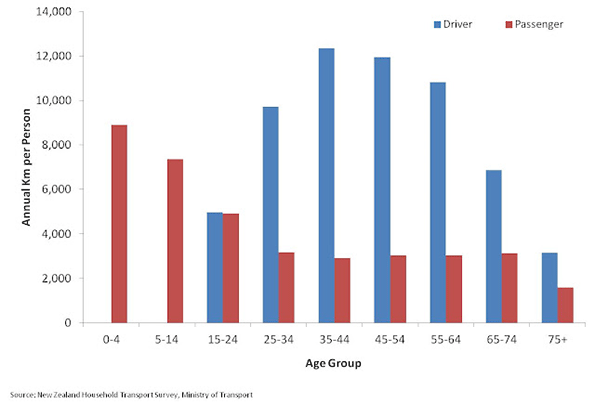
    What does go a long way to explaining declining car travel in the aggregate is the fact that older people don’t drive as much younger people, and populations in western cities are simply getting older.  It’s simple maths – as the population ages car usage will go down, despite a greater propensity to drive among older cohorts. Again, look at the evidence from New Zealand:

    Figure 2: Automobile Dependence by Age Group, New Zealand 2004-2008


    Car usage appears to decline after age 44, rapidly after retirement age, 65. 

    Why does car use fall with age?
    There are a number of reasons why this may be so.  From 45 years on households have fewer transport-dependent children.  Mature families may have more localised social networks.  A greater share of recreation may be neighbourhood based.

    On retirement work trips disappear and incomes, discretionary dollars and consumption fall.  The capacity for more shared travel and trip planning increases as households age.  Diminished car use doesn’t necessarily mean that households are less automobile dependent.  They just doesn’t generate as much travel demand.

    These explanations don’t depend on particular urban designs.  Yet Newman and Kenworthy claim that diminished driving happens because “older people move back into cities from the suburbs”.  This is not consistent with the common observation of people’s preference to age in place.[3]  (For the New Zealand evidence, see my posting Ageing in the City).

    Moving into the centre – a one-way street?
    And their notion “the children growing up in the suburbs would begin flocking back into the cities rather than continuing the life of car dependence” rather simplifies a historically specific event: the transition of sons and daughters of the baby boomers from young adulthood, advanced education, and job seeking to the career and housing paths associated with their movement into more stable relationships.  As they age, it is highly likely that suburban preferences re-emerge, sustained by the capacity to purchase and operate a private vehicle.

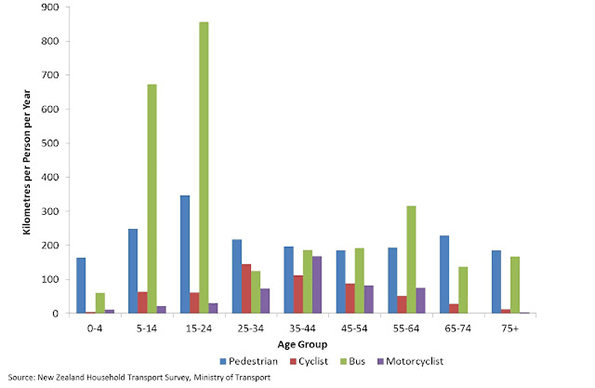
    Generation X boosted inner city dwelling over the past two decades, and Generation Y will do so, to a lesser extent, for another decade.  The 15 to 24 year age group also coincides with the age of greatest automobile independence (illustrated for New Zealand in Figure 3).  But don’t expect this historically-specific phenomenon to sustain some sort of indefinite culture of city consolidation, and I wouldn’t bet the fiscal bank on expensive transit systems designed around the assumption that it will. 

    These are passing generations: their successors will be that much smaller and facing a somewhat different world.[4]

    Figure 3: Use of non-Automotive Modes by Age Group, New Zealand 2004-2008


    Who are we planning for?
    Of course, there are plenty of exceptions to prove the rule: but that is the point.  Diverse communities have diverse expectations and behaviours. And they are continuously changing, in composition, in form, and in behaviour. 

    The failure of modernity lay in its assumption of conformity and convergence, compounded by the conceit that we could regulate for it.  And planning for what is little more than a statistical construct – the auto-independent city – risks blinding us to the richness and opportunity of alternatives, of lifestyle, of environmental stewardship, of urban design, and of mobility.

    If we start with the behaviour of individuals and households our designs for sustainable cities may be less deterministic and our planning less didactic, better informed, lighter in touch, and a lot more effective in meeting the long-term needs of evolving urban communities.

    Phil McDermott is a Director of CityScope Consultants in Auckland, New Zealand, and Adjunct Professor of Regional and Urban Development at Auckland University of Technology.  He works in urban, economic and transport development throughout New Zealand and in Australia, Asia, and the Pacific.  He was formerly Head of the School of Resource and Environmental Planning at Massey University and General Manager of the Centre for Asia Pacific Aviation in Sydney. This piece originally appeared at is blog: Cities Matter.

    Aukland photo by Bigstockphoto.com.


    [1]            Newman, P and Kenworthy J (1989) Cities and Auto Dependency: A Sourcebook. Gower, Aldershot
                         Newman, P and Kenworthy, J Sustainability and Cities: Overcoming Automobile Dependence, Island Press, Washington, D.C.
    [2]        Newman P and Kenworthy J (2011) “‘Peak Car Use’: Understanding the Demise of Automobile Dependence”, World Policy Transport and Practice, 17, 2, 31-42
    [3]        Pynoos R, Caraviello R, and Cicero C (2009) “Lifelong Housing: The Anchor in Aging-Friendly Communities”, Journal of the America Society on Aging, 33, 2, 26-32
    [4]         For New Zealand, check the numbers

  • From Connection to Dispersal: Urbanisation in the 21st Century

    Commentators have long studied connections between cities and how these influence their development. The city is the natural focus of trade-based theories of growth. Exporting a surplus, based on local resources and specialisation was – and is – considered the way to city wealth.

    In this world, transport is the key to the trade portal. The cities that dominated world trade in the 19th and 20th centuries were those best connected, initially through their ports and sea links complemented later through strong ties over the airways. Mega-ports and airport hubs were marks of city success. 

    This model may be changing, and we need to change our thinking about the future of our cities with it.

    Connectedness and concentration
    Connectedness is a mantra for the new urbanists: through international connection cities exploit the economies assumed to arise from ever-increasing concentration of people and business. Hence, the city seeking to make its mark globally must invest in ever increasing transport infrastructure. Acknowledging the information age, it may add high-speed broadband to the mix and perhaps, in a symbolic move, an international convention centre.

    But is this the right model for 21st century urbanisation?

    Aviation – moving on
    Think for a moment about what has happened in aviation. The last decade saw a quantum shift from a model whereby a few powerful hubs concentrated movement between a few major centres from which passengers and goods could, in turn, be distributed along local spokes – by regional aircraft, train, coach or car. Airlines based themselves overwhelmingly at these hubs.  The large, twin isle jet reigned supreme. The Airbus A380 is the latest conveyor of that model, but most likely the last.

    Because late in the 20th century there was a divergence between an ageing hub and spoke model and a growing model based on  dense networks connecting more and more cities directly. The single aisle, medium-haul jet took off.  And now the long-haul, highly efficient, medium-sized jet is further expanding this capacity to directly connect former spokes – smaller cities – without the need to hub through major cities.

    And all of this has been supported by the productivity leap brought about by the low cost airline model. More people, more cities, more directly connected than ever before with the capacity to transform economic, political and social relations among them.  [1]

    From transport to logistics
    The transport sector was about moving goods from A to B as cost effectively as regulation allowed; and all too often regulation kept costs up to protect old technology and incumbent operators, whether by surface, air, or sea. That, though, is changing as international transport is liberalised.    

    And today transport is itself transforming into the business of logistics. And logistics is about distribution – through a production chain, between producers and consumers, and among places.  Goods move seamlessly through integrated operations that can deliver almost anything almost anywhere in a matter of days. 

    An informational world
    As the capacity to transport goods went up and the cost went down, academics trying to explain the differential growth of cities appealed to a new notion that dominating the exchange of information was the new key to prosperity.  Knowledge and expertise were concentrated in key informational hubs where they became the centres of capitalist power, the hearths of globalisation.  [2]

    Well that’s changing, too. Information and expertise is becoming dispersed, knowledge ubiquitous.  This is not just about the internet – although it obviously plays a huge part.  It’s also about the explosion of personal mobility as informational cities give way to an informational world.  (It may also be about the potential for implosion as a result of over-concentration, a threat still lingering in the financial centres of the world). 

    Linked cities are giving way to networked communities.

    From consolidation …
    The lesson? Those of us involved in planning the city cannot assume the same structures will prevail in the future as those we inherited from the past.  We tend to plan, though, by looking for repeat patterns, seeking generalisation, extracting principles, predicting the unpredictable.  And because infrastructure – roads, rail, ports – are large scale, expensive, and enduring they become the bones around which we construct our futures. 

    Infrastructure, particularly transport infrastructure, shapes our presumptions about how the city will function and the form it will take. Hence, urban planning is preoccupied with how to consolidate existing structures, increasing their capacity by building up rather than out and moving to mass transit, among other things.

    … to dispersal
    Yet the shifts in 21st century logistics and information technology support dispersal.  And it might just be that dispersal is the key to 21st century urbanisation.
    Light rail systems, dedicated bus lanes, smaller, more fuel efficient vehicles, lower housing costs, more intimate localised but inter-connected sub-urban communities, common information and mobile expertise cutting across diverse tastes, experiences, and places – these may be the way of the future.

    In the developing world where urbanisation is most rapid they may be the only way.  Here dispersal is already the dominant reality. While urbanisation may be exemplified in a few megacities in Asia, these account for only a small part of the total. And even they are marked by rapid peripheral expansion, with distinctive, sprawling, dense and diverse communities on the edge. Democraticised, localised self help institutions and NGOs may be the way to improved sanitation and health care in this environment, and micro-commerce the way to sustainable prosperity. 

    And in the slower-growing cities of the west, the maturing of sub-urban life, a return to lifestyle-focused localism, ageing in place, and the growing importance of community-based care point to a future in which dispersal rather than concentration could be the dominant mode of social and spatial organisation. Central structures may still have a role, but a diminishing one.

    More generally we may have to think of cities themselves as comprising networks of connections, within and across boundaries. The stronger these networks, perhaps, the more resilient the city. But this does not translate to physical density. Proximity is not the issue. Well connected, dense networks will support, if not encourage, dispersal. 

    This is contrary to the currently favoured model in places like my city of origin – Auckland – but it is not at all contrary to the centre within that city that I call home.

    Getting it wrong
    More than ever as we try to plan for the very long-term, we need to open our minds to alternatives. You only need to look at the list of bankrupt airlines (or in and out of Chapter 11 in the US) to appreciate the consequences of overinvesting in the current model on the assumption that it will prevail indefinitely.

    Phil McDermott is a Director of CityScope Consultants in Auckland, New Zealand, and Adjunct Professor of Regional and Urban Development at Auckland University of Technology.  He works in urban, economic and transport development throughout New Zealand and in Australia, Asia, and the Pacific.  He was formerly Head of the School of Resource and Environmental Planning at Massey University and General Manager of the Centre for Asia Pacific Aviation in Sydney. This piece originally appeared at is blog: Cities Matter.

    Aircaft photo by BigStockPhoto.com.


    [1]            See, for example, Centre for Asia Pacific Aviation (2003) Low Cost Airlines in Asia Pacific: A Force for Change and (2009) Global Low Cost Carrier Report
    [2]           E.g. Castells M (1990) The Informational City: Economic Restructuring and Urban Development Blackwell; Sassen S (1991) The Global City, New York, London, Tokyo, Princeton University Press

  • Are 20th Century Models Relevant to 21st Century Urbanization?

    Analysis of the state of the world’s cities 2010/2011 by UN-Habitat focused on the narrowing urban divide, with 227 million people moving out of slum conditions over the preceding decade.  While acknowledging uncertainty over cause and effect, the report notes that:

    urbanization … is associated in some places with numerous, positive outcomes such as technological innovation, forms of creativity, economic progress, higher standards of living, enhanced democratic accountability and women’s empowerment. … the report calls for policy-makers and planners to understand that urbanization can be a positive force for economic development, leading to desirable social and political outcomes.

    The North Atlantic solution

    The report acknowledges the diversity of urbanisation[1], making its authors’ somewhat singular approach to managing it (more density) incongruous.  Their prescription is based on resisting urban sprawl, reflecting the experience of North America.  They also suggest that sprawl is a sign of “divided cities”, translating into

    an increase in the cost of transport, public infrastructure and of residential and commercial development. Moreover, sprawling metropolitan areas require more energy, metal, concrete and asphalt than do compact cities because homes, offices and utilities are set farther apart.

    The report denounces sprawl in suburban zones of high and middle income groups and in extensive slums on the city edge.  On the latter, they invoke issues of governance, saying it occurs because

    authorities pay little attention to slums, land, services and transport. Authorities lack the ability to predict urban growth and, as a result, fail to provide land for the urbanizing poor.

    Can one size fit all?

    It is difficult to accept prescription predisposed to a particular view. Urbanisation is not a single condition. Differences in the stage of urbanisation, vastly different physical, cultural and economic settings of “urban” settlement, and different institutional arrangements belie the idea of a universal response or that any particular form is best for all cities. 

    Apart from anything else, “western” cities [2] don’t really feature in 21st century urbanism.  Consider the figures.  In 1950 western cities accounted for 43% of the world’s urban population.  This was down to 23% in 1990 and 18% in 2010. UN projections have the figure down to 15% in 2030, accounting for between just 3% and 4% of all urban growth between now and then.

    What Size City?

    This post looks at some more numbers that help illustrate the diversity of urbanisation – the size of urban settlements. 

    According to UN figures,  8% of the world’s population lives in 53 cities housing over 5 million people; 12% in 388 cities of between 1 and 5 million; and 31% in cities of under 1 million. Any prescriptions for urban governance and urban form need to reflect quite extreme divergence between the few megacities and the many smaller settlements where the majority of urbanites live.

    The Urban Growth Trajectory

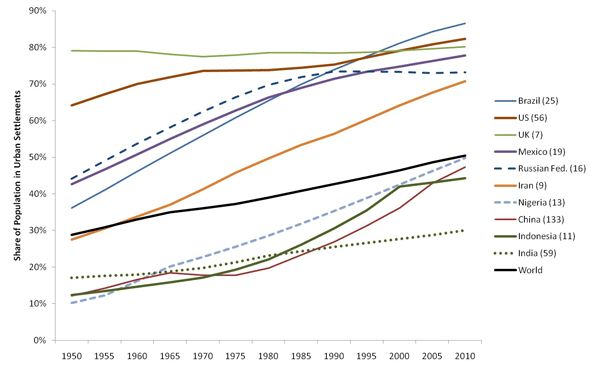
    Urbanisation experiences vary, also.  The different national experiences of the past 60 years can be illustrated using ten quite different countries (Chart 1).  By 2010, Brazil, US, UK, Mexico, and Iran were all heavily urbanised.  But the level of urbanisation changed little for the US and the UK over thelate 20th century, while it grew rapidly in the others.

    In yet another trajectory, erstwhile rapid urbanisation in Russia stalled after the mid 1980s. 


    Chart 1: Urbanisation Trends, Selected Nations, 1950-2010

    Urbanisation is accelerating in China, but has flattened off in Indonesia.  It has been increasing steadily in Nigeria and slowly but still steadily in India.

    Most people moving into smaller cities

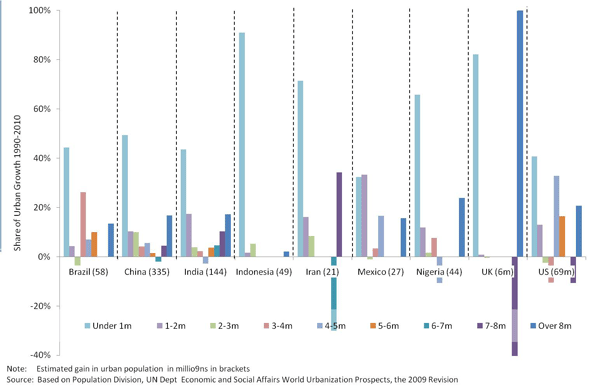
    Chart 2 shows shares of growth by city size groups over the last twenty years. (Russia is omitted because urbanisation actually declined by 5.5%.) 

    Cities of under 1 million residents dominate gains, strongly favouring developing countries.  They accounted for 90% of urban growth in Indonesia, 71% in Nigeria and 66% in Iran. 

    US experienced growth more or less across all size categories, although Chicago went from the 7m-8m to the 8m plus category, reducing down the former.

    Chart 2: Where Populations Grew – Cities by Size Category, 1990-2010

    Brazil, China, and Indonesia saw significant growth across the most size groups.  There appears to be a contrast within these countries between the centralising influence of few large cities and dispersed urbanisation in many much smaller settlements.

    (The picture for the UK reflects a gain of around 1 million people in London — to 8.6m — shifting it between categories.  Smaller cities actually accounted for 82% of the net UK gain in urban population, suggesting a duality between the growth of the capital and decentralisation through growth in smaller settlement). 

    So where are the big cities?

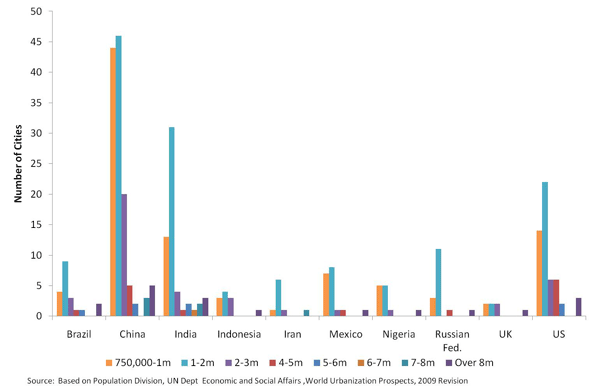
    The US has five urban agglomerations with a population of more than 5m, centred on New York, Los Angeles, Chicago, Philadelphia and Detroit (Chart 3).  Compare this with China, with twelve cities of over 5m, and five cities of more than 8 million people (Shanghai, Beijing, Chongqing, Shenzhen, and Guangzhou); or India, with eight over 5m and three over 8m (Mumbai, Kolkata, and Chennai).

    At the same time, China has 90 cities of between 750,000 and 2m, India 44 and the US 66.  Mexico has 15, Russia 14 and Brazil 13. 

    Chart 3: Number of Cities by Size Category, Ten Nations 2010

    Primacy – a mixed picture

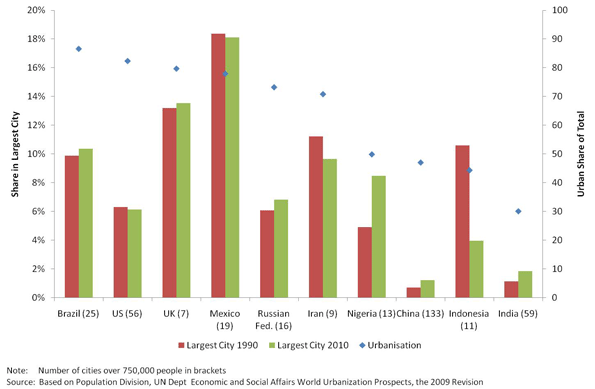
    Single centres that dominate national populations are termed “primate”.  Their rise and fall may be symptomatic of national economic fortunes.  Excessive primacy may increase economic volatility because the contrast between a rich centre and poor periphery is politically destabilising. One centre dominating financial, human, and intellectual resources may also increase national vulnerability to structural decline.

    The picture is mixed across our sample (Chart 4).  Mexico City and London stand out.  High levels of primacy are also evident in Iran and Indonesia, but have been easing, contrasting with Nigeria where it is increasing.  It is least pronounced in the countries with the largest urban populations – China and India — suggesting a strong population pull from a number of state or provincial capitals, as well as a host of much smaller cities.

    Chart 4: Population Share of Largest City, Ten Nations, 1990 and 2010

    So what does all this mean?

    The data confirms huge diversity in the sizes of cities people live in across and within nations.  It generates more questions than answers, though, the main one being whether it is relevant simply to transfer urban governance, management, or planning models from one place to another.  Apart from contrasts within and between nations, it is clear that the west is no longer the focus of urbanisation and is unlikely to hold many of the answers to today’s urban growth challenges.

    The evidence also indicates a tendency for urbanisation to take place in small, dispersed settlements rather than mega-cities.  More modest scale makes different demands on infrastructure and institutions.  It may also help manage urbanisation and ensure that benefits can be better accessed by larger numbers of people.  Small cities, sub-centres in large cities, and districts of modest scale may be better suited to adaptable and innovative planning and management than large scale, extensive cities with their more centralised, remote, and inevitably bureaucratic political and administrative systems. 

    Very large agglomerations do exist, even if they are not as dominant in the wider urban picture as their size and profiles might suggest.  The question they raise is whether they should continue to dominate national and international agenda for urban growth and management.  Dispersed urbanisation may better reflect the resources and capacities needed to support an exploding urban population in the 21st century.

    Phil McDermott is a Director of CityScope Consultants in Auckland, New Zealand, and Adjunct Professor of Regional and Urban Development at Auckland University of Technology.  He works in urban, economic and transport development throughout New Zealand and in Australia, Asia, and the Pacific.  He was formerly Head of the School of Resource and Environmental Planning at Massey University and General Manager of the Centre for Asia Pacific Aviation in Sydney. This piece originally appeared at is blog: Cities Matter.


    [1]  The lowest level of urbanisation incorporated by the UN depends on the conventions of individual nations but may refer to settlements with as few as 2,000 people.

    [2] Treated here as North America, Northern Western and Southern Europe, and Australasia

    Photo by NASA’s Marshall Space Flight Center.

  • Being Dense About Dwellings: Check the Numbers!

    Recently I suggested that in New Zealand we are heading into the perfect housing storm. Now we have news that house prices and rentals are on the climb again, although stocks remain tight, as an annual inflation rate of 5.3% hits a 21 year high.  The economists are suggesting this is good news, although it means interest rates may have to be pushed up sooner than expected.

    Well the bad news is that the housing crisis might just have worsened. 

    Sure, its not an across-the-board crisis, but it is very real to large and important sections of our population.  Lack of housing affordability remains a threat to social sustainability and economic recovery.  So how are we responding to the threat — or perhaps now the reality — of a perfect housing storm?  What provisions are we making in our urban plans?

    Smaller boxes – bigger footprint
    Urban planners are still more preoccupied with fitting more dwellings into smaller areas than they are with responding to people’s needs for housing.  It might help shift this fixation to point out that the preferred compact city solution is not only socially destructive, because it doesn’t reflect need and does nothing for affordability, but it is also environmentally short-sighted.

    Think about the metrics.

    Take 100 people and house them at 1.5 residents per dwelling.  That’s arbitrary, but it reflects a widespread expectation that most new dwellings will house smaller households in central locations. 

    In the interests of sustainability, let’s assume the resulting 67 dwellings are small, so that we can fit more of them onto less land.  Say, 120 sq meters per dwelling.  That totals 8,000 sq metres or thereabouts (more if we count the common areas in apartment buildings), 80 sq metres per person.  It’s also 67 kitchens, 67 lounges, maybe 67 media centres, at least 67 bathrooms, maybe some additional lighting for common areas and even some lifts.

    Now take 100 people and fit them in at 3 people per dwelling, terraces, duplexes or fully detached houses.  Let’s make the dwellings bigger, say 200 sq metres.  We now need only 33 dwellings, 6,600 sq metres of dwelling, or 66 sq metres per person.  Less space per person, sure, but that’s okay because now we need just half the kitchens, bathrooms, lounges and media centres.  However we look at it, we’ve used a lot less resources and have a spare 1,400 sq metres for open space, extra gardens, courtyards, whatever.  And with the capacity for extra bedrooms, we have much more flexible housing stock.

    So which is the more sustainable?  Surely bigger dwellings with higher occupancies.  Surprised?

    Can we plan for higher occupancies?
    Now, we can’t engineer household size, can we?  Well, actually we already do.  With a housing shortfall we now require young adults to stay longer with their parents, force singles to move in with others,  require couples to take on boarders, or even promote multi-family living, all boosting occupancies.

    So let’s at least understand that building more, smaller dwellings, especially medium- or high-rise apartments, does not necessarily deliver sustainable urban settlement, nor does it provide the flexibility to make the higher occupancy "solutions" we force on people easy to live with.

    Larger dwellings do allow for diverse living arrangements, but its more multi-generational living, more non-family households, more sharing.  Like them or not, such arrangements are likely to increase, if only in response to the affordability issues we seem intent on entrenching.

    So what’s happening to demand?
    So why are planners trying to put more people into smaller dwellings anyway?  How relevant is the expectation that average household size will be smaller in the future than it has been in the past?

    Most forecasts of housing “demand” simply extrapolate diminishing occupancy across demographic projections.  Its all about the coefficients, and the assumption that household structures won’t change much in the medium to long-term. 
    Well, it’s not that simple.

    Things like an unexpected boom in the dissolution of relationships over the past three or four decades, the rapid growth in migration, and the recent stabilisation and even reversal in occupancy rates undermine the conceit that we can accurately forecast the structure, preferences, and behaviour of households 20 or 30 years hence.  If that’s the case, why are our prescriptions for housing increasingly rigid?

    Projecting household types
    To understand this let’s stay with the current ”best”  projections of what households might look like in the future, and think about the implications for housing.

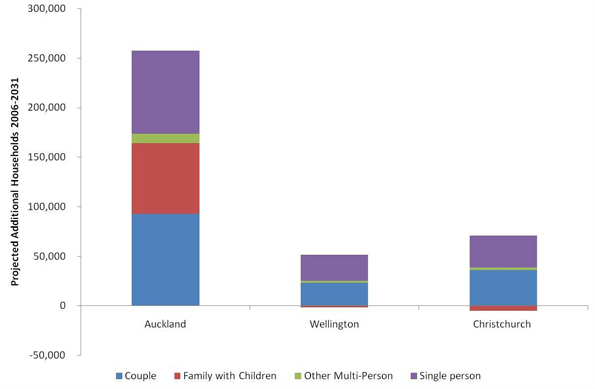
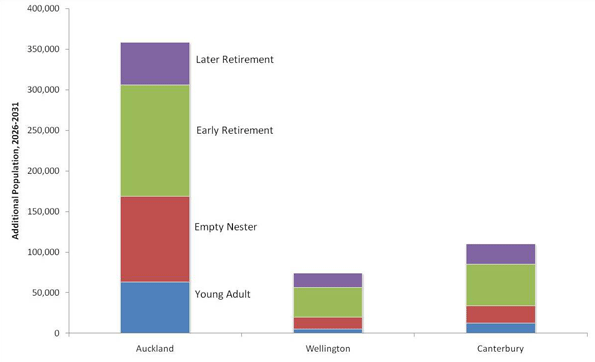
    Statistics New Zealand (SNZ) medium projections to 2031 indicate that families with children will account for a minority of household growth in our main cities (see chart).  The figures may even shrink in Wellington and Christchurch.  According to this projection, they will make up 28% of new households in Auckland, though, so we could still need over 71,000 new dwellings for families there.  It’s reasonable to expect that detached housing will still work best for them.

    Household Category Projections, Statistics New Zealand

    Couples will account for more growth, though, maybe 36% of new households in Auckland according to SNZ, and singles for 32%.  So let’s think about the preferences of the small household segment. 

    So what will the small household segment look  like?
    To get a feel for this, I divided the SNZ age projections into four (setting aside the main family age cohorts) : young adults (aged 20-29), empty nesters (the kids have left home, aged 50-64); early retirees (65-79), and later retirees (80+).  These are the groups most small households will come from.  But they have quite different housing preferences, so the nature of future demand for smaller dwellings depends on which ones grow the most.

    Age-Based Housing Demand Segments (based on SNZ Projections)

    So who will dominate growth?
    Empty nesters and retirees will dominate the demand for new houses.  And these are not usually people who want to move into small, centralised apartments, at least not as a primary residence. 

    Many of them have significant financial equity in their existing homes and emotional equity in their neighbourhoods.  If they move into smaller dwellings, they won’t be that small!  They will expect them to be well appointed and well located, probably close to where they already live. 

    They won’t want high or even medium rise.  And they are  likely to seek three or four bedrooms.  They will need the space to maintain active  lives into their seventies and eighties, more so than past generations.  They will be accommodating visiting family and friends; they will need offices, hobby areas, workshops, and storage. 

    Here’s a model to take seriously if we are serious about sustainability
    And as the baby boomers eventually become less independent, we might expect them to head into retirement villages, already a booming – and highly sustainable – form of housing.

    In fact, we should look seriously at retirement villages if we want to understand the sorts of arrangements that could dominate new housing demand over the next 30 years.  Here, the market seems to have got it right. 

    They offer varied living arrangements – detached and semi detached housing, terraces, apartments, and even on-site nursing facilities.  They offer medium density living with plenty of green space and gardens; common areas and shared facilities for recreation and leisure; plenty of on-site activity to cut down transport needs but also on-site parking to reflect the realities of modern living.  They achieve density and sustainability with style.  And – there must be a lesson here – they do it overwhelmingly in suburban if not city edge localities. 

    So let’s not assume that rising house prices mean a return to business as usual.  Far from it – freeing up the housing market must remain a top priority if the economy is in recovery mode.  And let’s start looking to the suburbs and beyond for the housing solutions that might just help it stay that way.

    Phil McDermott is a Director of CityScope Consultants in Auckland, New Zealand, and Adjunct Professor of Regional and Urban Development at Auckland University of Technology.  He works in urban, economic and transport development throughout New Zealand and in Australia, Asia, and the Pacific.  He was formerly Head of the School of Resource and Environmental Planning at Massey University and General Manager of the Centre for Asia Pacific Aviation in Sydney. This piece originally appeared at is blog: Cities Matter.

    Photo by flickr user: Adam Foster.

  • Urban Violence Abroad: An Arab Spring and a British Autumn?

    Treating urbanisation as some sort of homogeneous movement, a driver of an increasingly interdependent world of shared values, behaviour, and prosperity is to oversimplify.  There may be some common drivers, but urbanisation in the 21st century is likely to be quite different from urbanisation in the 20th century.  Suggesting a universal approaches to governing, managing and planning cities is providing answers without knowing the questions. 

    The role of the city has to be considered in recent outbreaks of localised or national violence.  In this post I raise the issue of urban violence with reference to urbanisation in North Africa and the Middle East, and explore possible parallels with recent riots in Britain.

    Violence and language

    Language, like planning, can be employed to make order out of chaos.  The American invasion of Iraq in 2005 was widely seen as the beginning of an Arab Spring, a label suggesting that people in other Arab nations might rise up in some universal quest for democratic deliverance from oppressive regimes following the expulsion of Saddam Hussein. 

    In keeping with this representation, today’s images of protest and violence in the streets of Egypt, Libya, and Syria are presented as signs of culture change leading inevitably to western-style democracy.  But it would be premature to assume that out of the current movements will come the end of autocracy, a displacement of authoritarian regimes with multi-party democracy, or a cessation of sectarian conflict. 

    Despite deep cultural difference that mean western expectations for Arab outcomes are likely to be flawed, there are parallels between what is happening in North Africa and urban violence in Britain.  Only there, the language is quite different.  The politicians and press are not lauding the people on the streets of London or Birmingham, and the reporting is a lot less optimistic. 

    Cities and revolution

    Have you noticed how the images of North African protests against autocratic governments are male-dominated, and urban? This is hardly new: think Paris at the end of the 18th century or in 1848.

    But today’s turmoil does raise a couple of thoughts.  First, let’s remember there is an enduring tradition of inter-tribal struggle for power and long-standing feuds among sects in the Middle East.  Internecine violence predates the colonial borders and post-colonial regimes that seem to be unraveling now.  Despite the increased trappings of modernisation, little may have changed by way of physical struggles for power in a traditionally male domain.

    But what is interesting is the way uprisings are playing out today as predominantly urban movements.  Urbanisation appears to play an important part in focusing discontent and making disenfranchisement visible.  Growing cities provide gathering places for growing protest.  They are the terrain for harassment, the platform for violence, and the stage for claim and counterclaim.  The march from city to city, whether in defiance or defence, tracks the progress of civil unrest, suppression, and revolution. 

    Social media – uniting or dividing?

    Much has been made of the role of social media in mobilising civilians to a common cause, but it can only really give form to popular protest in an urban setting.  Urbanisation may encourage unity among diverse groups opposing a common tyranny. But such unity is likely be transitory, lasting only to the fall of the first tyrant.

    Within fast growing cities of the Arab world sectarian divisions still run deep and social media may simply reinforce them, calling brothers to arms to settle old enmities once new protests have finished.

    The demographics of growing cities

    It might pay to look more closely at urbanisation to better understand the character of today’s protests.  Look at the underlying demographics of countries at the heart of unrest and regime change in North Africa, and compare them with, say, the US and the UK.  They:

    (1)    Are urbanising rapidly – Syria and Iraq stand out;
    (2)    Have large shares of their populations aged under 30 years – 67% in Iraq and 65% in Syria;
    (3)    Have higher unemployment – quite possibly much higher given the difficulty of measuring this figure in a consistent way.  Libya appears to lead the way, although some of the unemployment figures are little better than informed guesses.

    Syria

    Iraq

    Libya

    Tunisia

    Egypt

    US

    UK

    % Urban

    55.7%

    66.2%

    77.9%

    67.3%

    43.4%

    82.3%

    79.6%

    Urban Growth

    101.5%

    65.2%

    54.3%

    46.6%

    45.9%

    36.2%

    10.2%

    % Aged<30

    65.2%

    66.7%

    60.2%

    49.2%

    59.9%

    39.3%

    36.2%

    % Aged <30 Male

    51.0%

    50.7%

    51.1%

    50.1%

    50.9%

    49.8%

    50.1%

    Unemployment

    12.6%

    15.3%

    30.0%

    13.0%

    11.9%

    9.1%

    7.7%

    Sources: US Census Bureau; TradingEconomics.com; CIA World Fact Book, national statistical offices


    How far, it might be asked, is the Arab spring founded on the frustrations of Arab youth?  And can we really expect revolution in the streets to resolve issues of deprivation, dispossession, and boredom, without the revolutionaries first finding fulfilment and making real material (or spiritual) progress even if the short term ends of overthrowing incumbent rulers are met?

    The road to this Damascus is likely to be long and divided

    The mix of rapid urbanisation, youthful populations, and high unemployment is a volatile one.  Add strong religious, cultural or ethnic divisions and inequality within increasingly urbanised societies and the prospect is for prolonged unrest and sporadic violence. 

    While globalising communications and the accessibility of social media may feed visions of liberal democratic regimes and the illusion of increasingly connected societies, the result in North Africa and the Middle East may be quite different from any western ideal.  Revolution here may lead to ways of sharing and exercising power other than those associated with orderly, liberal democracies; or it may simply reinforce the fractured nature of these societies.

    The road ahead is not clear, nor it is likely to be smooth.

    Lessons for the west?

    Are the industrialised – and post-industrial – cities of the west insulated from the frustrations of youth?  Recent British experience suggests not.  The numbers are smaller, and the middle aged and middle class more likely to resist, but urban conditions of alienation and relative deprivation are significant, particularly among young people in large urban areas. 

    Deprivation is most conspicuous in cities, especially when economic growth is less assured and the fruits less dispersed.  Almost inevitably, the costs of stagnation are distributed disproportionately along ethnic and generational lines when the economy slows and business and governments consolidate. 

    Who’s rioting in Britain?

    In February 2011 it was reported that youth (16-24 years) unemployment in Britain hit a record 20.5%, compared with a general rate of 7.9%.  The majority of young unemployed are concentrated in urban areas: according to a 2009 Centre for Cities publication, the 63 largest British cities and towns contain 59% the country’s youth population, but 64% of the young who are on benefits.  Not only that, but a 2010 publication by the Institute for Public Policy Research suggests that half of Britain’s unemployed youth are black.

    The television images of British urban riots show a high proportion of youth, and a disproportionate representation of black youth.   While the riots were characterised by the level of damage to property and theft, attributing them simply to criminality (or moral weakness) misses the role of divisions within large cities.  When distinctive groups of people within cities sit outside prevailing economic and political structures, their collective lack of respect for property – or lives – should not be so surprising.

    There are obvious differences between the urban domain in Britain and that of North Africa, though.  For a start, dispossessed youth are a minority in Britain, where a strong middle-aged middle class will rally to support government efforts — or even to advance their own — to quell disorder.

    So, in urban settings that are figuratively a world apart a common contributor to street violence is an alienated youth.  But perhaps that’s as far as commonality goes.  In the Arab world, youth is a near or even absolute majority; in the western world it is minority.  In the Arab world it appears to be seeking a share of the power in rapidly urbanising communities; in the western world it is seeking its share of the good life in a long-urbanised society. 

    Phil McDermott is a Director of CityScope Consultants in Auckland, New Zealand, and Adjunct Professor of Regional and Urban Development at Auckland University of Technology.  He works in urban, economic and transport development throughout New Zealand and in Australia, Asia, and the Pacific.  He was formerly Head of the School of Resource and Environmental Planning at Massey University and General Manager of the Centre for Asia Pacific Aviation in Sydney. This piece originally appeared at is blog: Cities Matter.

    Photo by Syria-Frames-of-Freedom

  • Sustaining the Suburbs

    The proposition is simple, if not overwhelming.  If we want sustainable cities – however you define “sustainable” – we had better put some effort into the quality of suburban life.  We need to get over denigrating suburbs and sprawl.  That simply ducks the issue of where and how most people spend most of their time.  We need to moderate a preoccupation with promoting CBD and big centre lifestyles.  Those are places that people want visit, but not necessarily where they want to live.

    Come back Jane, our suburbs need you
    It’s fifty years now since Jane Jacobs’ landmark book about saving North American cities from themselves.  She argued against the prevailing push for urban renewal as displacing communities and destroying street life with motorways, car parks, and bland commercial development.  Jacobs’ writing and her activism inspired a resistance credited with saving inner city villages, helping retain the human character of large cities, and inspiring a generation of urban designers and planners. 

    There is no doubt that the Jacobs message took hold in New Zealand.  It’s become compelling since the crash of ‘87 slowed down the razing of inner city blocks and marked the beginning of the end of the white collar CBD.  Hanging on to what we’ve got is one way to stop the hollowing out.

    Unfortunately, today’s call for central city mega projects on which to stake a claim to an international presence and the push for large scale CBD residential development on which to stake a claim to environmental stewardship run the risk of reversing the gains to inner city life.  High rise apartments, tracts of high density housing, and grandiose civic plans risk undermining the essence of the central city in the same way as urban renewal and freeways once did.

    But that’s not what this posting is about.  The reality is that the bulk of our populations live in the suburbs; the suburbs that are growing the most; and that’s where we need to promote the capacity for people to live fulfilling lives.  That’s where today we need to promote street life and be wary of the threats posed by the new urbanists and their grand plans for intensification.

    Most people still live in the suburbs
    Its obvious that most people still live a suburban life.  But that doesn’t seem to be appreciated by the people who plan our cities today, even as the number of suburban residents keeps growing.

    Look at the three metropolitan areas in New Zealand, not big by international standards, but nevertheless reflecting an entrenched trend in the developed world – a move to decentralise.  The numbers say it all. 

    Over the last 14 years population growth has been totally dominated by the suburbs.  In Auckland, the inner city accounted for only 6% of a 326,000 person increase.  In other words, 305,000 opted to live in the suburbs and beyond, compared with 21,000 in the central city.  In Christchurch, the CBD accounted for just 1% of population growth and the rest of the inner city 2%.  Wellington, the capital city with a distinctively constrained setting did much better, but a revitalised CBD still accounted for just 10% of population growth. [1]

    Population Growth in the Central City: Auckland, Wellington, Christchurch, 1996-2010
    Source: Statistics New Zealand

    And they still favour the outer suburbs

    Let’s break this down a little further.  Greater Christchurch Urban Development Strategy Partners (http://www.greaterchristchurch.org.nz/) came up with a plan for consolidating the city.  This includes policies promoting central city living or living around established commercial centres and development contained largely within metropolitan limits.  Well, we can see the warning signs for this sort of thinking from the very small share of recent growth in the inner city.  It seems that the new plan is set to fly in the face of recent experience.   

    And if we divide Christchurch’s suburbs into three groups (inner, outer, and periphery) we find the decentralising tendency that it is set against is even stronger . [2]

    Population Growth in Christchurch Suburbs, 1996-2010

    The peripheral suburbs on the city fringes have led growth rates, while the outer suburbs have led absolute growth.  (That’s if we overlook the fact that the small towns in Christchurch’s hinterland left out of this analysis have grown at even faster rates, with the adjoining districts two of the fastest three growth areas in New Zealand).

    Does it make sense to stem this pressure?  Not if we want the cities to continue to grow, because the majority of people clearly favour suburban living, and that’s where the greatest capacity for accommodating them lies. 

    So while it’s exciting to record rapid growth rates of population gain in our inner cities, policy makers really need to make sure we are doing the right thing by our suburbs. 

    Places to live …
    This may mean, for example, ensuring that we don’t sacrifice too many of the green spaces to high density housing: our suburbs also need to breathe.  If we want to lift densities, then terraced units and the occasional low rise apartment may be all we need.  They are probably the most easily achieved forms of intensification in areas where consolidating sites is notoriously difficult and where existing residents will fight to preserve existing character. 

    Better still may be judicious development of greenfield sites, where we can boost densities by applying the principles of Smart Growth without destroying what people value about what went before, without overloading existing facilities and infrastructure, creating attractive public and private realms, and potentially enhancing rather than trashing biodiversity, water and air quality.

    Places to work …

    >We will also need to promote neighbourhood centres to ensure that they can accommodate diverse activities and services, that they are easy to get to and get around, well appointed and vibrant.  They may even become the focus of modest park and ride facilities, the framework around which flexible public transport within and beyond the neighbourhood can best be delivered.

    It may be timely to review what in our planning provisions force people to make regular cross-city journeys to work, and whether this can be changed through more decentralised employment. 

    Places to play …
    While local centres are becoming the focus of community and neighbourhood commerce and culture, suburban parks and gardens will also have a role to play.  We need good spaces close to the majority of homes for sport and recreation, and safe local places for families and children to gather.   

    We might more actively protect some of the informal spaces in our suburbs, and take a broad view of what constitutes heritage in doing so.  We may have to protect landscapes and structures because they are iconic in local areas, not because we believe they may have national or international significance.  Where they don’t exist, we may even have to create the landmarks, the parks and town belts, and the structures that reinforce local identity and culture.

    Strong suburbs for a strong CBD
    By allowing more things to happen in the suburbs without overloading them with bland residential development or tracts of mixed use that fall between urban design stools, we have an opportunity to advance the planners’ live-work-play mantra, and to enhance the sustainability of our cities. 

    Ultimately, it is the quality of day-to-day life in a city and its capacity to attract and hold skilled and motivated people that will determine its prosperity.  And it is those people and that prosperity that will underwrite the health of the CBD.  Without strong suburbs, we cannot sustain a strong CBD.


    [1]            For this exercise, the following council areas were counted, Kapiti, Porirua, Upper and Lower Hutt, and Wellington City.

    [2]           This classification omits the largely rural Banks Peninsula which is quite separate from the metropolitan area.

    Phil McDermott is a Director of CityScope Consultants in Auckland, New Zealand, and Adjunct Professor of Regional and Urban Development at Auckland University of Technology.  He works in urban, economic and transport development throughout New Zealand and in Australia, Asia, and the Pacific.  He was formerly Head of the School of Resource and Environmental Planning at Massey University and General Manager of the Centre for Asia Pacific Aviation in Sydney. This piece originally appeared at is blog: Cities Matter.
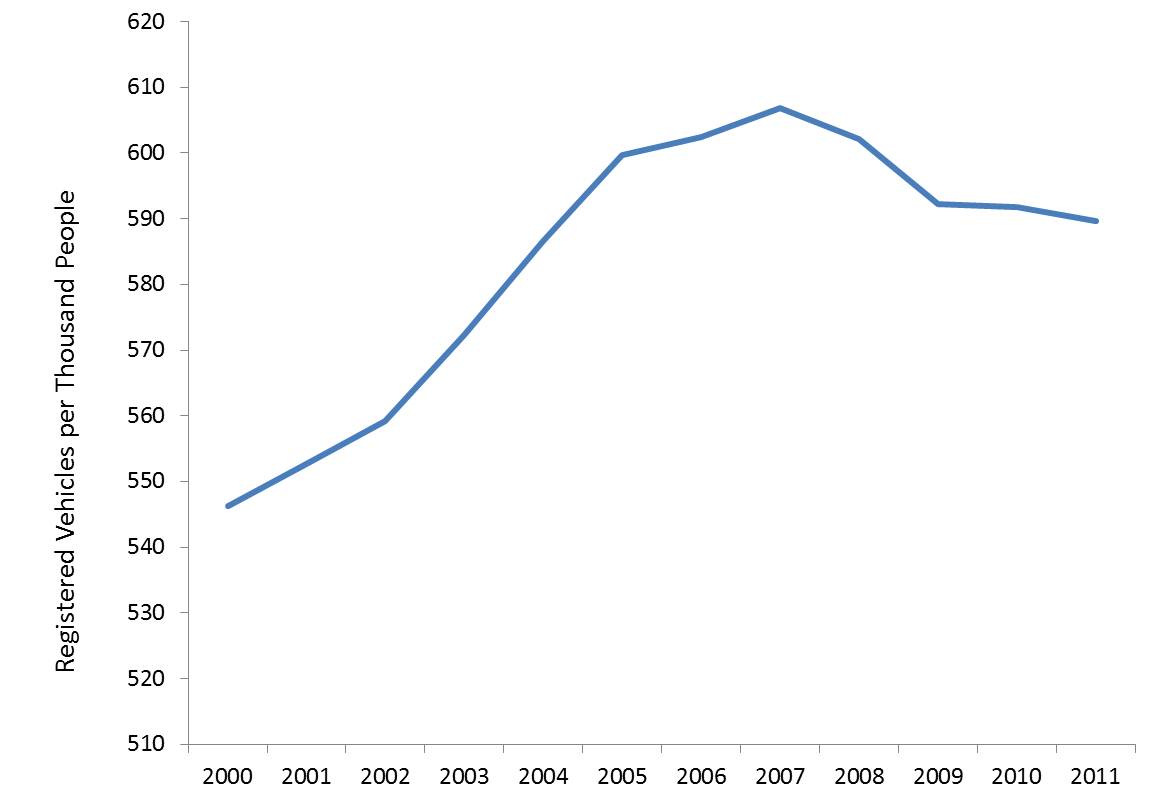
    Photo by New Zealand Defence Force.