Author: Randal OToole

  • Subsidies Haven’t Increased Transit Ridership

    In 2015, the American Public Transportation Association issued a press release whose headline claimed that transit ridership in 2014 achieved a new record. However, the story revealed that 2014 ridership was the highest since 1956. That’s no more a record than if it was the highest since 2013.
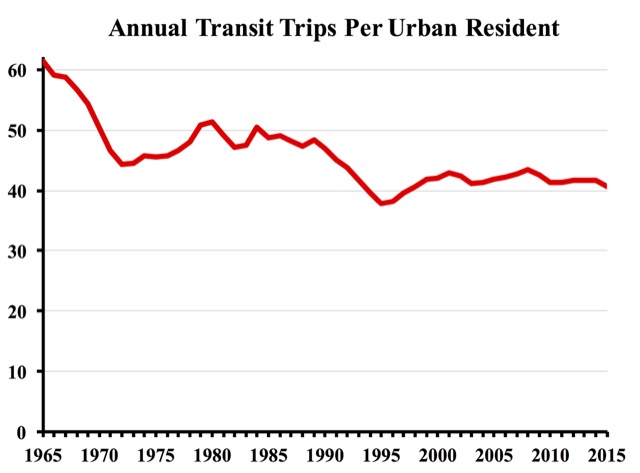
    The truth is that America’s urban population more than doubled between 1956 and 2014. Using the ridership number that really counts–trips per urban resident–2014’s number was a near-record low of 41 trips per person. The only time it was lower before 2014 was a few years in the mid-1990s, when ridership dropped to as low as 38 trips per person. The rate may fall to nearly that level in 2016.

    When Congress passed the Urban Mass Transportation Act of 1964, Americans took an average of 62 transit trips per person. At that time, 82 percent of all transit systems were privately owned. Within a decade, nearly every major transit system and all but a handful of minor ones were “municipalized” and the subsidies began to flow. At first, the federal government provided only capital subsidies, but in 1974 it also provided operating subsidies.

    By 1978, half of operating costs and, of course, all of the capital costs were subsidized. By the late 1980s, fares covered only a little more than a third of operating costs. With most money coming from taxpayers, transit agencies were more beholden to politicians than transit riders, and they became more interested in spending money to please political interests than in boosting transit ridership.

    Since 1965, transit operating subsidies (adjusted for inflation to today’s dollars) total close to $800 billion. We don’t have accurate capital cost data from before 1992, but since then we’ve spent close to $400 billion on capital programs (which in the transit industry include maintenance), most of it on rail transit.

    Thus, well over a trillion dollars in subsidies has resulted in transit ridership falling from 61 trips per urban resident in 1965 to 41 trips in 2015, and even less in 2016. The chart above shows that trips per urbanite have fluctuated since 1970, but those fluctuations are mainly in response to gasoline prices while the general trend is downward. To a large degree, this downward trend is because the subsidies have made transit agencies more responsive to politics than transit riders.

    Advocates of industrial policy argue that government should pick growth industries and nurture them along to help maintain American preeminence in new technologies. Skeptics suggest that government is more likely to pick losers than winners. Transit is clearly one of those losers.

    Most statistics in this post are from the American Public Transportation Association’s 2016 Public Transportation Fact Book data spreadsheet. Data for 2015 is from the National Transit Database. Urban population data are from the Census Bureau.

    This piece first appeared on The Antiplanner.

    Randal O’Toole is a senior fellow with the Cato Institute specializing in land use and transportation policy. He has written several books demonstrating the futility of government planning. Prior to working for Cato, he taught environmental economics at Yale, UC Berkeley, and Utah State University.

    Photo:
  • Reason #1 to End Transit Subsidies: It’s the Most Costly Transportation We Have

    Fifty-three years ago, the transit industry was mostly private and earned a net profit. Today, it’s almost entirely publicly owned, and subsidies have grown out of control. It’s time to take a stand and say all transportation subsidies are bad, but transit subsidies are the worst.

    The National Transit Database says agencies spent more than $64 billion in 2015 yet collected less than $16 billion in fares. They carried about 55 billion passenger miles, for an average cost of $1.15 per passenger mile, of which 87 cents was subsidized. No other major mode of passenger transportation is anywhere near this expensive.

    Americans spent about $1.1 trillion buying, operating, repairing, and insuring cars and light trucks in 2015, but they also drove their autos nearly 2.8 trillion miles. At average auto occupancies of 1.67 people (see table 16), that’s 4.6 trillion passenger miles by auto, for an average cost of about 24 cents per passenger mile. We don’t have 2015 data yet, but in 2014, government agencies spent about $72 billion subsidizing roads (add the $98 billion in “other taxes and fees” to the minus $10 billion in “less amount for nonhighway purposes” and the minus $16 billion for “less amount for mass transportation”).

    This is more than was spent subsidizing transit, but those roads not only produced 70 times as much passenger travel, they were used to ship more than a quarter of the freight moved in this country. Ignoring the freight, the subsidy was about 1.6 cents per passenger mile, meaning the total cost of transit was more than four times the cost of driving.

    Airfares are about 14 cents a passenger mile, making air travel a bargain. Airline subsidies are only a couple of cents a passenger mile (subtract government expenditures from government revenues and divide by passenger miles). Amtrak subsidies are comparatively horrendous at 22 cents a passenger mile but are still only a quarter of transit subsidies.

    Transit is expensive because it is subsidized. Lacking any need to keep costs within revenues, transit agencies spend way too much money accomplishing far too little. It is time to stop all transportation subsidies, but as the most-heavily subsidized form of transportation, transit should be the priority.

    This piece first appeared on The Antiplanner.

    Randal O’Toole is a senior fellow with the Cato Institute specializing in land use and transportation policy. He has written several books demonstrating the futility of government planning. Prior to working for Cato, he taught environmental economics at Yale, UC Berkeley, and Utah State University.

    Photo: Robert Dyess, CC License

  • Should Transit Fares Cover Operating Costs?

    Maryland has long had a state law requiring transit systems to collect enough fares to cover at least 35 percent of their operating costs. While it is admirable to set a target, this particular target is disheartening for two reasons.

    First, 35 percent is a pretty low goal. The 2015 National Transit Database lists 48 transit operations that cover between 100 and 200 percent of their costs, including New York ferries, the Hampton Jitney, several other bus lines, and a bunch of van pooling systems. No rail lines cover 100 percent of their operating costs, but BART covers 80 percent, Caltrains covers 72 percent, New York and DC subways cover 64 percent, and New York commuter trains cover 60 percent. On average, commuter bus and commuter rail systems earn half their operating costs. So 35 percent lacks ambition.

    Even worse, most Maryland transit operations don’t come close to meeting the target. Maryland commuter trains cover 45 percent of their costs. But Baltimore’s light rail only covers 17 percent, and its heavy rail covers a pathetic 13 percent. Standard bus service also covers just 13 percent of its costs, though commuter buses come closer to the target, reaching 28 percent.

    Maryland lawmakers have figured out a solution to the second problem, if not the first. They simply passed a bill abolishing the target. Now, transit advocates hope, the state can spend even more money building obsolete transit systems that won’t be able to afford to maintain because they can’t even cover a third of their operating costs.

    Transit is “not profitable,” said one advocate, “but it’s essential for an economically competitive region.” Just how economically competitive has Baltimore been since it sunk billions of dollars into light- and heavy-rail lines that don’t cover even a fifth of their operating costs? Maryland certainly won’t make itself more economically competitive by increasing the tax burden still further so they can build more obsolete transit lines.

    Failing to cover costs isn’t a symptom that you are economically competitive. It is a symptom that you’ve failed to provide things that people need and want. The Antiplanner can understand why people think we need to subsidize food stamps or other aid to low-income people. I can’t understand why people think nothing of throwing huge amounts of money towards marketable operations like transit.

    C. Northcote Parkinson, the author of Parkinson’s Law, said that organizations that set goals low so they would be easy to meet were suffering from a disease he called injelititis. The transit industry has been suffering from this disease since the mid-1960s, when it discovered it could live off the public trough rather than actually have to provide services that people want. Once this disease reached its late stages, he said, the only cure required “a change of name, a change of site, and an entirely different staff.”

    There’s still a chance that Maryland’s governor may veto the bill. Let’s hope he does.

    Randal O’Toole is a senior fellow with the Cato Institute specializing in land use and transportation policy. He has written several books demonstrating the futility of government planning. Prior to working for Cato, he taught environmental economics at Yale, UC Berkeley, and Utah State University.

    Photo: By AndrewHorne (Own work) [Public domain], via Wikimedia Commons

  • Transit Ridership Down 2.3% in 2016

    With little fanfare, the American Public Transportation Association (APTA) released its fourth quarter 2016 ridership report last week. When ridership goes up, the lobby group usually issues a big press release ballyhooing the importance of transit (and transit subsidies). But 2016 ridership fell, so there was no press release.

    The report showed that light-rail ridership grew by 3.4 percent, probably because of the opening of new light-rail lines such as Seattle, where the opening of the University line increased ridership by 60 percent. In the past, light-rail ridership has grown with the addition of new lines, but the number of passengers per mile of light rail has fallen, indicating diminishing returns to new rail construction.

    Commuter-rail ridership grew by 1.6 percent, mostly due to growth in New York City. Trolley bus ridership grew by 1.8 percent, almost all of which was in San Francisco. Demand-response (paratransit) grew by 0.7 percent.

    The two most important modes, however, both declined: heavy rail fell by 1.6% and buses by 4.1 percent. Since these two modes together carry 86 percent of transit riders, their decline swamped the growth in other modes. “Other,” which includes ferries, monorails, and people movers, also fell by 0.2 percent.

    In some cases, the decline in bus ridership more than made up for increases in rail ridership. Phoenix light-rail ridership grew by 10.6 percent, but for every light-rail rider gained, Phoenix transit lost nearly four bus riders. Los Angeles light-rail ridership grew by 8.7 percent, but for every light-rail rider gained, Los Angeles lost nearly six bus riders. Ridership on Nashville’s Music City Star grew by 2.6 percent, but the city lost more than 30 bus riders for every new rail rider. Denver opened a new rail line to the airport but lost more than 1-1/2 bus riders for every rail rider gained. Charlotte lost more than 15 bus riders per new rail rider, while Portland lost nearly 2 bus riders per new light-rail rider.

    Other major rail systems couldn’t even record gains. Washington’s Metrorail fell by 10.4 percent; Atlanta fell by 4.7 percent; and the biggest shock of all, New York City subways fell by 0.8 percent. Heavy-rail ridership also feel in in Baltimore (-13.2%), Chicago (-1.3%), Miami (-3.8%), and Philadelphia (-4.5%), among other places.

    Ridership on Boston’s aging subway lines fell by 0.2 percent. As in Washington, the Boston subway is experiencing maintenance problems, including smoke in the tunnels. MBTA has ordered new rail cars, one of which was put on display this week. As columnist Teresa Hanafin noted on Tuesday in the Boston Globe,

    Governor Charlie Baker and state transpo and T officials tour the new Orange Line trains at noon in Medford. The new cars are terrific: They come equipped with sneakers that riders can borrow when the trains break down and they have to walk to the next station, paperbacks to read during the daily delays, hair dryers so riders can help T workers warm up the tracks during cold weather, tasers to ward off gropers, vomit bags, nose plugs, hand sanitizer, and cheese vending machines so riders can feed the rats. Isn’t technology great?

    Light-rail ridership declined in, among other places, Buffalo (-6.1%), Cleveland (-4.7%), Dallas (-1.7%), Minneapolis (-0.2%), Philadelphia (-6.0%), Pittsburgh (-4.3%), St. Louis (-4.6%), and Sacramento (-3.5%). Commuter-rail ridership fell in Albuquerque (-7.7%), Austin (-3.5%), Dallas-Ft. Worth (-6.1%), Los Angeles (-4.3%), Maryland (-1.9%), Miami (-1.6%), Orlando (-8.5%), and Philadelphia (-5.9%), among other places.

    Salt Lake City has been getting more federal transit funding per capita than any other urban area, but the region seems to be losing its bet on light rail and commuter rail. Except for paratransit, every mode of transit in the region declined. The same thing happened in Dallas-Ft. Worth, which has built more light rail than any region in the country. Transit in San Jose, home of one of the nation’s worst-managed transit agencies, took a real nosedive, losing 10.0 percent of light-rail riders and 8.5 percent of bus riders.

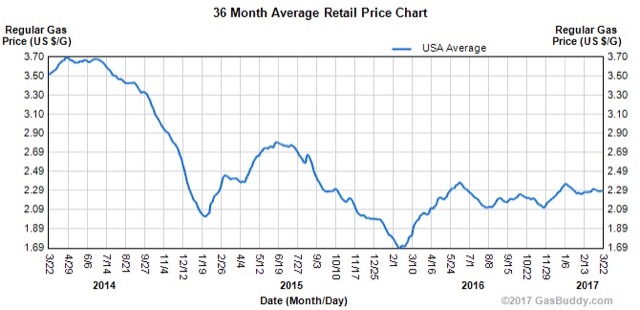
    APTA will no doubt blame these declines on low gasoline prices. Prices for regular gasoline in 2016 averaged $2.14, about 12 percent less than 2015’s $2.43. Prices in 2016 were also less variable, which might have given people more confidence in driving. Perhaps more important, per capita incomes grew by 3.5 percent, which probably contributed more to near-record auto sales than low gas prices (though the low fuel prices influenced people’s choices of what vehicles to buy).

    The transit industry bills itself as providing necessary transportation for low-income riders and alternative transportation for choice riders. Whether because of low gas prices, rising incomes, or growing shared-car services, low-income commuters are buying cars and higher-income travelers are making a choice not to use transit. In the face of these choices, transit agencies that want to spend hundreds of millions or billions on fixed-guideway transit, either rail or dedicated bus lanes, are wasting peoples’ money.

    Randal O’Toole is a senior fellow with the Cato Institute specializing in land use and transportation policy. He has written several books demonstrating the futility of government planning. Prior to working for Cato, he taught environmental economics at Yale, UC Berkeley, and Utah State University.

    Photo: Wade Rockett, CC License.

  • Portland Housing Stupidity Grows

    Here’s an incredibly stupid idea to deal with Portland’s housing affordability problems: Multnomah County proposes to build tiny houses in people’s backyard. The people will get to keep the houses on the condition that they allow homeless people to live in them for five years.

    That’s supposed to be an incentive. For five years, you have to share your yard with a homeless person who may be suffering from a variety of problems, after which you get to keep whatever is left of the tiny home. But as one Portland neighborhood activist points out, what homeless people need is healthcare and social work, not to be warehoused in someone else’s backyard.

    I suspect homeowners are going to be wary of this offer because they will have little control who lives in their yard. Not only would the homeowners be required to maintain the tiny houses while the homeless person or people lived in them, Portland is making it increasing difficult for landlords to evict unwanted tenants.

    Update: Despite my pessimism, 580 homeowners have “inquired about hosting a homeless family in their backyards.” Initially, the county will build four, and if it can raise the funds, it will build as many as 300 more.

    More important, this plan is stupidly expensive. The county estimates that each 220-square-foot tiny house will cost $75,000. That’s $341 per square foot! There are an estimated 3,800 homeless people in Portland, so housing them all this way would cost $285 million. That assumes one person per tiny house; some may house two, but housing people in tiny homes will also attract more homeless people into the area.

    There’s also a not-so-hidden agenda here: “creating a denser, more affordable city.” At least, that’s the plan. The reality is density doesn’t make cities more affordable. In fact, the densest cities tend to be least affordable.

    In Portland, people who build tiny houses in their yards face a huge increase in property taxes. That’s because, under Oregon law, their existing home is taxed at its 1996 value, plus a small annual increase for inflation, while new construction is taxed at today’s value. Thus, a new, 220-square-foot tiny house may be taxed more than the 2,000-square-foot house it shares a lot with.

    Multnomah County says it will “try” to waive property taxes for people willing to accept tiny houses for homeless people in their yards, at least for the five years that homeless people live in them. How generous! Mercy, thy name is Multnomah County! Except really, it’s name is Stupid.

    Randal O’Toole is a senior fellow with the Cato Institute specializing in land use and transportation policy. He has written several books demonstrating the futility of government planning. Prior to working for Cato, he taught environmental economics at Yale, UC Berkeley, and Utah State University.

    Photo: DubbaG [GFDL or CC-BY-SA-3.0], via Wikimedia Commons

  • The Economic Implications of Housing Supply

    A new paper with the above title by urban economists Edward Glaeser and Joseph Gyourko provides more evidence to back up the Antiplanner’s recent paper on the New Feudalism. One of the major points of that paper was that the Obama administration’s plan to force suburbs to relax zoning codes to allow higher density housing is not the solution to housing affordability problems.

    Glaeser and Gyourko point out that housing is affordable in most of the country despite zoning. In some parts of the country, however, “property rights have essentially been reassigned from existing land owners to wider communities, which have chosen to substantially reduce the amount of new building.” The result is that the supply curve for housing, which is nearly horizontal (meaning changes in demand have little effect on prices) in communities with traditional zoning, becomes very steep in the overly regulated communities (meaning small changes in demand can result in large changes in prices, i.e., prices will be more volatile).

    Glaser & Gyourko make one interesting point that I had not raised. One of the impediments to housing production in California is a state environmental quality act that requires developers to assess the local environmental impacts of new housing. The result is that little new housing has been built in California, forcing people to move to places like Arizona and Texas. But California’s temperate climate means that greenhouse gas emissions there are far lower than in interior states. “If California’s restrictions induce more building in Texas and Arizona, which require far more artificial cooling,” says the paper, “then their net environmental [effects] could be negative in aggregate.”

    The New York Times reported on the paper, but I think the writer misstates one of the main points. Instead of viewing homes as an investment, suggested the reporter, Americans should view them as consumer goods and accept that prices will fall. Americans need to “open our eyes to the negatives of the national obsession of owning a home, expecting its value to rise, and using the levers of local government to keep neighborhoods as they are,” says the Times.

    Yet homeownership isn’t an “obsession”; it is a natural, worldwide desire to have a predictable, stable home life. Nor does “using the levers of local government to keep neighborhoods as they are” make housing unaffordable: instead, it is using the levers of state or regional government to keep rural areas as they are. While the Antiplanner prefers the Houston model of deed restrictions over zoning, city zoning really isn’t a major problem for affordability so long as there is plenty of unzoned land outside the cities.

    In such areas, people don’t buy homes expecting to get rich from rising prices. But they do see the equity they build in their homes as a store of wealth that they can borrow against to start small businesses, put their children through college, or retire on.

    The one thing missing from the Glaeser/Gyourko paper and the Times article is a way out of the housing affordability mess. Glaeser/Gyourko suggest a federal program of building large numbers of homes in unaffordable areas, but considering the kind of homes federal bureaucrats are likely to build, this is likely to do more harm than good. The Times falls back on the Obama solution of building higher densities, but that’s not how most Americans want to live, and it seems silly to demand higher densities in states like California and Oregon that are at least 95 percent rural. The best solution to the conundrum, the Antiplanner has suggested, is through the courts, not legislation.

    Randal O’Toole is a senior fellow with the Cato Institute specializing in land use and transportation policy. He has written several books demonstrating the futility of government planning. Prior to working for Cato, he taught environmental economics at Yale, UC Berkeley, and Utah State University.

  • Three Steps to Fix America’s Election Process

    Almost everyone agrees that we just finished the most painful election season in anyone’s living memory, an agony made worse by the fact that it was nearly two years long. Fortunately, we aren’t doomed to repeat it, as we know many other countries have shorter and more civil election campaigns. Three changes to our method of electing presidents could reduce costs, save time, and make the process less divisive and more welcoming to voters.

    First, we should replace individual state primaries with a national primary in June. Individual primaries not only stretch out the election season and give a few states an inordinate say in the nominations, they also promote divisiveness because they force presidential candidates to concentrate on local issues that are outside the scope of the office of the president.

    Second, we should abolish the electoral college. Hillary Clinton won at least 200,000 more votes than Donald Trump, the second election in sixteen years where the winner of the popular vote didn’t win the election. Trump himself once wrote that “the electoral college is a disaster for democracy.”

    The traditional argument for the electoral college is that it encourages candidates to campaign throughout the country instead of one region and to pay attention to the small states as well as the large. In fact, it does exactly the opposite, leading candidates to focus on a handful of large battleground states that tend to flip between red and blue.

    This suppresses voter participation because people in other states know their votes won’t count, at least in the presidential race, which for many is the draw that brings them into the polling booth. Less than 56 percent of eligible voters cast ballots on Tuesday, and while some didn’t vote because they didn’t like the candidates, others abstained because they realized their vote wouldn’t affect the outcome in their particular state.

    A close look at the Washington Post‘s election map reveals that the real geographic divide is not between east and west, north and south, or big states and little states, but between urban and rural. Clinton won blocks of states on the West Coast and in the Northeast because those states are heavily urbanized, not because they have any common regional interest. The county map shows that major cities in red states such as Texas and Utah went for Clinton while rural areas in California and New York went for Trump. A strong correlation between the urban/rural split and Trump’s margin of victory/loss reveals that the degree of urbanization accounts for more than half of any state’s electoral result.

    Residents of New York City have more in common with people in San Francisco than they do with those in Plattsburgh, while residents of Portland have more in common with people in Austin than they do with those in Roseburg. In short, the electoral college fails to account for the geographic factors that are truly important. Eliminating the college would force candidates to appeal to a wider range of voters, thus stimulating voter participation and reducing alienation.

    The third change is to have a runoff if neither candidate gets a majority of the votes. A low-cost way to do this is through an instant runoff, where voters rank their choices. The candidate winning the fewest votes is eliminated and a winner is decided from amongst the rest of the votes. Whether a ranked vote or a separate election, a runoff could give third-party candidates more of a chance, especially if applied to state and local offices, because voters wouldn’t feel they are “wasting their votes” when they vote for a third party.

    These proposals might not have changed the winner of Tuesday’s election; Donald Trump clearly tapped into voter anger that many other people missed. On the other hand, if these changes were already in place, that anger might not have existed. Candidates would run very different campaigns: we’d have a shorter, less-costly election season; greater voter confidence that the system isn’t “rigged” by the electoral college; and more opportunities for people to express support for third party candidates.

    While there may be other good ways of fixing our election process, if we do nothing the best we can hope for is that the next election won’t be quite as bad as this one. That’s not a very happy thought, especially since, under the current system, the next presidential election campaign will begin in two years and the next congressional campaign will begin in two months.

    Randal O’Toole is a senior fellow with the Cato Institute specializing in land use and transportation policy. He has written several books demonstrating the futility of government planning. Prior to working for Cato, he taught environmental economics at Yale, UC Berkeley, and Utah State University.

    Photo by: By Tom Arthur from Orange, CA, United States (vote for better tape) [CC BY-SA 2.0], via Wikimedia Commons