Author: Richard Reep

  • Looking Forward, With Better Cheer

    Among many urbanites, a certain bunker mentality has already surfaced at key locations within the geography of the city.  Here in Orlando, places like the Stardust Video and Coffee where once there was warmth, one feels coolness in the air, a little less eye contact, briefer conversations, a sharper tone. For many who practice tolerance and inclusiveness, and bend our lives towards mutual sustainability, this was a temporary setback.  But this is no time for recriminations or succumbing to the temptation to snip at one another.  It is a time to look forward, with better cheer.

    We must expand our tolerance even further, and recognize that true inclusiveness really means everybody.  At the same time, there is a subtle upswing in other places too.  Just around the corner from Stardust lies three convenience stores, ostensibly gas pump backdrops.  It’s time to get to know the coffee choices around here, and expand my horizons a bit.

    Lotto, beer, and cigarettes figure big in these places; our small weaknesses are also their small profit. The mood in these colorful, brightly lit stores is upbeat, and it shows how the two different streams of society intermingle within very small distances.  

    In the 7-Eleven, Rhonda and Lexi posed for the camera, shoulder to shoulder with big grins on their faces. When asked who made the coffee, Rhonda announced "I did!"  Convenience store coffee is surprisingly good here.  Around the corner, Elizabeth briefed me on her complicated coffee system at the National Food Mart. When I asked her for a picture, she shrugged.  "Yeah, sure," and broke into a sweet, disarming smile.  

    For the workers in these stores, there’s a coming-out, a sense of "yeah, well, we’re cool too," a new posture being tried.  Is it the surprise, the swift triumph of the unhip, that has suddenly put a bounce in their step?  The cashiers of our vices are happier, a little more hopeful, these days, a little less grim and underclass.

    It is now the formerly hip Stardust which now feels dour and tragic. Avoidance of eye contact was once a game practiced at the convenience store; now it is practiced at this cluttered countertop.  At one time, the scene at Stardust was open, with shouts of greeting and smiles.  A boisterous and diverse crowd kept a gentle, Haight-Asbury vibe going.  It was improvisational, a do-it-yourself kind of culture. John, a retired engineer, mixed with hippie chicks, artists, writers and techies in for a cup and a jam.  DJs and photographers met to plan out a photo shoot.  

    Salesmen sat with their laptops, looking at their sales leads for the day.  In the evening, kids did their geometry homework while older couples sat and drank wine.  An ancient, timeless public house feel was rich and was ripe. This openness is what I love about Stardust, it has a sense of shared ownership and a mutual agreeableness that we are all in it together.  It suits me, as I move in a very wide range between laborers, the very wealthy, plumbers and professors.  

    In these days of looking backward, a veil of grimness seems to separate the hip and the cool for now.  Stardust is lately tinged just a bit with the atmosphere of all convenience stores.  It is tinted with the grimness of outcasts.

    This grimness of outcasts was once the province of convenience store workers, hanging their heads, ringing up gas sales, condoms, smokes.  They knew their place, and it was pretty far down the class system.  Condemned to shapeless, garish uniforms, convenience store workers were the bottom, especially in the chic neighborhood of Audubon Park.  Everyone on Corrine Drive outranked the convenience store worker.  The only caste lower than convenience store clerk was possibly convenience store night clerk.

    Life at the bottom of the social pyramid was bad enough, but especially the Audubon Park social pyramid, what with its ultra-cool scene of independent record stores, custom beer taps, movie production guys, East End Market, for Christ’s sake–a hipster convenience store in drag–and, naturally, it was all anchored by Stardust Video and Coffee.  For the convenience store clerk in this neighborhood, a special hell was your lot.  High school diploma, if you’re lucky, making nine oh five an hour selling stupid stuff to liberal arts school students, techies wearing glasses that cost six months of your wages, bourgeois bohemians. It rankled. You sucked.

    Back at Stardust, the post-election mortification has given way to the next phase of outsider-mentality:  recrimination.  Now, for the first time ever, I hear green-shaming: "Where’s your cup today?" after a patron asked for a coffee and committed the green sin of not bringing in his own reusable mug. This never used to happen at Stardust, where they are usually happy to sell you a disposable cup.  The barista, however, got a little dig in that morning, fingering me as the Other.

    I do not have to prove that I am not the Other.  That charge just won’t stick.  It’s a symptom of feeling like an outcast, possibly, to accuse someone, label them as Other, and sulk.  During my day, I think about those all around me in a modern, white-collar office, and how good we all have it.  Still, for many, the sense that things just weren’t good enough probably caused people to send a signal in the voting booth.   

    Perhaps here’s a lesson to this election, which has unnerved liberals and hipsters to their core. You cannot turn many, if not most, Americans into “the Other.” This is not the road to inclusiveness; perhaps the "in-crowd" at Stardust never was very inclusive to begin with.  If you want to see real people of color, go into the unhip convenience stores all around.  African-American, Asian-American, and Latina-American.  Inclusiveness means a society where all of our people, even the convenience store clerks, are included.

    At Stardust, one could easily convince oneself of being in comfortable surroundings of openness and diversity.  This bubble of comfort sadly diverged from reality.  Outside the bubble, the Lexis and Rhondas and Elizabeths have gotten a break.  They were decidedly NOT in this bubble.  It has finally burst.

    So what? I’m taking a break from the hip and the cool, and creating my own hip and cool with people in 7-Eleven, National Food Mart, and Shell.  I frequent these places often, for they have things that I need:  gas, air, vacuum, batteries, and aspirin. Stardust offers nothing practical like that anyway.  I’ve already introduced myself to a few of the other clerks, and found them to be very nice.  I haven’t been subjected to green-shaming, and probably won’t be.  They’re professional, they make it snappy, and they smile.

    It is weak and incorrect to circle the wagons and point fingers at The Other and continue this divisiveness that has caused such a big warfare in our hardened, weary society.  This is the sure road to further isolation and loss.  The secret is that there really are no losers and winners, and to act like there are just makes more. Instead, acting like we are all people with our own aspirations and difficulties is a harder, but far more interesting road to travel.  This is not about populist politics or presidents; rather, it is about the need to re-invent the concept of a society where everyone wins.

    Richard Reep is an architect with VOA Associates, Inc. who has designed award-winning urban mixed-use and hospitality projects. His work has been featured domestically and internationally for the last thirty years. An Adjunct Professor for the Environmental and Growth Studies Department at Rollins College, he teaches urban design and sustainable development; he is also president of the Orlando Foundation for Architecture. Reep resides in Winter Park, Florida with his family.
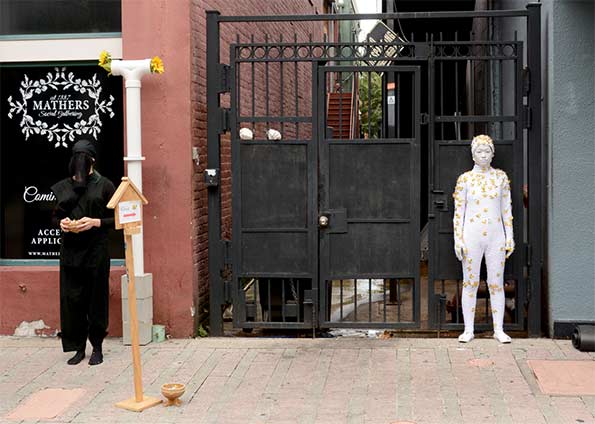
    Photo by DoxvoomOwn work, CC BY 2.5, Link

  • ‘Two Regimes’: A Visual Memory of Wartime Survival

    At the corner of Maitland Avenue and Maitland Boulevard, the Holocaust Memorial Center is squeezed between tennis courts and a small courtyard, part of the Jewish Community Center. Inside, the classrooms are nicely squared off. The exhibit “Two Regimes” takes up one classroom’s walls with about 40 paintings depicting life during the Stalin and Hitler regimes for Jews living in Mariupol, Ukraine. From this industrial port town on the shore of the Azov Sea to a ramshackle stilt house in north Florida, the exhibit is a strange tale, partly told.

    “The exhibit will be free and available for the public to view until January 2, 2017,” stated Terrance Hunter, Program Coordinator for the Holocaust Memorial Resource and Education Center of Florida. The Center is dedicated to building an inclusive community in the Orlando area through exhibits and educational programs centered around the events of the Holocaust. This is the very first show of these paintings by the artist, and the Holocaust Center, through a State of Florida Grant, is preparing classroom curriculum materials using the paintings to help children better understand this terrible period.

    Artist Nadia Werbitzky’s forty-odd paintings soulfully illuminate her mother’s memoirs of the times between the two world wars. After surviving several concentration camps, Werbitzky and her mother emigrated first to Germany, then to Canada, ending up in Baltimore. How her paintings came to rest under a Florida Cracker stilt house is still a bit of a mystery, confessed exhibit co-curator Kelly Bowen in a recent talk about the art.

    The work was discovered by Mimi Shaw, then an acting coach in Tallahassee in the late 1990s. A student advised her of an interesting garage sale, so she went, and discovered Teodora’s memoirs and much of Nadia’s paintings, slowly rotting in an old house about to be demolished. Foresight and determination helped Shaw and her friend Bowen rescue, and eventually restore, the artwork.

    Werbitzky studied at the Art Academy of Dusseldorf after the end of World War 2, developing her own style that references European masters like Van Gogh and Matisse. Haunted by her memories she carefully depicted real people in real events. When her work was subjected to authoritative Holocaust scholarship, the people she claimed to have painted were found to be real, and so are memorialized, as she put it, as “people who lived and breathed on this earth.”

    So much of our Holocaust education is about numbers: six million Jews; twenty-three main concentration camps, and so on. The suffering, however, cannot be abstracted into numbers and are brought to extraordinary life in Werbitzky’s beautiful paintings. “Hell’s Threshold” is a good example. It depicts the October 1941 Nazi roundup of 7,500 Jews in Mariupol. Standing in the back of the line, the woman in the pink dress was a friend of Teodora’s, and later verified by others. In a blue dress, a woman rushes around the corner to the back of the line with a young baby in her arms and pulling her daughter, who is clutching a large doll. Again, a specific memory of a specific person: this time, herself.

    The book “Two Regimes” puts the paintings and memoirs together, bringing old Russia to life, both good and bad. This touring exhibit evokes awe for its subjects and respect for the calm approach the curators have taken to restore and exhibit Verbitzky’s work. Two Regimes is worth seeing for both its artistic depth and its unique eye on this terrible time. If it happened then, it could happen again.

    This article first appeared in The Orlando Weekly.

    Richard Reep is an architect with VOA Associates, Inc. who has designed award-winning urban mixed-use and hospitality projects. His work has been featured domestically and internationally for the last thirty years. An Adjunct Professor for the Environmental and Growth Studies Department at Rollins College, he teaches urban design and sustainable development; he is also president of the Orlando Foundation for Architecture. Reep resides in Winter Park, Florida with his family.

    Image: Nadia Werbitzky

  • How Art Critics Create Community

    Orlando has taken on a new “web city” form. Its dispersal over a wide geographical area allows distinct and unique pockets of culture to arise within it, a kind of archipelago of art and design. It is a microcosm of the archipelago of many Florida cities. The overall effect is marvelous, if somewhat diluted by distance, and the broad metropolitan area has come to be a proving ground for artists, architects, and urban designers. As an artist and designer commenting on these topics, the single biggest trend I have seen in the last fifteen or so years is a growing sense of maturation. What else have I seen? And, over the years, what have my observations, and those of other critics, contributed to the art scene?

    In a city like Orlando, the art and design critic must have an exceptionally broad range, because the arts scene is flung between Daytona and Winter Haven, two poles that are each about 110 miles away from the city’s downtown area. The art scene in pre-World War II Central Florida consisted of a rare, purpose-built art colony simply called “The Research Studio,” where artists from the northeast wintered and pursued creativity.

    Near Winter Haven, Edward Bok, retired Harvard president and publisher of the Ladies’ Home Journal, created a cultural retreat of his own. Daytona, meanwhile, attracted automotive technology aficionados to the race track, bringing with them a uniquely American appreciation of pop culture and art. The artistic geography of Central Florida reflects the artistic range of America in many ways as a whole.

    More than one of Frank Lloyd Wright’s disciples relocated to Orlando as early as World War I, eying Florida’s inevitable growth potential. Few creatives sought Orlando specifically, and they gravitated here for different reasons. Jack Kerouac, for example, came to live with his sister while On the Road was prepared for publication, using Orlando as a place to escape. This escapism instinct would later inform millions of people a year, when tourism came to the area.

    In the aftermath of World War II, Orlando was a sleepy railroad and citrus-shipping town. Its binary heart was born in the ’60s with the arrival of Disney. Escapism as an industry brought thousands of performers, artists, and writers to the area. Downtown Orlando today is a hub where artists and writers congregate, while the themed-entertainment industry focuses artistic talents around the southwest side of town.

    As in any city, artists and designers have day jobs as well. But the Orlando area is one of the nation’s few metropolitan places of affordability and ease of lifestyle. We have artists whose work is collected nationally; artists who have works in major museums across the United States, and art events such as Snap! Orlando, a regional photography exhibition.

    Today, these artistic pursuits are being supplemented by new efforts in a wider range of locations. West Volusia County’s mixture of Stetson University and the Museum of Art – DeLand has become an artist’s haven. The Atlantic Center for the Arts, in New Smyrna Beach, has continued to program international artists, musicians, and writers in a secluded, tree-canopied forest near the Intracoastal Waterway. In financial parlance, these creative expressions are thriving new ventures.

    Art and design have always had an impact on quality of life. This is more important than ever in the twenty-first century as we re-invent the meaning of human habitation, and artists and designers articulate our current age visually. Performing arts and music also have profoundly influenced the visual arts and the notion of good design. The impact works in reverse as well: our thriving farm-to-table food scene nurtures — literally! — our creative community.

    But it is the conversation about art that is key, and the critic stimulates that discussion. As Oscar Wilde said, “The only thing worse than being talked about is not being talked about.” I come to the role of critic as a practitioner, one who walks in the shoes of the creative individual or team. I’d rather make art than talk about it, but still, I have a few thoughts to offer on what constitutes good criticism.

    Foremost, it is important to have standards, but standards are a little different than rules. Many urban designers are like artists who fret about using complimentary colors in the wrong way, overlooking the big picture. Standards of good art and design are universal, and are about getting an idea, a story, or a theme across in a satisfying or visually compelling way.

    I also pay little attention to credentials. Some of the best artists and designers come to the art world without any credentials at all. In this age, credentials are everything, but they haven’t made a great deal of difference in art and design. Some of the nation’s most highly credentialed urban designers were involved in creating Orlando’s Baldwin Park, which suffers from low business occupancy and high residential turnover.

    Meanwhile, the frowsy Audubon Park, just a half mile away, built in the 1940s, is a 2016 Great American Main Street Award-winner, and is bursting with independent entrepreneurial projects: coffeehouses, urban farms, an exquisite fishing gear business, and some of the best food in the city. Successful design isn’t about credentials; it is about the practical world of what works.

    In the fine arts, local museum leadership has undergone a transition, and curators have been set free to show relevant, impactful work. What the curators do with this freedom will be telling. So far, they have created an annual cash prize for the best Florida contemporary artist, unleashed a world-class private art collection free to the public, extended exhibitions to a college museum, and served as juries on artist-in-residence programs. All of this has been fueling the exchange of ideas and stories.

    Telling the exciting story of Central Florida art and design has been part of my good fortune. Because it is such a great story, the Association of Alternative Newsmedias has selected three stories about the Central Florida arts scene as finalists in a national competition, beating out stories from rivals such as Austin, Oakland, and Charlotte, three cities of similar size.

    An experimental building or a stunning painting is nothing if it is hidden or ignored. Today, with technology and imagination pushing the boundaries, it is often difficult to have a conversation about new art and architecture. Criticism helps to frame the conversation; it sets a standard for the dialogue about what we see. It also serves the purpose of applauding good results, and pointing out results that should be good, but are not. We make our cities better by agreeing on what works.

    Since coming to Central Florida in the mid 1990s, I have seen the artistic scene here mature. Experimental work, street art, and emerging talent continues to “bubble up” into the mix. In the past, the bubbles tended to pop, or to float away to places like New York City where the art would be noticed. Now, it seems that good artists are sticking around, trying to make this place better — and beginning to take us to the next level.

    Richard Reep is an award-winning artist and architect who writes art and design criticism for a variety of publications. You may nominate him as Best Arts Advocate 2016 by clicking http://orlandoweekly.secondstreetapp.com/l/Orlando-Weeklys-Best-of-Orlando-Readers-Poll-2016/Ballot/ARTSampCULTURE.
    Anyone visiting Central Florida can find a discussion of visually compelling aspects of the area in Reep’s Orlando Weekly column.

    Photograph by the author: “Cedar of Lebanon” by local artist Jacob Harmeling graces the southern quarter of Lake Eola Park in Downtown Orlando, one of the few original artworks commissioned as part of the city’s public art program.

  • Orlando: Shrines in the Urban Space

    Orlando is now a place where suffering may finally catalyze a response to social violence. The spontaneous outpouring of grief and reconciliation by its people shows that public space lives, and has a useful function in our digital age. In multiple places around the city remembrances of the victims of the Pulse nightclub shooting, and of musician and Voice contestant Christina Grimmie who was shot the previous day, are poignant, tangible evidence of the human spirit that one cannot ignore.

    In the aftermath of the cascading tragedies of early June, the city had lain grieving and stunned under merciless heat and a tropical storm. But vigils and public gatherings ignored the weather to show solidarity with the victims and their families and loved ones. Last week’s cool, dry, spring-like weather broke the city’s sickened fever. Gatherings at multiple sites gained momentum and size.

    Since ancient times, the plaza in front of a city’s political seat has held civic importance, and Orlando is no exception. The plaza at City Hall is sculpted into a multilevel maze with fountains and public art, so Orlando’s community adopted the much more open city block across South Orange Avenue as a gathering place — it’s a blank slate more adaptable to self-expression. In a synchronicity of events, its owner had recently demolished the 1960s architecture on this block to make way for future development. It is here that President Obama and Vice President Biden laid flowers for the victims of the Pulse nightclub shooting.

    South of downtown, Pulse nightclub itself had been quickly fenced off in black fabric, but beyond the fence and at nearby Orlando Regional Medical Center additional shrines spontaneously blossomed. By a week later, groups were still using them to stage vigils and gather to grieve, to struggle to understand, and to cleanse together in public. This function is so powerful, and so overriding, that the normally rigid traffic and parking regime has been adapted to allow people the space that they need.

    Throughout the twentieth century, public property in cities shrank while private property grew. Malls replaced Main Street. Large condominium complexes, primarily accessed from off-street garages, replaced brownstones that fronted sidewalks. In modern urban patterns, little remains of the old village green, the Italian piazza, or Greek agora. These spaces seemed to be relics, even burdens on the public realm that required upkeep and worry. Orlando’s open space is emblematic of this transition.

    Many think the death knell of these spaces has been the internet, with social media replacing the sidewalk as a forum for casual contact. Social media is all privately owned, so if this were true, it would mean that even more of life was spent on someone else’s private property. Photos of people lounging on sidewalks while staring at tiny screens seem to illustrate this point. Public space, some have claimed, is truly dead to the world, with little function other than as the pathway to private real estate development.

    Much has been written about this so-called collapse of the public realm, tying it to the extinction of civility and the twilight of civilization. It is fashionable to favor greedy selfishness to the exclusion of the common good, and private interests have little use for garbage-strewn plazas, broken-down town squares, or creaky old Main Streets. Private space is where it’s at, and the public is drowned out by amoral monologues of personal righteousness.

    Yet the urge to gather publicly continues, and in Orlando it happened on a scale large enough to be noticed. People still need their open space. Orlando’s famously tolerant and progressive community has come together in a heartbeat of vigils, religious ceremonies, speeches, spiritual gatherings, and memorial services, and it has done so out in the open.

    These are not orchestrated or premeditated gatherings. For those, people are renting halls or churches. Instead, these spontaneous gatherings are express an effort to right the wrongs suffered in our city. Ignoring the public/private boundaries, Orlandoans are using their open space for its most important function of all. Privatization of open space, it turns out, is little help in the face of the destruction that happened here.

    In the most personal of such shrines, the Plaza Theater, where young singer Christina Grimmie was senselessly shot, has received masses of flowers, candles, and testimonials. A steady stream of visitors spend a few moments in quiet prayer before moving on. At the theater’s narrow sidewalk the singer’s life was taken away, but her memory remains with us all.

    The block across from City Hall has five separate memorials constructed of flowers, posters, and banners, and is visited in steady, large numbers. Families, friends, and children pass by, moving quietly and slowly with few words to say. The tropical rains that come and go do not diminish the crowd: umbrellas come up and go down, but the elegiac procession continues.

    If Orlando has multiple hearts, the more formal of them is the regular rectangle between City Hall and the Dr. Phillips Performing Arts Center. The city’s other public space of any size is Lake Eola Park, a 16-block rectangle on downtown Orlando’s eastern edge, filled mostly with, well, Lake Eola. On the park’s western edge, facing downtown’s denser core, stands the Lake Eola amphitheater, the site of Orlando’s larger public gatherings.

    The amphitheater’s 200-odd seats were insufficient to hold the Sunday night crowd of 50,000 strong that gathered despite rain. People spilled onto nearby Rosalind Avenue, enlarging the public space of this corner of the park, to city-sized proportions. In this huge outpouring of grief, with chants of “One Orlando United” and “We Remember,” the names of the dead rang through the city streets and gave voice to our citizens’ grief as an actual rainbow emerged from the cloudy sky just at sunset.

    In times when the polarization of our country feels unbridgeable, and the dialectic seems to be reaching a crescendo, Orlando’s voice has said “one love.” LGBTWQ acceptance has always been available here, and replacing the acronym with “one love” in the face of violence has been Orlando’s mantra, both before and after our darkest weekend. More broadly, the unhealthy, antisocial violence that sparked two shooters to destroy so many lives has met with a startling voice of solidarity and purpose in Orlando. The blackness of our worst week is behind us, and the city’s emergence as a voice of tolerance is now just beginning.

    Richard Reep is an architect with VOA Associates, Inc. who has designed award-winning urban mixed-use and hospitality projects. His work has been featured domestically and internationally for the last thirty years. An Adjunct Professor for the Environmental and Growth Studies Department at Rollins College, he teaches urban design and sustainable development; he is also president of the Orlando Foundation for Architecture. Reep resides in Winter Park, Florida with his family.

    Photo by the author: Downtown Orlando at City Hall

  • Rise of the Mixed-Use Monoliths

    Density rules new development. From Florida to Texas to points west, city boosters herald a mixture of apartments and shops as an improvement on local ‘density’. Dense development can be well designed, and can contribute to the form of a city, but the new density’s formulaic style is a crossbreed of strip shopping centers joined with 1980s apartment complexes. Instead of a newly walkable urban environment, we are spawning more traffic than ever, in uninspired, pricey, new trophy projects that adorn our busy highways and replace quirky, individualistic neighborhoods with soulless, mock historic monoliths.

    The official name for the form of these developments is “urban mixed use,” but they are a far cry from city-center urbanity. Each new development is a variation on beige stucco and predictable planning. A mixed-use development is not a bad thing in and of itself; for every 200-unit mixed use development in the works, 200 acres of Florida’s wilderness is kept for future generations. Their repetitive nature, however, is depressing. Nowhere is this more evident than along the ten-mile Central Florida strip called US 17-92, where five of these developments are in various stages of life.

    US highways 17 and 92 combine south of Orlando to create a six-lane artery running north through several towns before splitting up once again, 17 going northwest and 92 going northeast. One response to the highway is the eccentric, prosperous community of Maitland, with 17-92 as its main street.

    Premodern Maitland still exists, from the unpainted vernacular architecture of the Holly Anna orange grove store all the way up to the last vestiges of Parker’s Lumber, a railside lumberyard that dates from the 1920s. Both signal an era when Maitland actually produced something. The town’s rather elegant, light brick church tower and the angled, delicate columns of Maitland Plaza, an office complex, indicate Maitland’s midcentury phase, that once-hopeful era when architecture smiled at tailfins and speed.

    Maitland, however, bought big into the new density storyline. At 17-92 and Lake Avenue the first in its collection was Victorian flavored, with a foil-lined particleboard tower thrust high over the empty storefronts lining the narrow sidewalk. Chunky columns rest between the storefronts, and thin-skinned apartments perch above whizzing cars.

    That development sits across from the venerable Lake Maitland Terrace, a 1960s era resort-style campus sensibly buffered from the roar of traffic by green trees and a lawn. Lake Maitland Terrace has a waiting list, and is memorably well detailed in precast concrete, built to last. But living over a busy commercial strip is in vogue today, so we can’t seem to produce any more Lake Maitland Terraces. Instead, we have the empty mixed-use hulk across the street, harbinger of more to come.

    And more have arrived, indeed. Maitland’s newer mixed-use experiments are beige neoclassical foam and stucco, looking vaguely like excrescences of Mediterranean and Victorian-town villages. The newest development-in-process promises “gathering… entertainment… living… swimming…” under the baleful stare of city hall’s recent stucco-and-foam tower looming in the background.

    Enthusiasm for these places has worn off among long-time Central Floridians, and reality has set in. Each one resembles the last more and more, as developers fine-tune the machine that pumps out mixed-use developments with alarming regularity. The public is already suspicious of them, pointing to more congested traffic, rising prices, and the banishment of individual businesses in favor of the chain stores. Gone are entrepreneurs building businesses, replaced by minimum-wage clerks and a store manager working for the somewhere-out-of- state home office.

    The design formula appears to mix a little bit of stacked stone (for authenticity’s sake), beige stucco smeared liberally over large, puffy columns, and a shopping-center canopy facing a parking lot. A narrow concrete sidewalk turns depressingly nasty when it gets to the apartment complex, where the outdoor entry corridor inevitably takes over – a no-man’s land of trash cans, aluminum mailboxes, and iron bar security gates. Apartment floor plans still have a couple variations on the one and two bedroom schemes, with living rooms that don’t quite fit the furniture found in Ikea.

    Maitland, in particular, has succumbed to a mock-historical design aesthetic of boxy architecture, carriage lanterns, and scrolled gewgaws. This city, when left to its own design aesthetic, commissions monuments along US 17-92 that nicely reference its own original architecture, a 1930s art colony built in a fantasy Mayan style. Originality, however, is out with the builders of the new density.

    Further north lies Altamonte Springs. Here, the developers went for an early Soviet Union period style, Floridified, with giant, pyramid-hatted apartments. These overlook Crane’s Roost, a pretty lake that is now over-engineered with parking along its banks. Planned with good intentions, the architecture falls apart upon closer inspection, its chief design innovation being a dark red three-story stucco wall along the sidewalk, perfect for absorbing the hot Florida sun. It almost makes me nostalgic for my 1980-vintage apartment complex with its slanted redwood siding and river-rock balcony.

    What unites all of these developments is their earnest puffery. Each is styled with gaudy mascara and rouge to look like something it is not. This is the DNA inherited from their ancestor, the shopping center. They all have large fat columns, thickened corners, and Neanderthal eyebrows to give them a sense of heaviness. But if you watch them under construction, you will see lots of metal or wood studs: they are hollow inside.

    Grafted onto this mask is an apartment block, but not one like the brownstones of old. These have no connection whatsoever to the street – no stoop or entry door on the sidewalk. Brownstones had architectural scale and character made famous by Ada Louise Huxtable; for example, she could date one by the lintels over the windows. No such luck here. The only decoration that adorns the exterior façade is a stucco control joint pattern.

    It’s as if every movie has to have blockbuster special effects, and can’t just tell a good story with actors anymore. By contrast, these developments replace a midcentury minimalism of architecture with a now- lost delicacy. Lake Maitland Terrace wasn’t special before the rise of mixed-use properties along the highway, but it was about itself, and nothing else: it didn’t pretend to be a Victorian main street or a Mediterranean hill town. With no special effects budget, it simply offered good views and workable, decent floor plans.

    I don’t believe that the hollowness marking the current taste in commercial development reflects the taste of everyone who actually uses it. Many of these places are vacant, a wave of retail space crashing upon us just in time for the online shopping trend. Welcome to the new America.

    What can we, as local users, do to combat this? Humanize them, renovate them, and add our own local color as they get older. Steer them closer to our own specific pathways. A certain sidewalk here might get a sun shade or a trellis added to shade it, converting it from an oven to a lovely pocket park.

    The spaces that we love in our town grew that way over time. We cannot let these hollow, mixed-use monoliths defeat or dispirit us. They are here to stay, and more are coming, so our job is now to take ownership of these buildings and start individualizing them. The sooner we can inflict the spirit of place upon them, they will cease being monstrosities, and become members of our own community of buildings.

    Richard Reep is an architect with VOA Associates, Inc. who has designed award-winning urban mixed-use and hospitality projects. His work has been featured domestically and internationally for the last thirty years. An Adjunct Professor for the Environmental and Growth Studies Department at Rollins College, he teaches urban design and sustainable development; he is also president of the Orlando Foundation for Architecture. Reep resides in Winter Park, Florida with his family.

    Photo of Maitland by the author

  • Florida’s Interstate-Adjacent Fantasy

    As 2015 wanes, many swimming in Florida’s new wave of growth are still being carried by a swift current. Everywhere one gazes, new apartments can be seen that accommodate some of the million-plus new residents who have moved here in the last five years. With over 140,000 people migrating to Florida from other states during 2014, and over 100,000 people moving to Florida from other countries, Florida’s GDP is predicted to have grown 3.2% in 2015, the highest in the country and well ahead of the national average. The tide has definitely come in.

    For natives and long-term residents, it feels like everyone up north woke up one Tuesday morning and said, “Hey honey, let’s quit our jobs, move to Florida, and get an apartment overlooking the interstate.” From Tampa to Daytona, mid-rise wood frame structures loom over semi-trucks and cars that whizz by, a new voyeur culture in the making.

    At first glance, the recent growth seems low quality and monolithic, blandly designed and structured to meet a uniform real estate development formula. The land along Interstate 4 is cheap and available for development. Like coral reefs that grow on the poisonous crags of undersea volcanoes, however, these apartments are an infrastructure for an ecology of both dreams and nightmares. Dispossessed by capitalism, many laid-off Americans seek a new start in the apartments of the Sunshine State. In these drywall-lined niches grow polyps of hope.

    Some newcomers come to Florida with job offers. Along with those taking advantage of the economic climate, there are others who show up without employment; many without jobs move to Florida and fill apartments only with the hope of a new life and prosperity. Such is the Florida of the nation’s imagination, a place of such bountiful employment opportunities that one can pick a job off a tree, like a wild orange. Do-over dreams hang in the air around these giant rental reefs, interwoven with expectations of an easy, low-cost retirement lifestyle. “I have several friends,” writes one retiree, “who all went south from Connecticut to Ft. Lauderdale years ago, and drifted north to Melbourne over the years… it seems like a nice place to live.” An image of retirees drifting around the state, like so many jellyfish drifting along a reef face, seems idyllic.

    Many have suffered more severe economic hardships. The third busiest bankruptcy court in the nation none other than the Middle District of Florida, housed in sunny Ft. Myers. Those without the means or the qualifications for a mortgage often retreat into Florida’s apartment culture, licking their financial wounds. Setting one’s sights a little lower and squeezing into a small apartment cosigned by a family member may be a humiliating, but necessary step towards a new beginning. The symbiotic relationship between debt and dreams can be seen through the glass walls of these buildings.

    Quite a few renters are also paying off student debt. “We cannot afford a house right now. Maybe not ever,” writes Selena in Florida about the student loans she and her husband have. The rental life, tinged with a very bitter dose of recent reality, is the color of all of the aspirations that swirl around the stucco, false mansard roofs, clubhouses and glittery swimming pools.

    The Florida resort lifestyle, jammed up against the interstate highway, is an unlikely scaffold for dreams. Percolating between the swaying palms are new beginnings, fresh starts, and resolutions to do better. Some of these dreams may blossom and grow out of the balconies and windows of these monolithic blocks of monthly rent, making these apartments a nomad’s brief sanctuary on the journey back to prosperity. These are the lucky ones, the temporary renters; those who stay in an apartment for a year or two while getting back on their feet.

    As viewed from the middle lane of I-4, these giant rental shoals, and the thought of the imagination that supports them, seem at once reassuring and terrible. Reassuring, because the idea that Florida is universally beloved still makes Floridians smile. Terrible, because this new biodiversity is voracious, and brings with it congestion. These mid-rises inhale a dense population, only to exhale them out onto Florida’s flat expanse of rooftops that spread ever further into Florida’s vanishing natural environment.

    Like coral reefs, which grow in the ocean where the surf is most active, these apartments grow in Florida where the weather is most active. The hurricane capital of America, the lightning capital of the world, and the humid heat are the real parts of the lingering illusion of a tropical wilderness that comes with this postcard paradise. Once arrived, many of the newcomers find the weather intense. Hopes and dreams cling to the apartments like barnacles, fluttering from the windows and balconies, despite the heavy summer rains.

    Apartment dwellers are a transient lot, often staying not longer than their lease term. When one moves out, workers clean and repair the unit to be ready for the next. Each new dweller from out-of-state brings his or her own illusions of Florida. Others bring a more grounded reality from their previous Florida experience. Either way, the dwellers’ new impressions blend with the redolent ecosystem of hopes and dreams surrounding the edifice.

    These Florida apartments are inspiration-gardens, attracting migrants seeking a better life. Only the individuals who dwell within them can activate their hopes. As rather expensive offerings, they are not analogous to the New York tenements of the nineteenth century, which were full of families crowded off of the European boats. Instead, these are high amenity, middle-income places to live. They act in the same way, as a distribution system for dreams, but are far more luxurious and appointed than the slums of old.

    The urgent, massive dream-reef construction project that has gone up alongside I-4 is in its peak phase, with a few nodes already complete between Tampa and Daytona. Apartments are clustered like a gigantic fringe along the denser population centers: Lakeland, Lake Buena Vista, Orlando, and Winter Park. Those living in earshot of the interstate’s mighty roar of traffic must have an ironic, contemporary sense of place. As a concrete reality, the I-4 corridor is not a particularly prestigious address. But as an abstraction that speaks of today’s politics, it has an importance of the first magnitude. If these two opposites— the dream of the America we desire and the reality of the America being constructed now — can be reconciled, then Florida’s growth is a healthy ecosystem that offers hope for the future.

    Richard Reep is an architect with VOA Associates, Inc. who has designed award-winning urban mixed-use and hospitality projects. His work has been featured domestically and internationally for the last thirty years. An Adjunct Professor for the Environmental and Growth Studies Department at Rollins College, he teaches urban design and sustainable development; he is also president of the Orlando Foundation for Architecture. Reep resides in Winter Park, Florida with his family.

    Photo by Cooper Reep: Typical new mid-rise on I-4 in Florida

  • Cities That Locate Art In Odd Places

    The city sidewalk today is pretty empty, with online shopping and social media having replaced shoe leather on pavement. Restrictions in the name of safety have also become more common since 9/11. One result of these trends is a movement called Art in Odd Places : the work of artists that use public space itself as a huge, blank canvas. Orlando is the most recent city to experiment in this fashion. This month, more than fifty artists there reasserted the right to an unfettered exchange of ideas in public space, reinventing the sidewalk. It was an interesting experiment that led to some bigger questions about the relationship between public space and civic involvement.

    Art in Odd Places was started by New York artist Ed Woodham in 1996 during the Cultural Olympiad in Atlanta, which coincided with the Olympics. With the media focused on sports, few recall that the Olympics is a celebration of mind and spirit, as well as of the body. Olympic cities host poets on the street reciting verses, and painters and sculptors exhibiting their pieces. Woodham struggled with officials to bring performance art to the event, and went home determined to keep the town square in its rightful place as the unfettered medium of exchange for art and ideas.

    All the way through the nineties, movies and television documented sidewalks thronging with people, parks full of activity, and public plazas alive with protests or festivals. Despite popular rhetoric that accuses the car of killing public space, something different was happening. Sidewalks and plazas have continued as the arena for public encounters in our cities. They reached capacity, but as cities spread out the car had little effect on, for example, Times Square, or on any other city’s sidewalk.

    Something funny started happening however; something only a few like Ed Woodham noticed. “In Atlanta, we were placed in a designated ‘free speech zone,’ which I found odd,” he commented to me while preparing for Orlando’s event. “I wondered when the city was no longer a free speech zone in its entirety.” Woodham noted, in particular, the clampdown after 9/11. Any sort of organized activity on the sidewalk was more and more regulated, in part due to a heightened sense of security.

    Today the value of public space is open to debate. Nicolett Mall, a pedestrian zone in downtown Minneapolis, is hardwired into the city’s soul and is being rejuvenated. Meanwhile, New York Mayor Bill de Blasio is considering removal of the plazas in Times Square that have attracted a lively crowd and the presence of costumed characters and street performers, many of them seeking tips.

    In 2013, Greensboro, North Carolina hosted Art in Odd Places, and the director of downtown Orlando’s Gallery at Avalon Island art curator Pat Greene visited. Two years later, Greene successfully co-curated the Orlando show, along with Voci Dance Director Genevieve Bernard. Between September 17th and 20th this year, Orlando became a host to dozens of artists on the street. The theme in Orlando is “Tone,” which is interpreted by each artist individually; pieces have been created around audio tones, color tones or other meanings of this word (I reviewed the work in a recent critique for the Orlando Weekly).

    For example, Forrest MacDonald’s subtle water pipes, inserted next to actual storm water pipes, were sprinkled down Magnolia Avenue, with hands reaching out of the pipes to stroke tufts of grass. Nathan Selikoff fed a microphone into a computer, and then onto a giant screen, projecting an “Audiograph” that mapped the soundwaves of the city like a huge EEG.

    On the more ethereal side, performance artist Masami Koshikawa created “Self Portrait as Butterfly Woman,” posing in white while an assistant invited passersby to place gold origami butterflies on her body suit. This gesture broke the barriers between strangers and the taboo of touch, and represented a sublime moment in the festival. Koshikawa eventually collected hundreds of butterflies.

    Arvid Tomayko paraded up and down Magnolia Street in his “Wearable Tentacle Horn,” a suit with trumpets coming out the ends of various sleeves. And Chris Scala pulled a wire mesh camper into a parking lot and slept in it, LED lights washing over his sleeping form, in a piece entitled “X-Ray Camper”. These are only a few examples of artists using public space to make a spectacle in a traditional manner.

    I visited Art in Odd Places at the height of the lunch rush on one day. A few scattered pedestrians wandered in and out of restaurants, and a preschool teacher led her little ones back to school from a library trip. The artists and their supporters comprised the largest single population group. (More people came by in the evening, according to Greene.)

    In the last ten years, the number of people living in downtown Orlando has actually increased, with more and more residential housing available in and around the city’s core. What has sucked the life out of sidewalks, it turns out, isn’t the suburbs; instead, it’s the tiny screen and the big screen that have occupied more and more of our lives, taking over the social space that was once reserved for the street. Casual shopping encounters, mixing social and economic activity, walking to business appointments, encounters on the once-active courthouse steps: all of this has become the archaic activity of yesteryear.

    Art in Odd Places did interrupt the tiny screen focus of the average pedestrian who braved the sunny weather that day. Some of the artists deliberately sought to enter the cell phones of bystanders: Sound artist Jeff Knowlton created an app called “Sonify: Orlando” which, when downloaded, provided an acoustic narrative with sounds triggered by the immediate location. A new art form, which Knowlton describes as “locative media,” is born. And overall, Woodham, in an optimistic manner, has aroused artists in city after city to reinvent the sidewalk. In Orlando, the event was a success.

    The darker issue of the regulation of the sidewalk, has, however, remained unaddressed. Woodham feels that well-meaning but overly stiff regulation has turned people out of their public space, and is working hard to reinvigorate the streets with art. Where a vacuum exists, artists often rush in, and the result reflects our contemporary culture. This type of activist art is not seeking to right a gross injustice or advocate a cause, except for that of free speech. It is spurred by open conjecture about the future use of the sidewalk, and asks pedestrians to re-invent the nature of our public space in the twenty-first century.

    Richard Reep is an architect with VOA Associates, Inc. who has designed award-winning urban mixed-use and hospitality projects. His work has been featured domestically and internationally for the last thirty years. An Adjunct Professor for the Environmental and Growth Studies Department at Rollins College, he teaches urban design and sustainable development; he is also president of the Orlando Foundation for Architecture. Reep resides in Winter Park, Florida with his family.

    Photos by the author: Anna McCambridge interacting with a piece of “Storm Water;” Koshikawa, right, with butterfly assistant.

  • Book Review: Designed For The Future by Jared Green

    By the fifth word of Designed for the Future, Jared Green had almost lost me. By the end, he hadn’t quite gained me. This slim, visually interesting handbook presents “80 practical ideas for a sustainable world” from the noted author of The Dirt, a weekly blog sponsored by the American Society of Landscape Architects. Green’s earnest mission is to find hope for the future, and with this book, he edits a collection of essays that points to some projects that do.

    It is a slim, portable, affordable book for the busy design professional in any discipline who is trying to wrap his or her head around the slippery notion of sustainability. Green’s introduction summarizes his process, and then presents each idea in a two-page spread. The ideas range from using mushrooms, which are now compressed into insulation panels (don’t eat your wall), to Rome as an example of walkable urbanism (don’t tell the taxi drivers). Each idea is presented with a photograph and a neat summary of how it contributes to the future. The point of all this activity, however, remains elusive in this otherwise intriguing little book.

    Designed For the Future poses the question to eighty thinkers: “What gives you hope that a sustainable future is possible?” Each replies with a brief description of a project that inspired them to see a way forward. Among the notable but not entirely successful attempts to provide an answer is an essay by Elizabeth Mossop, “Changing Course,” about a design competition to improve management of the Lower Mississippi River in Louisiana. She notes that up until now the river, managed by scientists and engineers, has lost wetlands and added pollution to the Gulf of Mexico. Giving designers a turn might be a good idea, as she suggests. While I’m sympathetic, I keep thinking of the woeful mismanagement of the Everglades in my home state of Florida, and how often well-intentioned healing practices seem forever delayed. It is as if we cannot collectively bring ourselves to veer off our current pathway, no matter who is in charge.

    Some essays, however, are the real thing. “Project Row Houses” by F. Kaid Benfield showcases artist Rick Lowe’s community development project to preserve 22 wood-frame shotgun homes in Houston. The project uses buildings that are already built, improving them rather than replacing them; it provides dignified shelter for historically disadvantaged African Americans, and has spawned urban agriculture, education, and similar enterprises. This is what sustainability should be all about: taking our stuff and making it better, rather than abandoning it and making more stuff.

    Many of the essays are somewhat predictable paeans to urban life. “Seven Dials,” by New Urbanist Victor Dover, extols the virtues of this tiny London street intersection and its surroundings. Developed in the seventeenth century, this West End neighborhood has gentrified nicely into a walkable community. The accompanying photo seems too good to be true: pedestrians actively engaged in their public realm, not a car in sight, the sundial festooned with Union Jacks. As a prosperous, white, upper-middle-class community, it is an easy example of the urbanist’s dream come true, but well nigh impossible to replicate in America’s big-box car culture. Perhaps it could survive as a simulated city somewhere.

    Green’s inclusion of an analysis by Anthony Flint of Unité d’Habitation inspired me. This 11-story apartment block, built in France after World War II, lets daylight in on both sides of each apartment,, and features rooftop uses. It was architect Le Corbusier’s first phase of his Radiant City plan. The design was much maligned in the 1990s by urban activists as a misanthropic disaster, who claimed that traditional neighborhoods were better. But the Unite d’Habitation turned out to be a pretty nice place after all, while many well-intended traditional neighborhood developments have had poor results. There is hope, after all, for modernism.

    Green’s second-to-last entry is an essay on vernacular architecture by Li Xiaodong, a Beijing architect and professor at Tsinghua University School for Architecture. In some ways, this is the book’s most important essay. “It’s about the process, not about design,” says Li, adding, “Architecture should be based in a dialogue with local conditions and lifestyles. It should be a product of that dialogue.” Li beautifully captures the essence of sustainability, seeing it as a thought process, not a look or a lifestyle; about reacting intelligently to local conditions with materials and labor available on hand.

    Green’s examples are heavy on the land planning side of things. Innovations such as 3-D printing are missed, and economics and technology are entirely ignored. And a few essays seem repetitive: Paris is in the book twice.

    The focus is on people, land, water, and air. Reducing pollution and waste are important, and his book illustrates examples of this in abundance. We seem to have bounced back from the bad old days of the Ohio River on fire and air so thick you can take a bite out of it. This book offers assurance we are not backsliding into the wicked ways of the past.

    Reducing the amount of stuff we take from the earth also figures big. Densifying cities, which conserves open space, is the topic of more than one essay. Staying local and using renewable, vernacular materials also has resonance with these contributors. Green’s essayists portray a future where resources are extracted a little more gingerly, and open land is conserved and even integrated into human habitation on a small scale to improve our relationship with nature.

    The classical definition of sustainability includes two other tenets: increasing biodiversity, and spreading a little justice around to other species. The book provides scant evidence that the future holds any hope for these two notions. The wind farm in Lester Brown’s “Wind Mega Complexes” essay even goes against these principles, showcasing the giant wind turbines blamed for bird kills. Regarding biodiversity, Green misses the Mesoamerican Biological Corridor project, an oversight perhaps due to his self-proclaimed “random process” for choosing contributors.

    Green begins the book with the statement, “We can’t give in to fatalism.” For the symptoms of fatalism, he presents examples of cures. Someone, somewhere, is treating these symptoms, he reassures us, saying that things are getting better in many different ways.

    A deeper disease, however, lies undiagnosed in this book. Cities are denser, yes; but they increasingly all look the same. Wetlands are saved, yes; but we continue to “manage” them, as if it would be awful if they were left to themselves. Just when public spaces are getting nicer, most Americans prefer to remain indoors, glued to their devices. None of these imply a future of abundance and beauty. Until our own meaning and purpose are more fully addressed by our present society, it seems difficult to conceive of the kind of future envisaged in Designed For the Future.

    Richard Reep is an architect with VOA Associates, Inc. who has designed award-winning urban mixed-use and hospitality projects. His work has been featured domestically and internationally for the last thirty years. An Adjunct Professor for the Environmental and Growth Studies Department at Rollins College, he teaches urban design and sustainable development; he is also president of the Orlando Foundation for Architecture. Reep resides in Winter Park, Florida with his family.

  • Historic Districts: The Past or The Future?

    Preservation seems like an easy idea to support. Who would be against it? History, character, and a sense of place are what great communities are all about. They generate tourism and makes us all culturally richer. Landowners in historic districts even enjoy higher land values than nearby landowners in newer, usually blander developments. What’s not to like?

    Apparently, a lot. Cities unilaterally impose ordinances from time to time, regulating building size, shape and use, and rarely are there complaints, although the changes affect everyone in the city. Here in Florida, building codes were recently stiffened, causing buildings in the entire state to become more expensive, and there were no complaints to speak of. But in the small community of Winter Park, when a proposal was floated to make obtaining historic district status less onerous, indignant protesters with cries of “property rights” were voiced. Protesters who were shy about fighting the State and the City may have finally found, in individual neighborhoods, a small enough foe to bully.

    Protesters claim that they fear restraint of trade, and they’re hoping to cash in on rising land values, particularly where they have been historically low. A historic designation might make an owner think twice before knocking a house down.

    There’s mirth in Cyria Underwood’s eyes as she tells us about coming here to Winter Park from Louisville, Kentucky. A tall, elegant African American woman, Underwood works at the Hannibal Square Heritage Center, and observes Winter Park’s preservation battles like this: “Black people have an oral history tradition, and it’s a good thing we do. We don’t expect our own buildings to get preserved. So here on the West Side, we hand down our oral history from mother to child, father to son. It’d be nice to see preservation taken seriously,” she muses, her eyes still smiling, “but African Americans have learned to make do without it.”

    Interest rates remain low. In neighborhoods like the West Side, where Cyria works, owners feel the pressure to sell. Hannibal Square, built originally for blacks in the 1880s, today houses a mix of families, some of whom go back to the town’s early days. Walkability, playgrounds and parks make this a dream community for urbanists; many residents ride the buses that travel up and down Denning Avenue, and Sunrail’s Winter Park Station is a couple of blocks away. Finally, it seems, this area has come into its own and become a hip, urban community at long last.

    “However,” murmurs Cyria, her eyes twinkling, “the wolf is at the door.” She’s referring to developers who buy small houses on small lots and replace them with much larger homes, townhomes, and even multifamily clusters. West-siders have been clinging on by the skin of their teeth. Service jobs with modest incomes and part-time work (much of it a long bus ride away) have kept this neighborhood afloat. While land values all around have skyrocketed, the West Side — historically African-American — has not been rewarded with such good fortune. Property values are, to put it politely, stable.

    Fairolyn Livingston moved out of the West Side in the ’70s, but comes back frequently. She explains that when a West Side homeowner sells, he or she walks off counting the cash. But Livingston cites more than one seller who couldn’t replace the Winter Park lifestyle with the proceeds from his or her home, and ended up moving into poorer and even less upwardly mobile parts of town. So goes gentrification: the new buyer, often white, unwittingly banishes an African American family to a lower stratum, hardening class divisions.

    Livingston is candid about the younger newcomers. Asked whether they join the neighborhood churches, she chuckles. “Oh, no. There’s no interaction with our community.” The new buyers, however, benefit from the short walk to Park Avenue’s chic restaurants and shops, and can Sunrail to happy hour downtown. The West Side’s character, meanwhile, dissolves under the homogenous new face of urban America, where everywhere resembles everywhere else.

    Cyria Underwood, Fairolyn Livingston and many others are unworried about the preservation battles being waged in Winter Park right now. This is not surprising: preservation of the West Side has not been high on the City’s agenda. The same development pressures are being fought all over.

    Locally, Friends of Casa Feliz, a Winter Park preservation organization, will be co-hosting a West Side History panel discussion this autumn to help keep what is left of the architecture.

    It’s part of keeping a conversation going about the local urban future. Historic districts come into being in most places with a simple majority, but Winter Park’s requirement of a supermajority makes them difficult and rare. Protesters against preservation see this as just fine, and do not want property rights to change.

    While he isn’t a vocal protester, realtor Mark Squires is a realist. With a Clark Gable smile and wink, he is a true denizen of Winter Park real estate. “Everyone wants historic character,” Squires offers, “but nobody wants to pay for it.” Smaller, older homes have tiny kitchens and bathrooms, and are often hard to maintain. Squires and his colleagues find that, for many young couples with kids, Winter Park’s lifestyle is in high demand. The last thing on their busy agendas is fixing cast iron pipes or repainting wood trim. Many buyers want new, as the developers, builders, realtors and lenders are well aware. Every home becomes a potential knockdown, if the price fits the formula.

    Squires’ local reality is that historic preservation, while it might make everyone a little better off, makes home sales harder. Our local economy is geared towards short-term private profit, and the notion that preservation can also be profitable is rarely considered. While developers in Boston, Chicago, and elsewhere have proven that historic preservation can make money, it has yet to be seen as a both/and proposition in Central Florida. City Hall dithers over the proposed historic district ordinance while the bulldozers roll.

    Underwood is philosophical about it. “Willing seller, willing buyer, you know? You can’t control what someone does after you go.” Rich or poor, the same argument applies. The individual decides whether to push the easy button and go for new, or save a little bit of quality for future generations.

    The current wave of transactions, fueled by low interest rates and demand for in-town living, is recasting the character of her neighborhood, as well as of the more affluent areas of the East Side. If the City Commission votes to ease historic district formation, perhaps there will be more than just oral history to remember Old Winter Park by. If not, and more bungalows succumb to the McMansion, we’ll all just have to huddle up around her chair and ask for stories about the buildings that used to be here, and the people who lived within them.

    Richard Reep is an architect with VOA Associates, Inc. who has designed award-winning urban mixed-use and hospitality projects. His work has been featured domestically and internationally for the last thirty years. An Adjunct Professor for the Environmental and Growth Studies Department at Rollins College, he teaches urban design and sustainable development; he is also president of the Orlando Foundation for Architecture. Reep resides in Winter Park, Florida with his family.

    Photo of Cyria Underwood by the author

  • Small Towns: The Value of Unique Places

    Rural and small towns suffer from a loss of faith in their place, and seem desperate to be recognized in our new, standardized world. Plenty of our developed land remains specific and even unique, but the highway does not go to it. Outside the cities, unpretty feed stores, the availability of tractor parts, and the presence of cattle hardly contribute to scientifically measured success. The refuge of the individual, the ability of a person to see his or her life as meaningful while it is separate and apart from a larger mass, is crippled. You’re only as good as your income; you’re only as witty as your social media posts, and you’re only red or blue.

    In Sanford, Florida, the mayor recently sat down with my urban design students and discussed the future of this small town. Sanford, once larger than Orlando, was a significant port, loading Central Florida’s farm produce onto ships and railroad cars for hungry Northeasterners. Now diminished, its quaint downtown reeks of history, beautifully preserved, but only a few jobs exist. Today’s brick-paved Main Street, with its galleries, bookstores, and restaurants, caters to a trickle of visitors, but Sanford feels the effects of being on Orlando’s periphery.

    “People come to me,” said Mayor Jeff Triplett, “and ask me to help bring jobs to Sanford. They wish we had a national chain drugstore like a Walgreens or CVS on Main Street. That,” he declared,” is their measure of having arrived.” Sanford citizens, he explained, see something like this as true progress.

    “That would kill your Main Street,” protested one student. Enjoying Sanford’s originality, the students encouraged the Mayor to consider that Sanford could do better than a franchise’s low-paying jobs. The quest, however, for some sign of progress continues.

    The conversation reflects how meaning, or a sense of place, is measured only in relation to a greater national homogeneity. People petition their leaders to bring meaning to their towns via a national chain. This monolithic built environment is, by itself, a giver of meaning. To someone living in a small town, the standardization of our lifestyle is the normal condition, and the lack of homogeneity is seen as impoverishment. It is somehow a disease, a condition of malnutrition, to be deprived of the physical structures of standardization.

    Today’s homogeneity can be a strength, providing a level playing field for society. Its virtues are equity, efficiency, and supermobility. As a single, unified scaffold, our homogenous built environment has grown outward and filled our land to the edges, and it places cities at the focal points of a grand grid. Mainstream literature extols the virtues of this grid, and celebrates today’s urban life. But homogeneity has its downsides, and places that are outside of this grand grid of progress suffer deeply. Variety is subsumed by today’s great global culture.

    Once, writers like Alvin and Heidi Toffler, and George Orwell, warned against this kind of growth, citing the hazards of the rational, scientific underpinnings of modernity. Objectifying everything and extinguishing the mystery of life seemed to them to be an exercise in nihilism. Other thinkers in the 1930s and 1940s also foresaw that the monolith of western civilization would consume everything in its path. Indeed, this consumption of unique places has been largely accomplished, and those that remain are considered stunted and backward. Everywhere one looks, the loss of variety and individualism is profound.

    And so small towns suffer in silence, their best and brightest arriving like refugees into bigger cities. Smooth, suburban density levels set our current standards, while agriculture and ranching seem unable to retain people.

    Science has brought us to this point, but blaming science is like blaming the trash can for the garbage within it. If the manmade environment we’ve created is imperfect, then it is a reflection of us. It probably isn’t going away anytime soon. We now exist in a nearly wholly manmade environment. Even the most rural exurban dweller lives in a substantially more technological and manmade environment — house, car, job — than the most urbane city dweller did a century ago.

    No, this crisis of is not a failure of science. It is a lack of quality. What we’ve built is everywhere, but it isn’t very good… yet.

    What to do with this homogenous world is the next generation’s big task. But we, too, must act now to confront the physical evidence of this imperfection. Change will come when we accept that we must fix it, and not wait for a deus ex machina to swoop down. Those longing for an apocalypse are seeking the easy way out: let flood, fire, or epidemic take care of the mess.

    I’d rather take responsibility for what has been created, and take better care of it. This monolithic, homogenous latticework of roads and buildings is the new frontier. Where man has already strongly modified nature, there is plenty of room for improvement.

    More cities that nurture native industry will create this new future. Balancing that approach with the Jeffersonian ideals of a strong, rural economy will bring equity to areas that are suffering. And that will build upon our strength.

    Richard Reep is an architect with VOA Associates, Inc. who has designed award-winning urban mixed-use and hospitality projects. His work has been featured domestically and internationally for the last thirty years. An Adjunct Professor for the Environmental and Growth Studies Department at Rollins College, he teaches urban design and sustainable development; he is also president of the Orlando Foundation for Architecture. Reep resides in Winter Park, Florida with his family.

    Photo of Sanford by Christine Wood