Author: Richard Reep

  • Celebrating Strips Malls: Strength in Standardization

    Our current urbanized form has become remarkably homogenous. Anywhere in Florida, and in much of the United States, one now experiences a new sense of sameness in the texture and the pace of places. America has entered a period of uniform buildings, roads, and infrastructure, differing only in the details. We live in a very standardized America today.

    To witness the new homogeneity, look no farther than the commercial strips that have come to dominate the 21st century experience. These strips are our marketplace, our town square writ large, and are a study in careful, intentional uniformity. In commercial America, from New York to California, these strips are smoothly uniform in both their scale and their details to a startling degree, differentiated only by local geography.

    This is the quiet strength of our country. Our commercial environment, although criticized for its aesthetic monotony, unifies our national experience. The endless asphalt strip expresses the contemporary American lifestyle, a way of ordering our space that represents our participation in the high-energy global economy. It’s ugly, but it works; so goes consumerism.

    Businesses that compete for the customer dollar ensure familiarity and efficiency, and the uniformity extends to the design of the store, both inside and out. From the front door to the street, a precise series of moves are choreographed around the invisible practices of safety, security, and barrier-free flow from the car door to the cash register. All of these dictate uniformity of design, a certain monolithic character, which moves the customer effortlessly from merchandise to the point of sale to the driveway.

    The driveway leads to the street. While we yearn for alternatives to the car, we still cling to its super mobility. Its influence results in a rigid, standardized design for all pavement. Lights, signs, intersections, and the pulse and rhythm of the road all become one. Gone, for the most part, are local eccentricities such as stoplights turned sideways; in their place are broad, well-lit roadways with the same signals everywhere, built with the future in mind. This, again, is a strength. Americans have always tended towards mobility, and standardization enables freedom of movement and a state of supermobility that is imagined, if not quite achieved.

    Because America’s building industry climbed a series of regulatory steps in the last several generations, today’s built environment is more uniform and less specific to its particular locale, with a vague, broad national character that is barrier-free and safe. Starting with the 1992 Americans with Disabilities Act (ADA), and continuing today with the International Building Code, standardization has become a quiet but powerful force.

    The ADA sought to remove the localized, obstacle-ridden geography that restricted a large population with sensory or mobility difficulties from having access to buildings and places. Since its passage, a substantial portion of our constructed world has been built under these rules, and older buildings have been adjusted to remove barriers. The result of this act has been to cause much of America to look the same, from the way our sidewalks rise up from the street to the size of our public bathrooms.

    Building codes became standardized, too. In the 1990s, three regional codes converged into one International Building Code. With the real estate development economy normalized at a national scale, it has become more efficient to deliver the same product everywhere, rather than customize an office or a store to local eccentricities. Building codes, which go back to Hammurabi’s time, have evolved into exquisitely complicated texts, annotated like the Talmud and as complex as the tax code. This sameness, again, allows super-mobility and comparisons of sales and productivity metrics from one place to another. It smooths the evolution of a new, migratory America. This again is a strength, if efficiency is any measure.

    Local codes still customize structures to particular locales; California requires resistance to seismic activity, and Florida protects against hurricanes. A lot of idiosyncratic localisms — nuances that did little to protect anybody — have been done away with, however. A wood building in the Midwest, for example, was called a Type Five building, while in the South it was Type Six, with accompanying detailed descriptions differing in little details. These were all melded into one, wood-frame building type by the new code, simplifying national-scale construction and design, and eliminating wastefulness. This convergence of codes promotes a common system of definitions and measures of firmness and safety.

    Intertwined with this rather massive regulatory convergence is, of course, the globalization of the economy. Standardization of materials is critical for manufacturers importing key products from overseas, and for assuring national real estate developers of similar costs from coast to coast. Sameness is a virtue, from an accounting perspective.

    Should this sameness be doubted, interview any offshore visitor about their American experience. While American behavior may generate complaints, the American built environment inspires awe and respect. “Why can’t we have this in our country,” more than one international guest has bitterly questioned me, usually pointing to a clean, well-ordered aspect of place that we take for granted. “America,” stated one South American to me recently, “is still the safest place to buy real estate, because of your standardization.” Monotony and safety features make for a dull sense of place, but great property values.

    How this came about is a study in our faith in the future. America has always had faith that things will get better, even in the darkest of times. This belief in the future seems lost today if one focuses merely on the surface, and the general deterioration of our national conversation. Our actions, however, are different than our words, and our actions – widening roads, consolidating codes, standardizing infrastructure – are those of a people in the process of perfecting our built environment. Only a people that cares about the future would be doing this.

    American roads and buildings are not precious; we are not a sentimental people, by and large, when it comes to our physical environment. The American style of place is a product of our society’s character. It is barrier-free, safe, and guarded well against disaster. Our character transcends the superficial notion of “style” and is expressed in a uniform, shared sense of place. Monotonous, yes; as all standardization tends to become, but with a great value placed upon planning and design.

    A positive byproduct of this style of place is equity. Roads (except toll roads) can be travelled by all, and buildings are built safely for all. Another is efficiency, speeding up the process of rolling out new infrastructure. A final byproduct is the future; we are giving our children’s generation a simplified infrastructure with one operating manual.

    What our progeny does with our standardized environment is up, of course, to them. Uniformity is a tacit scaffold upon which a unique, more localized future can be built, celebrating the specific geography and society of each individual place. Suffocating monotony can perhaps give way to flexibility, creativity, and a character that expresses our diversity as we move ahead.

    Richard Reep is an architect with VOA Associates, Inc. who has designed award-winning urban mixed-use and hospitality projects. His work has been featured domestically and internationally for the last thirty years. An Adjunct Professor for the Environmental and Growth Studies Department at Rollins College, he teaches urban design and sustainable development; he is also president of the Orlando Foundation for Architecture. Reep resides in Winter Park, Florida with his family.

    Flickr photo by Payton Chung, Meanwhile in Ethnoburbia: the new Chinatown in California’s San Gabriel Valley.
  • The Simulated City Vs The Urban Downtown

    While the city’s star is rising in popular literature, it has fallen in popular usage. Where have our sidewalks gone—and why is sidewalk activity disappearing? Sidewalk life has declined in urbanized areas, while population has swelled. Here in Florida, the third most populated state in the country, the average town’s sidewalks should be teeming with colorful crowds of businessmen, shoppers, and people on errands going to and fro. We should see sidewalks full of people happy to be out in the sunshine, and even happier to have escaped the gray cold and the snow. Instead, on weekdays, a trickle of lunch-goers emerges from towers. On weekends, there’s a brief crush of crowds before events. This seems to be all that our downtowns can manage anymore.

    The simulated city is the new place to be. It’s a manufactured copy of our downtowns, and can be found in theme parks and places where throngs congregate to experience the sidewalk in its current incarnation.

    The simulated city carries none of urbanity’s institutional hardware: no visible governmental facilities, religious institutions, schools or civic centers clutter the street wall. The simulated city eschews manufacturing and offices, instead making itself the chief enterprise: a mecca of retail, dining, and entertainment. It has cherry-picked the good stuff from the old urban form, presenting a cosmetically perfect face without blemish or quirk, redolent in its synthetic beauty.

    In Florida, with few natural resources and scant manufacturing, the simulated city takes advantage of tourism and growth. With the number of annual visitors approximately four and a half times its permanent population, Florida is a natural place for simulated cities to sprout. The earliest was the Magic Kingdom’s Main Street at Walt Disney World. This ancestor of the simulated city engendered replicants in other theme parks, each one topping the other in surprise and delight.

    This spring, Orlando’s Downtown Disney reopened as Disney Springs, a retail, dining, and entertainment district that is themed to resemble a lost small town. Nearby, Universal’s Citywalk incrementally reinvents itself, restaurant by restaurant. Further south, Miami’s South Beach has enjoyed an upsurge as well. With some of the highest real estate prices in Florida, South Beach has jumped species to become a simulated city too, enjoying a sidewalk life that is the envy of downtown Miami and, frankly, of the rest of Florida’s beach communities. There is magic on Ocean Boulevard’s pavement that is not found anywhere else in the state.

    What groups these together is simple: sidewalks full of people. Unlike the shadow-world of Florida’s urban downtowns, riverwalks, boardwalks, and Main Streets, throngs of people crowd these places every day and every night. For all the hoopla about the reinvigorated city, Florida’s urban scene fails to deliver even a fraction of the sidewalk life that these places have. The simulated city is the powerhouse of the future.

    Once going out meant heading to Main Street, and then, briefly, it was to the mall. Today, in the simulated cities one must carefully navigate between families, stepping between neon sneakers and wheeled strollers, flip-flops and brogans. This delicate ballet occurs while eye contact flickers between faces and facades; the traffic and the sky. The sum of such casual contact gives people a feeling for their public identity, and the simulated city is a tool to deliver this identity in the best possible light. The simulated city has become the choice for people to display their social selves.

    Dry cleaners, dentists, and others who provide services that imply an unclean recipient are banished completely from the synthetic city. In South Beach, the providers are in the less expensive real estate many blocks from the beach. The city is an unabashed celebration of sybaritic pleasure, the frosting on the urban experience without any of the cake.

    It is a city where your expectations as an urban connoisseur are completely fulfilled; decrepitude, blight, and eyesores are disallowed. Even better, a simulated city’s employees are rigorously trained to be cheerful and bright. No homeless people lounge on park benches, and there’s no visible crime, since there is no apparent indigence, want, or fear. Although it would not be turned away, the riskiest tranche of society seems to shun the simulated city. Its design reflects mainstream success, and discourages subversion, by having no alleys, no trashy areas, and no low income community adjacent to it.

    South Beach was able to jump species from being a regular city and evolve into a simulated city partly because of this last feature, what with being an island. No low-income edge rankles its visitors, or exposes them to a broad cross section of society. It is unique among Florida’s simulated cities because it does have housing (upscale, of course) in its mix.

    Urban boosters vaunt the ancient metropolitan core as if it still mattered. While urbanists are still fighting against the influences of the car, under their noses a new mobility trend threatens, one that will dwarf the damage done by the automobile.

    This, of course, is the internet, that global marketplace of goods and services that makes nearly everything but a haircut available online. Downtowns and suburban commercial clusters alike are fighting for their lives, and between telecommuting, online shopping, and social media, fewer and fewer folk find reasons to step out onto the sidewalk. Soon, if we go online to vote, even our civic duty can be done without stepping on pavement.

    Disney Springs presents a heady abundance of experiences to visitors along a lakeside walkway near Orlando. Families cluster together, friends walk in groups or split apart for different adventures. No obligation exists for greater social contact, since you are a visitor among visitors, and your anonymous bubble is preserved. This is a different state of mind than when you are in your own city where you may run into an acquaintance. As in a theme park, you are unlikely to run into someone you know.

    And because people are in a place that is made especially for pleasure, the sense of self tends to magnify, as evidenced by ubiquitous and annoying selfie sticks. Without the glowering facades of authoritarian institutions like churches, police stations, or city halls, the sense of place is completely recreational and mildly celebratory, inducing a temporary state of pleasant expansiveness.

    To see solid evidence for the simulated city’s high desirability, look at its twin conditions: Huge crowds coupled with high barriers to entry. South Beach requires visitors to take a slow crawl over a traffic-choked bridge onto the island, and pay stiff parking fees. Theme parks also charge parking fees, and entry requires a long, hot trudge through a parking lot. Driving, paying for parking, and then walking? Simulated cities must deliver high perceived value in exchange for this effort.

    As the twenty-first century lifestyle migrates from the urban-centric past into the online and suburbanized future, the sidewalk seems destined to become a playground. Florida’s three or four simulated cities, enormously successful places, tell us that people will overcome hurdles to seek out urban experiences, including light social contact as a recreational activity, while shunning their own urban core back home. This paradox, particularly easy to see here in Florida, may point to a future where people prefer to sip the urban water, rather than swim in it.

    Richard Reep is an architect with VOA Associates, Inc. who has designed award-winning urban mixed-use and hospitality projects. His work has been featured domestically and internationally for the last thirty years. An Adjunct Professor for the Environmental and Growth Studies Department at Rollins College, he teaches urban design and sustainable development; he is also president of the Orlando Foundation for Architecture. Reep resides in Winter Park, Florida with his family.

    Photograph by the author: Downtown Disney, a simulated small town, around lunchtime on a recent Sunday.

  • Florida’s Everglades: A Vernacular Far From Miami

    South Florida connotes a certain lifestyle in media and popular culture. Miami’s bright, tall energy has always been intertwined with the Florida Everglades’ quiet, flat landscape – low, grassy plains soaked with swamp water and edged by dense jungle. The seam where these two opposites meet is neither active nor passive; it is, instead, a third thing, where man’s activity has subtly modified the landscape, and nature has slowed man’s pace closer to its own. The edge of the Everglades has an almost off-kilter Caribbean or Central American sense of place that feels exotic and familiar at the same time. Its pleasant tension reassures me there is still an edge to Florida, when the scratchy blanket of protective regulation is thrown off to reveal informal, naturalized structures that blend beautifully into the natural environment.

    Southwest of Miami lies the city of Homestead, Florida, famous for being the front door through which Hurricane Andrew entered Florida in 1992. Today, Homestead is an exurb of Miami, with a relentless street grid extending west and south. Homestead’s housing, schools, and commercial strips grew after Andrew’s devastation, ending only at the hard edge of the Everglades National Park.

    Along this line, the housing and farmland stops, and is taken over by the wide ‘River of Grass’ –the term of the writer Marjory Stoneman Douglas, which has come to be synonymous with the Everglades’ ecosystems of marshes, swamps, mangrove forests, rocky land, and marine environments. Douglas, as well as local writers Patrick Smith and Carl Hiassen, has brought this unique place to life, with vivid descriptions of the colorful, offbeat character of the people who seem attracted to its vastness, and the freshwater river under it that flows down to the Caribbean Sea.

    Homestead’s western frontier is a jagged edge, a squared-off, pixilated curve defined by a patchwork of rear property lines and rural roads. On one side, houses pop up in between rows of beans; on the other, there grows a green a jumble of ficus and palmetto. At more than one location abandoned asphalt strips crumble into the jungle’s interior, a subdivision extended a little too far. Here, no one ever built a home, and the empty lots pass into a suburban archeology of rusted street signs and vine-choked fire hydrants, a developer’s dream faded away.

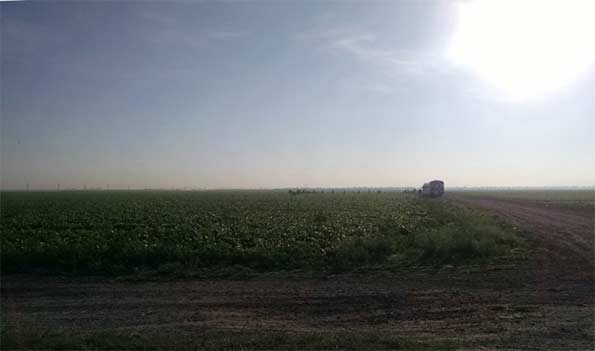
    In the agricultural areas, open fields with crops alternate with tropical fruit groves. Mango, papaya, banana, and coconut bloom in the spring, their fragrant scents wafting in the early morning air. Workers in the field are dwarfed by the flat landscape, a world away from the America’s eighth largest metropolitan area.

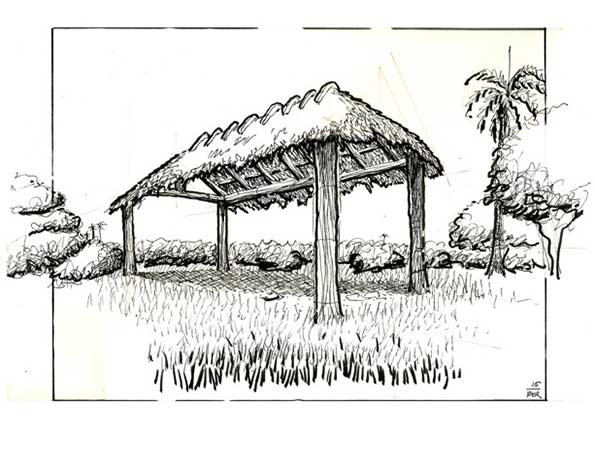
    Here, the vernacular building style is a colorful, deliciously un-Miami-like mix of shipping containers and barn tin. The traditional Seminole chickee —a rough, open hut with a raised floor, on a log frame — lends a tropical, exotic flair to this spotty rim of human inhabitation, pressed against nature’s vast size. The chickee’s thatched palm fronds create a natural insulation barrier that blocks the sun’s heat, and the fully open sides allow the tiniest of breezes to move air through the space underneath. This native response to the land is more appropriate than the thick-walled, stucco-buttered architecture imported from arid Spain and grafted onto Florida’s humid, wet character. The Seminole answer was to work with nature, have a light touch, and when a hurricane blows it all away, build it again. The classic Florida Chickee is an informal structure that the Seminole tribe builds. Some still use as living quarters in a way similar to camping (for those who prefer air conditioning, power, and plumbing, a more modern house is used).This zen approach to fulfilling the human need for shelter is decidedly un-modern and soft, and the chickee presence at the edge of the Everglades lends a certain amount of respect to the power of nature just beyond.

    Civilized life is stripped away, layer by layer, on the margin of the city. Abandoned subdivisions and Native American chickees coexist together, creating a sense of place that overlays the premodern chickee onto the failed subdivisions of modernity. This sense of place tends to mark man’s over-reach into the wilderness. Yet another marker can be found on buildings constructed by modern means, where layers of veneer have not been added: raw materials, unpainted and unadorned, stand crude and timeless against the trees and the sky. The edge’s presence can be sensed where structures start to dissolve into informality.

    Everglades National Park is a hard, urban boundary on the map, but on the ground it is a blurred zone where the slow-moving river of grass influences human activities. The nuanced edge continues into the Everglades themselves, where Florida’s subtle water-nature is uninterrupted. Water flows in a gentle, slow sheet across Florida’s flat limestone bed, coated with organic material barely thick enough for life to cling to. Where the limestone base dips a few inches, grass fails to grow; where a nub rises a few inches above this hard plain, unique tree islands gather. These islands are too densely vegetated to admit any human. Their edges are wrapped in a thick tangle of branches and leaves, a sort of bonsai-forest in miniature. Insects, birds, and other small creatures inhabit these infrastructures, forming their own natural urban civilizations of city-states, out of man’s reach.

    In between approaching jets and the distant rumble of airboats, a larger silence takes over. Penetrating the membrane between inside and outside gives us a new perspective. To confine our efforts to areas that are already strongly modified by human activities suddenly makes philosophical sense. Boundaries, once created, harden over time, and the softness of the western edge of humanity against the eastern boundary of the Everglades seems destined to harden. In its current state, this snapshot of the feathered, nuanced edge of civilization seems to be delicately balanced between the rural and the natural. Agricultural industry on the periphery of the great conurbation of Miami moves at a pace that is in between the seasonal flow of the Everglades and the nanosecond street culture of contemporary western civilization.

    Florida’s ubiquitous industry, tourism, mixes with agriculture even here at the edge of the wetlands, with the airboat rides, fruit stands, and alligator wrestling shows that pepper it. The vernacular architecture of the Everglades is not quite agricultural, yet not quite contemporary Florida either. Its flavor is connected to the Caribbean tropicalism one finds on islands like Puerto Rico, Barbados, and Hispañola. Endlessly adaptable shipping containers sit cheek-by-jowl with chicken coops and thatch awnings to create an ad hoc pedestrian space under palm trees. All is a little too clean and, well, ‘inspected,’ to be really offshore. But it’s also a little more relaxed than the uptight, postmodern built environment we’ve come to expect in America.

    Heading east out of the Everglades is a somewhat wistful journey forward in time. Rural roads lined with mango trees abruptly give way to fruit processing plants, which back up to grocery store strips, and the standard parade of global brand names enters the windshield, a gateway back into contemporary America. Stoplights take longer, the traffic pace quickens, and today’s Florida, like a hair shirt, envelops you in a cocoon of highly regulated infrastructure, put there for your own protection.

    Richard Reep is an architect with VOA Associates, Inc. who has designed award-winning urban mixed-use and hospitality projects. His work has been featured domestically and internationally for the last thirty years. An Adjunct Professor for the Environmental and Growth Studies Department at Rollins College, he teaches urban design and sustainable development; he is also president of the Orlando Foundation for Architecture. Reep resides in Winter Park, Florida with his family.

    Photos by the author: (top) vernacular building style on the edge of the Everglades; early morning workers arrive in Homestead by bus; protypical Chickee hut; unpainted structure, common on the edge of the Everglades.

  • The House of the Future Will be Solid-State

    Housing will take a great leap forward when the house becomes married to the concept of solid-state. This revolution will begin when solid-state – i.e., no moving parts – becomes meshed into notion of shelter; ergo, the solid state house. This will be the housing of the future.

    With the introduction of solid-state circuitry in the 1940s, the transistor replaced the vacuum tube to shrink circuits, improve precision, and eliminate maintenance and wear. This concept revolutionized electronics. Tubes were large, coarse, and had to be replaced when they overheated. Transistors did not. Tubes required a lot of energy and current to move electrons around to do their jobs, rest and recharge, and activate devices. Transistors could do the same jobs with a fraction of the energy, thus reducing heat, cost, and time; they could also be spaced closer together. Radios, which were briefcase sized objects, collapsed from to thumb-sized objects. A radio today is a mere speck; a partition within a larger microchip measured in nanometers.

    The solid-state house is not to be confused with the tiny house. Today, the tiny house movement is still in its nascent stages, and running into some important obstacles. For one thing, the entire economic system is blockading this movement, because the system is entirely designed for the supersized. During the permitting process, whether you permit 400 square feet or 4000 square feet, the same baseline cost applies, and the increase is only incremental. Municipalities, desperate for cash, have no incentive to reduce permitting costs. So the tiny house must pay the same tribute to the king as a McMansion.

    Builders have little interest in not-so-big houses, because they are built more quickly, and with fewer materials. Why would a builder want to sacrifice price? The management of a construction job is the same, whether managing a three month, 400 square foot project or a three month 4,000 square foot project.

    Builders also are accustomed to a supply chain of vendors with whom they have developed relationships. Gypsum wallboard, for example, is, the bread-and-butter staple of interior construction. If you are seeking an interior finish that has less impact on the environment, you will always pay more. The small house movement has not yet figured out how to work around the consumptive, wasteful supply chain, and unwittingly adopts it into the movement, rewarding the same people, taking the same resources from the earth, and injecting the same waste. The notion that the movement is doing less harm only means that a tiny house is less bad than a large house.

    And finally, a tiny house, once it is finished, has hundreds, if not thousands, of individual separate parts, and all of them move. During the daily temperature cycle things warm up, expanding during the day and shrinking at night. Rain wears down finishes and opens up joints between materials. Air conditioning creates a humidity imbalance that nature is constantly trying to correct. Even with today’s current construction methods, these issues are addressed no differently than they were fifty or a hundred years ago.

    Machines within the house — air conditioners, ceiling fans, switches, faucets, water heaters, and on and on and on — all have moving parts. They break down, require maintenance, and have their own supply stream. Whether a house is small or large, it has all the same baggage in terms of motors, lights, machines, and pipe joints. The lengths of straight pipe between joints may be shorter, but the connections, where the leaks occur, are still the same.

    The not-so-big-house will not, in its current form, succeed and converge into a broad ethos for the masses. The ‘system’ is embedded way too deeply into its bones. This system has evolved, Darwinian style, carrying its bad genes into the present. If the McMansion is doomed, so is the small house.

    But a different type of evolution is possible: Lamarckian evolution, in which change can come in one generation. Just as transistors evolved out of tubes, so can a solid-state house evolve out of a current house. This is the pathway towards the future. The ideal solid-state house shall have no separate moving parts, and shall be endlessly customizable out of factory parts. And the solid-state house shall shrink.

    The not-so-big house movement will be the testing ground for the solid-state house. Small projects are the province of invention. A new way of doing things is easier to test when failure is small scale.

    For example, water-carrying pipes currently are rigid PVC or copper because it is cheaper for long distance. In a small house, where water needs to be carried for shorter distances, more flexible hoses can be used, eliminating pipe joints. In the future small house these may be baked into the wall, much like holes in bread, eliminating a second material from the mix.

    Air conditioning may be under the floor or in the walls, operating through microtubules that work like sweat glands in reverse, constantly removing moisture from the air and channeling it into a system that cools air, creating a transpiration cycle that will allow the small house’s microclimate to function in the same way as the space under a tree canopy. LEED, the green certification rating system, requires a hermetically sealed space to minimize energy. But this new system will work best when the windows are open. Reconnecting with nature will be a pleasant byproduct of the solid-state house.

    As many appliances as possible will be 24 volt direct current, and will function without motors, gears, or bearings. A ‘gear room’ or utility room will be where the shameful old appliances, like washing machines, will be placed. Eventually these will be solid-state, too.

    The solid-state house will be at first very small. Finishes — the ‘look’ of the house — can meet any preference. If the current preference is stucco, for example, that can be added. The solid-state nature of the house, with prefabricated wall and roof panels cut to size and fitted together seamlessly will have its own integrity regardless of the clothing it wears.

    The most important part of the solid state house, though, will be its transportability. A foundation system will allow it to anchor firmly to the ground and be connected to local utilities (if required). As a not-so-big house, however, it will also be easily transportable.

    This exciting revolution will allow time and space to finally collapse, and bring architecture into our liquid, postmodern, nanosecond twenty-first century.

    Richard Reep is an architect with VOA Associates, Inc. who has designed award-winning urban mixed-use and hospitality projects. His work has been featured domestically and internationally for the last thirty years. An Adjunct Professor for the Environmental and Growth Studies Department at Rollins College, he teaches urban design and sustainable development; he is also president of the Orlando Foundation for Architecture. Reep resides in Winter Park, Florida with his family.

    Illustration by the author: “The solid state house is a thought project. I created the design and illustrated it [above]. I call the form the qwave. It’s shaped a little like a wave. And the house borrows from old technology – the Quonset™ hut. Quonset hut + wave = qwave.”

  • The Gilded Age Makes A Comeback

    The historian Carl Degler, who recently died, studied the rapid urbanization and industrialization of the late 19th century. That period has striking parallels to our country at the beginning of the 21st century. Between 1880 and 1915 the country’s face changed, and today the same phenomenon is occurring. The polarization of society and the divisive politics of that time were resolved, according to Degler, only by the rise of progressivism, which returned America to a sense of balance. The lack of a progressive “third way” today is startling, given that the concentrations of wealth and power are higher than ever existed in the Gilded Age.

    At the time, America was about to leave behind Jefferson’s ideals of an agrarian-based egalitarian society: the principles of free education, democracy, and land ownership. Now, we are urbanizing again, to a new and greater degree. As we evolve from industrialization to digitalization, the same cycle appears to be occurring. Here in Florida, urbanization is nearly complete, with a single archipelago of semi-urbanity having spread its web across nearly the entire peninsula.

    While this may seem like advancement, a gradually disempowered class feels increasingly resentful of the fast-moving cities. Here in Florida, those cities are woven in and around the rural populations. The situation seems dire, but it’s only a shadow of the human toll taken during the industrial revolution. Still, it is easy to see why social issues and moral values are central to those feeling left out of the cosmopolitan, prosperous cities.

    In the 1890s, no amount of handwringing by do-gooders helped reduce the suffering of children in mines, or the shameful exploitation of railroad workers. Populists, labor firebrands, and utopians contributed little to the solution, only sparking more controversy. Strikes increased divisiveness and polarized the country.

    Ultimately, it was through the emergence of progressivism in the reasonable center that true progress was made, and that the balance of the original founding principles was restored. No such movement exists today.

    An iconoclastic thinker, Degler called the progressive movement an essentially conservative one, pointing out that Fred Howe and its other luminaries pressed to conserve the original Jeffersonian goals of American reform. Degler quoted Howe: “The great problem now before the American people is, how can opportunity be kept open; how can industry be saved from privilege; how can our politics be left to the unimpeded action of talent and ability?” The progressives formed the American Creed around the new city and industry which were then rising. Howe’s questions are apt in this era’s uncertain world.

    A progressive center has yet to emerge from today’s highly polarized political climate. We continue to see and hear more divisiveness, and the upcoming presidential campaign promises to be nasty. Neither party has brought the two sides together. Our political campaigns in Florida reflect this same dialectic. Local races, once a bit more genteel, seem to be modeled after the national scene. A vacuum has opened up in the center. And today, just as at the end of the ninteenth century, there is little incentive yet to fill the vacuum.

    Degler saw turn-of-the-century American society as riven into the many poor and the few rich, and viewed the country’s founding democratic ideal as having been permanently subverted. His penetrating analysis of the last Gilded Age, and of an America that was gradual splintering, influenced a generation of scholars and historians. Degler’s essay, “New World A’Comin,’” noted that the rise of progressivism came only after decades of serious abuse and human tragedy at the end of the Industrial revolution.

    Progressives such as Howe and fellow reformer E. A. Ross encouraged the shouldering of a certain moral responsibility from top to bottom. But up until Ross’s treatise, Sin and Society in 1907, forty years of increasingly grisly and dark times for workers passed before things got much better.

    In today’s America, we don’t see dead children carried out of coal mines; no dead strikers, and no labor riots in the streets. ‘Worker abuse’ does not signify starvation or mortal danger. Protest against the privileged wealthy class is also less strident than it was a hundred years ago. Thus, if a progressive movement emerges from our current troubles, it is likely to be comparatively mild, and will need to fight against much more powerful odds to emerge. For one, the news media has no vested interest in settling disputes. And for another, the working class isn’t in peril for its life, and any great settling of accounts between the working class and the elite seems as though it will be put off to the distant future.

    I was a student in Florida in the 1970s when I first studied Carl Degler’s ideas during a unique period. The Vietnam War had just ended, and the national identity was sensitive. In Florida, we were highly conscious of the difficult relationship with Cuba. So, along with American history, the state required a course called “Americanism vs. Communism.” The notion of Americanism— not capitalism, you may notice, or democracy, but “Americanism”—included the terms “melting pot,” “exceptionalism,” and “The American Dream.” In a rural state with wide-open land at the time, this anxiety to present a unified, signature American identity had a powerful effect on those of us coming of age: Americanism was on the defensive.

    In that mix, Degler’s ideas were provocative. “Wherever men have striven to realize their moral visions, they have demonstrated that ideas, as well as economic forces, can change the direction of history,” Degler wrote in Out of Our Past. With Degler’s death, the notion of history’s moral trajectory may finally have died also. He challenged pat concepts: he refuted the notion of “melting pot,” citing the lack of assimilation of many ethnicities, and the stubborn refusal of a few to put racism behind them. Instead, he called America a “salad bowl.” He also rejected the idea of American exceptionalism, and noted that Jeffersonian ideals were only renewed through hard work. Maintaining these ideals today, in America’s new urban face, seems a fading dream as well.

    Here in Florida, the rancor of last autumn’s gubernatorial race seems forgotten. People are back at work, tourists are flowing into the state, and the population is swelling. Construction, thanks to easy credit, is everywhere. Reform is unlikely while the good times are here. Americanism, it seems, has triumphed, and the quaint, Jeffersonian notions of an agrarian, egalitarian society are again collecting dust for the time being.

    Instead, we have a superficial choice between two political parties that seems less and less substantive, and more and more like a marketer’s dream: Coke or Pepsi. Degler’s notion of history as a continual evolution of ideas, and of the rise of a progressive ‘third way’ is, for now, dormant. Many of us who were lucky enough to read Out of Our Past in Florida’s public schools still keep Degler’s provocative ideas with us. Those ideas may be put to good use when today’s soft drinks go out of style, and the public is thirsty for a middle ground once again.

    Richard Reep is an architect with VOA Associates, Inc. who has designed award-winning urban mixed-use and hospitality projects. His work has been featured domestically and internationally for the last thirty years. An Adjunct Professor for the Environmental and Growth Studies Department at Rollins College, he teaches urban design and sustainable development; he is also president of the Orlando Foundation for Architecture. Reep resides in Winter Park, Florida with his family.

    Flickr photo by Cliff: That Other Gilded Age. Edith Wharton, oil on canvas by Edward Harrison May, seen here during her privileged childhood. Wharton’s fiction became acclaimed for its critical view of Gilded Age society.

  • Central Florida: Stepping Into Deep Density

    Florida is on track to break the 20 million population mark by 2016, or possibly even this year. The Sunshine State will displace New York as the third most populous state in the country, just behind California and Texas. Nationally, rural counties absorb a lot of newcomers of modest income or fixed income seeking affordable places to live. Here in Orlando, however, banks and developers are betting big on a newfound taste for the urban lifestyle, beckoning new arrivals with hip-looking apartments and parking garages, often coupled with shopping plazas full of pricey, name-brand retailers. This is a gamble of huge proportions. Regrettably, it’s just another bubble waiting to burst.

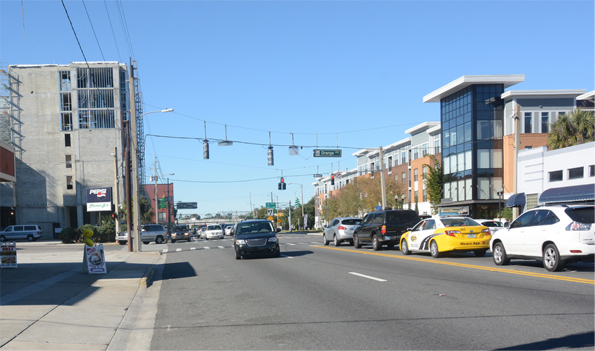
    North of downtown Orlando, two commercial corridors wind through various towns. Orange Avenue is Orlando’s version of Main Street (below: high density housing with a view of Interstate 4, Orange Avenue, and Highway 50 in Orlando, the three busiest roads in town).

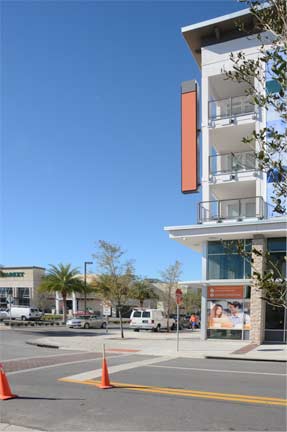
    Six new multifamily projects here are open or nearly completed. These are mid-rise buildings, four stories or greater, taking advantage of downtown’s proximity. Of course, each of these structures sports a new parking garage, acknowledging that our love affair with the car is still going strong.

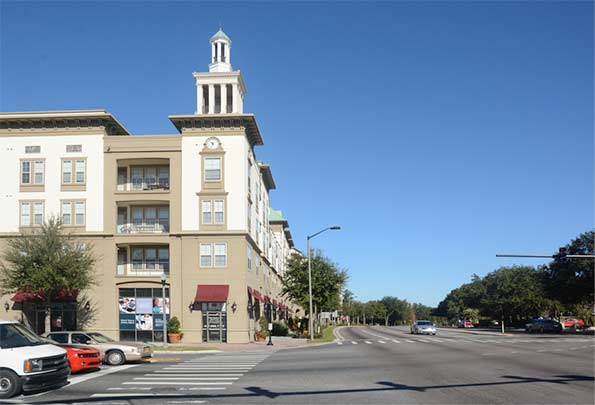
    US 17-92 is an even larger, 4-lane commercial strip running from downtown all the way up through Winter Park, Eatonville, Maitland, Altamonte Springs, Longwood, and beyond. It’s an Orlando version of Broadway, linking multiple neighborhoods and districts. It’s also a traffic-choked crawl, best to be avoided at certain times of the day. Nevertheless, three mid-rise apartment blocks loom over the cars, a high-rise senior living building is open for retirees, and several more are in the works (see below, at a rare, quiet moment. Still, this mock-historical apartment complex holds the street line).

    Each one of these developments ventures deeper and deeper into urban renewal territory, looking for the market’s edge. A recent proposal will displace warehouses along Orange Avenue, but is still firmly entrenched on the more profitable side of the railroad tracks. All of these developments take old or underperforming suburban sites and convert them into new, higher density blocks. The city, it seems, has finally triumphed in the battle for the hip and the cool.

    And it is a victory of sorts, at least for the short term. Each lender who funds a suburban infill project saves, for the time being, a greenfield exurban parcel that might otherwise have been chosen for the project. Florida is a state with a remarkably stressed natural environment, and these projects keep people close to the action, reducing the need for future corridors in the wilderness.

    Before the closing credits roll, however, the long-term impacts of these developments bear a closer look. While cities clap their hands for urbanism and the tax dollars it brings in, local citizens quite sensibly ask certain pointed questions… like, ‘what about traffic’? None of these new residents will do without a car, and at least one local development, approved blithely by municipal officials, now frustrates drivers for blocks around. More of the same is coming.

    Symptomatic, perhaps, of the current economy’s consumer weakness, most of these projects displace local producer activities. Instead of protecting home-grown businesses, municipal power has hastened their demise, driven by a real estate market which judged that they were not contributing to the economy at a high enough level. Gone are local commercial artists, two local sawmills and lumberyards, and a local hotel, all of which were net producers in the local economy.

    What has come in their place are yet more grocery stores — the adjacent grocery store is always a part of the formula — more hair salons, and name-brand apparel shops. Minimum-wage workers, many working for tips, now stand at cash registers where once business owners and entrepreneurs stood. These local independent businesses close down, or scatter to the more affordable periphery, which is becoming home to a new sprawl of producers. Shipping giant Amazon, for example, just completed a large facility in Florida. Near its customers in a metropolitan area?

    Nope: in rural Ruskin, locally famous for its beefsteak tomatoes. Elsewhere, local entrepreneur Carola Seminario, manufactures cosmetics in suburban Plantation, Florida, inland from Ft. Lauderdale. These businesses are far away from the dense urban core that traditionally hosted new business ventures. Like England, lampooned for becoming a “nation of shopkeepers” in the expansionist Victorian era, Florida’s urban population is becoming a reef of retail clerks and restaurant servers laboring for franchise bosses.

    In the meantime, Office occupancy rates are at a ghastly low in Central Florida, so urban development of office space is anemic. Instead, our oversupply of retail outlets just seems to keep rising. The multistory apartment stack, perched over a retail/restaurant base, has become a copy and paste routine. None of the tenants are local, independent retailers, either; the triple-net lease is only affordable to big national brands. Density is a game only the big boys can play, it seems.

    With Central Florida’s new commuter train rolling through town, the density might make some sense. But land value around rail stops has spiked in anticipation. Instead, development is occurring in the soft pockets of town, places where older, overlooked properties can be assembled with a minimum of fuss and cost. The result is that none of the new multifamily locations are really walkable to a train station. Hence, huge parking garages.

    After the applause has died down, a flush of new apartment dwellers may soon find out that a mortgage payment outside of the central city wouldn’t have been much higher than the monthly rent in town. Most people with kids, or planning for them, believe that raising them in apartments isn’t much fun. Grass, literally, is always greener. Meanwhile, Orlando cannibalized its local economy in a rush to approve these places, and became just another bland, warm commercial amalgam not much different than anywhere else in the southeast.

    By the time the city’s changes are fully visible, the transformation will be complete. Central Florida will have lost independent businesses to a miasma of ubiquitous name-brand franchises. A few service jobs will have been created, but the real careers are in corner offices of the chains’ corporate headquarters, way beyond the reach of Orlando’s residents. Rental rates will decline as growth stretches the market for a limited number of connoisseurs of the high-density lifestyle, and a gradual, insidious wealth disparity creates a new urban poor.

    The only vision, however, may be hindsight. After the bubble has burst, high density housing will remain. City planners have already begun rearranging infrastructure around this supposed densification: school boards, for example, are consolidating K-8 schools in anticipation of this new population. Urban planning, however, has to be measured in decades. School district planning, a long, slow, consensus-driven political process, takes years to implement. By the time a new school might open for the children in these places, the demographics might have shifted once again.

    Density is good in principle. It can breed efficiency, intensify business, and make a town throb with life. But in practice today, it seems to hollow out parts of the city. Dad doesn’t work on the ground floor of the apartment block; he drives to work, just like in the suburbs. Mom doesn’t hang around all day watching the kids and baking cookies; she drives to work also. The sidewalks aren’t filled with pedestrians on their way somewhere, cars slip in and out of garages, silently activating gate arms, and the kids are safely ensconced in front of electronics, not playing outside down below.

    The pricey tenant space on the ground floor doesn’t house local bakers, tailors, or professionals that live up above. Instead it houses a few minimum-wage store clerks scanning merchandise. The building form resembles this turn-of-the-century dream state — often stylistically, as well as functionally — but it’s a monstrous hybrid of the old and the new. Localism is traded away, and in its place a new feudalism, where remote landlords control vast segments of the urban realm, takes its place. With Florida’s population growth, there will still be places to prosper, but they seem less and less likely to be in the metropolis.

    Richard Reep is an architect with VOA Associates, Inc. who has designed award-winning urban mixed-use and hospitality projects. His work has been featured domestically and internationally for the last thirty years. An Adjunct Professor for the Environmental and Growth Studies Department at Rollins College, he teaches urban design and sustainable development; he is also president of the Orlando Foundation for Architecture. Reep resides in Winter Park, Florida with his family.

    photos by the author

  • Orlando Arts Scene: It’s an Urban Bus Trip

    Artists are bus riders. With day jobs to keep food on the table, they often forego luxuries, using feet and bicycles, as well as buses, instead of cars. They travel alongside many people for whom the bus is an absolute necessity. Too often, the bus is a class marker in America, and a racial marker in the South. Many do not want to cross the threshold of the bus. With artists increasingly passing through this doorway, the Transit Interpretation Project began, first in Orlando, Florida and now in Roanoke, Virginia. It is painting a new picture of the bus, revealing the reality behind the myths, and the humanity behind the faceless term “mass transit” that is so often used as a shorthand for problems and class divisions in our country.

    Taking the bus in the South still has a stigma. Since Rosa Parks’ era, the bus has remained an unfortunate symbol, reinforced by the waves of immigrants that have swelled the region’s population in recent decades. Many who move to the South seek the prosperous life of the American Dream, and the bus is not part of that pursuit.

    For many here in Orlando, Florida, the bus doesn’t register any significance in their lives. Its association with poverty and the working-class South remains visible, if a bit faded.

    I’ve ridden buses in Orlando and cities all over the country, and in a few other countries, too. Here in the South, the stigma still exists. I decided to ride a bus in Orlando during the summer, and learn firsthand what is happening on these lumbering behemoths of metal that steams along our crowded streets.

    My participation began on the #50, a bus route from downtown Orlando to Disney World. I sat alongside Judy, a night worker who left her house at 6:30PM to get to her night shift job starting at 10PM. Petite but hard-edged, Judy and her fellow night workers’ three-and-a-half hour commute each way is not for the leisure class. Coming back late at night, I joined a bus full of uniformed employees, droopy and exhausted from their service to the world travelers who come to play in Orlando.

    My own little blog to report my experiences became part of this project, along with art by photographers, writers, painters and sculptors. For example, Nathan Selikoff, a digital artist, made several animated computer graphics out of his bus ride experiences, including one based on my blog.

    The Transit Interpretation Project, TrIP for short, is an ongoing effort. The project’s work was exhibited at the Gallery at Avalon Island in downtown Orlando in August 2014. The result is an artist’s eye on the shared social space of the city.

    TrIP was the brainchild of Pat Greene, the current Director of the Gallery at Avalon Island. He recently spoke to me about the project. “Initially, when commuter rail was being proposed in Orlando, people parroted a lot of misinformation,” he said, “both for and against it. Train planners were using very analytical arguments, and contrarians were mostly being emotional about their protest. Both sides were very confident, but in many cases, both sides were also very wrong”.

    Orlando’s commuter rail opened this summer to the public with much fanfare, and has generated controversy. Greene, like many others, listened with skepticism to advocates’ claims that it will reduce traffic, because it rides on a nineteenth-century spine through a multipolar, twenty-first century, dispersed urban area. He also listened to opponents who decried it as costly and useless. He decided neither side had all the facts, and wanted to see for himself what buses and trains were really like in Orlando.

    Greene received two bus passes from friend. He invited artists to use them, and then write, paint, photograph, or make anything inspired by the experience, and post it to his website. The site remains open; anyone can participate by emailing their entry to Pat Greene athearsay@gmail.com. Contributors need not have any credentials, they need only to ride the bus and react.

    Greene carried his experiment to a colleague in Roanoke, Virginia. There, Jeremy Holmes, the director of a Ride Solutions Program that helps commuters find bus and carpool routes through the city, began a similar project. The results were displayed at Roanoke’s Marginal Arts Festival this year, illuminating another Southern town’s bus rider population.

    Analysts and talking heads don’t much ride the bus and therefore have little firsthand knowledge of the experience. On one bus ride in Orlando, an African-American man asked artist Jessica Earley to teach him how to pray; you can see her blogpost, labeled Unaffiliated Grace. On another, artist Greg Leibowitz had to convince security guards that taking photographs was not a crime; in spite of this, he captured marvelous portraits of riders. Artist Bethany Mikell sewed a dress from the images she gathered on the #8. Colombian Ivan Riascos mused, “What does this city have to offer me?” as he looked out the window of the #41. Each post, whether in writing or in images, adds a dimension to the individuals of the city.

    While the quality of the Orlando contributions is uneven, the point is not to critique the exhibition as art. It is, rather, to provide an opportunity to join a large-scale investigation into the meaning of twenty-first century public space in an American city of medium size. The space isn’t consistently crowded and hectic, nor is it consistently vacant. TrIP doesn’t consistently represent artists or riders who are black, white, brown, or any specific race or class. Instead, the blog posts build up a narrative of a rainbow rhythm marked by a gentle diversity, much common agreement about the miserable time-cost of the working person’s commute, and a view of a unique collection of humans that make up Central Florida’s specific and localized condition.

    This narrative gains its power from mining an overlooked, shared public space of the city: the inside of buses and trains. Greene eschewed officialdom in activating this project. “If I had approached Lynx [Orlando’s bus system] about doing it, I would have been in endless meetings with lawyers,” he commented. Instead, he just got on the bus and started chronicling what he saw, and encouraged other artists to do so as well.

    In a world where class privilege increasingly isolates people, transit is about the only vestige of the old urban experience where a broad cross-section of society can mix. It is a space that is owned by all of us, just a little bit. Sidewalks, if anyone has noticed, are usually empty in most cities today, making one less place where we can spontaneously encounter strangers. We’ve moved our social time online, building safer and safer little cocoons to prevent rubbing elbows with other classes. Artists seeking human portraits would have wasted their time on street corners in Orlando.

    On the bus, time with strangers revealed a great deal of warmth and emotion. The resulting portraits reveal the dignity of those who ride the bus. It makes me, as a resident of this town, feel a little closer to its soul.

    Richard Reep is an architect with VOA Associates, Inc. who has designed award-winning urban mixed-use and hospitality projects. His work has been featured domestically and internationally for the last thirty years. An Adjunct Professor for the Environmental and Growth Studies Department at Rollins College, he teaches urban design and sustainable development; he is also president of the Orlando Foundation for Architecture. Reep resides in Winter Park, Florida with his family.

    Photo by the author: “Judy”.

  • What College Gowns Bring to Towns

    The college town, one of America’s most appealing and unique features, grew out of the Age of Reason, and the concept of a regional, liberal-arts college nurtured by a small town has been intertwined with American history. Today, with enrollment dropping, the small, private college seems to be going the same way as the typewriter, the newspaper and the independent bookstore. While some colleges struggle to survive, the institution of the college town lives in suspended animation, ready to support whatever form its major employer may take. One thing’s for sure: the reinvention of the post-college town is coming.

    Here in Central Florida, the tradition of a liberal-arts college entwined with a small or medium-sized municipality is alive and well, for the moment. But trouble is brewing. While private institutions in Central Florida may not advertise their funding problems, the truth is plain to see. Rapid expansion of athletic programs, sure-fire profit centers for most schools, is underway at Rollins College, Stetson, and University of Tampa, and all are exploring other ways to reach more students, as well.

    Florida’s public universities are not immune to budget problems, either. And their response to the financial crisis says much about the future of college towns everywhere.

    Reinvention of the liberal arts college itself has been a cottage industry for the last several years. Student body diversification into “lifelong learning” (read: the lucrative retiree demographic), extensions, outreach campuses, and summer programs for primary and secondary schools has surged, as colleges try to open new markets. Bloated administrative costs have given rise to urgent fundraising and athletic programs, while an army of poorly paid adjunct professors shoulder an increasing burden of responsibility for the actual work of teaching. But, as Moody’s analyst Susan Fitzgerald has said about small, tuition-dependent colleges, they are in “a death spiral – this continuing downward momentum for some institutions [means] we’ll see more closures than in the past.”

    The Economist magazine has compared colleges to newspapers. If their analogy were to hold true, of the 4,700 colleges and universities in the world, “more than 700 institutions would shut their doors.” Citing the rise of massive, open, online courses or MOOCS, the magazine suggested that the idea of a professor interacting face-to-face with students will become a luxury. Colleges seem destined to end up in the same tiresome boat as the rest of the digital world, where everything, ultimately, becomes a product on Amazon.

    Uncertainty about the future has hastened the liberal arts school’s demise. In the darkest days of the recession we were told there was a STEM crisis: science, technology, engineering and mathematics were the fields that would get you a job. People ditched their liberal arts pursuits for more practical, employable ones, swearing off the indulgent frivolity of a philosophy course for a computer programming class. Panicking parents and students stampeded out of the gothic halls of the English department as fast as they could.

    Here in Florida, to pay for a new state campus in Lakeland, the Governor gutted the operational budget of Florida’s 11 other institutions of higher education. The new campus, located on rural land adjacent to Interstate 4, is far from any sort of population center. It’s a soulless commuter school; any form of a college town to accompany it lies far, far in the future.

    USF Polytechnic is being billed as a “destination campus”. Its showy new structure nearly complete, it lies naked to the Florida scrub and Interstate 4, with a few lonely stucco buildings and portable classrooms marking a kind of desperate, treeless sense of place in the hot Florida sun. No flip-flop-shod students strumming guitars, debating the meaning of Proust or the relevance of Marx will ever be found under its oak trees or in front of its bohemian coffee shops, because there aren’t any. Instead, there’s a harsh, asphalt parking lot and a long, hot trudge to the endpoint, another signal that one’s college years are just like a shopping trip to Wal-mart.

    If the one-in-seven death rate holds true, then one of the seven college towns in Central Florida will not have a future either. Gainesville, DeLand, Winter Park, St. Augustine, Tampa, Lakeland, and St. Petersburg are seven places with streets, residences, and businesses that each have grown up around colleges, public and private, and that enjoy a thriving sidewalk life.

    Ironically, at least two of these colleges were born in another desperate time, the Great Depression. The University of Tampa, across the Hillsborough River from downtown Tampa, started in a failed hotel when the city took it over from owner Henry Plant’s railroad empire. Likewise, Flagler College in St. Augustine began in a resort hotel built by New York railroad magnate Henry Flagler. The small, private, liberal-arts college was a perfect solution. A grand old structure was re-inhabited, and a struggling city was bolstered.

    Towns that grew up around these places have different, more informal qualities than other towns. In Gainesville, for example, churches, temples, student centers, and other non-profit institutions occupy prominent positions within the urban core. There’s a diversity of old houses with garage apartments, lean-tos, and enclosed porches. Wood apartment buildings have side stairs, outdoor beer kegs, and bicycle racks. They sit under huge, mature trees, clad in subtropical philodendron vines, and are connected by narrow dirt pathways carved independent of sidewalks. A sense of grown-over-time pervades within and around campus, its boundaries softened by sneaker and bicycle traffic, concert posters and poetry reading notices.

    Gainesville, with nearly fifty thousand students, will probably survive, but other, smaller towns may struggle. As conversion to digital learning reduces costs, the college town may disappear. Anonymous reviews, posted online, replace conversations in bookstores. University Avenue may be deleted, just like yesterday’s term paper.

    Our bookshelves are crowded with titles about the urban future, but in all of this furious scribbling it seems no one has noticed that sidewalks have all but emptied out in many of our cities. Chicago, New York, San Francisco, and a few more still march to the pedestrian beat. But a fairly thorough survey of peninsular Florida yields few sidewalks with any kind of street life — and the few that still operate as shared, social space all belong to our college towns.

    Students, with one foot in childhood and one in adulthood, still walk on sidewalks. They shop online, too, but they still patronize businesses for the sake of the social interaction, and still have use for the physicality of the street… for a street life that seems to be endangered.

    College towns, living on today in a shadow of their former bohemian selves, will be reinvented, just as education systems will. But for now, deprived of street life, we breed a different sort of citizen and thinker than an old college town once did. This new digital citizen will construct social space in ways yet to be foreseen.

    Richard Reep is an architect with VOA Associates, Inc. who has designed award-winning urban mixed-use and hospitality projects. His work has been featured domestically and internationally for the last thirty years. An Adjunct Professor for the Environmental and Growth Studies Department at Rollins College, he teaches urban design and sustainable development; he is also president of the Orlando Foundation for Architecture. Reep resides in Winter Park, Florida with his family.

    Photo of downtown Gainesville by the author. This scene is typical of the streets surrounding the campus of the University of Florida.

  • Florida: When Density is Destructive

    Brick streets, mature old oaks, and a sense of history imbue Winter Park, Florida with a sense of place that is the envy of many small cities and towns. The tony Park Avenue brings shoppers and visitors, who soak up its ambience and enjoy the street life of this quaint southern town. On the east side, bounded by blue lakes, lie gentrified historical mansions, while the west side is a neighborhood of smaller, affordable homes with multigenerational Winter Parkers. This community of little single-family homes is now endangered by developers that are gobbling up parcels two and three at a time, increasing the density threefold, and squeezing out residents in a new, “zoning for dollars” economic climate.

    Affluence and affordability have always maintained an uneasy truce, and the balance between them has historically been protected by cities through planning policies and an understanding that the mission of a city is to be workable for all of its residents, not just the wealthiest. Unfortunately, this balance tilts when the density imperative drives land values up, and tips the scales in favor of half-million dollar townhomes. High density has become fashionable in Winter Park these days, as it has in many cities, and there are some benefits to this new style. The costs? Well, those will be counted later.

    Density’s benefits look great on paper: a higher tax base, expensive new housing, walkable urbanity. When implemented well, these can make for positive changes. Advocates preach careful, sensitive ways to develop: don’t smash large and small buildings together; don’t mix uses on a street, and ramp up from low to high density across a gradient of a block or two. Advocates also preach a consensus-building process to avoid neighborhood clashes over growth issues. In places where this has happened, like Coral Gables in Miami, the story has mostly been a good one.

    The west side of Winter Park, with its cottages and modest residences for families, dates back to the 1920s. Within the neighborhood are many small churches to which residents walk on Sundays. Playgrounds, parks, and a community center characterize the West Side’s tree-shaded streets, and its proximity to the downtown area means jobs for many of its residents. For the last ninety years, the city has evolved around this neighborhood, and many families go back several generations. Its diversity includes many African American families, mixing with whites. It carved out a niche in the city.

    Today, the West Side is an older and less affluent neighborhood that happens to be close to a desirable address. The West Siders have already chosen their preferred building pattern and rhythm, infilling their blocks with new homes of similar size and scale, enlarging the tax base. They already live a walkable urban lifestyle, use mass transit, and evolve with slow and organic growth. In short, every urbanist’s dream.

    Like many cities that have a working class enclave that butts up against a newly trendy one, Winter Park has encouraged dense, mixed-use development, while nominally protecting its existing neighborhoods. And this is where the density equation seems to fall apart. The residents who leave the area will no longer participate in the economy of Winter Park. The new residents of half-million-dollar townhomes probably won’t ride the bus, walk to the churches, or otherwise activate the local streets. So a natural piece of the city is lost forever. Urbanism, for all that has been written in favor of this ideology, is diminished for the sake of density.

    West Siders protested in City Hall, asking the city not to upzone their neighborhood. While City Hall nodded to its citizens, it had already quietly allowed upzoning to take place, taking advantage of tired homeowners who decided to cash in. Half-million-dollar townhomes, which could be built in other areas, are instead being built here, to take advantage of low land values. Parking garages and midrise apartments now cast shadows on the adjacent small houses. Land values may rise on those parcels with new townhomes and midrise apartments, but immediately next door, the remaining adjacent little one-story cottages become particularly undesirable; the value of those homes becomes depressed. The owners’ only hope is to sell off to a high-density developer. Step by step, high density becomes more and more inevitable as the only solution left.

    The market forces at work in Winter Park have played out elsewhere across the country, with old neighborhoods eroding. This time around, with density all but institutionalized as the only acceptable way to grow, the deck seems to be stacked against entrenched locals. Cities are re-writing their development codes in favor of shiny new mid-rises and high-rises, ignoring existing residents who won’t be missed till they are gone.

    When the market, an amoral institution without sentiment, threatens neighborhoods, it is the job of City Hall to provide a hedge that ensures balance and fair play. But citizens have to shout over the money in order to be heard, so local groups like the Friends of Casa Feliz have stepped in on their side. If “zoning for dollars” can work against this section of the city, groups fear, then no one is safe, and people are reminding City Hall of its duty as a guardian of its residents.

    Density, on its own, is neither a good nor a bad thing. It can make a city more efficient and connected, and proponents tout its reputed health benefits and contribution to a thriving social life. When, in the process of allowing density, a city destroys the very values that it is supposed to promote, then the city ends up cannibalizing its neighborhoods for little benefit other than the one-time gain that the developers will realize from the sale of these newly built products. Income streams are put into mortgage-holders’ pockets, and, bit by bit, one more highly localized economy disintegrates.

    City halls, so obsessed with petty regulations, would do well to recall their basic functions as protectors of their residents. If there were a “back to basics” movement for government, many ordinances written to benefit the few would be shed, and there would be a refocus of attention back to the public good. The current infatuation with density, like many fashionable ideas, may come and go, but if a multigenerational neighborhood goes, it won’t be replaced in our lifetime.

    Richard Reep is an architect with VOA Associates, Inc. who has designed award-winning urban mixed-use and hospitality projects. His work has been featured domestically and internationally for the last thirty years. An Adjunct Professor for the Environmental and Growth Studies Department at Rollins College, he teaches urban design and sustainable development; he is also president of the Orlando Foundation for Architecture. Reep resides in Winter Park, Florida with his family.

    Photo by Betsy Owens of the Friends of Casa Feliz: “Preserved 1920s Cottage on Lyman Street”, Winter Park, Florida.

  • Florida: How Fine Art Became Local

    Fine art resides not only in the cosmopolitan cities. It lived, as we saw in the recent movie “The Monument Men”, in the many villages of Europe. Right now, we are seeing it living on the periphery of Orlando, Florida.

    Home to Stetson University, DeLand is forty minutes north of the regional core of downtown Orlando. It is one of those delightful, off-the-beaten-path towns that tourists love to stumble upon and explore; the largely intact, century-old strip along Woodland Boulevard is vibrant, bohemian, and alive. Florida’s archipelago of cities compete for the hip and the cool, and it is easy to dismiss places like DeLand. Cities and towns in this state have, for the most part, yet to grow the kind of institutions that speak of maturity, sophistication, and worldliness. The draw of DeLand is not sidewalk urban hipsters sipping lattes; instead, it speaks of a new age of curiosity, individuality, and appreciation for experience outside of the roaring din of the city. The newly re-named Museum of Art – DeLand signifies a powerful future for this part of Central Florida.

    Formerly called the Museum of Florida Art, the museum’s new name – no qualifiers, no excuses – befits a mission that brings world-class art to its patrons. “First and foremost, we serve our community,” said George Bolge, the Museum of Art – DeLand’s Chief Executive Officer. Bolge, retired from the Boca Raton Museum of Art, was asked to head up this museum and expand its scope and its reach. “At the same time, we are participating in the broader conversation about what art is, and where it is going. Our voice is being heard loud enough that people in New York are talking about what we are doing.”

    In the first half of 2014, Bolge’s exhibition run includes veteran Florida artist Jill Cannady, whose evolving career has stayed one step ahead of her critics. “This is important for people to see, and she is right here under our noses in DeLand, Florida,” said Bolge. Recent exhibitions like “Forging an Identity: Contemporary Latin American Art” drew patrons to exciting international artists who have helped shape Florida’s cultural and social ideas.

    In the official story of urban triumphalism, a museum executive should take his victory lap in Manhattan or Paris. Bolge, however, chose not to follow the herd. He was beckoned to DeLand by the opportunity to take an arts institution from good to great. The museum has its own building, a tan, prismatic form just north of downtown. Its exterior is a windowless enigma which belies a wonderful, light-filled volume within, one suited for showing world-class art. Its multifunction lower level has an atrium space and gallery, and an upper level gallery and classrooms. It’s a flexible facility that does its job by putting the art first, staying in the background, and being accessible to all.

    Even more interesting is the Museum of Art – DeLand’s downtown satellite, at the corner of Woodland and New York, six blocks south of the main gallery. This space, with a wood-floor and the rough-brick feel of a Chelsea loft gallery, recently exhibited “Small Masterworks” borrowed from the Butler Institute of American Art. Ascending the stairs, one is greeted by a free-flowing series of galleries which take you from a sunlit-filled reception area to a deep, introspective space that cleverly maximizes the art viewing experience. From Benjamin West, an American-born colonial artist, to Warhol, Lichtenstein, Motherwell, and others in the late 20th century, “Small Masterworks” provides sensitive and moving documentation of the evolving American art scene. DeLand, the quintessential American town, seems to be a perfect setting for it.

    This is the new story of Florida which is just now being written. While local art lovers are enriched by such an institution, it is drawing more and more attention from the surrounding metropolitan areas. With this museum, DeLand is now exporting culture to the city, in a reversal of the trend, signifying a maturation of the Florida arts scene.

    The Butler, in Ohio, is another example of this reversal. Nearly a century old with multiple locations today, The Butler is a solid institution with an international reputation. Something interesting is happening. As we have become used to mobility and flexibility, our world is no longer limited to where we live and work. With the internet, we are becoming increasingly connected. This favors DeLand, and places like it, with a new equity of distance – cutting-edge ideas are now a few clicks away. People in far-flung areas are less isolated.

    DeLand has a college vibe — a built-in art appreciation population — and with the rise of retiree enrollment, expect this population to go up. It’s affordable, walkable, and fun, with few of the big-city evils like crime and congestion that can scare away newcomers. No longer a tropical wilderness out of which man once carved a crude existence, Florida may now be settling down and becoming a more civil and aesthetic experience for its citizens. Towns like DeLand offer something that big cities like Orlando and Miami cannot: a high quality, human-scale lifestyle.

    “In DeLand,” Bolge stated, ”I’ve noticed that people have a pretty high opinion of their town… there is a spirited investment into making its art museum into a great institution.” Bolge sees this museum is a conduit to channel the story of Florida art into the broader flow national artistic energy. “We’re going to be showing what the Florida art patron likes, too,” he said, “so later this year, you will have a chance to see what a Floridian does with a world-class collection of artists.” “We are here for the local community,” says Bolge, “but it doesn’t hurt that we have a profile outside the community as well.”

    Richard Reep is an architect with VOA Associates, Inc., and an artist who has been designing award-winning urban mixed-use and hospitality projects, domestically and internationally, for the last thirty years. He is Adjunct Professor for the Environmental and Growth Studies Department at Rollins College, teaching urban design and sustainable development, and is president of the Orlando Foundation for Architecture. He resides in Winter Park, Florida with his family.

    Photo by Lisa Habermehl: Downtown satellite location of The Museum of Art – DeLand