Author: Richard Reep

  • Urban Housing: A Master Plan for the Few

    How we, as a nation, find bounty and beauty in the future depends upon how we react to two trends emerging from the recent difficult period in American urbanism. The first of these trends is the increasing lack of affordability in mainstream urban America, with the costs of maintaining a middle-class lifestyle at a level where distinct have/have-not lines are now drawn. The second is the increasing authoritarianism in mainstream urban America, where decisions about how our cities function are guided by a new array of authority figures that represent the common good. Both trends point to a disempowerment of a vast section of the American population.

    Our loss of housing affordability is an insidious development that will continue to eat away at the urban triumphalism that marked the beginning of this century. Generation Xers, seniors on fixed incomes and the struggling middle class will have much in common during the coming decade, with fewer and fewer housing solutions designed for them. If half of our consumer goods are purchased by the top ten percent, then the rest of us are increasingly irrelevant in terms of goods, and services, as well as in housing,

    Affordability on Main Street was once a concern of Wall Street. It was broadly known as Fordism, from the days when Henry Ford paid decent wages so that his workers could afford his new product, the car. Today, with Main Street on its knees, Fordism is dead and Wall Street turns more and more to itself, and to large, multinational conglomerates for profits. Volume generated by the middle class comes from a few companies like Apple, and, as the class shrinks, psychological distance between the haves and have-nots widens the gap, especially for those with memories of the material wealth they had in earlier days.

    Solutions to the affordability gap in the urban realm are conspicuous by their absence. Desirable addresses, decent houses, and access to amenities are now the province of relatively few, who are serviced by those on the outside, commuting into town from less hip and trendy places. New residential housing, driven by the Wall Street investment community, is geared towards the market-rate. The linkage between mass transit and affordable housing has been deftly snipped apart by the investment community, where the topic of affordable housing generates a yawn.

    Solutions? We might do well to investigate anti-urban trends, where peripheral and rural communities are stable and growing, and look at how these communities cope. Housing solutions like prefabricated units (think trailer parks, America’s answer to the favela) might be studied.

    Non-affordability, as a trend, is strongly linked to a co-evolutionary partner that is driving a wedge between the haves and have-nots: an authority figure which has become a new interlocutor in of the urban conversation, a sort of urban do-gooder to save us from ourselves, pushing more requirements and accepting fewer improvisations. Affordable housing has less to do with the square footage that is in that space, and more to do with the ingredients found within the square footage.

    The gloved hand of quasi-government authority has come to rest upon our cities with an increasingly tight grip, in the name of the green lobby or in the name of the traditional town.

    Cities underwent rapid change in the fifties and sixties due to the car, and subsequently parking garages, commercial strips, suburbs and highway overpasses sprouted. All these developments facilitated growth and expansion. Americans were remarkably unsentimental about their historic urban fabric, and notably experimental about innovative technological solutions to remove obstacles to this growth.

    Today, our confidence is shaken. The rise of authorities to dictate urban form signals that the era of innovation and improvisation is over, and that American cities are entering a new era of more rigid control of what gets built. The authority, in the form of a Master Plan, treats the city as if it were a vast, private land holding, and its citizens as if they were animals in a forest that was about to be developed.

    Master Plans have already been passed in Denver, Philadelphia, and Miami, and are on the boards for other cities in 2013. When a developer Master-Plans his land, he relies upon a Master to create the vision for the land, and this Master – credentialed, experienced, and hopefully talented – sets out the form of the future construction. The Master may have a passing interest in the voices from the land itself – biologists who count endangered species, for example – but the overarching form comes out of his mind, and the developer then implements the plan.

    When the same process is used upon a living, dynamic city, the results vary. Future citizens, bound by the edicts of this Master Plan, may submit to the Master’s vision, or, they may chafe at its restrictions. These Master Plans are formulated with great citizen input and collaboration until the time at which they are set. After that, they are to be obeyed. The plans create a physical model, or form; they are like a glove into which the city must fit its future hand.

    Master Plans attempt to take all possibilities into account, while creating ‘perfect’ rules by which the city can grow. Physical order, it is hoped, will lead to social order, as buildings once again behave like they did before the car. Should the future evolve as the Master predicts, the glove will fit the grown-up hand However, the future is notoriously difficult to predict.

    The new regulatory regime has become fashionable as citizens, sickened by the dirt and ugliness of our cities, seek an authority to keep us from temptation. As such, Master Plans arise from a noble intent not unlike the one held by city planners at the turn of the 20th century: to improve urban hygiene. And they may be correct in thinking that emulating urban form as it was before the car might just bring walkability back into fashion once again.

    The future, however, is ephemeral and dynamic, not static like a Master Plan, and may become frustrating to the Master Planners who have created elaborate blueprints for our nation’s cities. America’s fluid economic situation is giving rise to in-home workplaces, negating the need for traditional office space. It is giving rise to in-home manufacturing, reducing the size and complexity of factories. Warehouses, in today’s era of just-in-time-delivery, are being converted into other uses. And finally, Master Plans all seem to reminisce about Main Streets with lovely, tree-lined rows of shops under apartment (parking would be safely tucked in the back). These shops, renting for top dollar, stand empty today, made even more remote from reality with the advent of online retail.

    In short, Master Plans that rigidly enforce an urban form of yesteryear may become next year’s white elephants. Cities bearing these master plans may find themselves with a regulatory burden that is reducing their desirability as places to live and work. Following these cities specifically, learning of their successes and failures, and analyzing how Master Plans are working will tell us a lot about the future.

    As affordability is reduced and regulation increases, American cities could soon evolve into forms that are quite different from those of our past. And as confidence in the future fades, our cities take increasing comfort in the past, fossilizing our urban form as the Romans once did. For those underneath the affordability curve, improvisation and innovation will still continue, and insight into both of these emerging trends will yield a new sense of direction for the places where we live and work.

    Richard Reep is an architect and artist who lives in Winter Park, Florida. His practice has centered around hospitality-driven mixed use, and he has contributed in various capacities to urban mixed-use projects, both nationally and internationally, for the last 25 years.

    Flickr photo by alesh houdek: A walled and gated Miami home.
  • Petraeus’s Turf: The South Tampa Scene

    Bimbo eruptions are never fortunate occurrences, least of all for the bimbos involved. When they occur in South Tampa, they carry the sordid spectacles to new frontiers. A gentle but feisty cultural mix of blue-collar, white-collar, and varied ethnicities stretches between Old Tampa Bay and Hillsborough Bay on a peninsula tipped with MacDill Air Force Base. Local reactions in Tampa to the news vortex that now surrounds General David Petraeus will likely range from shock, to “meh,” to a certain pride in being in the spotlight, and to the addition of yet another notorious figure to Tampa’s colorful history.

    Tampa has always played in the shadow of New Orleans, with a good music and ethnic food scene, and a quirky local culture that isn’t quite mainstream American and isn’t quite Caribbean. A somewhat white bread version of New Orleans, Tampa has a local parade and festival that occurs the first week of February, but instead of Mardi Gras, Tampa’s party honors the apocryphal José Gaspar, a pirate who reportedly operated out of Tampa Bay.

    A spicy cultural mix to be sure, but it is meek and heavily regulated compared to the out-of-control scene in New Orleans. Perhaps the city’s overbearing white leadership has something to do with this; no one wants to be responsible if things get really wacky. Gasparilla is a kind of Mardi Gras you can take your kids to, perhaps in deference to Florida’s reputation as a family vacation destination.

    Cuban cigars, once made in Tampa by the case, linked the city to male hedonism early in its history, and this link has been reinforced ever since. Once home to Cuba’s freedom fighter, José Marti, Tampa’s Cuban heritage has faded from its fierce past glory as well. By the 1980s, the Miami Cuban community’s brash voice had taken over. “Yellow-rice Cuban” had become a putdown, implying one was from Tampa instead of Miami.

    The city itself started as a Caribbean freight port in the 1880s. Teddy Roosevelt and his Rough Riders stopped for provisions in Tampa along their way. A young British war correspondent, Winston Churchill, rode with Roosevelt into nearby Ybor City to sample a local bordello, before sailing on to Cuba. The city’s colorful past traditions includes military scandals that even date back to the straight-laced Victorian era.

    South Tampa blossomed as a streetcar suburb in the early part of the 20th century, and when Plant’s Hotel failed in the Great Depression, it was converted to a private college. The bay shore was sculpted into a 4-1/2 mile linear public park, still one of the most beautiful civic spaces in America. This boulevard reads like a spicy historical narrative of the city, with uniquely styled, Edwardian-era houses giving way to newer homes and condominium towers as one travels its length. Along this road, the magnates that helped build Tampa made their homes: Hugh Culverhouse, a tax lawyer who started the Tampa Bay Buccaneers, lived one condominium away from legendary George Steinbrenner Jr., who came to town to manage his shipping concerns when he wasn’t hollering at the Yankees.

    MacDill Air Force Base started as a training base for B-26 pilots during World War II. The bomber was so hot and difficult to handle that it was nicknamed the widow-maker, and its reputation gave MacDill its first catchphrase: “One a day in Tampa Bay.” Conviviality between town and base became an instant tradition, along with the town’s reputation for hosting a good time for all. And this reputation did not go away after the war.

    In the meantime, the infill neighborhoods behind the affluent waterfront residences acquired a unique flavor. Not quite as tropical as Miami, the over-scaled flora — huge banana trees, traveler’s palms, figs – are interwoven with gorgeous craftsman-style bungalows with deep, shady porches and high windows to let hot air escape. Like Boston, the little neighborhoods and districts of South Tampa are distinct, colorful, ‘hearty and vibrant. Along South Howard Avenue, a string of commercial and restaurant properties marks a definite dividing line between old and new.

    Bern’s Steakhouse dominates South Howard, where stars like Johnny Carson would stop and tuck into a prime rib when in Florida. Bern’s is emblematic of Tampa itself: a proud, independent, homegrown restaurant, known for its excellent food, but ungracefully crammed underneath an interstate overpass and about as charming on the outside as a warehouse. Inside, the fifties era red velvet and gold leaf decor conjure up visions of a Parisian brothel.

    Back behind Bern’s lies Parkland Estates, a quiet, depression-era neighborhood where Santos Trafficante Jr. retired in the 1960s. Considered the last of the old-line mafia dons, with territory stretching far into Cuba, the Trafficante family lived in his modest, blond brick home. While Tampa may seem remote from the action, it actually was an active territory for syndicates that reportedly controlled road construction and other businesses. And Tampa was the location for scenes in Good Fellas, a source of pride to many Tampa natives.

    By the time Trafficante died, however, Joe Redner had overtaken him in notoriety, operating a string of strip clubs and striking a highly visible profile in the city’s business and political circles. Never quite accepted enough to win his many bids for mayor, yet still a persuasive leader, Redner’s success may have had something to do with MacDills presence. Prurient behavior, tolerated but never quite accepted, gives Tampa a decidedly old-world flavor in the South’s entrenched white Protestant mainstream culture.

    MacDill still has a strong influence on South Tampa, employing some 3,000 people and actively participating in community projects. Its open house days, hugely popular, are a source of patriotic pride among locals, as are the jets flying overhead. Otherwise lacking a presence on the national scene, Tampa hosts the United States Central Command, with top military brass acting as local heroes. MacDill is immediately surrounded by base housing and service workers, but it’s pressed up next to high-net-worth neighborhoods for those who prefer the quiet anonymity of South Tampa to flashy, overheated South Florida.

    This week, as a warrior fell in Tampa, the event was fawned over by spotlight-hungry locals. The spectacle diminished not one, but multiple institutions, beginning with the FBI, the CIA, and the Army. What Taliban bullets could not do, our own culture did.

    Richard Reep is an architect and artist who lives in Winter Park, Florida. His practice has centered around hospitality-driven mixed use, and he has contributed in various capacities to urban mixed-use projects, both nationally and internationally, for the last 25 years.

    Flickr photo: by amanderson2: A very tame pirate ship in Gasparilla, 2010.

  • Florida: When Your Best (Place) Just Ain’t Good Enough

    Real estate broker Coldwell Banker handles corporate relocations for a large portion of our middle class. It recently released a survey of Suburbanite Best Places to Live. While it’s easy to dismiss as a sales tool for their realtors, the survey provides a fascinating glimpse of middle class, suburban preferences, influenced by our current economy. Coldwell Banker’s top honors go to Cherry Hills Village, Colorado, a suburb of Denver. Suburbs of Seattle, New York City, Washington, DC, and other prominent cities feature strongly on Coldwell Banker’s list, which highlights places that are sprinkled evenly throughout the United States. Notably missing are any communities in Florida.

    For a state with sunshine, beaches, and low taxes, Florida just doesn’t have the chops to get even one community onto the top 100 list.

    Weather, evidently, has little to do with our middle class’s desirable locations. Frigid Whitefish Bay, just south of Milwaukee, captured spot #100. Situated along the shore of Lake Michigan, this suburb of 14,000 doesn’t exactly have the kind of weather that makes people flock to the beach. Instead, it offers residents a strong sense of community, heritage, and a culture that values education and family. If you move here, you’ll find yourself within a suburban community with a high homeownership ratio, an educated population, and a quality of life that includes short commutes, low crime rates, close conveniences, and a tendency to eat at home.

    Suburban living has maintained a strong appeal for middle-class Americans due to the popularity of many of the factors on which Coldwell Banker based its rankings. While socialites prefer more urban, dense lifestyles (which is another list that Banker recently produced), suburbanites prefer backyards and quieter neighborhoods away from the hustle and bustle of the city; they don’t need to be near the action. Florida has all these things in abundance, except when compared to… almost everywhere else.

    Windermere, Florida’s top ranked suburb, came closest, ranking just below Whitefish Bay and a couple of others. Like most suburbs on the list, Windermere is on the periphery of a large metropolitan area (Orlando), and contains conveniences, good schools, parks, and recreation facilities.

    For much of its history, Florida represented the suburban American dream. The net benefits included an affordable cost of living and upward mobility, and Florida’s growth has consisted almost entirely of suburban densities. No one can accuse Florida developers of building communities that people didn’t want – the product was carefully researched to fit the market.

    In the late period of the boom, urban options were also developed, in the belief that a new demand for socialite “downtown” style living would emerge. Townhomes and condominiums rose in Florida’s primary and secondary urban markets. Even tertiary cities like Sanford, a historic agricultural town north of Orlando, begot a six-story condo. Those who migrated from Chicago and the dense Northeast now had a diverse set of choices, from rural to urban, with something to please everybody.

    It is perhaps this dilution of the market that has made Florida’s star fade a bit in relation to the national constellation of suburbs. If East Grand Rapids, Michigan (Coldwell Banker’s #8) can outrank the hundreds of suburbs around Tampa, Miami, Jacksonville, Tallahassee, and Orlando, there’s something else going on besides beauty.

    One thing that many of the top 100 have in common is a strong public education system. Florida, which has refused to invest in education, may now be harvesting the bitter fruit of this stubborn negligence. The state’s primary growth today continues to be in retirees who are uninterested in supporting education, and who control a large part of the state’s political power.

    Another aspect that the top 100 suburbs offer is safety. “Safety is a priority,” states the opening page of this survey, but it simply isn’t something that most people associate with the Sunshine State. A state that doesn’t offer a strong sense of personal safety isn’t going to rank highly, no matter what else is being offered. With two out of the ten most dangerous cities in the country, Florida seems more like the wild West than a suburbanite’s dream come true.

    Increasing public safety and public education are two efforts that government can do best, most people agree. Florida has spiraled downward on both fronts. The state’s leadership, by cutting taxes during the worst part of the recession, haven’t exactly helped the situation. With Florida’s new home sales up, the state’s economists are whistling a happy tune, convinced that the worst is over. But what Coldwell Banker is telling Florida is a different, darker story.

    Florida’s best offerings are attracting a population less interested in the core values stated in the Coldwell Banker survey – safety, good education, a sense of community – and so we continue to get more of the same. More population that reinforces Florida’s lack of investment in community, more population reluctant to put money into education, and more population that is quick to move somewhere else at the earliest opportunity seem to be Florida’s fate. This represents a lost opportunity to those who wish to see Florida make gains in these spheres – education, community, and safety. And it represents a lost opportunity to match up a truly beautiful place with truly involved people.

    Corporations seeking to relocate and recruit good people pay attention to these surveys. Florida’s low taxes may lure a few more down south, but if corporations need to attract and retain top talent, this survey points to where they are likely to go, regardless of the incentives our state has to offer.

    Places like Whitefish Bay, Wisconsin; Rossmoor, California; and Haworth, New Jersey will continue to gain in the type of population that share these same values. The middle class, fighting its way back from a threatened extinction, isn’t likely to take a chance on a place that has a rapidly degrading quality of life. Until Florida’s culture starts caring about the quality of its community, safety, and education, our state will continue to grow without flourishing as a place where people desire to be.

    Richard Reep is an architect and artist who lives in Winter Park, Florida. His practice has centered around hospitality-driven mixed use, and he has contributed in various capacities to urban mixed-use projects, both nationally and internationally, for the last 25 years.

    Bigstock photo: Florida Housing

  • Swing State Geography: The I-4 Corridor

    Overheated presidential politics have done few favors to Florida, except to put 132 miles of hot asphalt on everyone’s lips:  Interstate 4.  Completed in the late 1960s, this interstate (in fact, the only interstate highway to be entirely contained within one state) is known by millions who have  visited there at least once on vacation.  But the social and political reality in the world  around Interstate 4 is little known outside of Central Florida.  Like Ypres, the Flemish town continually under assault during World War 1, I-4 will receive the brunt of both side’s forces.  It deserves to be known a bit for its quirky uniqueness,   even if, like Ypres, it will recede to obscurity once the election is over.

    America’s other single-digit interstate, I-5 in southern California, has such a singular personality that its users refer to it as “the five.” Not so I-4, although many users spit when they say it. With the third highest accident rate in the nation with 1.58 fatal accidents per mile 2004-2008 , Interstate 4 is notorious   for its congestion, dangerous drivers and bad karma. A section of it is even rumored to be haunted.

    I-4 begins rather inauspiciously in Tampa, at a highway interchange with I-275 that even the state Department of Transportation calls “malfunction junction.”   Tampa itself is a brew of German, Italian, Spanish, and Cuban immigrants largely supplanted in the 1980s by in-migration from other states. With a port poised to take advantage of Tampa’s proximity to the Panama Canal, Tampa, and its sister city, St. Petersburg, offer a fantastic coastal setting for urban development. 

    Unfortunately, the two cities now squabble eternally over what has recently been diminishing economic opportunity, often leaving their geography a large, low-grade commercial wasteland. With little to offer except beaches and waterfront real estate, Tampa and St. Pete struggle for their existence. Their airport,  considered the world’s best in the 1980s and 1990s, has been overtaken by newer, better facilities in Orlando, Denver, and other international cities, and like Tampa in general, it suffers as a has-been. No matter; Tampa’s feisty nightlife has turned Ybor City from a quaint, vacant historic district into a wet-zoned bar district that still houses the best music scene in Central Florida.

    Over the bay, St. Petersburg features lovely waterfront sidewalk life with delightful galleries and museums, but it remains “God’s waiting room” with shuffleboard courts and early bird specials at local diners. Beautiful older neighborhoods surround both downtowns, but the outer-ring growth that reaches out beyond these prewar suburbs seems unremarkable and bland. The area, once a diverse mix of blue-collar industry and office workers, has lost a lot of both.

    St. Petersburg is set in Pinellas County, a peninsula that reaches downward just as the San Francisco bay area’s peninsula reaches upward.  But as San Francisco took off  Pinellas did not.  Even the gulf coast of Pinellas County, with beautiful beaches, fails to reach its potential, housing gritty, second-rate motels and paint-peeled condos catering to vacationers unable to afford Sarasota further on down the shore.

    Downtown Tampa these days possesses the sad, romantic air of places once important but now in a state of vanished grandeur. The sidewalks are harsh, bricky, and hot; almost no one traverses the sun-grilled open space at noon. Vacant, boarded-up storefronts are prevalent, punctuated by sleazy, vacant eateries. Channelside, a redeveloped area between downtown and the historic district, has suffered the blight of new, cheesy-looking condominiums built over storefronts, awaiting the throngs of young singles seeking an urban lifestyle but never quite arriving. Channelside looks like an empty stage set, et, “for lease” signs flapping in the breeze.

    Beltways like Interstate 4 can be dividers or uniters, and this one is both and neither at the same time.  East of Tampa, it makes little difference which side of I-4 you reside on; north of Interstate 4 is Temple Terrace and the University of South Florida, and south of Interstate 4 lies Brandon, an unincorporated town. Interstate 4 presents no barrier between the two sides, with fluid movement suggesting that in this section, I-4 presents no obstacle or defining boundary.

    Further east, however, one encounters the city of Lakeland, hanging like a pendulous fruit just south of the freeway. There is a rather fascinating notion that Florida’s urban areas are all aspects of one very large, complex web of urban settlement  most of whom are net consumers, taking in more than they produce. Unlovely Lakeland, the agro-industrial capital of central Florida, is just the opposite. Rich with phosphate, one of Florida’s only natural resources, Lakeland mines and processes this mineral for fertilizer and soap additives. It sends the phosphate by truck and by rail to the Port of Tampa for export.  Lakeland also processes orange juice and a variety of Florida’s agricultural products, and has clusters of food-packaging industries to support this activity. Lakeland, in the heart of what locals call “Florida Cracker country”, works hard and is definitively blue collar.

    North of I-4, Lakeland quickly fades into suburbs and ranchlands. Here, one passes through the Green Swamp, a wetlands that remains undeveloped and remote. An aviation museum reminds you that you are in Central Florida indeed, but little else of man’s handiwork is evident until US 27, an old, pre-war highway that runs along a nice, high ridge which brought so many people to Florida before the interstates came.

    As a boundary, Interstate 4 here is still largely symbolic, with a truck-stop cluster of gas stations and fast-food restaurants that eke out a living. On either side, however, the population remains rural and at this juncture, US 27 unites both sides of I-4, negating its myth as a boundary between red and blue Florida. By now, the alert traveler may have noticed that he is trending more northerly than easterly, and indeed Interstate 4 is slowly turning one to the north into the fringes of greater Orlando.

    At one time, Interstate 4 had seasonally fluctuating traffic. In the late summer heat, one could hit stretches of I-4 where no other cars could be seen on the horizon. Today, however, it frequently slows to parking-lot crawl on the outskirts of Lake Buena Vista. For this is the pleasantly named region in which Disney resides, and I-4 straddles this region. On the left side is Walt Disney World.  On the right side, Celebration:  Disney’s tribute to high-design community living.  Both sides lie within the Reedy Creek Improvement District, a self-governing singularity cleverly established by Walt Disney to prevent annoying regulation.

    The first time one arrives to this section of I-4, no matter what age, is special.  Little things like the power line pole artfully shaped like a Mickey Mouse or the words “Magic Kingdom” on the big green signboards.  Here, I-4 is a conduit of anticipation, a rim from which one anxiously departs to plunge into  a fantasy world.

    Flipping conventional wisdom on its head, cosmopolitan Orange County is mainly to the north of I-4, while Osceola County to the south is pretty much…well, country, in a Silver Spurs Rodeo sort of way. Osceola County houses a great deal of the service industry that maintains the machines of tourism. It also contains a large immigrant population, and the mix has raised tensions in this region. Presidential politics must intimately understand the problems of this county, or risk alienation of its voters over gaffes.

    As I-4 finally turns due north you pass through an area once considered Orange County’s back door, the county jail, large sewage treatment facilities, and Lockheed Martin all sit, surrounded now by development pressures and the occasional stray theme park. Universal Studios is surrounded by residents so close they can hear the screams from the roller coasters in their back yards. Holy Land is isolated, crammed against I-4’s huge wall; and the spectacle of International Drive, one of the most interesting and unstudied urban conditions ever, is visible from much of I-4 as one trends northward towards downtown.

    After twisting and turning through more blah suburbia, I-4 finally ascends to an elevated, straight bridge and threads its way past downtown Orlando.  This is actually, when traffic is flowing, a terrific urban experience, especially at night. To the right, Orlando’s small collection of meek towers, marked by the Captain Crunch hat of a failed condominium; to the left, the Magic’s basketball arena.  This drive continues northward through Orlando’s mosaic of adjacent towns. Younger than Florida’s average population, and largely from somewhere else, this region seems to be perpetually seeking itself, but never quite finding it. The allure of New York and Chicago seem to pick off the best and the brightest, but these folks are always backfilled with newcomers. With the leftist firebrand Alan Grayson   counterbalanced by the Tea Party’s right wing voice, Daniel Webster, the area will be critical in  this election season.

    Past Orlando’s heat and light, Interstate 4 traverses one last stretch of Florida’s untamed wilds, the Tomoka wetlands. This is the stretch that is rumored to be haunted, for traffic fatalities seem more common than normal as one traverses through region here. Perhaps the proximity of Cassadega , home to many spiritualists, has something to do with it, or perhaps the vengeful souls from a graveyard  supposedly under the roadbed are to blame. Either way, one is relieved to see signs of civilization when one finally reaches the end of Interstate 4 as it tees into I-95 near Daytona, Florida.

    One of many cities trying to reinvent itself, Daytona’s allegiance to Nascar and motorcycles is legendary, but it has suffered heavy joblessness and unsettlement in this Millennial Depression. With its share of overbuilt beachfront condos, an unusually blighted amusement park in the center of town, and a restless, angry inner-city population, Daytona’s dire straits resembles, in some ways, Detroit or other hard-hit areas. 

    And so, Interstate 4 begins and ends. Like Ypres, it may come to represent the battleground of an ugly war. The front at one end of I-4, St. Petersburg, represents genteel poverty, at the other the angry poor are looking for answers. In the middle, Orlando has the two extremes of political viewpoints personified by real candidates with passionate followers. Interstate 4, in the Orlando area, was a recipient of a new congressional district, thanks to population growth that continues into the state. What this population growth brings, and how it changes the character of this interesting, complex corridor, will be revealed after the election in November.

    Richard Reep is an architect and artist who lives in Winter Park, Florida. His practice has centered around hospitality-driven mixed use, and he has contributed in various capacities to urban mixed-use projects, both nationally and internationally, for the last 25 years.

    Interstate 4 sign photo by Bigstockphoto.com.

  • Localism As An Anti-Depressant

    Are we heading into a new era of local solutions?

    Western economists and governments usually measure the health of the job market by unemployment percentages, with unemployment defined as less-than-full-time employment. But the reality for many Americans today is more akin to the rest of the world. Dad may not have a full-time job, but instead works several part-time jobs – auto mechanic when there are customers, store clerk on the weekends, and perhaps furniture repair guy for the neighborhood. Mom probably has a few part-time jobs also: housekeeper at a nearby hotel, caterer, and babysitter. Children old enough to work may do odd jobs.

    This kind of economy may be more prevalent than economists think. It breeds neither hope nor health, especially since most remember the before-times.

    Active resistance to this dark vision likely means more local solutions to economic problems. Instead of the turnaround coming from above, it may instead come from below. Big oil, big finance, and their floundering politicians are not the place to look for answers anymore. This may come as no surprise to anyone who has watched the last four years worth of turmoil, but the media, which is caught up in this game, is missing a much bigger story.

    A good example from recent history is the turnaround performed by Boston’s North End neighborhood. Before World War II, this neighborhood was a classic immigrant community, and considered unhealthy, dangerous, and poor. After the war it was blacklisted by bankers who refused mortgages for home buyers, and the North End was cut off by the Central Artery highway running through the city. It became Boston’s odd, leftover district.

    But a mysterious thing happened to the North End. The nation’s great urbanist, Jane Jacobs, visited it in 1959 with the director of the Boston Housing Authority, who wanted to show her the neighborhood before it was razed in the name of urban renewal. What she saw was a vibrant, robust street life, beautifully restored buildings, tenements that had been repurposed for middle-income flats, and a sense of pride in the neighborhood. After researching the area, she discovered it had the lowest crime rate, disease rate, and mortality rate in the city. Jacobs successfully staved off the bulldozers, and the North End still exists as one of the most picturesque neighborhoods in America today.

    Because the North End was cut off by institutional investors, the neighborhood became economically introverted. Construction work was done on a cash or barter basis, and people made slow, incremental changes to their residences as the money became available. Instead of relying on banks for big credit infusions, North Enders relied on themselves.

    By the standards of mainstream economists like Paul Krugman, the economy seems to be unraveling. A different way to view this phenomenon is to see it as multiplexing: different channels are being created. When only one channel is effectively being considered, other channels are developed without much scrutiny.

    Tippy Perez is a typical example of someone who has tuned in to a local economic channel. As a paralegal for a large Orlando corporation with thousands of employees, Ms. Perez had job security, benefits, and the signature suburban lifestyle of the mainstream economy. Last year, however, she quit her job. “It was a dead-end job that wasn’t worth the fight anymore,” she stated. Between uncertain job security and the increasingly vicious corporate politics that come with the territory at such a large firm, her mainstream economy job simply could not hold her. After she quit Ms. Perez began a neighborhood pet-sitting service. Within a few months her home-based business has taken off, and she will never look back.

    It’s busy and demanding, and lacks such mainstream amenities as a 401K, vacation, and sick leave, and Ms. Perez left a fine professional career for the service industry. This move, however, has much greater appeal to her because she can regulate the pressure. The income, although smaller, comes with less stress. Corporate downshifters starting bike shops and farms have been around for some time, but those are usually stories of escape from an urban location. Ms. Perez is part of an increasing population that has chosen to stay in the same place, but to downshift out of the mainstream into the local economy, sometimes as local as the immediate neighborhood.

    Food trucks are another example. The restaurant world, so overrun by big brand franchises and chains, has been seriously challenged by a new form of dining with little overhead and a spicy, independent spirit. The popularity of these trucks comes from the fatigue we are suffering from the high prices and industrialized food production typical of so many restaurants today. Alert neighborhood organizations are combining food truck rallies with local farmers’ markets and other events to create new forms of public involvement. Without the regulatory burden that comes with public accommodations, food trucks are a sign of this new economy.

    The hallmark of each of these phenomena is its localism. As in the North End, no one is waiting for the big banks to come in and fix things. Instead, people are turning local needs into opportunities at a scale that is small enough that outside help is not needed. Under our very noses, a new economy is being born. Our towns and cities will adapt to this form long before it is noticed by the mainstream. The ingenuity and ambition of individuals will be the factors that bring us out of the Millennial Depression, and create a new economy for the future.

    Richard Reep is an architect and artist who lives in Winter Park, Florida. His practice has centered around hospitality-driven mixed use, and he has contributed in various capacities to urban mixed-use projects, both nationally and internationally, for the last 25 years.

    Flickr photo: Boston’s North End by P Medved

  • Will Servants’ Quarters Come Back, Too?

    As the Great Recession enters its fourth summer, America continues to separate into the multiple economic strands that characterized an earlier day. Our cities, built mostly since the 1930s, poorly accommodate this lack of unity, and will require radical revision if our class divisions continue to deepen.

    Back in the era of the streetcar suburbs, at the turn of the 20th century, we also experienced a tiered, multiple economy. The post-Victorian prosperous middle class had carved itself new residential beltways around inner core cities – the so-called “suburbs”. The look and the form of these old residential beltways is fondly remembered by some, so much so that they are imitated in some new developments today. Tall houses tight to the street with service alleys and front porches marked America’s urban form in this era, and can be seen in much of the literature promoting traditional town planning.

    Examining the original homes more closely yields some surprises, for they were radically different than our homes of today. The differences aren’t apparent from the outside, which is perhaps not important to the planners who wish to reinstitute this kind of design. Turn-of-the-century houses accommodated two economies by dedicating the first two floors to the middle-class family who owned the home (usually white), while the attic or basement had a separate entry and stair to the kitchen, dedicated to the staff (usually from an immigrant or ethnic minority group).

    This two-tiered economy was considered natural and acceptable at the time. Domestic labor was an inexpensive and ingrained part of the American middle class experience. The staff often came and went via the service alleys, and the streetcars were often built to connect the housekeepers, butlers, and cooks to the city, while father commuted into town on his own.

    Cities were also two-tiered, with bands of low-income service housing interwoven between more prosperous neighborhoods. Winter Park, Florida, where I live and work, is a good example of this. Tony Park Avenue is a shopping street that runs north-south through the city beside a pretty chain of lakes. Surrounding those lakes are houses built as second homes for wealthy families from Chicago and elsewhere in the Midwest.

    On the west side of Park Avenue, within a short walk of those homes, sits one of those bands: Hannibal Square, a neighborhood where many of the domestic service workers lived. Tiny homes on 25 foot lots still exist, sandwiched together, out of sight of the promenading Winter Park set across the railroad tracks. This city form was repeated with many variations throughout the South. The word “segregation” comes closest to identifying this double economy, with all the inequality that it implies.

    In Winter Park’s post-World War II era, as Florida boomed, many of the grand old bungalows with attic apartments emptied out, and were sold to owners looking for permanent, year-round residences. This new generation used these structures differently. A combination of upward mobility, opportunity, and a new sense of unity in the decade of conformity made it unfashionable to have servants in one’s own home. By 1954, separate but equal was banished forever in schools. Housing was undergoing a similar evolution. Throughout the 1960s the two-tiered home was phased out, and many thought staff quarters and the upstairs-downstairs subculture was gone forever.

    Economic pressure, meanwhile, on neighborhoods like Hannibal Square became fierce. Original residents, now retired, saw their home values appreciate. A few sold out – much to the chagrin of their children, who felt a neighborhood allegiance and resented the gentrification and loss of identity of their community. Cities like St. Petersburg, Florida, that have a similar geography to Winter Park, are still experiencing severe strains in race relations as they cope with this dark vestige of a two-tiered economy.

    Yet by the turn of this century our housing forms had shown measurable progress indeed. Segregated staff quarters were largely things of the past. Suburban residents, whether from Hannibal Square or upper Winter Park, were competing in the same large job marketplace, freed from the caste system of servant and served.

    Nostalgia for the urban form that flourished in a two-tiered economy stems from a romantic notion about the simplicity of these times, and, at least for the prosperous, life certainly was simple. But adapting the architecture of 1905 to the residential market of the start of this century has been a selective process.

    Shady, narrow streets, white picket fences, and front porches where neighbors could sit and wave to passers-by are trademarks of yesteryear which developers — and buyers — wanted to see replicated. Where servant’s quarters used to be, interior square footage was regained for home theaters, home gyms, game rooms, play rooms, and family rooms, now that a domestic servant was not required. These rooms respond to our contemporary culture’s increasingly private, plugged-in world, but are at odds with the outward urban form that emulates an “eyes on the street” culture swept away by the car. Home prices skyrocketed partly because buyers were demanding the interior amenities that they craved, as well as exterior amenities that they were being taught to appreciate.

    Meanwhile, our economy was dis-unifying into strands that economist Paul Krugman so aptly nicknamed The Great Unraveling. We thought we were progressing, but it is a bitter truth that the world can, after all, regress.

    Should this multi-tiered economy harden into a physical form, it could likely resemble that of the previous century, a form that we thought we had put away for good. It would be sadly ironic if neo-traditional neighborhoods, created to resemble the forms of the old two-tiered economy, are to now be remodeled to accommodate the “new” two-tiered economy.

    Richard Reep is an architect and artist who lives in Winter Park, Florida. His practice has centered around hospitality-driven mixed use, and he has contributed in various capacities to urban mixed-use projects, both nationally and internationally, for the last 25 years.

    Flickr Photo by Bob Carney. Neo-traditional homes – large homes on very small lots in Urbana, Maryland

  • Midcentury Modern

    Midcentury modern tours now are taking place in cities all over the country. Renewed interest in this era capitalizes on the millennials’ interest in design from a time that seems almost impossibly optimistic compared to today’s zeitgeist. Most cities around the country boast a healthy building stock from this postwar period, nicknamed “the suburbs,” although these are ritually condemned – and designated for annihilation – by academics, urban land speculators and the urban clerisy.

    Yet the new interest in the mid-century modern form reflects its basic and enduring appeal. As the curious and the trendy take bus tours of these inner-ring neighborhoods, the forms of this era evoke a sense of great confidence and faith in the future, both of which seem to be lost in the obsession with neo-traditional forms that hearken to the pre-car era or to the cartoonlike, sculpture-as-architecture one sees in many urban centers.

    Suburban expansion after World War II reached out beyond the streetcar systems that created the traditional neighborhoods of the late 19thand early 20th Century. The returning GIs wanted something simple and affordable to begin their lives after serving their country. Confidence surged in America’s know-how and ability to solve even the deepest social problems. The triumph of science and technology was a palpable presence. The dark side, of course, was the atomic threat, restraining our enthusiasm but only a little.

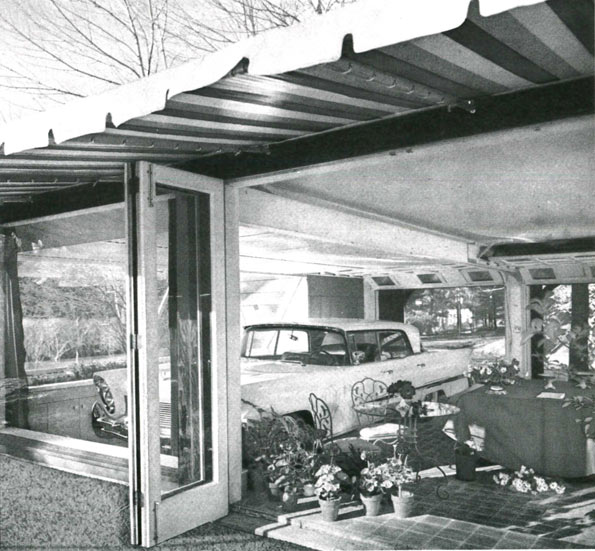
    In this midcentury era, planning and design began to be car-based. Residences were designed to show off the car, putting it out front for display – and some home plans even had tailfinned beauties in the living room


    Living Garage, photo from Populuxe by Thomas Hine

    Consumer goods were no longer accessed on foot; a new form of luxury consisted of driving up to the front door of a shop with parking in front. Front-loading houses and stores became unquestionably more efficient as a means to accommodate the new American lifestyle.

    Yet despite the auto-orientation, the architecture of this era retained the pedestrian scale and intimate feel that marked Main Street before World War 2. This both/and aesthetic marks the form of the 1940s and 1950s, with streamlined design styles like Art Deco Revival and materials like glass and stainless steel. Gentle angles suggested motion, and the theme of mobility was everywhere in the architecture.  Wider streets and lower, longer horizontal lines accommodated this theme and even today the architecture reinforces a feel of motion when driving past these structures.

    Modernism also formed a certain ethic. To be modern was more than a lifestyle choice; it was an acceptance of science, knowledge, and technology, free from preconceptions.  At the time, modernism elevated architecture above the style debate, and was considered even a shedding of styles. The politics of the time was similarly marked by Truman’s “straight talk”, and there was a shedding of rhetoric and posturing that lasted up until Joe McCarthy began once again a divide-and-conquer campaign against people.

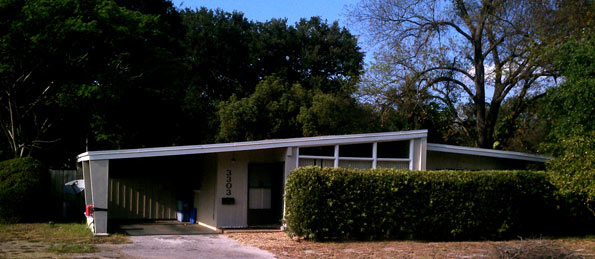
    Translated to the suburbs, modernism meant practical homes, without the adornment that marked Victorian architecture. Instead, modernist residences were marked by deep horizontals and large picture windows, providing a sense of openness that was a hallmark of modernist thought. Floor plans also were open, allowing free movement through space, rather than cutting the house up into cluttered little parlors, dining rooms, or nooks. 

    Today, midcentury modern design is fetishized for mass consumption in magazines like Dwell that emphasize acquisitiveness over ethics. But back then, the design meant something else, something cleaner and more powerful. In the 1950s, modernism meant consumption, but even more, the modernism defined the quest for the inner self and a new, forward looking outlook.

    By reducing modernism to a sofa style or wallpaper pattern, we risk losing all that this era stood for.  Buildings from the 1950s have sustained themselves through multiple recessions, the rise of the internet, cultural acceleration, massive city growth, and globalism. So perhaps they point towards a real definition of sustainability by having good bones and adapting through all these changes.

    The current millennial generation seeks a practical domestic situation, much like returning GIs. Most would prefer to reduce car-trips, but are realistic about this goal, given the range of their travel. Most in this generation see right through car-free living claims; more than one of my students, when discussing walkability, stated that “I’m not gonna lug my groceries even a block in this heat.” The battle with the car is chiefly about making the car more efficient, and less ubiquitous through the use of telecommuting and on-line shopping. It is not about removing it from the scene entirely.

    So as McMansions have swollen to represent a kind of architectural obesity, they have made many midcentury neighborhoods unfashionable, for typically these older homes have one parking space, often in a carport, not a true garage. They also are front-loaded, a much more efficient planning concept than alleys, but then the car becomes part of the front façade. Millennials have a hard time understanding what’s wrong with that. Again, as one 28-year-old student put it to me, “It’s just a house, after all…what’s the big deal?”

    Developers seeking first-time homebuyers, however, respond to the regulatory climate, which favors solutions like garages on alleys, big homes on tight lots, and neotraditional styling.  Bonus density and other zoning incentives rig the game in favor of this highly regulated development pattern, even in the exurbs.  Here in Central Florida, the development zone nicknamed Horizon West has been codified to enforce these form-based principles, with stiff permitting fees and a highly participatory government staff to keep things on the straight-and-narrow.

    Keeping prices low with all this overburden requires developers to cut the cost of the home drastically, likely reducing lifespan of components and systems. Ironically, the house meeting these tortured standards of today is less sustainable than the house built in 1953, with better bones and an adaptable floor plan.

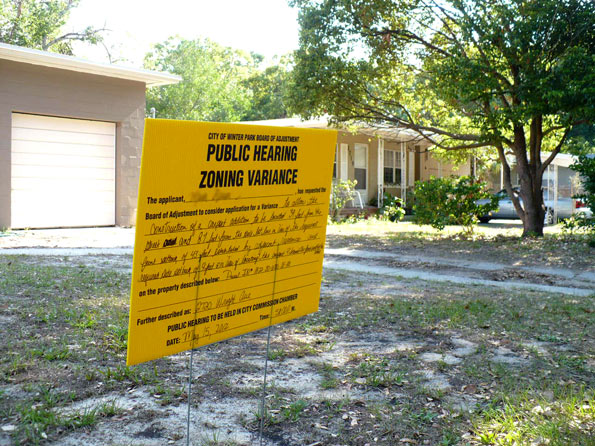
    Meanwhile, these 1950s neighborhoods are under attack for their very form. Cities, persuaded by planners to heal the effects of the car, cannot do so in a granular manner, so ordinances are passed  forbidding front-facing garages, or garages set back arbitrarily from the house front. These 1950s homes, with their carports, couldn’t be built today, and so are reduced to the status of heritage sites from a bygone era. In Winter Park, garages are banished to the rear on new homes, and if you are adding a garage to your midcentury home, it must be arbitrarily set back at least four feet from your front wall whether or not your lot can accommodate this arbitrary, and seemingly pointless, ordinance.

    Of course mid modern tours allow people to rediscover the essence of the 1950s, and these overlooked neighborhoods could be the springboard for a new era in modern planning.  Front-loaded neighborhoods can be successful when the architecture is designed at a human scale, and fine-grained integration of residential and commercial uses point to a future of home-office, cottage-industry, people-based industry once again.

    The Victorian era ended rather abruptly in the 1890s with a series of economic catastrophes that changed America’s middle class. Architecture switched to a more streamlined, Edwardian style – simple, flexible, and utilitarian forms that quickly gave rise to modernist design.  This current economic transition may well bode a similar outcome – design styles, often labeled “contemporary,” reduce the amount of architectural gingerbread and fussiness, reducing cost and maintenance, and may be favored by the coming generation for its cleanliness and utility.

    A new era that manages the car at a human scale, forgives people for wanting mobility and efficiency, and allows for contemporary exploration of style and design can and should inform new neighborhood planning. Midcentury suburbs, rediscovered by popular interest, can point the way to a middle ground between mcmansion-style subdivisions and neotraditional fussiness, and maybe even help us rediscover our confidence and faith once again.

    This essay is a summary of Richard Reep’s talk “Populuxe and the Atomic Bungalow” given at the 3rd annual Colloquium on Historic Preservation, hosted by Friends of Casa Feliz, Winter Park, Florida in April 2012.  Richard and his wife, Kim Mathis, hosted a midcentury modern tour in their own 1950s home for the colloquium.

  • CNU20: New Urbanism’s Young Adult Angst

    Possibly the most earnest folks in the real estate development industry assembled for the 20th anniversary of the founding of the Congress of the New Urbanism in West Palm Beach, Florida this month. Among the excellent accomplishments of CNU20 attendees: a credible car/pedestrian strategy, some fine looking new communities, and perhaps best of all, a body of hard-won knowledge about town-making for citizen education.

    Officially, CNU20 was optimistic and confident, but an undercurrent of negativism marred the event. More than one New Urbanist questioned the validity of what by now should have been a transformative movement. But the imposition of form-based codes and regulations on city growth has become a stress point in the movement’s evolution.

    Three hundred communities now boast New Urbanist town planning, over a dozen communities have adopted form-based zoning, and urban design schools are teaching the New Urban principles all over the country, facts triumphed during the opening plenary session. Form-based zoning uses a hierarchy of increasingly dense districts with defined boundaries, rather than land-use (or Euclidian) zoning to regulate growth. These principles are exquisitely defined in a model code nicknamed the Smart Code, which defines street width and sidewalk width, and provides fine-grained guidance on the form of a building on a given lot. Participants in early work sessions were taught how to work the code, and walked the hot, humid streets of West Palm Beach to interpret its many nuances and subtleties.

    In 2003, Downtown West Palm Beach was redeveloped, and it should be a proud example of the earliest New Urban efforts. Instead, conference participants spoke of the result with open distaste. The main outdoor plaza features a noisy fountain, which a group of attorneys, architects, and land planners belittled as “a mini Bellagio”; a pale imitation of the huge Las Vegas hotel’s water feature. Andrés Duany, one of the founders of the CNU, stated during the conference that “much of the architecture of the downtown zone was junk.” The movement’s most flamboyant spokesman, James Howard Kunstler, cited the “cartoonish, low quality finish of the buildings” as a failure. The distance New Urbanists have put between themselves and one of their finest achievements is dismaying.

    When not complaining about West Palm Beach, many practitioners wandered the somewhat sparse exhibit hall of booths sponsored by municipalities, attorneys, and consultants. Conversations often hit notes of personal suffering. Few new communities of any scale are being funded, so just as the supply of highly trained New Urbanists has hit the market, demand has dwindled to a trickle of infill projects here and there. Morale at the ground level was quite low, given the effort New Urbanists have put forth.

    Pedestrian-based urban form is a science that New Urbanists can offer to every community, and it has been a win for them where it has been implemented. Our monocultural vehicular transport model of car-dominated cities has made people work hard to carve out social space. The New Urbanist critique of the aesthetics of transportation is right on target. Armed with plenty of real data about how pedestrian environments work, New Urbanists have succeeded at softening the city and allowing pedestrians to compete.

    New Urbanists can also point to successes in the real estate market. In one study session, three single-family residential New Urbanist communities were analyzed, and the developer’s financial models were revealed. Each of the three communities fared better than their competitive set through the 2008-2012 cycle, in terms of net present value, appraisals, and foreclosure rate. New Urbanists claimed credit for this, although the affluent demographics and in-town locations tilted the plate in their favor. Still, New Urbanists have created a strong model that works for a segment of the population.

    Perhaps New Urbanism’s most potent contributions are to the art and science of traditional town planning. A solid body of knowledge that is based upon beautiful real places— Charleston, South Carolina and Savannah, Georgia, to name just two — now informs much of the theory behind place-making. We Americans are notably unsentimental about our cities, tearing down landmarks and whole districts in the quest for efficiency and betterment. New Urbanists have made it fashionable once again to care about history and good design, and our cities are the better for it.

    The CNU’s 20th anniversary marks a curious point in the life of this laudable and lasting movement. Because there isn’t any new development occurring, government effortshave turned towards adding form-based code overlays to existing cities. Already, Miami and Philadelphia have passed these codes to regulate growth. Many other cities like Orlando operate a standard zoning code by ordinance, while enforcing a form-based code as well. Property owners, developers, and design teams must now satisfy the intricacies of two local codes, rather than one, to get a building permit.

    While de-regulation is a term on everyone’s lips, this quiet up-tick in regulation has occurred largely under the radar screen. Those pushing for form-based code are largely consultants, who argue that the code will make for a better city by protecting us from ourselves. Municipal officials are amenable to, it, too.Both groups see the job security it promises them. Developers see profit if their communities can boast adherence to a strict code that promises a better lifestyle.

    Developers would normally scream loudly at any new regulation, no matter how trivial, but they are passively allowing form-based code because of the effect it can have on their bottom lines.
    If these codes tend to increase cost, well, the financial investors don’t complain, because the more money that’s borrowed to complete these structures, the more interest income they earn. So — form-based codes benefit all the interest groups that advocate their implementation.

    At CNU20 we witnessed the coming of age of a new regulatory regime. Place-making, once an activity trusted to individual citizens, has become codified; a vision enforced by authorities and interpreted by high priests who have special training to understand how to make a proper city. Maybe we have so abused our power as individuals that we deserve to have this power taken away. Perhaps our city form is so ugly, and so dysfunctional, that we cannot rescue it without serious intervention.

    Or, perhaps not. The American Dream is not about freedom from sprawl, as suggested in the movement’s seminal manifesto, “Suburban Nation”. Rather, it’s about freedom to choose. New Urbanists might be able to provide this freedom within the confines of a new institution, the Smart Code, as long as the Smart Code produced good results. But if the critique at CNU20 of their own Downtown West Palm Beach is any indication, the Smart Code ain’t so smart after all.

    American town planning needs less regulation, not more. Let’s use CNU’s body of knowledge to educate citizens and provide a path forward, not with the manacles of a new code, but with the freedom to create a new urban form that suits the lifestyles of the 21st century.

    Flickr photo by Eric Alix Rogers, New Urban, in Six Corners, Chicago. New houses, all facing a common sidewalk, with garages on alleys behind. Off of Kilbourn, just south of Irving Park.

    Richard Reep is an architect and artist who lives in Winter Park, Florida. His practice has centered around hospitality-driven mixed use, and he has contributed in various capacities to urban mixed-use projects, both nationally and internationally, for the last 25 years.

  • Gary Hustwit’s “Urbanized” Re-lighting Debate on Cities

    Gary Hustwit’s new film, “Urbanized,” is the third in his series of documentaries concerning design.  In his first two films, he looks at consumer product design and the global visual culture.  The existential problem of the city, an urgent one about which much of this website is concerned, is scarcely treated in our contemporary mainstream, and Hustwit’s effort is laudable. In this film, he tackles urban design, introducing ideas about how cities should – and should not – accommodate growth.  “Urbanized” tends to favor the big idea over the small, and airs the conventional wisdom of the urban design community.  In doing so, he brings to the public an important debate, but he misses some opportunities to explore change in the urban realm.

    In a visual feast of a film, interlaced with intriguing interviews of some of the luminaries of the 21st century design culture, “Urbanized” makes a case for elevating the environment to the same level of concern as architecture and mobility.  The documentary tends to reinforce, not question, notions of right and wrong growth that are promulgated by the urban intelligentsia, and he declines to explore the validity of most of these notions.  He also tends to focus on large, dramatic solutions to the urban growth dilemma, perhaps because they make for good cinema.  Flashy red Transmilenio buses in Bogatá; NASA-like control centers in Rio de Janiero; and Green Party clashes with the police in Stuttgart all imply that heroes must be at work to keep our cities livable and inspiring.

    To his credit, Hustwit does show local and small changes that are taking place in cities like New Orleans and Detroit.  He interviews urban agriculturalists, conceptual artists, and folks who spray-painted a graph of their power consumption on their street in Brighton, England.  Small moves like these are important, and tell us about how people are coping with unique urban challenges today.  But these stories are background to the larger profile stuff happening elsewhere on the globe.

    In Santiago, Chile, “Urbanized” shows the viewer how affordable housing is being developed on highly desirable land close to jobs.  The architect interviewed potential residents, giving them a choice between a water heater or a bathtub (all chose the bathtub, preferring to save up for the water heater).  Recognizing employment value over land value is exactly the kind of brave step that is much needed in our cities today, and this project provides a bold experiment to watch in this regard.  Even bolder is the strategy that assumes people, through their own devices, will prosper and increase the value of their home on their own – save up to buy a water heater, for example.  The documentary provides an interesting glimpse into an alternative approach to housing in this segment.

    Of course, no moviemaker could expect a good reception to a movie like this without paying homage to New York City, and Hustwit delivers us affectionate portraits of the Big Apple at the beginning, middle, and end of the film.  With the recent transformation of the city’s old elevated rail bridge, the High Line, Hustwit nicely showcases environmental awareness, historic preservation, and sustainability.  In a city that has effectively raised its hierarchy of needs to the ether, the issues of poverty and sanitation are worlds away.

    Which, in fact, they are in this film.  Over half the globe’s population lives in cities, so most—nearly one third of the globe’s population—live in urban  slums.  Hustwit exposes the pain of this reality.  Edgar Pieterse of the African Center for Cities describes the horrific conditions of urban poverty, and in Mumbai, architects discuss the government’s obstinacy in addressing these conditions in this famous slum.  Here, urban design is viewed as a strikingly pessimistic problem.  Density without modern technology violates basic hygiene and human dignity; and there appears to be no solution.

    The stereotype of Mumbai’s slums is reinforced, with a touch of Cape Town thrown in as well.  Yet, one wonders if the contemporary desperation of urban poverty in Western cities might be worth looking at, too; the vicious manner in which the Western poor vandalize their own city and strike out at their fellow citizens seems to be perpetually ignored, while the relatively mild behavior of the Mumbai slum dweller seems all too pitiable when viewed large on the big screen.  The poorest classes in the Western world, lacking access to education and upward mobility, are acutely aware of their neighbors’ material success, thanks to the ubiquitous media.  For fifty years, this tension has wrecked our inner cities, but has been ignored by urban designers.  “Urbanized” continues this trend.

    In the meantime, Hustwit interviews architects, urban planners, politicians, and academics who aspire to make cities walkable, compact, and connected.  Within this community, the car is deemed as a painful problem, and “Urbanized” takes us from Ebenezer Howard’s Garden City to modern day Phoenix.  The arc of the film begins with trains, and then showcases buses, cars, bicycles, and walking solutions.  By now, it is ritual to condemn the car and rejoice in the other options, and “Urbanized” follows this formula.

    Just as Mumbai is shorthand for slums, Phoenix is shorthand for sprawl.  Footage of traffic jams suggest that Phoenix is a worst-case scenario, even though the longest commutes by far take place in denser regions, such as New York and Los Angeles. Again, “Urbanized” does slip in a small, but important point, using Grady Gammage, Jr., a real estate attorney, academic, and political leader in Phoenix.  Gammage reminds the viewer that what is commonly labeled as “sprawl” is, in fact, the density level at which humanity has always dwelt.

    “Urbanized” serves as a timely milestone, bringing together voices and ideas that dominate our thinking about cities today.  While it deals with problems like the rebuilding of New Orleans, it also seems timeless by not mentioning some of the recent changes that affect our urban existence.

    The global recession cooled off the credit market, which has paused construction in all but a few places.  The impact this has had on our cities would be an interesting documentary to watch, for our built environment is much like a consumer product, as buildings go quickly obsolete and competition forces building owners to keep up.  Nimble private developers have already switched gears to repair and renovate; yet our municipal codes, fees, and processes are still geared to the boom.  This schism between private and public thinking is constraining our cities today.

    Affordable housing will sharply affect urban life in the near future, and western cities seem to be on a trajectory that increasingly looks headed towards Mumbai.  Ignoring the gap between the rich and the poor and heaping requirement upon requirement until prosperity is all but lost to the poor could negatively affect our cities.

    The last time city planning was earnestly discussed at the mainstream level was perhaps in Jane Jacobs’s heyday in the early nineteen sixties.  Since then, the arguments and theories seem to have been put away, having solved the problem at the time, and new solutions have not been eagerly considered. These solutions – born in the righteous indignation of Jane Jacobs’s – are a bit shopworn.  Much has changed since the 1960s:  Our population has increased by an order of magnitude; urban dwellers outnumber rural, and our image of the city has changed.  We acquired an internet.  It is time to take stock.

    The debate about how our cities will grow in the 21st century must reach the mainstream, and get out of academia and the professional specialists.    “Urbanized” is a timely examination of the problems of the city today – how to provide a sanitary and dignified urban form at the basic level, and how to inspire and rejoice in the sheer spectacle of the city at a higher level.  It has started to relight the much-needed fires of debate and conversation among citizens of cities today.

    Richard Reep is an Architect and artist living in Winter Park, Florida. His practice has centered around hospitality-driven mixed use, and has contributed in various capacities to urban mixed-use projects, both nationally and internationally, for the last 25 years.

  • Why Downtowns Fail and How They Can Come Back

    To many Florida developers in the last decade, downtown condo towers seemed to make a lot of sense. They were sold as the logical locale for active seniors and millennials, great affordable starter homes, and best of all, investments.  Reinvigorating downtowns became fashionable currency in many of Florida’s second and third tier cities. 

    Sadly, many of these new structures have turned into hulking shadows today in places such as Delray Beach, Tampa, and Orlando. Many of Florida’s core urban districts suffer the dark windows, unoccupied balconies, vacant storefronts and wide open sidewalks that signify the opposite of thriving urbanity.  Repairing this false renaissance in downtowns requires city leaders to see the central business district for what it really is: just another suburb needing attention to stay healthy, safe, and productive.

    Suburbs are heavily marketed by their developers with product launches, public relations campaigns and lavish sales centers.  Downtowns, on the other hand, produce websites, but rarely have more, relying instead on the desirability of a downtown address to fill up space.  Rental apartments in former condominiums are competing with the slickly marketed suburbs for people.

    In terms of buying, the suburbs are winning, with the more desirable single-family detached dwelling now suddenly affordable.  Suburbs are comfortable, safe, and familiar to most buyers.  Downtowns are seen as edgy, transitional, and alien to many people, but they are attracting adventurous renters and a few buyers here and there who want to create a new scene.  A scene is one thing; a stable social network and a feeling of safety and security is entirely another.

    What downtowns lack is the sense of neighborhood that many inner-ring suburbs have, and the outer-ring suburbs are effectively gaining.  Until downtowns start reinventing their identity, they will have a difficult time selling a sense of place among the empty lots and decaying infrastructure.  Touring the downtown residential properties today is like touring a movie set, with new developer inventory garishly contrasting with the older, grown-in building stock. Few dare to tread past the end of the fresh concrete sidewalk, and the urban infill efforts are sporadic and unconnected. But, unfortunately, this has always been the case.

    Central Florida’s downtowns have languished for years, raising the question of their reason for existence.  Competing with, and often losing to, suburban fringe developments like Westshore in Tampa, the decline of these downtowns began years ago.  Sanborn maps (fire insurance documents from the early 20th century) reveal that neither Orlando nor Tampa ever really had fully built-out downtowns.  Warehouses, garages, residences and small hotels have coexisted with empty lots forever in these cities.  While their potential has always been high, they have never realized it.

    Perhaps we ask too much from the current form of our cities.  Our urban core regulatory structure and property values are geared towards a level of development that never occurred, and might never occur, while the suburban fringe has no such constraint put upon it.  It is past time to think of our downtowns a bit differently, put aside our emotional ties to them as “centers”, and begin to look at them as neighborhoods.

    Compared to suburban tracts, Florida’s downtowns have a stiffer regulatory environment, with downtown development boards and aesthetic police to prevent all but the most deep-pocketed players from entering the game.  These citizen-led authorities may be emboldened with pure intentions, but they tend to focus on nitpicky, hair-splitting trivia.  Arguments about the size of a fence or the color of a stucco band seem absurd to most people who wonder when an empty lot might eventually boast thriving businesses once again.  Downtowns, with their guardians of taste, may be preventing the horror of chain link fence in the district, but are unconsciously slowing the growth of any real soul as well.

    Tampa’s “Channelside” expanded this city’s downtown eastward towards the Latin Quarter, Ybor City.  With one of Florida’s tiniest Central Business Districts at 1 square mile, Tampa saw grand marble bank lobbies go dark, repurposed to host blueprinters serving the local design and construction industry.  It was a post-apocalyptic experience to see industrial-size copy machines busy at work where a once proud bank traded money.  But such has been the fate of Tampa’s downtown, left behind by edge cities like Westshore and eastern fringe suburban development.

    The hard work of downtown redevelopment, however, took second priority to the easier work of condemning empty industrial warehouse tracts between Tampa’s downtown and its port.  Selling off large chunks to developers, Tampa created a new Channelside district, where a lovely two bedroom condominium can be had for $157,000 .

    Orlando’s downtown has no natural boundaries, but blends into 1920s historic neighborhoods, and it saw many condominium towers rise up as well.  Mostly rental units today, many of these have suffered through a phase when recent college graduates roomed together in granite countertop heaven, turning the luxury towers into post-college dormitories complete with drunken pool parties, busted drywall, and beer bottles littering the hallways.  Such behavior is characteristic of transitional residents, who have little investment in their surroundings and are for the most part barely past adolescence.  The downtown model isn’t working too well for adults, but it isn’t working too well for these post-adolescents, either.

    Downtowns would do well to reconsider their model, relax the beauty boards, and allow a greater variety of development, mixing in affordable residential ownership.  People who come to stay downtown for the longer term will be the ones who can turn them into neighborhoods. Currently, the downtowns of Central Florida only have business or commercial interactions, with a few still going to church downtown. The idea of a network of social interactions easily fits into a suburban neighborhood, where neighbors see each other, their kids play together, and they casually meet and converse. This model does not fit a downtown in Central Florida at the present moment.

    This function has to be transplanted into downtowns if they are to keep their relevance.  Rather than imagine the resurgence of the downtown as urban center – which never really took hold in much of Florida – cities need to realize that their next step is to start aggressively turning downtown into an alternative form of suburb.  Suburbs have consumer necessities like grocery and drug stores, conveniently accessible by driving; maybe in downtowns a bit of walking is OK.  Suburbs have consistent identities; maybe in downtowns a new set of sidewalks is in order.  Neighborhoods with loyal residents also have spontaneity and variety; maybe in downtowns the beauty police could give it a rest.  Suburbs have relative safety and security; in downtowns this must be provided also, and is non-negotiable.

    Such an idea may be anathema to many of Florida’s urban designers.  Yet, what downtowns need is what makes the suburbs so successful: safety, continuity, and ease of contact with neighbors.  Recasting a downtown as a suburb simply acknowledges the sense of neighborhood that most people now can only find on the suburban frontier.

    The exciting prospect of turning downtowns into neighborhoods may be the hard work of the next generation of urban residents. Achieving true neighborhoods again in the once-thriving cores of Florida’s cities means that the older building stock, mixed with the new, will begin to have meaning once again.   The heritage of these places and the stories these buildings tell is rich and vibrant. The ability to sustain them into the 21st century means that their contribution will not be lost.  Reintegrating our older centers with the rest of the city will make them some of the most interesting and varied places of all.

    Richard Reep is an Architect and artist living in Winter Park, Florida. His practice has centered around hospitality-driven mixed use, and has contributed in various capacities to urban mixed-use projects, both nationally and internationally, for the last 25 years.

    Photo courtesy of BigStockPhoto.com.