Author: Richard Reep

  • New Urbanism vs. Dispersionism

    The Florida real estate developer, unburdened of state regulatory agencies, may now focus his efforts on pleasing the investment community and the local market.  I recently played the role of real estate developer interviewing two consultant teams vying to help me create a new fictional community.  Fortified with readings in both the New Urbanist camp and the Dispersionist camp, each team of students pitched their method of community building to me. 

    The actual debate was very lively, with many rebuttals and some serious emotional engagement.  The premise:  I have a multi-acre greenfield property.   I have shortlisted my planning candidates down to two:  a New Urbanist team, and a Dispersionist team.  Each team must pitch their philosophy, and I will select one team to design it.

    Question 1:  Since I am only able to afford Phase 1, future phases will be left to future developers.  In your approach, can future generations be trusted to keep focus on high-quality development?  How would you guarantee that the property rises in value?  I asked the New Urbanists to go first.

    The New Urbanist team was ready:  As Master Planners, they will create the entire form-based vision for the property and design it around a smart code so that the future developers will obey a plan to keep property values rising.  No future developer will get to ‘cheap out’.  For this team, the Master Plan will guarantee a quality of life for all residents.

    The Dispersionists will plan Phase 1, not as a rigid image of a town, but rather as a response to the natural landscape.  This team said the community would grow organically, from its functional needs, guaranteeing  the freedom of future generations to plan their own destiny. They  scoffed at a Master Plan that determined the urban form.  What good is a guarantee of a quality of life, they asked, if future generations want something different than the Master Planner intended?

    This round, in my mind, went to the Dispersionists.  Their argument that future generations should have the freedom to plan based on their functional needs outweighed the seductive beauty of a Master Plan.  Too many Master Plans are implemented poorly, or abandoned due to their disutility based on changing needs and markets.

    Question 2:  How does your viewpoint deal with the car?  How will residents and visitors get around your community?  I asked the Dispersionists to go first this time.

    “Well,” replied the Dispersionists, “Americans love their cars, and we love the car too.  We’ll plan for sidewalks and bikes, but we know that the car is a necessity.  We know that a 5-minute walk isn’t so realistic in Florida’s hot, humid climate.”  The Dispersionists have a hearty regard for cars, and they spoke of long, sweeping curves and scenic drives.  They pointed out that most residents will need to drive to other parts of the city as well.

    The New Urbanists shuddered.  “We will plan for car-free living,” they stated.  With very clever planning, they intended to keep driving to a minimum, and will design walking trails.  One New Urbanist ventured 4-story parking garages, crowing that their proposal would not be littered with gas stations.  The New Urbanists pointed out the ugly commercial strips dominating our current city, and how little they want that to intrude into the new development.

    I liked this, and challenged the Dispersionists.  Isn’t it better health, and less use of oil, to reduce vehicle dependency?  The Dispersionists asked me why, in this ten-acre community, I thought I could attract residents with 4-story parking garages?  Good point, I thought.

    Both sides had good answers, and the question did not fully go to one side or the other.  Cars do tend to  generate a lot of aesthetic horror.  On the other hand, they are not going away anytime soon, so learning how to deal with them seems like an important task for a developer looking to the future.

    Question 3:  How would you distribute density in your development?  One center, multiple centers, and centered around what?  This time the New Urbanists went first.

    The core, they stated, will be in the center of town, and could go to 8-10 stories, leaving the perimeter a green zone.  In the center will be the government and institutional buildings, carefully matched with proper style.  The point, they said, is predictability. They pledged to learn from the failures of the past, and their Master Plan will account for the full scope of development.

    The Dispersionists suggested multiple centers.  “Phase 1 will be our first density cluster,” they said, “and we’ll see how it goes.”  Unlike the New Urbanists, they didn’t want to introduce all their product at once, in case the market changes.  “We believe in New England-style green space,” they said, and wanted to evolve the community around these.  They saw the vitality of the community coming from diversity.

    I asked the New Urbanists what they would do if the market changes .  When pressed, they insisted their Master Plan had plenty of contingency plans in case the original plan wasn’t workable, but it sounded like they were winging it.

    This is what  the Dispersionists saw as their own strong suit.  “We don’t have all the answers,” they said.  Their first phase would gently nudge the community in a certain direction, but it would leave future developers the choice whether to reinforce the first phase, or strike out and build another phase better suited to a unique need.

    I felt that this round went to the Dispersionists. 

    Question 4:  Do you think your development scheme can promote or discourage social values?  Why or why not?  This time the Dispersionists went first.

    The Dispersionists believed that one cannot engineer social values through urban design.  However, they can be influenced.  Conservation, for example, is a value that they would promote in their plan to conserve open space and not overtake the land with development.  A sense of community, they said, was another, giving people a loyalty to their community out of good design.  These, they felt, led to a sustainable plan.

    The New Urbanists guaranteed that conservation land would always be there, and pointed out the Dispersionists’ flexibility as a negative . The New Urbanists insisted that their sense of place would be stronger, because it would be designed.  People want predictability.  New Urbanists would engage people by walking and having front porches.

    The Dispersionists speculated that neighbors will get to know one another in a cul-de-sac just as well as they would if they all had front porches.  They also felt that the shared experiences of a community would transcend the particular style or form that community took.

    Although I gave this one to the New Urbanists, I was skeptical about  the New Urbanists’ implication that well-behaved buildings produce well-behaved people.  The Dispersionists’ view that a cul-de-sac breeds any neighborly closeness also seemed a bit disingenuous.  It was near the end of class.

    Question 5:  Give me your arguments why your strategy is sustainable.  I let the New Urbanists go first.

    For one thing, they said, they will have more efficient transportation. Vertical buildings save land, they argued, and people who choose this community will value open space more highly and be willing to live densely.  They believed that they will have less gridlock by de-emphasizing the car and will be more stable and socially cohesive.  All this will come from a well-designed Master Plan.

    The Dispersionists said  their community would start small and then grow.  Failures won’t cause dead zones, they claimed, because they are not sentimental about form and want a community that works.  So if a building in their development begets a failed business, the building will need to be reinvented to make it successful.

    “Yes, but,” countered the New Urbanists, “for every successful community like yours, there are 10 that have failed and ultimately decline in value.  What guarantee do you give that you will be the one out of ten?”  They went on to cite their successes – Seaside, Celebration, and so on.

    The Dispersionists noted that Seaside was a resort town and Celebration was heavily subsidized by a local employer, so those weren’t exactly good models.  In any case, they said, their community will appeal to a much broader segment of the population than the New Urbanists, and therefore more likely to sustain growth in the future.

    With that, the debate was concluded.  What lingers, however, are some truths that show both sides need to do some more work.

    The New Urbanists, fresh on the scene, seem overly evangelical in their approach, and demand a great deal of faith in the Master (Planner).  The slow, organically grown towns of which they are so fond were largely planned before the car.  While many of these towns, like Charleston, South Carolina, are sentimental favorites, their practical replication in today’s transportation-intensive, constantly changing real estate market is questionable.

    The Dispersionists, on the other hand, have been around for quite a long time, and are the modus operandi for much of the earth’s population.  They seem uninvolved in the aesthetics of the built environment, preferring to leave this up to individual taste, and the result is a rather shabby, cluttered contemporary American scene.  Some cleaning up is certainly in order.

    While the New Urbanists have a hopeful approach in this regard, they are overreacting to the vast consumer-oriented real estate development world that operated up until 2007, and are missing the fundamentals of how a real community works.  None are built around employers or economic producers in any significant way. None admit the lowest socioeconomic groups.  Content, perhaps, to dabble with shopping districts and farmer’s markets, New Urbanists have yet to offer what contemporary employers need – space, flexibility, and room to grow.  They therefore seem doomed to create peripheral urban designs rather than communities integrated with 21st century employers.

    Dispersionists would do well to pay a bit more attention to the natural environment, for the general public is quite aware of the toll that this strategy has taken.  Developers, having overbuilt in so many markets recently, will face tough opposition to bulldozing another woodland, given the empty real estate that exists in our cities today.

    It seems inevitable that dispersionist strategies will continue; they largely dominate our real estate development world and will continue to do so.  They make the most economic sense, they leave the future choices to the future generations, and they respond to people’s natural density tendencies.  One hopes that the New Urbanists will nudge the market a bit more towards aesthetic continuity and environmental stewardship as the next wave of growth inevitably begins again, and that the debate remains healthy, productive, and positive as citizens get re-engaged about the future of their cities.

    Richard Reep is an Architect and artist living in Winter Park, Florida. His practice has centered around hospitality-driven mixed use, and has contributed in various capacities to urban mixed-use projects, both nationally and internationally, for the last 25 years.

    Photo courtesy of BigStockPhoto.com.
  • Florida’s Quick Rebound

    Adding nearly 119,000 people in 2011, Florida has capped a decade of steady population increase  to see the state grow 19% since 2000.  Despite 2009, an historic year where more people left than arrived, the overall net growth of Florida has yielded two additional congressional seats, moving the state well on its way towards the becoming third most populous state in the nation.  This ascendancy brings new responsibility to the shoulders of the state’s leaders, and the direction this state takes in the coming years will depend upon how Florida reacts to this influx of new population.  It is time for true leadership to find appropriate voice for our state on the national scene.

    Contrary to the predictions of many within the urbanist intelligentsia, Florida’s farm counties grew the fastest. Osceola County, just south of bustling Orlando, grew by 55%; sleepy Sumter County, northwest of Orlando, grew by 75%; and Flagler County, home to historic St. Augustine, nearly doubled in population. Tampa, Orlando, and Miami have each seen their healthy share of immigration, but Florida’s rural areas have dramatically increased their appeal over a decade ago.

    At first this trend might be puzzling.  Lacking urban amenities such as museums, transit, and Starbucks, parts of rural Florida seem almost timeless.  Wildwood and Leesburg, nestled in the center of Florida, lack both beaches and theme parks.  They have one thing, however, that the urban areas do not have:  affordable housing.  And this is the elusive reality that must be turned around by Florida’s leadership if the state is to grow in a responsible manner.

    The Miami-Dade market has plenty of supply, but the average home lists for $509,000 .  Up in Wildwood, the home lists for $175,000, and you get a lot more house for your money.  People are voting with their feet for affordability.

    It’s not the price alone that seems to be putting people off, however.  Naples, which lists homes even higher than Miami, saw growth over the past ten years at a pace two and a half times that of Miami, and is expected to continue to grow at the same pace through 2015.  Anecdotally, it seems that newcomers have relocated to their vacation homes after selling off their other high-priced property, usually in the north. They sometimes reduced their expectations of what they can receive for their old houses and then permanently located where they prefer to live. If the buyers are older, they still likely made a nice profit over the past few decades.

    In Orange County, meanwhile, relieved realtors are finally starting to say goodbye to distressed properties.  Appraiser Lee Barnes commented that “foreclosures and short sales are 40% fewer, compared to this time last year,” and in an economy fueled by growth, the welcome sight of occupied rooftops means that commercial real estate is beginning to come back.  In fact, Orlando is near the top of the list in expected home price gains for 2012, a dramatic turnaround for the region.

    Florida’s comeback is timed with some key changes in regulating real estate development.  With state oversight all but vanquished by the governor, starving local counties welcome the property tax dollars associated with new growth.  No other revenue, apart from a sales tax, provides much cash to operate government in the Sunshine State. This makes growth a priority.

    But economic activity occurs in two forms:  growth (making more stuff) and development (making stuff better).  Quietly, in the past decade, Florida has added biomedical research clusters to its twin engines of growth and tourism, and this promises to increase greater resilience to the state economy.

    Some signs, however, point to Florida abandoning this strategy and continuing its boom-bust mentality.  The Governor, already warning the legislature of budget cuts in 2012, has expressed disappointment that the job creation return is poor on the State’s venture capital invested in bringing Scripps, Nemours, and other cutting-edge research organizations. He claims that are simply not adding jobs fast enough for his taste.  Abandoning these investments could mean that the organizations reduce their presence or even abandon the state.

    At the same time, Florida’s cities seem to be uncertain about how to tackle the problem of adding density without reducing affordability.  Land prices haven’t wavered much in the recession, with stubborn property owners holding on to assets that won’t sell, and they may benefit from this land-banking strategy in the long run.  Many who escape the Rust Belt and come to Florida express shock at the cost of living in the Sunshine State and are further dismayed over the quality of schools and surprising amount of congestion.  This mismatch between cost of living and quality of life may be part of the reason why Florida’s five largest cities were listed among the nation’s “saddest” in a recent Time poll .

    Casino gambling, a typical 1990s way to boost revenue, is being entertained by the Legislature, but other ideas should be considered as well.  For one thing, investment in the future means a better education system, perhaps a higher priority than ostrich food subsidies (currently exempt from state sales tax ).  Closing tax loopholes and fixing some long-broken parts of Florida’s tax code will help gain some badly-needed revenue.

    Very large infrastructure projects are also important to make Florida competitive.  On the east coast, NASA’s 60-year-old facilities need a major overhaul to continue providing America a spaceport for the 21st century and to pave the way for private space exploration.  This will maintain the deep investment in human capital of which Floridians were once justly proud.  The spaceport has a great deal of synergy with the National Simulation Center, located in Orlando, which is currently the country’s premier provider of military simulation and training.

    In more than one region, the Florida Venture Capital Act has brought world-class biomedical research laboratories, making dramatic advancements in cancer, diabetes, children’s health, and other key areas.  Already surging ahead and competing with area like Boston’s Research Center and the Silicon Valley, Florida must keep its edge in this field by continuing investment in the Venture Capital Fund.

    On the west coast, the Tampa Port Authority is already preparing for the widening of the Panama Canal, working in collaboration with ports of Mobile and Houston to partner with ocean carriers.  Continuing this investment and modernizing the logistics of truck and railroad traffic into the port is critical to make this economic engine prevail in the 21st century.

    Such infrastructure investment will improve Florida’s already existing assets, allowing for prosperity and upward mobility to occur within the state.  Competing with Texas will be difficult, given Florida’s lack of petrochemical resources, but the state’s native industry, tourism, has already made it a world-class destination. Florida’s leadership has already entered the national stage by saying “no” to high speed rail, but it has yet to define what it will say “yes” to.  Without intelligent citizen input, the state will likely fall back on its traditional pattern of being a passive receiver of investment and people, but not a creator of great new enterprises. 

    In contrast to states like California and Texas, Florida has been willing to be eternally passive; Disney World is a classic example.  Florida, a grateful recipient of this California enterprise, has benefitted secondarily, but the real power of this company still resides in Burbank.  This story is played out over and over again, with real estate developers from Dallas and Atlanta continuing to define the face of the state, aided and abetted by Wall Street investors who see Florida primarily as a waterfront real estate asset with some moderate margins available in between coasts.

    It is time for Florida to start doing, instead of being done to.  With investment in real infrastructure, good education and intelligent leadership, Florida can assume its responsibility as one of America’s new high-profile states, capable of exporting science, technology, and culture.  Our population growth contains within it the seeds of a bright future once we fix what is broken about our beautiful state.

    Richard Reep is an Architect and artist living in Winter Park, Florida. His practice has centered around hospitality-driven mixed use, and has contributed in various capacities to urban mixed-use projects, both nationally and internationally, for the last 25 years.

    Photo courtesy of BigStockPhoto.com.

  • Central Florida: On the Cusp of Recovery?

    Central Florida is poised at the cusp of a major turnaround, and its response to this condition will either propel the region forward, or drag it backward.  This cusp condition is brought about by a train and a road; neither of which have begun yet but both of which appear imminent.  Sunrail uses existing 19th century railroad tracks as a commuter spine through Orlando’s disperse, multipolar city.  The Wekiva Parkway completes a beltway around Orlando, placing it with Washington DC, Houston and other ringed cities.  Before either gets built, the region deserves some analysis on their combined effect, and how they can be nudged onto a pathway to make the region better.

    Sunrail brings with it mythology  about how trains affect cities.  In what has now become the standard, tired kabuki dance between developer interests and municipal ones.

    Not surprisingly, heavy regulation has entered the scene, with the avowed goal of creating dense urban pockets along even largely rural  train stops. This has sparked rising property values which may end up  frustrating the dream of transit-oriented development (TOD).  Affordable dwellings and meaningful employment within a half-mile of a train stop must be created in order to make this development work, but unless Central Florida can spark this, the new train will likely suffer from the same fate as the vast majority of its sunbelt counterparts:  low ridership and increasing tax subsidies.

    Inserting TOD into 17 locations in Central Florida is a bold experiment. In order for it to work, the rising costs of housing will need to be addressed, and Central Florida can take advantage of this ambition to succeed.  Orlando home sales are coming back, thanks to the mild climate and desirable lifestyle. That is very different, however, from guaranteeing that the economics of the rail commuter will make it worth discarding the single-family detached American Dream in favor of a relatively new model that has an unproven track record.

    Orlando also seems to be blithely going about the business of creating another ring of traffic around itself, descending into the same level where Atlanta’s Perimeter, the DC Beltway, and other like-kind roads live.  The Wekiva Parkway, long considered unneeded, is now being designed to complete the ring around Orlando, and will cross 25 miles of pristine wetlands that is a vestige of once-vast water resources of the region. 

    The Expressway Authority proposes this ring as an alternative to existing roads to serve the “growth needs of this area,” it conceded recently that this road segment made little economic sense except as a toll road accessing a new suburban single-family home development carved out of the swamps by one of the Governor’s chief fundraisers .  The asset value of this ring road may be more private than in the public interest.

    Traditionally agricultural land interlaced with wetlands, The Wekiva area to the northwest of Orlando has avoided large-scale Florida style bulldozing.  All this will change if the Governor is successful in eliminating water management regulations , freeing up much of Florida, including this corner of Orlando, for speculation.

    The local press, quick to criticize Alaska’s Bridge to Nowhere and always ready to jump on environmental issues, meekly ponders  the need for this $2 billion highway.  Maybe the elevated design, intended to be more ecologically friendly, makes it OK, despite the safety problems and high maintenance associated with this design.  Florida’s history is littered with the drawings of many other elevated highways eventually built on grade to save cost.  Once approved, the Wekiva Parkway may quickly be brought down to earth as well, displacing wetlands and agricultural land.

    The Wekiva Parkway will open up land supply which indeed will allow for more growth.  Done right, the asphalt will make land available that could be useful to the area’s economy.  It will bring traffic to historic, but presently lonely Sanford, potentially infusing the economy of this once-vibrant rail town.  Using principles of scarcity, land values could reflect people’s high desire to live in rural areas with all the services and guarantees that 21st century suburban life offers: fire and police protection, state-of-the-art infrastructure, and free pizza delivery.  It could invigorate neighboring towns that are currently struggling for survival.

    The risk is that such a road will simply allow more investment into Florida real estate without giving Florida much back in exchange.  Florida, already strained to meet its current population needs, should not simply trade another commercial strip for water resources that benefit many species and contribute to the region’s resilience. Rather, development models should emulate the best of America’s conservation development happening in states where water rights are scarce.  Connecting local employers with residential areas will enhance the value of both, and strategically keeping rural agricultural areas intact will preserve the region’s present land use diversity.

    Well managed development that conserves resources and balances broader needs with private interests will elevate the state’s prospects at this critical juncture.  One more bit of the original subtropical wilderness represents an asset for both present and future generations. With the right approach, the Wekiva Parkway can provide an enlightened model of low-density development that respects the value of open space.

    In town, Sunrail presents denser development as an alternative.  The normal pathway, however, seems to pit the profit-seeking real estate developer against ever higher regulatory burdens, which eventually make his product unaffordable to those coming here to escape high costs and regulations in other cities.  Keeping both employment and housing affordable are critical to achieving success with any of these projects.

    Moving product down the value chaindoes not do well current system, which leaves out the very people who Sunrail supposedly will benefit.  Density is one of those characteristics that seems to be about good timing: if you have it today, like San Francisco or New York, this is largely the result of history;  if you do not have it today, like Orlando, it is risky and probably a dubious proposition.

    The road and the train open up land that must be carefully stewarded to create opportunities for meaningful employment and affordable housing, both of which are presently scarce commodities.  The concept of transit-oriented development needs a success story, and Sunrail provides 17 opportunities to find one; meanwhile, the road presents a danger as well as an opportunity for Florida’s wetlands.  As the region slowly recovers from the recession, the two projects together should be carefully considered by the region’s citizens and leadership to truly redefine Central Florida’s identity for the 21st century.

    Richard Reep is an Architect and artist living in Winter Park, Florida. His practice has centered around hospitality-driven mixed use, and has contributed in various capacities to urban mixed-use projects, both nationally and internationally, for the last 25 years.

    Photo courtesy of BigStockPhoto.com.

  • Florida Gets Dragged Into the 21st Century

    Righteous cries of outrage and anger dominate Florida these days, as unreasonable assaults upon common sense seem to roll with regularity out of the governor’s office. Recently, Governor Scott   published a list of Florida’s higher education faculty, matching salaries to names.  This act was disingenuously styled as an effort towards transparency, but it was really a good old-fashioned right-wing poke at the eggheads. 

    Sadly, this does the Governor no favors, and reinforces the public’s perception of Scott as a reactionary Neanderthal with no heart or soul, perpetually on the wrong side of every issue.   Perception is important because Scott has done some very useful things:  cutting government, eliminating a bloated bureaucracy, stimulating private development, and questioning the economic benefits of all forms of higher education.  Unfortunately, he seems to cloak these actions in such vindictive, uncivil arrogance that the actions themselves remain mostly unexamined.

    The CEO-turned-Governor drove far-reaching budget cuts and deregulation, putting the state legislature into reactive mode, causing many to long for the days of milquetoast former Governor Charlie Crist.   The end result, however, was a budget that went down, not up, for the first time ever, an accomplishment that eluded Crist and his Republican predecessor, Jeb Bush.

    Along the way Scott also eliminated an entire state agency, the Department of Community Affairs (DCA). Some Floridians reacted badly, seeing their state stripped naked of its only protection against the large, out-of-state developers responsible for much of the economic growth in past decades.  While the governor claimed this move would allow towns and cities to determine their own destiny, no more protection from big brother could also mean that small towns, starved for tax revenue, will quickly cave to development pressure regardless of the broader consequences for property values.

    Taking out the DCA was a bold swipe at a bureaucracy that had seen its day come and go.  Established in 1985 to “manage” growth, the DCA failed to manage its own growth, encountered few real estate deals that it didn’t like, and guaranteed that only the largest, most deep-pocketed developers would prevail.  In this moribund economy, developers have yet to gear up for the next boom.  Instead, smaller, more agile players that meet more specific, localized needs are becoming more active.  Now that this large, lawyer-intensive burden is removed, small businesses may have a chance to compete.  Public outcry at large developments may, in fact, be more effective than an easily co-opted bureaucrat when it comes to land values and protection of sensitive wetlands.

    Scott also made national news by rejecting high speed rail between Orlando and Tampa.  Floridians, who were promised this by Barack Obama, were shocked and surprised.  The loss of this vision, along with the potential jobs that it created, was widely bemoaned.  Scott’s move set off a domino effect that has now come to doom the whole program.

    Federal rail programs, given a bad name by the quaint but inefficient Amtrack, make little practical sense today between Tampa and Orlando.  The distance is so short that the train would not be really high-speed in the true sense of the word; just as it reached its cruising speed, it would have to slow down again for Lakeland and other stops.  Missing some key stops such as Disney and lacking connectivity with other rail systems diminishes ridership, there was a real possibility that it would become a white elephant.

    Typecast as a hatchetman, Scott went against type this summer to fund central Florida commuter rail, and it looks like this 19th century spine running north-south through the region will soon be home to Sunrail.  At the recent panel discussion put on by the Orlando Chapter of the American Institute of Architects , “Sunrail” presented plans for 62 miles of track, complete with dreams of low- to mid-rise density clusters at various stops.   Perhaps figuring that the real costs won’t be known until after he is out of office (Sunrail will be 50% federally funded until 2019), Scott threw the region a bone that will create jobs to build and operate the trains. 

    Symposiums on the best way to develop around train stops are already being held.  Job growth and employment-related cluster development plans at least are being discussed. This is some rare good news for Florida’s development community, whether or not the rail system is capable of supporting itself financially .

    True to his form, however, Scott drew hisses for publicly disparaging anthropology, rhetorically asking the Northwest Business Association if it wanted to spend tax money to “educate more people who can’t get jobs in this field ,” preferring instead to focus tax subsidies on science, engineering, and technology.  The remark reinforces the public’s perception of Scott as a man with no heart or soul who seems bent on alienating – often unnecessarily – many whom he needs for support.

    His words mirror the country’s irrational political rhetoric and serve little purpose other than to inflame emotions.  Intent on making enemies with the media, his abuse of the fourth estate prevents constructive dialogue from taking place.  Fatigue at this rancorous rivalry is so high that Scott has become a big turnoff , and whatever he is associated with could quickly be undone the moment he leaves office.  

    It is important to recognize that Florida, under Scott and previous governors, has made strides in diversifying its economy by adding biomedical research through some shrewd venture capital investment.  The state is badly in need of evolving its education system to support these science, technology, engineering, and manufacturing jobs, in order to keep these employers close to home. Bringing Scripps, Nemours, and other research laboratories to the Sunshine State will mean little unless they are reinforced by curriculums producing graduates that will remain in these fields. 

    Scott can and should promote these ideas with a positive spin, mostly because we don’t want to repeat our 1990s experience with the entertainment industry.   A similar state-sponsored effort to bring the film studios was not coordinated much with education, so when state subsidies vanished, moviemakers quickly relocated elsewhere, leaving little trace of their presence behind.

    Scott’s actions have set changes into motion that will all have long-lasting effects in the state of Florida, if they are allowed to remain in place.  It is important for Floridians to realize these achievements and not be too put off by nasty words, nastily delivered. The important long-term effect may be that Scott, while dividing Floridians often unnecessarily, has begun to position the state for recovery.    When the wounds heal, the Sunshine State will emerge more nimble and less bound to institutions that did not serve it well, and will be better positioned to take advantage of the growth potential of America’s fourth most populous state.

    Richard Reep is an Architect and artist living in Winter Park, Florida. His practice has centered around hospitality-driven mixed use, and has contributed in various capacities to urban mixed-use projects, both nationally and internationally, for the last 25 years.

    Photo: Matthew Ingram

  • Can Florida Escape the Horse Latitudes?

    When it comes to the winds of change, Florida remains in the horse latitudes.  This zone of the Atlantic around 30 degrees latitude was so named by ship captains because their ships, becalmed in the water, seemed to move faster when they lightened their load by throwing off a few horses.  Florida’s governor Rick Scott, who campaigned on a promise to create 700,000 jobs in this state, appears to have adopted the same tactic by throwing overboard the Department of Community Affairs, the state agency that regulated real estate development.  Other bureaucracies may be next in line if the state doesn’t show signs of improvement soon.

    Billy Buzzett, appointed head of this bureaucracy, was in Orlando last week to discuss the new future of Florida growth management.  Growth will now be lightly monitored by the Department of Economic Opportunity , which is in charge of reviewing development plans, and will handle unemployment benefits as well.  Mr. Buzzett stated that the department’s mission will also include items such as weatherization of structures for hurricanes. All of this is good, but it’s a puzzling mix to throw into a single bureaucracy.  Obviously, real estate regulation is not the focus of this governor, who saw regulation as one of the chief obstacles to creating jobs in this state.

    The Department of Community Affairs was created in 1985 to set some standards for quality of life as well as for environmental protection.  Failing at both tasks, the DCA came under fire during the last election cycle as a statewide referendum (Amendment 4) on growth gained support from people tired of seeing forests converted into strip malls.  The referendum, narrowly defeated, would have people vote in Cailfornia-style ballots for such changes.  This may have been a bad idea, based on how California’s growth controls have stifled its once vibrant economy.

    In this era of minimal new building, the reinvention of growth management may be seen as a way to pass the time while we wait for the economy to recover.  In reality, however, there are some very large implications in the future.

    Governor Scott wants the state to be more like Texas, which regulates with a far lighter hand and seems to be navigating through this particularly horrid recession better than other big states.  Texas has growth and does not have an onerous, time-consuming process which weeds out all but the deepest pocketed investors.  Unlike Texas, however, Florida has few natural resources like oil and mineral wealth to fall back on for revenue, and therefore deregulates itself without any diversification of income stream.

    What this means to the local economy will be hard to predict.  Certainly, the DCA was able to negotiate with private developers, and helped to shield cities and counties from a lot of the pressure from out-of-state interests.  Without the DCA, it will be interesting to watch which of Florida’s regions stand up to this pressure and which regions, starved for cash, cave in to the pressures of growth.

    Although defeated, Amendment 4 clearly scared the real estate interests to death.  Legislation now prevents anything like that from happening again.  While real estate development clearly needs to be left in the hands of professionals, it also seems to have risen to the top of citizens’ awareness.  Whether it stays there or not is up to the state’s citizens, most of whom immigrated from elsewhere in search of the good life.  Growth benefitted the lowest economic class by creating cheap housing, construction jobs and access to consumer goods.  Florida, however, by grabbing the bottom tranche of workers, has missed a chance to build a more vertically integrated middle class with higher skilled workers.

    Orlando in particular is in an unfortunate situation, as it has no natural hard boundaries like the sea.  Like Atlanta, Central Florida’s metropolitan area can grow in concentric rings forever and ever, gobbling up more agriculture, wetlands, and forests.  Such a development pattern puts value on the rim, rather than in the center, leaving the older parts of the city devoid of investment, energy, and hope.  With private interests, whose mission is to grab the low hanging fruit, in chargethere will be little redevelopment of these interior districts, despite the sunk costs of infrastructure that could give them an edge. 

    Making more stuff is the business of growth.  Making stuff better is the business of development.  And development is what older neighborhood areas like this sorely need.  Successful in-fill redevelopment, in both suburban and urban locations, can still happen if employment can be added to the mix.

    It is up to our region’s leadership to turn this pattern around, and start valuing our real estate a little differently than in the past.  For example, debasing our wetlands to their mere economic value overlooks their larger value in terms of biodiversity.  Bringing wetlands and agriculture into our growth management policy would be a good first step towards creating a sustainable future for Central Florida.  Florida’s environmental movement need not turn into a shrill anti-growth machine as has happened elsewhere, but should be a partner with the real estate interests to protect the more long-term natural assets that bring so many to the Sunshine State in the first place.

    Recycling also need not be just the job of the utility department.   Recycling land through the EPA’s brownfield program is already underway by many municipalities, and provides a vehicle to reinvent neighborhoods that have failed. 

    As always, clean water will be the limiting factor to growth.  Already a concern of Florida, the state is divided into various water management districts, who regulate how clean water can be removed from the aquifer, and what kind of dirty water can be put into it.  No doubt this regulation will be under assault next.

    Without Secretary Buzzett’s new department, Florida is already showing signs of new employment opportunities and diversity.  Military spending in Florida is up, thanks to the National Center for Simulation, and medical research spending is continuing at a steady pace.  These were added to the mix of growth, tourism, and agriculture upon which Florida has traditionally relied. More jobs that revolve around these two industries will include support technology, computer science, manufacturing, and services. 

    These industries grew despite the regulatory burden of the state.  What is dangerous about Secretary Buzzett’s new department is its blasé treatment of the public’s genuine desire for better environmental management and a better quality of life.  Like many places, Florida has its share of “not in my backyard” sentiment reacting against more development.  The anger voiced in 2010 through Amendment 4, however, represented something new and deeper:  a collective sense that enough is enough.  Speculative development, built during the boom and remaining unoccupied to this day, is in every community, urban and rural.  Few believe that the empty condos, ghost town subdivisions, empty strip shopping centers, and vacant office parks are improvements over what was there before, and fewer still want this kind of insanity to return.

    So the death of the DCA, which allowed speculative development to the point of embarrassment, may have been a good thing.  Employment-based growth, which so far has eluded Florida’s regions, may now have a chance to take place.  With the new industries arriving, job creation is already a reality – no horses had to be thrown overboard to make that happen. What Florida needs now is some leadership at the local level to promote more employment-based growth that is slow, but sure, and that is sustainable for the long haul.   

     Richard Reep is an Architect and artist living in Winter Park, Florida. His practice has centered around hospitality-driven mixed use, and has contributed in various capacities to urban mixed-use projects, both nationally and internationally, for the last 25 years.

    Photo: Desiree N. Williams

  • Orlando: Uncle Sam Meets Mickey Mouse

    Hawks and doves disagree on whether World War II ended the Great Depression.  Depending on which species of bird squawks louder, military spending may be the only way out of our current financial malaise.  In many ways it is already happening, although it is a surreptitious and quiet influence felt mostly in the high-tech economic sector.  Defense growth in one of the most unlikely places – Orlando, Florida – has already begun to diversify the region’s income stream, create a new urban corner of Central Florida, and tap into some of the natural allies and partners that already exist here.  Mickey Mouse is now sharing Orlando with Uncle Sam as the militarization of the local economy increases.

    America’s current rough patch, as Dr. Roger Siebert recently wrote about , seems to be deeper than any in recent memory, and recalls the 1930s.  During that time, isolationism was only cured by a slap in the face:  Pearl Harbor.  Today’s isolationism, so vigorously voiced in the calls to depart Afghanistan, seems to echo that period.  Enlistment in the military isn’t exactly vigorous, and intervention in troubled regions is not on the radar screen of even the most ardent hawk.  America seems too self-involved at the moment to care.

    Yet at this very same time, Pentagon spending is quietly rising in the modeling, simulation, and training fields.  Already employing 53,000 Floridians, 9,000 more than the state’s hallowed agriculture industry, this growth sector is hugely dependent upon a high-skilled, high-wage workforce.  The ability to train soldiers, sailors, and pilots without the expense of actual bombs and equipment has clearly demonstrated its benefits to the satisfaction of the military brass, making it inevitable that more is to come.

    Co-located next to Florida’s premier high-tech medical research park, Lake Nona, the National Simulation Center is the most common name used to describe the efforts underway at the Central Florida Research Park on the east side of town.  More importantly, however, the Center is adjacent to the University of Central Florida.  Already the second largest university in the country, UCF is home to much of this Center’s local 18,000 workforce.   With Navy, Air Force, and Marines research and training, the Simulation Center has quietly become the world’s largest military simulator .

    Regionally, it leverages its old Naval Training Center roots and proximity to NASA facilities at Cape Canaveral to capture workers, skill sets, and continuous research and improvement.    While the town struggles with slumping tourism and anemic population growth, the high-tech military industry is rapidly taking over as one of the biggest new economies to hit Florida.

    Spinoffs from military research can only benefit Central Florida’s attractions and rides, as future tourists will be able to experience more and more virtual thrills in addition to more traditional meatspace rides and shows.   In the meantime, it remains a quiet partner in diversifying the economy.

    In the 1990s, the Naval Training Center left Orlando, ostensibly because it duplicated facilities that the Navy had elsewhere.  Its developable land, close to downtown Orlando, became Baldwin Park, and the old barracks, classrooms, and laboratories were quickly bulldozed for lucrative residential real estate.  Few were aware that the functions of the Orlando Naval Training Center were downsized, not eliminated, and were quietly relocated to the east side of town.

    The Training Center evolved into the National Simulation Center. As a research-intensive industry, it capitalized on its new proximity to the University of Central Florida’s campus, and began an interchange with the engineering and computer science programs at that school.  UCF, today with over 50,000 students, has quickly grown to become the nation’s second largest university, just behind Ohio State.  UCF’s own Research Park has grown to rival the fabled Research Triangle in North Carolina, due to the synergy between military and higher education.

    Its new location also moved the Training Center a little bit closer to the Kennedy Space Center as well.  The Navy has always had a presence at Cape Canaveral, and with the employee base around the Space Center available less than an hour’s commute away, the Training Center has already benefitted from the availability of this highly skilled workforce who has suffered from the ebb and flow of NASA’s political fortunes.

    Medical research being conducted by Scripps, Burnham, and Nemours will also benefit from this activity, as they are all building new facilities at Lake Nona.  This medical research campus will employ many with the same skills, education, and training as the Simulation Center, and provide choices for the scientists and engineers living in Lake Nona’s suburbs.  This makes the residential real estate around Lake Nona a bright spot in Central Florida’s otherwise horrendous housing market .

    Surrounding the Simulation Center, small companies have already started feeding creativity and innovation into the giant maw of the military, and spinoffs – commercialization of its technology – have also benefitted larger companies such as Orlando’s game design team at Electronic Arts and the military contractor Lockheed Martin.  This supply chain, once established in Orlando, gives localized sustainability to this industry and suggests that it has achieved a foothold among the tourism, agriculture, and growth industries firmly established in Central Florida.

    Geographically, East Orlando is difficult to develop.  Like the surface of swiss cheese, land above the flood plain, traditionally agricultural, is interlaced with wetlands and lakes, and it has been historically ignored for the broad swaths of low-hanging fruit closer to the theme parks and population centers on the west side of town.  Pressure to develop, however, has suddenly put this area in the spotlight, and controversial proposals by homebuilders and other owners have raised questions about whether Florida should stay on its historic pathway of man vs. nature.   Infrastructure – roads, utilities, and other unglamorous investment – still doesn’t exist in much of East Orlando.  Because development has historically been in small pockets fragmented by the area’s mosaic of wetlands, connectivity and sheer mass will be difficult to achieve without great cost to the environment.

    Yet this does not have to be so.  Dense development can happen with respect to nature, as proven by countries such as Germany and Sweden .  If left to the same old forces that developed the rest of Florida, it is unlikely that East Orlando will experience any innovation regarding development strategy, and Central Florida will host the same old battles of environmentalists vs. developers again and again.  The state’s growth strategy – leaving it up to private interests – may have already guaranteed this outcome.

    If, however, innovation transcends the research mission and influences the style of development to support this research, then the military and medical centers in East Orlando have a chance to provide a true, new pathway to the future.  Like Victor Gruen’s 1963 concept for Valencia, which recognized such modern aspects of society such as the car, East Orlando could be planned as an employment-based community within the context of nature using contemporary science and technology.  Orlando, the ephemeral city home to amusement parks and orange groves, could become a model for development to influence other areas struggling with the same questions.

    Militarization of the economy may become a vehicle for true change.  The cluster of military agencies and private businesses, headed by Lockheed Martin, all revolve around this economy and provide a badly-needed shot in the arm of Orlando’s workforce.  With high-salary, highly educated workers, global connectivity, and a growth engine no less than the Department of Defense, Orlando can be assured of some good times ahead while the tourism and housing sectors recover.  The region’s leadership must think carefully how to embrace this new savior, and what the greater implications are for the future.

    Richard Reep is an Architect and artist living in Winter Park, Florida. His practice has centered around hospitality-driven mixed use, and has contributed in various capacities to urban mixed-use projects, both nationally and internationally, for the last 25 years.

    Photo by Research Development Engineering Command

  • Condo Culture: How Florida Became Floridastan

    Welcome to Griftopia. The Florida housing industry needs a karmic rebalancing. Our recent roar of building new structures is echoed today by the squeaks and pops of a different type of construction industry. Invasive testing – the architectural equivalent of a biopsy – seems to be on the rise. Saws, hammers, and cranes can be heard through the quiet suburban developments and subdivisions around Florida, as shingles and stucco are cut off in small patches to reveal serious problems within.

    Like the hidden defects in mortgage-backed securities and other arcane instruments of finance, these flaws are covered up and papered over, but are no less damaging. They are also just as revealing about our collective haste to accommodate growth.

    Few other places saw as much suburban expansion as Florida did, beginning in the 1990s and lasting right up until the bursting of the 2008 real estate bubble. Old hands in the Florida real estate development game see the cycle as never-ending, stretching all the way back to Ponce de Leon, whose “fountain of youth” was perhaps the state’s first marketing gimmick. The most recent bust, however, provides important lessons, should future cycles include speculators and regulators alike feeding at the trough. Rapid growth breeds errors, compromises, and sloppiness which have dire, lasting consequences.

    Pundits are assigning blame for the Millennial Depression up and down the economic ladder, and certainly the Florida housing boom and bust provides many examples of all that went wrong. The largest developers, driven by stockholders and Wall Street to seek rapid growth and high profits, gambled that Florida’s population boom would last forever. With the good addresses already taken, “B” properties close to interstates, under flight paths and adjacent to sensitive wetlands began to see activity. Low density reduced the developers’ risks and reduced construction costs, as well.

    The Florida condominium – outwardly appearing as an apartment complex — was a home ownership product for the masses. As long as the product lasted 30 years (or however long it took to pay off the mortgage), no one much cared about its quality and stability as an asset. Anonymous, stick-built stucco boxes, baking in the Florida sun, seemed the perfect solution to meet the demands of stockholders and investors, and the regulatory pathway was smoothed over to keep the production line rolling.

    Immigrants from abroad and from other parts of the country bought their own piece of the American Dream: gated entries, warrens of tight garages, patches of St. Augustine grass, buggy-whip sized oak trees and tightly wrapped stucco and glass boxes. Balconies are common, although the tiny decks and the heat preclude much enjoyment of the outdoors. Designed to prevent neighbors from meeting or children to freely play, these contemporary cracker box condos sullenly sweat in the heat. Still, they gave a much-needed step-up for the vast service workforce looking for a way out of the rental market and into an ownership position, and buyers can perhaps be forgiven for overlooking the cheapness of construction in favor of a new way to prosperity and success.

    The demand, however, outstripped the ability to deliver. Design and construction delays simply due to over-commitment and lack of manpower meant that corners were cut, compromises were made, and slop was tolerated. It was as if the investment mania on Wall Street – in journalist Matt Taibbi’s words, “griftopia” – had trickled down to the field superintendents, masons, and framing crews. A collective haste gripped much of the state’s growth industry, haste that is cause for regret today.

    A ten-year-old stucco building may look to be in perfectly good shape from the outside. When entering the bland, beige entry hall, however, the tang of mold immediately invades one’s nose. Once water has been trapped in a building it breeds a most sinister fungus.

    Condominium units that suffer this malady are ascending the legal chain one by one across the girth of the state. First, individual owners collect themselves and confront their homeowner’s association. HOAs bombarded with complaints succumb quickly to “condo chaser” attorneys who promise to split the goodly sums they can rake off the insurance companies that covered the contractors and design professionals involved in the mess. And then, discovery begins.

    It takes about a week to vivisect a low-rise building. Ordinarily, the stucco walls are saw-cut down to the bone, and the plaster comes off in a solid sheet, revealing metal strap ties and sheathing tissue within. The sheathing panels themselves are made of glued together wood chips – so-called “oriented strandboard” – only as strong as the glue itself. Removal of the sheathing layer reveals the deep ligaments and structural bones of the building.

    Buildings designed in Texas, Ohio, Georgia, and elsewhere populate the Florida landscape. These buildings have almost no roof eave at all, as if the fierce Florida sun didn’t matter. The skin-tight stucco may not be Portland cement plaster, because dryvit (an acrylic latex substitute for stucco invented after World War II to quickly rebuild Europe) has become a popular substitute. The windows are set at the outside of the wall, with no shading at all on the glass. The effect is that the building looks as stretched tight as a balloon.

    Unfortunately, such a combination frequently admits water into tiny cracks and crevices, and the water has no way to seep out. Revealing the interior guts of a building is the only way to uncork mold and rust horrors that are otherwise invisible. Insidious ants wind their way into the dark spaces between walls and floors where water and food are available.

    Biopsies on sick buildings reflect our collective errors of judgment, and the healing process will be lengthy and expensive. Designs that do not reflect the harsh realities of Florida’s hot, wet climate are certainly responsible for some of the errors. Designs that did not acknowledge the scarcity of experienced construction crews were also responsible, because construction takes teamwork and skill. And contractors, encouraged to cut costs in order to boost their own bottom lines, cut time or cut labor to get the job done faster.

    Designers and contractors may also legitimately point the finger back at clients who pushed hard. A collective irrationality set in towards the end of the last decade. More work had to be done by fewer people, less experience was available to go around, and in the heat of the moment steps could be skipped in the name of innovation. The consequences are being felt only now.

    A huge, sad pile of lost resources, our vanishing wood and raw materials, must be hauled off to clean these errors out of the system. Sadder to see are the homeowners, as they pack up and move out of their mold-infested units. But saddest of all is the apparent inability of the industry to learn from its own mistakes.

    Let’s hope that this time around it can happen differently. Reject growth for growth’s sake. Florida, hooked on this drug for too long, deluded itself into filling up wetlands and paving more and more space.

    Instead, as the tide rolls in once again, Florida can make a pact with itself to invest in development, rather than growth. Redeveloping older, inner cores of cities where services and employment are already in place can go a longer way towards making the state a sustainable, diverse place to live than paving one more tract of raw land mowed down for home lots can.

    Revamp the state’s development culture. Private developers have written Florida’s growth management code, and gradually increased the requirements so that only the largest and most deep-pocketed developers can compete. Protecting neither the environment nor quality of life very well, the development regulations are in dire need of rewriting, with a different set of requirements that favor smaller-scale development and redevelopment, and encourage affordability.

    In the meantime, discovery continues. More leaky roofs, more fungus-infested units, and more attics seething with ants, testimony to our collective haste and greed. As the nation slowly recovers economically, Florida has paused for breath on the pathway to healthy construction. Before the next boom, its development industry would be wise to use this break in the action to consider the alternatives.

    Richard Reep is an Architect and artist living in Winter Park, Florida. His practice has centered around hospitality-driven mixed use, and has contributed in various capacities to urban mixed-use projects, both nationally and internationally, for the last 25 years.

    Photo by the author.

  • Can Common Sense, and maybe Mickey, Save Orlando’s Transit Mess?

    The week’s debate about high-speed rail has once again polarized our populace, inflamed irrationality, and sent everyone back to their familiar corners.  Little constructive debate is possible when major newspapers are flailing the governor for rejecting money and the seemingly global revolutionary fervor is gripping local citizens who rallied in protest Wednesday night around downtown Orlando’s Lake Eola.  None of this will do any good for the service workers trying to get to their jobs in the theme parks or for downtown cube dwellers streaming to scattered office parks. With or without light rail the city inches closer and closer to the traffic hell of Atlanta, or worse even, DC. After all, both cities already have large rail transit systems.

    What will do some good is a creative discussion of some real change that can occur to improve our commute.

    We must recognize that we are stuck with our cars.  They aren’t going away.  We can’t wish them away. We have to make them better fast, because with changes blowin’ in the wind and with oil jumping back up over $100 a barrel.

    The high-speed bullet train – a sort of latter-day interstate highway program – sounded like a great idea at first, a welcome alternative to the ardor of air travel and the gas-sucking monotony of driving.  It has shortcomings, however, it will likely prove obscenely expensive, and once one gets to the destination, one is typically relegated to more driving.

    Nor is this some form of effective industrial policy.  The things will be built overseas – Germany, Japan or most likely China –  a great jobs program for someone else.  And tourists, who vastly prefer the freedom of car rental and driving, aren’t likely to use it except as a novelty for one of their visits to our wonderful place.  Perhaps the bitterest part of the bullet train pill: it will indebt our children and grandchildren to pay off landowners giving up their land in eminent domain – which produces nothing – and the cost of complex machines made overseas. The bullet train ends up being a clumsy solution imposed from above, rather than a grassroots solution to our real problems. 

    Any frequent driver on Interstate 4 between Orlando and Tampa can tell you there are four basic kinds of traffic: tourists in buses or cars; freight, in the form of tractor-trailers: business travelers (who need the flexibility of a car on the other end): and personal travelers.  Instead of targeting an expensive solution at just the smallest form of traffic, personal travel, a 4-part solution is suggested, all of which would add up to far less than $2 billion that minimally the high-speed line would have cost.

    1.  Trains can be good – for freight.  There are already freight lines running between Tampa and Orlando.  Getting the freight off of tractor-trailers and onto these freight lines, where it is vastly cheaper to move goods, should be a no-brainer for the state.  Use some of the DOT money to modernize freight depots along the pathway, incentivize freight customers to move their goods onto trains, and this will vastly improve the situation.
    2. Tourists can drive – at a price.  Our state should be treat itself with higher regard and also encourage a culture of sustainability for those visiting us.  Higher taxes on rental cars should be charged, and the taxes placed in an environmental fund to remove some of the unsightly development that has defaced our region, and return it to the special place it once was.
    3. Give business travelers an alternative.  If there were an affordable air shuttle between Tampa and Orlando, at the right price it would be full.  Little Embraers (made in Melbourne, by the way) taking off from FBOs at Orlando Executive Airport, Sanford Airport, and Orlando International Airport and landing in Tampa airfields would be worth $100 a seat, if the time/cost tradeoff were analyzed.  Ybor City for lunch, anyone?
    4. Give personal drivers an alternative.  For the cost of less than 50 miles of new road, a totally independent alternative to I-4 is waiting out there.  The first link of this road would connect Tampa’s Crosstown Express to Lakeland’s Western Beltway.  The next link of this road would connect the Western Beltway to the Greenway at Celebration.   Drivers will be able to go from downtown Tampa to downtown Orlando without their wheels touching I-4 even once.  Nice.

    And now, for the big one.  Right smack in the middle of the white-hot I-4 corridor lays a large, private entity, Disney, has been operating a private, train-based mass transit system for the last 40 years.  High labor costs?  Yes.  Fossil fuel driven?  Yes.  This entity has been strangely silent over the entire debate.

    If this entity were to wake up and seize the opportunity before it, one might see a true train that works.  First of all, the monorail was planned with some sense: it connects dense areas together.   If Disney were to offer to build, as a private development, extensions of its monorail reaching out to Tampa on one side and Orlando on the other, the air rights for this system could be along government-owned I-4 (no imminent domain costs).  This entity is also highly encouraged to charge market rate and to make a profitable venture out of operating this system. And the taxpayers would not be stuck with the bill.

    A vision for transit between Tampa and Orlando needs to be truly holistic, taking into account all types of traffic connecting the two regions.  This vision also needs to be locally driven, taking advantage of local strengths and assets already in place.  The high speed bullet train does none of this.  Instead, a multi-faceted solution that provides flexibility at both ends, leverages our current strengths, and partners with the strongest player in the region has a chance of truly making a difference in the present tense and likely future budget climate  This is what sustainability is truly about, and is what our future generations deserve.

    Richard Reep is an Architect and artist living in Winter Park, Florida. His practice has centered around hospitality-driven mixed use, and has contributed in various capacities to urban mixed-use projects, both nationally and internationally, for the last 25 years.

    Photo by Joe Penniston

  • Maglev-Jitney Could Revolutionize Mass Transit

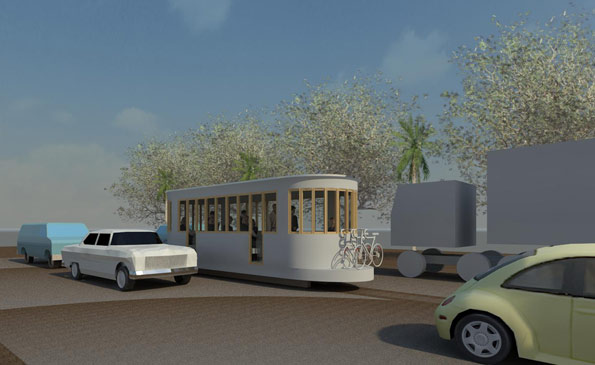
    Using EDS suspension developed in Germany with Halbach array magnets, mini-maglev jitneys are a new technology that could transform congested corridors of Orlando. The train car itself is small – only 8’ wide x 30’ long – and holds approximately 12 sitting people and 8 or 9 standing people. But the ability of the train to zip along the centerline of crowded arteries like 17-92 and 50, and future tracks along secondary strips within the region, could give people a new way to travel.

    Silent, with no moving parts, the electrodynamic maglev can ride along a guideway buried in the center of the road. Depressions for the jitney’s levitation magnets are shallow enough to drive over, making maglev tracks no more an obstacle than railroad crossings. Within cities like Portland, electric streetcars with clicking and buzzing pantographs are the norm, and drivers, pedestrians, bikers, and buses all coexist within a narrow public street. Here in Orlando, the pantograph, exposed to hurricanes, would be a liability, and the maglev instead presents a safer, more reliable transit system of the future.

    How does it work? The train rests on tires at each stop, but as it accelerates past walking speed, powerful permanent magnets in the chassis lift it up off the guideway. Solid magnets in the guideway present an opposing force (really, the same pole is offered to the jitney’s undercarriage, pushing it forward and away). Electric power is present only immediately underneath the vehicle’s footprint, making the guideway a benign, inert force within the busy roadways in the city.

    The car itself is a “smart” car, with no driver needed – a GPS-controlled computer stops and starts the car, with motion detectors delaying it briefly while passengers get on and off. As the car glides along, the photovoltaic roof powers the car’s air conditioners, lights, wi-fi system, and other devices. If the car breaks down, it simply comes to rest on its wheels, and it can be towed to safety within minutes.

    But maglev technology, already in use for decades in France, Germany, Japan, and China, is already outstripping older technology in safety and reliability. These older systems went for speed, making for very large, heavy trains travelling in excess of 300 mph.

    The mini-maglev, by contrast, will feature headways within minutes of each other – if you miss one, another will be along in 10 minutes or less in peak times. Bike racks in front and back allow you mobility once you reach your stop, and since they are designed for short trips, the cars are designed for standing as well as seated passengers. A full 360◦ glazed car will allow views in and out – making the trip pleasant, safe, and enjoyable.

    Whispering along at conventional traffic speeds, mini-maglevs offer the busy commuter an option that is convenient, reliable, and beautiful. These jitneys are life-enhancing features that will set Orlando apart from other cities in terms of sense-of-place. Neither a 19th century train nor a 20th century bus, the mini-maglev borrows a transportation concept from the islands – the jitney – and recognizes our region’s multipolar, fine-grained circulation system already in place. Instead of fighting this system with a heavy steel-wheel rail system on 19th century rails like Sunrail, it simply enhances existing corridors.

    Jitneys roam many Caribbean islands, gathering workers around the villages and transporting them into the resorts and the towns in packets of 10 or 15 passengers a vehicle. Frequent stops make them more like large-scale vanpools rather than small-scale buses, and they act as the connective tissue among the spread-out villages and settlements in which islanders dwell.

    The spirit of the jitney is transformed by 21st century technology into a transit system serving the needs of a spread-out, dense region like Orlando. Let’s face it: while driving, we are highly tempted to chat on the telephone, text, or do many other things other than drive. Waiting at red lights or stopped in traffic jams, the pleasure that once was driving has now receded all too frequently in favor of frustration, anger, and fatigue. We sense the lost time behind the wheel, seeking to make up for some of it with mobile communication, but this has an external price to pay: the driver ahead misses the green light because he is texting, making your trip longer as well.

    In the mini-maglev future, the distance and time are unchanged; what has changed is your freedom while you travel. Getting there will be fun again, and arriving in a mini-maglev jitney will be the new way to make an entrance.

    Electronic Jitney farecards will make paying for the ride super-easy, and if you have any question about the route, timetable, or stops, fear not: your smart phone app will show you where you are going, where you want to get off closest to your stop, and map out how to get there from here. It will also helpfully show you what is coming up along your path: A library, your friend, a Starbucks…

    And, for frequent riders, a feature long desired by mass transit commuters worldwide: on-call jitneys. Frequent riders will be able to electronically request a jitney at their desired stops, making these computer-controlled cars come to you. Getting off work late no longer means a lengthy nighttime wait for a taxi, or the next bus not due for another hour. You can request the car, and the farecard will give you back a message instructing you when and where to show up. With computer-controlled routing, mass transit is now more individually customizable than ever.

    The mini-maglev jitney, combined with personal electronic systems, transforms mass transit from a Victorian burden on cities into a sexy, hip way to get where you need to go.

  • Pimp My Stripmall, Please!

    If anything characterizes the face of Florida’s landscape, it is the proliferation of shopping malls of all types. Generation by generation, as population swelled, country roads widened into highways and each intersection seemed to blossom into four parking lots framed by strip centers decorated with small, freestanding stores and restaurants. These malls represented the prosperity of the American middle class. Now that consumerism has slowed and been rechanneled online, new malls aren’t being built and the existing ones are looking a bit dog-eared, with shuttered stores, empty parking lots, and aging facades. Repurposing the American mall is a huge opportunity waiting for the right moment, and represents an opportunity to heal much of Florida’s economic stagnation.

    As the car culture rose after World War II, malls – convenient places that fit our newly prosperous lifestyle — rose as well. Thinkers, sentimental about the hard work that went into an organic, localized Main Street were largely horrified at its replacement by strip shopping centers and regional shopping malls. Yet this growth continued unabated, and while the debate over the mall’s moral stance raged, the building type continued to be a popular investment vehicle. It became codified and regulated into a more and more complex, layered experience, dominated by traffic and parking, manipulated by industrial psychologists, and fine-tuned by mall managers so that the best possible presentation of goods was made to the consumer.

    The consumer was unsentimental about the architectural debris that was left in the wake of the flight to the suburbs. As old village streets saw local businesses shuttered, cries of “Too hard to find parking” and “Why are your prices so high?” echoed on their sidewalks. Purposeless old Main Street: The lucky ones became tourist destinations, filled with chocolate shops and art galleries. Here in Central Florida, the lucky ones include Mount Dora, Sanford, and Ybor City, where parking lots and garages have been surgically inserted into the back alleys, a rigorous code enforces the form, and hand built architectural details from America’s Victorian era still surprise and delight.

    The consumer will continue to be a strong component of the American middle class, and no doubt many malls will continue to thrive. Florida’s oversupply has attracted tremendous attention, and repurposing raw space could become a creative new way that cities will grow. Winter Park Village, a 1960s indoor regional shopping mall, was cut open and now features a mixed-use shopping, dining, entertainment, and residential space barely resembling its former self. Metro Church in Winter Springs occupies a former Belk-Lindsey department store, with church-related functions occupying what was once a general lease area. Full Sail University in Winter Park is largely housed in converted strip centers as well. These conversions are not unique to Central Florida, and will likely continue into the future.

    The biggest opportunity, however, seems untried as of yet in America: manufacturing in a mall. Production, much more than consumption, creates jobs, and the raw open space of old retail sites can be easily converted into industrial uses. Geography is in their favor. Malls were typically built if at least 3,000 surrounding households could be found to support them; today these households could provide labor, instead of cash, to the right investor looking to onshore a product.

    Aligning industry with opportunity seems difficult on the surface. Manufacturing investment abounds in relatively unregulated India, but with the huge sunk costs that American industry already has, startups and expansions seem to be nonexistent. Turning this around would require a fundamental shift in American culture, allowing us to think of ourselves as producers once again. American know-how hasn’t vanished; rather, it lies dormant underneath the heavy regulatory burden, and under the high barriers to entry that our manufacturers created in their quest to be the largest and to shut out competition.

    New products are being created every day… overseas. If investment isn’t coming from within America, perhaps the right NGO sponsoring microloans could be tapped to consider the broken, declining landscape of suburban America to reinvigorate our natural American creativity and give small scale capital access to startups. Selecting the industries that we want to have, re-onshoring them, and producing things people need would once again provide jobs, diversify the local economy, and create the kind of upward mobility we once counted on for the American Dream.

    And the physical plant – one of the biggest investments that a producer makes – is already there. The regulatory burden of redevelopment, shouldered by the initial developer, should be minor at best, depending on the quality of the infrastructure, which would speed a conversion into reality. At a time in Florida when growth is on pause, the redevelopment of existing assets is likely the most favored way to provide economic expansion and pull Florida out of its nosedive.

    Mall redevelopment would please the environmental movement, as well. Huge swaths were cut into the Florida wilderness to make way for retail, with nary a peep from environmentalists in the eighties and nineties. One of the tenets of sustainable development is to confine construction to areas that are already strongly modified by human activities, and repurposing abandoned space fits this mandate to a tee.

    Florida, with its abundance of unused retail space, has an opportunity to become a leader if it can attract the right kind of investor. India, with all its problems including ethnic strife and the lingering caste system, is certainly not waiting for opportunity to create its own future. China, with its authoritarian regime, has surged ahead in terms of entrepreneurial spirit that seems sorely lacking in America at the present moment. Seeing gold in a dead strip mall may seem farfetched, but out of opportunities like this we can reinvent our own future and fuel a renaissance of the American dream, one mall at a time.

    Richard Reep is an Architect and artist living in Winter Park, Florida. His practice has centered around hospitality-driven mixed use, and has contributed in various capacities to urban mixed-use projects, both nationally and internationally, for the last 25 years.

    Photo by Clinton Steeds: Phoenix Village Mall, Ft. Smith – Bench at Back Entrance. The photographer writes that it was the first mall in Arkansas when it opened in 1970, adding, “It has so far failed to live up to the “Phoenix” part of its name”.