Author: Richard Reep

  • Can Sacred Space Revive the American City?

    By Richard Reep

    During most business downturns, nimble private business owners search for countercyclical industries to which they adapt. During this business downturn, the construction industry finds itself frantically looking for anything countercyclical. Private construction, almost completely driven by the credit market, has stopped, and public construction, driven by tax revenue, has also stalled. Religious institutions, however, seem to be continuing incremental growth and building programs, giving evidence to some people’s answers to spiritual questions being asked today.

    Christian congregations surged in the 1990s, building megachurches in mostly suburban neighborhoods throughout the country. In some cities, mostly in the South, the urban megachurch also became common. Fundraising for these followed patterns that made lending a fairly straightforward risk; many were financed by a combination of patron contributions and lending from local or regional banks. By the early part of this decade, the growth of megachurches was a well-established pattern, and had become a sophisticated niche within the booming development and construction industry, as reported by Forbes Magazine in 2003.

    Churches seem to remain one of the few work sectors for construction firms, architects and planners. This comes at a time when there appears to be very little new development, either private or public in Central Florida. Even small private projects that were funded by cash or private equity have been postponed or cancelled, as the money sits on the sidelines. Yet Christian churches continue to expand, forcing them to accommodate the needs of their worshippers.

    Unlike in the past decade, much of this expansion is taking place in smaller congregations, and is funded mostly by donations, pledges, and bequests. “Our church task force is looking at creative ways to raise money for facility expansion,” commented Scott Fetterhoff, President of Salem Lutheran Church. “We have to have faith however that our congregation, and those looking for spiritual growth in a society with eroding values, will support worthwhile causes.”

    Fetterhoff also displays a very worldly sense of pragmatism. ”Our expansion and outreach program will simply adjust to fit the available budget,” he adds. “On the bright side with a construction industry looking for work, that might allow us to do more for less.”

    This is one example of several recent interviews with local church leaders who are considering a construction project, and all are echoing similar themes. Salem’s expansion includes new classroom space which seems part of a growing interest to provide flexible multi-purpose space for church-based education and community use – largely in lieu of public education. No one in Florida can ignore the continuous stream of news reports of its legislature’s continued reduction of funds for Florida’s public education system, and many in Florida are trying to find alternatives for their children.

    Salem’s decision to expand is emblematic of other stories in the region. This incremental growth may signal a consolidation of sacred space into people’s lives, as we cope with the changes in our secular, consumer-driven culture. Salem Lutheran, and others like it, use the general uncertainty of our economic times to re-focus on faith based relationships. This is a true grass-roots trend.

    On a larger scale, the evangelical movement continues to encourage church construction on a more global, top-led basis, in what is termed “church planting” by its leadership. The surge of interest in nontraditional forms of churches in the Western Hemisphere is well-documented and remarkable, as this Christian movement is supplanting traditional denominations, particularly Catholicism. Religion remains formidable in America, but much of it reflects more of a shift from one form of Christianity to another.

    One organization, Capernaum Ministries, is developing a retreat for Christian pastors and ministers to provide leadership training to church leaders. Its founder, Jim Way, sees his mission as creating “a laboratory for building effective relationships between leaders of various denominations and independent ministries.” Way, a minister and founder of Capernaum Ministries, has affiliations with over 3,000 churches. “I see this as an opportunity to study, and solve, the problem of how the decline of the denominational church influence is affecting American culture”.

    As cities have grown in the past several decades, the well-documented lack of sacred space has been notable as governments meticulously avoid any tangible form of religious expression, and mainstream religions find themselves in retreat. While public space in American cities has always been constitutionally secular, sacred space usually evolved with the development of cities, towns and neighborhoods.

    Sadly, this has been missing from private development for some time. Church growth in the suburbs usually occurs after the fact, not as part of a planned community, for developers are loathe to forfeit profits on a choice parcel of land.

    Church building has historically been a narrow niche market avoided by most design and construction professionals who have preferred more lucrative building types, like hotels or hospitals. If one believes in the organic model of city growth and development, this has been a serious deficiency.

    But now, amidst lower costs for construction and more need for their services, some congregations seem to be taking stock, making plans, and acting. Salem Lutheran, like many, has members who come from the design and construction industries. These congregants know how to efficiently deliver a building, and are offering these skills to their congregations, while their regular businesses sit idle.

    Whether global or grass-roots, the development of sacred space will need to overcome the substantial obstacle of financing, difficult in the best of times, using new means and methods. Nontraditional means including volunteer labor, outright donations, in-kind donations, and bartering will bring costs down to more affordable levels. As projects are realized, alternative practices to achieve affordability could result in interesting innovations.

    If the current economic crisis begs some larger spiritual questions in people, then there may be a countercyclical trend towards investment in sacred space. Faced with lowered expectations and a lost sense of prosperity, people naturally long for some aspect of their lives that transcends the material. Church building, however incremental and small, demonstrates that sacred space is important to enough people to do something about it. Their actions speak loudly in these uncertain economic times.

    Richard Reep is an Architect and artist living in Winter Park, Florida. His practice has centered around hospitality-driven mixed use, and has contributed in various capacities to urban mixed-use projects, both nationally and internationally, for the last 25 years.
  • Financial Crisis Boosts Local Markets

    By Richard Reep

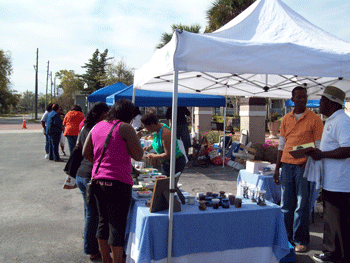
    The current economic crisis has many mixed impacts, including the shift of grocery customers to low-cost companies like Wal-mart. Yet at the same time we see a shift to local, community markets in an effort to cope with the new economy. While the global players deliver discounts due to their enormous volume, local community markets offer low-priced produce, goods, and services due to their microscopic volume. This common ground between individual efforts and enormous buying machines yields an interesting treasure trove of passion and hope.

    As folks cope with financial turmoil, their choices for purchasing venues seem to be driven by the need for saving, as well as the need for a good experience. The middlemen, such as the regional and national chains, seem to be squeezed in between truly global players like Wal-mart, and the rising tide of localism appearing at a grass-roots level in so many communities.

    The rise of these small, open-air markets is an encouraging sign of authentic social interaction, after so many assaults upon our social network by the forces of the Old Economy. It suggests a new role for local entrepreneurs and for the revival of community spirit. At these local markets, producer and consumer traffic in direct interaction, without the army of marketing consultants, business analysts, merchandisers, industrial psychologists, and the rest of the hangers-on who have transformed the agora into an often dispiriting and uninteresting shopping experience.

    Now, with the Old Economy in shambles, the New Economy appears to be reviving the community element to our American commercial culture. Even a few years ago the Farmer’s Market was considered an anachronism, something found in rural areas and overlooked by cosmopolitan city dwellers. The fact that these are rising up in our urban and suburban culture speaks to our need for freshness, for authenticity, and for some spontaneity.

    In Central Florida, the Winter Park Farmer’s Market is perhaps the grandfather of the Central Florida market scene, having started sometime in the eighties. No one at the City could remember exactly when it started. Ron Moore, Parks and Recreation Assistant Director now manages the market, and he laughed when asked about its success in a recent interview. “Consulting to other municipalities who want to start up their own markets is a part-time job”, said Moore, his latest effort being Eatonville, whose inaugural Community Market was an exciting event.

    Markets on public property are an important trend in our cities, for they signal the revival of public space. All too often public space has been defined by soulless plazas, many of which are deserted most of the time. But, with the rise of the public market, the classic agora has been revived in Winter Park, Maitland, Downtown Orlando’s Lake Eola, Eatonville, and elsewhere in Central Florida.

    Mr. Moore stated that the Winter Park Farmer’s Market’s summer season is typically the slow time, but last summer was their best one ever, and this winter has been the highest attendance ever, with a waiting list of merchants to get in. He is fine-tuning the mix using common sense, watching people flow and traffic flow. This reflects a locally based entrepreneur who is all instinct and good listening skills; he is not a mall merchandiser using industrial psychology and the appeal of sameness to make sales.


    North of Orlando lays the town of Eatonville, America’s oldest African-American incorporated community, and it is sandwiched between the affluent Winter Park and Maitland areas. The Eatonville Market, for its part, is attracting produce, food items, and flowers, and is worth a visit on a Saturday morning. Complete with a stage, shoppers are treated to a vibrant music scene as well as a shopping venue, and as this market takes off, it will attract more and more people to this historically significant community.


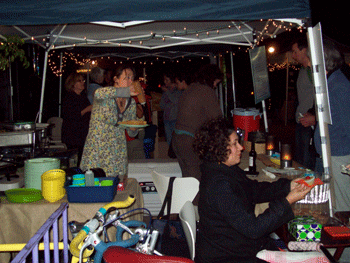
    Public open markets are exciting, but perhaps an even more interesting trend is the private-run market. Organizers of private markets can have more authority over the vendors and their merchandise, and can give their markets more style to suit a specific audience. One of the area’s more interesting markets occurs at night – the Wednesday evening Audubon Community Market, occurring at Stardust Video and Coffee. Founded by Emily Rankin, the Community Market strives to bring items produced specifically in Audubon Park.

    This epitomizes the spirit of the new localism. The fact that it occurs at night makes the market scene unique. Ms. Rankin, in an interview, revealed that the Audubon Park Garden District, which she founded, now includes a network of vegetable gardens, and these are showcased at the market. Her cafe, Roots, serves food at this market, and it provides services, locally grown produce, art, music and other handmade items which rotate on a weekly basis.

    There are many advantages to privately run markets. The Winter Park Farmer’s Market has pages and pages of rules and forms. The private Audubon Community Market is direct, paperless, and quick: Ms. Rankin looks at your product and says, you are in or out. Her management of the market has sustained it through a change in location or two, and she is optimistic that the market will grow in popularity as people start looking locally for what they can’t find globally

    During times of financial stability, people often seek to reduce risk and experimentation, clinging to the tried and true. Certainly retail’s global players focus on cold calculation and maintaining shareholder value. Yet at the grassroots, individuals and families also seek a level of comfort and interaction. The consumer response to community markets suggests that there is a widely felt allegiance with these intrepid street vendors who brave the elements for a dollar’s worth of grapefruit. The shifting economy is allowing individual voices to speak and be heard by a wider audience. This is the coarse of true innovation. Those who persevere in the community market scene could well influence our commercial future for decades to come…

    Richard Reep is an Architect and artist living in Winter Park, Florida. His practice has centered around hospitality-driven mixed use, and has contributed in various capacities to urban mixed-use projects, both nationally and internationally, for the last 25 years.
  • How the Financial Crisis Threatens Localism

    By Richard Reep

    As in many places, the poor economy is forcing many families in affluent Winter Park, Florida to make some necessary adjustments. One of the most basic adjustments relates to shopping for food and staples. In better times, Winter Park was ruled by two Publix supermarkets and a Whole Foods. Grocery-cart conversation among friends became a common event; now this smooth, middle-class lifestyle pattern has been disrupted.

    Hard times are driving people to less intimate settings, largely to Wal-Mart and other discount stores, whose offerings and management are largely interchangeable between places. In this way hard times could be shifting the pendulum swing away from localism and towards globalism. For now, Wal-Mart’s globalism offers the advantage of low prices, overcoming the disdain that many in Winter Park expressed at this store; for it is the antithesis of Winter Park’s treasured shopping culture epitomized by Park Avenue, a quaint strip of unique boutiques. Even if you did buy those steaks at Wal-Mart, you didn’t exactly advertise the fact at your dinner party.

    Winter Parkers had thought that their basic food needs had been comfortably institutionalized. As neighborhood touchstones go, Publix is Florida’s gold standard. Winn-Dixie, Albertson’s, and other competition paled in comparison to the customer loyalty that Publix brought. Their brands weren’t much different, and neither were their prices. There was just something about that kelly green logo that inspired people to integrate Publix into their own personal culture and lexicon.

    For years, this chain has built a loyal following in Florida. Good customer service, great store brands, convenient and quality stores all contributed to their preeminence in the grocery market, and allowed them to expand in the Southeast. Today, however, Publix is challenged by its own reputation, and has become vulnerable to competition as local shoppers tighten their pocketbooks.

    Winter Parkers had two choices between their Publix: Hollyanna and Lakemont. The brand veneer, both in content and in form, was subtly bent to suit local tastes. People referred to their favorite as “my Publix”, and even when the Baldwin Park Publix opened in 2003 closer to many folks, their loyalty with their particular store kept them from going to the Baldwin Park store. (Its architecture doesn’t help; this storefront might have been designed by Albert Speer).

    Suddenly, however, Publix faces real competition from stores that traditionally do not overlap with its market share. This Lakeland-based company, which boasts an excellent reputation, finds itself now with both emptier parking lots and smaller cash register totals. What’s going on here?

    At the Lakemont Publix, the organic produce area has grown, in direct response to hip, organic Whole Foods up the street. Whole Foods, however, is suffering mightily in this economy – who needs $8.00 strawberries? If you are skeptical about this, a tour of their largely deserted parking lots and front entry areas on Sunday afternoon, when grocery shopping is near-peak, can be quite telling.


    Whole Foods has some great parking spaces right near the front door, and the entry area, usually clogged with shoppers, seemed to be nearly desolate. A few students sat at the bistro tables tapping on laptops; not the usual rich scene for this upscale store.

    Publix at Lakemont also had some great parking spaces right near the front door, and an even more desolate entry area. In fact, where are the Girl Scouts?


    Where have all these people gone? The answer lies up State Road 436 to the left, ladies and gentlemen – Wal-Mart! Parking near the front…forget it. At the entry, a line of people going in and full shopping carts coming out! And the Girl Scouts are smart enough to realize that this is where the local culture is going these days! Is Wal-Mart the new Publix?

    As everyone is frantically re-tooling their own personal economy, Wal-Mart has become the grocer of choice for more and more of Winter Park. Are the prices really lower? A little bit. Will Publix adapt to the new, changing times to meet this challenge? For this 79-year-old Florida-based grocery store chain, and all its loyal (but more loyal to their checkbooks) customers, we certainly hope so.

    The buying power of globalism continues to disrupt and shift local patterns. As Wal-Mart, Costco, and others compete in this New Economy, local and regional chains need to react quickly to gain back their customer base, or they will find themselves in for a difficult struggle to regain lost ground.

    Richard Reep is an Architect and artist living in Winter Park, Florida. His practice has centered around hospitality-driven mixed use, and has contributed in various capacities to urban mixed-use projects, both nationally and internationally, for the last 25 years.
  • Florida’s Tourism Addiction

    Remember those innocent days last summer, when the biggest worry was high gas prices? Florida already felt the pinch as tourism dropped dramatically. Then, as the financial markets collapsed last fall, Florida’s leaders woke up and began talking about diversification. Like deer caught in the crosshairs of a rifle scope, economic boosters darted around looking for new safe places in the knowledge economy, ways to revitalize agriculture, and even exploring private space development to supplement the stuttering NASA program.

    But now, having passed through the last quarter, this talk is once more put aside for reliance on tourism again. It appears that the line for Disney’s Space Mountain could be an inverse indicator of the state’s appetite for healthy diversification. As wait time for the ride shortened in October, space programs, research laboratories, and business incubators fell back in the minds of public officials. Today, with lower gas prices, those who still have jobs are coming back to the theme parks, and the relief that state officials feel is audible: no more silly talk about diversification!

    Once upon a time, before all the turmoil, NASA had a space program. From afar, one may infer there is an exciting base of science and technology centered around the Kennedy Space Center, with engineering plants and satellite factories and science laboratories. A visit to this area reveals nothing of the sort: sleepy Cocoa, a beach town seemingly lost in time, housing a few small offices scattered around the town labeled Grumman, Boeing, or Lockheed Martin. NASA’s space program in Florida, as it turns out, produces spectacular launches but not much else; the winds of politics on Capitol Hill blow so hot or cold that little sustained investment is possible into this local economy. In 2008, NASA quietly eliminated 4,000 jobs in Central Florida, as the space shuttle program is phased out and replaced with a more efficient vehicle.

    Meanwhile, tourism grew and no one noticed.

    Once upon a time, before all the freezes, Central Florida had agriculture specializing in citrus. Remember Anita Bryant and the famous Florida Orange? Groves actually extended into southern Georgia a century ago, but citrus farming retreated further and further south as farmers sought less risk from the weather. By the early 1990s, more freezes caused Central Florida farmers to throw in the towel, carrying out with them orange juice processing plants, bottle manufacturers, and shipping and trucking centers. Replacement crops were neither entertained nor encouraged by the State, and the farmers sold their land to developers, who quickly rezoned the land for single family subdivisions. Population grew, and no one noticed.

    Once upon a time, East Coast businesses were moving their corporate headquarters to Florida. If anybody remembers John Naisbitt’s 1980 book Megatrends, Orlando was named one of the top ten cities of the future. AAA, the automobile travel association, moved its corporate headquarters to Central Florida, joining Tupperware and several others. It appeared that low taxes and great weather inevitably would lure more companies. It escaped most people’s notice that the other corporations moving here, such as Harcourt Brace Jovanovich (now Harcourt), weren’t moving their leadership, but only back offices and computer hardware to Florida, taking state business incentives and returning the favor with service workers, not executives. As these service workers are downsized due to outsourcing and automation, Florida’s economy has been dramatically affected. Meanwhile the corporate headquarters in New York were protected. The top executives may have maintained condos in Florida, but never took the place seriously for business.

    But still tourism was growing, and no one noticed.

    Once upon a time, Florida was known as the state of low taxes. No income tax for us, thank you very much, despite a few weak attempts by the legislature. Rather, Florida depends on sales taxes and property taxes to balance its budget, and growth seemed to guarantee that these would rise. But even as low as taxes were, business leaders two years ago pressured the new Governor and legislature to propose a tax cut referendum, and like sheep, the citizens voted yes. Heck, who would not want their taxes cut? Shortly after property taxes were voted lower, the bottom fell out of Florida’s housing market, producing the perfect storm of lower taxes on properties dropping in value. Then, the wise leaders chose to cut necessities like education, rather than luxuries like the purchase of U.S. Sugar’s abandoned properties.

    But tourism was growing, and no one seemed to care.

    The litany of missed opportunities is longer than the space to list them. To anyone running a business, diversification of sources of income would seem natural to promote the long-term health of your business. But Florida consistently has shown disdain for this sort of behavior, because tourism continues to provide a steady stream of revenue. It is true that historically tourism has risen at the same rate as population growth and there is no reason to doubt that tourism will rebound. So once again, Florida’s reliance on tourism may seem its key to economic survival.

    In Central Florida, the economy is tourism, with worldwide visitorship, and compared to its next closest competitor, Las Vegas, Central Florida has come through smelling like a rose. Hotels within Disney’s property quietly finished 2008 on budget, and other hotels surrounding the theme parks suffered only modest losses. New hotel starts are halted, and owners with cash are not seeking expansion, renovation, nor repositioning while occupancy is down.

    Meanwhile, digital media and medical research remain the two most viable diversification channels for Central Florida. Partnerships between the private sector and the University of Central Florida to create a digital media development center will bear fruit in the coming years, both on campus and in downtown Orlando. Growth in medical research is already happening with the arrival of the Nemours Center for Pediatric Research. Both of these are happening because of internal decisions, windows of opportunity, and with mostly private, not government, help. On the downside, space investment dwindles, agriculture divestiture continues, and the State sits idly by, dreaming dreams of legalized gaming so as to put even more eggs into tourism’s basket.

    These are excellent times for diversifying the state’s economy. Tourism breeds not just an epehemeral city, but an ephemeral state – and the risk of this position is felt every day as jobs get scarcer and scarcer. Florida’s business leaders need to take responsibility for the future of the state, stop their addiction to tourism, and seek higher and safer ground. Only with a diversified economy will the State of Florida have long-term prospects for a prosperous future.

    So come on back, everyone, and get in line for rides at Disney! Those of us living and working in Central Florida thank you for coming. And, while you are here, pat yourselves on the back for helping Florida postpone its inevitable reckoning with economic reality.

    Richard Reep is an Architect and artist living in Winter Park, Florida. His practice has centered around hospitality-driven mixed use, and has contributed in various capacities to urban mixed-use projects, both nationally and internationally, for the last 25 years.

  • The Future of the Shopping Mall

    By Richard Reep

    “I had two rules for Christmas this year:
    1. Under 13 years old only;
    and
    2. Internet only.”

    –overheard at Stardust Video and Coffee in Orlando, Florida.

    One of the most distinctive benchmarks of contemporary American life, the classic indoor shopping mall, is now gasping for survival. The two rules expressed above were commonly heard during this shopping season, calling into question whether the 20th century indoor shopping mall will survive in its present form.

    Almost since it was born in the early 1950s, the shopping mall has engendered controversy. Few today recall the enthusiasm which greeted the first malls in the Midwest, giving shoppers something they previously lacked: adequate parking closer to a more varied selection of goods. Malls quickly caught on, and developers repeated this success across the country. The so-called regional mall became a new tourism destination, an economic engine powering local economies, and a cultural marker in which our suburban nation, recently empowered by the mass production of the car, took great pride.

    Malls, however, were decried by urban thinkers like Lewis Mumford and Jane Jacobs. For one thing, they turned the traditional building inside out, with the unlovely backs of the stores facing the exterior. For another, they required huge seas of asphalt to accommodate parking, necessitating long, arduous walks from the car to the mall door.

    Perhaps more seriously, however, thinkers criticized malls as dealing a lethal blow to the traditional Main Street. To support the development costs of the regional indoor shopping mall, the leasing prices only let large, national chain stores in, wiping out almost any vestige of local identity. Generally speaking, shoppers overlooked this fault in favor of access to a much greater diversity of goods and essentially deserted Main Street in droves.

    Architects and developers quickly gathered empirical evidence about people’s shopping patterns and applied these to the design, so by the 1970s the regional indoor shopping mall was perfected down to a reliable formula that could be applied consistently, with reliable and satisfying economic results to the landowner and his bank. Older malls, such as Lenox Square in Atlanta, underwent drastic renovations to adapt to the formula, increasing visitors and sales, and cementing the place of the regional mall in American culture.

    Yet the mall also had one largely overlooked advantage: its ability to deliver a safe, secure environment for its inhabitants. Being private property, the landowner could afford to eject suspicious behavior and deal with theft swiftly, in a way that police in a public setting could not. The mall could be secured in a way impossible for the traditional city street.

    Malls grew, finally testing the upper limits at over 4 million square feet in Bloomington, Minnesota. However, like dinosaurs, their great size and their slow speed have now limited their ability to adapt to changing times. Malls began to suffer a decline as early as the 1990s. This decline was due to challenges from big-box retailers, and the even more convenient commercial strip mall. Mall developers fought off these challengers by including both boxes and strips within new development tracts, so a new regional mall such as the Brandon Mall in Tampa, Florida opened in 1994 with a brand-new Target store and brick-façade strips flanking its entry. Shoppers parked at the main mall, shopped, and then parked in front of various strips, shopping their way out of the parking lot.

    Yet this model could not rescue malls, so developers started reinventing them as lifestyle centers. Retail was subsidized by dining and entertainment venues, and when the residential boom arrived around 2002 and 2003, condos were thrown in the mix. At the same time, consolidation of mall owners was taking place, and one of the single biggest mall owners, General Growth, was faced with the task of stewarding these giants into the new millennium.

    Yet even as “lifestyle centers”, malls have continued to suffer. General Growth and others like them found themselves fighting a defensive action, as per-square-foot sales of malls softened. At one time, they entertained the notion of adding hotels to malls, imagining that malls remained destinations. Shoppers, however, were getting scarcer, and except for Black Friday (the day after Thanksgiving) and the day after Christmas, it was becoming easier and easier to find a parking place in front of your favorite national department store.

    This year’s Christmas season has further weakened the malls. E-commerce retail, rising since 2000, accounts now for over $34 billion in retail sales, or 3.1% of total retail sales, for the third quarter of 2008 (source: U. S. Census Bureau). This rise continues to penetrate the physical retail environment, and the mall is the most vulnerable to this new form of commerce. Accompanied by a sudden drop of consumer spending, this trend has turned bad times into a veritable rout.

    For companies like General Growth, which has flirted with bankruptcy, tough times are ahead. Adaptive reuse strategies – turning malls back into town centers with residential density – remains one possible strategy. Another may be to retune old-line malls into destinations for fast growing consumer populations such as Hispanics. There are clearly many possibilities.

    In this sense malls represent a huge opportunity for a forward-thinking investor, and this building type should be analyzed for its positive features. Aside from the good portion of commercial debt it represents, the mall usually boasts a prime location within existing suburban infrastructure, and typically sits on level land that would ease redevelopment. A mall in east Orlando has already been changed into Mainsail, a private higher education facility. Others have been made into municipal service centers. The redeveloper may preserve the building and land whole or, like ancient Roman coliseums, malls may be disintegrated so that only fragments of the mall’s original development pattern will be noticeable.

    No doubt some malls will survive in unique pockets – and they could come to represent the new localism – if they have engrained themselves enough into local culture. This may be particularly true in outer suburbs where there was no Main Street and the mall has remained the focal point for local concourse and rendezvous.

    One thing is clear. Given the rise of internet commerce, and perhaps a long-term slowdown in consumer spending, the mall seems destined for a major makeover in the coming decade.

    Richard Reep is an Architect and artist living in Winter Park, Florida. His practice has centered around hospitality-driven mixed use, and has contributed in various capacities to urban mixed-use projects, both nationally and internationally, for the last 25 years.

  • Farmer’s Markets: Reviving Public Space in Central Florida

    By Richard Reep

    Noted architect Daniel Liebeskind, teaching at Yale in the early 1990s, proclaimed “Public space is dead”. A provocative notion at the time, he was simply observing American cultural phenomena, and our evolution away from Main Street into the mall, away from the downtown church to the suburban megachurch, and away from common space into private space. While all this is true, it misses a countercyclical element in our cities, and in the Orlando area, public space is very much alive and assuming a new role in the neighborhoods.

    Human social activities still need to take place, and we are surprisingly adaptable when it comes to getting the interaction we need, when we need it. Public space has hosted political, sacred, commercial, and ceremonial activities for the entire history of the city. This recent flight from public to private is due to the perception of personal safety, and the need to conduct social activities in a secure zone. We simply don’t much care whether the backdrop for our social life is a 19th century town square, or a 20th century suburban shopping mall.

    Crime rose in the last half of the 20th century beyond the level of comfort for most citizens, and although it receded in the late 1990’s (for reasons yet to be satisfactorily explained), crime has resurged. This year, Orlando jumped from a relatively crime-free status to a position within the top 10 in the country for violent crime, and nearly every neighborhood has experienced an increase in various forms of break-ins, vandalism, and theft. Along with our economic lives, our civic lives seem to be going backward at the present moment.

    Thus, private space thrives and public space dies; this has been our only means of control over our personal security. Shopping malls and big box stores are our new Main Streets, and instead of condemning their form, we should be studying them, because they are telling us what people need and crave as part of their daily lives.

    In the public arena, cities cope with the crime trend variously, and it is instructive to look at Orlando’s methods in light of its commitment to New Urbanism as a city growth model. Orlando has recently published Crime Prevention Through Environmental Design via a Bureau of Justice Assistance grant. Aimed at both businesses and individuals, the booklet recommends that private outdoor space be well-defined by gates and clear perimeters, and suggests other design elements to reduce the risk of being targeted by criminals.

    Much of the booklet makes sense and reinforces strategies such as natural surveillance, target hardening, territorial reinforcement, and access control. The booklet also tries in vain to tie new urbanist ideals to crime prevention. For example, speed tables, a favorite new urbanist device to reduce speeding, are cited as a way to tell “potential offenders they had better think twice before committing a crime.” Whether there is a correlation between speed bumps and safe neighborhoods remains to be seen.

    The booklet rightly states that “streets should be designed to discourage cut-through traffic” as a means of natural access control. Ironically, this flies in the face of new urbanist development patterns, which encourage open-ended, straight street grids, and discourage cul-de-sacs as elitist. The practical reality of safety and security necessarily overrides the theory and rhetoric of New Urbanism as it is applied in Orlando.

    We continue to evolve into a city that has troubled public spaces and increasing private spaces, much like the rest of the country. While the crime rate has risen suddenly in Central Florida, however, our public space, far from being doomed, is now hosting scenes of new civic involvement.

    The age-old agora, contrary to reports of its death, is actually alive and well. Weekend markets are springing up in public nooks and crannies around the older, urban core, and in the suburban public parks as well. These markets are scenes of a new American involvement with each other, in a manner similar to the traditional European town square and the historical American village green. “Farmer’s Markets,” “Fresh Markets,” and “Weekend Markets” are becoming popular not just in downtown Orlando, but in downtown Winter Park, Maitland, College Park, and surrounding communities. These markets are exciting because they are growing, despite all the forces working against them: crime, internet commerce, and the accelerated kinetic lives we lead in this new millennium. People are finding something important at these small, crowded, open-air market stalls, and it isn’t just good tomatoes.

    For merchants, they ostensibly cut out the army of middlemen between the customer and contemporary, chain-store retail. Open-air markets are an exciting and interesting alternative to the internet, a medium that prevents direct sampling of a physical, sensual product such as food. And, a visit to the Winter Park Farmer’s Market on any given Saturday would make any mall-store merchant green with envy: hands holding full shopping bags, and lots of them. Business is being done!

    For customers, the thrill of a bargain is supplemented by a sense of community and a shared enjoyment of a vibrant local scene. Maitland, a suburban municipality five miles north of Orlando, recently started its own Farmers’ Market and has already outgrown Quinn Strom Park, and will soon be moving to the larger Lake Lily Park next year. Customers are treated to live music performances, occasional tables of Fresh Art by Maitland Art Center artists, and stalls by masseuses, cheese makers, and ethnic food providers. The informal nature of these markets guarantee spontaneity, an enjoyment of shared community, and an opportunity for relaxed interaction and discourse free of the manipulation of marketers, advertisers, designers, and other enablers of the high art of contemporary Western consumption.

    At least in Central Florida, public space is not dead at all; people seek ways to maintain the tradition of the agora, despite assault upon this tradition. Although safety needs have forced us to flee to malls, supermarkets, big box retail, and the internet for our consumer needs, we’ve traded safety and security for spontaneity and deeper interaction. We are ingenious at finding ways around the slick, sophisticated veneer of chain-store commerce for a more visceral sensory and social experience.

    In Central Florida, these markets are springing up to provide this, and they reinforce locality and pride in our neighborhoods, for they are a reference that citizens are more and more often using to reinforce their neighborhoods’ identity. If this trend continues, these markets may increase in weekly frequency and broaden their involvement by becoming a forum for public speaking and political dialogue. Public space is alive and well in the new millennium, and its new adaptation to this old use can provide an exciting glimpse into the future.

    Richard Reep is an Architect and artist living in Winter Park, Florida. His practice has centered around hospitality-driven mixed use, and has contributed in various capacities to urban mixed-use projects, both nationally and internationally, for the last 25 years.

  • Back to Basics in Orlando

    By Richard Reep

    For the last decade the City of Orlando has been concentrating form, trying somehow to displace its image as the ultimate plastic city. Although tourism helped insulate Central Florida from the slowdowns of the 1970s and 1980s, the last three recessions hit Orlando harder than the national average. This metropolitan area has now been taking on a more essential task of morphing slowly away from its status as ephemeral support city for the theme parks.

    One sign of this new appreciation for the basic necessity of good jobs can be seen in two new districts: one concentrated around medical research and practice; the other concentrated around digital media.

    Both districts will greatly enhance the city’s core offering of service jobs, and are being nationally scrutinized for their viability as a new home for technological research and application. In the next phase of city-making, Orlando can make important steps towards a sustainable economy, if it grows good jobs while focusing on the basics of safety, security, and a spiritual core for its citizens.

    The first growth district, on Orlando’s ring road, is Lake Nona. Private interests have combined with institutions of higher education to create a core of medical research and technology. The most recent star addition to this, Nemours Children’s Hospital, will anchor part of the development. Medical research laboratories by Florida’s major public universities flank the hospital, and more medical facilities are on their way.

    Surrounded by residential communities and scrub pine, the medical district is in its infancy. This community already boasts two promising features. For one, the focus on good jobs sets the fundamental stage for organic and meaningful growth created. This seems logical enough, but the employment element has been largely missing from most new developments of regional impact. Secondly, the residential community, currently less than 10% developed, appears to be growing unmolested by the need to conform to pre-set ideas about cities. Lake Nona’s Master Plan promises an 11-acre oval “town center”, likely to be a mixed-use district typical of recent Southeastern town centers: shops, offices, residential, and of course, the local supermarket, Publix.

    Thankfully, the developer is leaving the town center to the future, and this new core will have a chance to reflect Lake Nona’s mature identity, rather than be thrust upon the community by the Master Developer in some kind of bland neohistorical form. This is reminiscent of Valencia, planned in the late 1950s and developed in the 1960s, where core community functions such as hospitals, government offices, and schools were built first by the Newhall family near Los Angeles. Residential areas filled in the 1960’s and 1970s; but the original Town Center, designed by Victor Gruen, was not built until the late 1980s, after Valencia matured. The lesson of Valencia is that organic growth can yield a vibrant, successful development plan. Valencia remains today a positive addition to the Santa Clarita Valley and southern California in general.

    Switch focus to the inner city: forgotten, chaotic, grim residences; sagging front porches and weedy lots. Orlando’s own inner city, Parramore, did not benefit very well from the run-up in the last six years, and by the looks on the faces of the residents who watch you as you drive by, they know it. The City of Orlando has decided that it is now their turn.

    This will be an interesting experiment to see whether the greenfield results of New Urbanism can be translated to what is essentially a classic, 1960s urban renewal project in reverse: Demolition of 20-year-old event center slums, to be replaced by new construction to further the cause of virtual reality.

    The City’s bonding capacity, sadly, has been tapped for major venues (a new sports arena and a performing arts center), but failure of the event center has led to a healthy focus on higher skilled jobs. The city envisions a partnership with higher education and the private sector to create a digital media village, similar to Laval, a suburban community just north of Montreal. Laval, an existing neighborhood in search of new life, benefited from a similar effort when the city focused on developing its bioscience and information industries. Now Laval’s status has begun to show some basic street life and has a highly successful retail complex that draws shoppers from throughout the region.

    This concept of a technopole has now been borrowed by the City of Orlando to create a similar district centered around digital media: movies, gaming, and other pursuits. The city must be careful to make sure that, like Laval, it concentrates on jobs growth first, and then seeks to integrate those jobs with the community. As a city with a strong, form-based planning outlook, Orlando will certainly be anxious that the Media Village conforms to the concepts of New Urbanism.

    The trend is ominous: Cities that allow their job base to become concentrated in a small handful of industries are risking their economic lives on a set of very outdated assumptions. On the other hand, cities that have sought out high technology jobs have become the “survivors” of the economic downturn.

    In the year 1980, there were only nine research parks in America. Today there are more than 200 in the United States, and competition from overseas is heating up fast.

    It is important to remember what a giant head start that we gave to other cities. The Triangle Research Park near Raleigh / Durham was founded back in 1959, and now houses more than 150 research and technology companies. Although Orlando is the “new kid” on this particular block, if we focus on what the employers need, we still have a lot to offer besides tourism.

    With the economy stagnating, a growing focus on jobs – and building an environment that promotes growth – should have a strong appeal. As in the 1930s, slower growth can begin to get the community to look beyond New Urbanist form-obsession and look to more fundamental elements that create jobs and wealth as opposed to seeking to win accolades from developers and the architectural and planning establishments.

    Richard Reep is an Architect and artist living in Winter Park, Florida. His practice has centered around hospitality-driven mixed use, and has contributed in various capacities to urban mixed-use projects, both nationally and internationally, for the last 25 years.

  • Urban Infill With Less Hype and More Serendipity

    By Richard Reep

    Urban infill in cities of the Southeast follows typical patterns: assemblage of several blocks of older building stock at a low price; careful navigation through the zoning and public process to mix uses and increase density; and finally design and construction of parking, office, residential, and retail uses. The next phase is often marked by alienation and departure of the existing surrounding residents, concerns of safety and security within the development, and a socioeconomic wall between new and old.

    This sad pattern is evident in Orlando at Winter Park Village, a 90s New Urbanism infill, where a failed indoor shopping mall was eviscerated and converted to an outdoor retail and entertainment district. Initially it generated a buzz, attracted shoppers, and signed anchor tenants. But the adjacent lower-income residents benefitted not a whit from this development, surrounding land remains fallow or abandoned, and recent store closings call into question the long-term viability of the project.

    Such problems worsened during the real-estate bubble, which promoted residential-driven development. This tore even bigger rifts in the fabric of cities. Sodo, the most recent cluster development opening in south Orlando at the dawn of financially uncertain times, could have a different future. This development is free from preconceptions about urban form and style and does not pretend the world is as simple as it was at the turn of the 20th century. Sodo offers a mix of uses clustered in medium density with access to jobs in the city’s older, denser infrastructure.

    Typically, brave new residents buy into urban infill projects at a higher rate and higher price than the surrounding community, creating a class schism. The surrounding community in need of good jobs is reluctant to become the service workers in these developments, and this uneasy coexistence breeds anxiety and insulation. City planners consider these urban infills successful as they bring ‘higher-end’ residents (translated: higher tax contribution) and create the demand for more such projects. Older residents often despise the new construction and move out, driven out by a combination of increasing property values, loss of neighborhood identity, and a sense of alienation.

    In its infancy, Sodo appears to have the ingredients to become a good alternative to so-called “TND” or Traditional Neighborhood Development, as set forth by the Congress for the New Urbanism. Originally planned as condominium units, Sodo opens as a luxury rental community, which recognizes the current mortgage meltdown and the future of residential real estate in the Southeast. This neighborhood was typically oriented to the surrounding Wadeview railroad industrial district, but Sodo clearly looks north up Orange Avenue, beckoning hip, young, downtown workers.

    With a certain gritty charm, South Orange Avenue winds below downtown, anchored by orange-bricked Orlando Regional Medical Center, a vast complex shoehorned into the old, industrial neighborhood. Sodo is not within walking distance of 300 luxury units worth of anything, not now nor in the near future, which makes it decidedly un-New Urbanist. But as the economy idles, Sodo has attracted some interesting comments from its neighbors that tell a positive story.

    The development’s website is refreshing for what it does not proclaim in its marketing hype. It does not reference New Urbanist ideology anywhere. It does not claim to be a live-work-play solution to all life’s problems. It does not show happy white families riding bikes in parks. Its logo and presentation is simple and direct: Orlando is growing fast, and we want a piece of that pie. Rather than promote ideology, Sodo appears to promote itself as a blank slate upon which the future residents, retail and office tenants may write the future identity of this cluster.

    It is probably dangerous to draw conclusions from blogs, because the bloggers do not represent a broad cross-section of the population. Computer-savvy, opinionated, and sophisticated, bloggers do not include many elderly, minorities, and people too busy with their lives to dash off a few lines about their feelings. Therefore, the local bloggers’ positive attitude about Sodo may not represent the entire range of feelings of people affected by this development.

    However, rather than fear and loathing, Sodo has generated this: “I have had drunken people from the local bar (closing soon…HOORAY) pass out on my front yard. I am thrilled that this development is happening. It will no doubt enhance my quality of life and take us into a direction that the Wadeview Park area has sorely needed.” Similar comments abound, and the overall sense of approval from residents who bother to write about Sodo is a sign that this urban infill development is being welcomed rather than shunned.

    Another sign that Sodo may blend into its neighborhood is the developer’s choice to market it as exclusively rental. Although the rental is “luxury” starting at $1,000 per month for 659 square feet, the economic step between this property and the next-door homes is less than it would have been if these units had been sold as 300 trendy urban condos.

    Examined closer, Sodo makes some concessions to reality. It connects to the surrounding street grid on 3 sides, and the sense of safety and security within Sodo is beefed up with private security. The apartments have uninspiring views into their own parking garages, and the lack of green space throughout is harsh and startling. In order to accommodate parking, the anchor retail store parks its cars on the roof; shoppers are treated to the novelty of an outdoor shopping cart escalator, which should be interesting during the monsoon season of Orlando’s summer.

    While all this is encouraging, Sodo is not an example of organic growth, blending new and old seamlessly. For example, it is doubtful that Sodo residents and existing locals will bond over coffee in the Starbucks or burritos in the Taco Bell. Exclusively private, Sodo has no library, park, school, or other public amenity except for its shopping sidewalks, and it seems strange to think of Sodo hipsters venturing into the local community to worship, walk the streets, or volunteer. Sodo seems to be a social oasis, at least for the present moment.

    Sodo therefore exemplifies the problems of growth with which Orlando grapples: if taken in lumps, like Sodo, growth represents a jarring socioeconomic schism between the old and the new. If taken in lower density, like subdivisions, growth represents huge tracts of land being gobbled up, a jarring ecological schism between the natural and the manmade. Less lumpy than most, Sodo seems to have timing in its favor, with the slower growth of the near future allowing it to enter the economic slipstream at a lower speed.

    What is refreshing about Sodo, besides its crisp, clean, architecture, is that it does not carry the baggage of ideology and fetish for form that recent urban infill developments seem to carry. It is therefore free to evolve its identity by delivering safety and security to its residents, a sustainable mix of shopping and office spaces, and a sense of place that transcends the physical. Success is measured by functional yardsticks – not form yardsticks – and urban infill projects across the country can be measured the same way. Sodo may represent a realistic model of urban infill, welcomed by the community, able to assert its identity through the social and economic futures of its businesses and residents. This is the way healthy cities grow.

    Richard Reep is an Architect and artist living in Winter Park, Florida. His practice has centered around hospitality-driven mixed use, and has contributed in various capacities to urban mixed-use projects, both nationally and internationally, for the last 25 years.

  • Orlando: The Limits of Form

    By Richard Reep

    To date, luminaries of the New Urbanist movement such as Andres Duany and Peter Calthorpe have done little to change Orlando. The central Florida city remains balkanized, market-driven, and vaguely cosmopolitan in nature. Orlando’s vitality does not depend on the physical form of the city, but rather the spiritual involvement of its citizens, the safety and security that they gain from their urban choice as well as the unique mix of jobs created by the employment of Orlando. These three intangible factors drive the form, and a healthy city planning process will not ignore this in favor of a rigid dress code.

    New Urbanists, of course, can point to pockets of clustered development that echo their philosophy. Baldwin Park, Horizon West, and Avalon Park are three large examples. Mills Park, Sodo, and other smaller projects abound, for which the New Urbanist movement takes credit. All of these projects have in common a core that mixes residential, office, and retail in a form denser than the surrounding community does. All of these projects take great pains to store vehicles, once you have arrived to the core, in a way that masks them from view. In addition, all of these projects feature traditional architectural styles that express early 20th century America.

    Yet these efforts have failed to produce affordable housing for those who truly want to live within walking distance of their workplace. This is in part because New Urbanists seem to have trouble with the idea of creating an economic base first. By contrast, older, organically grown clusters are thriving nicely, in areas such as Thornton Park. At one time, Lake Eola (a small, oval lake) separated Downtown Orlando from this older neighborhood walking distance of downtown. The area was shabby, violent, and chaotic. But efforts to drive downtown toward Thornton Park – painstakingly led by visionaries who believed in the neighborhood – has created an organically grown, variable density cluster that adds tremendous value to the city.

    New Urbanists, however, are not approving of Thornton Park, perhaps because it was not their idea. They point to a violation of their form-based codes, which maintain seven stories the maximum height for a good structure. They point to the on-street parking – another abomination to their theology. In addition, they point to the older, single-family residential development that exists in and around the other development, citing its violations of their theoretical density hierarchy (six gradients of density, from urban to rural, which must occur in a specific order, and which are collectively labeled “the transect.”). Lastly, they are mute when it comes to the older, 11- and 12-story senior living towers associated with downtown churches, which happen to be 100% full with a waiting list. Somehow, this affordable housing does not fit into the Smart Code.

    Parramore is another shabby, violent, chaotic neighborhood exists adjacent to Downtown Orlando, with similar potential to Thornton Park. Like cosmetic surgeons rushing to claim credit for a half-facelift, the New Urbanist professionals, when questioned about this area of Orlando, freeze with a faint smile, and mention that no private interests have approached them about Parramore. Until this happens, they maintain implementing the imagined order of a proper city, as set forth in the “Smart Code” by the Congress of the New Urbanism, is impossible. The code regulates form rather than use, and is generally referred to as a form-based code for this reason.

    It is time to call off the form wars, and put effort into the basics what makes a city great: encouragement of a city’s spiritual life, solid bases for employment, and assurance of safety and security. We have to become more pragmatic in these times of economic turmoil; embrace of a strict planning theology, and the mass dumping of land-use regulation that have shaped cities for the past 50 or more years, could inhibit more organically driven growth that may be far more economically viable.

    Orlando’s enduring, 10-year involvement with New Urbanism has reaped mixed results. While some organically developed areas like Thornton Park add interesting and thoughtful form to the city, many of the New Urbanist projects (which are larger in scale the farther out from the urban core) add bland, living-over-retail or office-over-retail streetfronts. These developments cherry-pick from New Urbanism what developers and city planners can agree upon: traditional architecture, vertical stacking of uses, and selective relaxation of land use codes.

    Although the New Urbanist projects have contributed to Orlando’s messy vitality, it has also worsened traffic since one has to drive from cluster development to cluster development. And it also contributes to Orlando’s tax base, because New Urbanism, as implemented in Orlando, comes at a cost premium over suburban development. This guarantees developers only propose projects where they can make the most money. It also reflects the most glaring problem New Urbanism in its current form: it leaves behind the rest of us.

    In reality although form-based codes claim to improve the city’s form, they also create a host of non-form social, traffic, income disparity, and employment problems for the city to solve. To improve social involvement, attract and retain meaningful employment, and deliver a safe and secure envelope is very hard work. Citizens should care what their city looks like. However, for the city to focus overly on form, placing aesthetics above the older, more proven values is not the way to create successful places that work primarily for people, not architects.

    Richard Reep is an Architect and artist living in Winter Park, Florida. His practice has centered around hospitality-driven mixed use, and has contributed in various capacities to urban mixed-use projects, both nationally and internationally, for the last 25 years.

  • New Urbanism’s Economic Achilles Heel

    By Richard Reep

    Whether one believes that form follows function or that function can follow form, a town or a city needs three key elements to be healthy. Firstly, a sense of place that includes the sacred is important to people to provide a basis for spiritual involvement. The city must then be able to reliably deliver safety and security to its inhabitants in order to grow and mature. And lastly, a city must provide the means of employment for its inhabitants.

    New Urbanism, in its quest to dictate the physical form of an urban development, has ignored the last key element. An examination of New Urbanism in developments in Central Florida shows a glaring lack of employment, raising questions about their sustainability and long-term viability.

    As we enter the second decade of Celebration, it is useful to look at this city and its influence on the surrounding region. Opened in 1996, Celebration incorporated much of the design philosophy that was formulated around the idea that a city should have a certain “look.” This design philosophy was promulgated to the general public in Suburban Nation, a book that lashed out at the current suburban form and proposed a new form based on a nostalgic notion about a golden age of American town-making, generally in the first decades of the last century.

    By regulating the specific architectural form of a new development, the New Urbanists proposed to improve the blandness, placelessness, and lack of character that is the lot of most contemporary suburbs. Celebration, sponsored by Disney, opened to white-hot press acclaim nationwide. Phase 2 was opened ahead of schedule due to demand for new homes. Market values of homes rose quickly beyond the norm for Central Florida. Developers took notice.

    Soon, other spawn of Celebration began to show up in Central Florida, and today we have several New Urbanist communities that aspire to the same level of success. Baldwin Park, funded by Chicago’s Pritzker family, is a smaller scale version of Celebration located in the City of Orlando and convenient to downtown. Avalon Park, in the southeast corner of Orange County, is accessed from the perimeter highway that is turning Orlando into a mini-Atlanta. Horizon West, the youngest of these, is due west of Downtown Orlando, and offers another New Urbanist antidote to subdivisions, adhering to the same formula of “live, work, and play.” All of these, including Celebration, are coping with the housing crisis, foreclosure crisis, and various other current market conditions just like the rest of us.

    Sadly the “live, work, and play” slogan, which comes from New Urbanist literature, does not bear out in reality. The notion is fine enough: that people can reduce commutes by living and working in the same community. During the supposedly halcyon days of pre-auto, early 20th century America, this was the reality for many Americans. One’s life could occur within a small, walkable radius, reinforcing itself and reinforcing the social bonds of a community.

    But the early 21st Century is very different than the early 20th and New Urbanist attempts to travel backwards in time have met with limited success. To work near where you live, there needs to be employment down the street. None of these communities have employment opportunities – jobs – down the street from the residences. The dwellers of all these communities get in their cars and drive to their jobs off-campus. New Urbanism thus becomes an after-6pm-and-weekend lifestyle choice, not a new way of life.

    In Celebration, many of the early residents were Disney executives; only 4 or 5 years after opening did Disney develop office space in Celebration for some of their offices. Baldwin Park, approximately 2 miles from Downtown Orlando, never pretended to capture the employment aspect, instead selling itself (to many Celebration residents who rushed to this newer, hipper version of their town) as a downtown commute. And neither Avalon Park nor Horizon West have employment opportunities within their town centers. What they do have is easy access to the area’s ring road – ensuring vehicular congestion outside of their New Urbanist communities.

    What is in their Town Centers? Ironically, you find only a small shopping district and the ubiquitous Publix, Florida’s home-grown grocery store chain. The formula of “live-work-play” must stick in the craw of those who are employed in these stores, because the Publix employees, Starbucks baristas, dry cleaner cashiers, and others who do work in these Town Centers can not possibly afford the New Urbanist real estate. Rather than a social continuum (as was more common in the idealized version of America), there is a new social schism, with the New Urbanist underclass forced to commute to the New Urbanist communities from more affordable but less trendy housing nearby.

    In contrast, the region’s native communities have been thriving throughout the same growth period. Communities like College Park, adjacent to Orlando’s downtown, offer something that New Urbanist communities do not: diverse housing, from garage apartments and rental communities up to stately mansions, all within walking distance of each other. They offer an idiosyncratic mix of sacred places, playgrounds, schools, and shops in what the Philadelphia architect and theorist Robert Venturi calls “messy vitality.” No overarching body dictated the form, developed transects, or rigidly controlled the distance between the front porch to the street to achieve these vibrant, socially cohesive, and proud neighborhoods.

    New Urbanists claim to reduce the need for cars, but Orlando’s New Urbanist communities make the car more necessary than ever. Built on the periphery of the metropolitan area, they require a vehicle to complete the circle of functions necessary for a healthy society. Orange County planners have been submissive to the New Urbanists – especially after Celebration – but increasingly recognize that they do not solve the problems they claim to solve and instead invent more: higher traffic, less affordable housing near city centers, and lumpy development sprawl.

    The lesson for Orlando is to refrain from being seduced by the beauty contest that New Urbanists proclaim, and instead integrate all the key deeper social values such as safety, security, sacred places, and employment together. This is basic stuff recognized by greater minds – think of George Mitchell at the Woodlands or Victor Gruen in Valencia – who understand that employment constitutes a critical component to building a successful new community. Until New Urbanists learn this basic economic lesson, their contribution to our communities will remain sharply limited.

    Richard Reep is an Architect and artist living in Winter Park, Florida. His practice has centered around hospitality-driven mixed use, and has contributed in various capacities to urban mixed-use projects, both nationally and internationally, for the last 25 years.