Author: Richey Piiparinen

  • Is the “Rust Belt” a Dirty Word?

    Many people hate the term “Rust Belt”. They dislike the aesthetics of the Rust Belt. For others, the term is less loaded, but rather a moniker denoting who we are. Consider me in the latter camp. But I often cross paths with those who loathe the term, or more exactly any notion of there being a Rust Belt culture.

    For instance, I recently ran into a top official for the City of Cleveland. We shook hands, discussed backgrounds, before the individual put a name to a book I co-edited called Rust Belt Chic: A Cleveland Anthology, which is a collection of stories detailing what it means to be a Clevelander, a Rust Belter. The official let on she didn’t care for the term “Rust Belt”, and in fact found the idea of celebrating a Rust Belt culture backwards and distasteful. I told the official there was a new generation taking ownership of having grown up in a post-industrial reality, and that make no apologies for it. The official insinuated those people are not in positions of power, so what does it matter. I responded in ten years many will be, and so it matters a lot.

    Anyway, the conversation stayed with me for a few weeks, if only because it was a living, breathing example of what needs to go in Cleveland, if not the whole of the Rust Belt; namely, shame and false pride. Both characteristics go together. Said philosopher Lao Tzu:

    Pride attaches undue importance to the superiority of one’s status in the eyes of others; And shame is fear of humiliation at one’s inferior status in the estimation of others. When one sets his heart on being highly esteemed, and achieves such rating, then he is automatically involved in fear of losing his status.

    Shame. It’s pretty thick in these parts, and it’s linked to the region’s nickname, “The Rust Belt”. After all, rust connotes disuse, or of being left behind. Yet we are only shameful because the region did have status. We were a proud region once, as our forefathers and foremothers built this country. They protected this country. They enabled the defeat of Hitler. No hyperbole on that last part.

    Specifically, before being the “Rust Belt” the region was the “Arsenal of Democracy”, which was a term coined by Detroiter Bill Knudsen in his conversation with a weary and worried President Roosevelt on the eve of WWII. At the time of the talk, May 28th, 1940, America had the 18th largest army in the world, and so what FDR needed from Knudsen was reassurance Detroit’s industrial infrastructure could produce weapons at a pace unimaginable. Knudsen replied Detroit’s manufacturing might could transform into the country’s “Arsenal of Democracy”, with term eventually gaining traction in an FDR fireside chat dated December 29, 1940. In it, the President states:

    We must be the great arsenal of democracy. For us this is an emergency as serious as war itself. We must apply ourselves to our task with the same resolution, the same sense of urgency, the same spirit of patriotism and sacrifice as we would show were we at war.

    Obviously, the area succeeded, with Pittsburgh having produced one-fifth of the Allied forces steel from 1940 to 1945 alone.


    Courtesy of Seeking Michigan

    Needless to say, the region has had a lot to be proud of. But then macroeconomic forces took hold. Things globalized, and thus the way we lived and the things we did became obsolete. Shit happened. Shit is still happening. Yet part of the reason this is so is because we cannot let go. Being proud turned into stubborn pride, particularly for the region’s leadership who is hanging on to the illusion that yesterday will happen as long as we adhere to the same thought processes and power structures that held tow during the region’s heyday. But then yesterday doesn’t happen. Year after year it doesn’t happen. The pride becomes desperation. The pride becomes false. Said William Blake:

    Shame is pride’s cloak.

    And so with the collective shame comes collective temptation and desperation. Casinos will save the cities. Convention centers will save the cities. If only the cities will beautify enough. If only we had an outdoor chandelier. Or a suburban-type downtown mall. Or a tech district. Or a critical mass of microbreweries and boutiques. Or whatever anyone else doing. Anyone else, but us.

    Meanwhile, such city transformations erode the region’s true competitive advantage, which is who we are, and the various potentials inherent in our ability to persevere, i.e., our “learned resilience”. Writes Erie, PA native and economic development blogger Jim Russell:

    What I mean is seeing opportunity hiding in a community struggling with survival. There’s just something about Youngstown that stirs passion in me. I’m not gawking at ruin porn or glossing over everything that is wrong. I love Rust Belt cities. I love Rust Belt culture. I’m proud to be from the Rust Belt. That’s what Rust Belt Chic now means to me. It’s personal. It’s who I am. For Pittsburgh, I could sense the tide turning. I see the same transformation taking place in other Rust Belt cities. A pejorative, Rust Belt-ness is an asset. It’s a starting point for moving forward, not a finish line or a civic booster campaign.

    There is indeed a growing movement of Rust Belt pride taking hold. Yet it is not a false pride, rather a pride that’s derived from an acceptance of having become rust. Such can be immeasurable for the psychogeography of the region. After all, says William James,

    Acceptance of what has happened is the first step to overcoming the consequences of any misfortune.

    Richey Piiparinen is a writer and policy researcher based in Cleveland. He is co-editor of Rust Belt Chic: The Cleveland Anthology. Read more from him at his blog and at Rust Belt Chic.

  • The Persistence of Failed History: “White Infill” as the New “White Flight”?

    “There is a secret at the core of our nation. And those who dare expose it must be condemned, must be shamed, must be driven from polite society. But the truth stalks us like bad credit.” – Writer Ta-Nehisi Coates

    ***

    With the recent Supreme Courts strike down of the 1965 Voting Rights Act, which was created to protect minority representation, the headline in the Huffington Post read “Back to 1964?” While some contend the title hyperbolic, the HuffPost lead, if not the strike down itself, reflects the reality of a country still tethered to its discriminatory past.

    This reality is reflected in all facets of American society, including urbanism. Specifically, is the “back-to-the-city” movement destined to become 1968 inverted; that is, instead of “white flight” there’s “white infill”? If so, the so-called “game-changing” societal movement will be a process of switching out the window dressing, with the style du jour less lace curtains, more exposed brick.

    While debatable, there appears to be a back-to-the-city trend, particularly the inner-core areas of America’s largest and most powerful cities. For instance, according to a recent report by the Census Bureau, Chicago’s core exhibited a 36% boom in its population from 2000 to 2010—a gain of nearly 50,000. Rounding out the top five core-growth gainers were the cities New York, Philadelphia, San Francisco, and Washington D.C. The report finds that, on average, “[T]he largest metro areas—those with 5.0 million or more population—experienced double-digit percentage growth within 2 miles of their largest city’s city hall…”

    Who is moving into these “spiky” urban cores?

    Whites largely. For example, much of Chicago’s core gains comes from the downtown zip code 60654, in which 11,499 (77%) of the area’s 14,868 incoming residents were white, and where the median family income is $151,000. Other zip codes in Chicago’s core share similar proportions of growth, such as 60605, with 70% of its 12,423 new residents being white. Contrast this with a 5% growth rate for blacks.

    As well, according to research by the Thomas B. Fordham Institute examining the zip codes with the largest growth in the share of white population from 2000 to 2010, 15 of the top 50 were located in Philadelphia, New York, and Washington D.C. Philadelphia’s downtown zip code 19123 grew its population by nearly 40%, and its proportion of whites increased from 25% to almost 50%.  In D.C., the growing core zip code of 20001 increased its white share from 6% to 33% in a mere 10 years. While in Brooklyn, the zip codes 11205 and 11206 showed similar growth dynamics, with overall gains of 15% and 18% respectively, and corresponding increases in the white share of approximately 30%. Also on the Institute’s list are zip codes in not-quite-global cities such as Chattanooga, Austin, Atlanta, St. Paul, Indianapolis, Tampa, and Portland, with the vast majority of the “whitening” areas located in, or besides, the downtown core.

    Now, why does it matter if whites are leading the charge into those cores frequently championed as evidence of a new social order? After all, it is a step forward, right? Or, as urbanist Kaid Benfield recently wrote:

    Inner cities are growing again.  People of means, especially young people, want to be in cities today.  While that carries its own set of challenges, I would submit that addressing the challenges of gentrification is a far better problem to have than coping with massive abandonment and rampant crime.

    While that line of argument has merit, what’s missing is a deeper examination about those “people of means”. Specifically, a recent study out of Brandeis University showed the wealth gap between blacks and whites has nearly tripled over the past 25 years. That said, the people of means wanting to be in cities is largely the same people who always had means, and they are simply taking their means from one geography to the next; that is, from the suburban development to the urban enclave.

    Gap


    Of course many argue that infusing affluence into an area will create broad spillover effects. Tweeted urban planner Jeff Speck:

    “A beautiful and vibrant downtown can be the rising tide that lifts all ships. #walkablecity”.

    Yet there is little evidence of a “trickle down” effect within “rejuvenated” space. For instance, in his piece examining the aforementioned D.C. zip code of 20001, Dax-Devlon Ross writes:

    In 2011 alone, condos accounted for 57 percent of total home sales (276), most at triple the 2000 median price. The zip code now boasts an Ann Taylor, a Brooks Brothers, an Urban Outfitters, enough bars to serve several university populations at once and a mind-boggling 10 Starbucks…

    …What’s telling about the zip code’s “new build” makeover is that it did not move the poverty needle. The zip code’s poverty rate is exactly what it was in 1980, 1990 and 2000 — 28 percent — and the child poverty rate is nearly twice what it was in 1990 (45 percent).

    In other words, such developmental strategy is a game of whack-a-mole in which the raison d’être for the mole won’t stop until real economic restructuring happens, or until equity truly starts entering into the lexicon of our shared language. Instead, we get the apologia of the status quo that is shifting the same affluence to the same pockets, switch out the spatial aesthetics of the parking lot for the parklet.


    Trump Towers Chicago. Courtesy of Northwestern Univ.

    That said, there is real doubt the country has the stomach for such discourse, let alone for policy that can affect the prioritization of human and community capital. From the article “Separate, Unequal, and Ignored”, the author suggests that “[r]acial segregation remains Chicago’s most fundamental problem”, and he questions why the issue remained muted during the recent mayor’s race. Answered Princeton sociologist Douglas Massey:

    “[Segregation] is a very difficult and intractable problem. Politicians don’t like to face up to difficult and intractable problems, whatever their nature”.

    Unfortunately for city proponents, this same inability to face the issue by leading urban thinkers is making the “new urbanism” movement look really old. Asked about the risk of racial and economic homogeneity at the hands of the “back-to-the-city” movement, Alan Ehrenhalt, author of “The Great Inversion and the Future of the American City”, answered this way:

    I think you’re going to have class segregation no matter what you do. It would be nice to have people of all classes living right next to each other in gentrified downtowns. That’s probably not going to happen. It is true that a gentrified area tends to become less diverse. Cities can’t solve all problems.

    No, cities can’t solve all problems. But neither should cities be used to make existing problems worse. Re-urbanism, or specifically the opportunities it creates for equitable reinvestment, should be respected for what it is: a chance to move forward from a divided, destructive past.

    Yet such will take collective will and reflective honesty. Or the ability to look deep in the mirror at the American face and know that behind us is a persistence of failed history.

    Richey Piiparinen is a writer and policy researcher based in Cleveland. He is co-editor of Rust Belt Chic: The Cleveland Anthology. Read more from him at his blog and at Rust Belt Chic.

    Lead photo courtesy of Columbus Underground.

  • Visions of the Rust Belt Future (Part 2)

    There are interesting developments being played out in the Rust Belt. Some cities, like Detroit, seem to be embarking whole hog down the creative class path. Others, like Pittsburgh, have their own thing going on, a thing loosely delineated as the “Rust Belt Chic” model of economic development, with no modest amount of success. How a given Rust Belt city reinvests will have a large say in its future.

    Part 1 of this series examined the nascent creative classification of Detroit. Part 2 analyzes whether or not there is a new way forward for post-industrial cities, using the lessons from Pittsburgh and Cleveland as a guide.

    Rust Belt Chic

    Rust Belt Chic is the opposite of Creative Class Chic. The latter [is] the globalization of hip and cool. Wondering how Pittsburgh can be more like Austin is an absurd enterprise and, ultimately, counterproductive. I want to visit the Cleveland of Harvey Pekar, not the Miami of LeBron James. I can find King James World just about anywhere. Give me more Rust Belt Chic.—Jim Russell, Talent Geographer and economic development blogger at Pacific Standard.

    ***

    Pittsburgh has been referred to as “hell with the lid taken off”. It’s not a compliment, with the moniker originating from an 1868 travelogue written in The Atlantic Monthly. But the reference is a misquote. From the piece:

    On the evening of this dark day, we were conducted to the edge of the abyss, and looked over the iron railing upon the most striking spectacle we ever beheld … It is an unprofitable business, view-hunting; but if any one would enjoy a spectacle as striking as Niagara, he may do so by simply walking up a long hill to Cliff Street in Pittsburg, and looking over into — hell with the lid taken off.”

    As stated, the context of the piece has been lost to the narrative of the Rust Belt malaise, with one Pittsburgh local writing: “It was practically a love letter to the city, yet that damned ‘hell with the lid taken off’ line is all that survives”.

    This Rust Belt notion of “hell with the lid taken off”, “Shittsburgh”, and Cleveland as the “Mistake by the Lake” flows from a certain reality, as the post-industrial transition hasn’t exactly been a sun-bathing. But the lore is also partly contrived, since it’s derived from a stubborn stereotyping of the Rust Belt as a backwater you go to die. Such rigid yet malleable beliefs are “mesofacts”, or cognitions which—while not necessarily reflecting reality—nonetheless influence reality, particularly the act of migration. Writes Samuel Arbesman, the founder of the term:

    [I]magine you are considering relocating to another city. Not recognizing the slow change in the economic fortunes of various metropolitan areas, you immediately dismiss certain cities. For example, Pittsburgh, a city in the core of the historic Rust Belt of the United States, was for a long time considered to be something of a city to avoid.

    Mesofacts are an issue for Rust Belt cities. But the  resultant civic booster pandering comes off as desperation, with the image makeover usually but a process to “hip” your city into something, anything else. In fact there has been ample shame in being Rust Belt. Shame for having been post-industrialized. Abandoned. Idled from what the culture is known for: hard work. The collective sense has affected how the future is plotted.  Buffalo, St. Louis, Dayton yearn to be Las Vegas, Miami, Portland, New York. In fact, as we speak, Cleveland is planning a “transformational” vibrancy effort that entails hanging a Rodeo Drive-like outdoor chandelier in its theatre district. It will hang not a mile away from a neighborhood, Central, with a 70% poverty rate. Such dissonance-ensuing efforts kills recovery efforts. Said Jean de la Fontaine:

    “Everyone has his faults which he continually repeats: neither fear nor shame can cure them”.

    The alternative is for a city to know itself,  to chart its own way. Let others copycat their way to oblivion, or to become, according urbanist Aaron Renn, some “sort of mini-Brooklyn instead of who they really are at heart”. But this isn’t easy. It requires a collective and sustained effort, and a conceptual frame that can guide the process. This, then, is the central driving tenant of Rust Belt Chic economic development. It is not a process of “kumbaya-ing”, but a strategy sourced through that basic wisdom of the ages: “Know Thyself”.


    Courtesy of Red, White, and Blueprints

    Below details the experiences of Pittsburgh and Cleveland using the Rust Belt Chic lens, particularly showing how an awareness of its legacy costs and legacy opportunities can be used to build emerging economies and evolving societies.

    The New Economy: Neither Extraction nor Retention

    A reality for the Rust Belt is that people left. Cleveland’s population declined by one-third in the 1970s. Pittsburgh’s exodus occurred in the 1980s. In fact, the whole of the region exported people, with states like California historically benefiting. Commonly, domestic outmigration has been viewed akin to leprosy, with angst-ridden brain drain initiatives haranguing people to stay put. This is a prime example of a mesofact-driven policy that does more harm than good. Rather, understanding how to leverage the fact your citizens are everywhere would be wise in an economy where connection matters more than place. This is the view in international economic development. Rust Belt cities should get wise. How Sweden thinks:

    Swedish Foreign Affairs Minister Carl Bildt believes it’s essential to embrace globalization. “I want to have more of the world in Sweden and more of Sweden in the world,” he told me. Sweden isn’t afraid of brain drain, he said. Instead, “we encourage our young people to study abroad and to work abroad.” Many return, but even those who don’t help to connect Sweden to what Mr. Bildt calls “the global flow of ideas.”

    This “global flow of ideas” is not just talk. It has legs. Writes leading Rust Belt Chic thinker, and colleague, Jim Russell: “Moving from one place to another is an economic stimulus. People leaving Cleveland promotes growth.”
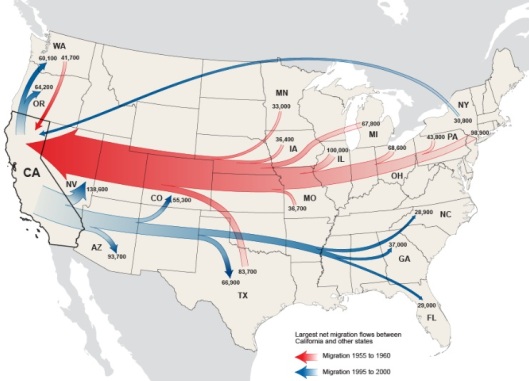
    Courtesy of the Census.

    Courtesy of the Census.

    How does this work exactly?

    Think of an act of migration as a lying down of fiber optics, with each trip thickening the network between two points in space. Often, cluster relationships begin forming. Take Los Angles and Pittsburgh. For years, the best talent would be poached at Carnegie Mellon. On the surface, this meant Pittsburgh would grow the talent and California, though an employer such as Disney Labs, would reap the rewards.

    Brain drain, right? Thus, spend money to herd the nerds, and make your talent inert for the sake of a Census count. Or, as Russell writes: “Pittsburgh is dying. Time to pony up the jingle and get Richard Florida to save the day.”

    Well, as Ernest George Ravenstein wrote in “The Laws of Migration, 1885”, “Each main current of migration produces a compensating counter-current”, and this is exactly what happened between Pittsburgh and Los Angeles. For instance, as the cost of attracting talent into “spiky locales” started becoming prohibitive, alternatives were sought. For Disney Labs, one was locating an R&D center near Carnegie Mellon, with the decision influenced by the networks formed through by Pittsburgh’s “brain drain”. Count Google and Apple as two others bellying up in the Rust Belt backwater. As is Schell Games, an educational gaming company with a founder born in Jersey, educated in Pittsburgh, and refined in Los Angeles. Located in the South Side neighborhood of Pittsburgh, the company totaled a quarter of a billion dollars in sales in 2011. A similar process is being played out in Cleveland between Case Western, University Hospitals, and Philips Technology in the field of medical imaging. These are just some of the  relational opportunities across the whole of the Rust Belt.

    Digging further, there is something else going on here, particularly as it relates to the Rust Belt’s legacy asset of growing talent. To wit, other regions, like Portland, attract talent, but their educational ecosystems are less developed. The Rust Belt educates. It mines talent. Exports talent. For instance, according to the Chronicle of Higher Education, the top 10 states for out-of-state freshman enrollment reside in the Midwest (Pennsylvania is 1, Ohio is 7).

    Why does this matter? Because much like the industrial epoch before it, the innovation economy—to buy a term from Economist Enrico Moretti—is converging; that is, it is becoming less “spiky” and looking for leverage. Thus, the “rise of the rest”. From the Harvard Business Review:

    It goes without saying that no matter how much talent a company might have, there are many more talented people working outside its boundaries. Yet all too many companies focus solely on acquiring talent, on bringing talent inside the firm. Why not access talent wherever it resides?

    The overall lesson here is this: Rust Belt cities need to get over lamenting the Chicken Little-like strategy that is plugging the brain drain. Let your people go. Let them grow. Concentrate on the network.  The trend of jobs constricting its supply line to talent is likely to grow. Welcome to the “talent economy”.

    “Cool” Exhaustion

    Venture capitalist Brad Feld recently said, “The cities that have the most movement in and out of them are the most vibrant”. The statement speaks to the reality that Pittsburgh et al. won’t shrink their way to growth, as in-migration is needed. On that score, there’s some indication of Rust Belt demographic inflows, indicating changes of a mesofact shift.

    For example, people are returning to Pittsburgh, with a positive net migration for the past five years. In fact, U-Haul’s latest annual survey marks Pittsburgh as the top growth city in the U.S. There’s some movement back to Cleveland as well. My past research for the Urban Institute showed a net inflow of 25- to 34-year olds in the city’s downtown, as well as its surrounding inner-core neighborhoods. Other Cleveland neighborhoods and inner-ring suburbs are seeing a net inflow of young adults as well. Also, migration patterns from 2005 to 2010 flowed net positive to Cleveland’s Cuyahoga County from the “spiky” counties of Chicago’s Cook County and Brooklyn’s King County.

    Will the trend grow? Here, it’s necessary to infer why it is occurring, so as to emphasize the inherent competitive advantages Rust Belt cities have to offer.

    Part of the psychogeographic attraction that Cleveland and Pittsburgh have is the fact they are not Portland, Brooklyn, or any other variety of venerable hot spots engaging in an  arms race of mod. Industrial cities maintain distinct cultures comprised of unique histories that are manifested by both elegant and unpolished bones. In short, the Rust Belt is real places, with real people. Wrote a New York City cyclist and author on his recent trip entitled “It’s Monday, I’m Back, And Cleveland!”:

    Portlanders ride around on bespoke bicycles wearing artisanal fanny packs and eating kimchi quesadillas out of food trucks.  Clevelanders watch “The Deer Hunter” and eat rabbit and tubular meats while basking in the warm glow of their leg lamps…

    …Cleveland has its own unique take on the whole “artisanal” phenomenon.  For example, in Brooklyn people open stores where they only sell olive oil or mayonnaise, or where some Oberlin graduate will give you an old-timey shave with a straight razor and a leather strop for $75.  In Cleveland, this guy sits outside his shop making bats.


    Courtesy of Bike Snob NYC

    Rust Belt cities, then, got their own thing going on, something at variance with the universal creative class typology said to attract “young and the restless”. To engage in copycatting would be a tragedy for Cleveland and Pittsburgh to adopt—like re-branding a flower by eroding its scent.

    Joi Ito, the head of MIT’s Media Lab, agrees, saying city making is not about heavy-handed creative class endeavors, but about backing off, letting things emerge. But again, this requires city self-awareness, which, according to Ito, “has to do with the character of the city, the character of the people, the character of the mayor”. In other words, the answers for a city are inside of it. Not inside the idea of outside programming.

    And by being self-aware, Cleveland and Pittsburgh could position themselves as places for the “cool exhausted”, or places about community, affordability, and family. Places that contain good single-family housing stock. Places with coffee shops, taverns, and backyards. Places not prone to the dichotomy of micro-apartments v. McMansions but rather rest in a middle-grounding sweet spot that is projected to be attractive to the next generation of homebuyers. Says a newcomer to Pittsburgh from Brooklyn:

    Moving to Lawrenceville was one of the smartest things we’ve done.  It’s a visually, historically, and socially stimulating neighborhood with a stronger sense of community than I’ve experienced anywhere else.

    No doubt,  in-migration of all types is needed—i.e., Pittsburgh’s and Cleveland’s foreign-born rates are at historic lows— but the low-hanging fruit is Rust Belt refugees, or “boomerangers”, many Global City graduates. Russell, who has been examining the phenomenon for years, sees this variant of return migration as a potential game-changer for historically declining Rust Belt cities, particularly because it represents a counter flow to the donut hole-patterning of urban decline. “This is happening, and it’s on a scale much larger than expected,” Russell says. “We are busy catching up to a trend. The Rust Belt Chic migration is a particular form of return migration: Rust Belt suburb-to Big City-to grandpa’s neighborhood”.

    Economically speaking, such migrants pack a wallop, as the act of migration is primarily an entrepreneurial act. Such is illustrated in a recent New York Times piece called “Replanting the Rust Belt”. In it, they profile Cleveland chef Jonathan Sawyer who moved back home from New York to raise his family. Yet he was also determined “to help the city transcend its Rust Belt reputation”. Once there, Sawyer “foraged for people”, eventually setting up a local food ecosystem that “connects mushroom farms, bean gardens, Italian bakeries, Amish dairies, noodle makers, butchers and the basement and backyard of his own house”.

    Migrants like Sawyer are economic change agents. Pittsburgh and Cleveland need to scale them up, and then do everything they can to eliminate barriers so they can forage properly.

    Bowling with Strangers

    As the middle class re-enters and gentrifies inner city Rust Belt neighborhoods, consequences will arise. Still, desperate city leaders are happy with any trade-offs, as is evidenced by Detroit’s economic development czar George Jackson recent declaration that: “I’m sorry, but, I mean, bring it on [gentrification]. We can’t just be a poor city and prosper.”

    Such conceptions are common in government, institutionalized even. Notes Neil Smith:

    Gentrification became a systematic attempt to remake the central city, to take it back from the working class, from minorities, from homeless people, from immigrants…What began as a seemingly quaint rediscovery of the drama and edginess of the new urban “frontier” became in the 1990s broad-based market driven policy.

    It is widely understood gentrification does little to eliminate the systemic problems facing not only the Rust Belt, but most communities: that of segregation and inequality. There needs to be a prioritizing of the underlying neighborhood dynamics that offer both hope and challenges for a path forward. To that end, given the rapidity of demographic and housing change in the industrial Midwest—i.e., it’s “brokenness”—consider the Rust Belt as good a living “lab” as any.

    For instance, certain demographic shifts in various Rust Belt cities are going against longstanding patterns, particularly the organic evolution of mixed neighborhoods. The integration is coming from several angles, which is largely due to the “benefits” of a depressed housing market. For instance, in Ohio City, one of Cleveland’s gentrifying neighborhoods, the percentage of black residents increased from 24% of the population to 34% from 1990 to 2010, whereas the percentage of whites declined 58% to 50%. Given that Ohio City is one of the areas seeing an inflow of 25- to 34-year old residents, there appears to be  a meet-up of lower-to-middle-income black families that have migrated from the East Side of Cleveland with younger suburban and exurban whites. The same demographic patterns are occurring in other Cleveland neighborhoods such as Edgewater, Old Brooklyn, and Kamm’s Corners, as well numerous suburbs, suggesting a “shake-up” of social capital paradigms that have kept Cleveland not only geographically segregated, but psycho-sociologically segregated.

    “Social capital”, you say?

    Yes. Most often social capital is talked about in good terms only, a la Putnam’s seminal book Bowling Alone But as illustrated in the paper “Why the Garden Club Couldn’t Save Youngstown”, too much social capital kills. For example, too much trust in others like you can parallel not enough trust in others unlike you, leading  to immobility, insularity, and stagnation of ideas.  What is needed in Cleveland and Pittsburgh is less social capital, or more movement, more outsiders, and more crossing of such psychogeographic divides as the Cuyahoga River, which has served to divide the  city of Cleveland between the East and West Sides. These “shake-ups” that are occurring fosters the heterogeneity necessary to reverse Cleveland’s declining, patriarchal course.


    “My Hometown”. Courtesy of Plain Dealer

    But simple diversification of neighborhoods won’t do the trick. For instance, a white teen may go to a diverse high school but it doesn’t mean she will have black friends. This filtering along entrenched historical fault lines happens in neighborhoods as well. The scene in D.C.:

    Both groups [whites and blacks] feel entitled and resent the other’s sense of entitlement. Over time the neighborhood’s revitalization engineers a rigid caste system eerily reminiscent of pre-1965 America. You see it in bars, churches, restaurants and bookstores. You see it in the buildings people live in and where people do their shopping. In fact, other than public space, little is shared in the neighborhood. Not resources. Not opportunities. Not the kind of social capital that is vital for social mobility. Not even words.

    What is partly occurring here relates to a controversial finding of Putnam’s, or that diversity can decrease social capital—perhaps too much. “People living in ethnically diverse settings appear to ‘hunker down’”, writes Putnam, or “to pull in like a turtle”.

    Why?

    Part of the reason is that neighborhood diversity can equate to living “by” each other and not “with” each other. As such, neighborhood integration is still raw in the American zeitgeist, with heterogeneity, according to Putnam, engendering mistrust and too little social capital. A next step is needed. Here, community leaders should heed lessons from the concept of creative destruction. From the article “The Downside of Diversity”:

    If…diversity, at least in the short run, is a liability for social connectedness, a parallel line of emerging research suggests it can be a big asset when it comes to driving productivity and innovation…

    … In other words, those in more diverse communities may do more bowling alone, but the creative tensions unleashed by those differences in the workplace may vault those same places to the cutting edge of the economy and of creative culture.

    This, then, represents a key opportunity for Cleveland and Pittsburgh to reconstitute a new American neighborhood model by harnessing the potential inherent in its integrating neighborhoods. This opportunity is perhaps greater in Rust Belt communities given—as of yet—the absence of housing market pressure that tends to filter people along similar demographic lines. The mission is simple: how can cities foster mobility without a complete sacrifice of trust? This entails thinking about social capital in a new way: neither a presence nor absence of it, but a continuum of social capital with insularity based on comfortability on one end, and insularity based on mistrust on the other. The sweet spot of social capital is somewhere in the middle, which entails not bowling with your buddies or bowling alone, but bowling with strangers—until they no longer aren’t.

    Why is this so important?

    Where people live informs them no less than where they go to school. Neighborhoods are factories of human capital. America needs to go past the gentrification model of revitalization. The cities that still have a fighting chance, like in the Rust Belt, should lead.

    Richey Piiparinen is a writer and policy researcher based in Cleveland. He is co-editor of Rust Belt Chic: The Cleveland Anthology. Read more from him at his blog and at Rust Belt Chic.

    Lead photo courtesy of Spicy Biscotti.

  • The Cleveland Miracle That Should Never Have Been

    “[T]he most obvious, ubiquitous, important realities are often the ones that are the hardest to see and talk about.” Writer David Foster Wallace
    The story of the three Cleveland women kidnapped over 10 years ago and recently found alive in a house on the city’s Near West Side has captivated the national imagination. There is the miracle aspect from the fact that such situations rarely end this way. There is the hero aspect that is Charles Ramsey, the raw dog, uber-Cleveland man that tells it like it is (e.g., “Bro, I knew something was wrong when a little, pretty white girl ran into a black man’s arms.”) But that is not what this essay is about. Rather, it is about our failure as a city, particularly a failure of priority.

    On Monday, May 6th, the feeling in the air as one of the girls-turned-women emerged into her freedom was torn. There was elation at the miracle that the supposed dead were alive, yet there was also a collective unease that comes with the reality that Cleveland can be a violent city, and that there was a need for a miracle in the first place.

    Worse, the fact that the decades-long captivity occurred in the shadows of Cleveland’s revitalization success story, Ohio City—the city’s artisan district and home of the West Side Market—well, let’s just say it was enough to give many in this city pause. Including myself.

    Specifically, the week’s events left me acutely aware that Cleveland is still comprised of remnants of a post-industrial community. For it is a city still reeling. Still struggling. Still failing the most vulnerable. And it is a city still culpable, if only through fostering a continued failure in leadership that refuses to build the city the right way.

    Yes, like many cities, there are pockets of reinvestment, such as the gentrifying neighborhoods of Detroit Shoreway, Downtown, University Circle, Ohio City, and Tremont. And reinvestment in inner-city neighborhoods is needed, as concentrated poverty and segregation is no path forward. But Cleveland is not going to consume and play its way out of this. Re-treading the entertainment district into whatever urban revitalization fad appears to be going on in any given decade will only lead to what we always got: a perpetual state of “revitalization”. What will work is a real reconstitution of Cleveland’s neighborhoods; that is, a reconstitution of people, and not simply of place. To that end, think of the city as a net. No amount of investment will stick until we rethread our community fabric, which involves growing the people that comprise a community in the first place.

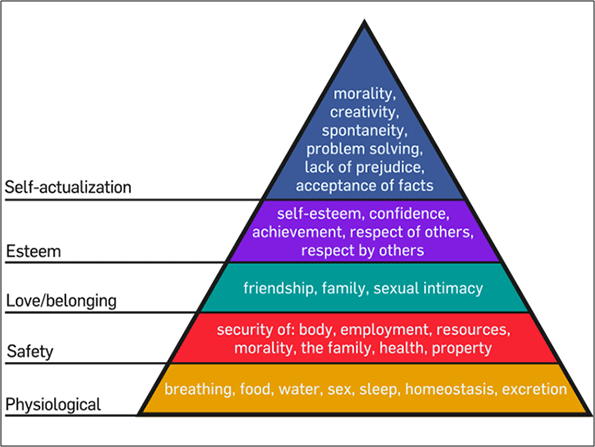
    Maslow's Hierarchy of Needs.svg

    How does a city do this? Well, the first step is to not get too cute, and to do the obvious realities right.. No amount of beautification projects will save a post-industrial city. A city needs to focus on the basics, as you develop a city like you grow a child. Here, the psychologist Albert Maslow’s hierarchy of needs can help.

    To wit, city leaders must prioritize physiological needs: eradicate food deserts, curb environmental threats, etc. Then, focus on safety. Not just manning safety force slots, but making sure those protecting us respect their duty. There are big questions about this in Cleveland. Also, shelter. Real local housing policies are needed, as are innovative educational and workforce development strategies. If you want to get creative, you can even leverage and strategize various needs together, like utilizing a glut of vacant storefronts into small business/entrepreneurial initiatives. Next, encourage social and cultural attachment so the benefits of community capital can be had. Don’t worry. If persons can breathe, eat, work, feel safe, and go home, they are likely to do this on their own. In fact that is the beauty of a hierarchy approach, as investment at the bottom turns into a self-fulfilling process up top. And then the icing on the cake: actualizing individuals, perhaps through fostering creative capital programs. That said, creatively classifying a city is doing it backwards if you haven’t built your city from the foundation up. Said Maslow: “A first-rate soup is more creative than a second-rate painting.”

    And while this makes intuitive sense to regular Clevelanders, it is confusing for the local leaders, if only through the advice of revitalization experts. For instance, in an article addressing concerns over whether or not Detroit’s investment should go to a bike path initiative, the author references an expert as to why the answer is “yes”:

    As Peter Kageyama argues in his book For the Love of Cities, “In the city making ‘hierarchy of needs’ we see most communities focused on bottom-line, core issues of making cities functional and safe. There still are many communities that struggle to even deliver functional and safe but that is not the problem. The problem is when communities only focus on the functional and safe and never raise their aspirations.”…Ultimately, places that do not engage us emotionally do not feel worth caring about.

    Clicking on the link above to Kageyama’s page, the expert details his thoughts and his audience:

    I focus primarily on American cities though the ideas are relevant to any place. I pay particular attention to some of our most challenged places such as Detroit, Cleveland and New Orleans as they have become hot beds of social innovation as government and the “official” city-makers have struggled to reconcile shrinking budgets and diminished capabilities. Into this vacuum has flowed a new breed of city-maker – usually young, independent, unofficial, creative, rule breaking and entrepreneurial. These are the new “frontiersmen” and “frontierswomen” who are rebuilding these cities from the ground up.

    There are a few problems here. First, while attachment to place is important, the logic is a bit flawed. A person insecure in various aspects of livability, like food and shelter, is not going to have their concerns addressed via an emotional connection to a given place. I am not saying developing place is bad. I am only saying such an approach is akin investing in nice drapes as your house is on fire. Put the fire out. Protect your people. Grow your people. After all, according to economic developer Jim Russell, people develop, not places.

    Second, local leaders are elected for a reason. To lead. And to serve and protect. “Frontiersmen” or Frontierswomen” are not going to protect the preyed upon—notwithstanding Charles Ramsey, though I doubt that is what Kageyama had in mind.

    No doubt, the events in Cleveland have shaken the city—yet another tear in an already torn city. And while the local and national news media is branding the escape of three women and one child as the “Miracle in Cleveland”, it wasn’t. At least not for us. We failed these young women. We failed the women before them. I hope this serves as our wake-up call. We will not play our way out of this. And if we continue to try, there will always be shame in the shadows of our revitalization.

    Richey Piiparinen is a writer and policy researcher based in Cleveland. He is co-editor of Rust Belt Chic: The Cleveland Anthology. Read more from him at his blog and at Rust Belt Chic.

    Top photo Courtesy of WOIO/AP

  • Visions of the Rust Belt Future (Part 1)

    “Men often applaud an imitation and hiss the real thing”–Aesop

    There are interesting developments being played out in the Rust Belt. Some cities, like Detroit, seem to be embarking whole hog down the creative class path. Others, like Pittsburgh, have their own thing going on, a thing Economic Geographer Jim Russell has delineated as the “Rust Belt Chic” model of economic development, with no modest amount of success. How a given Rust Belt city reinvests will have a large say in its future.

    Part 1 of this series, below, examines the nascent creative classification of Detroit. Part 2 analyzes whether or not there is a new way forward for post-industrial cities, using the lessons from Pittsburgh and Cleveland as the building blocks to developing an alternative set of strategies for struggling cities.

    Detroit Rock (Ventures) City

    In Detroit, the scene is playing out as such: rampant disinvestment in the core and extreme poverty around it. To help fix this, ties between Rock Ventures head and real estate billionaire Dan Gilbert, urbanist Richard Florida, and the non-profit Project for Public Spaces have been initiated. The goal, laudable enough, is to reinvest in downtown. And while the renewal formula planned is not new, the extent that the milieu is a controlled environment for an urban experiment is perhaps ahistorical, if only because Detroit’s level of disinvestment has created a vacuum that, naturally, power abhors.

    To wit, a recent New York Time’s article entitled “A Missionary’s Quest to Remake Motor City” hints at the level Dan Gilbert—who  has bought $1 billion in downtown property in what has been called a “skyscraper sale”—and his advisors have been handed the keys:

    “My job,” said Dave Bing, the Detroit mayor and former National Basketball Association star, “is to knock down as many barriers as possible and get out of the way.”

    And:

    “Mr. Gilbert met in a conference room for his twice-a-month Detroit real estate meeting, with about a dozen people who work for him, plus a lawyer and leasing agent. If Detroit 2.0, as this group often calls the effort, has a planning committee, this is it.”

    And:

    “[H]e and his staff will apparently have a largely free hand.”

    Now, the plan, and how the plan for Detroit’s future came about.

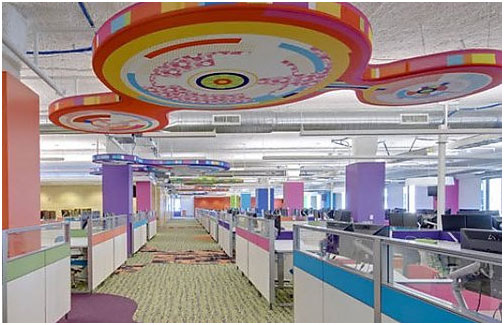
    A wealthy investor, Dan Gilbert, buys downtown properties. That investor goes on the record as to the importance of reinvesting into the urban core. That investor moves his mortgage company’s employees from suburban office parks into his own downtown real estate. Then, the investor, taking cues from his consultants, throws in something about innovation, which, at its lowest common denominator, means designing your way to a “culture of innovation”. Thus, the investor encourages that Romper Room-style office setting complete with what some would say is tacky décor wholly out of line with the soul of “the D”, but yet which is said to fun-birth inspiration—i.e., “[A] karaoke machine sat in an aisle. Guys threw footballs to one another; one employee shot at colleagues with a Nerf gun”; and “A Quicken promotional video solidifies the company’s attempts at over-the-top marketing, prominently featuring the space’s inexplicable Pac-Man theme”—despite the fact that your primary product line, i.e., mortgages,  needs far less innovation than it does a modicum of conventionality and ethics. Nonetheless, the sentiment of creative destruction is there.


    This basic process, then, is multiplied out from the office setting into strategic urban space, particularly around Gilbert’s real estate. The idea here is to design space so as to create vibrancy so as to galvanize commerce so as to ignite broad economic growth.

    Enter the partnership with the Project for Public Spaces, who is working with Gilbert’s group to do a set of “Lighter, Quicker, Cheaper” placemaking interventions, including pop-up shops. The conceptual girth behind the plan, according to a recent article “Detroit Leads the Way on Place-Centered Revitalization”, is described as such:

    “We proposed developing a Placemaking vision for the major public spaces, and refining the plan through the Power of 10 concept,” says Meg Walker, a Vice President at PPS who worked on the project. “…A lot of developers aren’t as enlightened as Dan Gilbert…they wouldn’t necessarily think about the glue that’s holding this all together.”

    “The Power of 10 framework suggests that a great city needs at least ten great districts, each with at least ten great places, which in turn each have at least ten things to do. Great public spaces produce an energy and enthusiasm that spills over into surrounding areas…

    With the conceptual description as a guide, this is a classic case of the urbanists’ version of trickled-down economics, in which an influx of capital into finite corridors is meant to attract wealth that “spills over” into surrounding areas. Unfortunately, there is little by way of evidence that this works, as was recently admitted by Richard Florida himself. What it may do, however, is fill real estate supply by pursuing a select target market, as placemaking can act as a grease to create pockets of creative class demand to support condos or retail and office space. And while one can certainly argue it beats rampant core disinvestment, it’s not the path of a bold new way that will measurably change the trajectory of Detroit, so says U of M Professor Michael Gordon. In effect, it’s simply shifting people from one set of real estate to another, with nothing undertaken on a systemic level to tackle Detroit’s real problem: poverty and disenfranchisement in its neighborhoods. Worse, re-urbanization as such is likely to exacerbate class and race divides that have plagued Detroit for decades, thus worsening Detroit’s real problem: poverty and disenfranchisement in its neighborhoods.

    Besides, we have been here before. Michigan via its Cool Cities campaign had a plan based off the same Detroit 2.0 premise, switch out the window dressing. Design place, accrue vibrancy, growth wealth. Obviously, the multi-million dollar economic development initiative didn’t work. Neither have similar initiatives across the whole of the Rust Belt.

    So, where’s the beef? What makes Detroit 2.0 different?  

    Naturally, this is where the economic development buzzwords “start-up” and “tech district enter into the Detroit 2.0 lexicon; that is, creating dense city areas will nurture spontaneous interactions that will foster Detroit’s innovation community, putting it firmly on the path to be the “Silicon Valley of the Midwest”. But every city wants this (or at least they are informed they do)—e.g., “Miami Wants to Be the Next Big Start-Up City”—and so the effort ultimately comes off as anything but visionary, rather visionless, trying.

    Cue the Onion. From an article entitled “St. Louis Mayor Has Sad Little Plan For Turning City Into High-Tech Hub”:

    In what appears to be a completely earnest attempt to revitalize a sluggish local economy, St. Louis mayor Francis G. Slay unveiled Thursday a detailed, ambitious, and truly depressing plan to turn his city into a major technology hub. “We’re going to show America, and the rest of world, just how innovative and cutting-edge St. Louis can be,” said the mayor, who displayed genuine optimism as he outlined a desperate strategy to woo major players in the high-tech sector with a sad little series of subsidies and tax incentives his city cannot afford… The mayor ended his presentation by pleading with reporters to dub the hopelessly untenable project “St. Louis 2.0.”

    In all, the current Detroit economic development approach is copycat urbanism at its finest, as there is nothing inherently “Detroit” about it. Nothing that intrinsically builds off its only true competitive advantage: itself.

    For instance, Motor City is Motor City for a reason: it builds things. It designs things. Like, for instance, cars, which, by last count, are still being used, with over 254 million registered passenger vehicles in the US in 2009 alone. And while technology-based automation is increasing manufacturing output at the expense of jobs, production is still huge business in the Rust Belt, with automotive-related STEM jobs (i.e., science, technology, engineering and mathematics-related employment)—i.e., the creative class before the “creative class” became the “creative class”)—aiding Detroit’s regional resurgence, with its 10.5% STEM job growth leading the country from 2010 to 2012. And no, this is not to say Detroit will recoup manufacturing jobs lost from its heyday. But it’s absurd for Detroit to neglect training and flexing its muscle—or its legacy of concept, design, and production—for a future with no middle between start-ups and baristas. I mean, advanced manufacturing isn’t nostalgia. It exists.


    So, why this path? Why pretty Detroit? Why make it culturally less distinct? Why embark on a plan of hyper-modern ephemerality when your distinction is resilience, making things, and hard work? Why? Where is the evidence that this even works? What in the hell is even going on here?

    To get to the bottom of this you need to be aware of parallel events in Cleveland. There, Dan Gilbert has hands in that city’s Downtown redevelopment as well. But it is not what you think. And therein lies the problem.

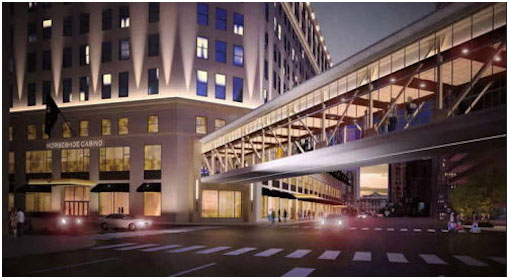
    You see, if the Detroit Dan Gilbert is the urbanists’ Dr. Jekyll than in Cleveland he becomes the anti-urban Mr. Hyde. In fact, the Cleveland Dan literally embarks on nearly all the urbanists’ seven deadly sins, including owning and running a casino placed right beside the city’s iconic Public Square, demolishing historic buildings for the creation of a VIP valet center, planning to ruin the iconic Terminal Tower by connecting an enclosed pedestrian tunnel from a parking garage into its face—the Plain Dealer architecture critic stated it was akin to “poking a straw in Mona Lisa’s nose”—and, more generally, pissing off Millennials.

    From a recent Atlantic Cities piece entitled “If Other Cities Are Demolishing Skywalks, Why Does Cleveland Want a New One?”, the author, who omits Dan Gilbert’s name, writes:

    “In the last decades of the 20th century, many American cities built skywalks in a desperate attempt to seem modern, hoping to create a sanitized urban experience that would compete with the sanitized suburban experience of indoor malls.

    For the most part, it didn’t work, and now cities…are tearing down the skywalks…in an effort to return pedestrian life and vitality to the street.

    Meanwhile, in Cleveland, the owners of the year-old Horseshoe Casino downtown are planning to build a brand-new skywalk…For many of the young people moving to Cleveland in search of a 21st-century urban experience – pedestrian-friendly, with lots of people out and about – it seems like a step backward in time.”


    Why is Gilbert going all anti-urban in Cleveland, then? In a word: money, as Moody’s just issued a report saying a walkway would help the casino reach predicted income streams, as it has been underperforming. Obviously casino ownership is a no frills money-making operation, as is real estate. With each: immediate financial return trumps the nurturing of human and community capital to support a vision of long-term economic growth.

    But Detroit Dan is different, right? He is a walkability guru’s guru. One of the “enlightened developers” as was stated above.

    Well, you be the judge. Here’s a blog post excerpt covering the recent Placemaking Leadership Council hosted in Detroit, with Detroit 2.0 taking center stage.

    Dan Gilbert, head of Rock Ventures and Quicken Loans, genuinely seemed to defer to Kent [the Project for Public Spaces head] when it came to his part of the presentation Thursday. Gilbert, who has millions of hours of public-speaking practice behind him, often turned to Kent to fill in the details on the upcoming renovations to Campus Martius, Cadillac Square, Capitol Park, Grand Circus Park and Paradise Valley.

    “Genuinely seemed to defer” is right. Or just bored as hell.

    And then there is this. This. Courtesy of a Curbed Detroit blog post called “Development In Downtown Detroit Is Playing Out Like A Huff Po Blog Post From 2009”. The referenced Huffington Post piece is by Detroiter Toby Barlow that is called “How a Billionaire Can Make a Billion Dollars”. The strategy? Buy Detroit, not “metaphorically” but “literally”, yet do it “very quietly, so as not to inflate any prices”. Then, according to Barlow, since a billionaire owns thing, he moves his employees to his buildings and gives them “incentives to live down near their work so that they’ll buy your residential property”. Barlow concludes:

    So, I don’t have to spell out the rest, do I? Real estate values will quickly soar as other companies, encouraged by your brazen move, make similar leaps into what will still be an incredibly affordable market. The momentum will build as the ever-frenzied media piles on.

    Yes, Detroit’s plan for the future pre-dated by a Huff Po blog entry from 2009.

    The big revelation here?

    Look, in the end, the Dan Gilbert’s of the world are in their line of work for one reason and one reason only: to make money. They will don whatever mask they need to play the part, be it the urban-loving Jekyll or the anti-urban Hyde. That’s the problem with creative class urbanism. It is dependent on developers who could care less. It is a means to an end for those who implement it.

    Too bad this end is not the beginning of a true path forward for a real Rust Belt recovery.

    Detroiters, like most Rust Belters, have been through enough. They deserve better.

    Richey Piiparinen is a writer and policy researcher based in Cleveland. He is co-editor of Rust Belt Chic: The Cleveland Anthology. Read more from him at his blog and at Rust Belt Chic.

  • Why Inmigration Really Matters, Particularly to the Rust Belt

    Cleveland Mayor Frank Jackson’s recent comment about immigration has drawn some local ire. At his annual remarks on the state of the city, the Mayor—in response to a question of how Cleveland can end its population decline by attracting immigrants—stated: “I believe in taking care of your own”.

    To be fair, the Mayor contextualized the statement by inferring that the best attraction strategy is to build a city that works for those who reside in it. In some respects I agree. In fact America attracts immigrants not because of “attraction strategies”, but because it offers the prospects of a better quality of life. So, if a city can nail that down, well, that is a hell of a pull.

    The problem, though, is that historically inward-facing legacy cities such as Cleveland have had a hard time moving the needle toward progress because fresh blood is lacking, and so a “taking care of your own” strategy often devolves into policies that simply further fossilize the status quo.

    Why?

    Because such cities—with low rates of inmigration, and a long lineage of social capital that can tip to the side of insularity and territorial encampment—have too much inertia, which is defined as “the resistance of an object to change its state of motion or rest”.

    Inertia is real, not simply in physics, but in organizational behavior, such as city politics and policy. And the more historical it is, the thicker the status quo, and thus the harder it is for a city to change—meaning the future, or the momentum of the city, can be like a train chugging to constant stops of stagnation unless a “force outside the system…act[s] upon the system for a long enough period of time to have any effect on changing the momentum.”

    Enter the importance of outsiders, be they immigrants, returning expats, or just new people from other parts of the country. Without them cities get stuck. People see the same things, talk the same things over. Bullshit territorial divides like East- versus West-side of the Cuyahoga River reign, effectively cutting a city’s “brain” in half. Business is business as usual, then. Hence the post-industrial-sixty-year decline.

    Writes Aaron Renn over at Urbanophile:

    I previously noted how it generally takes a critical mass of outsiders, enough to create a constituency for change in its own right, to drive real disruptive change in a community. These are the people who aren’t invested in the status quo. Absent that, getting reform that works will be a difficult challenge.

    Echoes migration expert and blogger Jim Russell:

    Without migration, there are no cities. An urban landscape is more than a draw for talent. Metros thrive on churn, both the influx and egress of people…

    … The very act of moving, particularly to the top tier of global cities, is entrepreneurial. You are surrounded by risk-takers and innovation. The competition is fierce. The cream of the crop is seeking any edge, looking for any opening.

    I am learning about the power of migration first hand. You see, I am a lifelong Clevelander, a West Sider, one well-versed in the how things are customarily done around here, and what thoughts and words are commonly produced if only through a Rust Belt inertia that can be cloaked in “tradition”. My partner, Andiara Lima, is a relative newcomer from Vale do Aço, or the “Steel Valley” of Brazil. Before I met her I was ignorant to the presence of the Brazilian community in Cleveland. Now, I no longer am, and the experience provides me with on-the-ground lessons as to the importance of migration in evolving the Rust Belt “way”.

    brazil house party


    For instance, individually speaking, my panorama is being broadened, with the dominant cultural connotations of Cleveland defined primarily by whiteness or blackness taking a needed hit. For instance, I was at a Brazilian-hosted house party not long back, and it was like nothing I ever experienced. The dining room was cleared, bodies moved, sweat poured, people screamed and shook ass. A band was set up to play bossa nova along a window seat. And it was happening all in the neighborhood of my childhood, but way beyond my childhood. Rather a feeling of something forward.  Not just past. Not identity politics, but a freshness needed so that crusty legacy and power can be dampened if only to bust identity politics up.

    No doubt, these identity politics hurt the region’s ability to welcome and catalyze emerging groups. For instance, I am reminded of a recent Facebook comment on a local politician’s page that discussed a community forum about how Cuyahoga County government reform would affect race relations. The commenter notes:

    The whole panel was black or white people. The Asians and Latinos were in the back of the room wondering “what about us?”

    “What about us?”

    It’s a good question, and one local leaders shouldn’t underestimate given the region’s need for fresh blood. And we aren’t just talking bodies, but talent, as migrants are “economic ass-kickers”, particularly due the fact that migration is in itself an act of entrepreneurialism.

    For instance, my partner Andiara studies the Brazilian trade market for a local investment company. Her informational network into the country, both professionally and informally, is deep. For me, she is a link between two Rust Belt worlds, shattering my sense of restrictive locality for a borderless view that gets me thinking about how to position Cleveland not just regionally, but globally.

    For Cleveland, she is a reserve for local industry that should be both cultivated and tapped, especially since—as the US Ambassador to Brazil recently said at Cleveland’s Union Club—“Brazil is an economic and democratic power the United States needs as a partner”.


    And there is Luca Mondaca and Moises Borges, both acclaimed Brazilian musicians who are plugging (into) and broadening (out) Cleveland’s musical legacy. Yet there is frustration, particularly for Luca, as she feels isolated, untapped, and sometimes lost in the culture of a city that—while desperate for freshness—has difficulty getting beyond the inertia that comes with being comfortably stale. And while I am hopeful that the city is in fact becoming more welcoming—and that the opportunity afforded by the region’s affordability and legacy assets can further open the inmigrant sluicegates—passive optimism is not an option.

    Neither is parochial playmaking.

    In fact, Andiara Lima, Luca Mondaca, and Moises Borges are Cleveland’s “own”. But without that recognition, they may not be for very much longer.

    Richey Piiparinen is a writer and policy researcher based in Cleveland. He is co-editor of Rust Belt Chic: The Cleveland Anthology. Read more from him at his blog and at Rust Belt Chic.

  • The Psychology of the Creative Class: Not as Creative as You Think

    “Innovation distinguishes between a leader and a follower”
    –Steve Jobs

    Behind every sociological movement is a psychology. The ever-growing creative classification of America is no different. The following teases the psychology of the movement apart.

    Why do this?

    Because it is needed. The costs of blindly acquiescing to copycat community building are too great. These costs are not simply aesthetic, even economic, but are costs in the ability to distinguish creativity from repetition, and ultimately: truth from fiction.

    Be Creative or Die

    “Anxiety is the dizziness of freedom”
    –Kierkegaard

    You may think creative classification—or the commoditization of cities as products to be consumed by creative people with means in the name of economic growth—begins with happiness. It doesn’t. It begins with anxiety. Writes Richard Florida on page 12 in The Rise of the Creative Class:

    [T]he September 11, 2001, tragedy and subsequent terrorist threats have caused Americans, particularly those in the Creative Class, to ask sobering questions about what really matters in our lives. What we are witnessing in America and across the world extends far beyond high-tech industry or any so-called New Economy: It is the emergence of a new society and a new culture — indeed a whole new way of life. It is these shifts that will prove to be the most enduring developments of our time. And they thrust hard questions upon us. For now that forces have been unleashed that allow us to pursue our desires, the question for each of us becomes: What do we really want?

    By tapping the defining moment of a generation of young people—a moment, mind you, defined by terror, insecurity, and “what if”— Florida begins his path to individual and societal progress from a point common to thinkers since the beginning of time, i.e., what does it all mean?

    In fact, if I was going to start a galvanizing societal theory, I’d begin there too, as uncertainty, if not fear, is a great motivator and catalyzer. Fearing failure, loneliness, meaninglessness, regret—it’s all fuel in the search for meaning, for life. And while this intrapersonal battle is stoked inside the individual, it becomes actualized in the world around us, not least in that relationship between a person and a place.

    Hence, the creative class credo: if you want to “live” you need to go to where the “action” is, else succumb to missing out. Such existentially-fueled place-pedestaling is perhaps the driving tenant of creative class urbanism. Writes Frank Bures:

    I know now that this was Florida’s true genius: He took our anxiety about place and turned it into a product. He found a way to capitalize on our nagging sense that there is always somewhere out there more creative, more fun, more diverse, more gay, and just plain better than the one where we happen to be.


    Courtesy of kenfager.com

    Of course many of us in “flyover country” can identify with this: our cities “suck”, and the lights of aspiration shine brighter elsewhere, particularly on the coast. And it’s a kind of self-loathing grown particularly virulent in the Rust Belt—that bastion of decay and anti-vibrancy. Regardless of the validity, the mesofact is out there: the Rust Belt is dead, go away to really live. Take this 2002 article entitled (aptly) “Be creative—or die”. Here, Florida, in a interview, states:

    They [cool cities] created a lifestyle mentality, where Pittsburgh and Detroit were still trapped in that Protestant-ethic/bohemian-ethic split, where people were saying, “You can’t have fun!” or “What do you mean play in a rock band? Cut your hair and go to work, son. That’s what’s important.” Well, Austin was saying, “No, no, no, you’re a creative. You want to play in a rock band at night and do semiconductor work in the day? C’mon! And if you want to come in at 10 the next morning and you’re a little hung over or you’re smoking dope, that’s cool.” I went to the Continental Club — I was invited by Austin’s leading political officials — and we went to see Toni Price the singer-songwriter, and there were hippies smoking dope right there on the back porch.

    Florida’s advice to city leaders? If you are uncool be cool, because cool nurtures a vibrant city, and a vibrant city attracts the crème de la crème who are different, unique, and anxious to suck the marrow out of life—and they will eventually spit it out into insights and innovation.

    Freedom Can Be Frightening

    One does not become fully human painlessy–Rollo May, existential psychologist.

    Recently on Twitter, Florida brought out the virtual creative class conch to alert to his followers that Yahoo was yanking its work-at-home privileges due to concerns over worker productivity. In a series of Tweets that lasted most of two days, Florida lambasted the decision, in effect showing how the 10 am start time has been liberalized over the years to not having to come into the office at all:

    1. Working from home = focus. 2. Office =distraction. 3. Innovation more a product of “urban” interaction than in-office interaction.

    — Richard Florida (@Richard_Florida) February 25, 2013

    Yahoo end game … Stars leave. Slackers go to office where they distract others. Result: Reduced overall productivity.

    — Richard Florida (@Richard_Florida) February 26, 2013

    Yahoo’s decision goes against, according to writer Charles Shaw: “‘the élan vital of the Creative Class [which] is “take me as I am and facilitate the use of my unique skills, but don’t expect me to buy into some corporate culture that requires me to change who I am’”.

    Explicit in such discourse is the unusual levels of individuality that’s supposedly threaded in the DNA of the creative class. No doubt, the concept of “individuality” in creative class theory is important, as unique, free-thinking creative-types are said to be the engine of the innovation economy, with the thinking that such individuals aren’t saddle-bagged with conformity and convention in their pursuit for fresh ideas.

    But is this true? Is the creative class really beyond the bounds of social conformity?

    To examine this, we return to the building blocks of creative class theory; namely, fear and anxiety.

    In Erich Fromm’s 1942 classic Escape from Freedom, the author takes pains to emphasize that freeing oneself from societal conventions is not a fun process, as “freedom can be frightening”. While his delineation of the lineage of modern man’s loneliness is spelled out extensively in the book, it is enough here to say that while market capitalism enabled a freedom in the pursuit of happiness through technological and democratic innovations, it also chained us because “the self” had become a commodity. Writes Fromm:

    “Man does not only sell commodities, he sells himself and feels himself to be a commodity…If there is no use for the qualities a person offers, he has none…Thus, the self-confidence, the “feeling of self”, is merely an indication of what others think of the person…If he is sought after, he is somebody; if he is not popular, he is simply nobody. The dependence of self-esteem on the success of the “personality” is the reason why for modern man popularity has this tremendous importance.”

    Fromm was damn prescient, as today more than ever there’s a tremendous amount of pressure to create a “false self” if you are interested in successfully navigating established social structures. This false self accepts not what it wants, but what it is supposed to want. To buck the system—that is, to emphasize the components of the “true self” that often have little value in a hyper-competitive society in which avatars compete in a virtual 24/7 spit-off so as to game a personal brand—we must, according to Fromm, realize that to know what one wants is not easy “butone of the most difficult problems any human being has to solve”.


    Courtesy of Jeff Bullas

    Of course many don’t solve this. We know this. We live it. Struggle with it, including this author. Instead, individuality is commonly sacrificed for the comfort in conformity. Writes Fromm:

    “[We] become a part of a powerful whole outside of oneself, to submerge and participate in it…By becoming part of a power which is felt as unshakably strong, eternal, and glamorous, one participates in its strength and glory.”

    It says here that one of these “powerful wholes” is to be able to self-identify with membership in the creative class. This is not a leap. Instead, the evidence of creative class conformity is increasingly clear in cities where creative class enclaves are thickest.

    Uniquely Conforming and Creatively Monotononizing

    In a time of deceit telling the truth is a revolutionary act–George Orwell

    One of Florida’s greatest accomplishments was to imbue a sense of distinctiveness in the millions upon millions of individuals that make up the creative class. This in itself is a feat, as it involves convincing persons that it is their own uniqueness that makes them a special, if massive, group. Writes Florida (The Rise of the Creative Class, 2002, 315, 326) via Jamie Peck:

    [The creative class] needs to see that their economic function makes them the natural — indeed the only possible — leaders of twenty-first century society . . .

    …[W]e must harness all of our intelligence, our energy and most important our awareness. The task of building a truly creative society is not a game of solitaire. This game, we play as a team’.

    Yet while preaching uniqueness to the self-believers as a galvanizing gimmick is clever, the problem for Florida is that those actually greasing the rails of creative classification on the ground are developers (Forest City’s Albert Ratner called Florida’s book the “playbook” for developers), and the only individuality they care about is the marketing kind, or the “you-are-so-special-you-deserve-this-condo” kind. Here, “individuality” and “diversity” aren’t meant to be taken literally, but as words to coax want so as to placate the shitty feeling of being a conformer, with of course conforming only placating the shitty feeling of loneliness.

    From an article “How to Brand Your City”, which covered Forest City’s Alexa Arena’s recent presentation about her San Francisco development project called “5M”:

    She said cultural diversity is a key ingredient in shaping a hub for innovation. Some of the best ways to promote diversity are restaurants, trendy corner shops and community events — all staples of 5M’s plan.

    Courtesy of Bold Italic

    Courtesy of Bold Italic

    Of course uttering such nonsense is beyond laughable–somewhat terrifying even–and if Arena and her ilk really believe such then they got their vested heads in the sand, fantasizing about diversity while monotone forms around them.

    Regardless, for others watching reality as it really happens they see creative class gentrification for what it is: a process of homogenization. In fact the sheer number of creative class = vanilla articles popping up everywhere of late may indicate that the jig is up (see here, here, here, and here), and those who actually moved to Big City for “the real”, or who grew up in Big City when it was in fact diverse before planned diversification, well, they are getting snarly. Writes Charles Hurbert in the “Homogenization of San Francisco”:

    Take a walk down Valencia Street today and you’ll find yourself waiting in line at a Disneyland of pop-culture opulence. Oblivious of the stark irony, graphic designers and marketing managers frequent $50/seat old-time barbershops and shop at retail boutiques obsessed with the rugged appeal of working-class fashion. Simultaneously, the actual businesses and experiences the proprietors are emulating are unable to compete in the increased rental market. What we’re left with are stage props and costumes in an increasingly detached culture of disingenuous, blue-collar nostalgia.

    This is not to say that the creative class movement will go down without a fight. Part of the fight is to acknowledge creative classification’s faults, with Florida himself–the “Urban Prophet” as he was recently donned in Property Week–out front and center owning the solutions to the consequences of his own policy. For instance, there is the Atlantic Cities “Class-Divided Series” which vividly demonstrates the extent the creative class forms enclaves in Global City space, thus exacerbating disparity. And there is a recent NPR Morning Edition interview that states “Urban scholar Richard Florida has found a problem with the way our cities are evolving”, ignoring of course the work of scholars like Jamie Peck who have been “finding” problems for the past decade.

    And then there is the other part of the fight which simply means believing it doesn’t exist. Here, economic development types carry the pail largely through good, old-fashioned “nothing to see here” pieces that serve to obfuscate the truth. Like this one in the San Francisco Chronicle entitled “Gentrification is no longer a dirty word” that I just picked up from Florida’s Twitter feed, which basically smashes a happy face over the pain creative classification can make:

    “Young people with talent are the new movers and shakers in the city,” says [30-year real estate veteran] Thompson, who says the city sells itself. “Last weekend I had some clients who were looking in the Mission. We drove by Dolores Park, and it was packed. They said, ‘Is there a street fair?’ “

    Nope, just another afternoon in trendy town.

    Again, the creative class movement will not walk gently into the art-festival-lit night. There is too much at stake. Too much money, and too much psycho-sociological comfort in being able to believe your part of a privileged group that has both force and uniqueness: a kind of snowstorm in which no two creative class snowflakes are alike.

    Largely, this fight will be played out in a clash of ideas in which reality versus relativism takes center stage in a battle for meaning versus no meaning: an Orwellian sociological/psychological shit show to determine whether or not 2 plus 2 = 5, diversity = homogeneity, individuality = conformity, authenticity = fake, and a life of meaning = the deep existential loneliness occurring when the false self aches.

    Nothing less than the integrity of creativity is at stake.

    Richey Piiparinen is a writer and policy researcher based in Cleveland. He is co-editor of Rust Belt Chic: The Cleveland Anthology. Read more from him at his blog and at Rust Belt Chic.

    Lead photo: The vibe in Cleveland. Courtesy of David Jurca

  • Gentrification and its Discontents: Cleveland Needs to Go Beyond Being Creatively Classed

    “Indeed, we have the know-how, but we do not have the know-why, nor the know-what-for”—Erich Fromm, social psychologist.

    The question of how you “become” as a city has been weighing on me lately. Is it enough to get people back into the emptiness? Is it enough to pretty the derelict? I mean, is the trajectory of Cleveland’s success simply a collection of micro-everythings, start-ups, and occupancy rates? That is, is Cleveland’s reward simply the benefit of being creatively classed?

    I hope not. It won’t work. Here is why.

    The problem with most city revitalization these days relates to its playbook: there are the investors who have the capital, and then the political power from which finance flows. Here, money not only talks, it builds, with investors’ wishes transcribed in how a city looks, feels, and functions. That said, the main interest of the investors is to make money, and so people are seen as consumers as opposed to citizens. Consumers that fill up real estate space. Consumers that salivate over tastes. Consumers of art and design, with the attraction to beauty meant to establish a “vibrancy for profit” mindset as opposed to experiencing beauty for the value of beauty’s sake. Come to think of it, the creative class is really just the consumer class, just like the rest of us. Yet they are anointed in status by city makers because they are thought to have more spending power than their working- and service-class counterparts.

    “Follow the creative community, and property values will rise,” states one recent article in a real estate publication. “You have given real estate developers the playbook”, echoes Albert Ratner, head of Cleveland-based Forest City, on his reading of “The Rise of the Creative Class”. The motivations, as such, are quite blatant.

    Now, why is this a problem?

    Because developers have extraordinary amounts of pull in directing where finances goes (this is particularly true in Cleveland), which means investment can get skewed to a select demographic. As such, the gap between the haves and have not’s grows and the geographic disparities begin to cement social inequities into the city’s fabric. Cracks then show: drug use, murders, alienation and disenfranchisement, growing pockets of continued disinvestment, and it won’t stop because research has consistently shown that inequity is an endless source of social ills. The only thing left to do is to compartmentalize our shadows, with “bad” kept in places away from the spots of our “hope”. This is not unique to Cleveland or to this era. It is just the way things have been, which leads me to wonder if Cleveland’s recent comeback is just a carousel in which progress is simply rearranging the broken deckchairs.

    But while the future is uncertain, failure need not be inevitable. Yet what can be done in Cleveland and other Rust Belt cities to ensure we don’t waste our opportunity? Unfortunately, little outside of a radical shift in how cities think about themselves, particularly as it relates to the notion of “revitalization”.

    This is where the concept of “Rust Belt Chic” comes in, which—when it is boiled down—is really just a process of collectively “knowing thyself” (an in depth description of Rust Belt Chic economic development will be delineated in a subsequent post). Specifically, by becoming aware of who we are as “Cleveland” we know who we are not, or more exactly: what we don’t need to be. This is important as it relieves the temptation of Cleveland trying to copy some other city’s so-called success which, in the end, is counterproductive, as such efforts—like the historic Columbia Building demolition for a Vegas-style “look”—ultimately eliminates those things like history and architecture which ties us together.

    columbia building

    The historic Columbia Building being demolished. Courtesy of the Cleveland Kid.

    This is all to say that Cleveland need not be “brochured” for the so-called creative class. That is simply objectifying your city as a product as opposed to a people, which is crude, and such posturing and posing is hardly Cleveland, besides.

    Instead, a hammering down of who we are in our process of becoming is needed. We are Clevelanders. We care and fight for this city, endlessly. We swear, shake hands, bleed, heal, work, fight, and pray—all in an environment molded more so by the reality of Mickey Rourke than the donning of Ashton Kutcher. And so while repopulating the core is needed, we also must engage in building the productive capacity of people as opposed to simply relying on a capacity to spend. Specifically, squeezing out price per sq. feet at the expense of community fabric is not true economic growth. It is mountains turned to coal.

    I cannot emphasize enough how important community development is to Cleveland’s future. For as creative classification goes main stream, more and more cities will begin looking and feeling the same, and more and more cities will be turned to products to be gobbled up by those with stars in their eyes. But this kind of thing is not for everyone, or even for most. It is for a slice, a finicky slice. And so I gather creative classification will go the way of the fad, like all styles do. Some cities will be stuck left to look at the cartoon tattoos that dot their body, while the people left longing will decompress to find something a little more real.

    Then—if we do it right—people will turn to Cleveland not because we faked the place as attractive, but because Cleveland made an effort to turn to its people.

    This post originally appeared at Cool Cleveland.

    Richey Piiparinen is a writer and policy researcher based in Cleveland. He is co-editor of Rust Belt Chic: The Cleveland Anthology. Read more from him at his blog and at Rust Belt Chic.

    Lead photo: Don’t call him creative classed. A Cleveland artist, Mac, and his rooster, Morty.

  • That Sucking Sound You Hear…Solutions to America’s Housing Crisis Are Needed

    There is a crisis in America that’s not being attended to. It is the housing crisis, and its tentacles reach deep into the decline of the American middle class. Particularly, the interlocking dynamics of foreclosure, abandonment, and blight are draining the net worth of millions of Americans. The solutions to date have been piecemeal and ineffective. One possible initiative on the radar—which will be explained further below—entails a federal investment in the strategic demolishing of thousands of “zombie properties” that are eroding equity and quality of life.

    This erosion is real. Writes Howie Kahn of his recent tour with a City of Detroit demolition crew:

    Old roofs half-collapse under the weight of snow, forcing the walls to bulge outward. Moisture eats away the insides. Mold spoils the walls, softens the floors. In the summer, the sun bakes it all to a high stink and turns it crisp as tinder. Nature takes over. Trees sprout through the dormers. Animals get comfortable. We see this everywhere we go…So many innocent onetime starter homes, built on credit and striving, now in foreclosure. The holding company writes it off as a loss. And unless some crusading neighborhood association acts as a sentry, no one’s watching the house anymore. In essence, it belongs to nobody—or to everybody. Because once a house becomes worthless and unwanted…it’s everybody’s problem. Everybody’s crime scene.

    As both a policy researcher and a Clevelander, I know these realities first hand. The city was home to over 40,000 vacant housing units in 2010, or nearly 20% of its stock. Several of these units were across a street from me, the result of a foreclosure on a rental investment purchased during housing inflation heights. Tenants were kicked out around 2009. The place sat empty, but I soon noticed people constantly disappearing into the back of the building. Drug activity I thought. Then one day I found a pile of hypodermic needles on my front lawn while cutting the grass. I have a child. The very real effect of blight acted as a drain on my property value, not to mention my quality of life.

    And while I stayed in the City of Cleveland, many don’t. Cleveland lost 17% of its population from 2000 to 2010. The population decline (which is a long-term trend)—combined with the subprime mortgage crisis—created for unprecedented amounts of oversupply. Often, with both banks and homeowners walking away, the vacant structure devolves into blight until it becomes “a disamentiy effect”, which in plain-speak simply means living near something nobody would want to, with the unappealing prospect monetized in the devaluation of the house’s market value.

    This disamentiy effect has been quantified. For instance, my colleague Nigel Griswold found that in Flint, MI each abandoned structure within 500 ft. reduced a home’s sales price by 2.27%. A study by Thomas Fitzpatrick of the Federal Reserve Bank of Cleveland showed an additional property within 500 ft. that is either delinquent or vacant reduces prices by 1.3%. In low-poverty areas the effect is greater: 4.6%.

    Of course the larger problem is the broader economic effect, as depreciation goes beyond a lower return on investment and gets at household net worth. Specifically, according to the Census Bureau, household net worth declined 20% from 2005 to 2010 (40% since 2007). Of this decline, 76% was attributed to a loss of home equity. Minorities were hardest hit, with average Black household equity falling from $70,000 to $50,000 and average Hispanic household equity falling $90,000 to $40,000.

    Such declines in net worth have swelled the number of Americans stuck in precarious economic conditions. A recent report called “Living on the Edge: Financial Insecurity and Policies to Rebuild Prosperity in America” found that nearly half of Americans are “liquid asset poor”, meaning “they lack the savings to cover basic expenses for three months if unemployment, a medical emergency or other crisis leads to a loss of stable income.”

    Vacant house in Detroit. Courtesy of Streetsblog

    Such economic figures are alarming, and they call for intensive solutions aimed at reconstituting the American middle class, if only to achieve a broader economic recovery outside of the investor class. One such solution could entail a large-scale strategic demolition of “zombie properties” in America’s hardest hit areas, such as the Rust Belt.

    Why demolition?

    It is simple, really: by removing the disamentiy effect you are giving the value of the surrounding houses a chance, and there is initial empirical proof that this does in fact occur. Specifically, in his examination of Flint, MI, Griswold found that Genesee County’s demolition investment was paying off, with $3.5 million of demolition activity producing $112 million in improved surrounding property values. Not a bad ROI, and it’s a return that positively affects homeowners, investors, and government alike.

    The question remains: why isn’t there a concerted effort to once and for all excise the hundreds of thousands “zombie properties” that are draining value from the American economy?

    The reasons are varied, but one in particular relates to a lack of empirical proof that demolition has a definitive monetary impact. One current study, spearheaded by Jim Rokakis of the Thriving Communities Institute, aims to fill the gap. The study, headed by Nigel Griswold, myself, and the Center on Urban Poverty and Community Development at Case Western Reserve University, was partly conceived out of a September 2012 interagency meeting on Residential Property Vacancy, Abandonment and Demolition in which—after hearing pleas from a largely Midwestern contingent—officials from Federal Treasury issued a challenge: show through robust empirical means that demolition (1) retains value on nearby properties, and (2) decreases the likelihood of future foreclosures. If the results prove definitive, Treasury suggested they could make a federal strategic demolition initiative a reality.

    Vacant houses in Buffalo. Courtesy of the NY Times.

    Of course the operative word here is “strategic”, as bulldozing for the sake of bulldozing does not a solution to a crisis make. As such, the intent of this research is also to help those on the ground ascertain where an investment in demolitions could pay off most. For example, there are properties—particularly architecturally-rich properties with high intrinsic value—that should be preserved and shuttled down another path. As well, there are areas in cities in which population decline is shifting ever so slightly. The area I had lived was one of them. And the house that was once vacant across from me has been renovated and is now home to a number of tenants. Thus, the authors of the study are cognizant of the contextualization that exists in various hardest hit cities, and so recommendations will be matched with an understanding as such.

    That said, the study is currently ongoing, and while the results are as yet unclear—and in fact may not be robust enough to convince D.C. to act—the effect of “zombie properties” on the financial and mental well-being of regular Americans is anything but uncertain.

    As a Clevelander, I know this all too well.

    Richey Piiparinen is a writer and policy researcher based in Cleveland. He is co-editor of Rust Belt Chic: The Cleveland Anthology. Read more from him at his blog and at Rust Belt Chic.

    Vacant Cleveland house photo by Flickr user edkohler.

  • Gentrification as an End Game, and the Rise of “Sub-Urbanity”

    “It took a bit of wind out of my sails, watching what happened in this neighborhood, watching how it happened…I don’t know how to beat this [gentrification]. I don’t know how anyone can beat this machine.”—From the article The Ins and Outs

    The Generalization of Gentrification

    The forces of gentrification are taking hold in America’s alpha cities. You can check the numbers or see the maps, but to get a good idea of its unprecedented rapidity, I’d suggest the blog Vanishing New York. There, you will see nearly each day the announcement of yet another old-school establishment losing the rent battle: Lenox Lounge in Harlem, Suzies Chinese Restaurant on Bleeker St., the Central Iron and Metal scrap yard below the High Line. And with the small-business soul of the city goes the regulars that gave places like New York City its identity before its global city branding.

    For instance, speaking about the closing of the Big Apple meat market in Hell’s Kitchen, writer Jeremiah Moss vents on the city’s whitewashing:

    The [Big Apple] exterior is wonderfully dreary, covered in graffiti and pigeon shit. Standing here, you could dream yourself into a lost New York. But not for long. It’s all coming down for more glass, more chain stores.

    A couple of years ago, the Times did a piece on Big Apple. The article includes a wonderful slideshow of photos, featuring the sort of person who shops at Big Apple, the sort of person that is also vanishing from New York, replaced by the svelte and distracted, the hollow men and women, tapping away at iPhones in sterilized Whole Foods aisles.


    Courtesy of The New York Times

    This is not a localized thing, as cities everywhere are grappling with the abruptness and consequences of such change. And while gentrification has been occurring here and there for decades, with community capital unwound on a street-by-street basis for higher returns and bigger tax receipts, the sheer push from above, like meat through a grinder, is now so systematic—and no longer personified by the Robert Moses’s of the world but by a kind of faceless force blowing a current of yield and tidiness in—that it has just become what is, with the late scholar Neil Smith referring to this latest iteration as the “generalization of gentrification”.

    In his article “New Globalism, New Urbanism: Gentrification as Global Urban Strategy”, Smith examines how gentrification has morphed from an unfortunate effect to an outright aim. One explanation for this relates to the ever-morphing private-public partnership in cities in which elected officials have forgone governing for investing, with policy no longer aspiring to guide economic growth but rather being crafted to “fit in the grooves” of market forces, particularly in the realm of real estate.

    Why real estate?

    Part of the reason is that economic leaders now primarily see Americans as consumers as opposed to producers, and so cities—particularly alpha dog global cities—have shifted their focus from payrolls to price per square feet, making real estate an increasingly important productive engine of cities as opposed to the productive capacity of the citizen. Enter, then, the volitional push of attracting as many creative class gentry as possible into the confines of a place, with real estate gimmicks—such as Mayor Bloomberg’s recent microapartment push—aimed at further squeezing blood from areas with far more density than available space.

    Does such wealth-packing inject capital into a given space? Yes. Is it a viable economic growth model? Wrote Aaron Renn in a recent New Geography piece:

    Indeed, all too much urbanism amounts to a sort of trickle down economics of the left, in which a “favored quarter” of artists, high end businesses, and the intelligentsia are plied with favors and subsidies while precious little ever makes it to those at the bottom rungs of society.

    This is not to disown the fact that global cities are economic engines in their own right. They are. It is only to state that their long-term economic growth prospects are being sold down the river at an exorbitant price. After all, people develop, not places.

    Gentrification of the Mind

    Allocating supply is one thing, but stoking the psychogeography of the creative class to want and squeeze into high-priced real estate is another. Historically, the common desire to move to an alpha dog city is to be where the action is. Moreover, NYC, Chicago and the like can graduate you. They can defang your limits while toiling the mind to the experiencing of new people and ideas. Said John Lennon:

    I regret profoundly that I was not an American and not born in Greenwich Village. It might be dying, and there might be a lot of dirt in the air you breathe, but this is where it’s happening.

    Yet this “if you can make it here you can make it anywhere” pull is arguably not what’s driving the generalization of gentrification. Rather, it is the idea of big city suburbanization, or more exactly: the hybridization of city “vitality” with the comforts of suburbanization, creating for a kind of third place called “sub-urbanity”.

    In many respects, this is not surprising, as the most recent “return-to-city” movement is largely fueled by younger suburbanites who are tired of missing out on big city action. Not the action per se of Charles Bukowski’s L.A. or Patti Smith’s New York, but the action of, well, Chandler, Kramer, and Carrie. Said Alan Ehrenhalt, author of The Great Inversion and the Future of American Cities:

    This is the generation, don’t forget, that watched Seinfeld and Sex and the City and Friends – usually from sofas safe in the confines of the suburbs. I think they find suburban life less exciting than urban life. While they are in a single or childless situation, they’re particularly eager to try it.

    And try it they should: varied experiences make varied lives make more richly contextualized societies. But the rub here is that the mentality sewn from “the confines of the suburbs” is not being sacrificed for the beautifully unnerving experience that is “the real” of city life, but rather that creative class enclaves are increasingly being appropriated into the domesticated lifestyle embodied by traditional suburbia.

    Of course John Lennon’s Greenwich Village this is not. And this bodes ill for alpha dog cities in that vanilla-ing a people and a place is a death knell to collective urgency, if only because comfort puts to sleep the burn that has traditionally sparked the next generation of ideas. Writes Sarah Schulman, author of The Gentrification of the Mind: Witness to a Lost Imagination:

    Gentrification is a replacement process. So it is where diversity is replaced by homogeneity, and this, I believe, undermines urbanity and changes the way we think because we have much less access to a wide variety of points of view. We are diminished by it. So literally, the range of our mind’s reach is much more limited because of gentrification.

    But again: lest we think this is all a mistake, or simply the byproducts of shifting demographics or economic and cultural change. Rather, it is the point. It is today’s path toward urban renaissance. And it’s a path creating for a “sub-urbanity” that is emerging when the generalization of gentrification meets the gentrification of the mind.

    So, what does this mean for the future of urban development? My guess is that there will be a growing unhappiness with sub-urbanity that’s going to create for a lot of people left wanting, be they young suburbanites longing for urban authenticity or indigenous urbanites who are tired of the schtick. As such, cities would do well to prepare for the “return-of-the-city movement”, which means prioritizing urban integrity and community capital against the temptations of the gentrifying machine.

    Richey Piiparinen is a writer and policy researcher based in Cleveland. He is co-editor of Rust Belt Chic: The Cleveland Anthology. Read more from him at his blog and at Rust Belt Chic.

    Lead photo by Liz Ferla, flickr user lism.