We have a severe drug problem, we’ve been told, that mostly affects suburbanites. The dangerous drug is not taken by mouth, nor by injection, yet it is used daily by every family member and must be stopped before we, as a nation, are utterly destroyed. According to many experts, our “dependence” on cars must stop.
Internet rumors abound that we are about to be legislated out of our stupor, and be taxed into high density, inner core cities. Should this rumor become fact, let’s look at what effect it will have on our economy, and, quite frankly, on the American Dream of home ownership.
Today, the housing market is still dealing with the disaster of plummeted prices. Since 80% of the new home market this past decade has been suburban, it would be safe to say that 80% of Americans that bought in this century are the hardest hit, because these new homes have dropped to pre-boom pricing. It has been young families, generally, that have driven out to the suburbs to find new homes, the promise of lower density, and newer safe schools. In addition, many (most) of these families believed that their homes were a source of income; after all, values were increasing 10% or more annually, and that equity could be tapped in loans, (both suburban and urban).
While many think of the suburbs as pure white, that is no longer true. The suburbs today, in general, are intermixed with all races. But the new race being ridiculed by many is the “suburbanite”. The suburbanite yearning for his or her daily fix of the car, consuming our fuel, and spewing carbon into our atmosphere must be eradicated at all costs.
So how do we eradicate this vermin? There are rumors of a carbon tax that will place a financial burden on those vehicular junkies. Who cares that this major portion of America’s population is under the most financial pressure since the depression. If we tax these infidels, that will surely bring them to their senses , and we can cure their dependence on Chevys, Fords, and Mini-vans. Let’s break their backs once and for all, so that these families will abandon what is left of the suburbs and be forced back to the inner core. If reason does not work, we can just legislate it.
Let’s imagine this new future filled with promise of a new America. In this fantasy, we visit the Smith family, who moved from their 10,000 foot suburban lot into the urban core. Adam Smith, the father, now must take the bus to the train station for the new light rail line that goes to Edenville, his job out in the suburb as a plant manager (it seems that his place of employment did not make the move). With connections, he can make it to work within an hour, whereas his 10 mile commute from suburb to suburb took 20 minutes.
Lilly Smith (his new wife, as the old one refused to move into a 20 story inner city high-rise) works at Bester Buy on the edge of the city. She needs two bus connections to get there Having a car is not an option, since parking costs are prohibitive in the city. Luckily, the kids are old enough to be left alone; Josh is 8 years old, Jane is 12, and Joey, who is 15, watches over the siblings. Today is a holiday and they are home from school, but the cold rainy day keeps them inside, along with hundreds of other kids who play in the vast corridors.
Lilly arrives at work, only to remember that Jane had a dentist appointment which she forgot about. She shivers, thinking about the old days, and the warm comfort of the Mini-van she once relied on to take her kids to appointments. She breaks out into a sweat and falls into a stupor. Her fellow workers recognize the symptoms, as they too have been weaned of their dependence upon personal vehicles. Her manager, Ralph, lets her take a week of sick leave to get help.
Ralph is lucky. He lives in a single family neighborhood on the edge of the city. He has his own large lot, a spacious 35 feet wide and 90 feet long. He and his wife each posses a car. His luxury two story home, setback five feet from the sidewalk, is 25 feet wide and 50 feet deep; the house itself is a massive 2,500 square feet, over twice as large as the Smiths inner city apartment. He also has three children who enjoy the privacy of their back yard. The garage adjacent to the 12 foot wide alley consumes 440 square feet of their remaining 1,200 square foot rear yard. Still, with 760 square feet of green space, the kids are lucky.
Ralph and his wife, Mary, both drive electric cars. Mary has the larger vehicle, with a 50 mile range per charge on a warm day. Their daughter wants to play with a cousin who still lives in the suburbs, 20 miles away. This is a cold day, which reduces the range of the vehicle to 35 miles, and their cousins do not have a charging station, so their 11 years old daughter is driven to the Light Rail station, a mile away.
A week later, back at the Smith apartment, an argument starts between Adam and Lilly about her desire to get out of the city. Even if they did move out to near Adam’s plant, they would need Lilly’s paycheck to make ends meet, so she would need the light rail and two bus connections to get to work. Lilly begins to sweat and shake again… When Josh asks what is wrong with Mommy, Adam explains about the days when Americans were drugged out on their cars, the days when people were free to go when and where they wanted. As he describes those terrible times, he too yearns for those days. Adam and Lilly dream of moving out to a place with space, if only the carbon tax on moving out of the city could allow it, but alas, it’s only a dream that only the wealthy can now afford.
A fantasy? Here is what I’m experiencing as a planner. When I met with a city official a few weeks ago I was admonished for a proposal that included attached garages. I explained that attaching the garage reduces 40 feet of exterior wall to be built, and here in Minnesota, an attached garage means you do not have to shovel snow between the home and the garage, nor slip on the ice. Why would I detach a garage, I asked? The city official explained that according to his planning staff, the space between the garage and the home is a social gathering spot where neighbors can stop and talk about their day. I had thought that’s what that large front porch we are proposing on the homes was for.
There is a movement to prevent the toxic drug — the car — from infecting our lives. For me, no way you are taking me off my ERPT — Extremely Rapid Personal Transport — dependence.
This is the second of a two-part series in which different authors examined the centrality of the autombile in urban and suburban life.
Photo by Rick Harrison of the author’s ERPT — his Porsche.
Rick Harrison is President of Rick Harrison Site Design Studio and Neighborhood Innovations, LLC. He is author of Prefurbia: Reinventing The Suburbs From Disdainable To Sustainable and creator of Performance Planning System. His websites are rhsdplanning.com and performanceplanningsystem.com.
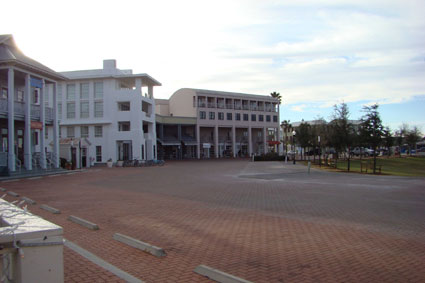 What I experienced in Seaside was much different than what I expected from watching The Truman Show. When the film was released, the main feature of a typical cookie-cutter suburban home was… well, uh, hmm… I guess you could describe it as quite featureless. But some developers and builders ventured forth into New Urbanism, or an emulation of the look. The home buyer was now faced with a choice: the requisite aluminum, white, three car garage door with the home hidden somewhere behind it, or a home with a front porch instead. Buyers became smitten. They may have still bought the garage snout home, but the writing was on the wall. The days of the vinyl clad / garage forward / featureless home were numbered, and if builders were smart, then they had to increase their architectural character. Many suburban homes gained a porch, some architectural detail, and a somewhat less prominent garage. Buyers started demanding walks and other amenities… and builders and developers responded until the housing market crashed.
 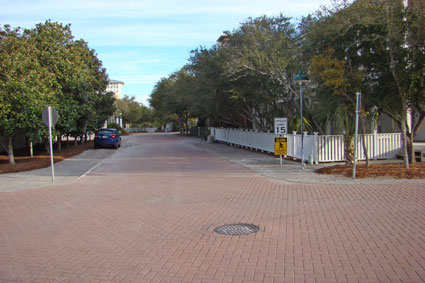 I distinctly remember Seaside from The Truman Show as well coiffed and manicured. Homes all behind picket fences. When we strolled the streets, the landscaping between each home and white picket fence was overgrown, making it difficult to see the homes and closing up space along the streets. There were no walks along the streets. There were natural trails in a straight pedestrian system behind each home along the rear yards, with paths so narrow (about 4’ between picket fences) that I needed to follow behind my wife as we strolled through the blocks (these paths were not in the movie).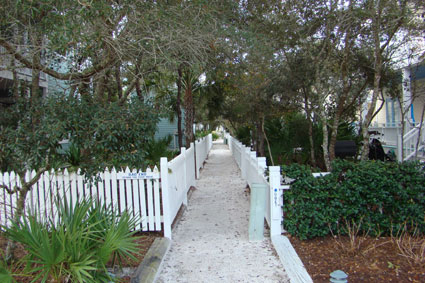
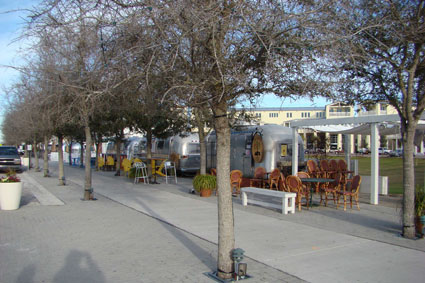 In general, much of Seaside is overgrown with landscape that blocks the feeling of space. We were told by a few sources that only about twenty residences have full time owners, with the rest rented. There were a few restaurants and bars, and the same grocery store that was in The Truman Show, but the feel of the development was much different than what I expected after seeing the movie. The main street has rows of Airstream trailers with street vendors selling various food items, something I found distracting from the image of New Urbansim; very touristy. The general pattern of Seaside is quite maze-like, requiring us to carry a map as we took a stroll.