Author: Rick Harrison

  • Land Planning: Put Tech and Team on The Same Page

    Technological advances allow Civil Engineering and Land Surveying professionals to perform, in minutes, tasks that would have taken days or weeks before computer usage became widespread. I have been fortunate to have been part of the technology industry from its humble beginnings. In the 1960s, working for a Land Planning firm, I began inventing devices to reduce the time it took to draft plans. These contraptions would hang on the wall, jokingly labeled Rickometer1, Rickometer2, etc. My systems allowed me to get the plans out faster, but the designs were no better because of these devices.

    Fast forward four decades and nothing has changed.

    For all the technological advances in the land development design industry, not a single design solution has evolved beyond today’s prevalent cookie-cutter planning patterns. We can knock out plans ever faster, but rarely better.

    Why Has Technology Failed To Improve Planning?
    This is something I’ve wrestled with over the past several years as I developed my latest industry offering: Performance Planning System (PPS). Originally I had thought the problem of moving the development industry forward was lack of communication, understanding, and in some ways respect between consultants in surveying, engineering, planning & architecture.

    For example the numbers pros(civil engineers and land surveyors) fear working with the vague and terribly inaccurate freehand work of the artist pros (planners, architects, landscape designers, etc). The artists mistakenly think that if their work goes into a Computer Assisted Design (CAD) system, it somehow magically becomes accurate. To stereotype for a moment, these different consultants often have very different personalities. The artists and numbers people are not likely to be found in a friendly chat at the corner coffee stand, unless forced together by a business meeting.

    The land development related software industry is competitive, but mostly controlled by the big three companies: Autodesk, ESRI and Bentley. All three offer land development design “add-ons,” but none offer a true “land planning” system expanding beyond the cookie-cutter recipe. Another problem is that software terminology is specific to the particular industry it serves. As such, the planning terminology typical of, say, a Geographic Information Systems (GIS) package would not be part of a civil engineering software package. Land surveying-specific terminology would never show up in an architectural package. All of these software giants have done a glorious job of allowing their “users” to get the job out faster. But we need to create wonderful neighborhoods, not faster subdivisions.

    Civil engineers and land surveyors must be extremely accurate, because the plans they produce are legal documents. The basis of their plans is coordinate geometry, which tracks points tied to a numbering system. This “point numbering” system, introduced in the 1970s, introduces complexity; it’s an instance where automation increases tediousness.

    Changing The Course Of Land Development
    Putting technology aside, a host of other factors have prevented land planning from moving forward in the right direction. In the past two decades our land planning firm developed new methods to design neighborhoods that would significantly reduce the infrastructure and environmental impacts of development, while maintaining the density of conventional and Smart Growth design alternatives. This evolved into providing exciting neighborhoods with lower housing costs.

    In other words we developed a higher level of land development practices through methodology that was not device dependent, but instead, knowledge driven. To teach this knowledge, we worked with Sustainable Land Development International (SLDI.org) to produce the book Prefurbia-Reinventing the Suburbs from Disdainable to Sustainable. The book sets a foundation for a new way to think about land development design and regulations.

    When we wrote Prefurbia we retained Rickard Kronick, an author who specializes in the history of architecture, to investigate the various college courses in planning offered in the USA. All offered Urban Design courses. None were specific to suburban design. Suburban development represents 80% of the growth in the USA. Did you ever wonder why suburban planning and design has stagnated? Wonder no more!

    Next, we developed an advanced coordinate geometry design software that eliminated the tediousness of point number management. This new software would blend common terminology of the various land development consultants, in an effort to break down communication barriers between designers and engineers.

    Finally, we planned to expand the platform to a series of college level courses for low-impact suburban design. I approached a multitude of urban planning professors to seek help with this project. None were interested.

    It was time to re-evaluate. Reality check: There will never be software functions that will create wonderful, vibrant neighborhoods that are environmentally sound and economically feasible. A software function only automates complex tasks into less keystrokes. This guarantees monotony if everybody uses the same package. In order to advance planning we must improve that other software… you know that stuff that lies between your ears!

    Creating a New End User
    So we decided to create a system that would create a better end user. This meant teaching those number pros design methods that create character and value, and giving the artist pros a foundation in engineering and surveying. Teach how to recognize the tremendous waste in design to create more efficient development. Teach the importance that architecture plays in every development, not just from a façade (front porch) perspective. Teach how to integrate the interior floor plan as a component of the overall neighborhood functionality. The world is designed using ordinance minimum requirements that result in minimal projects. Teach how to design beyond the minimums.

    In other words, teach low impact design that embraces the environment as well as the developers profitability. We teach what can go terribly wrong when attempting “green” goals. We estimated that the entire cost to us to expand the product into something that educates is less than $10 a package (per student). We also intend for this system to be a portal inviting others to contribute to the educational material.

    Make no mistake – this does not mean we have made anything “easier” for the land development industry. Just the opposite. The knowledge base is extensive, and each new element adds a layer of thought to the planning process. In time we will know if this experiment in a new approach to design will yield the intended results, and create a more sustainable world.

    Rick Harrison is President of Rick Harrison Site Design Studio and Neighborhood Innovations, LLC. He is author of Prefurbia: Reinventing The Suburbs From Disdainable To Sustainable and creator of Performance Planning System. His websites are rhsdplanning.com and performanceplanningsystem.com.
  • Suburbs & Cul-de-Sacs: Is The Romance Over?

    The Virginia Department of Transportation does not like cul-de-sacs. You know, those little circles that suburban home dwellers worship so much and pay a premium to be located on? Under its regulations, all new subdivisions must have only through streets. Essentially, no more cul-de-sacs. Getting rid of these desirable dead-ends, according to the DOT, will improve safety and accessibility for emergency vehicles.

    The new set of rules regarding street regulations is called Secondary Street Acceptance Requirements (SSAR). It requires a set of closed, interconnected street segments designed under specific formulae to make sure the streets are well situated for pedestrians and bicycles. The SSAR is also designed to better distribute traffic in local suburban settings, specifically subdivisions.

    I’m here to defend the cul-de-sac, but not as it is typically built and designed.

    What makes a cul-de-sac lot premium? Homeowners fall in love with the quiet courts and the sense of built-in neighborliness. The words “quiet cul-de-sac location” can spur more sales than the words “new granite counters.” The homes have huge rear yards, because of the extreme pie shape. The paved dead end areas guarantee no traffic will be speeding through, making parents and kids feel safe.

    The wide angles between the adjacent home sides create some useable side yard space, as well as added privacy. Quiet, serene, and safe – what’s not to love?

    Who Determines The Best Street Pattern? One of the biggest problems of suburban street design is that those who typically plan subdivisions don’t focus on vehicular or pedestrian flow, nor are they required to do so. The vast majority of subdivisions (and even of master planned developments) in the US are designed by engineering and land surveying companies that focus on density and meeting the ‘minimums’. A developer will typically hire the same company that engineers and surveys their site to plan the subdivision layout.

    Very little information is available on how to create suburban street patterns with connectivity. These areas may have significant topographic variations, making a traditional urban grid pattern undesirable. Suburban regulations don’t offer much help or guidance, either. Planning commissions and city councils that do not have an understanding of traffic engineering end up giving a yes vote to site plans they do not understand. The result is a conglomeration of people involved in the approval processes that produce a traffic system based more on familiarity than on functionality.

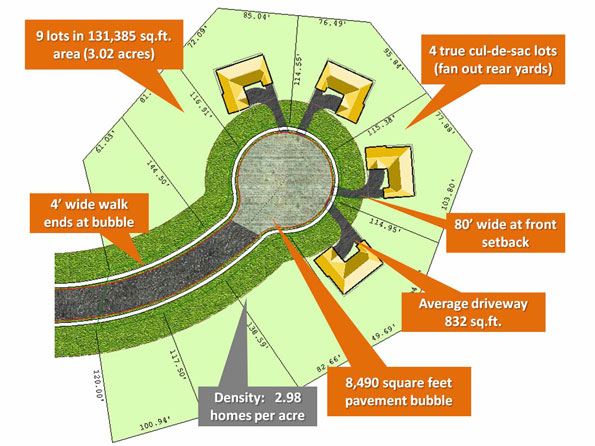
    Cul-de-Sac Design Guidelines: To make matters worse, existing design guidelines for cul-de-sacs create the most waste with the least benefit. Here in the upper Midwest, a cul-de-sac will have a 120 foot diameter right-of-way with a 110 foot circle of asphalt. Why? Because fire departments say they need that radius to turn around a fire truck. Go a bit south and that dimension reduces to a 100 foot diameter right-of-way with a 90 foot diameter circle. I’m not sure why northern firemen don’t turn the steering wheel as tight as those in the South, but according to these regulations, they apparently can’t. So up North the typical cul-de-sac will consume 8,500 square feet of paving, and in the South just under 6,000.

    This means that at a typical 25 foot setback from the right-of-way to the home front, an 80 foot wide suburban lot in the north will result in four or so premium lots. In the South, with a typical 20 foot setback and narrower 60 foot wide lot, there might be five or so premium lots.

    An 8,500 square foot volume of cul-de-sac paving for four Northern-sized lots comes out to 40 percent more square feet of paving per house compared to the same lot on a straight street. This means the home will cost the city 40 percent more for snow removal, resurfacing, etc., forever. It also cost the developer 40 percent more, but that is recouped because the lots on the cul-de-sac can be sold at a huge premium.

    A street leading to a cul-de-sac will have standard size lots fronting it. Depending upon the length of the street, there may be a few lots or dozens of them leading to the premium ones along the circle. These “street” lots might have a slightly higher value because of the low traffic approaching a closed end street, but they will certainly not equal the value of the lots around the circle.

    From an efficiency perspective, it seems like only a fool would defend the use of cul-de-sacs. Here are some facts from that fool. In planning, everyone assumes that the minimum dimension is the most efficient. In cul-de-sacs, the minimum dimensions are typically very inefficient. Making cul-de-sacs larger than the minimum fire engine turning radius makes them more efficient.

    Impossible? Take a look at the typical suburban design above, and compare it to to this re-designed cul-de-sac:

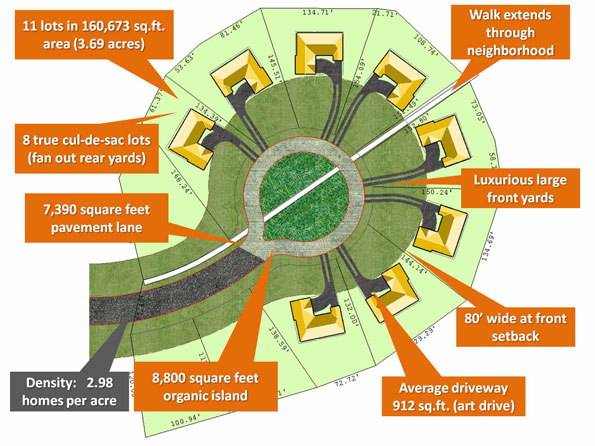
    By making a typical northern cul-de-sac larger, say 160 feet in diameter, and using a one-way narrow lane with an island in the center, the amount of total paved area plummets. Instead of a solid sea of asphalt, the new cul-de-sac uses 10% less paving and has room for a central park that will be approximately 8,800 square feet of organic surface.

    Now place the homes at a deeper setback. Yes, pulling the homes farther from the right-of-way to a 40 or 50 foot setback (instead of 25) accomplishes two things. It stretches the length of the setback line and makes the lots much less pie-shaped. The new, deeper setback should double the number of lots…with much less paving. Instead of being 40 percent less efficient, the new cul-de-sac is approximately 20 per cent more efficient than a rectangular lot on a straight street.

    And while the new cul-de-sac lot is less pie shaped, it will still have a significantly larger rear yard. The lots overlooking an 8,800 square foot park will have a much higher value than if they were overlooking 8,500 square feet of asphalt or concrete. The park can be used in a variety of ways, but a combination of rain gardens and recreation seems natural. By draining into the center, we eliminate curbing on one side, making them even more efficient. Since the number of premium cul-de-sac lots is at least doubled and uses less paving and less overall land area, there would be fewer cul-de-sacs.

    The Dead End Issue: But what of pedestrian and bicycle circulation? Well, that’s simple, as these non-vehicular designs can extend beyond the cul-de-sac as well as through them, making the central park areas destination places. Emergency vehicular access? Interconnecting walks could be made wide enough at certain locations to provide emergency access that would rival tight grid patterns.

    If these arguments favoring the efficient new cul-de-sacs aren’t enough, God likes them! How do I know? What scripture did I study to make this claim? Well, if God did not want cul-de-sacs, then why vary the natural contours of the land? Not every site is perfectly flat or a perfect square shape. In many cases, contours form peaks and valleys in which cul-de-sacs may be the only way to design a development; anything else would be unnatural.

    Hold your hand in front of you and then spread your fingers wide. When rain falls on the land and runs off it forms peaks and valleys similar to your jutting fingers. Where this happens, using the natural contour for the location of cul-de-sacs makes much more sense than trying to place a circulation pattern between the finger nails. Property configurations also often require a cul-de-sac or two (three, four or more).

    Of course a big bull-dozer could reconfigure any land to implement SSAR, but then…wouldn’t that be a sin?

    Rick Harrison is President of Rick Harrison Site Design Studio and Neighborhood Innovations, LLC. He is author of Prefurbia: Reinventing The Suburbs From Disdainable To Sustainable and creator of Performance Planning System. His websites are rhsdplanning.com and performanceplanningsystem.com.
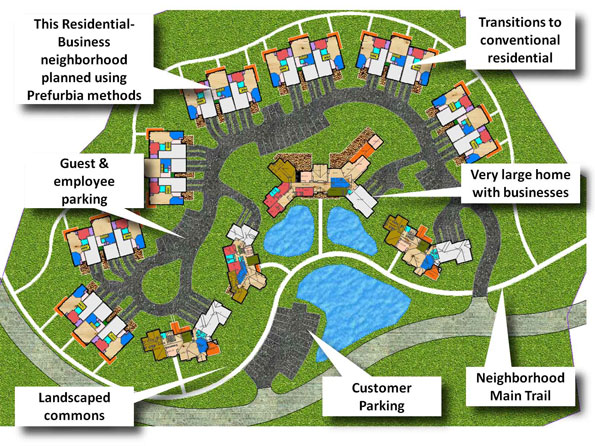
    Photo:

  • Housing: Density & Desire

    Density — the number of units per acre on a proposed site plan — is at the heart of the developer’s mantra: More density, more profit. Meanwhile, environmentalists and many planners preach high density as the promise for a better future. The compression of families is an attempt to curb sprawl and reduce transportation energy consumption. For these reasons, many Green programs demand a minimum density to qualify for certification. Those who sit on suburban city councils and planning commissions fear over-densification, and typical suburban ordinances are written to oppose density.

    Who’s right? Nobody. There is no ideal density number in planning or development. Forget the search for a numerical value. Instead, concentrate on livability.

    Ordinances throughout the world state minimal dimension requirements. Some suburban ordinances, but not most, specify density maximums. But density alone cannot determine the most important issue in any development: Is it a great place to live? If both environmental impact and affordability were added to the mix, then you could equate livability with sustainability.

    Suburban Settings: The term ‘sprawl’ is recklessly used to describe all new suburban development, as if every new suburb was composed of massive lots with McMansions. Want proof that it’s not so? Take a tour of a suburb near a major city that was developed this past decade. In most, you will find smaller lots with homes compressed close together, often with less open space than older, large lot developments. Many of the new suburban developments that are close to major cities approach New Urbanism in density. There are some large lot developments for large residential estates, which are frowned upon as if achievement has become evil.

    The opponents of suburbia often don’t factor in the changes that have come about in environmental regulations. When urban areas of the past were built, wetlands (previously known as “swamps”) were simply filled in for development. Wooded areas were clear cut for the new city to be built. Today, we cannot fill in wetlands that in some places constitute vast areas within suburban communities. Many suburban cities have tree preservation and slope restrictions that also result in large open spaces. Because land that developers in the past simply built over is now set aside for preservation, today’s suburbs are going to naturally appear much less “dense” than existing suburban areas. Should a new “urban” city sprout today, as a result of these same protections it too may appear far less dense.

    Higher density can drive up raw land value. Developers who can place four homes on each acre are willing to pay much more than they would have a decade ago for the same land, when each acre could yield only two homes or less. The consumer ultimately pays the same (or more) for a much smaller lot, so density does not deliver affordability.

    Ordinances typically do not deliver livability. When we provide amenities that are not required in ordinances such as an architectural theme, or parks, walks, trails, destination places, and then add sustainability elements such as low impact storm drainage, green building, engineering, and landscaping…what keeps all of this affordable? Increased density helps when the original plan is for large lots. But we can only push density increases to a limit that preserves the sense of space that suburban home buyers expect. Cities that have already reduced minimum lots from, say, 10,000 square feet to 5,000 gave up all of their spare space long ago. Reducing lot size on an already small space can destroy livability. When lots were larger, there was negotiating power: Want smaller lots and more density? Then we’ll build a sustainable neighborhood, not a subdivision. With a small lot that negotiating power vanishes.

    Livability results from a balance of the hundreds of elements that must be taken into consideration when planning, engineering and constructing a neighborhood. A density goal can easily tip that balance in the wrong direction.

    I was trained on how to abuse the regulatory system. In the early 1970s, I was on top of the planning game as a master at manipulating regulations. I was able to find holes in the regulations to legally justify cramming units together. I felt victorious when I gained density. After driving through many of the neighborhoods that were eventually built, pride turned into shame. They were nothing special. I created developments that would do nothing to enhance the living standards of the residents; instead, they made the developer (who was now long gone) more profit. I vowed to never again use increased density as a goal, but rather to use balanced design practices as the driving force of all my neighborhood plans.

    Urban Settings: It is expected that density will be higher in urban areas. We recently did a proposal on a four acre infill site in Minneapolis. We pushed the density on one proposal to 111 units. Our goal was to produce an affordable (i.e. low income), environmentally sound development that would provide a sense of space and accomplishment (pride) for the residents. In low income neighborhoods it is important to hide parked cars as they can be an eyesore that can have a negative visual impact. All parked cars were to be hidden in underground parking areas or in the rear of a home.
    Utilizing new architectural design practice, we provided panoramic views of landscaped spaces using the kitchen as the focal spot for every unit. In this new era, which we call Prefurbia, one goal is to make the interior floor plan an integral component of the overall neighborhood design; we break up the architecture to create that all important curb appeal and eliminate the monotony so common in urban settings, especially lower-income ones. Density was also limited because we wanted to keep each unit at a minimum of 900 square feet. Every home was tied to a meandering walk system leading to a central aquatic garden in a 0.7 acre park. A truly wonderful place to live, at any income level.

    Yet when we presented the development plan we were told that the density goal was 120 units. When we asked where that number came from, we were told it was the minimum that was needed for LEED-ND standards. Jamming another 10% of density would bring the proposal out of balance – something would need to be sacrificed. We could eliminate the central park focus, or perhaps throw the parked cars in the open, or make the small units even smaller. We could eliminate the tie between the floor plans and the neighborhood. Going up another floor would just make the parking situation worse, as we would then have no room to hide the cars underneath the apartments. Demanding a minimum density does nothing to assure good development. If anything, it provides another target that detracts from creating a well balanced neighborhood that is a pleasure to live within.

    Density Instead of Profitability: When I began to plan developments for a nationally recognized firm, we achieved the density goals, but had no clue as to the actual costs of constructing a neighborhood. We would cross a creek to reach isolated corners of a site and gain a few lots, never realizing that a bridge costs much more than the profits gained in those few units. Using geometry instead of smart design practices, we stretched the length of streets, never realizing that streets cost about $300 (today’s dollars) for each extra foot. In the end we did get to the desired density ratio, but at what cost? Smarter design would have been to balance the infrastructure needs against the density goals. That was 40 years ago. Unfortunately those regulating and planning many of today’s new developments and redevelopments still look only to density, not to other costs.

    Density And The Environment: Planners assume that if we increase density in one place then we will not need to build somewhere else, and the end result will be that we will be left with vast, natural open spaces. This fantasy can only become a reality if the additional density achieved on a site corresponds with the dedication of a permanent preserve of open space elsewhere in the same city.

    Want to make this a better world to live in? Forget trying to justify a particular number of units per acre. I was guilty of this approach at one time. There is actually a term for the attitude: it’s defined as “difficult to understand or follow because of being closely packed with ideas or complexities of style”…and that word is “Dense”!

    Rick Harrison is President of Rick Harrison Site Design Studio and author of Prefurbia: Reinventing The Suburbs From Disdainable To Sustainable. His website is rhsdplanning.com.

  • Personal Rapid Transit: Twenty-First Century Transport?

    Recently I had the chance to visit Taxi 2000. This Personal Rapid Transit (PRT) company is based just minutes from my office in Minneapolis. I’m no expert on rail systems, but I’ve always believed that an elevated system that can run freely over existing right-of-ways makes more sense than an antiquated system based on nearly 200 hundred year old technology.

    Since we plan new neighborhoods and cities, I saw a great opportunity to design a new town with an elevated PRT system as a major design influence, not as an afterthought. A perfect combination: a new age city based upon the latest methods, with a convenient way to access most of the region, based on a 21st century design, not an 18th century one.

    I typically investigate the products and companies that I’m about to meet. I’d heard about PRT solutions for well over a decade and assumed there were many examples of installations. After searching the internet I found not a single installed PRT system serving a city.

    I’ve never been a fan of light rail for a variety of reasons. Human beings are smart enough to explore space, extend life spans for decades, and remodel genetics. Yet all we can come up with is a slow (and often unsightly) train that runs on tracks conceived in the 1800s that now cost billions of dollars to implement? We are told that building a light rail line spurs economic growth. Even if true, typically only a minor portion of a town benefits because the system is linear. Most are designed to be functional, not beautiful, and most light rail trains are not inspiring.

    I used to drive in Minneapolis, but now train tracks intermix with the driving lanes in some areas of town. I avoid those sections, and now do my spending in the suburbs. I’m sure I’m not the only one. This brings me to my final opposition to light rail: Because it’s typically ground-based, it’s obstructive to implement, and often requires the demolition of buildings and the acquisition of right-of-ways. All of this costs plenty.

    On top of this, many businesses suffer during the construction of light rail, while it interferes with their access. Sure, they might ultimately get additional business, but first they must survive a period with reduced access.

    Mike Lester, CEO of Taxi 2000 demonstrated the prototype of SkyWeb Express along with its technologies to us. Over a period of three hours, Mike proudly showed us what they have accomplished.

    First, this is an on-call system. This means that you do not have to wait for the next train. Cars located only a minute or so away await your command. No more missed connections while waiting an hour for the next ride.

    It is elevated far above ground — 5 meters — using existing right-of-way on posts spread far apart. In an urban area such as Minneapolis which already has a skyway system, this could coincide with existing access points on the second or third floors. It’s non-linear, and able to easily turn corners and access much of a city, not just points along a single route.

    It maintains a constant rate of speed; no stops needed until you reach the destination. About 30+ miles per hour might not seem fast, but a mile every two minutes in an urban environment is indeed impressive. It’s limited to 3 persons per vehicle with plenty of extra space for luggage, boxes, or even a bicycle. No more crowding. It goes where you want, not only on a preset route. In theory it’s safer because you can access it alone, not with strangers. And one car needing maintenance does not shut down the system.

    The big issue that all transit needs to address is the cost. The light rail transit in Minneapolis costs somewhere around a billion dollars. PRT cost studies show a savings of 60 to 70 percent could have been realized along the same line. Even if the estimates are wrong by double, that’s over $200 million that could have been spent elsewhere, or to make a quite comprehensive PRT system for the same dollars.

    I’m not easily convinced when someone tries to “sell” me on new technologies, but that common sense meter in my brain was at 100% as I learned about the PRT possibilities. I was not sold that this will get everyone out of their cars, but it’s a solution that would be more effective than a rail system.

    So why no installations?

    PRT companies have been around for a while, continually upgrading and perfecting their systems. While I’m not sure how they get funded, I can tell you that cities have a hard time spending hundreds of million dollars on systems developed by small firms. As a software developer of Geographic Information Systems in the 1990’s we constantly lost sales to larger companies, even though our product was superior. It appeared that cities were more comfortable buying from companies with hundreds of employees working in tall impressive buildings than from smaller firms. It was natural to think a firm that appeared quite large had staying power compared to small companies with a handful of employees. But in the dot-com bust we learned that size does not guarantee longevity.

    I’ve written this before, but it bears repeating: On August 1st, 2009 President Obama addressed the nation with: “Future economic prosperity depends on building a new, stronger foundation and recapturing the spirit of innovation …. Innovation has been essential to our prosperity in the past, and it will be essential to our prosperity in the future”.

    Small PRT firms have risked everything, adhering to a belief that it is a viable solution for urban transportation problems today and in the future. How have we rewarded these innovators who certainly have the spirit? We continually invest in the most non-innovative, obtrusive, and expensive solution: Light Rail. We reward large corporations who take no risk… What happened to us? Let’s see if this new Administration can stand by the President’s words and invest in the pioneers who can create that strong American foundation.

    Rick Harrison is President of Rick Harrison Site Design Studio and author of Prefurbia: Reinventing The Suburbs From Disdainable To Sustainable. His website is rhsdplanning.com.

  • A Threat To Home Owners Associations

    In the 1990s, just about the only site amenity that most suburban developments offered was a fancy entrance monument. Usually, there were no other additions beyond ordinance minimums and even those weren’t generally elaborate. Some of these monuments did cost millions, but once past the gilded gates, the seduction ended, and residents were greeted by familiar monotonous cookie cutter subdivisions.

    As neighborhood planners, we educate our developer clients regarding the virtues of building site amenities that improve Quality of Life (trails, gazebos, decorative ponds and fountains, etc). You would think these amenities were an easy sell to the cities approving the developments. After all, great developments create a great city, right? It’s not that simple, because all of these amenities require maintenance, and that places a burden on tax payers. No city wants to create a tax burden for all, when the likely benefit accrues to the few within the development.

    The solution to that problem was simple: The Home Owners Association. We are not talking about the type of Stepford-like association where lifestyles and flower plantings are strictly dictated, but the more limited type that adds a small monthly fee to service the common outdoor site amenities. In other words, only those extra amenities are cared for. Private yards still remain the financial burden of the individual homeowners. In the North, with snow removal, these neighborhood association fees are likely to be higher if the trails and walks are cleared. Since these Associations do not have to maintain private yards or address maintenance of buildings typical of townhome projects, the monthly fees are minimal. Some associations were formed in the North that did give options for snow removal on private driveways, at a very reasonable cost (after all, why not clear a few extra driveways while you are out clearing the trails?).

    The developer could now offer a much higher living standard and create more valuable lots that would be easier to sell. The majority of the neighborhoods we designed in the late 1990s through 2006 (the recession) offered the advantages that these minimal cost Associations could provide. We encouraged developers to spend less on elaborate entrance monuments and instead spread real value through the development where people lived.

    How HOAs May Be At Risk The recession has not just brought about massive foreclosures and reduced home prices. It has escalated real-estate taxes (the home value may be 40% less but the tax remains at pre-recession rates) and put the very idea of a Home Owners Association at risk. With failed development, there are often also failed Associations. With little or no maintenance of a development that was once cared for by private funding, cities may have to take over the burden until the economy recovers, and in some areas, if it recovers. Comprehensive associations that maintain all of the grounds (where there are no privately maintained yards),including the building exteriors and rooftops, as well as the streets, are at the greatest risk. The limited Associations that were typical of the neighborhoods we designed are not as much of a problem, but could easily be lumped into “all Associations are bad news” category in the minds of those approving future developments, after the economy returns.

    This affects all types of residential development.

    Developments that exceed minimum standards typically offer site amenities to make the development more enticing. Someone must maintain these extras. Fear of HOA failures will certainly be more on the minds of cities after the recession, but without HOAs, who will maintain the amenities? A two million dollar entrance monument does not make a neighborhood sustainable. Spreading value through the neighborhood with features that enhance quality of life, is a better investment. The Homeowners Association must not fall victim to the recession.

  • Housing Design: Create The Next Classic

    I often compare home marketing to automotive marketing, not because I was raised in Detroit and am somewhat of a motor head, but because these are two very big ticket items that have been developed and marketed in very different ways. You may think that auto companies are huge corporate conglomerates, and builders are mostly small, local companies selling a home or two, but the major builders certainly are not small concerns. A major builder selling 50,000 homes at $250,000 each would generate the same total income as a small auto company selling 500,000 cars at $25,000 each. Yet, there has been much more product research, development, testing, and marketing on cars, SUVs or trucks than on homes.

    To “drive” this comparison home consider the following: Compare the specifications on a $140,000 (adjusted for inflation) 30 year old Ferrari 308 which was state of the art in 1980, and even the most basic car, for example a Hyundai Genesis Coupe. The two passenger 300 horsepower Ferrari would do 0-60 in 6.8 seconds with a top speed of 142 HPH, slower than the $25,000 Hyundai ‘s 0-60 in 5.5 seconds, top speed at 149 MPH. The Hyundai would actually make that hairpin turn with a computer assisted 0.90g lateral acceleration, while the Ferrari would slide into the roadside ditch at only 0.81g.

    And the list goes on. The Hyundai adds 10 more highway MPG to the Ferrari’s 16 MPG. Watch out for deer? At an emergency stop from 60 MPH the Hyundai takes only 111 feet, a whopping 42 feet less than the Ferrari which plows right through Bambi. After adjusting for inflation, the specifications of the Hyundai blow past the Ferrari for 80% less money. Reliability? Not even close. The Ferrari 308 owner will be on a first name basis with his or her mechanic, and probably even know his family.

    So… while it seems stagnant at times, the auto industry has still made tremendous progress. From a style, materials, and overall design standpoint, any of today’s cars and trucks render those built in the early 1980s obsolete. The industry offers an astonishingly better product than it did twenty-five years ago. This is despite a few moments when auto manufacturers lost their way. Remember 1981 — a recession with car showrooms in shambles and the government rescuing Chrysler — and Lee Iacocca touting the “K” Car? My, auto makers have come a long way!

    Now let’s compare the 1980 suburban single family home to the 2006 (the height of the housing market) suburban single family home.

    From National Association of Home Builders data we see that the average 1980 house was just over $76,000 and averaged about 1,800 square feet. Adjusted for inflation, that 1980 home would be approximately $190,000 in 2006 dollars. This equates to approximately $105 a square foot. The 1980s were also the age of large sprawling suburban lots; 10,000 sq.ft would have been considered, in some areas, too small. Suburban densities of two units per acre were typical in the north, with higher densities in the three to four unit per acre range as one traveled south. The 1980’s home price included a spacious lot.

    Fast forward through 26 years (of evolution?). Homes gradually increased in size to an average of 2,414 sq.ft. (again, NAHB data). The typical home in 2006 cost $264,000, or $109 a square foot. Essentially, the home built at the peak of the market cost only slightly more than the home built in 1980. Lot areas generally have come down in size. In the south where densities were already higher, the lot size reduction was minimal, but in the north that 1980 10,000 sq.ft. lot that was once considered small would today be considered quite large.

    The 1980s home would have been built to a lower standard with little in energy conservation; it was wasteful. The home built 25 years later — at the height of the market in 2006 — would have been built to much higher standards, both in construction and in energy efficiency.

    Today’s consumer may favor the older, 1980s suburban home. It is likely built in an area with mature landscaping, local conveniences, and established schools, and it is probably located closer to town (employment), on a larger lot. Yes the home is slightly older, but not significantly visually different than the more recent home, at least to the naked eye. The transition from the previous three decades, 1950 to 1980, was drastic. But it was not so in the past 30 years.

    The new suburban home in today’s market is typically on the outer edge of urbanization. The confidence level that services and schools will be developed in a timely manner is much lower. There simply has not been a significant change in housing during the past three decades. The garage-forward 1980s home that proudly displays massive garage doors that define the streetscape is similar to the suburban homes built today, except the home built today might also include the obligatory porch sitting next to the garage.

    Three decades ago Chrysler responded to market changes with the K car, a cheap car that was commercially successful. Notice how many K cars you see on the road today? Longevity, reliability and quality were not its strong points. Cars are temporary. They are disposable and recyclable. Today’s home builders are largely responding to the housing market with a K car attitude of scrimping that will only make the homes built on yesterday’s developments seem even more attractive.

    But housing stock cannot survive on temporary solutions that respond to short trends. The lot that is sold today is likely to be around for many centuries. The home will likely be remodeled over time, but its foundation may last as long as the lot. There are no junk yards for houses…well there are, and they’re called slums.

    Builders rely on suppliers to develop products that improve the housing stock. For example, the vinyl cladding era of the 1980s has been (somewhat) replaced by more attractive concrete based products and wood alternatives. The problem is that these vinyl alternatives are often more expensive – in some cases, much more.

    It’s time for builders to respond by following the automotive industry. That means offering enough of a design revolution to attract new customers. Investing in research and development at a time when banks turn away builders and developers might seem an impossible task. As a design and technology company, we know that first hand. We have a huge investment in future technologies that will not be available until the beginning of 2010.

    Before the recession, we typically invested 10% of our gross income (designing new developments) in new technologies. Planning and architecture is not exactly a thriving industry today. Banks are not interested in funding anything related to land development, sustainability, or software. To keep development on track, our investment now represents over 50% of our total income.

    Getting through this period has been tough, but at the end of the day we will have a revolutionary product with a new range of services that will benefit development-related industries. Architects can respond to a down market by investing their down time in experimentation and development of better design methods to increase the value of housing, instead of sitting around waiting for a client to call.

    During this past decade people got used to making a new home purchase to supplement their income, assuming that home values would rise several thousands of dollars annually. Those days are gone. Give consumers a new reason to buy: a better product. When future housing customers have the opportunity to significantly increase their living standards by purchasing new homes vs. staying where they are, they will want to buy new again.

    Rick Harrison is President of Rick Harrison Site Design Studio and author of Prefurbia: Reinventing The Suburbs From Disdainable To Sustainable. His website is rhsdplanning.com.

  • Home-Based Businesses: Residential Zoning and The Cyber Village

    Currently in the United States about 27% of all homes have some form of a home based business. These businesses can be key to conservation efforts that lower our carbon footprint by reducing transportation needs, eliminating redundant facilities, and consolidating equipment. They provide significant opportunities for two solutions to problems that face today’s growth issues.

    My software company was founded in Dallas, where I worked from the dining room table in an apartment. I yearned for the day my business could operate out of a real office. After the business started generating a positive cash flow the apartment was left behind, and my office moved to a location in the newly built Dallas Galleria. My 104 square feet of office space was complimented with a separate meeting room, receptionist, and a parking space in the garage. All this cost me $600 a month. After the initial six month lease was up the rent skyrocketed and parking was no longer free; however, the 104 square feet remained the same.

    Oh, how I yearned for a nice dining room table to work from!

    Soon I decided that the money spent on rent — both apartment and Galleria office — could build a really nice home. In 1982 I built a home specifically designed for a residence and my business. With about 4,000 square feet, of which about one third was dedicated business space with a separate office entrance, we had a viable base from which to live and work.

    The IRS allowed us to write-off one third of the total housing expenses without question. By not having to pay office rent we could double the home payments, and the 30 year mortgage was paid in full in less than 10 years.

    Maple Grove, the lakefront suburban Minnesota community where we had built, allowed a home business occupation via ordinance limited to one non-family employee. At first we complied, but the business grew. At times there were up to 6 employees at the home, but neighbors did not complain.

    I was not the only lake front home operating a big business. Across the lake, a major manufacturer of car radar warning units operated out of the basement of a house. This was a husband-and-wife business, but it was no small operation. The company had full page ads in leading automotive magazines. I sometimes visited; I’d hear the phone ring with an order, and the wife would say ‘I’ll see if we have any in stock at the warehouse, can you hold?’ She would then call down to the basement and ask if they could make an A-50 unit for shipping. Nobody but the UPS man would know the truth!

    Solution #1: The Residential/Business
    The Residential/Business (RB zoning) would be an entirely new land use, sort of a morphing of an office center and a neighborhood of luxury single family homes. Office complexes typically have a higher degree of landscaping and architectural detail than single family developments. In the RB neighborhood, homes would be large and impressive with heavily landscaped commons that serve as pedestrian access to the businesses that are located within the home structure.

    Family members and employees would park in the rear, with multiple garage spaces and outside parking for the employees. From the arterial streets abutting these developments it would be an impressive sight, giving a sense of wealth to the neighborhood and municipality. The types of businesses would be restricted to low traffic professional services, including medical services, but also could include very light manufacturing. The RB zones would be an excellent transition (buffer) from commercial centers to residential ones. The RB residential structures would house the entire business and home, serving as the main hub for all of the business needs.

    Below, a Residential/Business community

    There could be some overlap of business functions into the residential elements of the home. For example, a conference center with an 80 inch screen for presentations could be used for Monday night football on occasion. From a financial standpoint, for a small to medium sized business owner this is a win-win situation. It delivers the advantages that I had experienced in my own situation in a comprehensive, specifically designed development plan.

    Solution #2: The Cyber Village
    George E. Van Hoesen, of Global Green Building, LLC, has developed an alternative solution, the Cyber Village.

    The proliferation of computers and cell phones, as well as video conferencing and express delivery, has made the notion of the at-home cyber office an excellent solution for growth issues. New definitions of work, recreation, and education have brought the family home again. Residential design and community planning can begin to address the increasing needs of these new households while keeping the neighborhood’s primarily residential character.

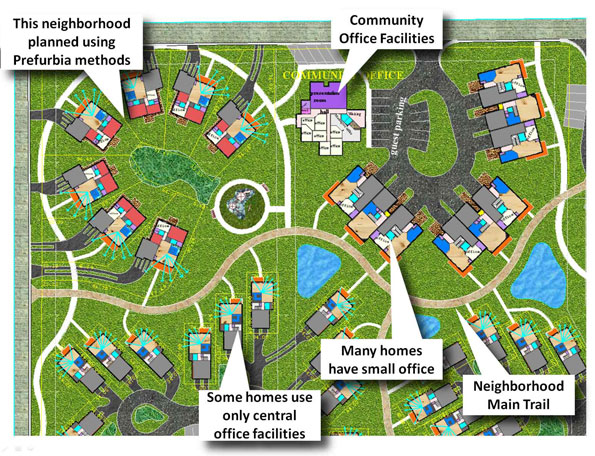
    Unlike the Residential/Business solution, homes in the Cyber Village need not be as business intensive or change the character of a neighborhood. A main component of the Cyber Village is the Cyber Office, serving as the community foundation for business activity. This facility, complete with offices, reception services, mail services, meeting rooms, board rooms, reference libraries and office equipment, would serve subscribers (businesses within the neighborhood) for their out-of-office and administrative needs. This Cyber Office location could serve as the hub for deliveries, recycling, storm shelter, resource center, rideshare, and other community resource needs. Subscribers would choose the level of access to the facility based on their own individual business needs. The features of the cyber office would lend credibility and added professionalism to a residence-based business without breaking the bank.

    Below, a Cyber Village

    The neighborhood Cyber Office could be managed as a for-profit business, providing services for a fee. Communities could also manage a Cyber Office as a part of the homeowners association. A mix of services could be provided, depending on the needs of the community. The overall concept reduces the carbon footprint of the home-based business and addresses the needs of the changing work place.

    Zoning Both Solutions
    Both solutions fall outside the scope of conventional zoning. The Cyber Village may comply more easily with existing regulations, especially those that allow a home to operate a business with a few employees. If a city’s regulations are flexible enough, it may be possible to design and implement a Cyber Village that complies with city code now. The Residential/Business solution, with its more aggressive business size, would compete with — or make obsolete — office complexes. Office “use” is often taxed at a higher rate than residential use. Since cities do not like to lose tax revenue, it is likely that municipalities would require a new basis to tax the RB residents.

    Creating a new zoning class and tax classification is not difficult, but it might be time consuming. The current slow market allows cities to restructure their zoning and tax codes, so now is the time to act.

    Both solutions would have a significant reduction on the carbon footprint of land development. They offer alternatives to the Smart Growth solutions in which shop owners are encouraged to live over their stores in high density developments. Both the Residential/Business and the Cyber Village alternatives curb traffic and sprawl…and at the same time, provide residential settings with enough space for family enjoyment.

    Rick Harrison is President of Rick Harrison Site Design Studio and author of Prefurbia: Reinventing The Suburbs From Disdainable To Sustainable. His website is rhsdplanning.com.

  • Homebuilding Rebound… Or Boredom in the Burbs?

    The economy might come back – but will the housing market return? And in what form?

    Right now, builders are jumping into the low end of the market because of the $8,000 first time home buyer tax credit. This tax credit cannot survive indefinitely. Compared to homes sold in 2006, today’s are bare bones in size, materials and finishes in response to current, temporary market conditions. But the scrimping only makes the homes built in yesterday’s developments more attractive to potential buyers. The next wave of home buyers will have a choice: stay where they are, move to a more recently built (devalued) home, or buy new.

    Here’s a rundown on the major factors — and the forces on them — that will guide home buyers in their decisions. It’s also a rundown for any community, planner or developer — government or private sector — who would like to see the market rebound.

    Lot Size: Will buyers want to be shoehorned into new compressed development, or will they prefer to remain in the larger lot suburbs, where there are plenty of bargains today with usable yards and at least some views?

    The administration is pushing for compact (very dense) development, something the home buying market historically finds less desirable. If one hundred residents of a subdivision were asked the square footage of their lot, few would know the answer (more would be aware of their house’s square footage). Homes placed close to the street guarantee a claustrophobic feeling of space. Space is defined by that object that stops viewshed – typically a home, wall (fence) or low vegetation.

    Density is increased by the creation of narrower lots (and homes). When the lot narrows either the square footage of the house must plummet, or the home must get deeper. Assuming that facing directly into the home next door is not a quality view, the percentage of wall space that allows windows with a good view becomes very small as the home narrows.

    To illustrate, take a business card and look especially at the long edges. The shape emulates the rectangular perimeter of a typical suburban home built in the past few decades. Now imagine nice front and rear yard spaces with plenty of wall surface for windows, even with a garage taking up a portion of the front.

    Along comes the anti-sprawl movement pushing narrower lots, and making those on City Councils and Planning Commissions feel guilty about destroying the planet. Across America over the past two decades lots have been getting smaller – in some cases much smaller. Now take that business card and rotate it 90 degrees. This would represent the shape of a typical suburban home today.

    Huh. Wouldn’t all those side windows now look into the neighbors home? Well, windows now are placed along the short side of the home. What about the garage? Well, typically that’s still along the front, but since cars did not suddenly get 33% narrower, occupants just lost quite a bit of precious viewing area. Density went up by 33% but useable yards went down by 33%.

    Today we are building with much less width than we did during the past few decades. Yet the environmentalists and press do not seem to have taken notice.

    What is most likely coming down the road?

    Miniscule, very narrow lots combined with vertical growth. To illustrate, cut that business card in half. OK, so there goes the square footage right? Take one half and place it on top of the other. Well, it’s likely that the home was already two story, so that means three stories right? How much do you like climbing stairs? Better buy stock in residential elevator companies. So how do you park cars in this very narrow lot? If you do not want the street to appear as a solid wall of garage doors, then the only way to provide garage space is a single width garage, two stalls deep — another inconvenience — or a two car garage in the rear… but there goes any attempt for quality rear yard space.

    Architecture: Suburban homes have been looking pretty bland for the past few decades. Slapping on a front porch (most are the size of a stoop) really doesn’t make that much difference.

    Blame architects? An AIA registered, certified, artistically talented architect was not likely involved in the design process of the mass market home. It’s far cheaper to let Harry down the street (nephew of what’s his name) to draw up plans. How do you think many small home builders get financed? If they go to a lumber yard and select from a series of home plans, they can get a package deal; materials and financing furnished by the same source, standard packages from which to choose. Any wonder why 30 home builders in the same town seem to all build the same character-free house?
    Did the lumber yard hire a talented architect to gain advantage in the local market? What incentive do you think the supplier of the materials would have to actually be efficient in the drafting of the home? Excess material means increased profits!

    Homes in suburbia lack character and devalue a community as a general rule, but it’s not always the case. For example, in many areas in Texas, housing is affordable and full of architectural character with great landscaping. Builders in the major Texas markets know that if they shortcut curb appeal, nobody will clamor to their door. The local home buying market is astute… and today’s strongest home market.

    National large home builders? Most of the nationals expand into an area by buying out a local builder that showed signs of success (see above).

    Green: Ask your banker how much green means to the value of a home. Ask the appraisal company, does green add any value? Green certification is commonly messy and difficult, requiring builders to chase points instead of building wisely. Most green standards were inspired by a social engineering agenda. My own certified green home earns me lots of points because I’m near a bus stop and walking distance to a coffee shop. No wonder the financial people don’t take the movement seriously. My residential elevator? Not listed on the “points” system. Home designed to maximize quality viewsheds? No points! We had intended to place a 1 ½ inch foam insulation fill around the entire foundation surface, but a 2 inch minimum was required to earn points . That increased the cost of construction by $900. I’m not an expert in insulation, but it seems I spent 30% more to get a 0.1% benefit on my utility bill – hell of a deal! That $900 extra added to my payments – let’s see with interest, that cost me $5.25 every month… got my point though.

    Will the home market flourish when the economy returns?

    In the last few weeks I was Keynote Speaker at the Western States Planning Association Annual Meeting and at the North Dakota American Institute of Architects.

    Planners and Architects are very different groups. Ever wonder why the neighborhood plan and the architecture of the homes within it rarely seem related to each other? Nobody looks at mass market housing from a perspective of combined architectural spaces as a main component of the overall neighborhood design. The merging of planning and architecture on housing for the masses was well received by both groups.

    How will we bring the housing market back?

    Not by scrimping and reducing value, but by increasing value through a combined effort of architects, planners, and engineers to create a new era of sustainable communities that increase living standards affordably. Density is not a solution. A revolution in design is.

    Rick Harrison is President of Rick Harrison Site Design Studio and author of Prefurbia: Reinventing The Suburbs From Disdainable To Sustainable. His website is rhsdplanning.com.

  • Cookie Cutter Housing: Wrong Mix For Subdivisions

    Nobody likes the taste of “cookie cutter” development. In the forty years that I’ve been in the land planning industry, at meeting after meeting I hear planning commissioners and city council members complain about the same thing: That developers submit the same recipes to cook up bland subdivisions over and over.

    But while the developers are the scapegoat, it’s those who sit on the council and planning commissions that are as much, if not more to blame. They are also the ones with the power to change the status quo.

    Communities have a cookbook that tells the developer and the design consultant the ingredients that must be used; this is called “The Ordinance”. Just as one might bake cookies using clearly defined amounts of flour and sugar, the cook looks to the ordinance to see that he will need exactly 10 feet between homes, at precisely a 20 foot setback from the curb, served up on a lot no greater than 5,600 square feet.

    Thus, 100 cookies baked from the same recipe have about as much in common as the 100 lots built on “Pleasant Acres”. The developer presents the plan to the council. The scrumptious, pastel-colored rendering promises a tasteful development. But the council and planning members remember the aftertaste of the promises of past submittals.

    Developers do not design land developments. They hire consultants who design them. The consultants are likely to be engineers and land surveyors, who also act as land planners. A cookie cutter development is called a “Subdivision”. A really large cookie-cutter development is called a “Master Planned Community”. In the end, no matter what its size, when you look down the street on which people live, both Subdivision and Master Planned Community have the exact same feel.

    Why? Because the ordinance says so.

    Yes, it’s true that the ordinance does not say anything about how to make creative, wonderful, sustainable communities; it only demands certain minimum dimensions and area restraints. But the key problem is that the developer, the engineer, the surveyor, and the planners think that the term “minimum” means the “absolute” dimensions.
    So who cooked up these ordinances? Who determined that 5,600 square feet was the ideal lot size for the zoning in a particular city? Why does the fire department demand the public streets be 40 feet wide, when in a nearby city the public streets are just 26 feet wide? Are the buildings burning down over there, and not here?

    Citizens who have the power to create the changes that are needed – the councils, the planning commission members, and the Mayors — unquestionably embrace these recipes that enforce the absence of taste in their cities. Those who write regulations are actually often being paid to boilerplate these nauseating formulas from neighboring towns, when they should be looking to create entirely new recipes for tasteful development.

    It’s time to throw out the systems that don’t work. Ordinances should be more reward-based and less minimum-based. A town’s regulations should ask developers to explain each element of the design and tell how it benefits the developer, the resident or business owner, and the city.

    For example, most ordinances simply state: ’10 foot side yard minimum (20 feet between buildings)’. What if the ordinance was written as ’10 foot side yard’, then went on to explain that staggering the homes could offer a better streetscape. It might go on to mention that, with windows placed along the staggered side, living areas would have better views, making the homes more marketable. In this scenario, side yards could be reduced, to, say, 5 feet (10 feet between buildings). This type of regulation guides developers by rewarding better design with denser development. Virtually every aspect of the regulations could be written in such a manner. Nobody loses – everyone wins!

    The developer’s consultants also deserve some of the blame. The developer will always hope for a project that will sell better than other developments in the area…always. Yet somehow, the developer trusts that the same consulting firm that designs all the other developments in town will have some special brainstorm that will somehow set this particular Subdivision apart.

    This is one reason that nothing really changes. Another is that consultants who design Subdivisions (mostly licensed engineers and surveyors) are not likely to go against the rules. To a licensed individual who places his or her reputation and stamp on a plan, challenging a rule is very uncomfortable. Conflict between the consultant and the council and planning commission is highly feared: what if the change fails? The city’s representatives might view the consultant negatively on the next project. It’s far simpler to use one cup of flour and a tablespoon of sugar.

    Until only six years ago I felt as if I was the only one challenging convention. At every meeting I would present plans that went beyond ordinance minimums to make sustainable and functional communities. At every meeting, typically in the back row, was the developer’s engineer, paid to attend. I had to defend against every question regarding engineering that was done outside of the recipe, and offer reasons for the benefits. Never once did an engineer who was paid to back me up offer support.

    Then, in 2003 at a council meeting in the small town of Amery, Wisconsin, the impossible happened. On an engineering question, the developer’s consultant, Steve Sletner, owner of TEC Design, of Eau Claire, Wisconsin jumped right in and actually defended the changes we were challenging. A Licensed Civil Engineer became my instant hero (still is).

    If every engineer thought more about the quality of life of those living in the developments that they engineer, this would be a much better world. Since then, Steve and I have been winning the war against the cookie-cutters in an enjoyable, relaxed atmosphere with councils and planning commissions everywhere.

    Outside of the US, I’ve also found similar roadblocks to successful design. While in the Middle East, I met with the young head of sales for an extremely large developer. He complained about home designs that customers simply did not care for. I asked if he let his superiors know about the problems. Fear came across his face. Fear of confrontation is perhaps the biggest problem holding us back. Confrontation should not be an issue if there is supporting proof that the new solution offers less environmental impact and higher value, or is safer, etc.

    An advantage we have in the US is that the citizens who sit on planning commissions and councils have more common sense than consultants give them credit for. When they don’t like the taste of what they are getting, they spit out negative comments at public meetings.

    I wish that every planning commissioner and council member in this country could get this one message: If you don’t like the taste of what you are getting, hire a different cook to write a new cookbook for your community. President Obama recently stated that we must rely on the American spirit of innovation. A rewards-based regulatory system would be a major step in innovating the way our cities operate.

    The planning industry needs a massive overhaul to replace our obsolete system with one that results in sustainable development. Minimum-based regulations are recipes that guarantee that only minimal cities will be built. Cities are the foundation of our society. And remember: You are what you eat.

    Rick Harrison is President of Rick Harrison Site Design Studio and author of Prefurbia: Reinventing The Suburbs From Disdainable To Sustainable. His website is rhsdplanning.com.

  • Do Home Energy Credits Need A Remodel?

    With the home building industry in peril, you would think that legislators would come up with immediate solutions to help foster new home construction. And there are now two well known Federal programs regarding housing: one is the $8,000 tax credit for first time home buyers, and the other is the 30% energy tax credit for a select few components of home remodeling.

    The $8,000 credit for first time home buyers is a good idea, and seems to have helped at least a few buyers purchase homes. Of course, it’ s not clear how many purchased bargains on previously owned homes and how many actually purchased new homes.

    The 30% energy tax credits are a different matter. I’m against the current incarnation of the program for a host of reasons:

    Problem No. 1: The 30% tax credit applies to only a few select items that somehow qualified, and there’s no (simple) way to get on the approved list. In addition, Energy Star certification assures that the “product” has gone through some scrutiny on performance and reliability. But what of the equally important installers?

    Problem No. 2: New construction gets very limited tax credits. When retrofitting existing houses, tax credits apply to the installation of efficient windows and insulation. But new construction (along with remodels) is not eligible unless it includes Geothermal, Solar Hot Water, or Solar Electricity. These benefits are meaningful only to those with enough income to make a credit of this size enticing. The middle and upper class homeowners who are willing to finance these upgrades hope that the after-tax benefits will make the investment worthwhile.

    In theory, of course, the ticky-tacky downtrodden neighborhoods built after World War II can also be upgraded…to become energy efficient ticky-tacky downtrodden neighborhoods. But the energy credit will not benefit those that need it the most: those in the lower income strata that find it difficult to survive from pay check to pay check. A 30% tax credit does them no good at all. Even if the tax credit made sense for downtrodden neighborhoods, none of the older homes would ever become nearly as energy efficient as new construction.

    As an example, let’s say 50 homes in a low income neighborhood did take advantage of the tax credits and upgraded their windows and insulation, and added geothermal design because that was the only option approved for the benefits. This would easily add up to well over $50,000 per home – at least $2,500,000 – of which almost a million dollars is funded by you, the tax payer.

    As an alternative, the 50 houses could be leveled, and excess streets abandoned to create a large developable contiguous tract of land. New home builders on the verge of bankruptcy, and even corporate national builders, could easily reinvent their business to build new urban neighborhoods using more efficient development patterns. To upgrade a new affordable home with more energy efficient windows would cost $2,000, an inch of foam insulation added to exterior walls would be another $2,000, and a high efficiency heating and cooling design just another $2,000. This highly efficient new home would use a fraction of the energy of an upgraded old home, and would add only $300,000 for all 50 homes. New neighborhoods could also have a fraction of the environmental impact of older ones, if planned using newer techniques. Low income families can live in new green neighborhoods, and the home building industry can find a new market while curbing sprawl at the same time…

    Any politicians reading this? (see study).

    Problem No. 3: The current tax credits promote overkill. Almost all the recent Green Certified Homes sold in the Minneapolis area had geothermal design as part of their package. Certainly a home builder increases profits by including a complex geothermal system instead of a simple, highly efficient and low cost conventional heating and cooling system. Building a new, well insulated home results in a significant reduction of heating and cooling energy needs, and the upgrade to a highly efficient system on a new home costs as little as $3,000 extra. But if the home design is not geothermal it will not get tax credits. A passive solar designed home gets free heat on sunny days — also not eligible for tax credits — but a $50,000 geothermal system is.

    Problem No. 4: The current tax credits are creating a false economy for the very few businesses that manufacture approved items. Without the tax credits, these suppliers and manufacturers would need to come in at a reasonable price point/payback ratio to generate the volume of sales necessary to be profitable. In other words, they would have to invent, innovate, and deliver systems that make sense or fail in the marketplace. As soon as the tax credit ends many will not survive. An article on energy tax programs of the 1980s and the “tin men” that sold under-performing systems shows how 95% of the manufacturers of that era went out of business when the Carter era tax benefits ended. What happens to the warranty and guarantees when the company is no longer around?

    So what’s the solution to the problems? Either fix the tax credit program, or do away with it.

    Make the program flexible enough so that new innovations can be accommodated, and make the system itself easy to access. This would encourage companies to be competitive, and give hope to start-ups that cannot right now get financing. The current application system favors well-funded, big corporations, and is far too restrictive in its scope. Have the tax credit apply to window and insulation upgrades above the “standard for code”, and include all heating and cooling systems that are above the 90% efficiency typically included in new construction. Even a tax credit limited to the price difference created by the upgrade would jump start both the green industry and new home construction.

    And while we’re jumpstarting…let’s not forget a little history. During the dot-com crash earlier this decade, unscrupulous promoters bilked investors out of billions of dollars on false promises. These promoters did not disappear, they simply moved to the next opportunity: mortgage and real estate. Quick profits from flipping real estate created an economy that was un-policed and unsustainable. Let’s not permit energy upgrades supported with a 30% tax credit to become the next unsustainable wave.

    Rick Harrison is President of Rick Harrison Site Design Studio and author of Prefurbia: Reinventing The Suburbs From Disdainable To Sustainable. His website is rhsdplanning.com.