Author: Rob Sentz

  • The Emerging Professional, Scientific, and Technical Sector

    Although the professional, scientific, and technical industry sector makes up only 6% of the U.S. workforce, it was responsible for 10% of national job growth from 2010 to 2012. In addition, the broad industry (NAICS 54) grew by 6% in the past two years, which illustrates our nation’s march toward a more technical, STEM type workforce. There are over 9.2 million jobs in this industry, which is driven by sub-sectors like computer system design services and management, scientific, and technical consulting services.


    The Industries

    In this post we’d like to give you a better picture of the top sub-sectors that are driving the professional, scientific, and technical sector. To do this, we’ve selected 16 six-digit industries that fall into this sector. Each one is either:

    1. A big employer (offices of lawyers or engineering services),
    2. Showing impressive % growth since 2010 (media buying or translation and interpretation services), or
    3. Adding a lot of jobs (computer systems design or custom computer programming).

    We have included the 2010 and 2012 job totals, change, % change, and top occupations that staff each industry. Many of these sectors can be thought of as “specialists” that generate their income by providing consulting or professional services to their consumers. NOTE: We have not included every sub-sector of NAICS 54 on this list.

    NAICS Code Description 2010 Jobs 2012 Jobs Change % Change Top Occupations
    Source: QCEW Employees, Non-QCEW Employees & Self-Employed – EMSI 2012.3 Class of Worker
    541512 Computer Systems Design Services 726,989 815,729 88,740 12% Software Developers, Computer Systems Analysts
    541511 Custom Computer Programming Services 697,318 768,093 70,775 10% Software Developers, Computer Systems Analysts
    541611 Administrative Management and General Management Consulting Services 487,428 544,976 57,548 12% Management Analysts, Services Sales Representatives
    541330 Engineering Services 911,012 947,188 36,176 4% Civil Enginners, Mechanical Engineers
    541613 Marketing Consulting Services 207,357 234,470 27,113 13% Management Analysts, Market Research Analysts
    541712 Research and Development in the Physical, Engineering, and Life Sciences (except Biotechnology) 440,152 463,887 23,735 5% Medical Scientists, Biological Technicians
    541211 Offices of Certified Public Accountants 415,253 436,074 20,821 5% Accountants, Bookkeeping Clerks
    541810 Advertising Agencies 200,344 214,083 13,739 7% Advertising Sales Agents, Public Relations Specialists
    541380 Testing Laboratories 147,147 160,565 13,418 9% Chemical Technicians, Chemists
    541214 Payroll Services 151,406 164,762 13,356 9% Accountants, Bookkeeping Clerks
    541711 Research and Development in Biotechnology 141,037 148,561 7,524 5% Medical Scientists, Biological Technicians
    541614 Process, Physical Distribution, and Logistics Consulting Services 105,799 112,025 6,226 6% Management Analysts, Business Operations Specialists
    541110 Offices of Lawyers 1,256,437 1,260,717 4,280 0% Lawyers, Paralegals
    541930 Translation and Interpretation Services 25,534 29,794 4,260 17% Interviewers, Interpreters and Translators
    541830 Media Buying Agencies 12,510 15,336 2,826 23% Advertising Sales Agents, Public Relations Specialists
    541360 Geophysical Surveying and Mapping Services 17,409 18,898 1,489 9% Surveying and Mapping Technicians, Architects
    Total 5,943,133 6,335,157 392,024 7%

    Observations:

    • Computer systems design and custom computer programming services are the clear leaders and have added a ton of jobs — 89,000 and 71,000 jobs respectively, representing 12% and 10% increases. Software developers and computer system analysts are key occupations for these two sectors. If you are looking for a job, these are fantastic occupations and industries to focus on.
    • While not a large sector, media buying agencies has the fastest % growth (23%) since 2010. This translates to nearly 3,000 new jobs in an industry that employs 15,000. From a talent perspective, advertising agencies (which grew by nearly 14,000 new jobs, or 7%, since 2010) is similar to media buy agencies. Advertising sales agents and public relations specialists are two common occupations that should be in demand across these two sectors.
    • The biggest sector on this list is offices of lawyers. It employs 1.26 million, but has had zero job growth since 2010.

    These are the big “E’s” on the eye chart, but other sub-sectors are also worth noting. Research and development (research and development in the physical, engineering and life sciences and research and development in biotechnology) as well as testing laboratories are showing good growth. Together they have added 45,000 new jobs since 2010. They all employ medical scientists, biological and chemical techs, and chemists.

    Industries related to business operations also appear to be thriving:

    • Offices of certified public accountants (436,000 total jobs, 21,000 new jobs in two years, 5% growth)
    • Payroll services (165,000 total jobs, 13,000 new jobs in two years, 9% growth)
    • Process, physical distribution, and logistics consulting services (112,000 total jobs, 6,000 new jobs in two years, 6% growth)
    • Administrative management and general management consulting services (545,000 total jobs, 58,000 new jobs in two years, 12% growth)

    Geography

    Before we take a closer look at the actual occupations, let’s consider how these jobs are distributed. Using Analyst, we filtered for which states have the highest concentration of the 16 sub-sectors. Maryland, Washington, D.C., and Virginia have by far the highest concentration of these industries. These three geographies are also the only areas that we would call “highly specialized” for these jobs, which means that the concentration of professional, scientific, and technical jobs is more than 60% greater than the national average, and is actually getting closer to twice what a typical region has. After that, we see that Massachusetts, New Jersey, Colorado, New Mexico, and California have concentrations between 1.2 and 1.59, which means the jobs are 20-60% more concentrated in these states (the national average equals 1.0).

    The other states’ concentrations are closer to or (in most cases) below the national average. Why are most states below the national average? Good question. This is because the states with higher concentrations have such a huge number of these jobs: they throw off the average. This is a great illustration of “clustering.”

    Now, if your state doesn’t have a high concentration of these jobs at the moment, fear not. Quite a few states out there have shown some pretty impressive growth for these industries over the past two years. In particular, North Dakota (17% since 2010), Delaware (13%), Georgia (12%), Utah (11%), Vermont (11%), New York (11%), Washington (11%), and South Carolina (10%). A lot of states have shown moderate growth and just a handful have actually declined.

    Finally, here are the large MSAs with the highest concentrations (1.2 and up). The San Jose and Washington, D.C. MSAs have concentrations more than twice as high as the national average. See the table for more detail:

    MSA Name 2010 Jobs 2012 Jobs Change % Change 2012 Avg. Annual Wage 2010 National Location Quotient
    Washington-Arlington-Alexandria, DC-VA-MD-WV 374,638 391,991 17,353 5% $124,495 2.85
    San Jose-Sunnyvale-Santa Clara, CA 99,801 109,231 9,430 9% $157,425 2.55
    San Francisco-Oakland-Fremont, CA 167,627 187,350 19,723 12% $133,194 1.88
    Boston-Cambridge-Quincy, MA-NH 192,212 207,628 15,416 8% $127,130 1.79
    Detroit-Warren-Livonia, MI 119,558 132,099 12,541 10% $95,774 1.61
    San Diego-Carlsbad-San Marcos, CA 99,262 102,426 3,164 3% $112,513 1.61
    Denver-Aurora-Broomfield, CO 81,553 87,155 5,602 7% $102,484 1.50
    Raleigh-Cary, NC 32,701 35,499 2,798 9% $89,675 1.48
    Baltimore-Towson, MD 81,539 87,509 5,970 7% $102,246 1.44
    Austin-Round Rock-San Marcos, TX 49,224 55,773 6,549 13% $102,732 1.42
    New York-Northern New Jersey-Long Island, NY-NJ-PA 505,778 551,933 46,155 9% $121,856 1.38
    Philadelphia-Camden-Wilmington, PA-NJ-DE-MD 159,168 165,037 5,869 4% $110,591 1.36
    Atlanta-Sandy Springs-Marietta, GA 124,980 142,268 17,288 14% $95,338 1.27
    Houston-Sugar Land-Baytown, TX 144,338 154,709 10,371 7% $110,109 1.26
    Kansas City, MO-KS 53,424 58,580 5,156 10% $90,296 1.25
    Chicago-Joliet-Naperville, IL-IN-WI 227,237 238,150 10,913 5% $108,363 1.24
    Columbus, OH 48,404 52,078 3,674 8% $90,348 1.23
    Seattle-Tacoma-Bellevue, WA 90,243 101,010 10,767 12% $100,138 1.18

    The Occupations

    So what jobs are we talking about? We’ve mentioned a few already, but you’ll see a list of the top occupations for the 16 aforementioned sub-sectors below. These are jobs that we could consider “emerging” as these sectors continue to thrive. Note: The growth of these occupations isn’t quite as high as we’ve seen for some of the sub-sectors. This is mostly because the occupations are staffed across other industries that aren’t growing quite as much (or not at all).

    For this table, we’re including the occupations from our previous table, their total employment (across all industries — not just the ones above), their 2010-2012 growth, average hourly wage, and typical education level:

    Occupation Total Employment, 2012 2010-2012 Growth Avg Hourly Wage Avg Ed Level
    Computer Systems Analysts 527,350 5.0% $38 45% Bachelor’s
    Software Developers and Computer Systems Analysts 996,902 8.0% $44 50% Bachelor’s
    Management Analysts 727,348 5.0% $36 41% Bachelor’s
    Services Sales Reps 710,385 2.5% $25 38% Bachelors
    Civil Engineers 269,908 1.4% $37 57% Bachelor’s
    Mechanical Engineers 253,033 6.5% $38 52% Bachelor’s
    Biological Technicians 75,167 1.6% $19 37% Bachelor’s
    Accountants 1,273,877 3.7% $30 56% Bachelor’s
    Bookkeeping, Accounting and Auditing Clerks 1,859,752 2.5% $17 39% Some College (no degree)
    Medical Scientists 104,396 7.0% $37 64% Doctoral
    Busuiness Operations Specialists 1,004,963 1.2% $30 33% Bachelor’s
    Lawyers 768,596 0% $51 97% Professional Degree
    Paralegals and Legal Assistants 269,061 2.7% $23 34% Bachelor’s
    Interviewers 228,666 2.8% $15 35% Some College (no degree)
    Interpreters and Translators 68,895 8.2% $22 30% Bachelor’s
    Advertising Sales Agents 186,417 1.4% $22 47% Bachelor’s
    Public Relations Specialists 233,604 3.5% $26 56% Bachelor’s
    Surveying and Mapping Technicians 51,896 0% $20 37% Some College (no degree)
    Architects 110,512 0% $33 52% Bachelor’s

    Observations:

    • All but four of the 18 occupations are dominated by a workforce that has attained at least a bachelor’s degree. The only jobs where this is not the case are bookkeepers (39% have some college, no degree), medical scientists (64% doctoral degree), lawyers (97% professional degree), and surveying and mapping technicians (37% some college, no degree).
    • Translators and software developers have the highest growth percentage (8.2% and 8.0%, respectively) since 2010. They are followed by medical scientists (7%) and mechanical engineers (6.5%).
    • Lawyers, architects, and surveying and mapping techs did not experience any growth since 2010.

    Here are a few helpful definitions if you’d like to explore some of these jobs further:

    1. Computer systems analysts – Analyze science, engineering, business, and other data processing problems to implement and improve computer systems.
    2. Management analysts – Conduct organizational studies and evaluations, design systems and procedures, conduct work simplification and measurement studies, and prepare operations and procedures manuals to assist management in operating more efficiently and effectively.
    3. Biological technicians – Assist biological and medical scientists in laboratories. Set up, operate, and maintain laboratory instruments and equipment, monitor experiments, make observations, and calculate and record results. May analyze organic substances, such as blood, food, and drugs.
    4. Medical scientists – Conduct research dealing with the understanding of human diseases and the improvement of human health. Engage in clinical investigation, research and development, or other related activities. Includes physicians, dentists, public health specialists, pharmacologists, and medical pathologists who primarily conduct research.
    5. Interviewers – Interview persons by telephone, mail, in person, or by other means for the purpose of completing forms, applications, or questionnaires. Ask specific questions, record answers, and assist persons with completing form. May sort, classify, and file forms.
    6. Advertising sales agents – Sell or solicit advertising space, time, or media in publications, signage, TV, radio, or Internet establishments or public spaces.
    7. Surveying and mapping technicians – Perform surveying and mapping duties, usually under the direction of an engineer, surveyor, cartographer, or photogrammetrist to obtain data used for construction, mapmaking, boundary location, mining, or other purposes.

    Conclusions

    So, quick summary:

    • Though it is small, the professional, scientific, and technical sector is responsible for a greater and greater share of jobs.
    • The jobs tend to be more concentrated in specific areas, namely Maryland, D.C., and Virginia.
    • The jobs tend to be associated with four-year degrees.
    • The industries tend to be more highly specialized — meaning, they add value and do a lot of consulting work based on that expertise.
    • Business operations, logistics, software, scientific research, and engineering are the major areas of focus.

    Data and analysis from this report came from Analyst, EMSI’s web-based labor market tool. Please contact Rob Sentz (rob@economicmodeling.com) if you have questions or comments. Follow us @desktopecon.

    Lab technician photo by Bigstock.

  • Top Cities for Engineers Based on Actual vs. Expected Wages

    EMSI recently developed a methodology for calculating expected wages for occupations by region. The analysis is aimed at helping us better understand what regional earnings should be given the performance of a set of standardized occupations that are ubiquitous, stable, and diverse across the US economy. It’s a bit like the consumer price index, just for occupations.

    Read more about that here.

    To illustrate how enlightening this can be, we produced a high-level summary for architecture and engineering occupations (SOC 17) to see what cities rank above and below where you might expect. In this case, we limited our analysis to metros with greater than 190,000 jobs. Also note, we are using 2011 wages in this model, and most of the occupations in the group are related to engineering.

    Looking for a job?

    The top six MSAs on our list are the cities (190,000+ jobs) with the highest actual-to-expected ratios in that nation. They are therefore good regions for jobseekers and employees because of the higher-than-expected wages. Also notice how these are cities you might not expect (e.g., San Francisco and Seattle aren’t on the list). Why? Well, the wages in those cities are good, but there is more competition (in the form of talent), the cost of living is quite high, and the other occupations in the region are also pretty high-paying. The regions we have listed here have architecture and engineering jobs that are paid substantially higher than what we would predict given the local economy.

    1. Augusta-Richmond MSA

    Right off the bat, the model gives us some data that we might not have expected. The Augusta-Richmond MSA, which is spread between the Georgia-South Carolina border, has the highest actual-to-expected ratio (1.15). Based upon our analysis of a set of standardized occupations, we expect that architecture and engineering occupations would make $34.29 per hour (average earnings for all occupations in this category) in this MSA. In reality, wages are just about $5.00 per hour more ($39.36), which is significant.

    This means that the Augusta-Richmond MSA has the highest national earnings for architecture and engineering given the conditions in the local economy. This also makes Augusta-Richmond the second-highest paying region for these jobs among cities where wages are higher than we would expect. This MSA also has the highest percent job growth since 2009, which might be a prime factor contributing to the higher-than-expected wages. High local demand means that companies have to pay more to get the workers they want. This region also has a concentration of architecture and engineering workers above the national average.

    Oddly enough, the labor market in this area has actually declined by 1% since 2009, which equals a loss of more than 3,000 jobs. Sectors like construction and education are still not doing very well.

    So what companies might we be talking about in Augusta-Richmond? After all, if you are considering a job as an engineer or architect, this seems like a good region to focus on. We searched through Equifax data, which is now part of our tools, and found that URS has a strong presence in the region. If you are not familiar, URS is on the list of top 500 largest companies in America. CH2M Hill, Ingersoll Rand, and John Deere also employ engineers in this area.

    2. Knoxville, Tenn.

    With an actual-to-expected ratio of 1.14, Knoxville is No. 2 on the list. Actual wages ($37.35 per hour) are $4.69 more than we would expect and, like Augusta-Richmond, we see good job growth since 2009. Also note that there are 2,000 more jobs in this region than Augusta-Richmond. In general, Knoxville’s economy is healthier than the top city in our list. Since 2009, the region has expanded by 4%, adding some 14,000 new jobs.

    A high demand for engineers in the region is also likely driving the wages up to levels higher than we would expect. A big factor here is Oak Ridge National Laboratory. URS also has a presence in Knoxville, as does Navarro Research, a big government contracting firm, and ABSG Consulting, a company that designs products and services for risk management.

    Obviously, people who focus on engineering and architecture would have many other employment opportunities with different types of companies, but these are just good examples of groups that employ engineers.


    3. Oklahoma City, Okla.

    The third city with better-than-expected wages for architecture and engineering occupations is Oklahoma City. Wages are $4.50 above where we would expect and job growth is strong (more than 10% since 2009). Also, with nearly 14,000 current jobs, OKC is a good spot for engineers to be looking.

    OKC is also demonstrating very healthy growth. Architecture and engineering gained 1,300 new jobs since 2009 and the overall economy grew by over 14,000 jobs. This is even better than our previous two cities.

    With companies like Interim Solutions for Government, OKC is a big city for government contracting. Firms like Northrop Grumman, CH2M Hill, Chesapeake Energy, Wyle, and Boeing also have a strong presence there.


    4. Baton Rogue, La.

    Unlike our previous three cities, Baton Rogue has experienced overall decline since 2009. Despite this, the actual-to-expected ratio is quite high (1.13) and wages are $4.32 per hour higher than we would expect.

    A more stagnant economy combined with a dip in total employment should result in a drop in wages in the coming years. It should also be noted that the region has more than 9,000 jobs in this sector and a relatively high concentration (when compared to the state and nation) for architecture and engineering jobs. However, the regional concentration is slipping more toward the national average and away from specialization. Basic summary: Wages are still pretty high, but the job market isn’t as good as Knoxville or Augusta-Richmond.

    Jacobs Engineering, Richard Design Services, and Stebbins Engineering have a presence in this region.


    5. Huntsville, Ala.

    Huntsville, which is fifth on our list, is the highest-paying metro region on the list. Despite that good news, architecture and engineering jobs have contracted by a surprising 8% since 2009, making it the second-worst city in terms of decline on this list. The regional labor market in general has contracted by 2% in that same period. The only occupation category to lose more jobs than architecture and engineering is production. Pretty much every engineering occupation — from aerospace, which is the largest engineering sector, to mechanical — lost jobs.

    As it stands, hourly wages for architecture and engineering occupations are still $5.00 higher than we would predict and even $5.00 higher than a place like the New York City MSA. So, if you can find an architecture or engineering job here, it’s likely going to be well-paying for the economy. Again, wages are high, but the labor market is pretty shaky.

    Huntsville is pretty well known for aerospace and defense (companies like Northrop Grumman, Raytheon and Lockheed Martin) and the Cummings Research Park.


    6. Ogden-Clearfield, Utah

    Ogden, Utah, is ranked sixth for cities where actual architecture and engineering wages are higher than expected and is the only non-Southern city in the top six. Current pay stands at $36.48 per hour, which is $4.00 greater than we would expect ($32.54).

    Ogden is also the smallest city in our top six. Despite its size, architecture and engineering jobs play a big role in the regional economy. We can say this because, next to military occupations, architecture and engineering jobs have the second-highest concentration in Ogden relative to the national average.

    Since 2009, there really hasn’t been any job growth, however. And the local economy has only increased by 2%, so it might be a tough area to find a job right now. As far as employers go, the Air Force has a strong presence as well as Northrop Grumman, General Dynamics, and General Atomics.

    Where Actual < Expected

    So now we reverse the perspective a bit. In our previous analysis, we looked at the top six cities where architecture and engineering occupations make more than we would expect. Now we will look at the top six (or bottom six, depending on how you want to think about it) cities where pay for architecture and engineering is below what you would expect. These might be good targets for employers who are looking for lower-wage areas.

    1. Milwaukee-Waukesha-West Allis, Wisc.

    Expected wages for architecture and engineering occupations in Milwaukee are $36.69 per hour. In reality, the average is more like $32.81, which is $3.88 below what we would expect. There also hasn’t been much job growth (in percent terms) for either engineering or the general economy.

    There are 16,000 jobs in the region, and if you are employer looking to hire or relocate, Milwaukee might be a good target. Wages are a bit lower than we would expect, so workers might move jobs for slightly higher offers, and there is a fairly large pool of workers. Milwaukee is the second largest city on this list.

    In terms of employment, Siemens and Johnson Controls have a presence in the region.


    2. Columbus, Ohio

    Architecture and engineering jobs in Columbus have contracted by 3% while the rest of the economy has actually increased by 3.4%. Actual hourly wages ($32.26) are similar to Milwaukee and are $4.00 below what we would expect.

    The basic story: Columbus appears to have a rapidly decreasing share of engineering jobs. In three short years, the region’s location quotient — a measure of concentration — for architecture and engineering jobs dropped from .93 to .85 (1.0 is the national average). So what is driving this region’s growth? The healthy sectors appear to be health care and computer-related jobs.

    If you’re an engineer looking for work in Columbus or you’re thinking of setting up a shop there, note that the region seems to be de-specializing in the architecture and engineering occupation sector. One notable engineering group in the Columbus area is the Honda R&D group. Again, if you are an employer looking for underpaid engineers, Columbus could be a good target.


    3. New York-Northern New Jersey-Long Island

    The expansive New York City MSA, which covers half of New Jersey, is third on our list of metros where wages are below what we would expect. The NYC MSA has 92,500 architecture and engineering jobs, with average pay about $5.00 per hour below what we would expect given the economy. There hasn’t been job growth either. Since 2009, architecture and engineering jobs have contracted by 1% in an economy that grew by 2%.

    Another important statistic: The NYC MSA is pretty far below the national average when it comes to the concentration of engineering jobs. This means that even though the region has nearly 100,000 jobs, it is actually below what we would expect for a region of its size.

    Finally, the NYC MSA has the highest expected wage (nearly $45 per hour) on our list, which isn’t surprising (note: Huntsville’s actual wage is in this range). In reality, the actual wage for the NYC metro area is much closer to what is seen in metros like Augusta-Richmond or Oklahoma City.

    The number of well-known companies in this region are more numerous than we can include. For now, here are three to consider: Foster Wheeler, Hazen and Sawyer, and Syska Hennessy.

    4. Lakeland-Winter Haven, Fla.

    Next we jump from the largest city to the smallest in terms of architecture and engineering employment. The economy of Lakeland-Winter Haven has about 210,000 jobs total and only 1,900 jobs related to architecture and engineering. In addition, since 2009, the economy has increased by 1% while architecture and engineering jobs have contracted by 9%. This means that the metro area, which has a very low concentration of engineering jobs, is quickly losing the architecture and engineering base it has. Not surprisingly, wages are $3.50 per hour below what we would expect.

    Furthermore, the average wage for architects and engineers in Lakeland-Winter Haven is the lowest on our list. Wages in Hunstville are a whopping $17.71 greater than Lakeland-Winter Haven. If you are an employer looking for underpaid engineers, this region is a good target. Lockheed Martin, DCR Services, and AMEC have a presence in the region.

    5. Trenton-Ewing, NJ

    When it comes to cities with actual-to-expected wages lower than we would expect, Trenton, N.J., is second-to-last on the list. Actual wages are $38.61 per hour, which is $5.19 below the expected level of $43.80.

    There are 4,000 architecture and engineering jobs in this economy, which, given its total workforce of 247,000, means it has a architecture and engineering workforce similar to the national average for its size. This is another region where the economy has had 1% growth, but fairly significant decline (-5%) in architecture and engineering occupations since 2009. If you are an employer looking for engineers who might be a bit footloose, the Trenton area could be worth checking out.

    RMJM, URS, and Raytheon are located in this region.


    6. Fayetteville-Springdale-Rogers, AR-MO

    So now we reach the bottom. The city with the lowest actual-to-expected ratio (.85) in the nation for engineering and architecture jobs is Fayetteville-Springdale-Rogers, a MSA in northwest Arkansas and southwest Missouri. This region has the unique distinction of having architecture and engineering wages that are nearly $6.00 per hour below what we would expect for the economy. Fayetteville is also about $12 an hour below places like Oklahoma City, Augusta-Richmond, and New York City — and $17 below Huntsville.

    Furthermore, this metro has the second-fewest jobs on our list. As of 2012, there are about 223,000 jobs in the economy and just 2,475 are related to architecture and engineering. This means that the Fayetteville area has a concentration very similar to Lakeland-Winter Haven and the New York MSA — far below the national average.

    Oddly enough, this is also the only region with an actual-to-expected ratio below 1.0 that had some growth (a modest 1.2%). The rest of the regional economy grew by 5% since 2009, making it the fastest-growing region for our lower-cost cities. Wages should jump a bit if these trends continue. Again, this would be a good region for employers to target workers because of the relatively low wages.

    Some of the top regional employers are Walmart, the Benchmark Group, Cisco, and Oracle.

    Further Information & Observations

    So, if you’re curious, here is a look at architecture and engineering occupations. Most of them are engineering jobs that have grown at a rate consistent with the national economy (2% growth since 2009).

    SOC Code Description 2009 Jobs 2012 Jobs Change % Change Median Hourly Wage
    Source: QCEW Employees, Non-QCEW Employees & Self-Employed – EMSI 2012.3 Class of Worker BETA
    17-1010 Architects, Except Naval 140,119 130,859 (9,260) (7%) $32.20
    17-1020 Surveyors, Cartographers, and Photogrammetrists 56,884 55,873 (1,011) (2%) $27.02
    17-2010 Aerospace Engineers 84,304 86,455 2,151 3% $49.54
    17-2020 Agricultural Engineers 3,429 3,551 122 4% $37.04
    17-2030 Biomedical Engineers 16,062 19,387 3,325 21% $40.43
    17-2040 Chemical Engineers 28,311 29,003 692 2% $44.86
    17-2050 Civil Engineers 270,999 269,908 (1,091) 0% $37.18
    17-2060 Computer Hardware Engineers 75,483 78,174 2,691 4% $46.76
    17-2070 Electrical and Electronics Engineers 300,133 302,289 2,156 1% $42.85
    17-2080 Environmental Engineers 49,868 51,953 2,085 4% $38.07
    17-2110 Industrial Engineers, Including Health and Safety 234,314 245,694 11,380 5% $37.38
    17-2120 Marine Engineers and Naval Architects 6,849 7,158 309 5% $41.17
    17-2130 Materials Engineers 22,979 24,540 1,561 7% $40.78
    17-2140 Mechanical Engineers 239,935 253,033 13,098 5% $38.28
    17-2150 Mining and Geological Engineers, Including Mining Safety Engineers 7,662 8,087 425 6% $40.11
    17-2160 Nuclear Engineers 21,776 22,847 1,071 5% $48.44
    17-2170 Petroleum Engineers 32,187 37,513 5,326 17% $59.25
    17-2190 Miscellaneous Engineers 139,248 145,169 5,921 4% $43.29
    17-3010 Drafters 218,065 207,185 (10,880) (5%) $23.72
    17-3020 Engineering Technicians, Except Drafters 449,601 459,529 9,928 2% $25.72
    17-3030 Surveying and Mapping Technicians 54,551 51,896 (2,655) (5%) $19.39
    Total 2,452,759 2,490,105 37,346 0.02 35.56

    Drafters and architects have taken the biggest hit nationally. Surveyors and surveying/mapping tech haven’t fared too well either. Otherwise, engineers are doing pretty well. Biomedical engineers have grown by 21% and petroleum engineers have grown by 17% since 2009.

    If you are interested in finding a good spot to be an engineer, we suggest taking a look at the Augusta-Richmond area, the metro region with the highest actual-to-expected ratio in the nation. Architecture and engineering occupations in Augusta-Georgia make nearly $40 per hour, which is the third highest on this list and on par with the wages seen in the NYC MSA. To put that in perspective, if you want to work as an engineer in the NYC MSA and live in a place like Long Island, where the average home price is $815,000, the dollar isn’t going to stretch quite as far as it would in a place like Augusta, Ga., where the average home price is $163,000.

    Other top cities to consider based on the actual-to-expected ratio are Knoxville and Oklahoma City. Both have strong labor markets, a decent amount of jobs, and wages quite a bit above what we would expect.

    In general, cities in the South seem to be pretty competitive for architecture and engineering wages. Ogden was our only non-Southern city to have wages higher than we would expect. This could indicate that there is more of a scarcity of good talent in these regions, which should drive the price up. Baton Rouge and Huntsville have shakier labor markets, but the pay tends to be good if you have a job there.

    Cities that tend to demonstrate underpay for engineering are spread about a bit more. Two are in the New York/New Jersey area (NYC MSA and Trenton MSA), two are more Southern (Lakeland-Winter Haven and the Fayetteville-Springdale-Rogers MSA), and two are in the Rust Belt (Columbus and Milwaukee). This could be due to labor markets that are more unstable and therefore slightly saturated with engineers.

    Finally, if employers are complaining about skills shortage in cities where the actual pay is far below the expected, chances are they are not willing to pay enough. To put it in perspective: If you are an employer in Milwaukee that is looking for engineers and are only willing to pay $32 per hour, you will likely find a limited pool of candidates. This might prompt you think there’s a skills shortage. Before you jump to that conclusion, try raising the hourly wage to $36 or higher and you will likely see a lot more interested engineers flocking in your direction.

    Data and analysis from this report came from Analyst, EMSI’s web-based labor market tool. Please contact Rob Sentz (rob@economicmodeling.com) if you have questions or comments. Follow us @desktopecon. Read more about our wage estimating process here.

    Illustration by Mark Beauchamp.

  • Top Manufacturing Sectors For 2011

    There has been lots of data indicating that domestic manufacturing is regaining some vigor after years of wasting away. Brookings’ Martin Neil Baily and Bruce Katz, writing in the Washington Post, noted:

    Manufacturing employment, output and exports are headed in the right direction: In April, the number of U.S. manufacturing jobs was up 489,000 from the January 2010 low of 11.5 million. The Institute of Supply Management’s manufacturing index has shown 33 consecutive months of expansion.

    Some of this growth may be due to re-shoring efforts. This CNBC article mentions Chesapeake Bay Candle, which outsourced much of its manufacturing workforce 17 years ago and is starting to bring them back. Here is an excerpt:

    A survey by the Boston Consulting Group in February found more than one-third of U.S.-based manufacturing executives at companies with sales greater than $1 billion are either planning or considering bringing production back to the United States from China.

    To inform the discussion a bit more, we tapped into our database and pulled all of the 4-digit NAICS manufacturing sectors (86 in all) to learn more about the recent growth. From the end of 2010 to the end of 2011, our data tells us that the 4-digit manufacturing sectors added just over 200,000 jobs. NOTE: This is less than the Brookings research shows, but we are likely looking at slightly different timeframes and datasets.

    Job Winners

    The industries that gained the most jobs in one year didn’t necessarily go through the roof, but considering what they went through over the previous nine or 10 years, it is safe to say that the trends we are seeing now are pretty significant. Prior to 2010, pretty much every manufacturing sub-sector experienced significant decline. Domestic machinery manufacturing especially stands out. Several sub-sectors gained a healthy number of jobs last year.

    1. Ag, construction and mining machinery manufacturing (NAICS 3331) gained nearly 14,000 new jobs (7% employment growth) and now employs 218,000. From 2001 to 2009, this industry declined by 3%, shedding 7,500 jobs.
    2. Other machinery manufacturing (NAICS 3339, a catch-all industry) gained 12,000 new jobs (5% employment growth) and now employs 237,000. From 2001 to 2009, this industry declined by 26%, shedding 85,000 jobs.
    3. Metalworking machinery manufacturing (NAICS 3335) gained 11,000 new jobs (7% employment growth) and now employs 166,000. From 2001 to 2009, this industry declined by 37%, shedding 91,000 jobs.

    All told, these three sectors added some 37,000 jobs in one year, which is great considering that they actually lost 184,000 over the previous nine years.

    Of all the 4-digit sectors, machine shops (NAICS 3327) gained the most new jobs in one year — about 22,000 jobs or 7% employment growth. There are now some 330,000 employed in this sector. From 2001 to 2009, this industry declined by 11% and shed 38,000 jobs.

    Motor vehicle part manufacturing (NAICS 3363) added 20,000 jobs, which was 3% growth. There are now 435,500 employed in this industry. From 2001 to 2009, this industry declined 46% (a loss of 356,000 jobs).

    Semiconductor manufacturing (NAICS 3344) did well by adding 17,000 new jobs, which represents 4% growth. There are now 386,000 jobs in this sector. From 2001 to 2009, this industry declined by 41% (a loss of 266,000 jobs).

    Finally, aerospace products manufacturing (NAICS 3364) gained 13,000 jobs, which is 3% growth. The current job count stands at 488,000. From 2001 to 2009, this industry declined by 3% (a loss of 14,000 jobs).

    The big thing to note here is how much of this is related to advanced manufacturing.

    Fastest-Growing

    Audio and visual equipment manufacturing (NAICS 3343) had the fastest overall growth from 2010-2011. The big thing to note is that from 2001-2009 the industry actually lost more than half (53%) of its total workforce, a total of 25,000 jobs. During 2011, it managed to gain back 12% or 2,360 jobs. We’d say that a one-year rebound like that is great news after such a huge loss.

    After that, steel product manufacturing (NAICS 3312), which lost 17,000 jobs (-25%) since 2001, had 10% employment growth and added over 5,000 jobs from 2010-11, and foundries (NAICS 3315), which lost 86,000 jobs (-43%), grew by 9% and added nearly 10,000 jobs.

    Highest-Paying

    With an average industry earnings level of $140,000 per year (keep in mind this is averaging the wages and salaries of all workers in the industry together), computer and peripheral equipment manufacturing (NAICS 3341) has the highest earnings. From 2001 to 2009, the industry lost 41% of its workforce or 118,000 jobs. In 2011, it grew by 6%, adding 9,400 jobs.

    After that comes pharmaceutical and medicine manufacturing (NAICS 3254) and petroleum and coal products manufacturing (NAICS 3241), which both average about $102,000 per year. Neither of these final two sectors grew last year.

    Biggest Losers

    Despite the overall growth, some industries are still in decline.

    Printing and related support activities (NAICS 3231) lost 21,000 jobs in one year (-4%), which was the biggest loss of any 4-digit sector. The biggest loser in percent terms was apparel knitting mills (NAICS 3151), which lost 10% of its workforce.


    Below is the complete data table of all 86 sectors.

    Description 2010 Jobs 2011 Jobs Change % Change 2011 Avg. Annual Wage
    Total
    11,487,828
    11,690,458
    202,630
    0.02
    $59,138
    Machine Shops; Turned Product; and Screw, Nut, and Bolt Manufacturing
    311,123
    332,817
    21,694
    7%
    $48,785
    Motor Vehicle Parts Manufacturing
    415,180
    435,493
    20,313
    5%
    $55,050
    Semiconductor and Other Electronic Component Manufacturing
    369,879
    386,407
    16,528
    4%
    $88,772
    Agriculture, Construction, and Mining Machinery Manufacturing
    203,837
    217,594
    13,757
    7%
    $70,602
    Aerospace Product and Parts Manufacturing
    475,009
    487,886
    12,877
    3%
    $87,430
    Other General Purpose Machinery Manufacturing
    225,257
    237,315
    12,058
    5%
    $61,266
    Metalworking Machinery Manufacturing
    155,031
    166,188
    11,157
    7%
    $53,903
    Foundries
    111,056
    121,031
    9,975
    9%
    $50,014
    Computer and Peripheral Equipment Manufacturing
    158,879
    168,224
    9,345
    6%
    $140,228
    Other Fabricated Metal Product Manufacturing
    245,850
    254,972
    9,122
    4%
    $55,840
    Architectural and Structural Metals Manufacturing
    319,567
    327,843
    8,276
    3%
    $46,489
    Coating, Engraving, Heat Treating, and Allied Activities
    121,460
    128,481
    7,021
    6%
    $43,415
    Beverage Manufacturing
    167,187
    173,497
    6,310
    4%
    $51,120
    Ventilation, Heating, Air-Conditioning, and Commercial Refrigeration Equipment Manufacturing
    125,870
    132,160
    6,290
    5%
    $49,587
    Ship and Boat Building
    123,574
    129,773
    6,199
    5%
    $56,065
    Industrial Machinery Manufacturing
    97,824
    103,848
    6,024
    6%
    $71,912
    Motor Vehicle Manufacturing
    152,736
    158,707
    5,971
    4%
    $79,407
    Engine, Turbine, and Power Transmission Equipment Manufacturing
    90,970
    96,758
    5,788
    6%
    $72,697
    Motor Vehicle Body and Trailer Manufacturing
    108,962
    114,439
    5,477
    5%
    $44,994
    Forging and Stamping
    88,269
    93,647
    5,378
    6%
    $52,770
    Steel Product Manufacturing from Purchased Steel
    52,287
    57,449
    5,162
    10%
    $57,738
    Nonferrous Metal (except Aluminum) Production and Processing
    58,036
    62,360
    4,324
    7%
    $61,286
    Plastics Product Manufacturing
    501,678
    505,984
    4,306
    1%
    $45,499
    Other Electrical Equipment and Component Manufacturing
    117,847
    122,012
    4,165
    4%
    $58,774
    Boiler, Tank, and Shipping Container Manufacturing
    84,588
    88,693
    4,105
    5%
    $57,507
    Converted Paper Product Manufacturing
    281,187
    284,673
    3,486
    1%
    $53,341
    Alumina and Aluminum Production and Processing
    54,054
    57,539
    3,485
    6%
    $58,638
    Medical Equipment and Supplies Manufacturing
    303,297
    306,341
    3,044
    1%
    $61,515
    Electrical Equipment Manufacturing
    134,318
    136,968
    2,650
    2%
    $63,766
    Audio and Video Equipment Manufacturing
    20,042
    22,402
    2,360
    12%
    $79,151
    Basic Chemical Manufacturing
    140,942
    143,045
    2,103
    1%
    $88,113
    Fabric Mills
    54,021
    56,110
    2,089
    4%
    $41,628
    Other Miscellaneous Manufacturing
    263,116
    265,031
    1,915
    1%
    $46,223
    Iron and Steel Mills and Ferroalloy Manufacturing
    85,954
    87,603
    1,649
    2%
    $73,636
    Cut and Sew Apparel Manufacturing
    125,398
    126,937
    1,539
    1%
    $36,150
    Manufacturing and Reproducing Magnetic and Optical Media
    25,002
    26,425
    1,423
    6%
    $85,820
    Other Transportation Equipment Manufacturing
    33,191
    34,547
    1,356
    4%
    $63,123
    Railroad Rolling Stock Manufacturing
    18,402
    19,752
    1,350
    7%
    $62,647
    Office Furniture (including Fixtures) Manufacturing
    96,048
    97,283
    1,235
    1%
    $44,807
    Commercial and Service Industry Machinery Manufacturing
    92,184
    93,335
    1,151
    1%
    $64,827
    Bakeries and Tortilla Manufacturing
    276,593
    277,718
    1,125
    0%
    $35,578
    Rubber Product Manufacturing
    121,591
    122,587
    996
    1%
    $51,487
    Resin, Synthetic Rubber, and Artificial Synthetic Fibers and Filaments Manufacturing
    89,107
    90,092
    985
    1%
    $78,720
    Footwear Manufacturing
    13,148
    13,863
    715
    5%
    $35,261
    Cutlery and Handtool Manufacturing
    40,141
    40,830
    689
    2%
    $54,144
    Paint, Coating, and Adhesive Manufacturing
    55,883
    56,555
    672
    1%
    $64,627
    Pharmaceutical and Medicine Manufacturing
    278,781
    279,434
    653
    0%
    $102,299
    Pesticide, Fertilizer, and Other Agricultural Chemical Manufacturing
    35,755
    36,407
    652
    2%
    $73,502
    Other Leather and Allied Product Manufacturing
    10,934
    11,557
    623
    6%
    $35,423
    Animal Food Manufacturing
    51,602
    52,172
    570
    1%
    $52,176
    Spring and Wire Product Manufacturing
    42,338
    42,813
    475
    1%
    $45,935
    Electric Lighting Equipment Manufacturing
    45,298
    45,750
    452
    1%
    $52,943
    Sugar and Confectionery Product Manufacturing
    66,412
    66,834
    422
    1%
    $46,306
    Hardware Manufacturing
    23,529
    23,867
    338
    1%
    $53,447
    Dairy Product Manufacturing
    130,203
    130,532
    329
    0%
    $50,968
    Leather and Hide Tanning and Finishing
    4,015
    4,311
    296
    7%
    $44,342
    Soap, Cleaning Compound, and Toilet Preparation Manufacturing
    100,840
    101,045
    205
    0%
    $63,366
    Other Nonmetallic Mineral Product Manufacturing
    65,438
    65,575
    137
    0%
    $49,114
    Other Chemical Product and Preparation Manufacturing
    84,148
    84,261
    113
    0%
    $62,910
    Grain and Oilseed Milling
    58,689
    58,669
    -20
    0%
    $61,858
    Sawmills and Wood Preservation
    82,512
    82,459
    -53
    0%
    $38,074
    Textile and Fabric Finishing and Fabric Coating Mills
    36,210
    36,151
    -59
    0%
    $41,847
    Lime and Gypsum Product Manufacturing
    13,483
    13,408
    -75
    -1%
    $55,548
    Clay Product and Refractory Manufacturing
    40,381
    40,289
    -92
    0%
    $47,440
    Other Food Manufacturing
    163,346
    163,230
    -116
    0%
    $51,728
    Other Furniture Related Product Manufacturing
    36,427
    36,300
    -127
    0%
    $39,650
    Pulp, Paper, and Paperboard Mills
    111,661
    111,144
    -517
    0%
    $74,825
    Glass and Glass Product Manufacturing
    78,991
    78,420
    -571
    -1%
    $51,877
    Apparel Accessories and Other Apparel Manufacturing
    13,699
    12,973
    -726
    -5%
    $35,757
    Tobacco Manufacturing
    16,251
    15,510
    -741
    -5%
    $95,669
    Petroleum and Coal Products Manufacturing
    110,968
    110,014
    -954
    -1%
    $101,861
    Fiber, Yarn, and Thread Mills
    29,142
    28,113
    -1,029
    -4%
    $34,390
    Household Appliance Manufacturing
    58,658
    57,563
    -1,095
    -2%
    $53,698
    Other Textile Product Mills
    61,833
    60,658
    -1,175
    -2%
    $32,955
    Fruit and Vegetable Preserving and Specialty Food Manufacturing
    173,410
    172,057
    -1,353
    -1%
    $42,885
    Animal Slaughtering and Processing
    485,619
    484,061
    -1,558
    0%
    $33,217
    Apparel Knitting Mills
    18,521
    16,702
    -1,819
    -10%
    $35,513
    Cement and Concrete Product Manufacturing
    169,820
    167,189
    -2,631
    -2%
    $46,464
    Veneer, Plywood, and Engineered Wood Product Manufacturing
    63,204
    60,319
    -2,885
    -5%
    $40,514
    Navigational, Measuring, Electromedical, and Control Instruments Manufacturing
    407,365
    404,342
    -3,023
    -1%
    $89,109
    Other Wood Product Manufacturing
    193,833
    190,791
    -3,042
    -2%
    $34,431
    Textile Furnishings Mills
    57,300
    54,100
    -3,200
    -6%
    $36,515
    Seafood Product Preparation and Packaging
    36,471
    33,132
    -3,339
    -9%
    $37,983
    Communications Equipment Manufacturing
    115,861
    111,978
    -3,883
    -3%
    $98,379
    Household and Institutional Furniture and Kitchen Cabinet Manufacturing
    223,590
    218,463
    -5,127
    -2%
    $34,868
    Printing and Related Support Activities
    485,717
    464,657
    -21,060
    -4%
    $43,810


    State-by-State

    As is our custom in posts like this, we like to provide a state-by-state breakdown. To do this we aggregated all 86 industries together and looked at the distribution of these jobs by state. Here are the results.

    The good news is that 40 out of 51 states (including Washington, D.C.) gained manufacturing jobs.

    Oklahoma had the best single year percentage growth (9%) for manufacturing and added nearly 11,000 new jobs. Its current tally of manufacturing jobs is 133,500. Texas added the most new jobs, 23,000, and Michigan was second with 21,000. Current employment levels in each state are 833,000 and 497,000, respectively.

    California employs the most, 1.2 million, and grew by 1% or 10,000 jobs in 2011.

    Indiana and Wisconsin have the highest concentration of manufacturing jobs. Both are nearly twice the national average, and both employ roughly 450,000 manufacturing workers.

    D.C. has the highest pay (averaging nearly $100,000 per year) but very few manufacturing jobs (about 1,000). Massachusetts, which has 260,000 manufacturing jobs and grew by 2% last year, has the second highest average industry earnings ($78,000).

    Ten states lost jobs. New Jersey was the biggest loser with -8,100 jobs (3% decline). After New Jersey comes Arkansas, which lost 5,100 jobs (-3%) and New York, which dropped 3,500 jobs (-1%).

    The data for each state is below.

    State Name 2010 Jobs 2011 Jobs % Change 2011 Avg. Annual Wage 2010 National Location Quotient (Average is 1.00)
    Total
    11,487,828
    11,690,458
    0.02
    $59,138
    Oklahoma
    122,790
    133,524
    9%
    $47,547
    0.91
    Utah
    110,240
    116,542
    6%
    $50,210
    1.07
    Louisiana
    137,263
    145,003
    6%
    $61,321
    0.83
    South Carolina
    207,789
    219,353
    6%
    $51,111
    1.3
    Washington
    254,839
    266,538
    5%
    $68,111
    1
    Michigan
    475,226
    496,576
    4%
    $61,671
    1.42
    Missouri
    243,033
    253,599
    4%
    $50,367
    1.05
    Arizona
    147,905
    154,034
    4%
    $68,224
    0.7
    Iowa
    200,797
    207,870
    4%
    $50,659
    1.57
    South Dakota
    36,963
    38,208
    3%
    $40,746
    1.04
    Idaho
    53,103
    54,797
    3%
    $51,351
    0.97
    Kansas
    159,776
    164,868
    3%
    $51,944
    1.35
    Nebraska
    91,598
    94,376
    3%
    $43,020
    1.13
    Texas
    810,074
    833,421
    3%
    $65,352
    0.89
    Kentucky
    209,263
    215,162
    3%
    $50,610
    1.33
    Wisconsin
    429,233
    439,887
    2%
    $51,403
    1.83
    Ohio
    620,422
    635,427
    2%
    $54,371
    1.42
    Pennsylvania
    560,428
    572,069
    2%
    $55,099
    1.15
    Vermont
    30,796
    31,431
    2%
    $54,094
    1.17
    Illinois
    559,975
    570,941
    2%
    $61,073
    1.14
    Massachusetts
    254,462
    259,117
    2%
    $78,315
    0.91
    Wyoming
    8,710
    8,858
    2%
    $53,439
    0.35
    Tennessee
    298,290
    303,357
    2%
    $52,828
    1.31
    Florida
    307,489
    311,391
    1%
    $52,500
    0.48
    Minnesota
    292,048
    295,448
    1%
    $57,855
    1.28
    North Dakota
    22,548
    22,803
    1%
    $43,695
    0.68
    Indiana
    447,514
    452,536
    1%
    $55,692
    1.85
    Alabama
    236,259
    238,796
    1%
    $49,608
    1.44
    Virginia
    229,864
    231,927
    1%
    $52,845
    0.7
    California
    1,235,043
    1,244,965
    1%
    $75,079
    0.95
    Oregon
    163,179
    164,466
    1%
    $60,036
    1.14
    North Carolina
    431,536
    434,259
    1%
    $52,551
    1.24
    New Mexico
    29,019
    29,194
    1%
    $53,901
    0.41
    West Virginia
    49,066
    49,307
    0%
    $51,340
    0.79
    Georgia
    343,354
    344,947
    0%
    $51,640
    1.01
    Connecticut
    165,636
    166,385
    0%
    $76,876
    1.17
    New Hampshire
    65,760
    66,055
    0%
    $62,446
    1.23
    Colorado
    125,494
    126,028
    0%
    $61,496
    0.63
    Delaware
    26,137
    26,120
    0%
    $57,090
    0.72
    Rhode Island
    40,328
    40,216
    0%
    $50,621
    1.01
    Hawaii
    12,913
    12,873
    0%
    $40,153
    0.23
    New York
    455,654
    452,083
    -1%
    $61,365
    0.61
    Maine
    50,672
    50,234
    -1%
    $50,836
    0.98
    Mississippi
    135,901
    134,099
    -1%
    $41,709
    1.39
    Maryland
    115,097
    113,196
    -2%
    $66,776
    0.51
    Montana
    16,386
    15,942
    -3%
    $42,569
    0.43
    New Jersey
    255,906
    247,809
    -3%
    $75,142
    0.77
    Arkansas
    160,159
    155,012
    -3%
    $40,584
    1.57
    Nevada
    37,888
    36,329
    -4%
    $51,492
    0.38
    Alaska
    12,735
    11,912
    -6%
    $42,559
    0.42
    District of Columbia
    1,272
    1,168
    -8%
    $97,287
    0.02


    Conclusion

    Folks who watch the economy tend to pay a lot of attention to manufacturing. This is because manufacturing of all types and sizes produces a lot of jobs and, as export-based sectors, bring much-needed dollars into the economy.

    This data offers some glimmers of hope for a very large sector that has been the constant bearer of bad news for as long as anyone can remember. More companies are opting for domestic production and the products they produce (like heavy machinery) are seeing good domestic and worldwide demand.

    In this analysis some of the big winners appear to be machine shops, machinery manufacturers, audio/visual products, aerospace, foundries, metal working, and computer related manufacturing. Let us know if you’d like to learn more about any of the states or sectors we covered.

    Rob Sentz is the marketing director at EMSI, an Idaho-based economics firm that provides data and analysis to workforce boards, economic development agencies, higher education institutions and the private sector. He is the author of a series of green jobs white papers. For more, contact Rob Sentz (rob@economicmodeling.com). You can also reach us via Twitter @DesktopEcon.

    Illustrations by Mark Beauchamp.

  • Infographic: Growth of All Occupations by Industry & Education, 2001-2011

    We recently partnered with Catherine Mulbrandon at VisualizingEconomics.com to create a series of treemaps that illustrate important aspects of the labor market. In this post we provide a sneak peek at two of the graphics she created. The remainder will be posted in An Illustrated Guide to Income in the United States, a booklet from Catherine set to be released this summer.

    These two graphics are based on EMSI’s labor market database, which is a combination of over 80 public and private data sources. More specifically, the first table shows job change for all occupations by industry (based on 2-digit supersectors, as defined by the North America Industry Classification System) and the second shows occupation change by education level. The data is from 2001-2011.

    Red indicates decline and blue indicates growth.

    Each square on the graphic indicates a specific 5-digit occupation classified by the Standard Occupational Classification system. There are over 800 unique squares present on the charts. Large squares, like the ones on the upper right and in the retail trade sector, indicate a lot of jobs for the specific occupation code. Smaller squares indicate occupations with less jobs.

    In the graphic above we have pulled together occupation data related to all 20 NAICS supersectors. Government, health care, and retail trade have the largest employment. Utilities, mining, and management of companies have the fewest jobs. Also note the size of the squares within each industry sector. Here are a few observations:

    • Broad momentum. It is interesting to note how each broad industry sector tended to either be dominated by growth or decline. For instance, with very few exceptions, almost every occupation within the manufacturing sector declined from 2001-2011. The same holds true for construction, information, agriculture, and, to a certain extent, retail trade. Conversely, sectors like health care, educational services, professional/scientific/technical services, accommodation and even arts tended to show occupational growth.
    • Mixed sectors. Other industry sectors like finance, administrative, real estate, wholesale trade, and government were much more mixed.

    The graphic above shows the distribution of jobs across all levels of educational attainment. We use the same 5-digit SOC codes and group them according to what their typical educational attainment is. Where possible, occupation titles are included so you can get a sense of where certain jobs fall. Here are a few quick observations:

    • The OJT sectors (on-the-job training) are huge. This includes short-term OJT (lower right), moderate-term OJT (upper left), long-term OJT (middle right), and work experience in a related field (center). Also notice how the occupations in these sectors are less stable than the others. This is consistent with what was observed in the latest recession — jobs with higher education levels tend to perform better in tough economic times.
    • Advanced degrees showed growth. Over the past 10 years, every occupation associated with a more advanced degree (master’s, doctoral, professional) showed some sort of growth.
    • The other sectors have mixed results. Bachelor’s degrees showed more stability over the past 10 years, but there are a handful of occupations that declined since 2001. The same holds true for associate’s, postsecondary vocational awards, and degrees plus work experience.
  • The Growth In Science & Research Occupations

    Local economic developers and policy pundits often point to scientific and research jobs as an important part of regional economies and a critical driver of innovation for the nation’s economy. As we continue to filter through the data in our latest release (built on nearly 90 federal and state data sources), we notice that many occupations related to science and research are doing quite well.

    The actual category of occupations is referred to as “life, physical, and social science occupations,” by Bureau of Labor’s Standard Occupational Classification System (SOC 19). This group includes 44 occupations from the associate’s degree to doctorate level, ranging from medical technicians to market research analysts. In this post, we will look at how states compare in this job category and highlight some of the jobs that are most notable since ’07.

    OVERVIEW

    First, here is a quick overview of the sector. There are currently 1.3 million jobs in this category, and since 2007 there has been 3.3% growth at the national level. In 2010, over 500,000 students completed education and training related to these jobs, according to the IPEDS database from the National Center for Education Statistics. (Note: These graduates would also be pursuing occupations that we are not measuring in this analysis, so this data doesn’t necessarily say that overtraining is occurring). We estimate that in 2011 there were nearly 70,000 openings for science and research occupations in this category.

    The median hourly wage for this category is nearly $30 per hour and there is a pretty even split between males and females. Also, nearly 50% of the people who work in this sector are between the ages of 25 and 44.

    STATE-BY-STATE LOOK

    • Not surprisingly, California has the highest number of these jobs (nearly 200,000). From 2007 to 2011, the state gained over 8,000 jobs. The state also has a jobs concentration (LQ) of 1.24, higher than than the national average (1.0).
    • North Dakota and South Dakota had the highest percent growth for these jobs (12% and 10%, respectively). However, because employment was relatively low to begin with, each state added less than 500 jobs.
    • The District of Columbia has the highest concentration of these jobs as well as the highest pay. From 2007 to 2011, about 1,500 new jobs were created. The concentration of these jobs in DC is more than three times greater than the national average.
    • Other states with relatively high concentrations of these jobs are Alaska (2.0), Delaware (1.9), Montana (1.89), Wyoming (1.73), Massachusetts (1.7), New Mexico (1.6), Idaho (1.58), Maryland (1.57), Washington (1.56), Colorado (1.28), Vermont (1.26), Oregon (1.24), New Jersey (1.24), New York (1.14), and Minnesota (1.12).
    • Perhaps surprisingly, New Jersey is one of only six states to have lost jobs in this occupation sector over the past five years. In New Jersey, the job loss was actually quite substantial––3,400 jobs, a 7.4% decline. Also of note, the states with the lowest concentration of these jobs tend to be in the South: Tennessee, Alabama, South Carolina, Florida, Kentucky, Georgia, and Mississippi (among other states) are all well below the national average for these occupations.

    Below is a table of all the states, sorted from the most to the least concentrated. The data comes from EMSI’s 2011.4 Covered dataset.

    State Name 2007 Jobs 2011 Jobs Change % Change 2011 Median Hourly Wage 2007 National LQ
    Total 1,279,078 1,321,345 42,267 3.3% $29.50
    District of Columbia 20,395 21,920 1,525 7.5% $42.43 3.16
    Alaska 6,344 6,836 492 7.8% $28.73 2.02
    Delaware 7,659 7,144 (515) -6.7% $32.07 1.90
    Montana 7,955 8,152 197 2.5% $21.25 1.89
    Wyoming 4,659 4,922 263 5.6% $22.86 1.73
    Massachusetts 51,381 54,568 3,187 6.2% $33.21 1.70
    New Mexico 12,555 12,709 154 1.2% $29.68 1.60
    Idaho 9,875 9,944 69 0.7% $21.86 1.58
    Maryland 38,229 40,791 2,562 6.7% $35.27 1.57
    Washington 43,250 46,353 3,103 7.2% $30.92 1.56
    Colorado 27,947 29,304 1,357 4.9% $32.58 1.28
    Vermont 3,587 3,688 101 2.8% $25.66 1.26
    California 182,821 191,357 8,536 4.7% $32.81 1.24
    Oregon 19,998 21,028 1,030 5.2% $25.42 1.24
    New Jersey 45,876 42,485 (3,391) -7.4% $34.46 1.24
    New York 91,307 92,552 1,245 1.4% $29.28 1.14
    Minnesota 28,474 29,484 1,010 3.5% $29.89 1.12
    Pennsylvania 57,545 58,368 823 1.4% $29.20 1.08
    Utah 11,985 12,885 900 7.5% $23.17 1.04
    Hawaii 6,541 6,713 172 2.6% $27.83 1.04
    Virginia 36,864 40,063 3,199 8.7% $33.14 1.03
    North Carolina 39,857 40,847 990 2.5% $27.17 1.02
    South Dakota 3,787 4,171 384 10.1% $20.82 1.01
    Connecticut 15,164 15,144 (20) -0.1% $31.49 0.96
    Iowa 13,463 13,809 346 2.6% $24.37 0.96
    Wisconsin 24,921 25,844 923 3.7% $26.36 0.95
    Texas 89,518 96,626 7,108 7.9% $29.62 0.93
    North Dakota 3,033 3,387 354 11.7% $22.66 0.90
    West Virginia 5,935 6,186 251 4.2% $21.69 0.88
    Michigan 33,820 33,310 (510) -1.5% $25.99 0.86
    Nebraska 7,456 7,989 533 7.1% $24.64 0.85
    Illinois 46,289 46,701 412 0.9% $30.86 0.84
    Arizona 20,486 20,869 383 1.9% $25.29 0.82
    Kansas 10,705 11,143 438 4.1% $25.06 0.82
    Maine 4,643 4,729 86 1.9% $24.49 0.82
    Rhode Island 3,669 3,636 (33) -0.9% $27.46 0.81
    New Hampshire 4,467 4,610 143 3.2% $26.88 0.76
    Missouri 19,013 19,145 132 0.7% $26.17 0.74
    Ohio 36,798 37,410 612 1.7% $27.42 0.74
    Indiana 19,744 19,771 27 0.1% $23.80 0.72
    Arkansas 7,814 8,390 576 7.4% $23.49 0.70
    Oklahoma 9,933 10,512 579 5.8% $25.93 0.68
    Louisiana 11,944 12,416 472 4.0% $26.73 0.67
    Nevada 7,844 7,674 (170) -2.2% $27.88 0.65
    Mississippi 7,111 7,186 75 1.1% $23.65 0.65
    Georgia 25,071 25,245 174 0.7% $27.72 0.65
    Kentucky 10,746 11,347 601 5.6% $23.13 0.62
    Florida 45,819 46,374 555 1.2% $25.72 0.61
    South Carolina 10,881 11,277 396 3.6% $23.81 0.60
    Alabama 10,405 10,461 56 0.5% $24.41 0.56
    Tennessee 13,493 13,871 378 2.8% $24.72 0.52

    TOP PERFORMERS

    Altogether there are 44 distinct occupations captured in this category. We have selected the top 14 jobs based on total number of jobs, growth (% and total), and earnings. The data has been organized based on educational level. The 14 occupations we selected added over 42,000 jobs, which is 7% growth in five years. Average earnings are about $32 per hour. There is also an even distribution between associate’s, bachelor’s, master’s, and doctoral education levels.

    SOC Code Description 2007 Jobs 2011 Jobs Change % Change 2011 Avg Hourly Wage Education Level
    Source: EMSI Covered Employment – 2011.4
    19-4041 Geological and petroleum technicians 13,805 15,258 1,453 11% $27.99 Associate’s degree
    19-4093 Forest and conservation technicians 29,306 31,577 2,271 8% $17.65 Associate’s degree
    19-4099 Life, physical, and social science technicians, all other 59,353 60,501 1,148 2% $21.60 Associate’s degree
    19-4021 Biological technicians 71,269 75,215 3,946 6% $19.90 Bachelor’s degree
    19-3022 Survey researchers 19,716 21,693 1,977 10% $20.39 Bachelor’s degree
    19-3021 Market research analysts 225,271 230,358 5,087 2% $32.47 Bachelor’s degree
    19-2099 Physical scientists, all other 24,343 25,382 1,039 4% $44.66 Bachelor’s degree
    19-2041 Environmental scientists and specialists, including health 81,070 83,675 2,605 3% $32.41 Master’s degree
    19-2042 Geoscientists, except hydrologists and geographers 30,504 32,602 2,098 7% $44.99 Master’s degree
    19-3099 Social scientists and related workers, all other 28,226 31,068 2,842 10% $35.12 Master’s degree
    19-1029 Biological scientists, all other 27,425 30,380 2,955 11% $33.30 Doctoral degree
    19-1042 Medical scientists, except epidemiologists 95,226 105,224 9,998 10% $40.67 Doctoral degree
    19-3031 Clinical, counseling, and school psychologists 94,123 97,347 3,224 3% $34.74 Doctoral degree
    19-1021 Biochemists and biophysicists 21,762 23,504 1,742 8% $42.58 Doctoral degree
    Total 821,399 863,784 42,385 7% $32.17

    OBSERVATIONS

    • HIGHEST-PAYING – The highest-paying jobs on the list are geoscientists and physical scientists. Both average over $44 per hour. It is interesting to note that these are jobs associated with master’s and bachelor’s degree education rather than doctoral degrees. Most would just naturally assume that the doctoral degrees would have higher wages. Geoscientists gained 2,000 jobs (7% growth) and physical scientists gained 1,000 jobs (3% growth).
    • FASTEST-GROWING – The fastest-growing jobs on the list have been geological and petroleum technicians and biological scientists. They both grew by 11% over the past five years and added 1,500 and 3,000 jobs respectively. They each average about $30 per hour. The average ed level for geological and petroleum techs is an associate’s, and biological scientists typically have doctoral degrees. Again notice the similarity in wages; a higher average education level doesn’t necessarily result in higher wages. Other occupations that experienced higher levels of growth were survey researchers, social scientists, and medical scientists, which all had 10% growth.
    • MOST NEW JOBS – Medical scientists (doctoral degree level) added 10,000 jobs in five years, which is the largest number of new jobs. Medical scientists average about $40 per hour and there are over 100,000 working across the nation. The next occupation is market research analysts, which added 5,000 jobs (2% growth). Market research analysts make just over $30 an hour and typically have bachelor’s degrees.
    • MOST JOBS – Market research analysts also have the highest level of employment on this list: 230,000 jobs are classified under this title. The typical ed level for this job is a bachelor’s degree.

    If you would like to take a closer look at each of the jobs, including what industries they work in, simply click the links below. The data and analysis comes straight from Analyst, EMSI’s web-based labor market analysis tool. With Analyst, users can look at over 800 occupations and 1,100 industries for any geography in the US. Data is also available for the UK.

    Rob Sentz is the marketing director at EMSI, an Idaho-based economics firm that provides data and analysis to workforce boards, economic development agencies, higher education institutions and the private sector. He is the author of a series of green jobs white papers. For more, contact Rob Sentz (rob@economicmodeling.com). You can also reach us via Twitter @DesktopEcon.

    Illustration by Mark Beauchamp.

  • Interactive Graphic: Ranking States By Competitiveness

    In a previous post we looked at which states have been most competitive in terms of job creation since the recession.

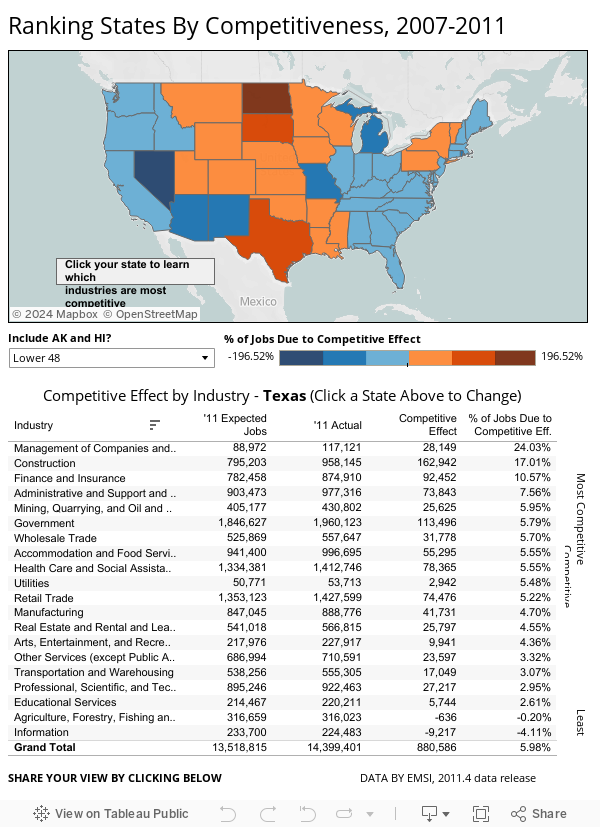
    In this post we teamed up with our friends at Tableau Software to produce the following interactive graphic, which details individual industries that are driving states to be more (or less) competitive. The graphic breaks down the performance of the 20 major sectors in every state in the contiguous US (plus Hawaii and Alaska) in terms of expected and actual job change from 2007-2011. Further explanation of the analysis is below.

    Rundown on the data

    We used shift share, a standard economic analysis method that reveals if overall job growth is explained primarily by national economic trends and industry growth or unique regional factors. Shift share analysis, which can also be referred to as “regional competitiveness analysis,” helps us distinguish between growth that is primarily based on big national forces (the proverbial “rising tide lifts all boats” analogy) vs. local competitive advantages.

    To generate our ranking, we summed the overall competitive effect for each broad 2-digit industry sector by state (e.g., agriculture, manufacturing, health care, construction, etc.) and added them together to yield a single statewide number that indicates the overall competitiveness of the economy as compared to total economy. We calculate the competitive effect by subtracting the expected jobs (the number of jobs expected for each state based on national economic trends) from the total jobs. The difference between the total and expected is the competitive effect. If the competitive effect is positive, then the industries within the state have exceeded expectations and created more jobs than national trends would have suggested. Those industries are therefore gaining a greater share of the total jobs being created. If the competitive effect is negative, then the industries are not gaining jobs as fast as what we would expect given national trends. In this case the state is losing a greater share of the total jobs being created.

    Observations On Most Competitive

    The big thing that stands out is that most of the competitive states tend to be in the middle of the country. This is tied to the growth in the oil and gas sector, yes, but in most cases better-than-expected performance in construction, government, and other miscellany sectors. In Alaska, North Dakota, and Nebraska, smaller states in terms of population and jobs, manufacturing, transportation, and construction are some of the most competitive industries. Louisiana also fares quite well in healthcare and accommodation & food services.

    Observations On Least Competitive

    For states that rank toward the bottom, the housing bust and subsequent construction downturn is the biggest culprit. For instance, in Nevada, which is last on the list, construction is nearly 50,000 jobs below what would be expected given national and industry trends. Florida, a much more populous state, is more than 130,000 jobs below what would be expected. For states like Michigan, Ohio, and Indiana, the poor performance in manufacturing and government weighed heavily in our ranking.

    Here is the original graphic that show the comparison between states.

    Please check out the graphic and let us know if you have any questions. Email Rob Sentz (rob@economicmodeling.com) or hit us via Twitter @DesktopEcon. Data and analysis comes from Analyst, EMSI’s web-based labor market analysis tool.

  • Which States Are Growing More Competitive?

    By Hank Robison and Rob Sentz. Illustration by Mark Beauchamp.

    In many ways, individual U.S. states are like 50 laboratories where differing public policy, industry focus, and economic development strategies are tried and tested. Different approaches yield different results and some states become more competitive – gaining a larger share of total job creation — while others struggle and lose share. This phenomenon has been evident over the past few years as our nation struggles to recover. Some states have been doing quite well while others are still limping along.

    In this post we have produced a side-by-side analysis of every state to show how they stack up against each other. The goal is to see which states are becoming more competitive (that is, gaining a larger share of the total job creation), and which are losing their share of the jobs being created. The table and graphic each rank the states based on the overall competitive effect and what percentage of jobs (from 2007-2011) are based on competitive effects.

    HOW WE DID IT

    To produce this analysis we used “shift share,” a standard economic analysis method that reveals if overall job growth is explained primarily by national economic trends and industry growth or unique regional factors. Shift share analysis, which can also be referred to as “regional competitiveness analysis,” helps us distinguish between growth that is primarily based on big national forces (the proverbial “rising tide lifts all boats” analogy) vs. local competitive advantages.

    Read more on shift share in this article: Understanding Shift Share.

    ABOUT THE DATA

    The chart (see the full version here) and table display aggregate industry data (2-digit NAICS) for every state plus Washington, D.C. from 2007-2011. To generate our ranking, we summed the overall competitive effect for each broad 2-digit industry sector (e.g., agriculture, manufacturing, health care, construction, etc.) and added them together to yield a single statewide number that indicates the overall competitiveness of the economy as compared to total economy. We calculate the competitive effect by subtracting the expected jobs (the number of jobs expected for each state based on national economic trends) from the total jobs. The difference between the total and expected is the competitive effect. If the competitive effect is positive, then the state has exceeded expectations and created more jobs than national trends would have suggested. It is therefore gaining a greater share of the total jobs being created. If the competitive effect is negative, then the state is below what we would expect given national trends. In this case the state is losing a greater share of the total jobs being created.

    Click here or on the image to the right to see full infographic.

    State Total Jobs, 2011 Expected Jobs, 2011 Competitive Effect % of Jobs Due To Comp. Effect
    Source: EMSI Complete Employment, 2011.4
    North Dakota
    516,605
    469,857
    46,748
    9.05%
    Texas
    14,399,398
    13,518,812
    880,586
    6.12%
    Alaska
    452,115
    433,687
    18,428
    4.08%
    Louisiana
    2,504,020
    2,407,581
    96,439
    3.85%
    South Dakota
    546,100
    525,117
    20,983
    3.84%
    Nebraska
    1,212,275
    1,172,633
    39,642
    3.27%
    District of Columbia
    815,948
    792,259
    23,689
    2.90%
    Oklahoma
    2,130,093
    2,082,728
    47,365
    2.22%
    Vermont
    422,070
    412,696
    9,374
    2.22%
    Utah
    1,616,991
    1,583,067
    33,924
    2.10%
    Iowa
    1,931,567
    1,893,018
    38,549
    2.00%
    Arkansas
    1,534,714
    1,506,531
    28,183
    1.84%
    Massachusetts
    4,135,549
    4,072,323
    63,226
    1.53%
    Washington
    3,790,572
    3,739,147
    51,425
    1.36%
    Pennsylvania
    7,092,698
    6,999,188
    93,510
    1.32%
    New York
    10,838,410
    10,695,567
    142,843
    1.32%
    Colorado
    3,095,540
    3,055,919
    39,621
    1.28%
    Virginia
    4,716,133
    4,657,857
    58,276
    1.24%
    Wyoming
    388,092
    383,853
    4,239
    1.09%
    Kentucky
    2,320,844
    2,305,702
    15,142
    0.65%
    West Virginia
    906,644
    902,716
    3,928
    0.43%
    Wisconsin
    3,426,638
    3,415,893
    10,745
    0.31%
    New Hampshire
    825,620
    823,626
    1,994
    0.24%
    Montana
    618,754
    617,477
    1,277
    0.21%
    Maryland
    3,313,904
    3,307,612
    6,292
    0.19%
    Kansas
    1,773,058
    1,769,699
    3,359
    0.19%
    Mississippi
    1,477,695
    1,476,543
    1,152
    0.08%
    Connecticut
    2,158,390
    2,157,345
    1,045
    0.05%
    Maine
    796,843
    798,431
    -1,588
    -0.20%
    South Carolina
    2,437,347
    2,443,486
    -6,139
    -0.25%
    Minnesota
    3,388,760
    3,397,958
    -9,198
    -0.27%
    Illinois
    7,202,487
    7,237,065
    -34,578
    -0.48%
    North Carolina
    5,129,787
    5,156,952
    -27,165
    -0.53%
    New Jersey
    4,862,884
    4,904,000
    -41,116
    -0.85%
    Oregon
    2,190,416
    2,209,867
    -19,451
    -0.89%
    Missouri
    3,451,992
    3,484,707
    -32,715
    -0.95%
    Tennessee
    3,518,654
    3,553,409
    -34,755
    -0.99%
    Indiana
    3,490,060
    3,533,252
    -43,192
    -1.24%
    Hawaii
    833,901
    844,613
    -10,712
    -1.28%
    Ohio
    6,426,057
    6,516,379
    -90,322
    -1.41%
    New Mexico
    1,049,578
    1,066,008
    -16,430
    -1.57%
    Delaware
    521,838
    530,012
    -8,174
    -1.57%
    Georgia
    5,152,260
    5,246,899
    -94,639
    -1.84%
    Alabama
    2,463,047
    2,508,686
    -45,639
    -1.85%
    Idaho
    871,814
    888,471
    -16,657
    -1.91%
    California
    19,906,130
    20,292,975
    -386,845
    -1.94%
    Rhode Island
    580,271
    593,811
    -13,540
    -2.33%
    Michigan
    5,068,282
    5,250,678
    -182,396
    -3.60%
    Florida
    9,632,855
    10,042,000
    -409,145
    -4.25%
    Arizona
    3,144,238
    3,290,959
    -146,721
    -4.67%
    Nevada
    1,473,322
    1,584,189
    -110,867
    -7.52%

    OBSERVATIONS

    There’s no surprise at the top: North Dakota is the clear leader. If North Dakota grew at the rate of the national economy, we would have expected about 470,000 total jobs in the state for 2011. Instead, there are an estimated 520,000 jobs in the state. The difference between the two is the competitive effect. In other words, North Dakota is ahead of what we would expect by 47,000 jobs, or nearly 10% greater than it should be.

    Second on our list is Texas, which is 6% (or 880,000 jobs) ahead of where we would predict given national trends. Alaska, Louisiana, and South Dakota are about 4% above their expected jobs totals. Better-than-expected performances in construction — and in some cases, oil and gas extraction and government — are major driving factors for this growth. More importantly, oil is driving lots of other economic activity within some of these states and they are pulling a greater share of jobs to support the resultant industry growth.

    Bolstered by significant government spending, Washington, D.C, also gained a greater share of jobs since the recession. The region is nearly 3% ahead of where we would expect.

    Other states with solid competitive effects (about 1%) are Nebraska, Oklahoma, Vermont, Utah, Iowa, Arkansas, Massachusetts, Washington, Pennsylvania, New York, Colorado, Virginia, and Wyoming.

    Nevada is last on our list. The difference between total jobs and expected jobs is -110,000 or nearly -8%. For Nevada and Arizona, second-last in competitiveness, the construction sector is the major culprit.

    In terms of total job expectations, Florida and California are losing the greatest share of the jobs. They are both about 400,000 below what would be expected. For Florida, that is a much more significant figure (4.25% below expected growth).

    Michigan is nearly 200,000 jobs below where they should be.

    Other states that are losing a significant share of jobs are Tennessee (-1%), Indiana (-1.24%), Hawaii (-1.28%), Ohio (-1.41%), New Mexico (-1.57%), Georgia (-1.84%), Alabama (-1.85%), Idaho (1.91%), California (-1.94%), and Rhode Island (-2.33%).

    CONCLUSION

    The big lesson: states that gained a greater share of the total job creation from 2007-2011 have characteristics that make them more competitive and healthy from a job creation point of view. If a state is losing, then it stands to reason that there are factors within the state that make it less competitive. As the economy recovers, the states with higher competitive effects could have an advantage over states that haven’t been able to create or pull their fair share of the jobs. If a state is hemorrhaging jobs faster than the national economy, there should be cause for concern. There are likely toxic conditions within industry sectors and economic policies that make it very difficult for employment and economic activity to flourish. As the nation recovers these states will likely recover much slower, and other states might just keep pulling more jobs away from them.

    Rob Sentz is the marketing director at EMSI, an Idaho-based economics firm that provides data and analysis to workforce boards, economic development agencies, higher education institutions and the private sector. He is the author of a series of green jobs white papers. For more, contact Rob Sentz (rob@economicmodeling.com). You can also reach us via Twitter @DesktopEcon.

    Dr. Robison is EMSI’s co-founder and senior economist with 30 years of international and domestic experience. He is recognized for theoretical work blending regional input-output and spatial trade theory and for development of community-level input-output modeling. Dr. Robison specializes in economic impact analysis, regional data development, and custom crafted community and broader area input-output models.

    Illustration by Mark Beauchamp.

  • Interactive Data Visualization: The Connection Between Manufacturing Jobs and Exports

    By Hank Robison and Rob Sentz

    We recently observed that there are only about 50 manufacturing sectors out of 472 (6-digit NAICS) that actually gained jobs over the past 10 years. This made us wonder because we keep hearing that manufacturing output is actually improving. Politicians and policymakers tend to assume that an uptick in output would naturally result in an uptick in employment. So we investigated.

    What we found

    We placed national export data on top of job totals for each of the 472 manufacturing sectors, and found that manufacturing exports (inflation-adjusted) actually grew by 56% from 02-10 while manufacturing jobs contracted by 23%. Growth in exports have clearly not resulted in more domestic jobs. See the interactive graphic at the bottom of this post for a visualization.

    Across the manufacturing sectors we are actually seeing a predominantly inverse relationship between jobs and exports. To explore this further, we placed each of the 472 industries into one of four categories (again see the graphic):
    1) Those that gained both exports and jobs,
    2) Those that gained exports but lost jobs,
    3) Those that lost exports but gained jobs, and
    4) Those that lost both exports and jobs.

    Some observations

    Those advocating for increased exports as a way of resuscitating jobs in manufacturing need to look at this data. Only 11% of all manufacturing sectors showed gains in jobs and exports, which is not a huge surprise given manufacturing decline. 19% lost jobs AND exports at the same time. Now here is the stat really worth noting — 71% of all manufacturing sectors increased their exports while decreasing their domestic workforce.

    There are some political ramifications here. The Obama Administration has proposed exports as a key to kick-starting the U.S. labor market (see this post from Brookings). Economists and policy experts as well as all of us here at EMSI are huge fans of improving exports. Exports are a principal source of foreign exchange and an important driver for U.S. goods. Export industries also tend to pay higher wages and connect with the rest of the economy through greater multiplier effects, which mean they are key for income and job formation.

    However, as the data suggests things are not that simple. Domestic manufacturers appear to be outsourcing large parts of their work to foreign suppliers. In the process, they employ fewer domestic workers but become more competitive in foreign markets. As a result, exports go up while employment goes down. This is something that policymakers need to consider before pinning too much hope on exports as a way of reviving manufacturing sector employment.

    Conclusion

    There may be a conflict of goals here. On one hand we want high-wage, high-benefit jobs; on the other, “full employment.” But in manufacturing can we have both? If wages, and benefits are pushing producers to outsource then either wages go down (an unattractive prospect), or we adopt policies that spawn productivity growth needed to support high-wages. Are there any other choices?

    Data Graphic

    In this interactive graphic, you can explore EMSI’s data on manufacturing jobs and exports. The data is based on 4-digit NAICS manufacturing sectors. NOTE: 6-digit data was used in the previous analyis.

    Click on the chart to highlight an industry or use the drop-down box. Data in the top half of the graphic shows percentage change in jobs (on the y-axis) and exports (on the x-axis). The bottom line graph simply compares manufacturing jobs and exports over time.

    As we highlighted above, 71% of all manufacturing sectors increased their exports while decreasing their domestic workforce from 2002 to 2010.

    For more information, email Rob Sentz.

  • Comparing Perry’s Texas to Romney’s Massachusetts

    Republican primary front-runners Rick Perry and Mitt Romney are each basing a large part of their campaigns on their economic track records. So who is better when it comes to jobs and the economy — Romney or Perry?

    Let’s put each of their states under the microscope to see what the data says. In this exercise we will use Analyst, EMSI’s web-based labor market analysis tool, to help us see the ins and outs of the Massachusetts and Texas economies.

    Notes:
    1. All data, graphs, and tables are from Analyst’s 2011.3 dataset, which is based on BLS, Census, BEA, and nearly 80 other sources.

    2. As an economics firm we want to stress this point — businesses and economic activity create jobs, not politicians.

    3. Gov. Perry (2000-current) and Romney (Massachusetts Governor from 2003-2007) do not have perfectly overlapping times in office, so we are going to consider the 10-year time frame and then look at how the states have performed during the recession, which would tend to reflect the legacy of each politician (e.g., politicians always inherit the blessings or curses of the previous administration).

    4. Performance during the recession is the key point of data we want to look at. Which state is strong when tough times arise?

    TEN-YEAR TRENDS
    Right off the bat we see that the Texas economy is the clear leader. The state grew by 18%, or about 2.2 million jobs, in the last 10 years. Over that same time period Massachusetts grew by 2%, or less than 100,000 jobs.

    (click images to enlarge)


    Almost every industry sector in Texas grew from 2001 to 2011. Agriculture, information, and manufacturing were the only ones to actually decline. The big leaders were health care (43% growth, 421,000 jobs), government (17% growth, 282,000 jobs), oil and gas (111% growth, 257,000 jobs), finance and insurance (38% growth, 216,000 jobs), and professional and technical services (29% growth, 210,000 jobs).

    NAICS Code Description 2001 Jobs 2011 Jobs Change % Change 2011 Earnings
    62 Health Care and Social Assistance 985,667 1,407,160 421,493 43% $49,118
    90 Government 1,679,431 1,961,341 281,910 17% $59,455
    21 Mining, Quarrying, and Oil and Gas Extraction 231,809 488,494 256,685 111% $136,302
    52 Finance and Insurance 575,109 791,054 215,945 38% $69,091
    54 Professional, Scientific, and Technical Services 713,722 923,621 209,899 29% $74,784
    72 Accommodation and Food Services 789,913 987,746 197,833 25% $19,814
    56 Administrative and Support and Waste Management and Remediation Services 744,446 932,960 188,514 25% $33,979
    53 Real Estate and Rental and Leasing 410,363 559,112 148,749 36% $31,946
    81 Other Services (except Public Administration) 592,116 708,981 116,865 20% $28,597
    23 Construction 849,097 950,903 101,806 12% $54,438
    61 Educational Services 148,927 214,526 65,599 44% $36,378
    55 Management of Companies and Enterprises 41,840 105,073 63,233 151% $102,137
    71 Arts, Entertainment, and Recreation 171,298 230,177 58,879 34% $24,422
    44-45 Retail Trade 1,350,407 1,400,681 50,274 4% $30,803
    48-49 Transportation and Warehousing 506,512 553,486 46,974 9% $60,395
    42 Wholesale Trade 508,024 552,876 44,852 9% $80,704
    22 Utilities 52,813 55,870 3,057 6% $118,804
    11 Agriculture, Forestry, Fishing and Hunting 345,303 319,410 (25,893) (7%) $20,912
    51 Information 299,481 227,513 (71,968) (24%) $73,610
    31-33 Manufacturing 1,066,622 871,533 (195,089) (18%) $79,460
    Total 12,062,901 14,242,517 2,179,616 18% $53,493
    Source: EMSI Complete Employment – 2011.3

    Massachusetts’ growth sprung primarily from health care (24% growth, 111,000 jobs), professional and technical services (10% growth, 37,000 jobs), educational services  (19% growth, 35,000 jobs), and real estate (27% growth, 34,000 jobs). A big thing to note is that nine industry sectors — utilities, government, transportation, retail trade, management of companies, wholesale trade, information, construction, and manufacturing — lost jobs from 2001-2011.

    NAICS Code Description 2001 Jobs 2011 Jobs Change % Change 2011 Earnings
    62 Health Care and Social Assistance 468,668 579,523 110,855 24% $60,616
    54 Professional, Scientific, and Technical Services 363,592 400,919 37,327 10% $96,534
    61 Educational Services 184,644 220,002 35,358 19% $56,621
    53 Real Estate and Rental and Leasing 125,313 159,096 33,783 27% $32,018
    72 Accommodation and Food Services 249,024 277,782 28,758 12% $22,995
    81 Other Services (except Public Administration) 179,165 203,904 24,739 14% $33,199
    71 Arts, Entertainment, and Recreation 84,064 105,900 21,836 26% $28,814
    52 Finance and Insurance 232,356 253,578 21,222 9% $115,262
    56 Administrative and Support and Waste Management and Remediation Services 212,872 213,893 1,021 0% $39,572
    21 Mining, Quarrying, and Oil and Gas Extraction 2,604 3,398 794 30% $148,741
    11 Agriculture, Forestry, Fishing and Hunting 20,552 20,373 (179) (1%) $33,359
    22 Utilities 12,332 11,383 (949) (8%) $135,669
    90 Government 432,156 426,859 (5,297) (1%) $66,827
    48-49 Transportation and Warehousing 124,887 111,495 (13,392) (11%) $52,693
    44-45 Retail Trade 406,859 393,365 (13,494) (3%) $32,842
    55 Management of Companies and Enterprises 72,884 58,796 (14,088) (19%) $125,760
    42 Wholesale Trade 150,660 134,602 (16,058) (11%) $91,749
    51 Information 122,543 100,471 (22,072) (18%) $100,676
    23 Construction 219,882 195,324 (24,558) (11%) $66,726
    31-33 Manufacturing 398,839 264,887 (133,952) (34%) $94,358
    Total 4,063,896 4,135,549 71,653 2% $63,647
    Source: EMSI Complete Employment – 2011.3

    Since much of the discussion in the Republican primary has to do with the nation’s more recent economic turmoil, let’s refocus our analysis to 2007 – 2011.

    MASSACHUSETTS FACTS
    The current population of Massachusetts is 6.6 million with 4.1 million jobs. The unemployment rate is 7.6%, and average earnings in the state are more than $63,000 per year. The gross regional product (GRP), which is the value of all goods and services produced in a region by all industries, is $378 billion per year.

    In Massachusetts, nearly 80% of the population is White, Non-Hispanic. The age demographics tell us the state is pretty balanced, and educational attainment is high.


    Massachusetts ’07-11

    From 2007-2011, jobs declined by 1% (overall loss of 34,000). All things considered — not bad. The biggest losses were felt in construction and manufacturing (total losses of 82,000 jobs). The biggest gains were in health care (45,000 jobs), educational services (11,000 jobs), professional and technical (11,000 jobs), and accommodation and food services (10,000 jobs).

    NAICS Code Description 2007 Jobs 2011 Jobs Change % Change 2011 Earnings
    62 Health Care and Social Assistance 534,634 579,523 44,889 8% $60,616
    61 Educational Services 209,184 220,002 10,818 5% $56,621
    54 Professional, Scientific, and Technical Services 390,170 400,919 10,749 3% $96,534
    72 Accommodation and Food Services 267,731 277,782 10,051 4% $22,995
    52 Finance and Insurance 245,717 253,578 7,861 3% $115,262
    81 Other Services (except Public Administration) 196,358 203,904 7,546 4% $33,199
    71 Arts, Entertainment, and Recreation 98,450 105,900 7,450 8% $28,814
    22 Utilities 10,653 11,383 730 7% $135,669
    21 Mining, Quarrying, and Oil and Gas Extraction 2,854 3,398 544 19% $148,741
    11 Agriculture, Forestry, Fishing and Hunting 19,934 20,373 439 2% $33,359
    51 Information 100,643 100,471 (172) 0% $100,676
    90 Government 427,688 426,859 (829) 0% $66,827
    53 Real Estate and Rental and Leasing 162,635 159,096 (3,539) (2%) $32,018
    55 Management of Companies and Enterprises 62,367 58,796 (3,571) (6%) $125,760
    48-49 Transportation and Warehousing 116,671 111,495 (5,176) (4%) $52,693
    44-45 Retail Trade 404,423 393,365 (11,058) (3%) $32,842
    42 Wholesale Trade 148,614 134,602 (14,012) (9%) $91,749
    56 Administrative and Support and Waste Management and Remediation Services 227,964 213,893 (14,071) (6%) $39,572
    23 Construction 236,308 195,324 (40,984) (17%) $66,726
    31-33 Manufacturing 306,523 264,887 (41,636) (14%) $94,358
    Total 4,169,521 4,135,549 (33,972) (1%) $63,647
    Source: EMSI Complete Employment – 2011.3

    Also, here is a view of 6-digit (NAICS) industries that grew and declined from 2007-11. In the table above we looked only at 2-digit NAICS. When we use the 6-digit sectors we can see much more specific industry detail. Portfolio management was the highest growing industry from 2007-11 in Massachusetts.


    Here is a list of occupations that grew and declined from ’07-11. These are 5-digit occupations (SOC codes). Consistent with the industry data, the fastest-growing occupation is personal financial advisors.


    TEXAS FACTS

    Texas has a total population of 25.6 million with 14.2 million jobs. The average earnings is $53.5K per year, and the unemployment is 972,000. The unemployment rate is 8.4%, which is a tad higher than Massachusetts’. The state’s GRP is $1.2 trillion per year.


    In terms of demographics, Texas is 46% White, Non-Hispanic, 36% Hispanic, and 11% Black or African American. Educational attainment is lower than Massachusetts. Texas also appears to have a slightly younger population when compared to Massachusetts.


    Texas ’07-11

    From 2007-2011, the Texas economy grew by 3% (391,000 jobs gained overall). The state had huge job gains in oil and gas extraction (56% growth and 175,000 jobs), health care (14% growth and 171,000 jobs), and government (7% growth and 125,000 jobs). Other sectors like finance and insurance, accommodation and food, professional and technical, and educational services all had decent gains. Losses occurred in construction and manufacturing (about 192,000 jobs), retail trade (41,000 jobs or -3%), information (35,000 jobs or -13%), transportation (24,000 jobs or – 4%) and wholesale trade (13,000 jobs or -2%).

    NAICS Code Description 2007 Jobs 2011 Jobs Change % Change 2011 Earnings
    21 Mining, Quarrying, and Oil and Gas Extraction 313,502 488,494 174,992 56% $136,302
    62 Health Care and Social Assistance 1,235,840 1,407,160 171,320 14% $49,118
    90 Government 1,836,081 1,961,341 125,260 7% $59,455
    52 Finance and Insurance 717,799 791,054 73,255 10% $69,091
    72 Accommodation and Food Services 943,336 987,746 44,410 5% $19,814
    54 Professional, Scientific, and Technical Services 892,977 923,621 30,644 3% $74,784
    61 Educational Services 192,643 214,526 21,883 11% $36,378
    55 Management of Companies and Enterprises 83,783 105,073 21,290 25% $102,137
    81 Other Services (except Public Administration) 689,944 708,981 19,037 3% $28,597
    71 Arts, Entertainment, and Recreation 215,084 230,177 15,093 7% $24,422
    22 Utilities 50,935 55,870 4,935 10% $118,804
    11 Agriculture, Forestry, Fishing and Hunting 317,762 319,410 1,648 1% $20,912
    56 Administrative and Support and Waste Management and Remediation Services 934,474 932,960 (1,514) 0% $33,979
    53 Real Estate and Rental and Leasing 564,471 559,112 (5,359) (1%) $31,946
    42 Wholesale Trade 565,616 552,876 (12,740) (2%) $80,704
    48-49 Transportation and Warehousing 577,467 553,486 (23,981) (4%) $60,395
    51 Information 262,342 227,513 (34,829) (13%) $73,610
    44-45 Retail Trade 1,441,632 1,400,681 (40,951) (3%) $30,803
    23 Construction 1,025,977 950,903 (75,074) (7%) $54,438
    31-33 Manufacturing 989,430 871,533 (117,897) (12%) $79,460
    Total 13,851,095 14,242,517 391,422 3% $53,493
    Source: EMSI Complete Employment – 2011.3

    Here is a look at 6-digit industries and 5-digit occupations that grew and declined at the largest clip in Texas from ’07-11. As you can see, oil and natural gas extraction is a very big driver for the state. Under Perry, the state also picked up quite a few local government jobs during the recession.


    CONCLUSION

    Based on job numbers, both candidates do have legitimate claims that their states have done well through the recession. In this comparison — Texas really benefits from the huge grow within oil and natural gas. See this recent interactive display to better visualize this trend.

    When looking at data like this, it is important to keep in mind that the economies of states (and these two states in particular) are quite different in terms of total population, demographics, and industry composition. Both states have some strong qualities, but based on raw numbers, Texas is the obvious choice.

    Rob Sentz is the marketing director at EMSI, an Idaho-based economics firm that provides data and analysis to workforce boards, economic development agencies, higher education institutions and the private sector. He is the author of a series of green jobs white papers. Email Rob with questions at rob@economicmodeling.com.

    Lead illustration by Mark Beauchamp

  • Life and Death in the Labor Market

    The Wall Street Journal recently listed the Top 10 Dying Industries, via research firm IBISWorld. Some industries didn’t just see temporary decline during the recession – some won’t recover and will slowly (or quickly) disappear. IBISWorld’s data format is a little different than ours, and its categories are somewhat obscure, but we thought it would be interesting to pull together a similar table with the associated job data.

    With one major exception, all of these industries have seen some shakeup. But job loss by itself doesn’t tell the full story. Wired telecommunications carriers lost the most jobs, but are tied with newspaper publishing for the second smallest percentage change on the list. This is probably because these are entrenched industries and will take longer to become totally obsolete. Contrast those industries with photofinishing. Photofinishing has been a smaller industry all along, but its percent loss is at 68%. Consider the last time you looked at snapshots that weren’t digital, and then say a little prayer for the photofinishing industry.

    Description 2001 Jobs 2010 Jobs Change % Change
    Wired Telecom. Carriers 1,038,230 709,179 -329,051 -32%
    Mills 487,344 208,526 -278,818 -57%
    Apparel Manufacturing 273,650 127,175 -146,475 -54%
    Newspaper Publishing 428,659 289,997 -138,662 -32%
    DVD, Game & Video Rental 167,526 84,442 -83,084 -50%
    Record Stores 84,884 30,416 -54,468 -64%
    Photofinishing 66,170 20,901 -45,269 -68%
    Manufactured Home Dealers 43,203 19,430 -23,773 -55%
    Formal Wear & Costume Rental 19,889 12,217 -7,672 -39%
    Video Postproduction Services 26,098 26,319 221 1%


    The one industry on this list that is not like the others is video postproduction services. As we mentioned earlier, there’s not an exact relationship between our industry groups and IBISWorld’s, so where it has found overall decline we’ve found slight growth. Here’s a look at our overall fastest-declining industries since 2001:

    Description 2001 Jobs 2010 Jobs 2001-2010 % Change 2001-2010 Change 2009-2010 Change
    Crop and animal production 3,060,000 2,630,246 -14% -429,754 -11,754
    Professional Employer Organizations 798,710 432,936 -46% -365,774 -6,154
    Wired Telecommunications Carriers 1,038,230 709,179 -32% -329,051 -31,331
    New Single-Family Housing Construction (except Operative Builders) 849,104 526,926 -38% -322,178 -57,059
    Department Stores (except Discount Department Stores) 857,007 562,392 -34% -294,615 2,786
    Temporary Help Services 2,349,389 2,125,113 -10% -224,276 284,107
    New Car Dealers 1,118,633 902,006 -19% -216,627 -3,062
    Postal Service 866,747 698,630 -19% -168,117 -8,185
    Nonresidential electrical contractors 767,556 609,549 -21% -158,007 -47,931
    Scheduled Passenger Air Transportation 560,105 409,277 -27% -150,828 -2,988


    This table shows some pretty major decline in several industries. “Crop and animal production” along with “new single family housing construction” stand out. The interesting one on this list is “temporary help services.” That industry shows overall decline of over 224,000 jobs, but this amazing comeback from 2009-2010 where it gains over 284,000 jobs. It ends up with the smallest percentage decline on the list, 10%. However, if we look from 2001-2009, it would top the list here, with a loss of over 508,000 jobs, or 22% decline.

    The industry with the largest percentage loss over that period, “professional employer organizations,” shows 46% decline. That industry, a provider of leased employees typically for human resources management, has shown steady decline since 2003. While that decline looks to have slowed recently, it hasn’t stopped. We’ll have to wait for more data to see what happens.

    Is There Life in Manufacturing?

    Before we get to the better news, let’s look at a quick reminder about what manufacturing has been doing over the past 10 years. From 2001 to 2010 the manufacturing sector lost 4.7 million jobs nationally. Pretty dismal. However, there are industries within the sector that show growth. If we look from 2001-2010 the top 10 fastest-growing manufacturing industries are.

    Description 2001 Jobs 2009 Jobs 2010 Jobs 2001-2010 2009-2010
    Wineries 27,531 47,117 46,850 19,319 -267
    Perishable Prepared Food Manufacturing 24,584 36,785 36,962 12,378 177
    Oil and Gas Field Machinery and Equipment Manufacturing 48,327 61,698 59,673 11,346 -2,025
    Ship Building and Repairing 92,336 103,526 100,841 8,505 -2,685
    Surgical and Medical Instrument Manufacturing 107,547 115,938 115,721 8,174 -217
    Ethyl Alcohol Manufacturing 3,272 9,797 9,708 6,436 -89
    Plastics Packaging Film and Sheet (including Laminated) Manufacturing 5,879 11,782 12,302 6,423 520
    Digital Printing 20,894 27,531 27,308 6,414 -223
    In-Vitro Diagnostic Substance Manufacturing 13,444 19,916 19,458 6,014 -458
    Spice and Extract Manufacturing 16,126 20,708 20,980 4,854 272


    This still isn’t the good news. As the table demonstrates, most of the industries showing high growth from 2001 to 2010 have slackened considerably from 2009 to 2010, and many of them have declined. We would hope to be seeing some hint of recovery in these industries, but instead we’re seeing loss.

    To zero in on industries showing current growth in the manufacturing sector, we’ll look at the top 10 manufacturing industries showing the most growth from 2009 to 2010.

    Description 2001 Jobs 2009 Jobs 2010 Jobs 2001-2010 Change 2009-2010 Change
    All Other Plastics Product Mfg. 400,046 260,516 264,562 -135,484 4,046
    All Other Motor Vehicle Parts Mfg. 167,487 106,257 109,069 -58,418 2,812
    Automobile Mfg. 168,403 94,904 97,424 -70,979 2,520
    Travel Trailer and Camper Mfg. 36,231 23,190 25,347 -10,884 2,157
    Motor Home Mfg. 17,612 9,473 11,525 -6,087 2,052
    Motor Vehicle Metal Stamping 111,209 55,426 57,470 -53,739 2,044
    Wet Corn Milling 9,185 8,127 10,166 981 2,039
    Motor Vehicle Seating and Interior Trim Mfg. 65,601 40,325 42,194 -23,407 1,869
    Iron and Steel Mills 118,583 85,200 86,837 -31,746 1,637
    Motor Vehicle Transmission and Power Train Parts Mfg. 96,132 53,644 55,109 -41,023 1,465


    As you run over this list you’ll probably get the takeaway pretty quickly. The lesson of this table is that the federal auto manufacturing bailout had an immediate positive effect. In an already declining industry sector the bailout has enabled auto manufacturing to recover, very slightly, after a long period of decline.

    Of the three industries on this list not directly related to auto manufacturing (all other plastics mfg., wet corn milling, and iron and steel mills) only wet corn milling showed growth from 2001 to 2009. This means that nine of the top 10 manufacturing industries that have grown from 2009 to 2010 are industries showing a sudden turnaround, without a growth trend in place. Because these correlations are so close, we took a quick look at the relationship between auto manufacturing and iron and steel milling in our input-output model and did not find a strong industry tie. The same was true for auto manufacturing and all other plastics mfg.

    Life vs. Death

    So where do we go from here? First we looked at dying industries. Then we looked at industries within a dying industry sector that are recovering because of massive infusions of money from the government. Is it all really that depressing out there?

    The following table shows high growth industries looking into the future. We applied a filter to get industries growing beyond than the national average, percentage-wise, and then chose the top 10 projected to add the most new jobs from 2008 to 2014.

    Description 2008 Jobs 2014 Jobs Change % Change
    Local government 14,425,000 14,905,114 480,114 3%
    Crude Petroleum and Natural Gas Extraction 556,883 987,818 430,935 77%
    Home Health Care Services 1,294,652 1,697,041 402,389 31%
    Offices of Physicians (except Mental Health Specialists) 2,439,113 2,834,694 395,581 16%
    Investment Advice 855,566 1,220,851 365,285 43%
    Portfolio Management 731,703 1,088,517 356,814 49%
    General Medical and Surgical Hospitals 4,312,784 4,669,173 356,389 8%
    Private Households 1,623,184 1,922,073 298,889 18%
    Services for the Elderly and Persons with Disabilities 663,261 936,620 273,359 41%
    Federal government, civilian, except postal service 2,069,474 2,327,756 258,282 12%


    Local government tops the list, adding nearly a half million jobs. Its percentage growth is the lowest on the list, however. On the other hand, crude petroleum and natural gas extraction is projected to grow by around 430,000 jobs from 2008 to 2014 and projects 77% growth. Health industries make an excellent showing. Between home health care services, offices of physicians, general medical and surgical hospitals, and services for the elderly and person with disabilities, there’s a total projected addition of 1,427,718 jobs. Also notable: two finance industries show up here, investment advice and portfolio management, both of them indicating that after the crash folks are interested in getting some outside advice on their holdings. 

    Much of this growth appears to be driven by demographics: the huge baby boomer generation is reaching senior status, and the U.S. is projected to continue its overall population growth fueling the need for growth in local government and health care to serve growing demand.

    Of course, this isn’t a comprehensive look at industry growth. Everyone knows that the health sector is growing, and we’re starting to spot other reasons for hope. But the truth is that the US economy recently underwent a major shakeup, and hasn’t totally bounced back yet. As far as manufacturing goes, there’s not a ton of good news right now. There is some life out there. But we’ve still got a long way to go.

    Rob Sentz is the marketing director at EMSI, an Idaho-based economics firm that provides data and analysis to workforce boards, economic development agencies, higher education institutions and the private sector. He is the author of a series of green jobs white papers.

    Illustration by Mark Beauchamp