Author: Sami J. Karam

  • Africa: 800 Million Jobs Needed

    African economies are in a race to get ahead of the demographic boom.

    While some people in the United States are sweating the presence, against the backdrop of a demographically stagnant white population, of the 11 million undocumented immigrants or of the 30+ million other foreign-born residents, there are far bigger numbers brewing in other parts of the world, indeed numbers that are so large that they could affect decades from now the life of an American citizen far more than the rare determined Mexican or Guatemalan who manages henceforth to scale President Trump’s purportedly impenetrable border wall.


    In the next decades as was so often the case in history, the future shape of the world could once again be decided in Europe and by Europe’s and the West’s handling of Africa’s incipient demographic boom.

    In fact, if you are a generous-minded European who shares the Pope’s noble sentiment and who views the ongoing wave of migrants coming into your country as a benign and positive development; or, if you believe that borders are outdated constructs and that all refugees and other immigrants should be welcomed into the rich world; indeed, if it is your view that anyone who stands in the way of this openness is misguided by racist and nefarious motives, then it behooves you to test the strength of your belief by examining the larger demographic data coming out of Africa and Asia.

    Because it is likely that your kindness and generosity will be, in the next decades, tested to their limits (unless they are limitless like the Pope’s). Because the two million people who have entered Europe on foot or via inflatable rafts in the past few years are, in scale, only thin vapor rising out of the demographic cauldron that is boiling up in Africa and south Asia. There are potentially many many more to come.

    The Numbers

    If Africa does not get its act together to start creating jobs at a rapid rate, there may be tens of millions more such people attempting to migrate in the future. The world population in 2015 stood at 7.3 billion and, on the UN’s medium variant, was expected to rise to 9.7 billion in 2050. Half of this 2.4 billion increase would take place in sub-Saharan Africa where the population will more than double in nearly every country.

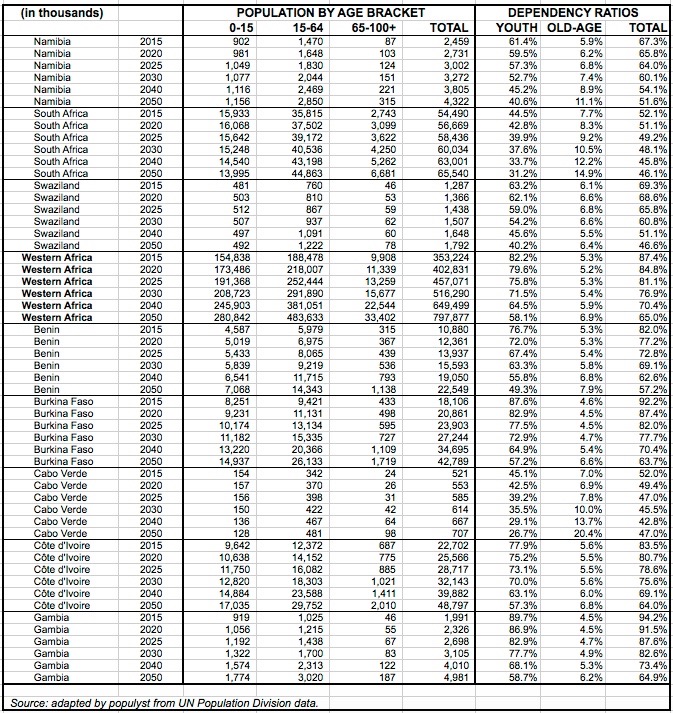
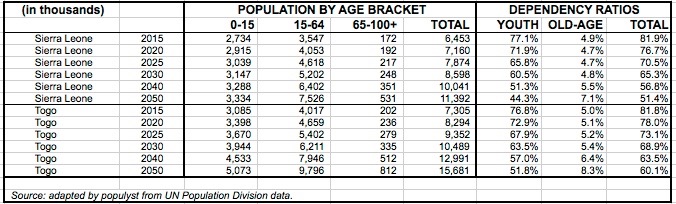
    (See at the bottom of the article region and country tables derived from the UN’s medium variant).

    Today sub-Saharan Africa has a billion people. In 2050, it will have 2.1 billion. Of more vivid concern is the fact that the working-age population, aged 15 to 64, will grow by 800 million people from 500 million to 1.3 billion. This 800 million increase is roughly equal to five times the current size of the US labor force.

    It is possible that these numbers are too high. But it should be noted that, in arriving at these forecasts, the UN Population Division has plugged into its assumptions a significant decline in fertility rates across the sub-continent, from 4.8 children per woman today to 3.1 in 2050. On a constant-fertility scenario assuming no decline in the fertility rate, the population boom would be even larger. The working age population would rise to 1.6 billion (instead of 1.3 billion under the median variant) and the increase from today would then be equal to 1.1 billion (instead of 800 million). These are unimaginable numbers that are unlikely to materialize.

    (See this article for the Total Fertility Ratio of every African country from the highest, Niger at 7.7, to the lowest, Mauritius at 1.5.)

    In some ways, the precise magnitude of the boom is unimportant, so long as we accept that it will be somewhere between large and very large. Even a sanguine scenario that would halve the increase of the working age population from 800 million to 400 million would still present a challenge that African economies are today ill-equipped to handle. Economic conditions are insufficient even today to adequately feed, dress, educate and shelter the population.

    One reason to feel some optimism is the fact that the BRIC countries (Brazil, Russia, India and China) also experienced a big rise in their working-age populations in the past thirty-five years and they managed to handle their demographic boom effectively. But this positive outcome was greatly assisted by a steep decline in China’s dependency ratio (DR) from 0.77 to 0.38. The DR is the ratio of dependents, children and the elderly, to working adults.

    By comparison, the DR of sub-Saharan Africa is projected to fall from 0.86 today to a still elevated 0.63 in 2050. The decline in the youth DR (see tables below) is somewhat offset by a rise in the old-age DR that is itself due to an expected increase in life expectancy.

    Certainly, if African fertility falls faster than median variant estimates, the total DR would decline more rapidly and there could be a faster acceleration in job creation and in GDP per capita.

    (See at the bottom of the article the change in the dependency ratio for every country).

    The Drive for Change

    Africa is a wealthy continent but its wealth is highly concentrated in the hands of a few and it is often domiciled outside of Africa, in offshore financial centers, and in real estate and other assets all over the developed world. For decades, this configuration has worked wonders for Africa’s rulers and their entourages.

    If the above numbers are correct, that configuration is not sustainable in the long run. Not only will there be many more Africans in the future than in the past, but the advances in global connectivity through the internet and mobile phones mean that these future Africans will be much more aware of the prevailing living standards in the rich world. Even now, each has in the palm of his hand a direct visual connection to Europe, the United States and other prosperous places. They have seen what a rich society looks like and they want their own place within it.

    So what are the steps that can be taken to improve conditions in Africa? They can be summed up as the following:

    • Fight corruption and cronyism. They divert capital to a small percentage of the population, capital that should be re-invested within Africa.

    • Stop or reduce capital flight from poor to rich countries. A lot of Africa’s money is parked in offshore bank vaults, real estate projects or trophy property in the West.

    • Raise confidence among foreign investors. With less corruption and clearer exit strategies, foreign money would flood into Africa.

    • Institute a more inclusive form of governance that helps spread power and wealth away from the elite and to a greater segment of the population.

    • Create or reinforce an independent judiciary, strengthen the rule of law, including respect for contract law and property rights.

    • Invest in infrastructure. Africa needs trillions of dollars for projects ranging from power generation and water treatment plants to new roads and transportation systems.

    • Boost literacy to rich-country levels, and close the gender gap in literacy. There is a strong correlation between female literacy and fertility. The greater the literacy, the lower the number of children per woman.

    • Lower fertility. There is also a strong correlation between fertility and GDP per capita. Several countries like China that experienced a sharp decline in fertility enjoyed a significant demographic dividend.

    Because there is now on the one hand an entrenched elite that may not easily let go of its privileges and on the other hand enormous demographic pressure on the economy, it is becoming clear that the current configuration is no longer sustainable. Either Africa gets on the fast road to modernization and industrialization, or the continent could suffer dislocation and instability at a near unimaginable scale.

    There is certainly a strong desire by many foreign parties to invest in Africa, but there is a lack of confidence in one’s ability to recover the investment with or without a profit. This major hurdle can be overcome by modernizing Africa’s institutions and its financial system, and as importantly by attacking corruption and cronyism.

    Tables

    The data below were compiled by populyst from the UN Population Division’s medium variant. Note that in sub-Saharan African in 2015-2050:

    • the youth population (under 15 years old) is not quite doubling.

    • the working-age population (15 to 64) is more than doubling.

    • the elderly population (over 64) is more than tripling, albeit from a low base.

    In the world overall, the under 15 number will be stagnant, the 15-64 will grow by 25% and the over 64 will more than double.

    This piece originally appeared on Populyst.net

    Sami Karam is the founder and editor of populyst.net and the creator of the populyst index™. populyst is about innovation, demography and society. Before populyst, he was the founder and manager of the Seven Global funds and a fund manager at leading asset managers in Boston and New York. In addition to a finance MBA from the Wharton School, he holds a Master’s in Civil Engineering from Cornell and a Bachelor of Architecture from UT Austin.

    Photo: Lars Rohwer (Lars Rohwer – per OTRS) [CC BY-SA 3.0], via Wikimedia Commons

  • A Different Kind of Border Wall

    To slow mass migration, stop the illicit capital flight from poor to rich countries.

    An asset manager called ____ Capital recently sent out this email seeking referrals:

    The US Investor visa program allows one to invest $500,000 U.S. in a government licensed fund for a period of about five years and in around 18 months, a conditional green card is attained for the investor and their immediate family. The investor and their family can live, work and study anywhere in the United States and there are no educational, age or English language requirements.

    Most experts report that on September 30th the investment amount will increase from $500k to $1.3m, a significant jump that will price out many potential investors.

    There is still time to file before September 30th if you start your process with ____ Capital now.

    Others can comment on the practice of selling green cards (and ultimately US citizenships) to wealthy foreigners while millions of other applicants, some of whom would be greater contributors to the United States, continue to wait in line for years. Our concern is one step removed and has to do with the legality of this money.

    Give me your rich, but no huddled masses. (photo: populyst)

    It would be unfortunate if foreign money inflows into the US, whether green card-related or not, benefited only a small number of American fund managers and real estate developers while they lowered the standard of living of larger numbers of Americans, for example by crowding them out of some cities because of rising home prices. But it would be doubly unfortunate if some of this money was also illicit, in other words stolen or obtained through dubious maneuvers by corrupt or crony foreign government officials and corporate executives.

    Indeed, to use just one example, the fact that the identity of many buyers in New York’s newest condominiums is cloaked by the use of shell companies is unhelpful to anyone claiming that these vast incoming sums are mostly clean money. For more on this, see Manhattan Ultra-Luxury ‘Battling the Serpent of Chaos’.

    Why Mass Migration

    Before we loop and close this circle, let us examine a very related issue: the mass migration of people from poor countries towards Europe, North America and other wealthy nations.

    When considering the migrant crisis, from the Middle East, Asia and Africa into Europe, or from Asia and Latin America into the United States, the question among policy makers has been on whether and on how to allow or to stop the inflow of people: when, where, how and how many?

    But an antecedent question should be: what in the first place is causing these people to migrate thousands of miles, often at the risk of their own lives? Clearly the answer resides in the poor economies of their home countries. But then what accounts for this poor state of their economies?

    Capital flight must be one of the most important reasons. Modern economics and globalization encourage the free flow of capital. But what if this capital leaving poor countries was ill-obtained? What if it was stolen by corrupt government officials or corrupt corporate executives, or diverted unethically by cronies operating on the margin of legality?

    We do know that wealth and opportunity in many of these countries are hoarded by a small, insecure and often corrupt governing elite. Indeed it is the insecurity that accompanies such hoarding that naturally leads to a significant share of this capital being exported towards jurisdictions where the risk of seizure is deemed to be minimal.

    Yet rich country economies are already awash in capital due to extremely accommodative central bank monetary policy while at the same time poor countries are in dire need of capital to improve their own infrastructure and economy. Simply put, their economies need this money a lot more than ours do. If anything, our own economies may be suffering from too much capital because of extremely low interest rates.

    Closing the Loop

    This then is the reality of today. Rich countries have been on the one hand accepting with open arms the capital coming from poor countries and profiting from it handsomely, and on the other hand balking, to put it euphemistically, at accepting the people from these poor countries who are emigrating in part as a result of this large capital flight.

    The Honest Accounts report estimates that illicit capital outflows from sub-Saharan Africa alone totaled $67.6 billion in a single recent year and that the continent is a net creditor to the world to the tune of $41.3 billion per year.

    One way to think about it then is that migrants are coming to our shores after their country’s money has already come to our shores. As with your typical human being, their search for better living conditions are forcing them to follow the money, some of which happens to be their money. This is not to justify illegal immigration but to explain that it is at least partially a result of our open and undiscriminating stance towards incoming wealth.

    If, as Pope Francis recently stated, corruption steals from the poor, then its younger brother, cronyism, steals from the middle class. Of course, most poor countries don’t have a middle class and their elites therefore often don’t even bother to become cronies. With a weak judiciary, they go directly into corruption, usually with impunity until the levers of power change hands, which is not all that often.

    Parenthetically, it stands to reason that elites in poor countries would not love democracy at home because it reconfigures the power structure every few years in a way that threatens their standing and prosperity. These same elites however do love the democracy and fair play of rich countries because they are the conditions that allow them to safeguard their assets.

    For better or for worse, things are different now due to demographics and technology. For decades, all the power players – government officials, foreign corporations, safe-haven banks – have extracted a large share of wealth because the poor in underdeveloped nations were few, disorganized and largely uninformed. But now they are far more numerous, goaded by smugglers to emigrate, and better informed through the internet. See Working Age Population Around the World to understand the potential magnitude of the migrant issue.

    Where the Money Goes

    The image of the elite from poor countries living in the lap of luxury, jetting to their homes in New York, Miami and London, visiting their financial advisors in Zurich and Cayman, and educating their children at tony private colleges while the masses of their countries subsist in abject poverty, often without sanitation, water or electricity, is so widespread and so real that it has almost become an accepted cliche to most people.

    But to the European and American business and financial elite, the moneyed foreign elite is irresistibly cool, usually not because it is foreign but because it is moneyed and often free-spending. For every American consumer whose appetite for luxury goods is flagging, there may be two or three new wealthy consumers in emerging nations who are eager to collect luxury status symbols. If Louis Vuitton and BMW revenues were to stall in the United States, these firms would merely intensify their focus on new customers in the Middle East, Africa and Asia.

    Foreign elites are also big investors in the United States and Europe. The destination of flight capital is usually one of the following:

    • Banks or financial institutions that offer some secrecy and safety. Historically, this has been private banks domiciled in Switzerland but more recently, it has become any financial institution in an offshore financial center such as the Cayman Islands, Bermuda, Panama, Cyprus, the Channel Islands or other. The Tax Justice Network estimated in 2016 that $12 trillion from developing countries were parked in offshore havens.
    • This capital is then funneled by these banks to asset management firms, be they stock and bond funds, private equity funds or other, to be put to productive use through investments in the public or private markets (see footnotes 1 and 2).
    • Real estate projects in New York, Miami, London, Vancouver and many other places. In 2015, a report by the New York Times estimated that in six of Manhattan’s most expensive buildings, shell companies owned between 57 and 77 percent of the condominiums. (see footnote 3).
    • Other asset classes such as art where funds can be parked safely.

    So, here today, we are faced with this question: is it right to accept into our country another people’s money but to turn away the people themselves? And if we cannot, due to their sheer numbers, accept the people themselves without risking a disruption of our own politics and economics, shouldn’t we then at least turn away the illicit capital that is fleeing their countries? Shouldn’t that capital remain in their countries where it can help them build a better economy and thus remove or reduce their need to emigrate across the sea?

    Given that the number of working-age Africans and Asians is about to swell by hundreds of millions of additional job seekers, it would be prudent for us to encourage the capital originating in their countries to stay at home rather than come to rich countries where it is distorting prices in real estate and other markets. We may not be able to enforce a barrier against all such capital but it behooves us to try and limit the migration of illicit wealth, or to face the inevitable blowback, a human wave of tens of millions of migrants banging on the door to enter the rich world.

    Cruelty plays its hand artfully. Some large beneficiaries of foreign money inflows are also vociferous proponents of greater limits on immigration. These two positions can coexist harmoniously within the same brain only until the connection between the trillions in capital flight and the millions of migrants is exposed in full relief.

    _____________________

    1. Most of the returns on this capital underperform the major stock indices but custodians seem indifferent while they extract their own hefty fees. Meanwhile the owners of the capital don’t worry about a few percentage points of underperformance when their main motive is the safety of the principal. This is the real reason why hedge funds continue to thrive despite delivering poor performance. Their investors are more tolerant of subpar returns because the main alternative is to keep their money in their home countries where they could lose some or all of it in an unfriendly crackdown.

    2. In theory, the Patriot Act required financial institutions to investigate the sources of funds that they receive from foreign countries. But in practice, depositors with no suspected connection to terrorism are ostensibly granted the all clear. Finance firms are simply not staffed or equipped to differentiate between ill-gotten funds and clean funds.

    3. Here too, investors are relatively indifferent to the return they obtain and are merely looking to garage their wealth. Some of New York’s new high-rise condominiums have been called “safety deposit boxes with a view”.

    This piece originally appeared on Populyst.net

    Sami Karam is the founder and editor of populyst.net and the creator of the populyst index™. populyst is about innovation, demography and society. Before populyst, he was the founder and manager of the Seven Global funds and a fund manager at leading asset managers in Boston and New York. In addition to a finance MBA from the Wharton School, he holds a Master’s in Civil Engineering from Cornell and a Bachelor of Architecture from UT Austin.

    Photo by Mstyslav Chernov/Unframe (Own work) [CC BY-SA 4.0], via Wikimedia Commons

  • Capitalism Did Not Win the Cold War

    When the Soviet Union collapsed 26 years ago, it was generally agreed that the West had won the Cold War. This was affirmed by the prosperity and possibilities awaiting citizens of Western countries, as opposed to the political and economic stagnation experienced by those in Communist states. A natural conclusion, much repeated at the time, was that capitalism had finally defeated communism.

    This sweeping statement was only partially true. If one took capitalism and communism as the only two protagonists in the post–World War II struggle, it was easy to see that the latter had suffered a mortal blow. But there was a third, stealthier protagonist situated between them. This was a system best identified today as cronyism. For if capitalism did win over the other two contenders in 1991, its victory was short-lived. And in the years that have followed, it is cronyism that has captured an ever-increasing share of economic activity. A survey of the distribution of power and money around the world makes it clear: cronyism, not capitalism, has ultimately prevailed.

    Defining Cronyism

    What is cronyism? In a previous article, I objected to the term “crony capitalism” on the grounds that cronyism is itself antithetical to the principles of capitalism and ought not be viewed as a derivative of it. Cronyism is, rather, a separate system that fallsbetween capitalism and state-controlled socialism. When a country drifts from capitalism toward socialism, the transitional period is one in which cronies rule the land.

    Transitional cronyism claims to be capitalistic, whereas socialism claims to be egalitarian. But they are very similar, except for the size of the group of cronies at the top. In cronyistic societies, a larger group extracts a growing share of society’s wealth for themselves and their associates. In socialistic systems, a smaller group vies savagely for wealth and power: because putatively egalitarian economies are usually less efficient at generating wealth, there may be less to go around, making the infighting among socialist leaders that much more bitter.

    Read the entire piece at Foreign Policy.

    Sami Karam is the founder and editor of populyst.net and the creator of the populyst index™. populyst is about innovation, demography and society. Before populyst, he was the founder and manager of the Seven Global funds and a fund manager at leading asset managers in Boston and New York. In addition to a finance MBA from the Wharton School, he holds a Master’s in Civil Engineering from Cornell and a Bachelor of Architecture from UT Austin.

    Photo: Agência Brasil Fotografias [CC BY 2.0], via Wikimedia Commons

  • New Infrastructure in Sub-Saharan Africa

    This post will be continuously updated as we learn about new projects.

    On the three main vectors of wealth creation, African countries have lagged other developing nations for several decades. Sub-Saharan Africa is the poorest region of the world and suffers from poor infrastructure, uneven literacy, endemic corruption, political instability and war. While this is problematic for the present, improving conditions are pointing to a more promising future.

    In particular, sub-Saharan Africa could have a unique opportunity to realize a demographic dividend if its elevated fertility rate and dependency ratio decline in the same way as have those of other countries in the past.

    The experience of China shows that a significant dividend can be reaped if other conducive factors are also present. Most important among them are a growing workforce that is more literate and productive, and an institutional framework that is supportive of economic development.

    Innovation-based productivity gains as we understand them in the West can be scarce in the poorest developing countries. But productivity can be improved quickly through educational programs and through well targeted infrastructure projects.

    There is much to do given that Africa has a large infrastructure deficit. A World Bank Fact Sheet provides the following numbers:

      • Electricity: The 48 countries of Sub-Saharan Africa (with a combined population of 800 million) generate roughly the same amount of power as Spain (with a population of 45 million).

      • Roads: Only one-third of Africans living in rural areas are within two kilometers of an all-season road, compared with two-thirds of the population in other developing regions.

      • Water: Water storage capacity is currently 200 cubic meters per capita and needs to increase to at least 750 cubic meters per capita, a level currently found only in South Africa. Only six million hectares, concentrated in a handful of countries, are equipped for irrigation. Though less than five percent of Africa’s cultivated area, the irrigation-equipped area represents 20 percent of the value of agricultural production.

      • The cost of redressing Africa’s infrastructure deficit is estimated at US$38 billion of investment per year, and a further US$37 billion per year in operations and maintenance; an overall price tag of US$75 billion. The total required spending translates into some 12 percent of Africa’s GDP. There is currently a funding gap of US$35 billion per year.

      Below are some recently announced projects in sub-Saharan Africa that will likely have a large impact on nearby populations. (Some of the links are behind a paywall).

      Uganda-Tanzania pipeline

      Tanzania and Uganda signed on May 26 an intergovernmental agreement for the construction of the world’s longest electrically heated crude-oil export pipeline, which is being designed by Houston-based Gulf Interstate Engineering Co.


      The 1,445-kilometer East Africa Crude Oil Pipeline (EACOP) project, which is being developed by France’s Total SA, China’s CNOOC and UK’s Tullow Oil, would enable the commercialization of the estimated 6.5 billion barrels of crude-oil reserves in Uganda’s Albertine basin. (link)

      Tanzania rail project

      A joint venture of Portuguese and Turkish construction firms has been awarded a $1.2-billion contract for a new 202-kilometer, single-track, 1,435-millimeter-gauge railway line, in Tanzania. The segment is part of the 1631-km Dar es Salaam-Isaka-Kigali and Keza-Musongati railway project connecting the country to neighboring Burundi and Rwanda. (link)

      Landlocked Ethiopia seeking stake in Somali port

      Ethiopia is in talks to acquire shares in a joint venture involving DP World Ltd. that will manage a port in northern Somalia, a Somali official said, a move that could give the fast-growing yet landlocked Horn of Africa economy its first stake in foreign docks. (link)

      Mozambique suspension bridge

      Chinese crews, with the help of German supervisors, are building what will be Africa’s largest suspension bridge, in Mozambique. Slated for completion in the third quarter of this year, the 3,003-meter-long, $725-million Maputo Bridge and Link Roads project will strengthen north-south connections and provide a new road link to South Africa and Swaziland. (link)

      East African Power Plant

      Two foreign-led consortiums have been awarded contracts to build the East Africa-sited, 80-MW Rusumo hydropower project, which is intended to reduce electricity costs and promote renewable power in Tanzania, Rwanda and Burundi. (link)

      Rwanda Airport

      The South African subsidiary of a Portuguese civil construction company has won a two-phase, $818-million contract to construct Bugesera International Airport in Rwanda under a build-own-operate-transfer model, with a view to turning it into central Africa’s premier air transport hub by 2018. (link)

      Tallest Building in Africa

      Kenyan President Uhuru Kenyatta recently laid the foundation stone for what will be the tallest building in Africa in the Upper Hill neighborhood of Nairobi. Construction is underway at the development site, and slated for completion by December 2019.


      The ambitious project will see twin glass-facade towers rise above the city, the larger standing at 300 meters tall, far surpassing the continent’s current leader — Johannesburg’s 223-meter Carlton Centre. (link)

      Zimbabwe Road Expansion

      Zimbabwe has signed an agreement with a Chinese-Austrian consortium to resume the delayed $2.7-billion rehabilitation and expansion of the 971-kilometer Beitbridge-Harare-Chirundu highway, which links landlocked Zimbabwe and Zambia to the ports of Durban and Richards Bay in South Africa. (link)

      Dams in Ethiopia

      Italy’s Milan-based industrial group Salini Impregilo has been awarded a $2.8-billion hydropower project by the Ethiopian Electric Power Corp., a state-controlled company that produces, transmits, distributes and sells electricity in Ethiopia.


      The contract involves the construction, with financing from Italy’s credit agency Servizi Assicuative de Commerce Estero, of the 2,200-MW Koysha Dam on the Omo River in the southern part of the country.


      Salini currently is constructing Ethiopia’s 6,000-MW Grand Ethiopian Renaissance Dam, which, when commissioned in 2017, will be Africa’s largest and the world’s No. 11 largest hydropower project. The Italian construction firm last year completed the 1,870-MW Gibe III hydroelectric power project at a cost of $1.6 billion. (link)

      These are only a few examples of the new infrastructure in Africa. The need for new roads, power plants, rail connections, harbors, water and wastewater facilities, telecommunications etc. is very large and presents a significant opportunity for investors, under the proper governance preconditions.

      This piece originally appeared on Populyst.

      Sami Karam is the founder and editor of populyst.net and the creator of the populyst index™. populyst is about innovation, demography and society. Before populyst, he was the founder and manager of the Seven Global funds and a fund manager at leading asset managers in Boston and New York. In addition to a finance MBA from the Wharton School, he holds a Master’s in Civil Engineering from Cornell and a Bachelor of Architecture from UT Austin.

      Photo: Al Gesh Road, Sahara. (Photo by KaiAbuSir via Wikimedia Commons)

  • Father of the Bernie Sanders Presidency

    President Trump’s elite-managed populism opens a path for a more genuine version.

    On the usual political spectrum, there are left and right, people who call themselves progressive or conservative, socialist/social democrat or capitalist. But these labels seem to mean less today than in the past. The Trump phenomenon highlighted another divide that has little to do with the historic left and right. Crudely speaking, we can call it coastal vs. non-coastal, urban vs. rural, ethnically diverse vs. more homogeneous, elitist vs. populist. This at least is the way the dominant media sees it.

    (click chart to enlarge)

    At the same time, the old labels are not completely dead. So if we try to overlay the new on the old and to categorize the Trump following, we could say that some of the old guard conservatives joined forces with the new rural populists. This is a little complicated and barely makes sense given that the former include some of the elites, in other words the very same people who have angered the populists for the past decade. Many people who want lower taxes and free trade and globalization voted for the same person, Donald Trump, as did people who want import tariffs and restrictions on the flows of people, capital and goods. Some of the same people who survived in 2008 thanks to Wall Street bailouts voted for the same candidate as did people who are still seething over the bailouts.

    donald_trump_official_portraitWhen a human construct no longer makes sense because it is the product of decades of layering of one strain over another, it may be better to restart with a clean slate and to find new models to explain the present.
    Our own favorite model is to hypothesize that the country has drifted away from laissez-faire for several decades and that it has been moving towards socialism. The current interregnum is the time when cronies rule the land. Starting around 1990, cronyism corrupted laissez-faire, an unsurprising evolution since laissez-faire is never pure anyway. And later cronyism heralded its own final mutation into socialism. The case we made in The Bridge from Laissez-faire to Socialism is that socialism is not the system that replaces capitalism, but the system that replaces one form of cronyism with another. The sequence therefore is laissez-faire to the first form of cronyism to the second form of cronyism.

    The older form of cronyism claims to be capitalistic (thus the oft-seen oxymoron “crony capitalism”) and the newer form claims to be egalitarian but they are essentially the same, except for the identities of the cronies at the top who extract the most wealth for themselves and their friends. Because egalitarianism is usually less efficient at managing wealth, there may also be a smaller number of cronies under socialism, which makes the infighting among its leaders that much more bitter and savage.

    Feel the Bern 2020

    On this theory and on current trends then, Bernie Sanders would be elected President of the United States in 2020.

    This may look like a bold assertion, mitigated only by the fact that Senator Sanders is already aged 75 today. If he were elected in 2020, could he remain in office until the age of 83? Very possible, given the medical profession’s ability to keep us alive and functioning well into our eighties. For example, another socialist, Robert Mugabe of Zimbabwe, is now 93 and intends to run for another five-year term in 2018.

    At any rate, voters will not care about the Senator’s age, just as they did not care about candidate Trump’s own shortcomings. What will matter to them is that candidate Sanders will be the flag bearer leading in his wake a younger Vice-President and a slew of new generation Democrats who will be just as eager to undo four years of Trump/Pence as Trump/Pence have been to undo eight years of Obama/Biden.

    To every action, there is an equal or, in the case of politics, a greater reaction. When President Obama alienated half of the electorate by passing the Affordable Care Act through unorthodox procedures, the seed for the Tea Party and then for the rise of Trump was planted. And Trump has already planted the seed for Sanders or of his young charismatic political heir, whoever he or she may be. Or, if that seed was already planted thanks to Senator Sanders’ own strong showing during the campaign, the President’s recent actions have provided a truckload of nutritious fertilizer. The anti-Trump blowback so far does not look like a slow growing plant.

    The President’s Barbell Strategy

    Although he has styled himself a populist, Mr. Trump is mainly a populist when he fires messages on Twitter or when he holds rallies in rural settings, places where he would otherwise rarely venture except perhaps to play golf. But when he goes back to New York, Washington or Mar-a-Lago, he is once again surrounded through his own choice by the same usual East Coast elites who for three decades have thrived at the courts of the Bushes, the Clintons and the Obamas.

    President Trump’s entourage is more elitist than populistic. Even the unconventional Steve Bannon graduated from Harvard Business School and was a one-time banker, and cannot therefore claim the life story of an authentic populist. Team Trump’s populism is not truly organic, but looks instead like posturing and voyeurism, like that of investment bankers occupying the most expensive seats at a Bruce Springsteen concert. It can be very enjoyable for the elite to glimpse the world of the working class, so long as they are never at risk of becoming a part of it.

    The President’s barbell strategy of on the one hand giving lip service to blue-collar populism while on the road, and on the other hand appointing some of the same people that a dyed in the wool elitist would have also appointed, has paid off very nicely so far. It is however inherently unstable and unsustainable except under the scenario of a thriving economy. To his credit, Mr. Trump knows this, which is why he will be holding a rally for his base every so often as a way to tell them that he has not forgotten them, even though finance and energy billionaires happen to be among his favorite people in the world. Normally, only a casuist would attempt to square this circle but the President’s distinct genius has enabled him to pull if off so far.

    It will be interesting to see for how long this magical balancing act can be maintained. An easy answer would be: until the next economic slowdown. It is fine to play both sides as long as things are improving, or expected to be improving soon. People believe what they want to believe. But failure to deliver for the thriving elite or for the suffering working class will turn either or both into potent Trump adversaries. And this is how an opening would be created for Senator Sanders.

    TRiUMPh of the Cronies

    Sanders-021507-18335- 0004But why Sanders?

    Instead of attacking cronyism, the endemic problem of our age, as a true populist might do, President Trump has instead given it a strong new lease on life. In truth, whether Hillary Clinton or Donald Trump prevailed last November, the die had been cast that the winner would represent the culmination of cronyism in its ultimate triumph. Both Mrs. Clinton and Mr. Trump have crony credentials that exceed those of former presidents. Therefore, the election of POTUS 45 probably signaled the end of something and not the beginning of something, notwithstanding Mr. Trump’s new-dawn declarations to the contrary.

    For evidence of cronyism’s final ascent to the seat of power, consider again Mr. Trump’s selections for cabinet and advisory positions. Several are successful operators in business activities that are often associated with cronyism, in this case narrow sub-sectors of energy, finance, law and real estate. What differentiates them is not their success, which by itself would be admirable, but their success in cracks of the laissez-faire economy that are extractive or rent-seeking and largely reliant on government dealing and connections, which is less admirable.

    The New York Times reported the following on 15 April 2017:

    President Trump is populating the White House and federal agencies with former lobbyists, lawyers and consultants who in many cases are helping to craft new policies for the same industries in which they recently earned a paycheck.

    Socialism’s day would come in four years because Mr. Trump has misread the economic tea leaves and has ascribed the moribund economy to an excess of taxes and regulations instead of to the true culprit, which is deteriorating demographics. As a consequence his efforts to ignite another Reagan style boom and to create 25 million new jobs are unlikely to succeed. Mr. Sanders is one of the most vocal critics of cronyism and his speech will be rich with I-told-you-sos if President Trump’s impending deregulation of Wall Street leads to another financial crisis on top of a weaker economy.

    After being disappointed by both Obama and Trump, the struggling working class and shrinking middle class will be ready to try yet another new thing. Electing a socialist will be the boomers’ last hurrah and the millennials rose-tinted dream of a new paradise finally blanketing the earth. Joel Kotkin recently noted:

    The millennials —arguably the most progressive generation since the ’30s—could drive our politics not only leftward, but towards an increasingly socialist reality, overturning many of the very things that long have defined American life.

    and further:

    The long-term hopes of the American left lie with the millennial generation. The roughly 90 million Americans born between 1984 and 2004 seem susceptible to the quasi socialist ideology of the post-Obama Democratic Party. They are also far more liberal on key social issues—gender and gay rights, immigration, marijuana legalization—than any previous generation. They comprise the most diverse adult generation in American history: some 40 percent of millennials come from minority groups, compared to some 30 percent for boomers and less than 20 percent for the silent and the greatest generations.

    Millennials’ defining political trait is their embrace of activist government. Some 54 percent of millennials, notes Pew, favor a larger government, compared to only 39 percent of older generations. One reason: Millennials face the worst economic circumstances of any generation since the Depression, including daunting challenges to home ownership. More than other generations, they have less reason to be enamored with capitalism.

    Sanders’ Math

    As to Senator Sanders’ math in 2020, it should be remembered that Mr. Trump carried two pivotal states, Michigan and Wisconsin, by very narrow margins in the general election and that Mr. Sanders won both of these states in the primaries. It would not take a lot for both to tip to Mr. Sanders in a possible Sanders-Trump showdown in 2020.

    screen-shot-2017-02-27-at-12-34-45-pm

    The addition of Ohio or Pennsylvania, both of which were won by Trump in 2016 and by Obama in 2008 and 2012, would be sufficient to secure Mr. Sanders victory if no other states changed sides in 2020 vs. 2016.

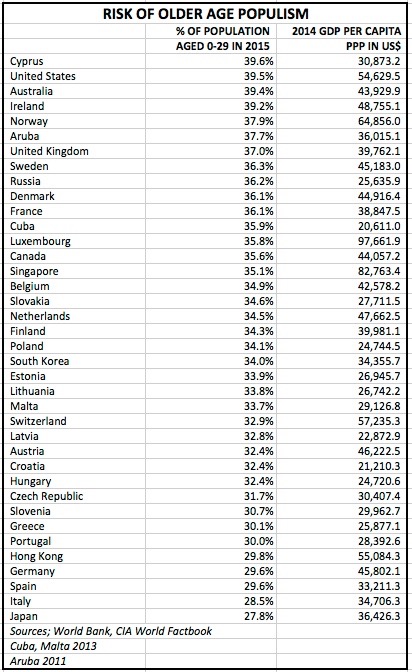
    As noted in So You Want a Revolution, the United States is one of many richer countries at risk of older age populism. These countries have relatively older populations (only 40% or less of the population aged 0-29) and higher GDP per capita ($20,000+).


    Demographics, combined with breakthrough innovations and strong institutions, have made America very wealthy in recent decades. We are now at a critical juncture and at risk of squandering our prosperity by focusing on a wrong set of problems and by empowering the wrong leaders, Trump and stage 1 cronyism that will lead to Sanders and stage 2 cronyism, or socialism.

    Sami Karam is the founder and editor of populyst.net and the creator of the populyst index™. populyst is about innovation, demography and society. Before populyst, he was the founder and manager of the Seven Global funds and a fund manager at leading asset managers in Boston and New York. In addition to a finance MBA from the Wharton School, he holds a Master’s in Civil Engineering from Cornell and a Bachelor of Architecture from UT Austin.

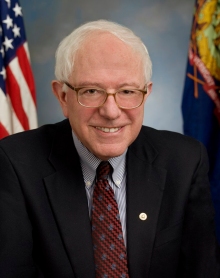
    Bernie Sanders photo by Michael Vadon [CC BY-SA 2.0], via Wikimedia Commons.

  • Outsmarting Crime Together: CityCop CEO Nadim Curi

    In a new podcast, Sami J. Karam speaks to Nadim Curi, CEO of the anti-crime app CityCop.

    Powered by its successful rollout in Latin America started in 2014 and further boosted by funding from startup accelerator techstars, CityCop has staked a claim to turn its “social platform for community watch” into the global leader in crime reporting and public safety.

    Curi explains:

    What Waze has done for traffic globally, we have done the same for public safety.

    What we are doing at CityCop is to make all of this information [about crime incidents] that today is private or is lost, to make it public. The criminals have always taken advantage of this lack of information. They have always the same modus operandi, in the same areas, at the same hours, against the same unaware people. CityCop is making all of this information public for the people to be much better informed of what is happening.

    FullSizeRender

    Starting in Austin, CityCop plans to expand to San Francisco, Chicago, New York and other cities. Curi’s ultimate ambition is to turn CityCop into a global “Waze against crime”.

    TO HEAR THE PODCAST, CLICK HERE OR ON THE TIMELINE BELOW:

  • The Economics of Dependency

    This article first appeared at Foreign Affairs.

    How countries hit the demographic sweet spot.

    Demographics are among the most important influences on a country’s overall economic performance, but compared with other contributors, such as the quality of governance or institutions, their impact is underappreciated.

    Demographic factors, such as the age structure of a population, can determine whether a given economy will grow or stagnate to an even greater extent than can more obvious causes such as government policy. One of the most consequential aspects of demographics as they relate to the economy is a phenomenon known as the “demographic dividend,” which refers to the boost to economic growth that occurs when a decline in total fertility, and subsequent entry of women into the work force, increases the number of workers (and thus decreases the number of dependents) relative to the total population. The demographic dividend has contributed to some of the greatest success stories of the twentieth century, and countries’ ability to understand and capture this dividend will continue to shape their economic prospects well into the future. Continue reading at Foreign Affairs >>>

    Sami Karam is the founder and editor of populyst.net and the creator of the populyst index™. populyst is about innovation, demography and society. Before populyst, he was the founder and manager of the Seven Global funds and a fund manager at leading asset managers in Boston and New York. In addition to a finance MBA from the Wharton School, he holds a Master’s in Civil Engineering from Cornell and a Bachelor of Architecture from UT Austin.

    Photo: infradept

  • Trump Country: Where the Immigrants Aren’t

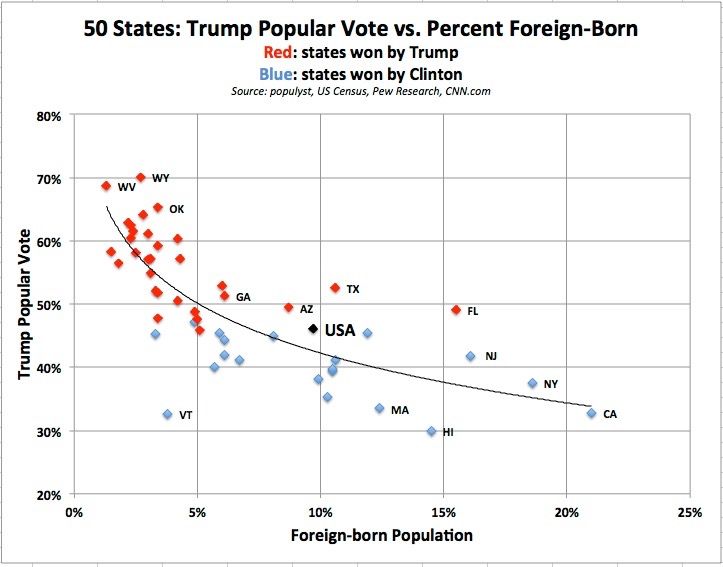
    Trump did best in the states with the lowest percentages of foreign-born residents.

    “I love the poorly-educated”, gushed Donald Trump after winning the Nevada primary in February. But in the end, what happened in the primary, stayed in the primary. Come November, Trump lost the state to Hillary Clinton, a turn that is explained by the fact that there is a higher percentage of foreign-born residents in Nevada than in any state won by Trump, save Florida.

    In fact, Trump won the general election because he carried almost all of the states where there are few foreign-born residents. His anti-immigration message resonated most in the parts of the country that have the fewest immigrants. Of course, he also won immigrant-heavy Arizona, Florida and Texas, but mainly by prevailing in rural counties. He lost in the counties that include the major urban centers of Miami, Orlando, Tampa, Dallas, Houston, Austin and San Antonio. He did win in Maricopa county where Phoenix is located but perhaps not in Phoenix itself. (Maricopa county encompasses a lot more than Phoenix as it is larger by itself than the entire state of New Jersey, and larger than Connecticut and Delaware put together.)

    If the size of the Trump vote can be used as a proxy for a state’s sentiment towards immigration and concern about terrorism, and it probably can, then it seems that the people who are most worried about immigration and terrorism are those who are the least exposed to it and the least at risk from it. This is counter-intuitive from the point of view of probability: why worry about a low probability event? But it could make sense from the point of view of fear: many people can be prone to fear and to misunderstand what they do not know well. Their opinions of others are formed mainly by what they see or read in the media, rather than by their own first-hand experiences.

    Where Trump Won

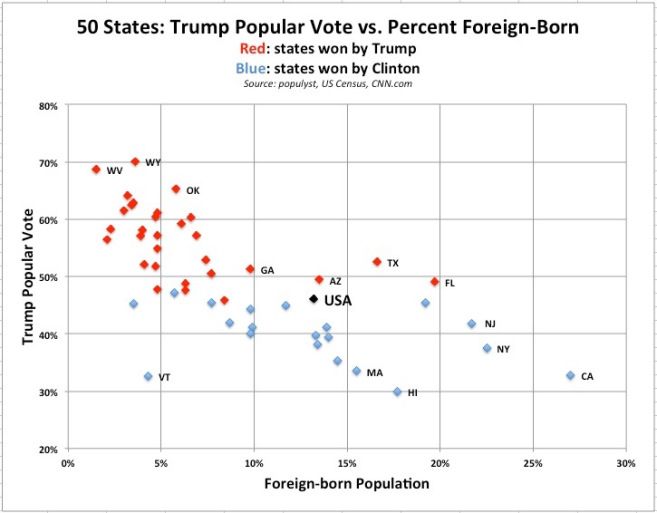
    In the United States overall, there were in 2015 as many as 42 million people who were born in another country, or 13.2% of the US population. But as shown in the chart, every state won by Trump last November, except for Arizona, Texas and Florida, has a smaller percentage of foreign-born than the national average. In fact, the lower the percentage of foreign-born in a given state, the better Trump has done in that state.

    In Wyoming and West Virginia (3.6% and 1.5% foreign-born), he carried approximately 70% of the popular vote. But in Georgia (9.8% foreign-born), he carried about 50%. This difference in the vote cannot be totally attributed to the fact that a majority of the foreign-born probably went for Clinton, given that the difference between 70% and 50% is far higher than the difference between 9.8% and 3.6% and that the latter variable includes non-voters such as children and undocumented immigrants.

    Meanwhile California, New York, New Jersey, Nevada, Hawaii and Massachusetts all have a higher percentage of foreign-born than the national average and they all voted for Hillary Clinton by wide margins. With Illinois, the District of Columbia, Washington state and a few others, these are the states with the big urban centers that saw the largest protests against the recent executive order banning entry from seven Muslim countries.

    In the above chart, the percent of foreign-born (provided by the US Census) includes unauthorized migrants. Pew Hispanic Research estimated their numbers in every state as of 2014. If we strip the unauthorized figure from the foreign-born figure, we end up with an even better correlation. The resulting chart below reinforces the notion that Trump did well in inverse proportion to the foreign-born presence in any state.

    Texas and Florida are moderate outliers in the sense that Trump did better than one would have expected from the regression. But conversely, he did far worse in the New England states, in particular Vermont, New Hampshire and Maine all of which have fewer than 5% foreign-born in their populations. Vermont is a big outlier, ostensibly because of the number of former New Yorkers living in the state, or the Bernie Sanders factor. Its total population is also very small at around 630,000.

    (click and zoom in to enlarge the table)

    screen-shot-2017-02-03-at-10-37-43-am-2

    With his current policies, the President is not courting any immigrant-heavy states and his solid base elsewhere allows him to ignore the protests. People who live in the rural South or Midwest may feel just as strongly in favor of the visa ban or of other Trump initiatives but their low-density living makes it harder for them to make their numbers visible through outdoor protests. The same is true of the lower density regions of Arizona, Florida and Texas where support for Trump was rock solid.

    Terror Calculus

    It is also worth noting that the Trump states (red in the chart) have not been the targets of terrorist activities or threats to the same extent as New York or Washington DC. So here again, the people more often targeted by terrorism seem less worried about newcomers and Muslims than people who live in a small town or rural setting where the odds of terror attacks are close to nil. Terrorists want to inflict as much damage and as many casualties as possible, a more attainable goal in dense urban centers. Even if they targeted smaller localities, the odds that it would be one’s own small town out of thousands of others are probably no greater than the odds of a mass shooting by a citizen born and raised in the United States.

    Meanwhile, there is only one New York City and only a few cities of the size of Chicago or Washington DC. Even in these cities, the odds of being a victim of terrorism are very small. An attack may well occur but the likelihood that it will be at the exact time T and place P where a resident R may find himself, out of hundreds of millions of other possible daily T-P-R combinations, is indeed minimal. Of course, a scenario involving a WMD attack throws off this tragic and otherwise reassuring calculus. But then this speaks more to the need for detection and prevention of WMDs, rather than to the extreme vetting of individuals originating from certain countries.

    So to sum up, people who have few if any foreign neighbors appear to be more worried about foreigners and terrorism than people who have many foreign neighbors. And from their sparsely populated townships, they could now effect restrictive policies not only for their own localities, but even for the large cities that they rarely visit. This is not so unusual. Historically, decisions made at the center have not always complied with local preferences. However, it should be added that historically, it was more often the preferences of the big cities that were imposed on the great plains.

    President Trump says he loves the poorly-educated but he also relies on the support of voters who are less exposed to immigrants. Which then begs the following question: how deep is these voters’ sentiment towards the foreign-born in places where they are scarce, and for how long can the President tap it to maintain his popularity? A lot hinges on the answer.

    Sami Karam is the founder and editor of populyst.net and the creator of the populyst index™. populyst is about innovation, demography and society. Before populyst, he was the founder and manager of the Seven Global funds and a fund manager at leading asset managers in Boston and New York. In addition to a finance MBA from the Wharton School, he holds a Master’s in Civil Engineering from Cornell and a Bachelor of Architecture from UT Austin.

    Photo: Gage Skidmore, CC License

  • The Futility of Annual Top 10 Predictions

    In every recent year, a black swan event has made top 10 lists appear quaintly naive and unimaginative. Our list is probably no better.

    This time of year, top 10 predictions are all the rage. These lists can be interesting and entertaining but how useful are they really?

    This question goes to the heart of forecasting. How futile or how useful is an attempt to forecast the economy, or technology, or world events for the next twelve months? There are three answers.

    First, not futile and somewhat useful. Projecting the trends of 2016 into 2017 is a useful exercise to identify their linear logical trajectories and end points. For example, the automation of many job functions will continue as long as robotics and artificial intelligence make progress. Or, North Korea’s ability to deliver a nuclear warhead on a long-range missile will continue to improve if unchecked.

    Second, futile and not that useful. When a desirable trend, say a decline in unemployment, is identified, policy makers will attempt to reinforce it. When an undesirable trend becomes obvious, they will work to counter it. However in both cases, the intervention can be either effective or counterproductive. It can either reinforce or roll back the trend. Human tinkering means that few trends are truly linear or logical beyond the near-term. There may be a slowdown in the spread of automation. There may be an agreement to stop North Korea’s nuclear ambitions.

    Third, neither futile nor useful but somewhat irrelevant. While forecasters are focusing their sights on the high probability of a, b and c, there are always bigger low-probability events brewing under the surface. In fact, the most important event in any given year, the one event that shakes things up and that has wide long-lasting ramifications, is usually one that few people foresaw at the beginning of that year.

         •  In 2016, Brexit and the victory of Donald Trump. A large majority of experts gave either event a low probability.

         •  In 2015, the massive refugee influx into Europe. The numbers were rising in previous years but no one saw the surge coming.

         •  In 2014, the sudden rise of ISIS after it conquered large territories in Syria and Iraq. President Obama had famously dismissed them as the JV team a few months earlier.

         •  In 2013, the Boston Marathon bombing and Edward Snowden’s revelations.

    And so on. If you look at it by decade, the most important events of the 1990s and 2000s were the collapse of the Soviet Union and the 9/11 terror attacks. Neither featured in top ten lists in any year but both had an enormous impact and repercussions that are still rippling around the world.

    So instead of a list of top 10 higher probability predictions, we should consider a list of lower probability events each of which, were it to occur, would have a very large impact on the future of politics, economics, science etc. As extensively argued by Nassim Taleb, black swan events often have a much greater impact on the future.

    Here is one attempt to compile such a list, with the caveat admission that it is only marginally better if at all than other lists and that the most important event of 2017 will likely be something else.

    Low Probability high impact events

    In no particular order:

         •  A major cyberattack that paralyzes the electric grid, payment exchanges, the stock market and/or other infrastructure. Until repaired, this would wreak havoc on daily life and the economy and would hit GDP for several quarters. It would also lead to new security measures and the attendant spending by corporations and governments.

         •  Putin removed from power. This has a low probability but it is not impossible. Referring to Putin, George Friedman recently wrote that “Russia must be led by a magician who can make small things appear large.” Through ways not always approved in the West, Putin has managed to spread Russia’s influence despite economic deterioration. But Russia has large demographic and economic challenges which could get worse after his departure.

         •  Another financial crisis starting in Europe or in emerging markets. Though regulation and oversight have increased since 2008, there was no deep overhaul of the cultural mindset at many leading financial institutions. The world is awash with credit and emerging markets are considerably weaker now than in 2008. If nothing else, moral hazard created by the bailouts means that the next crisis could be as severe as the last one, with little appetite in the public for saving the banks one more time.

         •  A joint Russia-NATO military operation against ISIS and a settlement of the Syrian war. ISIS has lost much territory in 2016 but is still effective at orchestrating terror attacks in other countries. During the campaign, Donald Trump vowed to hit them hard.

         •  A sharp economic slowdown in China. China has been a huge engine of growth for over two decades lifting its own economy and boosting commodity-based countries such as Brazil, Russia and the OPEC countries. Chinese demand also helped maintain strong demand for American and European goods at a time when growth in Western economies was sluggish or nonexistent. At the same time, China’s low-cost manufacturing and capital flows into the US lowered inflation and interest rates. A marked China slowdown could throw all of the above in reverse, lifting interest rates in the US and Europe and depressing demand for finished goods and commodities.

         •  Political turmoil in Saudi Arabia and/or Iran. Both countries have vast oil reserves and are the leading power brokers in the Middle East. Destabilization in either would have important near and long-term consequences.

         •  A coup d’état or populist revolt in an OECD country. OECD member Turkey experienced an aborted military takeover in 2016. Could it happen elsewhere? Highly improbable but not necessarily 100% out of the question, as far as black swans are concerned.

         •  The price of oil at $20 or $90 per barrel. Today oil is trading near $55 and a decline to $40 or a rise to $65 are neither here nor there in terms of their lasting impact. But a $30 to $40 rise or drop would certainly shake things up. It is not difficult to construct either scenario, improbable as it may be. For a drop, imagine China and/or the US economy weakening while production from Iran, Iraq, Libya and US shale producers surges back. For a rise, consider emerging markets recovering with a stronger India while turmoil in the Middle East threatens some production.

         •  A major terrorist attack with thousands of casualties. Unfortunately, this one will have to feature on the list every year for the foreseeable future. Though it has a low probability, its occurrence anywhere would shock and reshape the world for the several decades that follow.

         •  On the positive side, there will continue to be advances in science and medicine. Because positive developments tend to build on the previous years’ progress, they are by their nature incremental, and are therefore unlikely to generate surprise shock or awe headlines.

    These are all low probability but not zero probability events. And the impact of each would be far greater than that of any higher probability event featuring in many top 10 predictions for 2017.

    Sami Karam is the founder and editor of populyst.net and the creator of the populyst index™. populyst is about innovation, demography and society. Before populyst, he was the founder and manager of the Seven Global funds and a fund manager at leading asset managers in Boston and New York. In addition to a finance MBA from the Wharton School, he holds a Master’s in Civil Engineering from Cornell and a Bachelor of Architecture from UT Austin.

    Photo: Edvard Munch [Public domain or Public domain], via Wikimedia Commons

  • The Mainstream Media Will Rise Again

    The news media was flattened on November 8th, but its recovery has already started.

    One of the striking features in all the commentary on Facebook about Donald Trump’s victory is the number of times that the words I, me and my appeared in member posts. For example, “I am proud”, “I am optimistic”, or “I am fearful”, “I am worried”, etc. The comments celebrating or lamenting the event were mostly about the way the writer felt about the event, not about the event itself. That looks like a subtle difference but it reveals a demarcating line between an introverted reaction vs. an extroverted one.

    None of this is too surprising because even in normal times, Facebook’s format and primary raison d’être are to enable people to talk about themselves and to update their friends on their comings and goings. On any given day outside of an election period, the blue bannered webpage seems to be 80% introversion (photos and news of one’s own family, or one’s own meal, or one’s own travels, challenges and accomplishments) and 20% extroversion (posts of articles about third parties).

    Anatomy of a Crash

    It was surprising however to observe the same I, me, my phenomenon in the columns of major newspapers in the immediate aftermath of the election. Leading columnists were unusually introspective, if not introverted. Writing in the first person, they felt homeless in America, were horrified, struggled to absorb the impossible and vowed to fight back.

    Of course, columnists are often media superstars and their extensive use of the first person may come from a deliberate effort by the newspaper editors to render the news commentary more personal. That coloring was certainly in full relief in the angst-ridden I haven’t slept in my room since the election and Trump’s election stole my desire to look for a partner among others.

    Nonetheless, whether deliberate or incidental, the I me my device can be seen as a sign that leading dailies, or at least their op-ed pages, have over the years drifted from extroverted to introverted, from objective analysis to star-studded opinion.

    In reality, the op-ed pages need not be so full of personal opinion and subjective thoughts and feelings. Opinion can be objective analysis, and as such can become an arms length discussion of facts without necessarily pointing the reader towards the author’s own views. The op in op-ed then becomes an invitation and encouragement to the reader to form his own opinion, instead of a presentation of the writer’s opinion. Fairly or unfairly, the value placed on the latter has been in steady decline for many years.

    The presentation of facts in support of this new approach requires the inclusion of more soft and hard information and data. As W. Edwards Deming was fond of saying, “without data, you are just another person with an opinion”, or, at his more whimsical, “in God we trust; all others must bring data”. Data in an op-ed does not have to be numerical, so long as the tone and content are objective and analytical. Of course there is some subjectivity in choosing one set of data or facts vs. another but a writer will not be credible if the scope of his analysis is too narrow. An article is enriched by the addition of more and more data. It should be as full of data as possible and as short as necessary to make it a compact and quick read.

    This is painting with a broad brush and we should recognize that the leading dailies still produce outstanding content, including on the op-ed page. But it is fair to say that, in reflecting and understanding the general mood of the country, these papers were blindsided by the more recent upstarts of the internet age and even by savvy Twitter users like Mr. Trump himself and others.

    Social media has revalued upwards the opinion of every person with a computer or smartphone and simultaneously devalued professional opinion leaders such as newspaper columnists, academics and others. Remember that Time Magazine’s Person of the Year in 2006 was YOU. Perhaps it is the new competition from you and from bloggers and micro-bloggers that has led these columnists to emphasize the first person in their writings as if to remind us that their credentials far outweigh those of the random blogger across town. Indeed they do. But in today’s free for all media, opinions are increasingly judged on their own merits, and not as much by the identity of the writer.

    Here is the key to understanding the news media’s endless travails. Of course, digital and social media have played a big role in the decline of advertising at major newspapers, but so has each paper’s own approach to news and commentary. A good first step towards recovery would be to excise or minimize I, me, my from the op-ed page and to shift the whole tenor from introversion to extroversion. With data and facts presented in a rigorous and coherent manner, a columnist becomes much more than “just another person with an opinion”.

    Scraping the Bottom

    At first blush, the current state of play is not that encouraging. In the world of the internet, of blogging, of Facebook and BuzzFeed, it has become more difficult for legacy newspapers to keep up with a changing audience. Millennials may be more interested in short articles that combine news and entertainment than in the type of long form articles and analyses that are the hallmarks of the New York Times and other leading dailies.

    To gauge the prevailing mood, consider the table below which shows the results of several Google searches on November 18th, a randomly chosen date. Although cronyism is arguably a real scourge of our time, there were on Google only 348,000 results for “Hillary cronyism” and 423,000 results for “Trump cronyism”. What is important in the table is how these numbers compare to other searches. Some serious crises like “Flint Michigan water” log in at less than two million results, but the distracting “Trump Rosie” has over 9 million and the promised “Trump build a wall” nearly 35 million, while itself only one tenth of the ubiquitous mega blockbuster “Trump Twitter”.

    Clearly, the more important items are under-covered while the ephemeral and insubstantive get a ton of coverage. It is possible however that this trend towards the superficially satisfying has run its course and that traditional news can regain some advantage. As with any downward spiral, recovery seems more plausible after hitting bottom. Strong brands in any sector can be tarnished for a while but in most cases they can adapt and enjoy a lasting rebound under altered circumstances.

    Although no one can make this prediction with high confidence, there is a nebulous long-observed propensity for big trends to reverse themselves once they have reached an extreme point, as the devaluation of the media has on November 8th. There is also an increasing desire among news consumers to gravitate back to the great time-tested brands in order to gain some immunization against the so-called post-truth world.

    Note for example that since the election, The New York Times has seen a ten-fold increase in daily subscription sign-ups, a signal that many readers are returning to more established brands at a time when fake news is spreading over the internet. Yet this surge may prove short lived if real reforms are not implemented in the wake of the election surprise.

    At any rate, a total subscription count of 2.5 million at the Times seems exceedingly low for what is one of the top news brands in the world. Further, the market value of the New York Times company at $2.4 billion, though it has risen 30% since the election, still underestimates the full potential of the brand.

    Sami Karam is the founder and editor of populyst.net and the creator of the populyst index™. populyst is about innovation, demography and society. Before populyst, he was the founder and manager of the Seven Global funds and a fund manager at leading asset managers in Boston and New York. In addition to a finance MBA from the Wharton School, he holds a Master’s in Civil Engineering from Cornell and a Bachelor of Architecture from UT Austin.

    Photo: ‘New York Times’ photo Copyright © 2016 populyst.net.