Author: Sami J. Karam

  • Should Children Vote?

    The rising cost of entitlements will test inter-generational harmony.

    In the week following the Brexit vote, a recurrent complaint from the losing side was that a majority of older people voted to leave while a majority of younger people voted to remain. In the eyes of the complainers, this rendered the leave outcome less legitimate because younger people have more years of life ahead of them and therefore would allegedly suffer more than old people from a decision to leave the European Union. So much for the wisdom of old age knowing what is best. And so much for the principle of one person one vote, regardless of age, gender or race or whatever.

    Instead of disenfranchising a group of older voters, we may consider allowing children some representation in our voting system. In the United States, the voting age is 18 which means that there are approximately 74 million US citizens aged under 18 who do not have the right to vote. That is a sizable 23% of the entire population who will all be adults by 2034 and who may not in the future take kindly to the long-duration budget commitments that were made in their absence.

    Entitlements Demand and Supply

    When Social Security was introduced in 1935, US life expectancy at birth was 62 years. When Medicare was introduced in 1965, it was 74 years. Today, it is approaching 80 years. What is more, people who are now middle-aged or older can expect to live past the age of 80. Life expectancy at birth is 80 years, but an American aged 70 can now expect to live to 85. And one aged 80 can expect to live to 89. Meanwhile the retirement age has remained around 65 since 1935, which means that the demand for these entitlements has increased in line with or faster than the rise in life expectancy.

    In recent years, two other factors have put this demand on an accelerating trajectory. One is the rising number of retired baby boomers. The other is the relentless increase in health care costs.

    On the other side of the equation, US households have fewer children today than in the past. The US Total Fertility Ratio (TFR) was a low 2.0 children per woman in the mid 1930s due to the Great Depression. It then zoomed to 3.5 at the height of the baby boom in the late 1950s before settling back back to 3.0 in the mid 1960s. But today, the TFR is back to its Depression era levels of 2.0 children per woman. It is a cruel irony that Medicare was enacted in 1965, just as the baby boom was ending. Because there are fewer workers per retiree today, the supply of dollars for entitlements has become less abundant.

    screen-shot-2016-11-12-at-2-36-28-pm

    Pros and Cons

    Going back now to the question of the children’s vote, there are at least two reasons to maintain the status quo, which is a right to vote at 18.

    First you could say that before a certain age, a person is not mentally equipped to make a critical choice between several candidates. Some people may argue, and not just for comic effect, that many adults from any demographic group are similarly ill-equipped, but that is a more subjective appraisal.

    Perhaps this question is better addressed by re-examining what the voting age should be. Is 18 the proper age to get the right to vote? It would not be hard to make a case that 16 is old enough. If you can drive, you can vote.

    Second you could say that young people should not have the right to vote because they don’t pay taxes. But as we know, a large percentage of adult Americans also don’t pay taxes. If there is a case for eliminating representation without taxation, there is no reason why this restriction should be confined to the under 18 cohorts.

    On the other side of the argument, the logic of giving children some representation would be obvious if we hadn’t lived without it for so long. For one, it would place a check on government actions and decisions that create economic benefits for older generations while imposing a financial burden on the young. If the very young had some representation, the magnitude of this wealth transfer would certainly be smaller.

    Two Steps for Representation

    In theory, Americans aged less than 18 are represented indirectly by their parents’ votes. But in practice, the idea that a teenager would agree with his parents’ political choices sounds realistic only to someone who has never met a teenager. Therefore Step One would be to provide some representation by lowering the voting age to 16.

    That would still leave 66 million Americans aged 0 to 15 with no direct representation. Today, a family of two parents and three children has two votes. But a childless couple also has two votes. We may then consider Step Two which is to give parents a fractional vote for every child. For example, a family would get an additional one third of a vote if the family has one child, two thirds for two children and one full vote for three or more children. The extra fractions would be attached to one of the parents’ votes. So if that parent pulled the lever for a certain candidate, his vote would count not as one vote, but as 1.33 votes if he has one child, 1.67 votes if he has two and two votes if he has three or more.

    Of course, this could get complicated quickly if the parents disagree on whom to vote for. Which parent would become the custodian of the fractional votes to use on Election Day? This can easily be addressed by having parents take turns at every new electoral cycle, by having the fractional votes randomly allocated to either parent, or by giving each parent half of the fractional votes. In the latter case, for a family with three children, Mom and Dad would each have 1.5 votes.

    Yet another proposal is to let each child decide his/her vote and to allocate to him/her a fractional vote that starts at one tenth of a vote at the age of nine and grows by one tenth every year until it reaches a full vote at eighteen. In this case, a ten year old would have 2/10 of a vote and a fifteen year old would have 7/10 of a vote and both would choose their own candidates instead of piggybacking their parents’ preferences.

    As things stand today, giving children some representation would tip the scale to the Democrat candidate in many contests. In the most recent election for example, Pew Research estimates that voters aged 18 to 29 favored Hillary Clinton by an 18% margin and those aged 30 to 44 favored her by 8%. Meanwhile, voters aged 45 or higher preferred Donald Trump by an 8% margin.

    Notwithstanding probable resistance from some quarters, the issue ought to be decided on its own merits rather than on whether it helps or hurts one or the other party. If one party’s platform appeals mainly to the older generations, the children’s vote would be a healthy jolt and an incentive for that party to start addressing issues that are of greater import to the young.

    Further, any concern that children representation would skew the results unfairly is mitigated by the fact that, in a typical election, as many as 45% of eligible voters don’t even bother to show up. Because the margin of victory is small in most elections, a low turnout also leads to a skewed outcome.

    Sami Karam is the founder and editor of populyst.net and the creator of the populyst index™. populyst is about innovation, demography and society. Before populyst, he was the founder and manager of the Seven Global funds and a fund manager at leading asset managers in Boston and New York. In addition to a finance MBA from the Wharton School, he holds a Master’s in Civil Engineering from Cornell and a Bachelor of Architecture from UT Austin.

  • Job Creation Under the Next President

    Retraining the employed and the unemployed for higher value-added skills is now more important than simply adding to the number of jobs.

    Coal and steel magnate Wilbur Ross, a senior policy advisor to the Trump campaign, has just made in the pages of the Wall Street Journal an economic prediction that looks mathematically unattainable.

    Writing with Professor Navarro of UC – Irvine, Mr. Ross forecast that policies enacted by a President Trump would lead to the creation of 25 million new jobs, ostensibly over an eight year period:

    Donald Trump will cut taxes, reduce regulation, unleash our abundant energy and eliminate our trade deficit through muscular trade negotiations that increase exports, reduce imports and eliminate cheating. These policies will double our economic growth rate, create 25 million new jobs, boost labor and capital incomes, generate trillions of additional tax revenues and reduce debt as a percentage of GDP.

    To evaluate the 25 million figure, remember that new job creation during the booming Ronald Reagan and Bill Clinton two-term presidencies amounted to 16.1 million and 22.5 million, respectively. Given the growth of the population, you could say that a 25 million target compares reasonably to these figures. It is optimistic but, on the face of it, not outlandish.

    That is, until you scrutinize the underlying demographics. A new job requires not only an open paid position but also a person to occupy this position. In order to have 25 million new jobs, we need 25 million people to fill these jobs. So does the US even have 25 million people who would be available in the next eight years? It doesn’t seem like we do.

    job numbers

    Now as at any time, there are three main sources of new workers:

    Increase in working-age population: During the 1980s decade (which includes the two Reagan terms), the population aged 20 to 64 grew by 18.5 million. During the 1990s (including the two Clinton terms), it grew by 19.1 million. In the coming decade ending in 2025 by contrast, it will only grow by a much smaller 2.6 million.

    What explains this decline in growth for this segment? Simply put, there were many more new babies in the 1960s than in the 1910s, resulting in strong growth in the 1980s. But there were only a few more babies in the 2000s than in the 1950s, resulting in lower growth in the 2016-25 decade. Put another way, a rising number of boomers are turning 65 every year and exiting the 20-64 age bracket. This means that, unlike in the 1980s and 1990s, a large percentage of people going into these 25 million jobs will have to come from other sources.

    Immigration: Assuming an annual influx of one million immigrants (green card holders), we estimate another 7 new million workers for the decade, and a prorated 5.6 million over eight years.

    The idle and unemployed: The current official unemployment rate is hovering around 5%. However, the U6 measure of unemployment now stands at 9.7%, not far from its historical average. If we assume generously that U6 will drop by 3% towards its low of October 2000, there would be an additional 4.8 million people available for work.

    Adding all these figures (and making adjustments from 10 to 8 years where needed), we see that there is still a shortfall of 12.5 million people, or half the 25 million needed to meet the new supply of jobs.

    Keeping an open mind, we could speculate that an additional 12 or 13 million people, counting for example a large number of women and elderly, could decide to join or remain in the labor force. But this seems unlikely within the big economic boom described by Mr. Ross and Professor Navarro. If the economy will be doing that well, fewer spouses may choose to work and more people will retire early.

    Finally, the next President could increase the number of immigrants to address the labor force shortfall. This decision would require doubling or tripling the number of visas and green cards awarded annually, a policy that runs against the grain of Trump campaign pledges.

    To sum up, an optimistic level of job creation under the next President, whether Trump or Clinton, would be 12 to 15 million. But even this lower target will prove to be too ambitious if, as is widely anticipated, automation and the internet of things take over more job functions.

    Further, because the marginal demand for jobs will be less than in the past, an effort to boost the supply looks not only ill-fated but also misdirected, like that of a general preparing to fight the last war. At this juncture of changing demographics and increased automation, it will be more important to upgrade jobs to higher value-added functions than to simply count the number of net new jobs. Bringing the old jobs back would in theory provide much needed relief to households that are struggling, but retraining these same workers for better jobs will ultimately lead to more favorable outcomes.

    In this vein, investments in education and retraining seem more critical now than in the past. Rather than merely adding jobs, a more promising employment strategy for the next President would be to facilitate retraining programs for people who have not kept up with the economy because of outsourcing or other factors.

    All this will probably be unconvincing to Mr. Ross and Professor Navarro who downplay the role of demographics in the economy and who believe that a sufficient amount of can-do spirit will overcome the facts of a hard-nosed analysis:

    Some falsely assert that the U.S. and other developed countries have settled into a “new normal” of slower economic growth due to greater competition from developing countries and demographic changes beyond our control.

    But to quote Mr. Trump’s running mate, Gov. Mike Pence, “People in Scranton know different. People in Fort Wayne know different.”

    We shall see.

    One clear fact remains however: the golden decades ending in 2005 were in part powered by a fast-growing population and a declining dependency ratio, two conditions that are now fading.

    Sami Karam is the founder and editor of populyst.net and the creator of the populyst index™. populyst is about innovation, demography and society. Before populyst, he was the founder and manager of the Seven Global funds and a fund manager at leading asset managers in Boston and New York. In addition to a finance MBA from the Wharton School, he holds a Master’s in Civil Engineering from Cornell and a Bachelor of Architecture from UT Austin.

    Photo: neetalparekh

  • The US Census Digs Deeper: Where Were Your Ancestors From?

    Over 45 million Americans identify their dominant ancestry as German and 22,000 identify theirs as Marshallese, from the Marshall Islands in the Pacific. But in the US Census proposed new form for 2020, both of these groups get their own box to check for the first time. In the previous 2010 form (shown below), German-Americans would simply check ‘White’ and Marshallese-Americans would check ‘Other Pacific Islander’.

    In the 2020 form therefore, the US Census is seeking more disclosure and more granularity in the population data. This desire for more detail is not evenly spread however. The Marshallese, 0.01% of the US population, get as much real estate on the form as do German-Americans, 14% of the population. Germany being a country of many regions and Bundesländer, there would surely be more fragmentation in that 14% if anyone cared enough to know the percentage who claim for example Bavarian vs. Hessian ancestry.

    This extra layer of detail would make sense if the US Census was agnostically gathering data about ancestry. The Census would then determine a certain hurdle, say 1% or 2% of population, beyond which a group would get its own check box. But as we will see below, the Census has specific policy-related reasons for gathering this data.


    Fifty Shades

    The proposed new form (shown below with annotations by Pew Research) has nearly tripled in size from 2010 and now includes a new section for Americans of ‘Middle Eastern or North African’ (MENA) ancestry who had been until now categorized as ‘White’. Notwithstanding this new privilege, the six national origins listed in the MENA section (Lebanese, Syrian, Iranian, Moroccan, Egyptian and Algerian) altogether add up to well below 1% of the population.

    Of course, this is the percentage of people who ‘self-identify’ as Middle Eastern or North African. Their actual number is likely to be higher if you account for the fact that some still prefer to self-identify as white. Even with this adjustment however, the MENA groups probably don’t exceed 2% of the population.

    screen-shot-2016-10-06-at-10-54-39-am-2

    A similarly sized section is reserved for ‘Native Hawaiian and Other Pacific Islander’ (including the Marshallese) but here again, the entire section and its six choices represent a small percentage that is less in total than 0.25% of the population. Here then are six choices to cover fewer than 0.25% of Americans, same as the six choices under the ‘White’ heading to cover 60%+ of Americans who are of European descent.

    Because each major heading only includes six ethnic or national identifiers, many large groups of Europeans are not represented by the available choices. For example, Scottish and Norwegian are 5.5 million and 4.4 million, or 1.7% and 1.4% of the population, but are not on the form.

    Even within a section, the inclusion of some countries and exclusion of others are not straightforward. For example, in the new ‘Hispanic, Latino or Spanish’ category, Guatemalan with a population of 1.38 million is left out to make room for Colombian with 1.08 million. This may come from a desire to have at least one South American country listed among the six in this category. By contrast in the 2010 census, most Americans of Hispanic, Latino and Spanish ancestry would check the ‘White’ box.

    In its effort to obtain a comprehensive picture, the Census has to grapple with the complication of data that is is part race, part ethnicity and part national origin.

    One solution is to do away with the headline categories (White, Hispanic, Black, Asian etc.) and to simply list the 40-odd subcategories. Yet this would still overweigh some and underweigh others.

    Another solution then is to simply list all the countries of the world. But this in turn would not provide enough information on race. Is an American of South African ancestry black or white? To be thorough, an adjacent question could request this information. But then is an Argentinian of German ancestry ‘White’ or ‘Hispanic, Latino or Spanish’? Is the Paris-born son of Moroccan immigrants ‘French’ or a descendant of MENA ancestors?

    The point here is that there is little racial or ethnic homogeneity in many countries, even if most Americans associate their own ancestry with one or two specific nationalities. The key phrase in this data collection is ‘self-identify’, meaning the way each American chooses to identify him or herself. The offered choices are in many cases convenient shortcuts rather than objective identifiers.

    Data for Policy

    A third solution in theory would be to opt for simplicity and to do away with this type of data collection altogether. Not all nations request this information in their censuses. Censuses in Italy, the Netherlands, Norway and other countries make no mention of race or ethnicity. France passed a law in 1978 that makes it illegal for the census to collect data on race or ethnicity. A Brookings Institution article explains:

    Unlike many other West European countries, and very much unlike English-speaking immigrant societies such as the United States, Canada or Australia, France has intentionally avoided implementing “race-conscious” policies. There are no public policies in France that target benefits or confer recognition on groups defined as races. For many Frenchmen, the very term race sends a shiver running down their spines, since it tends to recall the atrocities of Nazi Germany and the complicity of France’s Vichy regime in deporting Jews to concentration camps. Race is such a taboo term that a 1978 law specifically banned the collection and computerized storage of race-based data without the express consent of the interviewees or a waiver by a state committee. France therefore collects no census or other data on the race (or ethnicity) of its citizens.

    The article goes on to discuss some policies and laws that were adopted to fight racism and to improve conditions in economically depressed parts of the country.

    The US however is different in many ways. It has several large groups of different ethnicities and a longer history of often difficult race relations. The US Census addresses the question of race data collection on its website:

    Why does the Census Bureau collect information on race?

    Information on race is required for many Federal programs and is critical in making policy decisions, particularly for civil rights. States use these data to meet legislative redistricting principles. Race data also are used to promote equal employment opportunities and to assess racial disparities in health and environmental risks.

    Looking at each in turn,

    Federal programs: It makes sense for the Census to identify the location of communities that receive some kind of government attention or assistance. Yet, when you consider the new form, it is not entirely clear why some programs should be tailor made for say Egyptian-Americans (represented on the new form, though only 0.08% of the population) but none for the numerous Scots-Irish (not represented, though 1% of the population) some of whom, according to this new book, have long endured a weak economy in Appalachia and would certainly welcome some assistance.

    One explanation is that the Census is counting the groups that are more likely to experience discrimination rather than any group that happens to be suffering economic distress. But if this is the case, why then have the choices of German, Irish, English etc. instead of just White?

    Redistricting:As often discussed elsewhere, redistricting that takes race or ethnicity in consideration can easily lead to gerrymandering, an undesirable way to define district boundaries.

    Employment, Health, Environment:Here again as with Federal Programs, it is not immediately obvious why the Census needs more granularity than it already had in 2010.

    Outside of the provision of government programs to specific groups, there seems to be no compelling reason for the Census to collect and distribute data on race, ethnicity or national ancestry. Of course, corporations also find this data useful in their effort to market their products to people of various cultural affinities. But private demographers could easily fill the gap if the Census did not collect the data with sufficient detail.

    The big question is whether the Census should be asking this question in the first place. Could government programs be effective by targeting poorer parts of the country without any data on race or ethnicity? It may be a good idea to analyze the experience of France in this regard.

    Politicians may like the fragmented information that helps them tailor their message specifically to the audience in every locality they visit. But on any given issue, a national politician should offer a consistent message whether he is speaking to a crowd in Minneapolis, San Diego or New York. And a local politician would already have a close knowledge of his district’s or state’s demographics.

    This piece first appeared at Populyst.net.

    Sami Karam is the founder and editor of populyst.net and the creator of the populyst index™. populyst is about innovation, demography and society. Before populyst, he was the founder and manager of the Seven Global funds and a fund manager at leading asset managers in Boston and New York. In addition to a finance MBA from the Wharton School, he holds a Master’s in Civil Engineering from Cornell and a Bachelor of Architect

    Photo: Travelin’ Librarian

  • New York, Two States of Mind

    Is New York City helping or holding back Upstate New York?

    Towards the end of times, when all of mankind congregates in a final purgatory to draw the main lessons of this grand adventure called Life, there will be special attention paid to the centuries’ long efforts at harmonizing individual happiness with the needs of the collective. There will be seminars on leadership and war. There will be a thick chapter on the blessings and dangers of science. There will be a long section, co-written by poets and undertakers, on the success of freedom and the failure of tyranny. There will be wonder and consternation about religion and the nature of the universe. And there will be, inevitably, extensive reporting on economic ideology.

    Here, a slim primer on laissez-faire will easily outshine ponderous encyclopedic tomes on communism, socialism and other failed -isms. Capitalism, the word and the theory, will be presented as a zealous and perhaps unnecessary attempt at creating a code for laissez-faire, something that occurs naturally. Cronyism will be understood as the corruption and distortion of laissez-faire and the phrase crony capitalism will be dismissed as an oxymoron and an unwarranted amalgamation.

    Finally, there will be a footnote on dirigisme, or the state’s effort at orchestrating and controlling economic growth by directing public and private funds towards its own selection of industries and businesses. Some will call it national industrial policy, or picking winners and losers. Others will deride it as a pretext for cronyism to assert itself under the guise of policy. There will be references to its various forms and intensities in France under De Gaulle, in Japan with MITI and in many other places.

    It will be mentioned in passing by bemused Americans that it was also tried once upon a time in New York State and that it led to the same dead end of wasted resources and corruption. Among the evidence presented will be reports of public/private investments organized by the state’s government in the early 2000s and the uncovering of a scandal in 2016.

    New York, Two States of Mind

    Meanwhile, if we rewind and zoom in on present day New York, it is clear that there is no other state in the nation like the Empire State. It has New York City, a dynamic universal metropolis, and it has a huge land area Upstate that is demographically and economically stagnant. No other state is so economically polarized. In California, Texas and Florida, the population and wealth are less geographically concentrated.

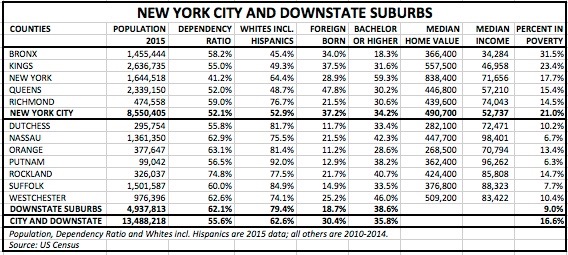
    On many measures, New York City and State have little in common. Consider the following:

    New York City covers less than 1% of New York State’s land area and is home to 43% of the State’s population. Including downstate suburbs, the New York City metro area adds up to 65% of the state’s population.

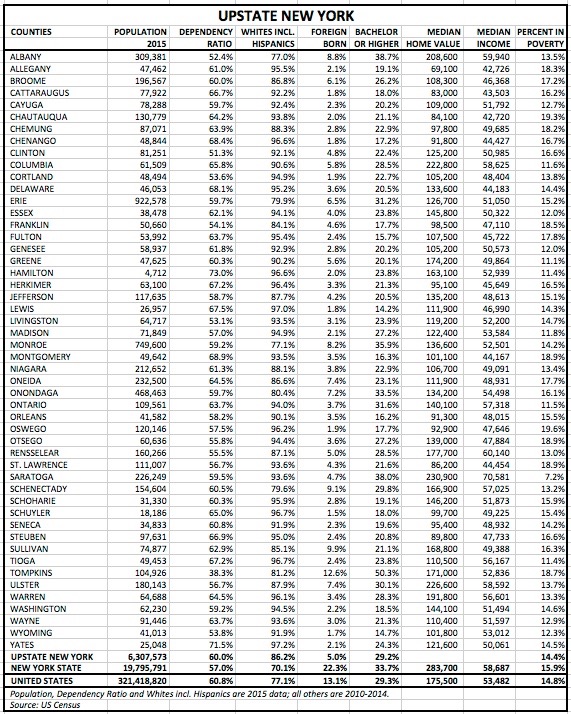
    In the City, 53% of people are white (including hispanics) and 37% are foreign-born. Outside the City, 83% are white and 11% foreign-born. If you exclude seven downstate counties that are near the City (see tables), the percentage of the Upstate population who are foreign-born drops to 5%. By way of comparison, the entire US population is 77% white and 13% foreign-born. So New York City is less white and much more foreign-born than the United States. And New York State is more white and much less foreign-born.

    Because there is a higher percentage of poor people in the City, notably in the Bronx, the median household income at $52,737 is lower than the $58,687 for the state overall. However the average income is much higher in the City due to its high-paying jobs in law, media, finance and health care. The weight of the 1% or 5% highest earners would be more visible in the average than in the median. As shown in the table, the median income in the downstate suburbs is significantly higher than in the City or Upstate. The median household income in the United States is $53,482.
    screen-shot-2016-09-19-at-3-01-43-pm-2


    Home values are much higher in the City and surrounding counties than in the rest of the state. In the City, the median home value is $491,000 whereas a median home can be obtained in most counties Upstate for less than $200,000. The higher ratio of median home value to median income underlines the greater income disparity in the City.

    In New York county (Manhattan), the median home value is $838,000 or 12 times the median household income of $72,000. This would be unsustainable if the average income did not deviate significantly from the median, or in other words, if there was not a small percentage of people earning large and very large incomes every year. In Manhattan, the average income of the top 1% is $8.1 million. And the average income of the bottom 99% is $70,468. The ratio of the first to the second is 116. (sources: Economic Policy Institutehowmuch.net).

    By contrast, in Allegany county for example, the median home value is only 1.6 times the median income. The average income of the top 1% is $358,554 million and that of the bottom 99% is $25,595. The ratio of the first to the second is 14.

    In the United States overall, the median home value is $175,500, or 3.3 times the median income. In 2013, the average income of the top 1% was $1.1 million and that of the bottom 99% was $45,567, resulting in a ratio of 25.
    screen-shot-2016-09-19-at-3-01-38-pm-2


    It is tempting to conclude from these figures that New York City is doing very well and that New York State is doing, depending on one’s perspective, as well or as poorly as the rest of the country. But on closer scrutiny, both the City and the state face some challenges that are unique to New York.

    Stagnant Demographics

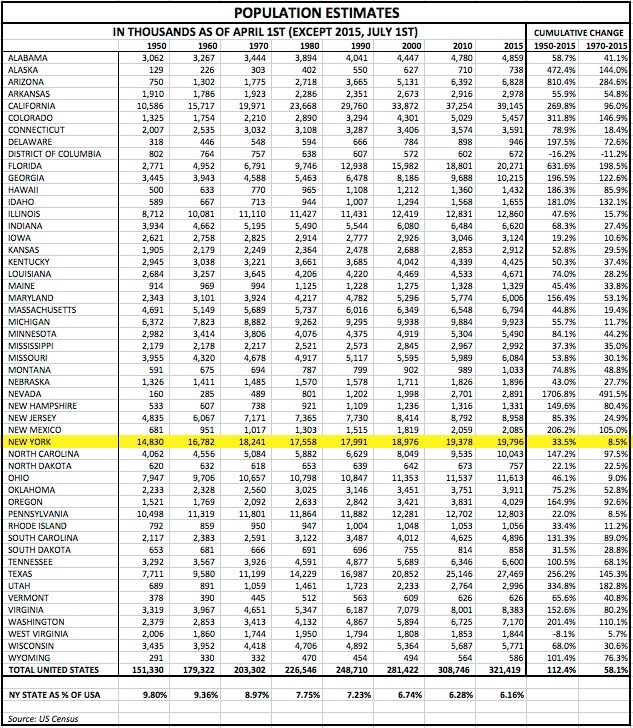
    The most obvious is the fact that the size of New York’s population has barely budged in the past forty-five years except for getting older. In 1970, there were 18.2 million people in New York State and in 2015 only 19.8 million. This change amounts to an 8% cumulative increase over 45 years, a very low figure compared to the 58% growth in the US population over the same period.
    screen-shot-2016-09-19-at-11-16-10-am-2


    If there had been instead a modest annual population growth rate of 0.5% due to new births, the cumulative growth over 45 years would have come to 25%. Further, because New York City is a magnet for new immigrant arrivals, one would expect that cumulative growth to have exceeded 25%. Instead, the 8% figure over 45 years means that there has been a steady large migration of New Yorkers towards other states.

    New York State had 9% of the country’s population in 1970 and 6.2% in 2015. The state and City have not been choice destinations except for people seeking employment in specific industries or for recent immigrants looking for a social gateway into the United States via their own national communities.

    Also worth noting is the fact that the state’s entire population growth (800,000 people) since 2000 has been concentrated in the City and downstate suburbs. The size of the population Upstate has flatlined for years while getting older.

    Of course, this stagnation is partly explained by the large migration over several decades of Americans heading to sun belt and mountain states in the West, South and Southwest. No doubt the invention of affordable air conditioning and the expansion of the interstate highway network facilitated this exodus from North to South.

    Other legacy large industrial states like Pennsylvania and Ohio also show weak single digit growth in the period 1970 to 2015. But neither has a large universal metropolis like New York City and neither shows as great a divide between its largest city and Upstate region. Meanwhile the populations of California, Colorado, Texas and Utah have doubled or more than doubled in 1970-2015, as have those of Southeastern states like Florida, Georgia and the Carolinas. Arizona has quadrupled and Nevada grown six fold, albeit from a low base in both cases.

    A closer to home comparison is only marginally more comforting. If New York State was a state on its own today, its demographics would compare poorly to those of its neighbors. Next door Vermont and New Hampshire have both grown smartly despite lacking a significant industrial base and large metro areas. The largest employers in both states are IBM and a collection of ski resorts, hospitals, colleges, retail stores and insurers/banks/asset managers. New Hampshire has also benefited from its proximity to Boston, with some tax-minded commuters choosing to declare residence in the southeastern corner.

    Part of this may be a public relations issue. Both New England states have done a better job than New York in associating their names with autumn foliage, winter sports and summer boating even though New York has similar colors, ski areas and lakes.

    pictures-126

    Vermont or Upstate New York?

    And compared to New England, Upstate is rarely showcased in movies. Wikipedia has long lists of movies set in New England and in New York City but no such list for New York State. In the 1987 movie Baby Boom, management consultant J. C. Wiatt (Diane Keaton) escapes New York City’s chaos and complexity, and dumps New York State without a thought on her way to a simpler life in Vermont that ends up delivering not only space, beauty and peace but also greater wealth and even romance.

    Weather can also be an important factor. Some parts of New York State get much more snow and have many more overcast days every year than do Vermont, New Hampshire, Pennsylvania and Ohio.

    Policies for Upstate

    Nonetheless, if weather is the work of Providence, government policy is very much man-made and should be designed to capitalize on the state’s assets and to mitigate its handicaps. The empirical evidence so far is that policy has not done enough to improve conditions Upstate.

    To the South and West, both Pennsylvania and Ohio have enjoyed a better economy than Upstate thanks in part to the shale energy boom while New York maintains a ban on fracking. It can afford to do so thanks to its large tax revenues coming from the City. According to a 2011 Rockefeller Institute study, in 2010 New York City contributed 48.7% of the state’s tax revenues. The downstate suburbs contributed an additional 23.6%, leaving a modest 27.7% coming from the rest of Upstate.

    These revenue percentages don’t deviate significantly from the weight of the population in the various regions. But the same Rockefeller Institute study showed that expenditures are more favorably weighted towards Upstate which received 42.2% of the state’s spending while the City and downstate suburbs received 40% and 17.7% respectively. In other words, Upstate has not been self-sufficient in terms of tax expenditures vs. tax receipts and has been receiving funds from the metro area.

    Some will allege that this is how a state should operate. Less productive areas receive assistance from more productive ones. But New York State could do better by making itself more tax-friendly to businesses and households. Our populyst state-by-state analysis shows that a median household in New York keeps 82.5% of its income after taxes, a percentage that places the state in the lowest quintile of all states on this measure. By contrast, a median household in Florida, Tennessee, Nevada, Texas or Washington State keeps over 88% of its income. The difference in after-tax take-home incomes would be even greater for higher earning households.

    The table below shows total and per capita state government tax collections for fiscal year 2013. On a per capita basis, New York State is in the first highest quintile for all state taxes, and second only to Connecticut for individual and corporate income state taxes. Among states with large populations, it is comfortably first in both categories, higher than California, Illinois, Pennsylvania and Ohio, and much higher than low-tax Texas and Florida.


    None of this may be a surprise, given that New York routinely ranks among the highest-tax states in the country. But instead of cutting taxes across the board and letting the market work its magic, the state has opted to launch a number of targeted public and public/private initiatives to reenergize the economy Upstate.

    Start-Up NY offers tax free zones to research-oriented businesses. In order to qualify, a business must partner with a university and must operate in one of the sectors targeted by the program.

    Judging by this recent announcement, the impact so far has been helpful on a local level but negligible in improving the state’s overall condition:

    Governor Andrew M. Cuomo today announced that 18 new businesses will join START-UP NY, relocating or expanding their operations across the state through innovative tax-free zones associated with public colleges and universities. These 18 businesses have committed to create at least 135 new jobs and invest nearly $10 million over the next five years in Western New York, the Southern Tier, Central New York, the Capital District, New York City and Long Island.

    and further:

    START-UP NY now has commitments from 172 companies to create at least 4,175 new jobs and invest more than $229.2 million over the next five years in New York State.

    That comes to  an average of 24 jobs and an investment of $1.33 million per company, small figures in a state of 19 million people and a GDP of $1.4 trillion. Perhaps the choice of a few sectors and the required linkage to a college should be removed and a tax abatement should be offered to all startups.

    Though its impact is small, Start-Up NY at least has the distinction of a hip dynamic name. By contrast, other initiatives that have a greater immediate dollar impact are encumbered by vaguely Soviet-sounding names such as the Regional Economic Development Council Initiative and the Upstate Revitalization Initiative.

    In both of these initiatives, development funds are allocated to New York’s ten regions through a process of competitive applications. From the former’s website:

    This year, the 10 Regional Councils once again competed for funding and assistance from up to $750 million in state economic development resources as part of Round V of the REDC competition. Additionally, the Governor established a new competition in 2015 – the Upstate Revitalization Initiative – to award a total of $1.5 billion to three regions, which will help to transform local economies by providing $500 million over the next five years to support projects and strategies that create jobs, strengthen and diversify economies, and generate economic opportunity within the region. Of the state’s 10 regions, seven were eligible for the URI competition: Finger Lakes, Southern Tier, Central New York, Mohawk Valley, North Country, Capital District, and Mid-Hudson.

    quick scan of the dollars awarded in these initiatives shows that many, though not all, are earmarked for marginal improvements or investments and are unlikely to lead to large economic returns.

    The Inevitable

    If this was the only problem with dirigisme, we might simply lament it as a well-intentioned but wasteful approach to economic growth. However, it is usually accompanied by an increase in cronyism and corruption. The fact that the state has been collecting a tax surplus in the City and diverting it Upstate created an opportunity for administrators to play favorites in awarding contracts and to contravene the rules of competition that usually prevail in a free market. When this kind of opportunity emerges, it is inevitable that someone will seize on it.

    And so the scandal that has just broken with the charging of nine people in Governor Cuomo’s entourage should not come as a surprise. City Journal takes a similar view:

    Eager to revive the depressed counties of New York’s heartland and Southern Tier, Cuomo lacked the courage to use his considerable influence with the Albany legislature to prune taxes and pare regulation. His solution was to bury the problem in tax dollars. This approach isn’t intrinsically criminal, but it does attract people of low degree, some of whom have recently been posting bail. And it betrays poor judgment on Cuomo’s part—in the policies he pursues, in the people he trusts, and in the electorate at large.

    The New York Post is equally skeptical of government-orchestrated public-private investments:

    The cloud of alleged corruption now surrounding billions of dollars in state economic development investments is an outgrowth of Cuomo’s highly secretive and centralized management style.

    Compared to previous Albany-directed corporate-welfare binges, Cuomo’s approach has featured a uniquely close intertwining of government and corporate interests — complete with state ownership of the means of production.

    To an outside observer, it may have seemed curious that development of a solar-panel factory in Buffalo [the case being investigated] was being guided by a state college administrator in Albany.

    This free market distortion is primarily systemic at its root. It grows naturally from the state’s involvement in the economy. As noted by City Journal, bad systems have a way of empowering bad actors. It is likely therefore that more revelations will surface about more malpractice elsewhere in the state’s initiatives.

    Now would be a good time to re-evaluate the overriding economic strategy. So far, the state’s initiatives have weighed in favor of a top-down set of targeted solutions instead of a blanket laissez-faire approach that would foster growth from genuine grassroots entrepreneurship. But this experiment with dirigisme has led to the usual distortions of cronyism and wasted or misallocated resources. The state should consider stepping back from its deeper involvement and instead moving forward with lower tax rates for middle-income households and with lower regulation for businesses.

    New York City’s high paying jobs generate the tax receipts needed to meet spending needs in the rest of the state. But the surplus from City tax revenues can also be seen as the enabler of bad policy and as the reason why the state has not implemented the fiscal policies needed Upstate. The City is a huge asset for the state but it may be holding back the measures needed to reignite a demographic and economic revival in all of New York.

    This at least could be the conclusion drawn when we look back from the future at our present predicament. But so far, the Governor has shown no inclination of changing course, stating after the charges surfaced:

    I am more committed to western New York’s revitalization than ever before… We are not going to miss a beat.

    Note: The dependency ratio in the tables is calculated as the sum of people aged less than eighteen and more than 65, divided by the number of people aged 18-65.

    This piece first appeared at Populyst.net.

    Sami Karam is the founder and editor of populyst.net and the creator of the populyst index™. populyst is about innovation, demography and society. Before populyst, he was the founder and manager of the Seven Global funds and a fund manager at leading asset managers in Boston and New York. In addition to a finance MBA from the Wharton School, he holds a Master’s in Civil Engineering from Cornell and a Bachelor of Architecture from UT Austin.

  • The Bridge from Laissez-Faire to Socialism

    Cronyism remains unchecked in the world’s largest economy.

    We might object to the phrase crony capitalism for two reasons:

    First, because cronyism is in some ways the antithesis of capitalism. The freedom to compete and the freedom to fail that are central tenets of capitalism are severely compromised by cronyism when in the former case powerful politicians intervene to shield their friends in business and finance from competition, and in the latter intervene again to save them from bankruptcy or occasionally from criminal prosecution. Of course, these friends in turn are no disloyal slouches and they later show themselves to be supremely appreciative by underwriting, financially and otherwise, those same politicians who had all but guaranteed their continued dominance in normal times and their survival against bad odds in times of distress.

    Second, because cronyism is just as prevalent, or arguably more prevalent, in a socialist system than in a capitalist one. Socialism is made popular by charismatic figures appealing to the idealism of some voters but wherever it succeeds in establishing itself, its anonymous toiling bureaucrats turn out to be expert cronies of the very first order, if we are to judge by the experience of many countries in the past century.

    Laissez-faire to cronyism to socialism

    This experience suggests the following chronology of events: cronyism gradually creeps into and takes over the laissez-faire economy. After some time, its extractive practices and excesses make socialism appear desirable and reasonable to an increasing number of voters. Finally if socialists manage to take control of government, they trumpet the victory of the people and the dawn of an egalitarian era but in their actions simply replace one set of cronies with another. If this is accurate, socialism then would not be the system that replaces capitalism, but rather the culmination of cronyism. Cronyism is a disease on the body of laissez-faire and socialism is an ultimate manifestation of that disease, investing all the organs of the body and bringing about its final demise.

    For evidence, see Venezuela. Did the downward spiral start with the socialist Hugo Chavez? Or did it start with the cronyism that preceded Chavez and that made Chavez attractive to an increasing number of people? A case can be made for the latter, even if Chavez in the end played a key role in precipitating the downfall.

    The hypothesis is that when laissez-faire is compromised by cronyism, the entire social and economic architecture becomes more vulnerable to the siren call of socialism. This may be because lower income people instinctively understand and accept that a Henry Ford or a Steve Jobs would earn a large fortune as a just reward for his innovations and business genius and large contributions to the advancement of mankind. The same people also understand and accept that lesser Fords and Jobses would earn smaller fortunes that are commensurate with their own lesser contributions, and so on. But these same people have a more difficult time accepting the vast sums extracted from the economy by people who take few risks, contribute little, and owe their advancement and wealth mainly to the lottery of birth or to the connections they have made in the higher circles of learning, politics or business. To say so is not a refutation of capitalism, but of cronyism.

    It makes sense then to decouple the words crony and capitalism and to not let the spread of cronyism be used as a pretext to abandon laissez-faire. The Economist recently acknowledged this difference by identifying some industries where cronyism is rampant:

    Some industries are prone to “rent seeking”. This is the term economists use when the owners of an input of production—land, labour, machines, capital—extract more profit than they would get in a competitive market. Cartels, monopolies and lobbying are common ways to extract rents. Industries that are vulnerable often involve a lot of interaction with the state, or are licensed by it: for example telecoms, natural resources, real estate, construction and defence. (For a full list of the industries we include, see article.) Rent-seeking can involve corruption, but very often it is legal.

    More on this later but note in passing that the term capitalism itself has a tenuous pedigree since its use did not become widespread until the mid 19th century mainly as an antonym to socialism or communism. It has little other reason to exist and proponents of freedom in commerce may be well advised to use the term laissez-faire instead, or an English equivalent, and not let themselves be ensnared in a futile debate of one -ism against another. People who engage in a free and mutually beneficial exchange of goods and services don’t cast about looking for an -ism to describe their activity, just as breathing comes to us naturally and we are not looking to encode a complex ideology to justify its benefits. We need breathing to support life, and we need laissez-faire for the very same reason.

    Cronyism around the world

    Until about two decades ago, the problem of cronyism was mainly present in smaller economies in the developing world where the governing elite was small and dominated by local business interests. In each of these places, politicians and business leaders were closely related by class or clan or blood or marriage, and they successfully perpetuated a system that preserved their wealth and power.

    More recently, cronyism has been on the rise in the United States. Indeed it has become one of the objects of our fascination but, as with the weather, everyone talks about it and no one does anything about it. That can be in part because cronyism is difficult to identify and to expose. Often it is not illegal, a fact that gives moral comfort to its practitioners and ensures its continued advance. Most cronies probably don’t see themselves as cronies but merely as savvy business people trying to do good by influencing policy, or as members of an intelligentsia who have a duty to get involved in government.

    The zero hour of cronyism may have been in 2008 when the financial crisis was so severe that cronyism came into full public view, like a bad family feud normally played out behind closed curtains suddenly erupting in the town square. The depredations of 2008 look like a textbook script of how cronyism works. Failed capitalists did not fail but were given by their powerful friends another chance and they later employed this new chance not only to cement their own positions and to weaken their competitors, but to also cement the positions of the powerful friends who bailed them out. Everything seems to have worked out just fine so long as not too many people asked questions as to how and why it all happened in the way that it did.

    But our understanding of this phenomenon has only grown since then. Some of the general workings of cronyism were described in the 2012 book Why Nations Fail: The Origins of Power, Prosperity and Poverty by Daron Acemoglu and James Robinson in which the authors differentiate between extractive and inclusive economies. Extractive economies are dominated by cronyism while inclusive economies are closer to a competitive laissez-faire model.

    It was alleged and accepted that extractive economies were most often in emerging markets, and that inclusive ones were generally in developed nations. Yet shortly after the publication of Acemoglu and Robinson’s book, this separation came under increased scrutiny. For example, The Economist in 2012 took the “extractive” label and stuck it on the financial industry of the West. In an article titled The Question of Extractive Elites, it wrote:

    There are two potential candidates for extractive elites in Western economies. The first is the banking sector. The wealth of the financial industry gives it enormous lobbying power, including as contributors to American presidential campaigns or to Britain’s ruling parties. By making themselves “too big to fail”, banks ensured that they had to be rescued in 2008.

    If it is true that banking is “extractive”, no one should be surprised that eight years after the 2008 bailouts, the socialism of Bernie Sanders and the populism of Donald Trump have reached a very ripe and receptive audience of disgruntled voters. On our thesis, the success of these two candidates is a natural result of the decades-old drift from laissez-faire to cronyism.

    The problem with cronyism is that it is a form of corruption, albeit one that is nebulous and often legal. A very large sum paid to a former or future government official for consulting or lobbying or for a speech may not technically rise to the level of a bribe but it does look like an attempt to capture that individual and to secure his loyalty before he returns to government where he would then be most appreciative towards his financial patrons. Perhaps then we may think of cronyism as a form of corruption that has thrived temporarily in the absence of the laws and regulations needed to fight it. Or perhaps no new laws are needed and instead a more vigorous judiciary is needed to implement existing laws, that is a judiciary whose independence is not already corroded by the spread of cronyism.

    Corruption Perceptions Index

    Among the many watchdog organizations that study corruption around the world, Berlin-based Transparency International (TI) publishes an annual ranking of countries in itsCorruption Perceptions Index. In 2015, TI ranked the United States 16th of 167 countries. Except for Canada, Singapore, Australia and New Zealand, all of the countries that ranked ahead of the US were in Western and Northern Europe, with Denmark, Finland and Sweden achieving the top scores.

    Large emerging countries fared poorly in the index. Brazil now in the throes of an impeachment battle and several corruption scandals ranked 76th. India was also 76th and Mexico was 95th. China was 83rd and Russia 119th. At the bottom were socialist countries and countries beset by war and internal strife.

    Overall therefore the US score was not as good as those of small relatively homogeneous European nations, but it was far above those of countries with large populations and growing economies.

    Yet with the vast amounts of money sloshing around the US economy, courtesy of the Federal Reserve’s zero interest rate policy, and given the rise of cronyism for over a decade, it is fair to wonder aloud whether Transparency International is being too kind with its US ranking.

    In order to answer this question, we try to estimate the size of the crony economy in the US. This is a difficult endeavor because there are few sources that can be helpful in measuring and quantifying cronyism. The Economist gave it a good try by developing acrony-capitalism index in 2014 and by updating it in 2016.

    In the US, the wealth of billionaires in crony industries adds up to a relatively small percentage of GDP, 2.2% in 2014 and 1.8% in 2016. According to the Economist, this measure of cronyism is a much bigger issue in other countries such as Russia (18% in 2016), Malaysia (13%) and even Singapore (1o.7%).

    Screen Shot 2016-08-18 at 4.25.43 PM

    On the other hand, measured in actual dollars, the wealth controlled by crony billionaires in the United States comes to $334 billion and is second only to that of their counterparts in China. This amount is about ten times the amount of crony wealth in more corrupt (per TI’s estimation) countries such as Brazil and others. So, in raw numbers, the US could be by far one of the largest theaters of cronyism in the world.

    The Economist writes that, because of the crash in commodity prices, the size of the global crony economy is smaller now than it was in 2014:

    Our newly updated [2016] index shows a steady shrinking of crony billionaire wealth to $1.75 trillion, a fall of 16% since 2014. In rich countries, crony wealth remains steadyish, at about 1.5% of GDP. In the emerging world it has fallen to 4% of GDP, from a peak of 7% in 2008. And the mix of wealth has been shifting away from crony industries and towards cleaner sectors, such as consumer goods

    but The Economist still sees cronyism as a significant factor in the 2016 US presidential election. Regarding Donald Trump:

    Despite this slowdown, it is too soon to say that the era of cronyism is over—and not just because America could elect as president a billionaire whose dealings in Atlantic City’s casinos and Manhattan’s property jungle earn him the 104th spot on our individual crony ranking.

    and Hillary Clinton, via some of her donors:

    The rich world has lots of billionaires but fewer cronies. Only 14% of billionaire wealth is from rent-heavy industries. Wall Street continues to be controversial in America but its tycoons feature more prominently in populist politicians’ stump speeches than in the billionaire rankings. We classify deposit-taking banking as a crony industry because of its implicit state guarantee, but if we lumped in hedge-fund billionaires and other financiers too, the share of American billionaire wealth from crony industries would rise from 14% to 28%.

    This lumping together of commercial/retail banks and investment banks/hedge funds under the crony banner would have been largely unjustified before 2008, notwithstanding the controversial rescue of Long Term Capital in 1998, but it does not look as far-fetched after the 2008 bailout of banks of all stripes.

    After the election, we may see a continued advance of cronyism or we may see a retreat. A trend often turns on itself after it reaches a new apex. In order to dial away from socialism and populism and move back towards laissez-faire, we could step up our efforts to limit and roll back cronyism. Otherwise we may see an even stronger drive towards populism or socialism at the next election.

    See also The Economist Daily Chart: Comparing Crony Capitalism Around the World.

    This piece first appeared at Populyst.net.

    Sami Karam is the founder and editor of populyst.net and the creator of the populyst index™. populyst is about innovation, demography and society. Before populyst, he was the founder and manager of the Seven Global funds and a fund manager at leading asset managers in Boston and New York. In addition to a finance MBA from the Wharton School, he holds a Master’s in Civil Engineering from Cornell and a Bachelor of Architecture from UT Austin.

    Photo of Hugo Chavez by Victor Soares/AgenciaBrasil via Wikipedia.

  • America Without Immigration 2015-50

    Be careful what you wish for, if that is what you wish for.

    Except for the oil shocks of the 1970s and a few other recessionary years, the US economy has generally been strong in the postwar era since 1945. Huge advances in technology and trade, a favorable business environment and strong demographics combined to create tens of trillions of dollars of new wealth in the US and around the world.

    The demographic component played an important supporting role. During the baby boom years, the number of Americans grew at an average annualized rate of 1.6% (see chart). In subsequent years starting in the mid 1960s, this growth faded to about 1% where it remained until 2007-08. Since then, it has fallen to 0.7% and, on current UN projections, it will continue to fall through 2050 when it may dip under 0.4%.

    Screen Shot 2016-08-01 at 11.00.53 AM

    Put another way, the population grew 1% per year on average in the years 1950-2015 and is expected to grow at half this rate, or 0.5% per year, from today to 2050. As a result, the US population will be at 356 million in 2030 and 389 million in 2050, equivalent to 18 million and 67 million fewer Americans in those years than if the growth rate had remained on its historic 1% trajectory.

    (In the charts below, ‘At 1% CAGR’ refers to the (not expected) continuation of the historic 1% trend; ‘Medium’ refers to current projections, including continued immigration; ‘Zero Migration’ refers to a scenario with no new immigrants starting in 2005-10.)

    Screen Shot 2016-07-30 at 7.36.15 AM

    Screen Shot 2016-07-30 at 7.37.01 AM

    What accounts for this slowdown? Mainly the boomer phenomenon. First, baby boomers had fewer children than their parents. The Total Fertility Rate (TFR = average children per woman) stood at near 2.0 in the 1980s and 1990s, compared to near 3.5 in the 1950s and early 1960s. Second, the number of US deaths will surge in 2025-45, echoing eighty years later the surge in births in 1945-65. Barring a leap in life expectancy, this death boom will put the brakes on demographic growth.

    So even before we start talking about immigration, the US population will be slowing down and slowing down by a big number, recording a shortfall or “deficit” of 67 million vs. the historic trend by 2050.

    Version 2

    Version 2

    In addition, the aging of the population will create another challenge with a rising dependency ratio (number of dependents per worker) reducing discretionary spending and investing, and straining pensions and entitlements. On current trends, the dependency ratio is expected to rise from 50.9 in 2015 to 65.8 in 2050. This ratio was at 66.5 in 1960 and its subsequent decline in four consecutive decades provided a big boost to the US economy.

    Screen Shot 2016-07-30 at 7.36.23 AM

    Adding immigration to the discussion further complicates the picture. If America had taken in no more immigrants starting in 2005-10, its population would be 48 million smaller (114.9 minus 66.9 in the table above) in 2050 than if it had remained on the present course and 115 million smaller than if it had remained on its historic trajectory. Further, the dependency ratio would climb to 69.6 in 2050. Note how the population would stop growing around 2035 because the number of deaths would roughly equal the number of births. (See also America Heading Towards Zero Population Growth?)

    It is important to highlight the demographic shortfall vs. the historic trajectory because some of today’s more extreme anti-immigration rhetoric is being presented as a promised return to the better economic conditions of the past. These conditions can be recovered through other paths but not through measures that exacerbate the population slowdown. Indeed if we judge by the figures above, it is clear that returning to the past is not in the realm of the possible, at least as far as demographics are concerned.

    In order for the US population to grow at 1% again without immigration, the birth rate would have to jump to levels not seen since the baby boom or higher. Even then, the dependency ratio would climb more steeply for two decades because of the millions of new babies.

    The US economy can and most likely will have a bright future but it cannot count on population growth to fulfill its historic supportive role. The economy benefited for decades from the demographic sweet spot of a rising population and a declining dependency ratio. Neither of these measures will be as supportive in the future. Instead greater gains will have to come from technology and automation and from investments in productivity and education.

    Related:

    This chart shows the number of Americans aged 20-64 and 30-59 under the Medium scenario. The working age population (20-64) is expected to remain flat for fifteen years and then to grow at a lower rate than in the past. This population would decline under a Zero Migration scenario. While it is true that automation will take over a number of functions and would dampen the impact of a stagnant or falling work force, demand for goods and services would certainly take a hit unless new export markets are opened up.

    Screen Shot 2016-03-10 at 2.58.14 PM (1)

    For more on the role of demographics in the economy, we suggest that you listen to this podcast.

    It should also be remembered that world demographics are far from standing still. See here and here or consult the Populyst demography archive.

    Sami Karam is the founder and editor of populyst.net and the creator of the populyst index™. populyst is about innovation, demography and society. Before populyst, he was the founder and manager of the Seven Global funds and a fund manager at leading asset managers in Boston and New York. In addition to a finance MBA from the Wharton School, he holds a Master’s in Civil Engineering from Cornell and a Bachelor of Architecture from UT Austin.

    Statue of Liberty photo, Public Domain via Wikimedia Commons

  • So You Want a Revolution

    You say you want a revolution
    Well you know
    We’d all want to change the world.____ The Beatles (1968)

    Apparently not. Not any more. Not everyone wants to change the world. To the Beatles in 1968, when young people aged less than 30 added up to 52% of the US population, it might have looked like everyone wanted a revolution and that a nascent movement had a deep reserve of younger cohorts ready to push for change. But the percentage of the population aged less than 30 today is only 39% and falling. If 39% vs. 52% does not look like a big difference, consider that 13% of the US population is equivalent to 42 million additional young people who would be among us, if the percentage was the same as in 1968. A quarter to a third (10 to 14 million) would be in their 20s.

    At the same time, because older more conservative generations would weigh less in the total population mix, their moderating influence would be less effective at deterring the young. This shift in the age distribution of the population explains why the youth revolt gained traction in 1968 but more recent attempts such as Occupy Wall Street turned to farce and fizzled out.

    Meanwhile the over-45 age bracket now accounts for 41% of the US population (vs. 31% in 1968), its highest level ever and a level that explains the elevation of the two oldest presidential nominees in US history, Hillary Clinton and Donald Trump. It also helps explain why the nostalgia-powered Trump is still a contender while the youth-oriented Bernie Sanders has withdrawn. At this stage of the process in 1970, Sanders would have been the nominee while Clinton and Trump would have already left the scene.

    Speaking of revolutions, a recent op-ed in the Wall Street Journal draws an analogy between Iran in 1979 and Turkey today in the immediate aftermath of the aborted Turkish coup d’etat. Writes the author:

    Revolutions don’t require majorities, but rather angry and excited minorities that are willing to act violently to take power.

    Undoubtedly true, but they also require a critical mass of young people combined with fairly dismal economic conditions which Turkey does not have now to the same extent as Iran in 1979. In 1979 in Iran, the under 30 accounted for a huge 71% of the population and Iranian GDP per capita on a PPP basis was about $2,000 (in 2013 dollars). By contrast, in Turkey today, the under 30 are only 50% and GDP per capita is in excess of $10,000. That is enough young people to shake things up as the young did in the West in 1968 but probably not enough to impose a lasting change as the young did in Iran in 1979.

    A general hypothesis therefore is that the danger of civil unrest grows when per capita GDP is low and the population is young. Looking at successful uprisings in Algeria (1962), China (1949), Cuba (1952) and Iran (1979), we note that the under 30 numbered more than 60% in every case. Meanwhile revolts failed in Hungary (1956) and Czechoslovakia (1968) where the under 30 were less than 50% of total population. Of course, this is not a comprehensive list and there may be examples that refute the hypothesis. In addition, foreign interference as in Hungary and Czechoslovakia renders the age distribution less relevant to the outcome of a revolt. But it is a fair bet that a larger young population in a lower-income country heightens the risk of unrest.

    The graph below shows for each country the per capita GDP in 2014 dollars and the percentage of people aged less than 30. The US is shown in red. The cutoff levels are set at $5000 for GDP per capita and at 60% for population aged under 30. Countries in the upper left quadrant are wealthier and have fewer young people and are as a result at lower risk of civil unrest. Countries in the lower right are younger and poorer and have in theory a higher risk of civil unrest. Iran in 1979 was clearly in the lower right high-risk quadrant. Turkey today is in the upper left lower-risk quadrant.

    GDPvsCivilUnrest


    Readers of this site may be familiar with this graph from a previous post discussing the relationship of fertility and national income. It is worth revisiting the earlier post to understand why some countries are outliers on the graph.

    So what are the countries that fall in the lower right quadrant? These countries have an under 30 population of 60% or more of total, and a GDP per capita of $5,000 or less. Here is the list.

    Screen Shot 2016-07-18 at 2.08.05 PM (2)


    At the other extreme, if we look at Brexit and the nomination of Donald Trump as examples of a new form of revolt that we may call ‘older age populism’, here are the countries that are exposed to it, using as cutoffs $20,000 for GDP per capita and 40% for population aged less than 30. Not surprisingly, most of these countries are part of the West and most enjoyed a significant demographic dividend in the three decades 1975-2005.

    Screen Shot 2016-07-18 at 2.26.03 PM (2)


    Of course, most revolutions end badly, and many end very badly. On the revolution train, idealists sit in the front and present in the early days the benign and seductive case for change. Radicals bide their time while sitting in the back and later take over with their nefarious plans. The Beatles knew it:

    But when you talk about destruction
    Don’t you know that you can count me out

    Full lyrics here.

    Read more about why Occupy Wall Street failed.

    Sami Karam is the founder and editor of populyst.net and the creator of the populyst index™. populyst is about innovation, demography and society. Before populyst, he was the founder and manager of the Seven Global funds and a fund manager at leading asset managers in Boston and New York. In addition to a finance MBA from the Wharton School, he holds a Master’s in Civil Engineering from Cornell and a Bachelor of Architecture from UT Austin.

  • Learning from Medellín with Alejandro Echeverri

    “I think, if you want to write a new narrative at some specific moment in the story of a city, it is important that you have to feel the transformation and see the transformation. So the physical transformation is important but always there is more a spiritual thing, as happens with emotional connections and inspirational things.” ______Architect Alejandro Echeverri.

    If you have an interest in Latin America or in urban matters, you will have read by now that the city of Medellín, Colombia has undergone a startling transformation in the past fifteen years. In the 1980s and 1990s, the name of Medellín evoked fearsome drug cartels, violence and terrorism.

    But in the 2000s, Medellín took a dramatic turn for the better. In 2012, it was selected from 200 contenders as Innovative City of the Year in a survey organized by the Wall Street Journal and the Urban Land Institute. Today, it features regularly among lists of forward-looking cities and must-see destinations.

    EcheverriPhoto

    One of the most important actors in this giant leap is the Medellín architect Alejandro Echeverri. With the inspired leadership of Mayor Sergio Fajardo and a team of architects, engineers, communicators and social workers, Echeverri in his post as Medellín’s Director of Urban Projects set out to bring real improvements through a strategy of “social urbanism” which included large and small projects in the most troubled parts of the city.

    Echeverri who is currently a 2016 Loeb Fellow at Harvard’s Graduate School of Design shared his thoughts with Sami Karam in this 50 minute podcast. A few highlights are transcribed below.

    On giving value to local conditions: “It is better to add than to erase.”

    From the start, Echeverri and his team avoided the top-down approach favored by past urban planners and worked to develop what he describes as a holistic collaboration between architects, community representatives, social workers, city administrators and the private sector.

    At another time in another city, planners might have decided to clear existing low-income settlements and to restart with a clean slate, for example by building high-rise apartments in a parklike setting. Many such projects in the US and Europe are seen today as expensive failures where traditional relations of community and family break down and where crime and vandalism are chronic problems.

    An important differentiator in Medellín was to leave existing homes and communities in place. Echeverri explains:

    “First came respect and [the idea] to give value to the local conditions, give value to the memories. There is a lot of value. Sometimes because you have some different preconceptions and you belong to a different world, it is difficult for you to see the value of these things. I am talking not only about the value of the physical environment. I am talking about the value of the social engagement, the economy, most of it informal, but they have a lot of solidarity, networks and so on… The process of Medellín, the singularity is some special sensibility about local conditions and houses and thinking that it is better to add than to erase.”

    “These projects don’t just have the goal of increasing the quality of life for people, but also to increase their pride and self-esteem.”

    On gondolas, transit stations and library parks

    Among the most visible physical improvements was the introduction of metro cable cars or gondolas that connect poor areas on the hillsides (the barrios) to the subway in the city below. The new transport system facilitated the commute to work, school etc. but as importantly, it created nodes of communal activity around the transit stations.

    800px-Metrocable_de_Medellín,_Colombia

    Metrocable and Biblioteca Espana. Photo via Wikimedia Commons by Ben Bowes.

    Echeverri says:

    “We wanted to do a holistic intervention around each station, combining physical transformation and programs of education, innovation, entrepreneurship and so on. So we used each station as a magnet to develop a public space. We focused as well on the itineraries of the common people, how the people use the barrios, from the houses to the schools to the stations and how to improve that condition and give them more public services and public spaces and new cultural facilities.  So, working with the community, and thinking that big infrastructures are important but the same importance is given to the small details, small interventions. And the intervention has to be with the people as well.”

    In addition to the gondolas, as many as nine library parks designed by Colombian architects were built in poorer areas and stand today as symbols of a fresh approach to education and culture. One of the them, the Parque Biblioteca España is shown in the photo above.

    How do you measure success?

    With a decline in violence, all of Colombia has enjoyed a resurgence in investment and tourism. In 2011-15, foreign direct investment was over three times what it had been a decade earlier (source: colombiareports.com). In 2015, the number of foreign visitors, 76% of whom were vacationers, was over 2.5x higher than in 2005 (source:colombiareports.com). Bogota was the number one destination with 45% of visitors, followed closely by Medellín with 39%.

    pui-fotos-04

    Photo from Proyecto Urbano Integral / Alejandro Echeverri + Valencia Arquitectos.

    Echeverri sees vindication and success in these figures and adds the following:

    “The externalities that happened after we recovered the confidence and spirit of society permitted many other interests to start to see Medellín as an opportunity. International companies started to appear. Medellín started to be again one of the main cities for events in Latin America. A lot of researchers and universities were interested again to have partnerships with different institutions of Medellín. So, it is like a virtual cycle but we still have a structural problem. The challenge is big.”

    “The main [way we measure success] is how the quotidianity [the daily life] happens today in our city. I am talking about the quotidianity, about the every day life in different parts of the city, mostly in some of the problematic areas, where the kids and the  people and the mothers could be out and move and have facilities of education and could spend half of the time in the public transport system going to work. When the kids go out of the houses or the schools, they don’t see the informal armies, the paramilitaries, that used to be in charge of the public space. So they have different opportunities. We still have problems and so on but the every day life changed a lot. Change the priority because the city today is thinking of education and innovation and not of violence and security.”

    Can some lessons be applied to other cities?

    With urbanization increasing all over the world, most cities face considerable challenges in infrastructure, housing and security. Echeverri believes that some ideas can be borrowed from Medellín’s experience.

    “Every city has some singularity and some local conditions. But always, you find everybody is in agreement on what are the problematic issues and problematic areas of the city, but the political decision to solve those problematic areas and issues doesn’t happen. So focus on problematic areas, be strategic and continuous. Work with ethics, it is important. I strongly believe in the connection with the local conditions, the connection of the public policy and urban transformation with where the people live and where the people have an identity, where the life of the city is happening. I am talking about barrios and neighborhoods.

    “To develop a holistic intervention in strategic areas is not easy but it is very powerful if you can combine simultaneously a package of actions: physical transformations, I am talking about public transport systems, public spaces, spaces for culture, education etc., a programmatic package in relation with innovation, local economies.”

    To be sure, Echeverri is not declaring victory. He says that there remains much work ahead to cement and prolong the city’s achievements of recent years. He stresses the necessity of having a suitable organizational structure and institutional partnerships between the municipality, the private sector and academia. Other topics covered in the podcast include funding issues and the need for political continuity.

    “You cannot change the story of a city in eight years or ten years.  I believe that the process of transformation of Medellín started and was very consistent because some processes happened in a good way but it needs continuity, more years to develop. You improve some specific conditions in some areas but you cannot transform and recover all the problems. For example, the housing problem which is still there.”

    There is much more in the podcast. Listen to the whole thing.

    TO HEAR THE PODCAST, CLICK HERE OR ON THE TIMELINE BELOW:

    Sami Karam is the founder and editor of populyst.net and the creator of the populyst index™. populyst is about innovation, demography and society. Before populyst, he was the founder and manager of the Seven Global funds and a fund manager at leading asset managers in Boston and New York. In addition to a finance MBA from the Wharton School, he holds a Master’s in Civil Engineering from Cornell and a Bachelor of Architecture from UT Austin.

    Top photo by User: (WT-shared) CONOCER at wts wikivoyage (Own work) [Public domain], via Wikimedia Commons

  • European GDP: What Went Wrong

    First the two world wars, then a decline in the birth rate.

    Newspapers these days are full of stories on World War I which started 100 years ago. They are also full of stories on today’s anemic European economy, as for example with Italy’s negative growth rate in the second quarter and France’s struggle to reach 1% GDP growth this year. At first blush, these two sets of stories are unrelated. But on closer look, it is apparent that the economy today is a distant echo of the war a century ago. And it all comes down to Europe’s demographics.

    In my view, there are essentially three main catalysts of economic growth: innovation, demographics, and a favorable institutional framework. To illustrate this, imagine that a firm develops the best smartphone in the world but that there is only a potential market of 1 million buyers. Clearly, the wealth created by this innovation would be far smaller than if the potential market was 100 million buyers. Thus the importance of demographics.

    Now imagine that there is a market of 1 billion people but that there is no innovation of any kind. In this case, wealth creation would be greatly stunted and, with few new assets being created, wealth would become essentially a game of trading existing resources. Thus the importance of innovation. Finally, imagine a country where institutions are weak, where contract law is weak, where access to capital is difficult, where the government is corrupt and political risk is high. Here again there would not be much innovation because there would not be much capital or much incentive to innovate. Thus the importance of a favorable institutional framework.

    Too many deaths

    So going back to Europe, we could say that it has some innovation and that it has a favorable institutional framework, though in both cases to a lesser extent than the United States. What Europe lacks most is a strong demographic driver. It is enlightening in this regard to look at the sizes of European populations in the year 1900 vs. today:

     Population (millions)  1900 2014 Growth CAGR  TFR 
    France 38 66 74% 0.5%  1.98
    Germany 56 81 45% 0.3%  1.42
    Italy 32 61 91% 0.6%  1.48
    Russia 85 146 72% 0.5%  1.53
    Spain 20.7 46.6 125% 0.7%  1.50
    United Kingdom 38 64 68% 0.5%  1.88
    Brazil 17 203 1094% 2.2%  1.80
    China 415 1370 230% 1.1%  1.66
    Egypt 8 87 988% 2.1%  2.79
    India* 271 1653 510% 1.6%  2.50
    Indonesia 45.5 252 454% 1.5%  2.35
    Japan 42 127 202% 1.0%  1.41
    Mexico 12 120 900% 2.0%  2.20
    Nigeria 16 179 1019% 2.1%  6.00
    Philippines 8 100 1150% 2.2%  3.07
    United States 76 318 318% 1.3%  1.97

    * includes India, Pakistan, Bangladesh and Burma.

    Source: Various, United Nations. Data may include errors. Estimates vary due to shifting borders and uneven reporting.

    Two important points stand out:

    First, in 1900, European countries were not only the world’s economic and military powers. They were also among the most populous countries in the world. By contrast today, Russia is the only country in the top 10 most populous. Then Germany is 16th and France is 20th. More importantly, some of the new demographic powers, India, Nigeria, Egypt, Mexico, the Philippines and Indonesia, are growing at a healthy clip, as can be seen from their Total Fertility Ratios (TFR, see table) whereas European countries are growing very slowly at TFRs that will ensure stagnation or shrinkage in the sizes of their population. A ranking ten or twenty years from now may show no European countries in the top 20 most populous countries.

    Second, comparing European population sizes in 2014 vs. 1900 reveals a very slow annual increase in the 114 year period. And this is where the effects of the two World Wars, of the Spanish Influenza and of communism can be seen. Populations have grown with a CAGR of less than 1% per year for the last 114 years.

    The United States had fewer casualties in the two World Wars, more immigration and a strong post-war baby boom, resulting in a healthy 1.3% population CAGR and a near quadrupling of the population over the past 114 years. However, as I wrote previously, the US faces slower, sub 1% population growth in the next few decades.

    Here is the tally of deaths for some countries in the two World Wars:

     Millions of deaths  WW1 % of pop WW2 % of pop
     France    1.7 4.3%   0.6 1.4%
     Germany    2.8 4.3%   8.0 10.0%
     Italy    1.2 3.3%   0.5 1.0%
     Soviet Union    3.1 1.8% 22.0 14.0%
     UnitedKingdom    1.0 2.0%   0.5 0.9%
     United States    0.1 0.1%   0.4 0.3%

    Source: Various. Estimates vary widely and may include errors.

    Estimates of deaths from the Spanish Influenza of 1918-19 vary widely from 20 to 50 million people worldwide. And Stalin’s purges are estimated to have killed over 20 million. Tens of millions of people and a larger number of descendants would have been added to today’s European population had these events not occurred. I made the case last year that Europe’s economies and markets suffer from weak domestic demand and have for a long time been driven by events outside of Europe itself.

    Too few births

    In general, a large number of countries are facing a more challenging demographic period in the next fifty years compared to the last fifty. Since the 1970s, there had been a steady decline in the dependency ratios (the sum of people under 14 and over 65 divided by the number of people aged 15 to 64) of the US, Western Europe, China and others. This decline is explained by a lower birth rate and was accelerated by large numbers of women joining the work force in several countries. There were fewer dependents and more bread winners than in previous decades.

    In future years, dependency ratios are expected to rise due to the aging of the population in most countries and a decline in the number of workers per dependent. In the United States for example, baby boomers are swelling the number of dependents who rely on younger generations to support them in retirement (whether through taxes or through buoyant economy and stock market). But because boomers had fewer children than their parents, the burden on these children will be that much greater than it was on the boomers themselves.

    In effect, our demographics have pulled forward prosperity from future years. Had there been more children in the West in the 1970-2000 period, there would have been less overall prosperity during that time, but we would now look forward to stronger domestic demand and a stronger economy going forward.

    Note in the table below that the dependency ratio of Japan bottomed around 1990 which is the year when its stock market reached its all-time high; and that the dependency ratios in Europe and the US bottomed a few years ago around the time when stock markets reached their 2007 highs. The fact that several stock indices are now at higher peaks than in 2007 can be largely credited to America’s faster pace of innovation and to near-zero interest rates. Case in point: Apple’s market value has more than tripled since 2007.

    DependencyRatios

    India will soon be the most populous country in the world but because its dependency ratio is still declining, its growth profile may improve in future years. The same is true of Subsaharan Africa where the fertility rate is still high but declining steadily thanks to improved health care for women and declining infant mortality. As such both India and Subsaharan Africa could see faster economic growth than elsewhere, provided the institutional framework can be improved towards less corruption and more efficiency.

    Europe is in a bind in the sense that, even if it had the wherewithal to do so, it cannot now raise its birth rate without making its demographic situation worse in the near term (by raising its dependency ratio faster). For the foreseeable future, its economy will become even more dependent on exports towards the United States and emerging markets. The new frontier for European exports may well be in the old colonies of the Indian subcontinent and of Subsaharan Africa.

    Sami Karam is the founder and editor of populyst.net and the creator of the populyst index™. populyst is about innovation, demography and society. Before populyst, he was the founder and manager of the Seven Global funds and a fund manager at leading asset managers in Boston and New York. In addition to a finance MBA from the Wharton School, he holds a Master’s in Civil Engineering from Cornell and a Bachelor of Architecture from UT Austin.

    Lead photo 4 August 1914 (via Wikipedia)

  • Manhattan Ultra-Luxury ‘Battling the Serpent of Chaos’

    The deceleration of China and resulting commodities crash have created a problem for developers of ultra luxury condominiums.

    The ancient Egyptians believed that the sky was a solid dome, the belly of the goddess Nut who arched her body from one side of the horizon to the other. Every day, the sun god Ra emerged in the east and sailed in his boat across the sky until dusk when he disappeared in the west by dipping below the surface of Nun, the ocean upon which the whole flat earth floated.

    This story would have been useful two years ago when Manhattan real estate was soaring and many participants were proclaiming that the sky was the limit. It turns out that that particular sky, the ‘real estate sky’, is not as infinite and rich in wonders as the real sky. It is instead very finite like the sky of ancient Egyptian cosmology, its hard boundary formed not by Nut’s belly but by the marginal buyer’s stomach for paying ever rising prices.

    Until recently, the strong Chinese economy and resulting surge in commodity prices had fueled an economic boom in many developing countries. With this boom came rapid wealth to a segment of the population sometimes referred to as the oligarchy, or the world elite, or the global UHNW (ultra high net worth) class. And with that wealth, largely earned within the borders of countries with an unpredictable polity, came the logical and prudent decision to place some of it abroad where the likelihood of seizure or expropriation by unfriendly authorities was deemed to be low or nonexistent.

    There seemed to be a large conduit, a money superhighway, running beneath the world’s oceans through which trillions of dollars flowed smoothly for thousands of miles from that Chinese demand to that commodities boom to that sudden wealth and finally to this prudent decision. A great many of this conduit’s outlets were invisible and hidden in the hushed basements of Swiss or other offshore private banks. Yet others were semi-visible in the proliferation of hedge funds, private equity funds and other ventures solely dedicated to the management of paper assets.

    And finally some outlets were very visible in the real estate markets of London, New York, Miami and other cities. The trillions of dollars on the money superhighway traveling inbound from Russia, China, Brazil, Qatar and other places have seeded and fertilized Manhattan’s Billionaire’s Row on 57th street and other parts of Midtown, resulting in the sudden emergence, like weeds out of the ground, of tall and super-tall condominium towers.

    If they were trees instead of buildings, they would follow the normal cycle of nature rationing their reserves in winter and flourishing in the summer. But human constructs are less well calibrated and real estate cycles can be difficult to navigate. It takes a long time to carry a new building from conception to delivery. Few developers have the wherewithal or the resources to make big plans in the trough of a bust. But many embark on long cycle projects during boom times, accepting the risk that completion may not come before the next downturn.

    IMG_4249

    15 Central Park West.

    Until now, the way to market these new condominiums was to sell as many units as possible pre-construction or during construction, thereby transferring the time-related risk to the buyer. This approach worked beautifully in recent years as evidenced by the huge success of the Time Warner Center, 15 Central Park West and of a good part ofOne57, the first in this cycle among several tall ultra-luxury towers.

    How did we get here in the first place? And why was Manhattan a choice destination for this foreign wealth? The answer is that, in addition to offering the promise of secrecy and safety, new condominiums benefited from lax regulation and zoning and preferential tax treatments.

    When secrecy was no longer as readily on offer at Swiss private banks, foreigners shifted their sights to other havens and found US real estate to be a uniquely welcoming alternative. Here, it was still possible for agents to transact via shell companies that were organized onshore or offshore, ostensibly to conceal the identity of foreign parties who preferred to remain anonymous.

    A recent Washington Post article explains:

    What many Americans might not realize is that foreign-owned shell companies play a big role in the U.S. economy through the real estate market. When purchased through a shell company, an offshore company or a trust, U.S. real estate offers wealthy foreigners a stable and secretive investment.

    In the last quarter of 2015, 58 percent of all property purchases of more than $3 million in the United States were made by limited liability corporations, rather than named people. Altogether, those transactions totaled $61.2 billion, according to data from real estate database company Zillow.

    And further:

    The U.S. government doesn’t ask real estate brokers to monitor their clients for money laundering risks, the way that banks and other financial institutions – and real estate brokers in some other countries — are required to do. The 2001 Patriot Act gave the Treasury Department the ability to do this, but lobbying from the real estate industry has helped secure an exemption for the last 15 years.

    One57

    One57 dominates today but taller condominiums are now under construction.

    Last year, an extensive report by the New York Times titled Towers of Secrecy investigated shell companies that invest in Manhattan real estate. The report estimated that in six of Manhattan’s most expensive buildings including 15 Central Park West, One57, The Plaza and the Time Warner Center, shell companies owned between 57% and 77% of the condominiums.

    Across the United States in recent years, nearly half the residential purchases of over $5 million were made by shell companies rather than named people, according to data from First American Data Tree analyzed by The Times.

    In addition to favorable regulation welcoming this wave of cash, New York’s tax policy also made it easier for developers to meet the surging demand. Some ultra-luxury buildings received tax abatements initially intended to encourage the construction of affordable housing.

    Today however, the money flow, safety, secrecy, regulation and tax policy that enabled the boom are all threatening to reverse course at the same time, creating a new reality that may be problematic for investors and developers.

    It is a new reality that could also be problematic for the city. Money in Swiss private banking accounts can be easily withdrawn but money withdrawn from luxury condos with limited local appeal leaves a large footprint behind. Foreign money can be quickly gone but the buildings will be here quasi-forever.

    China’s economy has softened, commodities have crashed and the money flow from emerging markets to midtown Manhattan has slowed from a gusher to a stream, or perhaps a trickle. As a result, the profitability of many condominiums that are now under construction looks less assured than it was eighteen or twenty-four months ago.

    In addition, there are new calls for better monitoring of shell companies and for disallowing tax abatements in the case of super luxury apartments.

    This seems to all be coming at a bad time with several of the newest towers now rising above street level and boosting the pre-construction inventory. The surge in supply is taking place just as demand is slackening.

    A top Manhattan broker told populyst that the high luxury segment (apartments priced over $10 million) had buckled under a worsening macro environment, with signed contracts running at 38% below last year. Meanwhile, new supply is up 5.4% from last year and expected to continue growing.

    Sales at some of the new condominiums are likely to do well while others suffer. Because of its location and the success of 15 Central Park West designed by the same architect Robert A. M. Stern, it is fair to expect that 220 Central Park South will do fine by attracting demand from New Yorkers and wealthy Americans. Other buildings with less enviable locations will probably do well in their upper reaches but may have trouble selling mid-height units where views do not clear surrounding buildings.

    IMG_4248

    220 Central Park South.

    Asking prices are already being adjusted downward. Extell Development lowered its total sellout price by more than $200 million to $1.87 billion for its One Manhattan Squareproject. Toll Brothers has had price reductions at 1110 Park Avenue and 400 Park Avenue South. World Wide Group and Rose Associates have followed suit at 252 East 57th Street. And at 111 East 57th, JDS Development Group and Property Markets Group will wait about a year before launching sales at their ‘Billionaires’ Row’ tower.

    The broader market seems to also be coming under pressure. A recent study by research firm Miller Samuel for the Real Deal estimated that “by the end of 2017, Manhattan will have five years of excess inventory”.

    Roughly 14,500 units are expected to hit the market between 2015 and 2017But by the end of 2017, just over 5,000 of those units are expected to have sold, and going by the current rate of sales, it would take more than five years to sell all that excess inventory.

    The analysis looks at all new units that have launched or are set to launch in Manhattan over a three-year period, across all price points. It assumes the same rate of sales the new development market saw during the second half of 2015, which equates to just under 1,850 closed sales per year.

    Based on that absorption rate, more than 9,400 new units would be unsold by the end of 2017.

    What may retrenchment look like for Manhattan now? According to a recent New York Post article,

    In the past five years, about $8 billion worth of apartments worth $5 million or more have been bought, or three times higher than years previous. Most troubling is that 50 percent of these have been bought for cash, forked out by shell companies controlled by persons unknown.

    And further:

    An end to secrecy is supported by the G7, United Nations and the Organization for Economic Cooperation and Development. The concern is that countries with hot money outflows are being destabilized, while countries inundated with illicit cash are developing real estate bubbles and high housing costs for ordinary residents.

    The biggest losers are China, where $1.39 trillion left between 2004 and 2013; Russia, with $1 trillion hidden, and Mexico, with an outflow of $528 billion.

    In some African nations, the outflow of funds is so sizable that it is shrinking the size of their economies and sabotaging their societies.

    Meanwhile, in New York, the flood of buying by persons unknown is damaging the housing market. Between 2010 and 2015, the average square-foot price of a residence in New York City jumped from $1,000 to $1,450, an increase of 45 percent.

    The bottom line is that there are now many factors conspiring to slow down the tens of billions of dollars moving from emerging markets into US and European property markets. Profitability models for individual projects drawn during the boom are now incorporating less ambitious assumptions. Can the global economy reaccelerate in the next two years to vindicate the initial return projections? Anything is possible but this would require a stabilization of the Chinese economy and some recovery in commodity prices.

    Instead of the soaring rocket of boom years, the real estate cycle is more akin to the journey of the sun god Ra, who at night “visited the underworld, a watery realm of the demons of the dead, where he battled with the serpent of chaos, and victoriously returned to the day each morning”.

    Sami Karam is the founder and editor of populyst.net and the creator of the populyst index™. populyst is about innovation, demography and society. Before populyst, he was the founder and manager of the Seven Global funds and a fund manager at leading asset managers in Boston and New York. In addition to a finance MBA from the Wharton School, he holds a Master’s in Civil Engineering from Cornell and a Bachelor of Architecture from UT Austin.