Author: Sami J. Karam

  • Would Reaganomics Work Today?

    The key drivers that propelled the Reagan economy are now tapped out or out of favor.

    The name of Ronald Reagan is frequently evoked by the current contenders to the GOP nomination. Donald Trump speaks admiringly of the 40th President of the United States and uses a truncated version of his 1980 campaign slogan “Let’s Make America Great Again”. Ted Cruz promises to implement Reagan’s solution of lower taxes, lower regulation and a stronger military. Before he bowed out recently, Marco Rubio was equal in his praise. And John Kasich stakes an even more tangible claim by reminding us that he is the only candidate who actually worked with Reagan.

    But if Reagan’s economy is something we can reproduce, we should first understand the most important drivers of that economy. Arthur Laffer, the father of supply-side economics, said in 2006 that the four pillars of Reaganomics were sound money, low taxes, low regulation and free trade. In addition to these four, we add our own two which are more contextual enablers than proactive policies: demographics and innovation. It is our contention that the first four would not have succeeded without the last two.

    Demographics: Reagan’s time in office coincided with powerful demographic tailwinds, namely a strong decline in the dependency ratio (DR), an accelerated rise in the American work force, and a rich demographic dividend. The dependency ratio (red line in the first chart below) is the ratio of dependents to workers, calculated as the sum of people aged less than 20 and over 64 divided by the number of people aged 20-64. When the US total fertility rate (TFR, the average number of children per woman) declined from 3.5 children per woman in 1960 to less than 2 in 1975, the dependency ratio followed with a lag, falling from 0.9 in 1970 to 0.76 in 1980, 0.70 in 1990 and 0.66 in 2010.

    Under the right conditions when the dependency ratio falls, the economy can reap a demographic dividend. With fewer dependents, households are able to divert more of their income toward discretionary spending, savings and investments, helping create more innovative companies that in turn boost the incomes of households. That is more or less the dynamic that propelled the US economy during the 1980s and 1990s.

    Screen Shot 2016-03-10 at 2.58.14 PM

    Looking at the future now, the dependency ratio bottomed in 2010 and is set to rise again from 0.66 in 2010 to 0.71 in 2020 to 0.83 in 2035. This increase is due mainly to the aging of the population and the increased number of dependents aged 65 or over. It is essentially a reversal of the powerful dynamic that benefited the economy in the 1980s and 1990s. The demographic tailwinds seen during the Reagan presidency have turned into headwinds.

    Screen Shot 2016-03-10 at 2.58.14 PM (1)

    In the second chart, we can see that the size of the US population aged 20-64 (red line) rose strongly from 1970 to 2015 and will level off and rise more slowly from here on. The population aged 30-59 (blue line), arguably the most productive and highest-earning and highest-spending segment, rose strongly starting in 1980 and flattened out around 2010. So here again, the two Reagan terms benefited from a rapid increase in the size of the work force. Clearly the most favorable period, the one with the highest acceleration, was from around 1983 to 2000, matching the economic boom of the Reagan to Clinton years.

    Note in passing that a similar chart for Europe, America’s top trading partner, shows an even more troubling picture. Excluding eastern Europe and Russia (red line below), the population aged 20-64 will fall from a peak of 267 million in 2010 to an estimated 232 million in 2050. Including eastern Europe and Russia, it will fall from 459 million to 370 million.

    Screen Shot 2016-03-14 at 4.57.43 PM

    (the charts above were derived by populyst from data produced by the UN Population Division).

    Innovation: Reagan came to office at a time of great innovations in computer technology. Innovation was then and remains now one of the most potent drivers of the economy. We have every reason to hope that America will remain as innovative as it was in the past. But the rate of innovation will certainly suffer if skilled foreign professionals are unable or unwilling to come and work in the United States because of more restrictive visa or residency policies.

    Interest Rates: Reagan started his first term with very high inflation and interest rates. Both started to decline during his presidency, helping stabilize and grow the economy and boosting the stock market. But we now face the risk of deflation. And interest rates are at rock bottom. As shown in the chart below from Goldman Sachs, the 10-year US Treasury yield was near 16% when Reagan took office and it is now at 2%, near all-time historic lows. Real rates are still negative and the Federal Reserve has few options left in its efforts to stimulate the economy through monetary policy.

    Screen Shot 2016-03-13 at 7.46.05 AM
    (click image to enlarge)

    Taxes: It is true that President Reagan enacted important tax cuts but these cuts came at a time when the marginal income tax rate was much higher than it is today. The chart below from the Tax Foundation shows that the top rate in 1980 was 70% and is now 39.6%.

    Screen Shot 2016-03-13 at 7.26.58 AM

    The top corporate income tax rate was 46% in 1981 vs. 35% today. And the top rate for long-term capital gains was 28% vs. 20% today (plus a 3.8% Medicare tax since 2013).

    Reagan’s tax cuts came at a time when spending on entitlement was relatively small compared to what it will be in the years ahead. Even at current levels of taxation, the federal budget deficit is expected to start rising again due to additional spending on old-age entitlements. The Congressional Budget Office predicts an expansion in the deficit from $439 billion in 2015 to $810 billion in 2020 and $1,226 billion in 2025. (see pages 147-149 of this CBO publication.)

    And as shown in the chart below from the St. Louis Fed, the federal debt is now much higher at over 100% of GDP, vs. 31% when Reagan took office.

    Screen Shot 2016-03-14 at 10.43.38 AM (2)

    It seems clear therefore that there is not as much scope for cutting taxes in the current environment as there was in the early 1980s. Unless accompanied by other changes, implementation of a flat tax or general cuts in tax rates are likely to increase the debt and deficit beyond the already high projections.

    Free Trade: Opening new markets and lowering trade barriers were cornerstones of US policy in the 1980s and 1990s. If today European demand is slackening and China is entering a slower period, there could be new markets for US exports in the Asian and African frontier markets that are experiencing a demographic boom. Expanding trade to these new markets would spur new demand for American goods.

    But free trade is now under attack from parties who argue that too many American jobs have gone abroad to China, Mexico and others. The presidential primaries have shown so far that a non negligible segment of the American electorate has been receptive to this argument. This means that the openness of free trade could in coming years be slowed or indeed reversed.

    Adding it all up, the table summarizes the scope for success of Reaganomics today vs. in 1981.

    Screen Shot 2016-03-15 at 10.55.18 AM

    Hoping for a replay of the Reagan years through action on the same economic levers will most likely result in disappointment. Leading 2016 candidates have expressed hostility towards free trade and have called for restrictions on all forms of immigration. In addition, the underlying context is now less conducive to growth than it was in 1981.

    Nonetheless, another component of the Reagan formula was a healthy dose of optimism. Economic prospects seemed insurmountable in 1981 but the ensuing boom surpassed expectations. The US economy remains flexible and innovative and will find a way to muddle through until contextual factors improve and higher growth returns.

    Sami Karam is the founder and editor of populyst.net and the creator of the populyst index™. populyst is about innovation, demography and society. Before populyst, he was the founder and manager of the Seven Global funds and a fund manager at leading asset managers in Boston and New York. In addition to a finance MBA from the Wharton School, he holds a Master’s in Civil Engineering from Cornell and a Bachelor of Architecture from UT Austin.

    Photo by White House Photographic Office – National Archives and Records Administration

  • The Relationship Between Fertility and National Income

    We all heard that “demography is destiny”. But how many of us truly believe it? If demography was destiny, the world would look very different today. The two demographic giants China and India would be uncontested economic and military powers. The United States would be a regional power struggling to keep up. Larger European nations such as Britain, France and Germany would barely register on the economic map, while smaller ones such as Switzerland and Finland would be invisible. Nigeria and DR Congo would be African powerhouses. Brazil, Indonesia and the Philippines would be the shining stars of their continents.

    None of this is true because demography is not destiny. Population size alone does not set a country on a predictable course. Still, demography is, among other factors, an important determinant of destiny. While the rate of demographic growth (or decline) is important, what is more important is the age distribution of the population. Too many old people means an elevated dependency ratio and less income available for spending and investing. Too many young people means an overburdened education system and high unemployment.

    The chart below shows for each country the percentage of the population that is aged 0-29 vs. per capita GDP based on purchasing power parity (PPP). The correlation is undeniable.

    Screen Shot 2016-02-02 at 4.56.14 PM

    Countries with a smaller percentage of young people have higher GDP per capita. Many of these countries and regions, including the United States, Europe and China, have benefited from a demographic dividend while their birth rates declined in recent decades.

    Conversely, countries with more young people have lower GDP per capita. Most of them are in Asia and Africa.

    We can argue about causality. Are countries poorer because they have more children? Or do they have more children because they are poorer? Or are they both poorer and have more children because of a third factor?

    Nothing is simple and all three are true. Countries are poorer because they have too many children, mothers have no time to educate themselves, and there is little or no disposable income to save or invest. But countries also have more children in part because they are poorer, have inadequate health services and suffer from high child mortality. And many countries are poorer and more fertile because female literacy is low and gender inequality is high.

    What is known is that countries that experience a decline in their birth rate sometimes realize a demographic dividend, an economic boost that can last years or even decades. Improving health care and boosting literacy have been shown to break the cycle of extreme poverty and extreme fertility.

    Meanwhile, this is the world that we face in the next few decades: rich countries that are getting older and poor countries that are very young. Working-age populations are shrinking in the rich countries while in poor countries, they are booming beyond those countries’ abilities to educate them, shelter them and employ them.

    The chart above shows that there are many outliers, countries that are either poor despite being relatively older, or richer despite being relatively younger. When we looked to see if the outliers have anything in common, it turned out that they do.

    The first group (old and poor) are shown in red and are the countries that are former or current communist states. The second group (rich and young) are shown in black and are the leading oil and gas-producing nations. The yellow data points are the nations that are (or were) both communist and wealthy from energy resources.

    Communism may be considered an “unusual” way of managing an economy since it conflicts with strong human instincts for creativity and innovation. Likewise, the huge accidental wealth that comes from finding oneself living on top of vast underground resources may also be deemed “unusual” (or certainly lucky) since it is probably rare, or perhaps even unprecedented, in several millennia of human experience.

    If we remove the outlying red and black data points, we end up with the chart below with a much better regression and trend line and an r-squared of 0.78, a large improvement from 0.37 when all the data is included. The trend line is curved because the y-axis is on a log scale.

    This reinforces the idea that in a large majority of countries, young populations tend to be far poorer. At first, this statement may ring intuitively true and uncontroversial, because young people have had less time to accumulate wealth, until one examines the magnitude of the wealth gap. The GDP per capita of the very youngest nations is less than 5% that of the oldest. The Central African Republic’s is 1% of Switzerland’s.

    Screen Shot 2016-02-02 at 5.02.29 PM

    This is a constantly changing dynamic. And it remains to be seen whether the rich countries of the West can weather the aging of their populations and maintain their GDP per capita at current levels.

    They may struggle to do so and we may find that over the long term, demography reasserts itself every so often, even if temporarily, as the leading driver of our destiny.

    Sami Karam is the founder and editor of populyst.net and the creator of the populyst index™. populyst is about innovation, demography and society. Before populyst, he was the founder and manager of the Seven Global funds and a fund manager at leading asset managers in Boston and New York. In addition to a finance MBA from the Wharton School, he holds a Master’s in Civil Engineering from Cornell and a Bachelor of Architecture from UT Austin.

    Baby photo by Bigstock.

  • MENA Economies: Trouble Ahead

    The economies of the Middle East and North Africa (MENA) are ill prepared for the coming population boom.

    War, terrorism, repression and poverty are all common features in much of today’s Middle East and North Africa (MENA). How are the region’s demographics changing in the next few decades? And what is the prognosis for improved living conditions?

    It is difficult to look at the UN 2015 report and believe that the future will play out as outlined by the numbers. Even under the UN’s ‘medium variant’, which assumes a steady decline in total fertility ratios (TFR = average children per woman), the projected population growth would add significant stress on nations that are ill prepared to feed, educate and provide the needed jobs of the future.

    Note in the first table that TFRs have been falling for decades and are expected to continue trending towards the 2.1 replacement level, or indeed lower in many cases. Except for Egypt, the North African countries are already near replacement and will dip lower by 2050. And all the Western Asia countries, with the notable exception of Iraq, will be near or below replacement by 2050.

    (click to enlarge.)

    Screen Shot 2016-01-08 at 9.54.57 AM

    Yet between now and 2050, the MENA population will still grow significantly. Every country will have more people by 2050 than today. Lebanon stands out as the sole exception but this is explained by the fact that its population recently bulged by 20% or more due to the influx of Syrian refugees. In due time, a number of these refugees will return to Syria or emigrate to a third country.

    (click to enlarge.)

    Screen Shot 2016-01-08 at 9.54.51 AM

    In thirty five short years, Egypt is seen adding 60 million people to its current 91 million. The people of Iraq, Yemen and Sudan would double and those of Somalia nearly triple. The relatively richer Iran and Turkey (technically not in the MENA region but added here for comparison) will grow more modestly, as will oil-rich Kuwait, Saudi Arabia, the UAE and Qatar. In all, there will be nearly 300 million more people in the MENA, a worrying prospect given the current condition of the region’s economies.

    (click to enlarge.)

    Screen Shot 2016-01-08 at 9.54.38 AM

    Under the right conditions, a growing population could be an encouraging sign and a potent contributor to economic growth. But these conditions include a falling dependency ratio (the number of children + elderly, divided by the number workers). In this case, as shown in the table, the dependency ratio is expected to rise in half the MENA countries. An encouraging sign is the fact that it will be falling in the countries with the fastest growing populations, though perhaps not sufficiently to create the opportunity for a strong demographic dividend.

    In Egypt for example, the DR would fall from 62.3 to 56.5, not a large decline. And in Iraq, it would go from 78.7 to a still high 63.7. Yemen and Syria stand out for faster declines in their DRs but these figures may be less reliable given the current turmoil they suffer.

    (click to enlarge.)

    Screen Shot 2016-01-08 at 9.54.21 AM

    The MENA region therefore faces a long-term challenge to absorb the large rise in its working-age populations. As shown in this table, there will be, within 35 years, 40 million more Egyptians and 30 million more Iraqis seeking employment and improved living standards. In the entire MENA, there would be 180 million more people of working age. Optimism dictates that from the current travails will emerge a model that meets the needs of these rising populations.

    Some economic figures

    Compared to the years 2001-05 and 2006-10, the most recent five year period has seen a marked slowdown in Egypt, Jordan, Oman, Lebanon and Qatar, and continued strong growth in Saudi Arabia, the UAE and Iraq (to the extent that these figures can be trusted). The IMF’s estimates for 2015 and 2016, shown in the table, may prove too optimistic if energy prices remain low.

    (click to enlarge.)

    Screen Shot 2016-01-12 at 5.21.32 PM

    Screen Shot 2016-01-12 at 5.19.25 PM

    Per capita GDP shows a clear divide between on one side the oil rich countries Saudi Arabia, Qatar, Kuwait and the UAE, and on the other side poor or mismanaged countries. In theory, Iraq’s and Libya’s oil wealth should position them to join the club of the wealthy. But with the price of oil down from over $100 per barrel in 2014 to about $30 today, there will be contraction in the GDP figures of the richer countries with repercussions across the entire MENA region.

    (Note: Per UN appellation and data in this article, State of Palestine encompasses the West Bank and Gaza.)

    Sami Karam is the founder and editor of populyst.net and the creator of the populyst index™. populyst is about innovation, demography and society. Before populyst, he was the founder and manager of the Seven Global funds and a fund manager at leading asset managers in Boston and New York. In addition to a finance MBA from the Wharton School, he holds a Master’s in Civil Engineering from Cornell and a Bachelor of Architecture from UT Austin.

    MENA country map by DanPMKOwn work adapted from Africa in the World (grey).svg by TUBS, CC BY-SA 3.0, .


  • Demographics and Commodities Crash Slowing Growth of Poorer Countries

    Changing demographics and the commodities crash have slowed down the development of poorer countries.

    Perhaps it all started with a turn in China’s demographics. Demand growth for commodities has declined sharply from recent years and has resulted in a crash of global prices. Copper is down 54% from its post 2008 peak and down 25% this year alone. Crude oil is down 67% and 39% in the same time spans. In addition to softer demand, prices were negatively impacted by jumps in supply, most notably from shale energy producers in the United States.

    Impact of the 2011-15 Commodities Crash

    If this massive price correction tells us anything, it is that the world is looking more vertical again. Aspiring economic powers of two or five years ago are grappling with the recessionary effects of lower prices for oil, natural gas, copper, iron ore and nearly every other commodity. If, per Warren Buffett’s impeccable quip, “you don’t know who is swimming naked until the tide goes out”, the commodities tide has gone out of the emerging markets boom and many were haplessly exposed in the raw.

    Screen Shot 2015-12-23 at 9.12.52 AM

    Swimming naked in this context means an economy that was overly dependent on one or two drivers of growth. In the case of Russia, it was too dependent on energy. Brazil, too dependent on copper, iron ore and other commodities. And in both cases, not enough effort was made to diversify the economy and to implement needed reforms during the good times. The curse of cyclical wealth is that in good times, there seems to be no compelling reason for reforms. Why tinker with something that appears to be working? And in bad times, it is more difficult to implement those same reforms. Why create even more uncertainty in a time of uncertainty?

    (click table to enlarge)

    Screen Shot 2015-12-23 at 12.27.39 PM

    Leo Abruzzese of the Economist Intelligence Unit writes that “in 2016 rich countries will account for their largest share of global growth in this decade.” The EIU estimates that the eight largest rich economies will contribute 43% of global growth, while the eight largest emerging markets contribute 34%. These are respectively the highest and lowest shares in several years and they represent a big reversal from 2013 when the rich eight contributed 31% of global growth and the emerging eight as much as 47%. See chart in this article.

    Among the flag bearers of emerging markets, Russia has suffered a crisis and a recession caused by the decline of energy prices and some foreign sanctions imposed during the Ukraine conflict. As shown in the table, Russia’s compound average real GDP growth has slowed from 6.1% in 2001-05, to 3.5% in 2006-10 and to 1.4% in 2011-15. The more recent two five-year periods both include a crash in the price of oil from over $100 to less than $40. The economy is expected to contract 2.7% this year. Russia’s problems are partly due to demographics because its population is shrinking and its dependency ratio is rising. But other reasons for the slowdown include a dearth of innovation and a business climate which discourages inward investment.

    Screen Shot 2015-12-22 at 6.19.32 AM

    China’s impressive real GDP growth printed at or near double digit annual rates for the entire decade 2002-11 but this growth has tapered starting in 2012 to an estimated 7.1% in 2015 and probably lower next year. As discussed here, China managed to capture a very large demographic dividend thanks to sound policymaking that encouraged trade and investment. But its dependency ratio has now bottomed and started to climb. In response, China can avoid a prolonged decline by adopting reforms that encourage innovation and investment.

    Brazil is in the midst of a contraction made worse by corruption scandals at leading companies such as Petrobras and BTG Pactual. The demographic picture is mixed but there will be little to cheer about before reforms are enacted to reduce corruption and encourage investment. The alternative is to wait for the next commodity bull market but this could take years to materialize.

    India looks best among the BRIC countries in part due to its more favorable demographics and to the promise of accelerated reforms under prime minister Modi. We discussed India’s demographics and the prospects for investments and legislative reforms in previous posts here and here.

    Outside of the BRIC countries, countries with favorable demographics could over time pick up the torch and lead a revival of emerging markets. These include Pakistan, Indonesia, the Philippines, Nigeria and other countries of sub-Saharan Africa. Because of its booming working-age population, Africa holds the most promise but also presents the biggest challenge. See previous posts on Africa discussing policymakingeducationdemographicstrade and infrastructure.

    “Science is the Cause”

    Meanwhile, the immediate result of the emerging market slowdown is that we are now at some distance from the optimistic visions put forth by, among others, Thomas Friedman in The World is Flat: A Brief History of the Twenty-First Century (2007) and Fareed Zakaria in The Post-American World and the Rise of the Rest (2009), books that trumpeted the rise of emerging markets economies in the 21st century. Zakaria summed it up in a supporting Newsweek article:

    It is an accident of history that for the last several centuries, the richest countries in the world have all been very small in terms of population. Denmark has 5.5 million people, the Netherlands has 16.6 million. The United States is the biggest of the bunch and has dominated the advanced industrial world. But the real giants—China, India, Brazil—have been sleeping, unable or unwilling to join the world of functioning economies. Now they are on the move and naturally, given their size, they will have a large footprint on the map of the future.

    This quote is full of peremptory élan but it deserves to be examined in some detail because in my view, it reveals the main error in the author’s thesis and blurs the corrective factors that now require our attention. After all, how robust was this vision of the “Post-American world” if a very predictable cyclical downturn in commodity prices is sufficient to put it on hold and defer it for years? Contrast Zakaria’s thought with the following excerpt from Winston Churchill’s speech Fifty Years Hence in 1931:

    When we look back beyond a hundred years over the long trails of history, we see immediately why the age we live in differs from all other ages in human annals. Mankind has sometimes travelled forwards and sometimes backwards, or has stood still even for hundreds of years. It remained stationary in India and in China for thousands of years. What is it that has produced this new prodigious speed of man? Science is the cause. Her once feeble vanguards, often trampled down, often perishing in isolation, have now become a vast organized united class-conscious army marching forward upon all the fronts towards objectives none may measure or define. It is a proud, ambitious army which cares nothing for all the laws that men have made; nothing for their most timehonoured customs, or most dearly cherished beliefs, or deepest instincts. It is this power called Science which has laid hold of us, conscripted us into its regiments and batteries, set us to work upon its highways and in its arsenals; rewarded us for our services, healed us when we were wounded, trained us when we were young, pensioned us when we were worn out. None of the generations of men before the last two or three were ever gripped for good or ill and handled like this.

    Zakaria emphasized demographics while Churchill focused on the importance of science and innovation. Both are key components of growth. Some European countries such as Denmark and the Netherlands may not weigh much demographically but their contributions to the advancement of science and philosophy easily exceed those emanating from many populous nations.

    As often discussed on this page, demographics are an important driver of the economy, but they are only one of several important drivers, the others being innovation, productivity, health, governance and institutional strength. Demography is not destiny but it is a part of destiny. It cannot alone deliver sustainable economic growth and it can at times impact the economy adversely. In the present case, a turn in demographics is one of the reasons for China’s slowdown and the resulting fall in commodity prices.

    It is true that China, India and to a lesser extent Brazil are demographic giants. But it does not follow that their economic progress was unnaturally held back for centuries, while diminutive populations raced ahead due to a temporary fluke of history. Those smaller populations had innovation and a conducive context going for them. In order to be sustainable beyond one economic cycle, or even one economic super cycle, strong growth requires innovation, reliable institutions, good governance, political plurality and low corruption.

    It is still early in the century, but for now, the rise of the rest seems to have stalled. The questions going forward are: is this merely a pause in the development of poorer nations or is it the beginning of an unfortunate reversal? What can be done to build upon the past boom and to put these nations and others back on the growth trajectory?

    Sami Karam is the founder and editor of populyst.net and the creator of the populyst index™. populyst is about innovation, demography and society. Before populyst, he was the founder and manager of the Seven Global funds and a fund manager at leading asset managers in Boston and New York. In addition to a finance MBA from the Wharton School, he holds a Master’s in Civil Engineering from Cornell and a Bachelor of Architecture from UT Austin.

    Shanghai photo by flickr user Sprengben.

  • In One Chart: Achieving the Demographic Dividend

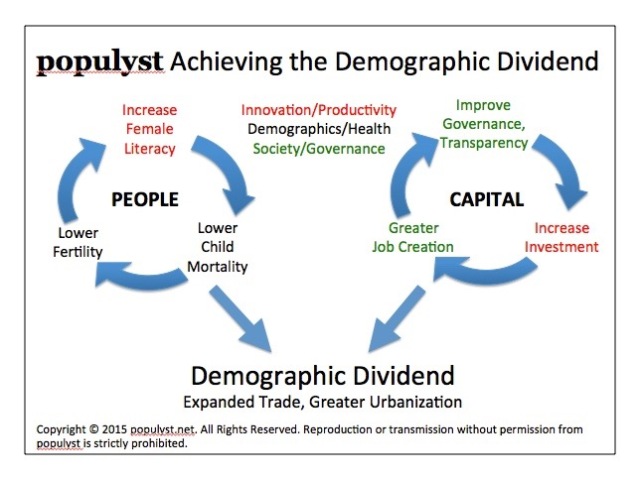
    The experience of China provides a useful policy template for countries with booming populations in south and southeast Asia and in sub-Saharan Africa. The Chinese boom showed that a growing working-age population combined with a declining fertility ratio can result in a large demographic dividend if certain conditions are met. As noted in this recent post, two important drivers of lower fertility are an increase in female literacy and a decline in child mortality.

    At the same time, better governance, lower corruption, an improvement in business conditions and increased investments in infrastructure and education would lead to higher foreign and domestic investments and greater job creation. Greater urbanization and an expansion of foreign trade can also be byproducts or causes or effects of the demographic dividend.

    Screen Shot 2015-12-01 at 1.19.23 PM

    After the demographic dividend, a country can remain on a growth path through additional political and regulatory reforms that encourage innovation and strengthen institutions.

    Sami Karam is the founder and editor of populyst.net and the creator of the populyst index™. populyst is about innovation, demography and society. Before populyst, he was the founder and manager of the Seven Global funds and a fund manager at leading asset managers in Boston and New York. In addition to a finance MBA from the Wharton School, he holds a Master’s in Civil Engineering from Cornell and a Bachelor of Architecture from UT Austin.

  • How Many People Will Live in Africa in 2050 and 2100?

    Large declines in fertility will depend on raising female literacy above 80%.

    Every few years, the United Nations Population Division releases demographic projections for the entire world and for every country, region and continent. Although the UN’s database is the most used source on demographics, the data is not equally reliable for all countries.

    Countries in the developed world conduct regular censuses and produce detailed numbers that are considered reliable. Less developed countries conduct censuses on an irregular basis or are completely unable to conduct them and have instead to rely on demographic sampling. In the poorest countries of the world, most of which are in sub-Saharan Africa, censuses are infrequent or nonexistent and even sampling can be irregular and unreliable.

    This poses a problem today because the biggest population growth by far is expected to take place in these same poor countries. In order to get a fair picture of the world population in the 21st century, we need to get reliable data from the fastest growing region.

    François Pelletier who heads the UN’s Population Estimates and Projections Section told populyst that he considers the data for the next 35 years, that is the projections for the years 2015-2050, to be fairly reliable, with greater confidence in the near years than in the later years. The further the horizon of the projections, the greater the uncertainty. In this regard, Pelletier suggested that the projections beyond 2075, especially those focusing on the median trajectory at the country level, be treated with some degree of caution.

    This makes perfect sense because a small change in the assumptions for child mortality and total fertility ratios (TFR = average children per woman) will have a relatively small impact in the near years and a cumulatively larger impact in the later years.

    For example, if we assume for sub-Saharan Africa a low variant fertility ratio of 4.02 children per woman in 2020-2025 instead of a medium variant closer to 4.42, the cumulative impact of this change adds up to a difference in population size of ‘only’ 80 million people after ten years, a 5% deviation, but of as many as 600 million after fifty years, a 20% deviation.

    Another source of demographic projections is the Vienna-based Wittgenstein Centre and it has cast doubt on the UN’s projections for world and Africa populations. In a note written by Samir KC, the Centre argues that the UN’s projections are too high because the fertility ratio in Africa is likely to fall faster than the UN predicts.

    The Centre’s rationale is reached through analogy with the Asian fertility decline between 1970 and 1990 which was steeper than is predicted by the UN for Africa. Samir KC writes (our emphasis):

    Once countries urbanize and citizens become wealthier, fertility declines everywhere.

    The most important factor is women’s education. Already today, an Ethiopian woman with secondary education has on average only 1.6 children, compared to a woman with no education who has 6 children.

    This relationship is true across Africa (see figure).

    Fertility-rate

    We know that access to education is expanding across Africa. There is even talk of an education dividend.

    Once all girls go to school and stay there longer, they will have fewer children, especially as they will also be exposed to a more modern lifestyle, be it through TV, the cell phone and the fact that Africa is urbanizing rapidly.

    This has also been the experience in Asia. It took about 20 years in Asia for its fertility to decline from more than 5 children per woman during early 1970s to less than 3 children per woman in early 1990s.

    Similarly, India took about 20 years for its fertility to decline from 4.7 children per woman in early 1980s to 3.1 by early 2000s.

    With new development and the plans for the better future in the making, it won’t be a surprise if the average African family would have only three children as soon as 2035.

    If that assumption bears out, then Africa cannot reach 4 billion — and the world would peak this century at below 10 billion.

    So who is right, the UN or the Wittgenstein Centre?

    First, let us look at what each party is projecting. Second, let us examine in greater depth the correlation between fertility ratios and female literacy. Finally, let us see if the Wittgenstein Centre’s use of the Asian precedent makes sense for Africa.

    Running the Numbers

    Screen Shot 2015-11-17 at 8.16.19 PM

    The adjoining tables (click to enlarge) show the UN’s projections for its low and medium variants. We ignore the high variant and other variants for now because our main purpose is to discuss whether the medium variant is too high, as alleged by the Wittgenstein Centre.

    If we look at the two variants for the year 2050 in the table below, we can see that the difference in population size in sub-Saharan Africa is about 200 million or approximately 10% of the total, a non negligible deviation but one that does not fundamentally alter one’s view of the future. Looking further out to 2100, the difference is much more significant at nearly 1.2 billion or about 30% of the total.

    Going through the same comparison for the whole world, the difference is 1 billion in 2050 and a big 4 billion in 2100, respectively 10% and 50% of the total. Also highlighted are figures for India, another high growth country.

    Screen Shot 2015-11-17 at 8.15.20 PM

    The Wittgenstein forecast is a bit lower than the UN’s low variant and assumes a sub-Saharan fertility ratio of 3.0 instead of 3.25 for the UN. Its population estimates for Africa in 2100 is 2.6 billion people, marginally lower than the UN’s low variant which is at 3 billion. We say “marginally” only in the sense that this difference looks large but it results from a small change in assumptions starting now 85 years earlier.

    Female literacy and Fertility Ratios

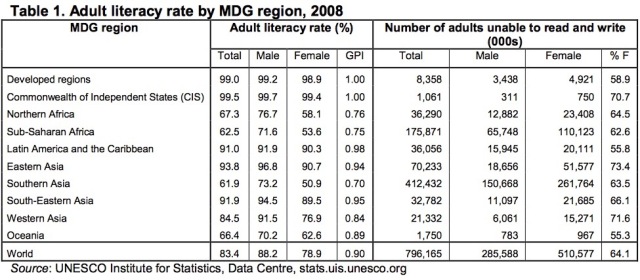
    Looking at women’s education, it is clear that female literacy, the cornerstone of Wittgenstein projections, is further behind in sub-Saharan Africa than in any other region of the world. The Indian subcontinent and the Middle East/North Africa also lag the rest of the world. Table 1 below shows that the lag in female literacy has been most pronounced in Southern Asia, Africa and the Middle East (Western Asia). Encouragingly, table 2 shows that the lag is significantly narrower among younger people.

    Screen Shot 2015-11-21 at 6.29.19 AM

    Screen Shot 2015-11-21 at 6.29.11 AM

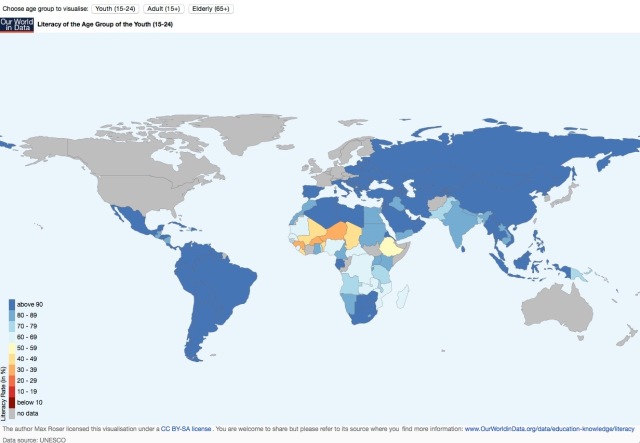
    It is clear that literacy is improving in Africa. The Oxford economist Max Roser compiled this map from UNESCO data and published it on his site Our World in Data. Click on the map to use the interactive feature.

    Screen Shot 2015-11-20 at 12.10.37 PM (2)

    The data shows solid progress in the literacy rate for youth aged 15-24, compared to older groups. For example, 66% of Nigeria’s youth (15-24) are literate, compared to 51% for the overall adult population (defined as 15+ here) and only 22% for the elderly population (65+). Other sub-Saharan countries show a similar progression.

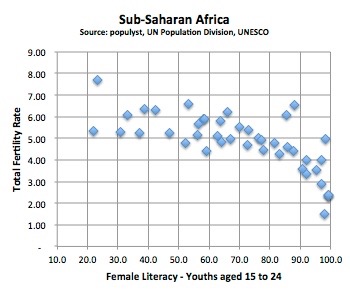
    The countries with the highest literacy rate among the youth group are also the ones with the lowest fertility ratios. Botswana and South Africa have youth literacy rates of 95% and 99% and TFRs of 2.9 and 2.4, respectively.

    One surprising data point is Kenya with a literacy rate of 82% and a TFR of 4.4. Though lower than the 5.1 sub-Saharan average, Kenya’s TFR is still quite high, suggesting that the biggest decline in fertility may occur at a literacy rate that is higher than 80% or 85%. It may be that the TFR falls slowly as literacy rises from 50% to 85% and falls rapidly as it rises from 85% to 100%.

    In order to examine this hypothesis, we compiled the following tables and charts.

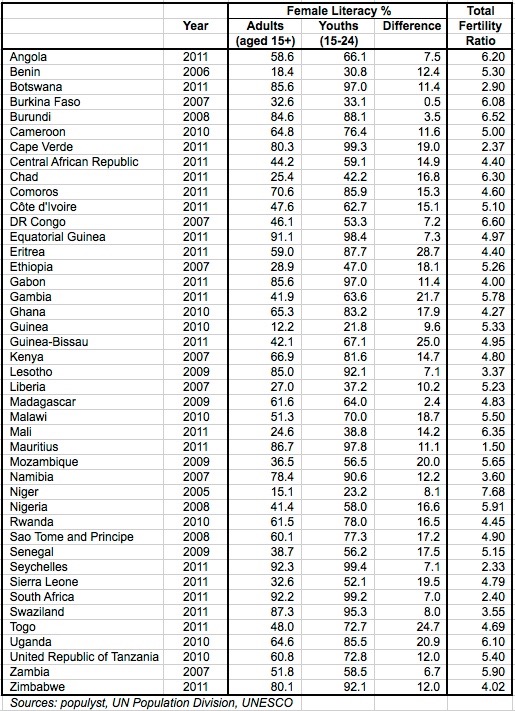
    The table shows rates of female literacy for all sub-Saharan countries (except Congo, Somalia and South Sudan). Many of these figures may not be reliable but the trend is clear that female literacy is improving all over the African subcontinent.

    Screen Shot 2015-11-23 at 11.25.32 AM (2)

    Plotting these figures, we reach the most important conclusion which is that the biggest decline in total fertility takes place after female literacy rises over 80%. Under 80%, the fall in TFRs and correlation with literacy is very weak. Excluding all countries with female adult literacy over 80%, the regression has an r-squared of only 0.29 (0.21 if the outlier Niger is also removed). Data from Burundi, Equatorial Guinea and Uganda look somewhat suspect with literacy over 80% and TFRs at 6.5, 4.97 and 6.1.

    Screen Shot 2015-11-23 at 11.19.09 AMVersion 2


    There may be cultural factors that may slow down this dynamic. In order to get a fuller picture, we looked for data on gender inequality. The United Nations Development Programme ranks countries by gender inequality. As shown in the table below, sub-Saharan African countries dominate the bottom of the ranking. It is not surprising that countries ranked lowest on the Gender Inequality Index also have the lowest female literacy and highest fertility ratios. Niger, Mali, Chad, DR Congo, Mozambique, Liberia, CAR all still have youth female literacy well below or barely above 50%. Niger looks especially challenging with a TFR of 7.7 and very low female literacy.

    Screen Shot 2015-11-19 at 2.03.39 PM (2)


    Non-African countries among the bottom 30 include lowest-ranked Yemen (152nd), Afghanistan (149th), Papua New Guinea (135th), Haiti (132nd), Egypt (130th), Pakistan (127th), India (127th) and Syria (125th). Nigeria and a number of others were not ranked in the latest data.

    Analogy with Asia 1970-1990

    Finally, does the Wittgenstein’s use of the precedent of Asia in 1970-1990 make sense for Africa now? We can see in the tables above that the fertility ratio in Asia fell from 5 in 1970 to 3 in 1990.

    We can also see that China played a big role in this decline with its own TFR falling from 5 to 2. The one-child policy contributed to this accelerated decline but a big leap in literacy from about 50% to well over 90% was also a big contributor. Our hypothesis that fertility falls modestly under 80% female literacy, and collapses precipitously above 80% is supported by the Chinese experience. Literacy rose in the 1950s and 1960s but the TFR was still at 6.3 children per woman in 1965-70, very close to the 1950-55 TFR of 6.11. But twenty years later in 1985-90, female youth literacy exceeded 90% and the TFR fell to 2.75.

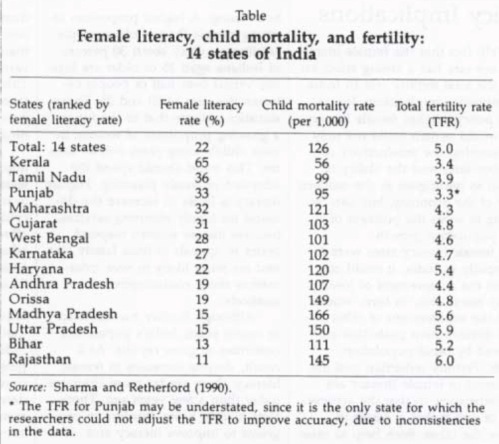
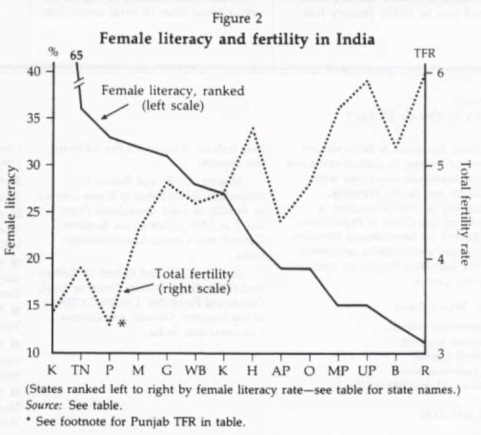
    India is following a similar path with its female youth literacy ratio rising from 67.7 in 2001 to 87.2 in 2015 and its TFR falling from 3.3 in 2001 to 2.48 now. In the case of India however, the decline appears more gradual and is not obviously faster above the 80% literacy threshold. The table and graph below show that in the case of India the correlation holds well for literacy rates that are well below 80%.

    Screen Shot 2015-11-23 at 4.11.32 PM (2)Screen Shot 2015-11-23 at 4.11.55 PM (1)


    Other considerations

    Another way to gauge the validity of the Asia analogy is to see whether Asia was more or less developed in 1970 than sub-Saharan Africa is today. If Asia was more developed, then the analogy may not be valid and the decline in African TFR will likely be slower. In order to answer this question, we look at electricity consumption per capita as a proxy for development.

    According to the World Bank, electricity consumption per capita in 1970 was 150 kilowatt hour (kWh) in China and 95 kWh in India. Below are the figures for the most populous countries in sub-Saharan Africa.

    Screen Shot 2015-11-19 at 1.20.03 PM (2)


    Per capita electricity consumption in Kenya and Nigeria in 2012 (most recent World Bank data) looked roughly in line with China in 1970, while DR Congo and Tanzania in 2012 looked closer to India’s consumption in 1970. In the absence of a more robust method, we could say that the TFR in Kenya and Nigeria could decline like China’s in 1970-90, while the TFR in DR Congo and Tanzania could decline like India’s, and the TFR in Ethiopia and Uganda could decline even more slowly.

    Under this scenario, the TFR for Kenya and Nigeria would fall to 2 by 2035, while in DR Congo and Tanzania, it would fall to only around 4, and in Ethiopia and Uganda to a still higher level.

    In a similar vein, we could look at urbanization since people living in urban areas tend to have fewer children. With the exception of Uganda, all the countries in the table appear more urbanized than China was in 1970. The percentages shown for DR Congo (42%) and Nigeria (46.9%) look suspect because they are not far below China’s current percentage of urbanization 54.4%. It looks like definitions of urbanization differ across countries and we may fall back on electricity consumption as a more reliable indicator.

    Version 2


    Conclusion

    All in, the answer to how fast African TFRs will decline remains elusive. We can however draw the following conclusions:

    • Demographics are not on automatic pilot. Proactive intervention to raise female literacy, to invest in infrastructure and to improve governance will all have a significant impact on future fertility rates. Absent these measures, it should not be assumed that TFRs will decline in Africa as fast as they did in Asia. They may remain high or they may decline for other reasons such as food or water scarcity.
    • The correlation between female literacy and fertility ratios is neither linear nor gradual. In the case of sub-Saharan Africa, TFRs seem to decline rapidly above 80% female literacy. Below 80%, the correlation is negligible or nonexistent.
    • The recent history of Asian fertility may or may not be a reliable precedent for Africa. China’s evolution in particular was greatly impacted by government policy, including the one-child policy, the literacy campaigns and the expansion of global trade.
    • Data from Africa and other less developed countries is generally unreliable. For example, it is possible that literacy rates and/or fertility rates for some African countries are inflated. It is also possible as a consequence that the relationship between literacy and fertility is in fact quite linear, as seen in the case of India.

    Sami Karam is the founder and editor of populyst.net and the creator of the populyst index™. populyst is about innovation, demography and society. Before populyst, he was the founder and manager of the Seven Global funds and a fund manager at leading asset managers in Boston and New York. In addition to a finance MBA from the Wharton School, he holds a Master’s in Civil Engineering from Cornell and a Bachelor of Architecture from UT Austin.

    Some sources used in this article:

    UNESCO Institute for Statistics: ADULT AND YOUTH LITERACY: National, regional and global trends, 1985-2015

    UNESCO Institute for Statistics: ADULT AND YOUTH LITERACY: Global Trends in Gender Parity

    Population Institute: How Female Literacy Affects Fertility: The Case of India

    Sreemarti Chakrabarti: Women and Adult Literacy in China

    World image by BigStockPhoto.com.

  • China’s Demographics at a Turning Point

    For decades, the decline in China’s birth rate was a big boost for the economy. What now?

    This week, schadenfreude could have been a word invented for China experts if you judge by some of the commentary surrounding the country’s lifting of its one-child policy. Most got it right that the legacy of the one-child policy is now a problem for the Chinese economy because of a rapidly rising old-age dependency ratio (green line in the first chart below). This was tacitly acknowledged by the lifting of the policy.

    But many got it wrong that the one-child policy has always been a problem for the Chinese economy since its inception. The cause of their error is the inclination in some quarters to merge a political and moral issue with an economic one, as if to press the point that unfree and coercive decisions are not only bad eventually for the economy, but bad always and from day one. Unfortunately, economic accountability does not come instantaneously after coercive policies are implemented. Politicians are lucky in that the ultimate consequences of their decisions can take years or even decades to finally be seen in full relief.

    Before this occurs, the more immediate and proximate result of a bad policy may in fact be hugely positive for a long time. The reason is that a bad policy can borrow prosperity from the future, or in other words, front-load prosperity to the detriment of future generations. By enacting a policy that pulls prosperity forward, the present can look like a boom but the future then has to contend with the reversing undertow of that same policy.

    At any rate, it is right that a free society focuses on the one-child policy’s encroachment on personal freedom and on the unintended consequence of a lopsided male-female ratio. But ignoring these very important issues for a moment, it must also be said that the one-child policy was in fact a significant contributor, arguably even a critical enabler, of the Chinese boom of the past few decades.

    (The chart shows China’s dependency ratios: Total DR in blue; Child DR in red; Old-age DR in green. Source: UN Population Division. See definitions in footnotes.)

    DR China

    There is no mystery here because the chain reaction is well understood by demographers and economists, albeit perhaps forgotten or ignored by some this week. As the Chinese fertility ratio declined, so did the total and child dependency ratios (blue and red lines in the chart), opening a window of opportunity for a demographic dividend.

    China’s policymakers managed to seize on this window to accelerate the economy. Here business dynamism, economic policy and the large expansion of trade with the US, Europe, Japan and other economies made a big difference and allowed the country to capitalize on the opportunity and to reap a large demographic dividend.

    But there is no free lunch in economics or indeed in demographics. The long-term effect of the one-child policy was to pull prosperity forward by crashing the dependency ratio faster and generating a demographic dividend that was far larger than would have been if households had had more children.

    Without the one-child policy, China’s dependency ratio would have fallen more slowly between 1980 and 2010 and may have looked more like India’s (chart below). The decline would have been less pronounced in 1980-2010 and therefore the demographic dividend less great, but the climb would be less steep now and therefore the future less challenging. See Demography Charts – 1 for dependency ratios of other countries.

    BRIC Countries Total Dependency Ratios

    BRIC Countries Total Dependency Ratios

    With only one child to support aging parents, the dependency ratio has started a climb that will continue for several decades. Should the removal of the one-child policy result in more children, this would in the near term push the dependency ratio to rise even faster. As sure as demography was a tailwind in the years 1990-2010, it will be a headwind for decades to come.

    This does not mean that the Chinese economy will be weak for decades. Demographics is only one component among many and economies can adapt to changing conditions. Should there be a surge in Chinese innovation and/or new reforms to raise productivity, China could very well skirt or mitigate the coming demographic challenge.

    China’s target for annual real GDP growth is now 6.5%, compared to nearly 10% on average since 1980.  These figures must be seen against the backdrop of a working-age population that rose steadily from 500 million in 1975 to a billion in 2015, and that is expected to level off and contract to 920 million by 2035. See also Working Age Population Around the World 1960-2050.

    Version 2

    Here are a few notable recent articles on the one-child policy:

    • Harvard Professor Amartya Sen writes in the New York Times that the empowerment of women had more to do with China’s declining fertility ratio than did the one-child policy. This is credible on the one hand because the fertility ratio had already declined significantly by the time the policy was enacted. But it is not wholly credible on the other hand because it does not square with the issue of selective abortions. It seems odd that empowered women would have a bias for male children. Perhaps the chronology of events must be examined more closely in order to validate Professor Sen’s thesis.
    • Several commentators are quoted in this other New York Times article and most get it right. Many agree with Harvard Professor David Bloom’s statement that “the economically active share of the population will fall, reversing the demographic dividend that has figured so prominently in China’s rapid economic growth over the past few decades”. Fred Hu, founder of Chinese investment firm Primavera Capital Group, argues that “what drives China’s future in the next two or three decades is not the population. It is whether future leaders can continue to push ahead political and economic reforms.”
    • In this Wall Street Journal piece, economist Nicholas Eberstadt seems to ignore the demographic dividend when he writes that “the one-child mandate is the single greatest social-policy error in human history.” As argued above, this is true from the point of view of individual freedom, and maybe true for the Chinese economy going forward, but certainly not true for that economy from 1980 to today.

    Definitions:

    The total dependency ratio is the ratio of the population aged 0-14 and 65+ to the population aged 15-64. They are presented as number of dependents per 100 persons of working age (15-64).

    The child dependency ratio is the ratio of the population aged 0-14 to the population aged 15-64. They are presented as number of dependents per 100 persons of working age (15-64).

    The old-age dependency ratio is the ratio of the population aged 65 years or over to the population aged 15-64. They are presented as number of dependents per 100 persons of working age (15-64).

    Sami Karam is the founder and editor of populyst.net and the creator of the populyst index™. populyst is about innovation, demography and society. Before populyst, he was the founder and manager of the Seven Global funds and a fund manager at leading asset managers in Boston and New York. In addition to a finance MBA from the Wharton School, he holds a Master’s in Civil Engineering from Cornell and a Bachelor of Architecture from UT Austin.

    Top photo by Rex Pe from Savannah, Georgia, USA (student teacherUploaded by Adrignola) [CC BY 2.0], via Wikimedia Commons

  • Report: Africa’s Demographic Transition, Dividend or Disaster?

    A recent report published jointly by the World Bank and by Agence Française de Développement highlights the challenge of realizing Africa’s promised demographic dividend. The title Africa’s Demographic Transition: Dividend or Disaster? (see footnote 1) sums up the authors’ thesis that the dividend is not an automatic result of falling fertility ratios (TFR).

    Instead, falling TFRs open a window of opportunity which can lead to a demographic dividend when governments and the public sector implement the requisite steps to capitalize on this opportunity. Lower child mortality usually leads to falling fertility ratios and improvements in women’s health. But most important among concurrent or subsequent initiatives are investments in education, and the provision of sufficient jobs to a booming working-age population.

    From the report [our emphasis]:

    Declines in child mortality, followed by declines in fertility, produce a “bulge” generation and a period when a country has a large number of working-age people and a smaller number of dependents. Having a large number of workers per capita gives a boost to the economy provided there are labor opportunities for the workers.
    And elsewhere:

    The first and perhaps most challenging step is to speed up the fertility decline in countries where it is currently slow or stalled. Reducing fertility leads to immediate gains in income per capita as youth dependency rates fall. However, achieving the full potential of the demographic dividend requires economic policies that take advantage of the opportunity. Formulating and implementing policies that strengthen financial institutions and encourage saving will channel rising incomes into domestic savings and investments that further fuel growth and development.

    Empirical evidence points to three highly interactive accelerators [of fertility decline]:

    • Health, especially child health. Child health is a critical input into fertility declines. As children’s health and survival rates improve, family demand for more children declines as confidence in child survival increases. Smaller family sizes improve maternal health, which further improves child health, completing a virtuous cycle.
    • Education, especially education for girls. Female education is a critical driver of lower desired fertility and the transition from high to low fertility. Fertility decline, in turn, has a strong effect on education by allowing for fewer, healthier, better nourished, and better educated children.
    • Women’s empowerment, which is clearly related to the first two. Better educated and healthier women with more market, social, and decision-making power in the family—are likely to have fewer children (World Bank 2011). And women who have fewer children—as a result of delayed age of marriage, delayed first sexual contact, or more space between births—are much more likely to enter the paid labor market, to have higher earnings, and to be more empowered.

    Further, the report provides a road map of the policies that are necessary to convert fertility decline into a first demographic dividend and a second demographic dividend. These policies are shown in Table 0.3 (all charts below are from the report).

    Screen Shot 2015-10-29 at 10.04.26 AM


    Table 0.1 shows a correlation between each country’s total fertility ratio (TFR) and its GDP per capita. Countries with high TFRs have lower GDP per capita. Some of the most populous countries, Kenya, Ethiopia and Tanzania are in the middle ranges, while others like DR Congo are near the GDP bottom (and TFR top). Nigeria is an outlier with better than average GDP per capita but a higher than average TFR. Botswana and South Africa have higher GDP per capita and lower TFRs.

    Screen Shot 2015-10-28 at 1.49.21 PM


    Table 0.2 shows the relation of child mortality and TFRs. Low mortality coincides with a low TFR. Nigeria and DR Congo are problematic with high mortality and high TFRs, whereas Tanzania still maintains a higher than average TFR despite relatively low child mortality.

    Screen Shot 2015-10-28 at 1.50.27 PM


    Figure 0.5 shows the evolution of TFRs for several countries since 1960. Niger’s remained high while South Africa’s declined. Nearly all country TFRs are falling, albeit at a slower rate than previously expected in some cases.

    Screen Shot 2015-10-28 at 1.49.50 PM

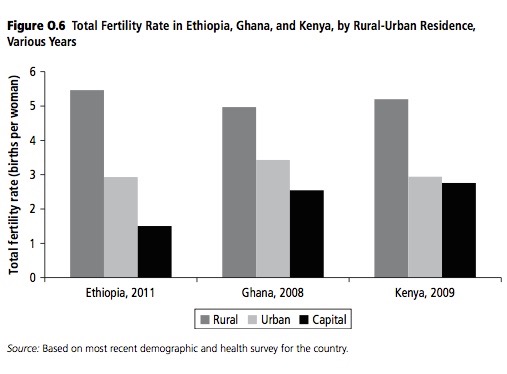
    Figure 0.6 shows the clear divide in TFRs between rural and urban areas of Ethiopia, Ghana and Kenya. An increase in agricultural productivity and the creation of urban jobs will contribute to further declines in TFRs.

    Screen Shot 2015-10-28 at 1.50.06 PM


    Download the full report here.

    Sami Karam is the founder and editor of populyst.net and the creator of the populyst index™. populyst is about innovation, demography and society. Before populyst, he was the founder and manager of the Seven Global funds and a fund manager at leading asset managers in Boston and New York. In addition to a finance MBA from the Wharton School, he holds a Master’s in Civil Engineering from Cornell and a Bachelor of Architecture from UT Austin.

    1. Canning, David, Sangeeta Raja, and Abdo S. Yazbeck, eds. 2015. Africa’s Demographic Transition: Dividend or Disaster? Africa Development Forum series. Washington, DC: World Bank. doi:10.1596/978-1-4648-0489-2. License: Creative Commons Attribution CC BY 3.0 IGO
  • The Candidates’ Other Demographic Challenge

    It is massively larger than 11 million illegals.

    Hans Rosling, co-founder of Gapminder, calls it “the biggest change of our time”. It is Africa’s population growth from 1 billion people today to 2.5 billion by 2050 and 4 billion by 2100.

    You could say that a close “second biggest change of our time” is the aging and stagnation of the population in rich countries. The combined population of North America, Europe, Japan and Australia/New Zealand is now at 1.3 billion and it will remain at 1.3 billion by 2050 and 2100 with small gains in North America and Oceania offset by declines in Europe and Japan.

    This boom and bust present an unprecedented challenge to policy makers in every country of the world. Poor countries in Africa and Asia are ill-prepared for a boom that will last for decades. And rich countries must adapt their economies to a new reality of flat or falling domestic demand. In addition, the West also faces an increased flow of migrants from Africa and the Middle East fleeing poverty or war.

    If a candidate wishes to seriously address the demographic emergency, he might turn his attention to the much larger global picture, not just what happens at the US-Mexico border. Without an improvement in local conditions in Africa and Asia, millions will try to move to the West. The numbers we now see crossing the Mediterranean at great risk will pale in comparison to those of twenty or thirty years from now.

    In the same week that Donald Trump announced his immigration plan, there was news that Germany could accept as many as 750,000 refugees this year. If they end up remaining in Germany, this would amount to 0.9% of the German population, a higher annual rate of immigration than the US has had in over a century. By way of comparison, the current US rate is at 1 million green cards per year, equal to 0.3% of  the US population. The post war average is 0.25% per year.

    The migrant crisis is putting Europe’s openness to the test. Not all countries are as welcoming. Sweden is more open than others and has been accepting the equivalent of 1%+ of its population every year. Other countries only agree to take in very small numbers or reserve the right to be selective.

    Of course, it is not as easy to move from Africa to North America. The Atlantic and Pacific Oceans will deter millions of desperate migrants who will instead try their luck with Europe.

    In fact, barring the unexpected, the Western hemisphere is relatively insulated from this century’s population boom. On current UN projections, the population of North and South America will rise by a relatively modest 225 million between now and 2050, less than 10% of the entire 2.4 billion rise in world population. Nonetheless we can assume that some millions, or perhaps tens of millions, out of a few billions, will find their way across the oceans.

    This chart shows the scale of the expected changes. The first bar on the left, nearly invisible, is the current population of illegal immigrants in the US, estimated at 10 to 15 million. The next one, barely visible, are the future legal immigrants into the US between today and 2050 assuming the current run rate of 1 million per year. The next four bars are the increases in populations for the US, the Western hemisphere, Africa and the world in the next 35 years.

    IllegalsvsPopChg

    So you can see that our domestic concerns are minute in comparison to what is happening elsewhere in the world. It is true that close proximity to a crisis creates a greater sense of urgency. A small problem next door can be more pressing than a large problem a thousand miles away.

    But the rapidly changing demographics of the West, and of Africa and Asia, are already having an impact on our lives. It is right therefore to discuss the following during a political campaign:

    • Developed countries including the US, Canada, Europe, Japan, Australia, New Zealand are having fewer children than in the past. Their total fertility ratios (TFR) are below the replacement level of 2.1 average children per woman. This means that the populations of these countries are shrinking (Japan, Germany, Italy), plateauing (Europe in general) or growing slowly (North America, France, Great Britain).
    • According to the latest UN estimate, the US population will increase from 322 million today to 389 million in 2050. This projection includes future immigrants and is equivalent to an annual growth rate of 0.5%, well below the 1.2% average of the last 100 years. The post war average is also 1.2%.
    • Europe’s population will fall from 738 million to 707 million. Russia, Germany and Italy will shrink while France and the UK grow slowly.
    • Several emerging markets including China and Russia also have TFRs below replacement. China’s population will be peaking then falling. It will be surpassed by India’s within the next ten years.
    • All the above mentioned countries except India have aging populations. The median age in the United States is now 38 years and rising. In nearly all European countries, it is over 40. In Germany and Japan, it is 46. At the other end of the spectrum, in booming Nigeria, Ethiopia and Congo, it is less than 20.
    • Dependency ratios (loosely the number of dependents per worker) are rising everywhere except in Sub-Saharan Africa, India and a few other countries.
    • As noted above, the populations of Sub-Saharan Africa and of the Indian subcontinent (India, Pakistan, Bangladesh) are booming. Sub-Saharan Africa is estimated to grow from 962m today to 2.1 billion in 2050. India from 1.3 billion to 1.7 billion.
    • And the world population is expected to grow by 2.4 billion additional people by 2050. But the Western hemisphere is expected to add only 225 million, less than 10% of the projected increase.

    Screen Shot 2015-08-17 at 4.04.27 PM

    So what is to be done?

    One of Mr. Trump’s proposals is to build a wall along the Mexican border. Beyond the near term, this may or may not prove effective. Certainly, the Southern border as it stands today is one of the softest points of entry for current and future illegal immigrants.

    A more comprehensive and more robust solution is to improve conditions in the migrants’ countries of origin through trade, investments in infrastructure, health care and education, and assistance in building stronger institutions. (Such an effort may fly in the face of Mr. Trump’s other promise to repatriate jobs that have been outsourced to China and other emerging markets, but that is another topic.)

    Contrary to some political discourse, an investment in the economies of poor countries is not just altruism. It is a win-win strategy and an investment in our own future. Bjorn Lomborg, founder of the Copenhagen Consensus, wrote recently about investing in the health and education of children in poor countries:

    It is morally right that every child should be given the best chance to survive, eat well, stay healthy, and receive an education. Now we also know that it is among the best investments we can make. Healthy, well-educated kids grow into productive adults, capable of providing a better future for their own children, creating a virtuous circle that can help build a better, more prosperous world.

    Our own work at populyst centers on the development of the populyst index™ which rates each country on three measures: innovation/productivity, demographics/health care, and institutional strength/governance. In recent years, the deteriorating demographics of the West have eroded their standing in the index. And the booming demographics of poor countries have given them an opportunity to make significant strides if they can implement the needed reforms.

    A symbiotic solution that addresses the challenges of both rich and poor countries would involve the following:

    • Emerging economies would benefit from western capital, technology and institutional expertise.
    • Better health care in Africa and India would lower infant mortality, improve women’s health and accelerate the fall in TFRs, curbing the big population boom.
    • Domestic demand is slackening in rich countries and would benefit from new sources of demand from rising populations. A rising standard of living in poor countries will add to the revenues of Western firms dealing with sluggish home markets.
    • An improvement in emerging economies would relieve the migrant crisis we are now seeing in the Mediterranean and Europe.

    In case of inaction, the political instability and economic dislocation the world may suffer because of the ongoing population boom will touch our own country in more undesirable ways than a few million unwanted immigrants have done so far.

    How do we respond to the twin problem of stagnant demographics in the West and booming demographics in poor countries? This is the question that all candidates should be debating.

    Sami Karam is the founder and editor of populyst.net and the creator of the populyst index™. populyst is about innovation, demography and society. Before populyst, he was the founder and manager of the Seven Global funds and a fund manager at leading asset managers in Boston and New York. In addition to a finance MBA from the Wharton School, he holds a Master’s in Civil Engineering from Cornell and a Bachelor of Architecture from UT Austin.

  • Working Age Population Around the World 1960-2050

    A fast growing economy usually requires a growing working-age population.  It is informative in this regard to look at the size of the working-age population (wap) for different regions and countries of the world.

    Screen Shot 2015-09-25 at 1.05.48 PM

    This data, compiled from the UN’s World Population Prospects – the 2015 Revision, tells us the following:

    • The wap of Europe, the US and Japan experienced healthy growth between 1960 and 1990. After 1990, it started to decline in Japan and to stagnate in Europe but it continued to grow in the US.
    • Based on the UN’s ‘medium variant’ forecast, the wap of Europe will decline steadily for the rest of this century, from 492 million in 2015 to 405 million in 2050. Barring a massive inflow of immigrants or a sharp rise in the birth rate, France’s wap will flatline and Germany’s will fall by 23% in 2015-2050.
    • The US wap will grow for the rest of the century, but at a much lower rate than in the years 1960-2015. See this table for average annual growth rates:

    Screen Shot 2015-09-25 at 1.05.26 PM

    • The wap of the BRIC countries experienced strong growth until 2015, but it will be flat from hereon. Only India’s wap will continue to grow. Brazil’s will be flat while China’s and Russia’s fall sharply.
    • Last but certainly not least, the wap of sub-Saharan Africa will continue to boom, adding 800 million people in the next 35 years.
    • Looking at the entire world picture, the wap will grow by 1.27 billion in 2015-2050, which is a slower rate of growth than in the past. The vast bulk of this addition will come from sub-Saharan Africa, India and a few other Asian countries.

    Version 2

    In the 25 year interval 1990-2015, the wap of BRIC countries grew by 650 million, driven by India, China and to a lesser extent Brazil. The question now is whether sub-Saharan Africa and India can translate their own booming wap into rapid and sustainable economic growth. With developed and BRIC countries slowing down, the world economy depends on it.

    This piece first appeared at Populyst.com.